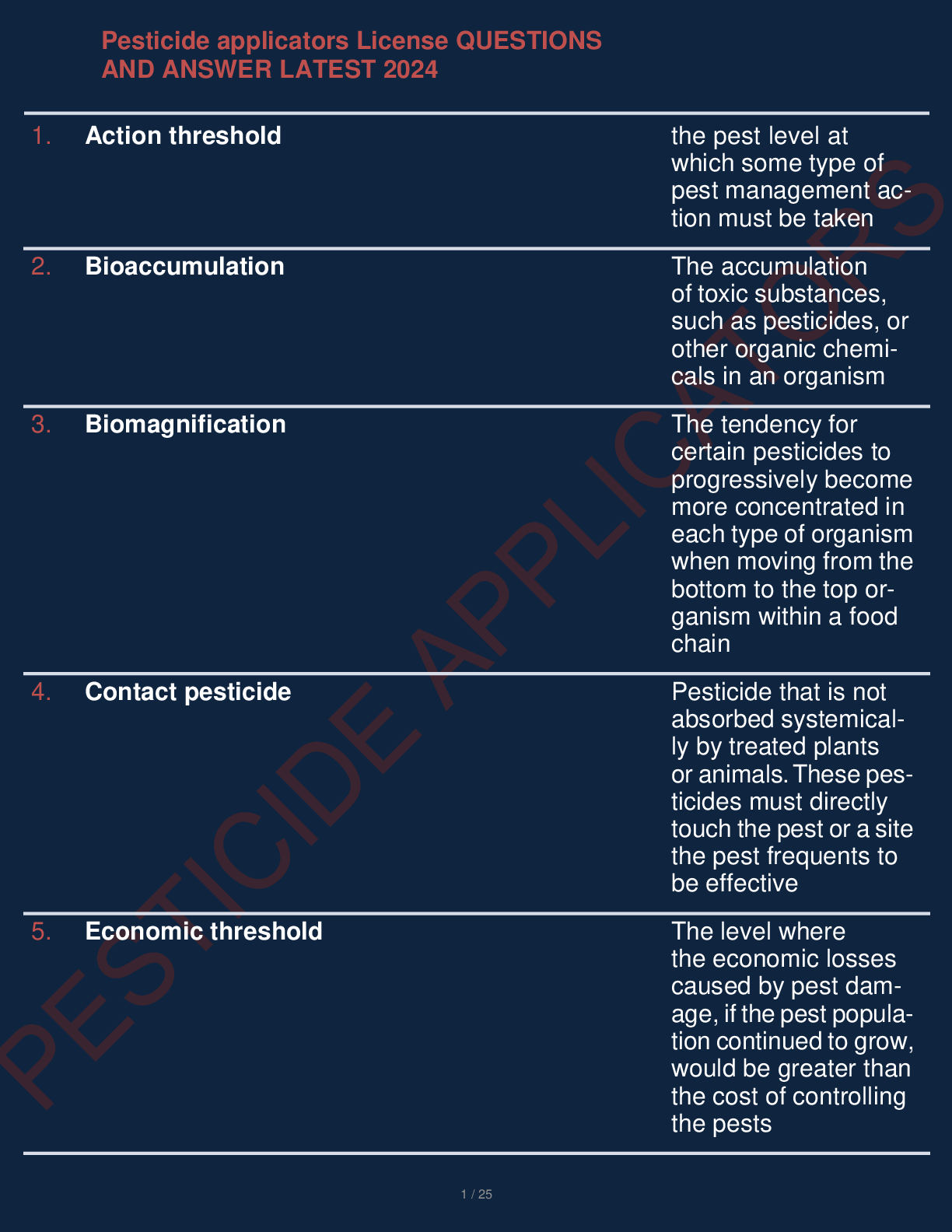
1. Action threshold the pest level at which some type of pest management ac- tion must be taken
2. Bioaccumulation The accumulation of toxic substances,
such as pesticides, or other organic chemi- cals in an organism
...
1. Action threshold the pest level at which some type of pest management ac- tion must be taken
2. Bioaccumulation The accumulation of toxic substances,
such as pesticides, or other organic chemi- cals in an organism
3. Biomagnification The tendency for certain pesticides to progressively become more concentrated in each type of organism when moving from the bottom to the top or- ganism within a food chain
4. Contact pesticide Pesticide that is not absorbed systemical- ly by treated plants
or animals. These pes- ticides must directly touch the pest or a site the pest frequents to be effective
5. Economic threshold The level where
the economic losses caused by pest dam- age, if the pest popula- tion continued to grow, would be greater than the cost of controlling the pests
6. Eradication One of the three
primary pest control goals that refers to the total elimination of a pest from a designat- ed area
7. Integrated Pest management The coordinated use of pest and envi- ronmental information and available pest control methods to prevent unacceptable levels of damage by the most economical means with the least possible hazard to people, property and the environment.
8. Key pest A pest that causes
major damage on a regular basis
9. Mode of Action How the pesticide works - specific sys- tem(s) in the pest that are affected by the pesticide
10. Occasional pest A pest that causes damage only once in a while because of its life cycle or environ- mental influences, or as a result of human activities
11. Persistance
length of time a pesti- cide remains active to control pests
12. Pesticide Any material that is
applied to plants, the soil, water, harvest- ed crops, structures, clothing and furnish- ings, or animals to kill, attract, repel or reg- ulate or interrupt the growth and mating of pests or to regulate plant growth
13. Pesticide resistance the ability of an insect, fungus, weed, rodent, or other pest to tol- erate a pesticide that once controlled it
14. Prevention one of the three prima-
ry pest control goals that strives to inhibit the onset of a pest out- break
15. Quarantine regulatory method to
control the introduc- tion and dissemination of pests into new ar- eas
16. Residual pesticide pesticide that con- trols pests for weeks, months or even years
17. Secondary pest a pest that becomes a problem when a key
pest is controlled or eliminated
18. Selectivity the degree to which a
pesticide will kill a cer- tain type of pest
19. Suppression one of the three prima- ry pest control goals that attempts to re- duce pest populations to a tolerable level or to a point below the economic injury level
20. Systemic pesticide (translocated) pesticides that are ab- sorbed by the pest and then transported with- in the treated pest
21. Active ingredient the substance in a pesticide product that is intended to kill, re- pel, or otherwise con- trol a target pest
22. Acute effect an illness that be-
comes apparent soon after an exposure to a pesticide occurs
23. Application rate pertaining to the amount of pesticide that is applied to a known area, such as an acre
24. Brand name name under which the
manufacturer sells the product
25. Caution the signal word used
on labels of the least toxic pesticides
26. Certified Applicator a person who
has demonstrated through an examina- tion process the abili- ty to safely handle and apply restricted use pesticides
[Show More]