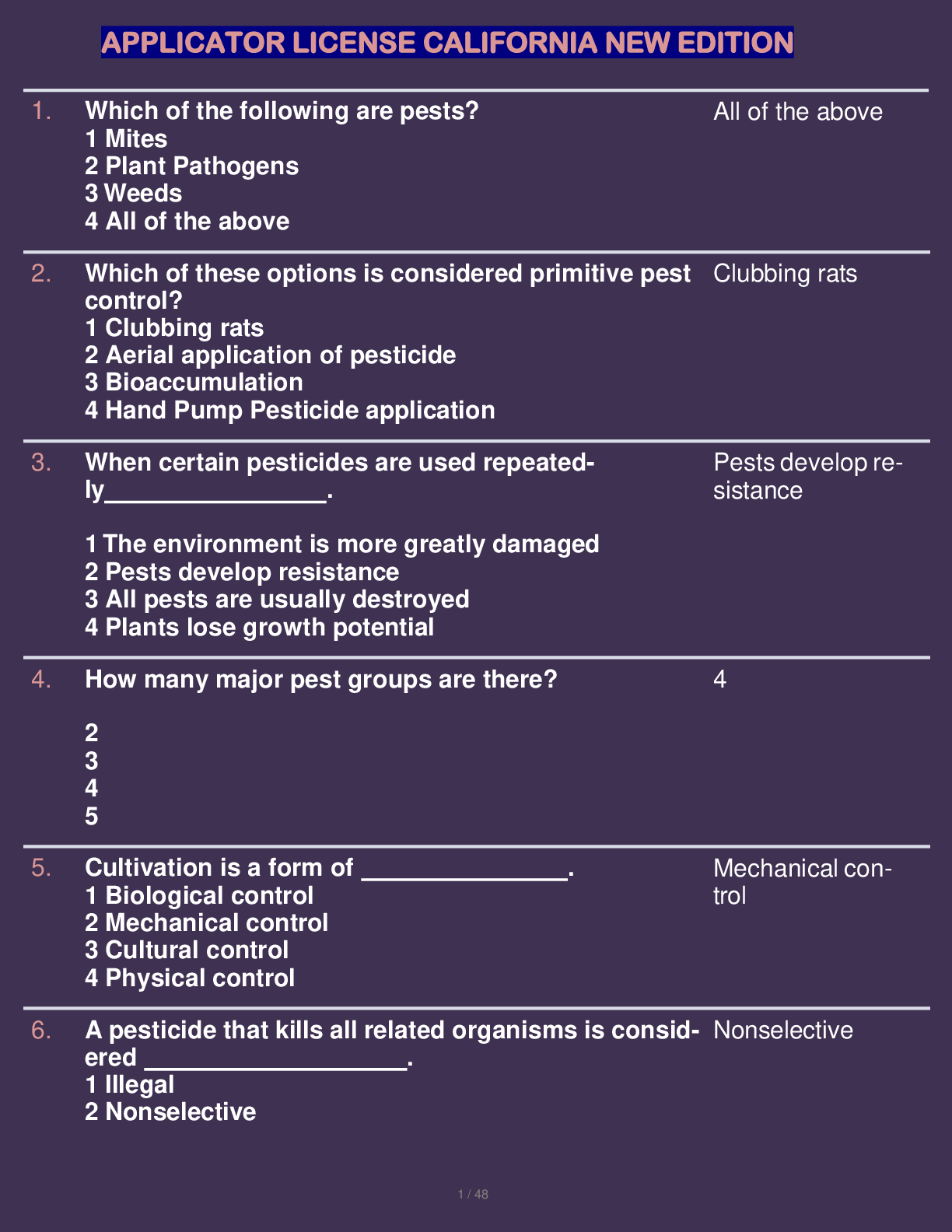
1. Which of the following are pests?
1 Mites
2 Plant Pathogens
3 Weeds
4 All of the above
2. Which of these options is considered primitive pest control?
1 Clubbing rats
2 Aerial application of pesticide
3 Bioacc
...
1. Which of the following are pests?
1 Mites
2 Plant Pathogens
3 Weeds
4 All of the above
2. Which of these options is considered primitive pest control?
1 Clubbing rats
2 Aerial application of pesticide
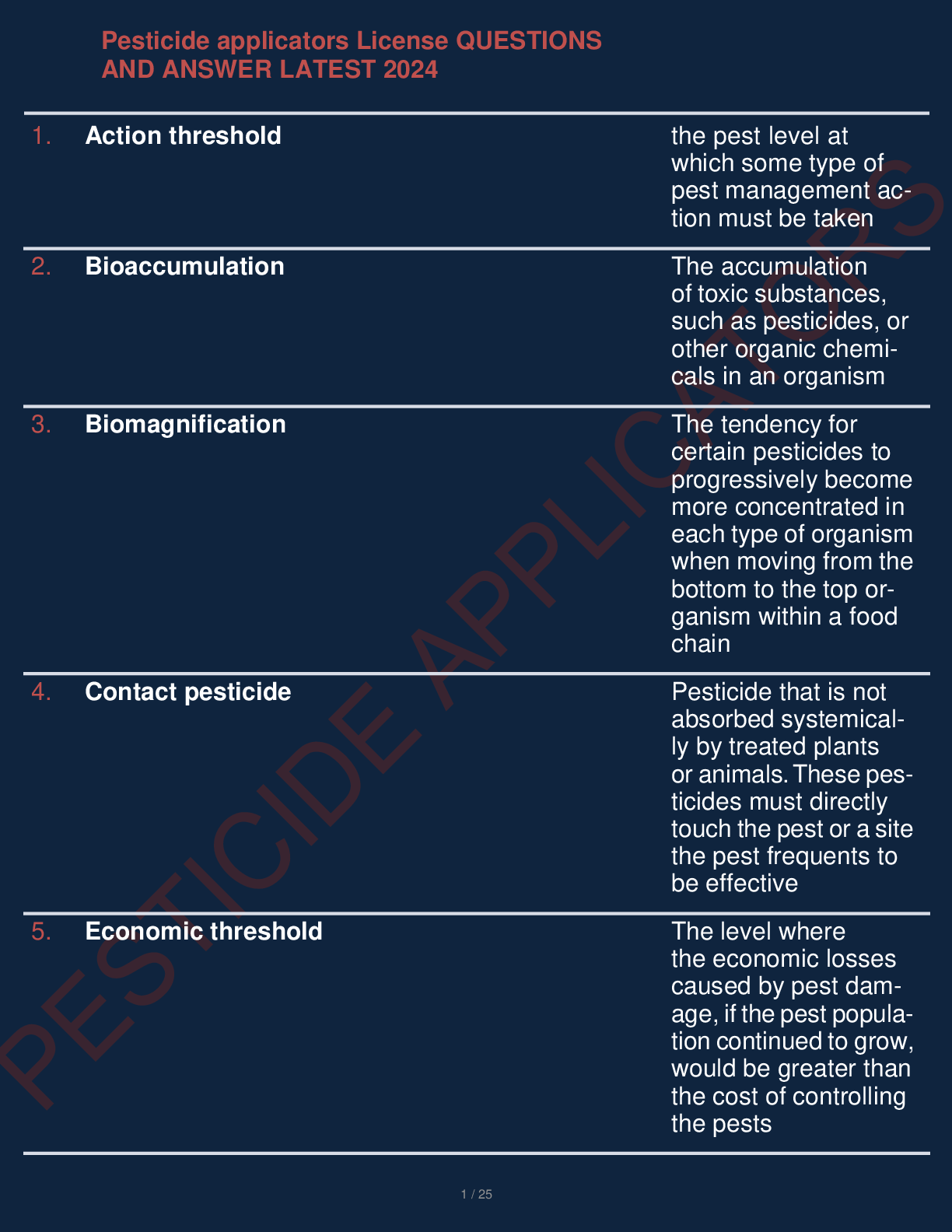
3 Bioaccumulation
4 Hand Pump Pesticide application
3. When certain pesticides are used repeated- ly .
1 The environment is more greatly damaged
2 Pests develop resistance
3 All pests are usually destroyed
4 Plants lose growth potential
4. How many major pest groups are there?
2
3
4
5
5. Cultivation is a form of .
1 Biological control
2 Mechanical control
3 Cultural control
4 Physical control
6. A pesticide that kills all related organisms is consid- ered .
1 Illegal
2 Nonselective
All of the above
Clubbing rats
Pests develop re- sistance
4
Mechanical con- trol
Nonselective
3 Selective
4 Systemic
7. Integrated Pest Management .
1 Implements a balanced tactical approach
2 Anticipates and prevents damage from occurring
3 Uses several tactics in combination
4 All of the above
8. The first task when using an IPM approach is always
.
1 Pest identification
2 Monitor and survey for pests
3 Set IPM goals
4 Implement pesticide application
9. Which of the following are IPM goals?
1 Prevention
2 Suppression
3 Eradication
4 All of the above
10. A pest's life cycle has little effect on resistance levels.
1 True
2 False
11. Which of the following is NOT considered a pesti- cide?
herbicide insecticide fungicide parricide
12. control is the altering of the environment, for example, changing humidity, temperature, air flow, water, and light.
All of the above
Pest identification
All of the above
False
parricide
Physical
1 Chemical
2 Mechanical
3 Physical
4 Cultural
[Show More]