HESI Focus on Child Health Exam - Questions, Answers and Rationales
Document Content and Description Below
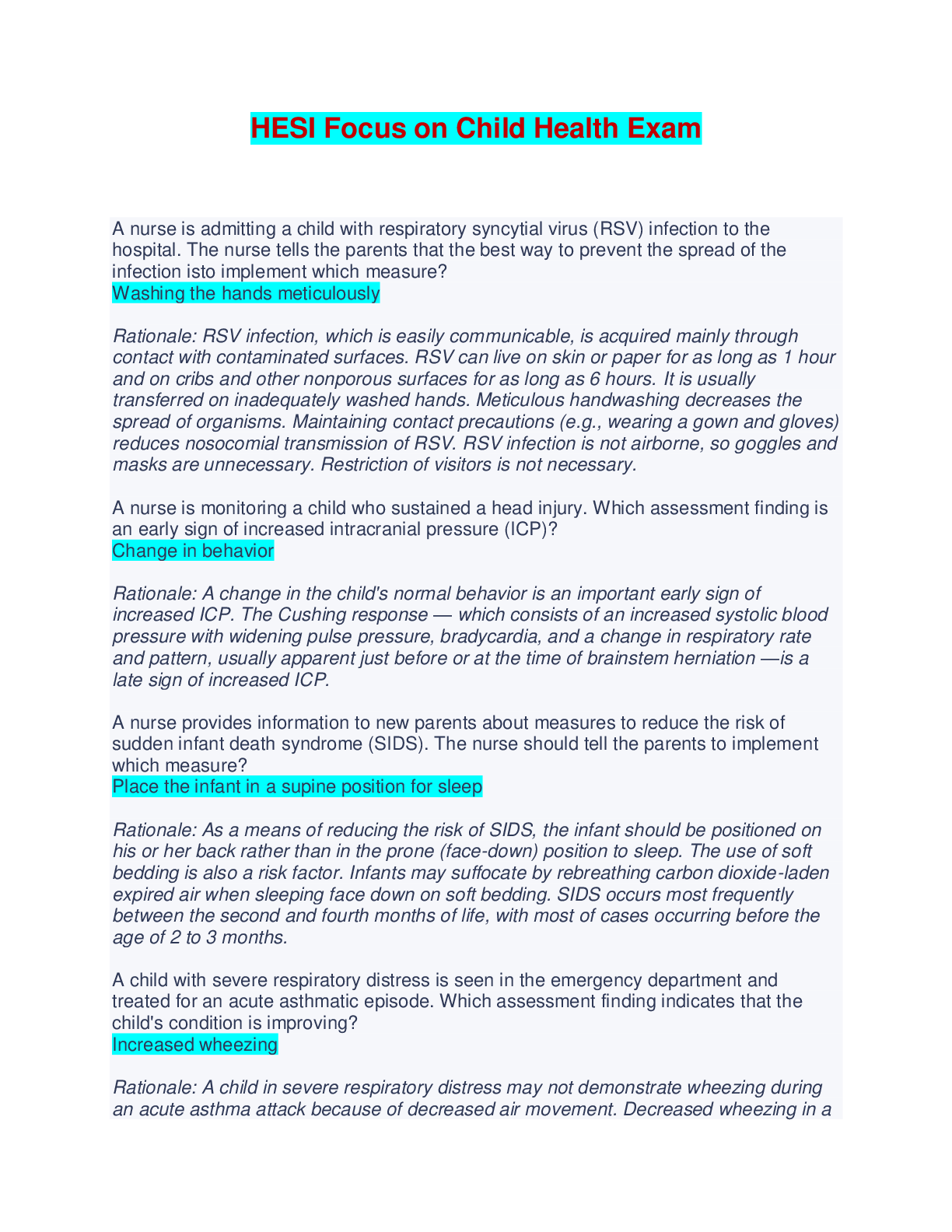
HESI Focus on Child Health Exam - Questions, Answers and Rationales A nurse is admitting a child with respiratory syncytial virus (RSV) infection to the hospital. The nurse tells the parents that th
...
e best way to prevent the spread of the infection isto implement which measure? Washing the hands meticulously Rationale: RSV infection, which is easily communicable, is acquired mainly through contact with contaminated surfaces. RSV can live on skin or paper for as long as 1 hour and on cribs and other nonporous surfaces for as long as 6 hours. It is usually transferred on inadequately washed hands. Meticulous handwashing decreases the spread of organisms. Maintaining contact precautions (e.g., wearing a gown and gloves) reduces nosocomial transmission of RSV. RSV infection is not airborne, so goggles and masks are unnecessary. Restriction of visitors is not necessary. A nurse is monitoring a child who sustained a head injury. Which assessment finding is an early sign of increased intracranial pressure (ICP)? Change in behavior Rationale: A change in the child's normal behavior is an important early sign of increased ICP. The Cushing response — which consists of an increased systolic blood pressure with widening pulse pressure, bradycardia, and a change in respiratory rate and pattern, usually apparent just before or at the time of brainstem herniation —is a late sign of increased ICP. A nurse provides information to new parents about measures to reduce the risk of sudden infant death syndrome (SIDS). The nurse should tell the parents to implement which measure? Place the infant in a supine position for sleep Rationale: As a means of reducing the risk of SIDS, the infant should be positioned on his or her back rather than in the prone (face-down) position to sleep. The use of soft bedding is also a risk factor. Infants may suffocate by rebreathing carbon dioxide-laden expired air when sleeping face down on soft bedding. SIDS occurs most frequently between the second and fourth months of life, with most of cases occurring before the age of 2 to 3 months. A child with severe respiratory distress is seen in the emergency department and treated for an acute asthmatic episode. Which assessment finding indicates that the child's condition is improving? Increased wheezing Rationale: A child in severe respiratory distress may not demonstrate wheezing during an acute asthma attack because of decreased air movement. Decreased wheezing in a child who is not improving clinically may signal an inability to move air. This is referred to as a "silent chest" and is an ominous sign during an asthma episode. With treatment, increased wheezing may actually signal that the child's condition is improving. Shortness of breath, dyspnea on exertion, and stridor are manifestations of an asthmatic episode that indicate airway obstruction. A child who is experiencing wheezing during an acute asthma episode is brought to the emergency department by the parents. Which intervention does the nurse prepare to implement first? Administration of a bronchodilator Rationale: A child who is experiencing an episode of wheezing along with other symptoms of an acute asthma attack will first receive a bronchodilator by way of nebulizer or metered-dose inhaler. If the symptoms do not improve, a dose of an oral corticosteroid is usually prescribed. If the child's condition still does not improve, hospitalization may be necessary. Once the child is hospitalized, humidified oxygen is administered to keep the oxygen saturation at 95% or greater. An IV line is initiated to deliver fluids and provide venous access for parenteral medications as prescribed. Chest radiography, arterial blood gas determinations, or pulse oximetry may be performed as a means of further evaluating the child's oxygenation status. A nurse provides instruction to an adolescent client with exercise-induced asthma. Which statement by the adolescent indicates a need for further instruction? "I should use the bronchodilator after I finish working out." Rationale: Exercise-induced asthma may be triggered by the rapid breathing of large volumes of cool, dry air, such as that taken in with mouth breathing during exercise. The symptoms of exercise-induced asthma usually begin after 5 to 10 minutes of exercise and often last 30 to 60 minutes. Measures to prevent exercise-induced asthma include warming the air by breathing through the nose or covering the mouth and nose with a scarf when exercising in cold weather, using an inhaled bronchodilator before exercise, and practicing techniques to decrease hyperventilation, such as progressive muscle relaxation and diaphragmatic breathing. A nurse is providing instructions on the use of a metered-dose inhaler (MDI) to an adolescent with asthma. Which statements by the adolescent indicates an understanding of the instructions? Select all that apply. "I need to shake the inhaler well before I use it." "I really need to use the spacer when I inhale the corticosteroid." "I have to put my lips tightly around the mouthpiece, press down on the inhaler, and breathe in slowly." Rationale: If the health care provider has prescribed two inhalations, the nurse teaches the adolescent to wait at least 2 minutes after the first inhalation before taking the second. The adolescent is also taught to shake the inhaler before repeating the dose. The client should hold his or her breath for as long as possible, at least 5 to10 seconds, to allow the medicine to penetrate deep into the lungs. A spacer must be utilized with the MDI when corticosteroids are being inhaled to prevent yeast infection of the mouth A nurse provides instructions to the parents of an infant with bronchopulmonary dysplasia about the safe use of oxygen at home. Which statement by a parent indicates a need for further instruction? "We can put petroleum jelly on her lips to relieve the dryness." Rationale: If oxygen is being used at home, the parents are instructed to avoid using alcohol-based substances or oil, which are flammable and increase the risk for fire, around the infant's mouth. Products that should be avoided include petroleum jelly, vitamin A and D ointment, and baby oil. The remaining statements reflect correct use of oxygen at home. The nurse is assigned a child who has been admitted to the hospital with suspected cystic fibrosis (CF). Which tests does the nurse anticipate will be prescribed to diagnosis CF? Select all that apply. Chest x-ray Sweat chloride assay Rationale: The diagnosis of CF is established with the use of several tests findings: a quantitative sweat chloride test result of more than 60 mEq/L (60 mmol/L),, a chest x-ray showing patchy atelectasis, and a stool analysis revealing fat. The barium swallow is used to diagnosis gastrointestional disorders such as pyloric stenosis but not CF. Intestinal biopsy is not used to diagnose CF. Stool examination for ova and parasites is used to diagnose parasitic infestation; CF is not caused by a parasite. A pancreatic enzyme preparation is prescribed for a child with cystic fibrosis (CF). The nurse instructs the child's mother to administer the pancreatic enzyme in what way? With meals and snacks Rationale: Pancreatic enzyme preparations are administered to ease the steatorrhea that occurs in CF as a result of digestive system involvement. These preparations are administered with every meal and snack to supplement and replace pancreatic enzymes and aid digestion A nurse provides instructions to the mother of a child with cystic fibrosis (CF) on the correct procedure for administering pancrelipase. The nurse tells the child's mother that the medication may be administered with which item? Applesauce Rationale: Pancrelipase is a pancreatic enzyme preparation used to reduce fat in the stool and to aid the digestion of protein, carbohydrates, and fat. Because these enzymes may be inactivated by heat, the preparation should not be administered with hot foods.
[Show More]
Last updated: 1 year ago
Preview 1 out of 28 pages