*NURSING > HESI > Focus on Delegating/Prioritizing Triage Disaster Exam - Questions, Answers and Rationales (All)
Focus on Delegating/Prioritizing Triage Disaster Exam - Questions, Answers and Rationales
Document Content and Description Below
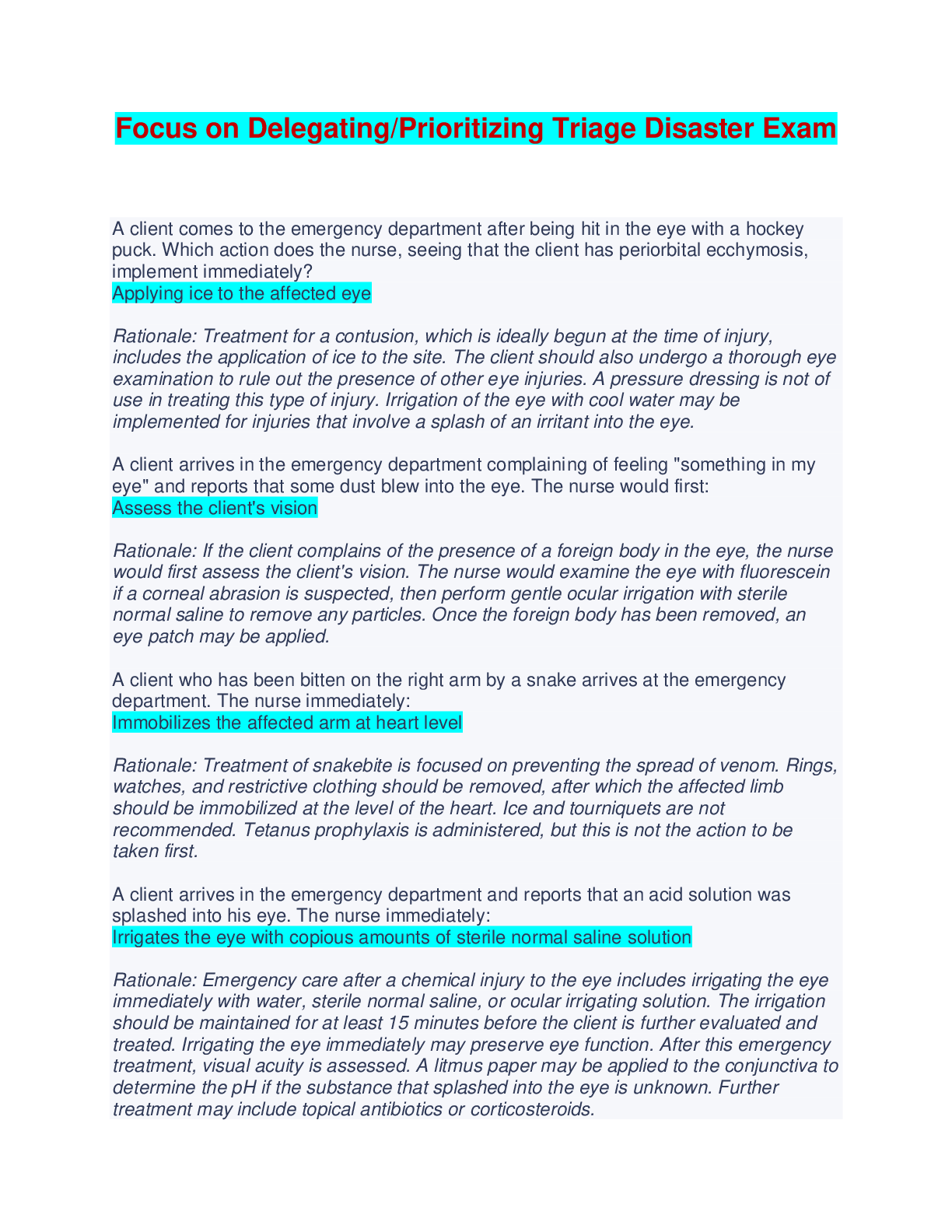
Focus on Delegating/Prioritizing Triage Disaster Exam - Questions, Answers and Rationales A client comes to the emergency department after being hit in the eye with a hockey puck. Which action does ... the nurse, seeing that the client has periorbital ecchymosis, implement immediately? Applying ice to the affected eye Rationale: Treatment for a contusion, which is ideally begun at the time of injury, includes the application of ice to the site. The client should also undergo a thorough eye examination to rule out the presence of other eye injuries. A pressure dressing is not of use in treating this type of injury. Irrigation of the eye with cool water may be implemented for injuries that involve a splash of an irritant into the eye. A client arrives in the emergency department complaining of feeling "something in my eye" and reports that some dust blew into the eye. The nurse would first: Assess the client's vision Rationale: If the client complains of the presence of a foreign body in the eye, the nurse would first assess the client's vision. The nurse would examine the eye with fluorescein if a corneal abrasion is suspected, then perform gentle ocular irrigation with sterile normal saline to remove any particles. Once the foreign body has been removed, an eye patch may be applied. A client who has been bitten on the right arm by a snake arrives at the emergency department. The nurse immediately: Immobilizes the affected arm at heart level Rationale: Treatment of snakebite is focused on preventing the spread of venom. Rings, watches, and restrictive clothing should be removed, after which the affected limb should be immobilized at the level of the heart. Ice and tourniquets are not recommended. Tetanus prophylaxis is administered, but this is not the action to be taken first. A client arrives in the emergency department and reports that an acid solution was splashed into his eye. The nurse immediately: Irrigates the eye with copious amounts of sterile normal saline solution Rationale: Emergency care after a chemical injury to the eye includes irrigating the eye immediately with water, sterile normal saline, or ocular irrigating solution. The irrigation should be maintained for at least 15 minutes before the client is further evaluated and treated. Irrigating the eye immediately may preserve eye function. After this emergency treatment, visual acuity is assessed. A litmus paper may be applied to the conjunctiva to determine the pH if the substance that splashed into the eye is unknown. Further treatment may include topical antibiotics or corticosteroids. A nurse assessing a client with a closed chest tube drainage system notes constant bubbling in the water seal chamber. The nurse assesses the system for air leaks but is unable to locate a visible leak. Based on this finding, the nurse next: Replaces the drainage system Rationale: Constant bubbling in the water seal chamber of a closed chest tube drainage system may indicate the presence of an air leak. The nurse would assess the chest tube system for the presence of an air leak if constant bubbling were noted in this chamber. If an air leak cannot be located, the nurse next replaces the drainage system. If continuous bubbling in the water seal chamber continues, the health care provider is notified, because an air leak may be present in the pleural space, and leakage and trapping of air in the pleural space may result in a tension pneumothorax. Reducing the degree of suction being delivered will not affect the bubbling in the water seal chamber and could be a harmful. Clamping and milking the chest tube are both incorrect. Additionally, a chest tube is not clamped or milked unless specifically prescribed and the procedure is an approved intervention as stated in the agency's policies and procedures. A client who has sustained a severe burn injury is brought to the emergency department (ED). Which action does the ED nurse implement immediately? Administering 100% oxygen by way of face mask Rationale: When a victim who sustains a burn injury arrives at the ED, breathing is assessed and a patent airway established immediately. The client is also immediately given 100% oxygen by face mask to prevent tissue hypoxia, which may occur as a result of the high carboxyhemoglobin level involved in a burn. If the victim has severe respiratory distress or airway edema, endotracheal intubation may be necessary. Once oxygen has been started, fluid resuscitation is implemented. Body temperature is maintained and the client is covered with sterile sheets or blankets. Care of the burn wound is delayed until all live-saving measures have been initiated. Tetanus prophylaxis may be necessary, but this is not a priority intervention. A registered nurse (RN) on the day shift has been assigned to care for four clients. Once the nurse has made initial rounds and checked all of the assigned clients, which client will the RN care for first? *A client with metastatic carcinoma who has just received pain medication *A client who is scheduled for occupational therapy at 10 a.m. *A client scheduled for an ultrasound at 11 a.m. who is on nothing-by-mouth (NPO) status *A client who is scheduled for surgery at 1 p.m. Rationale: The RN would care for the client who is scheduled for surgery at 1 p.m. first. Several issues, including client preparation (physical and emotional) and health care provider prescriptions, must be addressed before the surgery, and this preparation takes time. Additionally, the operating often makes late changes in the schedule, depending on room and health care provider availability, and may request an earlier surgery time. Therefore it is best to ensure that this client is prepared. It is best to wait for pain medication to take effect before providing care to a client in pain. The client scheduled for an ultrasound and the client scheduled for occupational therapy later in the morning do not have priority needs. A nurse is assigned to care for four clients. Which client would the nurse would assess first during initial rounds? A client with pneumonia Rationale: Airway is always a high priority, and the nurse would assess the client with pneumonia first. Clients in Buck's traction and those with chronic renal failure or cirrhosis have intermediate needs. A nurse is changing a client's central intravenous (IV) catheter dressing. During the procedure, the unit secretary calls the nurse over the handheld radio and says that a health care provider has telephoned and is asking to speak to the nurse. The nurse should: Ask the unit secretary to inform the health care provider that the call will be returned after the dressing change has been completed Rationale: Because the dressing change is a sterile procedure and a risk for infection exists, it is appropriate to ask the unit secretary to obtain a telephone number from the health care provider so that the call may be returned. It is not appropriate to ask a health care provider to wait while a procedure is being completed. Having the unit secretary transfer the call to the nurse's handheld radio is a potential HIPAA violation, because the health care provider may wish to speak to the nurse regarding another client, and the client with whom the nurse is working would hear the conversation. A man calls a nurse in the emergency department (ED) and tells the nurse that his wife "just got a bloody nose." The man then asks the nurse what to do to stop the bleeding. The nurse tells the man immediately to: Place the spouse in a sitting position, leaning forward with the head tipped downward Rationale: Initial care of the client with epistaxis consists of having the client sit up and lean forward with the head tipped downward to prevent the swallowing or aspiration of blood. The fingers are used to compress the soft tissues of the nose against the septum, with pressure maintained for at least 5 minutes. Ice or a cold compress is applied to the nose, not the back of the neck, to constrict the blood vessels. The health care provider is notified if bleeding does not stop with these interventions. In the hospital, if bleeding does not stop with direct pressure, a cotton ball soaked in a topical vasoconstrictor is placed in the nose and pressure is applied. A client arrives in the nursing unit after internal maxillary fixation (IMF) surgery. The nurse immediately: [Show More]
Last updated: 1 year ago
Preview 1 out of 29 pages
Buy this document to get the full access instantly
Instant Download Access after purchase
Buy NowInstant download
We Accept:

Reviews( 0 )
$16.00
Can't find what you want? Try our AI powered Search
Document information
Connected school, study & course
About the document
Uploaded On
Jan 18, 2024
Number of pages
29
Written in
All

Additional information
This document has been written for:
Uploaded
Jan 18, 2024
Downloads
0
Views
85