Hello NR546 students,
In order to provide feedback on the weekly quizzes, I will provide rationale
statements for the quiz questions. You will note that there are more than 5
listed this is because the quiz testbank i
...
Hello NR546 students,
In order to provide feedback on the weekly quizzes, I will provide rationale
statements for the quiz questions. You will note that there are more than 5
listed this is because the quiz testbank is larger than 5 questions and the
additional information can help you prepare for the final and direct your
study.
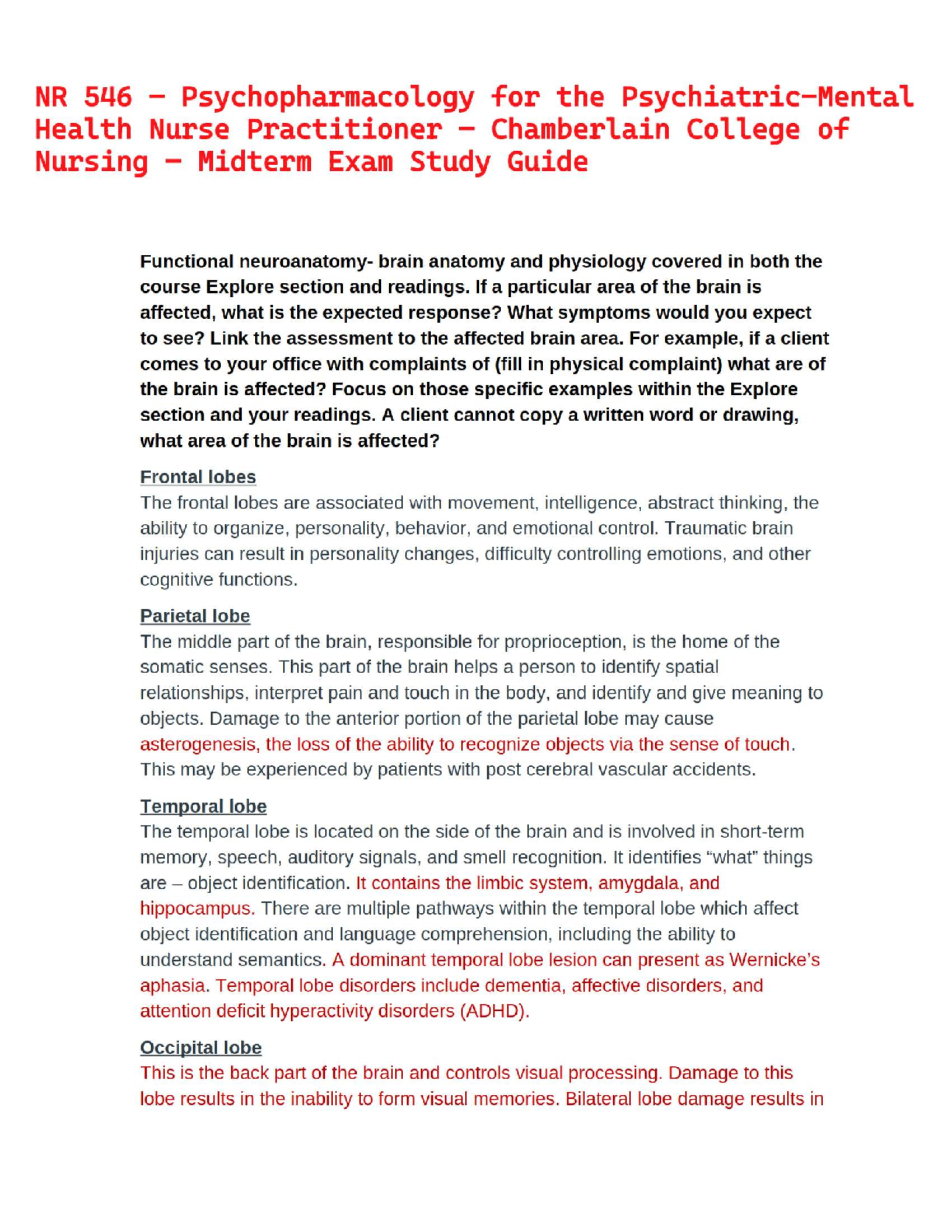
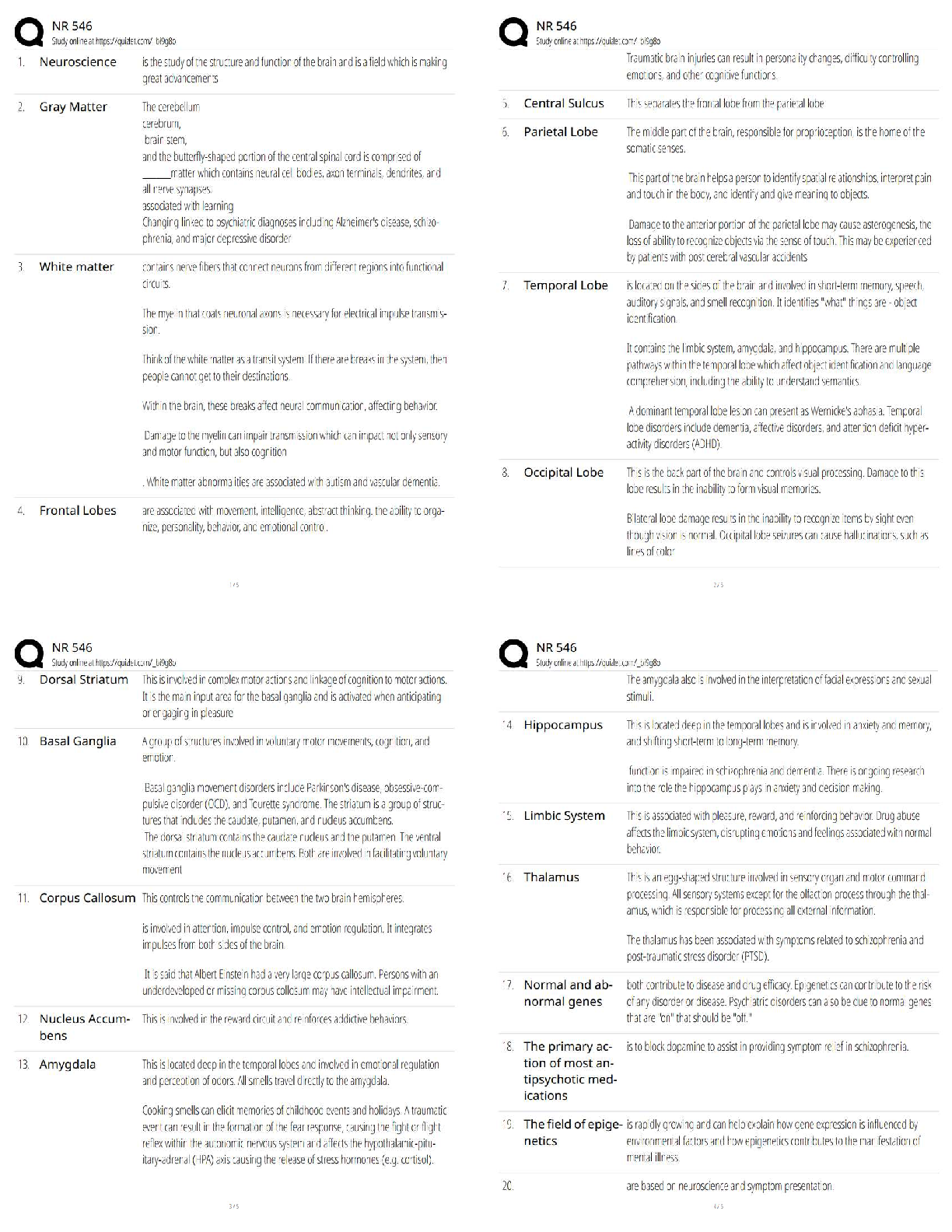
• The amygdala is associated with anxiety and perception of odors.
• The hippocampus is involved in memory and anxiety. The amygdala is
associated with anxiety and perception of odors. The prefrontal cortex
is associated with executive function. The thalamus is associated with
motor command processing
• The client’s cognitive status can result in an ethical concern if the
client is unable to self-determine care or is a danger to self or others.
Ability to pay is not an ethical issue.
• basal ganglia are a group of structures involved in voluntary motor
movements. Basal ganglia are also involved in cognition and emotion.
• Limbic system is associated with emotion and learning
• hippocampi are associated with long term memory
• Wernicke's area is associated with speech comprehension. Review
activity
• the dorsolateral prefrontal cortex (DLPFC) is concerned with higher
level functioning. The VLPFC is involved with motor inhibition the IFG
contains Broca's area which is associated with speech production
understanding grammar. Pliska Ch. 8
• the OFC is involved in decision making and social behavior with a focus
on punishment and rewards. The OFC inhibits and activates the
amygdala and is activated when a risk assessment is required. Some
behaviors associated with the OFC include sex, sugar, pain, social
humiliation, money, rewards, fame, and aggression. The amygdala will
identify a threat and then the OFC will determine the risk or benefit of
an action based on past experience. Pliska Ch. 8, p.158
• At this time, 20 % of the world’s population is suffering from a
neurologic and/or psychiatric disorder.
[Show More]