Test Bank for Anatomy & Physiology 10th Edition Patton TB
Anatomy and Physiology
10th Edition
Patton Test Bank
Chapter 01: Organization of the Body
Patton: Anatomy and Physiology, 10th Edition
MULTIPLE CHOICE
...
Test Bank for Anatomy & Physiology 10th Edition Patton TB
Anatomy and Physiology
10th Edition
Patton Test Bank
Chapter 01: Organization of the Body
Patton: Anatomy and Physiology, 10th Edition
MULTIPLE CHOICE
1. Which of the following describes anatomy?
a. Using devices to investigate parameters such as heart rate and blood pressure
b. Investigating human structure via dissections and other methods
c. Studying the unusual manner in which an organism responds to painful stimuli
d. Examining the physiology of life
ANS: B DIF: Memorization REF: p. 3
TOP: Anatomy and Physiology
2. Systemic anatomy is a term that refers to:
a. physiological investigation at a microscopic level.
b. anatomical investigation that begins in the head and neck and concludes at the feet.
c. anatomical investigation that uses an approach of studying the body by
systems—groups of organs having a common function.
d. anatomical investigation at the molecular level.
ANS: C DIF: Memorization REF: p. 4
TOP: Anatomy and Physiology
3. Physiology can be subdivided according to the studied.
a. type of organism
b. organizational level
c. systemic functiond. All of the above are correct.
ANS: D DIF: Memorization REF: p. 4
TOP: Physiology
4. Physiology:
a. recognizes the unchanging (as opposed to the dynamic) nature of things.
b. investigates the body’s structure.
c. is concerned with organisms and does not deal with different levels of organization
such as cells and systems.
d. is the science that examines the function of living organisms and their parts.
ANS: D DIF: Memorization REF: p. 4
TOP: Physiology
5. One of the basic principles of the standardized terminology is the avoidance of , or
terms that are based on a person’s name.
a. homonyms
b. antonyms
c. eponyms
d. synonyms
ANS: C DIF: Memorization REF: p. 5
TOP: Language of Science and Medicine
6. Metabolism refers to:
a. the chemical basis of life.
b. the sum of all the physical and chemical reactions occurring in the body.
c. an organization of similar cells specialized to perform a certain function.
d. a subdivision of physiology.
ANS: B DIF: Application REF: p. 5 TOP: Characteristics of Life
7. From smallest to largest, the levels of organization of the body are:
a. organism, chemical, tissue, cellular, organ, system, organelle.
b. chemical, microscopic, cellular, tissue, organ, system, organism.
c. organism, system, organ, tissue, cellular, organelle, chemical.
d. chemical, organelle, cellular, tissue, organ, system, organism.
ANS: D DIF: Memorization REF: p. 6
TOP: Levels of Organization
8. The smallest living units of structure and function in the body are:
a. molecules.
b. cells.
c. organelles.
d. atoms.
ANS: B DIF: Memorization REF: p. 7
TOP: Levels of Organization
9. An organization of many simNilUarRcSelI lsNthGatTaBre.sCpeOciMalized to perform a certain function is
called a(n):
a. tissue.
b. organism.
c. system.
d. organ.ANS: A DIF: Memorization REF: p. 7
TOP: Tissue Level
10. An organ is one organizational level lower than a(n):
a. system.
b. cell.
c. organelle.
d. tissue.
ANS: A DIF: Memorization REF: p. 7
TOP: Organ Level
11. The reproductive system includes all of the following except the:
a. testes.
b. ovaries.
c. ureter.
d. penis.
ANS: C DIF: Memorization REF: p. 8
TOP: Body Systems
12. The lungs are located in the:
a. thoracic cavity.
b. mediastinum.
c. abdominal cavity.
d. cranial cavity.
ANS: A DIF: Memorization REF: p. 12
TOP: Body Cavities
13. The mediastinum contains all of the following except the:
a. trachea.
b. venae cavae.
c. right lung.
d. esophagus.
ANS: C DIF: Memorization REF: p. 12
TOP: Body Cavities
14. The gallbladder lies in the:
a. abdominal cavity.
b. pelvic cavity.
c. dorsal cavity.
d. mediastinum.
ANS: A DIF: Memorization REF: p. 13
TOP: Body CavitiesU S N T O
15. The number of abdominal regions is:
a. three.
b. five.
c. seven.
d. nine.
ANS: D DIF: Memorization REF: p. 14
TOP: Abdominopelvic Regions
16. The abdominal region in which the urinary bladder is found is the:
a. hypogastric.
b. epigastric.
c. right lumbar.
d. left iliac.
ANS: A DIF: Memorization REF: p. 15
TOP: Abdominopelvic Regions
17. A surgeon removing a gallbladder should know to find it in the region.
a. right lumbar
b. right hypochondriac
c. hypogastric
d. umbilical
ANS: B DIF: Memorization REF: p. 14
TOP: Abdominopelvic Regions
18. The abdominal region in which the appendix is found is the:
a. hypogastric.
b. right iliac.
c. right lumbar.
d. right hypochondriac.
ANS: A DIF: Memorization REF: p. 15
TOP: Abdominopelvic Regions
19. Popliteal refers to the:
a. calf.
b. ankle.
c. cheek.
d. area behind the knee.
ANS: D DIF: Memorization REF: p. 16
TOP: Latin-based Descriptive Terms for Body Regions
20. A plane through the body that divides the body into right and left sides is called:
a. sagittal.
b. frontal.
c. coronal.
d. transverse.
ANS: A DIF: MNemoRrizaItionG B.C M
TOP: Body Planes and Sections
REF: p. 1621. The abdominal quadrants are located with what structure as their midpoint?
a. Umbilicus
b. Pubic bone
c. Xiphoid process
d. Iliac crest
ANS: A DIF: Memorization REF: p. 13
TOP: Abdominopelvic Quadrants
22. Humans have similar right and left sides of the body, at least superficially. This is an example
of:
a. anatomical position.
b. anterior symmetry.
c. ipsilateral position.
d. bilateral symmetry.
ANS: D DIF: Memorization REF: p. 8
TOP: Anatomical Position
23. Two major cavities of the human body are:
a. ventral/dorsal.
b. inferior/superior.
c. visceral/parietal.
d. axial/appendicular.
ANS: A DIF: Memorization REF: p. 9
TOP: Body Cavities
24. The dorsal cavity contains all of the following except the:
a. brain.
b. spinal column.
c. spinal cord.
d. thyroid gland.
ANS: D DIF: Memorization REF: p. 12
TOP: Body Cavities
25. A plane through the body that divides the body into anterior and posterior portions is:
a. sagittal.
b. median.
c. coronal.
d. transverse.
ANS: C DIF: Memorization REF: p. 10
TOP: Body Planes and Sections
26. The plane that divides the body into upper and lower parts is the plane.
a. sagittal
b. frontal
c. transverse
d. superficialANS: C DIF: Memorization REF: p. 11
TOP: Body Planes and Sections
27. A somatotype characterized by having a muscular physique is called a(n):
a. endomorph.
b. mesomorph.
c. ectomorph.
d. None of the above is correct.
ANS: B DIF: Application REF: p. 17, Connect It
TOP: Body Type and Disease
28. A somatotype characterized by a thin, fragile physique is a(n):
a. ectomorph.
b. mesomorph.
c. endomorph.
ANS: A DIF: Memorization REF: p. 17, Connect It
TOP: Body Type and Disease
29. The abdominopelvic cavity contains all of the following except the:
a. kidneys.
b. gallbladder.
c. right lung.
d. urinary bladder.
ANS: C DIF: Memorization REF: p. 13
TOP: Body Cavities
30. Which of the following is not one of the characteristics of life?
a. Digestion
b. Balance
c. Conductivity
d. Circulation
e. Reproduction
ANS: B DIF: Memorization REF: p. 5
TOP: Characteristics of Life
31. An idea that is supported by repeated experiments and observation is called a:
a. fact.
b. theory.
c. concept.
d. hypothesis.
ANS: B DIF: Memorization REF: p. 3
TOP: Science and Society
32. Molecules are:
a. atoms combined to form larger chemical aggregates.
b. electrons orbiting nuclei.
Nc. a complex of electrons arraUngeSd inNconTcentricOshells.
d. composed of cellular organelles.
ANS: A DIF: Memorization REF: p. 6
TOP: Chemical Level: Basis for Life
33. Mitochondria, Golgi apparatus, and endoplasmic reticulum are examples of:
a. molecules.
b. cytoplasm.
c. organelles.
d. plasma membranes.
ANS: C DIF: Memorization REF: p. 7
TOP: Levels of Organization
34. When many similar cells specialize to perform a certain function, it is referred to as a(n):
a. tissue.
b. organelle.
c. organ system complex.
d. organism.
ANS: A DIF: Memorization REF: p. 7
TOP: Tissue Level
35. Several kinds of tissues working together are termed a(n):
a. plasma membrane.
b. organ.
c. organism.
d. organ system.
ANS: B DIF: Memorization REF: p. 7
TOP: Organ Level
36. Blood production is a function of which system?
a. Reproductive
b. Respiratory
c. Skeletal
d. Lymphatic
ANS: C DIF: Memorization REF: p. 7
TOP: System Level
37. The dorsal cavity contains the:
a. brain and spinal cord.
b. heart and lungs.
c. reproductive organs.
d. digestive organs.
ANS: A DIF: Memorization REF: p. 12
TOP: Body Cavities
38. The ventral cavity contains the:
a. thoracic and abdominope
lvN
ic
RcavIitieGs.N R I G B.C M
b. heart and lungs only.
c. digestive and reproductive organs.
d. brain and spinal cord.
ANS: A DIF: Memorization REF: p. 12
TOP: Body Cavities
39. The axial portion of the body consists of the:
a. arms, neck, and legs.
b. neck, torso, and arms.
c. torso, arms, legs, and head.
d. head, neck, and torso.
ANS: D DIF: Memorization REF: p. 15
TOP: Body Regions
40. The abdominopelvic cavity contains all of the following except the:
a. stomach.
b. pancreas.
c. heart.
d. reproductive organs.
ANS: C DIF: Memorization REF: p. 13
TOP: Body Cavities
41. Visceral peritoneum would cover which of the following organs?
a. Heart
b. Intestines
c. Lungs
d. Spinal cord
ANS: B DIF: Memorization REF: p. 13
TOP: Body Cavities
42. A sagittal section divides the body into portions.
a. upper and lower
b. right and left
c. front and back
d. proximal and distal
ANS: B DIF: Memorization REF: p. 10
TOP: Body Planes and Sections
43. A frontal section divides the body into portions.
a. upper and lower
b. right and left
c. front and back
d. cortex and medullary
ANS: C DIF: Memorization REF: p. 10
TOP: Body Planes and Sections
44. Axilla is a term referring to which body region?
a. Anterior elbow
b. Armpit
c. Posterior knee
d. GroinANS: B DIF: Memorization REF: p. 15
TOP: Latin-based Descriptive Terms for Body Regions
45. The tissue is not a major tissue of the body.
a. cutaneous
b. epithelial
c. connective
d. nervous
ANS: A DIF: Memorization REF: p. 7
TOP: Tissue Level
46. “Apple-shaped” and “pear-shaped” usually describe subtypes of what major body type?
a. Mesomorph
b. Ectomorph
c. Endomorph
d. Polymorph
ANS: C DIF: Memorization REF: p. 17, Connect It
TOP: Body Type and Disease
47. An organ is one organizational level higher than a(n):
a. system.
b. cell.
c. organelle.
d. tissue.
ANS: D DIF: Memorization REF: p. 7
TOP: Organ Level
48. Which of the following does not describe anatomical position?
a. Head pointing forward
b. Body standing erect
c. Arms extended from the shoulders, palms up
d. All of the above describe the body in the anatomical position.
ANS: C DIF: Memorization REF: p. 9
TOP: Anatomical Position
49. Someone studying gross anatomy would not study which of the following?
a. The location of the heart and chambers of the heart
b. Muscles of the arms and legs
c. The nucleus of the cell
d. All of the above would be studied.
ANS: C DIF: Memorization REF: p. 4
TOP: Anatomy
50. The parietal pleura covers the N:
a. lungs.
b. heart.
c. walls of the thoracic cavity.
d. Both A and B are correct.
ANS: C DIF: Memorization REF: p. 13
TOP: Body Cavities51. The hollow part of an organ or body structure is called the of the organ.
a. cortical part
b. lumen
c. medullary part
d. apical part
ANS: B DIF: Memorization REF: p. 9
TOP: Terms Related to Organs
52. The narrowest part of an organ or body structure is called the of the organ.
a. cortical part
b. lumen
c. medullary part
d. apical part
ANS: D DIF: Memorization REF: p. 10
TOP: Terms Related to Organs
53. Which of the following is not a directional term of the body?
a. Apical
b. Proximal
c. Superficial
d. Deep
ANS: D DIF: Memorization REF: p. 9
TOP: Terms Related to Organs
54. What is the anatomical direction term that means nearer the surface?
a. Deep
b. Distal
c. Proximal
d. Superficial
ANS: D DIF: Application REF: p. 9 TOP: Directional Terms
55. An x-ray technician has been asked to make x-ray films of the liver. Which of the
abdominopelvic regions must be included?
a. Right hypochondriac, epigastric, and left hypochondriac
b. Right hypochondriac, right lumbar, and right iliac
c. Right iliac, hypogastric, and left iliac
d. Right lumbar, umbilical, and left lumbar
ANS: A DIF: Application REF: p. 13 TOP: Abdominopelvic Regions
56. As a nurse, you are assistingNaUphRySsiIciN anGwTitBh.thCeOexMamination of a patient. The physician asks
you to tell the patient, who is lying on the examination table, to assume the anatomical
position. How would you instruct the patient to assume this position?
a. Have the patient stand up and place his arms at his sides, palms facing forward,
with hands and feet facing forward.
b. Have the patient stand up and place his arms at his sides, palms facing posteriorly,
with hands and feet facing forward.
c. Have the patient stand up and place his arms behind him, palms facing to the side,
with feet facing forward.
d. Have the patient stand up and place his arms at his sides, palms facing down, with
feet facing forward.
ANS: A DIF: Application REF: p. 8 TOP: Anatomical Position57. During a routine physical examination, a patient with an endomorphic somatotype with a
large waistline and overall “apple shape” should be advised that such a distribution of fat may
lead to what conditions?
a. Heart disease, stroke, high blood pressure, and colitis
b. Heart disease, stroke, high blood pressure, and diabetes
c. Heart disease, stroke, low blood pressure, and colitis
d. Prostate cancer, low blood pressure, and diabetes
ANS: B DIF: Application REF: p. 17, Connect It
TOP: Body Type and Disease
58. If your reference point is “farthest from the trunk of the body” versus “nearest to the trunk of
the body,” where does the knee lie in relation to the ankle?
a. Distal
b. Proximal
c. Superficial
d. Superior
ANS: B DIF: Application REF: p. 9 TOP: Directional Terms
59. The study of microscopic anatomy might include:
a. systemic anatomy.
b. cytology.
c. histology.
d. both B and C.
ANS: D DIF: Memorization REF: p. 4
TOP: Anatomy
60. The structure that is called the “powerhouse” of the cell is the:
a. cytoplasm.
b. endoplasmic reticulum.
c. mitochondria.
d. Golgi apparatus.
ANS: C DIF: Memorization REF: p. 7
TOP: Levels of Organization
61. How many main tissue typesNaUreRfoSuIndNiGnTthBe.huCmOaMn body?
a. 4
b. 8
c. 11
d. 6
ANS: A DIF: Memorization REF: p. 7
TOP: Levels of Organization
62. The mediastinum is located in the cavity.
a. dorsal
b. abdominal
c. ventral
d. Both B and C are correct.
ANS: C DIF: Application REF: p. 12 TOP: Body Cavities
63. Another term for posterior is:a. ventral.
b. dorsal.
c. inferior.
d. proximal.
ANS: B DIF: Memorization REF: p. 9
TOP: Directional Terms
64. The term most nearly opposite cortical would be:
a. peripheral.
b. apical.
c. medullary.
d. basal.
ANS: C DIF: Memorization REF: p. 9
TOP: Terms Related to Organs
65. Withdrawing from a painful stimulus is an example of:
a. excretion.
b. growth.
c. responsiveness.
d. secretion.
ANS: C DIF: Application REF: p. 5 TOP: Characteristics of Life
MATCHING
Match each organ to its corresponding system.
a. Respiratory
b. Digestive
c. Urinary
d. Reproductive
e. Endocrine
f. Cardiovascular
g. Integumentary
h. Muscular
i. Skeletal
j. Nervous
1. Tendons
2. Pituitary gland
3. Skin
4. Capillaries
5. Ligaments
6. Spinal cord
7. Bronchial tree
8. Testes and ovaries
9. Large and small intestines
10. Ureters1. ANS:
TOP:
H
Body Systems
DIF: Memorization REF: p. 8, Table 1-2
2. ANS:
TOP:
E
Body Systems
DIF: Memorization REF: p. 8, Table 1-2
3. ANS:
TOP:
G
Body Systems
DIF: Memorization REF: p. 8, Table 1-2
4. ANS: F DIF: Memorization REF: p. 8, Table 1-2
TOP: Body Systems
5. ANS:
TOP:
I
Body Systems
DIF: Memorization REF: p. 8, Table 1-2
6. ANS:
TOP:
J
Body Systems
DIF: Memorization REF: p. 8, Table 1-2
7. ANS:
TOP:
A
Body Systems
DIF: Memorization REF: p. 8, Table 1-2
8. ANS:
TOP:
D
Body Systems
DIF: Memorization REF: p. 8, Table 1-2
9. ANS:
TOP:
B
Body Systems
DIF: Memorization REF: p. 8, Table 1-2
10. ANS:
TOP:
C
Body Systems
DIF: Memorization REF: p. 8, Table 1-2
Match each term to its associated region.
a. Abdominal
b. Brachial
c. Cervical
d. Coxal
e. Cutaneous
f. Digital
g. Femoral
h. Lumbar
11. Thigh
12. Arm
13. Anterior torso14. Lower back between ribs and pelvis
15. Fingers and toes
16. Hip
17. Skin
18. Neck
11. ANS:
TOP:
G
Body Regions
DIF: Memorization REF: p. 16, Table 1-4
12. ANS:
TOP:
B
Body Regions
DIF: Memorization REF: p. 16, Table 1-4
13. ANS:
TOP:
A
Body Regions
DIF: Memorization REF: p. 16, Table 1-4
14. ANS:
TOP:
H
Body Regions
DIF: Memorization REF: p. 16, Table 1-4
15. ANS:
TOP:
F
Body Regions
DIF: Memorization REF: p. 16, Table 1-4
16. ANS:
TOP:
D
Body Regions
DIF: Memorization REF: p. 16, Table 1-4
17. ANS:
TOP:
E
Body Regions
DIF: Memorization REF: p. 16, Table 1-4
18. ANS:
TOP:
C
Body Regions
DIF: Memorization REF: p. 16, Table 1-4
Match each term to its correct corresponding statement.
a. Superior
b. Inferior
c. Anterior
d. Posterior
e. Medial
f. Lateral
g. Proximal
h. Distal
i. Superficial
19. The great toe is to the little toe.
20. The skin is to the muscles beneath it.
21. The vertebrae are located on the aspect of the body.
22. The hand is to the shoulder.
23. The abdomen is to the head.
24. The lungs are to the intestines.
25. The nose is located on the surface of the head.
26. The knee is to the ankle.
27. The ear is on the aspect of the head.
19.
20.
ANS:
TOP:
ANS:
E DIF:
Directional Terms
I DIF:
Memorization
Memorization
REF:
REF:
p. 9
p. 9
TOP: Directional Terms
21.
22.
ANS:
TOP:
ANS:
TOP:
D DIF:
Directional Terms
H DIF:
Directional Terms
Memorization
NURSINGTB.C
Memorization
REF:
OM
REF:
p. 9
p. 9
23. ANS:
TOP:
B
Directional
DIF:
Terms
Memorization REF: p. 9
24. ANS:
TOP:
A
Directional
DIF:
Terms
Memorization REF: p. 9
25. ANS: C DIF: Memorization REF: p. 9Match each set of functions with its corresponding system or systems.
a. Reproduction and development
b. Processing, regulation, and maintenance
c. Outer protection
d. Support and movement
e. Communication, control, and integration
f. Transportation and defense
28. Nervous system
29. Muscular system and skeletal system30. Circulatory system and lymphatic system
31. Respiratory system, digestive system, and endocrine system
32. Reproductive system
33. Integumentary system
28. ANS:
TOP:
E
Body Systems
DIF: Memorization REF: p. 8, Table 1-2
29. ANS:
TOP:
D
Body Systems
DIF: Memorization REF: p. 8, Table 1-2
30. ANS:
TOP:
F
Body Systems
DIF: Memorization REF: p. 8, Table 1-2
31. ANS:
TOP:
B
Body Systems
DIF: Memorization REF: p. 8, Table 1-2
32. ANS:
TOP:
A
Body Systems
DIF: Memorization REF: p. 8, Table 1-2
33. ANS:
TOP:
C
Body Systems
DIF: Memorization REF: p. 8, Table 1-2
Match each characteristic of life with the correct descriptive phrase.
a. Conductivity
b. Excretion
c. Growth
d. Circulation
e. Respiration
f. Responsiveness
g. Digestion
h. Absorption
i. Secretion
j. Reproduction
NURSINGTB.COM
34. Movement of digested nutrients through the wall of the digestive tract into body fluids for
transport to the cell
35. Permits an organism to sense, monitor, and respond to changes in the external environment
36. Production and release of specialized substances to support diverse body functions
37. Responsiveness and this characteristic are highly developed in nerve cells
38. Movement of body fluids and other substances from one part of the body to another
39. Removal of waste produced by many body functions
40. Comes about as a result of a normal increase in size or number of cells
41. Exchange of gases between the organism and the environment
42. Formation of new individuals
43. Process by which complex food substances are broken down into simple substances that can
be absorbed by the cells
34. ANS:
TOP:
H
Characteristics
DIF: Memorization
of Life
REF: p. 5, Table 1-1
35. ANS:
TOP:
F
Characteristics
DIF: Memorization
of Life
REF: p. 5, Table 1-1
36. ANS:
TOP:
I
Characteristics
DIF: Memorization
of Life
REF: p. 5, Table 1-1
37. ANS: A DIF: Memorization REF: p. 5, Table 1-1TOP: Characteristics of Life
38. ANS:
TOP:
D DIF: Memorization
Characteristics of Life
REF: p. 5, Table 1-1
39. ANS:
TOP:
B DIF: Memorization
Characteristics of Life
REF: p. 5, Table 1-1
40. ANS:
TOP:
C DIF: Memorization
Characteristics of Life
REF: p. 5, Table 1-1
41. ANS:
TOP:
E DIF: Memorization
Characteristics of Life
REF: p. 5, Table 1-1
42. ANS:
TOP:
J DIF: Memorization
Characteristics of Life
REF: p. 5, Table 1-1
43. ANS:
TOP:
G DIF: Memorization
Characteristics of Life
REF: p. 5, Table 1-1
Match each term related to an organ to its definition or explanation.
a. Medullary
b. Basal
c. Apical
d. Cortical
e. Lumen
44. Base or widest part of the organ
45. Outer region or layer of an organ
46. Hollow part of an organ or tube of the body
47. Inner region of an organ
48. Narrow part or point of an organ
44. ANS:
TOP:
B DIF: MNemUoRriSzaItioNnGTB.COM REF:
Terms Related to Organs
p. 10
45. ANS:
TOP:
D DIF: Memorization
Terms Related to Organs
REF: p. 9
46. ANS:
TOP:
E DIF: Memorization
Terms Related to Organs
REF: p. 9
47. ANS:
TOP:
A DIF: Memorization
Terms Related to Organs
REF: p. 9
48. ANS:
TOP:
C DIF: Memorization
Terms Related to Organs
REF: p. 10
Match each level of organization with its description.
a. Chemical
b. Organelle
c. Cellular
d. Tissue
e. Organ
f. System
g. Organism
49. Highest level of organization
50. Includes mitochondria
51. Composed of the smallest structure that possesses the basic characteristics of living matter
52. Level at which the tissues work together to perform a specific function53. Composed of macromolecules
54. Cells working together to perform a specific function
55. Level at which a group of organs work together to perform specific complex functions
49. ANS:
TOP:
G
Levels of
DIF: Memorization
Organization
REF: p. 8
50. ANS:
TOP:
B
Levels of
DIF: Memorization
Organization
REF: p. 7
51. ANS:
TOP:
C
Levels of
DIF: Memorization
Organization
REF: p. 7
52. ANS:
TOP:
E
Levels of
DIF: Memorization
Organization
REF: p. 7
53. ANS:
TOP:
A
Levels of
DIF: Memorization
Organization
REF: p. 6
54. ANS:
TOP:
D
Levels of
DIF: Memorization
Organization
REF: p. 7
55. ANS:
TOP:
F
Levels of
DIF: Memorization
Organization
REF: p. 7
OTHER
1. In simple terms, what are the characteristics of life?
ANS:
Answers will vary.
DIF: Application REF: p.N5
URSINGTTOBP:.C ChOarMacteristics of Life
2. Discuss the principle of complementarity of structure and function.
ANS:
Answers will vary.
DIF: Application REF: p. 16 TOP: Interaction of Structure and Function
3. Explain one way in which culture has affected science. Explain one way in which science has
affected culture.
ANS:
Answers will vary.
DIF: Application REF: p. 3 TOP: Science and Society
4. Describe the levels of organization from chemical to system.
ANS:
Answers will vary.
DIF: Memorization REF: p. 6 TOP: Levels of Organization5. Describe anatomical position. Give examples of structures that are ipsilateral and contralateral
to each other.
ANS:
Answers will vary.
DIF: Application REF: p. 8 TOP: Anatomical Position
6. List the directional terms, and use them to describe the relationship between two structures in
the body.
ANS:
Answers will vary.
DIF: Application REF: p. 9 TOP: Anatomical DirectionsChapter 02: Homeostasis
Patton: Anatomy and Physiology, 10th Edition
MULTIPLE CHOICE
1) Of the 11 major body systems, which is the least involved in maintaining homeostasis?
a. Circulatory
b. Endocrine
c. Lymphatic
d. Reproductive
ANS: D DIF: Application REF: p. 25, Table 2-1
TOP: Homeostatic Functions of Body Systems
2) Homeostasis can best be described as:
a. a constant state maintained by living and nonliving organisms.
b. a state of relative constancy.
c. adaptation to the external environment.
d. changes in body temperature.
ANS: B DIF: Application REF: p. 31 TOP: Homeostasis
3) The normal reading or range of normal is called the:
a. sensor point.
b. set point.
c. effector point.
d. integrator point. NURSINGTB.COM
ANS: B DIF: Memorization REF: p. 24
TOP: Set Point
4) Which of the following is not one of the basic components in a feedback control loop?
a. Effector mechanism
b. Transmitter
c. Sensor
d. Integrating center
ANS: B DIF: Memorization REF: p. 27
TOP: Basic Components of Control Mechanisms
5) The body’s thermostat is located in the:
a. heart.
b. cerebellum.
c. pituitary.
d. hypothalamus.
ANS: D DIF: Memorization REF: p. 27
TOP: Basic Components of Control Mechanisms
6) The contraction of the uterus during the birth of a baby is an example of feedback.
a. negativeb. positive
c. inhibitory
d. deviating
ANS: B DIF: Memorization REF: p. 29
TOP: Positive Feedback in Control Systems
7) Negative-feedback mechanisms:
a. minimize changes in blood glucose levels.
b. maintain homeostasis.
c. are responsible for an increased rate of sweating when air temperature is higher
than body temperature.
d. All of the above are correct.
ANS: D DIF: Memorization REF: p. 28
TOP: Negative Feedback in Control Systems
8) Pathogenesis can be defined as:
a. a specific disease.
b. a group of diseases.
c. the course of disease development.
d. a subgroup of viruses.
ANS: C DIF: Memorization REF: p. 32
TOP: Disease Terminology
9) Intracellular parasites that consist of DNA or RNA surrounded by a protein coat and
sometimes by a lipoprotein e
NnveRlopeIareGcalBle.d:C M
a. viruses.
b. bacteria.
c. fungi.
d. protozoa.
U S N T O
ANS: A DIF: Memorization REF: p. 34
TOP: Basic Mechanisms of Disease
10) The term that literally means self-immunity is:
a. autoimmunity.
b. homoimmunity.
c. passive immunity.
d. active immunity.
ANS: A DIF: Memorization REF: p. 34
TOP: Basic Mechanisms of Disease
11) Epidemiology is the study of the of diseases in human populations.
a. occurrence
b. distribution
c. transmission
d. All of the above are correct.
ANS: D DIF: Memorization REF: p. 32
TOP: Disease Terminology12) Which of the following may put one at risk for developing a given disease?
a. Environment
b. Stress
c. Lifestyle
d. All of the above
ANS: D DIF: Memorization REF: pp. 34-35
TOP: Basic Mechanisms of Disease
13) Negative-feedback control systems:
a. oppose a change.
b. accelerate a change.
c. have no effect on the deviation from set point.
d. establish a new set point.
ANS: A DIF: Memorization REF: p. 28
TOP: Negative Feedback in Control Systems
14) Positive-feedback control systems:
a. have no effect on the deviation from set point.
b. accelerate a change.
c. ignore a change.
d. do not exist in human systems.
ANS: B DIF: Memorization REF: p. 28
TOP: Positive Feedback in Control Mechanisms
15) Shivering to try to raise yourNbUodRySteImNpGerTatBur.eCbaOckMto normal would be an example of:
a. the body trying to maintain homeostasis.
b. a positive-feedback mechanism.
c. a negative-feedback mechanism.
d. both A and C.
ANS: D DIF: Synthesis REF: p. 27
TOP: Negative Feedback in Control Systems
16) Which of the following is a protein substance with no DNA or RNA and is thought to be the
cause of mad cow disease?
a. Virus
b. Bacteria
c. Prion
d. Protozoan
ANS: C DIF: Memorization REF: p. 33
TOP: Pathogenic Organisms
17) Of the pathogenic organisms, which of the following are the most complex?
a. Viruses
b. Tapeworms
c. Bacteria
d. ProtozoaANS: B DIF: Memorization REF: p. 34
TOP: Pathogenic Organisms
18) If the secretion of oxytocin during childbirth operated as a negative-feedback control loop,
what effect would it have on uterine contractions?
a. Oxytocin would stimulate stronger uterine contractions.
b. Oxytocin would inhibit uterine contractions.
c. There would be no changes in the strength of the uterine contractions.
d. Uterine contractions would initially be weak and then gain strength after the
release of the hormone.
ANS: B DIF: Application REF: p. 28
TOP: Positive Feedback in Control Systems
19) Intrinsic control:
a. usually involves the endocrine or nervous system.
b. operates at the cellular level.
c. is sometimes called autoregulation.
d. operates at the system or organism level.
ANS: C DIF: Memorization REF: p. 31
TOP: Levels of Homeostatic Control
MATCHING
Match each term with its corresponding definition or explanation
a. Prion
b. Tumor
c. Fungi
d. Gene mutation
e. Bacteria
f. Virus
g. Protozoa
NURSINGTB.COM
1. An intracellular parasite that consists of an RNA or DNA core surrounded by a protein coat
2. A type of protein that converts normal protein in the nervous system into abnormal proteins
that cause loss of function
3. A tiny, primitive cell that lacks a nucleus and can cause infection
4. An abnormal growth or neoplasm
5. Altered DNA that causes abnormal proteins to be made that do not perform their intended
function
6. A one-celled organism whose DNA is organized into a nucleus that can parasitize human
tissue
7. Simple organisms that are similar to plants but lack chlorophyll, which allows plants to make
their own food; because these organisms cannot make their own food, they parasitize human
tissue
1. ANS: F DIF: Memorization REF: p. 34
TOP: Basic Mechanisms of Disease
2. ANS: A DIF: Memorization REF: p. 33U S N T O
TOP: Basic Mechanisms of Disease
3. ANS:
TOP:
E DIF: Memorization
Basic Mechanisms of Disease
REF: p. 34
4. ANS:
TOP:
B DIF: Memorization
Basic Mechanisms of Disease
REF: p. 34
5. ANS:
TOP:
D DIF: Memorization
Basic Mechanisms of Disease
REF: p. 33
6. ANS:
TOP:
G DIF: Memorization
Basic Mechanisms of Disease
REF: p. 34
7. ANS:
TOP:
C DIF: Memorization
Basic Mechanisms of Disease
REF: p. 34
SHORT ANSWER
1. Diagram a homeostatic control mechanism, including the three basic components.
ANS:
Answers will vary.
DIF: Synthesis REF: p. 26 TOP: Homeostatic Control Mechanisms
2. How does childbirth demonstrate positive feedback?
ANS:
Answers will vary.
DIF: Synthesis REF: p.N29 R I GTOBP:.C PosiMtive Feedback in Control Systems
3. Give an example of how categories of risk factors or predisposing conditions could overlap.
ANS:
Answers will vary.
DIF: Synthesis REF: pp. 34-35 TOP: Basic Mechanisms of Disease
4. Explain the feed-forward control system, and give an example of one in the body.
ANS:
Answers will vary.
DIF: Application REF: p. 34 TOP: Feed-Forward in Control Systems
ESSAY
1. Give an example of a system, either living or nonliving, that is designed to maintain a
relatively constant condition by using a negative-feedback mechanism. Explain briefly how
the system works to accomplish this.
ANS:
Answers will vary.DIF: Synthesis REF: pp. 28-29 TOP: Basic Components of Control Mechanisms
2. Explain how your set point can change under varying circumstances.
ANS:
Answers will vary
DIF: Synthesis REF: pp. 29-30 TOP: Changing the Set Point
NURSINGTB.COMChapter 03: Chemistry of Life
Patton: Anatomy and Physiology, 10th Edition
MULTIPLE CHOICE
1. Which of the following represents a trace element in the body?
a. Sulfur
b. Chlorine
c. Iron
d. Phosphorus
ANS: C DIF: Memorization REF: p. 40, Table 3-1
TOP: Elements and Compounds
2. The kind of element is determined by the number of:
a. protons.
b. neutrons.
c. mesotrons.
d. electrons.
ANS: A DIF: Application REF: p. 41
TOP: Atomic Number and Mass Number
3. Atomic mass is determined by the number of:
a. protons and electrons.
b. neutrons and electrons.
c. neutrons, protons, and eleNcUtroRnSs.INGTB.COM
d. protons and neutrons.
ANS: D DIF: Application REF: p. 41
TOP: Atomic Number and Mass Number
4. Carbon has an atomic number of 6. The number of electrons found in the first shell is:
a. two.
b. four.
c. six.
d. eight.
ANS: A DIF: Application REF: pp. 41-42 TOP: Energy Levels
5. The atomic number of carbon is 6. How many unpaired electrons are in its outer shell?
a. Two
b. Three
c. Four
d. Five
ANS: C DIF: Application REF: p. 42 TOP: Energy Levels
6. A negatively charged subatomic particle that moves around the nucleus is a(n):
a. orbital.
b. proton.c. neutron.
d. electron.
ANS: D DIF: Memorization REF: p. 40, Table 3-1
TOP: Atomic Structure
7. When atoms combine, they may gain, lose, or share:
a. electrons.
b. protons.
c. neutrons.
d. nuclei.
ANS: A DIF: Application REF: p. 43 TOP: Attractions Between Atoms
8. An ionic bond is formed by:
a. two or more positive ions combining.
b. two or more negative ions combining.
c. a positive and a negative ion attracting each other.
d. sharing of a pair of electrons.
ANS: C DIF: Application REF: pp. 43-44 TOP: Ionic Bonds
9. An example of an element would be:
a. Ne.
b. CO2.
c. C6H12O6.
d. H2O.
ANS: A DIF: AN ppUlicRaS tioInNGRTEBF:.C p. 40M, Table 3-1
TOP: Elements and Compounds
10. An isotope of an element contains different numbers of from other atoms of the same
element.
a. electrons
b. protons
c. neutrons
d. both protons and neutrons
ANS: C DIF: Application REF: p. 42 TOP: Isotopes
11. The study of metabolism includes examination of:
a. catabolism.
b. anabolism.
c. ATP requirements.
d. all of the above.
ANS: D DIF: Memorization REF: p. 46
TOP: Metabolism
12. An example of a catabolic process is:
a. hydrolysis.
b. dehydration synthesis.
c. formation of a peptide bond.d. both B and C.
ANS: A DIF: Memorization REF: p. 46
TOP: Metabolism
13. Which of the following elements is least likely to combine with another element?
a. Hydrogen
b. Helium
c. Oxygen
d. Carbon
ANS: B DIF: Synthesis REF: p. 42
TOP: Attractions Between Atoms—Chemical Bonds
14. The hydrogen isotope tritium consists of:
a. one proton.
b. one proton and one neutron.
c. two protons and one neutron.
d. one proton and two neutrons.
ANS: D DIF: Application REF: p. 42, Figure 3-7
TOP: Isotopes
15. Which of the following bonds are the weakest?
a. Ionic
b. Hydrogen
c. Electrovalent
d. Covalent
NURSINGTB.COM
ANS: B DIF: Memorization REF: p. 44
TOP: Hydrogen Bonds
16. The type of reaction in which substances are combined to form more complex substances is
called a(n) reaction.
a. reversible
b. exchange
c. synthesis
d. decomposition
ANS: C DIF: Memorization REF: p. 45
TOP: Chemical Reactions
17. The process of the digestion of food is an example of which type of reaction?
a. Synthesis
b. Decomposition
c. Exchange
d. Reversible
ANS: B DIF: Application REF: p. 45 TOP: Chemical Reactions
18. Substances that accept hydrogen ions are called:
a. acids.
b. bases.c. buffers.
d. salts.
ANS: B DIF: Memorization REF: p. 49
TOP: Bases
19. Acids:
a. are proton donors.
b. taste sour.
c. release hydrogen ions in an aqueous solution.
d. All of the above are true of acids.
ANS: D DIF: Synthesis REF: p. 48 TOP: Acids
20. A solution that contains a greater concentration of hydroxide ions (OH–) than hydrogen ions
(H+) is a(n) solution.
a. acidic
b. alkaline (basic)
c. neutral
d. Not enough information is given to determine the character of the solution.
ANS: B DIF: Application REF: p. 49 TOP: Bases
21. In the presence of a base, red litmus paper will:
a. stay red.
b. turn blue.
c. turn green.
d. turn yellow. N
URSINGTB.COM
ANS: B DIF: Memorization REF: p. 49, Figure 3-14
TOP: Acids and Bases
22. The most abundant and important compound(s) in the body is(are):
a. air.
b. water.
c. proteins.
d. nucleic acids.
ANS: B DIF: Memorization REF: p. 47
TOP: Water
23. Approximately what percentage of the body weight of an adult is water?
a. 40%
b. 50%
c. 60%
d. 70%
ANS: B DIF: Memorization REF: p. 47
TOP: Water
24. AB + CD → AD + CB is an example of a(n) _ reaction.
a. synthesis
b. exchangec. decomposition
d. reversible
ANS: B DIF: Application REF: p. 47 TOP: Chemical Reactions
25. Which of the following represents properties of water?
a. High specific heat
b. High heat of vaporization
c. Strong polarity
d. All of the above
ANS: D DIF: Synthesis REF: p. 48, Table 3-2
TOP: Properties of Water
26. The approximate pH of gastric fluid is:
a. 10.
b. 8.
c. 4.
d. 2.
ANS: D DIF: Memorization REF: p. 49
TOP: The pH Scale
27. The formation of sucrose involves the removal of a molecule of water. This is called:
a. hydrolysis.
b. oxidation.
c. decomposition.
d. dehydration synthesis. N
URSINGTB.COM
ANS: D DIF: Synthesis REF: p. 46 TOP: Anabolism
28. The study of metabolism includes examination of:
a. catabolism.
b. anabolism.
c. ATP requirements.
d. all of the above.
ANS: D DIF: Memorization REF: p. 46
TOP: Metabolism
29. An example of a catabolic process is:
a. hydrolysis.
b. dehydration synthesis.
c. formation of a peptide bond.
d. both B and C.
ANS: A DIF: Memorization REF: p. 46
TOP: Metabolism
30. Which of the following is not one of the major elements present in the human body?
a. Oxygen
b. Zinc
c. Carbond. Potassium
ANS: B DIF: Application REF: p. 40, Table 3-1
TOP: Elements and Compounds
31. Which of the following is not a subatomic particle?
a. Proton
b. Electron
c. Radon
d. Neutron
ANS: C DIF: Memorization REF: p. 40, Table 3-1
TOP: Atomic Structure
32. The total number of electrons in a neutral atom equals the number of:
a. neutrons orbiting the atom.
b. protons plus the number of neutrons in its nucleus.
c. protons in its nucleus.
d. ions in its nucleus.
ANS: C DIF: Memorization REF: p. 41
TOP: Energy Levels
33. An atom can be described as chemically inert if its outermost electron shell contains
electrons.
a. eight
b. nine
c. two N R I G B.C M
d. Both A and C are correct. U S N T O
ANS: A DIF: Synthesis REF: p. 42 TOP: Energy Levels
34. Ionic bonds are chemical bonds formed by the:
a. sharing of electrons between molecules.
b. donation of protons from one atom to another.
c. transfer of electrons from one atom to another.
d. acceptance of neutrons from one atom by another.
ANS: C DIF: Application REF: p. 43 TOP: Ionic Bonds
35. Chemical bonds formed by the sharing of electrons are called:
a. ionic.
b. covalent.
c. hydrogen.
d. isotopic.
ANS: B DIF: Memorization REF: p. 44
TOP: Covalent Bonds
36. The type of chemical reaction most likely to require energy is a(n) _ reaction.
a. synthesis
b. decomposition
c. exchanged. All of the above reactions are equally likely to require energy.
ANS: A DIF: Memorization REF: p. 45
TOP: Chemical Reactions
37. The elements carbon, hydrogen, oxygen, and nitrogen make up which percentage of the
human body?
a. 50%
b. 69%
c. 78%
d. 96%
ANS: D DIF: Memorization REF: p. 52
TOP: Elements and Compounds
38. Which subatomic particles carry a charge?
a. Protons and neutrons
b. Neutrons and electrons
c. Protons and electrons
d. Neutrons only
ANS: C DIF: Memorization REF: pp. 40-41
TOP: Atomic Structure
39. The element oxygen has an atomic number of 8, which means it contains:
a. four protons and four neutrons.
b. eight protons.
c. eight neutrons. N R I G B.C M
d. four protons and four electrUonsS. N T O
ANS: B DIF: Synthesis REF: p. 41
TOP: Atomic Number and Mass Number
40. For sodium to transform from a neutral atom to a positive ion, it must:
a. gain an electron.
b. gain a proton.
c. lose an electron.
d. lose a proton.
ANS: C DIF: Application REF: p. 43 TOP: Ionic Bonds
41. A molecule that is polar:
a. can form a hydrogen bond.
b. must be ionic.
c. has an unequal charge.
d. is both A and C.
ANS: D DIF: Application REF: p. 44 TOP: Hydrogen Bonds
42. The reaction between hydrogen and oxygen needed to form water is an example of a:
a. hydrogen bond.
b. synthesis reaction.
c. decomposition reaction.d. None of the above is correct.
ANS: B DIF: Application REF: p. 45 TOP: Chemical Reactions
43. Electrolytes are:
a. organic compounds.
b. called cations if they have a negative charge.
c. called cations if they have a positive charge.
d. both A and B.
ANS: C DIF: Memorization REF: p. 48
TOP: Electrolytes
44. A weak acid:
a. dissociates very little in solution.
b. dissociates almost completely in solution.
c. will cause the pH of the solution to rise above 7.
d. does both B and C.
ANS: A DIF: Application REF: p. 48 TOP: Acids and Bases
45. Salts:
a. can form as the result of a chemical reaction between acids and bases.
b. are electrolytes.
c. will form crystals if the water is removed.
d. All of the above are correct.
ANS: D DIF: Application REF: p. 50 TOP: Salts
NURSINGTB.COM
46. Hydrolysis a water molecule.
a. joins compounds by removing
b. breaks down compounds by removing
c. joins compounds by adding
d. breaks down compounds by adding
ANS: D DIF: Memorization REF: p. 46
TOP: Catabolism
47. As the concentration of hydrogen ions (H+) increases, the:
a. solution becomes more basic.
b. solution becomes more acidic.
c. pH rises.
d. Both A and C are correct.
ANS: B DIF: Application REF: p. 48 TOP: Acids and Bases
48. As the concentration of hydroxide ions (OH–) increases, the:
a. solution becomes more basic.
b. solution becomes more acidic.
c. pH rises.
d. Both A and C are correct.
ANS: D DIF: Application REF: p. 49 TOP: Acids and BasesN R I G B.C
49. A magnesium atom has an atomic number of 12, an atomic mass of 25, and a +2 charge. This
atom would contain protons, neutrons, and electrons.
a. 12; 25; 2
b. 12; 13; 14
c. 12; 13; 10
d. Not enough information is given to answer the question.
ANS: C DIF: Application REF: p. 41 TOP: Atomic Structure
50. The octet rule refers to the:
a. stability of the nucleus when the protons are in a multiple of eight.
b. stability of the atom when there are eight electrons in the outermost energy level.
c. stable configuration of the nucleus when there are eight more neutrons than
protons.
d. principle that one atom can combine with a maximum of eight other atoms.
ANS: B DIF: Application REF: p. 43 TOP: Energy Levels
51. The type of reaction most likely to release energy is a(n) reaction.
a. synthesis
b. decomposition
c. exchange
d. All of the above reactions are equally likely to release energy.
ANS: B DIF: Application REF: p. 45 TOP: Chemical Reactions
52. Which of the following is not true of all isotopes of oxygen?
a. They can all react with twoUhydSrogNen aTtoms toOform water.
b. They have the same number of protons.
c. They have the same atomic mass.
d. All of the above are true of isotopes of oxygen.
ANS: C DIF: Application REF: p. 42 TOP: Isotopes
53. Hydrogen can form only when the hydrogen atom is covalently bonded to:
a. an oxygen atom.
b. a nitrogen atom.
c. a fluorine.
d. any of the above.
ANS: D DIF: Memorization REF: pp. 44-45
TOP: Attractions Between Molecules/Hydrogen Bonds
54. A strong acid:
a. holds on strongly to its hydrogen atoms, releasing very few in solution.
b. would cause a drop in the pH of a solution.
c. would cause a rise in the pH of a solution.
d. is both A and C.
ANS: B DIF: Application REF: p. 48 TOP: Acids
55. If the pH of a person’s blood is 7.4, it would be described as:a. strongly acidic.
b. neutral.
c. slightly acidic.
d. slightly alkaline.
ANS: D DIF: Application REF: p. 48 TOP: Bases
56. When sodium (Na) gives up an electron to chlorine, the result is the formation of a sodium ion
(Na+) with a positive charge. This happens because there is then one more than .
a. proton; electron
b. electron; proton
c. proton; neutron
d. electron; neutron
ANS: A DIF: Application REF: p. 44 TOP: Ionic Bonds
57. If an atom with a total of nine electrons were to ionically bond with an atom with a total of
three electrons, what would occur?
a. The atom with nine electrons would share one of its electrons with the other atom.
b. The atom with nine electrons would lose one of its electrons, and the atom with
three electrons would accept it.
c. The atom with nine electrons would accept one of the electrons from the atom with
three electrons.
d. The atom with three electrons would share one of its electrons with the other atom.
ANS: C DIF: Application REF: pp. 43-44 TOP: Ionic Bonds
58. The carbon-containing molecNuleRs forImeGd byBl.ivCingMthings are often called:
a. buffers.
b. inorganic molecules.
c. organic molecules.
d. salts.
U S N T O
ANS: C DIF: Application REF: p. 47
TOP: Organic and Inorganic Compounds
59. The term that is used to describe all of the chemical reactions that occur in body cells is:
a. catabolism.
b. metabolism.
c. synthesis.
d. anabolism.
ANS: B DIF: Application REF: p. 46 TOP: Metabolism
60. When your body is building larger and more complex chemical molecules from smaller
subunits, what is occurring?
a. Anabolic reactions that expend energy
b. Anabolic reactions that require energy
c. Catabolic reactions that expend energy
d. Catabolic reactions that require energy
ANS: B DIF: Application REF: p. 46 TOP: Metabolism61. Which type of radiation consists of an electron that is released by the nucleus of an atom?
a. Alpha
b. Beta
c. Delta
d. Gamma
ANS: B DIF: Memorization REF: p. 42, Connect It
TOP: Radioactivity/Connect It
62. Which type of radiation consists of electromagnetic radiation, a form of light energy?
a. Alpha
b. Beta
c. Delta
d. Gamma
ANS: D DIF: Memorization REF: p. 42, Connect It
TOP: Radioactivity/Connect It
63. Which type of radiation consists of two protons and two neutrons?
a. Alpha
b. Beta
c. Delta
d. Gamma
ANS: A DIF: Memorization REF: p. 42, Connect It
TOP: Radioactivity/Connect It
64. A + B AB is an example oNf a(Rn) I G reBa.ctCion.M
a. decomposition U
b. reversible
c. exchange
d. Both A and B are correct.
S N T O
ANS: B DIF: Memorization REF: p. 46
TOP: Chemical Reactions
65. The octet rule refers to the:
a. stability of the nucleus when the protons are in a multiple of eight.
b. stability of the atom when there are eight electrons in the outermost energy level.
c. stable configuration of the nucleus when there are eight more neutrons than
protons.
d. principle that one atom can combine with a maximum of eight other atoms.
ANS: B DIF: Application REF: p. 42 TOP: Energy Levels
66. The “coat” of water that forms around charged solutes is often called a(n):
a. dehydration shell.
b. hydration shell.
c. colloid.
d. aqueous solution.
ANS: B DIF: Memorization REF: p. 47
TOP: Solutions and Colloids67. Particles slightly larger than molecules can become dispersed in water without settling out.
This type of watery mixture is called a(n):
a. solvent.
b. solute.
c. colloid.
d. aqueous solution.
ANS: C DIF: Memorization REF: p. 47
TOP: Solutions and Colloids
68. The body can dissipate excess heat and maintain normal temperature by evaporation of water
by the property of:
a. transportation.
b. specific heat.
c. polarity.
d. heat of vaporization.
ANS: D DIF: Application REF: p. 48, Table 3-2
TOP: Properties of Water
TRUE/FALSE
1. The number of protons in the nucleus of an atom determines its atomic mass.
ANS: F DIF: Memorization REF: p. 41
TOP: Atomic Number and Atomic Mass
NURSINGTB.COM
2. The positively charged electrons are found in clouds outside the nucleus of an atom.
ANS: F DIF: Memorization REF: p. 40, Table 3-1
TOP: Atomic Structure
3. Two shared pairs of electrons represent a single covalent bond.
ANS: F DIF: Application REF: p. 44 TOP: Covalent Bonds
4. The digestion of food is an example of a decomposition reaction.
ANS: T DIF: Application REF: p. 45 TOP: Chemical Reactions
5. The number and arrangement of electrons orbiting in an atom’s outer shell determine its
chemical activity.
ANS: T DIF: Application REF: p. 41 TOP: Energy Levels
6. An atom is chemically inert if its outermost shell has two pairs of electrons.
ANS: F DIF: Application REF: p. 42 TOP: Energy Levels
7. An isotope of an element contains the same number of neutrons but different numbers of
protons.ANS: F DIF: Memorization REF: p. 42
TOP: Isotopes
8. Electrovalent and ionic bonds are the same.
ANS: T DIF: Memorization REF: p. 43
TOP: Ionic Bonds
9. Radiation results from the breaking apart of the nucleus of an atom.
ANS: T DIF: Memorization REF: p. 42, Connect It
TOP: Radioactivity/Connect It
10. Radioactivity can cause an atom of one element to change to that of another element.
ANS: T DIF: Memorization REF: p. 42, Connect It
TOP: Radioactivity
11. Gamma radiation has less mass than alpha or beta radiation.
ANS: T DIF: Application REF: p. 42, Connect It
TOP: Radioactivity
12. A substance that resists changes in pH when acids or bases are added is called a buffer.
ANS: T DIF: Application REF: p. 50 TOP: Buffers
13. The chemical reaction of an aNcUidRwSitIhNaGbaTseBw.iCllOprModuce a salt and water.
ANS: T DIF: Application REF: p. 50 TOP: Salts
14. Water acts as a very effective solvent.
ANS: T DIF: Memorization REF: p. 47
TOP: Water
15. Electrolytes include acids, bases, and salts.
ANS: T DIF: Memorization REF: p. 48
TOP: Electrolytes
16. By definition, inorganic compounds do not contain carbon.
ANS: F DIF: Memorization REF: p. 47
TOP: Organic and Inorganic Compounds
17. Electrolytes are characterized by having either a positive or a negative charge.
ANS: T DIF: Memorization REF: p. 48
TOP: Electrolytes
18. Acids are electrolytes that produce OH+ ions.ANS: F DIF: Memorization REF: p. 48
TOP: Acids
19. pH is the negative logarithm of the hydrogen ion concentration.
ANS: T DIF: Memorization REF: p. 49
TOP: The pH Scale
20. Metabolism includes the processes of both anabolism and catabolism.
ANS: T DIF: Memorization REF: p. 46
TOP: Metabolism
21. ATP is broken down in an anabolic reaction.
ANS: F DIF: Application REF: p. 46 TOP: Catabolism
22. Catabolism and anabolism are major types of metabolic activity.
ANS: T DIF: Memorization REF: p. 46
TOP: Metabolism
23. Sodium chloride is an example of an ionic bond.
ANS: T DIF: Application REF: p. 43 TOP: Ionic Bonds
24. The digestion of food is an exNamRpleIof aGsynBth.eCsis rMeaction.
U S N T O
ANS: F DIF: Synthesis REF: p. 46 TOP: Chemical Reactions
25. The pH scale indicates the degree of acidity or alkalinity of a solution.
ANS: T DIF: Memorization REF: p. 49
TOP: Acids and Bases
26. Litmus paper will turn red in the presence of a base.
ANS: F DIF: Memorization REF: p. 49
TOP: Acids and Bases
27. The atomic mass of an atom is equal to the number of protons plus the number of neutrons.
ANS: T DIF: Memorization REF: p. 41
TOP: Atomic Number and Atomic Mass
28. The mass of a proton is almost exactly equal to the mass of an electron.
ANS: F DIF: Memorization REF: p. 41
TOP: Atomic Number and Atomic Mass
29. Hydrogen will react with other atoms to get eight electrons in its outer energy level.ANS: F DIF: Application REF: pp. 41-42 TOP: Energy Levels
30. A double covalent bond involves the sharing of two electrons.
ANS: F DIF: Application REF: p. 44 TOP: Covalent Bonds
31. Synthesis reactions release energy for use by the cell.
ANS: F DIF: Memorization REF: p. 47
TOP: Chemical Reactions
32. Electrolytes dissociate to form ions.
ANS: T DIF: Application REF: p. 45 TOP: Electrolytes
33. As the hydrogen ion concentration increases, the pH value increases.
ANS: F DIF: Application REF: p. 49 TOP: Acids and Bases
34. Chemistry can be defined as the science that deals with the structure, arrangement, and
composition of substances and the reactions they undergo.
ANS: T DIF: Memorization REF: p. 39
TOP: Introduction
35. The nucleus of the atom will always have a positive charge.
ANS: T DIF: AN pplicRatioIn GREBF:.p.C 41 M TOP: Atomic Structure
U S N T O
36. If an atom has an atomic number of 12 and an atomic mass of 25, it must have 13 neutrons.
ANS: T DIF: Application REF: p. 41
TOP: Atomic Number and Atomic Mass
37. Consider an atom that has an atomic mass of 18. For it to be electrically neutral, it must have
18 electrons.
ANS: F DIF: Application REF: p. 41
TOP: Atomic Structure, Atomic Number, and Atomic Mass
38. Atoms become positively charged by gaining protons.
ANS: F DIF: Memorization REF: pp. 43-44
TOP: Ionic Bonds
39. Inorganic compounds do not play an important role in living systems.
ANS: F DIF: Application REF: p. 47
TOP: Organic and Inorganic Compounds
40. Acids release protons in solution.ANS: T DIF: Memorization REF: p. 48
TOP: Acids
41. The “aliveness” of a living organism depends on the mixture of elements of which it is made.
ANS: F DIF: Memorization REF: p. 40
TOP: Elements and Compounds
42. Four elements are considered to be the major elements in the body.
ANS: F DIF: Memorization REF: p. 39
TOP: Elements and Compounds
43. Dalton named the atom after the Greek word for invisible.
ANS: F DIF: Memorization REF: p. 40
TOP: Atoms
44. A neutral atom that has 22 protons must have 22 electrons.
ANS: T DIF: Application REF: p. 40 TOP: Atoms
45. A neutral atom that has 22 protons must have 22 neutrons.
ANS: F DIF: Application REF: p. 40 TOP: Atoms
46. A neutral atom that has 22 protons could have 25 neutrons.
ANS: T DIF: AN ppUlicRatSioInNGRTEBF:.C p.O40M TOP: Atoms
47. Oxygen has eight electrons, but only six of them are in its outermost energy level.
ANS: T DIF: Application REF: p. 42 TOP: Energy Levels
48. Hydrogen bonds between atoms do not form molecules or compounds.
ANS: T DIF: Memorization REF: p. 44
TOP: Attractions Between Molecules
49. According to the general formula, in synthesis reactions, the number of reactants is usually
greater than the number of products.
ANS: T DIF: Application REF: p. 45 TOP: Chemical Reactions
50. According to the general formula, in decomposition reactions, the number of reactants is
usually greater than the number of products.
ANS: F DIF: Application REF: p. 45 TOP: Chemical Reactions
51. According to the general formula, in exchange reactions, the number of reactants and the
number of products are usually equal.N R I G
ANS: T DIF: Application REF: p. 45 TOP: Chemical Reactions
52. A solution with a pH of 6 has 100 times more hydrogen ions than a solution with a pH of 4.
ANS: F DIF: Application REF: p. 49 TOP: The pH Scale
53. A solution with a pH of 3 has 100 times more hydrogen ions than a solution with a pH of 5.
ANS: T DIF: Application REF: p. 49 TOP: The pH Scale
54. Because oxygen has eight electrons, it has achieved its octet and will not react with other
elements.
ANS: F DIF: Application REF: p. 42 TOP: Energy Levels
55. Trace elements in the body make up about 1% of the body weight.
ANS: F DIF: Memorization REF: p. 39
TOP: Elements and Compounds
56. The atomic number of an atom determines its identity.
ANS: T DIF: Application REF: p. 41
TOP: Atomic Number and Mass Number
57. An ionic bond forms crystals whereas a covalent bond forms molecules.
ANS: T DIF: Memorization B.C M REF: pp. 43-44
TOP: Ionic Bonds and CovalentUBonSds N T O
58. Electrons surround the nucleus of an atom in areas of probability rather than in defined orbits.
ANS: T DIF: Memorization REF: p. 41
TOP: Energy Levels
59. The idea that electrons are found in areas of probability distribution around the nucleus was
first proposed by Niels Bohr.
ANS: F DIF: Memorization REF: p. 41
TOP: Energy Levels
60. The term atomic weight refers to the average mass number for a particular element based on
the typical proportions of different isotopes found in nature.
ANS: T DIF: Memorization REF: p. 42
TOP: Isotopes
61. A molecule can be an element or a compound.
ANS: T DIF: Application REF: p. 43
TOP: Attractions Between Atoms—Chemical BondsU S N T O
62. There cannot be an electrically neutral ion.
ANS: T DIF: Application REF: p. 44 TOP: Ionic Bonds
63. Ions gain or lose electrons to try to attain four pairs of electrons in their outermost energy
level.
ANS: T DIF: Memorization REF: p. 44
TOP: Ionic Bonds
64. Hydrogen bonds form as a result of the attraction between polar molecules.
ANS: T DIF: Memorization REF: pp. 44-45
TOP: Hydrogen Bonds
65. In a formula for a chemical reaction, the substances on the right of the arrow are referred to as
products.
ANS: T DIF: Memorization REF: p. 45
TOP: Chemical Reactions
66. A type of chemical reaction called hydrolysis is an example of an anabolic reaction.
ANS: F DIF: Memorization REF: p. 46
TOP: Catabolism
67. During catabolic reactions, some of the energy is released as heat to help keep the body warm.
ANS: T
TOP: Catabolism
N R I G B.C M
DIF: Memorization REF: p. 46
68. A type of chemical reaction called dehydration synthesis is an example of an anabolic
reaction.
ANS: T DIF: Memorization REF: p. 46
TOP: Anabolism
69. A few inorganic compounds contain both C-C bonds but no inorganic compound has a C-H
bond.
ANS: F DIF: Memorization REF: p. 47
TOP: Organic and Inorganic Compounds
70. Fifty percent or more of a normal adult’s body weight is water.
ANS: T DIF: Memorization REF: p. 47
TOP: Water
71. One of the functions of water in the body is that of helping to maintain a constant body
temperature.
ANS: T DIF: Memorization REF: p. 47TOP: Properties of Water
72. One function of carbon dioxide is to help maintain proper pH balance in the body.
ANS: T DIF: Memorization REF: p. 48
TOP: Oxygen and Carbon Dioxide
73. A substance that releases an OH– ion in solution is called a base.
ANS: T DIF: Memorization REF: p. 49
TOP: Bases
74. A solution containing the same number of H+ ions and OH– ions would have a pH of zero.
ANS: F DIF: Application REF: p. 49 TOP: The pH Scale
MATCHING
Match each term to its corresponding descriptive phrase.
a. Proton
b. Neutron
c. Electron
d. Isotopes
e. Ionic bonds
f. Covalent bonds
g. Octet rule
h. Atomic number
i. Atomic mass
j. Hydrogen bonds
NURSINGTB.COM
1. Number of protons an atom has
2. Subatomic particle with no charge
3. Bond formed between atoms when they share electrons
4. Subatomic particle with a positive charge
5. Atoms with the same number of protons but a different number of neutrons
6. Value determined by adding the number of protons and neutrons in an atom
7. Bond that requires a polar molecule
8. Subatomic particle that has a negative charge and is found in a “cloud” surrounding the
nucleus of the atom
9. Bond that is formed by the transfer of an electron from one atom to another
10. Indicates an atom will react until it has eight electrons in its outermost energy level
1. ANS: H DIF: Memorization REF: p. 41
TOP: Atomic Number and Mass Number
2. ANS: B DIF: Memorization REF: p. 41
TOP: Atomic Structure
3. ANS: F DIF: Memorization REF: p. 44
TOP: Covalent Bonds
4. ANS: A DIF: Memorization REF: p. 40
TOP: Atomic Structure5. ANS: D DIF: Memorization REF: p. 42
TOP:
6. ANS:
Isotopes
I DIF: Memorization REF: p. 41
TOP: Atomic Number and Mass Number
7. ANS: J DIF: Memorization REF: pp. 44-45
TOP: Hydrogen Bonds
8. ANS: C DIF: Memorization REF: p. 40
TOP: Atomic Structure
9. ANS: E
TOP: Ionic Bonds
DIF: Memorization REF: p. 43
10. ANS: G
TOP: Energy Levels
DIF: Memorization REF: p. 42
OTHER
1. Describe the Bohr model of the atom.
ANS:
Answers will vary.
DIF: Memorization REF: p. 41 TOP: Energy Levels
2. Name and briefly describe the types of chemical bonds discussed in this chapter.
ANS:
Answers will vary.
DIF: Application REF: ppN. 4U3R-4S5INGTB.COM
TOP: Covalent Bonds, Ionic or Electrovalent Bonds, and Hydrogen Bonds
3. Explain the types of chemical reactions discussed in this chapter, and give the formula for
each.
ANS:
Answers will vary.
DIF: Memorization REF: p. 45 TOP: Chemical Reactions
4. Name and describe the types of radiation discussed in the chapter.
ANS:
Answers will vary.
DIF: Application REF: p. 42, Connect It TOP: Radiation
5. Explain why the properties of water are important in the functioning of the body.
ANS:
Answers will vary.
DIF: Application REF: p. 47 TOP: Properties of Water6. Explain the role of buffers in maintaining the proper environment in which the body can
function.
ANS:
Answers will vary.
DIF: Application REF: p. 50 TOP: Buffers
7. Explain what is meant by anabolism and catabolism, and name a process that is an example of
each.
ANS:
Answers will vary.
DIF: Memorization REF: p. 46 TOP: Metabolism
8. Releases a hydrogen ion into a solution, which lowers the pH
a. Acid
b. Base
ANS:
A
DIF: Memorization REF: p. 48 TOP: Acids and Bases
9. Releases a hydroxide ion into solution, which raises the pH
a. Acid
b. Base
ANS:
B
NURSINGTB.COM
DIF: Memorization REF: p. 49 TOP: Acids and Bases
10. Turns red litmus paper blue
a. Acid
b. Base
ANS:
B
DIF: Memorization REF: p. 49 TOP: Acids and Bases
11. Turns blue litmus paper red
a. Acid
b. Base
ANS:
A
DIF: Memorization REF: p. 49 TOP: Acids and Bases12. Gastric fluid, approximately a 1.5 on the pH scale
a. Acid
b. Base
ANS:
A
DIF: Memorization REF: p. 49 TOP: Acids and Bases
13. Household ammonia, an 11 on the pH scale
a. Acid
b. Base
ANS:
B
DIF: Memorization REF: p. 49 TOP: Acids and Bases
14. Tastes sour
a. Acid
b. Base
ANS:
A
DIF: Memorization REF: pp. 48-49 TOP: Acids and Bases
NURSINGTB.COM
15. Tastes bitter
a. Acid
b. Base
ANS:
B
DIF: Memorization REF: pp. 48-49 TOP: Acids and BasesChapter 04: Biomolecules
Patton: Anatomy and Physiology, 10th Edition
MULTIPLE CHOICE
1) Which of the following is not one of the major groups of organic substances in the human
body?
a. Proteins
b. Salts
c. Lipids
d. Nucleic acids
ANS: B DIF: Memorization REF: p. 56
TOP: Organic Molecules
2) All of the following substances are organic except:
a. lipids.
b. electrolytes.
c. carbohydrates.
d. proteins.
ANS: B DIF: Application REF: p. 56 TOP: Organic Molecules
3) The amino group in an amino acid is:
a. NH3+.
b. COO–.
c. symbolized by the letter RN
d. SO2.
ANS: A DIF: Memorization REF: p. 63
TOP: Amino Acids
4) Peptide bonds join together molecules of:
a. glycerol.
b. glucose.
c. amino acids.
d. water.
ANS: C DIF: Application REF: p. 63 TOP: Amino Acids
5) Which lipid is part of vitamin D?
a. Glycerol
b. Steroids
c. Prostaglandins
d. Fatty acids
ANS: B DIF: Application REF: p. 60 TOP: Steroids
6) The element that is present in all proteins but not in carbohydrates is:
a. carbon.
b. hydrogen.c. oxygen.
d. nitrogen.
ANS: D DIF: Synthesis REF: p. 61 TOP: Proteins
7) The formation of sucrose involves the removal of a molecule of water. This is called:
a. hydrolysis.
b. oxidation.
c. decomposition.
d. dehydration synthesis.
ANS: D DIF: Synthesis REF: p. 57
TOP: Disaccharides and Polysaccharides
8) Humans can synthesize 13 of 21 basic amino acids; the remaining 8, which must be included
in the diet, are called:
a. enzymes.
b. essential amino acids.
c. structural proteins.
d. peptide bonds.
ANS: B DIF: Application REF: p. 63 TOP: Amino Acids
9) The basic building blocks of fats are:
a. monosaccharides.
b. disaccharides.
c. amino acids.
d. fatty acids and glycerol. N
URSINGTB.COM
ANS: D DIF: Memorization REF: p. 58
TOP: Triglycerides or Fats
10) A structural lipid found in the cell membrane is a:
a. triglyceride.
b. phospholipid.
c. steroid.
d. Both B and C are correct.
ANS: D DIF: Application REF: pp. 59-60 TOP: Phospholipids
11) DNA:
a. is a single strand of nucleotides.
b. contains the sugar ribose.
c. is a double-helix strand of nucleotides.
d. transports amino acids during protein synthesis.
ANS: C DIF: Application REF: p. 67
TOP: Nucleic Acids and Related Molecules
12) The type of lipoprotein associated with “bad” cholesterol and the production of atherosclerotic
changes in blood vessels is:
a. HDL.
b. LDL.c. VHDL.
d. none of the above.
ANS: B DIF: Memorization REF: p. 61
TOP: Blood Lipoproteins
13) The types of lipids found that form hormones, such as cortisone, estrogen, and testosterone
are:
a. triglycerides.
b. phosphoglycerides.
c. steroids.
d. prostaglandins.
ANS: C DIF: Application REF: p. 60 TOP: Steroids
14) Which of the following is not one of the three major ingredients of a DNA molecule?
a. Sugar
b. Nitrogenous bases
c. Phosphate
d. Lipid
ANS: D DIF: Memorization REF: p. 66
TOP: Nucleic Acids and Related Molecules
15) Proteins are composed of commonly occurring amino acids.
a. 10
b. 18
c. 21
d. 22 NURSINGTB.COM
ANS: C DIF: Memorization REF: p. 63
TOP: Proteins
16) Amino acids frequently become joined by:
a. peptide bonds.
b. catabolic reactions.
c. atrophic reactions.
d. all of the above.
ANS: A DIF: Application REF: p. 63 TOP: Amino Acids
17) Unsaturated fats:
a. contain all the hydrogen atoms they can hold.
b. contain only single bonds between carbon atoms.
c. are usually solids at room temperature.
d. will kink or bend because of the double bonds between the carbon atoms.
ANS: D DIF: Application REF: pp. 58-59 TOP: Triglycerides or Fats
18) Which lipid acts as a “tissue hormone”?
a. Triglyceride
b. Prostaglandin
c. Steroidd. Phospholipid
ANS: B DIF: Memorization REF: p. 60
TOP: Prostaglandins
19) The alpha helix is an example of which level of protein structure?
a. Primary
b. Secondary
c. Tertiary
d. Quaternary
ANS: B DIF: Memorization REF: p. 64
TOP: Levels of Protein Structure
20) Which of the following is not true of RNA?
a. It contains ribose sugar.
b. It contains adenine.
c. It is composed of smaller molecules called nucleotides.
d. All of the above are true of RNA.
ANS: D DIF: Memorization REF: pp. 67-68
TOP: DNA and RNA
21) Which of the following is not a major function of protein?
a. Provides structure for the body
b. Acts as a catalyst for chemical reactions in the form of enzymes
c. Provides energy for the body
d. All of the above are func
tN
ion
Rs ofIproGteinB. .C M
ANS: C DIF: MemUoriSzatioNn T O
TOP: Proteins
REF: p. 65, Table 4-3
22) Which level of protein structure refers to the number, kind, and sequence of amino acids?
a. Primary
b. Secondary
c. Tertiary
d. Quaternary
ANS: A DIF: Memorization REF: p. 64
TOP: Levels of Protein Structure
23) Which level of protein structure is one that contains several polypeptide chains?
a. Primary
b. Secondary
c. Tertiary
d. Quaternary
ANS: D DIF: Memorization REF: p. 64
TOP: Levels of Protein Structure
24) Which of the following is not true of both triglycerides and phospholipids?
a. They both contain glycerol.
b. They both contain fatty acids.c. They both contain a hydrophobic and hydrophilic end.
d. All of the above are true of both triglycerides and phospholipids.
ANS: C DIF: Application REF: pp. 58-59
TOP: Triglycerides and Phospholipids
25) Prostaglandins and steroids share which of the following characteristics?
a. Both are found in the cell membrane.
b. Both have a ring structure in their molecule.
c. Both have a saturated fat in their structure.
d. None of the above are shared characteristics.
ANS: B DIF: Application REF: p. 60 TOP: Steroids and Prostaglandins
26) Which energy-releasing or energy-transferring molecule does not contain a nucleotide?
a. FAD
b. Creatine phosphate
c. NAD
d. ATP
ANS: B DIF: Memorization REF: p. 68
TOP: Nucleotides and Related Molecules
27) If one side of a DNA molecule is CTAGGCTG, the other side would be:
a. CTAGGCTG.
b. GATCCGAC.
c. CUAGGCUG.
d. GAUCCGAC.
N
URSINGTB.COM
ANS: B DIF: Application REF: p. 67 TOP: DNA and RNA
28) The term glycoprotein, a combination of two words, tells you that the compound is made of
, with being the dominant component.
a. a lipid and a protein; the lipid
b. carbohydrate and protein; carbohydrate
c. a lipid and a protein; the protein
d. carbohydrate and protein; protein
ANS: D DIF: Memorization REF: p. 69
TOP: Combined Forms
29) Which of the following is not true of carbohydrates?
a. They include substances commonly called sugars.
b. They are the body’s primary source of energy.
c. They are a part of both DNA and RNA.
d. All of the above are true of carbohydrates.
ANS: D DIF: Memorization REF: p. 56
TOP: Carbohydrates
30) When two molecules of glucose are joined, they form which disaccharide?
a. Sucrose
b. Maltosec. Lactose
d. Fructose
ANS: B DIF: Memorization REF: p. 57
TOP: Carbohydrates
31) A is a functional group that is temporarily unattached and is highly reactive because of
unpaired electrons.
a. hydroxyl
b. phosphate
c. amine group
d. free radical
ANS: D DIF: Memorization REF: p. 56
TOP: Organic Molecules
32) Sometimes referred to as animal starch, is the main polysaccharide in the body.
a. sucrose
b. maltose
c. glucose
d. glycogen
ANS: D DIF: Memorization REF: p. 57
TOP: Disaccharides and Polysaccharides
33) What is the most important factor in determining the physical and chemical properties of fatty
acids?
a. Degree of saturation
b. Presence of glycerol NURSINGTB.COM
c. Available bonds of hydrocarbons
d. Polarity
ANS: A DIF: Memorization REF: p. 58
TOP: Types of Fatty Acids
34) The roles played by proteins can be divided into which categories?
a. Structural and functional
b. Chemical and functional
c. Structural and chemical
d. Dehydration synthesis and hydrolysis
ANS: A DIF: Memorization REF: p. 61
TOP: Proteins
TRUE/FALSE
1. Proteins are the most abundant of the carbon-containing compounds in the body.
ANS: T DIF: Memorization REF: p. 61
TOP: Proteins
2. Glycogen and starch are both examples of polysaccharides.ANS: T DIF: Memorization REF: p. 57
TOP: Disaccharides and Polysaccharides
3. There are a total of 21 essential amino acids.
ANS: F DIF: Memorization REF: p. 63
TOP: Amino Acids
4. Steroids are often called tissue hormones.
ANS: F DIF: Synthesis REF: p. 60 TOP: Steroids
5. DNA molecules are the largest molecules in the body.
ANS: T DIF: Memorization REF: p. 67
TOP: Nucleic Acids
6. Adenine and thymine are referred to as purine bases, which are important constituents of a
DNA molecule.
ANS: F DIF: Memorization REF: p. 66
TOP: Nucleic Acids
7. The ability of proteins to perform their function depends on their shape or conformation.
ANS: T DIF: Application REF: p. 61 TOP: Proteins
8. Enzymes are functional proteNinUsRthSatIbNriGngTmBo.leCcu OlMes together or split them apart in chemical
reactions.
ANS: T DIF: Synthesis REF: p. 61 TOP: Proteins
9. High-density lipoprotein (HDL) is also called the “bad” cholesterol.
ANS: F DIF: Application REF: p. 61, Box 4-1
TOP: Blood Lipoproteins
10. The nonessential amino acids cannot be produced from the other amino acids or from simple
organic molecules.
ANS: F DIF: Memorization REF: p. 63
TOP: Amino Acids
11. Sugars and starches are both considered to be carbohydrates.
ANS: T DIF: Memorization REF: p. 56
TOP: Carbohydrates
12. Glucose is a hexose, and ribose is a pentose.
ANS: T DIF: Memorization REF: p. 56TOP: Carbohydrates
13. Nonessential amino acids are rarely used in the making of proteins in the human body.
ANS: F DIF: Application REF: p. 63 TOP: Amino Acids
14. Fats, steroids, and prostaglandins are all considered lipids.
ANS: T DIF: Memorization REF: p. 58
TOP: Lipids
15. Fats are composed of three fatty acids joined to a molecule of glycerol.
ANS: T DIF: Memorization REF: p. 58
TOP: Triglycerides or Fats
16. Saturated fats are more likely than unsaturated fats to be liquid at room temperature.
ANS: F DIF: Memorization REF: p. 59
TOP: Triglycerides or Fats
17. Phospholipids have a fat-soluble end and a water-soluble end.
ANS: T DIF: Memorization REF: p. 59
TOP: Phospholipids
18. Prostaglandins are associated with the prostate gland and therefore are not found in women.
ANS: F DIF: AN ppUlicRaS tioInNGRTEBF:.C p.O60M
19. A denatured protein has lost its functional shape.
TOP: Prostaglandins
ANS: T DIF: Memorization REF: p. 66, Figure 4-16
TOP: Importance of Protein Shape
20. RNA never exists in a double-stranded form.
ANS: F DIF: Memorization REF: p. 66, Table 4-4
TOP: DNA and RNA
21. Glycoproteins contain both a fat molecule and a protein molecule.
ANS: F DIF: Memorization REF: p. 69
TOP: Combined Forms
22. A sucrose molecule is formed by the synthesis reaction between glucose and fructose.
ANS: T DIF: Application REF: p. 57
TOP: Disaccharides and Polysaccharides
23. The quaternary structure of a protein contains more than one polypeptide chain.
ANS: T DIF: Application REF: p. 64 TOP: Levels of Protein Structure24. Both phospholipids and steroids are found in cell membranes.
ANS: T DIF: Memorization REF: p. 58 | p. 60
TOP: Phospholipids and Steroids
25. Steroids are the only lipids that contain a ring structure.
ANS: F DIF: Memorization REF: pp. 59-60
TOP: Prostaglandins
26. Nucleotides are used to make only RNA or DNA molecules.
ANS: F DIF: Memorization REF: p. 67
TOP: Nucleotides and Related Molecules
27. Each helical chain in a DNA molecule has a nitrogen base backbone toward the outside, and
phosphate-sugars compose the inner, interlocking base pairs of the interior.
ANS: F DIF: Application REF: p. 67
TOP: Nucleic Acids and Related Molecules
28. When ATP is in short supply, muscles can use creatine phosphate for extra energy.
ANS: T DIF: Memorization REF: p. 68
TOP: Nucleotides and Related Molecules
29. Both triglycerides and prostaNglanRdinIs caGn coBn.taCin uMnsaturated fat.
U S N T O
ANS: T DIF: Application REF: p. 59
TOP: Triglycerides and Prostaglandins
30. The three most common disaccharides—sucrose, lactose, and maltose—each contain at least
one molecule of glucose.
ANS: T DIF: Memorization REF: p. 57
TOP: Disaccharides and Polysaccharides
31. A saturated fat is saturated with hydrogen atoms.
ANS: T DIF: Memorization REF: p. 58
TOP: Types of Fatty Acids
32. A triglyceride is composed of a glycerol molecule and three of the same type of fatty acid.
ANS: F DIF: Memorization REF: p. 59
TOP: Formation of Triglycerides
33. The body uses the steroid cholesterol to make hormones.
ANS: T DIF: Memorization REF: p. 60
TOP: Steroids34. Proteins can be divided into functional proteins and structural proteins.
ANS: T DIF: Memorization REF: p. 61
TOP: Proteins
35. Amino acids get their name because they have an amino group (NH3+) and an acid group
(COO–).
ANS: T DIF: Memorization REF: p. 63
TOP: Amino Acids
36. When two amino acids are joined, a peptide bond is formed and an H+ ion is released.
ANS: F DIF: Memorization REF: p. 63
TOP: Amino Acids
37. The joining of amino acids in a peptide bond is an example of the process of hydrolysis.
ANS: T DIF: Memorization REF: p. 63
TOP: Amino Acids
38. Chaperone proteins assist in the proper folding of other proteins so they can have the correct
functional shape.
ANS: T DIF: Memorization REF: pp. 64-65
TOP: Levels of Protein Structure
39. RNA and DNA have the sam
Ne
UpyRriSmIidNinGeTbBas.esCbOutMdifferent purine bases.
ANS: F DIF: Memorization REF: p. 67
TOP: DNA and RNA
40. The function of transfer RNA is to select and adhere to a specific amino acid and place it in
the correct sequence in the primary protein strand.
ANS: T DIF: Memorization REF: p. 67
TOP: DNA and RNA
41. If one side of a DNA molecule is CCTAGGC, the opposite side of the molecule would be
CCTAGGC.
ANS: F DIF: Memorization REF: p. 66
TOP: DNA and RNA
MATCHING
Match each term to its corresponding descriptive phrase.
a. RNA
b. DNA
c. CarbohydrateU S N T O
d. Fat
e. Steroid
f. Protein
g. Prostaglandins
h. ATP
1. Substance composed of a glycerol molecule and three fatty acid molecules
2. Starch or sugar
3. Lipid found in sex hormone that is made up of four rings
4. Types of lipids that are called tissue hormones
5. Molecule that is the body’s usual source of direct energy
6. Nucleic acid that contains thymine and deoxyribose sugar
7. Substance that is made up of a long chain of amino acids
8. Nucleic acid that contains ribose sugar and uracil
1. ANS:
TOP:
D DIF:
Triglycerides or Fats
Memorization REF: p. 58
2. ANS:
TOP:
C DIF:
Carbohydrates
Memorization REF: p. 56
3. ANS:
TOP:
E DIF:
Steroids
Memorization REF: p. 60
4. ANS:
TOP:
G DIF:
Prostaglandins
Memorization REF: p. 60
5. ANS: H DIF: Memorization REF: p. 67
TOP: Nucleotides and Related Molecules
6. ANS: B DIF: Memorization REF: p. 67
TOP: Nucleic Acids and RelatNed MRoleIculeGs B.C M
7. ANS: F DIF: Memorization REF: p. 61
TOP: Proteins
8. ANS: A DIF: Memorization REF: p. 66
TOP: Nucleic Acids and Related Molecules
SHORT ANSWER
1. List the types of lipids, and give a function for each type.
ANS:
Answers will vary.
DIF: Application REF: pp. 58-60 TOP: Lipids
2. Explain the different functions performed by RNA in the cell.
ANS:
Answers will vary.
DIF: Memorization REF: pp. 66-67 TOP: DNA and RNA
3. Name and describe the structural levels of protein.ANS:
Answers will vary.
DIF: Memorization REF: pp. 64-65 TOP: Levels of Protein Structure
4. Compare and contrast the structures of DNA and RNA.
ANS:
Answers will vary.
DIF: Application REF: pp. 66-67 TOP: DNA and RNA
ESSAY
1. If one side of a DNA molecule is A-T-C-G-G-T-C-A-G, what would the bases be on the other
side of the molecule? On what do you base your answer?
ANS:
T-A-G-C-C-A-G-T-C
DIF: Synthesis REF: p. 66, Table 4-4 TOP: Nucleic Acids
2. Enzymes that are exposed to high heat or low pH solutions lose their ability to function. What
causes this to happen? Be specific.
ANS:
Answers will vary.
NURSINGTB.COM
DIF: Synthesis REF: p. 66 TOP: Proteins
3. Chaperones are present in every body cell. Discuss the importance of these groups of proteins.
ANS:
Answers will vary
DIF: Application REF: pp. 64-65 TOP: Levels of Protein StructureChapter 05: Cell Structure
Patton: Anatomy and Physiology, 10th Edition
MULTIPLE CHOICE
1. The fundamental organizational unit of life is the:
a. atom.
b. cell.
c. gene.
d. DNA molecule.
ANS: B DIF: Memorization REF: p. 75
TOP: Introduction
2. Which of the following recognize and destroy nonself cells?
a. Gland cells
b. Immune cells
c. Nerve cells
d. Red blood cells
ANS: B DIF: Memorization REF: p. 76, Table 5-2
TOP: Examples of Cell Types
3. Main cell structures include all of the following except:
a. organelles.
b. plasma membrane.
c. interstitial fluid.
d. cytoplasm.
NURSINGTB.COM
ANS: C DIF: Memorization REF: pp. 77-78
TOP: Cell Structures
4. Which of the following is not a function of the plasma membrane?
a. Self-identification
b. Receptor site for messages
c. Selective barrier
d. Control center of the cell
ANS: D DIF: Memorization REF: p. 78, Table 5-3
TOP: Membrane Function
5. The structure in cells that is associated with the enzymatic breakdown (digestion) of foreign
material is the:
a. lysosome.
b. Golgi apparatus.
c. ribosome.
d. centriole.
ANS: A DIF: Memorization REF: p. 78, Table 5-2
TOP: Lysosomes6. The major function of ribosomes is to synthesize:
a. proteins.
b. carbohydrates.
c. fats.
d. cholesterol.
ANS: A DIF: Memorization REF: p. 78, Table 5-2
TOP: Ribosomes
7. Which are the organelles that allow for the recycling of amino acids in the cell?
a. Peroxisomes
b. Mitochondria
c. Ribosomes
d. Proteasomes
ANS: D DIF: Memorization REF: p. 85
TOP: Proteasomes
8. Which organelle processes and packages material to be secreted?
a. Nucleolus
b. Ribosome
c. Mitochondrion
d. Golgi apparatus
ANS: D DIF: Memorization REF: p. 83
TOP: Golgi Apparatus
9. Projections from the cell that
mN
oR
ve m
IateGrialBs .anCd mMucus are called:
a. cilia.
b. flagella.
c. microvilli.
d. microtubules.
U S N T O
ANS: A DIF: Memorization REF: p. 90
TOP: Cell Extensions
10. Granules or threads within the nucleus are called:
a. microfilaments.
b. chromatin.
c. nucleotides.
d. microtubules.
ANS: B DIF: Memorization REF: p. 87
TOP: Nucleus
11. Skin cells (epithelial) are held tightly together by:
a. gap junctions.
b. desmosomes.
c. tight junctions.
d. adhesions.
ANS: B DIF: Memorization REF: p. 92
TOP: Cell Connections12. The inner membrane of what double-membrane structure is contorted into folds called cristae?
a. Golgi apparatus
b. Mitochondrion
c. Endoplasmic reticulum
d. Ribosome
ANS: B DIF: Memorization REF: p. 86
TOP: Mitochondria
13. The cell extension that assists epithelial cells in absorption is called:
a. cilia.
b. flagella.
c. microvilli.
d. desmosomes.
ANS: C DIF: Application REF: p. 90 TOP: Cell Extensions
14. A specialized cell structure that propels the sperm is the:
a. flagellum.
b. cilium.
c. microvillus.
d. microtubule.
ANS: A DIF: Memorization REF: p. 91
TOP: Cell Extensions
15. DNA is a major constituent o
fN
wR
hich
cI
el
Gl orBga.nCelle?M
a. Lysosome
b. Ribosome
c. Chromosome
d. Nucleus
U S N T O
ANS: D DIF: Memorization REF: p. 87
TOP: Nucleus
16. An area of cytoplasm that coordinates the building and breaking of microtubules is called:
a. cytoplasm A.
b. mitochondria.
c. centrosome.
d. ribosomes.
ANS: C DIF: Memorization REF: p. 88
TOP: Centrosomes
17. The structure that separates the contents of a cell from the surrounding tissue is known as:
a. Golgi apparatus.
b. plasma membrane.
c. cytoplasm.
d. centrosome.
ANS: B DIF: Memorization REF: p. 95
TOP: Cell Membranes18. Which organelles consist of vesicles that have pinched off from the Golgi apparatus?
a. Mitochondria
b. Cilia
c. Peroxisomes
d. Lysosomes
ANS: D DIF: Memorization REF: p. 85
TOP: Lysosomes
19. Tiny indentations of the plasma membrane that resemble caves are called:
a. mitochondria.
b. caveolae.
c. cisternae.
d. vesicles.
ANS: B DIF: Memorization REF: p. 80, Box -1
TOP: Caveolae
20. The is often called the microtubule organizing center.
a. centrosome
b. cytoskeleton
c. centriole
d. ribosome
ANS: A DIF: Memorization REF: p. 88
TOP: Centrosomes
21. Each of the following is an eNxaUmRplSeIofNtGheTpBla.smCaOmMembrane function except:
a. boundary.
b. self-identification.
c. receptor sites.
d. production of proteins.
ANS: D DIF: Synthesis REF: p. 81 TOP: Cell Membranes
22. Which of the following is a functional characteristic of ribosomes?
a. Manufacture of mRNA
b. Protein synthesis
c. DNA replication
d. Housing of DNA
ANS: B DIF: Memorization REF: p. 83
TOP: Ribosomes
23. ATP production occurs within which organelle?
a. Rough endoplasmic reticulum
b. Golgi apparatus
c. Flagellum
d. Mitochondrion
ANS: D DIF: Application REF: p. 86 TOP: Mitochondriac. liver cell.
24. Which organelle consists of separate tiny sacs called cisternae?
a. Golgi apparatus
b. Smooth endoplasmic reticulum
c. Rough endoplasmic reticulum
d. Mitochondria
ANS: A DIF: Application REF: p. 83 TOP: Golgi Apparatus
25. In nondividing cells, DNA appears as threads that are referred to as:
a. chromatin.
b. chromosomes.
c. histones.
d. none of the above.
ANS: A DIF: Application REF: p. 87 TOP: Nucleus
26. The nucleolus is composed chiefly of:
a. mRNA.
b. rRNA.
c. tRNA.
d. DNA.
ANS: B DIF: Memorization REF: p. 87
TOP: Nucleus
27. The largest human cell, measuring about 150 m, is a:
a. white blood cell.
b. female sex cell or ovum.N
URSINGTB.COM
d. male sex cell or sperm.
ANS: B DIF: Memorization REF: p. 76
TOP: Functional Anatomy of Cells
28. In the cell membrane, the hydrophilic part of the phospholipid molecule:
a. faces the exterior of the cell.
b. faces the interior of the cell.
c. is in the center of the phospholipid bilayer.
d. both A and B.
ANS: D DIF: Application REF: p. 80 TOP: Cell Membranes
29. In the cell membrane, the hydrophobic part of the phospholipid molecule:
a. faces the exterior of the cell.
b. faces the interior of the cell.
c. is in the center of the phospholipid bilayer.
d. both A and B.
ANS: C DIF: Application REF: p. 80 TOP: Cell Membranes
30. The presence of which substance in the cell membrane keeps it from breaking too easily?
a. Cholesterol
b. Proteinc. Phospholipids
d. Glycoproteins
ANS: A DIF: Memorization REF: p. 80
TOP: Cell Membranes
31. The identification function of the cell membrane is carried out by the:
a. cholesterol molecules.
b. phospholipid molecules.
c. glycoprotein molecules.
d. channel proteins.
ANS: C DIF: Memorization REF: p. 81
TOP: Cell Membranes
32. Rafts are stiff groupings of membrane molecules. What is their function?
a. Help organize the various components of the plasma membrane
b. Play an important role in the pinching of a parent cell into two daughter cells
c. Sometimes allow the cell to form depressions that form a means of carrying
substances into the cell
d. All of these are functions of rafts
ANS: D DIF: Synthesis REF: p. 80 TOP: Membrane Structure
33. Which of the following is not a function of the smooth endoplasmic reticulum?
a. Provides a site for ribosome attachment
b. Supplies membrane for use throughout the cell
c. Makes steroid hormones
d. Makes glycoproteins
ANS: A DIF: Application REF: pp. 82-83 TOP: Endoplasmic Reticulum
34. Which of the following is not true about ribosomes?
a. Contain protein
b. Composed of a large unit and a small unit
c. Surrounded by a membrane structure
d. Contain RNA
ANS: C DIF: Application REF: p. 83 TOP: Ribosomes
35. The membranous structure containing substances that protect the cell from harm are:
a. ribosomes.
b. lysosomes.
c. peroxisomes.
d. both B and C.
ANS: D DIF: Application REF: p. 86 TOP: Lysosomes and Peroxisomes
36. Which of the following statements does not describe the nucleolus?
a. It is found in the nucleus.
b. It has a membrane similar to the nucleus.
c. It is made of nucleic acids.
d. All of the above are true about the nucleolus.
NURSINGTB.C M OANS: D DIF: Application REF: p. 88 TOP: Nucleus
37. A list of the cell fibers from largest to smallest would read:
a. microtubules, intermediate filaments, microfilaments.
b. microtubules, microfilaments, intermediate filaments.
c. microfilaments, intermediate filaments, microtubules.
d. microfilaments, microtubules, intermediate filaments.
ANS: A DIF: Memorization REF: p. 88
TOP: Cell Fibers
38. The cell extension that contains microfilaments is called:
a. microvilli.
b. flagella.
c. cilia.
d. All cell extensions contain microfilaments.
ANS: A DIF: Memorization REF: p. 90
TOP: Cell Extensions
39. Which of the following organelles is considered a membranous organelle?
a. Lysosome
b. Ribosome
c. Nucleolus
d. Both A and B
ANS: A DIF: Memorization REF: p. 85
TOP: Cytoplasm and OrganellNesURSINGTB.COM
40. Which of the following organelles is considered a nonmembranous organelle?
a. Golgi apparatus
b. Ribosome
c. Mitochondria
d. Both A and B
ANS: B DIF: Memorization REF: p. 83
TOP: Cytoplasm and Organelles
41. The barrier function of the plasma membrane is accomplished by the:
a. receptor proteins.
b. glycoproteins.
c. rafts in the cell membrane.
d. phospholipid bilayer.
ANS: D DIF: Application REF: p. 81, Table 5-4
TOP: Cell Membranes
42. Which structures in the cell membrane are a stiff grouping of membrane molecules that are
rich in cholesterol?
a. Glycoproteins
b. Rafts
c. Phospholipidsd. Receptor proteins
ANS: B DIF: Memorization REF: p. 80
TOP: Membrane Structure
43. Which of the following is not true of the rough endoplasmic reticulum?
a. It makes lipids and carbohydrates.
b. It is made of broad, flattened sacs.
c. It has many ribosomes attached to it.
d. All of the above are true of rough endoplasmic reticulum.
ANS: A DIF: Memorization REF: p. 82
TOP: Endoplasmic Reticulum
44. The enzyme catalase is an important chemical in the functioning of the:
a. mitochondria.
b. proteasomes.
c. peroxisomes.
d. lysosomes.
ANS: C DIF: Memorization REF: p. 86
TOP: Peroxisomes
45. Which of the following structures contains DNA?
a. Nucleus
b. Mitochondria
c. Ribosome
d. Both A and B
NURSINGTB.COM
ANS: D DIF: Application REF: p. 78, Table 5-2
TOP: Mitochondria and Nucleus
46. Damage to the centrosome and centrioles in a cell would have the greatest impact on which
cell function?
a. Energy production
b. Protein synthesis
c. Cell division
d. Synthesis of lipids and carbohydrates
ANS: C DIF: Application REF: p. 89 TOP: Centrosomes
47. Which cell extension lacks a central pair of microtubules, is not found in blood cells, and
functions in the kidney to monitor urine flow?
a. Microvilli
b. Primary cilium
c. Cilia
d. Flagella
ANS: B DIF: Memorization REF: p. 91
TOP: Cell Extensions
48. Which of the following is not a function of the integral membrane proteins?
a. Acting as receptorsb. Signal transduction
c. Identification of “self”
d. All of the above are functions of the integral membrane proteins.
ANS: D DIF: Memorization REF: p. 81
TOP: Cell Membranes
49. Which of the following does not describe a structure or function of the proteasome?
a. Breaking down abnormal and misfolded proteins released from the ER
b. Looks like a hollow cylindrical drum made of protein subunits
c. Requires the small protein called ubiquitin to pull proteins in
d. All of the above are structures or functions of proteasomes.
ANS: D DIF: Memorization REF: p. 85
TOP: Proteasomes
50. Which cell fiber serves as part of our “cellular muscles?”
a. Centrosome
b. Microfilament
c. Microtubule
d. Intermediate filament
ANS: B DIF: Memorization REF: p. 86
TOP: Cell Fibers
51. Which fiber is the smallest of the cell fibers?
a. Centrosome
b. Microfilament
c. Microtubule
d. Intermediate filament
NURSINGTB.COM
ANS: B DIF: Memorization REF: p. 86
TOP: Cell Fibers
52. Which cell fiber is made of twisted strands of protein?
a. Centrosomes
b. Microfilament
c. Microtubule
d. Intermediate filament
ANS: D DIF: Memorization REF: p. 86
TOP: Cell Fibers
53. Which type of cell connection joins heart muscle cells?
a. Tight junction
b. Desmosome
c. Macrofilament
d. Gap junction
ANS: D DIF: Memorization REF: p. 92
TOP: Cell Connections
54. Which type of cell connection acts like a “spot weld” to hold cells together?a. Tight junction
b. Desmosome
c. Macrofilament
d. Gap junction
ANS: B DIF: Memorization REF: p. 92
TOP: Cell Connections
55. How do vesicles move from place to place in an organized way within the cell?
a. Molecular motors pull them along the microtubules and microfilaments of the
cytoskeleton
b. Vaults pull them along the microtubules and microfilaments of the cytoskeleton.
c. Rafts pull them along the microtubules and microfilaments of the cytoskeleton.
d. Microvilli and flagella move them along the microtubules and microfilaments of
the cytoskeleton.
ANS: A DIF: Synthesis REF: pp. 89-90 TOP: Molecular Motors
56. Lysosomes perform autophagy. This means that they:
a. are the protein-destroying organelle in the cell.
b. break down proteins and cytoplasm that are not needed by “self eating.”
c. synthesize ATP.
d. provide an internal supporting framework.
ANS: B DIF: Synthesis REF: p. 85 TOP: Lysosomes
TRUE/FALSE
NURSINGTB.COM
1. The longest extension of a nerve cell can be over a meter in length.
ANS: T DIF: Application REF: p. 76 TOP: Functional Anatomy of Cells
2. An important function of the cell membrane is the maintenance of cell integrity.
ANS: T DIF: Synthesis REF: p. 81 TOP: Cell Membranes
3. Peroxisomes contain enzymes that detoxify harmful substances.
ANS: T DIF: Memorization REF: p. 86
TOP: Peroxisomes
4. The outer portion of the cell membrane is hydrophobic, or water loving.
ANS: F DIF: Memorization REF: p. 80
TOP: Cell Membranes
5. Ribosomes attached to the endoplasmic reticulum are responsible for making proteins to be
exported out of the cell.
ANS: T DIF: Memorization REF: p. 82
TOP: Endoplasmic Reticulum6. The functions of the nucleus are regulated by RNA.
ANS: F DIF: Memorization REF: p. 87
TOP: Nucleus
7. The major direct cell connections are tight junctions, gap junctions, and desmosomes.
ANS: T DIF: Memorization REF: p. 92
TOP: Cell Connections
8. Tight junctions do not allow molecules to spread through the cracks between cells.
ANS: T DIF: Memorization REF: p. 92
TOP: Cell Connections
9. Gap junctions are found in the small intestine. They allow molecules to flow between cells.
ANS: F DIF: Memorization REF: p. 92
TOP: Cell Connections
10. The number of mitochondria in a cell is basically related to its degree of cell activity.
ANS: T DIF: Memorization REF: p. 86
TOP: Mitochondria
11. The cell’s internal supporting framework is called the cytoskeleton.
ANS: T DIF: MNemoRrizaItionG B.C M REF: p. 88
TOP: Cytoskeleton U S N T O
12. The size of a cell’s nucleolus is indirectly related to the amount of protein the cell produces.
ANS: T DIF: Memorization REF: p. 88
TOP: Nucleus
13. Heart muscle cells are joined by gap junctions to facilitate the movement of electrical
impulses.
ANS: T DIF: Memorization REF: p. 92
TOP: Cell Connections
14. Cell connections called desmosomes are like Velcro holding cells together.
ANS: T DIF: Memorization REF: p. 92
TOP: Cell Connections
15. Cilia are longer and more numerous than flagella.
ANS: F DIF: Memorization REF: p. 91
TOP: Cell Extensions
16. The nucleolus is made up of tightly coiled DNA.ANS: F DIF: Memorization REF: p. 88
TOP: Nucleus
17. The thinnest cell fibers are tiny, hollow tubes called microtubules.
ANS: F DIF: Memorization REF: p. 88
TOP: Cell Fibers
18. The plasma membrane can be described as a double layer of phospholipid molecules.
ANS: T DIF: Synthesis REF: p. 80 TOP: Cell Membranes
19. Generally, the more active a cell is, the fewer mitochondria it will contain.
ANS: F DIF: Application REF: p. 86 TOP: Mitochondria
20. Cell fibers that are composed of twisted protein strands are microtubules.
ANS: F DIF: Memorization REF: p. 88
TOP: Cell Fibers
21. The “typical” or composite cell described in this chapter is very similar to most of the cells in
the human body.
ANS: F DIF: Memorization REF: p. 77
TOP: The Typical Cell
22. The watery fluid in the cell isNcUalRleSdIcyNtoGsT olB. .COM
ANS: T DIF: Memorization REF: p. 78
TOP: Cell Structures
23. Water-soluble substances easily pass through the cell membrane.
ANS: F DIF: Memorization REF: p. 80
TOP: Cell Membranes
24. Glycoproteins on the cell membrane identify the cell as “self.”
ANS: T DIF: Application REF: p. 81 TOP: Cell Membranes
25. Rough endoplasmic reticulum looks rough because there are mitochondria attached to it.
ANS: F DIF: Memorization REF: p. 82
TOP: Endoplasmic Reticulum
26. Smooth endoplasmic reticulum is the organelle that supplies membrane material for use
throughout the cell.
ANS: T DIF: Memorization REF: p. 83
TOP: Endoplasmic Reticulum27. Ribosomes are only found attached to endoplasmic reticulum.
ANS: F DIF: Memorization REF: p. 83
TOP: Ribosomes
28. The main function of the ribosome is to provide energy to the cell.
ANS: F DIF: Memorization REF: p. 83
TOP: Ribosomes
29. The Golgi apparatus helps to prepare material for export from the cell.
ANS: T DIF: Memorization REF: p. 83
TOP: Golgi Apparatus
30. The protein-processing units of the Golgi apparatus are called cisterna.
ANS: T DIF: Memorization REF: p. 83
TOP: Golgi Apparatus
31. Lysosomes can be called the “garbage disposals” of the cell.
ANS: T DIF: Memorization REF: p. 85
TOP: Lysosomes
32. The catalase in the peroxisomes reacts to detoxify carbon dioxide.
ANS: F DIF: MNemUoRriSzaItioNnGTB.COM
TOP: Peroxisomes
33. The inner folds of the mitochondria are called cisterna.
REF: p. 86
ANS: F DIF: Memorization REF: p. 86
TOP: Mitochondria
34. It is likely that a muscle cell would have more mitochondria than a fat cell.
ANS: T DIF: Application REF: p. 86 TOP: Mitochondria
35. One of the main functions of the mitochondria is to supply the cell with ATP.
ANS: T DIF: Memorization REF: p. 96
TOP: Mitochondria
36. The name nucleus comes from the Greek word for color.
ANS: F DIF: Memorization REF: p. 87
TOP: Nucleus
37. Chromosomes and chromatin are both forms of DNA.
ANS: T DIF: Application REF: p. 87 TOP: Nucleus38. Microtubules are sometimes called the “engines” of the cell.
ANS: T DIF: Memorization REF: p. 88
TOP: Cell Fibers
39. The body of a female does not produce cells with flagella.
ANS: T DIF: Application REF: p. 91 TOP: Cell Extensions
40. Schleiden and Schwann were the first scientists to see cells.
ANS: F DIF: Memorization REF: p. 75
TOP: Introduction
41. The largest human cell is the female ovum or egg cell.
ANS: T DIF: Memorization REF: p. 76
TOP: Functional Anatomy of Cells
42. Another term for cytosol is intracellular fluid.
ANS: T DIF: Memorization REF: p. 78
TOP: Cell Structures
43. The fluid mosaic model describes the chromatin material found in the nucleus.
ANS: F DIF: MNemoRrizaItionG B.C M REF: p. 95
TOP: Cell Membranes U S N T O
44. One function of the smooth endoplasmic reticulum is to help maintain a low Ca++
concentration in the cell’s interior.
ANS: T DIF: Memorization REF: p. 83
TOP: Endoplasmic Reticulum
45. A major part of ribosomes is deoxyribonucleic acid.
ANS: F DIF: Memorization REF: p. 83
TOP: Ribosomes
46. The proteasomes contain enzymes that assist in protein synthesis.
ANS: F DIF: Memorization REF: p. 85
TOP: Proteasomes
47. Proteasomes only destroy abnormal or misfolded proteins in the cell.
ANS: F DIF: Memorization REF: p. 85
TOP: Proteasomes
48. Small proteins called ubiquitins assist the proteasomes in accomplishing their function.ANS: T DIF: Memorization REF: p. 85
TOP: Proteasomes
49. An organelle called a vault, composed of RNA and protein, functions to shuttle molecules to
and from the nucleus.
ANS: T DIF: Memorization REF: p. 87, Connect It
TOP: Vaults
50. An angstrom is larger than a nanometer.
ANS: F DIF: Memorization REF: p. 76, Table 5-1
TOP: Units of Size
51. Two types of lipids, phospholipids and cholesterol, are important molecules in the cell
membrane.
ANS: T DIF: Memorization REF: p. 80
TOP: Cell Membranes
52. Rafts are stiff groupings of membrane molecules that are rich in cholesterol.
ANS: T DIF: Memorization REF: p. 80
TOP: Membrane Structure
53. Hormones attach to special cholesterol molecules in the cell membrane.
ANS: F DIF: M
NRUemori
SzaItioNnGTB.COM
TOP: Membrane Function
REF: p. 81
54. Three ribosomal subunits must come together to form a functioning ribosome.
ANS: F DIF: Memorization REF: p. 83
TOP: Ribosomes
55. Many ribosomes can work on the same mRNA strand at the same time; when this occurs, the
structure is called a polyribosome.
ANS: T DIF: Memorization REF: p. 83
TOP: Ribosomes
56. A complete ribosome only exists when it is making a protein.
ANS: T DIF: Application REF: p. 83 TOP: Ribosomes
57. In order for the Golgi apparatus to function correctly, both the ribosomes and the rough
endoplasmic reticulum must be functioning also.
ANS: T DIF: Application REF: p. 83 TOP: Golgi ApparatusU S N T
58. Muscular dystrophy is a disease condition that can be linked to the malfunctioning of
proteasomes.
ANS: F DIF: Memorization REF: p. 85
TOP: Proteasomes
59. The nucleus is the only structure in the cell that contains DNA.
ANS: F DIF: Memorization REF: p. 86
TOP: Mitochondria
60. Another name for the centrosome is the microtubule organizing center.
ANS: T DIF: Memorization REF: p. 86
TOP: Centrosomes
61. The centriole is a single cylindrical structure at the boundary of the centrosome.
ANS: F DIF: Memorization REF: p. 89
TOP: Centrosomes
62. Small protein structures called molecular motors pull loads from one part of the cell to
another along the cytoskeleton.
ANS: T DIF: Memorization REF: pp. 89-90
TOP: Molecular Motors
63. All of the cell extensions—mNicroRvillIi, ciGlia,Ban.dCflagMella—have basically the same structure.
They only differ in number per cell and length.
ANS: F DIF: Memorization REF: p. 89
TOP: Cell Extensions
64. Primary cilia are unable to move because they lack the central pair of microtubules and motor
molecules.
ANS: T DIF: Memorization REF: p. 91
TOP: Cell Extensions
65. Cytoplasm is another term for cytosol.
ANS: F DIF: Memorization REF: p. 78
TOP: Cell Structures
66. One important function of integral membrane proteins is signal transduction or carrying
messages across the cell membrane.
ANS: T DIF: Memorization REF: p. 81
TOP: Membrane Function
67. Integral membrane proteins play an important role in pinching off the cell membrane so two
new cells can form during cell division.ANS: F DIF: Memorization REF: p. 81
TOP: Membrane Function
68. Organelles can be divided into two groups, hydrophobic (water fearing) and hydrophilic
(water loving).
ANS: F DIF: Memorization REF: p. 82
TOP: Cytoplasm and Organelles
69. The only structural difference between the rough and smooth endoplasmic reticulum (ER) is
that the rough ER has ribosomes attached.
ANS: F DIF: Memorization REF: pp. 82-83
TOP: Endoplasmic Reticulum
70. The ribosome is an example of a membranous organelle.
ANS: F DIF: Memorization REF: p. 83
TOP: Ribosomes
71. When vesicles from the Golgi apparatus reach the cell membrane, the contents are secreted to
outside the cell.
ANS: T DIF: Memorization REF: pp. 84-85
TOP: Golgi Apparatus
72. The usual destination for vesNic
leU
sreRS
leI
asN
edbyGBT
the.C
GMO
olgi apparatus is the nucleus of the cell.
ANS: F DIF: Memorization REF: p. 85
TOP: Golgi Apparatus
73. Lysosomes are vesicles that have been pinched off from the smooth endoplasmic reticulum.
ANS: F DIF: Memorization REF: p. 85
TOP: Lysosomes
74. Nuclear pore complexes regulate what can enter and leave the nucleus.
ANS: T DIF: Memorization REF: p. 87
TOP: Nucleus
75. Centrioles are made up of cylinders of nine bundles of microtubules with three tubules in
each bundle.
ANS: T DIF: Memorization REF: p. 89
TOP: Centrosomes
76. Centrosomes play an important role in cell division.
ANS: T DIF: Memorization REF: p. 89
TOP: Centrosomes77. Primary cilia can act as sensory organelles.
ANS: T DIF: Memorization REF: p. 91
TOP: Cell Extensions
78. One function of the microvilli is to increase the surface area of a membrane to provide for
more efficient absorption.
ANS: T DIF: Memorization REF: p. 90
TOP: Cell Extensions
MATCHING
Match each cell structure with its corresponding description or function.
a. Plasma membrane
b. Smooth endoplasmic reticulum
c. Golgi apparatus
d. Nucleolus
e. Nucleus
f. Ribosome
g. Lysosome
h. Mitochondria
i. Peroxisomes
j. Rough endoplasmic reticulum
k. Proteasomes
1. Tubular network in the cell w
NUith
RSno
INribo
GBTsome
.s
COthat
Msy
nthesize lipids and carbohydrates
2. Outer boundary of the cell made up of phospholipids and proteins
3. Functions in processing and packaging of protein molecules to be exported from the cell
4. Protein factory made up of two subunits
5. Structure in the cell nucleus that makes ribosomes
6. Major source of ATP synthesis; the “powerhouse” of the cell
7. Vesicles or sacs in the cell that can destroy large molecules or even the cell itself
8. Vesicles that contain catalase that are important in metabolic reactions involving hydrogen
peroxide
9. Structures that destroy improperly folded protein molecules that could possibly harm the cell
10. One of the largest structures in the cell; contains DNA
11. Broad, flattened sacs that extend from the nucleus and have ribosomes attached to them
1. ANS: B DIF: Memorization REF: p. 82
TOP: Endoplasmic Reticulum
2. ANS: A DIF: Memorization REF: p. 79
TOP: Cell Membranes
3. ANS: C DIF: Memorization REF: p. 83
TOP: Golgi Apparatus
4. ANS: F
TOP: Ribosomes
DIF: Memorization REF: p. 83
5. ANS: D
TOP: Nucleus
DIF: Memorization REF: p. 876. ANS:
TOP:
H
Mitochondria
DIF: Memorization REF: p. 86
7. ANS:
TOP:
G
Lysosomes
DIF: Memorization REF: p. 85
8. ANS:
TOP:
I
Peroxisomes
DIF: Memorization REF: p. 86
9. ANS:
TOP:
K
Proteasomes
DIF: Memorization REF: p. 85
10. ANS:
TOP:
E
Nucleus
DIF: Memorization REF: p. 87
11. ANS: J DIF: Memorization REF: p. 92
TOP: Endoplasmic Reticulum
Match each term to the phrase that describes it best.
a. Microtubules
b. Intermediate filaments
c. Microfilaments
d. Centrosomes
e. Cilia
f. Flagella
g. Microvilli
h. Desmosomes
i. Tight junctions
j. Gap junctions
k. Primary cilium
l. Centrioles
12. Cell fiber that can be found iNn UmRusSclIeNceGllTs B.COM
13. Cell extension that is found on the sperm cell
14. Cell connections that are like small “spot welds”
15. Cell extension that increases surface area for more efficient absorption
16. Largest of the cell fibers; act like “engines” for the cell
17. Microtubule organizing centers that also play a role in cell division
18. Cell connections that form tunnels between cells and are found in heart muscles
19. Cell fibers that are slightly thicker than microfilaments
20. Cell extensions that are shorter than flagella and are found lining the respiratory tract
21. Cell connection that forms a “collar” around groups of cells
22. Tiny cylinders that can be found near the boundaries of the centrosomes
23. Cell extensions that lack the center pair of microtubules and can function as sensory
organelles; not found in blood cells, but most other cells have them
12. ANS:
TOP:
C
Cell Fibers
DIF: Memorization REF: p. 88
13. ANS: F DIF: Memorization REF: p. 91
TOP: Cell Extensions
14. ANS:
TOP:
H DIF:
Cell Connections
Memorization REF: p. 92
15. ANS:
TOP:
G DIF:
Cell Extensions
Memorization REF: p. 90
16. ANS: A DIF: Memorization REF: p. 88TOP: Cell Fibers
17. ANS:
TOP:
D
Centrosomes
DIF: Memorization REF: p. 89
18. ANS: J DIF: Memorization REF: p. 92
TOP: Cell Connections
19. ANS:
TOP:
B DIF:
Cell Fibers
Memorization REF: p. 88
20. ANS:
TOP:
E DIF:
Cell Extensions
Memorization REF: p. 91
21. ANS:
TOP:
I DIF:
Cell Connections
Memorization REF: p. 92
22. ANS:
TOP:
L DIF:
Centrosomes
Memorization REF: p. 89
23. ANS:
TOP:
K DIF:
Cell Extensions
Memorization REF: p. 91
OTHER
1. Describe the structure of the cell membrane, and explain what is meant by the fluid mosaic
model.
ANS:
Answers will vary.
DIF: Application REF: pp. 79-80 TOP: Cell Membranes
2. Explain the functions of the cNellRmemIbraGne.B.C M
U S N T O
ANS:
Answers will vary.
DIF: Application REF: p. 81 TOP: Cell Membranes
3. Explain what structure on the cell membrane makes it difficult to transplant an organ from one
person into another.
ANS:
Answers will vary.
DIF: Synthesis REF: p. 80 TOP: Cell Membranes
4. Name and give the functions of the membranous organelles of the cell.
ANS:
Answers will vary.
DIF: Memorization REF: p. 78, Table 5-3
TOP: Cell Structures
5. Name and give the functions of the non-membranous organelles of the cell.ANS:
Answers will vary.
DIF: Memorization REF: p. 78, Table 5-3
TOP: Cell Structures
6. Name and explain the function of each of the three types of cell fibers in the cell.
ANS:
Answers will vary.
DIF: Memorization REF: p. 88 TOP: Cell Fibers
7. What is the function of the centrosome, and by what other name is it known?
ANS:
Answers will vary.
DIF: Memorization REF: p. 88 TOP: Centrosomes
8. What are molecular motors, and what is their function in the cell?
ANS:
Answers will vary.
DIF: Memorization REF: pp. 89-90 TOP: Molecular Motors
9. Explain the structure and funNct
ionRU
SofItN heGmTiB cr.ovCilOli.M
ANS:
Answers will vary.
DIF: Memorization REF: p. 90 TOP: Cell Extensions
10. Explain the structure and function of cilia and flagella. What is the only type of human cell
that has a flagellum?
ANS:
Answers will vary.
DIF: Memorization REF: pp. 90-92 TOP: Cell Extensions
11. Explain the structure and function of the primary cilium in the cell. Which cell type does not
have a primary cilium?
ANS:
Answers will vary.
DIF: Memorization REF: p. 91 TOP: Cell Extensions
12. Describe the structure and function of the nucleus. Include the structure and function of the
nucleolus.ANS:
Answers will vary.
DIF: Memorization REF: p. 87 TOP: Nucleus
13. Name and describe the three types of cell connections.
ANS:
Answers will vary.
DIF: Memorization REF: p. 92 TOP: Cell Connections
ESSAY
1. Joanne, a 75-year-old patient, has an active peptic ulcer. Describe the cellular organelles
involved in synthesizing digestive enzymes for the stomach.
ANS:
Answers will vary.
DIF: Synthesis REF: pp. 82-86 TOP: Cytoplasm and Organelles
2. Rebecca received second-degree sunburn and was very uncomfortable for several days. Her
skin began to heal, and some of the epithelial tissue began to peel off in layers. Explain the
cell connections that allow the skin cells to hold onto each other in a sheet.
ANS:
Answers will vary.
NURSINGTB.COM
DIF: Synthesis REF: p. 92 TOP: Cell Connections
3. Explain the process by which a protein is processed in preparation for being released by the
cell, starting at the ribosome and ending at the cell membrane.
ANS:
Answers will vary.
DIF: Synthesis REF: pp. 83-85 TOP: Golgi ApparatusChapter 06: Cell Function
Patton: Anatomy and Physiology, 10th Edition
MULTIPLE CHOICE
1. Diffusion of particles through a membrane by means of a carrier molecule is called:
a. pinocytosis.
b. osmosis.
c. facilitated diffusion.
d. dialysis.
ANS: C DIF: Memorization REF: p. 103
TOP: Facilitated Diffusion
2. Diffusion requires:
a. a semipermeable membrane.
b. a concentration gradient.
c. ions.
d. none of the above.
ANS: B DIF: Memorization REF: p. 100
TOP: Diffusion
3. All of the following are examples of passive transport except:
a. filtration.
b. osmosis.
c. endocytosis.
d. dialysis.
NURSINGTB.COM
ANS: C DIF: Memorization REF: p. 105
TOP: Passive Transport Processes
4. A saline solution that contains a higher concentration of salt than a red blood cell would be:
a. isotonic.
b. hypotonic.
c. hypertonic.
d. hydrostatic.
ANS: C DIF: Memorization REF: p. 103
TOP: Osmosis
5. Materials can be moved from a low concentration to a high concentration through:
a. facilitated diffusion.
b. filtration.
c. osmosis.
d. active transport.
ANS: D DIF: Application REF: p. 105 TOP: Active Transport Processes
6. Which of the following is not true of diffusion?
a. Uses cellular energyb. Can occur in living and nonliving cells
c. May occur both into and out of the cell
d. Energy source is cellular
ANS: A DIF: Application REF: p. 99 TOP: Diffusion
7. A membrane carrier structure attracts a solute to a binding site, changes shape, and releases
the solute on the other side of the cell membrane. This describes the process of:
a. endocytosis.
b. the sodium and potassium pump.
c. channel-mediated transport.
d. carrier-mediated transport.
ANS: D DIF: Application REF: p. 104
TOP: Carrier-Mediated Passive Transport
8. The physical process by which water and solute move through a membrane when a
hydrostatic pressure gradient exists across the membrane is the process of:
a. dialysis.
b. osmosis.
c. diffusion.
d. filtration.
ANS: D DIF: Application REF: p. 105 TOP: Filtration
9. Which is not true about the sodium and potassium pump?
a. It uses cellular energy.
b. Sodium moves into the ce
Nll aRnd pIotaGssiuBm.mCovMes out of the cell.
c. A carrier system is used. U S N T O
d. It can move substances against their concentration gradient.
ANS: B DIF: Memorization REF: pp. 105-106
TOP: Transport by Pumps
10. Which is true about the sodium and potassium pump?
a. Two sodium ions are taken into the cell.
b. Three sodium ions are taken out of the cell.
c. Three potassium ions are taken into the cell.
d. Two potassium ions are taken out of the cell.
ANS: C DIF: Memorization REF: pp. 105-106
TOP: Transport by Pumps
11. Two solutions of different concentrations of glucose are separated by a membrane that allows
both glucose and water to pass through. When dynamic equilibrium is reached, there will be:
a. no movement of water or glucose.
b. movement of glucose but not water.
c. movement of water but not glucose.
d. an even exchange of material across the membrane.
ANS: D DIF: Synthesis REF: p. 99 TOP: Diffusion
12. Phagocytosis is an example of:a. exocytosis.
b. endocytosis.
c. passive transport.
d. facilitated diffusion.
ANS: B DIF: Application REF: p. 107 TOP: Transport by Vesicles
13. Water will move through the cell membrane by:
a. dialysis.
b. pumps.
c. facilitated diffusion.
d. osmosis.
ANS: D DIF: Synthesis REF: p. 101 TOP: Osmosis
14. NaCl would move through the cell membrane in which direction?
a. Both into and out of the cell
b. Into the cell
c. Out of the cell
d. Neither into nor out of the cell
ANS: A DIF: Synthesis REF: p. 99 TOP: Diffusion
15. The small water channels in the cell membrane are called:
a. phospholipid molecules.
b. transport pumps.
c. aquaporins.
d. transport vesicles. N
URSINGTB.COM
ANS: C DIF: Memorization REF: p. 103
TOP: Osmosis
16. If a cell were placed in a hypotonic solution:
a. there would be a net gain of water into the cell.
b. there would be a net loss of water out of the cell.
c. no water would move into or out of the cell.
d. water would move into and out of the cell in equal amounts.
ANS: A DIF: Application REF: p. 102 TOP: Osmosis
17. If a cell were placed in a hypertonic solution:
a. there would be a net gain of water into the cell.
b. there would be a net loss of water out of the cell.
c. no water would move into or out of the cell.
d. water would move into and out of the cell in equal amounts.
ANS: B DIF: Application REF: p. 103 TOP: Osmosis
18. The pressure of a solution is the pressure that prevents the movement of water by
osmosis from pure water into the solution.
a. osmotic
b. potential
c. ionicd. actual
ANS: A DIF: Memorization REF: p. 102
TOP: Osmosis
19. Which of the following is not a passive transport process?
a. Dialysis
b. Osmosis
c. Filtration
d. Phagocytosis
ANS: D DIF: Application REF: p. 107 TOP: Passive Transport Processes
20. Diffusion of water through a selectively permeable membrane in the presence of at least one
impermeable solute is referred to as:
a. diffusion.
b. osmosis.
c. phagocytosis.
d. pinocytosis.
ANS: B DIF: Application REF: p. 100 TOP: Osmosis
21. The engulfing of microbes by white blood cells is an example of:
a. pinocytosis.
b. exocytosis.
c. phagocytosis.
d. “cell drinking.”
ANS: C DIF: MNemUoRriSzaItioNnGTB.COM
TOP: Transport by Vesicles
REF: p. 107
22. A hypertonic solution contains concentration of solute the cell.
a. a greater; than
b. the same; as
c. a lesser; than
d. None of the above is correct.
ANS: A DIF: Memorization REF: p. 103
TOP: Osmosis
23. The force of a fluid pushing against a surface could be described as pressure.
a. facilitated.
b. hydrostatic.
c. hypostatic.
d. diffused.
ANS: B DIF: Memorization REF: p. 105
TOP: Filtration
24. If a 20% glucose solution were separated from a 10% glucose solution by a permeable
membrane:
a. glucose would move from the 20% solution to the 10% solution.
b. water would move from the 10% solution to the 20% solution.c. water would move from the 20% solution to the 10% solution.
d. both A and B would occur.
ANS: D DIF: Application REF: p. 100 TOP: Diffusion
25. The proteins in the cell membrane that can open and close are called:
a. enzymes.
b. gated channel proteins.
c. glycoproteins.
d. both A and B.
ANS: B DIF: Memorization REF: p. 103
TOP: Channel-Mediated Passive Transport
26. Hydrostatic pressure in the blood is:
a. generated by the contraction of the heart.
b. generated by gravity.
c. important to the functioning of the kidney.
d. all of the above.
ANS: D DIF: Application REF: p. 105 TOP: Filtration
27. Gated channels in the cell membrane can be “opened” by:
a. electrical changes or voltage.
b. chemicals.
c. light.
d. all of the above.
ANS: D DIF: AN ppUlicRaS tioInNGRTEBF:.C p. 10M4
TOP: Channel-Mediated Passive Transport
28. After phagocytosis occurs, enzymes from which organelle can digest what is in the vesicle?
a. Lysosome
b. Golgi apparatus
c. Mitochondria
d. Cytoskeleton
ANS: A DIF: Memorization REF: p. 107
TOP: Transport by Vesicles
29. The location at which the enzyme molecule binds to the substance it acts on is called the:
a. substrate.
b. coenzyme.
c. active site.
d. cofactor.
ANS: C DIF: Memorization REF: p. 110
TOP: Role of Enzymes
30. Which of the following is not true of glycolysis?
a. It occurs in the cytoplasm.
b. It does not require oxygen.
c. The energy is transferred to NADH.d. It is able to get almost all of the energy out of a glucose molecule.
ANS: D DIF: Memorization REF: p. 112
TOP: Glycolysis
31. In aerobic respiration, the function of oxygen is to combine with:
a. pyruvate in glycolysis.
b. NADH in the citric acid cycle.
c. electrons and hydrogen at the end of the electron transport system.
d. lactate in glycolysis.
ANS: C DIF: Memorization REF: p. 114
TOP: Electron Transport System
32. Which of the following is not true of enzymes?
a. They increase the activation of a reaction.
b. They are unchanged by the chemical reaction.
c. They frequently require a cofactor or coenzyme to function.
d. All of the above are true of enzymes.
ANS: A DIF: Memorization REF: p. 110
TOP: Role of Enzymes
33. A molecule or other agent that alters enzyme function by changing the enzyme’s shape is
called a(n):
a. cofactor.
b. coenzyme.
c. allosteric effector.
d. proenzyme. NURSINGTB.COM
ANS: C DIF: Memorization REF: p. 111
TOP: General Function of Enzymes
34. Which of the following is not true of the citric acid cycle?
a. Occurs in the mitochondria
b. Directly releases 36 ATPs of energy
c. Has acetyl CoA as a starting product
d. All of the above are true of the citric acid cycle.
ANS: B DIF: Application REF: p. 113 TOP: Citric Acid Cycle
35. Digestive enzymes belong to which group?
a. Hydrases
b. Phosphorylating enzymes
c. Hydrolases
d. Isomerases
ANS: C DIF: Memorization REF: p. 110
TOP: Classification and Naming of Enzymes
36. Which enzymes rearrange atoms within a molecule?
a. Hydrases
b. Phosphorylating enzymesN R I G B.C M
c. Oxidation-reduction enzymes
d. Isomerases
ANS: D DIF: Memorization REF: p. 110
TOP: Classification and Naming of Enzymes
37. Which factor can have an effect on the functioning of an enzyme?
a. Temperature
b. pH
c. An increase in the amount of end product produced by a reaction
d. All of the above
ANS: D DIF: Memorization REF: p. 111
TOP: General Function of Enzymes
38. Which of the following is not true of the exocytosis?
a. The vesicles containing the protein were formed by the rough endoplasmic
reticulum.
b. The vesicles are pulled to the cell membrane by the cytoskeleton.
c. The vesicles add to the structure of the cell membrane.
d. All of the above are true of exocytosis.
ANS: A DIF: Memorization REF: p. 108
TOP: Exocytosis
39. Which of the following is true of catabolic pathways?
a. They turn larger molecules into smaller ones.
b. They turn smaller molecules into larger ones.
c. They require energy from tUhe cSell.N T O
d. Both B and C are true.
ANS: A DIF: Memorization REF: p. 109
TOP: Cell Metabolism
40. Which of the following is true of anabolic pathways?
a. They turn larger molecules into smaller ones.
b. They turn smaller molecules into larger ones.
c. They require energy from the cell.
d. Both B and C are true.
ANS: D DIF: Memorization REF: p. 109
TOP: Cell Metabolism
TRUE/FALSE
1. Dialysis is a form of filtration that results in a separation of small and large solute particles.
ANS: T DIF: Memorization REF: p. 101
TOP: Dialysis
2. For osmosis to occur, a selectively permeable membrane must be present.ANS: T DIF: Memorization REF: p. 101
TOP: Osmosis
3. The physical movement of water and solutes through a membrane when a hydrostatic pressure
gradient exists is called filtration.
ANS: T DIF: Memorization REF: p. 105
TOP: Filtration
4. Active transport processes that use protein carrier molecules, or pumps, do not use cellular
energy but rely instead on concentration gradients.
ANS: F DIF: Memorization REF: pp. 105-106
TOP: Active Transport Processes
5. Most enzymes cannot catalyze a reaction in both directions.
ANS: F DIF: Memorization REF: p. 111
TOP: General Function of Enzymes
6. Glycolysis does not require oxygen and is therefore termed anaerobic.
ANS: T DIF: Memorization REF: p. 112
TOP: Glycolysis
7. The citric acid cycle and electron transport system are located in the Golgi apparatus.
ANS: F DIF: MNemoRrizaItionG B.C M REF: p. 113
TOP: Citric Acid Cycle U S N T O
8. Protein synthesis is an anabolic pathway for cells.
ANS: T DIF: Memorization REF: p. 115
TOP: Anabolism
9. A semipermeable membrane is needed for diffusion to occur.
ANS: F DIF: Memorization REF: p. 99
TOP: Diffusion
10. A 10% solution of NaCl has a higher concentration of water than a 10% solution of glucose.
ANS: F DIF: Memorization REF: pp. 99-100
TOP: Diffusion
11. A solution may be defined as various solutes dissolved in a solvent.
ANS: T DIF: Application REF: p. 101 TOP: Dialysis
12. Red blood cells placed in a hypertonic solution may be destroyed because the blood cells will
lyse.ANS: F DIF: Memorization REF: p. 103
TOP: Osmosis
13. A hypertonic solution has a higher amount of osmotic potential than any other type of
solution.
ANS: T DIF: Application REF: p. 102 TOP: Osmosis
14. For osmosis to occur there must be at least one impermeable solute present.
ANS: T DIF: Application REF: p. 102 TOP: Osmosis
15. One of the advantages of active transport is that it can move materials up, or against, its
concentration gradient.
ANS: T DIF: Application REF: p. 105 TOP: Active Transport Processes
16. The active transport process involving pumps requires both a carrier system and cellular
energy.
ANS: T DIF: Application REF: pp. 105-106 TOP: Transport by Pumps
17. Endocytosis and pinocytosis are both active transport processes, because they require a carrier
system such as a pump.
ANS: F DIF: Application REF: pp. 107-108 TOP: Transport by Vesicles
18. The process of pinocytosis mNayUbReSvIieNwGedTaBs.thCeOceMll drinking.
ANS: T DIF: Application REF: p. 107 TOP: Transport by Vesicles
19. Facilitated diffusion is a metabolically inexpensive process.
ANS: T DIF: Application REF: p. 103 TOP: Facilitated Diffusion
20. The sodium-potassium pump is an example of a passive transport process.
ANS: F DIF: Memorization REF: p. 106
TOP: Transport by Pumps
21. Cellular secretion can be achieved by endocytosis.
ANS: F DIF: Memorization REF: p. 107
TOP: Transport by Vesicles
22. Diffusion is a form of filtration that results in the separation of small and large solute
particles.
ANS: F DIF: Application REF: p. 101 TOP: Dialysis
23. The three processes that comprise cellular respiration are glycolysis, the citric acid cycle, and
the proton transport system.ANS: F DIF: Memorization REF: p. 112
TOP: Overview of Cellular Respiration
24. The “lock-and-key model” is used to describe how mRNA and tRNA base pairs align.
ANS: F DIF: Application REF: p. 110
TOP: Chemical Structure of Enzymes
25. Protein anabolism is a rarely used cellular activity.
ANS: F DIF: Memorization REF: p. 115
TOP: Anabolism
26. Diffusion is a characteristic of living things and will not occur in a nonliving system.
ANS: F DIF: Memorization REF: p. 101
TOP: Osmosis
27. Because of the phospholipid cell membrane, water cannot diffuse into or out of the cell.
ANS: F DIF: Application REF: p. 99 TOP: Diffusion
28. The higher the osmotic pressure of a solution, the greater the tendency for water to move into
it.
ANS: T DIF: Synthesis REF: p. 102 TOP: Osmosis
29. The size of the molecule is anNiUmRpSorItaNntGfaTcBto.r iCnOboMth dialysis and filtration.
ANS: T DIF: Synthesis REF: p. 105 TOP: Filtration
30. Facilitated diffusion and simple diffusion move substances in opposite directions.
ANS: F DIF: Memorization REF: p. 103
TOP: Facilitated Diffusion
31. Endocytosis can occur when molecules bind to membrane receptor proteins.
ANS: T DIF: Memorization REF: p. 107
TOP: Transport by Vesicles
32. A side effect of exocytosis is the addition of new membrane material to the cell membrane.
ANS: T DIF: Synthesis REF: p. 108 TOP: Transport by Vesicles
33. An inorganic substance, such as an ion, is called a coenzyme when it is part of an enzyme.
ANS: F DIF: Memorization REF: p. 110
TOP: Chemical Structure of EnzymesANS: T U S N T O
34. For an enzyme to function, the coenzyme must fit into the enzyme’s active site like a key fits
into a lock.
ANS: F DIF: Memorization REF: p. 110
TOP: Chemical Structure of Enzymes
35. The hydrolyzing enzyme sucrase joins two sucrose molecules together.
ANS: F DIF: Memorization REF: p. 110
TOP: Classification and Naming of Enzymes
36. Lactate is the result of glycolysis and is the substance that enters the citric acid cycle.
ANS: F DIF: Memorization REF: p. 112
TOP: Glycolysis, Citric Acid Cycle
37. Most of the chemical energy released by the citric acid cycle is in the form of ATP.
ANS: F DIF: Memorization REF: p. 113
TOP: Citric Acid Cycle
38. The electron transport system makes ATP by the movement of electrons through the inner
mitochondrial membrane.
ANS: F DIF: Application REF: pp. 113-114 TOP: Electron Transport System
39. Both the citric acid cycle and the electron transport system occur in the mitochondria.
N R I G B.C M
DIF: Memorization REF: p. 113
TOP: Citric Acid Cycle, Electron Transport System
40. Anaerobic respiration is about 17 times more efficient in producing ATP than is aerobic
respiration.
ANS: F DIF: Memorization REF: p. 113
TOP: Electron Transport System
41. Molecules may move down their concentration gradient by passing through a membrane
carrier.
ANS: T DIF: Memorization REF: p. 104
TOP: Carrier-Mediated Passive Transport
42. Gated membrane channels can be opened and closed only by chemical stimuli.
ANS: F DIF: Memorization REF: p. 104
TOP: Channel-Mediated Passive Transport
43. Special membrane channels called aquaporins assist the diffusion of water across the cell
membrane.
ANS: T DIF: Memorization REF: p. 103TOP: Osmosis
44. An enzyme is a catalyst.
ANS: T DIF: Memorization REF: p. 109
TOP: Role of Enzymes
45. The “lock-and-key” model of enzyme function explains how the protein and substrate join.
ANS: T DIF: Memorization REF: p. 110
TOP: Chemical Structure of Enzymes
46. All enzyme names end with the suffix “-ase.”
ANS: F DIF: Memorization REF: p. 110
TOP: Classification and Naming of Enzymes
47. Allosteric effectors activate or inactivate enzymes by changing the shape of the enzyme’s
active site.
ANS: T DIF: Memorization REF: p. 111
TOP: General Function of Enzymes
48. Coenzymes join enzymes to form proenzymes.
ANS: F DIF: Memorization REF: p. 111
TOP: General Function of Enzymes
49. Proenzymes are unable to actNaUsRa ScaItaNlyGstTinBa.nCyOtyMpe of chemical reaction.
ANS: T DIF: Memorization REF: p. 111
TOP: General Function of Enzymes
50. One possible end product of glycolysis is lactate .
ANS: T DIF: Memorization REF: p. 112
TOP: Glycolysis
51. Phagocytosis and exocytosis are opposite processes.
ANS: T DIF: Memorization REF: pp. 107-108
TOP: Transport by Vesicles
52. An enzyme eliminates the activation energy needed for a reaction to occur.
ANS: F DIF: Memorization REF: p. 109
TOP: Role of Enzymes
53. Digestive enzymes belong to a group of enzymes called hydrases.
ANS: F DIF: Memorization REF: p. 110
TOP: Classification and Naming of EnzymesANS: F U S N T O
54. Both temperature and pH change can affect the allosteric site of an enzyme.
ANS: T DIF: Memorization REF: p. 111
TOP: General Function of Enzymes
55. Oxygen is used in the citric acid cycle in cell respiration.
ANS: F DIF: Memorization REF: p. 113
TOP: Electron Transport System
56. Glycolysis produces very little ATP but produces several molecules of NADH and FADH2.
ANS: F DIF: Memorization REF: p. 113
TOP: Citric Acid Cycle
57. The energy storage molecules NADH and FADH2 have their energy converted to ATP in the
electron transport system.
ANS: T DIF: Application REF: p. 113 TOP: Electron Transport System
58. Because a living cell membrane can limit the diffusion of some substances by opening and
closing channels, the membrane can be called selectively permeable.
ANS: T DIF: Memorization REF: p. 104
TOP: Channel-Mediated Passive Transport
59. When molecules pass directly through the cell membrane, the process is called filtration.
N R I G B.C M
DIF: Memorization REF: p. 100
TOP: Simple Diffusion
60. If a blood cell was placed in a solution and the cell began to swell and take in water, the
solution would be called hypotonic to the cell.
ANS: T DIF: Application REF: p. 103 TOP: Osmosis
61. The sodium-potassium pump in the cell membrane moves potassium into the cell and sodium
out of the cell.
ANS: T DIF: Memorization REF: p. 106
TOP: Transport by Pumps
62. To maintain homeostasis, the sodium-potassium pump moves equal amounts of sodium and
potassium into and out of the cell.
ANS: F DIF: Memorization REF: p. 106
TOP: Transport by Pumps
63. Phagocytosis can be translated to “cell eating.”
ANS: T DIF: Memorization REF: p. 107
TOP: Transport by Vesicles64. The vesicles used in exocytosis have broken off from the mitochondria and are pulled to the
cell membrane by the cytoskeleton.
ANS: F DIF: Memorization REF: p. 108
TOP: Transport by Vesicles
65. Activation energy is the amount of energy gained by the cell as a result of a catabolic
pathway.
ANS: F DIF: Memorization REF: p. 109
TOP: Role of Enzymes
66. The enzyme that catalyzes the formation of sucrose is probably specific to that reaction.
ANS: T DIF: Memorization REF: p. 111
TOP: General Function of Enzymes
67. The process of end-product inhibition in a metabolic pathway is an example of a
positive-feedback loop.
ANS: F DIF: Memorization REF: p. 111
TOP: General Function of Enzymes
68. The process of glycolysis produces two molecules of pyruvate for every one molecule of
glucose.
ANS: T DIF: AN ppUlicRatSioInNGRTEBF:.C p.O11M2 TOP: Glycolysis
69. The process of glycolysis does not occur in a specific organelle.
ANS: T DIF: Memorization REF: p. 112
TOP: Glycolysis
70. The most important end product in cellular respiration is oxygen.
ANS: F DIF: Memorization REF: p. 114
TOP: Electron Transport System
MATCHING
Match the name of each enzyme with its function or description.
a. Hydrases
b. Hydrolases
c. Phosphorylating enzymes
d. Mutases or isomerases
e. Carboxylases or decarboxylases
f. Oxidases and hydrogenases
1. Add or remove phosphate groups
2. Add water to a molecule without splitting itU S N T O
3. Digestive enzymes
4. Involved in oxidation-reduction reactions
5. Add or remove carbon dioxide
6. Rearrange atoms within a molecule
1. ANS: C DIF: Memorization REF: p. 110
TOP: Classification and Naming of Enzymes
2. ANS:
TOP:
A DIF: Memorization
Classification and Naming of Enzymes
REF: p. 110
3. ANS:
TOP:
B DIF: Memorization
Classification and Naming of Enzymes
REF: p. 110
4. ANS:
TOP:
F DIF: Memorization
Classification and Naming of Enzymes
REF: p. 110
5. ANS:
TOP:
E DIF: Memorization
Classification and Naming of Enzymes
REF: p. 110
6. ANS:
TOP:
D DIF: Memorization
Classification and Naming of Enzymes
REF: p. 110
Match each term with its description.
a. Cytosol
b. Citric acid cycle
c. Pyruvate
d. Acetyl coenzyme A
e. NAD
f. Mitochondria
g. Lactate
h. Electron transport systemN R I G B.C M
i. Anaerobic
j. Glycolysis
7. First step in cellular respiration
8. Part of the cell in which glycolysis takes place
9. Part of the cell in which citric acid cycles take place
10. Converted from pyruvic acid if no oxygen is present
11. Last step in cellular respiration
12. Process also called the Krebs cycle
13. Carries the end product of glycolysis to the citric acid cycle
14. Describes a process that can take place without oxygen
15. Compound that carries high energy electrons to the electron transport system
16. End product of glycolysis
7. ANS:
TOP:
J DIF: Memorization
Overview of Cellular Respiration
REF: p. 112
8. ANS:
TOP:
A
Glycolysis
DIF: Memorization REF: p. 112
9. ANS: F DIF: Memorization REF: p. 113
TOP: Citric Acid Cycle
10. ANS:
TOP:
G
Glycolysis
DIF: Memorization REF: p. 112
11. ANS: H DIF: Memorization REF: p. 112U S N T O
TOP: Overview of Cellular Respiration
12. ANS:
TOP:
B DIF: Memorization
Citric Acid Cycle
REF: p. 113
13. ANS:
TOP:
D DIF: Memorization
Citric Acid Cycle
REF: p. 113
14. ANS:
TOP:
I DIF: Memorization
Glycolysis
REF: p. 112
15. ANS:
TOP:
E DIF: Memorization
Citric Acid Cycle
REF: p. 113
16. ANS:
TOP:
C DIF: Memorization
Glycolysis
REF: p. 112
OTHER
1. Compare and contrast the processes of diffusion and osmosis.
ANS:
Answers will vary.
DIF: Application REF: pp. 99-103 TOP: Passive Transport Processes
2. Name the three types of vesicle-mediated transport and explain how they are different.
ANS:
Answers will vary.
DIF: Synthesis REF: ppN. 10R7-10I8 GTOBP:.C TranMsport by Vesicles
3. Describe a hypertonic solution and a hypotonic solution. Explain what would happen to a cell
if it were put into each of these solutions.
ANS:
Answers will vary.
DIF: Synthesis REF: p. 103 TOP: Osmosis
4. Briefly explain the process of glycolysis. What energy molecules are produced, and how
many of each are produced?
ANS:
Answers will vary.
DIF: Synthesis REF: p. 112 TOP: Glycolysis
5. Briefly explain the citric acid cycle. Name the energy molecules produced, and explain how
many of each are produced.
ANS:
Answers will vary.
DIF: Synthesis REF: p. 113 TOP: Citric Acid Cycle6. Explain why the electron transport system is necessary to get all of the usable energy out of
the processes of glycolysis and the citric acid cycle.
ANS:
Answers will vary.
DIF: Synthesis REF: pp. 113-114 TOP: Electron Transport System
7. Explain the classification system and naming system for enzymes.
ANS:
Answers will vary.
DIF: Memorization REF: p. 110
TOP: Classification and Naming of Enzymes
8. Explain how the allosteric site on an enzyme allows the enzyme to function. Explain the types
of allosteric effectors.
ANS:
Answers will vary.
DIF: Application REF: p. 111 TOP: General Function of Enzymes
ESSAY
1. A nurse was instructed to disNsoUlvReSaIpiNllGinTaBs.mCalOl aMmount of liquid medication. As she
dropped the capsule into the liquid, she was interrupted by a telephone call. On her return to
the medication cart, she found the medication had completely dissolved and apparently
scattered evenly throughout the liquid. This phenomenon did not surprise her; because she
was aware from her knowledge of cell transport that had created this distribution.
Explain this phenomenon.
ANS:
Diffusion (Explanations will vary.)
DIF: Synthesis REF: pp. 99-101 TOP: Diffusion
2. Anne ran in the Boston marathon. During the race, she lost a large amount of hypotonic sweat.
Would you expect her cells to shrink, swell, or remain the same? Explain your answer.
ANS:
Shrink (Explanations will vary.)
DIF: Synthesis REF: pp. 102-103 TOP: OsmosisChapter 07: Cell Growth and Development
Patton: Anatomy and Physiology, 10th Edition
MULTIPLE CHOICE
1. The pairing of bases of a strand of DNA is obligatory. If a strand of DNA were composed of
the base sequence of ATCG, what would be the obligatory sequence of its opposing base
pairs?
a. TAGC
b. CGAT
c. GCTA
d. ATCG
ANS: A DIF: Application REF: p. 121
TOP: Deoxyribonucleic Acid (DNA)
2. Which of the following is not true of RNA?
a. It is a single strand.
b. It contains uracil rather than thymine.
c. The obligatory base pairs are adenine and uracil, and guanine and cytosine.
d. It contains deoxyribose sugar.
ANS: D DIF: Synthesis REF: p. 123 TOP: Transcription
3. The correct order of the phases of mitosis is:
a. anaphase, telophase, metaphase, prophase.
b. prophase, metaphase, anaNpU haRseS, ItelNoGphTasBe..
c. prophase, anaphase, metaphase, telophase.
d. anaphase, metaphase, prophase, telophase.
COM
ANS: B DIF: Synthesis REF: p. 128 TOP: Mitosis
4. When the chromosomes align themselves across the equator of the spindle fibers, it is
characteristic of which phase of mitosis?
a. Prophase
b. Anaphase
c. Metaphase
d. Telophase
ANS: C DIF: Memorization REF: p. 129
TOP: Mitosis
5. During which stage of mitosis do the centrioles move to the opposite poles of the cell?
a. Prophase
b. Metaphase
c. Anaphase
d. Telophase
ANS: A DIF: Application REF: p. 129 TOP: Mitosis
6. Extensive weight training causes the muscle cells to:a. atrophy.
b. hypertrophy.
c. undergo hyperplasia.
d. undergo anaplasia.
ANS: B DIF: Application REF: p. 132
TOP: Changes in Cell Growth, Reproduction, and Survival (Box 7-2)
7. A DNA molecule is characterized by all of the following except:
a. double helix shape.
b. obligatory base pairing.
c. ribose sugar.
d. phosphate groups.
ANS: C DIF: Memorization REF: p. 121
TOP: Deoxyribonucleic Acid (DNA)
8. All of the following occur as a result of meiosis except:
a. chromosome number remains at 46.
b. primitive sex cells become mature gametes.
c. the cells become haploid.
d. meiosis occurs in two steps.
ANS: A DIF: Memorization REF: pp. 130-131
TOP: Meiosis
9. A sequence of three bases forms a(n):
a. codon.
b. anticodon.
c. amino acid.
d. polypeptide bond.
NURSINGTB.COM
ANS: A DIF: Memorization REF: p. 121
TOP: Deoxyribonucleic Acid (DNA)
10. Transcription can be best described as the:
a. degradation of tRNA.
b. reading of mRNA codons by tRNA.
c. replication of DNA.
d. synthesis of mRNA.
ANS: D DIF: Application REF: p. 123 TOP: Transcription
11. Which of the following statements is true?
a. Amino acid chains form DNA.
b. The site of transcription is within the nucleus, whereas the site of translation is in
the cytoplasm.
c. Uracil is present in DNA in place of thymine.
d. None of the above is true.
ANS: B DIF: Memorization REF: pp. 123-124
TOP: Deoxyribonucleic Acid (DNA)N R I G B.C M
12. An individual’s entire set of DNA can be referred to as a:
a. chromosome.
b. chromatid.
c. genome.
d. cytokinesis.
ANS: C DIF: Memorization REF: p. 126
TOP: DNA Replication
13. Twenty-three chromosomes per cell in humans is referred to as:
a. haploid.
b. diploid.
c. myoid.
d. dioid.
ANS: A DIF: Memorization REF: p. 131
TOP: Meiosis
14. Which of the following terms is synonymous with tumor?
a. Anaplasia
b. Hyperplasia
c. Neoplasm
d. Benign
ANS: C DIF: Application REF: p. 132, Box 7-2
TOP: Changes in Cell Growth, Reproduction, and Survival (Box 7-2)
15. If a sequence of nitrogen bases in nucleic acid were A-U-C-G-A, which of the following
would be true about the nucleicUacS id? N T O
a. It contains deoxyribose sugar.
b. It could be found only in the nucleus.
c. It contains ribose sugar.
d. Both A and B are true.
ANS: C DIF: Application REF: pp. 122-123 TOP: Transcription
16. The G1 and G2 phases of cell growth are separated by:
a. anaphase.
b. the S phase.
c. telophase.
d. both A and C.
ANS: B DIF: Memorization REF: p. 128
TOP: DNA Replication
17. DNA replication occurs during:
a. prophase.
b. telophase.
c. metaphase.
d. none of the above.
ANS: D DIF: Memorization REF: p. 129
TOP: DNA ReplicationN R I G
18. If a species of animal had 16 pairs of chromosomes in its normal body cells, its gametes
would contain chromosomes.
a. 16
b. 8
c. 32
d. None of the above is correct.
ANS: B DIF: Memorization REF: p. 131
TOP: Meiosis
19. In protein synthesis, some segments of the RNA transcript represent noncoding parts of the
DNA. These are called:
a. exons.
b. codons.
c. introns.
d. spliceosomes.
ANS: C DIF: Memorization REF: p. 123
TOP: Editing the Transcript
20. The membranous organelle in the cytoplasm that is able to replicate itself is the:
a. Golgi apparatus.
b. mitochondrion.
c. lysosome.
d. ribosome.
ANS: B DIF: Memorization B.C M REF: p. 127
TOP: Production of Cytoplasm U S N T O
21. Which of the following is not a phase of mitosis?
a. Prophase
b. Metaphase
c. Anaphase
d. Interphase
ANS: D DIF: Memorization REF: p. 129
TOP: Mitosis
22. The end product of the process of transcription is a:
a. mRNA molecule.
b. tRNA molecule.
c. protein.
d. new DNA molecule.
ANS: A DIF: Application REF: p. 123 TOP: Transcription
23. The end product of the process of translation is a:
a. mRNA molecule.
b. tRNA molecule.
c. protein.
d. new DNA molecule.ANS: C DIF: Application REF: p. 125 TOP: Translation
24. If the original DNA code was ACG, the mRNA that would be formed would be:
a. UCG.
b. AGC.
c. UGC.
d. Not enough information is given to answer the question.
ANS: C DIF: Application REF: p. 125 TOP: Translation
25. If the original DNA code was ACG, the tRNA that would transfer the correct amino acid
would have which sequence of nucleotides?
a. UCG
b. ACG
c. UGC
d. Not enough information is given to answer the question.
ANS: B DIF: Application REF: p. 125 TOP: Translation
26. Interphase does not include which of the following?
a. M phase
b. G1 phase
c. G2 phase
d. S phase
ANS: A DIF: Memorization REF: p. 129
TOP: Mitosis
27. In the DNA molecule, obligaNtoUryRbSasIeNpGaiTrinBg.aClwOaMys pairs:
a. A-G.
b. C-T.
c. A-T.
d. both A and B.
ANS: C DIF: Memorization REF: p. 121
TOP: Deoxyribonucleic Acid (DNA)
28. In humans, one gene consists of about how many nucleotide pairs?
a. 10,000
b. 1000
c. 100
d. 50
ANS: B DIF: Memorization REF: p. 121
TOP: Deoxyribonucleic Acid (DNA)
29. Which is capable of properly refolding an improperly refolded protein molecule?
a. Proteasome
b. Proteome
c. Chaperone
d. Polyribosome
ANS: C DIF: Memorization REF: p. 125TOP: Post-Translation Processing
30. Which is capable of destroying improperly folded proteins that could possibly harm the cell?
a. Proteasome
b. Proteome
c. Chaperone
d. Polyribosome
ANS: A DIF: Memorization REF: p. 125
TOP: Post-Translation Processing
31. Which is the complete set of proteins that can be produced by the cell?
a. Proteasome
b. Proteome
c. Chaperone
d. Polyribosome
ANS: B DIF: Memorization REF: p. 126
TOP: Post-Translation Processing
32. The structure that holds two newly replicated DNA strands together is the:
a. centromere.
b. telomere.
c. spindle.
d. chromatid.
ANS: A DIF: Memorization REF: p. 128
TOP: DNA Replication
NURSINGTB.COM
33. Intron segments are removed by a process involving small nuclear structures called:
a. proteasomes.
b. spliceosomes.
c. telomeres.
d. exons.
ANS: B DIF: Memorization REF: p. 123
TOP: Editing the Transcript
TRUE/FALSE
1. The terms cytokinesis and mitosis mean the same thing.
ANS: F DIF: Memorization REF: p. 128
TOP: Cell Reproduction
2. A nucleotide of a DNA molecule consists of a ribose sugar, phosphoric acid, and a
nitrogenous base.
ANS: F DIF: Memorization REF: p. 121
TOP: Deoxyribonucleic Acid (DNA)ANS: F DIF: Memorization REF: p. 130
3. The action of a gene is determined by the arrangement of the obligatory base pairs in the
nucleotides composing a DNA molecule.
ANS: T DIF: Memorization REF: p. 128
TOP: Deoxyribonucleic Acid (DNA)
4. A major function of DNA is to instruct the ribosome, through tRNA, concerning which
protein is to be synthesized.
ANS: F DIF: Memorization REF: p. 125
TOP: Translation
5. Protein synthesis begins with translation.
ANS: F DIF: Memorization REF: p. 122
TOP: Transcription
6. The enzyme DNA polymerase coordinates the mechanism of obligatory base pairing.
ANS: T DIF: Memorization REF: p. 128
TOP: DNA Replication
7. In normal mitosis, the two daughter cells are identical genetically to the parent cell.
ANS: T DIF: Memorization REF: p. 128
TOP: Cell Reproduction
8. Anaplasia is a state in whichNce
llsRU
faS
il I
todiffeGBNT
re.
ntiaCMO
te into specialized cell types.
ANS: T DIF: Memorization REF: p. 132, Box 7-2
TOP: Changes in Cell Growth, Reproduction, and Survival (Box 7-2)
9. Genes determine polypeptide structure, which determines the structure of enzymes and
structural proteins, which determine the cell’s functions and structure.
ANS: T DIF: Application REF: p. 121
TOP: Deoxyribonucleic Acid (DNA)
10. Chromosomes align across the equator of the spindle fibers during anaphase of mitosis.
ANS: F DIF: Memorization REF: p. 129, Table 7-5
TOP: Major Events in Mitosis
11. One significant similarity between RNA and DNA is that they both are shaped as a
polypeptide chain.
ANS: F DIF: Application REF: p. 121
TOP: Deoxyribonucleic Acid (DNA)
12. Gamete is the result of a somatic cell undergoing mitosis.ANS: F DIF: Memorization REF: p. 123
U S N T O
TOP: Meiosis
13. Normal meiosis results in daughter cells that are genetically identical to the parent cell.
ANS: F DIF: Memorization REF: p. 131
TOP: Meiosis
14. It is during meiosis phase I that the number of chromosomes is halved.
ANS: T DIF: Application REF: p. 131 TOP: Meiosis
15. Diabetes mellitus is a disorder of DNA replication.
ANS: F DIF: Memorization REF: p. 133
TOP: Mechanisms of Disease
16. Hypertrophy refers to an increase in cell size, whereas hyperplasia refers to an increase in cell
number.
ANS: T DIF: Memorization REF: p. 132
TOP: Changes in Cell Growth, Reproduction, and Survival (Box 7-2)
17. In transcription, the DNA of the cell is edited and the introns are removed.
ANS: F DIF: Memorization REF: p. 123
TOP: Editing the Transcript
18. The anticodon on a tRNA moNlecRuleIhasGexaBct. lyCthe same nucleotide sequence as the DNA
code that formed that part of the mRNA molecule.
ANS: F DIF: Memorization REF: p. 125
TOP: Translation
19. The anticodon on the tRNA molecule has exactly the same nucleotide sequence as the DNA
code that formed that part of the mRNA molecule except that uracil would replace thymine.
ANS: T DIF: Memorization REF: pp. 124-125
TOP: Transcription, Translation
20. The mitochondria are unique organelles because they are able to replicate themselves.
ANS: T DIF: Memorization REF: p. 127
TOP: Production of Cytoplasm
21. The number of cyclin-dependent kinase enzymes varies greatly during the life of a cell.
ANS: F DIF: Memorization REF: p. 131
TOP: Regulating the Cell Life Cycle
22. Introns carry the code for the making of a protein.TOP: Editing the Transcript
23. A type of ribonucleic acid that can stimulate translation is called RNAi.
ANS: F DIF: Memorization REF: p. 125, Connect It
TOP: Translation
24. DNA synthesis occurs during prophase in mitosis.
ANS: F DIF: Memorization REF: p. 128
TOP: DNA Replication
25. The term neoplasm is another word for tumor.
ANS: T DIF: Memorization REF: p. 132
TOP: Changes in Cell Growth, Reproduction, and Survival (Box 7-2)
26. Atrophy and hypertrophy occur most often in fat cells as the body stores or uses fat.
ANS: F DIF: Memorization REF: p. 132
TOP: Changes in Cell Growth, Reproduction, and Survival (Box 7-2)
27. Protein synthesis is the central building process for cell growth and maintenance.
ANS: T DIF: Memorization REF: p. 121
TOP: Protein Synthesis
28. The “rungs” of the DNA laddNer aRre mIadGe upBo.fCeithMer deoxyribose sugar or phosphoric acid.
U S N T O
ANS: F DIF: Memorization REF: p. 121
TOP: Deoxyribonucleic Acid (DNA)
29. What differentiates one DNA nucleotide from another is whether it has a ribose or a
deoxyribose sugar.
ANS: F DIF: Memorization REF: p. 121
TOP: Deoxyribonucleic Acid (DNA)
30. The distance between the two uprights in the DNA ladder is always equal to the total distance
of one purine and one pyrimidine nitrogen base.
ANS: T DIF: Application REF: p. 121
TOP: Deoxyribonucleic Acid (DNA)
31. A DNA codon consists of three nucleotides.
ANS: T DIF: Memorization REF: p. 121
TOP: Deoxyribonucleic Acid (DNA)
32. A human gene is a segment of the DNA molecule.
ANS: T DIF: Memorization REF: p. 122TOP: Deoxyribonucleic Acid (DNA)
33. A human gene is made up of about 250 DNA nucleotides.
ANS: F DIF: Memorization REF: p. 122
TOP: Deoxyribonucleic Acid (DNA)
34. Examples of noncoding RNA are messenger RNA and ribosomal RNA.
ANS: F DIF: Memorization REF: p. 122
TOP: Ribonucleic Acid (RNA)
35. Splitting of the plasma membrane and cytoplasm into two is called cytokinesis.
ANS: T DIF: Memorization REF: p. 128
TOP: Cell Reproduction
36. If the original DNA was ATCGGA, the messenger RNA formed from this DNA would be
TUGCCT.
ANS: F DIF: Application REF: p. 123 TOP: Transcription
37. Editing of the mRNA begins when a modified adenine base is added to one end of the RNA
strand.
ANS: F DIF: Memorization REF: p. 123
TOP: Editing the Transcript
38. A polyribosome is making se
Nv
U erRalScoIpNieGsTofBth.eCsa OmMe protein molecule.
ANS: T DIF: Application REF: p. 125 TOP: Translation
39. If the original DNA code was CAA, the transfer RNA for that strand of DNA would be CAA.
ANS: T DIF: Synthesis REF: p. 121 TOP: Translation
40. Anticodons make up part of the messenger RNA, because they are opposite of the DNA
codon.
ANS: F DIF: Application REF: p. 125 TOP: Translation
41. Transfer RNA carries amino acids to the ribosome where they are added to the protein being
built.
ANS: T DIF: Memorization REF: p. 125
TOP: Translation
42. The complete set of proteins that can be made by the cell is called its proteome.
ANS: T DIF: Memorization REF: p. 126
TOP: Translation43. If a protein is not folded properly, chaperone proteins can break it down and recycle the
individual amino acids.
ANS: F DIF: Memorization REF: p. 125
TOP: Translation
44. The centromere holds two chromatids together.
ANS: T DIF: Memorization REF: p. 128
TOP: DNA Replication
45. Telomeres are strands of nucleotides at the end of the chromosome that are expendable and
are not needed for formation of proteins.
ANS: T DIF: Memorization REF: p. 127
TOP: DNA Replication
46. During prophase, chromosomes become chromatin, the nuclear membrane disappears, and
spindle fibers form.
ANS: F DIF: Memorization REF: p. 129
TOP: Mitosis
47. Telophase is the last stage of mitosis, and if cytokinesis is going to occur it begins at this
stage.
ANS: T DIF: Memorization REF: p. 130
TOP: Mitosis N
URSINGTB.COM
48. If the haploid number of chromosomes for a cell is 24, there would be 12 chromosomes in the
gamete.
ANS: F DIF: Application REF: p. 131 TOP: Meiosis
MATCHING
Match each of the terms related to protein synthesis with its corresponding statement or
definition.
a. mRNA
b. tRNA
c. Transcription
d. Translation
e. RNAi
1. Process that occurs when the double strands of a DNA segment separate and RNA nucleotides
pair with DNA nucleotides
2. Type of RNA that carries information in many groups of three nucleotides called codons, each
of which codes for a specific amino acid
3. Type of RNA that has an anticodon and binds to a specific amino acid
4. Process that involves the movement of the mRNA with respect to the ribosome
5. Can inhibit the process of protein synthesis1. ANS:
TOP:
C
Transcription,
DIF: Memorization
Translation
REF: p. 123
2. ANS:
TOP:
A
Transcription |
DIF: Memorization
Translation
REF: p. 126
3. ANS:
TOP:
B
Transcription,
DIF: Memorization
Translation
REF: p. 125
4. ANS:
TOP:
D
Transcription |
DIF: Memorization
Translation
REF: p. 125
5. ANS:
TOP:
E
Transcription |
DIF: Memorization
Translation
REF: p. 125, Connect It
Match each phase of mitosis with its corresponding description.
a. Anaphase
b. Metaphase
c. Prophase
d. Telophase
6. Phase in which chromosomes become visible
7. Chromosomes align along the equator of spindle fibers
8. Chromosomes move toward opposite poles of the cell
9. Chromosomes elongate into chromatin form and spindle fibers disappear
6. ANS: C DIF: Memorization REF: p. 129
TOP: Major Events in Mitosis
7. ANS: B DIF: Memorization REF: p. 129
TOP: Major Events in Mitosis
8. ANS: A DIF: MNemUoRriSzaItioNnGTB.COM
TOP: Major Events in Mitosis
REF: p. 129
9. ANS: D DIF: Memorization REF: p. 130
TOP: Major Events in Mitosis
Match each of the following terms with its definition or description.
a. Adenine
b. mRNA
c. Intron
d. RNAi
e. Uracil
f. Chaperone protein
g. Transcription
h. tRNA
i. Thymine
j. Exons
k. Proteasomes
l. Telomere
m. Centromere
n. Haploid
o. Diploid
p. Translation
10. This nitrogen base is found only in RNA.11. This nitrogen base is found in both RNA and DNA.
12. This nitrogen base is found only in DNA.
13. This is the term used to describe the number of chromosomes in a gamete.
14. This is the term used to describe the normal number of chromosomes in most body cells.
15. These parts of the messenger RNA are removed and not sent to the ribosome.
16. These parts of the edited messenger RNA are sent to the ribosome.
17. This part of the chromosome is not replicated during DNA replication.
18. This structure holds two newly formed chromosomes together.
19. This can properly refold an improperly folded protein.
20. This can destroy an improperly folded protein before it can harm the cell.
21. This type of RNA carries information from the nucleus to the ribosome.
22. This type of RNA carries amino acids to the ribosome.
23. This type of RNA can prevent protein synthesis.
24. This process copies the DNA code to RNA.
25. This process results in a newly built protein.
10. ANS: E DIF: Memorization REF: p. 123
TOP: Deoxyribonucleic Acid (DNA)
11. ANS:
TOP:
A DIF: Memorization
Deoxyribonucleic Acid (DNA)
REF: p. 121
12. ANS:
TOP:
I DIF: Memorization
Deoxyribonucleic Acid (DNA)
REF: p. 121
13. ANS:
TOP:
N
Meiosis
DIF: Memorization REF: p. 131
14. ANS: O DIF: Memorization REF: p. 130
TOP: Meiosis NURSINGTB.COM
15. ANS: C DIF: Memorization REF: p. 124
TOP: Editing the Transcript
16. ANS: J DIF: Memorization REF: p. 123
TOP: Editing the Transcript
17. ANS:
TOP:
L DIF:
DNA Replication
Memorization REF: p. 127
18. ANS:
TOP:
M DIF:
DNA Replication
Memorization REF: p. 128
19. ANS:
TOP:
F
Translation
DIF: Memorization REF: p. 125
20. ANS:
TOP:
K
Translation
DIF: Memorization REF: p. 125
21. ANS:
TOP:
B
Transcription
DIF: Memorization REF: p. 123
22. ANS:
TOP:
H
Translation
DIF: Memorization REF: p. 123
23. ANS:
TOP:
D
Translation
DIF: Memorization REF: p. 125, Connect It
24. ANS:
TOP:
G
Transcription
DIF: Memorization REF: p. 123
25. ANS:
TOP:
P
Translation
DIF: Memorization REF: p. 125REF: pp. 127-128
OTHER
1. Describe the structure of a DNA molecule. What is the importance of the “triplet”?
ANS:
Answers will vary.
DIF: Application REF: p. 121 TOP: Deoxyribonucleic Acid (DNA)
2. Describe the process of transcription. What are introns and exons?
ANS:
Answers will vary.
DIF: Application REF: pp. 122-123 TOP: Transcription
3. Describe the process of translation. What is RNAi?
ANS:
Answers will vary.
DIF: Application REF: pp. 124-125 TOP: Translation
4. Describe the process of DNA replication.
ANS:
Answers will vary.
DIF: Memorization
N
URSINGTB.COM
TOP: DNA Replication
5. Explain the process of mitosis. Explain what occurs in each step.
ANS:
Answers will vary.
DIF: Memorization REF: pp. 128-129 TOP: Cell Replication
6. Explain the difference in the cells formed by mitosis and meiosis. Why is this difference
important?
ANS:
Answers will vary.
DIF: Application REF: pp. 130-131 TOP: MeiosisChapter 08: Introduction to Tissues
Patton: Anatomy and Physiology, 10th Edition
MULTIPLE CHOICE
1. The biology of tissues is called:
a. anatomy.
b. physiology.
c. histology.
d. cytology.
ANS: C DIF: Memorization REF: p. 138
TOP: Introduction to Tissues
2. Which of the following is not a characteristic of epithelial tissue?
a. Forms glands that secrete substances into and out of the body
b. Is important in communication and control
c. Covers and protects body surfaces
d. Lines the interior of body cavities
ANS: B DIF: Memorization REF: p. 138
TOP: Principal Types of Tissues
3. Which of the following is not a characteristic of muscle tissue?
a. Cells are specialized to contract
b. Produces movement for the body
c. Generates heat for the boNdyURSINGTB.COM
d. Cells are separated by a large quantity of extracellular matrix
ANS: D DIF: Memorization REF: p. 138
TOP: Principal Types of Tissues
4. Which of the following is not a primary germ layer in the embryo?
a. Hypoderm
b. Ectoderm
c. Mesoderm
d. Endoderm
ANS: A DIF: Memorization REF: p. 138
TOP: Development of Tissues
5. A tissue is:
a. a membrane that lines body cavities.
b. a group of similar cells that perform a common function.
c. a thin sheet of cells embedded in a matrix.
d. the most complex organizational unit of the body.
ANS: B DIF: Memorization REF: p. 137
TOP: Introduction to Tissues
6. Which of the following can be found in the extracellular matrix?N R I G B.C M
a. Water
b. Proteoglycans
c. Fibers
d. All of the above
ANS: D DIF: Memorization REF: p. 140
TOP: Extracellular Matrix
7. The peritoneum is an example of a membrane.
a. cutaneous
b. serous
c. mucous
d. cuboidal
ANS: B DIF: Memorization REF: p. 145
TOP: Epithelial Membranes
8. Connective tissue membranes differ from cutaneous and serous membranes in that they:
a. contain fewer layers of cells.
b. do not contain epithelial components.
c. are not smooth and slick.
d. do not secrete fluids.
ANS: B DIF: Synthesis REF: p. 147
TOP: Connective Tissue Membranes
9. Which of the following is not a characteristic of connective tissue?
a. Typically holds its cells together tightly by means of desmosomes
b. Protects the body from foreUignSinvNaderTs O
c. Supports the body
d. Transports substances throughout the body
ANS: A DIF: Memorization REF: p. 138
TOP: Principal Types of Tissues
10. The most complex tissue in the body is:
a. connective.
b. epithelial.
c. nervous.
d. muscle.
ANS: C DIF: Memorization REF: p. 138
TOP: Principal Types of Tissues
11. Which of the following would be an inflammation of the serous membrane?
a. Pleurisy
b. Peritonitis
c. Pericarditis
d. All of these are serous membrane inflammations
ANS: D DIF: Application REF: p. 146, Box 8-3
TOP: Inflammation of Serous Membranes (Box 8-3)12. The serous membrane covering the stomach is called the:
a. visceral pleura.
b. visceral peritoneum.
c. parietal pleura.
d. parietal peritoneum.
ANS: B DIF: Application REF: p. 146 TOP: Serous Membranes
13. The membrane lining the wall of the thoracic cavity is the:
a. visceral pleura.
b. parietal pleura.
c. visceral peritoneum.
d. parietal peritoneum.
ANS: B DIF: Memorization REF: p. 146
TOP: Serous Membranes
14. The membrane lining the wall of the abdominal cavity is the:
a. visceral pleura.
b. parietal pleura.
c. visceral peritoneum.
d. parietal peritoneum.
ANS: D DIF: Memorization REF: p. 146
TOP: Serous Membranes
15. Which type of tissue has the greatest capacity to regenerate?
a. Muscle
b. Nervous
c. Epithelial
NURSINGTB.COM
d. All of the above tissue have about equal ability to regenerate.
ANS: C DIF: Memorization REF: p. 144
TOP: Tissue Repair
16. Which tissue is most likely to form a keloid scar as it heals?
a. Muscle
b. Nervous
c. Epithelial
d. Connective
ANS: D DIF: Memorization REF: p. 144
TOP: Tissue Repair
TRUE/FALSE
1. Matrix may be defined as the living intracellular material surrounding the cells of a tissue.
ANS: F DIF: Memorization REF: p. 138
TOP: Introduction to Tissues2. The study of how the primary germ layers differentiate into the different kinds of tissues is
called histogenesis.
ANS: T DIF: Memorization REF: p. 138
TOP: Development of Tissues
3. Mucous membranes are important because they lubricate and protect passageways.
ANS: T DIF: Memorization REF: p. 146
TOP: Mucous Membranes
4. The primary germ layers that are formed in the embryo are epithelial, connective, muscular,
and nervous.
ANS: F DIF: Memorization REF: p. 138
TOP: Development of Tissues
5. All the cells that make up tissues are held together by intracellular structures called
desmosomes.
ANS: F DIF: Memorization REF: p. 143
TOP: Holding Tissues Together
6. In some tissues the cells are held together by desmosomes, and in other tissues they are held
together by nonliving matrix.
ANS: T DIF: Memorization REF: p. 143
TOP: Holding Tissues Togethe NrURSINGTB.COM
7. Cells in the embryo begin the process of cell differentiation.
ANS: T DIF: Memorization REF: p. 138
TOP: Development of Tissues
8. Collagen is a rubbery substance that is held in a fibrous shape by long, thin microfilaments.
ANS: F DIF: Memorization REF: p. 142
TOP: Elastin
9. When epithelial tissue is badly injured, a thick scar, or keloid, may develop.
ANS: F DIF: Memorization REF: p. 144
TOP: Tissue Repair
10. Many of the sugars attached to the protein backbone of a proteoglycan molecule are
fibronectin.
ANS: F DIF: Memorization REF: p. 142
TOP: Glycoproteins and Proteoglycans
11. Connective tissue tends to have large quantities of extracellular matrix.ANS: T DIF: Memorization REF: p. 138
TOP: Principal Types of Tissues
12. The serous membrane covering the lungs is the visceral pleura.
ANS: T DIF: Memorization REF: p. 146
TOP: Serous Membranes
13. A malignant tumor that arises from epithelial tissue is generally called a sarcoma.
ANS: F DIF: Memorization REF: p. 149
TOP: Neoplasms (Mechanisms of Disease)
14. A type of abnormal gene that seems to cause cancer is called an oncogene.
ANS: T DIF: Memorization REF: p. 149
TOP: Neoplasms (Mechanisms of Disease)
15. A group of cells that performs a common function is called tissue.
ANS: T DIF: Memorization REF: p. 137
TOP: Introduction
16. Collagen is the most abundant protein compound in the body.
ANS: T DIF: Memorization REF: p. 140
TOP: Collagen
17. An example of a cutaneous mNeUmRbrSanIeNisGtTheBs.kiCn.OM
ANS: T DIF: Memorization REF: p. 145
TOP: Cutaneous Membranes
18. Connective tissue membranes are made up of two kinds of tissue.
ANS: F DIF: Memorization REF: p. 144
TOP: Connective Tissue Membranes
19. Fibers in the extracellular matrix can include collagen and elastin.
ANS: T DIF: Memorization REF: p. 140
TOP: Components of the ECM
20. Both fibronectin and laminin are examples of glycoproteins.
ANS: T DIF: Memorization REF: p. 142
TOP: Glycoproteins and Proteoglycans
21. Epithelial and muscle tissue have the greatest ability to regenerate.
ANS: F DIF: Memorization REF: p. 144
TOP: Tissue Repair22. Serous membranes have an underlying connective tissue layer called the lamina propria.
ANS: F DIF: Memorization REF: p. 146
TOP: Mucous Membranes
OTHER
1. Give a brief description of tissue repair, including the varying capacities with which the
different types of tissues can accomplish this task.
ANS:
Answers will vary.
DIF: Synthesis REF: p. 144 TOP: Tissue Repair
2. Name and differentiate the two types of stem cells. What are some possible uses for stem
cells?
ANS:
Answers will vary.
DIF: Application REF: p. 139, Box 8-2 TOP: Stem Cells (Box 8-2)
3. Briefly describe cutaneous membranes and mucous membranes, and give the location of each
in the body.
ANS:
Answers will vary. NURSINGTB.COM
DIF: Memorization REF: pp. 145-146
TOP: Cutaneous Membranes and Mucous Membranes
4. Briefly describe serous membranes, and give their location in the body. Differentiate between
visceral and parietal membranes, and give an example of each.
ANS:
Answers will vary.
DIF: Application REF: pp. 145-146 TOP: Serous Membranes
5. Briefly describe connective tissue membranes, and give their location in the body.
ANS:
Answers will vary.
DIF: Memorization REF: p. 147
TOP: Connective Tissue Membranes
6. Name and briefly describe the four principal types of tissue in the body.
ANS:Answers will vary.
DIF: Memorization REF: p. 138 TOP: Principal Types of Tissues
ESSAY
1. Diana is 5 feet, 4 inches tall and weighs 125 pounds. She appears very healthy and fit, yet her
doctor advised her that she is over-fat. What might be the explanation for this assessment?
ANS:
Answers will vary.
DIF: Synthesis REF: p. 138, Box 8-1 TOP: Sports and Fitness (Box 8-1)
2. During a heart attack, heart muscle is damaged. Explain why, even when a person is fully
“recovered,” the heart is not as good as new.
ANS:
Answers will vary.
DIF: Synthesis REF: p. 144 TOP: Tissue Repair
NURSINGTB.COMChapter 09: Tissue Types
Patton: Anatomy and Physiology, 10th Edition
MULTIPLE CHOICE
1. The most widespread and abundant tissue in the body is:
a. epithelial.
b. connective.
c. muscle.
d. nervous.
ANS: B DIF: Memorization REF: p. 161
TOP: Connective Tissue
2. Blood is a member of which basic tissue type?
a. Epithelial
b. Connective
c. Muscle
d. Nervous
ANS: B DIF: Memorization REF: p. 161
TOP: Connective Tissue
3. How can epithelial tissue be described?
a. Forms glands
b. Contains mostly extracellular matrix
c. Forms membranes
d. Both A and C
NURSINGTB.COM
ANS: D DIF: Memorization REF: p. 155
TOP: Generalizations about Epithelial Tissue
4. Which of the following epithelial functions is a primary activity of glandular epithelium?
a. Protection
b. Secretion
c. Sensation
d. Excretion
ANS: B DIF: Application REF: p. 155
TOP: Functions of Epithelial Tissue
5. What structure is formed by the union of the basal and reticular lamina?
a. Nucleus
b. Basement membrane
c. Lysosome
d. Endoplasmic reticulum
ANS: B DIF: Memorization REF: p. 155
TOP: Generalizations about Epithelial Tissue
6. Which is not a function of epithelial tissue?Anatomy and Physiology 10th Edition Patton Test Bank
a. Absorption
b. Secretion
c. Assimilation
d. Protection
ANS: C DIF: Application REF: p. 155
TOP: Functions of Epithelial Tissue
7. Which of the following is not a function of adipose tissue?
a. Insulates to conserve body heat
b. Defends the body from microbes and injurious substances
c. Supports and protects the kidneys
d. Stores excess food
ANS: B DIF: Application REF: p. 164 TOP: Adipose Tissue
8. Which is not a function of connective tissue?
a. Transport
b. Support
c. Defense
d. Communication
ANS: D DIF: Memorization REF: p. 161
TOP: Functions of Connective Tissue
9. Collagenous fibers can be found extensively in tissue.
a. epithelial
b. connective
c. muscle
d. nervous
NURSINGTB.COM
ANS: B DIF: Memorization REF: p. 163
TOP: Characteristics of Connective Tissue
10. The type of tissue referred to as loose ordinary connective tissue is:
a. areolar.
b. adipose.
c. reticular.
d. cartilage.
ANS: A DIF: Application REF: p. 163
TOP: Loose Fibrous Connective Tissue (Areolar)
11. The basic organizational or structural unit of compact bone is called the:
a. canaliculi.
b. lamellae.
c. lacunae.
d. haversian system.
ANS: D DIF: Memorization REF: p. 167
TOP: Compact Bone Tissue
12. Cartilage is a form of tissue.Anatomy and Physiology 10th Edition Patton Test Bank
a. epithelial
b. connective
c. muscle
d. osseous
ANS: B DIF: Memorization REF: p. 163
TOP: Classification of Connective Tissue
13. The mature cells of bone are called:
a. fibroblasts.
b. osteoclasts.
c. osteocytes.
d. osteoblasts.
ANS: C DIF: Memorization REF: p. 167
TOP: Bone Tissue
14. The most prevalent type of cartilage is:
a. hyaline.
b. fibrous.
c. elastic.
d. synovial.
ANS: A DIF: Memorization REF: p. 168
TOP: Cartilage
15. Which of the following is not considered a formed element in the blood?
a. Erythrocyte
b. Thrombocyte
c. Astrocyte
d. Leukocyte
NURSINGTB.COM
ANS: C DIF: Memorization REF: p. 169
TOP: Blood Tissue
16. The type of tissue that contains cells called neurons is called:
a. muscle.
b. epithelial.
c. connective.
d. nervous.
ANS: D DIF: Application REF: p. 171 TOP: Nervous Tissue
17. Which of the following is another name for skeletal muscle?
a. Striated voluntary
b. Nonstriated involuntary
c. Striated involuntary
d. Pseudostriated involuntary
ANS: A DIF: Memorization REF: p. 169
TOP: Muscle Tissue
18. Basement membrane is composed of molecules made by tissue.Anatomy and Physiology 10th Edition Patton Test Bank
a. muscle
b. connective
c. epithelial
d. Both B and C are correct.
ANS: D DIF: Memorization REF: p. 155
TOP: Generalizations about Epithelial Tissue
19. Areolar tissue usually contains which types of cells in the greatest number?
a. Macrophages
b. Fibroblasts
c. Mast cells
d. Phagocytes
ANS: B DIF: Memorization REF: p. 163
TOP: Loose Fibrous Connective Tissue (Areolar)
20. Cells found only in cartilage include:
a. chondrocytes and fibroblasts.
b. chondrocytes and macrophages.
c. chondrocytes and mast cells.
d. only chondrocytes.
ANS: D DIF: Memorization REF: p. 168
TOP: Cartilage
21. Which of the following is not a characteristic of skeletal muscles?
a. Having one nucleus per c
Nell R I G B.C M
b. Being attached to bone
c. Having striations
U S N T O
d. Having voluntary or “willed” muscles
ANS: A DIF: Application REF: p. 169 TOP: Muscle Tissue
22. Which of the following is not a characteristic of smooth muscles?
a. Having one nucleus per cell
b. Having intercalated disks
c. Composing the walls of the viscera
d. Usually not being under voluntary control
ANS: B DIF: Application REF: p. 170 TOP: Muscle Tissue
23. Which of the following is not a proteoglycan found in the matrix of connective tissue?
a. Glucosamine
b. Collagen
c. Hyaluronic acid
d. All of the above are proteoglycans.
ANS: B DIF: Memorization REF: p. 163
TOP: Characteristics of Connective Tissue
24. Cancellous tissue is an example of which type of connective tissue?
a. CartilageAnatomy and Physiology 10th Edition Patton Test Bank
b. Bone
c. Dense connective
d. Loose connective
ANS: B DIF: Memorization REF: p. 168
TOP: Cancellous (Spongy) Bone Tissue
25. An axon is an important part of which kind of tissue?
a. Nervous
b. Smooth muscle
c. Cardiac muscle
d. Glandular epithelium
ANS: A DIF: Memorization
TOP: Nervous Tissue
REF: p. 171
26. Connective tissue forms from stem cell tissue called:
a. mesenchyme.
b. blastocyst.
c. endoderm.
d. ectoderm.
ANS: A DIF: Memorization
TOP: Connective Tissue
REF: p. 161
27. Which of the following is not a class of cartilage tissue?
a. Hyaline
b. Fibrocartilage
c. Cancellous
d. Elastic
NURSINGTB.COM
ANS: C DIF: Memorization REF: pp. 168-169
TOP: Classification of Connective Tissue
28. Which type of connective tissue helps newborns maintain body temperature by producing
heat?
a. Dense fibrous tissue
b. Beige fat
c. Brown fat
d. White fat
ANS: C DIF: Memorization REF: pp. 164-165
TOP: Adipose Tissue
29. Small spaces in the bone where osteocytes are located are called:
a. lacunae.
b. lamellae.
c. canaliculi.
d. marrow.
ANS: A DIF: Memorization REF: p. 167
TOP: Compact Bone TissueAnatomy and Physiology 10th Edition Patton Test Bank
30. Hematopoietic tissue can be found in the:
a. heart.
b. lungs.
c. bones.
d. intestines.
ANS: C DIF: Memorization REF: p. 169
TOP: Blood Tissue
31. Which cells form the blood-brain barrier that protects the brain from harmful substances in the
blood?
a. Oligodendrocytes
b. Neurons
c. Astrocytes
d. Microglia
ANS: C DIF: Memorization REF: p. 171
TOP: Nervous Tissue
32. Which cells electrically insulate axons to increase the speed of conduction?
a. Oligodendrocytes
b. Schwann cells
c. Astrocytes
d. Both A and B
ANS: D DIF: Memorization REF: p. 171
TOP: Nervous Tissue
33. Which cells help destroy pathNoUgeRnSs IanNdGdaTmBa.geCdOtiMssue in the brain?
a. Oligodendrocytes
b. Schwann cells
c. Astrocytes
d. Microglia
ANS: D DIF: Memorization REF: p. 171
TOP: Nervous Tissue
34. Dense irregular fibrous tissue is not found in which of the following structures?
a. Walls of arteries
b. Capsule surrounding the spleen
c. Fascia surrounding muscles
d. All of the above contain dense irregular fibrous tissue.
ANS: A DIF: Memorization REF: p. 166
TOP: Dense Irregular Fibrous Tissue
35. Dense regular fibrous tissue is not found in which of the following structures?
a. Tendons
b. Dermis of the skin
c. Ligaments
d. All of the above contain dense regular fibrous tissue.
ANS: B DIF: Memorization REF: p. 166Anatomy and Physiology 10th Edition Patton Test Bank
N R I G B. C M
TOP: Dense Regular Fibrous Tissue
36. The cell that has the opposite function of the osteoblast is the:
a. chondrocyte.
b. osteocyte.
c. osteoclast.
d. fibroblast.
ANS: C DIF: Memorization REF: p. 167
TOP: Compact Bone Tissue
37. Which of the following is not a characteristic of cardiac muscle?
a. Cells separated by intercalated disks
b. Also called nonstriated involuntary muscles
c. Found in the heart
d. All of the above are characteristics of cardiac muscle.
ANS: B DIF: Memorization REF: p. 171
TOP: Muscle Tissue
38. Epithelial cells can be classified according to shape. Which is not a characteristic shape of
epithelial cells?
a. Rectangular
b. Cubed
c. Columns
d. Flat
ANS: A DIF: Application REF: p. 155
TOP: Classification Based on CeUll SShapeN T O
39. Being able to readily diffuse material through itself, such as occurs in alveoli, is a
characteristic of which type of epithelial tissue?
a. Stratified columnar
b. Simple columnar
c. Stratified squamous
d. Simple squamous
ANS: D DIF: Application REF: p. 157 TOP: Simple Epithelium
40. Goblet cells, cilia, and microvilli are modifications of which type of epithelial tissue?
a. Simple squamous
b. Simple cuboidal
c. Simple columnar
d. Pseudostratified squamous
ANS: C DIF: Memorization REF: p. 157
TOP: Simple Epithelium
41. Keratinized stratified squamous epithelium is found in the:
a. mouth.
b. esophagus.
c. epidermis.Anatomy and Physiology 10th Edition Patton Test Bank
d. vagina.
ANS: C DIF: Application REF: p. 158 TOP: Stratified Epithelium
42. Glands that have no ducts but release their products directly into tissue fluid and blood are
called:
a. endocrine.
b. exocrine.
c. holocrine.
d. apocrine.
ANS: A DIF: Memorization REF: p. 159
TOP: Glandular Epithelium
43. Oil-producing glands that self-destruct in order to function are referred to as:
a. merocrine.
b. apocrine.
c. endocrine.
d. holocrine.
ANS: D DIF: Memorization REF: p. 161
TOP: Functional Classification of Exocrine Glands
44. How many layers make up pseudostratified epithelium?
a. One
b. Two
c. Three
d. Numerous
N
URSINGTB.COM
ANS: A DIF: Application REF: p. 156 TOP: Simple Epithelium
45. Which of the following would be identified as skin covering?
a. Pseudostratified columnar epithelium
b. Stratified squamous (keratinized) epithelium
c. Pseudostratified squamous (keratinized) epithelium
d. Stratified squamous non-keratinized epithelium
ANS: B DIF: Application REF: p. 158 TOP: Stratified Epithelium
46. Which of the following exocrine glands constitutes the mammary glands?
a. Merocrine
b. Apocrine
c. Holocrine
d. All of the above
ANS: B DIF: Memorization REF: p. 161
TOP: Functional Classification of Exocrine Glands
47. Which of the following is the functional classification of salivary glands?
a. Merocrine
b. Endocrine
c. Apocrine
d. HolocrineAnatomy and Physiology 10th Edition Patton Test Bank
U S N T O
ANS: A DIF: Memorization REF: p. 161
TOP: Functional Classification of Exocrine Glands
48. Which is not characteristic of reticular tissue?
a. It is a major component of the body’s defense process.
b. It is found in bone marrow.
c. It makes reticular fibers.
d. All of the above are characteristics of reticular tissue.
ANS: D DIF: Application REF: p. 165 TOP: Reticular Tissue
49. Reticular tissue does not form the framework for which of the following?
a. Kidney
b. Spleen
c. Lymph nodes
d. All of the above are composed of reticular tissue.
ANS: A DIF: Memorization REF: p. 165
TOP: Reticular Tissue
50. Which of the following is not true of simple squamous epithelium?
a. It is one layer thick.
b. It prevents the diffusion of material from one part of the body to another.
c. It is composed of flat, scalelike cells.
d. All of the above are true of simple squamous epithelium.
ANS: B DIF: Application REF: p. 157 TOP: Simple Epithelium
51.5
N R I G B.C M
Which of the following is not true of simple cuboidal epithelium?
1 a. It is one layer thick.
. b. It is composed of cuboidal cells.
c. It is found in ducts or tubules of the kidney.
d. All of the above are true of simple cuboidal epithelium.
ANS: D DIF: Application REF: p. 157 TOP: Simple Epithelium
52. Microvilli are found on which types of cells lining of the intestine?
a. Pseudostratified epithelium
b. Simple columnar epithelium
c. Stratified cuboidal epithelium
d. Simple cuboidal epithelium
ANS: B DIF: Memorization REF: p. 157
TOP: Simple Epithelium
53. Cilia are found on which type of cell in the lining of the respiratory tract?
a. Pseudostratified epithelium
b. Simple columnar epithelium
c. Stratified cuboidal epithelium
d. Simple cuboidal epithelium
ANS: A DIF: Memorization REF: p. 157Anatomy and Physiology 10th Edition Patton Test Bank
N R I G
TOP: Simple Epithelium
54. Glandular epithelium is usually composed of _ epithelium.
a. stratified cuboidal
b. stratified columnar
c. pseudostratified columnar
d. None of the above is correct.
ANS: D DIF: Memorization REF: p. 159
TOP: Glandular Epithelium
55. The functioning of which of the following glandular tissues does not injure the cell or cause a
loss of cytoplasm?
a. Apocrine
b. Endocrine
c. Merocrine
d. Holocrine
ANS: C DIF: Memorization REF: p. 161
TOP: Functional Classification of Exocrine
56. Microvilli assist epithelial tissue in:
a. protecting the underlying tissue.
b. releasing substances from glands.
c. absorbing nutrients.
d. all of the above functions.
ANS: C DIF: Memorization B.C M REF: p. 158
TOP: Simple Epithelium U S N T O
57. Another term for a ductless gland is an gland.
a. exocrine
b. endocrine
c. alveolar
d. Both A and C are correct.
ANS: B DIF: Memorization REF: p. 159
TOP: Glandular Epithelium
58. The type of cell found in connective tissue that releases histamine is a(n):
a. fibroblast.
b. macrophage.
c. mast cell.
d. areolar cell.
ANS: C DIF: Memorization REF: p. 163
TOP: Loose Fibrous Connective Tissue (Areolar)
TRUE/FALSE
1. Epithelial tissue attaches to connective tissue by means of a basement membrane.Anatomy and Physiology 10th Edition Patton Test Bank
ANS: T DIF: Memorization REF: p. 155
TOP: Generalizations about Epithelial Tissue
2. Epithelial tissue is moderately vascular, which results in very little blood loss when cuts
occur.
ANS: F DIF: Synthesis REF: p. 155
TOP: Generalizations about Epithelial Tissue
3. Epithelial tissue is characterized by large amounts of intercellular matrix and few cells.
ANS: F DIF: Memorization REF: p. 155
TOP: Generalizations about Epithelial Tissue
4. Adipose tissue contains predominantly fat cells.
ANS: T DIF: Memorization REF: p. 164
TOP: Adipose Tissue
5. Areolar tissue forms protective pads around the kidneys and other organs.
ANS: F DIF: Synthesis REF: p. 164 TOP: Adipose Tissue
6. Loose connective tissue is also called areolar tissue.
ANS: T DIF: Memorization REF: p. 163
TOP: Loose Fibrous Connective Tissue (Areolar)
7. Bone-destroying cells are calNleUdRosSteIoN blGasTtsB. .COM
ANS: F DIF: Memorization REF: p. 167
TOP: Bone Tissue
8. Elastic cartilage is the most prevalent type of cartilage.
ANS: F DIF: Synthesis REF: p. 169 TOP: Cartilage
9. Adipose tissue is a type of connective tissue.
ANS: T DIF: Memorization REF: p. 163
TOP: Classification of Connective Tissue
10. The osteon is the basic structural unit of compact bone.
ANS: T DIF: Synthesis REF: p. 167 TOP: Bone Tissue
11. Osteoblasts are specialized cells that build bone tissue.
ANS: T DIF: Application REF: p. 167 TOP: Bone Tissue
12. About 40% of the bone matrix is made of inorganic material.Anatomy and Physiology 10th Edition Patton Test Bank
ANS: F DIF: Memorization REF: p. 167
TOP: Bone Tissue
13. Striated muscle tissue can be controlled both voluntarily and involuntarily.
ANS: T DIF: Synthesis REF: p. 169 TOP: Muscle Tissue
14. Skeletal muscle tissue is striated and voluntary.
ANS: T DIF: Memorization REF: p. 169
TOP: Muscle Tissue
15. Skeletal muscle cells are referred to as muscle fibers and are characterized by a high degree of
contractility.
ANS: T DIF: Synthesis REF: p. 169 TOP: Muscle Tissue
16. Basic characteristics of the nervous system are excitation and conduction.
ANS: T DIF: Memorization REF: p. 177
TOP: Nervous Tissue
17. Epithelial tissue performs different functions based on the different types of matrix that make
up the tissue.
ANS: F DIF: Memorization REF: p. 155
TOP: Generalizations about Epithelial Tissue
18. Epithelial tissue produces the
NRUglyc
IGBSNToproteinpa
.rt
COoft
M
he basement membrane.
ANS: F DIF: Memorization REF: p. 155
TOP: Generalizations about Epithelial Tissue
19. Connective tissue makes up the glycoprotein part of the basement membrane.
ANS: T DIF: Memorization REF: p. 155
TOP: Generalizations about Epithelial Tissue
20. Membranous epithelium is often called surface epithelium.
ANS: T DIF: Memorization REF: p. 155
TOP: Types and Locations of Epithelial Tissue
21. Because connective tissue is avascular, food and oxygen must pass through the basement
membrane to reach the blood vessels in the epithelial tissue.
ANS: F DIF: Memorization REF: p. 155
TOP: Generalizations about Epithelial Tissue
22. Both collagenous fibers and reticular fibers are made of collagen.
ANS: T DIF: Memorization REF: p. 163Anatomy and Physiology 10th Edition Patton Test Bank
TOP: Characteristics of Connective Tissue
23. Adipocytes release leptin, which signals the brain and other tissues regarding how much fat is
stored and ready to use for energy.
ANS: T DIF: Memorization REF: p. 164
TOP: Adipose Tissue
24. Proteoglycans are composed of glucosamine bound to a polysaccharide core.
ANS: F DIF: Memorization REF: p. 163
TOP: Characteristics of Connective Tissue
25. Connective tissue can be classified based on the type of matrix it contains.
ANS: T DIF: Memorization REF: p. 163
TOP: Classification of Connective Tissue
26. Hyaluronidase assists in the absorption of injected drugs.
ANS: T DIF: Memorization REF: p. 163
TOP: Loose Fibrous Connective Tissue (Areolar)
27. Canaliculi allow osteocytes to stay alive within the bone tissue.
ANS: T DIF: Application REF: p. 167 TOP: Bone Tissue
28. Osteocytes were once osteocNlastsRthaIt beGcamBe.trCappMed in the hardening bone tissue.
U S N T O
ANS: F DIF: Application REF: p. 167 TOP: Bone Tissue
29. Osteoclasts are bone-destroying cells.
ANS: T DIF: Memorization REF: p. 167
TOP: Bone Tissue
30. The lack of blood vessels in cartilage tissue hinders its ability to heal.
ANS: T DIF: Memorization REF: p. 168
TOP: Cartilage
31. The matrix for blood tissue is plasma.
ANS: T DIF: Memorization REF: p. 169
TOP: Blood
32. Because of the stripes visible under the microscope, smooth muscle is called striated muscle.
ANS: F DIF: Memorization REF: p. 169
TOP: Muscle Tissue
33. The most numerous type of cell found in areolar tissue is the macrophage.Anatomy and Physiology 10th Edition Patton Test Bank
ANS: F DIF: Memorization REF: p. 163
TOP: Loose Fibrous Connective Tissue (Areolar)
34. Both neurons and neuroglia are found in nervous tissue.
ANS: T DIF: Memorization REF: p. 171
TOP: Nervous Tissue
35. The concentric layers of bone matrix are called lacunae.
ANS: F DIF: Memorization REF: p. 167
TOP: Compact Bone Tissue
36. In the process of endochondral ossification, the bone that is formed replaces cartilage.
ANS: T DIF: Memorization REF: p. 167
TOP: Bone Tissue
37. Astrocytes help protect the brain from harmful substances.
ANS: T DIF: Memorization REF: p. 171
TOP: Nervous Tissue
38. Oligodendrocytes help destroy damaged tissue and pathogens in the brain.
ANS: F DIF: Memorization REF: p. 171
TOP: Nervous Tissue
N
URSINGTB.COM
39. Important functions of connective tissue include protection, secretion, and absorption.
ANS: F DIF: Memorization REF: p. 155
TOP: Functions of Epithelial Tissue
40. Epithelial tissue is generally able to renew itself throughout life.
ANS: T DIF: Memorization REF: p. 155
TOP: Generalizations about Epithelial Tissue
41. The most abundant fat in the body is brown fat, which is able to generate heat and help
maintain body temperature.
ANS: F DIF: Memorization REF: p. 164
TOP: Adipose Tissue
42. Connective tissue is the most widespread and diverse tissue in the body.
ANS: T DIF: Memorization REF: p. 161
TOP: Connective Tissue
43. Blood, bone, and cartilage are the only types of connective tissue that do not contain fibers in
their structure.Anatomy and Physiology 10th Edition Patton Test Bank
ANS: F DIF: Memorization REF: p. 163
TOP: Classification of Connective Tissue
44. Fibroblasts in loose fibrous connective tissue are able to release substances such as histamine
and heparin.
ANS: F DIF: Memorization REF: p. 163
TOP: Loose Fibrous Connective Tissue (Areolar)
45. Another term for cancellous bone is spongy bone.
ANS: T DIF: Memorization REF: p. 168
TOP: Cancellous (Spongy) Bone Tissue
46. The external ear and larynx are made of fibrocartilage tissue.
ANS: F DIF: Memorization REF: p. 169
TOP: Elastic Cartilage Tissue
47. Hematopoietic tissue is responsible for making blood cells.
ANS: T DIF: Memorization REF: p. 169
TOP: Blood Tissue
48. Smooth muscle fibers tend to be longer, but weaker, than striated muscle fibers.
ANS: F DIF: MNemoRrizaItionG B.C M REF: p. 170
TOP: Muscle Tissue U S N T O
49. In a neuron, axons carry impulses toward the cell body and dendrites carry impulses away
from the cell body.
ANS: F DIF: Memorization REF: p. 171
TOP: Nervous Tissue
50. Transitional epithelium is unique in that it is composed of differing cell shapes in a stratified,
or layered, epithelial sheet.
ANS: T DIF: Memorization REF: p. 159
TOP: Classification Based on Layers of Cells
51. Stratified columnar epithelium is the most common type of epithelium and is found in many
areas throughout the body.
ANS: F DIF: Application REF: p. 158
TOP: Classification Based on Layers of Cells
52. Stratified transitional epithelium, such as is found in the urinary bladder, allows for distention.
ANS: T DIF: Application REF: p. 159
TOP: Classification Based on Layers of CellsAnatomy and Physiology 10th Edition Patton Test Bank
53. Compound exocrine glands have one duct and secrete two or more products.
ANS: F DIF: Application REF: p. 159
TOP: Structural Classification of Exocrine Glands
54. Mammary glands are endocrine glands that produce milk.
ANS: F DIF: Synthesis REF: p. 161
TOP: Functional Classification of Exocrine Glands
55. Salivary glands are an example of ductless exocrine glands.
ANS: F DIF: Synthesis REF: p. 161
TOP: Functional Classification of Exocrine Glands
56. Oil-producing glands that self-destruct in order to function are referred to as holocrine glands.
ANS: T DIF: Application REF: p. 161
TOP: Functional Classification of Exocrine Glands
57. Epithelial tissue can be classified by the number of layers the tissue has.
ANS: T DIF: Memorization REF: p. 157
TOP: Classification Based on Layers of Cells
58. The upper layer of stratified cuboidal epithelium can be keratinized for protection of the tissue
below it.
NURSINGTB.COM
ANS: F DIF: Memorization REF: p. 158
TOP: Stratified Epithelium
59. When transitional epithelium stretches, the cell shape changes from cuboidal to squamous in
appearance.
ANS: T DIF: Memorization REF: p. 159
TOP: Stratified Epithelium
60. Hormones are released into ducts by exocrine glands.
ANS: F DIF: Application REF: p. 159 TOP: Glandular Epithelium
61. Hormones are released into the blood by endocrine glands.
ANS: T DIF: Application REF: p. 159 TOP: Glandular Epithelium
62. Endocrine glands can be classified by the shape and complexity of their ducts.
ANS: F DIF: Application REF: p. 159
TOP: Structural Classification of Exocrine Glands
63. Apocrine gland cells die as a result of their functioning.Anatomy and Physiology 10th Edition Patton Test Bank
ANS: F DIF: Memorization REF: p. 161
TOP: Functional Classification of Exocrine Glands
64. Tendons have more elastic fibers than do ligaments.
ANS: F DIF: Memorization REF: p. 166
TOP: Dense Fibrous Tissue
65. Epithelial tissue can be subdivided into two types: squamous and columnar.
ANS: F DIF: Memorization REF: p. 155
TOP: Types and Location of Epithelial Tissue
66. The type of tissue that lines the vagina, mouth, and esophagus is called keratinized squamous
epithelium.
ANS: F DIF: Memorization REF: p. 158
TOP: Stratified Epithelium
67. Because stratified squamous epithelium is found in the urinary system, it is sometimes called
urothelium.
ANS: F DIF: Memorization REF: pp. 158-159
TOP: Transitional Epithelium
68. The term squamous comes from the Latin word meaning scaly, which describes the flat,
platelike cells. N
URSINGTB.COM
ANS: T DIF: Memorization REF: p. 155
TOP: Classification Based on Cell Shape
69. Pseudostratified columnar epithelial tissue is only two layers thick.
ANS: F DIF: Memorization REF: p. 156
TOP: Classification Based on Cell Shape
70. Stratified epithelial tissue is named for the shape of the cell on only the top layer.
ANS: T DIF: Memorization REF: p. 157
TOP: Classification Based on Layers of Cells
71. Because of their function, some histologists classify endothelium and mesothelium as
connective tissue.
ANS: F DIF: Memorization REF: p. 157
TOP: Simple Squamous Epithelium
72. Only merocrine glands release their secretions with no harm to the cell or plasma membrane.
ANS: T DIF: Memorization REF: p. 161
TOP: Functional Classification of Exocrine GlandsAnatomy and Physiology 10th Edition Patton Test Bank
73. Bone marrow is a type of reticular tissue.
ANS: T DIF: Memorization REF: p. 165
TOP: Reticular Tissue
74. Epithelial tissue can be classified by the shape of the cells.
ANS: T DIF: Memorization REF: p. 155
TOP: Classification Based on Cell Shape
75. Simple cuboidal epithelium is one cell layer thick; stratified cuboidal epithelium is more than
one layer thick.
ANS: T DIF: Application REF: p. 157
TOP: Classification Based Layers of Cells
MATCHING
Match each category of epithelial cell with its corresponding definition.
a. Simple squamous
b. Simple cuboidal
c. Simple columnar
d. Pseudostratified columnar
e. Stratified squamous
f. Transitional
1. Single layer of cube-shaped cNeUllsRSINGTB.COM
2. Multiple layers of cells with flat cells at the outer surface
3. Single layer of cells; some are tall and thin and reach the free surface, and others do not
4. Layers of cells that appear cubelike when the organ is relaxed and flattened when the organ is
distended by fluid
5. Single layer of flat, scalelike cells
6. Single layer of tall, thin cells; modification may appear goblet shaped
1. ANS: B DIF: Application REF: p. 157
TOP: Classification Based on Layers of Cells
2. ANS: E DIF: Application REF: p. 158
TOP: Classification Based on Layers of Cells
3. ANS: D DIF: Application REF: p. 158
TOP: Classification Based on Layers of Cells
4. ANS: F DIF: Application REF: pp. 158-159
TOP: Classification Based on Layers of Cells
5. ANS: A DIF: Application REF: p. 157
TOP: Classification Based on Layers of Cells
6. ANS: C DIF: Memorization REF: p. 157
TOP: Simple Epithelium
Match each type of gland to its corresponding description.
a. EndocrineAnatomy and Physiology 10th Edition Patton Test Bank
b. Holocrine
c. Merocrine
d. Apocrine
7. Ductless glands that produce hormones, such as the thyroid gland
8. Glands that complete their function without incurring damage to or loss of cytoplasm, such as
salivary glands
9. Glands that pinch off their tips to release their products, such as milk-producing mammary
glands
10. Glands that self-destruct to complete their function, such as glands that produce oil to
lubricate the skin
7. ANS: A DIF: Memorization REF: p. 159
TOP: Functional Classification of Exocrine Glands
8. ANS: C DIF: Memorization REF: p. 161
TOP: Functional Classification of Exocrine Glands
9. ANS: D DIF: Memorization REF: p. 161
TOP: Functional Classification of Exocrine Glands
10. ANS: B DIF: Memorization REF: p. 161
TOP: Functional Classification of Exocrine Glands
Match each term with its corresponding definition.
a. Neuron
b. Neuroglia
c. Axon
d. Soma
e. Dendrite
11. The cell body of the neuron
NURSINGTB.COM
12. Supportive cells of nervous tissue
13. Cell process that transmits nerve impulses away from the cell body
14. The conducting cells of the nervous system
15. Cell process that carries nerve impulses toward the cell body
11. ANS:
TOP:
D
Nervous
DIF:
Tissue
Memorization REF: p. 171
12. ANS:
TOP:
B
Nervous
DIF:
Tissue
Memorization REF: p. 171
13. ANS:
TOP:
C
Nervous
DIF:
Tissue
Memorization REF: p. 171
14. ANS:
TOP:
A
Nervous
DIF:
Tissue
Memorization REF: p. 171
15. ANS:
TOP:
E
Nervous
DIF:
Tissue
Memorization REF: p. 171
Match each general tissue type with a corresponding specific tissue.
a. Epithelial
b. Connective
c. Muscle
d. NerveAnatomy and Physiology 10th Edition Patton Test Bank
16. Bone and adipose tissue
17. Neurons and neuroglia
18. Tissue in the heart and the biceps of the arm
19. Tissue that lines the stomach and intestines
16. ANS: B DIF: Memorization REF: p. 161
TOP: Classification of Connective Tissue
17. ANS:
TOP:
D DIF: Memorization
Nervous Tissue
REF: p. 171
18. ANS:
TOP:
C DIF: Memorization
Muscle Tissue
REF: p. 169
19. ANS:
TOP:
A DIF: Memorization
Epithelial Tissue
REF: p. 155
OTHER
1. List and describe the five important functions performed by the various types of epithelial
tissues.
ANS:
Answers will vary.
DIF: Application REF: p. 155 TOP: Epithelial Tissue
2. Differentiate among simple, stratified, and transitional epithelia.
ANS:
Answers will vary.
NURSINGTB.COM
DIF: Synthesis REF: pp. 157-158 TOP: Classification of Epithelial Tissue
3. Differentiate among the three types of cartilage: hyaline, fibrous, and elastic.
ANS:
Answers will vary.
DIF: Synthesis REF: pp. 168-169 TOP: Cartilage
4. Why is blood considered to be the most unusual type of connective tissue?
ANS:
Answers will vary.
DIF: Synthesis REF: p. 169 TOP: Blood
5. Describe the three types of muscle tissue, and give a location and function of each.
ANS:
Answers will vary.
DIF: Application REF: p. 169 TOP: Muscle TissueAnatomy and Physiology 10th Edition Patton Test Bank
6. Describe the structure of bone and cartilage tissue. Explain how the difference in structure
affects the healing ability of both types of tissue.
ANS:
Answers will vary.
DIF: Memorization REF: pp. 167-168
TOP: Bone Tissue and Cartilage Tissue
7. Describe the three functional classifications of exocrine glands.
ANS:
Answers will vary.
DIF: Application REF: p. 159 | p. 161
TOP: Functional Classification of Exocrine Glands
ESSAY
1. Mr. Melbourne has emphysema and has been admitted to the cardiac care unit with oxygen
administered per nasal cannula. Emphysema destroys the tiny air sacs in the lungs, reducing
the diffusion of oxygen into the blood. These tiny air sacs, alveoli, are formed by what type of
tissue? What tissue type will form in place of the now damaged alveoli, and why will this
impair the diffusion process?
ANS:
Answers will vary. NURSINGTB.COM
DIF: Synthesis REF: p. 155 TOP: Epithelial Tissue, Tissue Repair
2. Explain how simple squamous epithelium and the microvilli and cilia illustrate the
relationship between structure and function.
ANS:
Answers will vary.
DIF: Synthesis REF: pp. 157-158 TOP: Simple EpitheliumAnatomy and Physiology 10th Edition Patton Test Bank
Chapter 10: Skin
Patton: Anatomy and Physiology, 10th Edition
MULTIPLE CHOICE
1. Which of the following vitamins is(are) absorbed through the skin?
a. Vitamin A
b. Vitamin D
c. Vitamin K
d. All of the above
ANS: D DIF: Memorization REF: p. 191
TOP: Functions of the Skin
2. Which of the following is not a function of the skin?
a. Defense against disease organisms
b. Synthesis of vitamin E
c. Regulation of body temperature
d. Excretion of water and salts
ANS: B DIF: Application REF: p. 191 TOP: Functions of the Skin
3. The superficial outer layer of the epidermis is the stratum:
a. basale.
b. lucidum.
c. corneum.
d. granulosum. NURSINGTB.COM
ANS: C DIF: Memorization REF: p. 184
TOP: Cell Layers
4. Of the five epidermal cell layers, the only one that can undergo mitosis is the stratum:
a. basale.
b. lucidum.
c. corneum.
d. granulosum.
ANS: A DIF: Memorization REF: p. 183
TOP: Cell Layers
5. The area referred to as true skin is the:
a. stratum corneum.
b. subcutaneous layer.
c. dermis.
d. hypodermis.
ANS: C DIF: Memorization REF: p. 186
TOP: Dermis
6. The hypodermis:
a. connects the dermis to underlying tissues.Anatomy and Physiology 10th Edition Patton Test Bank
b. is the layer of skin in which hair is produced.
c. connects the dermis and the epidermis.
d. is the layer of skin in which the nails are produced.
ANS: A DIF: Memorization REF: p. 188
TOP: Hypodermis
7. In what area of the body would you expect to find an especially thick stratum corneum?
a. Back of the hand
b. Thigh
c. Abdomen
d. Sole of the foot
ANS: D DIF: Synthesis REF: p. 181 TOP: Thin and Thick Skin
8. The papillary layer of the dermis:
a. is responsible for cleavage or tension lines in the skin.
b. does not contain blood vessels.
c. produces the ridges that make fingerprints.
d. contains large deposits of fat.
ANS: C DIF: Memorization REF: p. 186
TOP: Papillary Layer
9. Smooth muscles that produce goose pimples when they contract are the muscles.
a. papillary
b. cuticle
c. medullary
d. arrector pili NURSINGTB.COM
ANS: D DIF: Memorization REF: p. 187
TOP: Reticular Layer
10. The most common type of skin cancer is:
a. malignant melanoma.
b. basal cell carcinoma.
c. Kaposi sarcoma.
d. All skin cancers occur in about equal frequency.
ANS: B DIF: Memorization REF: p. 201
TOP: Skin Cancer (Mechanisms of Disease)
11. The type of cancer associated with immune deficiencies is:
a. squamous cell carcinoma.
b. Kaposi sarcoma.
c. basal cell carcinoma.
d. malignant melanoma.
ANS: B DIF: Application REF: p. 201
TOP: Skin Cancer (Mechanisms of Disease)
12. Prolonged exposure to the sun causes melanocytes to:
a. increase in number.Anatomy and Physiology 10th Edition Patton Test Bank
U S N T O
b. rupture and release their contents.
c. increase melanin production.
d. decrease melanin production.
ANS: C DIF: Memorization REF: p. 189
TOP: Skin Color
13. The hair follicle is found in the:
a. epidermis.
b. dermis.
c. hypodermis.
d. subcutaneous layer.
ANS: B DIF: Application REF: p. 185 TOP: Hair
14. Fingernail growth is the result of the mitosis of the cells in the stratum:
a. germinativum.
b. granulosum.
c. corneum.
d. lucidum.
ANS: A DIF: Memorization REF: p. 197
TOP: Nails
15. Apocrine sweat glands can be found in all of the following areas except the:
a. soles of the feet.
b. armpits.
c. areolae of the breasts. N R I G B.C M
d. pigmented skin areas around the anus.
ANS: A DIF: Application REF: p. 199 TOP: Apocrine Glands
16. The type of gland associated with blackheads is:
a. eccrine.
b. apocrine.
c. sebaceous.
d. ceruminous.
ANS: C DIF: Memorization REF: p. 199
TOP: Sebaceous Glands
17. Which is not part of a hair?
a. Shaft
b. Root
c. Lanugo
d. Medulla
ANS: C DIF: Synthesis REF: p. 195 TOP: Hair
18. Hair:
a. alternates between periods of growth and rest.
b. consists of keratinized cells.
c. is formed from cells of the germinal matrix.Anatomy and Physiology 10th Edition Patton Test Bank
d. is all of the above.
ANS: D DIF: Synthesis REF: p. 195 TOP: Hair
19. The hair papilla consists of tissue.
a. epidermal
b. dermal
c. hypodermal
d. fibrous connective
ANS: B DIF: Synthesis REF: p. 195 TOP: Hair
20. The most numerous, important, and widespread sweat glands in the body are:
a. apocrine.
b. eccrine.
c. ceruminous.
d. sebaceous.
ANS: B DIF: Memorization REF: p. 198
TOP: Sweat Glands
21. Sebum:
a. lubricates hair and skin.
b. is produced by sweat glands.
c. consists of dead cells from hair follicles.
d. is responsible for body odor.
ANS: A DIF: Synthesis REF: p. 199 TOP: Sebaceous Glands
NURSINGTB.COM
22. The waxy secretion in the external ear canal is:
a. eccrine.
b. apocrine.
c. sebaceous.
d. ceruminous.
ANS: D DIF: Memorization REF: p. 199
TOP: Ceruminous Glands
23. The surface film found on the skin has a variety of functions, including:
a. lubrication.
b. buffering of caustic irritants.
c. antibacterial and antifungal activity.
d. all of the above.
ANS: D DIF: Application REF: p. 192 TOP: Surface Film
24. Although body temperature normally changes very little during the course of a day, it is
generally the lowest during:
a. the early morning.
b. mid-afternoon.
c. late afternoon.
d. the evening.Anatomy and Physiology 10th Edition Patton Test Bank
ANS: A DIF: Application REF: p. 193
TOP: Homeostasis of Body Temperature
25. The conversion of water from a liquid state into a gaseous state happens with which form of
body heat loss?
a. Convection
b. Evaporation
c. Radiation
d. Conduction
ANS: B DIF: Synthesis REF: pp. 193-194 TOP: Evaporation
26. Which type of body heat loss is characterized by heat transfer from the surface of one object
to the surface of another object without actual contact?
a. Convection
b. Evaporation
c. Radiation
d. Conduction
ANS: C DIF: Memorization REF: p. 194
TOP: Radiation
27. The body compensates for the increase in the core body temperature caused by exercise by:
a. decreasing the blood flow to the skin.
b. increasing the blood flow to the core.
c. increasing the blood flow to the skin.
d. vasoconstriction of the blood vessels in the skin.
ANS: C DIF: MNemUoRriSzaItioNnGTB.COM
TOP: Heat Loss
REF: p. 193
28. The same degree of environmental temperature seems hotter in humid climates than it does in
dry ones because:
a. evaporation increases in humid climates.
b. evaporation is retarded in humid climates.
c. radiation is increased in humid climates.
d. humid climates alter the temperature receptors in the hypothalamus by
mechanisms unknown.
ANS: B DIF: Application REF: p. 194 TOP: Evaporation
29. A person leaning against a cold cement block wall would lose heat by the process of:
a. convection.
b. evaporation.
c. radiation.
d. conduction.
ANS: D DIF: Synthesis REF: p. 194 TOP: Conduction
30. The body’s temperature control center is located in the:
a. cerebrum.
b. medulla.Anatomy and Physiology 10th Edition Patton Test Bank
N R I G B.C
c. thalamus.
d. hypothalamus.
ANS: D DIF: Memorization REF: p. 194
TOP: Homeostatic Regulation of Heat Loss
31. A second-degree burn is characterized by:
a. destruction of both the epidermis and the dermis.
b. severe pain, generalized swelling, and edema.
c. minor discomfort and some redness.
d. involvement of muscles, fasciae, or bones.
ANS: B DIF: Application REF: p. 202
TOP: Estimating Body Surface Area (Mechanisms of Disease)
32. A major distinction between second- and third-degree burns is that third-degree burns:
a. involve injury to only the deep epidermal layers.
b. involve damage to only hair follicles.
c. involve damage to only the sweat glands.
d. are characterized by insensitivity to pain immediately after injury.
ANS: D DIF: Synthesis REF: p. 202
TOP: Estimating Body Surface Area (Mechanisms of Disease)
33. In the skin, the dermis:
a. and epidermis are both epithelial tissue.
b. and epidermis are both connective tissue.
c. is connective tissue and the epidermis is epithelial tissue.
d. is epithelial tissue and the eUpidSermNis isTconnecOtive tissue.
ANS: C DIF: Memorization REF: p. 181
TOP: Structure of the Skin
34. The layer beneath the dermis is called the:
a. hypodermis.
b. subcutaneous layer.
c. superficial fascia.
d. All of the above are correct.
ANS: D DIF: Memorization REF: p. 188
TOP: Hypodermis
35. Which cells originate in the bone marrow and are important in the immune function?
a. Dendritic cells
b. Melanocytes
c. Keratinocytes
d. Fibroblasts
ANS: A DIF: Memorization REF: p. 183
TOP: Cell Types
36. Which skin layer is called the barrier area?
a. Stratum lucidumAnatomy and Physiology 10th Edition Patton Test Bank
b. Stratum basale
c. Stratum granulosum
d. Stratum corneum
ANS: D DIF: Memorization REF: p. 184
TOP: Cell Layers
37. Which skin layer has cells that look prickly because of the desmosomes that join the cells
together?
a. Stratum basale
b. Stratum spinosum
c. Stratum granulosum
d. Stratum corneum
ANS: B DIF: Memorization REF: p. 183
TOP: Cell Layer
38. Which skin layer contains closely packed, clear cells that contain a gel-like substance called
eleidin?
a. Stratum lucidum
b. Stratum basale
c. Stratum granulosum
d. Stratum corneum
ANS: A DIF: Memorization REF: p. 184
TOP: Cell Layers
39. In which skin layer does the
NprocRessIof kGeraBtin.izCatioMn begin?
a. Stratum basale
b. Stratum corneum
c. Stratum granulosum
d. Stratum spinosum
U S N T O
ANS: C DIF: Memorization REF: p. 183
TOP: Cell Layers
40. Normally, which percentage of the cells in the stratum basale enter mitosis each day?
a. 20% to 25%
b. 10% to 12%
c. 18% to 20%
d. 35% to 40%
ANS: B DIF: Memorization REF: p. 184
TOP: Epidermal Growth and Repair
41. Which of the following is not true of the dermal-epidermal junction?
a. It is important in blocking bacteria from passing through the skin.
b. It is composed chiefly of basement membrane.
c. Its function is to “glue” the two layers of skin together.
d. All of the above are true.
ANS: A DIF: Memorization REF: p. 186
TOP: Dermoepidermal JunctionAnatomy and Physiology 10th Edition Patton Test Bank
42. Which of the following is not true of the dermis?
a. It contains a papillary layer.
b. It contains a reticular layer.
c. In general, the dermis is thinner on the dorsal side of the body than on the ventral
side.
d. It plays an important role in body temperature regulation.
ANS: C DIF: Memorization REF: p. 186
TOP: Dermis
43. “Burns” can be caused by:
a. ultraviolet light.
b. corrosive chemicals.
c. electrical current.
d. all of the above.
ANS: D DIF: Memorization REF: p. 202
TOP: Burns (Mechanisms of Disease)
44. The area of the skin in an average-size adult is about square feet.
a. 12
b. 18
c. 24
d. 31
ANS: B DIF: Memorization REF: p. 181
TOP: Introduction
NURSINGTB.COM
45. The term used to describe the skin and its appendages is:
a. epidermis.
b. dermis.
c. integumentary system.
d. integument.
ANS: C DIF: Memorization REF: p. 181
TOP: Introduction
46. Which cells of the skin are filled with a tough, fibrous protein and account for most of the
epidermal cells of the skin?
a. Dermatocytes
b. Langerhans cells
c. Keratinocytes
d. Melanocytes
ANS: C DIF: Memorization REF: p. 183
TOP: Cell Types
47. Which cells of the skin act as a type of antigen-presenting cell in the skin?
a. Dermatocytes
b. Dendritic cells
c. KeratinocytesAnatomy and Physiology 10th Edition Patton Test Bank
d. Melanocytes
ANS: B DIF: Memorization REF: p. 183
TOP: Cell Types
48. The cell layers of skin from the most superficial to the deepest appear in what order?
a. Stratum corneum, lucidum, granulosum, spinosum, and basale
b. Stratum basale, spinosum, granulosum, lucidum, and corneum
c. Stratum basale, granulosum, lucidum, spinosum, and corneum
d. Stratum corneum, granulosum, lucidum, spinosum, and basale
ANS: A DIF: Application REF: pp. 183-184 TOP: Cell Layers
49. The time required for the completion of mitosis, differentiation, and the movement of new
cells from the stratum basale to the surface of the skin is about:
a. 35 hours.
b. 17 days.
c. 22 days.
d. 35 days.
ANS: D DIF: Memorization REF: p. 184
TOP: Epidermal Growth and Repair
50. To increase the efficiency of protein synthesis, cells in which epidermal layer are rich in
RNA?
a. Stratum corneum
b. Stratum lucidum
c. Stratum spinosum
d. Stratum granulosum NURSINGTB.COM
ANS: C DIF: Memorization REF: p. 183
TOP: Cell Layers
51. Cells in which layer are filled with a protein called eleidin?
a. Stratum corneum
b. Stratum lucidum
c. Stratum spinosum
d. Stratum granulosum
ANS: B DIF: Memorization REF: p. 184
TOP: Cell Layers
52. Cells in which layer have a high level of lysosomal enzymes in their cytoplasm?
a. Stratum corneum
b. Stratum lucidum
c. Stratum spinosum
d. Stratum granulosum
ANS: D DIF: Memorization REF: p. 184
TOP: Cell Layers
53. The darkest of the skin pigments is:
a. beta carotene.Anatomy and Physiology 10th Edition Patton Test Bank
b. pheomelanin.
c. eumelanin.
d. none of the above.
ANS: C DIF: Memorization REF: p. 189
TOP: Skin Color
54. Which skin pigment is a light reddish color?
a. Beta carotene
b. Pheomelanin
c. Eumelanin
d. None of the above
ANS: B DIF: Memorization REF: p. 189
TOP: Skin Color
55. When the skin looks cyanotic, it is because can be seen through the skin.
a. oxygen-poor blood
b. oxygen-rich blood
c. hemosiderin
d. bile pigments
ANS: A DIF: Application REF: p. 190 TOP: Other Pigments
56. What increase in body temperature would be caused by pyrogens?
a. Heat exhaustion
b. Heat stroke
c. Fever
d. Malignant hyperthermia NURSINGTB.COM
ANS: C DIF: Memorization REF: p. 201
TOP: Abnormal Body Temperature (Mechanisms of Disease)
57. What increase in body temperature can be caused by anesthetics or muscle relaxants?
a. Heat exhaustion
b. Heat stroke
c. Fever
d. Malignant hyperthermia
ANS: D DIF: Memorization REF: p. 202
TOP: Abnormal Body Temperature (Mechanisms of Disease)
58. Hair can become brittle and dry as a result of the:
a. improper function of the sebaceous glands.
b. malfunction of the tactile (Meissner) corpuscle.
c. overproduction of keratin.
d. underproduction of synovial fluid.
ANS: A DIF: Application REF: p. 195 TOP: Hair
59. Many liquid medicines, such as insulin, are administered using a subcutaneous injection. Why
is the subcutaneous layer an ideal site for the administration of such medication?
a. The subcutaneous layer is rich in blood supply and nerve networks.Anatomy and Physiology 10th Edition Patton Test Bank
b. The subcutaneous layer has a rich blood supply and loose spongy texture.
c. The subcutaneous layer has a rich blood supply and firm texture.
d. The subcutaneous layer has a rich supply of nerves and loose spongy texture.
ANS: B DIF: Application REF: p. 188
TOP: Subcutaneous and Intradermal Injections (Box 10-3)
60. Onycholysis is usually caused by:
a. a cuticle infection.
b. malfunctioning of the tactile (Meissner) corpuscle.
c. overproduction of the root of the fingernail.
d. trauma to long fingernails.
ANS: D DIF: Application REF: p. 197 TOP: Nails
61. After several hours of landscaping the yard, Jennifer experienced a body temperature of 105°
F; a rapid heart rate; headache; and hot, dry skin. She was taken to a medical facility and
treated for what condition?
a. Heat exhaustion
b. Heat stroke
c. Hypothermia
d. Malignant hyperthermia
ANS: B DIF: Application REF: p. 202
TOP: Abnormal Body Temperature (Mechanisms of Disease)
62. Matt is admitted to the hospital with burns to the deep epidermal layers and injury to the upper
layers of the dermis. The phyNsiciRan tIreatGs MBat.t’sCcoMndition as a burn.
a. first-degree
b. hypothermia
c. minor
d. second-degree
U S N T O
ANS: D DIF: Application REF: p. 203
TOP: Estimating Body Surface Area (Mechanisms of Disease)
63. The special network of nerves deep in the dermis that is capable of detecting pressure on the
skin surface is called:
a. free nerve endings.
b. Krause end bulbs.
c. tactile corpuscle.
d. somatic sensory receptors.
ANS: D DIF: Application REF: p. 186 TOP: Dermis
64. Which statement best explains the importance of the dendritic cells?
a. They contribute color to the skin and serve to decrease the amount of ultraviolet
light that can penetrate into the deeper layers of the skin.
b. They become filled with a tough, fibrous protein called keratin.
c. They find markers on bacteria and other invaders and present them to other
immune system cells for recognition and destruction.
d. They form the attachment of the hair follicle with the arrector pili muscles.Anatomy and Physiology 10th Edition Patton Test Bank
ANS: C DIF: Application REF: p. 183 TOP: Cell Types
65. How can the regeneration time required for completion of mitosis, differentiation, and
movement of new keratinocytes from the stratum basale to the surface of the epidermis be
accelerated?
a. By abrasion of the skin surface
b. By the presence of eleidin
c. By the epidermal proliferating unit
d. By the presence of dermal-epidermal junctions
ANS: C DIF: Application REF: p. 184 TOP: Cell Types
66. The fibers in which layer make it possible for skin to stretch and be elastic?
a. Connective tissue
b. Epidermal
c. Muscle
d. Reticular
ANS: D DIF: Application REF: p. 187 TOP: Reticular Layer
67. After several months of extensive weight training, Nick has noticed pinkish, depressed
furrows with jagged edges in his axillary region. These markings are a result of:
a. a decrease in dermal papillae.
b. healing due to tiny tears in the dermis.
c. malfunction of the microvilli.
d. overproduction of the arrector pili muscles.
ANS: B DIF: AN pplicRatioIn GREBF:.p.C18M7 TOP: Dermal Growth and Repair
U S N T O
68. If you were looking under the microscope at a slide that contains skin glands, what three kinds
of microscopic glands would be present?
a. Sebaceous, eccrine, and ceruminous glands
b. Sweat, eccrine, and ceruminous glands
c. Sweat, eccrine, and sebaceous glands
d. Sweat, sebaceous, and ceruminous glands
ANS: D DIF: Application REF: pp. 198-199 TOP: Sweat Glands
69. Yellowish discoloration of the skin and other tissues is a condition known as jaundice. This
results from the:
a. gallbladder not being able to eliminate bile from the blood efficiently.
b. liver not being able to eliminate bile from the blood efficiently.
c. liver not being able to eliminate hemoglobin from the blood efficiently.
d. red blood cells not being able to eliminate hemoglobin.
ANS: B DIF: Application REF: p. 190 TOP: Jaundice (Box 10-4)
70. Immunity is a function of the skin and occurs by:
a. attacking and destroying pathogens.
b. evaporation and radiation of pathogens.
c. excretion of chemicals in sweat.
d. receptors that can detect sensations.Anatomy and Physiology 10th Edition Patton Test Bank
ANS: A DIF: Application REF: p. 193 TOP: Immunity
71. The skin of an infant is more easily damaged by penetration or abrasion than that of an adult.
Which layer is probably thinner in an infant than in an adult?
a. Stratum basale
b. Stratum corneum
c. Stratum lucidum
d. Stratum spinosum
ANS: B DIF: Application REF: p. 184 TOP: Cell Layers
72. A geneticist informs parents that their newborn infant does not have the enzyme tyrosinase.
The lack of this enzyme will result in:
a. albinism.
b. malignant hyperthermia.
c. scleroderma.
d. vitiligo.
ANS: A DIF: Application REF: p. 189 TOP: Skin Color
73. Which of the following is not true about thick or thin skin?
a. Thin skin is hairless.
b. Most of the body is covered in thin skin.
c. Epidermal ridges are found in thick skin.
d. All of the above are true.
ANS: A DIF: Memorization REF: p. 181
TOP: Thin and Thick Skin
N
URSINGTB.COM
74. Which of the following is not true of dermal growth and repair?
a. Just as the epidermis, the dermis is in a constant state of regeneration.
b. In the healing of an injury, fibroblasts reproduce and begin to form new connective
tissue.
c. Surgical incisions made parallel to cleavage lines are less likely to leave a scar.
d. All of the above statements are true.
ANS: A DIF: Memorization REF: p. 184
TOP: Dermal Growth and Repair
75. Which of the following is not true of the hypodermis?
a. It is also called the subcutaneous layer.
b. It contains mostly loose connective tissue and adipose tissue.
c. It is the deepest part of the skin.
d. All of the above are true.
ANS: C DIF: Memorization REF: p. 188
TOP: Hypodermis
76. The excretory function of the skin includes all of the following except:
a. influencing the fluid volume of the body.
b. playing an important excretory role for the body.
c. removing uric acid and urea from the body.Anatomy and Physiology 10th Edition Patton Test Bank
d. The excretory function includes all of the above.
ANS: B DIF: Memorization REF: p. 192
TOP: Excretion
77. Which of the following is not true of the body’s ability to regulate heat loss?
a. It is part of a negative-feedback mechanism.
b. Sweat glands increase the production of sweat.
c. The homeostatic regulation of body temperature is regulated by the thyroid gland.
d. All of the above are true.
ANS: C DIF: Memorization REF: p. 193
TOP: Homeostatic Regulation of Heat Loss
78. Friction ridges function to:
a. form fingerprints and footprints.
b. enhance our ability to grip surfaces
c. act as sensory aids that amplify vibrations
d. All of these are functions of friction ridges
ANS: D DIF: Synthesis REF: p. 182 TOP: Thick and Thin Skin
TRUE/FALSE
1. One of the important functions of the skin is the synthesis of vitamin D.
ANS: T DIF: Memorization REF: p. 191
TOP: Functions of the Skin N
URSINGTB.COM
2. Keratin is an important skin pigment that protects against ultraviolet light.
ANS: F DIF: Application REF: p. 183 TOP: Cell Types
3. The hypodermis is a subcutaneous layer rich in adipose and loose fibrous connective tissue.
ANS: T DIF: Memorization REF: p. 188
TOP: Hypodermis
4. The subcutaneous layer is also referred to as the superficial fascia.
ANS: T DIF: Memorization REF: p. 188
TOP: Hypodermis
5. Melanocytes account for approximately 55% of the epidermal cells.
ANS: F DIF: Memorization REF: p. 183
TOP: Cell Types
6. During the life of an individual, epidermal tissue is constantly being replaced.
ANS: T DIF: Synthesis REF: p. 184
TOP: Epidermal Growth and RepairAnatomy and Physiology 10th Edition Patton Test Bank
7. Turnover time for epidermal tissue can be accelerated by injury.
ANS: T DIF: Synthesis REF: p. 184
TOP: Epidermal Growth and Repair
8. Prolonged exposure to the sun causes decreased melanin production.
ANS: F DIF: Memorization REF: p. 189
TOP: Skin Color
9. A primary function of the dermal-epidermal junction is to “glue” together the dermis and the
epidermis.
ANS: T DIF: Memorization REF: p. 185
TOP: Dermoepidermal Junction
10. The epidermis is referred to as the true skin.
ANS: F DIF: Memorization REF: p. 186
TOP: Dermis
11. Normally about 10% to 12% of all cells in the stratum basale enter mitosis each day.
ANS: T DIF: Memorization REF: p. 184
TOP: Epidermal Growth and Repair
12. Both the epidermis and the dNermRis coIntiGnualBly.uCndeMrgo shedding and regeneration.
U S N T O
ANS: F DIF: Synthesis REF: p. 183 TOP: Cell Layers
13. Sensory receptors are found in the epidermis.
ANS: F DIF: Application REF: p. 186 TOP: Dermis
14. Goose pimples, elevation of the testes, and erection of the nipples result from the contraction
of muscles in the dermis.
ANS: T DIF: Application REF: p. 187 TOP: Reticular Layer
15. The dermis contains both voluntary and involuntary muscle fibers.
ANS: T DIF: Application REF: p. 187 TOP: Reticular Layer
16. Malignant melanoma has been steadily increasing in the United States for the past 20 years.
ANS: T DIF: Synthesis REF: p. 201
TOP: Skin Cancer (Mechanisms of Disease)
17. The basic ingredient in the skin that determines skin color is melanin.
ANS: T DIF: Memorization REF: p. 189Anatomy and Physiology 10th Edition Patton Test Bank
TOP: Skin Color
18. Vitiligo is an acquired condition that results in loss of pigment in certain areas of the skin.
ANS: T DIF: Memorization REF: p. 183
TOP: Vitiligo (Box 10-1)
19. An increase in the enzyme tyrosinase will lead to the destruction of pigment and result in
albinism.
ANS: F DIF: Synthesis REF: p. 189 TOP: Skin Color
20. Darkening of the skin may be caused by a decrease in the secretion of adrenocorticotropic
hormone.
ANS: F DIF: Application REF: p. 189 TOP: Skin Color
21. Lanugo is the technical term used for adult body hair.
ANS: F DIF: Memorization REF: p. 195
TOP: Hair
22. Terminal hair is the coarse pubic and axillary hair that develops at puberty.
ANS: T DIF: Memorization REF: p. 195
TOP: Hair
23. One way to stimulate hair groNw
thisRUS
tocIN
utitoGBT
r.
shaveCMO
it.
ANS: F DIF: Memorization REF: p. 195
TOP: Hair
24. One of the factors associated with the common type of baldness is the presence of
testosterone.
ANS: T DIF: Application REF: p. 195 TOP: Hair
25. Growth of nails is the result of mitosis in the stratum basale.
ANS: T DIF: Memorization REF: p. 197
TOP: Nails
26. The gland that produces the waxy secretion in the external ear canal is a sebaceous gland.
ANS: F DIF: Application REF: p. 199 TOP: Ceruminous Glands
27. An increase in sebum secretion in children may lead to increased susceptibility to ringworm.
ANS: F DIF: Synthesis REF: p. 200
TOP: Skin Infections (Mechanisms of Disease)
28. Apocrine sweat glands are the most numerous and widespread sweat glands in the body.Anatomy and Physiology 10th Edition Patton Test Bank
ANS: F DIF: Synthesis REF: p. 198 TOP: Eccrine Glands
29. There is a more than fivefold increase in the rate of sebum secretion between 10 and 19 years
of age.
ANS: T DIF: Memorization REF: p. 198
TOP: Acne (Box 10-7)
30. A person with a body temperature of 38 C would need to be treated for hypothermia.
ANS: F DIF: Application REF: p. 201
TOP: Abnormal Body Temperature (Mechanisms of Disease)
31. When heat must be conserved to maintain a constant body temperature, the dermal blood
vessels increase their diameter.
ANS: F DIF: Synthesis REF: p. 193 TOP: Heat Loss
32. Shivering is a good example of the body’s attempt to produce more heat.
ANS: T DIF: Application REF: p. 193 TOP: Heat Production
33. A person who is shivering would normally have dilated surface blood vessels in the skin.
ANS: F DIF: Synthesis REF: p. 193 TOP: Heat Loss
34. Heat loss by the skin is contrNolUleRdSbyIaNpGoTsitBiv.e-CfeOeM dback loop.
ANS: F DIF: Memorization REF: p. 194
TOP: Homeostatic Regulation of Heat Loss
35. The body’s temperature control center is located in the hypothalamus.
ANS: T DIF: Memorization REF: p. 194
TOP: Homeostatic Regulation of Heat Loss
36. The normal body temperature set point is 37 C.
ANS: T DIF: Memorization REF: p. 194
TOP: Homeostatic Regulation of Heat Loss
37. Besides changing the rates of metabolism, the primary means of controlling body temperature
is through changes in the size of blood vessels in the skin.
ANS: T DIF: Synthesis REF: p. 194
TOP: Homeostatic Regulation of Heat Loss
38. Skin thermal receptors provide important information to the heat-regulating centers in the
brain, resulting in autonomic regulation of body temperature.
ANS: F DIF: Application REF: p. 194Anatomy and Physiology 10th Edition Patton Test Bank
TOP: Homeostatic Regulation of Heat Loss
39. Heat loss by the skin is controlled by a negative-feedback loop.
ANS: T DIF: Memorization REF: p. 194
TOP: Homeostatic Regulation of Heat Loss
40. Blisters, severe pain, generalized swelling, and edema are characteristic of third-degree burns.
ANS: F DIF: Application REF: p. 202
TOP: Estimating Body Surface Area (Mechanisms of Disease)
41. The rule of palms and the rule of tens are two methods used in estimating the extent of body
surface area burned.
ANS: F DIF: Application REF: p. 202
TOP: Estimating Body Surface Area (Mechanisms of Disease)
42. Third-degree burns are less severe than first-degree burns and therefore are not as painful.
ANS: F DIF: Synthesis REF: p. 202
TOP: Estimating Body Surface Area (Mechanisms of Disease)
43. The thickest part of the skin is slightly more than 3 cm thick.
ANS: F DIF: Memorization REF: p. 181
TOP: Introduction
44. Integument and integumentarNyUsyRstSem INarGeTinBte.rcChaOnMgeable terms.
ANS: F DIF: Memorization REF: p. 181
TOP: Introduction
45. Integumentary system and skin are interchangeable terms.
ANS: F DIF: Memorization REF: p. 181
TOP: Introduction
46. A large amount of fat can be stored in the hypodermis.
ANS: T DIF: Memorization REF: p. 188
TOP: Hypodermis
47. Thick skin and thin skin refer to the dermis and the epidermis.
ANS: F DIF: Memorization REF: p. 181
TOP: Thin and Thick Skin
48. Hair is usually not found on thick skin.
ANS: T DIF: Memorization REF: p. 182
TOP: Thin and Thick SkinAnatomy and Physiology 10th Edition Patton Test Bank
49. In thin skin, some of the strata of the skin may be absent.
ANS: T DIF: Memorization REF: p. 182
TOP: Thin and Thick Skin
50. The cells at the surface of the skin are dead.
ANS: T DIF: Memorization REF: p. 184
TOP: Cell Layers
51. An abnormal thickening of the stratum corneum is called hyperkeratosis.
ANS: T DIF: Memorization REF: p. 184
TOP: Cell Layers
52. The stratum lucidum and stratum basale are sometimes referred to as the stratum
germinativum.
ANS: F DIF: Memorization REF: p. 183
TOP: Cell Layers
53. Blisters can be the result of damage to the desmosomes in a layer of skin.
ANS: T DIF: Memorization REF: p. 186
TOP: Blisters (Box 10-2)
54. The average turnover time for skin cells to go from the stratum basale to the surface of the
epidermis is about 35 days. N
URSINGTB.COM
ANS: T DIF: Memorization REF: p. 184
TOP: Epidermal Growth and Repair
55. Continual abrasion to the skin surface tends to lengthen the turnover time of the skin.
ANS: F DIF: Memorization REF: p. 184
TOP: Epidermal Growth and Repair
56. A group of active basal cells, together with its vertical column of migrating keratinocytes, is
called a dermal proliferating unit, or DPU.
ANS: F DIF: Memorization REF: p. 184
TOP: Epidermal Growth and Repair
57. The papillary layer of the dermis lies just below the dermal-epidermal junction.
ANS: T DIF: Memorization REF: p. 186
TOP: Papillary Layer
58. The reticular layer of the dermis serves as an attachment point for both smooth and skeletal
muscles.
ANS: T DIF: Memorization REF: p. 187Anatomy and Physiology 10th Edition Patton Test Bank
U S N T O
TOP: Reticular Layer
59. Surgical incisions that are made perpendicular to cleavage lines tend to heal with less of a
scar.
ANS: F DIF: Memorization REF: p. 187
TOP: Dermal Growth and Repair
60. Light-skinned people have fewer melanocytes in their skin than do dark-skinned people.
ANS: F DIF: Memorization REF: p. 189
TOP: Skin Color
61. The ability of melanocytes to darken the skin is dependent on the functioning of the enzyme
tyrosinase.
ANS: T DIF: Memorization REF: p. 189
TOP: Skin Color
62. Convection is responsible for most of the heat loss of the body.
ANS: F DIF: Memorization REF: p. 194
TOP: Convection
63. The protective function of the skin is limited to the protection of the underlying tissue from
abrasion and mechanical injury.
ANS: F DIF: MNemoRrizaItionG B.C M
TOP: Functions of the Skin
REF: p. 192
64. The shedding of epithelial elements from the skin surface is called desquamation.
ANS: T DIF: Memorization REF: p. 192
TOP: Functions of the Skin
65. The surface film that aids in the protective function of the skin is remarkably consistent from
one part of the skin to another.
ANS: F DIF: Memorization REF: p. 192
TOP: Surface Film
66. Because sweat can contain ammonia, urea, and other waste products, it plays a major role in
the excretion of body wastes.
ANS: F DIF: Memorization REF: p. 193
TOP: Functions of the Skin
67. When the skin is exposed to sunlight, it has the ability to convert cholecalciferol to vitamin D.
ANS: F DIF: Memorization REF: p. 193
TOP: Hormone (Vitamin D) ProductionAnatomy and Physiology 10th Edition Patton Test Bank
68. Because vitamin D is a compound that influences several important chemical reactions, it can
also be classified as an enzyme.
ANS: F DIF: Memorization REF: p. 193
TOP: Hormone (Vitamin D) Production
69. Radiation can account for both heat loss and heat gain.
ANS: T DIF: Memorization REF: p. 194
TOP: Radiation
70. Heat production occurs in two ways: metabolism of food and absorption of heat from the
environment.
ANS: F DIF: Memorization REF: p. 193
TOP: Homeostasis of Body Temperature
71. Sweat that drips off you does very little to cool your body.
ANS: T DIF: Application REF: p. 194 TOP: Evaporation
72. In a cool environment, conduction accounts for most of the heat loss of the body.
ANS: F DIF: Memorization REF: p. 194
TOP: Conduction
73. In using the rule of nines to determine the area of the body involved, the body is divided into
nine areas of 11% each. N
URSINGTB.COM
ANS: F DIF: Memorization REF: p. 202
TOP: Burns
74. Lanugo is usually found on a fetus or newborn.
ANS: T DIF: Memorization REF: p. 195
TOP: Hair
75. The cells of the germinal matrix are responsible for forming hair.
ANS: T DIF: Memorization REF: p. 195
TOP: Hair
76. The hair itself is composed of three layers: the shaft, the cortex, and the cuticle.
ANS: F DIF: Memorization REF: p. 195
TOP: Hair
77. Fingernails are composed of heavily keratinized epidermal cells.
ANS: T DIF: Memorization REF: p. 197
TOP: NailsAnatomy and Physiology 10th Edition Patton Test Bank
U S N T
78. Apocrine and eccrine glands are the two types of sebaceous glands.
ANS: F DIF: Memorization REF: p. 198
TOP: Sweat Glands
79. Eccrine glands are the more numerous of the sweat glands.
ANS: T DIF: Memorization REF: p. 198
TOP: Eccrine Glands
80. Although the ducts of the eccrine sweat glands come through the epidermis, the actual
secretory portion is located in the dermis.
ANS: F DIF: Memorization REF: p. 198
TOP: Eccrine Glands
81. Apocrine sweat glands begin functioning shortly after birth.
ANS: F DIF: Memorization REF: p. 199
TOP: Apocrine Glands
82. Because sebaceous glands produce a substance rich in triglycerides and fatty acids, it provides
a good growth medium for fungi.
ANS: F DIF: Memorization REF: p. 198
TOP: Sweat Glands
83. Malignant hyperthermia occuNrs aRs aIresuGlt oBf e.xCposure to certain types of anesthetic agents or
muscle relaxants.
ANS: T DIF: Memorization REF: p. 202
TOP: Abnormal Body Temperature (Mechanisms of Disease)
84. The skin surface area can be as large as 20 square feet in the average adult.
ANS: T DIF: Memorization REF: p. 181
TOP: Introduction
85. The skin is a thin and relatively flat organ and is an example of a serous membrane.
ANS: F DIF: Memorization REF: p. 181
TOP: Structure of the Skin
86. Fingerprints are an example of the friction ridges of the skin.
ANS: T DIF: Memorization REF: p. 182
TOP: Thin and Thick Skin
87. The keratinocytes of the skin are examples of antigen-presenting cells.
ANS: F DIF: Memorization REF: p. 183
TOP: Cell TypesAnatomy and Physiology 10th Edition Patton Test Bank
88. The stratum lucidum is superficial to the stratum basale.
ANS: T DIF: Application REF: p. 184 TOP: Cell Layers
89. An abnormally thick region of the stratum basale is called a callus.
ANS: F DIF: Memorization REF: p. 184
TOP: Epidermal Growth and Repair
90. Cleavage lines and Langer lines refer to the same thing.
ANS: T DIF: Memorization REF: p. 184
TOP: Dermal Growth and Repair
91. Langer lines is the more correct name for stretch marks.
ANS: F DIF: Memorization REF: p. 184
TOP: Dermal Growth and Repair
92. Albinism is the inability of the body to form melanin.
ANS: T DIF: Memorization REF: p. 189
TOP: Melanin
93. Jaundice can occur because of a very high concentration of vitamin A in the skin.
ANS: F DIF: MNemoRrizaItionG B.C M REF: p. 190
TOP: Other Pigments U S N T O
94. A high level of melanin in the skin assists in the formation of vitamin D.
ANS: F DIF: Memorization REF: p. 193
TOP: Hormone (Vitamin D) Production
95. Dendritic cells develop in the dermis of the skin but migrate to the epidermis of the skin to
function.
ANS: F DIF: Memorization REF: p. 183
TOP: Cell Types
96. Cells in the stratum spinosum layer are rich in RNA to make protein synthesis more efficient.
ANS: T DIF: Memorization REF: p. 183
TOP: Cell Layers
97. Keratohyalin is a protein in the stratum lucidum that will eventually be transformed into
keratin in the cells of the epidermis.
ANS: F DIF: Memorization REF: p. 183
TOP: Cell LayersAnatomy and Physiology 10th Edition Patton Test Bank
98. Cells in the stratum lucidum do not have a high metabolic rate, because they usually do not
have a nucleus.
ANS: T DIF: Memorization REF: p. 184
TOP: Cell Layers
99. High levels of lysosomal enzymes are found in the cells of the stratum granulosum layer.
ANS: T DIF: Memorization REF: p. 184
TOP: Cell Layers
100. One end of the arrector pili muscle is attached to a hair follicle.
ANS: T DIF: Memorization REF: p. 187
TOP: Reticular Layer
101. A scar is a dense mass of keratinocytes that forms when a wound to the skin heals.
ANS: F DIF: Memorization REF: p. 187
TOP: Dermal Growth and Repair
102. People who have mostly pheomelanin in their skin tend to have darker skin than people who
have mostly eumelanin.
ANS: F DIF: Memorization REF: p. 189
TOP: Skin Color
103. Melanosomes help prevent DNN
AmutatiRIUSN
onsGT
Bw.heCn
theMO
cell is exposed to ultraviolet radiation.
ANS: T DIF: Application REF: p. 189 TOP: Skin Color
104. You turn red when you blush, because the color of blood is red.
ANS: T DIF: Application REF: p. 190 TOP: Other Pigments
105. The presence of hemosiderin and bile pigments in the skin can cause the skin to appear
cyanotic.
ANS: F DIF: Application REF: p. 190 TOP: Other Pigments
106. Both the root and the lunula of the nail are covered by the cuticle and therefore cannot be seen
externally.
ANS: F DIF: Memorization REF: p. 197
TOP: Nails
107. If a person were in a totally bacteria-free environment, any sweat produced would have no
odor.
ANS: T DIF: Application REF: p. 198 TOP: Sweat Glands
108. Chemicals that cause the body to develop a fever are called pyrogens.Anatomy and Physiology 10th Edition Patton Test Bank
ANS: T DIF: Memorization REF: p. 201
TOP: Abnormal Body Temperature (Mechanisms of Disease)
109. Fever is always detrimental to the body, so the body temperature should be reduced to normal
as soon as possible.
ANS: F DIF: Application REF: p. 201
TOP: Abnormal Body Temperature (Mechanisms of Disease)
110. Malignant hyperthermia, heat exhaustion, and heat stroke are increasingly dangerous
consequences of exposure to high environmental temperatures.
ANS: F DIF: Memorization REF: p. 202
TOP: Abnormal Body Temperature (Mechanisms of Disease)
111. The skin is the largest and thinnest organ.
ANS: T DIF: Memorization REF: p. 181
TOP: Introduction
112. The hypodermis is the deepest layer of skin.
ANS: F DIF: Memorization REF: p. 188
TOP: Hypodermis
113. Most of the body is covered by protective thick skin.
ANS: F DIF: M
NRUemori
SzaItioNnGTB.COM
TOP: Thin and Thick Skin
114. Keratinocytes are sometimes called corneocytes.
REF: p. 181
ANS: T DIF: Memorization REF: p. 183
TOP: Cell Types
115. Melanocytes are sometimes called Langerhans cells.
ANS: F DIF: Memorization REF: p. 183
TOP: Cell Types
116. The stratum granulosum is sometimes called the barrier layer of the skin.
ANS: F DIF: Memorization REF: p. 184
TOP: Cell Layers
117. In order for proper growth and repair of the skin to occur, both insulin-like growth factor and
vitamin D must be present in the correct amounts.
ANS: F DIF: Memorization REF: p. 184
TOP: Epidermal Growth and RepairAnatomy and Physiology 10th Edition Patton Test Bank
118. The main function of the dermoepidermal junction is to act as a barrier to harmful chemicals
and bacteria.
ANS: F DIF: Memorization REF: pp. 185-186
TOP: Dermoepidermal Junction
119. Hair follicles and skin glands, made up of epithelial tissue, extend from the epidermis into the
reticular layer.
ANS: T DIF: Memorization REF: p. 187
TOP: Reticular Layer
120. In the healing of a wound, fibroblasts in the dermis quickly reproduce and begin forming a
dense mass of new connective tissue fibers.
ANS: T DIF: Memorization REF: p. 187
TOP: Dermal Growth and Repair
121. The death of melanocytes in the hair follicle of older people causes the hair to turn gray.
ANS: T DIF: Memorization REF: p. 189
TOP: Melanin
122. Permanent tattoos are made by injecting pigments into the epidermis of the skin, and because
of the regeneration of the epidermis, they become less distinct with age.
ANS: F DIF: Memorization REF: p. 190
TOP: Other Pigments N
URSINGTB.COM
123. The germinal matrix is a small mound of dermis that supplies blood to the hair follicle.
ANS: F DIF: Memorization REF: p. 195
TOP: Hair
124. The hair follicle serves as a primary location of adult stem cells for skin cells like
melanocytes.
ANS: T DIF: Memorization REF: p. 195
TOP: Hair
125. Toenails and fingernails grow at the rate of about 0.5 mm a week, but they grow faster in the
winter than they do in the summer.
ANS: F DIF: Memorization REF: p. 197
TOP: Nails
MATCHING
Match each layer of the epidermis with its corresponding characteristics.
a. Stratum corneum
b. Stratum lucidumAnatomy and Physiology 10th Edition Patton Test Bank
c. Stratum granulosum
d. Stratum spinosum
e. Stratum basale
1. A single layer of columnar cells that undergo mitosis
2. Most superficial layer of the epidermis; composed of very thin squamous cells
3. Layer in which the process of keratinization begins; the cells are filled with keratohyalin
4. Contains cells rich in ribonucleic acid and has prominent intercellular bridges or desmosomes
5. Layer that is absent in thin skin; cells are filled with a gel-like substance called eleidin
1. ANS:
TOP:
E
Cell Layers
DIF: Memorization REF: p. 183
2. ANS:
TOP:
A
Cell Layers
DIF: Memorization REF: p. 184
3. ANS:
TOP:
C
Cell Layers
DIF: Memorization REF: p. 183
4. ANS:
TOP:
D
Cell Layers
DIF: Memorization REF: p. 183
5. ANS:
TOP:
B
Cell Layers
DIF: Memorization REF: p. 184
Match each term with its definition or description.
a. Keratinocytes
b. Hypodermis
c. Papillary layer
d. Pheomelanin
e. Melanocytes
f. Arrector pili muscles
g. Eumelanin
h. Dendritic cells
i. Albinism
j. Reticular layer
NURSINGTB.COM
6. Skin cells that play a role in immunity
7. Make colored pigment for the skin
8. Also called the superficial fascia
9. Dermis layer made of dense white collagen fibers
10. Darkest of the melanin pigments
11. Structure attached to hair that can lift it and causes goose bumps
12. A genetic condition that causes the inability to produce melanin
13. Most important cell in the epidermis; makes up about 90% of it
14. Dermis layer that forms fingerprints
15. Pigment that produces a red-orange color
6. ANS:
TOP:
H
Cell Types
DIF: Memorization REF: p. 183
7. ANS:
TOP:
E
Cell Types
DIF: Memorization REF: p. 183
8. ANS:
TOP:
B
Hypodermis
DIF: Memorization REF: p. 188Anatomy and Physiology 10th Edition Patton Test Bank
9. ANS: J DIF: Memorization REF: p. 186
TOP: Reticular Layer
10. ANS:
TOP:
G
Melanin
DIF: Memorization REF: p. 189
11. ANS: F DIF: Memorization REF: p. 187
TOP: Reticular Layer
12. ANS:
TOP:
I DIF:
Melanin
Memorization REF: p. 189
13. ANS:
TOP:
A DIF:
Cell Types
Memorization REF: p. 183
14. ANS:
TOP:
C DIF:
Papillary Layer
Memorization REF: p. 186
15. ANS:
TOP:
D DIF:
Melanin
Memorization REF: p. 189
Match each term with its description or definition.
a. Hair papilla
b. Radiation
c. Apocrine gland
d. Lanugo
e. Convection
f. Germinal matrix
g. Sebaceous gland
h. Eccrine gland
i. Conduction
j. Ceruminous gland
16. Transfer of heat between twoNsUurRfaSceIsNwGitThoBu.t aCctOuM al contact
17. Most numerous gland of the skin; produces a transparent, watery liquid
18. Soft, fine hair that covers the fetus
19. Cup-shaped cluster of cells in the hair follicle
20. Transfer of heat from one surface to another because of contact with each other
21. Gland that secretes oil for hair and skin
22. Small mound of dermis in the hair follicle
23. Skin gland found in the armpits and the areola of the breast that produces a viscous and
colored secretion
24. Movement of heat away from the body caused by air movement or dissipation of heated fluid
particles
25. Gland that forms the brown waxy material used to protect the ear canal
16. ANS:
TOP:
B
Heat Loss
DIF: Memorization REF: p. 194
17. ANS:
TOP:
H
Sweat Glands
DIF: Memorization REF: p. 198
18. ANS:
TOP:
D
Hair
DIF: Memorization REF: p. 195
19. ANS:
TOP:
F
Hair
DIF: Memorization REF: p. 195
20. ANS:
TOP:
I
Heat Loss
DIF: Memorization REF: p. 193Anatomy and Physiology 10th Edition Patton Test Bank
U S N T O
21. ANS: G DIF: Memorization REF: p. 199
TOP:
22. ANS:
TOP:
Sebaceous Glands
A DIF:
Hair
Memorization REF: p. 195
23. ANS:
TOP:
C DIF:
Sweat Glands
Memorization REF: p. 198
24. ANS:
TOP:
E DIF:
Heat Loss
Memorization REF: p. 193
25. ANS:
TOP:
J DIF:
Ceruminous Glands
Memorization REF: p. 199
OTHER
1. Name and describe what occurs in the cells in each of the layers of the epidermis.
ANS:
Answers will vary.
DIF: Synthesis REF: pp. 183-184 TOP: Cell Layers
2. Explain how the involvement of desmosomes in a blister is a good example of the relationship
between structure and function at the chemical level of organization.
ANS:
Answers will vary.
DIF: Synthesis REF: p.N186R I GTOBP:.C BlistMers (Box 10-2)
3. Name and describe the pigments in the skin. Which pigment is more protective against
ultraviolet radiation?
ANS:
Answers will vary.
DIF: Synthesis REF: p. 189 TOP: Skin Color
4. Differentiate among first-, second-, and third-degree burns.
ANS:
Answers will vary.
DIF: Synthesis REF: p. 202
TOP: Estimating Body Surface Area (Mechanisms of Disease)
5. Explain the role of the blood vessels in the skin in the homeostatic regulation of heat loss in
the body.
ANS:
Answers will vary.
DIF: Application REF: p. 194 TOP: Homeostatic Regulation of Heat LossAnatomy and Physiology 10th Edition Patton Test Bank
6. Name and explain the methods of heat loss discussed in this chapter.
ANS:
Answers will vary.
DIF: Memorization REF: p. 193 TOP: Heat Loss
7. Explain the protection function of the skin, and include the role of the surface film.
ANS:
Answers will vary.
DIF: Memorization REF: p. 192 TOP: Functions of the Skin
8. Describe the formation of hair, and describe the parts of a hair follicle.
ANS:
Answers will vary.
DIF: Memorization REF: p. 195 TOP: Development of Hair
9. Describe the structure of fingernails, and describe how they grow and their rate of growth.
ANS:
Answers will vary.
DIF: Memorization N
URSINGRTEBF:.C p.O19M7 TOP: Nails
10. Name the two types of sweat glands. Explain the difference in their location in the body and
the substance they produce.
ANS:
Answers will vary.
DIF: Memorization REF: p. 198 TOP: Sweat Glands
11. Where are the sebaceous glands located? What do they produce, and what are the properties or
functions of the secretion?
ANS:
Answers will vary.
DIF: Application REF: p. 199 TOP: Sebaceous Glands
12. Explain the two ways in which body surface area can be estimated.
ANS:
Answers will vary.
DIF: Memorization REF: p. 202
TOP: Estimating Body Surface Area (Mechanisms of Disease)Anatomy and Physiology 10th Edition Patton Test Bank
ESSAY
1. The process of digesting food requires work from the body. Why would you expect the body
temperature to rise slightly after eating a big meal?
ANS:
Answers will vary.
DIF: Synthesis REF: p. 193 TOP: Heat Production
2. In hospitals, frequently a sensor is put over one fingernail to determine whether the patient’s
blood is properly oxygenated. Explain why this evaluation is possible.
ANS:
Answers will vary.
DIF: Application REF: p. 197 TOP: Nails
NURSINGTB.COMAnatomy and Physiology 10th Edition Patton Test Bank
Chapter 11: Skeletal Tissues
Patton: Anatomy and Physiology, 10th Edition
MULTIPLE CHOICE
1. A fracture in the shaft of a bone is a break in the:
a. epiphysis.
b. periosteum.
c. diaphysis.
d. articular cartilage.
ANS: C DIF: Application REF: p. 211 TOP: Structure of Long Bones
2. Endosteum can be found:
a. lining the medullary cavity.
b. covering bones.
c. at articular surfaces.
d. lining the epiphysis.
ANS: A DIF: Memorization REF: p. 212
TOP: Structure of Long Bones
3. Muscle tendon fibers attach to bone by interlacing with:
a. compact bone.
b. ligaments.
c. periosteum.
d. endosteum. NURSINGTB.COM
ANS: C DIF: Memorization REF: p. 212
TOP: Structure of Long Bones
4. The organic matrix of bone consists of:
a. collagenous fibers.
b. protein.
c. polysaccharides.
d. all of the above.
ANS: D DIF: Memorization REF: p. 213
TOP: Composition of Bone Matrix
5. In bone formation, the cells that produce the organic matrix are the:
a. osteoblasts.
b. osteocytes.
c. osteoclasts.
d. chondrocytes.
ANS: A DIF: Application REF: p. 216 TOP: Types of Bone Cells
6. The cells responsible for active erosion of bone minerals are called:
a. osteocytes.
b. osteoclasts.Anatomy and Physiology 10th Edition Patton Test Bank
c. osteoblasts.
d. osteomorphytes.
ANS: B DIF: Memorization REF: p. 216
TOP: Types of Bone Cells
7. Which of the following is not one of the primary functions performed by bones?
a. Mineral storage
b. Protection
c. Hormonal production
d. Hematopoiesis
ANS: C DIF: Memorization REF: p. 210
TOP: Functions of Bone
8. The cell organelles that synthesize organic matrix substances in bone formation are:
a. mitochondria and Golgi apparatus.
b. ribosomes and Golgi apparatus.
c. endoplasmic reticulum and ribosomes.
d. endoplasmic reticulum and Golgi apparatus.
ANS: D DIF: Application REF: p. 220
TOP: Intramembranous Ossification
9. The osteon, or haversian, system:
a. delivers nutrients to and removes waste products from bone cells.
b. produces yellow marrow.
c. resists stress.
d. erodes bone. NURSINGTB.COM
ANS: A DIF: Memorization REF: p. 215
TOP: Compact Bone
10. In intramembranous ossification, the process of appositional growth refers to the:
a. development of a core layer of spongy bone.
b. development of compact bone in long bones.
c. addition of an outside layer of osseous tissue on flat bones.
d. lengthening of long bone.
ANS: C DIF: Application REF: p. 220
TOP: Intramembranous Ossification
11. Hematopoiesis is carried out in the:
a. osteoclasts.
b. osteocytes.
c. yellow bone marrow.
d. red bone marrow.
ANS: D DIF: Memorization REF: p. 210
TOP: Functions of Bone
12. The primary ossification center of a long bone is located:
a. in the diaphysis.Anatomy and Physiology 10th Edition Patton Test Bank
b. in the epiphysis.
c. in the medullary cavity.
d. at the epiphyseal cartilage.
ANS: A DIF: Synthesis REF: p. 221 TOP: Endochondral Ossification
13. The major purpose of the epiphyseal plate is:
a. mending of fractures.
b. enlarging of epiphyses.
c. providing strength in long bones.
d. lengthening long bones.
ANS: D DIF: Memorization REF: p. 221
TOP: Endochondral Ossification
14. The first step in healing a fracture is:
a. the formation of specialized callus.
b. the formation of a fracture hematoma.
c. proper alignment of the fracture.
d. the formation of a collar of normal bone covering the broken ends.
ANS: B DIF: Synthesis REF: p. 226 TOP: Repair of Bone Fractures
15. Normally, bone loss will begin to exceed bone gain between the ages of years.
a. 20 and 25
b. 25 and 30
c. 30 and 35
d. 35 and 40
N
URSINGTB.COM
ANS: D DIF: Memorization REF: p. 225
TOP: Bone Remodeling
16. In bone growth, the medullary cavity is enlarged because of the activity of:
a. osteoclasts.
b. osteocytes.
c. osteoblasts.
d. chondrocytes.
ANS: A DIF: Memorization REF: p. 225
TOP: Bone Remodeling
17. The most abundant type of cartilage is:
a. hyaline.
b. elastic.
c. fibrocartilage.
d. All of the above are present in approximately equal amounts.
ANS: A DIF: Memorization REF: p. 218
TOP: Types of Cartilage
18. The form of the external ear is composed of:
a. fibrocartilage.
b. elastic cartilage.Anatomy and Physiology 10th Edition Patton Test Bank
N R I G
c. osseous tissue.
d. hyaline cartilage.
ANS: B DIF: Memorization REF: p. 218
TOP: Elastic Cartilage
19. In young children, vitamin A and protein deficiency will:
a. cause an increase in the thickness of epiphyseal plates in the growing long bones.
b. cause a decrease in the thickness of epiphyseal plates in the growing long bones.
c. produce the same alterations of the epiphyseal plate as does vitamin D deficiency.
d. have no effect on the epiphyseal plate but will cause an increase in bone marrow
production.
ANS: B DIF: Memorization REF: p. 228
TOP: Cartilage and Nutritional Deficiencies (Box 11-2)
20. Which of the following substances is not part of the inorganic matrix of bone?
a. Magnesium
b. Collagen
c. Sodium
d. Fluoride
ANS: B DIF: Memorization REF: p. 213
TOP: Composition of Bone Matrix
21. As the activity of osteoblasts increases, the:
a. level of calcium in the blood increases.
b. amount of calcium in bone increases. B.C M
c. level of calcium in the blooUd dS ecreNasesT. O
d. Both B and C occur.
ANS: D DIF: Application REF: p. 219
TOP: Regulation of Blood Calcium Levels
22. As the activity of osteoclasts increases, the:
a. level of calcium in the blood increases.
b. amount of calcium in bone increases.
c. level of calcium in the blood decreases.
d. Both B and C occur.
ANS: A DIF: Application REF: p. 219
TOP: Regulation of Blood Calcium Levels
23. Sesamoid bones are classified as bones.
a. long
b. short
c. irregular
d. flat
ANS: C DIF: Memorization REF: p. 211
TOP: Types of Bones
24. Which of the following is not a characteristic of the diaphysis?Anatomy and Physiology 10th Edition Patton Test Bank
U S N T O
a. Provides a bulbous shape for attachment of muscle
b. Hollow
c. Composed of compact bone
d. All of the above are characteristics of the diaphysis.
ANS: A DIF: Application REF: p. 211 TOP: Structure of Long Bones
25. Which of the following is not a characteristic of the epiphyses?
a. Made of spongy bone
b. Cylindrical in shape
c. Contain red bone marrow
d. All of the above are characteristics of the epiphyses.
ANS: B DIF: Application REF: p. 211 TOP: Structure of Long Bones
26. Which of the following is not dependent on the proper amount of calcium ions in the blood?
a. Blood clotting
b. Transmission of nerve impulses
c. Contraction of cardiac muscle
d. All of the above are dependent on the proper amount of calcium ions in the blood.
ANS: D DIF: Memorization REF: p. 219
TOP: Regulation of Blood Calcium Levels
27. The parathyroid hormone causes all of the following except:
a. increase of the absorption of calcium by the kidney.
b. stimulation of the activity of osteoblasts.
c. stimulation of the activityNofRosteIocla Gsts.B.C M
d. stimulation of vitamin D synthesis.
ANS: B DIF: Memorization REF: p. 219
TOP: Parathyroid Hormone
28. Which of the following is true of bone but not of cartilage?
a. It is classified as a connective tissue.
b. It has collagen fibers in its matrix.
c. Canals link blood vessels and cells.
d. Cells lie in lacunae.
ANS: C DIF: Application REF: p. 218 TOP: Types of Cartilage
29. Which of the following is not made of hyaline cartilage?
a. External ear
b. Cartilage rings in the trachea
c. Cartilage connecting the ribs and sternum
d. Cartilage in the tip of the nose
ANS: A DIF: Application REF: p. 218 TOP: Hyaline Cartilage
30. Which of the following is not made of elastic cartilage?
a. External ear
b. Tip of the nose
c. EpiglottisAnatomy and Physiology 10th Edition Patton Test Bank
U S N T O
d. Eustachian tubes
ANS: B DIF: Application REF: p. 218 TOP: Elastic Cartilage
31. Which type of bone consists only of compact bone?
a. Long
b. Short
c. Irregular
d. All types of bones are composed of both compact and spongy bone.
ANS: D DIF: Memorization REF: p. 211
TOP: Types of Bones
32. Cancellous bone is another term for a(n) bone.
a. irregular
b. spongy
c. short
d. compact
ANS: B DIF: Memorization REF: p. 211
TOP: Types of Bones
33. The humerus is an example of a(n) bone.
a. long
b. short
c. flat
d. irregular
ANS: A DIF: MNemoRrizaItionG B.C M
TOP: Types of Bones
34. A vertebral bone is an example of a(n) bone.
a. long
b. short
c. flat
d. irregular
REF: p. 211
ANS: D DIF: Memorization REF: p. 211
TOP: Types of Bones
35. The tarsal bones are examples of bones.
a. long
b. short
c. flat
d. irregular
ANS: B DIF: Memorization
TOP: Types of Bones
REF: p. 211
36. The scapula is an example of a(n) bone.
a. long
b. short
c. flatAnatomy and Physiology 10th Edition Patton Test Bank
d. irregular
ANS: C DIF: Memorization REF: p. 211
TOP: Types of Bones
37. The matrix of bone consists of:
a. mostly organic material with a lesser amount of inorganic salts.
b. almost equal amounts of organic material and inorganic salts.
c. mostly inorganic salts with a lesser amount of organic material.
d. greatly varying proportions of organic and inorganic material depending on the
location and function of the bone.
ANS: C DIF: Memorization REF: p. 213
TOP: Composition of Bone Matrix
38. Hydroxyapatite crystals constitute about how much of the total inorganic matrix?
a. 65%
b. 75%
c. 85%
d. 95%
ANS: C DIF: Memorization REF: p. 213
TOP: Composition of Bone Matrix
39. What condition results in vitamin D deficiency in children?
a. Rickets
b. Osteomalacia
c. Osteoporosis
d. Both A and B NURSINGTB.COM
ANS: A DIF: Memorization REF: p. 227
TOP: Metabolic Bone Disease (Mechanisms of Disease)
40. Lengthwise-running central canals are connected to each other by transverse-running:
a. haversian canals.
b. Volkmann canals.
c. canaliculi.
d. lacunae.
ANS: B DIF: Memorization REF: p. 227
TOP: Compact Bone
41. As the amount of calcitonin in the blood increases, the amount of calcium:
a. in the blood increases.
b. released from the bone increases.
c. in the blood decreases.
d. Both A and B are correct.
ANS: C DIF: Application REF: p. 220 TOP: Calcitonin
42. A person with a diet rich in calcium would probably have a:
a. low level of calcitonin.
b. low level of parathyroid hormone.Anatomy and Physiology 10th Edition Patton Test Bank
c. high level of calcitonin.
d. Both B and C are correct.
ANS: D DIF: Application REF: p. 219
TOP: Mechanisms of Calcium Homeostasis
43. Which type of bone is found in a tendon?
a. Irregular bone
b. Long bone
c. Sesamoid bone
d. Short bone
ANS: C DIF: Memorization REF: p. 211
TOP: Types of Bones
44. The concentric, cylinder-shaped layers of calcified bone matrix are called:
a. lacunae.
b. canaliculi.
c. central canal.
d. lamellae.
ANS: D DIF: Memorization REF: p. 215
TOP: Compact Bone
45. The small spaces in the matrix that contain the bone cells are called:
a. lacunae.
b. canaliculi.
c. central canal.
d. lamellae. NURSINGTB.COM
ANS: A DIF: Memorization REF: p. 215
TOP: Compact Bone
46. Diploë can be found:
a. in the diaphysis of a compact bone.
b. in the middle of spongy bone.
c. in the epiphysis of compact bone.
d. connecting parallel osteons in spongy bone.
ANS: B DIF: Memorization REF: p. 216
TOP: Cancellous Bone
47. In the epiphyseal plate, the proliferating zone is in the layer.
a. first
b. second
c. third
d. fourth
ANS: B DIF: Memorization REF: p. 221
TOP: Endochondral Ossification
48. In the epiphyseal plate, the zone of hypertrophy is in the layer.
a. firstAnatomy and Physiology 10th Edition Patton Test Bank
b. second
c. third
d. fourth
ANS: C DIF: Memorization REF: p. 221
TOP: Endochondral Ossification
49. Bones act as a reservoir for which of the following minerals?
a. Iron
b. Calcium
c. Phosphorus
d. Both A and B
ANS: D DIF: Memorization REF: p. 210
TOP: Functions of Bone
50. The small tubes in the osteon that bring nutrients and oxygen to the osteocytes are called:
a. canaliculi.
b. lacunae.
c. lamellae.
d. diploë.
ANS: A DIF: Memorization REF: p. 215
TOP: Compact Bone
TRUE/FALSE
1. The epiphyses consist mostlyNoUfRcoSmIpNacGt b ToBn. e,CusOuMally with yellow marrow in the center.
ANS: F DIF: Memorization REF: p. 211
TOP: Structure of Long Bones
2. Bone tissue is also called osseous tissue.
ANS: T DIF: Memorization REF: p. 213
TOP: Bone Tissue
3. Bone tissue consists mostly of cells dispersed in a limited amount of matrix.
ANS: F DIF: Synthesis REF: p. 213 TOP: Bone Tissue
4. The periosteum is a dense, white, fibrous membrane that covers bone except at joint surfaces.
ANS: T DIF: Memorization REF: p. 212
TOP: Structure of Long Bones
5. Flat bones differ from short bones in that flat bones have an inner portion of cancellous bone
covered on the outside with compact bone.
ANS: F DIF: Synthesis REF: p. 212 TOP: Structure of Flat Bones
6. Hydroxyapatite consists of highly specialized chemical crystals of calcium and phosphate.Anatomy and Physiology 10th Edition Patton Test Bank
ANS: T DIF: Application REF: p. 213 TOP: Bone Tissue
7. The tensile strength of bone is nearly equal to that of cast iron, but much lighter.
ANS: T DIF: Memorization REF: p. 213
TOP: Bone Tissue
8. The hardness of bone is related to its two major mineral components—calcium and iron.
ANS: F DIF: Application REF: p. 213 TOP: Bone Tissue
9. Haversian systems are found only in compact bone.
ANS: T DIF: Memorization REF: p. 215
TOP: Cancellous Bone
10. The strength of bone is increased by the arrangement of trabeculae.
ANS: T DIF: Application REF: p. 215 TOP: Cancellous Bone
11. Haversian systems are found only in cancellous bone.
ANS: F DIF: Memorization REF: p. 215
TOP: Cancellous Bone
12. Osteoclasts are nondividing osteoblasts that have become surrounded by matrix and lie within
lacunae.
NURSINGTB.COM
ANS: F DIF: Application REF: p. 216 TOP: Types of Bone Cells
13. In an infant’s or child’s body, virtually all of the bones contain yellow marrow.
ANS: F DIF: Application REF: p. 217 TOP: Bone Marrow
14. Osteogenesis involves the combined action of osteoblasts and osteoclasts.
ANS: T DIF: Memorization REF: p. 220
TOP: Development of Bone
15. The homeostasis of blood calcium is maintained by its moving into and out of bone tissue.
ANS: T DIF: Application REF: p. 219
TOP: Regulation of Blood Calcium Levels
16. Red marrow is found only in long bones.
ANS: F DIF: Application REF: p. 217 TOP: Bone Marrow
17. Most bones of the body are formed from cartilage models.
ANS: T DIF: Memorization REF: p. 221Anatomy and Physiology 10th Edition Patton Test Bank
TOP: Endochondral Ossification
18. During childhood and adolescence, ossification and bone resorption occur at equal rates.
ANS: F DIF: Memorization REF: p. 225
TOP: Bone Remodeling
19. Variations in the amount of ossification and resorption of bone tissue are age dependent.
ANS: T DIF: Synthesis REF: p. 225 TOP: Bone Remodeling
20. Throughout life, ossification and resorption continue to occur concurrently.
ANS: T DIF: Memorization REF: p. 225
TOP: Bone Remodeling
21. Weight-bearing exercises will tend to increase the likelihood of osteoporosis in the elderly.
ANS: F DIF: Application REF: p. 225
TOP: Exercise and Bone Density (Box 11-1)
22. Callus tissue binds the broken ends of a fractured bone.
ANS: T DIF: Application REF: p. 226 TOP: Repair of Bone Fractures
23. Both cartilage and bone contain living cells and are vascular tissues.
ANS: F DIF: AN pplicRatioIn GREBF:.p.C21M8 TOP: Types of Cartilage
U S N T O
24. A major difference between bone tissue and cartilage is the makeup of the matrix.
ANS: T DIF: Application REF: p. 218 TOP: Types of Cartilage
25. The type of cartilage growth most prevalent in childhood and early adolescence is interstitial
or endogenous growth.
ANS: T DIF: Memorization REF: p. 219
TOP: Growth of Cartilage
26. Appositional growth of cartilage occurs when chondrocytes in the deep layer of the
perichondrium begin to divide and secrete additional matrix.
ANS: T DIF: Memorization REF: p. 219
TOP: Growth of Cartilage
27. The occurrence of osteoporosis seems to be related to age and gender.
ANS: T DIF: Synthesis REF: p. 227
TOP: Metabolic Bone Disease (Mechanisms of Disease)
28. Osteoporosis occurs more often in elderly women than in males.Anatomy and Physiology 10th Edition Patton Test Bank
ANS: T DIF: Synthesis REF: p. 227
TOP: Metabolic Bone Disease (Mechanisms of Disease)
29. Interstitial growth of cartilage most often occurs during adulthood.
ANS: F DIF: Memorization REF: p. 219
TOP: Growth of Cartilage
30. In young children, vitamin A and protein deficiency can cause a decrease in the thickness of
epiphyseal plates in the growing long bones.
ANS: T DIF: Memorization REF: p. 228
TOP: Cartilage and Nutritional Deficiencies (Box 11-2)
31. Myeloid tissue is another name for bone marrow.
ANS: T DIF: Memorization REF: p. 217
TOP: Bone Marrow
32. Bones are the organs of the skeletal system.
ANS: T DIF: Memorization REF: p. 210
TOP: Introduction
33. Another name for compact bone is cancellous bone.
ANS: F DIF: Memorization REF: p. 211
TOP: Types of Bones N
URSINGTB.COM
34. Because each bone has a specific function, it is made of either all compact or all spongy bone.
ANS: F DIF: Memorization REF: p. 211
TOP: Types of Bones
35. The bones of the skull and the ribs are examples of flat bones.
ANS: T DIF: Memorization REF: p. 211
TOP: Types of Bones
36. The region between the epiphyses and the diaphysis in a mature bone is called the metaphysis.
ANS: T DIF: Memorization REF: p. 212
TOP: Structure of Long Bones
37. Articular cartilage can be defined as a layer of elastic cartilage that covers the joint surface.
ANS: F DIF: Memorization REF: p. 212
TOP: Structure of Long Bones
38. The endosteum usually surrounds yellow marrow in an adult.
ANS: T DIF: Synthesis REF: p. 212 TOP: Structure of Long BonesAnatomy and Physiology 10th Edition Patton Test Bank
39. The periosteum is a connective tissue membrane that lines the medullary cavity.
ANS: F DIF: Memorization REF: p. 212
TOP: Structure of Long Bones
40. Part of the bone matrix is made of inorganic substances.
ANS: T DIF: Memorization REF: p. 213
TOP: Composition of Bone Matrix
41. An important part of the bone matrix is a mixture of protein and polysaccharide called ground
substance.
ANS: T DIF: Memorization REF: p. 213
TOP: Composition of Bone Matrix
42. Chondroitin sulfate is an important compound in ground substance.
ANS: T DIF: Memorization REF: p. 215
TOP: Organic Matrix
43. The components of the inorganic matrix maintain the smooth surface and springy consistency
of the bone.
ANS: F DIF: Memorization REF: p. 215
TOP: Organic Matrix
44. The terms haversian system aNn
dU
osteoRIS
nN
a Gr
eT
iBnt.erCch
angMO
eable.
ANS: T DIF: Memorization REF: p. 215
TOP: Compact Bone
45. Lamellae and lacunae are interchangeable terms.
ANS: F DIF: Memorization REF: p. 215
TOP: Compact Bone
46. Transverse canals are located in the center of the osteon.
ANS: F DIF: Memorization REF: p. 215
TOP: Compact Bone
47. Both compact and spongy, or cancellous, bone have canaliculi.
ANS: F DIF: Memorization REF: pp. 215-216
TOP: Compact Bone, Cancellous Bone
48. The layer of cancellous bone between two layers of compact bone is called diploë.
ANS: T DIF: Memorization REF: p. 216
TOP: Cancellous BoneAnatomy and Physiology 10th Edition Patton Test Bank
ANS: F U S N T O
49. Without the canaliculi, the bone cells in compact bone would die of starvation and lack of
oxygen.
ANS: T DIF: Application REF: p. 215 TOP: Compact Bone
50. Osteoblasts secrete the inorganic salts that make up the structure of bone.
ANS: F DIF: Memorization REF: p. 216
TOP: Types of Bone Cells
51. Osteoclasts are large, multinucleate cells that erode bone minerals.
ANS: T DIF: Memorization REF: p. 216
TOP: Types of Bone Cells
52. Canaliculi are small openings in the lamella where bone cells are found.
ANS: F DIF: Memorization REF: p. 215
TOP: Compact Bone
53. In an adult who is anemic or has been exposed to radiation or toxic chemicals, yellow bone
marrow can become red bone marrow again.
ANS: T DIF: Memorization REF: p. 217
TOP: Bone Marrow
54. Parathyroid hormone is released when blood calcium levels are too high.
N R I G B.C M
DIF: Memorization REF: p. 219
TOP: Parathyroid Hormone
55. Parathyroid hormone and calcitonin are of equal importance in regulating the calcium level of
the blood.
ANS: F DIF: Memorization REF: p. 220
TOP: Calcitonin
56. Calcitonin is released when the blood calcium levels are too high.
ANS: T DIF: Memorization REF: p. 220
TOP: Calcitonin
57. Because of repeated wear and tear, athletes and dancers tend to have less dense bones than
people who exercise less often.
ANS: F DIF: Memorization REF: p. 225
TOP: Exercise and Bone Density (Box 11-1)
58. Both membrane and endochondral bone grow by interior expansion.
ANS: F DIF: Memorization REF: p. 220
TOP: Intramembranous OssificationAnatomy and Physiology 10th Edition Patton Test Bank
59. Initially, endochondral bone grows from the epiphyses toward the diaphysis.
ANS: F DIF: Memorization REF: p. 221
TOP: Endochondral Ossification
60. Because bone is connective tissue, a fractured bone will never heal and be as strong as before
the fracture.
ANS: F DIF: Memorization REF: p. 226
TOP: Repair of Bone Fractures
61. Short bones are made up of only spongy bone.
ANS: F DIF: Memorization REF: p. 212
TOP: Structure of Flat Bones
62. The blood-making function of bone is carried out by yellow marrow or myeloid tissue in the
medullary cavity.
ANS: F DIF: Memorization REF: p. 210
TOP: Functions of Bone
63. The inorganic salts that make up the bone matrix are equally divided between hydroxyapatite
and calcium carbonate.
ANS: F DIF: Memorization REF: p. 213
TOP: Composition of Bone MNat
rixRU
SINGTB.COM
64. Chondroitin is an amino sugar that is important in cartilage formation.
ANS: F DIF: Memorization REF: p. 218
TOP: Types of Cartilage
65. The term woven bone is used to describe new bone.
ANS: T DIF: Memorization REF: p. 224
TOP: Bone Remodeling
66. Hyaline cartilage is the most common type of cartilage in the body.
ANS: T DIF: Memorization REF: p. 218
TOP: Types of Cartilage
67. Sesamoid bones develop in tendons near a joint.
ANS: T DIF: Memorization REF: p. 211
TOP: Types of Bones
68. The patella or kneecap is the only sesamoid bone ever found in the human body.
ANS: F DIF: Application REF: p. 211 TOP: Types of BonesAnatomy and Physiology 10th Edition Patton Test Bank
69. The endosteum is necessary for bone healing and bone remodeling.
ANS: F DIF: Memorization REF: p. 212
TOP: Structure of Long Bones
70. Most of the matrix in bone is composed of inorganic rather than organic material.
ANS: T DIF: Memorization REF: p. 213
TOP: Bone Tissue
71. There are more than 200 bones in the human body.
ANS: T DIF: Memorization REF: p. 210
TOP: Types of Bones
72. The compact bone that is superficial to the diploë in the skull is called the external table.
ANS: T DIF: Synthesis REF: p. 212 TOP: Structure of Flat Bones
73. Internal table is the term used to describe the spongy bone on the interior of the skull.
ANS: F DIF: Memorization REF: p. 212
TOP: Structure of Flat Bones
74. All the lamellae in compact bone are found to be part of the osteon.
ANS: F DIF: MNemoRrizaItionG B.C M REF: p. 215
TOP: Compact Bone U S N T O
75. The inner circumferential lamellae can be found directly under the periosteum.
ANS: F DIF: Memorization REF: p. 215
TOP: Compact Bone
76. The body contains more spongy bone than it does compact bone.
ANS: F DIF: Memorization REF: p. 215
TOP: Cancellous Bone
77. When cancellous bone is put under mechanical stress, it responds by remodeling its trabeculae
in a different direction and by increasing their diameter.
ANS: T DIF: Memorization REF: p. 225
TOP: Bone Remodeling
78. When a compact bone is put under mechanical stress, it responds by forming wider osteons to
help better distribute the stress.
ANS: F DIF: Memorization REF: p. 225
TOP: Bone RemodelingAnatomy and Physiology 10th Edition Patton Test Bank
79. One function of bone is to provide a place to make blood cells.
ANS: T DIF: Memorization REF: p. 210
TOP: Functions of Bone
80. One function of bone is to store calcium and phosphorus for the body.
ANS: T DIF: Memorization REF: p. 210
TOP: Functions of Bone
81. Parathyroid hormone affects not only bone cells but also cells of the kidney.
ANS: T DIF: Memorization REF: p. 219
TOP: Parathyroid Hormone
82. Calcitonin is a protein hormone produced by the pituitary gland that helps regulate blood
calcium levels.
ANS: F DIF: Memorization REF: p. 220
TOP: Calcitonin
83. The epiphyseal plate is composed of three layers of cells.
ANS: F DIF: Memorization REF: pp. 221-222
TOP: Endochondral Ossification
84. After birth, the amount of cartilage in the body increases.
ANS: F DIF: M
NRUemori
SzaItioNnGTB.COM
TOP: Types of Cartilage
REF: p. 218
85. The type of cartilage found in the symphysis pubis is fibrocartilage.
ANS: T DIF: Memorization REF: p. 218
TOP: Types of Cartilage
86. The cartilage rings in the trachea and the tip of the nose are elastic cartilage.
ANS: F DIF: Memorization REF: p. 218
TOP: Types of Cartilage
87. Although bones are the main organs of the skeletal system, the system also includes ligaments
and tendons.
ANS: F DIF: Memorization REF: p. 210
TOP: Functions of Bone
88. Because bone building and bone resorption must be balanced, there are usually an equal
number of osteoblasts and osteoclasts in a bone.
ANS: F DIF: Memorization REF: p. 216
TOP: Types of Bone CellsAnatomy and Physiology 10th Edition Patton Test Bank
89. The thyroid gland produces the parathyroid hormone, which is the major regulator of blood
calcium homeostasis.
ANS: F DIF: Memorization REF: p. 219
TOP: Parathyroid Hormone
90. One effect of parathyroid hormone is stimulation of vitamin D activity to increase absorption
of calcium by the intestines.
ANS: T DIF: Memorization REF: p. 219
TOP: Parathyroid Hormone
91. Parathyroid hormone stimulates the activity of osteoclasts in the bone.
ANS: F DIF: Memorization REF: p. 219
TOP: Parathyroid Hormone
92. Both growth hormone and the neurotransmitter serotonin can stimulate bone growth.
ANS: F DIF: Memorization REF: p. 220
TOP: Other Mechanisms
93. Osteoblasts themselves are able to monitor extracellular calcium levels.
ANS: T DIF: Memorization REF: p. 220
TOP: Other Mechanisms
94. Due to continuous stress on t
NRUhebo
ISne,
NathGlTete Bs.aC ndOdMancers tend to have less dense bones than
do more sedentary people.
ANS: F DIF: Memorization REF: p. 220
TOP: Development of Bone
95. The growth of intramembranous bone begins with the formation of a cluster of osteoblasts
called ossification centers.
ANS: T DIF: Memorization REF: p. 220
TOP: Intramembranous Ossification
96. In endochondral ossification, the primary ossification centers are found in the epiphyses and
the secondary ossification centers are found in the diaphysis.
ANS: F DIF: Memorization REF: p. 221
TOP: Endochondral Ossification
97. The fracture hematoma is the last stage in the healing of a bone.
ANS: F DIF: Memorization REF: p. 226
TOP: Repair of Bone Fractures
98. One function of cartilage is to act as a shock-absorbing pad between bones.Anatomy and Physiology 10th Edition Patton Test Bank
ANS: T DIF: Memorization REF: p. 219
TOP: Function of Cartilage
MATCHING
Match each bone structure with its corresponding description.
a. Periosteum
b. Endosteum
c. Epiphyses
d. Diaphysis
e. Medullary cavity
f. Articular cartilage
1. Thin membrane that lines a large cavity in long bones
2. Covers joint surfaces
3. Part of long bone to which tendons attach
4. Location of spongy bone in a long bone
5. Tubelike hollow space in long bones
6. Central shaft of long bones
1. ANS:
TOP:
B
Structure of
DIF: Memorization
Long Bones
REF: p. 212
2. ANS:
TOP:
F
Structure of
DIF: Memorization
Long Bones
REF: p. 212
3. ANS:
TOP:
A
Structure of
DIF: Memorization REF:
Long BonesNURSINGTB.COM
p. 212
4. ANS:
TOP:
C
Structure of
DIF: Memorization
Long Bones
REF: p. 211
5. ANS:
TOP:
E
Structure of
DIF: Memorization
Long Bones
REF: p. 212
6. ANS:
TOP:
D
Structure of
DIF: Memorization
Long Bones
REF: p. 211
Match each microscopic bone structure with its corresponding description.
a. Lacunae
b. Central canal
c. Canaliculi
d. Trabeculae
e. Lamellae
f. Transverse canal
7. Little canals that connect areas of bone cells
8. Concentric rings of compact bone
9. Cavities in which bone cells are found
10. Contains blood vessels in living bone
11. Bone cells are found here in cancellous bone
12. Canals that connect parallel central canals
7. ANS: C DIF: Memorization REF: p. 215Anatomy and Physiology 10th Edition Patton Test Bank
U S N T O
TOP: Compact Bone
8. ANS:
TOP:
E
Compact Bone
DIF: Memorization REF: p. 215
9. ANS:
TOP:
A
Compact Bone
DIF: Memorization REF: p. 215
10. ANS:
TOP:
B
Compact Bone
DIF: Memorization REF: p. 215
11. ANS: D DIF: Memorization REF: p. 215
TOP: Cancellous Bone
12. ANS: F DIF: Memorization REF: p. 215
TOP: Compact Bone
Match each bone type with its corresponding description.
a. Irregular bones
b. Flat bones
c. Sesamoid bones
d. Short bones
e. Long bones
13. Often described as cube-shaped or box-shaped
14. Bones that are found in tendons; the patella is an example
15. Often clustered in groups and come in various sizes and shapes; vertebrae are an example
16. Easily identified by their extended longitudinal axis; the femur is an example
17. Generally broad and thin with a flattened or curved surface; ribs are an example
13. ANS: D DIF: Memorization REF: p. 211
TOP: Types of Bones N R I G B.C M
14. ANS: C DIF: Memorization REF: p. 211
TOP: Types of Bones
15. ANS: A DIF: Memorization REF: p. 211
TOP: Types of Bones
16. ANS: E DIF: Memorization REF: p. 211
TOP: Types of Bones
17. ANS: B DIF: Memorization REF: p. 211
TOP: Types of Bones
OTHER
1. List the six structures of long bones that are visible to the naked eye.
ANS:
Answers will vary.
DIF: Memorization REF: pp. 211-212 TOP: Structure of Long Bones
2. Describe the two chemical components of the extracellular bone matrix.
ANS:
Answers will vary.
DIF: Memorization REF: p. 213 TOP: Composition of Bone MatrixAnatomy and Physiology 10th Edition Patton Test Bank
REF: p. 215
3. Compare and contrast osteoblasts, osteoclasts, and osteocytes.
ANS:
Answers will vary.
DIF: Synthesis REF: pp. 216-217 TOP: Types of Bone Cells
4. Describe the varying degrees of bone formation (ossification) and bone destruction
(resorption) that occur from childhood to adulthood.
ANS:
Answers will vary.
DIF: Synthesis REF: pp. 224-225 TOP: Bone Remodeling
5. Name the types of bone found in the body, and give an example of each type.
ANS:
Answers will vary.
DIF: Application REF: p. 211 TOP: Types of Bones
6. Name and describe the parts of the osteon.
ANS:
Answers will vary.
DIF: Memorization
N
URSINGTB.COM
7. Name and describe the functions of bone.
ANS:
Answers will vary.
TOP: Compact Bone
DIF: Memorization REF: p. 210 TOP: Functions of Bone
8. Explain all the ways parathyroid hormone helps to increase blood calcium levels.
ANS:
Answers will vary.
DIF: Application REF: p. 219 TOP: Parathyroid Hormone
9. Where is the epiphyseal plate located? What is the function of the epiphyseal plate? Describe
the layers that make up the epiphyseal plate.
ANS:
Answers will vary.
DIF: Application REF: pp. 221-222 TOP: Endochondral OssificationAnatomy and Physiology 10th Edition Patton Test Bank
N R I G B.C M
10. Explain the steps in the healing of a bone fracture.
ANS:
Answers will vary.
DIF: Memorization REF: p. 226 TOP: Repair of Bone Fractures
11. Name, describe, and give the location of the different types of cartilage found in the body.
ANS:
Answers will vary.
DIF: Application REF: p. 218 TOP: Types of Cartilage
ESSAY
1. Dr. Haney, an orthopedic surgeon, called the admissions office of a hospital and advised that
he would be admitting a patient with an epiphyseal fracture. Without any other information,
the patient was assigned to the pediatric floor. What prompted this assignment?
ANS:
Answers will vary.
DIF: Synthesis REF: pp. 221-222 TOP: Endochondral Ossification
2. Emma, an elderly white woman, noticed that she was half an inch shorter than she was at her
last doctor’s visit. Her doctor suggested that she begin a regimen of dietary supplements of
calcium and vitamin D. What bUoneSdisNease Tdid theOdoctor suspect? What would the prescribed
treatment do for this condition?
ANS:
Answers will vary.
DIF: Synthesis REF: p. 227 TOP: Metabolic Bone Disease (Mechanisms of Disease)
3. Explain how the body regulates the calcium level in the blood. Discuss the activities of both
hormones involved and where each is made. What problems might occur in the body if the
calcium level were too low?
ANS:
Answers will vary.
DIF: Synthesis REF: p. 219 TOP: Mechanisms of Calcium Homeostasis
4. Growth hormone can be given to people to increase their height. This requires rapid bone
growth. If a young adult wants to be given growth hormone, x-ray films will be taken of his or
her skeleton. What is the physician looking for, and how would it affect the decision to give or
withhold growth hormone?
ANS:
Answers will vary.Anatomy and Physiology 10th Edition Patton Test Bank
DIF: Synthesis REF: p. 220 TOP: Endochondral Ossification
NURSINGTB.COMAnatomy and Physiology 10th Edition Patton Test Bank
Chapter 12: Axial Skeleton
Patton: Anatomy and Physiology, 10th Edition
MULTIPLE CHOICE
1. Which is not a part of the axial skeleton?
a. Rib
b. Vertebral column
c. Mandible
d. Clavicle
ANS: D DIF: Memorization REF: p. 234
TOP: Divisions of the Skeleton
2. Which is not a part of the appendicular skeleton?
a. Coxal bones
b. Parietal bones
c. Radius
d. Clavicle
ANS: B DIF: Memorization REF: p. 234
TOP: Divisions of the Skeleton
3. The axial skeleton consists of bones.
a. 60
b. 68
c. 74
d. 80
NURSINGTB.COM
ANS: D DIF: Memorization REF: p. 234
TOP: Divisions of the Skeleton
4. The appendicular skeleton consists of bones.
a. 102
b. 118
c. 126
d. 137
ANS: C DIF: Memorization REF: p. 234
TOP: Divisions of the Skeleton
5. The term sinus, as it relates to bone markings, can be defined as a:
a. raised area or projection.
b. cavity within a bone.
c. tubelike opening or channel.
d. groove or elongated depression.
ANS: B DIF: Memorization REF: p. 236
TOP: Terms Used to Describe Bone Markings (Table 12-2)
6. Which bone is a part of the axial skeleton?Anatomy and Physiology 10th Edition Patton Test Bank
a. Rib
b. Clavicle
c. Radius
d. Coxal bone
ANS: A DIF: Memorization REF: p. 234
TOP: Divisions of the Skeleton
7. Which bone is a part of the appendicular skeleton?
a. Scapula
b. Vertebra
c. Parietal
d. Mandible
ANS: A DIF: Memorization
TOP: Divisions of the Skeleton
REF: p. 234
8. Which suture is between the occipital and parietal bones?
a. Squamous
b. Lambdoid
c. Sagittal
d. Coronal
ANS: B DIF: Memorization
TOP: Cranial Bones
REF: p. 243
9. Mastoiditis is the inflammation of a sinus within which bone(s)?
a. Maxillae
b. Frontal
c. Sphenoid
d. Temporal
NURSINGTB.COM
ANS: D DIF: Memorization REF: p. 258
TOP: Mastoiditis (Mechanisms of Disease)
10. Which skull bone articulates with the first vertebra?
a. Temporal
b. Occipital
c. Sphenoid
d. Ethmoid
ANS: B DIF: Memorization
TOP: Cranial Bones
REF: p. 243
11. The upper parts of the nasal septum and the side walls of the nasal cavity are formed by which
bone(s)?
a. Nasal
b. Sphenoid
c. Ethmoid
d. Maxillae
ANS: C DIF: Synthesis REF: p. 245 TOP: Cranial BonesAnatomy and Physiology 10th Edition Patton Test Bank
12. Which of the following is a true statement?
a. The ethmoid is a flat bone that lies anterior to the sphenoid.
b. The ethmoid is an irregular bone that lies posterior to the sphenoid but anterior to
the nasal bones.
c. The ethmoid is an irregular bone that lies anterior to the sphenoid but posterior to
the nasal bones.
d. The ethmoid is a short bone that lies anterior to the nasal bones.
ANS: C DIF: Memorization REF: p. 245
TOP: Cranial Bones
13. Which of the following bones does not articulate with the maxillae?
a. Palatine
b. Mandible
c. Inferior concha
d. Zygomatic
ANS: B DIF: Memorization REF: p. 246
TOP: Facial Bones
14. If the cribriform plate is damaged, there is a chance of:
a. infectious materials passing from the ear to the brain.
b. food passing from the mouth into the nose.
c. difficulty chewing.
d. infectious materials passing from the nose to the brain.
ANS: D DIF: Application REF: p. 246 TOP: Cribriform Plate (Box 12-1)
15. A fontanel can best be descriNbeUdRaSs aI(nN)G :
a. bone in the skull.
b. unossified area in the infant’s skull.
c. articulation between two skull bones.
d. small opening.
TB.COM
ANS: B DIF: Memorization REF: p. 250
TOP: Fetal Skull
16. The upper part of the sternum is called the:
a. costal cartilage.
b. xiphoid process.
c. body.
d. manubrium.
ANS: D DIF: Memorization REF: p. 257
TOP: Sternum
17. The skeletal framework of the neck consists of vertebrae.
a. lumbar
b. thoracic
c. sacral
d. cervical
ANS: D DIF: Memorization REF: p. 251Anatomy and Physiology 10th Edition Patton Test Bank
TOP: Vertebrae
18. The number of thoracic vertebrae is:
a. 5.
b. 7.
c. 10.
d. 12.
ANS: D DIF: Memorization REF: p. 251
TOP: Vertebrae
19. All vertebrae except the sacrum and coccyx have a central opening called the:
a. spinous process.
b. vertebral foramen.
c. dens.
d. transverse process.
ANS: B DIF: Memorization REF: p. 252
TOP: Vertebrae
20. The thoracic cage (the thorax) includes all of the following bones except:
a. the scapula.
b. 12 pairs of ribs.
c. the vertebral column.
d. the sternum.
ANS: A DIF: Synthesis REF: p. 257 TOP: Ribs
21. Which of the following boneNs iUsRnoStIaNpaGrtToBf . thCe fOaMce?
a. Frontal
b. Zygomatic
c. Lacrimal
d. Maxilla
ANS: A DIF: Memorization REF: p. 243
TOP: Skull
22. Which of the following bones does not contain paranasal sinuses?
a. Frontal
b. Maxilla
c. Zygomatic
d. Sphenoid
ANS: C DIF: Memorization REF: p. 243
TOP: Cranial Bones
23. The occipital bone forms how many joints with other bones?
a. One
b. Two
c. Three
d. Four
ANS: D DIF: Application REF: p. 243 TOP: Cranial BonesAnatomy and Physiology 10th Edition Patton Test Bank
24. The largest of the paranasal sinuses is found in which bone?
a. Sphenoid
b. Maxilla
c. Ethmoid
d. Frontal
ANS: B DIF: Memorization REF: p. 247
TOP: Facial Bones
25. Another name for the zygomatic bone is the:
a. malar.
b. sphenoid.
c. ethmoid.
d. sesamoid.
ANS: A DIF: Memorization REF: p. 247
TOP: Facial Bones
26. Going from superior to inferior, the sequence of the vertebral column is:
a. sacral, coccyx, thoracic, lumbar, and cervical.
b. coccyx, sacral, lumbar, thoracic, and cervical.
c. cervical, lumbar, thoracic, sacral, and coccyx.
d. cervical, thoracic, lumbar, sacral, and coccyx.
ANS: D DIF: Application REF: pp. 252-253 TOP: Vertebral Column
27. The structure that furnishes t
Nhe aRxisIfor tGhe rBo.taCtionMof the head from side to side is the:
a. dens.
b. spinous process.
c. vertebral foramen.
d. transverse process.
U S N T O
ANS: A DIF: Memorization REF: p. 254
TOP: Vertebrae
28. The adult skeleton is composed of bones.
a. 206
b. 126
c. 80
d. 260
ANS: A DIF: Memorization REF: p. 233
TOP: Introduction
29. The bones of the middle ear are:
a. considered part of the appendicular skeleton.
b. considered part of the axial skeleton.
c. not included in either group.
d. There are no bones in the middle ear; it is composed only of cartilage.
ANS: B DIF: Memorization REF: p. 251
TOP: Divisions of the SkeletonAnatomy and Physiology 10th Edition Patton Test Bank
30. The two bones of the face that are not paired are the:
a. maxilla and mandible.
b. maxilla and vomer.
c. nasal and maxilla.
d. mandible and vomer.
ANS: D DIF: Memorization REF: p. 250
TOP: Facial Bones
31. The palatine bone:
a. makes up the side of the skull.
b. completes the nasal septum.
c. makes up part of the hard palate.
d. makes up none of the above.
ANS: C DIF: Memorization REF: p. 248
TOP: Facial Bones
32. What is the only bone of the body that does not articulate with another bone?
a. Vomer
b. Palatine
c. Ethmoid
d. Hyoid
ANS: D DIF: Memorization REF: p. 251
TOP: Hyoid Bone
33. The dens is part of the:
a. sacrum.
b. cervical vertebrae.
c. lumbar vertebrae.
d. thoracic vertebrae.
NURSINGTB.COM
ANS: B DIF: Memorization REF: p. 254
TOP: Vertebrae
34. The number of true pairs of ribs in the body is:
a. 7.
b. 12.
c. 5.
d. 3.
ANS: A DIF: Memorization REF: p. 257
TOP: Ribs
35. The sphenoid bone acts as the keystone for the cranium. Which bone acts as the keystone for
the face?
a. Mandible
b. Zygomatic
c. Maxilla
d. NasalAnatomy and Physiology 10th Edition Patton Test Bank
ANS: C DIF: Memorization REF: p. 246
TOP: Facial Bones
36. Which of the following is not associated with the vertebral column?
a. Spinous process
b. Vertebral foramen
c. Dens
d. All of the above are associated with the vertebral column.
ANS: D DIF: Memorization REF: p. 252
TOP: Vertebrae
37. The blunt cartilaginous lower tip of the sternum is called the:
a. body.
b. xiphoid process.
c. manubrium.
d. costal cartilage.
ANS: B DIF: Memorization REF: p. 257
TOP: Sternum
38. The floating ribs articulate with the:
a. vertebrae.
b. sternum.
c. costal cartilage.
d. Both A and C are correct.
ANS: A DIF: Application REF: p. 257 TOP: Ribs
NURSINGTB.COM
39. Which bone marking can be defined as a depression in a bone and often receives an
articulating bone?
a. Trochanter
b. Fossa
c. Foramen
d. Ramus
ANS: B DIF: Memorization REF: p. 236
TOP: Terms Used to Describe Bone Markings (Table 12-2)
40. Which bone marking can be defined as a curved portion of the bone?
a. Trochanter
b. Fossa
c. Foramen
d. Ramus
ANS: D DIF: Memorization REF: p. 236
TOP: Terms Used to Describe Bone Markings (Table 12-2)
41. Which bone marking can be defined as a large bump for the attachment of muscles?
a. Trochanter
b. Fossa
c. Foramen
d. RamusAnatomy and Physiology 10th Edition Patton Test Bank
ANS: A DIF: Memorization REF: p. 236
TOP: Terms Used to Describe Bone Markings (Table 12-2)
42. Which bone marking can be defined as a round hole in the bone through which vessels and
nerves can pass?
a. Trochanter
b. Fossa
c. Foramen
d. Ramus
ANS: C DIF: Memorization REF: p. 236
TOP: Terms Used to Describe Bone Markings (Table 12-2)
43. Which bone makes up the forehead and the anterior part of the calvaria?
a. Occipital
b. Frontal
c. Parietal
d. Temporal
ANS: B DIF: Memorization REF: p. 243
TOP: Cranial Bones
44. The two bones that make up the bulging topside of the cranium are the:
a. occipital bones.
b. frontal bones.
c. parietal bones.
d. temporal bones.
NURSINGTB.COM
ANS: C DIF: Memorization REF: p. 243
TOP: Cranial Bones
45. Which bones make up the lower side of the cranium, part of its floor?
a. Occipital
b. Frontal
c. Parietal
d. Temporal
ANS: D DIF: Memorization REF: p. 243
TOP: Cranial Bones
46. The mandible forms the only movable joint in the skull with the:
a. temporal bone.
b. maxilla.
c. frontal bone.
d. zygomatic bone.
ANS: A DIF: Memorization REF: p. 247
TOP: Facial Bones
47. The almost paper-thin bone that is shaped and sized similar to a fingernail and lies posterior
and lateral to each nasal bone is the bone.
a. zygomaticAnatomy and Physiology 10th Edition Patton Test Bank
b. lacrimal
c. sphenoid
d. ethmoid
ANS: B DIF: Memorization REF: p. 247
TOP: Facial Bones
48. Which of the following is not found in the eye orbit?
a. The eye
b. Muscle of the eye
c. Lacrimal apparatus
d. All of the above are found in the eye orbit.
ANS: D DIF: Memorization REF: p. 250
TOP: Eye Orbits
49. Which of the following is not a true comparison of a fetal and adult skull?
a. The face is a greater part of the skull in the adult.
b. The skull is a larger proportion of the body in the adult.
c. The skull of the fetus has fontanels, and the adult skull does not.
d. All of the above are true.
ANS: B DIF: Memorization REF: p. 250
TOP: Fetal Skull
50. Between the manubrium and the xiphoid process is the:
a. body of a true rib.
b. radius in the arm.
c. body of the sternum.
d. fibula of the leg.
NURSINGTB.COM
ANS: C DIF: Memorization REF: p. 257
TOP: Sternum
51. Posteriorly convex curvatures of the spine include:
a. thoracic and sacral curvatures.
b. cervical and thoracic curvatures.
c. cervical and sacral curvatures.
d. thoracic and lumbar curvatures.
ANS: A DIF: Application REF: p. 254 TOP: Spinal Curvatures
52. A newborn’s spine forms a continuous convex curve called a:
a. secondary curvature.
b. cervical curvature.
c. primary curvature.
d. lumbar curvature.
ANS: C DIF: Memorization REF: p. 255
TOP: Spinal Curvatures
TRUE/FALSEAnatomy and Physiology 10th Edition Patton Test Bank
1. The adult skeleton consists of about 206 separate bones.
ANS: T DIF: Memorization REF: p. 233
TOP: Introduction
2. The term margin, as it relates to bone markings, means a tubelike opening or channel.
ANS: F DIF: Memorization REF: p. 236
TOP: Terms Used to Describe Bone Markings (Table 12-2)
3. Bones of the appendicular skeleton form the brain case and vertebral column.
ANS: F DIF: Synthesis REF: p. 234 TOP: Divisions of the Skeleton
4. The upper extremities and the lower extremities are subdivisions of the axial skeleton.
ANS: F DIF: Synthesis REF: p. 234 TOP: Divisions of the Skeleton
5. Mastoiditis, if untreated, may lead to inflammation of the brain or of its coverings.
ANS: T DIF: Memorization REF: p. 258
TOP: Mastoiditis (Mechanisms of Disease)
6. The two maxillae together serve as the keystone in the architecture of the face.
ANS: T DIF: Memorization REF: p. 246
TOP: Facial Bones
7. The lacrimal bones contain oNpeUnRinSgsIfNorGthTeBte.aCr dOuMcts.
ANS: T DIF: Application REF: p. 247 TOP: Facial Bones
8. Just as the maxillae do, the mandible starts out as two separate bones.
ANS: T DIF: Application REF: p. 247 TOP: Facial Bones
9. Fontanels are immovable joints between skull bones.
ANS: F DIF: Synthesis REF: p. 250 TOP: Fetal Skull
10. The hyoid is unique in that it is the only bone in the body that does not form a joint with any
other bone.
ANS: T DIF: Memorization REF: p. 251
TOP: Hyoid Bone
11. The five sacral vertebrae remain separate until about 40 years of age; at that point they fuse to
form one wedge-shaped bone.
ANS: F DIF: Memorization REF: p. 254
TOP: Sacrum and CoccyxAnatomy and Physiology 10th Edition Patton Test Bank
12. Damage to the cribriform plate may also injure the olfactory nerves and cause a loss of the
sense of smell.
ANS: T DIF: Application REF: p. 254 TOP: Cribriform Plate
13. The maxilla and the temporal bone form the only movable joint within the structure of the
face.
ANS: F DIF: Memorization REF: p. 247
TOP: Facial Bones
14. The lacrimal bone contains grooves for the paranasal sinuses.
ANS: F DIF: Application REF: p. 247 TOP: Facial Bones
15. An immovable joint in the skull is called a fontanel.
ANS: F DIF: Synthesis REF: p. 243 TOP: Cranial Bones
16. The blunt, cartilaginous lower tip of the sternum is called the xiphoid process.
ANS: T DIF: Memorization REF: p. 257
TOP: Sternum
17. There are five pairs of false ribs.
ANS: T DIF: Memorization REF: p. 257
TOP: Ribs N
URSINGTB.COM
18. The posteriorly concave cervical and lumbar curvatures are sometimes called secondary
curvatures.
ANS: T DIF: Memorization REF: p. 254
TOP: Spinal Curvatures
19. Costal cartilage provides cushions between the bodies of vertebrae.
ANS: F DIF: Synthesis REF: p. 257 TOP: Sternum
20. The tubercle of each rib articulates with the vertebra’s body.
ANS: F DIF: Synthesis REF: p. 257 TOP: Ribs
21. There are 12 pairs of ribs.
ANS: T DIF: Memorization REF: p. 257
TOP: Ribs
22. The floating ribs do not articulate with any other bones.
ANS: F DIF: Memorization REF: p. 257
TOP: RibsAnatomy and Physiology 10th Edition Patton Test Bank
23. The floating ribs do not articulate with any other bones.
ANS: F DIF: Memorization REF: p. 257
TOP: Ribs
24. The number of bones in the skeleton is constant from person to person.
ANS: F DIF: Memorization REF: p. 233
TOP: Introduction
25. There are more bones in the appendicular skeleton than in the axial skeleton.
ANS: T DIF: Memorization REF: p. 234
TOP: Divisions of the Skeleton
26. Infectious material can accumulate in the air space within the mastoid bone, because it does
not drain into the nose like other sinuses.
ANS: T DIF: Memorization REF: p. 258
TOP: Mastoiditis (Mechanisms of Disease)
27. The skull contains more than 25 bones.
ANS: T DIF: Memorization REF: p. 236
TOP: Skull
28. The face contains more boneNs thR an thIe cGraniBum..C M
U S N T O
ANS: T DIF: Memorization REF: p. 243
TOP: Skull
29. Most of the facial bones are single (unpaired) bones.
ANS: F DIF: Memorization REF: p. 243
TOP: Skull
30. The joint connecting the two parietal bones and the frontal bone is called the coronal suture.
ANS: T DIF: Memorization REF: p. 243
TOP: Cranial Bones
31. The cribriform plate is part of the sphenoid bone.
ANS: F DIF: Memorization REF: p. 246
TOP: Cribriform Plate (Box 12-1)
32. The sagittal suture joins the right and left parietal bones.
ANS: T DIF: Memorization REF: p. 249
TOP: Cranial BonesAnatomy and Physiology 10th Edition Patton Test Bank
33. The dens is found on the first cervical vertebra, or atlas.
ANS: F DIF: Memorization REF: p. 254
TOP: Vertebrae
34. The dens are found on the second cervical vertebra, or axis.
ANS: T DIF: Memorization REF: p. 254
TOP: Vertebrae
35. The number of thoracic vertebra is the same as the number of ribs.
ANS: T DIF: Application REF: p. 257 TOP: Vertebral Column, Ribs
36. The xiphoid process and the manubrium are at opposite ends of the sternum.
ANS: T DIF: Memorization REF: p. 257
TOP: Sternum
37. The parietal bone is involved in three sutures—the lambdoidal, the squamous, and the
coronal.
ANS: T DIF: Memorization REF: p. 243
TOP: Cranial Bones
38. The bones of the skull form only sutures (immovable joints), not movable joints.
ANS: F DIF: MNemoRrizaItionG B.C M REF: p. 247
TOP: Facial Bones U S N T O
39. Although the mandible seems to be one bone, it is the result of a fusion of two bones in
infancy.
ANS: T DIF: Memorization REF: p. 247
TOP: Facial Bones
40. The palatine bones have horizontal portions that are part of the hard palate.
ANS: F DIF: Memorization REF: p. 249
TOP: Facial Bones
41. The vomer bone forms immovable joints with four other bones—the sphenoid, the palatine,
the ethmoid, and the frontal.
ANS: F DIF: Memorization REF: p. 250
TOP: Facial Bones
42. False ribs attach only to the thoracic vertebrae.
ANS: F DIF: Memorization REF: p. 257
TOP: RibsAnatomy and Physiology 10th Edition Patton Test Bank
43. The frontal, parietal, temporal, and sphenoid bones are all considered cranial bones.
ANS: T DIF: Memorization REF: p. 243
TOP: Cranial Bones
44. The maxilla is the largest and strongest bone of the face.
ANS: F DIF: Memorization REF: p. 247
TOP: Facial Bones
45. The cheek is shaped by the zygomatic bone underlying it.
ANS: T DIF: Memorization REF: p. 247
TOP: Facial Bones
46. The skull is divided into two major divisions, the cranium and the brain case.
ANS: F DIF: Memorization REF: p. 243
TOP: Skull
47. The top of the skull is also called the calvaria.
ANS: T DIF: Memorization REF: p. 243
TOP: Cranial Bones
48. The frontal, sphenoid, and ethmoid bones all contain paranasal sinuses.
ANS: T DIF: MNemoRrizaItionG B.C M REF: p. 243
TOP: Cranial Bones U S N T O
49. If you were examining the skull, the sphenoid and occipital bones would be less visible than
the frontal and ethmoid bones.
ANS: F DIF: Application REF: p. 243 TOP: Cranial Bones
50. In a newborn, the face is a much smaller part of the skull than it is in an adult.
ANS: T DIF: Memorization REF: p. 250
TOP: Fetal Skull
51. The extrinsic muscles of the tongue attach to the base of the mandible.
ANS: F DIF: Memorization REF: p. 251
TOP: Hyoid Bone
52. All the bones of the vertebral column have a vertebral foramen except the bones that make up
the coccyx.
ANS: F DIF: Memorization REF: p. 251
TOP: Vertebral Column
MATCHINGAnatomy and Physiology 10th Edition Patton Test Bank
Match each bone with its location.
a. Frontal
b. Hyoid
c. Mandible
d. Maxillae
e. Occipital
f. Palatine
g. Sphenoid
h. Temporal
i. Zygomatic
1. Neck bone
2. Upper jaw
3. Cheek bone
4. Lower jaw
5. Forehead
6. Contains middle and inner ear structures
7. Lower, posterior skull bone
8. Bat-shaped skull bone
9. Posterior of hard palate
TOP: Facial Bones
TOP: Cranial Bones
TOP: Cranial Bones
Match each bone with its corresponding bone marking.
a. Ribs
b. Sternum
c. Vertebrae
10. Xiphoid process
11. Transverse process
12. Costal cartilage
1. ANS: B DIF: Memorization REF: p. 251
TOP: Hyoid Bone
2. ANS: D DIF: Memorization REF: p. 247
TOP: Facial Bones
3. ANS: I
TOP: Facial Bones
DIF: MNemUoRriSzaItioNnGTB.COM REF: p. 247
4. ANS: C DIF: Memorization REF: p. 247
5. ANS: A DIF: Memorization REF: p. 243
6. ANS: H
TOP: Cranial Bones DIF: Memorization REF: p. 243
7. ANS: E DIF: Memorization REF: p. 243
8. ANS: G
TOP: Cranial Bones DIF: Memorization REF: p. 245
9. ANS: F
TOP: Facial Bones
DIF: Memorization REF: p. 248Anatomy and Physiology 10th Edition Patton Test Bank
U S N T O
10. ANS: B DIF: Memorization REF: p. 257
TOP: Sternum
11. ANS: C DIF: Application REF: p. 252 TOP: Vertebrae
12. ANS: A DIF: Application REF: p. 257 TOP: Ribs
Match each term with its corresponding definition.
a. Body
b. False ribs
c. Floating ribs
d. Manubrium
e. True rib
f. Xiphoid process
g. Costal cartilage
13. First seven pairs of ribs that attach directly to the sternum
14. Eleventh and twelfth ribs, which have no attachment to the sternum
15. Middle part of the sternum
16. Most superior part of the sternum
17. The blunt, cartilaginous lower tip of the sternum
18. The five pairs of ribs that do not attach directly to the sternum
19. The material that attaches the rib, directly or indirectly, to the sternum
13. ANS: E DIF: Application REF: p. 257 TOP: Ribs
14. ANS: C DIF: Synthesis REF: p. 257 TOP: Ribs
15. ANS: A DIF: Memorization REF: p. 257
TOP: Sternum
16. ANS: D DIF: MNemoRrizaItionG B.C M
TOP: Sternum
REF: p. 257
17. ANS: F DIF: Memorization REF: p. 257
TOP: Sternum
18. ANS: B DIF: Memorization REF: p. 257
TOP: Ribs
19. ANS: G DIF: Memorization REF: p. 257
TOP: Sternum
Match each bone marking term with its corresponding description.
a. Condyle
b. Trochanter
c. Fossa
d. Sinus
e. Ramus
f. Sulcus
g. Foramen
h. Fissure
20. A curved portion of a bone
21. Large bump for muscle attachment
22. Rounded bump; usually fits into a fossa of another bone
23. Long, cracklike hole for blood vessels and nerves
24. Cavity within a boneAnatomy and Physiology 10th Edition Patton Test Bank
25. Depression; often receives an articulating bone
26. A groove or an elongated depression
27. Round hole for blood vessels and nerves
20. ANS:
TOP:
E
Terms Used to
DIF: Memorization
Describe Bone Markings (Table 12-2)
REF: p. 236
21. ANS:
TOP:
B
Terms Used to
DIF: Memorization
Describe Bone Markings (Table 12-2)
REF: p. 236
22. ANS:
TOP:
A
Terms Used to
DIF: Memorization
Describe Bone Markings (Table 12-2)
REF: p. 236
23. ANS:
TOP:
H
Terms Used to
DIF: Memorization
Describe Bone Markings (Table 12-2)
REF: p. 236
24. ANS:
TOP:
D
Terms Used to
DIF: Memorization
Describe Bone Markings (Table 12-2)
REF: p. 236
25. ANS:
TOP:
C
Terms Used to
DIF: Memorization
Describe Bone Markings (Table 12-2)
REF: p. 236
26. ANS:
TOP:
F
Terms Used to
DIF: Memorization
Describe Bone Markings (Table 12-2)
REF: p. 236
27. ANS:
TOP:
G
Terms Used to
DIF: Memorization
Describe Bone Markings (Table 12-2)
REF: p. 236
OTHER
1. Identify the two main divisions of the human skeleton, and list the total number of bones
found in each division.
ANS:
Answers will vary.
NURSINGTB.COM
DIF: Memorization REF: p. 234 TOP: Divisions of the Skeleton
2. Describe the bones of the skull.
ANS:
Answers will vary.
DIF: Application REF: p. 236 | p. 243 TOP: Skull
3. What is mastoiditis?
ANS:
Answers will vary.
DIF: Memorization REF: p. 258
TOP: Mastoiditis (Mechanisms of Disease)
4. Explain the clinical significance of the cribriform plate.
ANS:
Answers will vary.Anatomy and Physiology 10th Edition Patton Test Bank
DIF: Synthesis REF: p. 246 TOP: Cribriform Plate (Box 12-1)
5. Identify the special features of the skull.
ANS:
Answers will vary.
DIF: Synthesis REF: p. 236 | p. 243 TOP: Skull
6. Describe the hyoid bone, including shape, location, and any unique features.
ANS:
Answers will vary.
DIF: Synthesis REF: p. 251 TOP: Hyoid Bone
7. List all the major divisions of the vertebral column, including the number of individual
vertebrae found in each division.
ANS:
Answers will vary.
DIF: Synthesis REF: pp. 251-255 TOP: Vertebral Column
8. Differentiate among true ribs, false ribs, and floating ribs.
ANS:
Answers will vary. N
URSINGTB.COM
DIF: Synthesis REF: p. 257 TOP: Ribs
9. What is the significance of a compression fracture of the vertebrae?
ANS:
Answers may vary
DIF: Synthesis REF: p. 255 TOP: Spinal Curvatures
ESSAY
1. The text says that 28 bones are in the skull; 8 bones form the cranium, and 14 bones form the
face. That leaves 6 bones unaccounted for. What are these bones, and where are they found?
ANS:
Bones of the middle ear, in the temporal bone
DIF: Synthesis REF: p. 235 TOP: Divisions of the SkeletonAnatomy and Physiology 10th Edition Patton Test Bank
Chapter 13: Appendicular Skeleton
Patton: Anatomy and Physiology, 10th Edition
MULTIPLE CHOICE
1. The layman’s name for the clavicle is the:
a. collarbone.
b. kneecap.
c. shinbone.
d. elbow.
ANS: A DIF: Memorization REF: p. 264
TOP: Shoulder Girdle
2. The trochlea and capitulum can be described as:
a. markings on the scapula.
b. parts of the proximal end of the ulna.
c. distal portions of the humerus.
d. metacarpal bones.
ANS: C DIF: Application REF: p. 264 TOP: Arm
3. The human hand has greater dexterity than the forepaw of any animal because of the freely
movable joint of the:
a. elbow.
b. shoulder.
c. wrist.
d. thumb.
NURSINGTB.COM
ANS: D DIF: Application REF: p. 267 TOP: Hand
4. The ulna articulates proximally with the:
a. carpal bones.
b. humerus.
c. scapula.
d. None of the above is correct.
ANS: B DIF: Memorization REF: p. 267
TOP: Forearm
5. Metacarpal bones form the framework of the:
a. wrist.
b. hand.
c. ankle.
d. foot.
ANS: B DIF: Memorization REF: p. 267
TOP: Hand
6. The pisiform bone can be found in the:
a. wrist.Anatomy and Physiology 10th Edition Patton Test Bank
b. ankle.
c. neck.
d. skull.
ANS: A DIF: Memorization REF: p. 267
TOP: Hand
7. The structure above the pelvic inlet, which is bordered by muscle in the front and bone along
the sides and back, is called the:
a. pelvic brim.
b. false pelvis.
c. pelvic girdle.
d. true pelvis.
ANS: B DIF: Memorization REF: p. 268
TOP: Pelvic Girdle
8. The anterior of the pelvic girdle is formed by the:
a. sacrum.
b. ilium.
c. ischium.
d. pubis.
ANS: D DIF: Synthesis REF: p. 268 TOP: Pelvic Girdle
9. During childbirth, a baby passes through an imaginary plane called the:
a. pelvic outlet.
b. symphysis pubis.
c. pelvic brim.
d. ilium.
NURSINGTB.COM
ANS: A DIF: Synthesis REF: p. 271 TOP: Pelvic Girdle
10. The longest and heaviest bone in the body is the:
a. tibia.
b. fibula.
c. coxal.
d. femur.
ANS: D DIF: Memorization REF: p. 272
TOP: Thigh
11. A person with a fractured patella would expect discomfort in the:
a. elbow.
b. knee.
c. head.
d. ankle.
ANS: B DIF: Application REF: p. 272 TOP: Thigh
12. Which of the following is not a tarsal bone?
a. Cuneiform
b. NavicularAnatomy and Physiology 10th Edition Patton Test Bank
c. Scaphoid
d. Talus
ANS: C DIF: Application REF: p. 274 TOP: Foot
13. Which of the following is not true?
a. The pubic arch in the male is less than a 90-degree angle.
b. The pelvic cavity is narrower in the male than in the female.
c. The coccyx is less flexible in the male.
d. All of the above are true.
ANS: D DIF: Synthesis REF: p. 275 TOP: Skeletal Variations
14. Going from proximal to distal, the bones of the upper extremity are:
a. metacarpals, carpals, ulna, and humerus.
b. carpals, metacarpals, ulna, and humerus.
c. humerus, radius, metacarpals, and carpals.
d. humerus, radius, carpals, and metacarpals.
ANS: D DIF: Application REF: p. 264 TOP: Upper Extremity
15. Going from proximal to distal, the bones of the lower extremity are:
a. femur, tibia, carpals, and metacarpals.
b. metacarpals, tarsals, femur, and tibia.
c. femur, tibia, tarsals, and metatarsals.
d. tarsals, metatarsals, femur, and tibia.
ANS: C DIF: Application REF: p. 271 TOP: Lower Extremity
NURSINGTB.COM
16. After the age of 50, the density of bone:
a. levels off and maintains its composition,
b. decreases slowly because of a shift in the remodeling activity.
c. increases slowly because of a shift in the remodeling activity.
d. decreases slowly because of changes in diet.
ANS: B DIF: Memorization REF: p. 264
TOP: Age Differences
17. Which of the following may cause skeletal variations?
a. Inadequate supply of calcium and vitamin D
b. Mechanical stress
c. Age
d. All of the above may cause skeletal variations
ANS: D DIF: Application REF: p. 276 TOP: Skeletal Variations
TRUE/FALSE
1. The shoulder girdle consists of only the scapula and the clavicle.
ANS: T DIF: Memorization REF: p. 276
TOP: Shoulder GirdleAnatomy and Physiology 10th Edition Patton Test Bank
2. The humerus articulates proximally with the clavicle.
ANS: F DIF: Memorization REF: p. 264
TOP: Arm
3. Palpable bony landmarks are bones that can be touched and identified through the skin.
ANS: T DIF: Memorization REF: p. 264
TOP: Palpable Bone Landmarks (Box 13-2)
4. The only bone of the wrist that is evident from the outside is the lunate.
ANS: F DIF: Synthesis REF: p. 273 TOP: Hand
5. Before childbirth, the symphysis pubis softens.
ANS: T DIF: Memorization REF: p. 267
TOP: Pelvic Girdle
6. The largest of the bones making up the innominate bone is the ischium.
ANS: F DIF: Synthesis REF: p. 271 TOP: Pelvic Girdle
7. The patella is the largest sesamoid bone in the body.
ANS: T DIF: Memorization REF: p. 268
TOP: Thigh
8. One similarity between the stNruUcRtuSreIs oNfGthTeBfo.oCt aOnMd hand is the equivalent degrees of
movement of both the thumb and the big toe.
ANS: F DIF: Application REF: p. 272 TOP: Foot
9. Young children’s bones have a greater risk of fracturing because of incompletely ossified
bone.
ANS: F DIF: Application REF: p. 273
TOP: Cycle of Life: Skeletal System
10. Because of how the clavicle articulates with the scapula, all shoulder movements involve the
sternoclavicular joint.
ANS: T DIF: Synthesis REF: p. 277 TOP: Shoulder Girdle
11. The olecranon and coronoid fossae are markings of the scapula.
ANS: F DIF: Memorization REF: p. 264
TOP: Arm
12. Only the radius has a direct articulation with the bones of the wrist.
ANS: T DIF: Memorization REF: p. 264Anatomy and Physiology 10th Edition Patton Test Bank
TOP: Forearm
13. The wrist consists of six irregular carpal bones.
ANS: F DIF: Memorization REF: p. 267
TOP: Hand
14. The lesser trochanter is a marking of the tibia.
ANS: F DIF: Memorization REF: p. 267
TOP: Thigh
15. Both the tibia and fibula articulate with the femur.
ANS: F DIF: Memorization REF: p. 272
TOP: Leg
16. When the knee is flexed, the patella can be easily distinguished.
ANS: F DIF: Memorization REF: p. 273
TOP: Thigh
17. There are two arches of the foot—one lengthwise and one crosswise.
ANS: T DIF: Memorization REF: p. 273
TOP: Foot
18. An open fracture is also knowNn aRs aIcomGpouBn. d C fracMture.
U S N T O
ANS: T DIF: Memorization REF: p. 274
TOP: Mechanisms of Disease
19. The two bones of the lower arm are the ulna and radius, and the two bones of the lower leg are
the tibia and fibula.
ANS: T DIF: Memorization REF: p. 277
TOP: Upper Extremity, Lower Extremity
20. The thumb has one less phalanx than the other fingers.
ANS: T DIF: Memorization REF: p. 264 | p. 268
TOP: Hand
21. The subpubic angle is wider in the male than it is in the female.
ANS: F DIF: Memorization REF: p. 267
TOP: Male-Female Skeletal Differences
22. The main difference between the male and female skeleton has to do with childbearing.
ANS: T DIF: Memorization REF: p. 275
TOP: Male-Female Skeletal DifferencesAnatomy and Physiology 10th Edition Patton Test Bank
23. The ulna bone is on the thumb side of the forearm.
ANS: F DIF: Memorization REF: p. 275
TOP: Forearm
24. In the lower leg, the tibia is larger than the fibula.
ANS: T DIF: Memorization REF: p. 264
TOP: Leg
25. The shoulder girdle consists of the sternum, the clavicle, and the scapula.
ANS: F DIF: Application REF: p. 273 TOP: Upper Extremity
MATCHING
Match each bone with its corresponding bone marking.
a. Femur
b. Fibula
c. Humerus
d. Coxal
e. Radius
f. Scapula
g. Tibia
h. Ulna
1. Olecranon fossa
2. Acetabulum
3. Lateral malleolus
4. Semilunar notch
5. Medial malleolus
6. Glenoid cavity
7. Radial tuberosity
8. Greater trochanter
NURSINGTB.COM
1. ANS:
TOP:
C
Arm
DIF: Memorization REF: p. 264
2. ANS:
TOP:
D
Pelvic Girdle
DIF: Memorization REF: p. 268
3. ANS: B DIF: Application REF: p. 273 TOP: Leg
4. ANS: H DIF: Application REF: p. 264 TOP: Forearm
5. ANS: G DIF: Application REF: p. 273 TOP: Leg
6. ANS: F DIF: Application REF: p. 264 TOP: Shoulder Girdle
7. ANS: E DIF: Application REF: p. 264 TOP: Forearm
8. ANS: A DIF: Application REF: p. 273 TOP: Thigh
OTHER
1. Beginning at the shoulder, name the bones in the upper extremity from proximal to distal.Anatomy and Physiology 10th Edition Patton Test Bank
ANS:
Humerus, ulna, radius, carpals, metacarpals, phalanges
DIF: Memorization REF: p. 264 TOP: Upper Extremity
2. Beginning at the hip, name the bones of the lower extremity from proximal to distal.
ANS:
Femur, patella, tibia, fibula, tarsals, metatarsals, phalanges
DIF: Memorization REF: p. 271 TOP: Lower Extremity
3. What is the clinical significance of palpable bony landmarks?
ANS:
Answers will vary.
DIF: Synthesis REF: p. 273 TOP: Palpable Bone Landmarks
ESSAY
1. A 10-year-old boy came into the emergency room with a painful knee joint. He had full range
of motion but was in pain. The attending physician suspected a fracture and ordered an x-ray
examination. What was the purpose of the x-ray evaluation? (Do not forget the epiphyseal
growth plate.)
ANS:
Answers will vary.
NURSINGTB.COM
DIF: Synthesis REF: p. 273
TOP: Sports and Fitness: Chondromalacia Patellae (Box 13-1)
2. What are the differences between the male and female skeleton that have clinical importance?
Explain your answer.
ANS:
Answers will vary.
DIF: Application REF: pp. 275-276 TOP: Male-Female Skeletal Differences
3. Explain how age differences and environmental factors may cause skeletal variations.
ANS:
Answers may vary
DIF: Application REF: p. 276 TOP: Skeletal VariationsAnatomy and Physiology 10th Edition Patton Test Bank
U S N T
Chapter 14: Articulations
Patton: Anatomy and Physiology, 10th Edition
MULTIPLE CHOICE
1. Which of the following is a true statement?
a. Joints can be classified into five major categories.
b. The functional classification of joints centers around the type of connective tissue
that joins the bones together.
c. The structural classification of joints centers around the type of connective tissue
that joins the bones together.
d. The structural classification of joints involves the degree of movement the joint
permits.
ANS: C DIF: Memorization REF: p. 282
TOP: Classification of Joints
2. Which of the following is not an example of a fibrous joint?
a. Symphyses
b. Sutures
c. Syndesmoses
d. Gomphoses
ANS: A DIF: Application REF: p. 282
TOP: Fibrous Joints (Synarthroses)
3. What are the unique joints thNat oRccurIbetGweeBn.thCe roMot of a tooth and the alveolar process of
the mandible or maxilla?
a. Symphyses
b. Syndesmoses
c. Gomphoses
d. Synchondroses
ANS: C DIF: Memorization REF: p. 282
TOP: Gomphoses
4. What are the most movable joints in the body?
a. Symphyses
b. Synovial
c. Syndesmoses
d. Synchondroses
ANS: B DIF: Memorization REF: p. 284
TOP: Synovial Joints (Diarthroses)
5. In terms of structure, which type of articulation has a joint capsule?
a. Fibrous
b. Cartilaginous
c. Synovial
d. AmphiarthroticAnatomy and Physiology 10th Edition Patton Test Bank
ANS: C DIF: Memorization REF: p. 284
TOP: Synovial Joints (Diarthroses)
6. In terms of function, which is considered an immovable joint?
a. Synarthrosis
b. Amphiarthrosis
c. Diarthrosis
d. All joints are movable.
ANS: A DIF: Application REF: p. 282
TOP: Fibrous Joints (Synarthroses)
7. A condyloid joint is an example of a(n) joint.
a. uniaxial
b. biaxial
c. multiaxial
d. immovable
ANS: B DIF: Memorization REF: p. 285
TOP: Types of Synovial Joints
8. Which joint allows for the widest range of movement?
a. Gliding
b. Saddle
c. Ball and socket
d. Hinge
ANS: C DIF: Memorization REF: p. 286
TOP: Types of Synovial JointsNURSINGTB.COM
9. The pads of fibrocartilage located between the articulating ends of bones in some diarthroses
are called:
a. ligaments.
b. menisci.
c. bursae.
d. synovial membranes.
ANS: B DIF: Memorization REF: p. 285
TOP: Structure of Synovial Joints
10. Menisci are:
a. cords of dense, white, fibrous tissue.
b. extensions of the periosteum.
c. hyaline cartilage cushions.
d. fibrocartilage pads.
ANS: D DIF: Memorization REF: p. 285
TOP: Structure of Synovial Joints
11. An example of a hinge joint is(are) the:
a. head of the radius articulating with the ulna.
b. interphalangeal joints.
c. first metacarpal articulating with the trapezium.Anatomy and Physiology 10th Edition Patton Test Bank
d. head of the humerus articulating with the scapula.
ANS: B DIF: Application REF: p. 285 TOP: Types of Synovial Joints
12. The knee joint is an example of a joint.
a. hinge
b. ball and socket
c. saddle
d. gliding
ANS: A DIF: Application REF: p. 285 TOP: Types of Synovial Joints
13. An example of a pivot joint is(are) the:
a. head of the radius articulating with the ulna.
b. first metacarpal articulating with the trapezium.
c. humerus articulating with the scapula.
d. interphalangeal joints.
ANS: A DIF: Application REF: p. 285 TOP: Types of Synovial Joints
14. The distal end of the radius articulating with the carpal bones is an example of a joint.
a. saddle
b. gliding
c. condyloid (ellipsoidal)
d. pivot
ANS: C DIF: Application REF: p. 286 TOP: Types of Synovial Joints
15. Which of the following is anNexUaRmSplIeNofGaTbBia.xiCalOjoMint?
a. Pivot
b. Hinge
c. Ball and socket
d. Condyloid
ANS: D DIF: Memorization REF: p. 286
TOP: Types of Synovial Joints
16. A gliding joint is an example of a(n) joint.
a. uniaxial
b. biaxial
c. multiaxial
d. pivot
ANS: C DIF: Memorization REF: p. 286
TOP: Types of Synovial Joints
17. Which joint allows for the most movement?
a. Gliding
b. Saddle
c. Ball and socket
d. Trochoid
ANS: C DIF: Synthesis REF: p. 286 TOP: Types of Synovial JointsAnatomy and Physiology 10th Edition Patton Test Bank
18. Moving a body part away from the medial plane of the body is called:
a. adduction.
b. abduction.
c. flexion.
d. extension.
ANS: B DIF: Memorization REF: p. 296
TOP: Abduction and Adduction
19. Kicking a football is accomplished by:
a. pronation.
b. adduction.
c. extension.
d. flexion.
ANS: C DIF: Synthesis REF: p. 296 TOP: Angular Movements
20. Moving a part of the body forward is:
a. protraction.
b. elevation.
c. inversion.
d. depression.
ANS: A DIF: Application REF: p. 297 TOP: Special Movements
21. The type of movement that increases the angle between body parts is:
a. flexion.
b. extension.
c. adduction.
d. abduction.
NURSINGTB.COM
ANS: B DIF: Application REF: p. 296
TOP: Extension and Hyperextension
22. Stretching the foot down and back and pointing the toe is called:
a. plantar flexion.
b. dorsiflexion.
c. hyperextension.
d. abduction.
ANS: A DIF: Memorization REF: p. 296
TOP: Plantar Flexion and Dorsiflexion
23. The type of movement that occurs when the head is dropped to the shoulder, then to the chest,
to the other shoulder, and toward the back is:
a. rotation.
b. flexion.
c. extension.
d. circumduction.
ANS: D DIF: Synthesis REF: p. 296 TOP: Circular MovementsAnatomy and Physiology 10th Edition Patton Test Bank
24. Tilting the foot upward, decreasing the angle between the top of the foot and the front of the
leg, is called:
a. dorsiflexion.
b. plantar flexion.
c. extension.
d. pronation.
ANS: A DIF: Memorization REF: p. 296
TOP: Plantar Flexion and Dorsiflexion
25. The rotator cuff muscles and tendons form a cufflike arrangement around the joint.
a. shoulder
b. hip
c. knee
d. ankle
ANS: A DIF: Application REF: p. 287 TOP: Humeroscapular Joint
26. Vertebral bodies are connected together by the:
a. ligamenta flava.
b. ligamentum nuchae.
c. posterior longitudinal ligament.
d. intertransverse ligaments.
ANS: C DIF: Application REF: p. 295 TOP: Vertebral Joints
27. The largest and most frequently injured joint is the:
a. hip.
b. knee.
c. shoulder.
d. ankle.
NURSINGTB.COM
ANS: B DIF: Memorization REF: p. 290
TOP: Knee Joint
28. Deterioration of the nucleus pulposus results in:
a. “housemaid’s knee.”
b. total hip replacement.
c. osteoporosis.
d. a “slipped disk.”
ANS: D DIF: Application REF: p. 295 TOP: Vertebral Joints
29. Rotator cuff surgery is performed quite commonly on professional baseball players, especially
pitchers. Evidently, the throwing motion places enormous stress on the:
a. elbow.
b. wrist.
c. shoulder.
d. hip.
ANS: C DIF: Application REF: p. 287 TOP: Humeroscapular Joint
30. The glenoid labrum is a:Anatomy and Physiology 10th Edition Patton Test Bank
a. ligament that connects the humerus to the scapula.
b. fibrocartilage that increases the depth of the glenoid cavity.
c. hyaline cartilage cushion in the shoulder joint.
d. bursa.
ANS: B DIF: Application REF: p. 287 TOP: Humeroscapular Joint
31. The condition of “housemaid’s knee” is an inflammation of the:
a. menisci.
b. cruciate ligaments.
c. synovial membrane.
d. prepatellar bursa.
ANS: D DIF: Application REF: p. 292 TOP: Knee Joint
32. All of the following are noninflammatory joint disorders except:
a. dislocation.
b. juvenile rheumatoid arthritis.
c. osteoarthritis.
d. All of the above are noninflammatory joint disorders.
ANS: B DIF: Synthesis REF: p. 303 TOP: Mechanisms of Disease
33. Sutures can be found in the:
a. skull and thorax.
b. skull and hip bones.
c. skull only.
d. hip only. N
URSINGTB.COM
ANS: C DIF: Memorization REF: p. 282
TOP: Fibrous Joints (Synarthroses)
34. Gomphoses can be found in the:
a. mandible.
b. frontal bone.
c. maxilla.
d. Both A and C are correct.
ANS: D DIF: Application REF: p. 282
TOP: Fibrous Joints (Synarthroses)
35. Synchondroses:
a. have hyaline cartilage between articulating bones in a joint.
b. are immovable joints.
c. are found only in the skull.
d. is another term for symphysis.
ANS: A DIF: Memorization REF: p. 283
TOP: Cartilaginous Joints (Amphiarthroses)
36. The occipital bone fitting into the atlas bone of the vertebrae is an example of a joint.
a. pivot
b. condyloidAnatomy and Physiology 10th Edition Patton Test Bank
N R I
c. saddle
d. gomphosis
ANS: B DIF: Memorization REF: p. 286
TOP: Types of Synovial Joints
37. Which ligament is not part of the hip joint?
a. Iliofemoral
b. Subacromial
c. Ischiofemoral
d. Pubofemoral
ANS: B DIF: Memorization REF: p. 290
TOP: Representative Synovial Joints
38. The ligamenta flava is located in the:
a. shoulder.
b. hip.
c. knee.
d. None of the above is correct.
ANS: D DIF: Memorization REF: p. 295
TOP: Representative Synovial Joints
39. The type of movement possible at a synovial joint depends on the:
a. amount of synovial fluid in the joint.
b. shape of the articulating surfaces of the bones.
c. presence of bursae in the joint. G B.C M
d. Both A and B are correct. U S N T O
ANS: B DIF: Memorization REF: p. 295
TOP: Types and Range of Movement at Synovial Joints
40. The opposite of dorsiflexion is:
a. dorsiextension.
b. abduction.
c. plantar flexion.
d. none of the above.
ANS: C DIF: Memorization REF: p. 296
TOP: Angular Movements
41. The opposite of eversion is:
a. protraction.
b. depression.
c. retraction.
d. none of the above.
ANS: D DIF: Memorization REF: p. 297
TOP: Special Movements
42. A sprain causes damage to:
a. ligaments.Anatomy and Physiology 10th Edition Patton Test Bank
b. tendons.
c. cartilage.
d. all of the above.
ANS: A DIF: Memorization REF: p. 304
TOP: Mechanisms of Disease
43. The joint between the distal ends of the radius and ulna is an example of a joint.
a. suture
b. gomphosis
c. syndesmosis
d. synovial
ANS: C DIF: Memorization REF: p. 282
TOP: Fibrous Joints (Synarthroses)
44. The periodontal membrane is associated with which type of joint?
a. Gomphosis
b. Suture
c. Syndesmosis
d. Synovial
ANS: A DIF: Memorization REF: p. 282
TOP: Gomphoses
45. Which type of joint joins the two pubic bones together?
a. Suture
b. Synovial
c. Synchondrosis
d. Symphysis
NURSINGTB.COM
ANS: D DIF: Memorization REF: p. 284
TOP: Cartilaginous Joints (Amphiarthroses)
46. Which of the following structures does not characterize a synovial joint?
a. Bursae
b. Joint cavity
c. Menisci
d. All of the above structures characterize a synovial joint.
ANS: D DIF: Memorization REF: p. 285
TOP: Synovial Joints (Diarthroses)
47. Which of the following structures does not characterize a synovial joint?
a. Joint capsule
b. Articular cartilage
c. Tendon
d. All of the above structures characterize a synovial joint.
ANS: C DIF: Memorization REF: p. 285
TOP: Synovial Joints (Diarthroses)
48. Saddle joints in the body can be found between the:Anatomy and Physiology 10th Edition Patton Test Bank
a. tibia and the femur.
b. thumb metacarpal and the trapezium in the wrist.
c. humerus and the glenoid fossa.
d. atlas and the occipital bone.
ANS: B DIF: Memorization REF: pp. 285-286
TOP: Biaxial Joints
49. Which structure of a synovial joint is defined as a closed, pillowlike structure that consists of
a synovial membrane filled with synovial fluid?
a. Bursae
b. Ligament
c. Menisci
d. Joint capsule
ANS: A DIF: Memorization REF: p. 285
TOP: Structure of Synovial Joints
50. Which structure of a synovial joint is defined as a sleevelike extension of the periosteum?
a. Bursae
b. Ligament
c. Joint cavity
d. Joint capsule
ANS: D DIF: Memorization REF: p. 284
TOP: Structure of Synovial Joints
51. Which structure of a synovia
Nl joiRnt isIdeGfineBd.asCa sMtrong cord of dense, white, fibrous
connective tissue?
a. Bursae
b. Ligament
c. Menisci
d. Joint capsule
U S N T O
ANS: B DIF: Memorization REF: p. 285
TOP: Structure of Synovial Joints
52. The olecranon bursa is associated with which joint?
a. Hip
b. Knee
c. Elbow
d. Shoulder
ANS: C DIF: Memorization REF: p. 288
TOP: Elbow Joint
53. Which of the following ligaments do not support the vertebral joints?
a. Anterior longitudinal ligaments
b. Ligamenta flava
c. Annular ligaments
d. All of the above ligaments support the vertebral joints.
ANS: C DIF: Memorization REF: p. 295Anatomy and Physiology 10th Edition Patton Test Bank
N R I G
TOP: Vertebral Joints
54. The epiphyseal plate between the epiphysis and diaphysis is an example of which type of
joint?
a. Suture
b. Syndesmosis
c. Synchondrosis
d. Gomphosis
ANS: C DIF: Memorization REF: p. 283
TOP: Synchondroses
55. Which joint allows for a unique movement called opposition?
a. Saddle
b. Pivot
c. Hinge
d. Condyloid
ANS: A DIF: Memorization REF: pp. 285-286
TOP: Saddle Joint
56. How many bursae are in the knee joint?
a. 5
b. 7
c. 10
d. 13
ANS: D DIF: Memorization B.C M REF: p. 292
TOP: Knee Joint U S N T O
57. If a goniometer reads zero, it most likely indicates that the joint:
a. is fully flexed.
b. is in the anatomical position.
c. has been injured and is somewhat dislocated.
d. is hyperextended.
ANS: B DIF: Memorization REF: p. 296
TOP: Measuring Range of Motion
TRUE/FALSE
1. An articulation is a point of contact between bones.
ANS: T DIF: Memorization REF: p. 282
TOP: Introduction
2. Sutures are found only in the skull.
ANS: T DIF: Memorization REF: p. 282
TOP: Sutures
3. A symphysis is a joint in which bones are connected by fibrous bands.Anatomy and Physiology 10th Edition Patton Test Bank
ANS: F DIF: Memorization REF: p. 284
TOP: Symphyses
4. Syndesmosis joints have hyaline cartilage at articular surfaces.
ANS: F DIF: Synthesis REF: p. 283 TOP: Syndesmoses
5. Synchondrosis joints between the ribs and sternum allow for expansion of the chest cavity
during breathing.
ANS: F DIF: Synthesis REF: p. 283 TOP: Synchondroses
6. All synovial joints have an enclosed cavity with a lubricating fluid.
ANS: T DIF: Synthesis REF: p. 285 TOP: Structure of Synovial Joints
7. Extensions of periosteum form a capsule around synovial joints.
ANS: T DIF: Synthesis REF: p. 284 TOP: Structure of Synovial Joints
8. Menisci are found in all synovial joints.
ANS: F DIF: Application REF: p. 285 TOP: Structure of Synovial Joints
9. Menisci are pillowlike structures formed of synovial membranes filled with synovial fluid.
ANS: F DIF: SyNnthe RsisI GREBF:.p.C28M5 TOP: Structure of Synovial Joints
U S N T O
10. Hinge joints permit adduction and abduction.
ANS: F DIF: Memorization REF: p. 285
TOP: Types of Synovial Joints
11. The joint between the metatarsals and the phalanges is a hinge-type joint.
ANS: T DIF: Synthesis REF: p. 285 TOP: Types of Synovial Joints
12. A pivot joint is a form of uniaxial joint.
ANS: T DIF: Memorization REF: p. 285
TOP: Types of Synovial Joints
13. Condyloid (ellipsoidal) joints are biaxial joints in which one bone fits into a depression on
another bone.
ANS: T DIF: Memorization REF: p. 285
TOP: Types of Synovial Joints
14. The fibrocartilage pads between the articulating ends of bones may be called menisci.
ANS: T DIF: Synthesis REF: p. 285 TOP: Structure of Synovial JointsAnatomy and Physiology 10th Edition Patton Test Bank
15. A gliding joint is a form of uniaxial joint.
ANS: F DIF: Memorization REF: p. 285
TOP: Types of Synovial Joints
16. As a group, gliding joints are the least movable of the synovial joints.
ANS: T DIF: Memorization REF: p. 286
TOP: Types of Synovial Joints
17. Circumduction consists of pivoting a bone on its own axis.
ANS: F DIF: Application REF: p. 296 TOP: Rotation and Circumduction
18. A goniometer is an instrument used to measure the range of motion of a joint.
ANS: T DIF: Memorization REF: p. 296
TOP: Measuring Range of Motion
19. Total hip replacement is the most common orthopedic operation performed on older persons
in the United States.
ANS: T DIF: Memorization REF: p. 304
TOP: Joint Replacement (Box 14-3)
20. Eversion turns the sole of the foot outward.
ANS: T DIF: M
NRUemori
SzaItioNnGTB.COM
TOP: Inversion and Eversion
21. When a man sticks out his jaw, he has protracted it.
REF: p. 297
ANS: T DIF: Memorization REF: p. 297
TOP: Protraction and Retraction
22. The acetabulum is a deep, cuplike socket, whereas the glenoid cavity is shallow and
saucer-shaped.
ANS: T DIF: Application REF: p. 290 TOP: Hip Joint
23. The hip joint permits flexion, extension, adduction, abduction, rotation, and circumduction.
ANS: T DIF: Memorization REF: p. 290
TOP: Hip Joint
24. The medial and lateral menisci form cushions for the head of the femur as it articulates with
the acetabulum.
ANS: F DIF: Synthesis REF: p. 290 TOP: Knee Joint
25. The anterior and posterior cruciate ligaments add stability to the knee joint.Anatomy and Physiology 10th Edition Patton Test Bank
ANS: T DIF: Application REF: p. 292 TOP: Knee Joint
26. Compared with the knee joint, the hip joint is relatively unprotected by surrounding muscles.
ANS: F DIF: Application REF: p. 290 TOP: Knee Joint
27. The hip joint is the largest and most vulnerable joint.
ANS: F DIF: Application REF: p. 290 TOP: Knee Joint
28. A “slipped disk” is the result of deterioration of the nucleus pulposus.
ANS: T DIF: Application REF: p. 295 TOP: Vertebral Joints
29. The joints between carpal bones are synarthrotic.
ANS: F DIF: Application REF: p. 294
TOP: Representative Synovial Joints
30. The type of arthritis associated with intemperate use of alcohol is rheumatoid arthritis.
ANS: F DIF: Synthesis REF: p. 305 TOP: Mechanisms of Disease
31. An arthroscopy is an examination of joints with x-ray studies.
ANS: F DIF: Synthesis REF: p. 304 TOP: Mechanisms of Disease
32. A joint must allow movemenNt bUeRtwSeIenNtGwTo Bbo.nCesOtoMbe called a joint.
ANS: F DIF: Memorization REF: p. 282
TOP: Introduction
33. All fibrous joints are completely fixed joints.
ANS: F DIF: Memorization REF: p. 282
TOP: Fibrous Joints (Synarthroses)
34. Flexibility of the tendons allows for some movement of syndesmotic joints.
ANS: F DIF: Memorization REF: p. 282
TOP: Fibrous Joints (Synarthroses)
35. Fontanels become sutures.
ANS: T DIF: Application REF: p. 282
TOP: Fibrous Joints (Synarthroses), Skull
36. During childbirth, the hyaline cartilage in the symphysis pubis allows for some slight
movement.
ANS: F DIF: Application REF: p. 283Anatomy and Physiology 10th Edition Patton Test Bank
TOP: Cartilaginous Joints (Amphiarthroses)
37. The “joints” between the epiphyses and diaphysis in a developing bone can be classified as
synchondrosis joints.
ANS: T DIF: Memorization REF: pp. 282-283
TOP: Cartilaginous Joints (Amphiarthroses)
38. Most symphyses are located in the midline of the body.
ANS: T DIF: Memorization REF: p. 284
TOP: Cartilaginous Joints (Amphiarthroses)
39. The vertebral column contains both cartilaginous joints and synovial joints.
ANS: T DIF: Memorization REF: p. 284
TOP: Cartilaginous Joints (Amphiarthroses)
40. There are more synovial joints in the body than any other type of joint.
ANS: T DIF: Memorization REF: p. 284
TOP: Synovial Joints (Diarthroses)
41. The gomphosis joint is the most complex joint in the body.
ANS: F DIF: Memorization REF: p. 284
TOP: Synovial Joints (Diarthroses)
42. The elbow and the dens of thNeUaxRisSaIreNbGotThBpa.rtCoOfMa uniaxial joint.
ANS: T DIF: Application REF: p. 285 TOP: Types of Synovial Joints
43. The thumb contains the only saddle joint in the body—the joint between the metacarpal bone
and the proximal phalange.
ANS: F DIF: Memorization REF: pp. 285-286
TOP: Types of Synovial Joints
44. The shallowness of the glenoid cavity makes the shoulder a rather unstable joint.
ANS: T DIF: Application REF: pp. 286-287
TOP: Representative Synovial Joints
45. The depth of the acetabulum gives stability to the hip joint.
ANS: T DIF: Memorization REF: p. 290
TOP: Representative Synovial Joints
46. Because of the instability of the glenoid cavity and humerus, one of the strongest ligaments in
the body is found surrounding the shoulder.
ANS: F DIF: Memorization REF: pp. 286-287Anatomy and Physiology 10th Edition Patton Test Bank
U S N T O
TOP: Representative Synovial Joints
47. The iliofemoral ligament, which helps stabilize the hip, is one of the strongest ligaments in the
body.
ANS: T DIF: Memorization REF: p. 290
TOP: Representative Synovial Joints
48. When a joint is in anatomical position, a goniometer should read 0.
ANS: T DIF: Memorization REF: p. 296
TOP: Measuring Range of Motion
49. If you are standing up and looking straight up toward the sky, your cervical spine will be
hyperextended.
ANS: T DIF: Application REF: p. 296 TOP: Angular Movements
50. Plantar flexion is a movement that applies only to the hands and feet.
ANS: F DIF: Memorization REF: p. 296
TOP: Angular Movements
51. Arthroplasty is the total or partial replacement of a joint with a prosthesis.
52.5
ANS: T DIF: Memorization REF: p. 304
TOP: Joint Replacement (Box 14-3)
N R I G B.C M
It is recommended that joint replacement surgery be done on younger people rather than older
2 people because they are better able to tolerate the procedure.
.
ANS: F DIF: Memorization REF: p. 304
TOP: Joint Replacement (Box 14-3)
53. Plantar flexion of the foot can also be described as extension of the leg.
ANS: T DIF: Memorization REF: p. 296
TOP: Plantar Flexion and Dorsiflexion
54. Rotation and circumduction are interchangeable terms.
ANS: F DIF: Memorization REF: p. 296
TOP: Circular Movements
55. Twisting the forearm so that the thumb points medially is called supination.
ANS: F DIF: Application REF: p. 296 TOP: Circular Movements
56. The periodontal membrane is part of a fibrous joint.
ANS: T DIF: Memorization REF: p. 282
TOP: GomphosesAnatomy and Physiology 10th Edition Patton Test Bank
ANS: F U S N T O
57. Although sutures are classified as immovable joints, the flexibility of the ligaments holding
the bone together do allow for some movement.
ANS: F DIF: Memorization REF: p. 282
TOP: Fibrous Joints (Synarthroses)
58. Ligaments are associated only with synovial joints.
ANS: F DIF: Application REF: p. 282
TOP: Fibrous Joints (Synarthroses)
59. Hyaline cartilage is associated only with synovial joints.
ANS: F DIF: Application REF: p. 282
TOP: Cartilaginous Joints (Amphiarthroses)
60. The only gomphosis joints in the body are found above the neck.
ANS: T DIF: Application REF: p. 282 TOP: Gomphoses
61. There is only one saddle joint in the body.
ANS: F DIF: Application REF: p. 285 TOP: Biaxial Joints
62. The humerus, the scapula, and the clavicle make up the joint usually referred to as the
shoulder joint.
N R I G B.C M
DIF: Memorization REF: p. 287
TOP: Humeroscapular Joint
63. An example of a structural classification of a joint would be a fibrous joint.
ANS: T DIF: Memorization REF: p. 282
TOP: Classification of Joints
64. An example of a structural classification of a joint would be an amphiarthrotic joint.
ANS: T DIF: Memorization REF: p. 282
TOP: Classification of Joints
65. The structural classification of a joint describes the type of movement the joint allows.
ANS: F DIF: Memorization REF: p. 282
TOP: Classification of Joints
66. The periodontal membrane is associated with a gomphosis joint.
ANS: T DIF: Memorization REF: p. 282
TOP: Gomphoses
67. A spheroid joint is another name for a ball-and-socket joint.Anatomy and Physiology 10th Edition Patton Test Bank
N R I
ANS: T DIF: Memorization REF: p. 286
TOP: Multiaxial Joints
68. The glenoidal labrum is the part of the hip joint that reinforces the acetabulum.
ANS: F DIF: Memorization REF: p. 287
TOP: Humeroscapular Joint
69. The annular ligament is the ligament that helps connect the ulna and radius.
ANS: T DIF: Memorization REF: p. 288
TOP: Elbow Joint
70. The intercarpal joints occur at the points of articulation between the bones of the ankle.
ANS: F DIF: Memorization REF: p. 289
TOP: Intercarpal Joints
71. A sprained ankle is most often caused by a severe external rotation of the ankle joint.
ANS: F DIF: Memorization REF: p. 293
TOP: Ankle Joint
72. When a person is standing on her toes, dorsiflexion of the foot has occurred.
ANS: F DIF: Application REF: p. 296
TOP: Plantar Flexion and Dorsiflexion G B.C M
U S N T O
73. A soldier standing at attention would have his arms fully adducted.
ANS: T DIF: Application REF: p. 296 TOP: Abduction and Adduction
74. Most of the symphysis joints in the body are in the appendicular skeleton.
ANS: F DIF: Synthesis REF: p. 284 TOP: Symphyses
75. The ranking of joints from most movement to least movement would be synarthroses,
amphiarthroses, and diarthroses.
ANS: F DIF: Memorization REF: p. 282
TOP: Classification of Joints
76. There are no gomphosis joints in the appendicular skeleton.
ANS: T DIF: Synthesis REF: p. 282 TOP: Gomphoses
77. The true ribs form cartilaginous joints with the sternum.
ANS: F DIF: Memorization REF: p. 283
TOP: SynchondrosesAnatomy and Physiology 10th Edition Patton Test Bank
78. A projection of one bone that articulates with a ring in another bone describes a condyloid
joint.
ANS: F DIF: Memorization REF: p. 285
TOP: Pivot Joints
79. Ball-and-socket joints are multiaxial joints.
ANS: T DIF: Memorization REF: p. 286
TOP: Multiaxial Joints
80. The occipital bone’s joint with the atlas is an example of a condyloid joint.
ANS: T DIF: Memorization REF: p. 286
TOP: Condyloid Joints
81. The joints between the radius and carpal bones are examples of gliding joints.
ANS: F DIF: Memorization REF: p. 286
TOP: Condyloid Joints
82. Because hinge joints can be involved in both flexion and extension, they are considered
biaxial joints.
ANS: F DIF: Memorization REF: p. 285
TOP: Uniaxial Joints
83. There are four bursae in the sNho
uldeRUS
rIj
oint.GNT
B.C
OM
ANS: T DIF: Memorization REF: p. 287
TOP: Humeroscapular Joint
84. A “pulled elbow” is more common in older adults, because the disk-shaped head of the radius
begins to erode away.
ANS: F DIF: Memorization REF: p. 288
TOP: Elbow Joint
85. There are six categories of synovial joints between the bones of the forearm, wrist, hand, and
fingers.
ANS: F DIF: Memorization REF: p. 288
TOP: Forearm, Wrist, Hand, and Finger Joints
86. Only the ulna articulates with the bones of the wrists.
ANS: F DIF: Memorization REF: p. 288
TOP: Radiocarpal Joint
87. The intercarpal joints are arranged in two rows of four bones each.
ANS: T DIF: Memorization REF: p. 289Anatomy and Physiology 10th Edition Patton Test Bank
TOP: Intercarpal Joints
88. The saddle joint allows for a unique movement called opposition.
ANS: T DIF: Memorization REF: p. 289
TOP: Carpometacarpal Joints
89. The gliding movement is the simplest of all movements.
ANS: T DIF: Memorization REF: p. 297
TOP: Gliding Movements
90. The terms inversion and eversion apply to movements of the hand.
ANS: F DIF: Memorization REF: p. 297
TOP: Inversion and Eversion
91. Closing one’s mouth would be an example of the movement of elevation.
ANS: T DIF: Memorization REF: p. 297
TOP: Elevation and Depression
MATCHING
Match each of the following terms with its main action.
a. Abduction
b. Adduction
c. Extension
d. Flexion
e. Pronation
f. Supination
NURSINGTB.COM
1. Turn the hand palm posteriorly
2. Increase the angle of a joint
3. Move the bone away from midline
4. Decrease the angle of a joint
5. Turn the palm anteriorly
6. Move the part toward the midline
1. ANS:
2. ANS:
TOP:
E C
Extension and
DIF: Synthesis
DIF: Application
Hyperextension
REF:
REF:
p. 296
p. 296
TOP: Supination and Pronation
3. ANS: A DIF: Application REF: p. 296 TOP: Abduction and Adduction
4. ANS: D DIF: Application REF: p. 296 TOP: Flexion
5. ANS: F DIF: Application REF: p. 296 TOP: Supination and Pronation
6. ANS: B DIF: Application REF: p. 296 TOP: Abduction and Adduction
Match each synovial joint structure term with its corresponding description.
a. Articular cartilage
b. Synovial membraneAnatomy and Physiology 10th Edition Patton Test Bank
U S N T O
c. Joint cavity
d. Menisci
e. Joint capsule
f. Ligaments
g. Bursae
7. Thin layer of cartilage covering the articulating surfaces of the bones
8. Closed, pillowlike structures formed from synovial membrane
9. Small space between two articulating bones
10. Secretes a lubricating fluid into the joint capsule
11. Pads of fibrocartilage between articulating bones
12. Strong cords of dense white connective tissue that help stabilize a joint
13. Sleevelike extension of the periosteum of each of the articulating bones in a joint
7. ANS:
TOP:
A
Structure of
DIF: Memorization
Synovial Joints
REF: p. 285
8. ANS:
TOP:
G
Structure of
DIF: Memorization
Synovial Joints
REF: p. 285
9. ANS:
TOP:
C
Structure of
DIF: Memorization
Synovial Joints
REF: p. 285
10. ANS:
TOP:
B
Structure of
DIF: Memorization
Synovial Joints
REF: p. 285
11. ANS:
TOP:
D
Structure of
DIF: Memorization
Synovial Joints
REF: p. 285
12. ANS: F DIF: Memorization REF: p. 285
TOP: Structure of Synovial Joints
13. ANS: E DIF: MNemoRrizaItionG B.C M
TOP: Structure of Synovial Joints
OTHER
1. Briefly describe how joints are classified.
ANS:
Answers will vary.
REF: p. 284
DIF: Application REF: p. 282 TOP: Classification of Joints
2. Why is slight movement of the symphysis pubis necessary?
ANS:
Answers will vary.
DIF: Synthesis REF: p. 284 TOP: Symphyses
3. List the structures that characterize synovial joints.
ANS:
Answers will vary.
DIF: Memorization REF: pp. 284-285 TOP: Structure of Synovial JointsAnatomy and Physiology 10th Edition Patton Test Bank
4. What purpose do ligaments serve?
ANS:
Answers will vary.
DIF: Synthesis REF: p. 285 TOP: Structure of Synovial Joints
5. What is the function of bursae?
ANS:
Answers will vary.
DIF: Synthesis REF: p. 285 TOP: Structure of Synovial Joints
6. Describe the anatomical structure of bursae.
ANS:
Answers will vary.
DIF: Application REF: p. 285 TOP: Structure of Synovial Joints
7. Give an example of a ball-and-socket joint.
ANS:
Answers will vary.
DIF: Memorization N
URSINGRTEBF:.C p.O28M6 TOP: Types of Synovial Joints
8. Differentiate among uniaxial, biaxial, and multiaxial joints.
ANS:
Answers will vary.
DIF: Synthesis REF: pp. 285-286 TOP: Types of Synovial Joints
9. What are joint mice?
ANS:
Answers will vary.
DIF: Application REF: p. 303 TOP: Joint Mice (Box 14-2)
10. Describe the stability of the hip joint.
ANS:
Answers will vary.
DIF: Application REF: p. 290 TOP: Hip Joint
11. Name and describe the three types of fibrous joints, and give a location of each type.Anatomy and Physiology 10th Edition Patton Test Bank
ANS:
Answers will vary.
DIF: Memorization REF: p. 282
TOP: Fibrous Joints (Synarthroses)
12. Name and describe the types of cartilaginous joints, and give a location of each type.
ANS:
Answers will vary.
DIF: Memorization REF: pp. 282-284
TOP: Cartilaginous Joints (Amphiarthroses)
13. Define flexion and extension, and give an example of each.
ANS:
Answers will vary.
DIF: Memorization REF: p. 296 TOP: Angular Movements
14. Define abduction and adduction, and give an example of each.
ANS:
Answers will vary.
DIF: Memorization REF: p. 286 TOP: Abduction and Adduction
15. Define rotation and circumdu
NUc
tio
RSn
, a
INnd
GTgiv
B.ean
Ce
O xaMmple of each.
ANS:
Answers will vary.
DIF: Memorization REF: p. 296 TOP: Rotation and Circumduction
ESSAY
1. Ralph notices pain in his shoulder every time he reaches up high for things on a shelf. He
informs his doctor, and she tells him that the small, fluid-filled sacs in his shoulder are
inflamed. What condition does Ralph have, and what would the treatment be?
ANS:
Answers will vary.
DIF: Synthesis REF: pp. 284-285 | p. 287
TOP: Structure of Synovial Joints, Humeroscapular Joint
2. Dislocation of the hip can cause major damage to the hip joint, sometimes requiring surgical
repair. Explain what the damage might be and why surgery might be required to repair the
function of the joint.Anatomy and Physiology 10th Edition Patton Test Bank
ANS:
Answers will vary.
DIF: Synthesis REF: p. 290 TOP: Hip Joint
NURSINGTB.COMAnatomy and Physiology 10th Edition Patton Test Bank
Chapter 15: Axial Muscles
Patton: Anatomy and Physiology, 10th Edition
MULTIPLE CHOICE
1. Skeletal muscles constitute approximately of our body weight.
a. 10%
b. 25%
c. 50%
d. 75%
ANS: C DIF: Memorization REF: p. 311
TOP: Introduction
2. The connective tissue sheath that envelops bundles of muscle fibers is the:
a. epimysium.
b. endomysium.
c. periosteum.
d. perimysium.
ANS: D DIF: Memorization REF: p. 311
TOP: Connective Tissue Components
3. The covering of individual muscle fibers is the:
a. epimysium.
b. endomysium.
c. periosteum.
d. perimysium.
NURSINGTB.COM
ANS: B DIF: Memorization REF: p. 311
TOP: Connective Tissue Components
4. Groups of skeletal muscle fibers are bound together by a connective tissue envelope called
the:
a. endomysium.
b. perimysium.
c. epimysium.
d. aponeurosis.
ANS: B DIF: Memorization REF: p. 311
TOP: Connective Tissue Components
5. An aponeurosis could be described as a:
a. flat sheet of connective tissue connecting muscle to other structures.
b. sheath that surrounds tendons.
c. deep fascia that covers muscles.
d. junction between a neuron and a muscle.
ANS: A DIF: Memorization REF: p. 311
TOP: Connective Tissue ComponentsAnatomy and Physiology 10th Edition Patton Test Bank
6. Muscles that contract at the same time as the prime mover are called:
a. synergists.
b. fixators.
c. antagonists.
d. both A and B.
ANS: D DIF: Memorization REF: p. 314
TOP: Muscle Actions
7. Which of the following is not a component of a lever system?
a. Fixator
b. Bone
c. Joint
d. Pull
ANS: A DIF: Application REF: p. 315 TOP: Lever Systems
8. The type of lever arrangement in which the pull is exerted between the fulcrum and resistance
or weight to be moved is a -class lever.
a. first
b. second
c. third
d. fourth
ANS: C DIF: Memorization REF: p. 316
TOP: Third-Class Levers
9. Muscles may be named accoNrdinRg toI: G B.C M
a. function.
b. direction of fibers.
c. points of attachment.
d. all of the above.
U S N T O
ANS: D DIF: Application REF: pp. 316-317 TOP: How Muscles Are Named
10. The sternocleidomastoid muscle is an example of a muscle named for its:
a. function.
b. number of attachments.
c. size.
d. points of attachment.
ANS: D DIF: Application REF: p. 318 TOP: How Muscles Are Named
11. A muscle that assists with mastication is the:
a. orbicularis oris.
b. buccinator.
c. platysma.
d. masseter.
ANS: D DIF: Application REF: p. 322 TOP: Muscles of Mastication
12. The muscle that draws the eyebrows together, producing vertical wrinkles above the nose
(frowning), is called the:Anatomy and Physiology 10th Edition Patton Test Bank
a. epicranius.
b. corrugator supercilii.
c. orbicularis oculi.
d. orbicularis oris.
ANS: B DIF: Application REF: p. 322
TOP: Muscles of Facial Expression
13. Which of the following muscles has fibers on a transverse plane?
a. Rectus abdominis
b. External oblique
c. Transverse abdominis
d. Internal intercostals
ANS: C DIF: Synthesis REF: p. 325 TOP: Trunk Muscles
14. Which of the following muscle(s) function(s) to protect the abdominal viscera?
a. External oblique
b. Internal oblique
c. Transversus abdominis
d. All of the above
ANS: D DIF: Application REF: p. 325
TOP: Muscles of the Abdominal Wall
15. Which muscle(s) form(s) most of the pelvic floor?
a. Levator ani
b. Coccygeus
c. Ischiocavernosus
d. Both A and B
NURSINGTB.COM
ANS: A DIF: Application REF: p. 328 TOP: Muscles of the Pelvic Floor
16. Purposeful movement is determined by:
a. the relationship of muscles to joints.
b. how muscles are attached to the skeleton.
c. the manner in which muscles are grouped.
d. all of the above.
ANS: D DIF: Memorization REF: p. 311
TOP: Introduction
17. Which fibrous connective tissue structures have a lining of synovial membrane?
a. Tendon sheaths
b. Aponeuroses
c. Fascicles
d. Both B and C
ANS: A DIF: Memorization REF: p. 311
TOP: Connective Tissue Components
18. A muscle is attached to the femur and the tibia. When the muscle contracts, the knee bends.
That would mean that the:Anatomy and Physiology 10th Edition Patton Test Bank
a. tibia attachment is the origin.
b. femur attachment is the insertion.
c. tibia attachment is the insertion.
d. Both A and B are correct.
ANS: C DIF: Application REF: pp. 313-314 TOP: Attachment of Muscles
19. A muscle is attached to the femur and tibia. Its function or action is to bend the knee. When it
contracts, it is acting as the:
a. antagonist.
b. prime mover.
c. fixator.
d. synergist.
ANS: B DIF: Application REF: p. 314 TOP: Muscle Actions
20. The origin of a muscle is on the femur, and the insertion is on the tibia. When it contracts, it
bends the knee. Which of the following is true?
a. The knee is acting as a fulcrum.
b. The movement is an example of a first-class lever.
c. The movement is an example of a second-class lever.
d. Both A and C are true.
ANS: A DIF: Application REF: p. 315 TOP: Lever Systems
21. The origin of a muscle is on the femur, and the insertion is on the tibia. When it contracts, it
bends the knee. Its fibers run parallel to the body. Which of the following terms might be part
of its name?
a. Extensor
b. Abductor
c. Flexor
d. Adductor
NURSINGTB.COM
ANS: C DIF: Application REF: pp. 317-318 TOP: How Muscles Are Named
22. The origin of a muscle is on the femur, and the insertion is on the tibia. When it contracts, it
bends the knee. Its fibers run parallel to the body. Which of the following terms might be part
of its name?
a. Rectus
b. Oblique
c. Femoris
d. Both A and C
ANS: D DIF: Application REF: pp. 316-317 TOP: How Muscles Are Named
23. There are more than skeletal muscles in the body.
a. 1200
b. 900
c. 600
d. 1000
ANS: C DIF: Memorization REF: p. 311
TOP: IntroductionAnatomy and Physiology 10th Edition Patton Test Bank
24. Another name for a skeletal muscle cell is a(n):
a. muscle fiber.
b. fascicle.
c. aponeurosis.
d. fascia.
ANS: A DIF: Memorization REF: p. 311
TOP: Connective Tissue Components
25. The rectus abdominal muscle is an example of a _ muscle.
a. convergent
b. parallel
c. fusiform
d. pennate
ANS: B DIF: Memorization REF: p. 312
TOP: Size, Shape, and Fiber Arrangement
26. The brachioradialis muscle is an example of a muscle.
a. convergent
b. parallel
c. fusiform
d. pennate
ANS: C DIF: Memorization REF: p. 312
TOP: Size, Shape, and Fiber Arrangement
27. The pectoralis major muscleNisUaR n
a. convergent
b. parallel
c. fusiform
d. pennate
xIamNpGleToBf.aCOM muscle.
ANS: A DIF: Memorization REF: p. 312
TOP: Size, Shape, and Fiber Arrangement
28. The soleus muscle is an example of a muscle.
a. convergent
b. parallel
c. fusiform
d. pennate
ANS: D DIF: Memorization REF: p. 312
TOP: Size, Shape, and Fiber Arrangement
29. Another name for a sphincter muscle is a muscle.
a. spiral
b. circular
c. fusiform
d. convergent
ANS: B DIF: Memorization REF: p. 313Anatomy and Physiology 10th Edition Patton Test Bank
TOP: Size, Shape, and Fiber Arrangement
30. The most common type of lever in the body is a -class lever.
a. first
b. second
c. third
d. fourth
ANS: C DIF: Memorization REF: p. 316
TOP: Lever Systems
31. Moving from superficial to deep, the connective tissue components would be:
a. epimysium, perimysium, endomysium.
b. endomysium, perimysium, epimysium.
c. perimysium, epimysium, endomysium.
d. perimysium, endomysium, epimysium.
ANS: A DIF: Application REF: p. 311
TOP: Connective Tissue Components
32. The latissimus dorsi muscle is an example of a muscle.
a. bipennate
b. convergent
c. spiral
d. fusiform
ANS: C DIF: Memorization REF: p. 313
TOP: Size, Shape, and Fiber Arrangement
NURSINGTB.COM
33. Which of the following is not a group of pennate muscles?
a. Bipennate
b. Tripennate
c. Multipennate
d. All of the above are groups of pennate muscles.
ANS: B DIF: Memorization REF: p. 312
TOP: Size, Shape, and Fiber Arrangement
34. Which of the following statements is incorrect?
a. The origin of the muscle is attached to the bone that does not move.
b. The insertion of the muscle is attached to the bone that moves.
c. When the muscle contracts, the insertion moves toward the origin.
d. All of the above are correct.
ANS: D DIF: Memorization REF: pp. 313-314
TOP: Attachment of Muscles
35. The prime mover can also be called the:
a. antagonist.
b. agonist.
c. fixator.
d. synergist.Anatomy and Physiology 10th Edition Patton Test Bank
ANS: B DIF: Memorization REF: p. 314
TOP: Muscle Actions
36. Which of the following statements about the muscles of the head is incorrect?
a. They are paired muscles.
b. They have different actions depending on whether one or both parts of the pair
contract.
c. The splenius capitis muscle is sometimes called the prayer muscle because it
causes the head to bow.
d. All of the above statements are correct.
ANS: C DIF: Memorization REF: p. 323
TOP: Muscles That Move the Head
37. Which of the following statements about the muscles of the thorax is incorrect?
a. When the diaphragm contracts, it decreases the volume of the thoracic cavity and
expels air from the lungs.
b. The muscles of the thorax assist in respiration.
c. The internal and external intercostal muscles have opposite effects on the ribs.
d. All of the above statements are correct.
ANS: A DIF: Memorization REF: pp. 323-324
TOP: Muscles of the Thorax
38. The trapezius muscle functions primarily to move the shoulders. However, when the occipital
bone acts as the insertion, the trapezius can:
a. bend and rotate the head toward the contracting side.
b. help extend the neck.
c. help flex the neck.
NURSINGTB.COM
d. return the head to the upright position after flexion.
ANS: B DIF: Memorization REF: p. 323
TOP: Muscles That Move the Head
TRUE/FALSE
1. There are more than 600 muscles in the body.
ANS: T DIF: Memorization REF: p. 311
TOP: Introduction
2. When a muscle contracts, the bone moved is the bone of insertion.
ANS: T DIF: Application REF: p. 313 TOP: Attachment of Muscles
3. The insertion is that point of attachment that does not move when the muscle contracts.
ANS: F DIF: Application REF: p. 313 TOP: Attachment of Muscles
4. Tendons are continuous with the layer of connective tissue called the epimysium.
ANS: T DIF: Memorization REF: p. 311Anatomy and Physiology 10th Edition Patton Test Bank
TOP: Connective Tissue Components
5. The direction of the fibers composing a muscle is not significant to its function.
ANS: F DIF: Application REF: p. 317
TOP: Size, Shape, and Fiber Arrangement
6. Tipping the head back on its atlas is an example of a third-class lever.
ANS: F DIF: Synthesis REF: p. 316 TOP: Lever Systems
7. Convergent muscles are said to be “featherlike” in appearance.
ANS: F DIF: Memorization REF: p. 312
TOP: Size, Shape, and Fiber Arrangement
8. Muscles usually act singly as a prime mover.
ANS: F DIF: Synthesis REF: p. 314 TOP: Muscle Actions
9. In a lever system, the fixed pivot around which the rod moves is called the fulcrum.
ANS: T DIF: Memorization REF: p. 315
TOP: Lever Systems
10. A set of scales and a pair of scissors are both examples of second-class levers.
ANS: F DIF: SyNnthe RsisI GREBF:.p.C31M6 TOP: Second-Class Levers
U S N T O
11. The gluteus muscles are examples of muscles that are named by location.
ANS: T DIF: Memorization REF: p. 316
TOP: How Muscles Are Named
12. In muscle terminology, the term rectus means straight.
ANS: T DIF: Memorization REF: p. 317
TOP: How Muscles Are Named
13. Muscles usually originate distal to the point of insertion.
ANS: F DIF: Synthesis REF: p. 314
TOP: Hints on How to Deduce Muscle Actions
14. The muscles of facial expression are unique in that at least one of their points of attachment is
to the deep layers of skin over the face or neck.
ANS: T DIF: Memorization REF: p. 321
TOP: Muscles of Facial Expression
15. Contraction of the internal intercostal muscles elevates the ribs.Anatomy and Physiology 10th Edition Patton Test Bank
ANS: F DIF: Application REF: pp. 323-324 TOP: Muscles of the Thorax
16. Just as individual bones are the organs of the skeletal system, individual muscles are the
organs of the muscular system.
ANS: T DIF: Memorization REF: p. 311
TOP: Skeletal Muscle Structure
17. Muscle cells and muscle fibers are interchangeable terms.
ANS: T DIF: Memorization REF: p. 311
TOP: Connective Tissue Components
18. Groups of muscle cells held together by the perimysium are called fascia.
ANS: F DIF: Memorization REF: p. 311
TOP: Connective Tissue Components
19. Tendons and aponeuroses are both fibrous tissue extending from a muscle.
ANS: T DIF: Memorization REF: p. 311
TOP: Connective Tissue Components
20. Fascia is another term for epimysium.
ANS: F DIF: Memorization REF: p. 311
TOP: Connective Tissue Components
21. Fascia is a general term for tNheUfRibSroIusNcGoTnnBe. ctiCve OtMissue found under the skin and around
muscle.
ANS: T DIF: Memorization REF: p. 311
TOP: Connective Tissue Components
22. The skeletal muscles are unique because they are the only organs made up of one kind of
tissue.
ANS: F DIF: Application REF: p. 311
TOP: Size, Shape, and Fiber Arrangement
23. Most muscles span a joint.
ANS: T DIF: Memorization REF: p. 313
TOP: Attachment of Muscles
24. Muscle can have only one origin attachment and one insertion attachment.
ANS: F DIF: Memorization REF: p. 313
TOP: Attachment of Muscles
25. That which is considered the origin and insertion of a muscle may change under certain
circumstances.Anatomy and Physiology 10th Edition Patton Test Bank
U S N T O
ANS: T DIF: Memorization REF: pp. 313-314
TOP: Attachment of Muscles
26. Agonists and prime movers are interchangeable terms.
ANS: T DIF: Memorization REF: p. 314
TOP: Muscle Actions
27. Antagonist muscles oppose the movement of the agonist muscle.
ANS: T DIF: Memorization REF: p. 314
TOP: Muscle Actions
28. First- and second-class levers are not as common in the body as third-class levers.
ANS: T DIF: Memorization REF: p. 316
TOP: Lever Systems
29. The two parts of the epicranium are connected by an aponeurosis.
ANS: T DIF: Memorization REF: p. 322
TOP: Muscles of Facial Expression
30. No muscles are both muscles of facial expression and muscles of mastication.
ANS: T DIF: Memorization REF: p. 322
TOP: Muscles of Facial ExpreNssioRn, MIuscG les oBf M.CasticMation
31. If one of the sternocleidomastoid muscles contracts, it causes a different movement than if
both of them contract.
ANS: T DIF: Memorization REF: p. 323
TOP: Muscles That Move the Head
32. The two muscle layers of the anterior and lateral abdominal wall have fibers running in
different directions.
ANS: F DIF: Memorization REF: p. 325
TOP: Muscles of the Abdominal Wall
33. Movement is one of the most distinctive and easily observed “characteristics of life.”
ANS: T DIF: Memorization REF: p. 311
TOP: Introduction
34. The fascia found on the surface of the muscle is called the superficial fascia.
ANS: F DIF: Memorization REF: p. 311
TOP: Connective Tissue Components
35. Tendons anchor muscles to bone by attaching to the periosteum of the bone.Anatomy and Physiology 10th Edition Patton Test Bank
U S N T O
ANS: T DIF: Memorization REF: p. 311
TOP: Connective Tissue Components
36. The difference between a tendon and an aponeurosis is that a tendon is composed of
connective tissue and an aponeurosis is composed of muscle tissue.
ANS: F DIF: Memorization REF: p. 311
TOP: Connective Tissue Components
37. If a muscle causes the knee to bend, the insertion point is above the knee and the origin point
is below the knee.
ANS: F DIF: Application REF: pp. 313-314 TOP: Attachment of Muscles
38. If a muscle causes the knee to bend, the origin point is above the knee and the insertion point
is below the knee.
ANS: T DIF: Application REF: pp. 313-314 TOP: Attachment of Muscles
39. Fixator muscles would most likely be found at the origin points of muscles rather than at the
insertion points of muscles.
ANS: T DIF: Application REF: pp. 313-314
TOP: Attachment of Muscles, Muscle Actions
40. In a first-class lever, the fulcrum lies between the pull and the load.
ANS: T
TOP: Lever Systems
N R I G B.C M
DIF: Memorization REF: pp. 315-316
41. In a second-class lever, the pull is exerted between the fulcrum and the load.
ANS: F DIF: Memorization REF: p. 316
TOP: Lever Systems
42. There are more than twice as many muscles as there are bones in the body.
ANS: T DIF: Application REF: p. 311 TOP: Introduction
43. Circular muscles are sometimes called sphincter muscles.
ANS: T DIF: Memorization REF: p. 313
TOP: Size, Shape, and Fiber Arrangement
44. The rectus abdominis is an example of a bipennate muscle.
ANS: F DIF: Memorization REF: p. 312
TOP: Size, Shape, and Fiber Arrangement
45. The deltoid muscle is an example of a multipennate muscle.Anatomy and Physiology 10th Edition Patton Test Bank
ANS: T DIF: Memorization REF: p. 312
TOP: Size, Shape, and Fiber Arrangement
46. The latissimus dorsi muscle is an example of a fusiform muscle.
ANS: F DIF: Memorization REF: p. 312
TOP: Size, Shape, and Fiber Arrangement
47. The epimysium is deep to the perimysium.
ANS: F DIF: Application REF: p. 311
TOP: Connective Tissue Components
48. A fixator muscle can be seen as another type of synergist muscle.
ANS: T DIF: Memorization REF: p. 314
TOP: Muscle Actions
49. The deltoid is an example of a muscle named by its shape.
ANS: T DIF: Memorization REF: p. 317
TOP: How Muscles Are Named
50. The sternocleidomastoid muscle is an example of a muscle named by the number of heads.
ANS: F DIF: Memorization REF: p. 318
TOP: How Muscles Are Named
51. Muscles make up about 30%NtoU4R0S%IoNf GouTrBbo.dCyOwMeight.
ANS: F DIF: Memorization REF: p. 311
TOP: Introduction
52. A group of skeletal muscle fibers is called a fascicle.
ANS: T DIF: Memorization REF: p. 311
TOP: Connective Tissue Components
53. Tendon sheaths that surround certain tendons have a lining of slick epithelial membrane that
reduces friction.
ANS: F DIF: Memorization REF: p. 311
TOP: Connective Tissue Components
54. The pectoralis major is an example of a convergent muscle.
ANS: T DIF: Memorization REF: p. 312
TOP: Size, Shape, and Fiber Arrangement
55. The sartorius is an example of a unipennate muscle.
ANS: F DIF: Memorization REF: p. 312
TOP: Size, Shape, and Fiber ArrangementAnatomy and Physiology 10th Edition Patton Test Bank
56. To stabilize a joint, the antagonist must contract while the prime mover contracts.
ANS: F DIF: Memorization REF: p. 314
TOP: Muscle Actions
57. A synergist muscle can be defined as a muscle that facilitates or complements the prime
mover.
ANS: T DIF: Memorization REF: p. 314
TOP: Muscle Actions
58. When a muscle contracts, the part of the body that moves is directly under the belly of the
muscle.
ANS: F DIF: Memorization REF: p. 315
TOP: Lever Systems
59. When a muscle contracts, the part of the body that moves is usually distal to the belly of the
muscle.
ANS: T DIF: Memorization REF: p. 315
TOP: Lever Systems
60. Muscles are sometimes named to reflect their function.
ANS: T DIF: Memorization REF: p. 317
TOP: How Muscles Are NameNd
URSINGTB.COM
61. The occipitofrontalis muscle is actually three muscles.
ANS: F DIF: Memorization REF: p. 322
TOP: Muscles of Facial Expression
62. The orbicularis oris surrounds the eye and allows you to blink.
ANS: F DIF: Memorization REF: p. 322
TOP: Muscles of Facial Expression
63. The masseter and temporalis muscle are muscles of mastication that have opposite functions.
ANS: F DIF: Memorization REF: p. 322
TOP: Muscles of Mastication
64. The muscles that move the head are paired muscles on opposite sides of the body.
ANS: T DIF: Memorization REF: p. 323
TOP: Muscles That Move the Head
65. During inspiration, the diaphragm contracts and flattens, which increases the size of the
thoracic cavity allowing air to enter the lungs.Anatomy and Physiology 10th Edition Patton Test Bank
ANS: T DIF: Memorization REF: pp. 323-324
TOP: Muscles of the Thorax
66. The internal oblique muscle is the deepest muscle in the abdominal wall.
ANS: F DIF: Memorization REF: p. 325
TOP: Muscles of the Abdominal Wall
67. The linea alba is a band of connective tissue that runs over the rectus abdominis from the
xiphoid process to the pubis.
ANS: T DIF: Memorization REF: p. 325
TOP: Muscles of the Abdominal Wall
68. Both the interspinales and the multifidus groups are muscles of the back.
ANS: T DIF: Memorization REF: p. 327
TOP: Muscles of the Back
69. The two levator ani and coccygeus muscles form most of the pelvic floor.
ANS: T DIF: Memorization REF: p. 328
TOP: Muscles of the Pelvic Floor
70. The main function of the trapezius muscle is to move the scapulae.
ANS: T DIF: Memorization REF: p. 323
TOP: Muscles That Move theNHeaRd I G B.C M
U S N T O
MATCHING
The following features are used in the naming of muscles. Match each feature with the
muscles named by that feature.
a. Location
b. Function
c. Shape
d. Direction of fibers
e. Number of heads or divisions
f. Points of attachment
1. Triceps
2. Rectus
3. Adductors
4. Brachialis
5. Deltoid
6. Sternocleidomastoid
1. ANS: E DIF: Application REF: p. 318 TOP: How Muscles Are Named
2. ANS: D DIF: Application REF: p. 317 TOP: How Muscles Are Named
3. ANS: B DIF: Application REF: p. 317 TOP: How Muscles Are Named
4. ANS: A DIF: Application REF: pp. 316-317 TOP: How Muscles Are NamedAnatomy and Physiology 10th Edition Patton Test Bank
U S N T O
5. ANS: C DIF: Application REF: p. 317 TOP: How Muscles Are Named
6. ANS: F DIF: Application REF: p. 318 TOP: How Muscles Are Named
Match each muscle with the corresponding description of its action.
a. Buccinator
b. Corrugator supercilii
c. Epicranius
d. Orbicularis oculi
e. Pterygoid
f. Sternocleidomastoid
7. Draw(s) the eyebrows together, producing vertical wrinkles (frowning)
8. Cause(s) sideways movement during mastication
9. Create(s) smile expression
10. Raise(s) the eyebrows (surprise)
11. Flex(es) the head (prayer muscle)
12. Close(s) the eye
7. ANS:
TOP:
B
Muscles of
DIF: Memorization
Facial Expression
REF: p. 322
8. ANS:
TOP:
E
Muscles of
DIF: Memorization
Mastication
REF: p. 316
9. ANS:
TOP:
A
Muscles of
DIF: Application
Facial Expression
REF: p. 322
10. ANS: C DIF: Synthesis REF: p. 322
TOP: Muscles of Facial Expression
11. ANS: F DIF: MNemoRrizaItionG B.C M
TOP: Muscles that Move the Head
REF: p. 323
12. ANS: D DIF: Memorization REF: p. 322
TOP: Muscles of Facial Expression
Match each term with its corresponding description.
a. Antagonists
b. Fixators
c. Prime movers
d. Synergists
13. Muscles that directly oppose prime movers
14. Muscles that play the major role in accomplishing a particular movement
15. Muscles that contract at the same time as the prime mover, producing a more effective
movement
16. Muscles that help maintain posture or balance during contraction of muscles acting on joints
in the arms and legs
13. ANS: A DIF: Synthesis REF: p. 314 TOP: Muscle Actions
14. ANS: C DIF: Synthesis REF: p. 314 TOP: Muscle Actions
15. ANS:
TOP:
D
Muscle
DIF:
Actions
Memorization REF: p. 314
16. ANS:
TOP:
B
Muscle
DIF:
Actions
Memorization REF: p. 314Anatomy and Physiology 10th Edition Patton Test Bank
U S N T O
Match each body location with its corresponding muscle.
a. Neck
b. Back
c. Chest
d. Abdominal wall
e. Shoulder
f. Arm
g. Forearm
h. Buttocks
i. Thigh
j. Leg
17. Gluteus maximus
18. Biceps brachii
19. Trapezius
20. Pectoralis major
21. Adductor magnus
22. Pronator teres
23. External oblique
24. Deltoid
25. Sternocleidomastoid
26. Gastrocnemius
17. ANS: H DIF: Application REF: p. 317, Table 15-2
TOP: How Muscles Are Named
18. ANS: F DIF: A
N pplicRatioIn GREBF:.p.C31M7, Table 15-2
TOP: How Muscles Are Named
19. ANS:
TOP:
B
How Muscles
DIF: Application
Are Named
REF: p. 317, Table 15-2
20. ANS:
TOP:
C
How Muscles
DIF: Application
Are Named
REF: p. 317, Table 15-2
21. ANS:
TOP:
I
How Muscles
DIF: Application
Are Named
REF: p. 317, Table 15-2
22. ANS:
TOP:
G
How Muscles
DIF: Application
Are Named
REF: p. 317, Table 15-2
23. ANS:
TOP:
D
How Muscles
DIF: Application
Are Named
REF: p. 317, Table 15-2
24. ANS:
TOP:
E
How Muscles
DIF: Application
Are Named
REF: p. 317, Table 15-2
25. ANS:
TOP:
A
How Muscles
DIF: Application
Are Named
REF: p. 317, Table 15-2
26. ANS:
TOP:
J
How Muscles
DIF: Application
Are Named
REF: p. 317, Table 15-2
Match each term with its corresponding description.
a. Endomysium
b. Tendon
c. Epimysium
d. Aponeurosis
e. FasciaAnatomy and Physiology 10th Edition Patton Test Bank
U S N T O
f. Perimysium
g. Tendon sheath
h. Fascicles
27. Tube-shaped structure of fibrous connective tissue
28. Delicate connective tissue that covers muscle cells
29. Connective tissue that bonds fascicles together
30. Tough connective tissue cord connecting muscle to the periosteum of a bone
31. Below the skin, it is called “superficial”; surrounding the muscle, it is called “deep”
32. Broad, flat sheet of tendonlike connective tissue
33. Coarse connective tissue that covers the entire muscle
34. Groups of skeletal muscle fibers
27. ANS:
TOP:
G
Connective
DIF: Memorization
Tissue Components
REF: p. 311
28. ANS:
TOP:
A
Connective
DIF: Memorization
Tissue Components
REF: p. 311
29. ANS:
TOP:
F
Connective
DIF: Memorization
Tissue Components
REF: p. 311
30. ANS:
TOP:
B
Connective
DIF: Memorization
Tissue Components
REF: p. 311
31. ANS:
TOP:
E
Connective
DIF: Memorization
Tissue Components
REF: p. 311
32. ANS:
TOP:
D
Connective
DIF: Memorization
Tissue Components
REF: p. 311
33. ANS: C DIF: Memorization REF: p. 311
TOP: Connective Tissue ComN poneRntsI G B.C M
34. ANS: H DIF: Memorization REF: p. 311
TOP: Connective Tissue Components
OTHER
1. Differentiate among the endomysium, perimysium, and epimysium.
ANS:
Answers will vary.
DIF: Synthesis REF: p. 311 TOP: Connective Tissue Components
2. Define the terms insertion and origin, in relation to muscle movement.
ANS:
Answers will vary.
DIF: Synthesis REF: p. 313 TOP: Attachment of Muscles
3. What is the “optimum angle of pull”?
ANS:
Answers will vary.DIF: Memorization REF: p. 315 TOP: Assessing Muscle Strength
4. Name and describe three of the six muscle shapes discussed in this chapter.
ANS:
Answers will vary.
DIF: Synthesis REF: pp. 312-313 TOP: Size, Shape, and Fiber Arrangement
5. Explain how muscles and the movement of the body help maintain stability or homeostasis.
ANS:
Answers will vary.
DIF: Application REF: pp. 310-311 TOP: Introduction
6. Name and explain the three types of levers. Which type is the most common in the body?
ANS:
Answers will vary.
DIF: Memorization REF: pp. 315-316 TOP: Lever Systems
7. Explain the way in which you could deduce the action of a muscle.
ANS:
Answers will vary. N
URSINGTB.COM
DIF: Memorization REF: p. 319
TOP: Hints on How to Deduce Muscle Actions
8. Describe or explain the following terms describing muscle action: prime mover, antagonist,
synergist, and fixator.
ANS:
Answers will vary.
DIF: Memorization REF: p. 314 TOP: Muscle Actions
9. Name four features that are used in the naming of muscles. Give an example of each.
ANS:
Answers will vary.
DIF: Application REF: pp. 316-318 TOP: How Muscles Are Named
ESSAY1. Imagine that a new, unnamed muscle has been discovered. It inserts into the posterior aspect
of the tibia and originates from two points in the center of the femur. Its fibers run parallel to
the femur. Give a name to the muscle, and explain its function.
ANS:
Answers will vary.
DIF: Synthesis REF: pp. 317-318 TOP: How Muscles Are Named
NURSINGTB.COMAnatomy and Physiology 10th Edition Patton Test Bank
ANS: B U S N T O
Chapter 16: Appendicular Muscles
Patton: Anatomy and Physiology, 10th Edition
MULTIPLE CHOICE
1. Which of the following muscles does not move the upper arm?
a. Pectoralis major
b. Latissimus dorsi
c. Deltoid
d. Trapezius
ANS: D DIF: Synthesis REF: p. 336 TOP: Muscles That Move the Arm
2. All of the following muscles are part of the rotator cuff muscles except the:
a. deltoid.
b. infraspinatus.
c. supraspinatus.
d. teres minor.
ANS: A DIF: Application REF: p. 337 TOP: Muscles That Move the Arm
3. The teres major and teres minor muscles move the:
a. forearm.
b. arm.
c. shoulder.
d. wrist.
N R I G B.C M
DIF: Application REF: p. 336, Table 16-2
TOP: Muscles That Move the Arm
4. The muscle that allows the thumb to be drawn across the palm to touch the tip of any finger is
the:
a. extensor digitorum.
b. opponens pollicis.
c. palmaris longus.
d. flexor carpi radialis.
ANS: B DIF: Application REF: p. 338
TOP: Muscles That Move the Wrist, Hand, and Fingers
5. The muscle that raises or lowers the shoulders or shrugs them is the:
a. deltoid.
b. latissimus dorsi.
c. trapezius.
d. pectoralis minor.
ANS: C DIF: Application REF: p. 334
TOP: Muscles Acting on the Shoulder Girdle
6. The muscle that extends and adducts the arm is the:
a. deltoid.Anatomy and Physiology 10th Edition Patton Test Bank
b. latissimus dorsi.
c. trapezius.
d. pectoralis minor.
ANS: B DIF: Application REF: p. 336, Table 16-2
TOP: Muscles That Move the Arm
7. The posterior arm muscle that extends the forearm is the:
a. biceps brachii.
b. triceps brachii.
c. supinator.
d. brachialis.
ANS: B DIF: Application REF: p. 341, Table 16-3
TOP: Muscles That Move the Forearm
8. The muscle that flexes the semipronated or semisupinated forearm is the:
a. biceps brachii.
b. brachialis.
c. brachioradialis.
d. triceps brachii.
ANS: C DIF: Application REF: p. 341, Table 16-3
TOP: Muscles That Move the Forearm
9. Muscles that move the upper arm originate on the:
a. ulna and humerus.
b. clavicle and scapula.
c. humerus.
d. ulna and radius.
NURSINGTB.COM
ANS: B DIF: Application REF: p. 336 TOP: Muscles That Move the Arm
10. In pushing (pressing) a weight from shoulder height to above the head, which of the following
muscles is least utilized?
a. Triceps brachii
b. Biceps brachii
c. Deltoid
ANS: B DIF: Synthesis REF: p. 336 | p. 341
TOP: Muscles That Move the Arm, Muscles That Move the Forearm
11. The muscle(s) assisting in rotating the arm outward is (are) the:
a. teres minor.
b. latissimus dorsi.
c. supraspinatus.
d. All of the above are correct.
ANS: A DIF: Application REF: p. 336 TOP: Muscles That Move the Arm
12. The action of the brachialis muscle is to the forearm.
a. flex
b. extendAnatomy and Physiology 10th Edition Patton Test Bank
c. pronate
d. supinate
ANS: A DIF: Application REF: p. 341
TOP: Muscles That Move the Forearm
13. The flexor muscles that move the fingers are mostly located on the:
a. anterior lateral surface of the forearm.
b. anterior medial surface of the forearm.
c. posterior surface of the forearm.
d. posterior surface of the hand.
ANS: B DIF: Synthesis REF: p. 337
TOP: Muscles That Move the Wrist, Hand, and Fingers
14. Which of the following is not a muscle that moves the thigh?
a. Adductor longus
b. Gracilis
c. Iliopsoas
d. Sacrospinalis
ANS: D DIF: Synthesis REF: p. 345
TOP: Muscles That Move the Thigh
15. Which of the following is not a muscle of the quadriceps femoris group?
a. Rectus femoris
b. Biceps femoris
c. Vastus medialis
d. Vastus intermedius NURSINGTB.COM
ANS: B DIF: Application REF: p. 345
TOP: Muscles That Move the Thigh
16. When an athlete injures a muscle of the hamstring group, the injury is on the:
a. upper arm.
b. posterior lower leg.
c. posterior thigh.
d. anterior thigh.
ANS: C DIF: Synthesis REF: p. 347
TOP: Muscles That Move the Thigh
17. Which of the following is not a muscle that moves the foot?
a. Sartorius
b. Peroneus longus
c. Tibialis anterior
d. Soleus
ANS: A DIF: Synthesis REF: p. 351
TOP: Muscles That Move the Ankle and Foot
18. Muscles located on the lower leg move the:
a. thigh.Anatomy and Physiology 10th Edition Patton Test Bank
b. hip.
c. knee.
d. foot.
ANS: D DIF: Memorization REF: p. 341
TOP: Muscles That Move the Ankle and Foot
19. Which of the following body systems assists the muscles in maintaining posture?
a. Digestive
b. Endocrine
c. Excretory
d. All of the above
ANS: D DIF: Memorization REF: p. 353
TOP: How Posture Is Maintained
20. Which of the following is not a posterior muscle that acts on the shoulder girdle?
a. Trapezius
b. Pectoralis minor
c. Levator scapulae
d. Rhomboideus
ANS: B DIF: Memorization REF: p. 334
TOP: Muscles Acting on the Shoulder Girdle
TRUE/FALSE
1. The deltoid is an example ofNaUmRulStiI fuNncGtiTonBm.uCsO cle M.
ANS: T DIF: Memorization REF: p. 334
TOP: Muscles That Move the Arm
2. Intrinsic foot muscles are responsible for movement of the ankle and foot.
ANS: F DIF: Application REF: p. 341
TOP: Muscles That Move the Ankle and Foot
3. The Achilles tendon is common to both the gastrocnemius and the soleus.
ANS: T DIF: Memorization REF: p. 341
TOP: Muscles That Move the Ankle and Foot
4. The soleus muscle is responsible for plantar flexion.
ANS: T DIF: Application REF: p. 351
TOP: Muscles That Move the Ankle and Foot
5. The gastrocnemius and soleus muscles act as antagonists.
ANS: F DIF: Synthesis REF: p. 351
TOP: Muscles That Move the Ankle and FootAnatomy and Physiology 10th Edition Patton Test Bank
6. The maintenance of body posture depends only on skeletal muscles and bones.
ANS: F DIF: Application REF: p. 353 TOP: How Posture Is Maintained
7. Muscles maintain posture by the property of tonicity.
ANS: T DIF: Memorization REF: p. 352
TOP: How Posture Is Maintained
8. The circulatory system is responsible for muscle tone.
ANS: F DIF: Synthesis REF: p. 353 TOP: How Posture Is Maintained
9. Poor posture puts abnormal strain on bones and may eventually produce deformities.
ANS: T DIF: Memorization REF: p. 353
TOP: How Posture Is Maintained
10. With aging, connective tissue replaces some muscle fibers, causing decreased muscle
strength.
ANS: T DIF: Memorization REF: p. 353
TOP: Cycle of Life: Muscular System
11. The respiratory, digestive, circulatory, excretory, and endocrine systems all contribute to the
ability of muscles to maintain posture.
ANS: T DIF: AN pp
licaRU
tionIS
NGRTEBF:.C p.O35M3 TOP: How Posture Is Maintained
12. To give stability to the shoulder, both the clavicle and scapula have very limited movement.
ANS: F DIF: Memorization REF: p. 337
TOP: Muscles Acting on the Shoulder Girdle
13. Both the pectoralis minor and the serratus anterior help hold or “fix” the scapula in place.
ANS: T DIF: Memorization REF: p. 334
TOP: Muscles Acting on the Shoulder Girdle
14. Lumbrical muscles are examples of intrinsic muscles of the hand.
ANS: T DIF: Memorization REF: p. 338
TOP: Muscles That Move the Wrist, Hand, and Fingers
15. Muscles that move the forearm are found proximal to the elbow.
ANS: T DIF: Memorization REF: p. 341
TOP: Muscles That Move the Forearm
16. Extrinsic muscles of the hand originate in the wrist.
ANS: F DIF: Memorization REF: p. 338Anatomy and Physiology 10th Edition Patton Test Bank
TOP: Muscles That Move the Wrist, Hand, and Fingers
17. Muscles that move the thigh and lower leg can be divided into two groups, muscles that come
from the hips and those that come from the gluteal muscles.
ANS: F DIF: Memorization REF: p. 341
TOP: Muscles That Move the Thigh and Leg
18. Four muscles, the deltoid, supraspinatus, infraspinatus, and teres minor, make up what is
called the rotator cuff around the shoulder.
ANS: F DIF: Memorization REF: p. 334 | p. 337
TOP: Muscles That Move the Arm
OTHER
1. What is tenosynovitis, and how is it caused?
ANS:
Answers will vary.
DIF: Synthesis REF: p. 339 TOP: Carpal Tunnel Syndrome (Box 16-2)
2. Explain how, during sleep, the muscles of the throat relax and can allow the muscles to
partially close the airway, causing sleep apnea.
ANS:
Answers will vary. NURSINGTB.COM
DIF: Application REF: pp. 352-353 TOP: How Posture Is Maintained
ESSAY
1. A nurse is preparing an injection for Amy. The amount of medication to be injected is 2 mL.
What area of Amy’s body will the nurse most likely select for this injection, and why?
ANS:
Answers will vary.
DIF: Memorization REF: p. 349
TOP: Intramuscular Injections (Box 16-3)Anatomy and Physiology 10th Edition Patton Test Bank
Chapter 17: Muscle Contraction
Patton: Anatomy and Physiology, 10th Edition
MULTIPLE CHOICE
1. Which of the following is not one of the major functions of muscles?
a. Movement
b. Protection
c. Heat production
d. Posture
ANS: B DIF: Memorization REF: p. 357
TOP: General Functions
2. The plasma membrane of a muscle fiber is called the:
a. sarcolemma.
b. myofibril.
c. sarcoplasm.
d. sarcomere.
ANS: A DIF: Memorization REF: p. 357
TOP: Overview of Muscle Cells
3. Bundles of fine fibers that extend lengthwise along muscle fibers are called:
a. myofibrils.
b. myofilaments.
c. striae.
d. sarcoplasmic reticulum.
NURSINGTB.COM
ANS: A DIF: Memorization REF: p. 359
TOP: Overview of Muscle Cells
4. The smallest contractile unit of muscle is a:
a. fiber.
b. myofibril.
c. sarcomere.
d. myofilament.
ANS: C DIF: Memorization REF: pp. 359-360
TOP: Overview of Muscle Cells
5. muscle is also known as striated muscle.
a. Smooth
b. Skeletal
c. Involuntary
d. Visceral
ANS: B DIF: Memorization REF: p. 359
TOP: Overview of Muscle Cells
6. The ability of muscle cells to respond to nerve stimuli is called:Anatomy and Physiology 10th Edition Patton Test Bank
a. irritability.
b. contractility.
c. extensibility.
d. elasticity.
ANS: A DIF: Application REF: p. 357
TOP: Function of Skeletal Muscle Tissue
7. In the structure called a triad, the T-tubule is sandwiched between:
a. actin filaments.
b. myofibrils.
c. sarcolemmas.
d. sacs of sarcoplasmic reticulum.
ANS: D DIF: Memorization REF: p. 358
TOP: Overview of Muscle Cells
8. The chief function of the T-tubules is to:
a. provide nutrients to the muscle fiber.
b. allow for the fiber to contract.
c. allow for electrical signals to move deeper into the cell.
d. allow for the generation of new muscle fibers.
ANS: C DIF: Memorization REF: pp. 357-358
TOP: Overview of Muscle Cells
9. Which of the following proteins found in myofilaments contains the cross-bridges?
a. Myosin
b. Actin
c. Tropomyosin
d. Troponin
NURSINGTB.COM
ANS: A DIF: Memorization REF: p. 361
TOP: Myofilaments
10. The protein molecule that has heads jutting out for cross-bridging is:
a. actin.
b. myosin.
c. troponin.
d. tropomyosin.
ANS: B DIF: Memorization REF: p. 361
TOP: Myofilaments
11. Thick myofilaments extend the length of the:
a. A-band.
b. Z-line.
c. I-band.
d. None of the above are correct.
ANS: A DIF: Memorization REF: p. 361
TOP: MyofilamentsAnatomy and Physiology 10th Edition Patton Test Bank
12. The neurotransmitter(s) secreted at the motor end plates of skeletal muscles is (are):
a. dopamine.
b. norepinephrine.
c. acetylcholine.
d. any of the above.
ANS: C DIF: Memorization REF: p. 361
TOP: Excitation of the Sarcolemma
13. The first event to occur in muscle relaxation is that:
a. tropomyosin returns to its original position.
b. myosin cross-bridges are prevented from binding to actin.
c. the sarcoplasmic reticulum begins actively pumping calcium back into its sacs.
d. acetylcholine is released.
ANS: C DIF: Memorization REF: p. 365
TOP: Relaxation
14. The ion necessary for cross-bridging is:
a. iron.
b. sodium.
c. potassium.
d. calcium.
ANS: D DIF: Synthesis REF: p. 365 TOP: Relaxation
15. The purpose of creatine phosphate in muscle contraction is to:
a. carry oxygen.
b. store calcium.
c. replenish energy supply.
d. rotate the cross-bridges.
NURSINGTB.COM
ANS: C DIF: Application REF: p. 365 TOP: ATP
16. Aerobic respiration:
a. allows the body to avoid the use of oxygen for a short time.
b. results in the formation of an incompletely catabolized molecule.
c. results in the formation of lactate.
d. produces the maximum amount of energy available from each glucose molecule.
ANS: D DIF: Memorization REF: p. 366
TOP: Catabolic Pathways
17. Skeletal muscles are innervated by:
a. somatic motor neurons.
b. autonomic motor neurons.
c. both somatic and autonomic motor neurons.
d. internal stimulation.
ANS: A DIF: Application REF: p. 368 TOP: Motor Unit
18. A motor unit is most correctly described as and a motor neuron.
a. sarcomere(s)Anatomy and Physiology 10th Edition Patton Test Bank
b. myofibril(s)
c. muscle fiber(s)
d. filament(s)
ANS: C DIF: Application REF: p. 368 TOP: Motor Unit
19. White fibers are also called fibers.
a. fast
b. slow
c. elongated
d. intermediate
ANS: A DIF: Memorization REF: p. 367
TOP: Types of Muscle Fibers (Box 17-4)
20. Most body movements are contractions.
a. isotonic
b. isometric
c. a combination of isotonic and isometric
d. single twitch
ANS: A DIF: Memorization REF: p. 374
TOP: Isotonic and Isometric Contractions
21. Endurance training is also known as:
a. isometrics.
b. hypertrophy.
c. aerobic training.
d. strength training. NURSINGTB.COM
ANS: C DIF: Memorization REF: p. 372
TOP: Effects of Exercise on Skeletal Muscles (Box 17-6)
22. During which phase of the twitch contraction is there a triggering of the release of calcium
ions into the sarcoplasm?
a. Latent period
b. Contraction phase
c. Relaxation phase
d. None of the above
ANS: A DIF: Application REF: p. 369 TOP: The Twitch Contraction
23. Physiological muscle fatigue may be caused by:
a. a relative lack of ATP.
b. high levels of lactate.
c. failure of the sodium-potassium pumps.
d. all of the above.
ANS: D DIF: Application REF: p. 371 TOP: Muscle Fatigue (Box 17-5)
24. All of the following are true characteristics of an isometric contraction except:
a. the muscle does not shorten.
b. it can produce work by tightening to resist a force.Anatomy and Physiology 10th Edition Patton Test Bank
c. movement is produced.
d. the tension produced by the myosin cross-bridges cannot overcome the load placed
on the muscle.
ANS: C DIF: Synthesis REF: p. 375 TOP: Isometric Contractions
25. A contraction in which the tension within the muscle remains the same but the length changes
is called a(n) contraction.
a. tonic
b. isotonic
c. isometric
d. tetanic
ANS: B DIF: Memorization REF: p. 374
TOP: Isotonic Contractions
26. Attempting to pick up an object too heavy to lift would result in which type of muscle
contraction?
a. Isotonic
b. Flaccid
c. Treppe
d. Isometric
ANS: D DIF: Synthesis REF: p. 375 TOP: Isometric Contractions
27. The graded strength principle states that:
a. muscle fibers either will contract with all the force possible under existing
conditions or will not con
NtracRt atIall.G B.C M
b. skeletal muscles contract wUithSthe NsamTe degreOe of strength at all times, but the
force generated is graded.
c. muscle size is indirectly proportional to muscle strength.
d. skeletal muscles contract with varying degrees of strength at different times.
ANS: D DIF: Memorization REF: p. 373
TOP: Graded Strength Principle
28. Painful muscle contractions or involuntary twitches are called:
a. tetanic contractions.
b. cramps.
c. convulsions.
d. fibrillations.
ANS: B DIF: Memorization REF: p. 379
TOP: Abnormal Muscle Contractions (Box 17-8)
29. The strength of a muscle contraction is influenced by the:
a. amount of load.
b. initial length of muscle fibers.
c. recruitment of motor units.
d. All of the above are correct.
ANS: D DIF: Synthesis REF: p. 373 TOP: Graded Strength PrincipleAnatomy and Physiology 10th Edition Patton Test Bank
N R I G B.C
30. Which of the following types of muscle tissue contains cells that have a single nucleus?
a. Cardiac
b. Smooth
c. Skeletal
d. Both A and B
ANS: B DIF: Memorization REF: p. 377
TOP: Smooth Muscle
31. All of the following are characteristics of smooth muscle except:
a. there are no striations.
b. there are no T-tubules.
c. thin and thick filaments are aligned in sarcomeres like skeletal muscles.
d. the sarcoplasmic reticula are loosely organized.
ANS: C DIF: Application REF: p. 377 TOP: Smooth Muscle
32. From smallest to largest, which of the following is the correct order of arrangement?
a. Fiber, myofibril, myofilament
b. Myofibril, myofilament, fiber
c. Myofilament, myofibril, fiber
d. Fiber, myofilament, myofibril
ANS: C DIF: Memorization REF: p. 359
TOP: Overview of Muscle Cells
33. Sarcolemma is a:
a. system of transverse tubules that extend at a right angle to the long axis of the cell.
b. segment of the myofibril beUtweSen NtwoTsuccessOive Z-lines.
c. unique name for the plasma membrane of a muscle fiber.
d. None of the above are correct.
ANS: C DIF: Memorization REF: p. 357
TOP: Overview of Muscle Cells
34. Which of the following is not associated with the thin myofilament?
a. Troponin
b. Tropomyosin
c. Actin
d. Myosin
ANS: D DIF: Memorization REF: p. 359
TOP: Myofilaments
35. Cross-bridges are also called:
a. myosin heads.
b. motor end plates.
c. synapses.
d. motor neurons.
ANS: A DIF: Memorization REF: p. 361
TOP: MyofilamentsAnatomy and Physiology 10th Edition Patton Test Bank
36. Treppe is also called:
a. tetanus.
b. electromyography.
c. wave summation.
d. staircase phenomenon.
ANS: D DIF: Memorization REF: p. 370
TOP: Treppe: The Staircase Phenomenon
37. Which of the following statements is incorrect about motor units?
a. Some motor neurons stimulate only a few dozen muscle fibers.
b. Some motor neurons stimulate a few thousand muscle fibers.
c. The more muscle fibers stimulated by a motor neuron, the more precise the
movements of that muscle can be.
d. All of the above statements are correct.
ANS: C DIF: Memorization REF: pp. 368-369
TOP: Motor Unit
38. A decrease in muscle size is termed:
a. hyperplasia.
b. atrophy.
c. hypertrophy.
d. treppe.
ANS: B DIF: Memorization REF: p. 372
TOP: Effects of Exercise on Skeletal Muscles (Box 17-6)
39. The characteristic of the musNclUeRceSllIthNatGdTirBec.tlCyOcaMuses movement is:
a. excitability.
b. irritability.
c. contractility.
d. extensibility.
ANS: C DIF: Memorization REF: p. 357
TOP: Functions of Skeletal Muscle Tissue
40. A sarcomere is a segment of myofibril between two successive:
a. Z-lines.
b. A-bands.
c. I-bands.
d. H-bands.
ANS: A DIF: Memorization REF: p. 359
TOP: Overview of Muscle Cells
41. The striations seen in skeletal muscle cells under the microscope are what part of the
sarcomere?
a. Z-lines
b. A-bands
c. I-bands
d. All of the aboveAnatomy and Physiology 10th Edition Patton Test Bank
ANS: B DIF: Memorization REF: p. 359
TOP: Overview of Muscle Cells
42. The myofilament that can be described as a globular protein strung together like beads to form
two intertwined strands is:
a. troponin.
b. actin.
c. myosin.
d. tropomyosin.
ANS: B DIF: Memorization REF: p. 361
TOP: Myofilaments
43. The myofilament that can be described as bundled golf clubs with their heads sticking out
from the bundle is:
a. troponin.
b. actin.
c. myosin.
d. tropomyosin.
ANS: C DIF: Memorization REF: p. 361
TOP: Myofilaments
44. After it is released from the sarcoplasmic reticulum, the calcium combines with which
protein?
a. Troponin
b. Actin
c. Myosin
d. Tropomyosin
NURSINGTB.COM
ANS: A DIF: Memorization REF: p. 363
TOP: Contraction
45. Glucose can be stored in the muscle as:
a. creatine phosphate.
b. ATP.
c. myoglobin.
d. glycogen.
ANS: D DIF: Memorization REF: pp. 365-366
TOP: Glucose and Oxygen
46. The substance that attracts oxygen in the myoglobin molecule is:
a. hemoglobin.
b. calcium.
c. iron.
d. ATP.
ANS: C DIF: Memorization REF: p. 366
TOP: Glucose and Oxygen
47. The lactate produced by anaerobic respiration is converted back to glucose in the:
a. lungs.Anatomy and Physiology 10th Edition Patton Test Bank
N R
b. liver.
c. mitochondria.
d. sarcoplasmic reticulum.
ANS: B DIF: Memorization REF: p. 366
TOP: Catabolic Pathways
48. Which of the following is not a factor in why a warm muscle contracts more forcefully than a
cool muscle?
a. ATP releases energy faster.
b. Calcium diffuses through the sarcoplasm more quickly.
c. Calcium tends to accumulate in the sarcoplasm.
d. More actin-myosin reactions occur.
ANS: A DIF: Memorization REF: pp. 370-371
TOP: Treppe: The Staircase Phenomenon
49. Which of the following terms describes an isometric contraction?
a. Eccentric contraction
b. Static tension
c. Concentric contraction
d. Both A and C
ANS: B DIF: Memorization REF: p. 375
TOP: Isometric Contractions
50. A satellite cell in a muscle can become active:
a. during isotonic contractions. I G B.C M
b. during isometric contractioUns. S N T O
c. after an injury to a muscle.
d. when a muscle becomes fatigued.
ANS: C DIF: Memorization REF: p. 357
TOP: Overview of Muscle Cells
51. The myofibrils contain about how many sarcomeres?
a. 150,000
b. 15,000
c. 1500
d. 150
ANS: B DIF: Memorization REF: p. 359
TOP: Myofilaments
52. The motor end plate makes up part of the:
a. Z-line.
b. T-tubules.
c. sarcoplasmic reticulum.
d. neuromuscular junction.
ANS: D DIF: Memorization REF: p. 361
TOP: Mechanism of ContractionAnatomy and Physiology 10th Edition Patton Test Bank
53. Which part of the sarcomere stays almost the same size during contraction?
a. A-band
b. I-band
c. H-band
d. None of the parts of the sarcomere stay the same size during contraction.
ANS: A DIF: Synthesis REF: p. 361 TOP: Myofilaments
54. Muscles usually contract to about of their length.
a. 30%
b. 40%
c. 80%
d. 90%
ANS: C DIF: Memorization REF: p. 364
TOP: Contraction
55. Muscle contractions will continue as long as:
a. the calcium ions are attached to the troponin.
b. there is dopamine in the neuromuscular junction.
c. there is ADP in the muscle cell.
d. T-tubules are transmitting impulses.
ANS: A DIF: Application REF: p. 365 TOP: Contraction, Relaxation
56. Which of the following is not an end-product of the breakdown of ATP?
a. An inorganic phosphate
b. Energy that can be used iNn mRusclIe coGntrB ac.tioCn M
c. ADP U S N T O
d. All of the above are end-products of the breakdown of ATP.
ANS: D DIF: Application REF: p. 365
TOP: Energy Sources for Muscle Contraction
57. Which type of muscle does not have T-tubules?
a. Smooth
b. Cardiac
c. Striated
d. All muscles have T-tubules.
ANS: A DIF: Memorization REF: p. 377
TOP: Characteristics of Muscle Tissue
58. Which structure functions to temporarily store calcium ions?
a. T-tubules
b. Sarcolemma
c. Sarcoplasmic reticulum
d. Myofilaments
ANS: C DIF: Memorization REF: p. 357
TOP: Overview of Muscle Cells
59. Which type of muscle is responsible for peristalsis?Anatomy and Physiology 10th Edition Patton Test Bank
N R I G B.C M
a. Multiunit smooth
b. Single-unit smooth
c. Cardiac
d. Striated
ANS: B DIF: Memorization REF: p. 378
TOP: Smooth Muscle
60. Which of the following is not a name for a muscle cell?
a. Muscle fiber
b. Sarcocyte
c. Myocyte
d. All of the above are names for muscle cells.
ANS: B DIF: Memorization REF: p. 357
TOP: Overview of Muscle Cells
61. Which of the following is not a part of the neuromuscular junction?
a. T-tubules
b. Motor neuron
c. Motor end plate
d. All of the structures are part of the neuromuscular junction.
ANS: A DIF: Memorization REF: p. 361
TOP: Excitation of the Sarcolemma
62. Which of the following is an incorrect statement regarding heat production?
a. The body temperature set point is established by the hypothalamus.
b. Shivering will increase bodUy teSmpN eratT ure. O
c. Body temperature functions on a negative-feedback mechanism.
d. All of the above are correct.
ANS: D DIF: Memorization REF: pp. 367-368
TOP: Heat Production
63. Which of the following statements is incorrect regarding muscle tone?
a. Tonic contractions is another name for muscle tone.
b. Muscle tone is important in maintaining posture.
c. Muscles with less than normal muscle tone are referred to as spastic.
d. All of the above statements are correct.
ANS: C DIF: Memorization REF: pp. 372-373
TOP: Muscle Tone
64. Which of the following statements about cardiac muscle is incorrect?
a. Cardiac muscle requires nervous stimulation to contract.
b. Cardiac muscle is also called striated involuntary muscle.
c. Cardiac muscle contains intercalated disks.
d. All of the above statements are correct.
ANS: A DIF: Memorization REF: p. 376
TOP: Cardiac MuscleAnatomy and Physiology 10th Edition Patton Test Bank
65. Which of the following statements about cardiac muscle is incorrect?
a. Cardiac muscle forms an electrically coupled mass called a syncytium.
b. Much of the calcium necessary for contraction comes from outside the cell.
c. In cardiac muscles, the T-tubules form dyads rather than the triads formed in
skeletal muscles.
d. All of the above statements are correct.
ANS: D DIF: Memorization REF: pp. 375-377
TOP: Cardiac Muscle
TRUE/FALSE
1. Myofibrils contain several sarcomeres lined up end to end.
ANS: T DIF: Application REF: p. 359 TOP: Overview of Muscle Cells
2. Another name for muscle cells is muscle fibers.
ANS: T DIF: Memorization REF: p. 357
TOP: Overview of Muscle Cells
3. Muscle cells have one nucleus and one mitochondrion.
ANS: F DIF: Synthesis REF: p. 357 TOP: Overview of Muscle Cells
4. Muscle fibers of skeletal muscle contain several nuclei.
ANS: T DIF: MNemUoRriSzaItioNnGTB.COM
TOP: Overview of Muscle Cells
REF: p. 357
5. A triad consists of a T-tubule sandwiched between sacs of the sarcoplasmic reticulum.
ANS: T DIF: Memorization REF: p. 358
TOP: Overview of Muscle Cells
6. The following are characteristics that allow muscles to function as they do: excitability,
contractility, extensibility, and regulation.
ANS: F DIF: Application REF: p. 357
TOP: Functions of Skeletal Muscle Tissue
7. The cell membrane of a muscle fiber is called the sarcoplasmic reticulum.
ANS: F DIF: Application REF: p. 357 TOP: Overview of Muscle Cells
8. The protein molecule that has heads jutting out for cross-bridging is called myosin.
ANS: T DIF: Application REF: p. 361 TOP: Myofilaments
9. A neuromuscular junction is a type of connection called a synapse.
ANS: T DIF: Memorization REF: p. 361Anatomy and Physiology 10th Edition Patton Test Bank
TOP: Excitation of the Sarcolemma
10. The sliding-filament theory is the current model of muscle contraction.
ANS: T DIF: Application REF: p. 363 TOP: Contraction
11. Muscle fibers use creatine phosphate to restore their ATP population.
ANS: T DIF: Application REF: p. 365 TOP: ATP
12. ATP is made up of adenine, ribose sugar, and three phosphate groups.
ANS: T DIF: Memorization REF: p. 365
TOP: ATP
13. Hemoglobin carries oxygen in red blood cells, and myoglobin stores oxygen in muscle fibers.
ANS: T DIF: Application REF: p. 366 TOP: Glucose and Oxygen
14. Anaerobic respiration is the first choice of the muscle cell for the production of ATP.
ANS: F DIF: Synthesis REF: p. 366
TOP: Energy Sources for Muscle Contraction
15. T-tubules are perpendicular to muscle fibers.
ANS: T DIF: Synthesis REF: p. 358 TOP: Overview of Muscle Cells
16. Myosin filaments attach to thNeUZRdSiskI.NGTB.COM
ANS: F DIF: Application REF: p. 360
TOP: A More Detailed Look at the Sarcomere (Box 17-1)
17. At rest, troponin covers the active sites on the actin molecules.
ANS: F DIF: Application REF: p. 361 TOP: Myofilaments
18. A compound that mimics the action of acetylcholine at the neuromuscular junction would
cause muscles to become flaccid.
ANS: F DIF: Synthesis REF: p. 361 | p. 363
TOP: Excitation of the Sarcolemma
19. Myosin filaments interact with actin filaments during muscle contraction.
ANS: T DIF: Application REF: p. 361 TOP: Myofilaments
20. When sarcomeres shorten, myofibrils also shorten.
ANS: F DIF: Application REF: p. 359 TOP: Overview of Muscle CellsAnatomy and Physiology 10th Edition Patton Test Bank
ANS: F U S N T O
21. For continued, efficient nutrient catabolism by muscle fibers, both glucose and oxygen are
required.
ANS: T DIF: Memorization REF: p. 365
TOP: Glucose and Oxygen
22. Slow fibers are also called white fibers, because they contain a low concentration of
myoglobin.
ANS: F DIF: Application REF: p. 367
TOP: Types of Muscle Fibers (Box 17-4)
23. A motor neuron plus the muscle fibers to which it attaches is called a motor unit.
ANS: T DIF: Application REF: p. 368 TOP: Motor Unit
24. The more precise the muscle movement, the greater the number of muscle fibers activated by
a motor neuron.
ANS: F DIF: Application REF: p. 369 TOP: Motor Unit
25. Muscles contract more forcefully after they have contracted a few times.
ANS: T DIF: Memorization REF: p. 370
TOP: Treppe: The Staircase Phenomenon
26. Smooth, sustained contractions are called treppe.
N R I G B.C M
DIF: Application REF: p. 370
TOP: Treppe: The Staircase Phenomenon
27. In psychological muscle fatigue, an individual cannot contract his or her muscles.
ANS: F DIF: Application REF: p. 371 TOP: Muscle Fatigue (Box 17-5)
28. Muscles with less-than-normal tone are described as in tetanus.
ANS: F DIF: Application REF: p. 371 TOP: Muscle Tone
29. During an isotonic contraction, the tension produced by the myosin cross-bridges cannot
overcome the load placed on the muscle.
ANS: F DIF: Application REF: p. 374 TOP: Isotonic Contractions
30. The degree of a muscle’s strength is influenced by many factors, including its metabolic
condition and number of motor units recruited.
ANS: T DIF: Memorization REF: p. 377
TOP: Graded Strength Principle
31. A tetanic contraction is stimulated by a single stimulus.Anatomy and Physiology 10th Edition Patton Test Bank
ANS: F DIF: Application REF: p. 371 TOP: Tetanus
32. Skeletal muscle organs contract on the all-or-none principle.
ANS: F DIF: Memorization REF: p. 373
TOP: Graded Strength Principle
33. Treppe is a steep increase in the strength of contractions that can be seen in a series of twitch
contractions.
ANS: F DIF: Memorization REF: p. 370
TOP: Treppe: The Staircase Phenomenon
34. The type of contraction exhibited by normal skeletal muscles most of the time is called
tetanus.
ANS: T DIF: Application REF: p. 371 TOP: Tetanus
35. The study of muscle activity is called myography.
ANS: T DIF: Memorization REF: p. 369
TOP: Myography
36. The graded strength principle states that skeletal muscles contract with varying degrees of
strength at different times.
ANS: T DIF: Memorization REF: p. 373
TOP: Graded Strength PrincipNle
URSINGTB.COM
37. As resistance increases, the number of motor units needed to overcome that resistance has to
increase.
ANS: T DIF: Synthesis REF: p. 372 TOP: Graded Strength Principle
38. Endurance training usually results in muscle hypertrophy.
ANS: F DIF: Application REF: p. 372
TOP: Effects of Exercise on Skeletal Muscles (Box 17-6)
39. Convulsions are abnormal, uncoordinated tetanic contractions of varying groups of muscles.
ANS: T DIF: Memorization REF: p. 379
TOP: Abnormal Muscle Contractions (Box 17-8)
40. Cardiac muscle is similar to skeletal muscle in that both form strong, electrically coupled
junctions with other fibers.
ANS: F DIF: Application REF: p. 375 TOP: Cardiac Muscle
41. Fibrillation is a tetanic contraction of cardiac muscle.
ANS: F DIF: Memorization REF: p. 379Anatomy and Physiology 10th Edition Patton Test Bank
TOP: Abnormal Muscle Contractions (Box 17-8)
42. T-tubules are found in all types of muscle tissue.
ANS: F DIF: Application REF: p. 357
TOP: Characteristics of Muscle Tissue
43. In visceral smooth muscle, gap junctions join individual smooth muscle fibers into large,
continuous sheets.
ANS: T DIF: Memorization REF: p. 377
TOP: Smooth Muscle
44. A satellite cell can fuse with myocytes during strength training to make larger muscle fibers.
ANS: T DIF: Memorization REF: p. 357
TOP: Overview of Muscle Cells
45. Myocyte is another term for a muscle cell.
ANS: T DIF: Application REF: p. 357 TOP: Overview of Muscle Cells
46. Muscle pain may also be referred to as muscular dystrophy.
ANS: F DIF: Synthesis REF: p. 379 TOP: Mechanisms of Disease
47. Duchenne (pseudohypertrophic) muscular dystrophy is the most common type of muscular
dystrophy. N
URSINGTB.COM
ANS: T DIF: Memorization REF: p. 379
TOP: Mechanisms of Disease
48. A motor neuron is considered part of the neuromuscular junction.
ANS: T DIF: Application REF: p. 361
TOP: Excitation of the Sarcolemma
49. Cramps are painful, involuntary muscle spasms.
ANS: T DIF: Memorization REF: p. 379
TOP: Abnormal Muscle Contractions (Box 17-8)
50. The thin myofilament is myosin, whereas the thick myofilament is actin.
ANS: F DIF: Memorization REF: p. 359 | p. 361
TOP: Myofilaments
51. Skeletal muscle has a great ability to stretch.
ANS: T DIF: Memorization REF: p. 357
TOP: Functions of Skeletal Muscle TissueAnatomy and Physiology 10th Edition Patton Test Bank
52. Muscle cells produce heat by the process of catabolism.
ANS: T DIF: Memorization REF: p. 357
TOP: General Functions
53. Actin, troponin, and tropomyosin are present on the thick myofilament.
ANS: F DIF: Memorization REF: p. 359 | p. 361
TOP: Myofilaments
54. One I-band resides within two sarcomeres.
ANS: T DIF: Memorization REF: p. 360
TOP: A More Detailed Look at the Sarcomere (Box 17-1)
55. Rigor mortis occurs because of damage done to the sarcolemma after death.
ANS: F DIF: Memorization REF: p. 366
TOP: Rigor Mortis (Box 17-3)
56. The cell membrane of a muscle fiber is called the sarcolemma.
ANS: T DIF: Memorization REF: p. 357
TOP: Overview of Muscle Cells
57. Oxygen molecules in the sarcoplasm are bound to the troponin molecule.
ANS: F DIF: MNemoRrizaItionG B.C M REF: p. 365
TOP: Glucose and Oxygen U S N T O
58. Myoglobin gives red muscle fibers their red color.
ANS: T DIF: Memorization REF: p. 366
TOP: Glucose and Oxygen
59. Isometric contraction is a contraction in which the tone or tension within a muscle remains the
same, but the length of the muscle changes.
ANS: F DIF: Memorization REF: p. 375
TOP: Isometric Contractions
60. The shorter a muscle before contraction, the more tension it will be able to generate.
ANS: F DIF: Memorization REF: p. 373
TOP: Graded Strength Principle
61. Muscles with less tone than normal are described as flaccid.
ANS: T DIF: Memorization REF: p. 375
TOP: Muscle Tone
62. The anabolism of protein by muscle cells produces heat for the body.Anatomy and Physiology 10th Edition Patton Test Bank
ANS: F DIF: Memorization REF: p. 357
TOP: Functions of Skeletal Muscle Tissue
63. Excitability and irritability are interchangeable terms in regard to muscle cells.
ANS: T DIF: Memorization REF: p. 357
TOP: Function of Skeletal Muscle Tissue
64. The sarcoplasmic reticulum in muscle cells is identical to the rough endoplasmic reticulum in
other cells.
ANS: F DIF: Memorization REF: p. 357
TOP: Overview of Muscle Cells
65. T-tubules are formed by an inward extension of the sarcolemma.
ANS: T DIF: Memorization REF: p. 357
TOP: Overview of Muscle Cells
66. The sarcoplasmic reticulum continually pumps calcium ions out of the sarcoplasm and stores
them in sacs.
ANS: T DIF: Memorization REF: p. 357
TOP: Overview of Muscle Cells
67. Myofibrils make up myofilaments.
ANS: F DIF: M
NRUemori
SzaItioNnGTB.COM
TOP: Myofilaments
REF: p. 359
68. The H-zone in a relaxed sarcomere is composed of only myosin.
ANS: T DIF: Application REF: p. 361 TOP: Myofilaments
69. The A-band in a relaxed sarcomere is composed of only actin.
ANS: F DIF: Application REF: p. 361 TOP: Myofilaments
70. The motor end plate is part of the neuromuscular junction.
ANS: T DIF: Memorization REF: p. 361
TOP: Excitation of the Sarcolemma
71. When the sarcomere contracts, the A-bands become smaller.
ANS: F DIF: Application REF: p. 364 TOP: Contraction
72. When the sarcomere contracts, the I-bands become smaller.
ANS: T DIF: Memorization REF: p. 364
TOP: ContractionAnatomy and Physiology 10th Edition Patton Test Bank
U S N T
73. When troponin and calcium combine, it causes actin to shift and allows the myosin to form
cross-bridges.
ANS: F DIF: Memorization REF: p. 363
TOP: Contraction
74. Because of the elasticity of the muscle fiber, as soon as the contraction stops, the sarcomere
goes back to its precontraction length.
ANS: F DIF: Application REF: p. 365 TOP: Relaxation
75. Myosin heads detach from the actin molecule when ATP attaches to it.
ANS: T DIF: Memorization REF: p. 365
TOP: ATP
76. The difference between red and white fibers is the amount of glycogen.
ANS: F DIF: Memorization REF: p. 366
TOP: Glucose and Oxygen
77. An accumulation of lactate in the muscle is the result of an oxygen debt.
ANS: T DIF: Memorization REF: p. 366
TOP: Catabolic Pathways
78. The release of calcium by theNsarRcopIlasmGicBre.ticCuluMm begins the contraction phase of a twitch
contraction.
ANS: F DIF: Memorization REF: p. 369
TOP: The Twitch Contraction
79. Tetanus will not occur in an individual with an up-to-date tetanus vaccination.
ANS: F DIF: Memorization REF: p. 371
TOP: Tetanus
80. Contraction of a small fraction of the total number of fibers in a muscle produces muscle tone.
ANS: T DIF: Memorization REF: p. 372
TOP: Muscle Tone
81. Maintaining muscle tone is one of the few examples of a positive-feedback mechanism in the
body.
ANS: F DIF: Application REF: p. 373 TOP: Muscle Tone
82. Recruitment is the term used to describe the addition of more motor units to allow a muscle to
increase its strength of contraction.
ANS: T DIF: Memorization REF: p. 373Anatomy and Physiology 10th Edition Patton Test Bank
TOP: Graded Strength Principle
83. The longer the initial length of a muscle, the stronger the contraction of that muscle can be.
ANS: F DIF: Memorization REF: p. 373
TOP: Graded Strength Principle
84. Cardiac fibers form a continuous electrically coupled mass called a syncytium.
ANS: T DIF: Memorization REF: p. 376
TOP: Cardiac Muscle
85. Because the heart is in almost constant contraction, its muscle cells have larger sarcoplasmic
reticula that can hold higher concentrations of calcium ions.
ANS: F DIF: Memorization REF: p. 376
TOP: Cardiac Muscle
86. Smooth muscle can contract to shorter lengths than skeletal muscles.
ANS: T DIF: Memorization REF: p. 377
TOP: Smooth Muscle
87. When smooth muscles have rhythmic contractions called peristalsis, they are able to move
food through the digestive tract.
ANS: T DIF: Memorization REF: p. 378
TOP: Smooth Muscle N
URSINGTB.COM
88. Muscle cells are called fibers, because they are long and thin. They can be 40 mm long but
only about 10 mm in diameter.
ANS: F DIF: Memorization REF: p. 357
TOP: Overview of Muscle Cells
89. T-tubules are unique to muscle cells.
ANS: T DIF: Memorization REF: p. 357
TOP: Overview of Muscle Cells
90. The liver has the ability to convert lactate back into glucose.
ANS: T DIF: Memorization REF: p. 366
TOP: Catabolic Pathways
91. Cardiac muscles require a stimulus from a motor neuron to contract, just as striated muscles
do.
ANS: F DIF: Memorization REF: p. 375
TOP: Cardiac MuscleAnatomy and Physiology 10th Edition Patton Test Bank
U S N T O
92. In smooth muscle cells, the calcium needed for contraction comes from outside the cell rather
than from inside the cell as it does in striated muscle contraction.
ANS: T DIF: Memorization REF: p. 377
TOP: Smooth Muscle
93. In smooth muscle cells, the protein calmodulin takes the place of the sarcoplasmic reticulum
found in striated muscle cells.
ANS: F DIF: Memorization REF: p. 377
TOP: Smooth Muscle
94. Skeletal muscles produce a major share of the heat generated by the body.
ANS: T DIF: Memorization REF: p. 357
TOP: General Functions
95. When a muscle contracts, the muscle always becomes shorter.
ANS: F DIF: Memorization REF: p. 357
TOP: Functions of Skeletal Muscle Tissue
96. Muscle fibers have many nuclei, because they are the result of several precursor cells joining
together to make a mature muscle fiber.
97.9
7 .
ANS: T DIF: Memorization REF: p. 357
TOP: Overview of Muscle Cells
N R I G B.C M
Only striated and cardiac muscles have triads; smooth muscles do not contain T-tubules.
ANS: F DIF: Application REF: p. 358 | p. 376
TOP: Overview of Muscle Cells and Cardiac Muscle
98. The primary function of tropomyosin and troponin is to prevent a muscle from contracting.
ANS: T DIF: Application REF: p. 361 TOP: Myofilaments
99. Acetylcholine is the neurotransmitter that stimulates muscle contraction.
ANS: T DIF: Memorization REF: p. 361 | p. 363
TOP: Excitation of the Sarcolemma
100. When the muscle looks “at rest,” the ATP has already transferred its energy to the actin fiber.
ANS: F DIF: Memorization REF: p. 365
TOP: ATP
101. The aerobic catabolic pathway that can supply energy to muscle cells is called fermentation.
ANS: F DIF: Memorization REF: p. 366
TOP: Catabolic PathwaysAnatomy and Physiology 10th Edition Patton Test Bank
ANS: F U S N T O
102. A muscle using anaerobic respiration would lower the pH of the blood passing through the
muscle.
ANS: T DIF: Synthesis REF: p. 366 TOP: Catabolic Pathways
103. There are two types of isometric contractions: concentric contractions and eccentric
contractions.
ANS: F DIF: Memorization REF: p. 375
TOP: Isometric Contractions
104. Eccentric muscle contractions actually result in the lengthening of the muscle.
ANS: T DIF: Memorization REF: p. 375
TOP: Isotonic Contractions
105. The term striated involuntary muscle refers to cardiac muscle.
ANS: T DIF: Memorization REF: p. 375
TOP: Cardiac Muscle
106. Single-unit smooth muscle is another term for visceral muscle.
ANS: T DIF: Memorization REF: p. 377
TOP: Smooth Muscle
107. Multiunit smooth muscle is more common in the body than single-unit smooth muscle.
N R I G B.C M
DIF: Memorization REF: p. 378
TOP: Smooth Muscle
108. There are three high-energy bonds in an ATP molecule.
ANS: F DIF: Memorization REF: p. 365
TOP: ATP
109. In muscles, oxygen can be transferred to the calcium by myoglobin molecules.
ANS: F DIF: Memorization REF: p. 365
TOP: Glucose and Oxygen
110. Muscle has the ability to store oxygen in myoglobin and store glucose as glycogen.
ANS: T DIF: Memorization REF: pp. 365-366
TOP: Glucose and Oxygen
111. Because the process of catabolism is less than 100% efficient, some of the energy is given off
as heat.
ANS: T DIF: Memorization REF: p. 367
TOP: Heat ProductionAnatomy and Physiology 10th Edition Patton Test Bank
112. The pituitary gland is responsible for the homeostatic control of body temperature.
ANS: F DIF: Memorization REF: p. 368
TOP: Heat Production
113. Shivering in response to a drop in body temperature is an example of a positive-feedback
mechanism in the body.
ANS: F DIF: Synthesis REF: p. 368 TOP: Heat Production
114. Each motor neuron in the motor unit is able to stimulate as many as two dozen muscle fibers.
ANS: F DIF: Memorization REF: p. 368
TOP: Motor Unit
115. The three phases of muscle contraction are contraction, relaxation, and recovery.
ANS: F DIF: Memorization REF: p. 369
TOP: The Twitch Contraction
116. During the latent period of muscle contraction, the impulse is transmitted from the
sarcolemma to the sarcomere.
ANS: T DIF: Memorization REF: p. 369
TOP: The Twitch Contraction
117. In the “warmed up” muscle, the calcium ions are able to be completely returned to the
sarcoplasmic reticulum. N
URSINGTB.COM
ANS: F DIF: Memorization REF: pp. 370-371
TOP: Treppe: The Staircase Phenomenon
118. Tonic contractions give the muscle its muscle tone.
ANS: T DIF: Memorization REF: p. 372
TOP: Muscle Tone
119. Muscles with less than normal muscle tone are called spastic.
ANS: F DIF: Memorization REF: p. 372
TOP: Muscle Tone
120. The T-tubules in the heart form dyads rather than the triads found in skeletal muscles.
ANS: T DIF: Memorization REF: p. 377
TOP: Cardiac Muscle
121. The result of endurance training is more blood vessels, not more muscle cells.
ANS: T DIF: Memorization REF: p. 372
TOP: Effects of Exercise on Skeletal Muscles (Box 17-6)Anatomy and Physiology 10th Edition Patton Test Bank
MATCHING
Match each term with its corresponding definition or description.
a. Actin
b. Sarcolemma
c. Contractility
d. Tropomyosin
e. Extensibility
f. Myosin
g. T-tubule
h. Irritability
i. Sarcomere
j. Troponin
k. Motor unit
1. Name given to the plasma membrane of a muscle cell
2. Inward extensions of the sarcolemma that allow impulses to go deeper into the cell
3. The ability of a muscle cell to be stimulated or excited
4. A neuron and all the muscle fibers it stimulates
5. Protein that blocks the receptor sites on the actin molecule
6. The ability of a muscle cell to shorten
7. Beadlike globular protein that makes up the thin myofilament
8. Protein that joins with calcium ions to allow cross-bridges to form
9. The ability of a muscle to stretch
10. Protein that looks like “bundled golf clubs”; makes up the thick myofilament
11. A segment of the myofilamenNt bR etweIenGtwoBZ.-lCinesM
U S N T O
1. ANS: B DIF: Memorization REF: p. 357
TOP: Overview of Muscle Cells
2. ANS:
TOP:
G DIF: Memorization
Overview of Muscle Cells
REF: p. 357
3. ANS:
TOP:
H DIF: Memorization
Functions of Skeletal Muscle Tissue
REF: p. 357
4. ANS:
TOP:
K DIF: Memorization
Motor Unit
REF: p. 368
5. ANS:
TOP:
D DIF: Memorization
Myofilaments
REF: p. 361
6. ANS:
TOP:
C DIF: Memorization
Functions of Skeletal Muscle Tissue
REF: p. 357
7. ANS:
TOP:
A DIF: Memorization
Myofilaments
REF: p. 361
8. ANS:
TOP:
J DIF: Memorization
Contraction
REF: p. 363
9. ANS:
TOP:
E DIF: Memorization
Functions of Skeletal Muscle Tissue
REF: p. 357
10. ANS:
TOP:
F DIF: Memorization
Myofilaments
REF: p. 361
11. ANS:
TOP:
I DIF: Memorization
Overview of Muscle Cells
REF: p. 359Anatomy and Physiology 10th Edition Patton Test Bank
Match each term with its corresponding description regarding the sliding-filament theory.
a. Troponin
b. Myosin
c. Actin
d. T-tubules
e. ATP
f. Calcium
g. Cross-bridges
h. Tropomyosin
i. Acetylcholine
12. Protein that has active sites for cross-bridge heads
13. By energizing these structures, chemical energy is converted to mechanical energy
14. The stimulus to contract the muscle is carried inside the muscle by this structure
15. Protein that directly prevents the formation of cross-bridges in the sarcomere
16. Chemical released by the motor neuron that initiates the stimulus for a muscle contraction
17. Compound that supplies the energy for muscle contraction
18. Ion that is released by the sarcoplasmic reticulum
19. Protein that has cross-bridge heads that pull on the thin fiber
20. Protein that has receptor sites for an ion that causes it to change shape and pull another protein
away from the receptor sites on the actin
12. ANS: C DIF: Memorization REF: p. 363
TOP:
13. ANS:
Contraction
G DIF: Application REF: p. 363 TOP: Contraction
TOP: Contraction
U S N T O
TOP: Excitation of the Sarcolemma
17. ANS:
TOP:
E
ATP
DIF: Memorization REF: p. 365
18. ANS:
TOP:
F
Contraction
DIF: Memorization REF: p. 363
19. ANS:
TOP:
B
Contraction
DIF: Memorization REF: p. 363
20. ANS:
TOP:
A
Contraction
DIF: Memorization REF: p. 363
OTHER
1. List and describe the three general functions of skeletal muscle tissue.
ANS:
Answers will vary.
DIF: Application REF: p. 357 TOP: General Functions
2. List three characteristics of muscles.
14. ANS: D
TOP: Contraction
15. ANS: H
DIF:
DIF:
MemN
oriR
za
tioI
n
G B.C M
Memorization
REF: p. 363
REF: p. 363
16. ANS: I DIF: Memorization REF: p. 361 | p. 363U S N T O
ANS:
Answers will vary.
DIF: Synthesis REF: p. 357 | pp. 375-378
TOP: General Functions, Functions of Cardiac and Smooth Muscle
3. Describe and/or diagram the sarcomere.
ANS:
Answers will vary.
DIF: Synthesis REF: p. 359 TOP: Overview of Muscle Cells
4. Describe the physiological process of muscle contraction.
ANS:
Answers will vary.
DIF: Synthesis REF: pp. 361-365 TOP: Mechanism of Contraction
5. Define rigor mortis. Why does it occur?
ANS:
Answers will vary.
DIF: Synthesis REF: p. 366 TOP: Rigor Mortis (Box 17-3)
N R I G B.C M
6. Explain the role of ATP in muscle contraction.
ANS:
Answers will vary.
DIF: Synthesis REF: p. 365 TOP: ATP
7. Explain how glycogen and myoglobin aid in muscle contraction.
ANS:
Answers will vary.
DIF: Memorization REF: pp. 365-366 TOP: Glucose and Oxygen
8. Differentiate among slow, fast, and intermediate fibers.
ANS:
Answers will vary.
DIF: Synthesis REF: p. 367 TOP: Types of Muscle Fibers (Box 17-4)
9. Explain how the treppe, or staircase, phenomenon applies to pre-exercise warm-up.
ANS:Anatomy and Physiology 10th Edition Patton Test Bank
Answers will vary.
DIF: Synthesis REF: p. 367 | pp. 370-371
TOP: Treppe: The Staircase Phenomenon, Effects of Exercise on Skeletal Muscles (Box 17-4)
10. Explain what is meant by the graded strength principle of muscle contraction.
ANS:
Answers will vary.
DIF: Synthesis REF: pp. 373-374 TOP: Graded Strength Principle
11. List three conditions that influence the strength of muscle contraction.
ANS:
Answers will vary.
DIF: Application REF: pp. 373-374 TOP: Graded Strength Principle
12. Explain the process of anaerobic respiration in the muscle. What is the oxygen debt, and how
is it “repaid”?
ANS:
Answers will vary.
DIF: Application REF: p. 366 TOP: Catabolic Pathways
13. Name and describe the myofNilaUmRen StIfiNbeGrsTiBn.thCeOsaMrcomere.
ANS:
Answers will vary.
DIF: Memorization REF: p. 359 | p. 361
TOP: Myofilaments
14. Explain the role of the skeletal muscles in heat production for the body.
ANS:
Answers will vary.
DIF: Memorization REF: pp. 367-368 TOP: Heat Production
15. Explain isometric muscle contractions and the two types of isotonic contractions.
ANS:
Answers will vary.
DIF: Memorization REF: pp. 374-375
TOP: Isotonic and Isometric Contractions
16. Explain the similarities and differences between skeletal and cardiac muscle cells. How do
these differences reflect the functioning of the heart?Anatomy and Physiology 10th Edition Patton Test Bank
ANS:
Answers will vary.
DIF: Application REF: pp. 375-377 TOP: Cardiac Muscle
17. Describe the structure of smooth muscle. Differentiate between single-unit and multiunit
muscle tissue.
ANS:
Answers will vary.
DIF: Memorization REF: pp. 377-378 TOP: Smooth Muscle
ESSAY
1. Susie Swift, an avid jogger, is running down the beach when she comes upon Bobby
Beachbum, a serious weight lifter. Bobby flirts with Susie, who decides he has more muscle
than brains. She continues her run down the beach, and Bobby begins to run after her. After
about a half mile, Bobby tires and gives up. Explain why Susie was able to continue to run
despite having less muscle mass than Bobby has.
ANS:
Answers will vary.
DIF: Synthesis REF: p. 367
TOP: Effects of Exercise on SNkeleRtal MIuscGles B (B.oxC17-M4)
U S N T O
2. Based on your knowledge of the structure and function of the muscle cells, explain why you
would expect to find multiple mitochondria and nuclei in them under microscopic
examination.
ANS:
Answers will vary.
DIF: Synthesis REF: p. 359 | p. 361 | pp. 365-366
TOP: Myofilaments, Glucose, and Oxygen
3. Both the skin, or integument, system and the muscle system are important in maintaining the
body temperature. The skin function is homeostatic in nature. Explain why the muscle
function is not.
ANS:
Answers will vary.
DIF: Synthesis REF: pp. 367-368 TOP: Heat ProductionAnatomy and Physiology 10th Edition Patton Test Bank
Chapter 18: Nervous System Cells
Patton: Anatomy and Physiology, 10th Edition
MULTIPLE CHOICE
1. The efferent pathways of the autonomic nervous system consist of the nervous
systems.
a. peripheral and afferent
b. sympathetic and parasympathetic
c. sympathetic and efferent
d. parasympathetic and somatic
ANS: B DIF: Memorization REF: p. 391
TOP: Somatic and Autonomic Nervous Systems
2. A neuron that transmits a nerve impulse toward the central nervous system is called a(n):
a. motor neuron.
b. sensory neuron.
c. interneuron.
d. bipolar neuron.
ANS: B DIF: Memorization REF: p. 400
TOP: Afferent and Efferent Divisions
3. The largest and most numerous types of neuroglia are the:
a. astrocytes.
b. microglia.
c. ependymal cells.
d. oligodendrocytes.
NURSINGTB.COM
ANS: A DIF: Memorization REF: p. 391
TOP: Overview of Glia
4. Which of the following is not a function of the central nervous system (CNS)?
a. Integrating sensory information
b. Evaluating the information
c. Initiating an outgoing response
d. All of the above are functions of the CNS.
ANS: D DIF: Memorization REF: pp. 389-390
TOP: Central and Peripheral Nervous Systems
5. The part of the nervous system that transmits impulses from the CNS to the skeletal muscle is
the:
a. somatic nervous system.
b. autonomic nervous system.
c. central nervous system.
d. afferent division.
ANS: A DIF: Memorization REF: p. 390
TOP: Somatic and Autonomic Nervous SystemsAnatomy and Physiology 10th Edition Patton Test Bank
N R I G B.C M
6. The myelin sheath is formed by:
a. Nissl bodies.
b. nodes of Ranvier.
c. Schwann cells.
d. neuron cell bodies.
ANS: C DIF: Memorization REF: p. 393
TOP: Glia
7. Which is not true of the myelin sheath?
a. It is associated with white fibers in the brain.
b. It is important for nerve impulse conduction.
c. It covers cell bodies in the brain and spinal cord.
d. It is destroyed in those with multiple sclerosis.
ANS: C DIF: Synthesis REF: p. 400 TOP: Nerves and Tracts
8. Neurons in the CNS have less chance of regenerating for all of the following reasons except:
a. there is no neurolemma in cells of the CNS.
b. astrocytes fill in the path of regrowth.
c. microglia lay down scar tissue.
d. All of these lessen the chance of healing in the CNS.
ANS: C DIF: Memorization REF: pp. 401-402
TOP: Repair of Nerve Fibers
9. Along a neuron, the correct pathway for impulse conduction is:
a. dendrite, axon, cell body, aUnd rSeceNptorT. O
b. dendrite, cell body, and axon.
c. axon, cell body, and dendrite.
d. receptor, axon, and cell body.
ANS: B DIF: Synthesis REF: p. 395 TOP: Neurons
10. A neuron that has only one axon but several dendrites is classified as a neuron.
a. multipolar
b. bipolar
c. unipolar
d. multidendritic
ANS: A DIF: Memorization REF: p. 397
TOP: Structural Classification
11. Which is true of a reflex arc?
a. It does not involve the brain.
b. It always consists of an afferent neuron and an efferent neuron.
c. It always consists of an afferent neuron, an efferent neuron, and an interneuron.
d. It always consists of an afferent neuron, an efferent neuron, the brain, and the
spinal cord.
ANS: B DIF: Memorization REF: p. 399
TOP: Reflex ArcAnatomy and Physiology 10th Edition Patton Test Bank
12. Multipolar neurons have:
a. multiple axons and multiple dendrites.
b. multiple axons and one dendrite.
c. multiple dendrites and one axon.
d. one dendrite and one axon.
ANS: C DIF: Memorization REF: p. 397
TOP: Structural Classification
13. Most unipolar neurons are usually:
a. motor neurons.
b. neurons of the parasympathetic nervous system.
c. sensory neurons.
d. neurons of the sympathetic nervous system.
ANS: C DIF: Memorization REF: p. 395, Table 18-1
TOP: Structural Classification
14. Fascicles are held together by a connective tissue layer called the:
a. endoneurium.
b. perineurium.
c. macroneurium.
d. epineurium.
ANS: B DIF: Memorization REF: p. 400
TOP: Nerves and Tracts
15. Gray matter in the brain andNspUinRalScIorNdGcoTnBsi.stCs pOrM imarily of:
a. nerve fibers.
b. neuroglia.
c. axons.
d. cell bodies.
ANS: D DIF: Memorization REF: p. 401
TOP: Nerves and Tracts
16. The white matter of the nervous system is made up of:
a. myelinated fibers.
b. nuclei.
c. unmyelinated fibers.
d. ganglia.
ANS: A DIF: Memorization REF: p. 400
TOP: Nerves and Tracts
17. Regeneration of nerve fibers will take place only if the cell body is intact and the fibers have:
a. nodes of Ranvier.
b. a neurilemma.
c. a myelin sheath.
d. neurofibrils.
ANS: B DIF: Application REF: p. 402 TOP: Repair of Nerve FibersAnatomy and Physiology 10th Edition Patton Test Bank
18. Which of the following compounds cannot cross the blood-brain barrier?
a. Water
b. Carbon dioxide
c. Glucose
d. Dopamine
ANS: D DIF: Memorization REF: p. 393, Box 18-1
TOP: The Blood-Brain Barrier (Box 18-1)
19. A lack of which neurotransmitter is associated with Parkinson’s disease?
a. Norepinephrine
b. Endorphins
c. Dopamine
d. Enkephalin
ANS: C DIF: Memorization REF: p. 393, Box 18-1
TOP: The Blood-Brain Barrier (Box 18-1)
20. Dendrites conduct impulses cell bodies.
a. toward
b. away from
c. within
d. None of the above is correct.
ANS: A DIF: Memorization REF: p. 396
TOP: Dendrites
21. Interneurons reside in the: NURSINGTB.COM
a. CNS and peripheral nervous system (PNS).
b. CNS only.
c. PNS only.
d. None of the above is correct.
ANS: B DIF: Memorization REF: p. 398
TOP: Functional Classification
22. Which of the following is the deepest connective tissue layer of a nerve?
a. Endoneurium
b. Perineurium
c. Epineurium
d. Fascicle
ANS: A DIF: Memorization REF: p. 400
TOP: Nerves and Tracts
23. Nerves that contain mostly afferent fibers are called nerves.
a. sensory
b. motor
c. mixed
d. Schwann
ANS: A DIF: Memorization REF: p. 400Anatomy and Physiology 10th Edition Patton Test Bank
TOP: Functional Classification
24. Small distinct regions of gray matter in the CNS are called:
a. nuclei.
b. tracts.
c. ganglia.
d. axons.
ANS: A DIF: Memorization REF: p. 401
TOP: Nerves and Tracts
25. The nervous system is organized to do which of the following?
a. Detect changes in the external environment.
b. Detect changes in the internal environment.
c. Evaluate changes in the environment.
d. All of the above are true.
ANS: D DIF: Memorization REF: p. 405
TOP: Organization of the Nervous System
26. In the human nervous system:
a. most of the cells are neurons.
b. most of the cells are glia cells.
c. there are almost equal numbers of glia cells and neurons.
d. the ratio of cells is unknown because of the complexity of the nervous system.
ANS: B DIF: Memorization REF: p. 391
TOP: Glia
27. Astrocytes attach to:
a. neurons.
b. oligodendrocytes.
c. blood vessels.
d. both A and C.
NURSINGTB.COM
ANS: D DIF: Memorization REF: p. 391
TOP: Astrocytes
28. One of the components of the blood-brain barrier is:
a. astrocytes.
b. neurons.
c. myelin.
d. oligodendrocytes.
ANS: A DIF: Memorization REF: p. 393, Box 18-1
TOP: The Blood-Brain Barrier (Box 18-1)
29. Which of the following statements does not apply to ependymal cells?
a. They form the sheets of cells that line fluid-filled cavities in the brain.
b. They make up part of the blood-brain barrier.
c. They produce fluid that fills the cavities in the brain.
d. They have cilia to move fluid in the brain.Anatomy and Physiology 10th Edition Patton Test Bank
N R I G
ANS: B DIF: Memorization REF: p. 392
TOP: Ependymal Cells
30. Schwann cells have a function in the PNS that is similar to that of which cells in the CNS?
a. Oligodendrocytes
b. Astrocytes
c. Microglia
d. Ependymal cells
ANS: A DIF: Application REF: p. 394 TOP: Peripheral Glia
31. The telodendria are:
a. the receptor portion of the dendrite.
b. where the dendrite attaches to the cell body.
c. where the axon leaves the cell body.
d. none of the above.
ANS: D DIF: Memorization REF: p. 396
TOP: Axon
32. What protein molecule very similar to hemoglobin temporarily stores a “backup” supply of
oxygen in nervous tissue?
a. Myoglobin
b. Neuroglobin
c. Nissl substance
d. Neurofibril
ANS: B DIF: Memorization B.C M REF: p. 395, Box 18-3
TOP: Neurons U S N T O
33. In a three-neuron reflex arc, the afferent neurons synapse with the:
a. interneuron.
b. efferent neuron.
c. contralateral neuron.
d. ipsilateral neuron.
ANS: A DIF: Memorization REF: p. 399
TOP: Reflex Arc
34. The nervous system can be divided:
a. according to its structure.
b. according to direction of information flow.
c. by control of effectors.
d. in all of the above ways.
ANS: D DIF: Memorization REF: p. 389
TOP: Organization of the Nervous System
35. The autonomic nervous system does not stimulate:
a. skeletal muscles.
b. smooth muscles.
c. glands.
d. cardiac muscle.Anatomy and Physiology 10th Edition Patton Test Bank
ANS: A DIF: Memorization REF: p. 391
TOP: Somatic and Autonomic Nervous Systems
36. The afferent pathways of the autonomic nervous system:
a. stimulate the fight-or-flight response.
b. maintain normal resting activity.
c. carry feedback information to integrating centers in the brain.
d. do both A and B.
ANS: C DIF: Memorization REF: p. 391
TOP: Somatic and Autonomic Nervous Systems
37. The other term for cell body is:
a. telodendria.
b. perikaryon.
c. Nissl body.
d. axon hillock.
ANS: B DIF: Memorization REF: p. 395
TOP: Neurons
38. Which of the following is not true of a three-neuron ipsilateral reflex?
a. It contains an interneuron.
b. The impulse leaves the CNS on the same side as the one on which it entered.
c. The impulse leaves the CNS on the side opposite to the one from which it entered.
d. It stimulates an action potential in a motor neuron.
ANS: C DIF: AN ppUlicRatSioInNGRTEBF:.C p.O39M9 TOP: Reflex Arc
39. Which is the only glia cell that is found outside of the CNS?
a. Schwann cell
b. Oligodendrocyte
c. Astrocyte
d. Ependymal cell
ANS: A DIF: Memorization REF: p. 392
TOP: Glia
40. The parasympathetic nervous system is part of the pathway of the nervous
system.
a. afferent; somatic
b. afferent; autonomic
c. efferent; somatic
d. efferent; autonomic
ANS: D DIF: Memorization REF: pp. 390-391
TOP: Somatic and Autonomic Nervous Systems
41. Preparing the body for “fight or flight” describes the function of the nervous system.
a. parasympathetic
b. sympathetic
c. somaticAnatomy and Physiology 10th Edition Patton Test Bank
N R I G B.C M
d. Both B and C are correct.
ANS: B DIF: Memorization REF: p. 391
TOP: Somatic and Autonomic Nervous Systems
42. Which of the following structures is (are) not found on the axon?
a. Axon hillock
b. Telodendria
c. Synaptic knob
d. All of the above structures are found on the axon.
ANS: A DIF: Memorization REF: p. 396
TOP: Neurons
43. What is the relationship between the afferent and efferent neurons of the reflex arc?
a. The afferent neurons move signals to the CNS, and the efferent neurons move
signals away from the CNS.
b. The afferent neurons move signals away from the CNS, and the efferent neurons
move signals to the CNS.
c. Afferent neurons are present in the brain, and efferent neurons are present at the
sensory site.
d. None. Efferent neurons are only present in gray matter of the brain and are needed
for the reflex arc to work correctly.
ANS: A DIF: Application REF: p. 399 TOP: Reflex Arc
44. If there were lesions on a bundle of myelinated fibers, what would occur?
a. Nerve conduction would be enhanced with an increase in motor coordination.
b. There would be no side effUectsSof tNhesTe typesOof lesions.
c. Nerve conduction would be impaired, and weakness, loss of coordination, and
visual impairment would occur.
d. Nerve conduction would be impaired, and neuromas would develop.
ANS: C DIF: Application REF: p. 394, Box 18-2
TOP: Multiple Sclerosis (MS) (Box 18-2)
45. Neurons have:
a. complete regeneration capacity.
b. no regeneration capacity.
c. very limited capacity to repair themselves.
d. none of the above.
ANS: C DIF: Application REF: p. 401 TOP: Repair of Nerve Fibers
46. After a stroke, there is usually some damage to brain tissue. What type of neuroglia would
you expect to find invading the affected area?
a. Astrocytes
b. Ependymal cells
c. Microglia
d. Oligodendrocytes
ANS: C DIF: Application REF: p. 392 TOP: Peripheral GliaAnatomy and Physiology 10th Edition Patton Test Bank
TRUE/FALSE
1. The nervous system consists of the brain, spinal cord, and nerves.
ANS: T DIF: Memorization REF: p. 389
TOP: Introduction
2. The afferent nervous system consists of all outgoing motor pathways.
ANS: F DIF: Memorization REF: p. 390
TOP: Afferent and Efferent Divisions
3. Multiple sclerosis is the most common primary disease of the CNS.
ANS: T DIF: Memorization REF: p. 394
TOP: Multiple Sclerosis (MS) (Box 18-2)
4. Ependymal cells engulf and destroy microbes and cellular debris in inflamed or degenerating
brain tissue.
ANS: F DIF: Synthesis REF: p. 392 TOP: Repair of Nerve Fibers
5. Oligodendrocytes form myelin sheaths around nerve fibers in the CNS.
ANS: T DIF: Memorization REF: p. 393
TOP: Oligodendrocytes
NURSINGTB.COM
6. Nerve fibers with many Schwann cells forming a thick myelin sheath are called myelinated
fibers, or gray fibers.
ANS: F DIF: Memorization REF: p. 394
TOP: Peripheral Glia
7. Small, lipid-soluble molecules can diffuse easily across the blood-brain barrier.
ANS: T DIF: Memorization REF: p. 393, Box 18-1
TOP: The Blood-Brain Barrier (Box 18-1)
8. Most of the neurons in the brain and spinal cord are unipolar.
ANS: F DIF: Memorization REF: p. 397
TOP: Structural Classification
9. In a contralateral reflex arc, the receptors and effectors are located on opposite sides of the
body.
ANS: T DIF: Memorization REF: p. 399
TOP: Reflex Arc
10. In an ipsilateral arc, the effectors and receptors are on opposite sides of the body.Anatomy and Physiology 10th Edition Patton Test Bank
ANS: T U S N T O
ANS: F DIF: Memorization REF: p. 399
TOP: Reflex Arc
11. Groups of cell bodies located in the brain or spinal cord are referred to as ganglia.
ANS: F DIF: Memorization REF: p. 400
TOP: Nerves and Tracts
12. Most injuries to the brain and spinal cord cause permanent damage.
ANS: T DIF: Memorization REF: p. 402
TOP: Repair of Nerve Fibers
13. In an adult, brain cells do not undergo mitosis, except to replace neurons that have been
damaged or destroyed.
ANS: F DIF: Memorization REF: p. 402
TOP: Repair of Nerve Fibers
14. Regeneration of nerve fibers will occur only if the cell body is intact and the fibers have a
neurilemma.
ANS: T DIF: Memorization REF: p. 401
TOP: Repair of Nerve Fibers
15. If a motor neuron is damaged, it can cause the muscle it innervates to atrophy because of lack
of stimulation.
N R I G B.C M
DIF: Memorization REF: p. 402
TOP: Repair of Nerve Fibers
16. The nervous system is designed to detect stimuli from both the internal and external
environment.
ANS: T DIF: Memorization REF: p. 389
TOP: Introduction
17. The nervous system can be divided according to structure, direction of information flow, and
speed of conduction.
ANS: F DIF: Memorization REF: p. 389
TOP: Introduction
18. The efferent division of the nervous system consists of mostly sensory pathways.
ANS: F DIF: Memorization REF: p. 390
TOP: Somatic and Autonomic Nervous Systems
19. Small, distinct regions of gray matter within the CNS are called nuclei.
ANS: T DIF: Memorization REF: p. 401
TOP: Nerves and TractsAnatomy and Physiology 10th Edition Patton Test Bank
20. Most nerves in the human nervous system are mixed.
ANS: T DIF: Memorization REF: p. 400
TOP: Nerves and Tracts
21. Neurons have, at best, a limited ability to repair themselves.
ANS: T DIF: Memorization REF: p. 401
TOP: Repair of Nerve Fibers
22. Regeneration of nerve fibers is impossible, even if the cell body is intact and the fibers have a
neurilemma.
ANS: F DIF: Memorization REF: p. 401
TOP: Repair of Nerve Fibers
23. There are differences between the central and peripheral nervous systems concerning the
repair of damaged fibers.
ANS: T DIF: Memorization REF: p. 402
TOP: Repair of Nerve Fibers
24. Bundles of unmyelinated fibers make up what is referred to as white matter.
ANS: F DIF: Memorization REF: p. 400
TOP: Nerves and Tracts
25. Rapid succession stimulation
NUof
RIGSNapostsyn
BTapti
.c
CMOneur
on by a synaptic knob is called an
ipsilateral reflex.
ANS: F DIF: Memorization REF: p. 399
TOP: Reflex Arc
26. Cranial nerves are considered part of the CNS.
ANS: F DIF: Memorization REF: p. 390
TOP: Central and Peripheral Nervous Systems
27. Spinal nerves are considered part of the PNS.
ANS: T DIF: Memorization REF: p. 390
TOP: Central and Peripheral Nervous Systems
28. When “central” and “peripheral” are used as directional terms in the nervous system, a nerve
fiber may be called peripheral if it extends from the cell body toward the CNS.
ANS: F DIF: Memorization REF: p. 389
TOP: Central and Peripheral Nervous Systems
29. When “central” and “peripheral” are used as directional terms in the nervous system, a nerve
fiber may be called peripheral if it extends from the cell body away from the CNS.ANS: T DIF: Memorization REF: p. 390
TOP: Central and Peripheral Nervous Systems
30. The CNS is composed of efferent nerves only.
ANS: F DIF: Memorization REF: p. 390
TOP: Afferent and Efferent Divisions
31. The PNS includes both efferent and afferent nerves.
ANS: T DIF: Memorization REF: p. 390
TOP: Afferent and Efferent Divisions
32. Pathways from the autonomic nervous system that form the thoracic region of the spinal cord
would be sympathetic pathways.
ANS: T DIF: Application REF: p. 391
TOP: Somatic and Autonomic Nervous Systems
33. Pathways from the autonomic nervous system that leave the CNS from the brain would be
sympathetic pathways.
ANS: F DIF: Application REF: p. 391
TOP: Somatic and Autonomic Nervous Systems
34. The name for the astrocyte comes from its shape.
ANS: T DIF: M
NRUemori
SzaItioNnGTB.COM
TOP: Astrocytes
REF: p. 391
35. Part of the function of the astrocyte is to help feed the neurons.
ANS: T DIF: Memorization REF: p. 391
TOP: Astrocytes
36. Microglia are functionally and developmentally very close to neurons.
ANS: F DIF: Memorization REF: p. 392
TOP: Microglia
37. The microglia engulf and destroy microorganisms and cellular debris.
ANS: T DIF: Memorization REF: p. 392
TOP: Microglia
38. Oligodendrocytes are found only around dendrites of neurons of the CNS.
ANS: F DIF: Memorization REF: p. 393
TOP: Oligodendrocytes
39. Gray fibers have no association with Schwann cells.Anatomy and Physiology 10th Edition Patton Test Bank
ANS: F DIF: Memorization REF: p. 394
TOP: Peripheral Glia
40. Gray fibers probably do not have nodes of Ranvier.
ANS: T DIF: Application REF: p. 394 TOP: Peripheral Glia
41. Cell body and perikaryon are interchangeable terms.
ANS: T DIF: Memorization REF: p. 395
TOP: Neurons
42. In neurons, microtubules are called neurofibrils.
ANS: F DIF: Memorization REF: p. 396
TOP: Neurons
43. Unipolar neurons have no axons.
ANS: F DIF: Memorization REF: p. 397
TOP: Structural Classification
44. Nerves are usually made up of a single large neuron.
ANS: F DIF: Memorization REF: p. 400
TOP: Nerves and Tracts
45. Whether a group of nerve fibNerUsRisScaIllNedGaTnBe.rvCeOorMa tract depends on its location.
ANS: T DIF: Memorization REF: p. 400
TOP: Nerves and Tracts
46. Astrocytes attempt to assist the neurons of the CNS in healing and regrowth.
ANS: F DIF: Memorization REF: p. 401
TOP: Repair of Nerve Fibers
47. Like other cells of the nervous system, glia cells have lost their capacity for cell division.
ANS: F DIF: Memorization REF: p. 391
TOP: Glia
48. Astrocytes, the star-shaped glia cells, may be able to transmit information along “astrocyte
pathways.”
ANS: T DIF: Memorization REF: p. 391
TOP: Astrocytes
49. The Greek word for tree correctly describes the shape of the axon.
ANS: F DIF: Memorization REF: p. 396
TOP: NeuronsAnatomy and Physiology 10th Edition Patton Test Bank
50. Microtubules and microfilaments provide a type of “railway” for the rapid transport of
organelles to and from the ends of the neuron.
ANS: T DIF: Memorization REF: p. 396
TOP: Neurons
51. The words nerve and neuron mean the same thing.
ANS: F DIF: Memorization REF: p. 400
TOP: Nerves and Tracts
52. Damage to a single neuron can have a “domino” effect causing the shutdown of an entire
nerve pathway.
ANS: T DIF: Memorization REF: p. 402
TOP: Repair of Nerve Fibers
53. The afferent pathways of the autonomic nervous system stimulate muscles and do not have a
sensory component.
ANS: F DIF: Memorization REF: pp. 390-391
TOP: Somatic and Autonomic Nervous Systems
54. The nervous system and the endocrine system share a common function of communication.
ANS: T DIF: Memorization REF: p. 389
TOP: Introduction N
URSINGTB.COM
55. The function of the parasympathetic nervous system is commonly described as preparing the
body for “fight or flight.”
ANS: F DIF: Memorization REF: p. 391
TOP: Somatic and Autonomic Nervous Systems
56. If a person were in a high-stress, emergency situation, the sympathetic division of the
autonomic nervous system would be active.
ANS: T DIF: Application REF: p. 391
TOP: Somatic and Autonomic Nervous Systems
57. If a skeletal muscle moved, it would be responding to the somatic nervous system.
ANS: T DIF: Memorization REF: p. 390
TOP: Somatic and Autonomic Nervous Systems
58. Microglia are associated with the formation of the blood-brain barrier.
ANS: F DIF: Memorization REF: p. 392
TOP: Glia
59. The blood-brain barrier is so effective that only water molecules are able to cross it.Anatomy and Physiology 10th Edition Patton Test Bank
ANS: F DIF: Memorization REF: p. 393, Box 18-1
TOP: Blood-Brain Barrier (Box 18-1)
60. Schwann cells and oligodendrocytes share a common function, but in different parts of the
nervous system.
ANS: T DIF: Application REF: p. 393 TOP: Glia
61. Satellite cells are oligodendrocytes that surround the cell bodies of neurons in the CNS.
ANS: F DIF: Memorization REF: p. 394
TOP: Peripheral Glia
62. Bipolar and multipolar are examples of the structural classification of neurons.
ANS: T DIF: Memorization REF: p. 397
TOP: Structural Classification
63. All reflex arcs contain an interneuron.
ANS: F DIF: Application REF: p. 399 TOP: Reflex Arc
64. One distinction between ipsilateral and contralateral reflexes is that contralateral reflexes have
interneurons and ipsilateral reflexes do not.
ANS: F DIF: Memorization REF: p. 399
TOP: Reflex Arc N
URSINGTB.COM
65. Only astrocytes, microglia, and oligodendrocytes are found in the CNS; Schwann cells and
ependymal cells are found in the PNS.
ANS: F DIF: Memorization REF: pp. 391-393
TOP: Glia
66. The endoneurium is deep to the epineurium.
ANS: T DIF: Application REF: p. 400 TOP: Nerves and Tracts
67. The epineurium is deep to the perineurium.
ANS: F DIF: Application REF: p. 400 TOP: Nerves and Tracts
68. It is now known that fresh new neurons are often added to existing networks of neurons.
ANS: T DIF: Memorization REF: p. 401
TOP: Repair of Nerve Fibers
69. The axon hillock is actually part of the cell body of the neuron.
ANS: T DIF: Memorization REF: p. 396
TOP: NeuronsAnatomy and Physiology 10th Edition Patton Test Bank
70. The nervous system contains two types of cells, neurons and glia cells, but only neurons
conduct nerve impulses.
ANS: T DIF: Memorization REF: p. 391
TOP: Glia
71. The word glia means “support,” which accurately describes their function in the nervous
system.
ANS: F DIF: Memorization REF: p. 391
TOP: Overview of Glia
72. There are about 900 million glia cells in the nervous system.
ANS: F DIF: Memorization REF: p. 391
TOP: Overview of Glia
73. Ependymal cells act like epithelial cells in the CNS, forming thin sheets that line cavities.
ANS: T DIF: Memorization REF: p. 392
TOP: Glia
74. Only axons are covered in myelin.
ANS: T DIF: Memorization REF: p. 396
TOP: Neurons
75. There are more glia cells in t
NRIGUSNhebrainthan
BTthe
.re
COare
Mne
urons.
ANS: T DIF: Memorization REF: p. 391
TOP: Overview of Glia
76. Some astrocytes have cilia that help keep the fluid in the nervous system moving.
ANS: F DIF: Memorization REF: p. 391
TOP: Astrocytes
77. Dendrites carry impulses toward the cell body.
ANS: T DIF: Memorization REF: p. 391
TOP: Neurons
78. Dendrites have many synaptic knobs so they can receive impulses from several other neurons
at the same time.
ANS: F DIF: Memorization REF: p. 396
TOP: Neurons
79. Interneurons are found only in the CNS.
ANS: T DIF: Memorization REF: p. 398Anatomy and Physiology 10th Edition Patton Test Bank
TOP: Functional Classification
MATCHING
Match each of the following cell types with its corresponding description.
a. Astrocyte
b. Oligodendrocyte
c. Microglia
d. Schwann cell
e. Ependymal cell
1. Has the capability of phagocytosis
2. Helps form the blood-brain barrier
3. Type of neuroglia that forms neurilemma
4. Resembles epithelial cells and lines fluid-filled cavities in the brain and spinal cord
5. Produces the myelin sheath around nerve fibers in the CNS
1. ANS:
TOP:
C
Glia
DIF: Memorization REF: p. 392
2. ANS:
TOP:
A
Glia
DIF: Memorization REF: p. 391
3. ANS:
TOP:
D
Glia
DIF: Memorization REF: p. 393
4. ANS:
TOP:
E
Glia
DIF: Memorization REF: p. 392
5. ANS: B DIF: Memorization REF: p. 393
TOP: Glia N
URSINGTB.COM
Match each part of the nervous system with its corresponding description.
a. Afferent division
b. Autonomic nervous system
c. Central nervous system
d. Efferent division
e. Parasympathetic division
f. PNS
g. Somatic nervous system
h. Sympathetic division
6. Consists of the brain and spinal cord
7. Consists of nerves that lie in the periphery of the nervous system
8. PNS subdivision that transmits incoming information from the sensory organs to the CNS
9. Produces the “fight-or-flight” response
10. Subdivision that carries information from the CNS to skeletal muscle
11. Subdivision of the efferent division that transmits information to smooth muscle, cardiac
muscle, and glands
12. Consists of all the outgoing pathways
13. Sometimes called the “rest-and-repair” division
6. ANS: C DIF: Memorization REF: p. 389
TOP: Central and Peripheral Nervous SystemsAnatomy and Physiology 10th Edition Patton Test Bank
ANS:
Answers will vary.
NURSINGTB.COM
N R I G
7. ANS: F DIF: Memorization REF: p. 390
TOP: Central and Peripheral Nervous Systems
8. ANS:
TOP:
A DIF: Memorization
Afferent and Efferent Divisions
REF: p. 390
9. ANS:
TOP:
H DIF: Memorization
Somatic and Autonomic Nervous Systems
REF: p. 391
10. ANS:
TOP:
G DIF: Memorization
Somatic and Autonomic Nervous Systems
REF: p. 391
11. ANS:
TOP:
B DIF: Memorization
Somatic and Autonomic Nervous Systems
REF: p. 391
12. ANS:
TOP:
D DIF: Memorization
Afferent and Efferent Divisions
REF: p. 390
13. ANS:
TOP:
E DIF: Memorization
Somatic and Autonomic Nervous Systems
REF: p. 391
Match each term with its definition or description.
a. Cell body
b. Axon
c. Nodes of Ranvier
d. Dendrite
e. Myelin
f. Neurofibrils
14. Nerve fiber that is highly branched; the name comes from the Greek word for tree
15. Fatty sheath around nerve fibers made by Schwann cells
16. Distal tips of these nerve fibers end in branches called telodendria
17. Microscopic gaps in the myelin sheath B.C M
18. Contains the nucleus and varioUus oSrgaNnellTes for thOe neuron
19. Bundles of intermediate filaments in the neuron
14. ANS:
TOP:
15. ANS:
TOP:
D
Neurons
E
Glia
DIF:
DIF:
Memorization
Memorization
REF:
REF:
p. 396
p. 394
16. ANS:
TOP:
B
Neurons
DIF: Memorization REF: p. 396
17. ANS:
TOP:
C
Glia
DIF: Memorization REF: p. 394
18. ANS:
TOP:
A
Neurons
DIF: Memorization REF: p. 395
19. ANS:
TOP:
F
Neurons
DIF: Memorization REF: p. 397
OTHER
1. What two systems perform the vital functions of communication and integration of body
processes?Anatomy and Physiology 10th Edition Patton Test Bank
ANS:
Answers will vary.
NURSINGTB.COM
DIF: Memorization REF: p. 389 TOP: Introduction
2. What comprises the CNS?
ANS:
Answers will vary.
DIF: Memorization REF: p. 389
TOP: Central and Peripheral Nervous Systems
3. What is the major function of neurons?
ANS:
Answers will vary.
DIF: Memorization REF: p. 395 TOP: Glia
4. What type of neuron is always a sensory receptor?
ANS:
Answers will vary.
DIF: Memorization REF: p. 399 TOP: Neurons
5. Name two types of tissue that are effectors.
ANS:
Answers will vary. NURSINGTB.COM
DIF: Memorization REF: p. 399 TOP: Reflex Arc
6. What is the difference between nuclei and ganglia?
ANS:
Answers will vary.
DIF: Memorization REF: p. 401 TOP: Nerves and Tracts
7. Describe the somatic and autonomic nervous systems.
ANS:
Answers will vary.
DIF: Memorization REF: pp. 390-391
TOP: Somatic and Autonomic Nervous Systems
8. Name and briefly describe the types of glia cells found in the nervous system.Anatomy and Physiology 10th Edition Patton Test Bank
NURSINGTB.COM
DIF: Memorization REF: pp. 391-394 TOP: Glia
9. Name and describe the three parts of the neuron.
ANS:
Answers will vary.
DIF: Memorization REF: pp. 395-396 TOP: Neurons
10. Name the two ways in which neurons are classified. Name and describe the types of neurons
in each classification.
ANS:
Answers will vary.
DIF: Application REF: pp. 397-398 TOP: Classification of Neurons
11. Explain the types of reflex arc. Differentiate between a contralateral reflex arc and an
ipsilateral reflex arc.
ANS:
Answers will vary.
DIF: Application REF: p. 399 TOP: Reflex Arc
12. Explain how a neuron can repair itself. What increases the likelihood of repair; what decreases
the likelihood of repair? If repair is not possible, what other options are possible to innervate
the effector organ?
ANS:
Answers will vary.
NURSINGTB.COM
DIF: Application REF: pp. 401-402 TOP: Repair of Nerve Fibers
ESSAY
1. Sue was in a severe car accident. She had injuries to her arm and lower spinal column. Her
physician told her that she most likely would regain the use of her arm but her legs would be
paralyzed. Why did he say that? Explain the differences in the neuron structures.
ANS:
Answers will vary.
DIF: Synthesis REF: pp. 401-402 TOP: Repair of Nerve FibersAnatomy and Physiology 10th Edition Patton Test Bank
NURSINGTB.COM
Chapter 19: Nerve Signaling
Patton: Anatomy and Physiology, 10th Edition
MULTIPLE CHOICE
1. Which is true of a neuron with a resting potential?
a. The cell membrane is permeable to Na+ but impermeable to K+ ions.
b. The outer surface of the plasma membrane has a negative charge.
c. The highest concentration of K+ is extracellular.
d. The sodium pump has moved Na+ to the outside of the plasma membrane.
ANS: D DIF: Application REF: pp. 409-410
TOP: Resting Membrane Potentials
2. The first event to occur when an adequate stimulus is applied to a neuron is:
a. the membrane potential moves immediately to a value of +30 mV.
b. the potassium channels open.
c. the sodium channels are inactivated.
d. some of the sodium channels at the point of stimulation open.
ANS: D DIF: Memorization REF: p. 411
TOP: Action Potential
3. Which is true of an action potential?
a. The plasma membrane is impermeable to Na+ and K+ ions.
b. Na+ ions move extracellularly.
c. The charges become equaNlUonRtSheIoNuGtsTidBe .anCd inMside of the plasma membrane.
d. The outside of the plasma membrane is negatively charged, and the inside is
positively charged.
ANS: D DIF: Synthesis REF: p. 414 TOP: Action Potential
4. The only ion(s) that can diffuse across a neuron’s membrane when the neuron is at rest is
(are):
a. sodium.
b. potassium.
c. proteins.
d. phosphate.
ANS: B DIF: Memorization REF: p. 410
TOP: Resting Membrane Potentials
5. A slight shift away from the resting membrane potentials in a specific region of the plasma
membrane is called a potential.
a. membrane
b. resting membrane
c. local
d. None of the above is correct.
ANS: C DIF: Memorization REF: p. 410
TOP: Local PotentialsAnatomy and Physiology 10th Edition Patton Test Bank
NURSINGTB.COM
N R I G
6. During a relative refractory period:
a. the action potential cannot be initiated.
b. a resting potential exists.
c. the cell membrane is impermeable to Na+ and K+.
d. the action potential can be initiated with a strong stimulus.
ANS: D DIF: Memorization REF: p. 413
TOP: Refractory Period
7. Within the nervous system, coding for the strength of a stimulus is accomplished through:
a. changes in the magnitude of the action potential.
b. changes in the length or duration of the action potential.
c. the frequency of nerve impulses.
d. an increase in the number of opening sodium channels.
ANS: C DIF: Memorization REF: p. 413
TOP: Refractory Period
8. The fastest nerve fibers in the body can conduct impulses up to approximately meters
per second.
a. 60
b. 85
c. 130
d. 190
ANS: C DIF: Memorization REF: p. 414
TOP: Conduction of the Action Potential B.C M
U S N T O
9. A synapse consists of:
a. a synaptic knob.
b. a synaptic cleft.
c. the plasma membrane of a postsynaptic neuron.
d. all of the above.
ANS: D DIF: Memorization REF: p. 415
TOP: Chemical Synapses
10. A synaptic knob would be located on a(n):
a. cell body.
b. axon.
c. dendrite.
d. cell body, axon, or dendrite.
ANS: B DIF: Memorization REF: p. 415
TOP: Chemical Synapses
11. When an impulse reaches a synapse:
a. two nerve fibers come in direct contact.
b. impulses will pass in either direction.
c. an electrical spark will jump the gap.
d. chemical transmitters are released.Anatomy and Physiology 10th Edition Patton Test Bank
NURSINGTB.COM
ANS: D DIF: Memorization REF: p. 417
TOP: Mechanisms of Synaptic Transmission
12. Excitatory neurotransmitters are most likely to:
a. increase the speed of impulse conduction.
b. make the cell membrane impermeable.
c. initiate an action potential.
d. make the resting potential more negative.
ANS: C DIF: Application REF: p. 418
TOP: Mechanisms of Synaptic Transmission
13. When current leaps across an insulating myelin sheath from node to node, the type of impulse
conduction is called:
a. repolarization.
b. refraction.
c. saltatory conduction.
d. diffusion.
ANS: C DIF: Memorization REF: p. 414
TOP: Conduction of the Action Potential
14. For a neurotransmitter to produce an inhibitory postsynaptic potential, which of the following
channels must open?
a. Sodium and potassium channels
b. Potassium and/or chloride channels
c. Sodium and chloride channels
d. Only the sodium channelNs URSINGTB.COM
ANS: B DIF: Memorization REF: p. 417
TOP: Mechanisms of Synaptic Transmission
15. Which of the following is true of spatial summation?
a. Simultaneous stimulation of more than one postsynaptic neuron occurs.
b. Impulses are fired in a rapid succession by the same neuron.
c. Neurotransmitters released simultaneously from several presynaptic knobs
converge on one postsynaptic neuron.
d. Speed of impulse transmission is increased when several neurotransmitters are
released.
ANS: C DIF: Memorization REF: p. 418
TOP: Summation
16. Which of the following is not one of the main chemical classes of neurotransmitters?
a. Triglycerides
b. Amines
c. Amino acids
d. Neuropeptides
ANS: A DIF: Memorization REF: p. 421
TOP: Classification of Neurotransmitters
17. Serotonin is an example of a(n):Anatomy and Physiology 10th Edition Patton Test Bank
NURSINGTB.COM
N R I G B.C M
a. amino acid neurotransmitter.
b. amine neurotransmitter.
c. acetylcholine derivative.
d. neuropeptide neurotransmitter.
ANS: B DIF: Memorization REF: p. 419
TOP: Classification of Neurotransmitters
18. The neurotransmitter(s) that inhibit(s) the conduction of pain impulses is(are):
a. acetylcholine.
b. enkephalins.
c. dopamine.
d. norepinephrine.
ANS: B DIF: Memorization REF: p. 424
TOP: Classification of Neurotransmitters
19. Neurotransmitters are released in a synapse and bind to:
a. presynaptic terminals.
b. the synaptic cleft.
c. the base of the axon.
d. receptors on the postsynaptic neuron.
ANS: D DIF: Memorization REF: p. 417
TOP: Mechanisms of Synaptic Transmission
20. Which of the following statements about amino acid neurotransmitters is incorrect?
a. They are among the most common neurotransmitters in the central nervous system
(CNS). U S N T O
b. They are all inhibitory neurotransmitters.
c. Glycine is a widely distributed inhibitory neurotransmitter in the spinal cord.
d. All of the above statements are correct.
ANS: B DIF: Application REF: p. 423 TOP: Amino Acids
21. Severe depression can be caused by a deficit in certain brain synapses of:
a. acetylcholine.
b. amines.
c. amino acids.
d. neuropeptides.
ANS: D DIF: Application REF: p. 421, Box 19-2
TOP: Antidepressants (Box 19-2)
22. Which of the following is not used by the body as a neurotransmitter?
a. Nitric oxide
b. Peroxide
c. Carbon monoxide
d. All of the above are used by the body as neurotransmitters.
ANS: B DIF: Memorization REF: p. 424
TOP: Other Small-Molecule TransmittersAnatomy and Physiology 10th Edition Patton Test Bank
NURSINGTB.COM
23. Which of the following antidepressants acts by blocking the action of monoamine oxidase
(MAO)?
a. Phenelzine
b. Imipramine
c. Amitriptyline
d. Cocaine
ANS: A DIF: Memorization REF: p. 421, Box 19-2
TOP: Antidepressants (Box 19-2)
24. Compared with the outside of the neuron, the inside has a(n) charge.
a. positive
b. negative
c. equal
d. None of the above are correct.
ANS: B DIF: Memorization REF: p. 409
TOP: Membrane Potentials
25. Acetylcholine is in the same class of neurotransmitters as:
a. serotonin.
b. histamine.
c. dopamine.
d. none of the above.
ANS: D DIF: Memorization REF: p. 421
TOP: Acetylcholine
26. Dopamine, epinephrine, andNnoUreRpSinIepNhGrinTeBa.reCcOlaMssified as:
a. acetylcholine.
b. neuropeptides.
c. catecholamines.
d. none of the above.
ANS: C DIF: Memorization REF: pp. 421-422
TOP: Amines
27. Stimulus-gated channels open in response to:
a. sensory stimuli.
b. the influx of potassium.
c. hyperpolarization.
d. both A and B.
ANS: A DIF: Memorization REF: p. 410
TOP: Local Potentials
28. The fastest nerve fibers in the body can conduct an impulse that is how much faster than the
slowest fibers in the body?
a. Almost 50 times faster
b. Almost 100 times faster
c. Almost 300 times faster
d. Almost 500 times fasterAnatomy and Physiology 10th Edition Patton Test Bank
NURSINGTB.COM
ANS: C DIF: Memorization REF: p. 414
TOP: Conduction of the Action Potential
29. Which neuron could transmit a nerve impulse the fastest?
a. A small-diameter neuron without myelin
b. A large-diameter neuron without myelin
c. A large-diameter neuron with myelin
d. A small-diameter neuron with myelin
ANS: C DIF: Application REF: p. 414
TOP: Conduction of the Action Potential
30. No impulse can be sent through a neuron:
a. during the relative refractory period.
b. when the charge of the neuron is –70.
c. during the absolute refractory period.
d. when the stimulus is too strong.
ANS: C DIF: Memorization REF: p. 413
TOP: Refractory Period
31. A synapse can occur only between an axon and:
a. a dendrite.
b. a cell body.
c. another axon.
d. any of the above.
ANS: D DIF: Memorization REF: p. 415
TOP: Chemical Synapses NURSINGTB.COM
32. The difference between sodium and potassium in the generation of action potential is that:
a. sodium causes repolarization of the cell membrane, and potassium causes
depolarization of the cell membrane.
b. sodium causes unipolarization of the cell membrane, and potassium causes
repolarization of the cell membrane.
c. sodium causes repolarization, and potassium is not required in the action potential
mechanism.
d. sodium causes depolarization of the cell membrane, and potassium causes
repolarization of the cell membrane.
ANS: D DIF: Application REF: p. 411 TOP: Action Potential
33. A neurologist is using a voltmeter to measure potential. The membrane potential of a neuron
was recorded at +30 mV. This is what type of membrane potential?
a. Action
b. Conduction
c. Polarized
d. Resting
ANS: A DIF: Application REF: p. 411
TOP: Types of Membrane Potentials
34. Which membrane receptor acts to directly change ion permeability when stimulated?Anatomy and Physiology 10th Edition Patton Test Bank
NURSINGTB.COM
a. Metabotropic receptor
b. G-protein-coupled receptors
c. Gated-channel receptor
d. Ionotropic receptor
ANS: C DIF: Memorization REF: p. 420
TOP: Functional Classification of Neurotransmitters
TRUE/FALSE
1. Neurons are the only living cells that maintain a difference in the concentration of ions across
their membranes.
ANS: F DIF: Application REF: p. 409 TOP: Membrane Potentials
2. When a neuron is resting, the inner surface of its plasma membrane is slightly positive
compared with its outer surface.
ANS: F DIF: Memorization REF: pp. 409-410
TOP: Resting Membrane Potentials
3. The sodium-potassium pump actively pumps three potassium ions out of the neuron and two
sodium ions into the neuron.
ANS: F DIF: Memorization REF: pp. 409-410
TOP: Resting Membrane Potentials
4. If the threshold potential is suNrUpaRssSedI,NthGeTfuBll.pCeaOkMof the action potential is always reached.
ANS: T DIF: Application REF: p. 412 TOP: Action Potentials
5. The magnitude of the action potential peaks when the sodium channels close.
ANS: T DIF: Application REF: p. 412 TOP: Action Potentials
6. The difference in electrical charge between the inside and outside of a membrane is called the
membrane potential.
ANS: T DIF: Memorization REF: p. 409
TOP: Membrane Potentials
7. In depolarization the membrane potential moves toward zero, whereas in hyperpolarization
the membrane potential moves away from zero.
ANS: T DIF: Memorization REF: pp. 410-411
TOP: Local Potentials
8. Whether an impulse is continued through the neuron depends on the magnitude of the voltage
in the axon hillock.
ANS: T DIF: Memorization REF: p. 418
TOP: Action PotentialsAnatomy and Physiology 10th Edition Patton Test Bank
NURSINGTB.COM
U S N T
9. In a myelinated fiber, the action potential jumps from one node of Ranvier to the next.
ANS: T DIF: Memorization REF: p. 414
TOP: Conduction of the Action Potential
10. The speed of a nerve impulse depends on the neuron’s resting potential.
ANS: F DIF: Memorization REF: p. 414
TOP: Conduction of the Action Potential
11. In a myelinated neuron, the impulse can travel under the myelin between nodes of Ranvier.
ANS: T DIF: Memorization REF: p. 414
TOP: Conduction of the Action Potential
12. The action potential is called an all-or-none response, because if the threshold potential is
surpassed, the full peak of the action is always reached; if the threshold potential is not
surpassed, no action potential will occur.
ANS: T DIF: Application REF: p. 414 TOP: Action Potentials
13. Myelinated fibers conduct impulses faster than unmyelinated fibers.
ANS: T DIF: Memorization REF: p. 414
TOP: Conduction of the Action Potential
14. Many anesthetics produce thN eir eRffecIts bGy inBh. ibCitingMthe opening of the potassium channels,
blocking the repolarization of nerve impulses.
ANS: F DIF: Memorization REF: p. 414, Box 19-1
TOP: Anesthetics (Box 19-2)
15. The sensory fibers from the skin generally conduct impulses up to about 130 meters per
second.
ANS: F DIF: Memorization REF: p. 414
TOP: Conduction of the Action Potential
16. The receptors embedded in the plasma membrane of a postsynaptic neuron are protein
molecules.
ANS: T DIF: Memorization REF: p. 416
TOP: Chemical Synapse
17. An inhibitory postsynaptic potential is produced through the hyperpolarization of the
postsynaptic membrane.
ANS: T DIF: Application REF: pp. 416-417
TOP: Mechanisms of Synaptic TransmissionAnatomy and Physiology 10th Edition Patton Test Bank
NURSINGTB.COM
U S N T
18. Spatial summation is the effect produced by a rapid succession of stimuli on a single
postsynaptic neuron.
ANS: F DIF: Memorization REF: p. 418
TOP: Summation
19. Excitatory neurotransmitters are most likely to initiate an action potential.
ANS: T DIF: Application REF: p. 417
TOP: Mechanisms of Synaptic Transmission
20. A neurotransmitter can be excitatory or inhibitory, not both.
ANS: F DIF: Application REF: p. 417
TOP: Functional Classification of Neurotransmitters
21. A neurotransmitter can be either excitatory or inhibitory depending on the postsynaptic
receptor.
ANS: T DIF: Application REF: p. 417
TOP: Functional Classification of Neurotransmitters
22. The neurotransmitter acetylcholine always has an excitatory effect.
ANS: F DIF: Memorization REF: p. 421
TOP: Acetylcholine
23. When epinephrine and norepNinepRhrinIe aGre reBle.aCsedMinto the bloodstream, they are called
hormones instead of neurotransmitters.
ANS: T DIF: Memorization REF: pp. 421-422
TOP: Amines
24. Enkephalins and endorphins are subclasses of amines that are pain relievers.
ANS: F DIF: Application REF: p. 424 TOP: Neuropeptides
25. When a neuropeptide is secreted with one or two other neurotransmitters, it is thought to serve
as a neuromodulator, regulating the effects of the other neurotransmitters.
ANS: T DIF: Memorization REF: p. 424
TOP: Neuropeptides
26. A membrane that exhibits a membrane potential is said to be depolarized.
ANS: F DIF: Memorization REF: p. 409
TOP: Membrane Potentials
27. Action potential and membrane potential are synonymous terms.
ANS: F DIF: Memorization REF: p. 411
TOP: Action PotentialAnatomy and Physiology 10th Edition Patton Test Bank
NURSINGTB.COM
28. During the nerve impulse, the internal charge of the neuron becomes briefly positive.
ANS: T DIF: Memorization REF: p. 413
TOP: Action Potential
29. Action potentials travel in only one direction along a nerve fiber.
ANS: T DIF: Memorization REF: p. 414
TOP: Conduction of the Action Potential
30. Many biologists believe that amino acids are among the most common neurotransmitters in
the CNS.
ANS: T DIF: Memorization REF: p. 422
TOP: Amino Acids
31. Cocaine produces a temporary feeling of well-being by blocking the release of dopamine.
ANS: F DIF: Memorization REF: p. 421. Box 19-2
TOP: Antidepressants (Box 19-2)
32. Glutamate is the most common excitatory neurotransmitter in the CNS.
ANS: T DIF: Memorization REF: p. 423, Table 19-4
TOP: Amino Acids
33. If a membrane exhibits a memNbrRaneIpoteGntiaBl,.itCis sMaid to be polarized.
U S N T O
ANS: T DIF: Memorization REF: p. 409
TOP: Membrane Potentials
34. When a neuron is resting, its membrane potential is zero.
ANS: F DIF: Memorization REF: p. 409
TOP: Resting Membrane Potentials
35. The resting potential of a neuron is maintained by having mostly negative ions on the inside
and mostly positive ions on the outside.
ANS: F DIF: Memorization REF: pp. 409-410
TOP: Resting Membrane Potentials
36. Action potential and nerve impulse are interchangeable terms.
ANS: T DIF: Memorization REF: p. 411
TOP: Action Potential
37. The opening of stimulus-gated channels is always followed by the opening of voltage-gated
channels.
ANS: F DIF: Application REF: pp. 411-412 TOP: Action PotentialAnatomy and Physiology 10th Edition Patton Test Bank
NURSINGTB.COM
38. Myelinated axons without gaps in the myelin (nodes of Ranvier) conduct impulses more
efficiently than axons with nodes of Ranvier.
ANS: F DIF: Memorization REF: p. 414
TOP: Conduction of the Action Potential
39. In a synapse, both the presynaptic cell and postsynaptic cell must be neurons.
ANS: F DIF: Application REF: p. 415 TOP: Structure of the Synapse
40. An electrical synapse occurs when a strong action potential is able to arc across a small
synaptic cleft.
ANS: F DIF: Memorization REF: p. 415
TOP: Types of Synapses
41. In the mature nervous system, electrical synapses can occur only where there are gap
junctions.
ANS: T DIF: Memorization REF: p. 415
TOP: Types of Synapses
42. All neurotransmitters are organic molecules.
43.4 3 .
ANS: F DIF: Application REF: p. 424
TOP: Other Small-Molecule Transmitters
NURSINGTB.COM +
The neuron is able to maintain an internal negative charge by pumping out sodium (Na ) and
pumping in chloride (Cl–).
ANS: F DIF: Memorization REF: pp. 409-410
TOP: Resting Membrane Potentials
44. There is a time when a neuron will not send a nerve impulse no matter how strong the
stimulus is.
ANS: T DIF: Memorization REF: p. 413
TOP: Refractory Period
45. Electrical synapses can be found in muscle tissue.
ANS: T DIF: Memorization REF: p. 415
TOP: Types of Synapses
46. Chemical synapses involve neurotransmitters.
ANS: T DIF: Memorization REF: p. 415
TOP: Types of Synapses
47. Some neurotransmitters use cyclic adenosine monophosphate as a second messenger to cause
a response in the postsynaptic cell.Anatomy and Physiology 10th Edition Patton Test Bank
NURSINGTB.COM
ANS: T DIF: Memorization REF: p. 420
TOP: Neurotransmitters
48. Carbon monoxide is the only neurotransmitter that is a gas rather than a liquid.
ANS: F DIF: Memorization REF: p. 424
TOP: Neurotransmitters
49. Local potentials can also be called graded potentials.
ANS: T DIF: Memorization REF: p. 411
TOP: Local Potentials
50. Local potentials usually occur in the dendrite or soma of the neuron.
ANS: T DIF: Memorization REF: p. 410
TOP: Local Potentials
51. Action potentials usually occur in the axon of the cell.
ANS: T DIF: Memorization REF: p. 414
TOP: Conduction of the Action Potential
52. No impulse can be sent if a nerve cell is in the absolute refractory period.
ANS: T DIF: Memorization REF: p. 413
TOP: Refractory Period
N
URSINGTB.COM
53. Absolute refractory periods occur in the axon of the cell; relative refractory periods occur in
the dendrite or soma of the cell.
ANS: F DIF: Application REF: p. 413 TOP: Refractory Period
54. The cell will send an impulse during the relative refractory period as long as the stimulus is
below threshold.
ANS: F DIF: Memorization REF: p. 413
TOP: Refractory Period
55. How long a memory lasts is related to what occurs at a synapse.
ANS: T DIF: Memorization REF: p. 419
TOP: Synapses and Memory
56. Many anesthetics produce their effects by inhibiting the opening of sodium channels.
ANS: T DIF: Memorization REF: p. 414, Box 19-1
TOP: Anesthetics (Box 19-1)
57. Within the plasma membrane, ion channels called leak channels are always open.Anatomy and Physiology 10th Edition Patton Test Bank
NURSINGTB.COM
ANS: T U S N T O
ANS: T DIF: Memorization REF: p. 410
TOP: Resting Membrane Potentials
58. A resting neuron has a positive internal charge.
ANS: F DIF: Memorization REF: pp. 409-410
TOP: Resting Membrane Potentials
59. The depolarization of a neuron is caused by the influx of the positively charged sodium ion
into the cell.
ANS: T DIF: Memorization REF: pp. 409-410
TOP: Resting Membrane Potentials
60. The relative refractory period can determine the strength of a stimulus even if the axon
functions on the “all-or-none” law.
ANS: T DIF: Memorization REF: p. 413
TOP: Refractory Period
61. Synapses between axons are the most common synapses in the nervous system.
ANS: F DIF: Memorization REF: p. 416
TOP: Chemical Synapses
62. Three structures make up a synapse: a synaptic knob, a synaptic cleft, and the plasma
membrane of the postsynaptic neuron.
N R I G B.C M
DIF: Memorization REF: p. 415
TOP: Chemical Synapses
63. The influx of sodium ions causes the release of neurotransmitters from the synaptic knob.
ANS: F DIF: Memorization REF: pp. 416-417
TOP: Mechanisms of Synaptic Transmission
64. Some neurotransmitters can be transported back to the synaptic knob and be reused by the
neuron.
ANS: T DIF: Memorization REF: pp. 416-417
TOP: Mechanisms of Synaptic Transmission
65. Serotonin and histamine are both in the monoamine subclass of neurotransmitters.
ANS: T DIF: Memorization REF: p. 421
TOP: Amines
66. The lack of dopamine is linked to the symptoms of Parkinson’s disease.
ANS: T DIF: Memorization REF: p. 421
TOP: AminesAnatomy and Physiology 10th Edition Patton Test Bank
NURSINGTB.COM
U S N T O
MATCHING
Match each term with its definition or description.
a. Presynaptic cell
b. Neurotransmitter
c. Postsynaptic cell
d. Synaptic knob
e. Electrical synapse
f. Chemical synapse
g. Synaptic cleft
1. Type of synapse that occurs when two cells are joined by a gap junction
2. Space between the presynaptic and postsynaptic cells
3. Tiny bulge at the end of the presynaptic cell
4. Cell that releases the neurotransmitter
5. Chemical that carries a nerve impulse across a synaptic cleft
6. Type of cell that could be a neuron or a muscle cell
7. Type of synapse in which the signal from the presynaptic to postsynaptic cell is carried by a
neurotransmitter
1. ANS: E DIF: Memorization REF: p. 415
TOP: Types of Synapses
2. ANS: G DIF: Memorization REF: p. 415
TOP: Chemical Synapse
3. ANS: D DIF: Memorization REF: p. 415
TOP: Chemical Synapse
4. ANS: A DIF: MNemoRrizaItionG B.C M
TOP: Types of Synapses
REF: p. 415
5. ANS: B DIF: Memorization REF: p. 415
TOP: Chemical Synapse
6. ANS: C DIF: Memorization REF: p. 415
TOP: Types of Synapses
7. ANS: F DIF: Memorization REF: pp. 415-416
TOP: Types of Synapses
OTHER
1. Describe resting potential, including the position of potassium and sodium ions.
ANS:
Answers will vary.
DIF: Synthesis REF: pp. 409-410 TOP: Resting Membrane Potentials
2. Describe the process of impulse conduction across a synapse.
ANS:
Answers will vary.
DIF: Synthesis REF: p. 414 TOP: Mechanisms of Synaptic TransmissionAnatomy and Physiology 10th Edition Patton Test Bank
NURSINGTB.COM
3. Choose either IPSP or EPSP, and explain on a physiological basis how it will affect a
postsynaptic neuron.
ANS:
Answers will vary.
DIF: Synthesis REF: p. 417 TOP: Mechanisms of Synaptic Transmission
4. Define IPSP and EPSP.
ANS:
Answers will vary.
DIF: Synthesis REF: p. 417 TOP: Mechanisms of Synaptic Transmission
5. Explain the ways in which the activity of the neurotransmitter is stopped at the postsynaptic
receptor.
ANS:
Answers will vary.
DIF: Application REF: pp. 416-418 TOP: Mechanisms of Synaptic Transmission
6. Explain both temporal and spatial summation.
ANS:
Answers will vary.
DIF: Memorization
NURSINGTB.COM
REF: p. 418 TOP: Summation
7. Name and briefly describe the different types of neurotransmitters used by the nervous
system.
ANS:
Answers will vary.
DIF: Memorization REF: pp. 419-424 TOP: Neurotransmitters
8. Other than their color, describe the differences between white matter and gray matter. Which
is able to conduct impulses more rapidly?
ANS:
Answers will vary.
DIF: Application REF: p. 414 TOP: Conduction of the Action Potential
9. Explain the process of an action potential moving down a neuron.
ANS:
Answers will vary.Anatomy and Physiology 10th Edition Patton Test Bank
NURSINGTB.COM
DIF: Memorization REF: pp. 411-413 TOP: Action Potential
10. Explain the two types of refractory periods. Explain how the relative refractory period can
help determine the strength of the stimulus.
ANS:
Answers will vary.
DIF: Application REF: pp. 413-414 TOP: Refractory Period
11. Explain what characteristics of the neuron affect the speed at which action potentials are
conducted. What is the range of speed at which an impulse can be conducted?
ANS:
Answers will vary.
DIF: Memorization REF: p. 414
TOP: Conduction of the Action Potential
12. Explain the neuron doctrine and the reticular theory of the nervous system. Which is currently
held to be the most correct?
ANS:
Answers will vary.
DIF: Application REF: pp. 424-425 TOP: Role of Nervous System Cells
ESSAY NURSINGTB.COM
1. Explain a way that the nerve cell is able to respond to stimuli of different strengths.
ANS:
Answers will vary.
DIF: Synthesis REF: pp. 413-414 TOP: Refractory PeriodAnatomy and Physiology 10th Edition Patton Test Bank
NURSINGTB.COM
Chapter 20: Central Nervous System
Patton: Anatomy and Physiology, 10th Edition
MULTIPLE CHOICE
1. The layer of the meninges that serves as the inner periosteum of the cranial bone is the:
a. pia mater.
b. arachnoid membrane.
c. dura mater.
d. None of the above is correct.
ANS: C DIF: Memorization REF: p. 433
TOP: Coverings of the Brain and Spinal Cord
2. The innermost layer of the meninges is the:
a. pia mater.
b. arachnoid membrane.
c. dura mater.
d. None of the above is correct.
ANS: A DIF: Memorization REF: p. 433
TOP: Coverings of the Brain and Spinal Cord
3. The main divisions of the central nervous system are the:
a. brain, spinal cord, and autonomic nerves.
b. brain, spinal cord, and peripheral nerves.
c. brain and spinal cord. NURSINGTB.COM
d. sensory division and motor division.
ANS: C DIF: Memorization REF: p. 432
TOP: Introduction
4. Meningitis refers to inflammation of the:
a. brain.
b. meninges.
c. spinal cord.
d. cerebrospinal fluid.
ANS: B DIF: Memorization REF: p. 435
TOP: Meningitis
5. Cerebrospinal fluid is found in all of the following except the:
a. subarachnoid space.
b. central canal.
c. third ventricle.
d. subdural space.
ANS: D DIF: Application REF: p. 435 TOP: Fluid Spaces
6. There are ventricles in the brain.
a. twoAnatomy and Physiology 10th Edition Patton Test Bank
NURSINGTB.COM
b. three
c. four
d. five
ANS: C DIF: Memorization REF: p. 435
TOP: Fluid Spaces
7. Cerebrospinal fluid is formed by filtration of blood in the:
a. central canal.
b. choroid plexuses.
c. subarachnoid space.
d. arachnoid villi.
ANS: B DIF: Memorization REF: p. 435
TOP: Formation and Circulation of Cerebrospinal Fluid
8. Cerebrospinal fluid circulates through the ventricles, into the central canal and , and is
absorbed back into the blood.
a. subarachnoid space
b. choroid plexuses
c. spinal cord
d. intraventricular foramen
ANS: A DIF: Memorization REF: p. 437
TOP: Formation and Circulation of Cerebrospinal Fluid
9. If the ventral nerve root of a spinal nerve were destroyed, a person would lose related
to that pathway.
a. sensory perception
b. willed movement
c. only reflex activity
NURSINGTB.COM
d. both reflex activity and sensation
ANS: B DIF: Application REF: p. 438 TOP: Structure of the Spinal Cord
10. If the dorsal root ganglia of the spinal nerve were destroyed, a person would lose
related to that pathway.
a. sensory perception
b. willed movement
c. only reflex activity
d. both reflex activity and sensation
ANS: A DIF: Application REF: p. 438 TOP: Structure of the Spinal Cord
11. Which of the following is not true of the lateral corticospinal tract fibers?
a. Most decussate.
b. Most inhibit the lower motor neuron.
c. They are referred to as pyramidal pathways.
d. They originate in the cerebral cortex.
ANS: B DIF: Synthesis REF: p. 461
TOP: Somatic Motor Pathways in the Central Nervous SystemAnatomy and Physiology 10th Edition Patton Test Bank
NURSINGTB.COM
N R
12. Impulses sent over which of the following tracts could result in voluntary movement,
especially of the hands, fingers, feet, and toes of the opposite side?
a. Medial reticulospinal
b. Lateral reticulospinal
c. Ventral corticospinal
d. Lateral corticospinal
ANS: D DIF: Memorization REF: p. 439
TOP: Functions of the Spinal Cord
13. The spinal tract that is located in the side of the cord, originates in the brain, and terminates in
the spinal cord is the tract.
a. lateral corticospinal
b. ventral spinothalamic
c. dorsal corticospinal
d. lateral spinothalamic
ANS: A DIF: Memorization REF: pp. 438-439
TOP: Structure of the Spinal Cord
14. Nerve fibers of the spinothalamic tract are:
a. sensory.
b. motor.
c. descending.
d. none of the above.
ANS: A DIF: Memorization REF: p. 439
TOP: Functions of the Spinal Cord I G B.C M
U S N T O
15. Which of the following is not true?
a. The spinal cord does not completely fill the spinal cavity.
b. The spinal cord extends from the foramen magnum to the first lumbar vertebra.
c. One bundle of nerve fibers (nerve roots) projects from each side of the spinal cord.
d. The spinal cord has anterior and posterior grooves that almost divide the cord into
symmetrical halves.
ANS: C DIF: Memorization REF: p. 438
TOP: Structure of the Spinal Cord
16. The brain has major divisions.
a. three
b. five
c. six
d. eight
ANS: C DIF: Memorization REF: p. 441
TOP: Brain
17. The brainstem does not include the:
a. pons.
b. medulla.
c. midbrain.Anatomy and Physiology 10th Edition Patton Test Bank
NURSINGTB.COM
d. cerebellum.
ANS: D DIF: Memorization REF: p. 442
TOP: Structure of the Brainstem
18. The pyramids are formed in the:
a. pons.
b. medulla.
c. midbrain.
d. cerebellum.
ANS: B DIF: Memorization REF: p. 442
TOP: Medulla Oblongata
19. Several “vital centers” are located in the:
a. basal ganglia.
b. cerebrum.
c. cerebellum.
d. medulla.
ANS: D DIF: Memorization REF: p. 444
TOP: Vital Centers (Box 20-3)
20. The vomiting reflex is mediated by the:
a. cerebrum.
b. medulla.
c. thalamus.
d. cerebellum.
NURSINGTB.COM
ANS: B DIF: Memorization REF: p. 444
TOP: Functions of the Brainstem
21. The cerebellum acts with the to produce skilled movement.
a. hypothalamus
b. thalamus
c. pons
d. cerebrum
ANS: D DIF: Memorization REF: p. 445
TOP: Functions of the Cerebellum
22. The part of the brain that assists in the maintenance of balance is the:
a. medulla.
b. pons.
c. cerebellum.
d. hypothalamus.
ANS: C DIF: Application REF: p. 445 TOP: Functions of the Cerebellum
23. Impulses from the play a part in arousing or alerting the cerebrum.
a. pons
b. thalamus
c. cerebellumAnatomy and Physiology 10th Edition Patton Test Bank
NURSINGTB.COM
d. hypothalamus
ANS: B DIF: Application REF: p. 448 TOP: Thalamus
24. The part of the brain that can directly influence or inhibit the release of hormones from the
pituitary is the:
a. hypothalamus.
b. thalamus.
c. medulla.
d. midbrain.
ANS: A DIF: Memorization REF: p. 448
TOP: Hypothalamus
25. Which of the following is not a function of the hypothalamus?
a. Production of hormones
b. “Go between” of the psyche and the soma
c. Appetite center
d. Regulation of motor activity
ANS: D DIF: Memorization REF: p. 448
TOP: Hypothalamus
26. Audition is a function of the lobe.
a. occipital
b. temporal
c. parietal
d. frontal
N
URSINGTB.COM
ANS: B DIF: Synthesis REF: p. 453
TOP: Functional Areas of the Cortex
27. The cerebellum performs all of the following functions except:
a. coordinates control of muscle action.
b. helps control posture.
c. controls cardiac function.
d. controls skeletal muscles to maintain balance.
ANS: C DIF: Memorization REF: p. 447
TOP: Functions of the Cerebellum
28. Which part of the brain releases the hormone melatonin?
a. Hypothalamus
b. Thalamus
c. Pineal gland
d. Cerebellum
ANS: C DIF: Memorization REF: p. 449
TOP: Pineal Gland
29. Impulses from which system play a part in arousing or alerting the cerebrum?
a. Reticular activating system
b. Limbic systemAnatomy and Physiology 10th Edition Patton Test Bank
NURSINGTB.COM
c. Cerebral cortex
d. Cerebellar cortex
ANS: A DIF: Memorization REF: p. 455
TOP: Integrative Functions of the Cortex
30. The areas specializing in language functions are found in the left cerebral hemisphere in:
a. about 10% of the population.
b. about 50% of the population.
c. about 90% of the population.
d. all people.
ANS: C DIF: Memorization REF: p. 455
TOP: Integrative Functions of the Cortex
31. The part(s) of the cerebrum associated with anger, fear, and sorrow is (are) the:
a. limbic system.
b. corpus callosum.
c. temporal lobes.
d. caudate nucleus.
ANS: A DIF: Memorization REF: p. 455
TOP: Integrative Functions of the Cortex
32. The type of brain wave associated with deep sleep is:
a. beta.
b. theta.
c. zeta.
d. delta. NURSINGTB.COM
ANS: D DIF: Memorization REF: p. 454
TOP: The Electroencephalogram (EEG) (Box 20-6)
33. A person who is awake, alert, and attentive would have a predominance of brain
waves.
a. beta
b. theta
c. zeta
d. delta
ANS: A DIF: Memorization REF: p. 454
TOP: The Electroencephalogram (EEG) (Box 20-6)
34. Which of the following is not a brain wave measurement?
a. Theta
b. Zeta
c. Delta
d. Beta
ANS: B DIF: Memorization REF: p. 454
TOP: The Electroencephalogram (EEG) (Box 20-6)
35. A lesion in the cerebral cortex might result in:Anatomy and Physiology 10th Edition Patton Test Bank
NURSINGTB.COM
a. motor deficits.
b. sensory deficits.
c. intellectual impairment.
d. any of the above.
ANS: D DIF: Synthesis REF: p. 455
TOP: Functional Areas of the Cortex
36. The falx cerebelli separates the:
a. two hemispheres of the cerebrum.
b. cerebellum from the cerebrum.
c. two hemispheres of the cerebrum.
d. dura mater from the arachnoid.
ANS: A DIF: Memorization REF: p. 433
TOP: Coverings of the Brain and Spinal Cord
37. The fourth ventricle is located:
a. in the left cerebral hemisphere.
b. in the right cerebral hemisphere.
c. below and medial to the lateral ventricles.
d. where the cerebellum attaches to the brainstem.
ANS: D DIF: Memorization REF: p. 435
TOP: Fluid Spaces
38. The layer of the meninges that adheres to the outer surface of the brain is the:
a. pia mater.
b. arachnoid membrane.
c. dura mater.
NURSINGTB.COM
d. None of the above is correct.
ANS: A DIF: Memorization REF: p. 433
TOP: Coverings of the Brain and Spinal Cord
39. Going from superior to inferior, the structures of the brainstem would be:
a. pons, midbrain, medulla oblongata.
b. midbrain, pons, medulla oblongata.
c. midbrain, medulla oblongata, pons.
d. medulla oblongata, pons, midbrain.
ANS: A DIF: Memorization REF: p. 442
TOP: Structure of the Brainstem
40. The white matter of the cerebellum is called the:
a. arbor vitae.
b. vermis.
c. peduncle.
d. None of the above is correct.
ANS: A DIF: Memorization REF: p. 444
TOP: Structure of the CerebellumAnatomy and Physiology 10th Edition Patton Test Bank
NURSINGTB.COM
41. The body’s biological clock is controlled by the:
a. pons.
b. thalamus.
c. cerebellum.
d. pineal body.
ANS: D DIF: Memorization REF: p. 449
TOP: Pineal Gland
42. The part of the cerebrum integral to articulating words is:
a. Broca’s area.
b. the reticular activating system.
c. the limbic system.
d. the insula.
ANS: A DIF: Memorization REF: p. 452
TOP: Integrative Functions of the Cortex
43. The corpus callosum connects the:
a. cerebral hemispheres.
b. hippocampus.
c. mammillary body.
d. central sulcus.
ANS: A DIF: Memorization REF: p. 451
TOP: Cerebral Tracts and Basal Nuclei
44. Axons from the gray horns o
Nf theRspI inalGcorBd .terCminMate in:
a. the cerebral cortex.
b. sensory receptors.
c. skeletal muscle.
d. none of the above.
U S N T O
ANS: C DIF: Memorization REF: p. 460
TOP: Spinal Cord
45. Which of the following is not an inward extension of the dura mater?
a. Falx callosum
b. Falx cerebri
c. Falx cerebelli
d. Tentorium cerebelli
ANS: A DIF: Memorization REF: p. 433
TOP: Coverings of the Brain and Spinal Cord
46. Besides protection, the cerebrospinal fluid helps regulate:
a. oxygen content of the body.
b. carbon dioxide content of the body.
c. pH of the body.
d. both B and C.
ANS: D DIF: Memorization REF: p. 435
TOP: Cerebrospinal FluidAnatomy and Physiology 10th Edition Patton Test Bank
NURSINGTB.COM
47. A way to distinguish between the anterior and posterior parts of the spinal cord is that the:
a. dura mater is thickest on the posterior side.
b. posterior fissure is deeper and wider than the anterior fissure.
c. anterior fissure is deeper and wider than the posterior fissure.
d. Both A and B are correct.
ANS: C DIF: Memorization REF: p. 438
TOP: Structure of the Spinal Cord
48. The foramen magnum is the structure that divides the:
a. medulla oblongata from the pons.
b. pons from the midbrain.
c. medulla oblongata from the spinal cord.
d. brainstem from the cerebellum.
ANS: C DIF: Application REF: p. 442 TOP: Medulla Oblongata
49. The central section of the cerebellum is called the:
a. arbor vitae.
b. vermis.
c. central sulcus.
d. longitudinal fissure.
ANS: B DIF: Memorization REF: p. 445
TOP: Structure of the Cerebellum
50. The corpus callosum is comp
NoseRd ofI G Btr.acCts. M
a. commissural
b. projection
c. association
d. spinothalamic
U S N T O
ANS: A DIF: Memorization REF: p. 451
TOP: Cerebral Tracts and Cerebral Nuclei
51. Which of the following is not a somatic sense?
a. Touch
b. Pressure
c. Proprioception
d. All of the above are somatic senses.
ANS: D DIF: Memorization REF: p. 453
TOP: Sensory Functions of the Cortex
52. Which lobe of the cerebral cortex is not involved in language function?
a. Frontal
b. Occipital
c. Temporal
d. All of the above are involved in language function.
ANS: B DIF: Memorization REF: p. 455
TOP: Integrative Functions of the CortexAnatomy and Physiology 10th Edition Patton Test Bank
NURSINGTB.COM
53. Which lobe of the cerebral cortex is not important in memory function?
a. Frontal
b. Occipital
c. Temporal
d. Parietal
ANS: A DIF: Memorization REF: p. 446
TOP: Integrative Functions of the Cortex
54. The hypothalamus gives rise to a stalk, leading to the posterior lobe of the pituitary gland.
This stalk is called the:
a. dentate nuclei.
b. infundibulum.
c. internal capsule.
d. pyramidal tract.
ANS: B DIF: Memorization REF: p. 448
TOP: Hypothalamus
55. The nervous system is divided into two major divisions, the:
a. brain and spinal cord.
b. central nervous system and the peripheral nervous system.
c. cerebrum and cerebellum.
d. afferent and efferent.
ANS: B DIF: Memorization REF: p. 432
TOP: Introduction
NURSINGTB.COM
56. As you move from the spinal cord up the central nervous system, the:
a. structural complexity increases.
b. functional complexity increases.
c. structural complexity decreases but the functional complexity increases.
d. Both A and B occur.
ANS: D DIF: Memorization REF: p. 433
TOP: Introduction
57. The epidural space is:
a. just below the dura mater.
b. just below the arachnoid mater.
c. found only in the area of the spinal cord.
d. between the arachnoid mater and pia mater.
ANS: C DIF: Memorization REF: p. 434
TOP: Coverings of the Brain and Spinal Cord
58. The filum terminale is part of the:
a. cerebellum.
b. cerebrum.
c. spinal cord.
d. meninges.Anatomy and Physiology 10th Edition Patton Test Bank
NURSINGTB.COM
ANS: D DIF: Memorization REF: p. 435
TOP: Coverings of the Brain and Spinal Cord
59. If a person received a lumbar puncture that removed 15 mL of cerebrospinal fluid from the
spinal cord, that amount would be about what percent of the cerebrospinal fluid?
a. 20%
b. 10%
c. 5%
d. 25%
ANS: B DIF: Application REF: p. 437
TOP: Formation and Circulation of Cerebrospinal Fluid
60. Which of the following structures is not part of the spinal cord?
a. Gray commissure
b. Conus medullaris
c. Cauda equina
d. All of the above are part of the spinal cord.
ANS: C DIF: Memorization REF: p. 438
TOP: Structure of the Spinal Cord
61. The corpora quadrigemina is a landmark of which part of the central nervous system?
a. Midbrain
b. Cerebellum
c. Hypothalamus
d. Cerebrum
ANS: A DIF: MNemUoRriSzaItioNnGTB.COM
TOP: Midbrain
REF: p. 444
62. The dentate nuclei are an important pair of nuclei in which part of the central nervous system?
a. Midbrain
b. Cerebrum
c. Cerebellum
d. Hypothalamus
ANS: C DIF: Memorization REF: p. 445
TOP: Structure of the Cerebellum
63. Which of the following structures is not part of the diencephalon?
a. Thalamus
b. Arbor vitae
c. Pineal gland
d. All of the above structures are part of the diencephalon.
ANS: B DIF: Memorization REF: p. 447
TOP: Diencephalon
64. What structure is the deepest groove in the cerebrum?
a. Central sulcus
b. Fissure of Rolando
c. Fissure of SylviusAnatomy and Physiology 10th Edition Patton Test Bank
NURSINGTB.COM
d. Longitudinal fissure
ANS: D DIF: Memorization REF: p. 450
TOP: Structure of the Cerebrum
65. Which groove is between the frontal and parietal lobes?
a. Central sulcus
b. Lateral fissure
c. Fissure of Sylvius
d. Longitudinal fissure
ANS: A DIF: Memorization REF: p. 450
TOP: Structure of the Cerebrum
66. What structure drains cerebrospinal fluid into the third ventricle?
a. Cerebral aqueduct (of Sylvius)
b. Interventricular foramen (of Monro)
c. Lateral foramina (of Luschka)
d. Cisterna magna
ANS: B DIF: Memorization REF: p. 435
TOP: Formation and Circulation of Cerebrospinal Fluid
67. What structure drains cerebrospinal fluid into the fourth ventricle?
a. Cerebral aqueduct (of Sylvius)
b. Interventricular foramen (of Monro)
c. Lateral foramina (of Luschka)
d. Cisterna magna
NURSINGTB.COM
ANS: A DIF: Memorization REF: p. 435
TOP: Formation and Circulation of Cerebrospinal Fluid
68. The spinal cord ends at vertebra L1 in a narrowed area called the:
a. cauda equina.
b. filum terminale.
c. conus medullaris.
d. funiculi terminale.
ANS: C DIF: Memorization REF: p. 438
TOP: Structure of the Spinal Cord
69. The olive is found in what part of the brain?
a. Medulla oblongata
b. Pons
c. Midbrain
d. Cerebellum
ANS: A DIF: Memorization REF: p. 443
TOP: Medulla Oblongata
70. Which of the following is an incorrect statement about the midbrain?
a. It contains the inferior colliculi where auditory centers are located.
b. It contains the superior colliculi where visual centers are located.Anatomy and Physiology 10th Edition Patton Test Bank
NURSINGTB.COM
c. It contains the red nucleus and black matter that are involved in muscle control.
d. All of the above are correct statements about the midbrain.
ANS: D DIF: Memorization REF: pp. 443-444
TOP: Midbrain
71. Which of the following is not a true statement about the cerebellum?
a. Its name means “little brain.”
b. It has more neurons than any other part of the nervous system.
c. Gray matter makes up the exterior cortex.
d. All of the above statements are true.
ANS: D DIF: Memorization REF: pp. 444-445
TOP: Structure of the Cerebellum
72. What part of the brain can produce a hormone?
a. Thalamus
b. Pineal gland
c. Hypothalamus
d. Both B and C
ANS: D DIF: Application REF: pp. 448-449
TOP: Hypothalamus and Pineal Gland
73. What lobe of the cerebrum cannot be seen in an exterior view?
a. Temporal
b. Insula
c. Parietal
d. Occipital NURSINGTB.COM
ANS: B DIF: Memorization REF: p. 449
TOP: Cerebral Cortex
74. Secondary sensory neurons conduct impulses from the spinal cord or brainstem to the:
a. hypothalamus.
b. thalamus.
c. cerebellum.
d. parietal lobe of the cerebrum.
ANS: B DIF: Memorization REF: p. 450
TOP: Somatic Sensory Pathways in the Central Nervous System
75. William was recently involved in a serious automobile accident. As a result, he has had
difficulty controlling his skeletal muscles and maintaining his balance. What part of the
nervous system was most likely damaged?
a. Cerebellum
b. Cerebral cortex
c. Myelin sheath of the peripheral neurons
d. Pineal gland
ANS: A DIF: Application REF: p. 445 TOP: Functions of the CerebellumAnatomy and Physiology 10th Edition Patton Test Bank
NURSINGTB.COM
76. Which statement explains how the lack of dopamine physiologically affects those individuals
suffering from Parkinson disease?
a. Without dopamine, the excitatory effects of acetylcholine are not restrained, thus
postural muscles are overstimulated.
b. Without dopamine, the excitatory effects of acetylcholine are inhibited, thus
relaxing postural muscles.
c. Without dopamine, the inhibitory effects of acetylcholine are not restrained, thus
postural muscles are overstimulated.
d. Without dopamine, the inhibitory effects of acetylcholine are restrained, thus
relaxing postural muscles.
ANS: A DIF: Application REF: p. 452
TOP: Parkinson Disease (Box 20-5)
77. The distinction between the reticulospinal and rubrospinal tracts of the spinal cord is that the
rubrospinal tract coordinates:
a. body movement and posture, and the reticulospinal tract maintains posture during
movement.
b. head and neck movement, and the reticulospinal tract maintains posture.
c. pain and temperature response, and the reticulospinal tract handles crude touch and
pressure.
d. unconscious kinesthesia, and the reticulospinal tract maintains posture.
ANS: A DIF: Application REF: p. 440 TOP: Functions of the Spinal Cord
78. Since her fall several weeks ago, Juanita has drifted into and out of consciousness. Her arousal
and/or alerting mechanisms apparently are not functioning properly. What specific area of the
brain is most likely responsibNleUfRorSthIeNseGfTacBto.rsC?OM
a. Cerebellum
b. Corpora quadrigemina
c. Reticular activating system
d. Thalamus
ANS: D DIF: Application REF: p. 448 TOP: Thalamus
79. When someone close to you dies, you feel a sense of sorrow among other emotions. Your
ability to experience emotions is the result of the:
a. caudate nucleus.
b. limbic system.
c. pineal gland.
d. reticular activating system.
ANS: B DIF: Application REF: p. 455
TOP: Integrative Functions of the Cortex
80. During your lifetime you are capable of remembering such things as telephone numbers,
social security numbers, and song lyrics from many years ago. Your ability to perform these
long-term memory tasks is possible because:
a. the right and left hemispheres specialize in cerebral functions such as short-term
and long-term recognition.
b. repeated impulse conduction over a given neuronal circuit produces synaptic
changes, which facilitates impulse transmission at the synapse.Anatomy and Physiology 10th Edition Patton Test Bank
NURSINGTB.COM
c. the spinothalamic pathway provides discrimination of short-term and long-term
memories.
d. extrapyramidal tracts consist of numerous relays of motor neurons that facilitate
impulse transmission at the synapse.
ANS: B DIF: Application REF: p. 456 TOP: Memory
81. The set of coordinated commands that control programmed muscle activity mediated by
extrapyramidal pathways is called the:
a. extrapyramidal tract.
b. motor program.
c. motor tract.
d. pyramidal tract.
ANS: B DIF: Application REF: p. 462 TOP: Extrapyramidal Tracts
82. Jeffery contracted bulbar poliomyelitis, and it has affected the medulla oblongata. The doctors
warned the family that his condition is grave and death may be imminent. What function of
the medulla oblongata has warranted such a dire prognosis?
a. The medulla oblongata contains the vital centers that control heart action, blood
vessel diameter, and respiration.
b. The medulla oblongata contains the neural connections of the reticular activating
system.
c. The medulla oblongata contains the pineal gland, which controls vital centers.
d. The medulla oblongata contains the corpora quadrigemina, which controls neural
transmission of impulses along the spinal cord.
ANS: A DIF: AN pp
licaRU
tionIS
NGRTEBF:.C p.O44M4 TOP: Vital Centers (Box 20-3)
83. The extension of the dura mater that separates the cerebrum from the cerebellum is the:
a. falx cerebella.
b. falx cerebri.
c. tentorium cerebella.
d. falx centralis.
ANS: C DIF: Memorization REF: p. 433
TOP: Coverings of the Brain and Spinal Cord
TRUE/FALSE
1. The central nervous system includes the brain, spinal cord, and autonomic nerves.
ANS: F DIF: Memorization REF: p. 432
TOP: Introduction
2. The central nervous system includes all of the nervous system except the peripheral nervous
system.
ANS: T DIF: Memorization REF: p. 432
TOP: Introduction
3. The meninges are protective coverings, continuous around the brain and spinal cord.Anatomy and Physiology 10th Edition Patton Test Bank
NURSINGTB.COM
N R
ANS: T DIF: Application REF: p. 433
TOP: Coverings of the Brain and Spinal Cord
4. Meningitis refers to inflammation of the brain.
ANS: F DIF: Memorization REF: p. 435
TOP: Meningitis
5. Cerebrospinal fluid circulates in the subarachnoid space of the meninges.
ANS: T DIF: Memorization REF: p. 435
TOP: Formation and Circulation of Cerebrospinal Fluid
6. Besides providing protection, the cerebrospinal fluid can influence the respiratory center.
ANS: T DIF: Memorization REF: p. 435
TOP: Cerebrospinal Fluid
7. Dural sinuses function as reservoirs for cerebrospinal fluid.
ANS: F DIF: Memorization REF: p. 434
TOP: Coverings of the Brain and Spinal Cord
8. The spinal cord completely fills the spinal cavity in the vertebrae.
ANS: F DIF: Memorization REF: p. 438
TOP: Structure of the Spinal Cord I G B.C M
U S N T O
9. A physician can use lumbar puncture to withdraw cerebrospinal fluid from the subarachnoid
space in the lumbar region of the spinal cord.
ANS: T DIF: Memorization REF: p. 436
TOP: Lumbar Puncture (Box 20-1)
10. The epidural space contains a layer of fat and other connective tissue.
ANS: T DIF: Memorization REF: p. 434
TOP: Coverings of the Brain and Spinal Cord
11. Funiculi consist of tracts divided into smaller bundles called nerve fibers.
ANS: F DIF: Memorization REF: p. 438
TOP: Structure of the Spinal Cord
12. Spinal reflex centers are located in the gray matter of the spinal cord.
ANS: T DIF: Memorization REF: p. 440
TOP: Functions of the Spinal Cord
13. Peripheral motor neuron cell bodies are located in the dorsal root ganglia of the spinal nerves.
ANS: F DIF: Application REF: p. 438 TOP: Structure of the Spinal CordAnatomy and Physiology 10th Edition Patton Test Bank
NURSINGTB.COM
U S N T
14. For voluntary skeletal muscle activity, impulses originate in the cerebrum but coordination of
the activity is a function of the cerebellum.
ANS: T DIF: Memorization REF: p. 445
TOP: Functions of the Cerebellum
15. The thalamus acts as a relay station for ascending sensory impulses.
ANS: T DIF: Memorization REF: p. 448
TOP: Thalamus
16. One of the major functions of the thalamus is its influence on the activity of the endocrine
system.
ANS: F DIF: Application REF: p. 448 TOP: Thalamus
17. The central sulcus divides the cerebrum into two hemispheres.
ANS: F DIF: Application REF: p. 450 TOP: Structure of the Cerebrum
18. Basal ganglia are islands of gray matter deep in the cerebellum.
ANS: F DIF: Application REF: p. 451 TOP: Cerebral Cortex
19. The secondary motor area is found in the gyrus just posterior to the primary motor area.
ANS: F DIF: AN pplicRatioIn GREBF:.C p. 45M4
TOP: Motor Functions of the Cortex
20. The vomiting reflex is mediated by the cerebellum.
ANS: F DIF: Application REF: p. 444 TOP: Functions of the Brainstem
21. The shallow grooves of the cerebrum are called sulci.
ANS: T DIF: Memorization REF: p. 444
TOP: Cerebral Cortex
22. The parieto-occipital fissure divides the cerebrum into two hemispheres.
ANS: F DIF: Memorization REF: p. 450
TOP: Cerebral Cortex
23. The secondary motor area activates groups of muscles rather than individual muscles.
ANS: T DIF: Memorization REF: p. 454
TOP: Motor Functions of the Cortex
24. The primary motor area, located in the precentral gyrus, is thought to activate individual
muscles in the hands and feet.Anatomy and Physiology 10th Edition Patton Test Bank
NURSINGTB.COM
ANS: T DIF: Memorization REF: p. 454
TOP: Motor Functions of the Cortex
25. A primary function of the reticular activating system (RAS) is to arouse or alert the cerebral
cortex.
ANS: T DIF: Memorization REF: p. 455
TOP: Consciousness
26. Under normal brain functioning, activation of the reticular activating system (RAS) produces
consciousness.
ANS: T DIF: Memorization REF: p. 455
TOP: Consciousness
27. Barbiturates and amphetamines are two drugs that can arouse the cerebral cortex.
ANS: F DIF: Memorization REF: p. 455
TOP: Consciousness
28. Cerebrospinal fluid is not found in the epidural space.
ANS: T DIF: Memorization REF: p. 435
TOP: Fluid Spaces
29. The fourth ventricle in the brain is an expansion of the central canal of the spinal cord.
ANS: T DIF: MNemoRrizaItionG B.C M REF: p. 435
TOP: Fluid Spaces U S N T O
30. The limbic system of the brain primarily functions in the production of speech.
ANS: F DIF: Application REF: p. 455 TOP: Emotion
31. To describe sensory pathways as “crossed” refers to the fact that each side of the brain
registers sensations from the opposite side of the body.
ANS: T DIF: Memorization REF: p. 459
TOP: Somatic Sensory Pathways in the Central Nervous System
32. The medial lemniscal system involves crude touch sensations, whereas the spinothalamic
pathway involves more discriminating touch and pressure sensations.
ANS: F DIF: Memorization REF: p. 459
TOP: Somatic Sensory Pathways in the Central Nervous System
33. Extrapyramidal tracts can function either to inhibit or to facilitate lower motor neurons.
ANS: T DIF: Memorization REF: p. 462
TOP: Extrapyramidal TractsAnatomy and Physiology 10th Edition Patton Test Bank
NURSINGTB.COM
ANS: T U S N T O
34. Pyramidal pathways are more often associated with smiles and frowns than are the
extrapyramidal pathways.
ANS: F DIF: Application REF: p. 461 TOP: Pyramidal Tracts
35. Ascending tracts carry only sensory information, whereas descending pathways carry only
motor information.
ANS: T DIF: Memorization REF: p. 439
TOP: Functions of the Spinal Cord
36. Repetition of nerve impulses on the same neuron circuitry produces memory.
ANS: T DIF: Application REF: p. 456 TOP: Memory
37. There are about 23 mL of cerebrospinal fluid in the nervous system.
ANS: F DIF: Memorization REF: p. 437
TOP: Formation of Cerebrospinal Fluid
38. Pyramidal tracts are motor pathways that form pyramids in the medulla.
ANS: T DIF: Memorization REF: p. 461
TOP: Pyramidal Tracts
39. Extrapyramidal pathways are more often associated with emotional expressions than are
pyramidal pathways.
N R I G B.C M
DIF: Memorization REF: p. 462
TOP: Extrapyramidal Tracts
40. Formation of the cerebrospinal fluid occurs mainly in the choroid plexus.
ANS: T DIF: Memorization REF: p. 435
TOP: Formation and Circulation of Cerebrospinal Fluid
41. The lateral ventricles are located within the cerebellum.
ANS: F DIF: Memorization REF: p. 435
TOP: Fluid Spaces
42. Cerebrospinal fluid is absorbed into the venous blood via the choroid plexus.
ANS: F DIF: Memorization REF: p. 435
TOP: Formation and Circulation of Cerebrospinal Fluid
43. Cerebrospinal fluid is not found in the subarachnoid space.
ANS: F DIF: Memorization REF: p. 435
TOP: Fluid Spaces
44. The four large, fluid-filled spaces within the brain are called ventricles.Anatomy and Physiology 10th Edition Patton Test Bank
NURSINGTB.COM
ANS: T DIF: Memorization REF: p. 435
TOP: Fluid Spaces
45. Disruption of cerebrospinal fluid circulation that causes the fluid to accumulate in the epidural
space is known as hydrocephalus.
ANS: T DIF: Memorization REF: p. 437
TOP: Hydrocephalus
46. Both the dorsal and ventral root ganglia in the spinal nerves contain cell bodies.
ANS: T DIF: Memorization REF: p. 438
TOP: Structure of the Spinal Cord
47. The cerebrum is the second largest portion of the brain.
ANS: F DIF: Memorization REF: p. 449
TOP: Cerebral Cortex
48. Functions of the brainstem include language, memory, and emotions.
ANS: F DIF: Memorization REF: p. 444
TOP: Functions of the Brainstem
49. The vomiting reflex is mediated by the medulla.
ANS: T DIF: MNemoRrizaItionG B.C M REF: p. 444
TOP: Functions of the BrainstemU S N T O
50. The shallow grooves of the cerebrum are called gyri.
ANS: F DIF: Memorization REF: p. 449
TOP: Cerebral Cortex
51. The islands of gray matter inside the hemispheres of the cerebrum are known as the cerebral
cortex.
ANS: F DIF: Memorization REF: p. 451
TOP: Cerebral Tracts and Basal Nuclei
52. Poliomyelitis results in flaccid paralysis via destruction of posterior horn neurons.
ANS: F DIF: Memorization REF: p. 460
TOP: Somatic Motor Pathways in the Central Nervous System
53. The dura mater is the periosteum of the cranial bones, and the pia mater attaches the brain
tissue.
ANS: T DIF: Memorization REF: p. 433
TOP: Coverings of the Brain and Spinal CordAnatomy and Physiology 10th Edition Patton Test Bank
NURSINGTB.COM
54. The tentorium cerebelli is a sickle-shaped extension of the dura that separates the two
hemispheres of the cerebellum.
ANS: F DIF: Memorization REF: p. 433
TOP: Coverings of the Brain and Spinal Cord
55. The deepest border of the subdural space is the arachnoid membrane.
ANS: T DIF: Application REF: p. 433
TOP: Coverings of the Brain and Spinal Cord
56. The most superficial border of the subarachnoid space is the dura mater.
ANS: F DIF: Application REF: p. 435
TOP: Coverings of the Brain and Spinal Cord
57. Filum terminale is the name given to the dura mater below the spinal cord.
ANS: F DIF: Memorization REF: p. 435
TOP: Coverings of the Brain and Spinal Cord
58. The spinal cord extends from the foramen magnum to the fifth lumbar vertebra.
ANS: F DIF: Memorization REF: p. 438
TOP: Structure of the Spinal Cord
59. The dorsal root ganglion consists of cell bodies of unipolar sensory neurons.
ANS: T DIF: M
NRUemori
SzaItioNnGTB.COM
TOP: Structure of the Spinal Cord
60. All spinal nerves are mixed nerves.
REF: p. 438
ANS: T DIF: Application REF: p. 438 TOP: Structure of the Spinal Cord
61. Each white column in the spinal cord consists of large numbers of cell bodies divided into
smaller bundles called tracts.
ANS: F DIF: Memorization REF: p. 438
TOP: Structure of the Spinal Cord
62. Based on the system of naming tracts in the spinal cord, the spinocerebellar tract would be an
ascending tract.
ANS: T DIF: Application REF: p. 439 TOP: Functions of the Spinal Cord
63. Based on the system of naming tracts in the spinal cord, the corticospinal tract would be a
descending tract.
ANS: T DIF: Application REF: p. 439 TOP: Functions of the Spinal Cord
64. Rapid mitosis stops at about age 9, but the brain grows in size until about age 18.Anatomy and Physiology 10th Edition Patton Test Bank
NURSINGTB.COM
U S N T O
ANS: F DIF: Memorization REF: p. 441
TOP: Brain
65. The two “colorful” structures in the brain, the red nucleus and the substantia nigra, are located
in the midbrain.
ANS: T DIF: Memorization REF: p. 444
TOP: Midbrain
66. All of the functions of the cerebellum have to do with control of smooth muscle or glands.
ANS: F DIF: Memorization REF: p. 445
TOP: Functions of the Cerebellum
67. The diencephalon is part of the brain located between the cerebrum and the top of the
brainstem.
ANS: T DIF: Application REF: p. 447 TOP: Diencephalon
68. The infundibulum connects the hypothalamus and the pineal body.
ANS: F DIF: Memorization REF: p. 448
TOP: Hypothalamus
69. Because there is a strong link between the thalamus and emotion, it can produce symptoms of
a psychosomatic disease.
ANS: F
TOP: Hypothalamus
N R I G B.C M
DIF: Memorization REF: p. 448
70. Most axons release neurotransmitters; however, some axons in the hypothalamus release
hormones.
ANS: T DIF: Memorization REF: p. 448
TOP: Hypothalamus
71. A lesion or tumor in the hypothalamus may cause overeating and result in substantial weight
gain.
ANS: T DIF: Memorization REF: p. 448
TOP: Hypothalamus
72. “Jet lag” occurs when the biological clock does not match up with the external clock. It is the
job of the pineal body to correct this.
ANS: T DIF: Application REF: p. 449 TOP: Pineal Gland
73. All of the lobes of the cerebrum are named after the bones that cover them.
ANS: F DIF: Memorization REF: p. 449
TOP: Cerebral CortexAnatomy and Physiology 10th Edition Patton Test Bank
NURSINGTB.COM
74. Association tracts connect parts of the same cerebral hemisphere.
ANS: T DIF: Memorization REF: p. 451
TOP: Cerebral Tracts and Cerebral Nuclei
75. Projection tracts pass through the corpus callosum from one hemisphere of the cerebrum to
the other.
ANS: F DIF: Memorization REF: p. 451
TOP: Cerebral Tracts and Cerebral Nuclei
76. The fact that one part of the cerebrum can take on a new function in response to damage to
another part of the cerebrum is an example of cerebral plasticity.
ANS: T DIF: Memorization REF: p. 452
TOP: Functional Areas of the Cortex
77. Consciousness may be defined as a state of awareness of one’s self, one’s environment, and
other humans.
ANS: T DIF: Memorization REF: p. 454
TOP: Consciousness
78. The conus medullaris is located at about the first lumbar vertebrae.
ANS: T DIF: Memorization REF: p. 438
TOP: Structure of the Spinal CNo
rdU
R
SINGTB.COM
79. The tertiary sensory neurons are entirely in the cerebrum.
ANS: T DIF: Memorization REF: p. 459
TOP: Somatic Sensory Pathways in the Central Nervous System
80. Decussation of sensory neurons usually occurs at the secondary neuron level before reaching
the thalamus.
ANS: T DIF: Memorization REF: p. 460
TOP: Somatic Sensory Pathways in the Central Nervous System
81. Most of the motor tracts of the central nervous system do not decussate.
ANS: F DIF: Memorization REF: p. 459
TOP: Somatic Motor Pathways in the Central Nervous System
82. The outermost protective covering of the brain is the dura mater.
ANS: F DIF: Memorization REF: p. 433
TOP: Coverings of the Brain and Spinal Cord
83. The epidural space is found only in the area of the spinal cord.Anatomy and Physiology 10th Edition Patton Test Bank
NURSINGTB.COM
ANS: T DIF: Memorization REF: p. 434
TOP: Coverings of the Brain and Spinal Cord
84. Changes in the oxygen content of the cerebrospinal fluid cause a homeostatic response in the
respiratory control center.
ANS: F DIF: Memorization REF: p. 435
TOP: Cerebrospinal Fluid
85. The pyramids are two bulges of white matter on the ventral surface of the pons.
ANS: F DIF: Memorization REF: p. 442
TOP: Structure of the Brainstem
86. Both the inferior colliculi and superior colliculi are found in the midbrain.
ANS: T DIF: Memorization REF: p. 444
TOP: Midbrain
87. The “tree of life” (arbor vitae) is found in the cerebellum.
ANS: T DIF: Memorization REF: p. 444
TOP: Structure of the Cerebellum
88. The central nervous system directly or indirectly regulates or influences nearly every organ in
the body.
ANS: T DIF: MNemoRrizaItionG B.C M REF: p. 463
TOP: The Central Nervous SysteUm aSnd tNhe WThole BoOdy
89. The part of the dura that extends into the longitudinal fissure is the falx cerebri.
ANS: T DIF: Memorization REF: p. 433
TOP: Coverings of the Brain and Spinal Cord
90. The tentorium cerebelli separates the cerebellum from the cerebrum.
ANS: T DIF: Memorization REF: p. 433
TOP: Coverings of the Brain and Spinal Cord
91. The pia mater has three important inward extensions: the falx cerebri, the falx cerebelli, and
the tentorium cerebelli.
ANS: F DIF: Memorization REF: p. 433
TOP: Coverings of the Brain and Spinal Cord
92. The ependymal cells are glia cells that assist in the production of cerebrospinal fluid.
ANS: T DIF: Memorization REF: p. 435
TOP: Formation and Circulation of Cerebrospinal Fluid
93. The interventricular foramen (the foramen of Monro) leads into the fourth ventricle.Anatomy and Physiology 10th Edition Patton Test Bank
NURSINGTB.COM
ANS: F DIF: Memorization REF: p. 435
TOP: Formation and Circulation of Cerebrospinal Fluid
94. The cerebrospinal fluid is absorbed into the venous blood by the median foramen of
Magendie.
ANS: F DIF: Memorization REF: p. 437
TOP: Formation and Circulation of Cerebrospinal Fluid
95. The dorsal nerve root carries motor impulses from the spinal cord to the skeletal muscles.
ANS: F DIF: Memorization REF: p. 438
TOP: Structure of the Spinal Cord
96. The deeper, wider groove on the spinal cord can be used to identify the ventral side of the
spinal cord.
ANS: T DIF: Application REF: p. 438 TOP: Structure of the Spinal Cord
97. The nerve roots that extend below the spinal cord are called the filum terminale.
ANS: F DIF: Memorization REF: p. 438
TOP: Structure of the Spinal Cord
98. The structure in the brain called the olive is found in the midbrain of the brainstem.
ANS: F DIF: MNemoRrizaItionG B.C M REF: p. 443
TOP: Medulla Oblongata U S N T O
99. The structure in the brain called the corpora quadrigemina is found in the midbrain.
ANS: T DIF: Memorization REF: p. 444
TOP: Midbrain
100. The vermis lies between the two hemispheres of the cerebellum.
ANS: T DIF: Memorization REF: p. 445
TOP: Structure of the Cerebellum
101. The cerebellum coordinates both incoming and outgoing motor information.
ANS: T DIF: Memorization REF: p. 446
TOP: Functions of the Cerebellum
102. The geniculate bodies are important nuclei in the hypothalamus.
ANS: F DIF: Memorization REF: p. 447
TOP: Thalamus
103. The hypothalamus is the only part of the brain able to release a hormone.Anatomy and Physiology 10th Edition Patton Test Bank
ANS: T DIF: Memorization REF: p. 444
NURSINGTB.COM
ANS: F DIF: Memorization REF: pp. 448-449
TOP: Hypothalamus and Pineal Gland
104. The hypothalamus is able to influence the functioning of both the sympathetic and
parasympathetic divisions of the autonomic nervous system.
ANS: T DIF: Memorization REF: p. 448
TOP: Hypothalamus
105. The corpus callosum is an example of a commissural tract of the cerebrum.
ANS: T DIF: Memorization REF: p. 451
TOP: Cerebral Tracts and Basal Nuclei
106. The gray commissure joins the spinal cord to the brain.
ANS: F DIF: Memorization REF: p. 438
TOP: Structure of the Spinal Cord
107. All spinal reflexes contain interneurons.
ANS: F DIF: Memorization REF: p. 440
TOP: Functions of the Spinal Cord
108. After birth, the brain grows only in size, not in number of neurons.
ANS: F DIF: Memorization REF: p. 441
TOP: Brain
N
URSINGTB.COM
109. Once a synapse is established in the brain, it remains for life.
ANS: F DIF: Memorization REF: p. 441
TOP: Brain
110. The adult brain weighs about 3 pounds.
ANS: T DIF: Memorization REF: p. 441
TOP: Brain
111. The brain contains about 200 billion cells.
ANS: T DIF: Application REF: p. 441 TOP: Brain
112. From superior to inferior, the brainstem is composed of the pons, midbrain, and medulla
oblongata.
ANS: F DIF: Memorization REF: p. 442
TOP: Structure of the Brainstem
113. Both the inferior and superior colliculi contain sensory centers.Anatomy and Physiology 10th Edition Patton Test Bank
NURSINGTB.COM
TOP: Structure of the Brainstem
114. All of the 12 cranial nerves come from one of the three parts of the brainstem.
ANS: F DIF: Memorization REF: p. 442
TOP: Structure of the Brainstem
115. Both the pons and medulla oblongata have centers that help regulate respiration.
ANS: T DIF: Memorization REF: p. 444
TOP: Functions of the Brainstem
116. The cerebrum has more neurons than any other part of the nervous system.
ANS: F DIF: Memorization REF: p. 444
TOP: Structure of the Cerebellum
117. The lateral fissure separates the cerebellum from the rest of the brain.
ANS: F DIF: Memorization REF: p. 445
TOP: Structure of the Cerebellum
118. One source of the tracts entering the cerebellum and forming the inferior cerebellar peduncle
is the medulla.
ANS: T DIF: Memorization REF: p. 445
TOP: Structure of the Cerebellum
119. The tracts that make up the mNidUdRleScIerNebGeTllaBr.peCdOunMcle come from the pons.
ANS: T DIF: Memorization REF: p. 445
TOP: Structure of the Cerebellum
120. The cerebellum controls skeletal muscles to maintain balance.
ANS: T DIF: Memorization REF: p. 445
TOP: Functions of the Cerebellum
121. The diencephalon consists of the thalamus and the hypothalamus.
ANS: F DIF: Memorization REF: p. 447
TOP: Diencephalon
122. The thalamus is responsible for the associating sensory impulses with feelings of pleasantness
and unpleasantness.
ANS: T DIF: Memorization REF: p. 447
TOP: Thalamus
123. The hypothalamus plays an important role in maintaining proper body temperature.
ANS: T DIF: Memorization REF: p. 449Anatomy and Physiology 10th Edition Patton Test Bank
NURSINGTB.COM
TOP: Hypothalamus
124. The hypothalamus plays a role in regulating water balance in the body.
ANS: T DIF: Memorization REF: p. 448
TOP: Hypothalamus
125. The hormone released by the hypothalamus, melatonin, helps regulate the biological clock.
ANS: F DIF: Memorization REF: p. 449
TOP: Pineal Gland
126. The location of the crossing of the left and right optic nerves is called the epithalamus.
ANS: F DIF: Memorization REF: p. 449
TOP: Pineal Gland
127. The term used to describe all of the connections within the human cortex to the rest of the
brain is connectomes.
ANS: T DIF: Memorization REF: p. 451
TOP: Cerebral Tracts and Basal Nuclei
128. The somatic senses include vision, hearing, and olfaction.
ANS: F DIF: Memorization REF: p. 453
TOP: Sensory Functions of the Cortex
129. Damage to Broca’s area of thNeUbrRaS inIcaNuGseTsBa.peCrsOon Mto become unable to articulate words, but
the person is still able to make vocal sounds.
ANS: T DIF: Memorization REF: p. 452
TOP: Language
MATCHING
Match each disorder with its corresponding definition.
a. Alzheimer disease
b. Cerebrovascular accident
c. Epilepsy
d. Huntington disease
e. Spastic paralysis
f. Hemiplegia
g. Paraplegia
h. Creutzfeldt-Jakob disease
1. Inherited form of dementia in which the symptoms first appear at between 30 and 40 years of
age
2. Disease that is caused by a prion and results in reduced brain function
3. Hemorrhage from or cessation of blood flow to the cerebral vessels, which destroys neurons;
also called a strokeAnatomy and Physiology 10th Edition Patton Test Bank
NURSINGTB.COM
4. Type of paralysis that affects one entire side of the body
5. Type of paralysis that affects both legs
6. Degenerative disease that affects memory; it generally develops during the middle to late
adult years, causing characteristic lesions in the cortex
7. Recurring or chronic seizure episodes involving sudden bursts of abnormal neuron activity
8. Type of paralysis that is experienced by many people with cerebral palsy; characterized by the
involuntary contraction of the affected muscles
1. ANS:
TOP:
D
Mechanisms
DIF: Memorization
of Disease
REF: p. 464
2. ANS:
TOP:
H
Mechanisms
DIF: Memorization
of Disease
REF: p. 465
3. ANS:
TOP:
B
Mechanisms
DIF: Memorization
of Disease
REF: p. 464
4. ANS:
TOP:
F
Mechanisms
DIF: Memorization
of Disease
REF: p. 464
5. ANS:
TOP:
G
Mechanisms
DIF: Memorization
of Disease
REF: p. 464
6. ANS:
TOP:
A
Mechanisms
DIF: Memorization
of Disease
REF: p. 464
7. ANS:
TOP:
C
Mechanisms
DIF: Memorization
of Disease
REF: p. 465
8. ANS:
TOP:
E
Mechanisms
DIF: Memorization
of Disease
REF: p. 464
Match each landmark of the brain with its description or location.
a. Longitudinal fissure
b. Lateral fissure
c. Sulci
d. Parieto-occipital sulcus
e. Fissure
f. Central sulcus
g. Gyri
NURSINGTB.COM
9. Frontal lobe lies in front of this groove and the parietal lobe lies behind it
10. Groove that separates the occipital and parietal lobes
11. General term for a convolution or raised area on the cortex
12. General term for a shallow groove in the cortex
13. Divides the cerebrum into right and left hemispheres
14. General term for a deep groove in the cortex
15. The deep groove above the temporal lobe
9. ANS:
TOP:
F
Cerebral
DIF:
Cortex
Memorization REF: p. 450
10. ANS:
TOP:
D
Cerebral
DIF:
Cortex
Memorization REF: p. 450
11. ANS:
TOP:
G
Cerebral
DIF:
Cortex
Memorization REF: p. 444
12. ANS:
TOP:
C
Cerebral
DIF:
Cortex
Memorization REF: p. 444Anatomy and Physiology 10th Edition Patton Test Bank
NURSINGTB.COM
13. ANS: A DIF: Memorization REF: p. 450
TOP: Cerebral Cortex
14. ANS: E DIF: Memorization REF: p. 449
TOP: Cerebral Cortex
15. ANS: B DIF: Memorization REF: p. 450
TOP: Cerebral Cortex
OTHER
1. Describe the three distinct layers that compose the meninges.
ANS:
Answers will vary.
DIF: Memorization REF: p. 433
TOP: Coverings of the Brain and Spinal Cord
2. What is a lumbar puncture? Why is it done?
ANS:
Answers will vary.
DIF: Memorization REF: p. 436 TOP: Lumbar Puncture (Box 20-1)
3. List the major ascending and descending tracts of the spinal cord, and identify the major
function of each tract.
ANS:
Answers will vary.
NURSINGTB.COM
DIF: Application REF: p. 439 TOP: Functions of the Spinal Cord
4. Describe the structure and major functions of the brainstem.
ANS:
Answers will vary.
DIF: Synthesis REF: pp. 442-444
TOP: Structure of the Brainstem, Functions of the Brainstem
5. How are the cerebral nuclei involved in Parkinson disease?
ANS:
Answers will vary.
DIF: Application REF: p. 452 TOP: Parkinson Disease (Box 20-5)
6. Briefly discuss one of the “integrative functions” of the cortex.
ANS:
Answers will vary.Anatomy and Physiology 10th Edition Patton Test Bank
NURSINGTB.COM
DIF: Application REF: pp. 454-456 TOP: Integrative Functions of the Cortex
7. Describe the four types of brain waves characterized by frequency and amplitude of the
waves.
ANS:
Answers will vary.
DIF: Application REF: p. 454 TOP: The Electroencephalogram (EEG) (Box 20-6)
8. Explain the functions, formation, and circulation of the cerebrospinal fluid.
ANS:
Answers will vary.
DIF: Application REF: pp. 435-437
TOP: Fluid Spaces, Formation and Circulation of Cerebrospinal Fluid
9. Explain the functions of the thalamus.
ANS:
Answers will vary.
DIF: Memorization REF: p. 448 TOP: Thalamus
10. Explain the functions of the hypothalamus.
ANS:
Answers will vary.
NURSINGTB.COM
DIF: Memorization REF: pp. 448-449 TOP: Hypothalamus
11. Name and describe the three important inward extensions of the dura mater.
ANS:
Answers will vary.
DIF: Memorization REF: p. 433
TOP: Coverings of the Brain and Spinal Cord
12. Name the three spaces between and around the meninges. What does each space contain?
ANS:
Answers will vary.
DIF: Memorization REF: pp. 434-435
TOP: Coverings of the Brain and Spinal Cord
13. If an injury occurred that damaged the lateral corticospinal tract on the right side of the body,
what impact would this have on the voluntary movement of the body?
ANS:Anatomy and Physiology 10th Edition Patton Test Bank
NURSINGTB.COM
Answers will vary.
DIF: Application REF: p. 439 TOP: Functions of the Spinal Cord
14. Name the three peduncles that enter or leave the cerebellum, and explain where they come
from or go to.
ANS:
Answers will vary.
DIF: Memorization REF: p. 445 TOP: Structure of the Cerebellum
15. Give the location of the pineal gland and its most likely function.
ANS:
Answers will vary.
DIF: Memorization REF: p. 449 TOP: Pineal Gland
16. Explain the location and function of primary, secondary, and tertiary sensory neurons. Which
of these neurons can decussate?
ANS:
Answers will vary.
DIF: Application REF: p. 459
TOP: Somatic Sensory Pathways in the Central Nervous System
NURSINGTB.COM
ESSAY
1. Kathryn suffered a cerebrovascular accident. It was determined that the left side of her
cerebrum was damaged. On which side of her body will she most likely notice paralysis?
Explain why.
ANS:
Answers will vary.
DIF: Memorization REF: p. 464 TOP: Mechanisms of Disease
2. Explain how the cerebrum and cerebellum are similar to a negative-feedback mechanism in
terms of controlling the movement of skeletal muscles.
ANS:
Answers will vary.
DIF: Synthesis REF: pp. 445-447 TOP: Functions of the CerebellumAnatomy and Physiology 10th Edition Patton Test Bank
NURSINGTB.COM
Chapter 21: Peripheral Nervous System
Patton: Anatomy and Physiology, 10th Edition
MULTIPLE CHOICE
1. All of the following cranial nerves have a functional classification of motor except:
a. oculomotor.
b. trochlear.
c. vestibulocochlear.
d. accessory.
ANS: C DIF: Memorization REF: p. 487
TOP: Cranial Nerves
2. Tic douloureux is a painful neuralgia of the nerve.
a. trigeminal
b. vagus
c. abducens
d. olfactory
ANS: A DIF: Memorization REF: p. 487, Box 21-4
TOP: Trigeminal Neuralgia (Box 21-4)
3. The nerve commonly called the vagus nerve is the cranial.
a. ninth
b. tenth
c. eleventh
d. twelfth
NURSINGTB.COM
ANS: B DIF: Memorization REF: p. 489
TOP: Vagus Nerve (X)
4. Which of the following cranial nerves is responsible for movements of the tongue?
a. Olfactory
b. Trigeminal
c. Trochlear
d. Hypoglossal
ANS: D DIF: Memorization REF: p. 490
TOP: Cranial Nerves
5. All of the following cranial nerves are involved in proprioception except the:
a. vagus.
b. hypoglossal.
c. accessory.
d. abducens.
ANS: A DIF: Memorization REF: p. 485
TOP: Cranial Nerves
6. Which of the following is not a plexus of the spinal nerves?Anatomy and Physiology 10th Edition Patton Test Bank
NURSINGTB.COM
N R I G
a. Cervical
b. Brachial
c. Lumbar
d. Thoracic
ANS: D DIF: Memorization REF: pp. 478-480
TOP: Nerve Plexuses
7. The cervical plexus:
a. is found deep in the neck.
b. is formed by the ventral rami of the first four cervical nerves and part of C5.
c. includes the phrenic nerve.
d. All of the above are correct.
ANS: D DIF: Memorization REF: p. 478
TOP: Cervical Plexus
8. Which plexus contains nerves that innervate the lower part of the shoulder and the entire arm?
a. Brachial
b. Cervical
c. Lumbar
d. Sacral
ANS: A DIF: Memorization REF: p. 478
TOP: Brachial Plexus
9. The sensory cranial nerves include only the:
a. optic, vestibulocochlear, and vagus. B.C M
b. olfactory, optic, and facial.U S N T O
c. olfactory, optic, and vestibulocochlear.
d. optic, facial, and vestibulocochlear.
ANS: C DIF: Memorization REF: p. 484
TOP: Cranial Nerves
10. The cranial nerve that arises from the spinal cord is the:
a. abducens.
b. accessory.
c. glossopharyngeal.
d. vagus.
ANS: B DIF: Memorization REF: p. 489
TOP: Accessory Nerve (XI)
11. Nerve impulses over the nerve cause increased peristalsis and decreased heart rate.
a. olfactory
b. trigeminal
c. vagus
d. hypoglossal
ANS: C DIF: Memorization REF: p. 488
TOP: Cranial NervesAnatomy and Physiology 10th Edition Patton Test Bank
NURSINGTB.COM
12. The spinal nerves are connected to the spinal cord and consist of pairs.
a. 12
b. 21
c. 31
d. 41
ANS: C DIF: Memorization REF: p. 477
TOP: Spinal Nerves
13. Spinal nerves are fibers.
a. only sensory
b. only motor
c. completely autonomic
d. motor and sensory
ANS: D DIF: Memorization REF: pp. 476-477
TOP: Structure of Spinal Nerves
14. A mixed nerve is one that:
a. goes both to the skin surface and to the viscera.
b. has its pathway mixed with other nerves.
c. carries both sensory and motor fibers.
d. carries large and small motor fibers.
ANS: C DIF: Memorization REF: p. 477
TOP: Structure of Spinal Nerves
15. Damage to the nerve c
NoulRd mIakeGtheBdi.apChraMgm unable to function.
a. phrenic
b. axillary
c. radial
d. medial cutaneous
U S N T O
ANS: A DIF: Memorization REF: p. 480
TOP: Phrenic Nerves (Box 21-2)
16. The phrenic nerve is found in the plexus.
a. cervical
b. brachial
c. lumbar
d. sacral
ANS: A DIF: Memorization REF: p. 478
TOP: Cervical Plexus
17. Which is(are) the neurotransmitter(s) in a somatic motor pathway?
a. Acetylcholine
b. Amines
c. Amino acids
d. Neuropeptides
ANS: A DIF: Memorization REF: p. 490
TOP: Basic Principles of Somatic Motor PathwaysAnatomy and Physiology 10th Edition Patton Test Bank
NURSINGTB.COM
U S N T O
18. Nerves that innervate the floor of the pelvic cavity and some of the surrounding areas are
found in the plexus.
a. sacral
b. cervical
c. coccygeal
d. lumbar
ANS: C DIF: Memorization REF: p. 481
TOP: Sacral Plexus and Coccygeal Plexus
19. The knee jerk can be classified as a segmental reflex because:
a. the center of the reflex arc lies in the spinal cord gray matter.
b. impulses that mediate it enter and leave the same segment of the cord.
c. the impulses that mediate it come from and go to the same side of the body.
d. of the kind of stimulation used to evoke it.
ANS: B DIF: Memorization REF: p. 491
TOP: Somatic Reflexes of Clinical Importance
20. Which of the following is not true of the knee jerk reflex?
a. It is a flexor reflex.
b. It is an ipsilateral reflex.
c. It is a spinal cord reflex.
d. It does not have to involve the brain.
ANS: A DIF: Memorization REF: p. 491
TOP: Somatic Reflexes of Clin
icN
al
RImp IortaGnceB.C M
21. Normal infants will show the Babinski reflex up to the age of years.
a. 1
b. 2
c. 2
d. 3
ANS: A DIF: Memorization REF: p. 492
TOP: Somatic Reflexes of Clinical Importance
22. Which of the following is a correct statement?
a. There are 7 cervical nerve pairs.
b. There are 11 thoracic nerve pairs.
c. There are 5 lumbar nerve pairs.
d. All of the above are correct statements.
ANS: C DIF: Memorization REF: p. 494
TOP: Spinal Nerves
23. The lumbar plexus gives rise to the nerve.
a. median
b. phrenic
c. femoral
d. None of the above is correct.Anatomy and Physiology 10th Edition Patton Test Bank
NURSINGTB.COM
ANS: C DIF: Memorization REF: p. 480
TOP: Lumbar Plexus
24. The peripheral nervous system includes:
a. only spinal nerves.
b. only spinal nerves and their branches.
c. only cranial nerves, spinal nerves, and their branches.
d. cranial nerves, the spinal cord, spinal nerves, and their branches.
ANS: C DIF: Memorization REF: p. 475
TOP: Introduction
25. The peripheral nervous system includes nerves.
a. autonomic
b. sensory
c. somatic
d. all of the above
ANS: D DIF: Memorization REF: p. 475
TOP: Introduction
26. Which part of the vertebral column has one more pair of nerves coming from it than it has
vertebrae?
a. Cervical
b. Thoracic
c. Lumbar
d. Both B and C
ANS: A DIF: MNemUoRriSzaItioNnGTB.COM
TOP: Spinal Nerves
27. Which is not true of the ventral nerve root?
a. It is also called the anterior root.
b. It contains the spinal ganglion.
c. It includes motor neurons.
d. All of the above are true.
REF: p. 475
ANS: B DIF: Memorization REF: p. 477
TOP: Structure of Spinal Nerves
28. Which is not true of the dorsal nerve root?
a. It is also called the posterior root.
b. It includes the spinal ganglion.
c. It includes sensory fibers.
d. All of the above are true.
ANS: D DIF: Memorization REF: p. 476
TOP: Structure of Spinal Nerves
29. Which is the only plexus that contains fibers from the thoracic region of the spinal cord?
a. Cervical
b. Brachial
c. LumbarAnatomy and Physiology 10th Edition Patton Test Bank
NURSINGTB.COM
d. Sacral
ANS: B DIF: Application REF: pp. 478-480
TOP: Nerve Plexuses, Brachial Plexus
30. Which of the following is not associated with the oculomotor nerve?
a. Movement of external eye muscles
b. Closing and opening of the eye (blink reflex)
c. Movement of intrinsic eye muscles
d. Proprioception of eye muscles
ANS: B DIF: Memorization REF: p. 486
TOP: Oculomotor Nerve
31. Which of the following is not a branch of the trigeminal nerve?
a. Zygomatic nerve
b. Ophthalmic nerve
c. Maxillary nerve
d. Mandibular nerve
ANS: A DIF: Memorization REF: p. 486
TOP: Trigeminal Nerve
32. Which of the following cranial nerves is not associated with eye movement?
a. Oculomotor
b. Trochlear
c. Trigeminal
d. Abducens
NURSINGTB.COM
ANS: C DIF: Memorization REF: p. 486
TOP: Trigeminal Nerve
33. Afferent nerves or fibers are found only in the nervous system.
a. sensory
b. autonomic
c. central
d. Both A and B are correct.
ANS: D DIF: Memorization REF: p. 475
TOP: Introduction
34. Efferent nerves or fibers are found only in the system.
a. central
b. autonomic
c. somatic
d. Both B and C are correct.
ANS: D DIF: Memorization REF: p. 475
TOP: Introduction
35. The cauda equina:
a. is part of the cervical plexus.
b. refers to the nerves below the ending of the spinal cord.Anatomy and Physiology 10th Edition Patton Test Bank
NURSINGTB.COM
c. is part of the brachial plexus.
d. is the term used to describe the groups of cranial nerves leaving the skull.
ANS: B DIF: Memorization REF: p. 476
TOP: Spinal Nerves
36. Which segment of the vertebral column generates more spinal nerve pairs than any other
segment?
a. Cervical
b. Thoracic
c. Lumbar
d. Sacral
ANS: B DIF: Memorization REF: p. 475
TOP: Spinal Nerves
37. The spinal ganglion can be found on the of the spinal nerve.
a. dorsal nerve root
b. dorsal ramus
c. ventral nerve root
d. ventral ramus
ANS: A DIF: Memorization REF: p. 476
TOP: Structure of Spinal Nerves
38. Small branches from the cervical plexus join which two cranial nerves?
a. Vagus and hypoglossal
b. Vagus and accessory N R I G B.C M
c. Hypoglossal and accessoryU S N T O
d. Glossopharyngeal and hypoglossal
ANS: C DIF: Memorization REF: p. 478
TOP: Cervical Plexus
39. By age 2 years in a normal infant, the stimulus that once caused the Babinski reflex now
causes:
a. the knee jerk reflex.
b. the ankle jerk reflex.
c. the plantar reflex.
d. no reaction at all.
ANS: C DIF: Memorization REF: p. 492
TOP: Plantar Reflex
40. A gymnast is experiencing problems with balance and equilibrium. Which of the following
cranial nerves may be causing this condition?
a. Accessory
b. Glossopharyngeal
c. Hypoglossal
d. Vestibulocochlear
ANS: D DIF: Application REF: p. 482, Table 21-3
TOP: Cranial NervesAnatomy and Physiology 10th Edition Patton Test Bank
NURSINGTB.COM
U S N T O
41. If a person is having problems with tongue movement, what would you predict as a possible
cause and other potential problems?
a. Hypoglossal nerve damage and a decrease in proprioception of the tongue
b. Oculomotor nerve damage and a drooping eye
c. Olfactory nerve damage and a decrease in the ability to smell
d. Vagus nerve damage and a decrease in respiration
ANS: A DIF: Application REF: p. 490 TOP: Cranial Nerves
42. Danielle has sustained an injury that has reduced her ability to complete simple tasks such as
lifting a pencil, manipulating eating utensils, and brushing her hair. The injury has affected the
motor pathways _ the central nervous system (CNS).
a. involuntary; outside
b. involuntary; within
c. voluntary; outside
d. voluntary; within
ANS: C DIF: Application REF: p. 490
TOP: Basic Principles of Somatic Motor Pathways
43. In a healthy adult, a well-placed tap on the knee will result in a:
a. contraction of the tendon and its muscles, the quadriceps femoris, and thereby
stimulation of the muscle spindles.
b. stretch of the blood vessels and decreased blood flow to the lower extremities.
c. stretch of the tendon, the quadriceps femoris, and thereby stimulation of the
muscle spindles.
d. stretch of the tendon andNits mRusIclesG, theBr.ecCtusMfemoris, and thereby stimulation of
the muscle spindles.
ANS: C DIF: Application REF: pp. 491-492 TOP: Knee Jerk Reflex
44. What is the difference between a somatic reflex and an autonomic reflex?
a. A somatic reflex is caused by contraction of smooth or cardiac muscles, whereas
an autonomic reflex consists of skeletal muscle contraction.
b. A somatic reflex is caused by the secretions of glands, whereas an autonomic
reflex consists of contraction of smooth and skeletal muscles.
c. A somatic reflex is caused by contraction of skeletal muscles, whereas an
autonomic reflex consists of contraction of smooth or cardiac muscle or secretions
of glands.
d. A somatic reflex is caused by contraction of smooth or cardiac muscles, whereas
an autonomic reflex consists of the secretions of glands.
ANS: C DIF: Application REF: p. 491 TOP: Nature of a Reflex
45. What would the result be if the phrenic nerve received an impulse from the cervical plexus?
a. The diaphragm would stop contracting.
b. Sensation to the anterior abdominal wall would cease.
c. Motor nerves to the thigh would not be able to receive impulses.
d. Motor nerves to the back of the neck would not be able to receive impulses.
ANS: A DIF: Application REF: p. 480 TOP: Phrenic Nerves (Box 21-2)Anatomy and Physiology 10th Edition Patton Test Bank
NURSINGTB.COM
46. How is herpes zoster (shingles) a result of the reactivation of the varicella zoster virus?
a. Adrenergic receptors of the cranial nerve send impulses to the brain, indicating
pain at the nerve site.
b. A cutaneous nerve is affected by the virus causing shingles, which remains
dormant in the dorsal root ganglion for years.
c. -receptors of the cranial nerve send impulses to the brain, indicating pain at the
nerve site.
d. A cranial nerve is affected by the virus causing shingles, which remains dormant in
the dorsal root ganglion for years.
ANS: B DIF: Application REF: p. 483 TOP: Herpes Zoster (Box 21-3)
47. After radiation treatment, Jake experienced a painful eruption of red, swollen plaques that
ruptured and later crusted over. Soon after the eruption of the vesicles, Jake complained of
burning and itching in the affected dermatome. These symptoms are most likely a result of
what condition?
a. Cranial nerve damage
b. Herpes zoster
c. Peripheral neuropathy
d. Trigeminal neuralgia
ANS: B DIF: Application REF: p. 483 TOP: Herpes Zoster (Box 21-3)
48. When responding to stimulation of the outer margin of the sole of the foot, a 1-year-old infant
extends her great toe without fanning of the other toes. This happens because:
a. the corticospinal fibers have become fully myelinated and the Babinski reflex
becomes suppressed. NURSINGTB.COM
b. the corticospinal fibers have not yet become fully myelinated and the Babinski
reflex is activated.
c. the sensory fibers in the ophthalmic branch of the fifth cranial nerve are mediated
by reflex arcs.
d. a deep reflex is mediated by a two-neuron spinal arc.
ANS: B DIF: Application REF: p. 492 TOP: Plantar Reflex
49. Judy has sustained an injury that has damaged the vestibulocochlear nerve. This injury will
have an effect on her ability to:
a. hear.
b. move her jaw.
c. open and close her eyes.
d. maneuver her tongue.
ANS: A DIF: Application REF: p. 485 TOP: Vestibulocochlear Nerve
50. A patient complains of numbness in the skin of the buttocks and the posterior surface of the
thigh and leg. The spinal nerve or peripheral branch most likely involved with this condition
is the plexus.
a. brachial
b. cervical
c. coccygealAnatomy and Physiology 10th Edition Patton Test Bank
NURSINGTB.COM
U S N T O
d. thoracic
ANS: C DIF: Application REF: p. 481 TOP: Nerve Plexuses
TRUE/FALSE
1. Each optic nerve contains fibers from both retinas.
ANS: F DIF: Application REF: p. 486 TOP: Optic Nerve (II)
2. Conduction by the sixth cranial nerve results in sensations of hearing.
ANS: F DIF: Application REF: p. 487 TOP: Abducens Nerve (VI)
3. The vagus nerve contains both sensory and motor fibers.
ANS: T DIF: Memorization REF: pp. 488-489
TOP: Vagus Nerve (X)
4. Injury to the sixth cranial nerve causes the eye to turn in because of paralysis of the abducting
muscle of the eye.
ANS: T DIF: Memorization REF: p. 488
TOP: Cranial Nerve Damage (Box 21-5)
5. There are 31 pairs of spinal nerves, all of which consist of both motor and sensory fibers.
ANS: T DIF: MNemoRrizaItionG B.C M
TOP: Spinal Nerves
REF: p. 477
6. A herpes zoster (shingles) outbreak usually affects more than one dermatome pattern on the
skin.
ANS: F DIF: Memorization REF: p. 483
TOP: Herpes Zoster (Box 21-3)
7. Trigeminal neuralgia, or tic douloureux, is characterized by stabbing pain radiating from the
eyes.
ANS: F DIF: Memorization REF: p. 487
TOP: Trigeminal Neuralgia (Box 21-4)
8. The ventral rami of all spinal nerves subdivide to form complex networks called plexuses.
ANS: F DIF: Memorization REF: p. 477
TOP: Structure of Spinal Nerves
9. Each spinal nerve attaches to the spinal cord by means of two short roots—a ventral root and a
dorsal root.
ANS: T DIF: Memorization REF: p. 477
TOP: Structure of Spinal NervesAnatomy and Physiology 10th Edition Patton Test Bank
NURSINGTB.COM
10. The phrenic nerve exits from the brachial plexus.
ANS: T DIF: Memorization REF: p. 478
TOP: Cervical Plexus
11. Any disease or injury that damages the spinal cord between the first and fifth cervical
segments also paralyzes the phrenic nerve and therefore the diaphragm.
ANS: T DIF: Memorization REF: p. 480
TOP: Phrenic Nerves (Box 21-2)
12. A dermatome is the skin surface area supplied by a single spinal nerve.
ANS: T DIF: Memorization REF: p. 482
TOP: Dermatomes and Myotomes
13. Approximately 3% of the population will suffer from shingles at some time in their lives.
ANS: T DIF: Memorization REF: p. 483
TOP: Herpes Zoster (Box 21-3)
14. Somatic reflexes are contractions of smooth muscles.
ANS: F DIF: Memorization REF: p. 491
TOP: Nature of a Reflex
15. At all stages of development,Na pRositIiveGBabBin.skCi reMflex always means destruction of
pyramidal tract fibers. U S N T O
ANS: F DIF: Memorization REF: p. 491
TOP: Somatic Reflexes of Clinical Importance
16. Each spinal nerve branches into three rami: a ventral branch, a dorsal branch, and an
autonomic or visceral branch.
ANS: F DIF: Memorization REF: pp. 476-477
TOP: Structure of Spinal Nerves
17. The spinal root that possesses a swelling is the dorsal root.
ANS: T DIF: Memorization REF: p. 476
TOP: Structure of Spinal Nerves
18. The dorsal root ganglion contains motor neuron cell bodies.
ANS: F DIF: Memorization REF: pp. 476-477
TOP: Structure of Spinal Nerves
19. The lower end of the spinal cord bears the name lumbosacral plexus.
ANS: F DIF: Memorization REF: p. 481Anatomy and Physiology 10th Edition Patton Test Bank
NURSINGTB.COM
TOP: Sacral Plexus and Coccygeal Plexus
20. There are 62 spinal nerves.
ANS: T DIF: Memorization REF: p. 496
TOP: Spinal Nerves
21. Herpes zoster is a unique viral infection that almost always affects the skin of a single
dermatome.
ANS: T DIF: Memorization REF: p. 483
TOP: Herpes Zoster (Box 21-3)
22. Myotome is a term referring to a skeletal muscle group innervated by motor neuron axons
from a given spinal nerve.
ANS: T DIF: Memorization REF: p. 483
TOP: Dermatomes and Myotomes
23. The sacral plexus is found deep within the shoulder.
ANS: F DIF: Memorization REF: p. 481
TOP: Sacral Plexus and Coccygeal Plexus
24. Skeletal muscles are somatic effectors.
ANS: T DIF: Memorization REF: p. 490
TOP: Basic Principles of SomNaticRMotIor PGathwBa.ysC M
U S N T O
25. The Babinski reflex is evoked via stimulation of the outer sole of the foot and will cause a
normal infant to extend the great toe.
ANS: T DIF: Application REF: p. 491 TOP: Plantar Reflex
26. Amines are the neurotransmitters in a somatic motor pathway.
ANS: F DIF: Memorization REF: p. 490
TOP: Basic Principles of Somatic Motor Pathways
27. Sympathetic chain and sympathetic rami refer to the same structure.
ANS: F DIF: Memorization REF: p. 477
TOP: Structure of Spinal Nerves
28. The peripheral nervous system includes cranial nerves.
ANS: T DIF: Memorization REF: p. 475
TOP: Introduction
29. The peripheral nervous system consists of 43 pairs of nerves and their branches.
ANS: T DIF: Application REF: p. 475 TOP: IntroductionAnatomy and Physiology 10th Edition Patton Test Bank
NURSINGTB.COM
30. The peripheral nervous system contains only efferent nerves.
ANS: F DIF: Memorization REF: p. 475
TOP: Introduction
31. Even though there are only seven cervical vertebrae, that region generates eight cranial
nerves.
ANS: T DIF: Memorization REF: p. 475
TOP: Spinal Nerves
32. The nerves emerging from the lower lumbar and sacral regions branch from a structure called
the cauda equina, not the spinal cord itself.
ANS: T DIF: Memorization REF: p. 476
TOP: Spinal Nerves
33. The spinal ganglion is located only on the ventral nerve root.
ANS: F DIF: Memorization REF: p. 476
TOP: Structure of Spinal Nerves
34. Branches of the dorsal ramus innervate the skin and muscles of the posterior surface of the
head, neck, and trunk.
ANS: T DIF: Memorization REF: p. 477
TOP: Structure of Spinal NervNes
URSINGTB.COM
35. Nerve plexuses of the thoracic region innervate the abdominal organs.
ANS: F DIF: Memorization REF: pp. 477-478
TOP: Nerve Plexuses
36. The brachial plexus is the only plexus that contains a thoracic spinal nerve.
ANS: T DIF: Memorization REF: pp. 478-480
TOP: Nerve Plexuses, Brachial Plexus
37. There is almost no overlap in the dermatomes of the body.
ANS: F DIF: Memorization REF: p. 482
TOP: Dermatomes and Myotomes
38. Based on the numbering system of the cranial nerves, cranial nerve XI would be more anterior
than cranial nerve III.
ANS: F DIF: Memorization REF: p. 484
TOP: Cranial Nerves
39. Most “motor” cranial nerves carry proprioceptive sensory fibers.Anatomy and Physiology 10th Edition Patton Test Bank
NURSINGTB.COM
ANS: T U S N T O
ANS: T DIF: Memorization REF: p. 484
TOP: Cranial Nerves
40. The cochlear nerve is composed of axons that originate in the organ of Corti.
ANS: T DIF: Memorization REF: p. 487
TOP: Vestibulocochlear Nerve
41. The vestibulocochlear nerve is sometimes called the acoustic nerve.
ANS: T DIF: Memorization REF: p. 487
TOP: Vestibulocochlear Nerve
42. The glossopharyngeal nerve supplies fibers to the carotid sinus, which has a role in the control
of blood pressure.
ANS: T DIF: Memorization REF: p. 488
TOP: Glossopharyngeal Nerve
43. Because the vagus nerve sends many fibers to the abdominal organs, it was given the name
vagus, which means visceral.
ANS: F DIF: Memorization REF: p. 488
TOP: Vagus Nerve (X)
44. The accessory nerve is unique among the cranial nerves, because none of its fibers originate in
the brain.
N R I G B.C M
DIF: Memorization REF: p. 490
TOP: Accessory Nerve (XI)
45. Reflexes are always unconscious or involuntary.
ANS: F DIF: Memorization REF: p. 490
TOP: Nature of a Reflex
46. A reflex always includes a muscle contraction or a gland secretion.
ANS: T DIF: Memorization REF: p. 491
TOP: Nature of a Reflex
47. The final efferent organ of the knee jerk reflex is the quadriceps femoris muscle.
ANS: T DIF: Application REF: p. 491
TOP: Somatic Reflexes of Clinical Importance
48. If a reflex causes cardiac muscle to contract, it can be either a somatic or an autonomic reflex.
ANS: F DIF: Memorization REF: p. 491
TOP: Nature of a ReflexAnatomy and Physiology 10th Edition Patton Test Bank
NURSINGTB.COM
ANS: F U S N T O
49. The plantar reflex consists of a curling under of all the toes, plus a slight turning in and
flexion of the anterior part of the foot.
ANS: T DIF: Memorization REF: p. 493
TOP: Somatic Reflexes of Clinical Importance
50. The plantar reflex and Babinski reflex are brought about by the same stimulus.
ANS: T DIF: Application REF: p. 492
TOP: Somatic Reflexes of Clinical Importance
51. The most common cause of peripheral neuropathy in the United States is diabetes mellitus.
ANS: T DIF: Memorization REF: p. 475
TOP: Peripheral Neuropathy (Box 21-1)
52. If you have never had chickenpox, it is unlikely that you will develop shingles.
ANS: T DIF: Application REF: p. 483 TOP: Herpes Zoster (Box 21-3)
53. There is one more thoracic spinal nerve than there are thoracic vertebrae.
ANS: F DIF: Memorization REF: p. 475
TOP: Spinal Nerves
54. When referring to a spinal nerve, the terms dorsal root and dorsal ramus refer to the same
structure.
N R I G B.C M
DIF: Memorization REF: p. 475
TOP: Structure of Spinal Nerves
55. The term plexus comes from the Latin word meaning braid.
ANS: T DIF: Memorization REF: p. 476
TOP: Nerve Plexuses
56. Thoracic spinal nerves are the only segment of spinal nerves that do not participate in a
plexus.
ANS: F DIF: Memorization REF: pp. 478-480
TOP: Brachial Plexus
57. The last spinal nerve is Cx 1 (from the coccyx), which joins with sacral spinal nerves to form
the coccygeal plexus.
ANS: F DIF: Memorization REF: p. 481
TOP: Sacral Plexus and Coccygeal Plexus
58. Only spinal nerves from the sacrum form the sacral plexus.
ANS: F DIF: Memorization REF: p. 481
TOP: Sacral Plexus and Coccygeal PlexusAnatomy and Physiology 10th Edition Patton Test Bank
NURSINGTB.COM
U S N T O
59. Because the distribution of nerves to skeletal muscle is arranged into specific myotomes, a
skeletal muscle can be innervated by axons from only one spinal nerve.
ANS: F DIF: Memorization REF: pp. 482-483
TOP: Dermatomes and Myotomes
60. It would be normal to find a functioning Babinski reflex in an infant as young as 4 months
old.
ANS: T DIF: Memorization REF: p. 492
TOP: Plantar Reflex
61. The corneal reflex refers to the eye reducing the size of the pupil in response to bright light.
ANS: F DIF: Memorization REF: p. 492
TOP: Corneal Reflex
62. Efferent neurons carry information away from the CNS; afferent neurons carry information
toward the CNS.
ANS: T DIF: Memorization REF: p. 475
TOP: Introduction
63. The nerves from the cervical plexus innervate the lower part of the shoulder and the entire
arm.
ANS: F DIF: MNemoRrizaItionG B.C M
TOP: Brachial Plexus
REF: pp. 478-480
64. The largest nerve of the body, the sciatic nerve, has its source in the sacral plexus.
ANS: T DIF: Memorization REF: p. 481
TOP: Sacral Plexus and Coccygeal Plexus
65. The olfactory nerve, the optic nerve, and the oculomotor nerve are the only cranial nerves that
do not come from the brainstem.
ANS: F DIF: Memorization REF: pp. 485-486
TOP: Cranial Nerves
66. All reflexes have their interneurons in the spinal cord.
ANS: F DIF: Memorization REF: p. 490
TOP: Nature of a Reflex
67. The somatic motor pathway has two neurons between the CNS and the effector organs, just as
the autonomic system does.
ANS: F DIF: Memorization REF: p. 490
TOP: Basic Principles of Somatic Motor PathwaysAnatomy and Physiology 10th Edition Patton Test Bank
NURSINGTB.COM
68. The optic tract contains fibers from both retinas.
ANS: T DIF: Memorization REF: p. 486
TOP: Optic Nerve (II)
69. The two optic nerves join at the optic chiasma.
ANS: T DIF: Memorization REF: p. 486
TOP: Optic Nerve (II)
70. Most of the optic nerve fibers terminate in the cerebellum.
ANS: F DIF: Memorization REF: p. 486
TOP: Optic Nerve (II)
71. All of the cervical nerves contribute to the cervical plexus.
ANS: F DIF: Memorization REF: p. 476
TOP: Cervical Plexus
72. Two cranial nerves, the hypoglossal and the vagus, receive branches from the cervical plexus.
ANS: F DIF: Memorization REF: p. 476
TOP: Cervical Plexus
73. The first four lumbar nerves contribute to the lumbar plexus.
ANS: T DIF: MNemoRrizaItionG B.C M REF: p. 480
TOP: Lumbar Plexus U S N T O
74. The femoral nerve, a major nerve in the lower extremity, exits from the lumbar plexus.
ANS: T DIF: Memorization REF: p. 480
TOP: Lumbar Plexus
75. The olfactory nerve has dendrites in the inferior turbinates of the nose.
ANS: F DIF: Memorization REF: p. 485
TOP: Olfactory Nerve
76. The axons of the olfactory nerve form about 20 small bundles that pierce the cribriform plate
to enter the brain.
ANS: T DIF: Memorization REF: p. 485
TOP: Olfactory Nerve
77. The oculomotor nerve contains fibers from the autonomic nervous system.
ANS: T DIF: Memorization REF: p. 486
TOP: Oculomotor Nerve
78. The trochlear nerve stimulates movement of the eye.Anatomy and Physiology 10th Edition Patton Test Bank
NURSINGTB.COM
ANS: T DIF: Memorization REF: p. 486
TOP: Trochlear Nerve
79. The trigeminal nerve gives rise to the ophthalmic nerve, the maxillary nerve, and the
zygomatic nerve.
ANS: F DIF: Memorization REF: p. 486
TOP: Trigeminal Nerve
80. The abducens nerve fibers originate in the medulla oblongata.
ANS: F DIF: Memorization REF: p. 487
TOP: Abducens Nerve (VI)
81. The abducens nerve abducts the upper arm.
ANS: F DIF: Memorization REF: p. 487
TOP: Abducens Nerve (VI)
82. The facial nerve contains efferent fibers to the tear glands and afferent fibers from the taste
buds.
ANS: T DIF: Memorization REF: p. 487
TOP: Facial Nerve
83. The glossopharyngeal nerve is the only cranial nerve that contains autonomic fibers.
ANS: F DIF: M
NRUemori
SzaItioNnGTB.COM
TOP: Glossopharyngeal Nerve
84. The vagus nerve originates in the pons.
REF: p. 488
ANS: F DIF: Memorization REF: p. 489
TOP: Vagus Nerve (X)
MATCHING
Match each cranial nerve with its function or description.
a. Olfactory nerve
b. Optic nerve
c. Oculomotor nerve
d. Trochlear nerve
e. Trigeminal nerve
f. Abducens nerve
g. Vestibulocochlear nerve
h. Glossopharyngeal nerve
i. Vagus nerve
j. Hypoglossal nerve
1. Connects to various external muscles of the eyeAnatomy and Physiology 10th Edition Patton Test Bank
NURSINGTB.COM
2. Involved in both hearing and equilibrium
3. Fibers are widely distributed in the body; name means “wanderer”
4. Dendrites and cell bodies are along the superior conchae
5. Supplies muscles of the tongue; name means “under the tongue”
6. Branches into three nerves: the ophthalmic, maxillary, and mandibular nerves
7. Sends fibers to the carotid sinus, which helps regulate blood pressure
8. Sends fibers to the occipital lobe and the superior colliculi
9. Sends fibers to the superior oblique muscle of the eye
10. Abducts the eye
1. ANS: C DIF: Memorization REF: p. 486
TOP: Oculomotor Nerve
2. ANS:
TOP:
G DIF: Memorization
Vestibulocochlear Nerve
REF: p. 487
3. ANS:
TOP:
I DIF:
Vagus Nerve (X)
Memorization REF: pp. 488-489
4. ANS:
TOP:
A DIF:
Olfactory Nerve
Memorization REF: p. 485
5. ANS:
TOP:
J DIF:
Hypoglossal Nerve
Memorization REF: p. 490
6. ANS:
TOP:
E DIF:
Trigeminal Nerve
Memorization REF: p. 486
7. ANS:
TOP:
H DIF: Memorization
Glossopharyngeal Nerve
REF: p. 488
8. ANS: B DIF: Memorization REF: p. 486
TOP: Optic Nerve (II)
9. ANS: D DIF: MNemUoRriSzaItioNnGTB.COM
TOP: Trochlear Nerve
REF: p. 486
10. ANS: F DIF: Memorization REF: p. 487
TOP: Abducens Nerve (VI)
Match each term with its description or definition.
a. Cauda equina
b. Ventral nerve root
c. Dorsal nerve root
d. Cervical plexus
e. Brachial plexus
f. Lumbar plexus
g. Dermatome
h. Myotome
i. Somatic reflexes
j. Autonomic reflexes
11. Plexus from which femoral nerve emerges
12. Nerve root that carries motor nerves away from the spinal cord
13. Skin surface area that is supplied by one spinal nerve
14. Reflexes that involve cardiac muscle, smooth muscle, and glands
15. Nerve root that carries sensory neurons into the spinal cord
16. Group or braid of nerves formed from spinal nerves C1 to C4Anatomy and Physiology 10th Edition Patton Test Bank
NURSINGTB.COM
17. Group of skeletal muscles that receive axons from one spinal nerve
18. Reflexes that involve skeletal muscles
19. Group of nerves that extend from the bottom of the spinal cord
20. Group or braid of nerves formed from spinal nerves C5 to T1
11. ANS: F DIF: Memorization REF: p. 480
TOP: Lumbar Plexus
12. ANS: B DIF: Memorization REF: p. 477
13.
TOP:
ANS:
Structure of Spinal Nerves
G DIF: Memorization REF: p. 482
TOP: Dermatomes and Myotomes
14. ANS:
TOP:
J DIF: Memorization
Nature of a Reflex
REF: p. 491
15. ANS:
TOP:
C DIF: Memorization
Structure of Spinal Nerves
REF: p. 477
16. ANS:
TOP:
D DIF: Memorization
Cervical Plexus
REF: p. 478
17. ANS:
TOP:
H DIF: Memorization
Dermatomes and Myotomes
REF: p. 483
18. ANS:
TOP:
I DIF: Memorization
Nature of a Reflex
REF: p. 491
19. ANS:
TOP:
A DIF: Memorization
Spinal Nerves
REF: p. 476
20. ANS:
TOP:
E DIF: Memorization
Brachial Plexus
REF: pp. 478-480
OTHER NURSINGTB.COM
1. List the names, numbers, and functional classifications of the cranial nerves.
ANS:
Answers will vary.
DIF: Memorization REF: p. 484, Table 21-2
TOP: Cranial Nerves
2. Briefly describe the structure of the spinal nerves.
ANS:
Answers will vary.
DIF: Application REF: pp. 476-477 TOP: Structure of Spinal Nerves
3. Why do the right and left phrenic nerves have considerable clinical interest?
ANS:
Answers will vary.
DIF: Memorization REF: p. 480 TOP: Phrenic Nerves (Box 21-2)
4. Outline the neural pathway involved in the patellar (knee jerk) reflex.Anatomy and Physiology 10th Edition Patton Test Bank
NURSINGTB.COM
U S N T O
ANS:
Answers will vary.
DIF: Synthesis REF: pp. 491-492 TOP: Knee Jerk Reflex
5. Identify the major nerve plexuses and which spinal nerves join to form each of them.
ANS:
Answers will vary.
DIF: Synthesis REF: pp. 478-481 TOP: Nerve Plexuses
6. What is a dermatome? What is a myotome?
ANS:
Answers will vary.
DIF: Memorization REF: pp. 482-483 TOP: Dermatomes and Myotomes
7. Explain the difference between the Babinski reflex and the plantar reflex. What does a
positive Babinski reflex in an adult indicate?
ANS:
Answers will vary.
DIF: Application REF: p. 493 TOP: Plantar Reflex
N R I G B.C M
8. Explain how the nerve plexuses make the nervous system more efficient.
ANS:
Answers will vary.
DIF: Application REF: p. 495 TOP: Nerve Plexuses
9. Describe the basic principles of somatic motor pathways.
ANS:
Answers will vary.
DIF: Memorization REF: p. 490
TOP: Basic Principles of Somatic Motor Pathways
10. Explain the difference between a spinal reflex and a cranial reflex. Explain the difference in
effector organs between somatic reflexes and visceral reflexes.
ANS:
Answers will vary.
DIF: Memorization REF: pp. 490-491 TOP: Nature of a Reflex
ESSAYAnatomy and Physiology 10th Edition Patton Test Bank
NURSINGTB.COM
1. A patient has a severe case of the hiccups. The physician injects an anesthetic solution into the
neck about an inch above the clavicle. What nerve was injected, and what is the result?
ANS:
Answers will vary.
DIF: Application REF: p. 480, Box 21-2 TOP: Phrenic Nerves (Box 21-2)
NURSINGTB.COMAnatomy and Physiology 10th Edition Patton Test Bank
NURSINGTB.COM
Chapter 22: Autonomic Nervous System
Patton: Anatomy and Physiology, 10th Edition
MULTIPLE CHOICE
1. Which generalization concerning the autonomic nervous system is not true?
a. All of its axons are afferent fibers.
b. It operates without conscious control.
c. It regulates visceral activities.
d. All of its neurons are motor.
ANS: A DIF: Memorization REF: pp. 499-500
TOP: Divisions of the Autonomic Nervous System
2. Which of the following would not be a major effector of the autonomic nervous system?
a. Skeletal muscles
b. Blood vessels
c. Sweat glands
d. Iris of the eye
ANS: A DIF: Memorization REF: p. 499
TOP: Overview of the Autonomic Nervous System
3. Somatic motor and autonomic pathways share all of the following characteristics except:
a. direction of information flow.
b. location of peripheral fibers.
c. number of neurons betweNenUcReSntIraNl nGeTrvBou.sCsyOsMtem (CNS) and effector.
d. acetylcholine.
ANS: C DIF: Memorization REF: p. 501
TOP: Basic Plan of Autonomic Pathways
4. The autonomic nervous system functions chiefly in the:
a. coordination of muscular activity.
b. innervation of smooth muscle in the viscera.
c. reception of sensory impulses.
d. arousal of alerting mechanism.
ANS: B DIF: Synthesis REF: p. 499
TOP: Overview of the Autonomic Nervous System
5. Once inside the sympathetic chain ganglion, the preganglionic fiber may:
a. synapse with a sympathetic postganglionic neuron.
b. send ascending and/or descending branches through the sympathetic trunk to
synapse with postganglionic neurons in other chain ganglia.
c. pass through one or more ganglia without synapsing.
d. do all of the above.
ANS: D DIF: Memorization REF: p. 500
TOP: Structure of the Autonomic Nervous SystemAnatomy and Physiology 10th Edition Patton Test Bank
NURSINGTB.COM
N R I G B.C M
6. Sympathetic responses generally have widespread effects on the body because:
a. they reach visceral effectors faster than parasympathetic impulses.
b. myoneural junctions contain a substance that inactivates acetylcholine.
c. preganglionic fibers are short and postganglionic fibers are long.
d. preganglionic fibers synapse with several postsynaptic fibers.
ANS: D DIF: Application REF: p. 503
TOP: Structure of the Sympathetic Pathways
7. Parasympathetic neuron cell bodies are located in:
a. the white columns of the sacral segments of the spinal cord.
b. the lateral gray columns of thoracic segments of the spinal cord.
c. nuclei of the brainstem and the lateral gray columns of the sacral cord.
d. collateral ganglia.
ANS: C DIF: Memorization REF: p. 503
TOP: Structure of the Parasympathetic Pathways
8. Which of the following is not an example of sympathetic stimulation?
a. Constriction of the bronchioles
b. Decreased secretion of the pancreas
c. Constriction of the urinary sphincters
d. Dilation of skeletal muscle blood vessels
ANS: A DIF: Application REF: p. 510
TOP: Summary of Sympathetic “Fight-or-Flight” Reaction (Table 22-5)
9. All of the following are examples of parasympathetic stimulation except:
a. contraction of the urinary bUladdSer.N T O
b. relaxation of the sphincters of the digestive tract.
c. increased salivation.
d. increased heart rate.
ANS: D DIF: Application REF: p. 507 TOP: Autonomic Functions
10. “Fight-or-flight” physiological changes include all of the following except:
a. increased conversion of glycogen into glucose.
b. constriction of respiratory airways.
c. increased sweating.
d. dilation of blood vessels in skeletal muscles.
ANS: B DIF: Memorization REF: p. 510
TOP: Functions of the Autonomic Nervous System
11. All of the following are characteristics of sympathetic preganglionic neurons except:
a. they secrete acetylcholine.
b. they have long fibers from CNS to ganglion.
c. dendrites and cell bodies are found in the lateral gray columns of thoracic and the
first four lumbar segments of the spinal cord.
d. All of the above are correct.
ANS: B DIF: Synthesis REF: pp. 500-501
TOP: Structure of the Sympathetic PathwaysAnatomy and Physiology 10th Edition Patton Test Bank
NURSINGTB.COM
12. Norepinephrine is liberated at:
a. the dendrite ending.
b. parasympathetic preganglionic nerve endings.
c. most sympathetic postganglionic nerve endings.
d. sympathetic preganglionic nerve endings.
ANS: C DIF: Synthesis REF: p. 505
TOP: Autonomic Neurotransmitters and Receptors
13. Beta receptors:
a. are cholinergic.
b. bind acetylcholine.
c. bind norepinephrine.
d. bind the toxin muscarine.
ANS: C DIF: Memorization REF: p. 505
TOP: Norepinephrine and Its Receptors
14. Propranolol is an example of a:
a. beta blocker.
b. drug used to treat irregular heartbeats.
c. drug used to treat hypertension.
d. All of the above are correct.
ANS: D DIF: Memorization REF: p. 505
TOP: Beta Blockers (Box 22-2)
15. A child was frightened by a lNarUgeRdSoIg.NTGhe TpBu.piClsOoMf the child’s eyes became dilated, and the
heart and respiratory rates increased. These symptoms were caused by stimulation of:
a. the parasympathetic nervous system.
b. the sympathetic nervous system.
c. both the parasympathetic and the sympathetic nervous systems.
d. None of the above would account for the symptoms.
ANS: B DIF: Application REF: p. 509
TOP: Functions of the Sympathetic Division
16. Which of the following might occur from the stimulation of parasympathetic fibers?
a. Goose pimples
b. Dilation of blood vessels to skeletal muscles
c. Increased blood sugar
d. Increased peristalsis in the digestive tract
ANS: D DIF: Memorization REF: p. 508
TOP: Autonomic Functions (Table 22-4)
17. Parasympathetic stimulation has no effect on any of the following areas except:
a. sweat glands.
b. skin blood vessels.
c. the liver.
d. the urinary bladder.Anatomy and Physiology 10th Edition Patton Test Bank
NURSINGTB.COM
U S N T O
ANS: D DIF: Application REF: p. 508
TOP: Autonomic Functions (Table 22-4)
18. Which of the following statements is not true?
a. The parasympathetic division is the dominant controller of most autonomic
effectors most of the time.
b. Under quiet, nonstressful conditions, more impulses reach autonomic effectors by
cholinergic parasympathetic fibers than by adrenergic sympathetic fibers.
c. The major function of the parasympathetic division is to serve as an “emergency”
system.
d. Parasympathetic stimulation causes an increase in the secretion of pancreatic juice
and insulin.
ANS: C DIF: Synthesis REF: p. 509
TOP: Functions of the Autonomic Nervous System
19. Alpha receptors bind with:
a. acetylcholine.
b. norepinephrine.
c. the toxin muscarine.
d. none of the above.
ANS: B DIF: Memorization REF: p. 505
TOP: Norepinephrine and Its Receptors
20. Which is not true about sympathetic postganglionic neurons?
a. They are usually longer than preganglionic neurons.
b. They produce acetylcholiNne.R I G B.C M
c. They produce norepinephrine.
d. They have acetylcholine receptors on their dendrites.
ANS: B DIF: Application REF: pp. 504-505
TOP: Autonomic Neurotransmitters and Receptors
21. Which is not true about parasympathetic postganglionic neurons?
a. They are usually shorter than the preganglionic neurons.
b. They produce acetylcholine as a neurotransmitter.
c. They produce norepinephrine as a neurotransmitter.
d. They have acetylcholine receptors on their dendrites.
ANS: C DIF: Application REF: pp. 504-505
TOP: Autonomic Neurotransmitters and Receptors
22. Acetylcholine can stimulate receptors.
a. alpha
b. beta
c. nicotinic
d. both alpha and beta
ANS: C DIF: Memorization REF: p. 505
TOP: Autonomic Neurotransmitters and Receptors
23. Norepinephrine can stimulate receptors.Anatomy and Physiology 10th Edition Patton Test Bank
NURSINGTB.COM
a. alpha
b. beta
c. nicotinic
d. both alpha and beta
ANS: D DIF: Memorization REF: p. 505
TOP: Autonomic Neurotransmitters and Receptors
24. How does a dually innervated autonomic effector differ from a singly innervated autonomic
effector?
a. A dually innervated effector receives input from both sympathetic and
parasympathetic pathways. A singly innervated autonomic effector receives input
from only the sympathetic division.
b. A dually innervated effector receives input from both sympathetic and
parasympathetic pathways. A singly innervated autonomic effector receives input
from only the parasympathetic division.
c. A dually innervated effector utilizes both acetylcholine and norepinephrine as
neurotransmitters. A singly innervated autonomic effector utilizes only
acetylcholine.
d. A dually innervated effector utilizes both acetylcholine and norepinephrine as
neurotransmitters. A singly innervated autonomic effector uses only
norepinephrine.
ANS: A DIF: Application REF: pp. 499-500
TOP: Divisions of the Autonomic Nervous System
25. Which of the following is a description of the principle of autonomic antagonism as it relates
to the autonomic nervous sysNteUmR?SINGTB.COM
a. If sympathetic impulses tend to inhibit the effector, parasympathetic impulses tend
to stimulate it.
b. If sympathetic impulses inhibit autonomic centers, parasympathetic impulses tend
to stimulate them.
c. If sympathetic impulses tend to stimulate an effector, parasympathetic impulses
tend to inhibit it.
d. If sympathetic impulses initiate nerve conduction, parasympathetic impulses stop
nerve conduction.
ANS: C DIF: Application REF: p. 508
TOP: Functions of the Autonomic Nervous System
26. Both sympathetic and parasympathetic divisions are tonically active, which means they:
a. are hydrolyzed by the enzyme acetylcholine.
b. continually conduct impulses to autonomic effectors.
c. continually conduct impulses to the brain.
d. have opposing effects.
ANS: B DIF: Application REF: p. 508
TOP: Overview of Autonomic Functions
27. If you were to damage some of the preganglionic fibers that enter the celiac ganglion, what
effect would this have on sympathetic stimulation?
a. Hormones secreted by the adrenal medulla may reach the various sympatheticAnatomy and Physiology 10th Edition Patton Test Bank
NURSINGTB.COM
U S N T O
effectors, where they would enhance and prolong the effects of the sympathetic
stimulation.
b. Hormones secreted by the pituitary gland may reach various sympathetic effectors,
where they would enhance and prolong the effects of the sympathetic stimulation.
c. Hormones secreted by the adrenal medulla may not reach the various sympathetic
effectors, thus delaying the effects of sympathetic stimulation.
d. Hormones secreted by the pituitary gland may not reach the various sympathetic
effectors, thus delaying the effects of sympathetic stimulation.
ANS: C DIF: Application REF: p. 503
TOP: Structure of the Sympathetic Pathways
TRUE/FALSE
1. Visceral effectors are innervated by sympathetic fibers.
ANS: T DIF: Application REF: p. 499
TOP: Overview of the Autonomic Nervous System
2. Effectors that have single innervation by the autonomic nervous system are innervated only by
the parasympathetic division.
ANS: F DIF: Memorization REF: p. 499
TOP: Overview of the Autonomic Nervous System
3. The parasympathetic and sympathetic divisions always act with a cooperative influence, and
through summation of the imNpulsRes,ItheGeffeBct.cCan bMe increased.
ANS: F DIF: Memorization REF: pp. 499-500
TOP: Overview of the Autonomic Nervous System
4. Most effectors of the autonomic nervous system are dually innervated by sympathetic and
parasympathetic neurons.
ANS: T DIF: Memorization REF: pp. 499-500
TOP: Overview of the Autonomic Nervous System
5. The autonomic nervous system includes only efferent neurons.
ANS: F DIF: Memorization REF: p. 500
TOP: Overview of the Autonomic Nervous System
6. Sensory neurons can operate in autonomic reflex arcs.
ANS: T DIF: Application REF: p. 500
TOP: Structure of the Autonomic Nervous System
7. Preganglionic neurons conduct impulses from the brain or spinal cord to an autonomic
ganglion.
ANS: T DIF: Memorization REF: p. 500
TOP: Structure of the Autonomic Nervous SystemAnatomy and Physiology 10th Edition Patton Test Bank
NURSINGTB.COM
8. Conduction to autonomic effectors requires only one efferent neuron.
ANS: F DIF: Memorization REF: p. 500
TOP: Structure of the Autonomic Nervous System
9. Sympathetic responses are usually widespread, involving many organ systems at once.
ANS: T DIF: Memorization REF: p. 503
TOP: Sympathetic Postganglionic Neurons
10. The parasympathetic division is also called the thoracolumbar division.
ANS: F DIF: Memorization REF: p. 500
TOP: Structure of the Sympathetic Pathways
11. The effect of a neurotransmitter on any postsynaptic cell is determined by the characteristics
of the receptor, not the neurotransmitter.
ANS: T DIF: Memorization REF: p. 505
TOP: Norepinephrine and Its Receptors
12. Parasympathetic stimulation has no effect on sweat glands.
ANS: T DIF: Memorization REF: p. 508
TOP: Autonomic Functions (Table 22-4)
13. The sympathetic division is tNhe dRomIinanGt coBn. troCllerMof the body at rest.
U S N T O
ANS: F DIF: Synthesis REF: p. 510
TOP: Functions of the Autonomic Nervous System
14. Nicotinic receptors are located on the dendrites of all preganglionic neurons of both the
parasympathetic and sympathetic divisions.
ANS: F DIF: Memorization REF: p. 505
TOP: Acetylcholine and Its Receptors
15. All cell bodies of the autonomic nervous system are located within the CNS.
ANS: F DIF: Application REF: p. 503
TOP: Structure of the Autonomic Nervous System
16. Once inside the sympathetic chain ganglion, the preganglionic fiber will always synapse with
a sympathetic postganglionic neuron.
ANS: F DIF: Application REF: p. 500
TOP: Structure of the Autonomic Nervous System
17. Some parasympathetic postganglionic neurons have their cell bodies in nuclei in the
brainstem.Anatomy and Physiology 10th Edition Patton Test Bank
NURSINGTB.COM
ANS: F DIF: Memorization REF: p. 504
TOP: Parasympathetic Postganglionic Neurons
18. The neurotransmitter released by both sympathetic and parasympathetic preganglionic
neurons is acetylcholine.
ANS: T DIF: Memorization REF: p. 505
TOP: Autonomic Neurotransmitters and Receptors
19. Axon terminals that secrete acetylcholine are called cholinergic terminals.
ANS: T DIF: Memorization REF: p. 505
TOP: Autonomic Neurotransmitters and Receptors
20. Monoamine oxidase is an enzyme that enhances the action of norepinephrine.
ANS: F DIF: Memorization REF: p. 505
TOP: Norepinephrine and Its Receptors
21. The preganglionic neurons of both the sympathetic and the parasympathetic divisions are
cholinergic.
ANS: T DIF: Memorization REF: p. 504
TOP: Autonomic Neurotransmitters and Receptors
22. Acetylcholine affects visceral effectors by first binding to alpha receptors.
ANS: F DIF: MNemoRrizaItionG B.C M REF: p. 505
TOP: Acetylcholine and Its ReceUptoS rs N T O
23. Both the parasympathetic and the sympathetic divisions continually conduct impulses to
visceral effectors.
ANS: T DIF: Memorization REF: p. 499
TOP: Overview of the Autonomic Nervous System
24. An effect of sympathetic stimulation on the eye is constriction of the pupil.
ANS: F DIF: Memorization REF: p. 508
TOP: Autonomic Functions (Table 22-4)
25. Blood vessels in both digestive organs and skeletal muscles are dilated by sympathetic
stimulation.
ANS: F DIF: Memorization REF: p. 508
TOP: Autonomic Functions (Table 22-4)
26. The “fight-or-flight” reaction is a normal response in times of stress.
ANS: T DIF: Memorization REF: p. 509
TOP: Functions of the Sympathetic DivisionAnatomy and Physiology 10th Edition Patton Test Bank
NURSINGTB.COM
27. Under normal, nonstressful conditions, the parasympathetic division is dominant.
ANS: T DIF: Memorization REF: p. 510
TOP: Functions of the Parasympathetic Division
28. Hormones released from the adrenal medulla produce effects similar to those of the
sympathetic division of the autonomic nervous system.
ANS: T DIF: Memorization REF: p. 509
TOP: Functions of the Sympathetic Division
29. Biofeedback involves willful control of specific effectors normally controlled only
autonomically.
ANS: T DIF: Memorization REF: p. 509
TOP: Biofeedback (Box 22-3)
30. The autonomic nervous system is a part of the CNS but operates autonomously.
ANS: F DIF: Application REF: p. 499
TOP: Overview of the Autonomic Nervous System
31. Autonomic effectors require two efferent neurons.
ANS: T DIF: Memorization REF: p. 512
TOP: Structure of the Autonomic Nervous System
32. The parasympathetic divisionNi
sU
tRh
eS
dominaIGNT
B nt.coCn
trMO
oller of the body at rest.
ANS: T DIF: Memorization REF: p. 510
TOP: Functions of the Parasympathetic Division
33. Sympathetic preganglionic neurons begin within the brain.
ANS: F DIF: Memorization REF: p. 500
TOP: Sympathetic Postganglionic Neurons
34. In most cases, the effects of the sympathetic and parasympathetic divisions of the autonomic
nervous system are antagonistic to each other.
ANS: T DIF: Memorization REF: p. 500
TOP: Overview of the Autonomic Nervous System
35. The somatic and autonomic nervous systems are similar in that they both have two efferent
neurons between the CNS and the effector organ.
ANS: F DIF: Memorization REF: p. 500
TOP: Structure of the Autonomic Nervous System
36. The gray ramus consists of postganglionic fibers of the sympathetic nervous system.
ANS: T DIF: Application REF: p. 501Anatomy and Physiology 10th Edition Patton Test Bank
NURSINGTB.COM
TOP: Sympathetic Postganglionic Neurons
37. The autonomic nervous system functions independently of the cerebral cortex.
ANS: F DIF: Memorization REF: p. 509
TOP: Functions of the Autonomic Nervous System
38. A new theory of autonomic neurotransmission says that most postganglionic fibers release
two substances to transmit an impulse.
ANS: T DIF: Memorization REF: p. 506
TOP: Nonadrenergic-Noncholinergic Transmission
39. The postganglionic neurons of both the sympathetic and parasympathetic nervous systems
produce acetylcholine as their neurotransmitter.
ANS: F DIF: Memorization REF: p. 505
TOP: Autonomic Neurotransmitters and Receptors
40. A short postganglionic neuron is a characteristic of the sympathetic nervous system.
ANS: F DIF: Memorization REF: p. 503
TOP: Sympathetic Postganglionic Neurons
41. A short postganglionic neuron is a characteristic of the parasympathetic nervous system.
ANS: T DIF: Memorization REF: p. 504
TOP: Parasympathetic PostganNglioRnicINeuGronsB.C M
U S N T O
42. If a nerve impulse is being sent to a gland, it will pass through two neurons.
ANS: T DIF: Synthesis REF: p. 499
TOP: Overview of the Autonomic Nervous System
43. A sympathetic preganglionic neuron usually synapses with only one postganglionic neuron.
ANS: F DIF: Memorization REF: pp. 501-503
TOP: Sympathetic Postganglionic Neurons
44. Norepinephrine can stimulate nicotinic or muscarinic receptors.
ANS: F DIF: Memorization REF: p. 505
TOP: Autonomic Neurotransmitters and Receptors
45. Nicotinic receptors are stimulated by acetylcholine.
ANS: T DIF: Memorization REF: p. 505
TOP: Autonomic Neurotransmitters and Receptors
46. Alpha receptors are stimulated by acetylcholine, whereas beta receptors are stimulated by
norepinephrine.Anatomy and Physiology 10th Edition Patton Test Bank
ANS: F DIF: Memorization REF: p. 505
NURSINGTB.COM
N R I G
TOP: Autonomic Neurotransmitters and Receptors
47. The autonomic nervous system regulates subconscious body functions.
ANS: T DIF: Memorization REF: p. 499
TOP: Overview of the Autonomic Nervous System
48. Autonomic pathways do not connect with skeletal muscles.
ANS: F DIF: Memorization REF: p. 499
TOP: Overview of the Autonomic Nervous System
49. The gray rami of the spinal nerve are sympathetic fibers, and the white rami are
parasympathetic fibers.
ANS: F DIF: Memorization REF: p. 500
TOP: Sympathetic Preganglionic Neurons
50. The sympathetic trunk runs from C8 to L4.
ANS: F DIF: Memorization REF: pp. 500-501
TOP: Sympathetic Preganglionic Neurons
51. When the sympathetic fiber enters the sympathetic trunk, it can send branches up or down the
trunk.
ANS: T DIF: Memorization B.C M REF: pp. 500-501
TOP: Sympathetic PreganglionicUNeSuronNs T O
52. The splanchnic nerve is made up of preganglionic sympathetic fibers.
ANS: T DIF: Memorization REF: p. 502
TOP: Sympathetic Preganglionic Neurons
53. Some modified postganglionic sympathetic fibers act as endocrine glands.
ANS: T DIF: Memorization REF: p. 503
TOP: Sympathetic Preganglionic Neurons
54. The parasympathetic nervous system is also called the craniosacral division.
ANS: T DIF: Memorization REF: p. 503
TOP: Parasympathetic Preganglionic Neurons
55. All cranial nerves except nerves I and II contain parasympathetic fibers.
ANS: F DIF: Memorization REF: p. 503
TOP: Parasympathetic Preganglionic Neurons
56. About half of the parasympathetic fibers travel in the vagus nerve.ANS: F DIF: Memorization REF: p. 503
TOP: Parasympathetic Preganglionic Neurons
57. All postganglionic sympathetic fibers release the neurotransmitter norepinephrine.
ANS: F DIF: Memorization REF: p. 504
TOP: Autonomic Neurotransmitters
MATCHING
Match each term with its description or definition.
a. Sympathetic nervous system
b. Parasympathetic nervous system
c. Alpha receptor
d. Nicotinic receptor
e. Sympathetic trunk
f. Splanchnic nerve
g. “Fight or flight”
h. “Rest and repair”
i. Acetylcholine
j. Norepinephrine
1. Structure that lies on either side of the spinal cord and through which preganglionic
sympathetic neurons enter
2. Neurotransmitter released by cholinergic fibers
3. One type of receptor stimulated by acetylcholine
4. Nervous system that is also cNalUleRdSthIeNthGorTaB co.luCmObaMr division
5. Informal term used to describe the response of the body to sympathetic nervous system
stimulation
6. Structure through which preganglionic sympathetic neurons that did not synapse in the
sympathetic chain ganglion continue
7. Informal term used to describe the response of the body to parasympathetic nervous system
stimulation
8. Nervous system that is also called the craniosacral division
9. Neurotransmitter released by adrenergic fibers
10. One type of receptor stimulated by norepinephrine
1. ANS: E DIF: Memorization REF: p. 501
TOP: Sympathetic Preganglionic Neurons
2. ANS: I DIF: Memorization REF: p. 501
TOP: Autonomic Neurotransmitters and Receptors
3. ANS: D DIF: Memorization REF: p. 505
TOP: Acetylcholine and Its Receptors
4. ANS: A DIF: Memorization REF: p. 500
TOP: Sympathetic Preganglionic Neurons
5. ANS: G DIF: Memorization REF: p. 509
TOP: Functions of the Sympathetic Division
6. ANS: F DIF: Memorization REF: p. 502
TOP: Sympathetic Preganglionic Neurons
7. ANS: H DIF: Memorization REF: p. 510TOP: Functions of the Parasympathetic Division
8. ANS: B DIF: Memorization REF: p. 503
TOP: Parasympathetic Preganglionic Neurons
9. ANS: J DIF: Memorization REF: p. 503
TOP: Autonomic Neurotransmitters and Receptors
10. ANS: C DIF: Memorization REF: p. 505
TOP: Norepinephrine and Its Receptors
SHORT ANSWER
1. Explain physiologically how summation influences effectors doubly innervated by the
autonomic nervous system.
ANS:
Answers will vary.
DIF: Synthesis REF: p. 508 TOP: Functions of the Autonomic Nervous System
2. Explain the function of monoamine oxidase as related to the autonomic nervous system.
ANS:
Answers will vary.
DIF: Synthesis REF: p. 505 TOP: Norepinephrine and Its Receptors
3. What is the name of the enzyme that terminates the action of acetylcholine?
ANS:
Acetylcholinesterase
NURSINGTB.COM
DIF: Memorization REF: p. 505
TOP: Acetylcholine and Its Receptors
4. Explain physiologically how a beta blocker affects heart muscle activity.
ANS:
Answers will vary.
DIF: Synthesis REF: p. 505 TOP: Norepinephrine and Its Receptors
5. What brain structure acts as a “connection” between the cerebrum and the autonomic nervous
system?
ANS:
Answers will vary.
DIF: Application REF: p. 500 TOP: Structure of the Autonomic Nervous System
6. List four ways the body adapts itself for maximum energy expenditure during stress
conditions.ANS:
Answers will vary.
DIF: Application REF: p. 509 TOP: Functions of the Sympathetic Division
7. Contrast somatic motor pathways with autonomic pathways.
ANS:
Answers will vary.
DIF: Synthesis REF: p. 500 TOP: Structure of the Autonomic Nervous System
8. What two enzymes terminate the activity of norepinephrine? How do they compare with the
enzymes that terminate the activity of acetylcholine? What effect does this difference have on
the body?
ANS:
Answers will vary.
DIF: Application REF: p. 505 TOP: Norepinephrine and Its Receptors
9. Explain the source and possible synapse points for the sympathetic preganglionic neurons.
ANS:
Answers will vary.
DIF: Memorization REF: pp. 500-503
TOP: Sympathetic PreganglionNicUNReSurIonNsGTB.COM
10. Explain the ways in which sympathetic postganglionic neurons travel to their effector organs.
Compare the relative length between sympathetic pre- and postganglionic neurons.
ANS:
Answers will vary.
DIF: Memorization REF: pp. 500-503
TOP: Sympathetic Postganglionic Neurons
11. Explain the way parasympathetic neurons travel from the CNS to their effector organs.
Compare the relative length between the parasympathetic pre- and postganglionic neurons.
ANS:
Answers will vary.
DIF: Memorization REF: pp. 503-504
TOP: Structure of the Parasympathetic Pathways
12. Explain the principle of autonomic antagonism and why it is important in maintaining
homeostasis.
ANS:
Answers will vary.DIF: Application REF: p. 508 TOP: Overview of Autonomic Functions
13. Explain in general, what the function of the sympathetic nervous system is.
ANS:
Answers will vary.
DIF: Memorization REF: p. 509
TOP: Functions of the Sympathetic Division
14. Explain in general, what the function of the parasympathetic nervous system is.
ANS:
Answers will vary.
DIF: Memorization REF: p. 510
TOP: Functions of the Parasympathetic Division
ESSAY
1. A small child runs in front of your car. You slam on the brakes, skid, and miss hitting the
child by inches. What effects did your autonomic nervous system have on your body as you
reacted to this situation? Explain why it will take you a while to calm yourself after this
incident.
ANS:
Answers will vary. NURSINGTB.COM
DIF: Synthesis REF: p. 509 TOP: Functions of the Sympathetic Division
2. Mrs. Fearful has surgery in the morning. At her preoperative checkup, her blood pressure and
glucose level are elevated. What might be the cause of this temporary increase?
ANS:
Answers will vary.
DIF: Application REF: p. 509 TOP: Functions of the Sympathetic Division
3. Explain why the cells of the adrenal medulla can be considered sympathetic postganglionic
neurons with no specific effector organ.
ANS:
Answers will vary.
DIF: Application REF: pp. 500-503 TOP: Sympathetic Preganglionic NeuronsChapter 23: General Senses
Patton: Anatomy and Physiology, 10th Edition
MULTIPLE CHOICE
1. The special senses:
a. are widely distributed throughout the body.
b. enable us to detect pain.
c. are dense in the fingertips.
d. are grouped in the tongue, nose, eyes, and ears.
ANS: D DIF: Memorization REF: p. 515
TOP: Distribution of Receptors
2. Pain that is perceived as being superficial but actually is caused by an underlying organ is
called pain.
a. phantom
b. referred
c. chronic
d. acute
ANS: B DIF: Memorization REF: p. 518
TOP: Referred Pain (Box 23-1)
3. Visceroceptors are located in which of the following?
a. Skin
b. Tendons
c. Internal organs
d. Skeletal muscles
NURSINGTB.COM
ANS: C DIF: Memorization REF: p. 516
TOP: Classification by Location
4. The somatic senses enable us to detect sensations, including:
a. touch.
b. temperature.
c. pain.
d. all of the above.
ANS: D DIF: Memorization REF: p. 514
TOP: Introduction
5. Intense stimuli of any type that results in tissue damage will activate:
a. mechanoreceptors.
b. thermoreceptors.
c. nociceptors.
d. photoreceptors.
ANS: C DIF: Memorization REF: p. 517
TOP: Classification by Stimulus Detected6. Chemoreceptors are most likely to be activated by:
a. cold temperatures.
b. noxious odors.
c. pain.
d. a change of receptor position.
ANS: B DIF: Memorization REF: p. 516
TOP: Classification by Stimulus Detected
7. The receptors responsible for sensing crude and persistent touch are the:
a. Meissner corpuscles.
b. Krause end bulbs.
c. Ruffini corpuscles.
d. free nerve endings.
ANS: C DIF: Memorization REF: p. 521
TOP: Sense of Touch
8. Which of the following is true of proprioceptors?
a. Function in relation to movement and position
b. Are superficial receptors
c. Are internal receptors
d. Are receptors for general senses such as touch, pressure, heat, and cold
ANS: A DIF: Memorization REF: p. 516
TOP: Classification by Location
9. Free nerve endings respond t
No alRl ofItheGfollBow.iCng sMtimuli except:
a. tickling.
b. itching.
U S N T O
c. strength of muscle contractions.
d. pain.
ANS: C DIF: Memorization REF: p. 517 | p. 520
TOP: Sense of Touch
10. Lamellar corpuscles are least numerous in the:
a. palms of the hands.
b. joints of the body.
c. skin of the back.
d. soles of the feet.
ANS: C DIF: Memorization REF: p. 521
TOP: Sense of Touch
11. Which of the following receptors are found in most body tissues?
a. Free nerve endings
b. Meissner corpuscles
c. Krause end bulbs
d. Ruffini corpuscles
ANS: A DIF: Memorization REF: p. 517
TOP: Sense of Touch12. Proprioceptors can be found in:
a. the urinary bladder.
b. major blood vessels of the body.
c. skeletal muscles.
d. both A and C.
ANS: C DIF: Memorization REF: p. 516
TOP: Classification by Location
13. The word “deform” describes the stimulus detected by:
a. chemoreceptors.
b. mechanoreceptors.
c. photoreceptors.
d. thermoreceptors.
ANS: B DIF: Memorization REF: p. 516
TOP: Classification by Stimulus Detected
14. Which of the following is true about pain receptors?
a. Alpha fibers respond to chronic pain.
b. Alpha fibers are associated with dull, aching pain.
c. Alpha fibers are associated with sharp, localized pain.
d. Beta fibers are associated with sharp, localized pain.
ANS: C DIF: Memorization REF: p. 518
TOP: Sense of Pain
15. Which of the following is anNanUaRtoSmIicNalGvTarBia.ntCoOf Ma Meissner corpuscle?
a. Krause end bulb
b. Pacinian corpuscle
c. Ruffini corpuscle
d. Both A and C
ANS: D DIF: Memorization REF: p. 521
TOP: Sense of Touch
16. The two general classes of sense organs are:
a. auditory and visual.
b. peripheral and central.
c. general and special.
d. chemoreceptors and mechanoreceptors.
ANS: C DIF: Memorization REF: p. 514
TOP: Introduction
17. Sensory impulses ending in what part of the central nervous system (CNS) may affect the
so-called “vital sign” reflexes?
a. Thalamus
b. Cerebellum
c. Brainstem
d. Cerebral cortexANS: C DIF: Memorization REF: p. 515
TOP: Receptor Response
18. Sensory impulses ending in what part of the CNS trigger imprecise or “crude” sensation
awareness?
a. Thalamus
b. Cerebellum
c. Brainstem
d. Cerebral cortex
ANS: A DIF: Memorization REF: p. 515
TOP: Receptor Response
19. Sensory impulses ending in what part of the CNS give specific awareness of a specific type of
sensation, its exact location, and its level of intensity?
a. Thalamus
b. Cerebellum
c. Brainstem
d. Cerebral cortex
ANS: D DIF: Memorization REF: p. 515
TOP: Receptor Response
20. The two-point discrimination test can be used to measure:
a. visual acuity.
b. the ability to determine the location of a sound.
c. the sensitivity of the skin in various parts of the body.
d. the ability to measure theNre UlaRtiSveItNemGpTeBra.tuCreOoMf two different objects.
ANS: C DIF: Memorization REF: p. 515
TOP: Distribution of Receptors
21. What types of receptors are important in stimulating the thirst center?
a. Mechanoreceptors
b. Osmoreceptors
c. Chemoreceptors
d. Thermoreceptors
ANS: B DIF: Memorization REF: p. 517
TOP: Classification by Stimulus Detected
22. If you slammed your finger in a car door, it would stimulate pain fibers.
a. chronic
b. acute
c. visceral
d. both chronic and visceral
ANS: B DIF: Application REF: p. 518 TOP: Sense of Pain
23. Which term is another name for a variant of a Meissner corpuscle called the bulboid
corpuscle?
a. Krause end bulb
b. Ruffini corpuscleN R I G B.C
c. Pacinian corpuscle
d. Root hair plexus
ANS: A DIF: Memorization REF: p. 521
TOP: Sense of Touch
24. Which term is another name for a variant of a Meissner corpuscle called the bulbous
corpuscle?
a. Krause end bulb
b. Ruffini corpuscle
c. Pacinian corpuscle
d. Root hair plexus
ANS: B DIF: Memorization REF: p. 521
TOP: Sense of Touch
25. Which large mechanoreceptor, when sectioned, shows thick laminated connective tissue
capsules?
a. Krause end bulb
b. Ruffini corpuscle
c. Pacinian corpuscle
d. Root hair plexus
ANS: C DIF: Memorization REF: p. 521
TOP: Sense of Touch
26. Which of the following defines or explains adaptation?
a. The magnitude of a receptor response increases over time to a continuous stimulus.
b. The magnitude of a receptoUr reSspoNnseTdecreasOes over time to a continuous
stimulus.
c. The stimulus is sent to the thalamus and redirected to the brainstem.
d. None of the above defines or explains adaptation.
ANS: B DIF: Memorization REF: p. 515
TOP: Receptor Response
27. Which of the following statements is not true of exteroceptors?
a. They send both tonic and phasic impulses to the CNS.
b. They are also called cutaneous receptors.
c. They are located on or near the surface of the body.
d. All of the above statements are true of exteroceptors.
ANS: A DIF: Memorization REF: p. 516
TOP: Classification by Location
28. Tactile meniscus is another name for the:
a. Meissner corpuscle
b. Pacinian corpuscle
c. Golgi receptor
d. Merkel disk
ANS: D DIF: Memorization REF: p. 521
TOP: Sense of Touch29. Which of the following is not true of a receptor potential?
a. It follows the all-or-none law.
b. It is a graded response.
c. It occurs when an adequate stimulus acts on a receptor.
d. It can stimulate an action potential in the axon of a sensory neuron.
ANS: A DIF: Memorization REF: p. 515
TOP: Receptor Response
30. Which of the following is considered a somatic sense?
a. Smell
b. Taste
c. Equilibrium
d. None of the above
ANS: D DIF: Memorization REF: p. 515
TOP: Distribution of Receptors
31. The two general classes of sense organs are:
a. auditory and visual.
b. peripheral and central.
c. general and special.
d. chemoreceptors and mechanoreceptors.
ANS: C DIF: Memorization REF: p. 514
TOP: Introduction
32. When referring to the sensoryNnUeRurSoI nsN, tGheTtBer.mCeOndMorgan refers to the lobe of the
brain.
a. occipital
b. temporal
c. parietal
d. None of the above is correct.
ANS: D DIF: Memorization REF: p. 515
TOP: Receptor Response
33. Which of the following is not true of a receptor potential?
a. It follows the all-or-none law.
b. It is a graded response.
c. It occurs when an adequate stimulus acts on a receptor.
d. It can stimulate an action potential in the axon of a sensory neuron.
ANS: A DIF: Memorization REF: p. 515
TOP: Receptor Response
34. Somatic sensory receptors are found in the:
a. skin.
b. muscles.
c. eyes and ears.
d. all of the aboveANS: D DIF: Memorization REF: p. 516
TOP: Classification by Sensory Pathway
TRUE/FALSE
1. Sensory receptors make it possible for the body to respond to stimuli caused by changes
occurring in our external and internal environments.
ANS: T DIF: Memorization REF: p. 515
TOP: Sensory Receptors
2. Touch and pressure are examples of stimuli that activate mechanoreceptors.
ANS: T DIF: Memorization REF: p. 521
TOP: Sense of Touch
3. As we wear our sneakers, we lose the constant feeling of their presence; this is called
adaptation.
ANS: T DIF: Memorization REF: p. 515
TOP: Receptor Response
4. Somatic sense receptors are distributed evenly throughout the body.
ANS: F DIF: Memorization REF: p. 515
TOP: Distribution of Receptors
5. Taste buds are both exterocepNto UrRs aSnIdNchGeTmBor.ecCep OtMors.
ANS: T DIF: Synthesis REF: p. 516 TOP: Classification by Location
6. Somatic sense receptors located in muscles and joints are called visceroceptors.
ANS: F DIF: Memorization REF: p. 516
TOP: Classification by Location
7. Muscle spindles are stimulated by excessive muscle contraction.
ANS: F DIF: Memorization REF: p. 521
TOP: Sense of Proprioception
8. Proprioceptors are receptors for touch, pain, heat, and cold.
ANS: F DIF: Memorization REF: p. 516
TOP: Classification by Location
9. You feel hungry because of a proprioceptor.
ANS: F DIF: Memorization REF: p. 516
TOP: Classification by Location
10. Proprioceptors are activated by a change in temperature.Anatomy and Physiology 10th Edition Patton Test Bank
ANS: F DIF: Memorization REF: p. 516
TOP: Classification by Location
11. Mechanoreceptors are the simplest, most common, and most widely distributed sensory
receptors.
ANS: F DIF: Memorization REF: p. 516
TOP: Classification by Structure
12. Somatic sense receptors located in muscles and joints are called proprioceptors.
ANS: T DIF: Synthesis REF: p. 516 TOP: Classification by Location
13. Golgi tendon receptors are stimulated by touch.
ANS: F DIF: Memorization REF: p. 521
TOP: Sense of Touch
14. Exteroceptors are often called somatic senses.
ANS: F DIF: Memorization REF: p. 516
TOP: Classification by Location
15. Olfactory receptors and taste buds are chemoreceptors.
ANS: T DIF: Memorization REF: p. 516
TOP: Classification by StimulNus R I G B.C M
U S N T O
16. Special sense organs can respond to only one type of stimuli, whereas general sense organs
can respond to several different types of stimuli.
ANS: F DIF: Memorization REF: p. 515
TOP: Receptor Response
17. Adaptation by a receptor causes an increase in the rate of impulse but a decrease in its
intensity.
ANS: F DIF: Memorization REF: p. 515
TOP: Receptor Response
18. Proprioceptors in muscles and joints tend to adapt faster than other types of receptors.
ANS: F DIF: Memorization REF: p. 515
TOP: Receptor Response
19. Proprioceptors are specialized types of visceroceptors.
ANS: T DIF: Memorization REF: p. 516
TOP: Classification by Location
20. Proprioceptors respond to pressure in such organs as the intestine and the urinary bladder.ANS: F DIF: Memorization REF: p. 516
TOP: Classification by Location
21. Referred pain may be caused by deep organ receptors and skin area receptors entering the
same segment of the spinal cord.
ANS: T DIF: Memorization REF: p. 518
TOP: Referred Pain (Box 23-1)
22. In referring to proprioceptors, the terms tonic and phasic are interchangeable.
ANS: F DIF: Memorization REF: p. 516
TOP: Classification by Location
23. Nociceptors can respond to intense light.
ANS: T DIF: Memorization REF: p. 517
TOP: Classification by Stimulus
24. Nociceptors serve as the primary receptor for pain.
ANS: T DIF: Memorization REF: p. 517
TOP: Sense of Pain
25. Because of its importance to survival, the brain has a high concentration of pain receptors.
ANS: F DIF: MNemoRrizaItionG B.C M REF: p. 518
TOP: Sense of Pain U S N T O
26. Lamellar corpuscle and Ruffini corpuscle refer to the same structure.
ANS: F DIF: Memorization REF: p. 521
TOP: Sense of Touch
27. Anatomically, each muscle spindle consists of a discrete grouping of about 5 to 10 modified
muscle fibers called intrafusal fibers.
ANS: T DIF: Memorization REF: pp. 521-522
TOP: Sense of Proprioception
28. The stretch reflex helps maintain posture.
ANS: T DIF: Memorization REF: p. 522
TOP: Sense of Proprioception
29. Golgi tendon receptors respond in a way similar to muscle spindles to maintain posture.
ANS: F DIF: Memorization REF: p. 522
TOP: Sense of Proprioception
30. The terms sensation and perception mean the same thing.NURSINGTB.COM
ANS: F DIF: Memorization REF: p. 515
TOP: Receptor Response
31. Another term for a cutaneous receptor is an exteroceptor.
ANS: T DIF: Memorization REF: p. 516
TOP: Classification by Location
32. Another term for a visceroceptor is an interoceptor.
ANS: T DIF: Memorization REF: p. 516
TOP: Classification by Location
33. Tonic proprioceptors allow us to know the location of our body parts without having to look.
ANS: T DIF: Memorization REF: p. 516
TOP: Classification by Location
34. Merkel disks and muscle spindles provide the body with information about muscle and the
strength of muscle contraction.
ANS: F DIF: Memorization REF: p. 521
TOP: Sense of Touch
35. Osmoreceptors measure the type of chemicals in the blood and stimulate the hypothalamus.
ANS: F DIF: MNemoRrizaItionG B.C M REF: p. 517
TOP: Classification by StimulusU S N T O
36. Osmoreceptors detect changes in the concentration of electrolytes in body fluids and can
stimulate the hypothalamic thirst center.
ANS: T DIF: Memorization REF: p. 517
TOP: Classification by Stimulus
37. Photoreceptors are found only in the eye.
ANS: T DIF: Memorization REF: p. 517
TOP: Classification by Stimulus
38. Mechanoreceptors are activated by stimuli that in some way deform or change the position of
the receptor.
ANS: T DIF: Memorization REF: p. 516
TOP: Classification by Stimulus
39. Referred pain is psychosomatic pain brought on by intense stress.
ANS: F DIF: Memorization REF: p. 518
TOP: Referred Pain (Box 23-1)NURSINGTB.COM
U S N T O
40. In referred pain, pain in a visceral organ is referred to skin sensors directly above it.
ANS: F DIF: Memorization REF: p. 518
TOP: Referred Pain (Box 23-1)
41. Pain that develops quickly and can be localized easily is called visceral pain.
ANS: F DIF: Memorization REF: p. 518
TOP: Sense of Pain
42. If you cut yourself on the finger, the fiber sending the message to your brain would be a type
A pain fiber.
ANS: T DIF: Application REF: p. 518 TOP: Sense of Pain
43. An itch is caused by a rapidly adapting free nerve ending called a root hair plexus.
ANS: F DIF: Memorization REF: p. 520
TOP: Sense of Touch
44. The interpretation of the sensation of being tickled requires a complex interaction of many
parts of the brain.
ANS: T DIF: Application REF: p. 520 TOP: Sense of Touch
45. The terms Merkel disk and tactile meniscus refer to the same structure.
ANS: T DIF: MNemoRrizaItionG B.C M
TOP: Sense of Touch
REF: p. 521
46. The tactile receptor is made up of two cells: a tactile epithelial cell and a tactile disk.
ANS: T DIF: Memorization REF: p. 521
TOP: Sense of Touch
47. Tactile disks adapt rapidly to make sure current information is being sent to the brain.
ANS: F DIF: Memorization REF: p. 521
TOP: Sense of Touch
48. The Ruffini corpuscle is an example of a bulboid corpuscle.
ANS: F DIF: Memorization REF: p. 521
TOP: Sense of Touch
49. The ability to sense the presence of your books when you have been holding them for a long
time depends on the functioning of the Krause end bulbs.
ANS: F DIF: Application REF: p. 521 TOP: Sense of Touch
50. A graded response is a response graded to the strength of a stimulus.NURSINGTB.COM
ANS: T DIF: Memorization REF: p. 515
TOP: Receptor Response
51. Thermoreceptors are activated by changes in the concentration of electrolytes.
ANS: F DIF: Memorization REF: p. 516
TOP: Classification of Receptors
52. The function of a receptor is to turn a stimulus into a nerve impulse.
ANS: T DIF: Memorization REF: p. 515
TOP: Receptor Response
53. Receptors are often described as sensitive axons or end organs.
ANS: F DIF: Memorization REF: p. 515
TOP: Receptor Response
54. Special senses tend to be grouped into localized areas.
ANS: T DIF: Memorization REF: p. 515
TOP: Distribution of Receptors
55. Sensations produced by receptors of general senses are often called somatic senses.
ANS: T DIF: Memorization REF: p. 516
TOP: Classification of Sensory Pathway
56. Walking would stimulate tonNicUpRroSprIioNcGepTtoBrs.. COM
ANS: F DIF: Memorization REF: p. 516
TOP: Classification by Location
57. Osmoreceptors monitor the concentration of glucose in the blood.
ANS: F DIF: Memorization REF: p. 517
TOP: Classification by Stimulus
58. The primary mechanism of fibromyalgia seems to be an abnormal amplification of pain
information by the CNS.
ANS: T DIF: Memorization REF: p. 519
TOP: Sense of Pain
59. The treatment of fibromyalgia requires an increase of calcium ions in the pain centers of the
spinal cord.
ANS: F DIF: Memorization REF: p. 519
TOP: Sense of Pain
60. Muscle tissue responds to efferent gamma motor neurons and afferent alpha motor neurons.NURSINGTB.COM
U S N T O
ANS: F DIF: Memorization REF: p. 522
TOP: Sense of Proprioception
61. Encapsulated nerve endings are encapsulated by cuboidal epithelial tissue.
ANS: F DIF: Memorization REF: p. 521
TOP: Sense of Touch
MATCHING
Match each receptor type with its corresponding description.
a. Chemoreceptors
b. Mechanoreceptors
c. Nociceptors
d. Photoreceptors
e. Thermoreceptors
1. Activated by intense stimuli of any type that results in tissue damage
2. Found only in the eye and responds to light
3. Activated by stretch or pressure in muscle tissue
4. Could be activated by a concentration of blood glucose
5. Activated by heat or cold
1. ANS: C DIF: Memorization REF: p. 517
TOP: Classification by Stimulus Detected
2. ANS: D DIF: Memorization REF: p. 517
TOP: Classification by StimulNus DRetecItedG B.C M
3. ANS: B DIF: Memorization REF: p. 516
TOP: Classification by Stimulus Detected
4. ANS: A DIF: Memorization REF: p. 516
TOP: Classification by Stimulus Detected
5. ANS: E DIF: Memorization REF: p. 516
TOP: Classification by Stimulus Detected
OTHER
1. Describe each of the receptor categories, based on the types of stimuli that activate them.
ANS:
Answers will vary.
DIF: Memorization REF: pp. 516-517
TOP: Classification by Stimulus Detected
2. Identify the sensation or function of the following somatic sense receptors: free nerve endings,
Meissner corpuscles, Krause end bulbs, Ruffini corpuscles, lamellar corpuscles, muscle
spindles, and Golgi tendon receptors.
ANS:
Answers will vary.NURSINGTB.COM
DIF: Memorization REF: pp. 519-522
TOP: Sense of Touch and Sense of Proprioception
3. Differentiate between exteroceptors, visceroceptors, and proprioceptors.
ANS:
Answers will vary.
DIF: Memorization REF: p. 516 TOP: Classification by Location
4. Differentiate between the pain receptors in the body—both fast and slow fibers and visceral
and somatic pain.
ANS:
Answers will vary.
DIF: Memorization REF: pp. 517-519 TOP: Sense of Pain
5. Explain the different functions of the muscle spindles and the Golgi tendon receptors.
ANS:
Answers will vary.
DIF: Memorization REF: pp. 521-522 TOP: Sense of Pain
NURSINGTB.COMNURSINGTB.COM
Chapter 24: Special Senses
Patton: Anatomy and Physiology, 10th Edition
MULTIPLE CHOICE
1. The olfactory tract carries impulses associated with:
a. taste.
b. equilibrium.
c. smell.
d. pain.
ANS: C DIF: Memorization REF: p. 527
TOP: Sense of Smell
2. There are openings into the middle ear.
a. two
b. three
c. four
d. five
ANS: C DIF: Memorization REF: p. 531
TOP: Middle Ear
3. Both olfactory receptors and taste buds are:
a. thermoreceptors.
b. chemoreceptors.
c. nociceptors.
d. mechanoreceptors.
NURSINGTB.COM
ANS: B DIF: Memorization REF: pp. 527-528
TOP: Sense of Smell and Sense of Taste
4. The number of pure, or “primary,” tastes is about:
a. 5.
b. 15.
c. 30.
d. 100.
ANS: A DIF: Memorization REF: p. 529
TOP: Taste Buds
5. All of the following are “primary” taste sensations except:
a. sweet.
b. sour.
c. spicy.
d. bitter.
ANS: C DIF: Memorization REF: p. 529
TOP: Taste Buds
6. The auditory ossicles include the:NURSINGTB.COM
a. malleus.
b. incus.
c. stapes.
d. All of the above are correct.
ANS: D DIF: Memorization REF: p. 531
TOP: Middle Ear
7. Which of the following is not a part of the bony labyrinth?
a. Semicircular canal
b. Malleus
c. Vestibule
d. Cochlea
ANS: B DIF: Memorization REF: p. 532
TOP: Inner Ear
8. The organ of Corti is located in the:
a. vestibule.
b. semicircular canal.
c. scala vestibuli.
d. cochlear duct.
ANS: D DIF: Memorization REF: p. 533
TOP: Cochlea and Cochlear Duct
9. Movement of hair cells in the organ of Corti against the membrane can stimulate nerve
impulse condition.
a. tectorial
b. basilar
c. vestibular
d. cochlear
NURSINGTB.COM
ANS: A DIF: Memorization REF: p. 533
TOP: The Process of Hearing
10. Which of the following structures is not a component of the external ear?
a. Auricle
b. Cerumen-secreting glands
c. Eustachian tube
d. External auditory meatus
ANS: C DIF: Memorization REF: pp. 530-531
TOP: External Ear
11. The tympanic membrane:
a. leads from the auricle into the temporal bone.
b. surrounds the cochlea and the semicircular canals.
c. is continuous with the external auditory meatus.
d. is also known as the inner ear.
ANS: C DIF: Memorization REF: p. 531
TOP: External EarNURSINGTB.COM
12. Impulses are transmitted from the inner ear to the brainstem by way of the nerve.
a. vestibular
b. cochlear
c. tectorial
d. oculomotor
ANS: B DIF: Memorization REF: p. 532
TOP: The Process of Hearing
13. The sense organs responsible for static equilibrium are located in the:
a. utricle.
b. saccule.
c. semicircular canals.
d. Both A and B are correct.
ANS: D DIF: Memorization REF: p. 534
TOP: Balance
14. The semicircular canals are in planes of the body.
a. two
b. three
c. four
d. five
ANS: B DIF: Memorization REF: p. 534
TOP: Vestibule and Semicircular Canals
15. The major function of the utrNicUleRaSndIsNacGcTulBe . inCthOeMvestibule is:
a. transmitting sound waves through bones.
b. changing sound waves into nerve impulses.
c. detecting the position of the head.
d. conducting sound waves through endolymph.
ANS: C DIF: Memorization REF: p. 534
TOP: Balance
16. Blood vessels are found in which of the following parts of the eye?
a. Cornea
b. Lens
c. Choroid
d. Aqueous humor
ANS: C DIF: Memorization REF: p. 539
TOP: Layers of the Eyeball
17. The white of the eye is referred to as the:
a. sclera.
b. choroid.
c. retina.
d. cornea.
ANS: A DIF: Memorization REF: p. 538NURSINGTB.COM
TOP: Layers of the Eyeball
18. The part of the eye containing nervous tissue is the:
a. sclera.
b. choroid.
c. iris.
d. retina.
ANS: D DIF: Application REF: p. 540 TOP: Layers of the Eyeball
19. Which of the following is a true statement?
a. Cones are more numerous than rods.
b. Cones are most densely concentrated in the fovea centralis.
c. Rods are most densely concentrated in the macula lutea.
d. Cones increase in density toward the periphery of the retina.
ANS: B DIF: Memorization REF: p. 540
TOP: Layers of the Eyeball
20. To produce a clear image, the aqueous humor is involved in the process of:
a. refraction.
b. constriction.
c. accommodation.
d. convergence.
ANS: A DIF: Memorization REF: p. 542
TOP: Formation of Retinal Image
21. The function of the lacrimal N apUpaRra StuIsNisGtTo:B.COM
a. secrete aqueous humor.
b. secrete vitreous humor.
c. drain aqueous humor.
d. secrete tears.
ANS: D DIF: Memorization REF: p. 537
TOP: Structure of the Eye
22. Presbyopia is a condition resulting from:
a. excessive aqueous humor.
b. opacity of the lens.
c. loss of lens elasticity.
d. irregular curvature of the cornea.
ANS: C DIF: Memorization REF: p. 543
TOP: Formation of Retinal Image
23. Which of the following must happen for near vision to occur?
a. Increased tension of the suspensory ligament
b. Relaxation of the ciliary muscle
c. Increased curvature of the lens
d. Contraction of the superior rectus muscle
ANS: C DIF: Memorization REF: p. 543NURSINGTB.COM
TOP: Formation of Retinal Image
24. Strabismus is a problem related to:
a. convergence.
b. accommodation.
c. refraction.
d. constriction.
ANS: A DIF: Memorization REF: p. 544
TOP: Formation of Retinal Image
25. Which of the following is a primary photopigment?
a. Green
b. Orange
c. White
d. Purple
ANS: A DIF: Memorization REF: p. 544
TOP: The Role of Photopigments
26. There are how many types of cones in the retina?
a. One
b. Two
c. Three
d. Four
ANS: C DIF: Memorization REF: p. 544
TOP: The Role of Photopigments
NURSINGTB.COM
27. The inability to focus the lens properly as we age is called:
a. myopia.
b. hyperopia.
c. presbyopia.
d. astigmatism.
ANS: C DIF: Memorization REF: p. 543
TOP: Formation of Retinal Image
28. Which is not true of nearsightedness?
a. Light rays converge in front of the retina.
b. The eyeball may be too long.
c. Convex glasses are used for correction.
d. If uncorrected, the image is blurred.
ANS: C DIF: Application REF: p. 548 TOP: Mechanisms of Disease
29. Irregular curvature of the cornea can produce:
a. myopia.
b. glaucoma.
c. hyperopia.
d. astigmatism.
ANS: D DIF: Memorization REF: pp. 548-549NURSINGTB.COM
TOP: Mechanisms of Disease
30. Which of the following is not a structure of the middle ear?
a. Incus
b. Stapes
c. Auditory tube
d. Vestibule
ANS: D DIF: Memorization REF: pp. 531-532
TOP: Middle Ear
31. Which of the following structures is concerned with hearing?
a. Utricle
b. Saccule
c. Semicircular canals
d. Cochlear duct
ANS: D DIF: Memorization REF: p. 532
TOP: The Process of Hearing
32. The passageway leading to the tympanic membrane is the:
a. external auditory meatus.
b. auditory tube.
c. eustachian tube.
d. oval window.
ANS: A DIF: Memorization REF: pp. 530-531
TOP: External Ear
NURSINGTB.COM
33. The eyelids and anterior surface of the eye are lined by the:
a. cornea.
b. iris.
c. lens.
d. conjunctiva.
ANS: D DIF: Memorization REF: p. 537
TOP: Structure of the Eye
34. Tongue papillae are classified by which of the following?
a. scent
b. structure
c. location
d. function
ANS: B DIF: Memorization REF: p. 528
TOP: Sense of Taste
35. The word cochlea means:
a. shell
b. snail
c. crest
d. oceanAnatomy and Physiology 10th Edition Patton Test Bank
ANS: B DIF: Memorization REF: p. 532
NURSINGTB.COM
TOP: Process of Hearing
36. Taste buds can be found:
a. in the lining of the mouth.
b. on the soft palate.
c. on the tongue.
d. in all of the above locations.
ANS: D DIF: Memorization REF: p. 528
TOP: Taste Buds
37. Which of the following tongue papillae do not have taste buds?
a. Fungiform
b. Filiform
c. Foliate
d. All of the above contain taste buds.
ANS: B DIF: Memorization REF: p. 528
TOP: Taste Buds
38. Which structure is not inside the vestibule of the inner ear?
a. Cochlear duct
b. Utricle
c. Saccule
d. All of the above are in the vestibule.
ANS: A DIF: Memorization REF: p. 532
TOP: Inner Ear NURSINGTB.COM
39. Which of the following is not an accessory structure of the eye?
a. Eyebrows
b. Eyelashes
c. The palpebrae
d. All of the above are accessory structures.
ANS: D DIF: Memorization REF: p. 536
TOP: Structure of the Eye
40. Clearness or sharpness of visual perception is known as:
a. control
b. peripheral sense
c. visual acuity
d. visual balance
ANS: C DIF: Memorization REF: p. 542
TOP: Visual Acuity (Box 24-2)
41. How many subdivisions does the anterior cavity of the eyeball have?
a. one
b. two
c. four
d. noneAnatomy and Physiology 10th Edition Patton Test Bank
NURSINGTB.COM
ANS: B DIF: Memorization REF: p. 541
TOP: Structure of the Eye
42. The sequence of auditory ossicles in the middle ear starting at the tympanic membrane and
ending at the oval window is:
a. malleus, incus, and stapes.
b. malleus, stapes, and incus.
c. stapes, malleus, and incus.
d. stapes, incus, and malleus.
ANS: A DIF: Memorization REF: p. 531
TOP: Middle Ear
43. Which tongue papillae are huge dome-shaped bumps that form a transverse row near the back
of the tongue?
a. Fungiform papillae
b. Circumvallate papillae
c. Foliate papillae
d. Filiform papillae
ANS: B DIF: Memorization REF: p. 528
TOP: Taste Buds
44. Which tongue papillae do not contain taste buds but allow us to experience food texture and
“feel”?
a. Fungiform papillae
b. Circumvallate papillae
c. Foliate papillae
d. Filiform papillae
NURSINGTB.COM
ANS: D DIF: Memorization REF: p. 528
TOP: Taste Buds
45. Which tongue papillae are large, mushroom-shaped bumps found in the anterior two-thirds of
the tongue surface?
a. Fungiform papillae
b. Circumvallate papillae
c. Foliate papillae
d. Filiform papillae
ANS: A DIF: Memorization REF: p. 528
TOP: Taste Buds
46. Of all the papillae on the tongue, which one contains the most taste buds?
a. Fungiform papillae
b. Circumvallate papillae
c. Foliate papillae
d. All papillae contain about the same number of taste buds.
ANS: B DIF: Application REF: p. 528 TOP: Taste Buds
47. Cones that are sensitive to light in the blue wavelength wave are referred to as cones.Anatomy and Physiology 10th Edition Patton Test Bank
NURSINGTB.COM
NURSINGTB.COM
a. B
b. L
c. S
d. M
ANS: C DIF: Memorization REF: p. 544
TOP: Cones
48. When you are looking at a large green field, which cones would be sending the green
wavelength to the brain?
a. G
b. L
c. S
d. M
ANS: D DIF: Application REF: p. 544 TOP: Cones
49. The photopigment melanopsin is found in:
a. rods only.
b. cones only.
c. ganglion cells.
d. both rods and cones.
ANS: C DIF: Memorization REF: p. 546
TOP: The Role of Photopigments
50. Which of the following statements is not true of the olfactory receptors?
a. They are chemoreceptors.
b. They are located in an area that is easily stimulated.
c. The sense of smell in humans is less keen than in many other animals.
d. All of the above statements are true.
ANS: B DIF: Memorization REF: p. 527
TOP: Olfactory Receptors
51. Which of the following statements is not true about the sense of hearing?
a. The amplitude of the sound wave determines the volume.
b. The frequency of the sound wave determines pitch.
c. High-frequency sound waves cause the basilar membrane near the oval window to
vibrate.
d. All of the above statements are true.
ANS: D DIF: Memorization REF: p. 533
TOP: Sense of Hearing
52. Which of the following statements is not true of the eye?
a. The anterior cavity is filled with vitreous fluid.
b. The anterior cavity is divided into anterior and posterior chambers.
c. The posterior cavity is larger than the anterior cavity.
d. All of the above statements are true.
ANS: A DIF: Memorization REF: p. 541
TOP: Cavities and HumorsAnatomy and Physiology 10th Edition Patton Test Bank
NURSINGTB.COM
TRUE/FALSE
1. Olfaction requires the chemical response of a dissolved substance for a stimulus.
ANS: T DIF: Memorization REF: p. 527
TOP: Sense of Smell
2. The olfactory receptor cells lie in an excellent position functionally to smell delicate odors.
ANS: F DIF: Memorization REF: p. 527
TOP: Olfactory Receptors
3. The transmission pathway for olfactory sensations is olfactory cilia, olfactory bulb, olfactory
tract, and cerebral cortex.
ANS: F DIF: Memorization REF: p. 528
TOP: Olfactory Pathway
4. The tip of the tongue reacts best to bitter taste.
ANS: F DIF: Memorization REF: p. 528
TOP: Taste Buds
5. The tip of the tongue reacts best to a salty taste and, to a lesser extent, to a sweet taste.
ANS: F DIF: Memorization REF: p. 528
TOP: Taste Buds NURSINGTB.COM
6. The eustachian tube connects the inner ear with the trachea.
ANS: F DIF: Memorization REF: p. 531
TOP: Middle Ear
7. High-frequency sound waves cause the narrow portion of the basilar membrane near the oval
window to vibrate.
ANS: T DIF: Memorization REF: p. 533
TOP: Sense of Hearing
8. The auditory ossicles include the malleus, incus, and stapes.
ANS: T DIF: Memorization REF: p. 531
TOP: Middle Ear
9. Movement of hair cells in the organ of Corti against the cochlear membrane can stimulate
nerve impulse conduction.
ANS: F DIF: Application REF: p. 534 TOP: Neural Pathway of Hearing
10. The sense organs associated with the semicircular canals function in static equilibrium.Anatomy and Physiology 10th Edition Patton Test Bank
NURSINGTB.COM
ANS: F DIF: Memorization REF: p. 534
TOP: Balance
11. Dynamic equilibrium depends on the functioning of the crista ampullaris.
ANS: T DIF: Memorization REF: p. 534
TOP: Balance
12. The retina is the incomplete innermost coat of the eyeball, in that it has no anterior portion.
ANS: T DIF: Memorization REF: p. 540
TOP: Layers of the Eyeball
13. The posterior cavity of the eye contains aqueous humor.
ANS: F DIF: Memorization REF: p. 541
TOP: Cavities and Humors
14. The eye is the only organ in the body in which both voluntary and involuntary muscles are
found.
ANS: T DIF: Memorization REF: p. 538
TOP: Muscles of the Eye
15. Glaucoma is a disease in which the lens becomes opaque.
ANS: F DIF: Memorization REF: p. 542
TOP: Cavities and Humors
N
URSINGTB.COM
16. Movement of the eyeball in any desired direction is accomplished by several intrinsic
muscles.
ANS: F DIF: Memorization REF: p. 538
TOP: Muscles of the Eye
17. All muscles of the eye are involuntary.
ANS: F DIF: Memorization REF: p. 538
TOP: Muscles of the Eye
18. Three processes focus light rays so that they form a clear image on the retina: refraction of the
light rays, constriction of the pupil, and convergence of the eye.
ANS: F DIF: Memorization REF: p. 542
TOP: Formation of Retinal Image
19. Visual acuity is the clearness or sharpness of visual perception.
ANS: T DIF: Memorization REF: p. 542
TOP: Visual Acuity (Box 24-2)
20. Aqueous humor is a gelatinous substance that fills the posterior cavity of the eyeball.Anatomy and Physiology 10th Edition Patton Test Bank
NURSINGTB.COM
ANS: F DIF: Memorization REF: p. 541
TOP: Cavities and Humors
21. Refraction means the deflection, or bending, of light rays.
ANS: T DIF: Memorization REF: p. 542
TOP: Formation of Retinal Image
22. Rhodopsin, the photopigment in rods, is less sensitive to light than cone pigments are.
ANS: F DIF: Memorization REF: p. 544
TOP: The Role of Photopigments
23. Color blindness is caused by mistakes in producing three photopigments in the cones.
ANS: T DIF: Memorization REF: p. 546
TOP: Color Blindness
24. The photo pupil reflex is an accommodation process normally used to see objects that are
close.
ANS: F DIF: Memorization REF: p. 543
TOP: Formation of Retinal Image
25. Usually the closer an object is, the greater the degree of convergence that is necessary to
maintain single vision.
ANS: T DIF: M
NRUemori
SzaItioNnGTB.COM
TOP: Formation of Retinal Image
26. Both rods and cones function to produce color vision.
REF: p. 544
ANS: F DIF: Memorization REF: p. 544
TOP: The Role of Photopigments
27. Rhodopsin is a photopigment present in rods that is used for night vision.
ANS: T DIF: Memorization REF: p. 544
TOP: The Role of Photopigments
28. Strabismus is more of a problem with the internal ciliary muscle than with the external
muscles.
ANS: F DIF: Application REF: p. 544 TOP: Formation of Retinal Image
29. Because rhodopsin is less sensitive to light than the cone photopigments, brighter light is
necessary for its breakdown.
ANS: F DIF: Memorization REF: p. 544
TOP: The Role of PhotopigmentsAnatomy and Physiology 10th Edition Patton Test Bank
NURSINGTB.COM
30. Convergence of impulses from cones is common.
ANS: F DIF: Memorization REF: p. 544
TOP: The Role of Photopigments
31. Each optic nerve contains fibers from both retinas.
ANS: F DIF: Memorization REF: p. 546
TOP: Neuronal Pathway of Vision
32. The number of pure, or “primary,” odorant receptors is about 15.
ANS: F DIF: Memorization REF: p. 527
TOP: Olfactory Receptors
33. Spicy is one of the “primary” taste sensations.
ANS: F DIF: Memorization REF: p. 528
TOP: Taste Buds
34. The tip of the tongue reacts best to sweet taste.
ANS: F DIF: Memorization REF: p. 528
TOP: Taste Buds
35. The sense organs responsible for the sense of balance are located in the vestibule and cochlea.
ANS: F DIF: MNemoRrizaItionG B.C M REF: p. 534
TOP: Balance U S N T O
36. The membranous labyrinth is filled with perilymph.
ANS: F DIF: Memorization REF: p. 532
TOP: Inner Ear
37. The correct order of the auditory ossicles deep to the tympanic membrane is malleus, incus,
and stapes.
ANS: T DIF: Memorization REF: p. 531
TOP: Middle Ear
38. There are three semicircular canals per ear.
ANS: T DIF: Memorization REF: p. 534
TOP: Vestibule and Semicircular Canals
39. From superficial to deep, the three layers of tissue that compose the eyeball are sclera,
choroid, and retina.
ANS: T DIF: Memorization REF: p. 538
TOP: Layers of the EyeballAnatomy and Physiology 10th Edition Patton Test Bank
NURSINGTB.COM
40. The white of the eye is called the choroid.
ANS: F DIF: Memorization REF: p. 538
TOP: Layers of the Eyeball
41. The function of the lacrimal gland is to secrete tears.
ANS: T DIF: Memorization REF: p. 537
TOP: Structure of the Eye
42. Light from red colors causes the breakdown of rhodopsin.
ANS: F DIF: Memorization REF: p. 544
TOP: The Role of Photopigments
43. Farsightedness, which is often the inability to focus the lens properly as we age, is also called
presbyopia.
ANS: T DIF: Memorization REF: p. 543
TOP: Formation of Retinal Image
44. The canal of Schlemm drains the aqueous humor from the anterior chamber.
ANS: T DIF: Memorization REF: p. 538
TOP: Cavities and Humors
45. Aqueous humor is formed by secretion of the ciliary body into the posterior chamber.
ANS: T DIF: M
NRUemori
SzaItioNnGTB.COM
TOP: Cavities and Humors
REF: p. 541
46. The correct order of the flow of tears is lacrimal gland, lacrimal duct, punctum, lacrimal sac,
lacrimal canal, and nasolacrimal duct.
ANS: F DIF: Memorization REF: p. 537
TOP: Structure of the Eye
47. The opening and separation of opsin and rhodopsin in the presence of light is called
bleaching.
ANS: F DIF: Memorization REF: p. 544
TOP: The Role of Photopigments
48. The retina is the complete outermost coat of the eyeball.
ANS: F DIF: Memorization REF: p. 540
TOP: Layers of the Eyeball
49. A person with 20/100 vision can see objects at 20 feet that a person with normal vision can
see at 100 feet.
ANS: T DIF: Memorization REF: p. 542Anatomy and Physiology 10th Edition Patton Test Bank
ANS: F DIF: Memorization REF: p. 533
NURSINGTB.COM
TOP: Visual Acuity (Box 24-2)
50. The use of high-definition optical coherence tomography (HD-OCT) is used to give a detailed
look at the condition of the retinal layers.
ANS: T DIF: Memorization REF: p. 541
TOP: Structure of the Eye
51. Unlike other neurons, olfactory receptors are replaced on a regular basis.
ANS: T DIF: Memorization REF: p. 527
TOP: Olfactory Receptors
52. Germinative epithelial basal cells constantly replace olfactory receptor neurons.
ANS: T DIF: Memorization REF: p. 527
TOP: Olfactory Receptors
53. Taste buds are stimulated by chemicals called tastants.
ANS: T DIF: Memorization REF: p. 528
TOP: Taste Buds
54. A new primary taste, called umami, found in protein foods has been proposed by researchers.
ANS: T DIF: Memorization REF: p. 529
TOP: Taste Buds
55. Chemical structure of a foodNisUthReSsI olNe dGeTteBrm.iCnaOntMof its flavor or taste.
ANS: F DIF: Memorization REF: p. 530
TOP: Neural Pathway of Taste
56. The terms auricle and pinna refer to the same anatomical structure of the ear.
ANS: T DIF: Memorization REF: p. 530
TOP: External Ear
57. The stapes rests on the inner surface of the tympanic membrane, or eardrum.
ANS: F DIF: Memorization REF: p. 531
TOP: Middle Ear
58. The function of the eustachian tube is to equalize all pressure on either side of the oval
window.
ANS: F DIF: Memorization REF: p. 532
TOP: Middle Ear
59. The tectorial membrane is responsible for generating impulses to maintain static equilibrium.Anatomy and Physiology 10th Edition Patton Test Bank
NURSINGTB.COM
TOP: Inner Ear
60. As the frequency of a sound wave increases, it causes the basilar membrane to vibrate nearer
the oval window.
ANS: T DIF: Memorization REF: p. 534
TOP: Sense of Hearing
61. Otoliths are “ear stones” that are found in the matrix of the macula of the ear.
ANS: T DIF: Memorization REF: p. 534
TOP: Static Equilibrium
62. The cell most likely to be found in the fovea centralis of the eye would be a rod cell.
ANS: F DIF: Memorization REF: p. 540
TOP: Layers of the Eyeball
63. Both the anterior and posterior chambers of the eye are found in the anterior cavity of the eye.
ANS: T DIF: Memorization REF: p. 541
TOP: Cavities and Humors
64. Chemically, all photopigments in rods can be broken down into opsin and retinal.
ANS: T DIF: Memorization REF: p. 544
TOP: The Role of Photopigments
65. The vitamin A derivative opsNinUiRs aSnIimNpGoTrtBan.tCcoOmMponent of photopigments in rods.
ANS: F DIF: Memorization REF: p. 544
TOP: The Role of Photopigments
66. The stapes fits into the round window in the middle ear.
ANS: F DIF: Memorization REF: p. 531
TOP: Middle Ear
67. The number of sound waves that occur during a specific timeframe is called its frequency.
ANS: T DIF: Memorization REF: p. 533
TOP: Sense of Hearing
68. The frequency of a sound determines its pitch.
ANS: T DIF: Memorization REF: p. 533
TOP: Sense of Hearing
69. Because rods only see in “black and white,” they are equally responsive to the entire range of
visible wavelengths.
ANS: F DIF: Memorization REF: p. 544Anatomy and Physiology 10th Edition Patton Test Bank
NURSINGTB.COM
TOP: Rods
70. Palpebrae is the scientific name for the eyelashes.
ANS: F DIF: Memorization REF: p. 537
TOP: Eyelids
71. Recovering from the effects of rapidly traveling through many time zones (jet lag) requires
the functioning of the ganglion cells of the eye.
ANS: T DIF: Application REF: p. 546 TOP: Ganglion Cells
72. There are three structurally different taste buds: fungiform, circumvallate, and filiform.
ANS: F DIF: Memorization REF: p. 528
TOP: Taste Buds
73. All taste buds are located on the tongue.
ANS: F DIF: Memorization REF: p. 528
TOP: Taste Buds
74. Some ions are linked with a specific taste, such as H+ ions being sour and Na+ ions being
salty.
ANS: T DIF: Memorization REF: p. 529
TOP: Taste Buds
75. The pinna and external acous
Nti
Uc R mSeaItuNsGreTfeBr t.oCthOeMsame structure.
ANS: F DIF: Memorization REF: p. 530
TOP: External Ear
76. The external ear ends at the eardrum.
ANS: T DIF: Memorization REF: p. 531
TOP: External Ear
77. The two fluids of the middle ear are perilymph and endolymph.
ANS: F DIF: Memorization REF: p. 532
TOP: Inner Ear
78. Perilymph is similar to cerebrospinal fluid and surrounds the membranous labyrinth.
ANS: T DIF: Memorization REF: p. 532
TOP: Inner Ear
79. The section above the cochlear duct is called the scala vestibuli.
ANS: T DIF: Memorization REF: p. 532
TOP: Cochlea and Cochlear DuctAnatomy and Physiology 10th Edition Patton Test Bank
NURSINGTB.COM
80. The section below the cochlear duct is called the scala vestibuli.
ANS: F DIF: Memorization REF: p. 533
TOP: Cochlea and Cochlear Duct
81. The hearing sense organ is the organ of Corti.
ANS: T DIF: Memorization REF: p. 533
TOP: Cochlea and Cochlear Duct
82. The macula is involved in static equilibrium.
ANS: T DIF: Memorization REF: p. 534
TOP: Sense of Balance
83. The iris is the colored part of the eye.
ANS: T DIF: Memorization REF: p. 538
TOP: Layers of the Eyeball
84. The pupil is an opening in the middle of the iris.
ANS: T DIF: Memorization REF: p. 539
TOP: Layers of the Eyeball
85. In order to produce the sharpest image, light is focused on the optic disk of the eye.
ANS: F DIF: MNemUoRriSzaItioNnGTB.COM
TOP: Layers of the Eyeball
REF: p. 544
86. The slow adaptation of the sense of smell is due to the adaptation inhibition of the granule
cells in the olfactory bulb.
ANS: F DIF: Memorization REF: p. 527
TOP: Olfactory Receptors
87. Gustatory cells are responsible for the sense of taste.
ANS: T DIF: Memorization REF: p. 528
TOP: Taste Buds
MATCHING
Place in proper sequence the structures through which sound waves are conducted, starting
with the number 1 and ending with 9.
a. 1
b. 2
c. 3
d. 4
e. 5Anatomy and Physiology 10th Edition Patton Test Bank
NURSINGTB.COM
U S N T O
f. 6
g. 7
h. 8
i. 9
1. Perilymph
2. Stapes
3. Tympanic membrane
4. Malleus
5. External auditory canal
6. Oval window
7. Round window
8. Incus
9. Organ of Corti
1. ANS:
TOP:
G
Pathway of
DIF: Memorization
Sound Waves
REF: p. 534
2. ANS:
TOP:
E
Pathway of
DIF: Memorization
Sound Waves
REF: p. 534
3. ANS:
TOP:
B
Pathway of
DIF: Memorization
Sound Waves
REF: p. 534
4. ANS:
TOP:
C
Pathway of
DIF: Memorization
Sound Waves
REF: p. 534
5. ANS:
TOP:
A
Pathway of
DIF: Memorization
Sound Waves
REF: p. 534
6. ANS: F DIF: Memorization REF: p. 534
TOP: Pathway of Sound WaveNs R I G B.C M
7. ANS: I DIF: Memorization REF: p. 534
TOP: Pathway of Sound Waves
8. ANS: D DIF: Memorization REF: p. 534
TOP: Pathway of Sound Waves
9. ANS: H DIF: Memorization REF: p. 534
TOP: Pathway of Sound Waves
Match each outer ear term with its corresponding description.
a. Auricle
b. Cerumen
c. External auditory meatus
d. Tympanic membrane
10. Fleshy part of external ear on the outside of head
11. Earwax
12. Passageway that leads to the tympanic membrane
13. Thin membrane that separates the inner ear and middle ear; vibrates in response to sound
waves
10. ANS: A
TOP: External Ear
DIF: Memorization REF: p. 530
11. ANS: B
TOP: External Ear
DIF: Memorization REF: p. 531Anatomy and Physiology 10th Edition Patton Test Bank
NURSINGTB.COM
12. ANS:
TOP:
C
External Ear
DIF: Memorization REF: p. 531
13. ANS:
TOP:
D
External Ear
DIF: Memorization REF: p. 531
Match each middle ear term with its corresponding description.
a. Auditory ossicles
b. Auditory tube
c. Mastoid air spaces
d. Oval window
e. Round window
14. Membrane-covered opening between the middle ear and inner ear; the stapes attaches to the
membrane
15. Membrane-covered opening between the middle ear and inner ear; nothing attaches to the
membrane
16. Spaces in the temporal bone that are connected to the middle ear
17. Structure that enables air pressure to be equalized between the outside air and the middle ear;
also known as the eustachian tube
18. Ear bones that transmit and amplify vibrations of the tympanic membrane to the oval window;
the malleus, incus, and stapes
14. ANS:
TOP:
D
Middle Ear
DIF: Memorization REF: p. 531
15. ANS:
TOP:
E
Middle Ear
DIF: Memorization REF: p. 531
16. ANS:
TOP:
C
Middle Ear
DIF: MNemoRrizaItionG B.C M
U S N T O
REF: p. 531
17. ANS:
TOP:
B
Middle Ear
DIF: Memorization REF: p. 532
18. ANS:
TOP:
A
Middle Ear
DIF: Memorization REF: p. 531
Match each inner ear term with its corresponding description.
a. Basilar membrane
b. Bony labyrinth
c. Cochlea
d. Cochlear duct
e. Endolymph
f. Membranous labyrinth
g. Organ of Corti
h. Perilymph
i. Scala tympani
j. Scala vestibule
k. Semicircular canals
l. Tectorial membrane
m. Vestibular membrane
n. Vestibule
19. The organ of hearing; located in the cochlea and filled with endolymphAnatomy and Physiology 10th Edition Patton Test Bank
NURSINGTB.COM
20. Consists of vestibule, cochlea, and semicircular canals
21. Membranes that are found within the bony labyrinth
22. Fluid between the bony and membranous labyrinths
23. Fluid within the membranous labyrinth
24. Part of the inner ear involved with hearing
25. A part of the inner ear involved with equilibrium
26. Cavity at the entrance of the semicircular canal
27. Membrane that separates the scala vestibuli and the cochlear duct
28. Membrane that separates the scala tympani and the cochlear duct
29. Upper section of the cochlea
30. Lower section of the cochlea
31. Space that contains the organ of Corti
32. Membrane to which hair cells of the organ of Corti extend
19. ANS:
TOP:
G DIF: Memorization
Cochlea and Cochlear Duct
REF: p. 533
20. ANS:
TOP:
B
Inner Ear
DIF: Memorization REF: p. 533
21. ANS:
TOP:
F
Inner Ear
DIF: Memorization REF: p. 532
22. ANS:
TOP:
H
Inner Ear
DIF: Memorization REF: p. 532
23. ANS:
TOP:
E
Inner Ear
DIF: Memorization REF: p. 532
24. ANS: C DIF: Memorization REF: p. 532
25.
TOP:
ANS:
TOP:
Inner Ear
K
Inner Ear
DIF:
NURSINGTB.COM
Memorization REF: p. 532
26. ANS:
TOP:
N
Cochlea and
DIF:
Cochlear
Memorization
Duct
REF: p. 532
27. ANS:
TOP:
M
Cochlea and
DIF:
Cochlear
Memorization
Duct
REF: p. 532
28. ANS:
TOP:
A
Cochlea and
DIF:
Cochlear
Memorization
Duct
REF: p. 532
29. ANS:
TOP:
J
Cochlea and
DIF:
Cochlear
Memorization
Duct
REF: p. 532
30. ANS:
TOP:
I
Cochlea and
DIF:
Cochlear
Memorization
Duct
REF: p. 532
31. ANS:
TOP:
D
Cochlea and
DIF:
Cochlear
Memorization
Duct
REF: p. 532
32. ANS:
TOP:
L
Cochlea and
DIF:
Cochlear
Memorization
Duct
REF: p. 533
Match each structure of the eye with its corresponding description.
a. Aqueous humor
b. Choroid
c. Cones
d. Cornea
e. Fovea centralisAnatomy and Physiology 10th Edition Patton Test Bank
NURSINGTB.COM
f. Iris
g. Optic disk
h. Retina
i. Rods
j. Vitreous humor
33. Humor found in the posterior chamber
34. Humor found in the anterior chamber
35. Layer that includes the iris
36. Transparent portion of the anterior of the eye
37. Innermost layer of the eyeball
38. Receptors for day vision
39. Area of dense concentration of cones
40. Receptor that is more concentrated in the peripheral area of the retina
41. Referred to as the blind spot in the eye
42. Changes in size or shape determine the size of the pupil
33. ANS: J DIF: Memorization REF: p. 541
TOP: Cavities and Humors
34. ANS: A DIF: Memorization REF: p. 541
TOP: Cavities and Humors
35. ANS: B DIF: Memorization REF: p. 539
TOP: Layers of the Eyeball
36. ANS: D DIF: Memorization REF: p. 538
TOP: Layers of the Eyeball
37. ANS:
TOP:
H DIF:
Layers of the Eyeball
Memorization REF: p. 540
38. ANS: C DIF: Application REF: p. 544 TOP: The Role of Photopigments
39. ANS: E DIF: Memorization REF: p. 540
TOP: Layers of the Eyeball
40. ANS: I DIF: Memorization REF: p. 540
TOP: Layers of the Eyeball
41. ANS: G DIF: Memorization REF: p. 540
TOP: Layers of the Eyeball
42. ANS: F DIF: Memorization REF: p. 539
TOP: Muscles of the Eye
OTHER
1. Describe the neuronal pathway for taste.
ANS:
Answers will vary.
DIF: Application REF: p. 530 TOP: Neuronal Pathway of Taste
2. What is the function of the eustachian tube?
ANS:
Answers will vary.Anatomy and Physiology 10th Edition Patton Test Bank
NURSINGTB.COM
DIF: Memorization REF: pp. 531-532 TOP: Middle Ear
3. Sound waves are transmitted through solids, liquids, and gases. Give a specific example of
each of these states as related to hearing and the ear.
Solid:
Liquid:
Gas:
ANS:
Answers will vary.
DIF: Application REF: p. 534 TOP: Pathway of Sound Waves
4. How does the ear differentiate between high- and low-frequency sound waves?
ANS:
Answers will vary.
DIF: Application REF: p. 533 TOP: The Process of Hearing
5. What is the difference between static and dynamic equilibrium? Where are the sense organs
for each located?
ANS:
Answers will vary.
NURSINGTB.COM
DIF: Memorization REF: p. 534 TOP: Balance
6. Where is the blind spot located? Why can’t light rays striking this area be seen?
ANS:
Answers will vary.
DIF: Memorization REF: pp. 540-541 TOP: Layers of the Eyeball
7. Explain the processes that allow for the focusing of light rays so that they form a clear image
on the retina.
ANS:
Answers will vary.
DIF: Application REF: pp. 542-544 TOP: Formation of Retinal Image
8. Explain why watery eyes occur when a person gets a common cold.
ANS:
Answers will vary.
DIF: Application REF: pp. 537-538 TOP: Lacrimal ApparatusAnatomy and Physiology 10th Edition Patton Test Bank
NURSINGTB.COM
9. Describe how light is converted into action potentials that are transmitted to the brain and
interpreted as vision.
ANS:
Answers will vary.
DIF: Synthesis REF: pp. 542-543 TOP: The Process of Seeing
10. In a generalized manner, describe the dual sensory functions of the ear.
ANS:
Answers will vary.
DIF: Synthesis REF: p. 530 TOP: The Process of Hearing | Balance
11. Explain the olfactory pathway. Why is it possible to link odors so powerfully to memory?
ANS:
Answers will vary.
DIF: Memorization REF: p. 528 TOP: Olfactory Pathway
ESSAY
1. Although Donald’s vision was normal, he had begun experiencing headaches and pain in his
eyes. The ophthalmologist suggested a test to determine the pressure in the anterior cavity of
Donald’s eyes. Why did the dNoctRor rIecomGme Bn.dCthisMtest, and what disease state was he
anticipating?
ANS:
Answers will vary.
U S N T O
DIF: Synthesis REF: pp. 549-550 TOP: Mechanisms of Disease
2. Grandpa Joe notices that his vision is becoming cloudy. What is the likely cause of his
problem? Provide a brief description of the cause and how it may be remedied.
ANS:
Answers will vary.
DIF: Synthesis REF: p. 549 TOP: Mechanisms of Disease
3. Amanda repeatedly became ill with throat infections during her first few years of school.
Lately she has noticed that whenever she has a throat infection, her ears become very sore
also. What might be the cause of this additional problem? Explain the connection between the
two problems.
ANS:
Answers will vary.
DIF: Synthesis REF: pp. 531-532 TOP: Middle EarAnatomy and Physiology 10th Edition Patton Test Bank
NURSINGTB.COM
4. Explain why the smell of a newly painted room becomes less noticeable the longer you are in
it but seems very strong again if you leave for a while and then return to the room.
ANS:
Answers will vary.
DIF: Synthesis REF: p. 527 TOP: Olfactory Receptors
5. Explain why the smell of a hospital or dentist’s office can bring about negative emotions and
why the smell of baking cookies or a baking turkey around Thanksgiving time can bring about
positive emotions.
ANS:
Answers will vary.
DIF: Application REF: p. 528 TOP: Olfactory Pathway
NURSINGTB.COMAnatomy and Physiology 10th Edition Patton Test Bank
NURSINGTB.COM
Chapter 25: Endocrine Regulation
Patton: Anatomy and Physiology, 10th Edition
MULTIPLE CHOICE
1. Endocrine glands can be made up of:
a. glandular epithelium.
b. neurosecretory tissue.
c. ducts leading to major arteries
d. both A and B.
ANS: D DIF: Memorization REF: p. 557
TOP: Organization of the Endocrine System
2. In comparison with the nervous system, the regulatory effects of the endocrine system are:
a. rapid to appear but short-lived.
b. slow to appear but long-lasting.
c. rapid to appear and long-lasting.
d. slow to appear and short-lived.
ANS: B DIF: Memorization REF: p. 557
TOP: Organization of the Endocrine System
3. Which of the following is not a characteristic of the endocrine system?
a. Chemical messenger travels a short distance.
b. Effector tissues include virtually all tissues.
c. Receptors are located onNthUeRplSasImNaGmTemBb.rCaneMor within the target cell.
d. All of the above are characteristics of the endocrine system.
ANS: A DIF: Memorization REF: p. 557
TOP: Organization of the Endocrine System
4. Which of the following endocrine glands is located in the neck?
a. Pineal
b. Pituitary
c. Thymus
d. Thyroid
ANS: D DIF: Memorization REF: p. 556
TOP: Introduction
5. Tropic hormones:
a. target other endocrine glands and stimulate their growth and secretion.
b. target reproductive tissues.
c. stimulate anabolism in their target cells.
d. do all of the above.
ANS: A DIF: Memorization REF: p. 558
TOP: Classification of Hormones
6. All of the following are nonsteroid hormones except:Anatomy and Physiology 10th Edition Patton Test Bank
NURSINGTB.COM
N R
a. oxytocin.
b. calcitonin.
c. cortisol.
d. glucagon.
ANS: C DIF: Memorization REF: p. 558
TOP: Steroid Hormones
7. The last step in the nonsteroid hormone mechanism of action is:
a. joining with the G protein on the cell membrane.
b. protein kinases activate other enzymes.
c. adenyl cyclase is activated.
d. cAMP is formed.
ANS: B DIF: Memorization REF: p. 562
TOP: Mechanisms of Nonsteroid Hormone Action
8. Hormones can be:
a. steroids.
b. peptides.
c. glycoproteins.
d. all of the above.
ANS: D DIF: Memorization REF: p. 558
TOP: Classification of Hormones
9. Steroids are able to pass easily through a target cell’s plasma membrane because they are:
a. synthesized from amino acids. I G B.C M
b. synthesized from carbohydUrateSs. N T O
c. lipid-soluble.
d. synthesized from nucleic acids.
ANS: C DIF: Memorization REF: p. 558
TOP: Steroid Hormones
10. When a small amount of one hormone allows a second hormone to have its full effect, the
phenomenon is called:
a. synergism.
b. permissiveness.
c. antagonism.
d. augmentation.
ANS: B DIF: Memorization REF: p. 561
TOP: General Principles of Hormone Action
11. Which of the following nonsteroid hormones bind to receptors associated with a DNA
molecule within the nucleus of the target cell?
a. Thyroxine
b. Triiodothyronine
c. Prolactin
d. Both A and B
ANS: D DIF: Memorization REF: p. 564Anatomy and Physiology 10th Edition Patton Test Bank
NURSINGTB.COM
TOP: The Nuclear Receptor Mechanism
12. The compound that is referred to as a tissue hormone is:
a. growth hormone.
b. prostaglandin.
c. adrenocorticotropic hormone.
d. thyroxine.
ANS: B DIF: Memorization REF: p. 567
TOP: Prostaglandins
13. All of the following are true statements except:
a. there are at least 16 different prostaglandins.
b. the first prostaglandin was identified in semen.
c. aspirin produces some of its effects by increasing PGE synthesis.
d. PGFs have been used to induce labor and accelerate the delivery of a baby.
ANS: C DIF: Memorization REF: pp. 567-568
TOP: Prostaglandins
14. The type(s) of prostaglandin that play(s) a role in the development of a fever is(are):
a. PGA.
b. PGE.
c. PGF.
d. PGA and PGE.
ANS: B DIF: Memorization REF: p. 568
TOP: Prostaglandins
NURSINGTB.COM
15. Which of the following statements is false?
a. Both the nervous system and endocrine system use chemicals to send messages.
b. For the nervous and endocrine systems to function, the receiving cells must have
the correct type of receptors.
c. Cells can have receptors for hormones or for neurotransmitters but not for both.
d. The nervous and endocrine systems can be seen as one system—the
neuroendocrine system.
ANS: C DIF: Memorization REF: p. 557
TOP: Organization of the Endocrine System
16. The production of thyroid hormone is stimulated by another hormone from the:
a. anterior pituitary.
b. posterior pituitary.
c. thyroid gland.
d. parathyroid gland.
ANS: A DIF: Synthesis REF: p. 565
TOP: Regulation of Hormone Secretion
17. The many hormones secreted by endocrine tissues can be classified simply as
hormones.
a. steroid or nonsteroid
b. anabolic or catabolicAnatomy and Physiology 10th Edition Patton Test Bank
NURSINGTB.COM
c. sex or nonsex
d. tropic or hypotropic
ANS: A DIF: Memorization REF: p. 558
TOP: Classification of Hormones
18. Which of the following is not true of steroid hormones?
a. They are lipid-soluble.
b. They are derived from a fatty acid molecule.
c. They can pass through the cell membrane.
d. All of the above are true about steroid hormones.
ANS: B DIF: Memorization REF: p. 558
TOP: Steroid Hormones
19. Which of the following is not a description of hormone interaction explained in the text?
a. Suppression
b. Antagonism
c. Synergism
d. Permissiveness
ANS: A DIF: Memorization REF: p. 561
TOP: General Principles of Hormone Action
20. The immediate effect of a steroid hormone on a cell is the:
a. formation of cAMP.
b. increase of enzyme-controlled intracellular reactions.
c. transcription of RNA. N R I G B.C M
d. activation of adenyl cyclaseU. S N T O
ANS: C DIF: Memorization REF: p. 561
TOP: Mechanisms of Steroid Hormone Action
21. One of the later effects of steroid hormones on the cell could be the:
a. transcription of RNA.
b. making of enzymes.
c. formation of cAMP.
d. activation of kinases.
ANS: B DIF: Memorization REF: p. 562
TOP: Mechanisms of Steroid Hormone Action
22. Which of the following does not act as a second messenger for nonsteroid hormones?
a. Inositol triphosphate
b. Guanosine monophosphate
c. Calcium-calmodulin complex
d. All of the above act as second messengers.
ANS: D DIF: Memorization REF: pp. 562-563
TOP: Mechanisms of Nonsteroid Hormone Action
23. Which of the following is not a functional classification of hormones?
a. SteroidAnatomy and Physiology 10th Edition Patton Test Bank
NURSINGTB.COM
b. Tropic
c. Anabolic
d. Neither A nor B is a functional classification of hormones.
ANS: A DIF: Memorization REF: p. 558
TOP: Classification of Hormones
24. Which of the following is not a chemical classification of hormones?
a. Steroid
b. Anabolic
c. Tropic
d. Neither B nor C is a chemical classification of hormones.
ANS: D DIF: Memorization REF: p. 558
TOP: Classification of Hormones
25. The common molecule from which all steroid hormones are derived is:
a. phospholipids.
b. cholesterol.
c. lecithin.
d. triglycerols.
ANS: B DIF: Memorization REF: p. 558
TOP: Classification of Hormones
26. Which of the following is not a source of nonsteroid hormones?
a. Cholesterol
b. Protein N R I G B.C M
c. Protein joined with a carboUhydSrateN T O
d. Individual amino acids
ANS: A DIF: Memorization REF: p. 558
TOP: Classification of Hormones
27. When a hormone attaches to a target cell, which of the following can occur?
a. It can initiate protein synthesis.
b. It can open or close ion channels.
c. It can activate certain enzymes in the cell.
d. All of the above can occur.
ANS: D DIF: Memorization REF: p. 561
TOP: General Principles of Hormone Action
28. The term downregulation refers to the:
a. decrease in hormone production as we age.
b. negative-feedback system of hormone regulation.
c. reduction of the number of hormone receptors in a cell.
d. movement of regulating hormones from the hypothalamus down to the pituitary
gland.
ANS: C DIF: Memorization REF: p. 566
TOP: Regulation of Target Cell SensitivityAnatomy and Physiology 10th Edition Patton Test Bank
NURSINGTB.COM
29. Synergism in hormone activity can be defined as:
a. one hormone causing the opposite effect of another hormone.
b. two hormones working together to enhance each other’s impact on a target cell.
c. a small amount of one hormone allowing another hormone to have its full effect.
d. none of the above; hormones do not work synergistically.
ANS: B DIF: Memorization REF: p. 561
TOP: General Principles of Hormone Action
30. Hormones that regulate activity in the secreting cell itself are called:
a. prostaglandins.
b. paracrine hormones.
c. autocrine hormones.
d. leukotriene hormones.
ANS: C DIF: Memorization REF: p. 567
TOP: Local Hormones (Box 25-3)
31. Which of the following is not a protein hormone?
a. Oxytocin
b. Insulin
c. Parathyroid hormone
d. All of the above are protein hormones.
ANS: A DIF: Memorization REF: p. 558
TOP: Nonsteroid Hormones
32. Which of the following is no
Nt a pReptI ide hGormBo.nCe? M
a. Oxytocin
b. Insulin
c. Antidiuretic hormone
U S N T O
d. All of the above are peptide hormones.
ANS: B DIF: Memorization REF: p. 558
TOP: Nonsteroid Hormones
33. Which of the following is not an amino acid derivative hormone?
a. Epinephrine
b. Norepinephrine
c. Thyroid hormones
d. All of the above are amino acid derivative hormones.
ANS: D DIF: Memorization REF: p. 558
TOP: Nonsteroid Hormones
34. Which of the following is not true of prostaglandins?
a. Contain a 20-carbon unsaturated fatty acid chain
b. Contain a 5-carbon ring
c. Made from membrane phospholipid molecules
d. All of the above are true of prostaglandins.
ANS: D DIF: Memorization REF: pp. 567-568
TOP: ProstaglandinsAnatomy and Physiology 10th Edition Patton Test Bank
NURSINGTB.COM
TRUE/FALSE
1. Most hormones are highly specific in their action.
ANS: T DIF: Application REF: p. 561
TOP: General Principles of Hormone Action
2. Endocrine glands release their hormones into ducts that eventually empty into the circulatory
system.
ANS: F DIF: Memorization REF: p. 556
TOP: Introduction
3. The endocrine system can regulate most cells in the body.
ANS: T DIF: Memorization REF: p. 556
TOP: Introduction
4. Both the endocrine and nervous systems exhibit control via regulatory feedback loops.
ANS: T DIF: Memorization REF: p. 556
TOP: Introduction
5. The general effect of hormones is to produce regulatory changes within the target cell.
ANS: T DIF: Memorization REF: p. 561
TOP: General Principles of HoNrmUoRnS e AIcNtioGnTB.COM
6. All nonsteroid hormones operate according to the second-messenger model.
ANS: F DIF: Memorization REF: p. 562
TOP: Mechanisms of Nonsteroid Hormone Action
7. The “lock-and-key” mechanism allows hormones to bind only with target cells that have
receptors that “fit” them exactly.
ANS: T DIF: Memorization REF: p. 561
TOP: General Principles of Hormone Action
8. Input from the nervous system influences secretion of some hormones.
ANS: T DIF: Memorization REF: p. 565
TOP: Regulation of Hormone Secretion
9. Short feedback loops tend to minimize wide fluctuations in hormone secretion rates.
ANS: F DIF: Application REF: p. 566
TOP: Regulation of Hormone Secretion
10. The chemical messengers of the endocrine system are neurotransmitters.Anatomy and Physiology 10th Edition Patton Test Bank
NURSINGTB.COM
ANS: F DIF: Memorization REF: p. 556
TOP: Introduction
11. In comparison with the nervous system, the regulatory effects of the endocrine system are
rapidly apparent, but short-lived.
ANS: F DIF: Memorization REF: p. 566
TOP: Introduction
12. The control of hormone secretion is usually a positive-feedback loop.
ANS: F DIF: Memorization REF: p. 564
TOP: Regulation of Hormone Secretion
13. The endocrine system functions at a much greater speed than the nervous system.
ANS: F DIF: Memorization REF: p. 556
TOP: Introduction
14. The most widely used method of hormone classification is by location in the body.
ANS: F DIF: Memorization REF: p. 558
TOP: Classification of Hormones
15. The anterior pituitary gland can be either stimulated to release hormones or inhibited from
releasing hormones by secretions from the hypothalamus.
ANS: T DIF: MNemoRrizaItionG B.C M REF: p. 565
TOP: Regulation of Hormone SeUcretSionN T O
16. Norepinephrine can be considered a neurotransmitter or a hormone, depending on what
releases it and how far it must travel to reach a receptor.
ANS: T DIF: Memorization REF: p. 557
TOP: Organization of the Endocrine System
17. Hormones can be classified based on their chemical structure or their function.
ANS: T DIF: Memorization REF: p. 558
TOP: Classification of Hormones
18. Chemically, steroid hormones are derived from the cholesterol molecule.
ANS: T DIF: Memorization REF: p. 558
TOP: Steroid Hormones
19. Protein hormones, glycoprotein hormones, and peptide hormones all contain amino acids.
ANS: T DIF: Application REF: p. 558 TOP: Nonsteroid Hormones
20. The amino acid tyrosine is used to produce epinephrine and the hormones made in the thymus
gland.Anatomy and Physiology 10th Edition Patton Test Bank
NURSINGTB.COM
ANS: F DIF: Memorization REF: p. 558
TOP: Nonsteroid Hormones
21. Hormones are synergistic if they have opposite effects on the target cell.
ANS: F DIF: Memorization REF: p. 561
TOP: General Principles of Hormone Action
22. Hormones that are antagonistic to each other are able to “fine-tune” the activity of the target
cell with great accuracy.
ANS: T DIF: Memorization REF: p. 561
TOP: General Principles of Hormone Action
23. The endocrine system is considered a very efficient system, because virtually every hormone
molecule produced finds its target cell receptor.
ANS: F DIF: Memorization REF: p. 561
TOP: General Principles of Hormone Action
24. Steroid hormones frequently travel in the bloodstream attached to soluble plasma proteins.
ANS: T DIF: Memorization REF: p. 561
TOP: Mechanisms of Steroid Hormone Action
25. The specific role of cAMP is to activate kinases.
ANS: T DIF: M
NRUemori
SzaItioNnGTB.COM
TOP: Mechanisms of Nonsteroid Hormone Action
REF: p. 562
26. Both steroid and nonsteroid hormones produce their effects by increasing the number of
enzymes that catalyze cellular reactions.
ANS: T DIF: Application REF: pp. 561-562
TOP: Mechanisms of Steroid Hormone Action, Mechanisms of Nonsteroid Hormone Action
27. Prostaglandins are lipid substances derived from cholesterol.
ANS: F DIF: Memorization REF: p. 568
TOP: Prostaglandins
28. Thromboxanes and leukotrienes can be called tissue hormones.
ANS: T DIF: Memorization REF: p. 567
TOP: Prostaglandins
29. Upregulating and downregulating hormone receptor proteins on the membrane of a target cell
will change its sensitivity to a hormone.
ANS: T DIF: Memorization REF: p. 566
TOP: Regulation of Target Cell SensitivityAnatomy and Physiology 10th Edition Patton Test Bank
NURSINGTB.COM
30. The target organs for tropic hormones are usually other endocrine glands.
ANS: T DIF: Application REF: p. 558 TOP: Classification of Hormones
31. In terms of affecting hormone action, synergism and permissiveness mean the same thing.
ANS: F DIF: Memorization REF: p. 561
TOP: General Principles of Hormone Action
32. Both synergism and permissiveness can increase the effect of a hormone.
ANS: T DIF: Memorization REF: p. 561
TOP: General Principles of Hormone Action
33. The cAMP system, the inositol triphosphate (IP3) system, and the mobile-receptor system are
second-messenger systems used by nonsteroid hormones.
ANS: F DIF: Memorization REF: p. 562
TOP: Mechanisms of Nonsteroid Hormone Action
34. Cells make prostaglandins by breaking apart triglyceride molecules.
ANS: F DIF: Memorization REF: p. 568
TOP: Prostaglandins
35. The name prostaglandin comes from the prostate gland.
ANS: T DIF: M
NRUemori
SzaItioNnGTB.COM
TOP: Prostaglandins
REF: p. 568
36. Aspirin and ibuprofen produce some of their effects by inhibiting PGA synthesis.
ANS: F DIF: Memorization REF: p. 568
TOP: Prostaglandins
37. Two specific prostaglandins are thromboxanes and leukotrienes.
ANS: F DIF: Memorization REF: p. 567
TOP: Prostaglandins
38. Protein hormones that contain lipid molecules can be classified as glycoprotein hormones.
ANS: F DIF: Memorization REF: p. 558
TOP: Nonsteroid Hormones
39. Most cells in the body can respond to many different types of hormones.
ANS: T DIF: Memorization REF: p. 561
TOP: General Principles of Hormone ActionAnatomy and Physiology 10th Edition Patton Test Bank
NURSINGTB.COM
U S N T O
40. In areas of the body where circulation is poor, hormones are carried by small ducts called
hormone channels.
ANS: F DIF: Memorization REF: p. 561
TOP: General Principles of Hormone Action
41. The nuclear-receptor model is used in describing the action of steroid hormones.
ANS: T DIF: Memorization REF: pp. 561-562
TOP: Mechanisms of Steroid Hormone Action
42. If the cellular response to a hormone caused an increase in RNA synthesis, the hormone most
likely was a steroid hormone.
ANS: T DIF: Application REF: pp. 561-562
TOP: Mechanisms of Steroid Hormone Action
43. The fixed-membrane-receptor model is used in describing the action of nonsteroid hormones.
ANS: T DIF: Memorization REF: p. 562
TOP: Mechanisms of Nonsteroid Hormone Action
44. If a small amount of hormone produced a disproportionately great response in a cell, the
hormone was most likely a nonsteroid hormone.
45.4
ANS: T DIF: Application REF: p. 563
TOP: Mechanisms of Nonsteroid Hormone Action
N R I G B.C M
Autocrine hormones have to travel farther to reach their target cell than do paracrine
5 hormones.
.
ANS: F DIF: Application REF: p. 567 TOP: Local Hormones (Box 25-3)
46. Both the endocrine system and nervous system are important in regulation of body function.
ANS: T DIF: Memorization REF: p. 556
TOP: Introduction
47. The target cell in the endocrine system is similar to the postganglionic neuron in the nervous
system, because they both have receptors that respond to the presence of a chemical.
ANS: T DIF: Memorization REF: p. 557
TOP: Organization of the Endocrine System
48. The release of a hormone by a gland is called signal transduction.
ANS: F DIF: Memorization REF: p. 557
TOP: Organization of the Endocrine System
49. Cells either have receptors for neurotransmitters and respond to the nervous system or have
hormone receptors and respond to the endocrine system, but not both.Anatomy and Physiology 10th Edition Patton Test Bank
ANS: F DIF: Memorization REF: p. 557
NURSINGTB.COM
TOP: Organization of the Endocrine System
50. A hormone is able to stimulate more cells than a neurotransmitter.
ANS: T DIF: Memorization REF: p. 557
TOP: Organization of the Endocrine System
51. Some cases of hormone deficiency can be traced to an obstruction in the duct through which
the hormone must pass.
ANS: F DIF: Application REF: p. 557
TOP: Organization of the Endocrine System
52. Some endocrine glands are actually made of nervous tissue.
ANS: T DIF: Memorization REF: p. 557
TOP: Organization of the Endocrine System
53. Many endocrine glands are made of epithelial tissue.
ANS: T DIF: Memorization REF: p. 567
TOP: Organization of the Endocrine System
54. Endocrine glands are located either in the head or the neck.
ANS: F DIF: Memorization REF: p. 567
TOP: Organization of the EndNocrinRe SIysteGm B.C M
U S N T O
55. A hormone that stimulates the salivary glands (exocrine glands) would be a tropic hormone.
ANS: F DIF: Memorization REF: p. 558
TOP: Classification of Hormones
56. Examples of steroid hormones are cortisol, aldosterone, and testosterone.
ANS: T DIF: Memorization REF: p. 558
TOP: Steroid Hormones
57. Examples of nonsteroid hormones are insulin, oxytocin, and epinephrine.
ANS: T DIF: Memorization REF: p. 558
TOP: Nonsteroid Hormones
58. A list of the nonsteroid hormones from largest to smallest would read protein hormones,
amino acid derivative hormones, and peptide hormones.
ANS: F DIF: Memorization REF: p. 558
TOP: Nonsteroid Hormones
59. One outcome of a nonsteroid hormone would be the synthesis of a specific enzyme.Anatomy and Physiology 10th Edition Patton Test Bank
NURSINGTB.COM
ANS: F U S N T O
ANS: F DIF: Memorization REF: p. 562
TOP: Mechanisms of Steroid Hormone Action
60. With a steroid hormone, the amount of hormone is directly related to the magnitude of the
response in the target cell.
ANS: T DIF: Memorization REF: p. 562
TOP: Mechanisms of Steroid Hormone Action
61. Steroid hormones tend to generate a rapid response in their target cells.
ANS: F DIF: Memorization REF: p. 562
TOP: Mechanisms of Steroid Hormone Action
62. Thyroid hormones are nonsteroid hormones but act more like steroid hormones when they
reach their target cells.
ANS: T DIF: Application REF: p. 564
TOP: Mechanisms of Nonsteroid Hormone Action
63. In nonsteroid hormones, the hormone itself is the first messenger.
ANS: T DIF: Memorization REF: p. 562
TOP: Mechanisms of Nonsteroid Hormone Action
64. Some nonsteroid hormones attach to cell membrane sodium channels, causing them to open
and allowing an influx of sodium into the cell.
N R I G B.C M
DIF: Memorization REF: p. 562
TOP: Mechanisms of Nonsteroid Hormone Action
65. Some nonsteroid hormones do not use a second messenger but are taken into the cell by
endocytosis and act directly on their target cells.
ANS: F DIF: Memorization REF: p. 562
TOP: Mechanisms of Nonsteroid Hormone Action
66. Responses that result from endocrine feedback loops are called endocrine reflexes.
ANS: T DIF: Memorization REF: p. 564
TOP: Regulation of Hormone Secretion
67. Parathyroid hormone reflexively increases secretion of parathyroid hormone in response to an
increase in blood calcium levels.
ANS: F DIF: Memorization REF: p. 565
TOP: Regulation of Hormone Secretion
68. The number of hormone receptors a cell has remains constant throughout the life of the cell.
ANS: F DIF: Memorization REF: p. 566
TOP: Regulation of Hormone SensitivityAnatomy and Physiology 10th Edition Patton Test Bank
NURSINGTB.COM
1. ANS: A U S N T O
69. Because most cells secrete prostaglandins, there is usually a fairly high concentration of
prostaglandins in the blood.
ANS: F DIF: Memorization REF: pp. 567-568
TOP: Prostaglandins
70. There are 16 structural classes of prostaglandins, classes A though P.
ANS: F DIF: Memorization REF: p. 567
TOP: Prostaglandins
MATCHING
Match each chemical classification with a corresponding hormone.
a. Steroid
b. Protein
c. Glycoprotein
d. Peptide
e. Amine
1. Cortisol
2. Melatonin
3. Insulin
4. Somatostatin
5. Luteinizing hormone
N R I G B.C M
DIF: Memorization REF: p. 558
TOP: Classification of Hormones
2. ANS: E DIF: Memorization REF: p. 558
TOP: Classification of Hormones
3. ANS: B DIF: Memorization REF: p. 558
TOP: Classification of Hormones
4. ANS: D DIF: Memorization REF: p. 558
TOP: Classification of Hormones
5. ANS: C DIF: Memorization REF: p. 558
TOP: Classification of Hormones
Match each term with its explanation or definition.
a. Synergism
b. Steroid hormone
c. Second messenger
d. Target cell
e. Upregulation
f. Antagonism
g. Prostaglandin
h. Tropic hormone
i. Nonsteroid hormone
j. Permissiveness
6. A cell with receptors for a specific hormoneAnatomy and Physiology 10th Edition Patton Test Bank
NURSINGTB.COM
N R I G
7. A small amount of hormone allows another hormone to have its full effect
8. Usually requires a second messenger to function
9. Uses the mobile-receptor model to function
10. Sometimes called a tissue hormone
11. One hormone has the opposite effect of another hormone
12. cAMP is an example of this
13. Increasing the number of receptors on a target cell
14. Hormone that targets another endocrine gland
15. The combination of hormones have a greater effect than the sum of the effects of the two
hormones separately
6. ANS: D DIF: Memorization REF: p. 561
TOP: Organization of the Endocrine System
7. ANS: J DIF: Memorization REF: p. 561
TOP: General Principles of Hormone Action
8. ANS: I DIF: Memorization REF: p. 562
TOP: Mechanisms of Nonsteroid Hormone Action
9. ANS: B DIF: Memorization REF: p. 561
TOP: Mechanisms of Steroid Hormone Action
10. ANS: G DIF: Memorization REF: p. 567
TOP: Prostaglandins
11. ANS: F DIF: Memorization REF: p. 561
TOP: General Principles of Hormone Action
12. ANS: C DIF: Memorization REF: p. 562
TOP: Mechanisms of Nonsteroid Hormone Action
13. ANS: E DIF: Memorization B.C M REF: p. 566
TOP: Regulation of Target CellUSensSitivN ity T O
14. ANS: H DIF: Memorization REF: p. 558
TOP: Classification of Hormones
15. ANS: A DIF: Memorization REF: p. 561
TOP: General Principles of Hormone Action
OTHER
1. Explain how a hormone can act specifically on one type of cell and not on others.
ANS:
Answers will vary.
DIF: Application REF: p. 561 TOP: General Principles of Hormone Action
2. Explain how cAMP acts as a second messenger for certain nonsteroid hormones.
ANS:
Answers will vary.
DIF: Application REF: p. 562 TOP: Mechanisms of Nonsteroid Hormone Action
3. How do the actions of prostaglandins differ from the actions of hormones?Anatomy and Physiology 10th Edition Patton Test Bank
NURSINGTB.COM
U S N T O
ANS:
Answers will vary.
DIF: Synthesis REF: pp. 567-568 TOP: Prostaglandins
4. Compare and contrast how the endocrine and nervous systems function to maintain
homeostasis of the internal environment.
ANS:
Answers will vary.
DIF: Synthesis REF: p. 556 TOP: Introduction
5. What are prostaglandins? From what substance are they made? Name two effects
prostaglandins have on the body.
ANS:
Answers will vary.
DIF: Memorization REF: pp. 567-568 TOP: Prostaglandins
6. Explain the mechanism of steroid hormone action. What is the end product of a steroid
hormone?
ANS:
Answers will vary.
DIF: Memorization N R I GREBF:.C pp. 5M61-562
TOP: Mechanisms of Steroid Hormone Action
7. Explain how a cell can upregulate or downregulate its response to the presence of a hormone.
ANS:
Answers will vary.
DIF: Application REF: p. 566 TOP: Regulation of Target Cell Sensitivity
ESSAY
1. Compare and contrast steroid and nonsteroid hormones, and give an example of each.
ANS:
Answers may vary.
DIF: Application REF: pp. 558-559 TOP: Classification of HormonesAnatomy and Physiology 10th Edition Patton Test Bank
NURSINGTB.COM
Chapter 26: Endocrine Glands
Patton: Anatomy and Physiology, 10th Edition
MULTIPLE CHOICE
1. The structure referred to historically as the master gland is the:
a. pituitary.
b. adrenals.
c. hypothalamus.
d. thyroid.
ANS: A DIF: Memorization REF: p. 576
TOP: Structure of the Pituitary Gland
2. Which of the following hormones is not secreted by the basophils?
a. Prolactin
b. Luteinizing hormone (LH)
c. Follicle-stimulating hormone (FSH)
d. Thyroid-stimulating hormone (TSH)
ANS: A DIF: Memorization REF: p. 576
TOP: Prolactin
3. The hormone most likely to cause a shift from glucose catabolism to fat catabolism is:
a. antidiuretic hormone (ADH).
b. TSH.
c. adrenocorticotropic hormNonUeR(ASCITNHG).
d. somatotropin.
B.COM
ANS: D DIF: Memorization REF: p. 575
TOP: Growth Hormone
4. Gonadotrophs secrete:
a. GH.
b. LH and FSH.
c. TSH.
d. prolactin.
ANS: B DIF: Memorization REF: p. 581
TOP: Adenohypophysis (Anterior Lobe of Pituitary)
5. Growth of the ovarian follicle occurs because of:
a. LH.
b. estrogen.
c. progesterone.
d. FSH.
ANS: D DIF: Memorization REF: p. 576
TOP: Tropic Hormones
6. Prolactin affects:Anatomy and Physiology 10th Edition Patton Test Bank
NURSINGTB.COM
a. the adrenal cortex.
b. body growth.
c. skin color.
d. milk secretion.
ANS: D DIF: Memorization REF: p. 579
TOP: Prolactin
7. The principal action of thyrotropin-releasing hormone is stimulating the:
a. release of ACTH.
b. secretion of growth hormone.
c. release of TSH.
d. release of FSH and LH.
ANS: C DIF: Memorization REF: p. 577
TOP: Control of Secretions in the Adenohypophysis
8. The vascular link between the hypothalamus and the adenohypophysis is called the:
a. circulatory system.
b. hypophyseal portal system.
c. vascular system.
d. releasing-inhibiting connection.
ANS: B DIF: Memorization REF: p. 577
TOP: Control of Secretions in the Adenohypophysis
9. Which hormones are produced by the hypothalamus to control the adenohypophysis?
a. Tropic hormones
b. Releasing hormones NURSINGTB.COM
c. Melanocyte-stimulating hormones
d. Basophils
ANS: B DIF: Memorization REF: p. 577
TOP: Control of Secretions in the Adenohypophysis
10. The hypothalamus produces:
a. somatotropin.
b. oxytocin.
c. lactogenic hormone.
d. melanocyte-stimulating hormone.
ANS: B DIF: Memorization REF: p. 580
TOP: Neurohypophysis (Posterior Lobe of Pituitary)
11. The neurohypophysis serves as a storage and release site for:
a. ADH.
b. oxytocin.
c. prolactin.
d. both A and B.
ANS: D DIF: Memorization REF: p. 580
TOP: Neurohypophysis (Posterior Lobe of Pituitary)Anatomy and Physiology 10th Edition Patton Test Bank
NURSINGTB.COM
12. The principal thyroid hormone is:
a. tetraiodothyronine (T4 or thyroxine).
b. triiodothyronine (T3).
c. calcitonin.
d. PTH.
ANS: B DIF: Memorization REF: p. 583
TOP: Thyroid Hormone
13. Calcitonin:
a. decreases calcium storage in bones.
b. raises blood calcium levels.
c. has the opposite effect of parathyroid hormone.
d. reveals thyroid functioning in the protein-bound iodine (PBI) test.
ANS: C DIF: Memorization REF: p. 583
TOP: Calcitonin
14. Parathyroid hormone (PTH) increases calcium absorption in the intestines by activating:
a. vitamin A.
b. vitamin C.
c. vitamin D.
d. iron.
ANS: C DIF: Memorization REF: p. 585
TOP: Parathyroid Hormone
15. Which of the following depe
NndsRon mIainGtainBin.gCnorMmal levels of calcium in the blood?
a. Blood clotting
b. Cell membrane
U S N T O
c. Neuromuscular excitability
d. All of the above
ANS: D DIF: Memorization REF: p. 585
TOP: Parathyroid Hormone
16. The hormone that causes ejection of milk into the mammary ducts is:
a. prolactin.
b. estrogen.
c. oxytocin.
d. progesterone.
ANS: C DIF: Memorization REF: p. 580
TOP: Oxytocin
17. An abnormally high metabolic rate could be associated with the functioning of the:
a. thyroid gland.
b. parathyroid gland.
c. posterior pituitary.
d. thymus.
ANS: A DIF: Application REF: p. 583 TOP: Thyroid HormoneAnatomy and Physiology 10th Edition Patton Test Bank
NURSINGTB.COM
18. The first step in the renin-angiotensin mechanism is:
a. angiotensin II circulates to the adrenal cortex, stimulating the secretion of
aldosterone.
b. renin causes angiotensinogen to be converted to angiotensin I.
c. the juxtaglomerular apparatus secretes renin into the blood in response to a fall in
the blood pressure within the kidney.
d. aldosterone causes increased reabsorption of sodium, which causes increased water
retention.
ANS: C DIF: Memorization REF: p. 587
TOP: Mineralocorticoids
19. Which of the following is not true of glucocorticoids?
a. Stress causes their release.
b. They cause an increase in the body’s defense mechanisms.
c. They stimulate gluconeogenesis.
d. They are hyperglycemic.
ANS: B DIF: Memorization REF: pp. 588-589
TOP: Glucocorticoids
20. The mineralocorticoids of the adrenal cortex regulate or influence balance.
a. calcium and sodium
b. sodium and chloride
c. sodium, potassium, and hydrogen
d. hydrogen and oxygen
ANS: C DIF: MNemoRrizaItionG B.C M REF: p. 587
TOP: Mineralocorticoids U S N T O
21. Secretion of is controlled mainly by the renin-angiotensin mechanism and blood
potassium concentration.
a. aldosterone
b. cortisol
c. adrenal estrogens
d. norepinephrine
ANS: A DIF: Memorization REF: p. 587
TOP: Mineralocorticoids
22. The adrenal medulla secretes:
a. ACTH.
b. cortisol.
c. epinephrine.
d. glucagon.
ANS: C DIF: Memorization REF: p. 590
TOP: Adrenal Medulla
23. The gland that serves in both an exocrine and an endocrine capacity is the:
a. pituitary.
b. pancreas.Anatomy and Physiology 10th Edition Patton Test Bank
NURSINGTB.COM
c. adrenal.
d. ovary.
ANS: B DIF: Memorization REF: p. 590
TOP: Structure of the Pancreatic Islets
24. Which of the following is a function of glucagon?
a. Promotes the entry of glucose into tissue cells
b. Tends to decrease blood glucose concentrations
c. Tends to increase blood glucose concentrations
d. Converts glucose into glycogen
ANS: C DIF: Memorization REF: p. 591
TOP: Pancreatic Hormones
25. Insulin:
a. tends to lower blood concentrations of glucose, amino acids, and fatty acids.
b. promotes metabolism of glucose by tissue cells.
c. is produced by beta cells.
d. All of the above are true of insulin.
ANS: D DIF: Memorization REF: p. 591
TOP: Pancreatic Hormones
26. Insulin and glucagon affect the body’s use of:
a. sodium.
b. potassium.
c. glucose.
d. calcium. NURSINGTB.COM
ANS: C DIF: Memorization REF: p. 591
TOP: Pancreatic Hormones
27. The major hormone produced by the corpus luteum is:
a. progesterone.
b. estrogen.
c. LTH.
d. chorionic gonadotropin.
ANS: A DIF: Memorization REF: p. 592
TOP: Ovaries
28. Human chorionic gonadotropin (hCG) is produced by the:
a. testes.
b. ovaries.
c. heart.
d. placenta.
ANS: D DIF: Memorization REF: p. 594
TOP: Placenta
29. Thymosin is a hormone that plays a role in:
a. the rate of metabolism.Anatomy and Physiology 10th Edition Patton Test Bank
NURSINGTB.COM
b. body growth.
c. immunity.
d. maintaining early pregnancy.
ANS: C DIF: Memorization REF: p. 594
TOP: Thymus
30. Which of the following is true of T4?
a. It contains three atoms of iodine.
b. It binds more efficiently to target cell receptors than does T3.
c. It is a prohormone for T3.
d. All of the above are true of T4.
ANS: C DIF: Application REF: p. 583 TOP: Thyroid Hormone
31. Which is not part of the pituitary gland?
a. Sella turcica
b. Infundibulum
c. Adenohypophysis
d. Neurohypophysis
ANS: A DIF: Memorization REF: p. 574
TOP: Structure of the Pituitary Gland
32. The type of cells that secrete ACTH are:
a. somatotrophs.
b. lactotrophs.
c. thyrotrophs.
d. corticotrophs. NURSINGTB.COM
ANS: D DIF: Memorization REF: p. 575
TOP: Adenohypophysis (Anterior Lobe of Pituitary)
33. High blood levels of ADH would be found in someone who has:
a. just eaten a meal high in sugar or other carbohydrates.
b. been working in high temperatures and is dehydrated.
c. a high level of calcium in the blood.
d. a low level of calcium in the blood.
ANS: B DIF: Application REF: p. 580 TOP: Antidiuretic Hormone
34. One of the few hormones that functions on a positive-feedback loop is:
a. ADH.
b. calcitonin.
c. oxytocin.
d. insulin.
ANS: C DIF: Memorization REF: p. 580
TOP: Oxytocin
35. The structure in the body that provides the “mind-body” link is the:
a. anterior pituitary gland.
b. hypothalamus.Anatomy and Physiology 10th Edition Patton Test Bank
NURSINGTB.COM
U S N T
c. posterior pituitary gland.
d. pineal gland.
ANS: B DIF: Application REF: p. 579
TOP: Control of Secretions in the Adenohypophysis
36. Release of PTH in the body would cause a(n):
a. increase in blood calcium.
b. decrease in blood phosphate.
c. decrease in vitamin D production.
d. All of the above are correct.
ANS: A DIF: Application REF: p. 585 TOP: Parathyroid Hormone
37. Mineralocorticoids are released from which part of the adrenal gland?
a. Zona fasciculata
b. Zona reticularis
c. Zona glomerulosa
d. Adrenal medulla
ANS: C DIF: Memorization REF: p. 587
TOP: Adrenal Cortex
38. High levels of hCG in the body would indicate:
a. the production of thyroid hormone needs to be increased.
b. there was too much calcium in the blood.
c. a pregnancy.
d. the glucose concentrationNofRtheIblooGd wBas.tCoo lMow.
ANS: C DIF: Application REF: p. 594 TOP: Placenta
39. The target cells for ADH are found in the:
a. kidney.
b. muscles in the walls of arteries.
c. osteoblasts in the bone.
d. Both A and B are correct.
ANS: D DIF: Memorization REF: p. 580
TOP: Antidiuretic Hormone
40. Which hormone stimulates uterine contractions?
a. Oxytocin
b. FSH
c. LH
d. Both B and C
ANS: A DIF: Memorization REF: p. 580
TOP: Oxytocin
41. Which of the following statements is not true of the pineal gland?
a. It is located on the dorsal aspect of the diencephalon.
b. Melatonin is stimulated by the presence of sunlight.
c. It produces melatonin.Anatomy and Physiology 10th Edition Patton Test Bank
NURSINGTB.COM
d. All of the above are true of the pineal gland.
ANS: B DIF: Memorization REF: p. 581
TOP: Pineal Gland
42. Which of the following statements is not true of the thyroid gland?
a. It usually consists of two lobes connected by an isthmus.
b. It is located in the mediastinum in the chest.
c. It contains a protein-iodine complex called thyroglobulin.
d. All of the above are true of the thyroid gland.
ANS: B DIF: Memorization REF: p. 582
TOP: Structure of the Thyroid Gland
43. Glucocorticoids are released by which part of the adrenal glands?
a. Zona glomerulosa
b. Zona fasciculata
c. Zona reticularis
d. Both B and C
ANS: D DIF: Memorization REF: p. 587
TOP: Adrenal Glands
44. Gonadocorticoids are released by which part of the adrenal gland?
a. Zona glomerulosa
b. Zona fasciculata
c. Zona reticularis
d. Adrenal medulla
NURSINGTB.COM
ANS: C DIF: Memorization REF: p. 589
TOP: Adrenal Glands
45. Which is not true of the hormone somatostatin?
a. It is produced by the delta cells of the pancreas.
b. It inhibits the secretion of glucagon.
c. It stimulates the secretion of insulin.
d. Both B and C are not true of the hormone somatostatin.
ANS: C DIF: Memorization REF: p. 591
TOP: Pancreatic Hormones
46. Which is not true about the testes?
a. They are composed mainly of sperm-producing seminiferous tubules.
b. Interstitial cells produce testosterone.
c. Testosterone is regulated mostly by LH.
d. All of the above are true of the testes.
ANS: D DIF: Memorization REF: p. 592
TOP: Testes
47. Which hormone is used by some people to keep themselves youthful or to boost athletic
performance?
a. Prolactin (PRL)Anatomy and Physiology 10th Edition Patton Test Bank
NURSINGTB.COM
U S N T O
b. Thyroid-stimulating hormone (TSH)
c. Human growth hormone (hGH)
d. Oxytocin
ANS: C DIF: Memorization REF: p. 576
TOP: Growth Hormone
48. The hormones that are produced by muscle tissue are called:
a. inhibins.
b. cytokines.
c. leptins.
d. myokines.
ANS: D DIF: Memorization REF: p. 595
TOP: Other Endocrine Glands and Hormones
TRUE/FALSE
1. Growth hormone indirectly increases glucose metabolism.
ANS: F DIF: Memorization REF: p. 576
TOP: Growth Hormone
2. Tropic hormones tend to have a generalized effect on the body.
ANS: F DIF: Memorization REF: p. 577
TOP: Tropic Hormones
N R I G B.C M
3. Most hormones released by the hypothalamus enter the hypophyseal portal system.
ANS: T DIF: Memorization REF: p. 577
TOP: Control of Secretions in the Adenohypophysis
4. FSH and LH are called gonadotropins because they stimulate the growth and maintenance of
the gonads.
ANS: T DIF: Memorization REF: p. 577
TOP: Tropic Hormones
5. Under stress conditions, the hypothalamus is a “go between,” linking the cerebrum and the
pituitary.
ANS: T DIF: Memorization REF: p. 578
TOP: Control of Secretions in the Adenohypophysis
6. Specific chemical-releasing factors made in the adenohypophysis are responsible for the
release of ADH and oxytocin into the blood.
ANS: F DIF: Memorization REF: p. 580
TOP: Neurohypophysis (Posterior Lobe of Pituitary)
7. The neurohypophysis is another name for the anterior pituitary.Anatomy and Physiology 10th Edition Patton Test Bank
ANS: F DIF: Memorization REF: p. 580
NURSINGTB.COM
TOP: Neurohypophysis (Posterior Lobe of Pituitary)
8. When the amount of ADH increases, the body tries to get rid of excess fluid and the volume
of urine increases.
ANS: F DIF: Memorization REF: p. 580
TOP: Antidiuretic Hormone
9. The pineal gland functions to support the body’s biological clock.
ANS: T DIF: Memorization REF: p. 581
TOP: Pineal Gland
10. A major function of the pineal gland is the development of the lymphatic system.
ANS: F DIF: Memorization REF: p. 581
TOP: Pineal Gland
11. The thyroid gland is the only endocrine organ that stores its hormones in another form for
later release.
ANS: T DIF: Memorization REF: p. 583
TOP: Thyroid Hormone
12. Thyroid hormone stimulates growth and tissue differentiation.
ANS: T DIF: M
NRUemori
SzaItioNnGTB.COM
TOP: Thyroid Hormone
13. Calcitonin is a hypercalcemic hormone.
REF: p. 583
ANS: F DIF: Memorization REF: p. 583
TOP: Calcitonin
14. Calcitonin decreases calcium storage in bones, thereby raising blood calcium levels.
ANS: F DIF: Memorization REF: p. 583
TOP: Calcitonin
15. Unlike thyroid hormone, calcitonin is said to have a “general” target.
ANS: F DIF: Memorization REF: p. 583
TOP: Calcitonin
16. An excess of parathyroid hormone can cause increased ossification of bone tissue.
ANS: F DIF: Memorization REF: pp. 585-586
TOP: Parathyroid Hormone
17. The center of the adrenal gland is the cortex.Anatomy and Physiology 10th Edition Patton Test Bank
ANS: F DIF: Memorization REF: p. 586
NURSINGTB.COM
TOP: Structure of the Adrenal Glands
18. Parathyroid hormone causes the kidney to retain calcium and excrete phosphate.
ANS: T DIF: Memorization REF: p. 585
TOP: Parathyroid Hormone
19. Hypercalcemia may be a cause of muscle spasms.
ANS: F DIF: Memorization REF: pp. 585-586
TOP: Parathyroid Hormone
20. Sex hormones are produced by the ovaries, testes, and adrenal glands.
ANS: T DIF: Application REF: p. 587 | p. 592
TOP: Adrenal Glands | Gonads
21. Aldosterone influences the kidney tubules to retain sodium and potassium ions.
ANS: F DIF: Memorization REF: p. 587
TOP: Mineralocorticoids
22. The major mineralocorticoid is aldosterone.
ANS: T DIF: Memorization REF: p. 587
TOP: Mineralocorticoids
N
URSINGTB.COM
23. Some of the effects of aldosterone are water retention and increased blood pressure.
ANS: T DIF: Memorization REF: p. 587
TOP: Mineralocorticoids
24. Aldosterone secretion is controlled mainly by the renin-angiotensin mechanism and by the
blood potassium concentration.
ANS: T DIF: Memorization REF: p. 587
TOP: Mineralocorticoids
25. Glucocorticoids are essential for maintaining a normal blood pressure.
ANS: T DIF: Memorization REF: p. 588
TOP: Glucocorticoids
26. The renin-angiotensin mechanism is a negative-feedback mechanism that helps maintain
homeostasis of blood pressure.
ANS: T DIF: Memorization REF: p. 588
TOP: Mineralocorticoids
27. Cortisone is the only glucocorticoid that is secreted in significant quantities.Anatomy and Physiology 10th Edition Patton Test Bank
ANS: F DIF: Memorization REF: p. 588
NURSINGTB.COM
TOP: Glucocorticoids
28. Both epinephrine and norepinephrine can bind to sympathetic effectors to prolong and
enhance the effects of the autonomic nervous system.
ANS: T DIF: Memorization REF: p. 590
TOP: Adrenal Medulla
29. Norepinephrine accounts for about 80% of adrenal medulla secretions.
ANS: F DIF: Memorization REF: p. 590
TOP: Adrenal Medulla
30. The tissue of the pancreas is made up of both endocrine and exocrine tissues.
ANS: T DIF: Memorization REF: p. 590
TOP: Structure of the Pancreatic Islets
31. Insulin and glucagon exert antagonistic effects on blood levels of glucose.
ANS: T DIF: Memorization REF: p. 591
TOP: Pancreatic Hormones
32. Diabetics produce an excessive amount of insulin.
ANS: F DIF: MNemoRrizaItionG B.C M REF: p. 591
TOP: Diabetes Mellitus U S N T O
33. Glucagon is secreted by the beta cells in the pancreatic islets.
ANS: F DIF: Memorization REF: p. 591
TOP: Pancreatic Hormones
34. Insulin lowers blood concentrations of glucose.
ANS: T DIF: Memorization REF: p. 591
TOP: Pancreatic Hormones
35. Glucagon, produced by alpha cells, tends to promote the movement of glucose, amino acids,
and fatty acids out of the blood and into tissue cells.
ANS: F DIF: Memorization REF: p. 591
TOP: Pancreatic Hormones
36. Diabetes mellitus is one of the most common endocrine disorders.
ANS: T DIF: Memorization REF: p. 591
TOP: Diabetes Mellitus
37. Female sex hormones are collectively referred to as androgens.Anatomy and Physiology 10th Edition Patton Test Bank
ANS: F DIF: Memorization REF: p. 592
NURSINGTB.COM
TOP: Testes
38. Secretin plays a regulatory role in the digestive process.
ANS: T DIF: Memorization REF: p. 594
TOP: Gastric and Intestinal Mucosa
39. The pituitary is attached to the hypothalamus by a stalk termed the pars intermedia.
ANS: F DIF: Memorization REF: p. 574
TOP: Structure of the Pituitary Gland
40. The vascular link between the hypothalamus and the adenohypophysis is termed the hepatic
portal system.
ANS: F DIF: Memorization REF: p. 577
TOP: Control of Secretions in the Adenohypophysis
41. Hypersecretion of prolactin can cause impotence in men.
ANS: T DIF: Memorization REF: p. 576
TOP: Prolactin
42. Psychosomatic relationships between human body systems and the brain have been proven
not to exist.
ANS: F DIF: M
NRUemori
SzaItioNnGTB.COM
TOP: Control of Secretions in the Adenohypophysis
43. T3 is the thyroid hormone released in greatest quantity.
REF: p. 579
ANS: F DIF: Memorization REF: p. 583
TOP: Thyroid Hormone
44. The two lobes of the thyroid are connected by the infundibulum.
ANS: F DIF: Memorization REF: p. 582
TOP: Structure of the Thyroid Gland
45. PTH increases calcium absorption in the intestines by activating vitamin D.
ANS: T DIF: Memorization REF: p. 585
TOP: Parathyroid Hormone
46. Calcitonin acts to increase blood calcium levels.
ANS: T DIF: Memorization REF: p. 583
TOP: Calcitonin
47. The parathyroid glands are located on the posterior surface of the thymus gland.Anatomy and Physiology 10th Edition Patton Test Bank
NURSINGTB.COM
ANS: F DIF: Memorization REF: p. 584
TOP: Structure of the Parathyroid Glands
48. The thyroid functions to support the body’s biological clock.
ANS: F DIF: Memorization REF: p. 581
TOP: Pineal Gland
49. Epinephrine is secreted by the adrenal cortex.
ANS: F DIF: Memorization REF: p. 590
TOP: Adrenal Medulla
50. The renin-angiotensin mechanism is a negative-feedback mechanism that helps maintain
homeostasis of blood calcium levels.
ANS: F DIF: Memorization REF: pp. 587-588
TOP: Mineralocorticoids
51. Ghrelin functions to reduce appetite and prevent an increase in blood glucose level.
ANS: F DIF: Memorization REF: p. 591
TOP: Pancreatic Hormones
52. Somatostatin has the primary role of inhibiting the secretion of adrenal hormones.
ANS: F DIF: MNemoRrizaItionG B.C M REF: p. 591
TOP: Pancreatic Hormones U S N T O
53. The major hormone produced by the corpus luteum is LH.
ANS: F DIF: Memorization REF: p. 577
TOP: Tropic Hormones
54. Testosterone is produced by the seminiferous tubules of the testes.
ANS: F DIF: Memorization REF: p. 592
TOP: Testes
55. The hormone that can be detected during the early part of a woman’s pregnancy with an
over-the-counter kit is hCG.
ANS: T DIF: Memorization REF: p. 594
TOP: Placenta
56. The thymus gland is smallest in children and reaches its maximum functional size in late
adulthood.
ANS: F DIF: Memorization REF: p. 594
TOP: ThymusAnatomy and Physiology 10th Edition Patton Test Bank
NURSINGTB.COM
57. The pituitary gland fits in the pituitary fossa in a structure called the sella turcica.
ANS: T DIF: Memorization REF: p. 574
TOP: Structure of the Pituitary Gland
58. The posterior pituitary gland is not composed of glandular tissue.
ANS: T DIF: Application REF: p. 574
TOP: Structure of the Pituitary Gland
59. Cells of the adenohypophysis can be classified as to their reaction to certain types of stain or
their type of tissue (glandular or neurosecretory).
ANS: F DIF: Memorization REF: p. 574
TOP: Structure of the Pituitary Gland
60. Both functions of oxytocin are regulated by a positive-feedback loop.
ANS: T DIF: Memorization REF: p. 580
TOP: Oxytocin
61. One difference between T3 and T4 is the number of iodine atoms attached to the molecule.
ANS: T DIF: Application REF: p. 583 TOP: Thyroid Hormone
62. Calcitonin inhibits the functioning of osteoblasts.
ANS: F DIF: AN pplicRatioIn GREBF:.p.C58M3 TOP: Calcitonin
U S N T O
63. Growth hormone and insulin are synergistic hormones.
ANS: F DIF: Application REF: p. 575 TOP: Growth Hormone
64. Growth hormone and insulin are antagonistic hormones.
ANS: T DIF: Application REF: p. 575 TOP: Growth Hormone
65. Because the target organs of FSH and LH are organs of the female reproductive system, males
do not produce them.
ANS: F DIF: Memorization REF: p. 577
TOP: Tropic Hormones
66. The heart produces a hormone that promotes sodium loss.
ANS: T DIF: Memorization REF: p. 594
TOP: Heart
67. The corticotrophic cells of the adenohypophysis secrete growth hormone.
ANS: F DIF: Memorization REF: p. 575
TOP: Adenohypophysis (Anterior Lobe of Pituitary)Anatomy and Physiology 10th Edition Patton Test Bank
NURSINGTB.COM
68. LH is an example of a tropic hormone.
ANS: T DIF: Memorization REF: p. 577
TOP: Tropic Hormones
69. Because growth hormone is always needed in the body to maintain muscle mass, it is released
at a constant rate by the pituitary gland.
ANS: F DIF: Memorization REF: p. 578
TOP: Control of Secretions in the Adenohypophysis
70. Adipose tissue contributes to the functioning of the endocrine system by producing a hormone
called leptin, which plays a role in energy balance.
ANS: T DIF: Memorization REF: p. 595
TOP: Other Endocrine Glands and Hormones
71. The anterior pituitary develops from the upward projection of the pharynx.
ANS: T DIF: Memorization REF: p. 574
TOP: Structure of the Pituitary Gland
72. The anterior pituitary develops from the downward projection of the brain.
ANS: F DIF: Memorization REF: p. 574
TOP: Structure of the Pituitary Gland
73. The adenohypophysis is divi
NUded
RISNintotw
Go
BTpart
.s
,
COthe
Mpa
rs anterior and the pars posterior.
ANS: F DIF: Memorization REF: p. 574
TOP: Structure of the Pituitary Gland
74. Growth hormone is also called somatotropin.
ANS: T DIF: Memorization REF: p. 575
TOP: Growth Hormone
75. Growth hormone is also called insulin-like growth factor.
ANS: F DIF: Memorization REF: p. 575
TOP: Growth Hormone
76. Growth hormone increases protein anabolism in cells.
ANS: T DIF: Memorization REF: p. 575
TOP: Growth Hormone
77. Growth hormone has a hyperglycemic effect.
ANS: T DIF: Memorization REF: p. 576
TOP: Growth HormoneAnatomy and Physiology 10th Edition Patton Test Bank
NURSINGTB.COM
78. Prolactin is produced by the acidophils in the pars anterior.
ANS: T DIF: Memorization REF: p. 576
TOP: Prolactin
79. The function of prolactin is to stimulate the secretion of milk.
ANS: T DIF: Memorization REF: p. 576
TOP: Prolactin
80. Tropic hormones are secreted by the acidophils of the pars anterior.
ANS: F DIF: Memorization REF: p. 577
TOP: Tropic Hormones
81. ACTH stimulates the adrenal medulla to produce and secrete its hormones.
ANS: F DIF: Memorization REF: p. 577
TOP: Tropic Hormones
82. Cells in the neurohypophysis make two hormones: ADH and oxytocin.
ANS: F DIF: Memorization REF: p. 580
TOP: Neurohypophysis (Posterior Lobe of Pituitary)
83. The release of ADH and oxytocin is controlled by nervous stimulation.
ANS: T DIF: MNemUoRriSzaItioNnGTB.COM
TOP: Neurohypophysis (Posterior Lobe of Pituitary)
REF: p. 580
84. Hormones of the neurohypophysis are actually made by cells of the supraoptic or sella turcica
nuclei.
ANS: F DIF: Memorization REF: p. 580
TOP: Neurohypophysis (Posterior Lobe of Pituitary)
85. Besides the cells of the kidney, target cells of ADH include muscle cells of the walls of the
arteries.
ANS: T DIF: Memorization REF: p. 580
TOP: Antidiuretic Hormone
86. Oxytocin plays an important role in both birth and milk production.
ANS: T DIF: Memorization REF: p. 580
TOP: Oxytocin
87. Men do not produce oxytocin.
ANS: F DIF: Memorization REF: p. 581
TOP: OxytocinAnatomy and Physiology 10th Edition Patton Test Bank
NURSINGTB.COM
88. The pineal gland is part of two systems, the endocrine system and the nervous system.
ANS: T DIF: Memorization REF: p. 581
TOP: Pineal Gland
89. The thyroid hormone T3 is more potent than T4, but less of it is produced.
ANS: T DIF: Memorization REF: p. 583
TOP: Thyroid Hormones
90. Going from superficial to deep, the layers of the adrenal cortex are zona glomerulosa, zona
reticularis, and zona fasciculata.
ANS: F DIF: Memorization REF: p. 587
TOP: Adrenal Cortex
91. Glucocorticoids stimulate the conversion of protein to sugar.
ANS: T DIF: Memorization REF: p. 588
TOP: Glucocorticoids
92. Glucocorticoids have a hypoglycemic effect on blood sugar.
ANS: F DIF: Memorization REF: p. 588
TOP: Glucocorticoids
93. High concentrations of glucoNcortRicoiIds cGausBe.anCincMrease in white blood cells.
U S N T O
ANS: F DIF: Memorization REF: p. 588
TOP: Glucocorticoids
94. The adrenal medulla functions as postganglionic sympathetic neurons. They are even
stimulated by preganglionic sympathetic neurons.
ANS: T DIF: Memorization REF: p. 590
TOP: Adrenal Medulla
95. The endocrine cells of the pancreas make up about 15% of the pancreas.
ANS: F DIF: Memorization REF: pp. 590-591
TOP: Structure of Pancreatic Islets
96. Most of the pancreatic islets cells are alpha cells that produce insulin.
ANS: F DIF: Memorization REF: p. 591
TOP: Structure of Pancreatic Islets
97. The two major female hormones produced by the ovaries are estrogen and progesterone.
ANS: T DIF: Memorization REF: p. 592
TOP: OvariesAnatomy and Physiology 10th Edition Patton Test Bank
NURSINGTB.COM
98. The thymus plays an important role in the development of T cells.
ANS: T DIF: Memorization REF: p. 594
TOP: Thymus
MATCHING
Match each hormone with its corresponding description.
a. Antidiuretic hormone
b. Adrenocorticotropic hormone
c. Follicle-stimulating hormone
d. Luteinizing hormone
e. Lactogenic hormone
f. Progesterone
g. Somatotropin
h. Oxytocin
1. Secreted by the corpus luteum
2. Stimulates the release of glucocorticoids and mineralocorticoids
3. Promotes growth
4. Stimulates testosterone production in males
5. Stimulates development of ovarian follicle
6. Causes water retention
7. Causes muscle contraction of the uterus
8. Also known as prolactin N
URSINGTB.COM
TOP: Tropic Hormones
3. ANS:
TOP:
G DIF: Memorization
Growth Hormone
REF: p. 575
4. ANS:
TOP:
D DIF: Memorization
Tropic Hormones
REF: p. 577
5. ANS:
TOP:
C DIF: Memorization
Tropic Hormones
REF: p. 577
6. ANS:
TOP:
A DIF: Memorization
Antidiuretic Hormone
REF: p. 580
7. ANS:
TOP:
H DIF: Memorization
Oxytocin
REF: p. 580
8. ANS:
TOP:
E DIF: Memorization
Prolactin
REF: p. 576
Match each hormone with its structure, function, or the gland that produces it.
a. Thyroid hormone
b. Insulin
c. Human chorionic gonadotropin
d. Aldosterone
e. Calcitonin
1. ANS: F DIF: Memorization REF: p. 592
TOP: Ovaries
2. ANS: B DIF: Memorization REF: p. 577Anatomy and Physiology 10th Edition Patton Test Bank
NURSINGTB.COM
U S N T O
f. Glucagon
g. Cortisol
h. Parathyroid hormone
9. Calcium-regulating hormone that is made in the thyroid gland
10. The only important mineralocorticoid hormone in humans
11. Hormone that is produced by the alpha cells of the pancreas
12. Hormone that regulates metabolism rate, processes of cell growth, and tissue differentiation
13. Hormone that causes an increase in blood calcium levels
14. Hormone that lowers the concentration of glucose in the blood
15. Hormone that is made by a fetal tissue component of the placenta
16. Hormone that is a chief glucocorticoid released by the adrenal gland
9. ANS:
TOP:
10. ANS:
E
Calcitonin
D
DIF:
DIF:
Memorization
Memorization
REF:
REF:
p. 583
p. 587
TOP: Mineralocorticoids
11. ANS:
TOP:
F DIF: Memorization
Pancreatic Hormones
REF: p. 591
12. ANS:
TOP:
A DIF: Memorization
Thyroid Hormone
REF: p. 583
13. ANS:
TOP:
H DIF: Memorization
Parathyroid Hormone
REF: p. 585
14. ANS:
TOP:
B DIF: Memorization
Pancreatic Hormone
REF: p. 591
15. ANS: C DIF: Memorization REF: p. 594
TOP: Placenta N R I G B.C M
16. ANS: G DIF: Memorization REF: p. 588
TOP: Glucocorticoids
SHORT ANSWER
1. The anterior and posterior divisions of the pituitary develop from different embryonic
structures. Identify the embryonic part from which each is derived.
ANS:
Answers will vary.
DIF: Application REF: p. 574 TOP: Structure of the Pituitary Gland
2. Briefly summarize how growth hormone affects metabolism.
ANS:
Answers will vary.
DIF: Application REF: pp. 575-576 TOP: Growth Hormone
3. Explain the negative-feedback principle for controlling anterior pituitary tropic hormone
production. Give an example in your explanation.Anatomy and Physiology 10th Edition Patton Test Bank
NURSINGTB.COM
U S N T O
ANS:
Answers will vary.
DIF: Application REF: p. 578 TOP: Control of Secretions in the Adenohypophysis
4. What role does the hypophyseal portal system play in the control of secretions in the
adenohypophysis?
ANS:
Answers will vary.
DIF: Application REF: pp. 578-579 TOP: Control of Secretions in the Adenohypophysis
5. Identify the principal actions of the hormones of the thyroid and parathyroid glands.
ANS:
Answers will vary.
DIF: Application REF: p. 582 | p. 584
TOP: Thyroid Gland | Parathyroid Gland
6. Explain how the renin-angiotensin mechanism operates to maintain blood pressure.
ANS:
Answers will vary.
DIF: Application REF: pp. 587-588 TOP: Mineralocorticoids
N R I G B.C M
7. What is the effect of glucagon on blood sugar level?
ANS:
Answers will vary.
DIF: Application REF: p. 591 TOP: Pancreatic Hormones
8. Explain the negative-feedback loop of ADH that helps maintain water balance in the body.
ANS:
Answers will vary.
DIF: Application REF: p. 580 TOP: Antidiuretic Hormone
9. List and briefly describe the tropic hormones produced by the pituitary gland. What is a tropic
hormone?
ANS:
Answers will vary.
DIF: Memorization REF: p. 577 TOP: Tropic Hormones
10. Where is the pineal gland, and what hormone does it produce? What is the effect of this
hormone?Anatomy and Physiology 10th Edition Patton Test Bank
NURSINGTB.COM
ANS:
Answers will vary.
DIF: Memorization REF: p. 581 TOP: Pineal Gland
11. What are the three regions of the adrenal cortex, and what types of hormones are produced by
each region?
ANS:
Answers will vary.
DIF: Memorization REF: p. 587 TOP: Adrenal Cortex
12. Explain why it is equally likely that males and females can produce hCG.
ANS:
It is fetal tissue hormone; either sex can make it.
DIF: Memorization REF: p. 594 TOP: Placenta
ESSAY
1. Nancy had an annual physical last week, and her urine indicated a high level of chorionic
gonadotropin. What does this mean for Nancy?
ANS:
Answers will vary. NURSINGTB.COM
DIF: Application REF: p. 593 TOP: Mechanisms of Disease
2. Select a hormone that would cause a problem for the body if it were hyposecreted or
hypersecreted. Name and describe the conditions caused by both hyposecretion and
hypersecretion of that hormone.
ANS:
Answers will vary.
DIF: Synthesis REF: pp. 596-597 TOP: Mechanisms of DiseaseAnatomy and Physiology 10th Edition Patton Test Bank
NURSINGTB.COM
Chapter 27: Blood
Patton: Anatomy and Physiology, 10th Edition
MULTIPLE CHOICE
1. Which of the following is(are) involved in determining a person’s total blood volume?
a. Age
b. Body type
c. Sex
d. All of the above
ANS: D DIF: Memorization REF: p. 609
TOP: Blood Volume
2. Blood volume per kilogram of body weight varies inversely with:
a. skeletal volume.
b. body fat.
c. water weight.
d. height.
ANS: B DIF: Memorization REF: p. 609
TOP: Blood Volume
3. A hematocrit of 56% would be an indication of:
a. leukocytosis.
b. anemia.
c. leukemia.
d. polycythemia.
NURSINGTB.COM
ANS: D DIF: Application REF: p. 610 TOP: Hematocrit
4. Which mature cell has no nucleus, mitochondria, or ribosomes?
a. Erythrocyte
b. Leukocyte
c. Platelet
d. Neutrophil
ANS: A DIF: Memorization REF: p. 610
TOP: Red Blood Cells (Erythrocytes)
5. A normal adult red blood cell count ranges from _ million/cubic mm.
a. 4.2 to 6.2
b. 5.5 to 6.5
c. 6.5 to 7.5
d. 7.5 to 8.5
ANS: A DIF: Memorization REF: p. 611
TOP: Red Blood Cells (Erythrocytes)
6. Which of the following cell types can carry oxygen?
a. LeukocyteAnatomy and Physiology 10th Edition Patton Test Bank
NURSINGTB.COM
b. Thrombocyte
c. Platelet
d. Erythrocyte
ANS: D DIF: Memorization REF: p. 611
TOP: Function of Red Blood Cells
7. A hematocrit of 40% means that in every 100 ml of whole blood, there are:
a. 40 red blood cells and the remainder is fluid plasma.
b. 40 ml of fluid plasma and 60 ml of red blood cells.
c. 40 ml of red blood cells and 60 ml of fluid plasma.
d. 2 liters (40% of 5 liters total) of fluid plasma.
ANS: C DIF: Application REF: p. 610 TOP: Hematocrit
8. Under the microscope, erythrocytes appear as:
a. biconcave disks without nuclei.
b. circular disks with centrally located nuclei.
c. circular disks with several nuclei.
d. oval disks with multilobed nuclei.
ANS: A DIF: Memorization REF: p. 610
TOP: Red Blood Cells (Erythrocytes)
9. Erythropoiesis is the formation of:
a. platelets.
b. red blood cells.
c. white blood cells.
d. all of the above. NURSINGTB.COM
ANS: B DIF: Memorization REF: p. 613
TOP: Formation of Red Blood Cells
10. Many types of blood cells are produced in the:
a. liver.
b. red bone marrow.
c. spleen.
d. pancreas.
ANS: B DIF: Memorization REF: p. 613
TOP: Formation of Red Blood Cells
11. In the formation of blood cells, the megakaryoblast ultimately develops into:
a. lymphocytes.
b. platelets.
c. monocytes.
d. both A and B.
ANS: B DIF: Memorization REF: p. 620
TOP: Formation and Life Span of Platelets
12. Erythropoietin is a hormone:
a. released by the kidney to stimulate red blood cell formation.Anatomy and Physiology 10th Edition Patton Test Bank
NURSINGTB.COM
b. released by the liver to stimulate red blood cell formation.
c. released by the kidney to stimulate red and white blood cell formation.
d. that causes the recycling of iron for production of red blood cells.
ANS: B DIF: Memorization REF: p. 613
TOP: Formation of Red Blood Cells
13. Which of the following is not a leukocyte?
a. Basophil
b. Reticulocyte
c. Neutrophil
d. Monocyte
ANS: B DIF: Memorization REF: p. 618
TOP: White Blood Cells (Leukocytes)
14. Carbon dioxide is transported as bicarbonate ions because of a chemical reaction catabolized
by the enzyme:
a. albumin.
b. fibrinogen.
c. carbonic anhydrase.
d. globulin.
ANS: C DIF: Memorization REF: p. 611
TOP: Function of Red Blood Cells
15. All blood cells are derived from:
a. reticulocytes.
b. proerythroblasts.
c. basophilic erythroblasts.
d. hemocytoblasts.
NURSINGTB.COM
ANS: D DIF: Memorization REF: p. 613
TOP: Formation of Red Blood Cells
16. Heme is broken down into what pigment, which is excreted in bile?
a. Amino acids
b. Iron
c. Bilirubin
d. Melanin
ANS: C DIF: Memorization REF: p. 613
TOP: Life Cycle of Red Blood Cells
17. Which of the following cell types are classified as agranulocytes?
a. Neutrophils and monocytes
b. Basophils and lymphocytes
c. Neutrophils and basophils
d. Lymphocytes and monocytes
ANS: D DIF: Memorization REF: p. 618
TOP: White Blood Cells (Leukocytes)Anatomy and Physiology 10th Edition Patton Test Bank
NURSINGTB.COM
N R I G B.C M
18. Which types of white blood cells are thought to play a role in the prevention of clotting?
a. Eosinophils
b. Monocytes
c. Basophils
d. Neutrophils
ANS: C DIF: Memorization REF: p. 619
TOP: Granulocytes
19. Which of the following is an example of a leukocyte?
a. Monocyte
b. Thrombocyte
c. Platelet
d. Erythrocyte
ANS: A DIF: Memorization REF: p. 618
TOP: White Blood Cells (Leukocytes)
20. Which types of white blood cells play a major role in immunity to infectious diseases?
a. Monocytes
b. Eosinophils
c. Lymphocytes
d. Basophils
ANS: C DIF: Memorization REF: p. 619
TOP: Agranulocytes
21. Which of the following are the most proficient at phagocytosis in the tissues?
a. Neutrophils and basophils U S N T O
b. Lymphocytes and eosinophils
c. Basophils and monocytes
d. Neutrophils and monocytes
ANS: D DIF: Memorization REF: pp. 618-619
TOP: Granulocytes, Agranulocytes
22. Thrombocytes are involved with:
a. blood clotting.
b. body defense.
c. transport of glucose.
d. transport of oxygen.
ANS: A DIF: Memorization REF: p. 620
TOP: Platelets
23. Which of the following Rh factor combinations could cause agglutination of an infant’s red
blood cells?
a. Mother–, father+, infant+
b. Mother–, father–, infant–
c. Mother+, father–, infant+
d. Mother+, father+, infant–
ANS: A DIF: Application REF: p. 617 TOP: The Rh SystemAnatomy and Physiology 10th Edition Patton Test Bank
NURSINGTB.COM
24. People with type AB blood are considered universal recipients because their blood:
a. does not contain the Rh antigen.
b. does not contain either anti-A or anti-B antibodies.
c. is absent of both antigen A and antigen B in the red blood cells.
d. Both B and C are correct.
ANS: B DIF: Memorization REF: p. 615
TOP: The ABO System
25. Which type of protein constitutes more than half of the total proteins in blood plasma?
a. Globulin
b. Fibrinogen
c. Albumin
d. Heme
ANS: C DIF: Memorization REF: p. 608
TOP: Blood Plasma
26. Which factor in the clotting process is the antihemophiliac factor?
a. IV
b. VIII
c. IX
d. X
ANS: B DIF: Memorization REF: p. 623
TOP: Blood Clotting (Coagulation)
27. Which factor in the clotting pNroUcResSsIisNthGeTCBhr.isCtmOaMs factor?
a. IV
b. VIII
c. IX
d. X
ANS: C DIF: Memorization REF: p. 623
TOP: Blood Clotting (Coagulation)
28. Calcium is used in the clotting process during:
a. stage I.
b. stage II.
c. stages I and II.
d. neither stage I nor stage II.
ANS: C DIF: Memorization REF: p. 622
TOP: Blood Clotting (Coagulation)
29. In stage II of clot formation, prothrombin is converted to:
a. fibrin.
b. fibrinogen.
c. thrombin.
d. thromboplastin.
ANS: C DIF: Memorization REF: p. 624Anatomy and Physiology 10th Edition Patton Test Bank
NURSINGTB.COM
N R I G
TOP: Blood Clotting (Coagulation)
30. In the formation of a clot, the insoluble network of fine threads in which the cellular elements
of blood are trapped is called:
a. fibrinogen.
b. fibrin.
c. thrombin.
d. thromboplastin.
ANS: B DIF: Memorization REF: p. 624
TOP: Blood Clotting (Coagulation)
31. Which of the following is an anticoagulant?
a. Calcium ions
b. Vitamin K
c. Thromboplastin
d. Heparin
ANS: D DIF: Application REF: p. 624
TOP: Conditions That Oppose Clotting
32. Which of the following statements is not true of plasma?
a. It is about 90% water.
b. It contains both electrolytes and nonelectrolytes.
c. It contains both colloids and crystalloids.
d. All of the above statements are true of plasma.
ANS: D DIF: Memorization B.C M REF: p. 608
TOP: Blood Plasma U S N T O
33. Which plasma protein plays an important role in blood clotting?
a. Fibrinogen
b. Albumin
c. Globulin
d. Plasminogen
ANS: A DIF: Memorization REF: p. 608
TOP: Blood Plasma
34. The major ingredient in hemoglobin that allows oxygen to be transported is:
a. sodium.
b. zinc.
c. iron.
d. copper.
ANS: C DIF: Memorization REF: p. 611
TOP: Hemoglobin
35. Which plasma protein plays an important role in the immune system?
a. Fibrinogen
b. Albumin
c. Globulin
d. PlasminogenAnatomy and Physiology 10th Edition Patton Test Bank
NURSINGTB.COM
U S N T O
ANS: C DIF: Memorization REF: p. 608
TOP: Blood Plasma
36. Which of the following formed elements assist in coagulation?
a. Leukocytes
b. Erythrocytes
c. Thrombocytes
d. Monocytes
ANS: C DIF: Memorization REF: p. 620
TOP: Platelets
37. Which of the following are not found in the buffy coat?
a. Erythrocytes
b. Leukocytes
c. Thrombocytes
d. All of the above are found in the buffy coat.
ANS: A DIF: Memorization REF: p. 610
TOP: Hematocrit
38. A person with only antibody B in his or her plasma would have which blood type?
a. A
b. B
c. AB
d. O
ANS: A DIF: MNemoRrizaItionG B.C M
TOP: The ABO System
39. Which of the following does not hasten clotting?
a. Rough spot in the endothelium
b. Abnormally slow blood flow
c. Heparin
d. All of the above hasten clotting.
REF: p. 615
ANS: C DIF: Memorization REF: p. 625
TOP: Conditions That Hasten Clotting
40. The function of blood is to:
a. carry food to the cells.
b. remove waste from the cells.
c. assist the body in temperature regulation.
d. do all of the above.
ANS: D DIF: Memorization REF: p. 607
TOP: Blood Composition
41. A hematocrit value of 38 ml/100 ml of blood would be:
a. the average for a man.
b. in the low normal range for a woman.
c. in the high normal range for a woman.Anatomy and Physiology 10th Edition Patton Test Bank
NURSINGTB.COM
d. in the low normal range for a man.
ANS: B DIF: Memorization REF: p. 610
TOP: Hematocrit
42. When whole blood is spun down in a centrifuge, the buffy coat can be found:
a. between the plasma and red blood cells.
b. at the very top of the test tube.
c. at the very bottom of the test tube.
d. in the plasma below the water but above the soluble proteins.
ANS: A DIF: Memorization REF: p. 610
TOP: Hematocrit
43. One hemoglobin molecule contains:
a. one molecule of heme.
b. one molecule of globin.
c. four iron atoms.
d. all of the above.
ANS: C DIF: Memorization REF: p. 611
TOP: Hemoglobin
44. What part of the hemoglobin molecule combines with carbon dioxide?
a. Globin
b. Heme
c. Iron atoms
d. Hemoglobin does not com
NbinRe wIithGcarbBo.nCdioxMide.
ANS: A DIF: MemUoriSzatioNn T O
TOP: Hemoglobin
REF: p. 610
45. Which are the only cells in the differentiation process of red blood cells that can be found
circulating in the blood?
a. Proerythrocytes
b. Reticulocytes
c. Basophilic erythrocytes
d. Polychromic erythrocytes
ANS: B DIF: Memorization REF: p. 613
TOP: Formation of Red Blood Cells
46. Which is not an end product of the breakdown of hemoglobin?
a. Amino acids
b. Bilirubin
c. Free oxygen
d. Iron
ANS: C DIF: Memorization REF: p. 613
TOP: Life Cycle of Red Blood Cells
47. Which of the following substances is not secreted by platelets?
a. ATPAnatomy and Physiology 10th Edition Patton Test Bank
NURSINGTB.COM
b. Thromboxane
c. Arachidonic acid
d. All of the above are secreted by platelets.
ANS: A DIF: Memorization REF: p. 620
TOP: Platelets
48. Whole blood constitutes about what percent of total body weight?
a. 0.8%
b. 5.3%
c. 8%
d. Between 12% and 15%, depending on body type
ANS: C DIF: Memorization REF: p. 607
TOP: Blood Composition
49. Which characteristic of blood makes it especially effective in temperature regulation?
a. Low specific heat capacity
b. High specific heat capacity
c. High evaporative potential
d. Both A and C
ANS: B DIF: Memorization REF: p. 607
TOP: Blood Composition
50. If you give a “unit” of blood in a blood drive and you are an average-sized adult, you have
given about what percent of your blood?
a. 1%
b. 5%
c. 10%
d. 15%
NURSINGTB.COM
ANS: C DIF: Memorization REF: p. 609
TOP: Blood Volume
51. The approximate blood volume in a human can be determined by using:
a. the direct method.
b. the indirect method.
c. a radioisotope.
d. both B and C.
ANS: D DIF: Memorization REF: p. 609
TOP: Blood Volume
52. Which is not a formed element of the blood?
a. Albumin
b. Platelet
c. Erythrocyte
d. Neither A nor B are formed elements of the blood.
ANS: A DIF: Memorization REF: p. 608
TOP: Formed Elements of BloodAnatomy and Physiology 10th Edition Patton Test Bank
NURSINGTB.COM
53. The presence of spectrin in the red blood cell makes it:
a. better able to carry oxygen.
b. more flexible.
c. better able to carry carbon dioxide.
d. able to produce hemoglobin.
ANS: B DIF: Memorization REF: p. 611
TOP: Red Blood Cells (Erythrocytes)
54. The sequence of developmental steps in the formation of red blood cells beginning with
hematopoietic stem cells is:
a. proerythroblasts, polychromic erythroblasts, basophilic erythroblasts, and
reticulocytes.
b. proerythroblasts, reticulocytes, polychromic erythrocytes, and basophilic
erythrocytes.
c. proerythroblasts, basophilic erythroblasts, polychromic erythroblasts, and
reticulocytes.
d. polychromic erythroblasts, basophilic erythroblasts, proerythroblasts, and
reticulocytes.
ANS: C DIF: Memorization REF: p. 613
TOP: Formation of Red Blood Cells
55. Which of the following is not an agranulocyte?
a. Monocyte
b. Lymphocyte
c. Eosinophil
d. All of the above are agranNuUloRcySteIsN. GTB.COM
ANS: C DIF: Memorization REF: p. 618
TOP: Agranulocytes
56. Which of the following is not true of white blood cells?
a. More brightly colored than red blood cells
b. Larger than red blood cells
c. Contain a nucleus
d. All of the above are true of white blood cells.
ANS: A DIF: Memorization REF: p. 618
TOP: White Blood Cells (Leukocytes)
57. Some white blood cells are capable of diapedesis, which means they can:
a. “eat” bacteria or damaged cells.
b. migrate out of blood vessels into tissue spaces.
c. engage in protein synthesis because they have a nucleus.
d. change from one type of white blood cell to another.
ANS: B DIF: Memorization REF: p. 618
TOP: Granulocytes
58. Which white blood cell helps protect against parasitic worms?
a. EosinophilAnatomy and Physiology 10th Edition Patton Test Bank
NURSINGTB.COM
b. Neutrophil
c. Basophil
d. Monocyte
ANS: A DIF: Memorization REF: p. 618
TOP: Eosinophils
59. The most mature developing red blood cell that still contains a nucleus is a:
a. reticulocyte.
b. polychromic erythroblast.
c. basophilic erythroblast.
d. proerythroblast.
ANS: B DIF: Memorization REF: p. 613
TOP: Formation of Red Blood Cells
60. Which white blood cell contains granules filled with histamine?
a. Eosinophil
b. Neutrophil
c. Basophil
d. Monocyte
ANS: C DIF: Memorization REF: p. 619
TOP: Basophils
61. A person with neither A, nor B antibodies in the blood plasma would have which blood type?
a. A
b. B
c. AB
d. O
NURSINGTB.COM
ANS: C DIF: Application REF: p. 615 TOP: The ABO System
62. A person with neither A, nor B antigens on the red blood cell would have which blood type?
a. A
b. B
c. AB
d. O
ANS: D DIF: Application REF: p. 615 TOP: The ABO System
63. A person with an antigen on the red blood cell and a different antibody in the plasma might
have which of the following blood type?
a. A
b. AB
c. O
d. Both A and C
ANS: A DIF: Application REF: p. 615 TOP: The ABO System
64. What substance involved in the process of blood clot formation is not made by the liver?
a. Fibrinogen
b. ProthrombinAnatomy and Physiology 10th Edition Patton Test Bank
NURSINGTB.COM
N R I G B.C
c. Vitamin K
d. All of the above are made by the liver.
ANS: C DIF: Memorization REF: p. 624
TOP: Blood Clotting (Coagulation)
65. What substance does not assist in the formation of a blood clot?
a. Fibrinogen
b. Plasmin
c. Vitamin K
d. All of the above assist in the formation of a blood clot.
ANS: B DIF: Memorization REF: p. 625
TOP: Clot Dissolution
66. A woman could have Rh antibodies in her blood if:
a. Rh+ blood was given in a transfusion.
b. an Rh+ fetus was developing within.
c. RhoGAM was given.
d. both A and B occurred.
ANS: D DIF: Application REF: p. 617 TOP: The Rh System
67. Which of the following statements is not true of hemoglobin?
a. Each red blood cell has between 200 million and 300 million molecules of
hemoglobin.
b. The hemoglobin in a red blood cell makes up about 70% of the cell’s dry weight.
c. It has four globin and four heme chains in each molecule.
d. All of the above statementsUareStruNe ofThemogOlobin.
ANS: B DIF: Application REF: p. 611 TOP: Hemoglobin
68. Which of the following statements is not true of platelets?
a. They develop from megakaryoblasts.
b. They release substances that cause vasoconstriction.
c. They have a life span of about 7 days.
d. All of the above statements are true of platelets.
ANS: D DIF: Application REF: p. 620 TOP: Platelets
69. After Martha’s baby was born, why did the physician apply a gauze dressing for a short time
on the umbilical cord and give the baby a dose of vitamin K?
a. Newborns do not have any platelets for the first 3 months and will bleed freely
unless actions are taken to prevent bleeding.
b. Newborns often show elevated platelet counts at birth, and both of the actions
taken by the physician will help the umbilical cord stop bleeding.
c. The physician knew that the baby would need vitamin K to replace the red blood
cells lost during delivery.
d. Newborns often have a reduced number of platelets, which are needed to clot
blood, and both of the actions taken by the physician will help the umbilical cord
stop bleeding.
ANS: D DIF: Application REF: p. 625Anatomy and Physiology 10th Edition Patton Test Bank
NURSINGTB.COM
TOP: Clinical Methods of Hastening Clotting (Box 27-3)
70. How does the body benefit from the breakdown of aged or damaged red blood cells?
a. The by-products of bilirubin are excreted into the intestine and decrease the
digestive process.
b. Globin is released as vitamin K and can be used for clotting.
c. The breakdown increases erythropoiesis, which results in an increase in red blood
cells.
d. Globin is converted to amino acids and used as an energy source or for protein
building.
ANS: D DIF: Application REF: pp. 613-614
TOP: Life Cycle of Red Blood Cells
71. Which kind of connective tissue makes blood cells for the body?
a. Myeloid
b. Lymphoid
c. Reticular
d. Both A and B
ANS: D DIF: Memorization REF: p. 608
TOP: Hematopoiesis
TRUE/FALSE
1. Another term for plasma is interstitial fluid.
ANS: F DIF: MNemUoRriSzaItioNnGTB.COM
TOP: Blood Composition
REF: p. 607
2. Direct measurements of total blood volume involve the “tagging” of red blood cells or plasma
components with radioisotopes.
ANS: F DIF: Memorization REF: p. 609
TOP: Blood Volume
3. The less fat in the body, the more blood there is per unit of body weight.
ANS: T DIF: Memorization REF: pp. 609-610
TOP: Blood Volume
4. In men red blood cell counts average about 4,800,000 per cubic millimeter of blood.
ANS: F DIF: Memorization REF: p. 611
TOP: Red Blood Cells (Erythrocytes)
5. The survival of red blood cells depends on their ability to change their shape.
ANS: T DIF: Memorization REF: p. 611
TOP: Red Blood Cells (Erythrocytes)
6. Blood constitutes about 4% of total body weight.Anatomy and Physiology 10th Edition Patton Test Bank
ANS: F DIF: Memorization REF: p. 607
NURSINGTB.COM
TOP: Blood Composition
7. Diapedesis is a process of phagocytosis and release of cytotoxic chemicals.
ANS: F DIF: Memorization REF: p. 618
TOP: Granulocytes
8. Eosinophils are the least numerous of the white blood cells, numbering only 0.5% to 1% of
the total leukocyte count.
ANS: F DIF: Memorization REF: p. 618
TOP: Granulocytes
9. Monocytes are polymorphonuclear leukocytes.
ANS: F DIF: Memorization REF: p. 619
TOP: Granulocytes
10. Erythropoietinogen is released primarily by the kidneys.
ANS: F DIF: Memorization REF: p. 613
TOP: Formation of Red Blood Cells
11. The average healthy young female has about 4 to 5 liters of blood in her body.
ANS: T DIF: MNemoRrizaItionG B.C M REF: p. 609
TOP: Blood Volume U S N T O
12. Platelets are important for blood clotting and hemostasis.
ANS: T DIF: Memorization REF: p. 620
TOP: Platelets
13. Under normal circumstances, there are no differences between the sexes in platelet count.
ANS: T DIF: Memorization REF: p. 620
TOP: Platelets
14. Platelets are formed only in red bone marrow.
ANS: F DIF: Memorization REF: p. 620
TOP: Formation and Life Span of Platelets
15. People with type O blood are considered universal donors and therefore crossmatching is not
needed before transfusing their blood.
ANS: F DIF: Memorization REF: p. 615
TOP: The ABO System
16. People with type O blood are considered universal recipients.Anatomy and Physiology 10th Edition Patton Test Bank
NURSINGTB.COM
ANS: F DIF: Memorization REF: p. 615
TOP: The ABO System
17. Type O blood contains both antigen A and antigen B on the red blood cells.
ANS: F DIF: Memorization REF: p. 615
TOP: The ABO System
18. If the recipient’s blood type is A, to avoid agglutination the donor’s blood type may be either
type O or type A.
ANS: T DIF: Memorization REF: p. 615
TOP: The ABO System
19. The only people who can ever have anti-Rh antibodies in their plasma are Rh-positive men or
women who have been transfused with Rh-negative blood or Rh-positive women who have
carried an Rh-negative fetus.
ANS: F DIF: Memorization REF: p. 617
TOP: The Rh System
20. The volume of plasma is equal to the whole blood minus the formed elements.
ANS: T DIF: Memorization REF: p. 608
TOP: Blood Plasma
21. Plasma is a straw-colored fluNid
thatRUS
accouIGN
ntT
Bs f.oCr m
oreMO
than half of the blood volume.
ANS: T DIF: Memorization REF: p. 608
TOP: Blood Plasma
22. The major component of plasma is protein.
ANS: F DIF: Memorization REF: p. 608
TOP: Blood Plasma
23. The type of plasma protein that constitutes more than half of the total amount is fibrinogen.
ANS: F DIF: Memorization REF: p. 608
TOP: Blood Plasma
24. The synthesis of plasma protein takes place in the liver.
ANS: T DIF: Memorization REF: p. 608
TOP: Blood Plasma
25. Globulins constitute approximately 55% of the total plasma protein content.
ANS: F DIF: Memorization REF: p. 608
TOP: Blood PlasmaAnatomy and Physiology 10th Edition Patton Test Bank
NURSINGTB.COM
26. Globulins play an important role in the body’s defense process.
ANS: T DIF: Memorization REF: p. 608
TOP: Blood Plasma
27. Antithrombins are important in clot formation.
ANS: F DIF: Memorization REF: p. 624
TOP: Conditions That Oppose Clotting
28. Streptokinase is an enzyme that can be used to dissolve clots.
ANS: T DIF: Memorization REF: p. 625
TOP: Clot Dissolution
29. Streptokinase, an enzyme from certain streptococci, can cause clot dissolution.
ANS: T DIF: Application REF: p. 625 TOP: Clot Dissolution
30. An extrinsic factor must be provided by the diet to prevent pernicious anemia.
ANS: T DIF: Memorization REF: p. 626
TOP: Mechanisms of Disease
31. Hematocrit and serum are synonymous terms.
ANS: F DIF: Memorization REF: p. 608 | p. 610
TOP: Hematocrit, Blood PlasmNa R I G B.C M
U S N T O
32. Oxygen deficiency increases leukocyte numbers by increasing the secretion of erythropoietin
by the kidneys.
ANS: F DIF: Memorization REF: p. 611
TOP: Formation of Red Blood Cells
33. The life span of circulating red blood cells is about 1 year.
ANS: F DIF: Memorization REF: p. 613
TOP: Life Cycle of Red Blood Cells
34. Hemoglobin is broken down into iron and bilirubin. The iron is returned to the bone marrow
and the bilirubin is excreted by the kidneys.
ANS: F DIF: Memorization REF: p. 613
TOP: Life Cycle of Red Blood Cells
35. People with type O blood are considered universal donors because their blood has Rh antigen
on the red blood cells.
ANS: F DIF: Memorization REF: p. 615
TOP: The ABO SystemAnatomy and Physiology 10th Edition Patton Test Bank
NURSINGTB.COM
36. People with type AB blood are considered universal donors.
ANS: F DIF: Memorization REF: p. 615
TOP: The ABO System
37. Type AB blood contains both A and B antigens on its red blood cells.
ANS: T DIF: Memorization REF: p. 615
TOP: The ABO System
38. Rh-positive blood contains Rh antigens on its red blood cells.
ANS: T DIF: Memorization REF: p. 617
TOP: The Rh System
39. Plasma is a dark red fluid that accounts for more than half of the blood volume.
ANS: F DIF: Memorization REF: p. 608
TOP: Blood Plasma
40. Blood plasma contains colloids, crystalloids, electrolytes, and nonelectrolytes.
ANS: T DIF: Memorization REF: p. 608
TOP: Blood Plasma
41. Another name for blood cells is formed elements.
ANS: T DIF: MNemoRrizaItionG B.C M REF: p. 607
TOP: Blood Composition U S N T O
42. If you donate a “unit” of blood at a blood bank, you have given about 5% of your total blood
volume.
ANS: F DIF: Application REF: p. 609 TOP: Blood Volume
43. Direct measurement of blood volume is usually not done on normal, healthy people.
ANS: T DIF: Memorization REF: p. 609
TOP: Blood Volume
44. In the indirect measurement of blood volume, it is assumed that the radioisotope is uniformly
distributed in the blood.
ANS: T DIF: Memorization REF: p. 609
TOP: Blood Volume
45. The terms packed cell volume and hematocrit are interchangeable.
ANS: T DIF: Memorization REF: p. 610
TOP: Hematocrit
46. Hematocrit includes red blood cells, white blood cells, and soluble proteins from the plasma.Anatomy and Physiology 10th Edition Patton Test Bank
NURSINGTB.COM
ANS: T U S N T O
ANS: F DIF: Memorization REF: p. 610
TOP: Hematocrit
47. The buffy coat is composed of all the formed elements except red blood cells.
ANS: T DIF: Application REF: p. 610 TOP: Hematocrit
48. The buffy coat composes about 5% of the total blood volume.
ANS: F DIF: Memorization REF: p. 610
TOP: Hematocrit
49. The rate of protein synthesis in mature red blood cells is slightly higher than in most of the
cells in the body.
ANS: F DIF: Application REF: p. 610
TOP: Red Blood Cells (Erythrocytes)
50. The protein spectrin helps keep the red blood cells rigid so they are not deformed when
passing through a capillary.
ANS: F DIF: Memorization REF: p. 611
TOP: Red Blood Cells (Erythrocytes)
51. The bicarbonate ions formed in carbon dioxide transport move out to the plasma and help the
body adjust pH.
N R I G B.C M
DIF: Memorization REF: p. 611
TOP: Function of Red Blood Cells
52. The part of the hemoglobin molecule that combines with oxygen is the heme.
ANS: T DIF: Memorization REF: p. 601
TOP: Hemoglobin
53. Maturation causes an increase in the size of red blood cells.
ANS: F DIF: Memorization REF: p. 613
TOP: Formation of Red Blood Cells
54. About 45% of whole blood is plasma.
ANS: F DIF: Memorization REF: p. 608
TOP: Blood Plasma
55. A drop in blood oxygen levels stimulates an increase in red blood cell formation.
ANS: T DIF: Memorization REF: p. 613
TOP: Formation of Red Blood Cells
56. A drop in blood oxygen levels stimulates the liver to release erythropoietin.Anatomy and Physiology 10th Edition Patton Test Bank
NURSINGTB.COM
ANS: F DIF: Application REF: p. 613
TOP: Formation of Red Blood Cells
57. On average, women have a slightly higher hematocrit value than men.
ANS: F DIF: Memorization REF: p. 610
TOP: Hematocrit
58. Conditions that result in decreased red blood cell numbers are called anemias.
ANS: T DIF: Memorization REF: p. 610
TOP: Hematocrit
59. To maintain the homeostatic level of red blood cell production, the body must supply the bone
marrow with recycled iron, amino acids, and bilirubin.
ANS: F DIF: Memorization REF: p. 613
TOP: Life Cycle of Red Blood Cells
60. The nuclei of red blood cells and white blood cells are almost identical in size.
ANS: F DIF: Application REF: p. 610 | p. 618
TOP: White Blood Cells (Leukocytes), Red Blood Cells (Erythrocytes)
61. The polymorphonuclear leukocytes are granulocytes.
ANS: T DIF: MNemoRrizaItionG B.C M REF: p. 618
TOP: Granulocytes U S N T O
62. Another name for eosinophils could be acidophils.
ANS: T DIF: Synthesis REF: p. 618 TOP: Eosinophils
63. Both the largest and smallest of the leukocytes are agranulocytes.
ANS: T DIF: Application REF: p. 619 TOP: Agranulocytes
64. The platelet count in the average adult is 500,000/mm3.
ANS: F DIF: Memorization REF: p. 620
TOP: Platelets
65. One of the ways platelets assist in blood homeostasis is to release chemicals that cause
vasoconstriction in the blood vessels.
ANS: T DIF: Memorization REF: p. 620
TOP: Platelets
66. Blood agglutination and blood clotting are different names for the same process.
ANS: F DIF: Application REF: p. 615 | p. 622Anatomy and Physiology 10th Edition Patton Test Bank
NURSINGTB.COM
TOP: The ABO System, Blood Clotting (Coagulation)
67. A woman who is pregnant for the first time cannot possibly have anti-Rh antibodies in her
blood.
ANS: F DIF: Application REF: p. 617 TOP: The Rh System
68. A difference between a crystalloid and a colloid is the size of the particle.
ANS: T DIF: Memorization REF: p. 608
TOP: Blood Plasma
69. The difference between crystalloids and colloids is that crystalloids have a charge and colloids
do not.
ANS: F DIF: Memorization REF: p. 608
TOP: Blood Plasma
70. One reason that blood is effective in heat regulation is that it has a high specific heat.
ANS: T DIF: Memorization REF: p. 607
TOP: Blood Composition
71. The buffy coat does not contain formed elements of the blood.
ANS: F DIF: Memorization REF: p. 610
TOP: Hematocrit
72. The shape of a red blood cell
NRUincre
ISase
sNiGtsTsuBrf.acCeOaMrea.
ANS: T DIF: Application REF: p. 610
TOP: Red Blood Cells (Erythrocytes)
73. The enzyme carbonic anhydrase allows carbon dioxide to join with the heme portion of the
red blood cell.
ANS: F DIF: Memorization REF: p. 611
TOP: Function of Red Blood Cells
74. The total surface area of all of the red blood cells in the body is about the size of a tennis
court.
ANS: F DIF: Memorization REF: p. 611
TOP: Function of Red Blood Cells
75. One of the reasons that red blood cells are so efficient in carrying oxygen is that one
hemoglobin molecule can carry two oxygen atoms.
ANS: F DIF: Memorization REF: p. 611
TOP: Hemoglobin
76. One of the functions of basophils is to protect the body from parasitic worms.Anatomy and Physiology 10th Edition Patton Test Bank
NURSINGTB.COM
U S N T O
ANS: F DIF: Memorization REF: p. 619
TOP: White Blood Cells (Leukocytes)
77. In the red blood cell, oxygen combines with the heme portion of hemoglobin, whereas the
globin portion of the hemoglobin combines with carbon dioxide.
ANS: T DIF: Memorization REF: p. 611
TOP: Hemoglobin
78. In the formation of red blood cells, reticulocytes develop directly from basophilic
erythroblasts.
ANS: F DIF: Memorization REF: p. 613
TOP: Formation of Red Blood Cells
79. In the formation of red blood cells, polychromatic erythroblasts develop directly from
basophilic erythroblasts.
ANS: T DIF: Memorization REF: p. 613
TOP: Formation of Red Blood Cells
80. Some white blood cells are named based on the types of substances that stain them for
microscopic study.
81.8
1 .
ANS: T DIF: Memorization REF: p. 618
TOP: White Blood Cells (Leukocytes)
N R I G B.C M
Neutrophils contain powerful lysosomes that assist them in their ability to be phagocytic cells.
ANS: T DIF: Application REF: p. 618
TOP: White Blood Cells (Leukocytes)
82. Both myeloid tissue and lymphatic tissue are considered hematopoietic tissue.
ANS: T DIF: Memorization REF: p. 620
TOP: Formation of White Blood Cells
83. Of the three proteins found in plasma, globulins are present in the smallest percentage.
ANS: F DIF: Memorization REF: p. 608
TOP: Blood Plasma
84. People who live and work in high altitudes often have elevated red blood cell numbers.
ANS: T DIF: Memorization REF: p. 610
TOP: Hematocrit
85. The difference in the number of red blood cells between the sexes is due to the stimulating
effect of estrogen on red blood cell formation.
ANS: F DIF: Memorization REF: p. 610Anatomy and Physiology 10th Edition Patton Test Bank
NURSINGTB.COM
U S N T O
TOP: Red Blood Cells (Erythrocytes)
86. One hemoglobin molecule can unite with a total of four molecules of oxygen.
ANS: T DIF: Memorization REF: p. 611
TOP: Hemoglobin
87. The heme portion of the hemoglobin molecule can carry oxygen to the cells and carbon
dioxide away from the cells.
ANS: F DIF: Memorization REF: p. 611
TOP: Hemoglobin
88. In the development of the red blood cell, polychromic erythroblasts are more mature cells than
basophilic erythroblasts.
ANS: T DIF: Memorization REF: p. 613
TOP: Formation of Red Blood Cells
89. In the development of the red blood cell, the reticulocyte is the most mature cell that still
contains a nucleus.
ANS: F DIF: Memorization REF: p. 613
TOP: Formation of Red Blood Cells
90. The mature red blood cell has no nucleus.
ANS: T DIF: MNemoRrizaItionG B.C M
TOP: Red Blood Cells (Erythrocytes)
REF: p. 610
91. About half of the mature red blood cell is made up of hemoglobin.
ANS: F DIF: Application REF: p. 610
TOP: Red Blood Cells (Erythrocytes)
92. Neutrophils contain granules that are able to release the anticoagulant heparin.
ANS: F DIF: Memorization REF: p. 619
TOP: Basophils
93. Basophils contain granules that are able to release histamine.
ANS: T DIF: Memorization REF: p. 619
TOP: Basophils
94. A person with a parasitic worm infection might have an increase in the number of eosinophils
in the blood.
ANS: T DIF: Application REF: p. 618 TOP: Eosinophils
95. A mature megakaryocyte can release as many as 3000 platelets into the blood.Anatomy and Physiology 10th Edition Patton Test Bank
NURSINGTB.COM
ANS: T DIF: Memorization REF: p. 620
TOP: Formation and Life Span of Platelets
96. A person without A or B antibodies in the blood must have blood type O.
ANS: F DIF: Application REF: p. 615 TOP: The ABO System
97. A person without A or B antigens on the red blood cells must have blood type O.
ANS: T DIF: Application REF: p. 615 TOP: The ABO System
98. A person with an antigen on the red blood cell and a different antigen in the blood plasma
could be either blood type A or blood type B.
ANS: T DIF: Application REF: p. 615 TOP: The ABO System
99. The end product of both the intrinsic and extrinsic clotting pathway is fibrin.
ANS: T DIF: Memorization REF: p. 624
TOP: Blood Clotting (Coagulation)
100. Whereas most vitamin K is synthesized by the liver, some is produced by bacteria in the small
intestine.
ANS: F DIF: Memorization REF: p. 624
TOP: Blood Clotting (Coagulation)
101. Only mature red blood cells aNre
foundRIUS
intGN
hecBT
ir.
culaCMO
tory system.
ANS: F DIF: Memorization REF: p. 613
TOP: Formation of Red Blood Cells
102. In order to maintain a constant level of red blood cells, about 2 billion red blood cells must be
made per day.
ANS: F DIF: Memorization REF: p. 613
TOP: Formation of Red Blood Cells
103. Vitamin B12 is needed for the production of red blood cells.
ANS: T DIF: Memorization REF: p. 614
TOP: Life Cycle of Red Blood Cells
104. Vitamin B12 is also called the intrinsic factor.
ANS: F DIF: Memorization REF: p. 614
TOP: Life Cycle of Red Blood Cells
105. Two conditions that hasten blood clotting are a rough spot on the endothelium and abnormally
slow–moving blood.
ANS: T DIF: Memorization REF: p. 625Anatomy and Physiology 10th Edition Patton Test Bank
NURSINGTB.COM
U S N T O
TOP: Conditions That Hasten Clotting
106. A person with a condition such as appendicitis would have an increase in both neutrophils and
in the total number of white blood cells.
ANS: T DIF: Memorization REF: p. 619
TOP: White Blood Cell Numbers
107. The general term for an overall decrease in white blood cells is leukocytosis.
ANS: F DIF: Memorization REF: p. 619
TOP: White Blood Cell Numbers
108. Most lymphocytes and monocytes come from hematopoietic adult stem cells in lymphatic
tissue.
ANS: T DIF: Memorization REF: p. 620
TOP: Formation of White Blood Cells
109. Because they are formed in lymphatic tissue, there are no lymphocytes in bone marrow.
ANS: F DIF: Memorization REF: p. 620
TOP: Formation of White Blood Cells
110. If an Rh-negative mother carries a second Rh-positive fetus, a condition called
erythroblastosis fetalis could seriously jeopardize her health.
ANS: F DIF: MNemoRrizaItionG B.C M
TOP: The Rh System
REF: p. 617
111. A substance called RhoGam can stop a mother from developing anti-Rh antibodies and protect
a future Rh-positive fetus.
ANS: T DIF: Memorization REF: p. 618
TOP: The Rh System
112. The function of blood clotting is hemostasis.
ANS: T DIF: Memorization REF: p. 622
TOP: Blood Clotting (Coagulation)
113. Blood that clots too slowly and blood that clots too quickly are both problems for the body.
ANS: T DIF: Memorization REF: p. 622
TOP: Blood Clotting (Coagulation)
114. Whether a blood clot event begins in or out of the circulatory system determines whether it is
intrinsic or extrinsic.
ANS: T DIF: Memorization REF: p. 623
TOP: Activation PathwaysAnatomy and Physiology 10th Edition Patton Test Bank
NURSINGTB.COM
115. A naturally occurring substance called plasmin is used by the body to dissolve clots.
ANS: T DIF: Memorization REF: p. 625
TOP: Clot Dissolution
MATCHING
Match each blood cell life span with the corresponding blood cell type.
a. 105-120 days
b. 10-12 days
c. Months
d. Days to years
e. Hours to 3 days
1. Monocyte
2. Erythrocyte
3. Basophil
4. Eosinophil
5. Lymphocyte
1. ANS:
TOP:
C
Classes of
DIF: Memorization
Blood Cells (Table 27-1)
REF: p. 609
2. ANS:
TOP:
A
Classes of
DIF: Memorization
Blood Cells (Table 27-1)
REF: p. 609
3. ANS:
TOP:
E
Classes of
DIF: Memorization
Blood Cells (Table 27-1)
REF: p. 609
4. ANS:
TOP:
B
Classes of Bl
DIF:
l
MNemUoRriSzaItioNnGTB.COM REF:
ood Cel s (Table 27-1)
p. 609
5. ANS:
TOP:
D
Classes of
DIF: Memorization
Blood Cells (Table 27-1)
REF: p. 609
Match each term with its corresponding description.
a. Agranulocytes
b. Basophils
c. Eosinophils
d. Granulocytes
e. Leukocytes
f. Lymphocytes
g. Megakaryoblasts
h. Monocytes
i. Neutrophils
j. Platelets
6. Leukocytes containing large cytoplasmic granules that stain
7. Granulocytes that phagocytize microorganisms for cellular defense; most numerous
leukocytes
8. Granulocytes that release heparin (to prevent clotting) and histamine (important in
inflammatory response)
9. Granulocytes that protect against infections caused by parasitic worms and allergic reactions
10. Agranulocytes involved in immunity; produce antibodiesAnatomy and Physiology 10th Edition Patton Test Bank
NURSINGTB.COM
11. Cells that enter tissues and are transformed into macrophages
12. Small, colorless bodies that function in blood clotting and hemostasis
13. Cells from which platelets are produced
14. Leukocytes without cytoplasmic granules
15. Group of nucleated cells that lack hemoglobin; also called white blood cells
6. ANS: D DIF: Application REF: p. 618
TOP: White Blood Cells (Leukocytes)
7. ANS:
TOP:
I DIF: Memorization
Granulocytes
REF: p. 618
8. ANS:
TOP:
B DIF: Memorization
Granulocytes
REF: p. 619
9. ANS:
TOP:
C DIF: Memorization
Granulocytes
REF: p. 618
10. ANS:
TOP:
F DIF: Memorization
Agranulocytes
REF: p. 619
11. ANS:
TOP:
H DIF: Memorization
Classes of Blood Cells (Table 27-1)
REF: p. 609
12. ANS:
TOP:
J DIF: Memorization
Platelets
REF: p. 620
13. ANS:
TOP:
G DIF: Memorization
Formation and Life Span of Platelets
REF: p. 620
14. ANS:
TOP:
A DIF: Memorization
White Blood Cells (Leukocytes)
REF: p. 618
15. ANS:
TOP:
E DIF: Memorization
White Blood Cells (Leukocytes)
REF: p. 618
Match each substance involv
NRUedin
SblIooNdGcTloBt f.orCmOaM tion with its description or function.
a. Tissue factor
b. Calcium
c. Fibrinogen
d. Prothrombin activator
e. Fibrin
f. Prothrombin
g. Vitamin K
h. Thrombin
i. Plasmin
16. The soluble protein that is acted on to form the insoluble protein that actually forms the clot
17. Substance that combines with calcium to convert fibrinogen to fibrin
18. Ion that is necessary in two steps of the clotting process
19. Material that is composed of lipoproteins and phospholipids released by damaged cells
20. Substance needed by the liver to make prothrombin
21. Substance that hydrolyzes fibrin strands and dissolves blood clots
22. Substance that converts prothrombin to thrombin in the presence of calcium ions
23. Insoluble protein that forms fine threads in the blood needed to make a clot
24. Protein that is acted on to become thrombin
16. ANS: C DIF: Memorization REF: p. 624
TOP: Blood Clotting (Coagulation)Anatomy and Physiology 10th Edition Patton Test Bank
NURSINGTB.COM
N R I G B.C
17. ANS: H DIF: Memorization REF: p. 624
TOP: Blood Clotting (Coagulation)
18. ANS:
TOP:
B DIF: Memorization
Blood Clotting (Coagulation)
REF: p. 624
19. ANS:
TOP:
A DIF: Memorization
Blood Clotting (Coagulation)
REF: p. 624
20. ANS:
TOP:
G DIF: Memorization
Blood Clotting (Coagulation)
REF: p. 624
21. ANS:
TOP:
I DIF: Memorization
Clot Dissolution
REF: p. 625
22. ANS:
TOP:
D DIF: Memorization
Blood Clotting (Coagulation)
REF: p. 622
23. ANS:
TOP:
E DIF: Memorization
Blood Clotting (Coagulation)
REF: p. 624
24. ANS:
TOP:
F DIF: Memorization
Blood Clotting (Coagulation)
REF: p. 622
OTHER
1. Define hematocrit. How is it determined?
ANS:
Answers will vary.
DIF: Memorization REF: p. 610 TOP: Hematocrit
2. Considering only the blood antigens A, B, AB, and O, which blood type is considered the
universal donor? Explain the pUhysiSoloN gicaTl basis oOf its being referred to as the universal
donor.
ANS:
Answers will vary.
DIF: Synthesis REF: p. 615 TOP: The ABO System
3. Considering only the blood antigens A, B, AB, and O, which blood type is considered the
universal recipient? Explain the physiological basis of its being referred to as the universal
recipient.
ANS:
Answers will vary.
DIF: Synthesis REF: p. 615 TOP: The ABO System
4. What is the major ingredient constituting plasma?
ANS:
Water.
DIF: Memorization REF: p. 608 TOP: Blood PlasmaAnatomy and Physiology 10th Edition Patton Test Bank
NURSINGTB.COM
5. Diagram the three stages of blood coagulation.
ANS:
Answers will vary.
DIF: Application REF: pp. 622-624 TOP: Blood Clotting (Coagulation)
6. Explain why a rough surface such as gauze, the application of heat, or gently squeezing the
tissue may be helpful in clot formation.
ANS:
Answers will vary.
DIF: Application REF: p. 625 TOP: Conditions That Hasten Clotting
7. Describe the factors that could result in a fetus contracting erythroblastosis fetalis. Be sure to
consider both maternal and fetal conditions.
ANS:
Answers will vary.
DIF: Synthesis REF: pp. 617-618 TOP: The Rh System
8. Explain the negative feedback mechanism for the correction of low blood oxygen
concentration.
ANS:
Answers will vary. NURSINGTB.COM
DIF: Application REF: p. 613 TOP: Formation of Red Blood Cells
9. Name and give the function of the three blood-formed elements.
ANS:
Answers will vary.
DIF: Memorization REF: p. 611 | p. 620
TOP: Red Blood Cells (Erythrocytes), White Blood Cells (Leukocytes), Platelets
10. List the steps in the formation of a red blood cell.
ANS:
Answers will vary.
DIF: Memorization REF: p. 613
TOP: Formation of Red Blood Cells
11. Describe the shape of the red blood cell. How does this structure assist the cell in
accomplishing its function?
ANS:
Answers will vary.Anatomy and Physiology 10th Edition Patton Test Bank
NURSINGTB.COM
DIF: Application REF: pp. 610-611 TOP: Red Blood Cells (Erythrocytes)
12. Explain the process by which the red blood cell assists in the transport of carbon dioxide in
the blood.
ANS:
Answers will vary.
DIF: Memorization REF: p. 611 TOP: Function of Red Blood Cells
13. Describe the molecular structure of hemoglobin. What is hemoglobin called when it is united
with oxygen? When it is united with carbon dioxide?
ANS:
Answers will vary.
DIF: Memorization REF: p. 611 TOP: Hemoglobin
14. What happens to the components of a red blood cell after it is broken down or fragments?
ANS:
Answers will vary.
DIF: Memorization REF: pp. 613-614
TOP: Life Cycle of Red Blood Cells
15. Name and give the functionsNoUf eRac ShItyNpGeTofBg.raCnOulMocyte.
ANS:
Answers will vary.
DIF: Memorization REF: pp. 618-619 TOP: Granulocytes
16. Name and give the functions of each type of agranulocyte.
ANS:
Answers will vary.
DIF: Memorization REF: p. 619 TOP: Agranulocytes
17. Describe the antigens and antibodies that would be found on the red blood cell and in the
plasma for all four of the ABO blood groups.
ANS:
Answers will vary.
DIF: Memorization REF: p. 615 TOP: The ABO System
18. In general terms, explain the difference between the process of agglutination, when
incompatible blood groups are mixed, and coagulation, the formation of a blood clot.Anatomy and Physiology 10th Edition Patton Test Bank
NURSINGTB.COM
ANS:
Answers will vary.
DIF: Application REF: p. 615 | p. 622
TOP: Blood Type (Blood Groups), Blood Clotting (Coagulation)
19. Explain the process by which a blood clot is dissolved.
ANS:
Answers will vary.
DIF: Memorization REF: p. 625 TOP: Clot Dissolution
ESSAY
1. Mrs. Washington’s blood type is O positive. Her husband’s type is O negative. Her newborn
baby’s blood type is O negative. Does this combination of blood types present any concerns
related to future pregnancies Mrs. Washington may have? Explain your answer.
ANS:
Answers will vary.
DIF: Synthesis REF: p. 617 TOP: The Rh System
2. After Martha’s baby was born, the physician applied a gauze dressing for a short time on the
umbilical cord. She also gave the baby a dose of vitamin K. Why did the physician perform
these two procedures?
ANS:
Answers will vary.
NURSINGTB.COM
DIF: Synthesis REF: pp. 622-624 TOP: Blood Clotting (Coagulation)Anatomy and Physiology 10th Edition Patton Test Bank
NURSINGTB.COM
Chapter 28: Heart
Patton: Anatomy and Physiology, 10th Edition
MULTIPLE CHOICE
1. The saclike structure around the heart is the:
a. epicardium.
b. myocardium.
c. endocardium.
d. pericardium.
ANS: D DIF: Memorization REF: p. 639
TOP: Coverings of the Heart
2. Which of the following is another name for the visceral layer of the pericardium?
a. Endocardium
b. Epicardium
c. Fibrous pericardium
d. Myocardium
ANS: B DIF: Memorization REF: p. 639
TOP: Coverings of the Heart
3. The thickest layer of tissue in the heart wall is the:
a. epicardium.
b. pericardium.
c. myocardium.
d. endocardium.
NURSINGTB.COM
ANS: C DIF: Memorization REF: p. 640
TOP: Wall of the Heart
4. The muscular layer of the heart wall is the:
a. epicardium.
b. pericardium.
c. myocardium.
d. endocardium.
ANS: C DIF: Memorization REF: p. 640
TOP: Wall of the Heart
5. The internal layer of tissue in the heart is the:
a. epicardium.
b. pericardium.
c. myocardium.
d. endocardium.
ANS: D DIF: Memorization REF: p. 640
TOP: Wall of the Heart
6. The right atrioventricular valve is also called the:Anatomy and Physiology 10th Edition Patton Test Bank
NURSINGTB.COM
a. bicuspid.
b. tricuspid.
c. mitral.
d. aortic.
ANS: B DIF: Memorization REF: p. 642
TOP: Valves of the Heart
7. Which of the following is not an atrioventricular valve?
a. Aortic
b. Mitral
c. Bicuspid
d. Tricuspid
ANS: A DIF: Memorization REF: p. 642
TOP: Valves of the Heart
8. The cavity of the heart that normally has the thickest wall is the:
a. right atrium.
b. left atrium.
c. right ventricle.
d. left ventricle.
ANS: D DIF: Memorization REF: p. 641
TOP: Chambers of the Heart
9. The valve that guards the left atrioventricular orifice is called the valve.
a. bicuspid N R I G B.C M
b. mitral U
c. tricuspid
d. Both A and B are correct.
S N T O
ANS: D DIF: Memorization REF: p. 642
TOP: Valves of the Heart
10. Which of the following is a semilunar valve?
a. Aortic
b. Mitral
c. Tricuspid
d. Bicuspid
ANS: A DIF: Memorization REF: p. 643
TOP: Valves of the Heart
11. All of the following are true statements except:
a. the right coronary artery is dominant in about 50% of all hearts.
b. both atria receive their blood supply from branches of the right and left coronary
arteries.
c. the more abundant blood supply goes to the myocardium of the left ventricle rather
than the right ventricle.
d. only a few connections, or anastomoses, exist between the larger branches of the
coronary arteries.Anatomy and Physiology 10th Edition Patton Test Bank
NURSINGTB.COM
ANS: B DIF: Application REF: pp. 644-645
TOP: Blood Supply of Heart Tissue
12. The structure referred to as the pacemaker of the heart is(are) the:
a. AV node.
b. SA node.
c. cardiac plexuses.
d. Both A and B are correct.
ANS: B DIF: Memorization REF: p. 646
TOP: Nerve Supply of the Heart
13. The structural components of the circulatory system include the:
a. heart and lungs.
b. heart and lymph nodes.
c. heart and blood vessels.
d. heart, vessels, and lymph nodes.
ANS: C DIF: Memorization REF: pp. 634-635
TOP: Introduction
14. The correct order of the layers of the heart from deep to superficial is:
a. myocardium, pericardium, and endocardium.
b. epicardium, myocardium, and pericardium.
c. epicardium, myocardium, and endocardium.
d. endocardium, myocardium, and epicardium.
ANS: D DIF: Memorization REF: p. 640
TOP: Wall of the Heart NURSINGTB.COM
15. The pulmonary and aortic valves are also called _ valves.
a. cuspid
b. semilunar
c. aortic
d. pulmonary
ANS: B DIF: Memorization REF: p. 641
TOP: Valves of the Heart
16. Respectively, the right and left atrioventricular valves are also known as:
a. tricuspid, mitral.
b. bicuspid, tricuspid.
c. mitral, bicuspid.
d. bicuspid, mitral.
ANS: A DIF: Memorization REF: p. 642
TOP: Valves of the Heart
17. Atrioventricular valves prevent backflow of blood into the:
a. atria.
b. lungs.
c. vena cava.
d. ventricles.Anatomy and Physiology 10th Edition Patton Test Bank
NURSINGTB.COM
U S N T O
ANS: A DIF: Memorization REF: p. 642
TOP: Valves of the Heart
18. The ventricle of the heart that ejects blood toward the lungs is the:
a. right atrium.
b. right ventricle.
c. left atrium.
d. left ventricle.
ANS: B DIF: Memorization REF: p. 641
TOP: Structure of the Heart
19. Which of the following is a cuspid valve?
a. Aortic
b. Pulmonary
c. Mitral
d. Both A and B
ANS: C DIF: Memorization REF: p. 642
TOP: Valves of the Heart
20. Chordae tendineae are associated with which structure?
a. Aortic valve
b. Mitral valve
c. Tricuspid valve
d. Both B and C
ANS: D DIF: MNemoRrizaItionG B.C M
TOP: Valves of the Heart
21. The pulmonary arteries carry blood to the:
a. lungs.
b. left atrium.
c. right atrium.
d. None of the above are correct.
REF: p. 642
ANS: A DIF: Memorization REF: p. 643
TOP: Flow of Blood Through the Heart
22. The pulmonary arteries empty blood into the:
a. right atrium.
b. right ventricle.
c. left atrium.
d. left ventricle.
ANS: A DIF: Memorization REF: p. 643
TOP: Flow of Blood Through the Heart
23. Which of the following is not true of the myocardium?
a. Cells are joined by intercalated disks.
b. The muscle cells are autorhythmic.
c. The muscle cells can quickly summate contractions to produce tetanus.Anatomy and Physiology 10th Edition Patton Test Bank
NURSINGTB.COM
d. It is made of electrically coupled functional units called syncytia.
ANS: C DIF: Memorization REF: p. 640
TOP: Wall of the Heart
24. Which of the following is not true of the atria?
a. They have thinner myocardial walls than do ventricles.
b. They are the same structure as the auricle.
c. They are called receiving chambers of the heart.
d. All of the above are true of the atria.
ANS: B DIF: Memorization REF: pp. 640-641
TOP: Chambers of the Heart
25. Which of the following is not true of ventricles?
a. They are the pumping chambers of the heart.
b. The myocardium of the ventricles is thicker than that of the atria.
c. The myocardium of the left ventricle is thicker than that of the right ventricle.
d. All of the above are true of the ventricles.
ANS: D DIF: Memorization REF: p. 641
TOP: Chambers of the Heart
26. If damaged, which valve could allow blood to leak back into the left ventricle?
a. Bicuspid
b. Tricuspid
c. Aortic semilunar
d. Pulmonary semilunar
NURSINGTB.COM
ANS: C DIF: Memorization REF: p. 643
TOP: Valves of the Heart
27. If damaged, which valve could allow blood to leak back into the right atrium?
a. Bicuspid
b. Tricuspid
c. Aortic semilunar
d. Pulmonary semilunar
ANS: B DIF: Memorization REF: p. 642
TOP: Valves of the Heart
28. Which of the following statements is not true about the nerve supply to the heart?
a. The heart is autorhythmic.
b. The heart receives both sympathetic and parasympathetic impulses.
c. The vagus nerve serves as an inhibitory nerve.
d. All of the above are true about the nerve supply to the heart.
ANS: D DIF: Memorization REF: p. 646
TOP: Nerve Supply of the Heart
29. The heart begins beating in the fetus at about what stage of development?
a. Fourth month
b. Second monthAnatomy and Physiology 10th Edition Patton Test Bank
NURSINGTB.COM
N R I G
c. After about 4 weeks
d. After about 2 weeks
ANS: C DIF: Memorization REF: p. 634
TOP: Introduction
30. Which of the following statements is not true of the location of the heart?
a. It lies in the mediastinum.
b. It lies to the right of the midline of the body.
c. It lies behind the body of the sternum.
d. All of the above are true about the location of the heart.
ANS: B DIF: Memorization REF: p. 635
TOP: Location of the Heart
31. Which of the following statements is not true of the heart?
a. The heart of an adult is proportionally larger than the heart of an infant.
b. The heart reaches its adult size between puberty and 25 years of age.
c. The average weight of the heart is about 85 grams more in the male than in the
female.
d. The heart tends to take on the shape of the chest of the individual.
ANS: A DIF: Memorization REF: p. 635
TOP: Size and Shape of the Heart
32. Pericardial fluid can be found between the:
a. myocardium and the epicardium.
b. myocardium and the endocardium. B.C M
c. pericardium and the ribs. U S N T O
d. epicardium and the pericardium.
ANS: D DIF: Memorization REF: p. 639
TOP: Coverings of the Heart
33. Cuspid valves open into:
a. the aorta.
b. the pulmonary artery.
c. the ventricles of the heart.
d. both A and B.
ANS: C DIF: Application REF: p. 641 TOP: Valves of the Heart
34. Semilunar valves open into:
a. the aorta.
b. the pulmonary artery.
c. the ventricles of the heart.
d. both A and B.
ANS: D DIF: Application REF: p. 643 TOP: Valves of the Heart
35. Blood from the superior vena cava enters which part of the heart?
a. Right atrium
b. Right ventricleAnatomy and Physiology 10th Edition Patton Test Bank
NURSINGTB.COM
c. Left atrium
d. Left ventricle
ANS: A DIF: Memorization REF: p. 643
TOP: Flow of Blood Through the Heart
36. If the chordae tendineae in the right side of the heart were damaged, it might cause blood to
leak into the:
a. pulmonary artery during heart contraction.
b. right ventricle during heart contraction.
c. right atrium during heart contraction.
d. right ventricle during heart relaxation.
ANS: C DIF: Application REF: p. 643 TOP: Atrioventricular Valves
37. What is the functional significance of large areas of cardiac muscle being electrically coupled
to form a single functional syncytium?
a. Because they form a syncytium, cardiac muscles can contract on their own.
b. Because they form a syncytium, muscle cells can pass an action potential along a
large area of the heart wall, stimulating contraction in each muscle fiber of the
syncytium.
c. Because they form a syncytium, muscle cells cannot summate contraction to
produce tetanus, and thus do not fatigue.
d. Because they form a syncytium, cardiac muscle cells can pass an action potential
by way of internodal bundles contracting both atrial chambers.
ANS: B DIF: Application REF: p. 640 TOP: Myocardium
38. The blood entering the aortaNhaUsRjuSstIleNftGwThBic.hCheOaMrt chamber?
a. Right atrium
b. Right ventricle
c. Left atrium
d. Left ventricle
ANS: D DIF: Memorization REF: p. 643
TOP: Flow of Blood Through the Heart
39. What is the correct explanation for how cardiac tamponade can affect the heart?
a. It causes a prolapsed mitral valve, one whose flaps extend back into the left atrium,
causing incompetence (leaking) of the valve.
b. It causes blood to not only eject forward into the aorta but also regurgitate back
into the left ventricle because of a leaky aortic semilunar valve.
c. It is a compression of the heart that impairs its pumping action and makes
immediate pericardial drainage necessary.
d. It is a delayed inflammatory response to streptococcal infection that results in
stenosis or other deformities of the valves, chordae tendineae, or myocardium.
ANS: C DIF: Application REF: pp. 653-654 TOP: Mechanisms of Disease
40. If the AV node were forced to assume pacemaker activity, the resulting pulse rate would be
beats per minutes.
a. 10 to 30Anatomy and Physiology 10th Edition Patton Test Bank
NURSINGTB.COM
b. 20 to 40
c. 30 to 50
d. 40 to 60
ANS: D DIF: Memorization REF: p. 648
TOP: Conduction System of the Heart
41. The normal pattern of impulse conduction through the heart is:
a. AV node, SA node, bundle of His, and Purkinje fibers.
b. AV node, SA node, Purkinje fibers, and bundle of His.
c. SA node, AV node, Purkinje fibers, and bundle of His.
d. SA node, AV node, bundle of His, and Purkinje fibers.
ANS: D DIF: Memorization REF: p. 648
TOP: Conduction System of the Heart
42. Which of the following most accurately describes what is measured by an electrocardiogram?
a. Electrical conductivity
b. Number of contractions per minute
c. The speed and strength of contractions
d. Any abnormal functioning
ANS: A DIF: Memorization REF: p. 648
TOP: Electrocardiogram (ECG)
43. Which of the following would not cause an ectopic beat?
a. Bundle of His
b. Purkinje fibers
c. SA node
d. AV node
NURSINGTB.COM
ANS: C DIF: Memorization REF: p. 648
TOP: Conduction System of the Heart
44. The QRS complex represents:
a. depolarization of the atria.
b. repolarization of the atria and depolarization of the ventricles.
c. depolarization of both the atria and ventricles.
d. repolarization of the ventricles.
ANS: B DIF: Memorization REF: pp. 649-650
TOP: ECG Waves
45. Heart sounds are made by the valves.
a. closing of the AV
b. closing of the semilunar
c. movement of blood through the
d. Both A and B are correct.
ANS: A DIF: Application REF: p. 653 TOP: Heart Sounds
46. A cause of a heart murmur may be:
a. incomplete closing of a valve.Anatomy and Physiology 10th Edition Patton Test Bank
NURSINGTB.COM
N
b. incomplete contraction of the atria.
c. narrowing of a valve (stenosis).
d. both A and C.
ANS: D DIF: Memorization REF: p. 653
TOP: Heart Sounds
47. Hypokalemia can cause an increase in the size of which of the following?
a. P wave
b. QRS complex
c. T wave
d. U wave
ANS: D DIF: Memorization REF: p. 650
TOP: Electrocardiogram (ECG)
48. The first heart sound heard, or the “lub” sound, is caused by the and the valves
closing.
a. ventricles contracting; AV
b. atria contracting; SL
c. atria contracting; SA
d. ventricles relaxing; AV
ANS: A DIF: Memorization REF: p. 653
TOP: Heart Sounds
49. On an ECG, the T wave represents:
a. depolarization of the atria. R I G B.C M
b. repolarization of the atria. U S N T O
c. depolarization of the ventricles.
d. repolarization of the ventricles.
ANS: D DIF: Memorization REF: p. 650
TOP: ECG Waves
50. Depolarization of the ventricles is:
a. clearly depicted by the QRS complex.
b. masked by the massive ventricular depolarization.
c. masked by the massive ventricular repolarization.
d. none of the above.
ANS: A DIF: Memorization REF: p. 649
TOP: ECG Waves
51. Which part of the QRS complex represents the repolarization of the atria?
a. Q wave
b. R wave
c. S wave
d. None of the above
ANS: D DIF: Memorization REF: pp. 649-650
TOP: Electrocardiogram (ECG)Anatomy and Physiology 10th Edition Patton Test Bank
NURSINGTB.COM
52. Which of the following is true of the conduction system of the heart?
a. It is made of cardiac muscle.
b. It is made of nervous tissue.
c. It continues its contractile roll even while conducting an impulse.
d. Both A and C are true of the conduction system of the heart.
ANS: A DIF: Memorization REF: pp. 647-648
TOP: Conduction System of the Heart
53. Which part of the conduction system of the heart is referred to as the pacemaker?
a. Purkinje fibers
b. Sinoatrial node
c. Atrioventricular node
d. Atrioventricular bundles
ANS: B DIF: Memorization REF: p. 648
TOP: Conduction System of the Heart
54. The period between the closure of the semilunar valve and the opening of the atrioventricular
valves is called:
a. atrial systole.
b. isovolumetric ventricular contraction.
c. isovolumetric ventricular relaxation.
d. passive ventricular filling.
ANS: C DIF: Memorization REF: p. 651
TOP: Cardiac Cycle
55. The period between the fillinNgUofRtSheIvNenGtrTicBle.sCanOdMthe opening of the semilunar valves is
called:
a. atrial systole.
b. isovolumetric ventricular contraction.
c. isovolumetric ventricular relaxation.
d. passive ventricular filling.
ANS: B DIF: Application REF: p. 651 TOP: Cardiac Cycle
56. The period during which blood is pumped out of the atria and into the ventricles is called:
a. atrial systole.
b. isovolumetric ventricular contraction.
c. isovolumetric ventricular relaxation.
d. passive ventricular filling.
ANS: A DIF: Memorization REF: p. 651
TOP: Cardiac Cycle
57. Atrial systole causes blood to:
a. leave the heart.
b. move through the semilunar valves.
c. move through the cuspid valves.
d. do both A and B.
ANS: C DIF: Application REF: p. 651 TOP: Atrial SystoleAnatomy and Physiology 10th Edition Patton Test Bank
NURSINGTB.COM
58. Which of the following are considered great vessels of the heart?
a. Aorta
b. Pulmonary trunk
c. Superior and inferior vena cavae
d. All of the above are great vessels of the heart
ANS: D DIF: Memorization REF: p. 640
TOP: Vessels of the Heart
59. How would relocating a vein for the purpose of bypassing a partial blockage in the coronary
arteries support a better functioning heart?
a. It would reduce the infection near the heart.
b. It would reduce the size of an enlarged heart by removing venous blood from the
damaged area, thus making the heart a better pump.
c. It would increase the cardiac contraction ability of the heart muscle by removing
venous blood from the damaged area.
d. It would construct detours around blocked coronary arteries and return oxygen-rich
blood flow to the coronary arteries.
ANS: D DIF: Application REF: p. 644
TOP: Blood Supply of Heart Tissue
TRUE/FALSE
1. The internal layer of the tissue in the heart is the epicardium.
ANS: F DIF: MNemUoRriSzaItioNnGTB.COM
TOP: Wall of the Heart
REF: p. 640
2. The heart of the developing human embryo begins to beat regularly early in the fourth week
after fertilization.
ANS: T DIF: Memorization REF: p. 634
TOP: Introduction
3. A major function of the pericardial sac is protection against friction.
ANS: T DIF: Memorization REF: p. 639
TOP: Coverings of the Heart
4. The mitral valve has three flaps.
ANS: F DIF: Memorization REF: p. 642
TOP: Valves of the Heart
5. Anastomoses are important for providing collateral circulation.
ANS: T DIF: Memorization REF: p. 645
TOP: Blood Supply of Heart Tissue
6. The value of an anastomosis is that it allows blood to bypass a blood vessel obstruction.Anatomy and Physiology 10th Edition Patton Test Bank
NURSINGTB.COM
ANS: T DIF: Memorization REF: p. 645
TOP: Blood Supply of Heart Tissue
7. Cardiac tamponade is a serious compression of the heart.
ANS: T DIF: Memorization REF: pp. 653-654
TOP: Mechanisms of Disease
8. The visceral pericardium adheres to the surface of the heart.
ANS: T DIF: Memorization REF: p. 639
TOP: Coverings of the Heart
9. The pacemaker of the heart is the SA node.
ANS: T DIF: Memorization REF: p. 646
TOP: Nerve Supply of the Heart
10. The “receiving chambers” of the heart are the atria.
ANS: T DIF: Memorization REF: p. 640
TOP: Chambers of the Heart
11. COPD refers to death of ischemic heart muscle cells.
ANS: F DIF: Memorization REF: p. 645
TOP: Mechanisms of Disease
N
URSINGTB.COM
12. The SA node resides primarily in the right atrial wall.
ANS: T DIF: Memorization REF: p. 646
TOP: Nerve Supply of the Heart
13. Angina pectoris and myocardial infarction are synonymous terms.
ANS: F DIF: Memorization REF: p. 654
TOP: Mechanisms of Disease
14. If today is your twenty-third birthday, your heart has been beating for more than 23 years.
ANS: T DIF: Application REF: p. 634 TOP: Introduction
15. The midline of the body divides the heart into equal right and left halves.
ANS: F DIF: Memorization REF: p. 635
TOP: Location of the Heart
16. Because the heart is positioned between two bony structures, CPR can be an effective,
lifesaving procedure.
ANS: T DIF: Application REF: p. 635 TOP: Location of the HeartAnatomy and Physiology 10th Edition Patton Test Bank
NURSINGTB.COM
17. The base of the heart is superior to the apex of the heart.
ANS: T DIF: Application REF: p. 635 TOP: Location of the Heart
18. As a person grows to adulthood, the heart increases in size and becomes a greater percentage
of the body weight.
ANS: F DIF: Memorization REF: p. 635
TOP: Size and Shape of the Heart
19. The pericardium is able to stretch in response to the contraction and relaxation of the heart.
ANS: F DIF: Memorization REF: p. 639
TOP: Structure of the Heart Covering
20. Epicardium and fibrous pericardium are two names for the same structure.
ANS: F DIF: Memorization REF: p. 639
TOP: Structure of the Heart Covering
21. The bulk of the heart wall is myocardium.
ANS: T DIF: Memorization REF: p. 640
TOP: Wall of the Heart
22. The mitral valve has fewer flaps than the right atrioventricular valve.
ANS: T DIF: AN pplicRatioIn GREBF:.pp.C 6M42-643 TOP: Valves of the Heart
U S N T O
23. The general function of both sets of valves in the heart is to prevent blood from flowing back
to the chamber it just left.
ANS: T DIF: Application REF: pp. 642-643 TOP: Valves of the Heart
24. The veins in the heart are called cardiac, but the arteries in the heart are called coronary.
ANS: T DIF: Memorization REF: pp. 644-646
TOP: Blood Supply of Heart Tissue
25. The heart is autorhythmic, which means it can generate its own action potential without
outside nerve stimulation.
ANS: T DIF: Memorization REF: p. 646
TOP: Nerve Supply of the Heart
26. The cardiac plexus contains both parasympathetic fibers and sympathetic fibers.
ANS: T DIF: Memorization REF: p. 646
TOP: Nerve Supply of the Heart
27. When fibers of the vagus nerve stimulate the heart, the heart rate increases.Anatomy and Physiology 10th Edition Patton Test Bank
NURSINGTB.COM
ANS: F DIF: Application REF: p. 646 TOP: Nerve Supply of the Heart
28. The left pump helps to move blood through the systemic circulation.
ANS: T DIF: Memorization REF: p. 647
TOP: The Heart as a Pump
29. The terms atria and auricle mean the same thing.
ANS: F DIF: Memorization REF: pp. 640-641
TOP: Chambers of the Heart
30. Blood passing through a semilunar valve will enter an artery.
ANS: T DIF: Application REF: p. 643 TOP: Valves of the Heart
31. Blood passing through a semilunar valve will enter a heart chamber.
ANS: F DIF: Application REF: p. 643 TOP: Valves of the Heart
32. Chordae tendineae are cordlike structures that connect semilunar valves to papillary muscles.
ANS: F DIF: Memorization REF: p. 642
TOP: Valves of the Heart
33. One function of the skeleton of the heart is to assist in the conduction of an impulse from the
atria to the ventricles.
ANS: F DIF: M
NRUemori
SzaItioNnGTB.COM
TOP: Skeleton of the Heart
REF: p. 643
34. Atria receive blood from veins, and ventricles pump blood into arteries.
ANS: T DIF: Memorization REF: pp. 640-641
TOP: Chambers of the Heart
35. The right and left coronary arteries are about equally dominant in hearts: 50% of hearts are
right artery dominant and 50% of hearts are left artery dominant.
ANS: F DIF: Memorization REF: p. 645
TOP: Coronary Arteries
36. A drop in blood oxygen levels will stimulate an increase in the heart rate.
ANS: T DIF: Memorization REF: p. 646
TOP: Nerve Supply of the Heart
37. As you might expect, most of the nerves leading to the heart end in the sinoatrial node.
ANS: T DIF: Memorization REF: p. 646
TOP: Nerve Supply of the HeartAnatomy and Physiology 10th Edition Patton Test Bank
NURSINGTB.COM
U S N T O
38. The epicardium and the visceral layer of the serous pericardium are the same structure.
ANS: T DIF: Memorization REF: p. 640
TOP: Epicardium
39. Because the muscle tissue of the heart forms a syncytium, electrical conduction through the
heart is more efficient.
ANS: T DIF: Memorization REF: p. 640
TOP: Myocardium
40. To support maximum muscle contraction of the heart muscle, the blood flow to the heart is
highest during the strongest contractions.
ANS: F DIF: Application REF: p. 644 TOP: Coronary Arteries
41. Endothelial cells are the only structures found in all parts of the circulatory system.
ANS: T DIF: Application REF: p. 640 TOP: Endocardium
42. The cardiovascular system is sometimes called the circulatory system.
ANS: T DIF: Memorization REF: p. 634
TOP: Introduction
43. The cardiovascular system consists of the heart and blood vessels.
ANS: T DIF: MNemoRrizaItionG B.C M
TOP: Introduction
44. The base of the heart lies on the diaphragm.
REF: pp. 634-635
ANS: F DIF: Memorization REF: p. 635
TOP: Location of the Heart
45. The lower part of the heart forms a blunt point known as the base.
ANS: F DIF: Memorization REF: p. 635
TOP: Location of the Heart
46. The skeleton of the heart is made of cartilage rather than bone.
ANS: F DIF: Memorization REF: p. 643
TOP: Skeleton of the Heart
47. The trabeculae carneae are structures of the heart that help add force to the contraction of the
heart.
ANS: T DIF: Memorization REF: p. 640
TOP: Endocardium
48. Ventricles are the pumping chambers of the heart.Anatomy and Physiology 10th Edition Patton Test Bank
NURSINGTB.COM
N R I
ANS: T DIF: Memorization REF: p. 641
TOP: Chambers of the Heart
49. The right ventricle has the thickest wall of any of the heart chambers.
ANS: F DIF: Memorization REF: p. 641
TOP: Chambers of the Heart
50. Blood passing through the mitral valve has just left the right atrium.
ANS: F DIF: Memorization REF: p. 643
TOP: Blood Flow Through the Heart
51. Blood passing through the aortic semilunar valves has just left the left ventricle.
ANS: T DIF: Memorization REF: p. 643
TOP: Blood Flow Through the Heart
52. Blood leaving the right ventricle passes through the right atrioventricular valve.
ANS: F DIF: Memorization REF: p. 643
TOP: Flow of Blood Through the Heart
53. Blood in the left atria has just come from the lungs.
ANS: T DIF: Memorization REF: p. 643
TOP: Flow of Blood Through the Heart G B.C M
U S N T O
54. Blood in both atria must pass through a semilunar valve to get to the next structure in the
heart.
ANS: F DIF: Memorization REF: p. 643
TOP: Flow of Blood Through the Heart
55. The most abundant blood supply in the heart goes to the left ventricle.
ANS: T DIF: Memorization REF: p. 644
TOP: Coronary Arteries
56. Most of the blood vessels of the heart return to the heart via the coronary sinus.
ANS: T DIF: Memorization REF: pp. 645-646
TOP: Cardiac Veins
57. Premature contractions, or extra systoles, often occur with lack of sleep, too much caffeine or
nicotine, alcoholism, or heart damage.
ANS: T DIF: Memorization REF: p. 655
TOP: Mechanisms of Disease
58. Diastasis is associated with the rapid filling of the ventricles.Anatomy and Physiology 10th Edition Patton Test Bank
ANS: F DIF: Memorization REF: p. 656
NURSINGTB.COM
TOP: Passive Ventricular Filling
59. Valvular insufficiency can cause heart murmurs.
ANS: T DIF: Memorization REF: p. 653
TOP: Heart Sounds
60. Residual volume refers to the blood that remains in the ventricle after the ejection period.
ANS: T DIF: Memorization REF: p. 651
TOP: Ejection
61. A heart murmur is one type of abnormal sound.
ANS: T DIF: Memorization REF: p. 653
TOP: Heart Sounds
62. Tachycardia is normal during sleep and in conditioned athletes while they are awake (but at
rest).
ANS: F DIF: Memorization REF: p. 655
TOP: Mechanisms of the Heart
63. The conduction system of the heart is composed of specialized motor neurons that are
embedded in the heart muscle.
ANS: F DIF: M
NRUemori
SzaItioNnGTB.COM
TOP: Conduction System of the Heart
REF: p. 647
64. The normal rhythm of the heart is set by the ectopic pacemaker.
ANS: F DIF: Memorization REF: p. 648
TOP: Conduction System of the Heart
65. A larger than normal U wave could indicate a high level of potassium in the blood.
ANS: F DIF: Memorization REF: p. 650
TOP: Electrocardiogram (ECG)
66. Because the ECG is not a direct measure of contraction, an ECG deflection could be recorded
without the actual contraction of the heart muscle occurring.
ANS: T DIF: Application REF: p. 649 TOP: Electrocardiogram (ECG)
67. In electrocardiography, only the contraction of the cardiac muscle causes a deflection.
ANS: F DIF: Memorization REF: p. 649
TOP: Electrocardiogram (ECG)
68. A U wave on an ECG is an indication of damage to ventricular myocardial cells.Anatomy and Physiology 10th Edition Patton Test Bank
NURSINGTB.COM
N R I G
ANS: F DIF: Memorization REF: p. 650
TOP: Electrocardiogram (ECG)
69. The P wave is named as such because it measures a positive deflection in the ECG.
ANS: F DIF: Memorization REF: p. 649
TOP: Electrocardiogram (ECG)
70. In an ECG both the deflections themselves and the interval between deflections can provide
information about the electrical conduction through the heart.
ANS: T DIF: Memorization REF: p. 649
TOP: Electrocardiogram (ECG)
71. During the normal cardiac cycle, there is never a time when both the atria and ventricles are
relaxed.
ANS: F DIF: Memorization REF: p. 650
TOP: Cardiac Cycle
72. Heart sounds are made by the closing of AV and semilunar valves.
ANS: T DIF: Application REF: p. 653 TOP: Heart Sounds
73. The AV node of the heart is known as the pacemaker.
ANS: F DIF: Memorization B.C M REF: p. 648
TOP: Conduction System of theUHeaSrt N T O
74. As the action potential enters the AV node by way of the internodal bundles, the speed of the
conduction increases to stimulate ventricular contraction.
ANS: F DIF: Memorization REF: p. 648
TOP: Conduction System of the Heart
75. During a normal ECG, the tracing should never go below the zero mark of the graph.
ANS: F DIF: Application REF: p. 649 TOP: Electrocardiogram (ECG)
76. The last wave in an ECG terminates the cardiac cycle; because of this, it is called the T wave.
ANS: F DIF: Memorization REF: p. 650
TOP: Electrocardiogram (ECG)
77. The repolarization of the atrium cannot be seen on the ECG because the size of the QRS
complex blocks it out.
ANS: T DIF: Memorization REF: p. 650
TOP: Electrocardiogram (ECG)Anatomy and Physiology 10th Edition Patton Test Bank
NURSINGTB.COM
78. During isovolumetric ventricular relaxation, both the semilunar valves and the AV valves are
closed.
ANS: T DIF: Memorization REF: p. 651
TOP: Isovolumetric Ventricular Relaxation
79. Passive ventricular filling occurs immediately after isovolumetric ventricular contraction.
ANS: F DIF: Memorization REF: p. 652
TOP: Cardiac Cycle
80. The Purkinje fibers actually stimulate the ventricles to contract.
ANS: T DIF: Memorization REF: p. 648
TOP: Conduction System of the Heart
81. The interaterial bundles divide into right and left bundle branches.
ANS: T DIF: Memorization REF: p. 648
TOP: Conduction System of the Heart
82. The sinoatrial node is in the right atrium, where the superior vena cava attaches.
ANS: T DIF: Memorization REF: p. 648
TOP: Conduction System of the Heart
83. In both the atria and ventricles, the first cells to depolarize are also the first cells to repolarize.
ANS: F DIF: M
NRUemori
SzaItioNnGTB.COM
TOP: Electrocardiogram (ECG)
84. The contraction of the heart is referred to as systole.
REF: p. 650
ANS: T DIF: Memorization REF: p. 650
TOP: Cardiac Cycle
85. The cardiac cycle is one complete heartbeat.
ANS: T DIF: Memorization REF: p. 650
TOP: Cardiac Cycle
86. During atrial systole the AV valves are closed.
ANS: F DIF: Memorization REF: p. 651
TOP: Cardiac Cycle
87. During isovolumetric ventricular contraction, the semilunar valves are closed but the AV
valves are open.
ANS: F DIF: Memorization REF: p. 651
TOP: Cardiac CycleAnatomy and Physiology 10th Edition Patton Test Bank
NURSINGTB.COM
88. Diastasis is a term used to describe a longer period of slow ventricular filling as ventricular
diastole ends.
ANS: T DIF: Memorization REF: p. 652
TOP: Cardiac Cycle
89. Pacemaker cells in the heart possess intrinsic rhythm.
ANS: T DIF: Memorization REF: p. 648
TOP: Conduction System of the Heart
90. Under resting conditions, the SA node fires at an intrinsic rhythmical rate of 80 to 85 beats per
minute.
ANS: F DIF: Memorization REF: p. 648
TOP: Conduction System of the Heart
91. The terms AV bundles and Purkinje fibers refer to the same structures.
ANS: F DIF: Memorization REF: p. 648
TOP: Conduction System of the Heart
92. The terms subendocardial fibers and Purkinje fibers refer to the same structures.
ANS: T DIF: Memorization REF: p. 648
TOP: Conduction System of the Heart
93. The contraction phase of theNc
ardiRU
accyclerefeIGB.SNT
rs C
toMO
diastole.
ANS: F DIF: Memorization REF: p. 650
TOP: Cardiac Cycle
94. Tachycardia refers to a heart rate of more than 100 beats per minute.
ANS: T DIF: Memorization REF: p. 655
TOP: Mechanisms of Disease
95. The term ischemia refers to abnormal heart sounds.
ANS: F DIF: Memorization REF: p. 654
TOP: Mechanisms of Disease
96. Congestive heart failure causes fluid to accumulate in the lung due to the inability of the right
side of the heart to generate a forceful contraction.
ANS: F DIF: Memorization REF: p. 657
TOP: Mechanisms of Disease
97. A third heart sound (S3), producing a “lubb-dupp-up” pattern, may be produced by a sudden
myocardial stretching during rapid ventricular filling.
ANS: T DIF: Memorization REF: p. 653Anatomy and Physiology 10th Edition Patton Test Bank
NURSINGTB.COM
U S N T O
TOP: Heart Sounds
MATCHING
Match each term related to heart circulation with its corresponding location or description.
a. Right ventricle
b. Right atrium
c. Left atrium
d. Left ventricle
e. Right atrioventricular valve
f. Left atrioventricular valve
g. Aortic semilunar valve
h. Pulmonary semilunar valve
i. Superior vena cava
j. Aorta
k. Pulmonary vein
l. Pulmonary artery
1. Heart chamber that receives blood from the pulmonary vein
2. Heart chamber that pushes blood through the right atrioventricular valve when it contracts
3. Valve through which the left ventricle pumps blood
4. Blood vessel that empties into the right atrium
5. Blood vessel into which the right ventricle pumps blood through a semilunar valve
6. Blood vessel that carries blood from the lungs to the heart
7. Blood vessel into which the left ventricle pumps blood through a semilunar valve
8. Valve that opens into the leftNvenRtricIle G B.C M
9. Valve through which the right ventricle pumps blood
10. Heart chamber that pumps blood through the aortic semilunar valve
11. Valve that opens into the right ventricle
12. Heart chamber that receives blood that has just passed through the right atrioventricular valve
1. ANS:
TOP:
C
Blood Flow
DIF: Memorization
Through the Heart
REF: p. 643
2. ANS:
TOP:
B
Blood Flow
DIF: Memorization
Through the Heart
REF: p. 643
3. ANS:
TOP:
G
Blood Flow
DIF: Memorization
Through the Heart
REF: p. 643
4. ANS:
TOP:
I
Blood Flow
DIF: Memorization
Through the Heart
REF: p. 643
5. ANS:
TOP:
L
Blood Flow
DIF: Memorization
Through the Heart
REF: p. 643
6. ANS:
TOP:
K
Blood Flow
DIF: Memorization
Through the Heart
REF: p. 643
7. ANS:
TOP:
J
Blood Flow
DIF: Memorization
Through the Heart
REF: p. 643
8. ANS:
TOP:
F
Blood Flow
DIF: Memorization
Through the Heart
REF: p. 643
9. ANS:
TOP:
H
Blood Flow
DIF: Memorization
Through the Heart
REF: p. 643Anatomy and Physiology 10th Edition Patton Test Bank
NURSINGTB.COM
G B.C M
10. ANS: D DIF: Memorization REF: p. 643
TOP: Blood Flow Through the Heart
11. ANS: E DIF: Memorization REF: p. 643
TOP: Blood Flow Through the Heart
12. ANS: A DIF: Memorization REF: p. 643
TOP: Blood Flow Through the Heart
Match each part of the conduction system of the heart to the description of its location or
function.
a. Interatrial bundles
b. Atrioventricular node
c. Sinoatrial node
d. Purkinje fibers
e. Bundles of His
f. Internodal bundles
13. Structure that is located below the atrial epicardium at its junction with the superior vena cava
14. Branches that are at the terminal ends of the bundles of His
15. Bundle that facilitates the rapid conduction to the left atrium
16. Structure through which conduction moves most slowly
17. Bundles that carry impulses to the atrioventricular node
18. Bundles that come from the atrioventricular node
13. ANS: C DIF: Memorization REF: p. 648
TOP: Conduction System of the Heart
14. ANS: D DIF: Memorization REF: p. 648
TOP: Conduction System of thNe HReartI
15. ANS: A DIF: MemUoriSzatioNn T O
TOP: Conduction System of the Heart
REF: p. 648
16. ANS: B DIF: Memorization REF: p. 648
TOP: Conduction System of the Heart
17. ANS: F DIF: Memorization REF: p. 648
TOP: Conduction System of the Heart
18. ANS: E DIF: Memorization REF: p. 648
TOP: Conduction System of the Heart
Match each ECG wave or complex with the corresponding action in the cardiac cycle.
a. QRS complex
b. P wave
c. T wave
d. U wave
19. Late repolarization of the Purkinje fibers, larger with hypokalemia
20. Ventricular depolarization
21. Atrial depolarization
22. Ventricular repolarization
19. ANS: D DIF: Memorization REF: p. 650
TOP: Electrocardiogram (ECG)
20. ANS: A DIF: Memorization REF: p. 649
TOP: Electrocardiogram (ECG)Anatomy and Physiology 10th Edition Patton Test Bank
NURSINGTB.COM
21. ANS: B DIF: Memorization REF: p. 649
TOP: Electrocardiogram (ECG)
22. ANS: C DIF: Memorization REF: p. 650
TOP: Electrocardiogram (ECG)
OTHER
1. Describe the anatomic positioning of the heart.
ANS:
Answers will vary.
DIF: Application REF: p. 635 TOP: Location of the Heart
2. Which chamber of the heart normally has the thickest wall? Why is this thick wall helpful in
accomplishing its function?
ANS:
Answers will vary.
DIF: Synthesis REF: pp. 640-641 TOP: Structure of the Heart
3. Select one heart valve. Give its name, location, and function.
ANS:
Answers will vary.
DIF: Synthesis REF: ppN. 6U4R1-S64I3NGTTOBP:.C VaOlvMes of the Heart
4. Trace a drop of blood from the right atrium to the aorta. List the specific chambers, valves,
blood vessels, and lungs in proper sequence.
ANS:
Answers will vary.
DIF: Synthesis REF: p. 643 TOP: Flow of Blood Through the Heart
5. Define cardiac tamponade and explain how it can affect the heart.
ANS:
Answers will vary.
DIF: Application REF: pp. 653-654 TOP: Mechanisms of Disease
6. Name, describe, and give the function of the heart coverings.
ANS:
Answers will vary.
DIF: Memorization REF: p. 639 TOP: Coverings of the HeartAnatomy and Physiology 10th Edition Patton Test Bank
NURSINGTB.COM
U S N REF: T p.O647
7. Name and describe the three layers of the heart wall.
ANS:
Answers will vary.
DIF: Memorization REF: p. 640 TOP: Wall of the Heart
8. What is the skeleton of the heart? What is its function and what is its impact on the
conduction of an electrical impulse through the heart?
ANS:
Answers will vary.
DIF: Memorization REF: p. 643 TOP: Skeleton of the Heart
9. Describe the passage of a normal impulse through the conduction systems of the heart.
ANS:
Answers will vary.
DIF: Memorization REF: pp. 647-648
TOP: Conduction System of the Heart
10. What part of the heart should serve as the normal pacemaker?
ANS:
Answers will vary.
N R I G B.C M
DIF: Memorization
TOP: Conduction System of the Heart
11. As compared with the body’s own heart pacemaker, what is the major disadvantage of a
mechanical pacemaker?
ANS:
Answers will vary.
DIF: Memorization REF: p. 648
TOP: Artificial Cardiac Pacemakers
12. Draw a normal ECG. Identify the physiological activity within the heart during each ECG
deflection and interval.
ANS:
Answers will vary.
DIF: Application REF: pp. 648-649 TOP: Electrocardiogram (ECG)
13. Explain why a transplanted heart would beat even if the nerves to the heart were not
reconnected.
ANS:Anatomy and Physiology 10th Edition Patton Test Bank
NURSINGTB.COM
Answers will vary.
DIF: Application REF: pp. 646-647 TOP: Conduction System of the Heart
14. Explain what occurs during atrial systole, isovolumetric ventricular contraction, and
isovolumetric ventricular relaxation.
ANS:
Answers will vary.
DIF: Memorization REF: pp. 650-651 TOP: Cardiac Cycle
ESSAY
1. Martha, a 63-year-old heavyset woman, was brought to the emergency room with chest pain
and severe anxiety. After running some blood work, medical personnel noted that her cardiac
enzyme levels were elevated. Why would this test be useful in diagnosing Martha’s condition,
and what is her condition?
ANS:
Answers will vary.
DIF: Memorization REF: p. 640 TOP: Cardiac Marker Studies
NURSINGTB.COMAnatomy and Physiology 10th Edition Patton Test Bank
NURSINGTB.COM
Chapter 29: Blood Vessels
Patton: Anatomy and Physiology, 10th Edition
MULTIPLE CHOICE
1. Which of the following vessels do not have the ability to constrict and dilate?
a. Arterioles
b. Arteries
c. Capillaries
d. Veins
ANS: C DIF: Synthesis REF: p. 667 TOP: Structure of Blood Vessels
2. Both the tunica media and the tunica adventitia are absent in:
a. arteries.
b. veins.
c. capillaries.
d. both B and C.
ANS: C DIF: Memorization REF: p. 668
TOP: Structure of Blood Vessels
3. The tissue layers of blood vessels from exterior to interior are:
a. tunica media, tunica intima, and tunica adventitia.
b. tunica adventitia, tunica media, and tunica intima.
c. tunica intima, tunica media, and tunica adventitia.
d. tunica media, tunica adveNnU titRiaS, aInN d G tuTniBca.inCtO imMa.
ANS: B DIF: Memorization REF: p. 668
TOP: Structure of Blood Vessels
4. Smooth muscle in blood vessels is located in the tunica:
a. adventitia.
b. intima.
c. media.
d. All of the above are correct.
ANS: C DIF: Memorization REF: p. 668
TOP: Structure of Blood Vessels
5. Which of the following act as blood reservoirs?
a. Arteries
b. Arterioles
c. Capillaries
d. Veins
ANS: D DIF: Memorization REF: p. 667
TOP: Veins
6. The structural components of the circulatory system include the:
a. heart and lungs.Anatomy and Physiology 10th Edition Patton Test Bank
NURSINGTB.COM
N R I G B.C
b. heart and lymph nodes.
c. heart and blood vessels.
d. heart, vessels, and lymph nodes.
ANS: C DIF: Memorization REF: p. 663
TOP: Introduction
7. In fetal circulation, the ductus arteriosus and foramen ovale:
a. take blood from the fetus to the placenta.
b. connect the pulmonary artery with the aorta.
c. bypass the lungs.
d. shunt blood from the right atrium into the left atrium.
ANS: C DIF: Memorization REF: p. 688
TOP: Fetal Circulation
8. After birth the umbilical vessels remaining in the infant’s body:
a. become fibrous cords that remain throughout life.
b. are shed in about 6 weeks.
c. shrink to eventually become capillaries.
d. remain as possible shunts for use later in life.
ANS: A DIF: Memorization REF: p. 689
TOP: Fetal Circulation
9. The order of blood flow through the vessels is:
a. arterioles, venules, capillaries, arteries, and veins.
b. arteries, arterioles, capillaries, venules, and veins.
c. veins, venules, capillaries,UarteSrioleNs, aTnd arterOies.
d. arterioles, arteries, capillaries, veins, and venules.
ANS: B DIF: Memorization REF: pp. 664-667
TOP: Major Blood Vessels
10. Which of the following vessels carries blood from the lungs to the heart?
a. Aorta
b. Pulmonary artery
c. Pulmonary vein
d. Inferior vena cava
ANS: C DIF: Memorization REF: p. 667
TOP: Major Blood Vessels
11. All arteries of the systemic circulation branch from the:
a. superior vena cava.
b. pulmonary artery.
c. innominate artery.
d. aorta.
ANS: D DIF: Memorization REF: p. 668
TOP: Systemic Circulation
12. As the external iliac artery enters the thigh, its name changes to the artery.Anatomy and Physiology 10th Edition Patton Test Bank
NURSINGTB.COM
a. subclavian
b. brachial
c. femoral
d. popliteal
ANS: C DIF: Memorization REF: p. 671
TOP: Systemic Arteries
13. A vein that returns blood from the head is the:
a. carotid.
b. innominate.
c. azygos.
d. jugular.
ANS: D DIF: Memorization REF: p. 682
TOP: Systemic Veins
14. Which of the following is a superficial vein in the lower arm?
a. Great saphenous
b. Cephalic
c. Brachial
d. Axillary
ANS: C DIF: Memorization REF: p. 680
TOP: Systemic Veins
15. Blood from the stomach and intestines goes to the liver through the:
a. hepatic portal vein.
b. hepatic vein.
c. renal vein.
d. inferior vena cava.
NURSINGTB.COM
ANS: A DIF: Memorization REF: p. 683
TOP: Systemic Veins
16. Regarding fetal circulation, the small vessel connecting the pulmonary artery with the
descending thoracic aorta is called the:
a. ductus arteriosus.
b. foramen ovale.
c. ductus venosus.
d. umbilical artery.
ANS: A DIF: Memorization REF: p. 688
TOP: Fetal Circulation
17. In fetal circulation, the ductus venosus:
a. takes blood from the fetus to the placenta.
b. connects the pulmonary artery with the aorta.
c. bypasses the liver.
d. shunts blood from the right atrium into the left atrium.
ANS: C DIF: Memorization REF: p. 688
TOP: Fetal CirculationAnatomy and Physiology 10th Edition Patton Test Bank
NURSINGTB.COM
18. Atherosclerosis is characterized by the deposition of lipids in the tunica:
a. intima.
b. adventitia.
c. media.
d. All of the above are correct.
ANS: A DIF: Memorization REF: p. 691
TOP: Mechanisms of Disease
19. Which of the following is a stretching of the artery walls?
a. Varicose veins
b. Anastomosis
c. Phlebitis
d. Aneurysm
ANS: D DIF: Memorization REF: p. 691
TOP: Mechanisms of Disease
20. The pulmonary arteries carry blood to the:
a. lungs.
b. left atrium.
c. right atrium.
d. None of the above are correct.
ANS: A DIF: Memorization REF: p. 669
TOP: Circulatory Routes
21. Which statement is true of arNteUrieRsS? INGTB.COM
a. They always carry oxygenated blood.
b. They always carry blood away from the heart.
c. They are the capacitance vessels of the body.
d. Both A and B are true of arteries.
ANS: B DIF: Memorization REF: p. 664
TOP: Types of Blood Vessels
22. Which statement is true of veins?
a. They always carry nonoxygenated blood.
b. They can be either muscular or elastic.
c. They always carry blood back to the heart.
d. All of the above are true of veins.
ANS: C DIF: Memorization REF: p. 667
TOP: Types of Blood Vessels
23. The most important blood vessels in the cardiovascular system are the:
a. capillaries.
b. arteries.
c. veins.
d. arterioles.
ANS: A DIF: Memorization REF: p. 665Anatomy and Physiology 10th Edition Patton Test Bank
NURSINGTB.COM
TOP: Capillaries
24. The blood vessel connecting the two capillary beds in the hepatic portal system is called a(n):
a. artery, because it is carrying blood to a capillary bed.
b. arteriole, because it has a precapillary sphincter muscle.
c. vein, because it is draining blood from a capillary bed.
d. portal vessel, because it is not easily classified as an artery or vein.
ANS: C DIF: Application REF: p. 683 TOP: Systemic Veins
25. Which of these blood vessels are called resistance vessels?
a. Venules
b. Muscular arteries
c. Arterioles
d. Metarterioles
ANS: C DIF: Memorization REF: p. 664
TOP: Arteries
26. Which of these blood vessels contain precapillary sphincters?
a. Venules
b. Muscular arteries
c. Arterioles
d. Metarterioles
ANS: D DIF: Memorization REF: p. 664
TOP: Arteries
27. After birth the ductus venosuNsUclRosSesIaNndG:TB.COM
a. allows blood to flow to the lungs.
b. allows blood to flow to the liver.
c. prevents blood from moving from the right to the left atrium.
d. stops blood flow to the placenta.
ANS: B DIF: Application REF: p. 688 TOP: Fetal Circulation
28. Christopher, a 2-month-old infant, has a bluish tinge to his skin. Upon listening to the infant’s
chest, the physician became concerned about a leakage of blood between the right and left
atria. What might have caused this problem and what is the treatment?
a. The ductus venosus may not have closed at birth, and immediate surgical repair
may be needed.
b. The ductus arteriosus may not have closed at birth, and immediate surgical repair
may be needed.
c. The foramen ovale may not be closed, causing backflow of blood into the lungs.
The physician will reexamine the infant frequently because the foramen ovale may
take as long as 9 months to heal.
d. The foramen ovale may be closed, causing backflow of blood into the lungs. The
physician will reexamine the infant frequently because the foramen ovale may take
as long as 9 months to open.
ANS: C DIF: Application REF: p. 689
TOP: Changes in Circulation at BirthAnatomy and Physiology 10th Edition Patton Test Bank
NURSINGTB.COM
TRUE/FALSE
1. The tunica media is also called the tunica adventitia.
ANS: F DIF: Memorization REF: p. 668
TOP: Layers of the Blood Vessel Wall
2. Arteries always carry blood away from the heart.
ANS: T DIF: Memorization REF: p. 664
TOP: Types of Blood Vessels
3. The tunica intima of arteries provides a smooth lining with valves to ensure one-way flow.
ANS: T DIF: Memorization REF: p. 668
TOP: Layers of the Blood Vessel Wall
4. Veins always carry deoxygenated blood.
ANS: F DIF: Memorization REF: p. 667
TOP: Types of Blood Vessels
5. As the external iliac artery enters the thigh, its name changes to the femoral artery.
ANS: T DIF: Memorization REF: p. 671
TOP: Systemic Arteries
NURSINGTB.COM
6. Precapillary sphincters increase the flow of blood through a tissue when they relax.
ANS: T DIF: Memorization REF: p. 664
TOP: Arteries
7. Precapillary sphincters are located in venules.
ANS: F DIF: Memorization REF: p. 664
TOP: Arteries
8. Pulmonary circulation is blood flow through the liver.
ANS: F DIF: Memorization REF: p. 669
TOP: Circulatory Routes
9. Systemic circulation includes blood flow to all parts of the body except the lungs.
ANS: T DIF: Memorization REF: p. 669
TOP: Circulatory Routes
10. The pulmonary artery carries oxygenated blood.
ANS: F DIF: Memorization REF: p. 668
TOP: Circulatory RoutesAnatomy and Physiology 10th Edition Patton Test Bank
NURSINGTB.COM
11. The circle of Willis is an example of an anastomosis.
ANS: T DIF: Memorization REF: p. 673
TOP: Systemic Arteries
12. The ductus arteriosus allows fetal blood to bypass the nonfunctioning fetal liver.
ANS: F DIF: Memorization REF: p. 688
TOP: Fetal Circulation
13. Umbilical arteries carry blood from the placenta to the fetus.
ANS: F DIF: Memorization REF: p. 686
TOP: Fetal Circulation
14. There are two umbilical arteries and one umbilical vein.
ANS: T DIF: Memorization REF: p. 686 | p. 688
TOP: Fetal Circulation
15. A stenotic valve is a leaky valve.
ANS: F DIF: Memorization REF: p. 691
TOP: Mechanisms of Disease
16. One function of elastic fibers is to help maintain blood pressure.
ANS: T DIF: MNemUoRriSzaItioNnGTB.COM
TOP: Elastic Fibers
17. Arteriosclerosis means “chest pain.”
REF: p. 667
ANS: F DIF: Memorization REF: p. 690
TOP: Mechanisms of Disease
18. Blood flow from the pulmonary arteries leads to the lungs.
ANS: T DIF: Memorization REF: p. 669
TOP: Circulatory Routes
19. The descending aorta is composed of the thoracic and abdominal aortas.
ANS: T DIF: Memorization REF: p. 671
TOP: Systemic Arteries
20. Smooth muscle is found in all parts of the vascular system except the capillaries.
ANS: T DIF: Memorization REF: p. 667
TOP: Structure of Blood Vessels
21. The tunica media in veins is thinner than the tunica media in arteries.Anatomy and Physiology 10th Edition Patton Test Bank
NURSINGTB.COM
ANS: T DIF: Memorization REF: p. 668
TOP: Structure of Blood Vessels
22. Very large arteries are called sinuses.
ANS: F DIF: Memorization REF: p. 679
TOP: Types of Blood Vessels
23. The blood vessels that supply other blood vessels with blood are called the vasa vasorum.
ANS: T DIF: Memorization REF: p. 668
TOP: Structure of Blood Vessels
24. Microcirculation includes only the blood flowing through the capillaries.
ANS: F DIF: Memorization REF: p. 664
TOP: Capillaries
25. Capacitance is a characteristic of veins.
ANS: T DIF: Memorization REF: p. 667
TOP: Veins
26. All blood returns to the heart by way of either the superior vena cava or the inferior vena cava.
ANS: F DIF: Application REF: pp. 668-669 TOP: Circulatory Routes
27. The first part of the aorta is cNalleRd thIe aoGrticBa.rcCh. M
U S N T O
ANS: F DIF: Memorization REF: p. 673
TOP: Systemic Arteries
28. Veins tend to have more anastomoses than do arteries.
ANS: T DIF: Memorization REF: p. 679
TOP: Systemic Veins
29. A portal system sends blood through two sets of capillaries.
ANS: T DIF: Memorization REF: p. 669
TOP: Systemic Veins
30. It is easier for material to pass through a continuous capillary than through a fenestrated
capillary.
ANS: F DIF: Memorization REF: p. 666
TOP: Capillaries
31. Continuous, fenestrated, and sinusoid are all terms that can describe a type of capillary.
ANS: T DIF: Memorization REF: pp. 665-666
TOP: CapillariesAnatomy and Physiology 10th Edition Patton Test Bank
NURSINGTB.COM
32. The foramen ovale is a hole in the wall between the right and left ventricles in the fetus heart
that facilitates blood being shunted away to avoid the nonfunctioning lungs.
ANS: F DIF: Memorization REF: p. 688
TOP: Fetal Circulation
33. Both the ductus venosus and ductus arteriosus are adaptations of the fetal circulatory system
designed to shunt blood away from the nonfunctioning lungs.
ANS: F DIF: Memorization REF: p. 688
TOP: Fetal Circulation
34. Arteriovenous shunts can redirect blood through the skin to help regulate heat loss.
ANS: T DIF: Memorization REF: p. 669
TOP: Circulatory Routes
35. The aorta is an example of a muscular artery.
ANS: F DIF: Memorization
TOP: Arteries
REF: p. 664
36. All veins carry blood back to the heart.
ANS: T DIF: Memorization
TOP: Veins
REF: p. 667
37. Collagen fibers function to kNee
UpRthSeIluNmGenToBf.thCeOblMood vessel open.
ANS: T DIF: Memorization REF: p. 667
TOP: Collagen Fibers
MATCHING
Match each artery to its correct anatomical location.
a. Axillary
b. Carotid
c. Coronary
d. Femoral
e. Gastric
f. Hepatic
g. Radial
h. Renal
i. Suprarenal
j. Tibial
1. Upper leg
2. Lower leg
3. Kidney
4. Liver
5. HeartAnatomy and Physiology 10th Edition Patton Test Bank
NURSINGTB.COM
6. Forearm
7. Stomach
8. Upper arm
9. Brain
10. Adrenal gland
1. ANS:
TOP:
D
Systemic
DIF:
Arteries
Memorization REF: p. 671
2. ANS:
TOP:
J
Systemic
DIF:
Arteries
Memorization REF: p. 671
3. ANS:
TOP:
H
Systemic
DIF:
Arteries
Memorization REF: p. 671
4. ANS:
TOP:
F
Systemic
DIF:
Arteries
Memorization REF: p. 671
5. ANS:
TOP:
C
Systemic
DIF:
Arteries
Memorization REF: p. 671
6. ANS:
TOP:
G
Systemic
DIF:
Arteries
Memorization REF: p. 671
7. ANS:
TOP:
E
Systemic
DIF:
Arteries
Memorization REF: p. 671
8. ANS:
TOP:
A
Systemic
DIF:
Arteries
Memorization REF: p. 671
9. ANS:
TOP:
B
Systemic
DIF:
Arteries
Memorization REF: p. 671
10. ANS:
TOP:
I
Systemic
DIF:
Arteries
Memorization REF: p. 671
Match each term with its cor
NRUrespo
SndIinNgGdTesBcr.ipCtiOonM.
a. Arteries
b. Capillaries
c. Pulmonary circulation
d. Systemic circulation
e. Tunica adventitia
f. Tunica intima
g. Tunica media
h. Veins
11. Blood flow from the heart to the body (not the lungs) and back to the heart
12. Vessels that carry blood away from the heart
13. Vessel in which exchange occurs between the blood and tissue fluid
14. Innermost layer of a blood vessel, consisting of endothelium
15. Middle layer of blood vessel, containing smooth muscle
16. Outer connective tissue layer of a blood vessel
17. Vessels that carry blood toward the heart
18. Blood flow from the heart to the lungs and back to the heart
11. ANS: D DIF: Memorization REF: p. 668
TOP: Circulatory Routes
12. ANS: A DIF: Memorization REF: p. 664
TOP: Types of Blood VesselsAnatomy and Physiology 10th Edition Patton Test Bank
NURSINGTB.COM
13. ANS:
TOP:
B
Capillaries
DIF: Memorization REF: p. 664
14. ANS: F DIF: Memorization REF: p. 668
TOP: Structure of Blood Vessels
15. ANS:
TOP:
G DIF: Memorization
Structure of Blood Vessels
REF: p. 668
16. ANS:
TOP:
E DIF: Memorization
Structure of Blood Vessels
REF: p. 668
17. ANS:
TOP:
H DIF: Memorization
Types of Blood Vessels
REF: p. 667
18. ANS:
TOP:
C DIF: Memorization
Circulatory Routes
REF: p. 669
SHORT ANSWER
1. What function does the foramen ovale serve in fetal circulation?
ANS:
Answers will vary.
DIF: Memorization REF: p. 688 TOP: Fetal Circulation
2. Describe the anatomy of the circle of Willis. Why is this an advantageous anatomical
configuration?
ANS:
Answers will vary. N
URSINGTB.COM
DIF: Synthesis REF: p. 673 TOP: Systemic Arteries
3. Describe the fetal circulation. Also, describe the changes in circulation at birth.
ANS:
Answers will vary.
DIF: Synthesis REF: pp. 686-688 TOP: Fetal Circulation
4. Name and describe the types of arteries from largest to smallest. What is the function of each?
ANS:
Answers will vary.
DIF: Memorization REF: p. 664 TOP: Arteries
5. Describe the various types of capillaries and the differences in the structure of their walls.
Explain why capillaries are the most important of all the blood vessels.
ANS:
Answers will vary.
DIF: Application REF: pp. 664-667 TOP: CapillariesAnatomy and Physiology 10th Edition Patton Test Bank
NURSINGTB.COM
6. Describe the structure and function of a vein. Explain the term capacitance vessel. What is a
venous sinus?
ANS:
Answers will vary.
DIF: Memorization REF: p. 667 TOP: Veins
7. Name and describe the types of cells or fibers that make up the structure of a blood vessel.
ANS:
Answers will vary.
DIF: Memorization REF: pp. 667-668 TOP: Structure of Blood Vessels
8. Name the three layers of tissue that make up a blood vessel.
ANS:
Answers will vary.
DIF: Memorization REF: p. 667 TOP: Structure of Blood Vessels
9. Name and explain the two exceptions to the typical “artery-capillary-vein” type of circulation
found in the circulatory system.
ANS:
Answers will vary.
DIF: Memorization
NURSINGTB.COM
REF: p. 669 TOP: Circulatory Routes
ESSAY
1. Christopher, a 2-month-old infant, has a bluish tinge to his skin. After listening to the infant’s
chest, the physician becomes concerned about a leakage of blood between the right and left
atria. What might have caused this problem, and what is the treatment?
ANS:
Answers will vary.
DIF: Application REF: p. 689 TOP: Fetal Circulation
2. Explain the differences between fetal and postnatal circulation. How do these differences
make the circulation of the fetus more efficient?
ANS:
Answers will vary.
DIF: Synthesis REF: pp. 686-689 TOP: Fetal CirculationAnatomy and Physiology 10th Edition Patton Test Bank
NURSINGTB.COM
3. Explain why the capillaries are the most important blood vessels in the circulatory system.
Explain how their structure assists them in accomplishing their functions.
ANS:
Answers will vary.
DIF: Application REF: pp. 664-667 TOP: Capillaries
NURSINGTB.COMAnatomy and Physiology 10th Edition Patton Test Bank
NURSINGTB.COM
Chapter 30: Circulation of the Blood
Patton: Anatomy and Physiology, 10th Edition
MULTIPLE CHOICE
1. All of the following will increase heart rate except:
a. sympathetic stimulation.
b. a decrease in aortic blood pressure.
c. a decrease in carotid blood pressure.
d. stimulation of cold receptors in the skin.
ANS: D DIF: Memorization REF: pp. 702-703
TOP: Factors That Affect Heart Rate
2. Which of the following is not true of the baroreceptors?
a. They are stretch receptors.
b. They are sensitive to changes in the oxygen content of the blood.
c. They send afferent nerve impulses to the cardiac control centers.
d. They are located in the carotid sinus and the aorta.
ANS: B DIF: Memorization REF: p. 702
TOP: Factors That Affect Heart Rate
3. Which of the following factors increases heart rate?
a. Sudden, intense pain of visceral organs such as the intestines and the gallbladder
b. Stimulation of skin receptors by cold
c. Anxiety and fear
d. Grief
NURSINGTB.COM
ANS: C DIF: Memorization REF: p. 703
TOP: Factors That Affect Heart Rate
4. Peripheral resistance is affected primarily by:
a. the length of myocardial fibers.
b. blood viscosity and the diameter of arterioles.
c. the capacity of the blood reservoirs.
d. elasticity of the heart.
ANS: B DIF: Memorization REF: p. 704
TOP: Peripheral Resistance
5. Which of the following is not a mechanism that increases blood volume and therefore venous
return of blood to the heart?
a. Antidiuretic hormone
b. Aldosterone
c. Atrial natriuretic hormone
d. Renin-angiotensin mechanism
ANS: C DIF: Memorization REF: p. 712
TOP: Changes in Total Blood VolumeAnatomy and Physiology 10th Edition Patton Test Bank
NURSINGTB.COM
6. Which of the following is not a true statement about cardiac output?
a. It can be calculated by dividing the stroke volume by the heart rate.
b. It is the amount of blood that flows out of a ventricle per unit of time.
c. In can be computed by using Fick’s Formula.
d. All of the above are true statements about cardiac output.
ANS: C DIF: Application REF: p. 700 TOP: Cardiac Output
7. The primary fluid flow principle of circulation is based on all of the following except a fluid:
a. flows only when a pressure gradient is absent.
b. does not flow when the pressure is the same in all parts of it.
c. flows only when its pressure is higher in one area than in another.
d. flows always from its higher-pressure area toward its lower-pressure area.
ANS: A DIF: Memorization REF: pp. 698-699
TOP: Primary Principle of Circulation
8. An increase in heart rate tends to increase:
a. cardiac output.
b. arterial blood volume.
c. blood pressure.
d. all of the above.
ANS: D DIF: Memorization REF: pp. 700-701
TOP: Cardiac Output
9. Cardiac output is determined by the:
a. return of blood to the hea
Nrt anRd th Ie hGeartBr.ate. M
b. strength of contraction of thUe leSft vNentrTicle. O
c. stroke volume and heart rate.
d. systolic discharge and stroke volume.
ANS: C DIF: Memorization REF: p. 700
TOP: Cardiac Output
10. Which of the following statements is true regarding local control of arterioles?
a. Local vasodilation is also referred to as active hyperemia.
b. Nitric oxide causes vasoconstriction.
c. Endothelin causes vasodilation.
d. All of the above statements are true regarding local control of arterioles.
ANS: A DIF: Application REF: p. 709 TOP: Local Control of Arterioles
11. The Fick formula is used for determining:
a. cardiac output.
b. blood vessel resistance.
c. mean pressure of the arteries.
d. cardiac cycle.
ANS: A DIF: Memorization REF: p. 700
TOP: Cardiac Output
12. The greatest resistance to blood flow occurs in the:Anatomy and Physiology 10th Edition Patton Test Bank
NURSINGTB.COM
N R I G B.C
a. arteries.
b. arterioles.
c. venules.
d. capillaries.
ANS: B DIF: Memorization REF: p. 704
TOP: Peripheral Resistance
13. Which of the following events would tend to cause a decrease in blood viscosity?
a. An increase in red blood cell count
b. Marked anemia
c. An increase in blood protein concentration
d. Both A and C
ANS: B DIF: Memorization REF: p. 704
TOP: Peripheral Resistance
14. A decrease in total plasma volume results from the mechanism.
a. atrial natriuretic hormone
b. antidiuretic hormone
c. renin-angiotensin
d. aldosterone
ANS: A DIF: Memorization REF: p. 712
TOP: Changes in Total Blood Volume
15. Minute volume is equal to the:
a. central venous pressure divided by the resistance.
b. mean arterial pressure dividUedSby tNhe cTentral vOenous pressure.
c. pressure gradient divided by the resistance.
d. difference between the mean arterial pressure and the resistance, divided by the
central venous pressure.
ANS: C DIF: Memorization REF: p. 715
TOP: Minute Volume of Blood
16. Which artery in the arm is used for measuring blood pressure?
a. Brachial
b. Radial
c. Ulnar
d. Axillary
ANS: A DIF: Memorization REF: p. 713
TOP: Measuring Blood Pressure
17. When you take a blood pressure reading, the first sound that you hear (top reading) is the:
a. systolic sound, indicating the relaxation of the ventricles.
b. systolic sound, indicating the contraction of the ventricles.
c. diastolic reading, indicating the contraction of the atria.
d. diastolic sound, indicating the relaxation of the ventricles.
ANS: B DIF: Memorization REF: pp. 713-714
TOP: Measuring Blood PressureAnatomy and Physiology 10th Edition Patton Test Bank
NURSINGTB.COM
18. Which of the following blood vessels has the largest total cross-sectional area?
a. Capillary
b. Aorta
c. Vena cava
d. Arteriole
ANS: A DIF: Memorization REF: p. 716
TOP: Velocity of Blood Flow
19. The best description of pulse pressure is the:
a. pressure of blood against artery walls during ventricular systole.
b. pressure of blood against artery walls during ventricular diastole.
c. pressure of blood against artery walls during atrial systole.
d. difference between the systolic and the diastolic blood pressures.
ANS: D DIF: Memorization REF: p. 714
TOP: Measuring Blood Pressure
20. The pulse in the neck is felt over which artery?
a. Temporal
b. Common carotid
c. Esophageal
d. Vertebral
ANS: B DIF: Memorization REF: p. 718
TOP: Where Pulse Can Be Felt
21. The pulse in the wrist is felt oNvUerRwShIicNhGarTteBry.?COM
a. Radial
b. Brachial
c. Ulnar
d. Axillary
ANS: A DIF: Memorization REF: p. 718
TOP: Where Pulse Can Be Felt
22. Which of the following arteries is not one of the six major pressure points used to stop arterial
bleeding?
a. Brachial
b. Femoral
c. Subclavian
d. Axillary
ANS: D DIF: Memorization REF: p. 718
TOP: Where Pulse Can Be Felt
23. Vasomotor control mechanisms influence:
a. diameter of capillaries.
b. stroke volume.
c. cardiac output.
d. diameter of arterioles.Anatomy and Physiology 10th Edition Patton Test Bank
NURSINGTB.COM
ANS: D DIF: Memorization REF: p. 704
TOP: Vasomotor Control Mechanism
24. A collection of mechanisms that influence the circulation of the blood is the definition for:
a. baroreceptors.
b. hemodynamics.
c. minute volume.
d. the Fick law.
ANS: B DIF: Memorization REF: p. 698
TOP: Hemodynamics
25. The blood in the subclavian vein of the chest had a P1 of 15 mm Hg. For the blood to flow
back to the heart, the P2 in the superior vena cava:
a. would have to be greater than 25.
b. would have to be between 15 and 25.
c. would have to be less than 15.
d. could be at any value.
ANS: C DIF: Application REF: p. 699
TOP: Primary Principle of Circulation
26. Which of the following statements is true?
a. Stimulation by the vagus nerve slows the heart rate.
b. Stimulation by the cardiac nerve slows the heart rate.
c. Parasympathetic stimulation occurs through the cardiac nerve.
d. Both B and C are true.
ANS: A DIF: MNemUoRriSzaItioNnGTB.COM
TOP: Factors That Affect Heart Rate
27. Peripheral resistance to blood flow comes about because of:
a. friction between the blood cells and vessel walls.
b. an increase in “arteriole runoff.”
c. constriction of the veins at the end of the capillary bed.
d. both A and C.
REF: p. 702
ANS: A DIF: Memorization REF: p. 704
TOP: Peripheral Resistance
28. Which of the following is not part of the vasomotor control mechanism?
a. The vasoconstrictor center in the medulla
b. Sympathetic stimulation of smooth muscles surrounding the resistance vessels
c. Sympathetic stimulation of the heart to increase cardiac output
d. All of the above are part of the vasomotor control mechanism.
ANS: C DIF: Memorization REF: p. 704 | p. 706 | p. 709
TOP: Vasomotor Control Mechanism
29. Blood in the veins of which organ is not considered part of the “blood reservoir” system?
a. Skin
b. Skeletal muscle
c. SpleenAnatomy and Physiology 10th Edition Patton Test Bank
NURSINGTB.COM
d. Liver
ANS: B DIF: Memorization REF: p. 704
TOP: Vasomotor Control Mechanism
30. The chemoreceptors in the carotid bodies are particularly sensitive to:
a. hypercapnia.
b. hypoxia.
c. a decrease in blood pH.
d. an increase in the hydrogen ion concentration of the blood.
ANS: A DIF: Memorization REF: p. 706
TOP: Vasomotor Control Mechanism
31. The effect of what substance is to increase the total blood volume?
a. ADH
b. ANH
c. Aldosterone
d. Both A and C
ANS: D DIF: Application REF: p. 712
TOP: Changes in Total Blood Volume
32. Which of the following statements is not true of the cardiovascular system?
a. For the body to survive, all parts of the body must be equally supplied with blood.
b. The cardiovascular system contains much less blood than the system could hold.
c. Blood must be directed to the cells that need it most.
d. Blood must move constan
tN
ly
thR
ro
uI
gh
GtheBc.arCdioMvascular system.
ANS: A DIF: MemUoriSzatioNn T O
TOP: Introduction
REF: pp. 697-698
33. Which of the following tasks must the circulation control mechanism accomplish?
a. Maintain circulation.
b. Vary the volume and distribution of the blood circulated.
c. Make sure that all cells receive the same amount of blood to maintain nutrient and
oxygen levels.
d. Both A and B are correct.
ANS: D DIF: Memorization REF: p. 698
TOP: Hemodynamics
34. The Latin word lamina means:
a. pump
b. heart
c. layer
d. flow
ANS: C DIF: Memorization REF: p. 714
TOP: Focus on Turbulent Blood Flow (Box 30-2)
35. Which of the following is not a means by which venous blood is returned to the heart?
a. The semilunar valves in the veinAnatomy and Physiology 10th Edition Patton Test Bank
NURSINGTB.COM
b. Respiration, which reduces pressure in the thorax and increases pressure in the
abdomen
c. The contraction of skeletal muscles pushing blood through the veins
d. All the above are means by which venous blood returns to the heart.
ANS: D DIF: Memorization REF: pp. 709-710
TOP: Venous Pumps
36. Which of the following factors would cause fluid to leave the blood vessel at the arterial end
of the capillary?
a. High hydrostatic pressure of the blood
b. High hydrostatic pressure of the interstitial fluid
c. High colloid pressure of the plasma proteins
d. All of the above
ANS: A DIF: Application REF: p. 711 TOP: Total Blood Volume
37. Which of the following factors would cause fluid to be reabsorbed into the blood vessel at the
venous end of the capillary?
a. High hydrostatic pressure of the blood
b. High colloid pressure of the plasma proteins
c. Hydrostatic pressure of the interstitial fluid
d. Both B and C
ANS: D DIF: Memorization REF: p. 711
TOP: Total Blood Volume
38. Circulatory shock caused byNan aRcute IallGergiBc.reCactiMon is called shock.
a. cardiogenic
b. hypovolemic
c. anaphylactic
d. septic
U S N T O
ANS: C DIF: Memorization REF: p. 719
TOP: Mechanisms of Disease
39. Circulatory shock caused by the effects of infectious agents is called shock.
a. cardiogenic
b. hypovolemic
c. anaphylactic
d. septic
ANS: D DIF: Memorization REF: p. 719
TOP: Mechanisms of Disease
40. Circulatory shock caused by a drop in the amount of blood in the circulatory system is called
shock.
a. cardiogenic
b. hypovolemic
c. anaphylactic
d. septic
ANS: B DIF: Memorization REF: p. 719Anatomy and Physiology 10th Edition Patton Test Bank
NURSINGTB.COM
TOP: Mechanisms of Disease
41. When trying to stop arterial bleeding by applying pressure, why is it necessary to apply
pressure between the bleeding part and the heart?
a. Because blood flows from the heart through the arteries to the injured part,
pressure placed between the heart and the bleeding point cuts off the source of
blood flow to that point.
b. Because blood pressure is greater in the arteries coming from the heart, pressure
placed between the heart and bleeding point reduces pressure, thus cutting off the
source of blood flow to that point.
c. Because venous blood pressure changes by alternate contraction and relaxation of
the atria, pressure placed between the heart and bleeding point cuts off the source
of venous blood flow to that point.
d. Because arterial blood pressure changes by alternate contraction and relaxation of
the atria, pressure placed between the heart and bleeding point cuts off the source
of arterial blood flow to that point.
ANS: A DIF: Application REF: p. 718 TOP: Where Pulse Can Be Felt
TRUE/FALSE
1. In order for all the cells of the body to survive, blood supplies to all cells must be equal.
ANS: F DIF: Memorization REF: p. 698
TOP: Hemodynamics
2. Two important baroreceptorsNa
relocRUS
Iat
ediGN
nT
Bth.eCao
rtaMO
and the carotid artery.
ANS: T DIF: Memorization REF: p. 702
TOP: Factors That Affect Heart Rate
3. Emotional stress can influence heart rate by creating impulses that go from the cerebrum to
the cardiac centers via the hypothalamus.
ANS: T DIF: Memorization REF: p. 703
TOP: Factors That Affect Heart Rate
4. An increase in blood temperature tends to slow down heart rate.
ANS: F DIF: Memorization REF: p. 703
TOP: Factors That Affect Heart Rate
5. Grief tends to make the heart beat faster.
ANS: F DIF: Memorization REF: p. 703
TOP: Factors That Affect Heart Rate
6. Pulse is defined as the alternate expansion and recoil of an artery.
ANS: T DIF: Memorization REF: p. 716
TOP: Pulse MechanismAnatomy and Physiology 10th Edition Patton Test Bank
NURSINGTB.COM
7. A fluid flows because a pressure gradient exists between different parts of its volume.
ANS: T DIF: Memorization REF: p. 699
TOP: Primary Principle of Circulation
8. If the heart rate drops and the stroke volume increases, cardiac output will always show a
decrease.
ANS: F DIF: Memorization REF: p. 700
TOP: Cardiac Output
9. Cardiac output and peripheral resistance are directly proportional to arterial blood volume.
ANS: T DIF: Memorization REF: p. 704
TOP: How Resistance Influences Blood Pressure
10. Because of the high concentration of protein in plasma, a decrease in the red blood cell count
will cause an increase in blood viscosity.
ANS: F DIF: Memorization REF: p. 704
TOP: Peripheral Resistance
11. The blood-pumping action of respirations and skeletal muscle contractions are both important
factors promoting the return of venous blood to the heart.
ANS: T DIF: Memorization REF: p. 710
TOP: Venous Pumps N
URSINGTB.COM
12. Operation of the Starling law ensures that when the amount of blood returned to the heart is
increased, stroke volume automatically increases to pump it out.
ANS: T DIF: Memorization REF: p. 701
TOP: Factors That Affect Stroke Volume
13. The vasomotor control mechanism regulates changes in the diameter of arteries.
ANS: T DIF: Memorization REF: p. 704
TOP: Vasomotor Control Mechanism
14. Hypoxic conditions act as the major stimulant to chemoreceptors.
ANS: F DIF: Memorization REF: p. 706
TOP: Vasomotor Control Mechanism
15. Diastolic pressure is the force of blood pushing against artery walls when the ventricles are
contracting.
ANS: F DIF: Memorization REF: pp. 713-714
TOP: Arterial Blood PressureAnatomy and Physiology 10th Edition Patton Test Bank
NURSINGTB.COM
U S N T O
16. The atrial natriuretic hormone mechanism promotes water retention, thus increasing total
plasma volume.
ANS: F DIF: Memorization REF: p. 712
TOP: Changes in Total Blood Volume
17. The volume of blood circulated per minute is equal to the difference between the mean arterial
pressure and the central venous pressure, divided by the resistance.
ANS: T DIF: Memorization REF: p. 715
TOP: Minute Volume of Blood
18. The pulse wave is associated with left ventricular diastole.
ANS: F DIF: Memorization REF: p. 717
TOP: Pulse Wave
19. The velocity of blood flow slows in the capillaries in association with an increase in total
cross-sectional area.
ANS: T DIF: Memorization REF: p. 716
TOP: Velocity of Blood Flow
20. The greater the cross-sectional area of a vessel, the greater the speed of the blood flow.
21.2
1 .
ANS: F DIF: Memorization REF: p. 716
TOP: Velocity of Blood Flow
N R I G B.C M
Venous pulse is just as significant clinically as arterial pulse.
ANS: F DIF: Memorization REF: p. 718
TOP: Venous Pulse
22. To stop arterial bleeding, pressure must be applied between the damaged artery and the heart.
ANS: T DIF: Memorization REF: p. 718
TOP: Where Pulse Can Be Felt
23. The pressure gradient in the ventricles exceeds the pressure in the pulmonary artery and aorta.
ANS: T DIF: Memorization REF: p. 699
TOP: Primary Principle of Circulation
24. Pumping load can also be referred to as preload
ANS: T DIF: Memorization REF: p. 701
TOP: Cardiac Output
25. Ejection fraction has no relation to the stroke volume.
ANS: F DIF: Memorization REF: p. 701
TOP: Cardiac OutputAnatomy and Physiology 10th Edition Patton Test Bank
NURSINGTB.COM
26. Orthostasis means “standing upright.”
ANS: T DIF: Memorization REF: p. 709
TOP: Venous Return to the Heart
27. The popliteal pulse point is found on the anterior surface of the elbow.
ANS: F DIF: Memorization REF: p. 718
TOP: Pulse
28. At rest most of the body’s blood supply resides in the pulmonary loop.
ANS: F DIF: Memorization REF: p. 704
TOP: Peripheral Resistance
29. Cardiac output is determined by multiplying stroke volume and heart rate.
ANS: T DIF: Memorization REF: p. 700
TOP: Cardiac Output
30. The resting cardiac output from the left ventricle is about 5 liters.
ANS: T DIF: Memorization REF: p. 700
TOP: Cardiac Output
31. Blood viscosity is highly variable in healthy individuals under resting conditions.
ANS: F DIF: MNemUoRriSzaItioNnGTB.COM
TOP: Peripheral Resistance
32. Exercise has little effect on cardiac output.
REF: p. 704
ANS: F DIF: Memorization REF: p. 707
TOP: The Cardiovascular System and Exercise (Box 30-1)
33. The stress-relaxation effect occurs in all blood vessels but is most important in the arteries.
ANS: F DIF: Memorization REF: p. 709
TOP: Venous Return to Heart
34. Velocity of blood is relatively constant as blood flows from the aorta toward the capillaries.
ANS: F DIF: Memorization REF: p. 716
TOP: Velocity of Blood Flow
35. In a healthy adult, blood pressure at the union of the vena cavae and right atrium is about 80
mm Hg.
ANS: F DIF: Memorization REF: p. 714
TOP: Measuring Blood PressureAnatomy and Physiology 10th Edition Patton Test Bank
NURSINGTB.COM
36. Parasympathetic control of the heart depends on the glossopharyngeal nerve (cranial nerve
IX).
ANS: F DIF: Memorization REF: p. 702
TOP: Factors That Affect Heart Rate
37. The difference between systolic and diastolic pressures is termed pulse pressure.
ANS: T DIF: Memorization REF: p. 714
TOP: Measuring Blood Pressure
38. The capillaries perform the transport function of the circulatory system.
ANS: T DIF: Memorization REF: p. 697
TOP: Introduction
39. Blood vessels can hold much more blood than is present in the body.
ANS: T DIF: Memorization REF: p. 697
TOP: Introduction
40. Stroke volume and systolic discharge mean the same thing.
ANS: T DIF: Memorization REF: p. 700
TOP: Cardiac Output
41. If the stroke volume remains constant, parasympathetic stimulation of the heart will cause an
increase in cardiac output. N
URSINGTB.COM
ANS: F DIF: Application REF: p. 700 | p. 702
TOP: Cardiac Output, Factors That Affect Heart Rate
42. The Fick law of the heart says that, within limits, the longer the heart fibers are at the
beginning of a contraction, the stronger the contraction will be.
ANS: F DIF: Memorization REF: p. 701
TOP: Factors That Affect Stroke Volume
43. Anger and fear have opposite effects on the heart rate.
ANS: F DIF: Memorization REF: p. 703
TOP: Factors That Affect Heart Rate
44. Because of their small diameter, capillaries account for almost all the resistance to blood flow
in the circulatory system.
ANS: F DIF: Memorization REF: p. 704
TOP: Peripheral Resistance
45. Blood viscosity is caused by both red blood cells and the protein concentration of the blood.
ANS: T DIF: Memorization REF: p. 704Anatomy and Physiology 10th Edition Patton Test Bank
NURSINGTB.COM
U S N T O
TOP: Peripheral Resistance
46. An increase in arterial blood pressure causes an increase in parasympathetic impulses to the
heart and blood vessels.
ANS: T DIF: Memorization REF: p. 706
TOP: Vasomotor Control Mechanism
47. As arterial blood pressure decreases, the number of impulses from the carotid baroreceptors to
the medulla decreases.
ANS: F DIF: Memorization REF: p. 706
TOP: Vasomotor Control Mechanism
48. Local vasodilation or reactive hyperemia can be caused by the release of endothelin by the
blood vessels.
ANS: F DIF: Memorization REF: p. 709
TOP: Local Control of Arterioles
49. The “pump” of the “respiratory pump” that moves blood to the central veins is the diaphragm.
ANS: T DIF: Application REF: p. 710 TOP: Venous Pumps
50. Venous valves would not be necessary in the jugular veins of the neck.
51.5
1 .
ANS: T DIF: Synthesis REF: p. 710 TOP: Venous Pumps
N R I G B.C M
Osmotic pressure tends to move plasma out of the capillary and into the tissues.
ANS: F DIF: Memorization REF: p. 711
TOP: Capillary Exchange and Total Blood Volume
52. Hydrostatic pressure tends to decrease from the arterial end of the capillary to the venous end
of the capillary.
ANS: T DIF: Memorization REF: p. 711
TOP: Capillary Exchange and Total Blood Volume
53. The first Korotkoff sound indicates the diastolic blood pressure.
ANS: F DIF: Memorization REF: p. 713
TOP: Arterial Blood Pressure
54. Bleeding that occurs at a relatively slow, steady rate would indicate that the damaged blood
vessel is most likely a vein.
ANS: T DIF: Memorization REF: p. 715
TOP: Blood Pressure and Bleeding
55. Because the circulatory system is a closed system filled with fluid, the pulse wave is felt at the
same time in any part of the body.Anatomy and Physiology 10th Edition Patton Test Bank
NURSINGTB.COM
ANS: F U S N T O
ANS: F DIF: Memorization REF: p. 717
TOP: Pulse Wave
56. As the elasticity of the artery wall decreases, the magnitude of the pulse wave increases.
ANS: F DIF: Application REF: p. 717 TOP: Pulse Wave
57. If a pulse were taken at the popliteal and dorsalis pedis arteries at the same time, it would be
felt at the popliteal artery first.
ANS: T DIF: Application REF: pp. 717-718
TOP: Pulse Wave, Where Pulse Can Be Felt
58. The arterial pulse is caused by the ventricles of the heart; the venous pulse is caused by the
atria of the heart.
ANS: T DIF: Application REF: pp. 717-718 TOP: Pulse Wave, Venous Pulse
59. Hemodynamics is the term used to describe a collection of mechanisms that influence the
active and changing circulation of the blood.
ANS: T DIF: Memorization REF: p. 698
TOP: Hemodynamics
60. By the time the blood reaches the venous end of the capillaries, the pressure on the blood has
reached 0 mm Hg.
N R I G B.C M
DIF: Memorization REF: p. 699
TOP: Primary Principle of Circulation
61. SV (stroke volume) HR (heart rate) = CO (cardiac output).
ANS: T DIF: Memorization REF: p. 700
TOP: Cardiac Output
62. Based on the Starling law of the heart, the greater the venous return, the stronger the heart
contraction.
ANS: T DIF: Application REF: p. 701
TOP: Factors That Affect Stroke Volume
63. When the amount of blood reaching the medulla drops, the medulla stimulates vasodilation to
increase the flow of blood to the brain.
ANS: F DIF: Memorization REF: p. 707 | p. 709
TOP: Medullary Ischemic Reflex
64. Blood osmotic pressure and blood hydrostatic pressure are opposing forces in terms of
moving fluid into and out of the circulatory system.
ANS: T DIF: Application REF: p. 711 TOP: Total Blood VolumeAnatomy and Physiology 10th Edition Patton Test Bank
NURSINGTB.COM
ANS: T U S N T O
65. The drop in blood pressure is greater between the aorta and capillary bed than it is between
the capillaries and the venae cavae.
ANS: T DIF: Application REF: p. 699
TOP: Primary Principle of Circulation
66. Deep, rapid breathing will increase the return of blood to the heart.
ANS: T DIF: Application REF: p. 710 TOP: Venous Pumps
67. If fluid were collecting at the venous end of a capillary, it could be caused by either a drop in
hydrostatic pressure or an increase in osmotic pressure.
ANS: F DIF: Application REF: p. 711
TOP: Capillary Exchange and Total Blood Volume
68. In order for Korotkoff sounds to be heard, the cuff pressure must stay above systolic pressure.
ANS: F DIF: Application REF: p. 713 TOP: Measuring Blood Pressure
69. If resistance in the blood vessels remains constant, the minute volume of blood is directly
related to the difference between arterial and venous pressure.
ANS: T DIF: Application REF: p. 716 TOP: Minute Volume of Blood
70. An increase in ADH in the blood would have a tendency to increase total blood volume.
N R I G B.C M
DIF: Memorization REF: p. 712
TOP: Changes in Total Blood Volume
71. ANH and ADH work synergistically to increase total blood volume.
ANS: F DIF: Application REF: p. 712
TOP: Changes in Total Blood Volume
72. ADH is short for antidiuretic hormone.
ANS: T DIF: Memorization REF: p. 712
TOP: Venous Return to the Heart/ADH Mechanism
73. The right atrium would have the lowest blood pressure in the systemic circulatory system.
ANS: T DIF: Application REF: p. 699
TOP: Primary Principle of Circulation
74. Arterial blood pressure is inversely related to blood volume.
ANS: F DIF: Memorization REF: p. 699
TOP: Arterial Blood Pressure
75. The cardiac output of the left ventricle is greater than the cardiac output of the right ventricle.Anatomy and Physiology 10th Edition Patton Test Bank
NURSINGTB.COM
ANS: F DIF: Synthesis REF: p. 700 TOP: Cardiac Output
76. In general, as stroke volume goes up, ejection fraction goes up.
ANS: T DIF: Memorization REF: p. 701
TOP: Factors That Affect Stroke Volume
77. In a typical healthy heart, ejection fraction is between 80% and 85%.
ANS: F DIF: Memorization REF: p. 701
TOP: Factors That Affect Stroke Volume
78. Acetylcholine can increase the strength of contractions and therefore increase ejection
fraction.
ANS: F DIF: Memorization REF: p. 701
TOP: Factors That Affect Stroke Volume
79. An increase in aldosterone would cause an increase in blood volume.
ANS: T DIF: Memorization REF: p. 712
TOP: Changes in Total Blood Volume
OTHER
1. Explain the primary principle of circulation as related to Newton’s first and second laws of
motion.
ANS:
Answers will vary.
NURSINGTB.COM
DIF: Application REF: pp. 698-699 TOP: Primary Principle of Circulation
2. What are two functions that circulation control mechanisms must accomplish?
ANS:
Answers will vary.
DIF: Memorization REF: p. 698 TOP: Hemodynamics
3. Explain how the Starling law relates to cardiac output.
ANS:
Answers will vary.
DIF: Synthesis REF: p. 701 TOP: Cardiac Output
4. List two factors that affect peripheral resistance. Explain how these factors influence arterial
blood pressure. In normal blood flow, where is the major peripheral resistance encountered?
ANS:Anatomy and Physiology 10th Edition Patton Test Bank
NURSINGTB.COM
Answers will vary.
DIF: Memorization REF: pp. 704-709 TOP: Peripheral Resistance
5. List two major factors that promote the return of venous blood to the heart. Explain how each
facilitates venous return.
ANS:
Answers will vary.
DIF: Memorization REF: p. 709 TOP: Venous Return to Heart
6. Explain how the forces of osmotic pressure and hydrostatic pressure work to maintain a
balance of fluid moving into and out of the capillary.
ANS:
Answers will vary.
DIF: Application REF: p. 711 TOP: Capillary Exchange and Total Blood Volume
7. Explain how a drop in blood protein can cause edema (the collection of fluid) in the tissues.
ANS:
Answers will vary.
DIF: Application REF: p. 712 TOP: Total Blood Volume
8. Name and explain the reflexeNsUthRatSaIffNecGt hTeBar.t rCatOe.M
ANS:
Answers will vary.
DIF: Memorization REF: pp. 702-704
TOP: Factors That Affect Heart Rate
9. Name and explain the vasomotor reflexes.
ANS:
Answers will vary.
DIF: Memorization REF: pp. 704-709
TOP: Vasomotor Control Mechanism
10. Explain the role of the lymphatic system in maintaining blood volume.
ANS:
Answers will vary.
DIF: Memorization REF: p. 711
TOP: Capillary Exchange and Total Blood VolumeAnatomy and Physiology 10th Edition Patton Test Bank
NURSINGTB.COM
11. Name and explain the relationship among the variables that impact the minute volume of
blood.
ANS:
Answers will vary.
DIF: Memorization REF: pp. 715-716 TOP: Minute Volume of Blood
12. Name and give the location of five places in the body where a pulse can be felt.
ANS:
Answers will vary.
DIF: Memorization REF: p. 718 TOP: Where Pulse Can Be Felt
ESSAY
1. Nicole records her resting heart rate at sea level. She then climbs a mountain. After reaching
18,000 feet, she stops and records her resting heart rate again. Predict what change, if any,
would be observed, and then explain the mechanisms involved.
ANS:
Answers will vary.
DIF: Synthesis REF: pp. 703-704 TOP: Factors That Affect Heart Rate
NURSINGTB.COMAnatomy and Physiology 10th Edition Patton Test Bank
NURSINGTB.COM
Chapter 31: Lymphatic System
Patton: Anatomy and Physiology, 10th Edition
MULTIPLE CHOICE
1. The main difference between the composition of lymph and interstitial fluid and the
composition of plasma is the percentage of in lymph and interstitial fluid.
a. lower; proteins
b. higher; proteins
c. lower; fats
d. higher; fats
ANS: A DIF: Memorization REF: p. 727
TOP: Lymph and Interstitial Fluid
2. Which of the following is a true statement?
a. The wall of the lymphatic capillary consists of a multiple layer of flattened
endothelial cells.
b. Lymphatic and blood capillary networks are dependent on each other.
c. Lymph from the entire body, except the upper right quadrant, drains eventually
into the thoracic duct.
d. The thoracic duct is approximately the same size as the large veins.
ANS: C DIF: Memorization REF: p. 728
TOP: Lymphatic Vessels
3. Lymph capillaries called lactNeaUlsRaSreIloNcGatTedBi.nCthe:M
a. spleen.
b. liver.
c. thymus.
d. small intestine.
ANS: D DIF: Memorization REF: p. 728
TOP: Lymphatic Vessels
4. Lymphatics resemble veins except that lymphatics:
a. have thinner walls.
b. contain more valves.
c. contain lymph nodes located at certain intervals along their course.
d. All of the above are correct.
ANS: D DIF: Memorization REF: p. 728
TOP: Lymphatic Vessels
5. All of the following are functions of the lymphatic system except:
a. transporting interstitial fluid back to the bloodstream.
b. providing immunological defenses.
c. transporting absorbed fats from the intestine to the blood.
d. filtering metabolic wastes.
ANS: D DIF: Memorization REF: p. 729Anatomy and Physiology 10th Edition Patton Test Bank
NURSINGTB.COM
TOP: Functions of Lymphatic Vessels
6. Which of the following is not a lymph organ?
a. Thymus
b. Spleen
c. Pancreas
d. Tonsils
ANS: C DIF: Memorization REF: p. 726
TOP: Overview of the Lymphatic System
7. The thymus undergoes involution during:
a. early childhood.
b. puberty.
c. old age.
d. fetal development.
ANS: C DIF: Memorization REF: p. 736
TOP: Thymus
8. Lymph ducts empty into the circulatory system, draining into the:
a. jugular vein.
b. subclavian veins.
c. superior vena cava.
d. inferior vena cava.
ANS: B DIF: Memorization REF: p. 728
TOP: Distribution of Lymphatic Vessels
NURSINGTB.COM
9. The percentage of the total proteins that leak out of the capillaries into the tissue fluid on a
daily basis is:
a. 40%.
b. 50%.
c. 60%.
d. 70%.
ANS: B DIF: Memorization REF: p. 729
TOP: Circulation of Lymph
10. The lymph pressure gradient is established by:
a. breathing movements.
b. skeletal muscle contractions.
c. parasympathetic stimulation.
d. both A and B.
ANS: D DIF: Memorization REF: p. 730
TOP: The Lymphatic Pump
11. If lymphatic return is blocked:
a. blood protein concentration soon falls below normal.
b. blood osmotic pressure soon falls below normal.
c. fluid imbalance and death will result.
d. all of the above will occur.Anatomy and Physiology 10th Edition Patton Test Bank
NURSINGTB.COM
ANS: D DIF: Memorization REF: p. 729
TOP: Functions of Lymphatic Vessels
12. Lymph flows through the thoracic duct and reenters the general circulation at the rate of about
liter(s) per day.
a. 1
b. 0.5
c. 3
d. 5
ANS: C DIF: Memorization REF: p. 731
TOP: Lymphatic Pump
13. Lymph circulation is maintained by all of the following except:
a. the heart.
b. inspiration.
c. skeletal muscle contractions.
d. valves.
ANS: A DIF: Memorization REF: p. 730
TOP: The Lymphatic Pump
14. The size of lymph nodes varies from mm to more than mm in diameter.
a. 1; 20
b. 10; 35
c. 20; 45
d. 30; 65
NURSINGTB.COM
ANS: A DIF: Memorization REF: p. 731
TOP: Structure of Lymph Nodes
15. Which of the following is a lymphokinetic factor?
a. Arterial pulsations
b. Postural changes
c. Passive compression of the body soft tissues
d. All of the above
ANS: D DIF: Memorization REF: p. 730
TOP: Lymphatic Pump
16. Which of the following is a function of lymph nodes?
a. Hematopoiesis
b. Filtration
c. Phagocytosis
d. All of the above
ANS: D DIF: Memorization REF: p. 734
TOP: Functions of Lymph Nodes
17. The lymph nodes located just above the bend of the elbow are called the lymph nodes.
a. inguinal
b. axillaryAnatomy and Physiology 10th Edition Patton Test Bank
NURSINGTB.COM
N R
c. superficial cervical
d. supratrochlear
ANS: D DIF: Memorization REF: p. 732
TOP: Locations of Lymph Nodes
18. The lymph nodes located in the groin are called the:
a. inguinal lymph nodes.
b. axillary lymph nodes.
c. submaxillary group.
d. submental group.
ANS: A DIF: Memorization REF: p. 732
TOP: Locations of Lymph Nodes
19. An infection in the thumb may result in enlargement of the nodes.
a. submental
b. inguinal
c. superficial cervical
d. superficial cubital
ANS: D DIF: Memorization REF: p. 732
TOP: Locations of Lymph Nodes
20. The lymph nodes located in the neck along the sternocleidomastoid muscle are called the:
a. submental and submaxillary groups.
b. superficial cervical lymph nodes.
c. supratrochlear lymph nodes. I G B.C M
d. superficial cubital lymph nUodeS s. N T O
ANS: B DIF: Memorization REF: p. 732
TOP: Locations of Lymph Nodes
21. The cluster of lymph nodes found in the underarm and upper chest regions is referred to as
nodes.
a. superficial cervical
b. inguinal
c. axillary
d. superficial cubital
ANS: C DIF: Memorization REF: p. 732
TOP: Locations of Lymph Nodes
22. A type of blood cell produced by lymph nodes is called a(n):
a. eosinophil.
b. erythrocyte.
c. neutrophil.
d. monocyte.
ANS: D DIF: Memorization REF: p. 734
TOP: Hematopoiesis
23. The breast—the mammary gland and surrounding tissue—is drained by the:Anatomy and Physiology 10th Edition Patton Test Bank
NURSINGTB.COM
a. lymphatics that originate in and drain the skin over the breast with the exception of
the areola and nipple.
b. lymphatics that originate in and drain the substance of the breast itself, as well as
the skin of the areola and nipple.
c. inguinal lymph nodes.
d. Both A and B are correct.
ANS: D DIF: Memorization REF: p. 735
TOP: Lymphatic Drainage of the Breast
24. of the lymph from the breast enters the lymph nodes of the axillary region.
a. Less than 50%
b. Less than 25%
c. More than 85%
d. More than 95%
ANS: C DIF: Memorization REF: p. 735
TOP: Lymph Nodes Associated with the Breast
25. The cutaneous lymphatic plexus drains lymph from the:
a. forearm.
b. facial areas.
c. breast.
d. leg.
ANS: C DIF: Memorization REF: p. 735
TOP: Lymphatic Drainage of the Breast
26. In advanced old age, the thymNuUsRmSayIbNeGlaTrgBe.lyCre OpMlaced by:
a. fat.
b. protein.
c. scar tissue.
d. cartilage.
ANS: A DIF: Memorization REF: p. 736
TOP: Thymus
27. The thymus is located in the:
a. right hypochondriac region.
b. left hypochondriac region.
c. mediastinum.
d. neck.
ANS: C DIF: Memorization REF: p. 736
TOP: Thymus
28. The size of the thymus is the largest at:
a. birth.
b. 2 years of age.
c. puberty.
d. approximately 25 years of age.
ANS: C DIF: Memorization REF: p. 736Anatomy and Physiology 10th Edition Patton Test Bank
NURSINGTB.COM
TOP: Thymus
29. The tonsils located near the posterior opening of the nasal cavity are called the tonsils.
a. palatine
b. pharyngeal
c. lingual
d. laryngeal
ANS: B DIF: Memorization REF: p. 736
TOP: Tonsils
30. The tonsils located near the base of the tongue are called the tonsils.
a. palatine
b. pharyngeal
c. lingual
d. laryngeal
ANS: C DIF: Memorization REF: p. 736
TOP: Tonsils
31. Which of the following is not true of the thymus gland?
a. Relative size is largest in early childhood.
b. It is the primary central organ of the lymphatic system.
c. It functions in the immune mechanism.
d. It functions mostly in adult life.
ANS: D DIF: Memorization REF: pp. 736-737
TOP: Thymus
NURSINGTB.COM
32. The spleen during infectious diseases and in old age.
a. atrophies; hypertrophies
b. hypertrophies; atrophies
c. secretes hormones; stops functioning
d. None of the above is correct.
ANS: B DIF: Memorization REF: p. 737
TOP: Spleen
33. The spleen is located in the region.
a. right hypochondriac
b. left hypochondriac
c. epigastric
d. left lumbar
ANS: B DIF: Memorization REF: p. 737
TOP: Spleen
34. Which of the following is a function of the thymus?
a. It serves as the final site of lymphocyte development before birth.
b. Soon after birth, it begins to secrete a group of hormones that enable lymphocytes
to develop into mature T cells.
c. Soon after birth, it begins to secrete a hormone that actively stimulates the
posterior pituitary to release oxytocin.Anatomy and Physiology 10th Edition Patton Test Bank
NURSINGTB.COM
d. Both A and B are functions of the thymus.
ANS: A DIF: Memorization REF: p. 737
TOP: Thymus
35. The part of the lymphatic system that secretes a hormone is the:
a. spleen.
b. thymus.
c. lymph nodes.
d. palatine tonsils.
ANS: B DIF: Memorization REF: p. 737
TOP: Thymus
36. The pulp of the spleen and its venous sinuses allow it to store up to ml of blood.
a. 100
b. 150
c. 250
d. 350
ANS: D DIF: Memorization REF: p. 739
TOP: Spleen
37. Which of the following is not a function of the spleen?
a. White blood cell destruction
b. Platelet destruction
c. Reservoir for blood
d. Hematopoiesis
NURSINGTB.COM
ANS: A DIF: Memorization REF: p. 739
TOP: Spleen
38. The vast majority of the body’s lymph is drained by the duct.
a. right lymphatic
b. left lymphatic
c. thoracic
d. abdominal
ANS: C DIF: Memorization REF: p. 728
TOP: Lymphatic Vessels
39. Adenitis is:
a. an infected adenoid.
b. an infected lymph node.
c. tissue swelling.
d. none of the above.
ANS: B DIF: Memorization REF: p. 734
TOP: Functions of Lymph Nodes
40. The lymph nodes perform which of the following functions?
a. Control blood pressure
b. DefenseAnatomy and Physiology 10th Edition Patton Test Bank
NURSINGTB.COM
c. Hematopoiesis
d. Both B and C
ANS: D DIF: Memorization REF: p. 734
TOP: Lymph Nodes
41. Lymph enters a node via:
a. afferent lymph vessels.
b. efferent lymph vessels.
c. sinuses.
d. trabeculae.
ANS: A DIF: Memorization REF: p. 731
TOP: Lymph Nodes
42. The thymus secretes:
a. T3.
b. T4.
c. thymosin.
d. both A and C.
ANS: C DIF: Memorization REF: p. 737
TOP: Thymus
43. Relative to the rest of the body, the thymus is largest at years of age.
a. 2
b. 10
c. 20
d. 50 NURSINGTB.COM
ANS: A DIF: Memorization REF: p. 736
TOP: Thymus
44. Peyer patches are isolated nodules of lymph tissue in the:
a. intestinal wall.
b. bronchial tree of the lungs.
c. throat.
d. bladder and urethra.
ANS: A DIF: Memorization REF: p. 726
TOP: Overview of the Lymphatic System
45. The high concentration of protein in the thoracic duct results from the protein-rich lymph that
drains from the:
a. skeletal muscle groups.
b. bronchial tree of the lung.
c. liver.
d. Both A and C are correct.
ANS: C DIF: Memorization REF: pp. 727-728
TOP: Lymph and Interstitial Fluid
46. The cisterna chyli:Anatomy and Physiology 10th Edition Patton Test Bank
NURSINGTB.COM
a. originates in the right lymphatic duct.
b. originates in the thoracic duct.
c. is the storage area for hormones made by the thymus gland.
d. filters the chyle coming from the small intestine.
ANS: B DIF: Memorization REF: p. 728
TOP: Distribution of Lymphatic Vessels
47. Lacteals:
a. drain into the right lymphatic duct.
b. are the lymphatics in the villi of the small intestines.
c. are able to absorb fat from the digestive system.
d. Both B and C are correct.
ANS: D DIF: Memorization REF: p. 729
TOP: Functions of Lymphatic Vessels
48. Which of the following is not true of lymph nodes?
a. They are oval or lima bean shaped.
b. They have one afferent vessel.
c. They act as a biological filter.
d. They are divided by trabeculae.
ANS: B DIF: Memorization REF: p. 731
TOP: Structure of Lymph Nodes
49. Which tonsils are known as adenoids when they become swollen?
a. Lingual
b. Sublingual
c. Pharyngeal
d. Palatine
NURSINGTB.COM
ANS: C DIF: Memorization REF: p. 736
TOP: Tonsils
50. Hassall corpuscles are part of the:
a. thymus.
b. spleen.
c. tonsils.
d. thoracic duct.
ANS: A DIF: Memorization REF: p. 737
TOP: Structure of the Thymus
51. Which of the following is not part of the lymphatic system?
a. Thymus
b. Spleen
c. Thyroid
d. Peyer patches
ANS: C DIF: Memorization REF: p. 726
TOP: Overview of the Lymphatic SystemAnatomy and Physiology 10th Edition Patton Test Bank
NURSINGTB.COM
52. Which of the following is not part of the lymphatic system?
a. Tonsils
b. Bone marrow
c. Liver
d. All of the above are part of the lymphatic system.
ANS: C DIF: Memorization REF: p. 726
TOP: Overview of the Lymphatic System
53. The lymph taken from what location has the highest concentration of protein?
a. Thoracic duct
b. Cisterna chyli
c. Spleen
d. Thymus
ANS: A DIF: Memorization REF: pp. 727-728
TOP: Lymph and Interstitial Fluid
54. About half of the lymph flowing through the thoracic duct comes from the:
a. liver.
b. small intestine.
c. spleen.
d. Both A and B are correct.
ANS: D DIF: Memorization REF: pp. 727-728
TOP: Lymph and Interstitial Fluid
55. What structure drains lymph
NfromRabIoutGthre Be.foCurtMhs of the body into the subclavian vein?
a. Right lymphatic duct
b. Thoracic duct
c. Cisterna chyli
d. Spleen
U S N T O
ANS: B DIF: Memorization REF: p. 728
TOP: Distribution of Lymphatic Vessels
56. The tonsils found at the base of the eustachian tubes are called:
a. palatine tonsils.
b. tubal tonsils.
c. lingual tonsils.
d. adenoids.
ANS: B DIF: Memorization REF: p. 736
TOP: Tonsils
57. How are lymphatic capillaries related to the function of the lymphatic system?
a. The wall of the lymphatic capillary consists of a multiple layer of flattened
endothelial cells that prevents drainage of blood into the lymphatic system.
b. The lymphatic capillary network allows lymph to flow from the larger-walled
capillaries into the vessels with a thin wall diameter.
c. The high degree of permeability of the lymphatic capillary wall permits very large
molecules and even particulate matter, which cannot be absorbed into the bloodAnatomy and Physiology 10th Edition Patton Test Bank
NURSINGTB.COM
ANS: C U S N T O
capillary, to be removed from the interstitial space.
d. The thoracic duct is approximately the same size as the large veins and forms an
open circuit to drain fluid into the renal system.
ANS: C DIF: Application REF: p. 729
TOP: Functions of Lymphatic Vessels
58. How do the reticuloendothelial cells compare to white blood cells as a defense against
infection?
a. Only white blood cells play a role in the body’s defense against infection.
b. There is no comparison between these two types of cells; reticuloendothelial cells
are in the lymphatic system and the white blood cells are part of the circulatory
system.
c. Reticuloendothelial cells (macrophages) lining the spleen remove microorganisms
from the blood and destroy them by phagocytosis in a fashion similar to that of
white blood cells.
d. Reticuloendothelial cells (macrophages) lining the spleen prevent microorganisms
from entering the blood in a similar fashion as do white blood cells, thus
preventing infection.
ANS: C DIF: Application REF: p. 739 TOP: Functions of the Spleen
59. Which would you predict would occur if a disease blocked the flow of lymph?
a. Lymphokinesis would increase.
b. Hematopoiesis would not occur.
c. The liver might become enlarged or lymphedema may occur.
d. The affected extremity would begin to shrink and become useless.
N R I G B.C M
DIF: Application REF: p. 740
TOP: Disorders Associated with Lymphatic Vessels
60. How would muscle contraction affect lymphokinetic action?
a. There is no association between muscle contraction and lymphokinetic action.
b. A decreased flow of lymph that occurs with increased physical activity helps
return fluid to the cardiovascular system.
c. Contraction of the smooth muscle in the thoracic vessel walls prohibits lymphatic
vessels from pulsing rhythmically and, thus, helps to keep lymph from moving
from one valved segment to the next.
d. Increased external pressure from muscle contraction also increases lymphatic
pressure, which results in keeping lymph moving in only one direction.
ANS: D DIF: Application REF: p. 730 TOP: Circulation of Lymph
61. Why is having an understanding of the lymphatic drainage of the breast important in
formulating the diagnosis and treatment of breast cancer?
a. A single cell of a primary cancer tumor can spread to other areas of the body
through the lymphatic system and cause metastasis.
b. Removing the cancer can stop drainage of blood from the tumor and increase the
flow of drainage of lymph from the breast area.
c. The lymphatic drainage will start to clot and decrease further lymphatic drainage.
d. The cancerous breast tissue will decrease lymphatic drainage, thus inhibiting the
spreading of the tumor cells.Anatomy and Physiology 10th Edition Patton Test Bank
NURSINGTB.COM
ANS: A DIF: Application REF: p. 734
TOP: Lymphatic Drainage of the Breast
62. A person with thymus malfunction would:
a. produce fewer B cells, thus reducing the effectiveness of the immune system.
b. experience an inhibition of thymosin, thus creating an increased number of
macrophages in the body.
c. produce more T cells, thus reducing the effectiveness of the immune system.
d. produce fewer T cells, thus reducing the effectiveness of the immune system.
ANS: D DIF: Application REF: p. 737 TOP: Functions of the Thymus
63. Which best describes the mechanism involved with the central movement, or flow, of lymph?
a. Movement is caused by gravity.
b. Lymph flow is caused by relaxation of the skeletal muscles.
c. Lymph flow in the body is the result of contracting skeletal muscles.
d. Lymph flow is caused by the contraction of blood vessels.
ANS: C DIF: Application REF: p. 730 TOP: Lymphatic Pump
64. Michael, a 43-year-old man, was in a serious car accident. He has a rigid and tender left
hypochondrium region. His blood pressure is dropping, and he is in pain. What organ might
be involved in this injury?
a. Kidney
b. Liver
c. Pancreas
d. Spleen NURSINGTB.COM
ANS: D DIF: Application REF: p. 737 TOP: Spleen
TRUE/FALSE
1. The two most important functions of the lymphatic system are immunity and the maintenance
of fluid balance in the internal environment.
ANS: T DIF: Memorization REF: p. 726
TOP: Introduction
2. About 1.5 liters of lymph flows through the thoracic duct daily.
ANS: F DIF: Memorization REF: p. 727
TOP: Lymph and Interstitial Fluid
3. The lymphatic system, like the circulatory system, is a closed circuit.
ANS: F DIF: Memorization REF: p. 727
TOP: Overview of the Lymphatic System
4. Besides fluid balance and immunity, the lymphatic system plays an important role in the
absorption of lipids.Anatomy and Physiology 10th Edition Patton Test Bank
NURSINGTB.COM
ANS: T DIF: Memorization REF: p. 726
TOP: Introduction
5. The lymphatic system is actually a specialized component of the circulatory system because it
consists of a moving fluid derived from the blood and tissue fluid and a group of vessels that
return the fluid to the blood.
ANS: T DIF: Memorization REF: p. 726
TOP: Overview of the Lymphatic System
6. Both lymph and interstitial fluid contain a higher percentage of proteins than does plasma.
ANS: F DIF: Memorization REF: p. 727
TOP: Lymph and Interstitial Fluid
7. Lymph is derived from blood and tissue fluid.
ANS: T DIF: Memorization REF: p. 727
TOP: Lymph and Interstitial Fluid
8. Lymphatics have thicker walls than do veins.
ANS: F DIF: Memorization REF: p. 728
TOP: Structure of Lymphatic Vessels
9. Lymphatic vessels originate as microscopic, blind-end vessels called lymphatic capillaries.
ANS: T DIF: MNemoRrizaItionG B.C M REF: p. 728
TOP: Distribution of LymphaticUVesSselsN T O
10. Lymphatic vessels contain more valves than do veins.
ANS: T DIF: Memorization REF: p. 728
TOP: Structure of Lymphatic Vessels
11. Lymph from the entire body drains eventually into the thoracic duct.
ANS: F DIF: Memorization REF: p. 728
TOP: Distribution of Lymphatic Vessels
12. Lymph contains platelets, which allow clots to form in lymphatic vessels.
ANS: F DIF: Memorization REF: p. 728
TOP: Loss of Lymphatic Fluid (Box 31-1)
13. Lymphatic capillaries (called lacteals) in the small intestine are important in the absorption of
fats.
ANS: T DIF: Memorization REF: p. 728
TOP: Lymphatic Vessels
14. The cisterna chyli drains into the right lymphatic duct.Anatomy and Physiology 10th Edition Patton Test Bank
NURSINGTB.COM
ANS: F DIF: Memorization REF: p. 728
TOP: Distribution of Lymphatic Vessels
15. Veins have more valves than do lymphatics.
ANS: F DIF: Memorization REF: p. 728
TOP: Structure of Lymphatic Vessels
16. Protein substances that have left the bloodstream return by way of lymph fluid.
ANS: T DIF: Memorization REF: p. 729
TOP: Functions of Lymphatic Vessels
17. Chyle is milky lymph that is high in fat content.
ANS: T DIF: Memorization REF: p. 729
TOP: Functions of Lymphatic Vessels
18. Damage to main lymphatic ducts may cause death from the loss of serum proteins.
ANS: T DIF: Application REF: p. 729 TOP: Lymphatic Vessels
19. Lymphatic capillaries and blood capillaries both play important roles in the absorption of
proteins from tissue spaces.
ANS: F DIF: Memorization REF: p. 729
TOP: Lymphatic Vessels N
URSINGTB.COM
20. Activities that result in central movement, or flow, of lymph are called lymphokinetic actions.
ANS: T DIF: Memorization REF: p. 730
TOP: Lymphatic Pump
21. Lymphatic vessels run parallel to veins and form frequent anastomoses with them.
ANS: F DIF: Memorization REF: p. 728
TOP: Distribution of Lymphatic Vessels
22. The valves in the lymphatics are more numerous in the larger vessels.
ANS: F DIF: Memorization REF: p. 728
TOP: Lymphatic Vessels
23. Lymph nodes, or glands, are perfectly round structures.
ANS: F DIF: Memorization REF: p. 731
TOP: Lymph Nodes
24. Lymph nodes may range from 1 mm to more than 20 mm in diameter.
ANS: T DIF: Memorization REF: p. 731
TOP: Lymph NodesAnatomy and Physiology 10th Edition Patton Test Bank
NURSINGTB.COM
25. The passive compression of the body’s soft tissues may act as a lymphokinetic factor.
ANS: T DIF: Memorization REF: p. 730
TOP: Circulation of Lymph
26. When an infection is present, germinal centers form and the lymph node begins to release
lymphocytes; some become antibody-producing plasma cells.
ANS: T DIF: Memorization REF: p. 731
TOP: Lymph Nodes
27. Lymph nodes contain reticuloendothelial cells that produce certain red blood cells.
ANS: F DIF: Memorization REF: p. 731
TOP: Lymph Nodes
28. Germinal centers are areas of rapidly dividing lymphocytes within a cortical node.
ANS: T DIF: Memorization REF: p. 731
TOP: Lymph Nodes
29. The supratrochlear lymph nodes are located in the neck along the sternocleidomastoid muscle.
ANS: F DIF: Memorization REF: p. 732
TOP: Locations of Lymph Nodes
30. The inguinal lymph nodes arNe loR cateId inGtheBg.roCin. M
U S N T O
ANS: T DIF: Memorization REF: p. 732
TOP: Locations of Lymph Nodes
31. Even though some lymph nodes occur in clusters, most occur as single nodes.
ANS: F DIF: Memorization REF: p. 732
TOP: Locations of Lymph Nodes
32. The lymphatic tissue of lymph nodes serves as the site of the final stages of maturation for
some types of lymphocytes and monocytes that have migrated from the bone marrow.
ANS: T DIF: Memorization REF: p. 734
TOP: Hematopoiesis
33. The cutaneous lymphatic plexus drains lymph from the breast.
ANS: T DIF: Memorization REF: p. 735
TOP: Distribution of Lymphatics in the Breast
34. Cancer of the breast is one of the most common forms of malignancy in women.
ANS: T DIF: Memorization REF: p. 734
TOP: Lymphatic Drainage of the BreastAnatomy and Physiology 10th Edition Patton Test Bank
NURSINGTB.COM
U S N T O
35. The majority of lymph from the breast enters the axillary lymph nodes.
ANS: T DIF: Memorization REF: p. 735
TOP: Lymph Nodes Associated with the Breast
36. The breast—the mammary gland and the surrounding tissues—is drained by six sets of
lymphatic vessels.
ANS: F DIF: Memorization REF: p. 735
TOP: Distribution of Lymphatics in the Breast
37. Axillary node enlargement may be a sign that breast cancer cells have spread to the nodes.
ANS: T DIF: Memorization REF: p. 736
TOP: Lymph Nodes Associated with the Breast
38. The palatine tonsils are located on each side of the throat.
ANS: T DIF: Memorization REF: p. 736
TOP: Tonsils
39. The thymus appears yellowish early in childhood because of the high concentration of fat.
ANS: F DIF: Memorization REF: p. 736
TOP: Thymus
40. The fetal thymus forms immaNturRe lyImphGocyBte.s,Cwhich then move to the bone marrow for the
final stages of lymphocyte development before birth.
ANS: F DIF: Memorization REF: p. 737
TOP: Thymus
41. The thymus plays an important role in “seeding” other lymphatic tissue such as the spleen and
lymph nodes with lymphocytes.
ANS: T DIF: Memorization REF: p. 737
TOP: Thymus
42. The size of the spleen is relatively constant in different individuals, regardless of sex or age.
ANS: F DIF: Memorization REF: p. 737
TOP: Structure of the Spleen
43. The spleen removes imperfect platelets from the blood.
ANS: T DIF: Memorization REF: p. 739
TOP: Functions of the Spleen
44. The spleen is not classified as a vital organ.
ANS: T DIF: Memorization REF: p. 739Anatomy and Physiology 10th Edition Patton Test Bank
NURSINGTB.COM
ANS: T U S N T O
TOP: Functions of the Spleen
45. Anastomoses are not characteristic of lymphatic vessels, and therefore a malignant tumor in
one breast cannot spread to the other breast.
ANS: F DIF: Memorization REF: p. 735
TOP: Lymphatic Anastomoses and Breast Cancer (Box 31-4)
46. Thymosin enables lymphocytes to develop into mature T cells, which attack foreign or
abnormal cells.
ANS: T DIF: Memorization REF: p. 737
TOP: Functions of the Thymus
47. Lymphedema, a swelling of the tissues of the extremities, may be treated by diuretics, bed
rest, and elevation of the involved extremities.
ANS: T DIF: Memorization REF: p. 740
TOP: Mechanisms of Disease
48. Hodgkin and non-Hodgkin are categories of lymphangitis.
ANS: F DIF: Memorization REF: p. 741
TOP: Mechanisms of Disease
49. Patients with immunodeficiencies such as AIDS often develop a malignancy of lymphoid
tissue.
N R I G B.C M
DIF: Memorization REF: p. 741
TOP: Mechanisms of Disease
50. Lymphatic capillaries that operate in the villi of the small intestine are called lacteals.
ANS: T DIF: Memorization REF: p. 728
TOP: Lymphatic Vessels
51. The lymphatic system contributes to the circulatory system.
ANS: T DIF: Memorization REF: p. 726
TOP: Overview of the Lymphatic System
52. Peyer patches make up the structural framework of both the spleen and tonsils.
ANS: F DIF: Memorization REF: p. 726
TOP: Overview of the Lymphatic System
53. Lymph does not have the ability to clot.
ANS: T DIF: Memorization REF: p. 728
TOP: Loss of Lymphatic Fluid (Box 31-1)
54. The milky lymph found in lacteals after digestion is called chyle.Anatomy and Physiology 10th Edition Patton Test Bank
NURSINGTB.COM
ANS: T DIF: Memorization REF: p. 729
TOP: Functions of Lymphatic Vessels
55. Activities that result in the flow of lymph are breathing movements and skeletal muscle
contractions.
ANS: T DIF: Memorization REF: p. 730
TOP: Lymphatic Pump
56. The hilus is a small depression on a lymph node from which the efferent lymph vessel exists.
ANS: T DIF: Memorization REF: p. 731
TOP: Lymph Nodes
57. Even though some lymph nodes occur as single nodes, most occur in clusters.
ANS: T DIF: Memorization REF: p. 732
TOP: Locations of Lymph Nodes
58. Removal of the spleen will most likely render a patient ill for the rest of his or her life.
ANS: F DIF: Memorization REF: p. 739
TOP: Functions of the Spleen
59. More than 85% of the lymph from the breast enters lymph nodes at the lateral edge of the
sternum.
ANS: F DIF: M
NRUemori
SzaItioNnGTB.COM
TOP: Lymph Nodes Associated with the Breast
REF: p. 735
60. After puberty, the thymus decreases in size; this process is called involution.
ANS: T DIF: Memorization REF: p. 736
TOP: Thymus
61. The spleen’s two functions are defense against foreign microorganisms and provision of a
blood reservoir.
ANS: F DIF: Memorization REF: p. 739
TOP: Functions of the Spleen
62. Almost all of the interstitial fluid filtered out by the capillaries enters the lymphatic system.
ANS: F DIF: Memorization REF: p. 726
TOP: Overview of the Lymphatic System
63. A large amount of interstitial fluid that collects in the tissue and causes swelling is called
edema.
ANS: T DIF: Memorization REF: p. 726
TOP: Overview of the Lymphatic SystemAnatomy and Physiology 10th Edition Patton Test Bank
NURSINGTB.COM
64. When interstitial fluid enters a lymph vessel, it is called lymph.
ANS: T DIF: Application REF: p. 726
TOP: Overview of the Lymphatic System
65. Interstitial fluid fills the spaces between the cells.
ANS: T DIF: Memorization REF: p. 727
TOP: Lymph and Interstitial Fluid
66. The cisterna chyli is in the thoracic cavity just inferior to the left subclavian vein.
ANS: F DIF: Memorization REF: p. 728
TOP: Distribution of Lymphatic Vessels
67. The tunica media of lymph vessels is similar to that of veins except the lymph vessels have no
smooth muscle.
ANS: F DIF: Memorization REF: p. 728
TOP: Structure of Lymphatic Vessels
68. The semilunar valves of the lymph vessels are formed from folds of the tunica intima.
ANS: T DIF: Memorization REF: p. 728
TOP: Structure of Lymphatic Vessels
69. The “beaded” appearance ofNlymRph vIessGels Bis.caCuseMd by bands of smooth muscle tissue
surrounding the vessel. U S N T O
ANS: F DIF: Memorization REF: p. 728
TOP: Structure of Lymphatic Vessels
70. The high degree of permeability of lymphatic capillaries allows particulate matter to enter the
capillary.
ANS: T DIF: Memorization REF: p. 729
TOP: Functions of Lymphatic Vessels
71. Blood in veins and lymph in lymph vessels are moved by the same kinds of “pumps.”
ANS: T DIF: Application REF: p. 730 TOP: Lymphatic Pump
72. Even though the lymphatic system has no single muscular pump like the heart, lymph flows at
about the same speed as blood.
ANS: F DIF: Memorization REF: p. 731
TOP: Lymphatic Pump
73. The lymphatic system returns about 3 liters of lymph back to the blood each day by
consistently returning about 125 ml per hour.Anatomy and Physiology 10th Edition Patton Test Bank
NURSINGTB.COM
B.C M
ANS: F DIF: Application REF: p. 731 TOP: Lymphatic Pump
74. There are between 10 to 15 axillary lymph nodes.
ANS: F DIF: Memorization REF: p. 732
TOP: Locations of Lymph Nodes
75. One function of the lymph node is to slow down the flow of lymph so that microorganisms
and particulate matter can be phagocytized.
ANS: T DIF: Memorization REF: p. 734
TOP: Functions of Lymph Nodes
76. The thymus gland is a primary organ of the lymphatic system with an epithelial framework
structure similar to that of the spleen.
ANS: F DIF: Memorization REF: p. 737
TOP: Structure of the Thymus
77. The reason the red pulp of the spleen is red is that it contains a great deal of blood.
ANS: T DIF: Memorization REF: p. 737
TOP: Structure of the Spleen
78. Peyer patches are isolated nodules of lymphatic tissue in the intestinal wall.
ANS: T DIF: Memorization REF: p. 726
TOP: Overview of the LymphNaticRSystIem G
U S N T O
79. The highest concentration of protein in the lymphatic system is found in the cisterna chyli.
ANS: F DIF: Memorization REF: p. 727
TOP: Lymph and Interstitial Fluid
80. About half the lymph that passes through the thoracic duct comes from the liver and the small
intestine.
ANS: T DIF: Memorization REF: pp. 727-728
TOP: Lymph and Interstitial Fluid
81. The terms lacteal and Peyer patches refer to the same structures in the intestines.
ANS: F DIF: Memorization REF: p. 728
TOP: Distribution of Lymphatic Vessels
82. The larger lymph vessels are made up of three layers of tissue, just as the veins and arteries
are in the circulatory system.
ANS: T DIF: Memorization REF: p. 728
TOP: Structure of Lymphatic VesselsAnatomy and Physiology 10th Edition Patton Test Bank
NURSINGTB.COM
83. Like most other structures in the body, lymph vessels have the capacity for repair or
regeneration when damaged.
ANS: T DIF: Memorization REF: p. 728
TOP: Structure of Lymphatic Vessels
84. Lymph from the lips, nose, and teeth drains through the submental and submandibular lymph
nodes.
ANS: T DIF: Memorization REF: p. 731
TOP: Structure of Lymph Nodes
85. Lymph nodes provide both biological and mechanical filtration.
ANS: T DIF: Memorization REF: p. 734
TOP: Functions of Lymph Nodes
86. The lymph with the highest concentration of protein is found in the right lymphatic duct.
ANS: F DIF: Memorization REF: p. 727
TOP: Lymph and Interstitial Fluid
87. Most of the protein in lymph comes from the small intestine and the liver.
ANS: T DIF: Memorization REF: pp. 727-728
TOP: Lymph and Interstitial Fluid
88. The right lymphatic duct origNin
aU
tRe
sS
aIs
theGN
cistBT
e.
rCna
chyMO
li.
ANS: F DIF: Memorization REF: p. 728
TOP: Distribution of Lymphatic Vessels
89. Small aggregates on lymphatic tissue are found throughout the body, especially in connective
and muscle tissue.
ANS: F DIF: Memorization REF: p. 734
TOP: Hematopoiesis
90. Palatine tonsils are called adenoids when they become swollen.
ANS: F DIF: Memorization REF: p. 736
TOP: Tonsils
91. The tubal tonsils are located near the base of the eustachian tubes.
ANS: T DIF: Memorization REF: p. 736
TOP: Tonsils
92. Although the thymus is at its largest size at puberty, its largest size relative to the rest of the
body occurs at age 2.
ANS: T DIF: Memorization REF: p. 736Anatomy and Physiology 10th Edition Patton Test Bank
NURSINGTB.COM
TOP: Thymus
93. There can be as many as three vessels that carry lymph back to the right subclavian vein.
ANS: T DIF: Memorization REF: p. 728
TOP: Distribution of Lymphatic Vessels
94. Lymph containing chyle is equally likely to be found in either the thoracic duct or the right
lymphatic duct.
ANS: F DIF: Application REF: p. 728
TOP: Distribution of Lymphatic Vessels
95. Lymph nodes are made of lymphatic tissue while lymph glands are actually made of epithelial
glandular tissue.
ANS: F DIF: Memorization REF: p. 731
TOP: Lymph Nodes
96. Sentinel lymph nodes can be used to determine whether breast cancer has spread.
ANS: T DIF: Memorization REF: p. 736
TOP: Lymph Nodes Associated with the Breast
97. The sets of tonsils that surround the throat form what is called the laryngeal lymphoid ring.
ANS: F DIF: Memorization REF: p. 736
TOP: Tonsils N
URSINGTB.COM
98. There are four sets of tonsils: the lingual, palatine, pharyngeal, and tubal.
ANS: T DIF: Memorization REF: p. 736
TOP: Tonsils
99. Tonsils are in deep recesses called tonsillar crypts.
ANS: T DIF: Memorization REF: p. 736
TOP: Tonsils
100. Elderly people have only about 10% function in their thymus gland.
ANS: F DIF: Memorization REF: p. 737
TOP: Functions of the Thymus
101. The medullary tissue in the thymus is composed of large spherical structures called thymic
corpuscles.
ANS: T DIF: Memorization REF: p. 737
TOP: Structure of the Thymus
102. The spleen is located in the right hypochondrium just below the diaphragm and above the
kidney.Anatomy and Physiology 10th Edition Patton Test Bank
NURSINGTB.COM
U S N T O
ANS: F DIF: Memorization REF: p. 737
TOP: Location of the Spleen
MATCHING
Match each body location with the corresponding group of lymph nodes.
a. In the neck along the sternocleidomastoid muscle
b. In the floor of the mouth
c. In the groin
d. Just above the bend of the elbow
e. Clustered deep within the underarm and upper chest regions
1. Inguinal lymph nodes
2. Submaxillary group
3. Axillary lymph nodes
4. Superficial cervical lymph nodes
5. Superficial cubital lymph nodes
1. ANS: C DIF: Memorization REF: p. 732
TOP: Locations of Lymph Nodes
2. ANS: B DIF: Memorization REF: p. 732
TOP: Locations of Lymph Nodes
3. ANS: E DIF: Memorization REF: p. 732
TOP: Locations of Lymph Nodes
4. ANS: A DIF: Memorization REF: p. 732
TOP: Locations of Lymph NoNdes R I G B.C M
5. ANS: D DIF: Memorization REF: p. 732
TOP: Locations of Lymph Nodes
Match each structure or organ of the lymphatic system with its corresponding function or
description.
a. Tonsils
b. Spleen
c. Lymph node
d. Cisterna chyli
e. Lymph
f. Thoracic duct
g. Thymus
h. Right lymphatic duct
i. Peyer patches
j. Hassall corpuscles
k. Interstitial fluid
6. Duct through which most of the lymph is returned to the blood
7. Small, oval-shaped or bean-shaped structures that can be as small as 1 mm
8. Isolated nodules of lymphatic tissue in the intestinal wall
9. Fluid that is filtered before being returned to the blood
10. Fluid that fills the spaces between cells
11. Duct that carries only about one fourth of the lymph back to the bloodAnatomy and Physiology 10th Edition Patton Test Bank
NURSINGTB.COM
U S N T O
12. Structure that has functions that include hematopoiesis and destruction of red blood cells and
platelets
13. Lymphoid tissue that forms a protective ring around the mouth and back of the throat
14. Structure that goes through involution as we age
15. Structure in the abdominal cavity that is the origin of the thoracic duct
16. Part of the structure of the thymus gland
6. ANS: F DIF: Memorization REF: p. 728
TOP: Distribution of Lymphatic Vessels
7. ANS: C DIF: Memorization REF: p. 731
TOP:
8. ANS:
TOP:
Structure of Lymph Nodes
I DIF: Memorization
Overview of the Lymphatic System
REF: p. 726
9. ANS:
TOP:
E DIF: Memorization
Lymph and Interstitial Fluid
REF: p. 727
10. ANS:
TOP:
K DIF: Memorization
Lymph and Interstitial Fluid
REF: p. 727
11. ANS:
TOP:
H DIF: Memorization
Distribution of Lymphatic Vessels
REF: p. 728
12. ANS:
TOP:
B DIF: Memorization
Functions of the Spleen
REF: p. 739
13. ANS:
TOP:
A DIF: Memorization
Tonsils
REF: p. 736
14. ANS:
TOP:
G DIF: Memorization
Location and Appearance of the Thymus
REF: p. 736
15. ANS: D DIF: Memorization REF: p. 728
TOP: Distribution of LymphatNic VResseIls G B.C M
16. ANS: J DIF: Memorization REF: p. 737
TOP: Structure of the Thymus
OTHER
1. Compare and contrast the compositions of the following:
Lymph
Interstitial fluid
Plasma
ANS:
Answers will vary.
DIF: Memorization REF: p. 727 TOP: Lymph and Interstitial Fluid
2. Compare and contrast the structures of veins and lymphatics.
ANS:
Answers will vary.
DIF: Memorization REF: p. 728
TOP: Structure of Lymphatic VesselsAnatomy and Physiology 10th Edition Patton Test Bank
NURSINGTB.COM
3. Discuss the potential physiological effect that could result if blood proteins that escaped from
the capillaries remained in the interstitial fluids without being returned to the blood.
ANS:
Answers will vary.
DIF: Synthesis REF: pp. 726-727 TOP: Overview of the Lymphatic System
4. Compare and contrast mechanisms for the movement of lymph through lymphatic vessels
with the movement of blood through veins.
ANS:
Answers will vary.
DIF: Synthesis REF: pp. 730-731 TOP: Lymphatic Pump
5. Discuss the role lymphatic vessels and nodes can play in handling the healing process when
swelling and infection are present.
ANS:
Answers will vary.
DIF: Synthesis REF: p. 729 | p. 734
TOP: Lymphatic Vessels, Lymph Nodes
6. Why is having an understanding of the lymphatic drainage of the breast important in
formulating the diagnosis and treatment of breast cancer?
NURSINGTB.COM
ANS:
Answers will vary.
DIF: Application REF: pp. 734-736 TOP: Lymphatic Drainage of the Breast
7. What is the clinical significance of the anastomoses that occur between superficial lymphatics
from both breasts across the middle line?
ANS:
Answers will vary.
DIF: Application REF: p. 735
TOP: Lymphatic Anastomoses and Breast Cancer (Box 31-4)
8. Describe the important functions performed by the thymus.
ANS:
Answers will vary.
DIF: Application REF: p. 737 TOP: Thymus
9. Identify each of the lymphatic organs, and give a generated function for each.
ANS:Anatomy and Physiology 10th Edition Patton Test Bank
NURSINGTB.COM
Answers will vary.
DIF: Synthesis REF: pp. 726-727 TOP: Overview of the Lymphatic System
10. Describe the structure of a lymph node, and explain what happens when lymph passes through
it.
ANS:
Answers will vary.
DIF: Memorization REF: p. 731 | p. 734
TOP: Structure of Lymph Nodes | Functions of Lymph Nodes
11. Name and give the location of the major clusters of lymph nodes in the body.
ANS:
Answers will vary.
DIF: Memorization REF: p. 732 TOP: Locations of Lymph Nodes
12. Name and describe the two main lymphatic ducts of the body. What area of the body is
drained by each? What is the cisterna chyli?
ANS:
Answers will vary.
DIF: Memorization REF: p. 728
TOP: Distribution of LymphatNicUVResSseIlsNGTB.COM
ESSAY
1. Baby Ruth was born without a thymus gland. Immediate plans were made to perform a
transplant. In the meantime, Baby Ruth was placed in strict isolation. Even her parents were
not allowed to touch her. Why was she placed in the isolation unit?
ANS:
Answers will vary.
DIF: Synthesis REF: p. 737 TOP: Thymus
2. Michael, a 43-year-old man, was in a serious car accident. He has a rigid and tender left
hypochondriac region. His blood pressure is dropping, and he is in pain. What organ might be
involved in this injury, and if it is involved, what treatment would be necessary?
ANS:
Answers will vary.
DIF: Synthesis REF: pp. 737-739 TOP: SpleenAnatomy and Physiology 10th Edition Patton Test Bank
NURSINGTB.COM
Chapter 32: Innate Immunity
Patton: Anatomy and Physiology, 10th Edition
MULTIPLE CHOICE
1. All of the following represent examples of nonspecific immunity except:
a. species resistance.
b. phagocytosis.
c. cell-mediated immunity.
d. mechanical and chemical barriers.
ANS: C DIF: Memorization REF: p. 747
TOP: Organization of the Immune System
2. The body’s first line(s) of defense is(are) the:
a. skin.
b. mucous membranes.
c. inflammatory response.
d. Both A and B are correct.
ANS: D DIF: Memorization REF: p. 749
TOP: Mechanical and Chemical Barriers
3. Inflammation mediators include:
a. histamine.
b. kinins.
c. prostaglandins.
d. all of the above.
NURSINGTB.COM
ANS: D DIF: Memorization REF: p. 750
TOP: Inflammation
4. The most numerous type of phagocyte is the:
a. neutrophil.
b. histocyte.
c. microglia.
d. Kupffer cell.
ANS: A DIF: Memorization REF: p. 752
TOP: Phagocytosis
5. The type of immune mechanism that provides a general defense by acting against anything
recognized as “not self” is called:
a. nonspecific immunity.
b. specific immunity.
c. autoimmune.
d. none of the above.
ANS: A DIF: Memorization REF: p. 747
TOP: Organization of the Immune SystemAnatomy and Physiology 10th Edition Patton Test Bank
NURSINGTB.COM
6. All of the following are major types of interferon except interferon.
a. cartilage
b. leukocyte
c. immune
d. fibroblast
ANS: A DIF: Memorization REF: p. 755
TOP: Interferon
7. Which of the following does not describe phagocytosis?
a. The ingestion and destruction of microorganisms or other small particles
b. Part of the inflammatory response
c. A major component of the body’s third line of defense
d. A nonspecific defense
ANS: C DIF: Memorization REF: p. 752
TOP: Phagocytosis
8. Interferon inhibits the spread of:
a. viruses.
b. bacteria.
c. cancer.
d. yeast.
ANS: A DIF: Memorization REF: p. 755
TOP: Interferon
9. Which type of cells is not inv
NolvRed iIn noGnspBec.ifCic imMmunity?
a. Monocytes
b. Lymphocytes
c. Neutrophils
d. Macrophages
U S N T O
ANS: B DIF: Memorization REF: p. 747
TOP: Organization of the Immune System
10. Which of the following is not a chemical used as a chemical barrier to pathogens?
a. Hydrochloric acid
b. Sebum
c. Complement
d. Hydrolyzing enzymes
ANS: C DIF: Memorization REF: p. 749
TOP: Mechanical and Chemical Barriers
11. Which of the following is not a characteristic of inflammation?
a. Heat
b. Redness
c. Swelling
d. All of the above are characteristics of inflammation.
ANS: D DIF: Memorization REF: p. 750
TOP: The Inflammatory ResponseAnatomy and Physiology 10th Edition Patton Test Bank
NURSINGTB.COM
N R I G
12. The ability of our immune system to attack abnormal or foreign cells but spare our own
normal cells is called:
a. innate immunity.
b. nonspecific immunity.
c. self-tolerance.
d. adaptive immunity.
ANS: C DIF: Memorization REF: p. 747
TOP: Organization of the Immune System
13. Adaptive immunity is also called immunity.
a. innate
b. specific
c. nonspecific
d. species
ANS: B DIF: Memorization REF: p. 747
TOP: Organization of the Immune System
14. Which substance produced by the skin contains pathogen-inhibiting agents?
a. Hydrochloric acid
b. Mucus
c. Enzymes
d. Sebum
ANS: D DIF: Memorization REF: p. 749
TOP: Mechanical and Chemical Barriers B.C M
U S N T O
15. Which substance can destroy pathogens by chemically hydrolyzing them?
a. Hydrochloric acid
b. Mucus
c. Enzymes
d. Sebum
ANS: C DIF: Memorization REF: p. 749
TOP: Mechanical and Chemical Barriers
16. Which substance can destroy pathogens by lowering the pH to a level at which they cannot
function?
a. Hydrochloric acid
b. Mucus
c. Enzymes
d. Sebum
ANS: A DIF: Application REF: p. 749
TOP: Mechanical and Chemical Barriers
17. Which of the following is not part of the inflammation response?
a. The release of chemicals that attract white blood cells
b. The formation of antibodies
c. The increase of blood flow to the inflamed areaAnatomy and Physiology 10th Edition Patton Test Bank
NURSINGTB.COM
N R I G B.C
d. All of the above are part of the inflammation response.
ANS: B DIF: Memorization REF: p. 750
TOP: The Inflammatory Response
18. Which of the following is not part of the inflammation response?
a. The release of histamine
b. The increase in vascular permeability
c. The stimulation of fibroblast growth
d. All of the above are part of the inflammation response.
ANS: D DIF: Memorization REF: p. 750
TOP: The Inflammatory Response
19. Which is the best explanation of how a white blood cell ingests and destroys a
microorganism?
a. The white blood cell engulfs the microorganism and then lysosomal enzymes
destroy it.
b. The white blood cell allows the microorganism to be absorbed by osmosis and then
lysosomal enzymes destroy it.
c. The white blood cell engulfs the microorganisms and chemotaxis destroys it.
d. The white blood cell allows the microorganism to be absorbed by osmosis and then
diapedesis destroys it.
ANS: A DIF: Application REF: p. 752 TOP: Phagocytosis
20. Which is the best explanation of how complement—a group of about 20 inactive enzymes in
the plasma and on cell surfaces—is activated and produces cytolysis?
a. Complement is “turned on”UbyStheNpreTsence oOf bacteria.
b. Complement is activated by antibodies to “drill a hole” into foreign cells, thus
causing cytolysis.
c. Complement causes vasoconstriction and inhibits phagocytosis.
d. Both A and B are correct.
ANS: B DIF: Application REF: p. 755 TOP: Complement
21. Two-year-old Jenny is undergoing treatment for leukemia and was exposed recently to
chickenpox. Her oncologist decided to give her a dose of interferon. What effect was the
physician hoping for with this approach?
a. It would stop the virus from traveling over the sensory nerve of a single
dermatome.
b. It would cause an increase in white blood cells.
c. It would inhibit the chickenpox infection from developing.
d. It would assist in the development of lymphocytes in the spleen.
ANS: C DIF: Application REF: p. 755 TOP: Interferon
TRUE/FALSE
1. Cytokines include leukotrienes, interferons, and histamine.
ANS: F DIF: Application REF: p. 747Anatomy and Physiology 10th Edition Patton Test Bank
NURSINGTB.COM
TOP: Organization of the Immune System
2. Diapedesis is the process by which microbes are marked for destruction by phagocytic cells.
ANS: F DIF: Memorization REF: p. 752
TOP: Phagocytosis
3. Phagocytosis is a nonspecific defense mechanism.
ANS: T DIF: Application REF: p. 749 TOP: Innate Immunity
4. Many of the inflammation mediators act as chemotactic factors.
ANS: T DIF: Memorization REF: p. 750
TOP: The Inflammatory Response
5. The inflammatory response is the body’s first line of defense.
ANS: F DIF: Memorization REF: p. 750
TOP: The Inflammatory Response
6. Neutrophils function in the immune system by producing immunoglobulins.
ANS: F DIF: Memorization REF: p. 752
TOP: Phagocytosis
7. Diapedesis is the process by which neutrophils migrate out of the bloodstream and around the
tissue cells to the injury site.N
URSINGTB.COM
ANS: T DIF: Memorization REF: p. 752
TOP: Phagocytosis
8. Natural killer cells are a group of neutrophils that kill many types of tumor cells and cells
infected by different kinds of viruses.
ANS: F DIF: Memorization REF: p. 753
TOP: Natural Killer Cells
9. Interferon mainly interferes with the ability of bacteria to produce disease.
ANS: F DIF: Memorization REF: p. 755
TOP: Interferon
10. Phagocytosis is the “first line of defense” in nonspecific immunity.
ANS: F DIF: Memorization REF: p. 752
TOP: Phagocytosis
11. Natural killer cells are 15% of the total lymphocyte cell number.
ANS: T DIF: Memorization REF: p. 753
TOP: Natural Killer CellsAnatomy and Physiology 10th Edition Patton Test Bank
NURSINGTB.COM
U S N T O
12. The most numerous type of phagocyte is the macrophage.
ANS: F DIF: Memorization REF: p. 752
TOP: Phagocytosis
13. A macrophage can migrate out of the bloodstream.
ANS: T DIF: Memorization REF: p. 752
TOP: Phagocytosis
14. Macrophages are a group of lymphocytes that kill many types of tumor cells and cells infected
by different kinds of viruses.
ANS: F DIF: Memorization REF: p. 753
TOP: Natural Killer Cells
15. The specific immune system has a more rapid response than the nonspecific immune system.
ANS: F DIF: Memorization REF: p. 747
TOP: Organization of the Immune System
16. Tobacco mosaic virus can destroy tobacco plants. It has no effect on humans. This is an
example of species resistance.
ANS: T DIF: Application REF: p. 749 TOP: Species Resistance
17. One reason for species resistNanceRis tIhe dGiffeBre.nCce iMn molecules on the cell membrane of
different species.
ANS: T DIF: Application REF: p. 749 TOP: Species Resistance
18. A chemotactic factor attracts antibodies to the site of infection.
ANS: F DIF: Memorization REF: p. 750
TOP: The Inflammatory Response
19. The characteristic signs of inflammation are the results of increased blood flow and increased
vascular permeability.
ANS: T DIF: Memorization REF: p. 750
TOP: The Inflammatory Response
20. In phagocytosis, a footlike projection, called a phagosome, extends toward a microorganism.
ANS: F DIF: Memorization REF: p. 752
TOP: Phagocytosis
21. Digestive enzymes and hydrogen peroxide are added to a phagosome to digest the
phagocytized microorganism.
ANS: T DIF: Memorization REF: p. 752Anatomy and Physiology 10th Edition Patton Test Bank
NURSINGTB.COM
TOP: Phagocytosis
22. Most of the pus surrounding an inflammation site consists of dead or damaged tissue cells.
ANS: F DIF: Memorization REF: p. 752
TOP: Phagocytosis
23. Natural killer cells are lymphocytes that are actually part of nonspecific immunity.
ANS: T DIF: Memorization REF: p. 753
TOP: Natural Killer Cells
24. A person’s natural killer cells usually kill cells of their own body.
ANS: T DIF: Application REF: p. 753 TOP: Natural Killer Cells
25. Complement can be activated only by the specific immune system.
ANS: F DIF: Memorization REF: p. 755
TOP: Complement
26. The ability of our immune system to attack abnormal or foreign cells but spare our own
normal cells is called innate immunity.
ANS: F DIF: Memorization REF: p. 747
TOP: Organization of the Immune System
27. Cytokines are chemicals releNasedRfroIm cGellsBto.tCriggMer or regulate both innate and adaptive
immune responses. U S N T O
ANS: T DIF: Memorization REF: p. 747
TOP: Organization of the Immune System
28. There are almost 100 billion lymphocytes in the body’s immune system.
ANS: F DIF: Memorization REF: p. 747
TOP: Organization of the Immune System
29. Species resistance refers to a phenomenon in which the genetic characteristics common to a
species provide defense against certain pathogens.
ANS: T DIF: Memorization REF: p. 749
TOP: Species Resistance
30. The role of fibroblasts in the inflammation response is to lay down a collagen web to try to
isolate the infecting organism.
ANS: F DIF: Memorization REF: p. 750
TOP: The Inflammatory Response
31. When pseudopods form a phagocyte, completely surrounding an organism and forming a sac
around it, the structure formed is called a phagosome.Anatomy and Physiology 10th Edition Patton Test Bank
NURSINGTB.COM
ANS: T DIF: Memorization REF: p. 752
TOP: Phagocytosis
32. One function of phagocytes is to function as antigen-presenting cells.
ANS: T DIF: Memorization REF: p. 752
TOP: Phagocytosis
33. The body identifies normal body cells by way of the unique major histocompatibility complex
displayed by the cell as a surface protein.
ANS: T DIF: Memorization REF: p. 754
TOP: Natural Killer Cells
34. The membrane attack complex is used by macrophages to mark bacteria for phagocytosis and
antibody attack.
ANS: F DIF: Memorization REF: p. 756
TOP: Complement
35. An autoimmune disease would indicate a problem with development of self-tolerance in the
immune system.
ANS: T DIF: Application REF: p. 747
TOP: Organization of the Immune System
36. Parts of the first line of immuNn
eU
defenRIS
seaGN
reinB.T
tChe
iMO
ntegumentary system.
ANS: T DIF: Memorization REF: p. 749
TOP: Mechanical and Chemical Barriers
37. Pyrogens are produced only by body cells that have been infected by a virus.
ANS: F DIF: Memorization REF: p. 750
TOP: Fever
38. Fever is always detrimental to the body and should be lowered as soon as possible.
ANS: F DIF: Memorization REF: p. 752
TOP: Fever
39. Aspirin is effective in lowering fever because it inhibits the growth of the disease-causing
organisms.
ANS: F DIF: Memorization REF: p. 750
TOP: Fever
40. Toll-like receptors help facilitate the overall innate immune response.
ANS: T DIF: Memorization REF: p. 756
TOP: Toll-Like ReceptorsAnatomy and Physiology 10th Edition Patton Test Bank
NURSINGTB.COM
41. The toll-like receptors on the cell membrane can be seen as a midpoint between specific and
nonspecific immunity.
ANS: T DIF: Application REF: p. 756 TOP: Toll-Like Receptors
42. Mechanical and chemical barriers can be called the body’s first line of defense.
ANS: T DIF: Memorization REF: p. 749
TOP: Mechanical and Chemical Barriers
43. The epithelial barriers in the body are part of the innate, nonspecific defenses of the body and
do not play a role in the specific immune system.
ANS: F DIF: Memorization REF: p. 749
TOP: Mechanical and Chemical Barriers
44. Heat, redness, swelling, and pain are characteristic signs of inflammation.
ANS: T DIF: Memorization REF: p. 750
TOP: The Inflammatory Response
45. T lymphocytes release histamine, kinins, and prostaglandins at the site of an infection.
ANS: F DIF: Memorization REF: p. 750
TOP: The Inflammatory Response
46. A fever is a reset of the bodyN’s
theRU
rmostatIGSN
T. B.COM
ANS: T DIF: Memorization REF: p. 750
TOP: Fever
47. One function of prostaglandins it to reduce fever caused by bacterial infection.
ANS: F DIF: Memorization REF: p. 750
TOP: Fever
48. Pavementing is the attraction of neutrophils to the site of an infection.
ANS: F DIF: Memorization REF: p. 752
TOP: Phagocytosis
49. About 10% to 15% of all cells in any organ are phagocytes.
ANS: T DIF: Memorization REF: p. 753
TOP: Phagocytosis
50. Apoptosis is a programmed cell death used by natural killer cells.
ANS: T DIF: Memorization REF: p. 754
TOP: Natural Killer CellsAnatomy and Physiology 10th Edition Patton Test Bank
NURSINGTB.COM
51. Interferon production is stimulated by the presence of double-stranded DNA in a cell.
ANS: F DIF: Memorization REF: p. 755
TOP: Interferon
52. There are three types of interferon: leukocyte, fibroblast, and immune.
ANS: T DIF: Memorization REF: p. 755
TOP: Interferon
53. Interferon can act like a paracrine hormone that allows infected cells to send an alarm to other
nearby cells.
ANS: T DIF: Memorization REF: p. 755
TOP: Interferon
54. Complement is a group of about 8 different inactive enzymes circulating in the plasma.
ANS: F DIF: Memorization REF: p. 755
TOP: Complement
55. To prevent accidental harm to the body, complement can be activated only by antibodies.
ANS: F DIF: Memorization REF: p. 755
TOP: Complement
MATCHING
NURSINGTB.COM
Match each term with its corresponding definition.
a. Phagocytosis
b. Macrophage
c. Nonspecific immunity
d. Interferon
1. Ingestion and destruction of microorganisms or other small particles
2. Mechanisms that resist a variety of threatening agents or conditions
3. Protein produced by the immune system to interfere with the ability of viruses to cause
disease
4. Phagocytic monocyte (nongranular WBC) in the immune system
1. ANS: A DIF: Memorization REF: p. 752
TOP: Phagocytosis
2. ANS: C DIF: Memorization REF: p. 747
TOP: Organization of the Immune System
3. ANS: D
TOP: Interferon
DIF: Memorization REF: p. 755
4. ANS: B
TOP: Phagocytosis
DIF: Memorization REF: p. 752
OTHERAnatomy and Physiology 10th Edition Patton Test Bank
NURSINGTB.COM
REF: pp. 753-754
1. Explain how a white blood cell ingests and destroys a microorganism.
ANS:
Answers will vary.
DIF: Application REF: p. 752 TOP: Phagocytosis
2. Explain the inflammatory response; include the chemicals released and the characteristic
signs.
ANS:
Answers will vary.
DIF: Memorization REF: p. 750 TOP: The Inflammatory Response
3. Name and describe the mechanical and chemical barriers of the nonspecific immune system.
ANS:
Answers will vary.
DIF: Memorization REF: p. 749
TOP: Mechanical and Chemical Barriers
4. What is a natural killer cell? Explain the functioning of a natural killer cell.
ANS:
Answers will vary.
DIF: Memorization
N
URSINGTB.COM
TOP: Natural Killer Cells
5. Explain how fever develops. How do various medicines like aspirin treat fever? What possible
advantage does fever give the body?
ANS:
Answers will vary.
DIF: Application REF: pp. 750-752 TOP: Fever
6. Explain the role of toll-like receptors in the nonspecific immune system.
ANS:
Answers will vary.
DIF: Memorization REF: p. 756 TOP: Toll-Like Receptors
7. The agent that causes tuberculosis is surrounded by a waxy layer that prevents water-soluble
proteins from penetrating it. It is known that cells in the immune system have a very difficult
time killing these agents through phagocytosis. Explain why this is true.
ANS:
Answers will vary.Anatomy and Physiology 10th Edition Patton Test Bank
NURSINGTB.COM
DIF: Synthesis REF: p. 752 TOP: Phagocytosis
ESSAY
1. Two-year-old Jenny was exposed to chickenpox. She was already undergoing treatment for
leukemia. Her oncologist decided to give her a dose of interferon. What effect was the
physician hoping for with this approach?
ANS:
Answers will vary.
DIF: Synthesis REF: p. 755 TOP: Interferon
NURSINGTB.COMAnatomy and Physiology 10th Edition Patton Test Bank
NURSINGTB.COM
Chapter 33: Adaptive Immunity
Patton: Anatomy and Physiology, 10th Edition
MULTIPLE CHOICE
1. B cell mechanisms are classified as immunity.
a. nonspecific
b. antibody-mediated
c. cell-mediated
d. Both A and B are correct.
ANS: B DIF: Memorization REF: p. 760
TOP: Overview of Adaptive Immunity
2. Macromolecules that induce the immune system to make certain responses are called:
a. antigens.
b. plasma proteins.
c. antibodies.
d. prostaglandins.
ANS: A DIF: Memorization REF: p. 761
TOP: The Language of Adaptive Immunity (Box 33-1)
3. Memory cells:
a. immediately secrete antibodies when they are formed.
b. are supporting cells and are not related to antibody production.
c. are a special type of T ceNll.URSINGTB.COM
d. become plasma cells when exposed to an antigen.
ANS: D DIF: Memorization REF: p. 763
TOP: B Cells and Antibody-Mediated Immunity
4. The constant region of the light chain in an antibody consists of amino acids.
a. 50
b. 77
c. 106
d. 168
ANS: C DIF: Memorization REF: p. 763
TOP: Antibodies (Immunoglobulins)
5. An immunoglobulin, or antibody molecule, consists of heavy and light
polypeptide chains.
a. two; two
b. four; two
c. two; four
d. four; four
ANS: A DIF: Memorization REF: p. 763
TOP: Antibodies (Immunoglobulins)Anatomy and Physiology 10th Edition Patton Test Bank
NURSINGTB.COM
6. The antibody normally constituting the highest percentage of antibodies in the blood is:
a. IgE.
b. IgG.
c. IgM.
d. IgA.
ANS: B DIF: Memorization REF: p. 764
TOP: Classes of Antibodies
7. The antibody produced after initial contact with an antigen is:
a. IgE.
b. IgG.
c. IgM.
d. IgA.
ANS: C DIF: Memorization REF: p. 764
TOP: Classes of Antibodies
8. The antibody commonly found in tears and saliva is:
a. IgE.
b. IgD.
c. IgM.
d. IgA.
ANS: D DIF: Memorization REF: p. 764
TOP: Classes of Antibodies
9. The function of which antibo
dyN
isR
ba
IsicaGllyBun.kCnowMn?
a. IgE
b. IgD
c. IgM
d. IgA
U S N T O
ANS: B DIF: Memorization REF: p. 764
TOP: Classes of Antibodies
10. The antibody associated with allergic reaction is:
a. IgE.
b. IgG.
c. IgM.
d. IgA.
ANS: A DIF: Memorization REF: p. 764
TOP: Classes of Antibodies
11. The major class of antibody present in the mucous membranes of the body is:
a. IgG.
b. IgE.
c. IgA.
d. IgD.
ANS: C DIF: Memorization REF: p. 764
TOP: Classes of AntibodiesAnatomy and Physiology 10th Edition Patton Test Bank
NURSINGTB.COM
12. The predominant antibody of a secondary response is:
a. IgE.
b. IgG.
c. IgM.
d. IgA.
ANS: B DIF: Memorization REF: p. 764
TOP: Classes of Antibodies
13. The most abundant circulating antibody, the one that normally makes up about 75% of all the
antibodies in the blood, is:
a. IgG.
b. IgA.
c. IgE.
d. IgM.
ANS: A DIF: Memorization REF: p. 764
TOP: Classes of Antibodies
14. Complement can best be described as a(n):
a. enzyme in blood.
b. lymphokine.
c. antibody.
d. hormone.
ANS: A DIF: Memorization REF: p. 765
TOP: Complement
NURSINGTB.COM
15. The complement system can be activated by:
a. the binding of complement protein 1 to the complement-binding site on the
antibody molecule.
b. the binding of complement protein 3 to bacteria or viruses in the presence of
properdin.
c. nonspecific immune mechanisms.
d. all of the above.
ANS: D DIF: Memorization REF: p. 765
TOP: Complement
16. According to the clonal selection theory, antigens select lymphocyte clones by:
a. the chemicals secreted by the lymphocytes.
b. the proximity of the lymphocytes to the antigens.
c. the shape of receptors on the lymphocyte’s plasma membrane.
d. producing toxins.
ANS: C DIF: Memorization REF: p. 766
TOP: Clonal Selection Theory
17. Which of the following can activate complement?
a. T cells
b. InterferonAnatomy and Physiology 10th Edition Patton Test Bank
NURSINGTB.COM
c. Properdin
d. Lymphokine
ANS: C DIF: Memorization REF: p. 766
TOP: Complement
18. Which of the following is true of lymphokines?
a. They are produced by B cells.
b. They inhibit macrophage activity.
c. Lymphotoxin is an example of a lymphokine.
d. They are produced by helper T cells.
ANS: C DIF: Memorization REF: p. 769
TOP: Activation and Functions of T Cells
19. Specific immunity is controlled by two classes of lymphocytes called:
a. antigens and antibodies.
b. T cells and B cells.
c. red blood cells and white blood cells.
d. agglutinogens and agglutinins.
ANS: B DIF: Memorization REF: p. 760
TOP: Overview of Adaptive Immunity
20. Which of the following can activate, or turn on, an inactive B cell?
a. Binding to its specific antibody
b. Binding to its specific antigen
c. Helper T cell N R I G B.C M
d. All B cells are activated whUenSan iNnfanTt is borOn.
ANS: B DIF: Memorization REF: p. 763
TOP: Development and Activation of B Cells
21. The part of the antibody that combines with the antigen is the:
a. variable region.
b. constant region.
c. carbohydrate chain.
d. complement-binding site.
ANS: A DIF: Memorization REF: p. 763
TOP: Antibodies (Immunoglobulins)
22. The chemical messengers that T cells release into inflamed tissues are called:
a. pathogens.
b. lymphokines.
c. lymphotoxins.
d. suppressor cells.
ANS: B DIF: Memorization REF: p. 769
TOP: Activation and Functions of T Cells
23. The type of immunity produced by vaccination would be immunity.
a. active naturalAnatomy and Physiology 10th Edition Patton Test Bank
NURSINGTB.COM
b. passive natural
c. active artificial
d. passive artificial
ANS: C DIF: Memorization REF: p. 764
TOP: Types of Adaptive Immunity
24. When a child develops measles and acquires immunity to a subsequent infection, this type of
immunity is called immunity.
a. acquired
b. natural
c. active
d. All of the above are correct.
ANS: D DIF: Memorization REF: p. 771
TOP: Types of Adaptive Immunity
25. Examples of lymphocytes are:
a. B cells.
b. T cells.
c. both A and B.
d. none of the above.
ANS: C DIF: Memorization REF: p. 760
TOP: Overview of Adaptive Immunity
26. Macrophages sensitize:
a. T cells.
b. B cells.
c. T cells and B cells.
d. none of the above.
NURSINGTB.COM
ANS: A DIF: Memorization REF: p. 769
TOP: Activation and Functions of T Cells
27. Which antibody has 10 antigen-binding sites?
a. IgM
b. IgA
c. IgD
d. IgG
ANS: A DIF: Application REF: p. 764 TOP: Classes of Antibodies
28. Which antibody has four antigen-binding sites?
a. IgM
b. IgA
c. IgD
d. IgG
ANS: B DIF: Application REF: p. 764 TOP: Classes of Antibodies
29. Which antibody has two antigen-binding sites?
a. IgMAnatomy and Physiology 10th Edition Patton Test Bank
NURSINGTB.COM
b. IgA
c. IgG
d. Both A and B
ANS: C DIF: Memorization REF: p. 764
TOP: Classes of Antibodies
30. Which of the following is not caused by complement protein activity?
a. Vasodilation
b. Agglutination of antigens
c. Cytolysis
d. All of the above are caused by complement protein activity.
ANS: B DIF: Memorization REF: p. 766
TOP: Complement
31. When an antigen attaches to a naïve B cell, it becomes a(n) cell.
a. memory
b. plasma
c. effector B
d. All of the above are correct.
ANS: D DIF: Memorization REF: p. 763
TOP: Development and Activation of B Cells
32. In the first stage of their development, B cells are known by all the following terms except
B cells.
a. effector
b. naïve
c. inactive
d. virgin
NURSINGTB.COM
ANS: A DIF: Memorization REF: p. 763
TOP: Development and Activation of B Cells
33. If a blood test indicated that a person had a high level of IgM antibodies in the blood, it could
be concluded that:
a. the person’s body is responding to a reexposure to an antigen.
b. the person’s body is responding to the initial exposure to an antigen.
c. the person has an increasing likelihood that he will become allergic to an antigen.
d. no conclusions could be made.
ANS: B DIF: Application REF: p. 764 TOP: Classes of Antibodies
34. Systemic lupus erythematosus is an example of a(n):
a. B cell–mediated condition.
b. T cell–mediated condition.
c. autoimmune condition that is caused by self-antigens being attacked.
d. isoimmune condition that is caused by self-antigens being attacked.
ANS: C DIF: Application REF: p. 775 TOP: Mechanisms of DiseaseAnatomy and Physiology 10th Edition Patton Test Bank
NURSINGTB.COM
ANS: A U S N T O
35. When a patient starts to have rejection problems with a transplanted organ, the problems are
usually caused by:
a. a B cell–mediated condition.
b. human leukocyte antigens (HALs).
c. self-antigens.
d. severe combined immune deficiency (SCID).
ANS: B DIF: Application REF: p. 776 TOP: Mechanisms of Disease
36. The human immunodeficiency virus (HIV) damages the immune system by cells.
a. invading memory
b. invading T
c. overproduction of B
d. overproduction of plasma
ANS: B DIF: Application REF: p. 777 TOP: Mechanisms of Disease
37. Why is it difficult to predict the total number of acquired immune deficiency syndrome
(AIDS) cases that will result from known HIV-infected patients?
a. After a person is infected, the signs of AIDS infection might not be apparent for
years.
b. The current treatment of highly active antiretroviral therapy (HAART) alters the
infected cells.
c. Infected cells begin to change only after azidothymidine (AZT) treatment is
started.
d. So many people have received the vaccine that there is no way to count who
actually has the infection.
N R I G B.C M
DIF: Application REF: p. 777 TOP: Mechanisms of Disease
38. Which is the best explanation of how immune suppression can be helpful in preventing
transplant rejection?
a. The immune system sometimes reacts against foreign antigens in the grafted
tissue, causing what is often called a rejection syndrome. Immune suppression
drugs reduce the immune system’s ability to attack the foreign antigens in the
donated tissue.
b. Because rejection is caused by an inappropriate and excessive response to
self-antigens, giving immune suppression drugs would reduce this effect.
c. Rejection involves antigen-antibody reactions, mainly IgE triggered by repeated
exposure to an allergen, so immune-suppression drugs would reduce the reaction
to the allergen, which in this case is the transplanted organ.
d. Delayed allergic response occurs with transplanted organs, so immune-suppressive
drugs would reduce the allergic response and decrease rejection.
ANS: A DIF: Application REF: p. 775 TOP: Mechanisms of Disease
39. Chris has very bad allergies, especially in the springtime, and is seeking help to overcome her
allergic reactions. Why would an antihistamine help Chris be more comfortable?
a. It would counter the effects of the self-antigen reaction.
b. It would replace the allergen with a different chemical and thus reduce her
symptoms.Anatomy and Physiology 10th Edition Patton Test Bank
NURSINGTB.COM
U S N T O
c. It would reduce the antigen-antibody reactions caused by the allergen.
d. It would reduce the amount of human leukocyte antigen in her system.
ANS: C DIF: Application REF: p. 775 TOP: Mechanisms of Disease
40. Steven had mumps as a child. Why did he not experience symptoms at the age of 41 after he
was again exposed to the mumps virus?
a. He had an injection with weakened virus shortly before he was exposed.
b. He had natural passive immunity to ward off the virus.
c. He had artificial passive immunity that he received from his brother after he had
the mumps.
d. He developed active immunity as the result of having mumps as a child.
ANS: D DIF: Application REF: p. 771 TOP: Types of Adaptive Immunity
TRUE/FALSE
1. T cell immune mechanisms are classified as antibody-mediated immunity.
ANS: F DIF: Memorization REF: p. 760
TOP: Overview of Adaptive Immunity
2. To function independently in the immune process, both B cells and T cells must become
thymocytes during development.
ANS: F DIF: Synthesis REF: pp. 762-763 | p. 768
TOP: B Cells and Antibody-Mediated Immunity, T Cells and Cell-Mediated Immunity
N R I G B.C M
3. Antigens are macromolecules that induce the immune system to take certain actions.
ANS: T DIF: Memorization REF: p. 761
TOP: The Language of Adaptive Immunity (Box 33-1)
4. Most antigens are large protein molecules foreign to the body.
ANS: T DIF: Memorization REF: p. 761
TOP: The Language of Adaptive Immunity (Box 33-1)
5. The combining site on an antibody determines the specificity of that antibody for an antigen.
ANS: T DIF: Memorization REF: p. 761
TOP: The Language of Adaptive Immunity (Box 33-1)
6. All antigens have epitopes of the same shape.
ANS: F DIF: Memorization REF: p. 761
TOP: The Language of Adaptive Immunity (Box 33-1)
7. Another name for antigenic determinants is epitopes.
ANS: T DIF: Memorization REF: p. 761
TOP: The Language of Adaptive Immunity (Box 33-1)Anatomy and Physiology 10th Edition Patton Test Bank
NURSINGTB.COM
8. Inactive B cells produce antibodies that insert on their plasma membranes to serve as antigen
receptors.
ANS: T DIF: Memorization REF: p. 763
TOP: Development and Activation of B Cells
9. The second stage of B cell development usually takes place in the lymph nodes and spleen.
ANS: T DIF: Memorization REF: p. 763
TOP: Development and Activation of B Cells
10. The heavy chains in an immunoglobulin molecule are about twice as long and weigh about
twice as much as light chains.
ANS: T DIF: Memorization REF: p. 763
TOP: Antibodies (Immunoglobulins)
11. The cloning of T cells produces both memory cells and plasma cells.
ANS: F DIF: Memorization REF: p. 768
TOP: Activation and Functions of T Cells
12. All of the cells in a clone of plasma cells produce identical antibodies.
ANS: T DIF: Memorization REF: p. 763
TOP: Development and Activation of B Cells
13. An antigen consists of two he
NRUSavyan
Id
NtwGoTliBgh.tCpoOlyMpeptide chains.
ANS: F DIF: Memorization REF: p. 763
TOP: Antibodies (Immunoglobulins)
14. Each light chain in an antibody molecule contains a constant region that consists of 446 amino
acids.
ANS: F DIF: Memorization REF: p. 763
TOP: Antibodies (Immunoglobulins)
15. An antibody has one antigen-binding site.
ANS: F DIF: Memorization REF: p. 763
TOP: Antibodies (Immunoglobulins)
16. The somatic recombination hypothesis is one possible explanation for the diversity of
antibodies.
ANS: T DIF: Memorization REF: p. 764
TOP: Diversity of Antibodies
17. Humoral immunity occurs within the plasma.Anatomy and Physiology 10th Edition Patton Test Bank
ANS: T DIF: Memorization REF: p. 764
NURSINGTB.COM
TOP: Functions of Antibodies
18. When antibodies cause antigens to agglutinate, it allows them to be disposed of by phagocytes
more easily.
ANS: T DIF: Memorization REF: p. 764
TOP: Functions of Antibodies
19. Haptens are sometimes called incomplete antigens.
ANS: T DIF: Memorization REF: p. 761
TOP: Language of Adaptive Immunity (Box 33-1)
20. Contact points between immune cells are sometimes called immunological synapses.
ANS: T DIF: Memorization REF: p. 769
TOP: Immunological Synapses (Box 33-3)
21. T cells, by definition, are lymphocytes that have passed through the thyroid gland.
ANS: F DIF: Memorization REF: p. 768
TOP: T Cells and Cell-Mediated Immunity
22. The fetal liver may act as the site for the first stage of T cell development.
ANS: F DIF: Memorization REF: p. 760
TOP: Overview of Adaptive ImNmuRnityI G B.C M
U S N T O
23. Unlike B cells, T cells do not display antigen receptors on their surface membranes.
ANS: F DIF: Memorization REF: p. 768
TOP: Activation and Functions of T Cells
24. The surface membranes of cancer cells are thought to have abnormal antigens.
ANS: T DIF: Memorization REF: p. 771
TOP: Immunity and Cancer (Box 33-4)
25. Suppressor T cells function by inhibiting T cell formation.
ANS: F DIF: Memorization REF: p. 770
TOP: Activation and Functions of T Cells
26. Suppressor T cells help B cells differentiate into antibody-secreting plasma cells by secreting
cytokines such as interleukin-2 and interleukin-4.
ANS: F DIF: Memorization REF: p. 770
TOP: Activation and Functions of T Cells
27. Inherited immunity and acquired immunity are forms of specific immunity.Anatomy and Physiology 10th Edition Patton Test Bank
NURSINGTB.COM
ANS: T DIF: Memorization REF: p. 771
TOP: Types of Adaptive Immunity
28. Passive immunity generally lasts longer than active immunity.
ANS: F DIF: Memorization REF: p. 771
TOP: Types of Adaptive Immunity
29. The immune mechanism that provides a defense by acting against cancer is termed
nonspecific immunity.
ANS: F DIF: Memorization REF: p. 771
TOP: Immunity and Cancer (Box 33-4)
30. Cell-mediated immunity involves T cells.
ANS: T DIF: Memorization REF: p. 760
TOP: Overview of Adaptive Immunity
31. CD4 and CD8 T cell subsets are clinically important in diagnosing AIDS.
ANS: T DIF: Memorization REF: p. 760
TOP: Overview of Adaptive Immunity
32. An antibody consists of two heavy and one light polypeptide chains.
ANS: F DIF: Memorization REF: p. 763
TOP: Antibodies (ImmunogloNbulinRs) I G B.C M
U S N T O
33. T cells secrete antibodies.
ANS: F DIF: Memorization REF: p. 764
TOP: Development and Activation of B Cells
34. IgM is the most predominant class of immunoglobulins in the body.
ANS: F DIF: Memorization REF: p. 769
TOP: Classes of Antibodies
35. The chemical messengers that T cells release into inflamed tissues are called lymphotoxins.
ANS: F DIF: Memorization REF: p. 769
TOP: Activation and Functions of T Cells
36. Plasma cells can secrete as many as 2000 antibodies per minute.
ANS: F DIF: Memorization REF: p. 763
TOP: Development and Activation of B Cells
37. IgD is the most understood antibody.
ANS: F DIF: Memorization REF: p. 764
TOP: Classes of AntibodiesAnatomy and Physiology 10th Edition Patton Test Bank
NURSINGTB.COM
38. The first vaccination provided immunity against the chickenpox virus.
ANS: F DIF: Memorization REF: p. 767
TOP: Immunization (Box 33-2)
39. Both B and T lymphocytes develop from hematopoietic stem cells.
ANS: T DIF: Memorization REF: p. 760
TOP: Overview of Adaptive Immunity
40. Even though tumor cells are part of your body, your immune system treats them as “foreign”
and tries to destroy them.
ANS: T DIF: Memorization REF: p. 770
TOP: Activation and Functions of T Cells
41. In humans, bursa equivalent tissue is the site for B-cell development.
ANS: T DIF: Memorization REF: p. 762
TOP: Development and Activation of B Cells
42. Once released from the bone marrow, the B cells migrate to the bursa of Fabricius to complete
their development.
ANS: F DIF: Memorization REF: p. 762
TOP: Development and Activation of B Cells
43. Antigens activate B cells. NURSINGTB.COM
ANS: T DIF: Memorization REF: p. 763
TOP: Development and Activation of B Cells
44. Plasma cells must be in a constant state of protein synthesis to accomplish their function.
ANS: T DIF: Synthesis REF: p. 763
TOP: B Cells and Antibody-Mediated Immunity, Development and Activation of B Cells
45. In an antibody the light chain makes up the variable region and the heavy chain makes up the
constant region.
ANS: F DIF: Memorization REF: p. 764
TOP: Structure of the Antibody Molecule
46. Because of the random nature of antibody protein synthesis, it is possible to have an
“anti-self” B cell.
ANS: T DIF: Memorization REF: p. 764
TOP: Diversity of Antibodies
47. Interleukins are cytokinins.Anatomy and Physiology 10th Edition Patton Test Bank
NURSINGTB.COM
ANS: T DIF: Memorization REF: p. 769
TOP: Activation and Functions of T Cells
48. Passive immunity provides more rapid protection than does active immunity.
ANS: T DIF: Memorization REF: p. 771
TOP: Types of Adaptive Immunity
49. B cells are named after a structure in birds.
ANS: T DIF: Memorization REF: p. 762
TOP: Development and Activation of B Cells
50. An activated B cell can give rise to both plasma cells and memory cells.
ANS: T DIF: Memorization REF: p. 763
TOP: Development and Activation of B Cells
51. T cells react mainly to antigens that are dissolved in plasma.
ANS: F DIF: Memorization REF: p. 768
TOP: Activation and Functions of T Cells
52. One of the antigen-specific sites on the antibody is used to activate the complement cascade in
the blood.
ANS: F DIF: Memorization REF: pp. 764-765
TOP: Functions of AntibodiesN, CoRmple ImeGnt B.C M
U S N T O
53. Memory cells do not actually produce antibodies.
ANS: T DIF: Memorization REF: p. 763
TOP: Development and Activation of B Cells
54. Antibody molecules can have as many as eight antigen-binding sites.
ANS: F DIF: Application REF: p. 764 TOP: Classes of Antibodies
55. An antibody molecule must have at least two antigen-binding sites.
ANS: T DIF: Application REF: p. 764 TOP: Classes of Antibodies
56. If a person had a severe shortage of antigen-presenting cells, it would have the greatest impact
on the humoral or antibody-forming specific immune system.
ANS: F DIF: Application REF: p. 768
TOP: Activation and Functions of T Cells
57. A person with a nonfunctioning immune system could still benefit from both natural and
artificial passive immunity.
ANS: T DIF: Application REF: p. 771 TOP: Types of Adaptive ImmunityAnatomy and Physiology 10th Edition Patton Test Bank
NURSINGTB.COM
58. A mother passing antibodies to the fetus is an example of natural passive immunity.
ANS: T DIF: Memorization REF: p. 771
TOP: Types of Adaptive Immunity
59. A person without a functioning immune system would not benefit from an injection of
antibodies developed by someone else.
ANS: F DIF: Application REF: p. 771 TOP: Types of Adaptive Immunity
60. B cells play an important role in humoral immunity.
ANS: T DIF: Memorization REF: p. 760
TOP: Overview of Adaptive Immunity
61. Adaptive immunity requires two signals: antigen and chemical.
ANS: T DIF: Memorization REF: p. 760
TOP: Overview of Adaptive Immunity
62. The letters “CD” following a T cell stand for “cellular diversity.”
ANS: F DIF: Memorization REF: p. 760
TOP: Overview of Adaptive Immunity
MATCHING
NURSINGTB.COM
Match each term with its corresponding definition.
a. Specific immunity
b. Antibody
c. B cell
d. Antigen
e. T cell
1. Lymphocyte that attacks pathogens directly
2. Mechanisms that provide specific protection against types of bacteria or toxins
3. Macromolecule that induces the immune system to produce antibodies
4. Substance produced by the body that destroys or inactivates a specific antigen
5. Lymphocyte that produces antibodies that attack pathogens or direct other cells to attack them
1. ANS: E DIF: Memorization REF: p. 760
TOP: Overview of Adaptive Immunity
2. ANS: A DIF: Memorization REF: p. 760
TOP: Overview of Adaptive Immunity
3. ANS: D DIF: Memorization REF: p. 761
TOP: The Language of Adaptive Immunity (Box 33-1)
4. ANS: B DIF: Memorization REF: p. 760
TOP: Overview of Adaptive Immunity
5. ANS: C DIF: Memorization REF: p. 760
TOP: Overview of Adaptive ImmunityAnatomy and Physiology 10th Edition Patton Test Bank
NURSINGTB.COM
NURSINGTB.C M O
Match each antibody class with its description, function, or location.
a. IgG
b. IgM
c. IgD
d. IgE
e. IgA
6. Antibody that is found in tears and saliva
7. The predominant class of antibody produced after initial contact with an antigen
8. Antibody that is associated with allergies
9. Antibody whose precise function is not yet known
10. Predominant class of antibody produced in the secondary response to an antigen
6. ANS:
TOP:
E
Classes of
DIF: Memorization
Antibodies
REF: p. 764
7. ANS:
TOP:
B
Classes of
DIF: Memorization
Antibodies
REF: p. 764
8. ANS:
TOP:
D
Classes of
DIF: Memorization
Antibodies
REF: p. 764
9. ANS:
TOP:
C
Classes of
DIF: Memorization
Antibodies
REF: p. 764
10. ANS:
TOP:
A
Classes of
DIF: Memorization
Antibodies
REF: p. 764
Match each type of specific immunity with its description or example.
a. Natural active immunity
b. Natural passive immunity
c. Artificial active immunity
d. Artificial passive immunity
11. A person gets a flu shot to keep from getting the flu
12. A person has had the mumps and is protected from getting them again
13. A mother passes antibodies to her baby
14. After exposure to hepatitis A, a person is given a gamma globulin (IgG) shot to keep him
from getting hepatitis
11. ANS:
TOP:
C
Types of
DIF: Memorization
Adaptive Immunity
REF: p. 764
12. ANS:
TOP:
A
Types of
DIF: Memorization
Adaptive Immunity
REF: p. 764
13. ANS:
TOP:
B
Types of
DIF: Memorization
Adaptive Immunity
REF: p. 764
14. ANS:
TOP:
D
Types of
DIF: Memorization
Adaptive Immunity
REF: p. 764
OTHERAnatomy and Physiology 10th Edition Patton Test Bank
NURSINGTB.COM
1. Antibody molecules may agglutinate antigens that are on the surface of microorganisms.
Explain how agglutination can help promote the destruction of microorganisms such as
bacteria.
ANS:
Answers will vary.
DIF: Application REF: pp. 764-765 TOP: Functions of Antibodies
2. Explain how complement is activated and can produce cytolysis in the process of humoral
immunity.
ANS:
Answers will vary.
DIF: Application REF: pp. 765-766 TOP: Functions of Antibodies
3. Explain the apparent basis for autoimmune diseases. Give two examples of such diseases.
ANS:
Answers will vary.
DIF: Application REF: p. 775 TOP: Mechanisms of Disease
4. Explain how the AIDS virus seems to affect the immune system.
ANS:
Answers will vary. NURSINGTB.COM
DIF: Application REF: p. 776 TOP: Mechanisms of Disease
5. Why is it difficult to predict the total number of AIDS cases?
ANS:
Answers will vary.
DIF: Synthesis REF: p. 776 TOP: Mechanisms of Disease
6. Describe the structure of an antibody molecule.
ANS:
Answers will vary.
DIF: Memorization REF: pp. 763-764
TOP: Structure of the Antibody Molecule
7. Name the classes of antibodies, and give the function of each.
ANS:
Answers will vary.
DIF: Memorization REF: p. 764 TOP: Classes of AntibodiesAnatomy and Physiology 10th Edition Patton Test Bank
NURSINGTB.COM
8. Describe the development and activation of B cells.
ANS:
Answers will vary.
DIF: Memorization REF: pp. 762-763
TOP: Development and Activation of B Cells
9. Describe the development, activation, and functions of T cells.
ANS:
Answers will vary.
DIF: Memorization REF: pp. 768-771
TOP: Development of T Cells Activation and Functions of T Cells
10. Compare and contrast the development of B cells and T cells.
ANS:
Answers will vary.
DIF: Application REF: pp. 762-763 | p. 768
TOP: Development and Activation of B Cells, Development of T Cells
11. Name and explain the role of regulating cells in the immune system.
ANS:
Answers will vary. NURSINGTB.COM
DIF: Memorization REF: pp. 768-771
TOP: Activation and Functions of T Cells
12. Explain the terms natural immunity, artificial immunity, active immunity, and passive
immunity. Give an example of natural passive immunity.
ANS:
Answers will vary.
DIF: Application REF: p. 771 TOP: Types of Adaptive Immunity
13. If a person had a nonfunctioning immune system, what types of adaptive immunity (artificial,
natural, active, and passive) could be beneficial and which would not be beneficial or even
harmful?
ANS:
Answers will vary.
DIF: Application REF: p. 771 TOP: Types of Adaptive Immunity
ESSAYAnatomy and Physiology 10th Edition Patton Test Bank
NURSINGTB.COM
1. Chris has very bad allergic reactions, especially in the springtime. He decided to seek medical
help to overcome these reactions. A physician explained that Chris needed an antihistamine to
limit the allergic symptoms. Explain why an antihistamine will help Chris be more
comfortable while he is experiencing spring hay fever.
ANS:
Answers will vary.
DIF: Synthesis REF: p. 775 TOP: Mechanisms of Disease
2. Steven had mumps as a child. At age 41 he was again exposed to the mumps virus; however,
he did not experience any symptoms of the mumps. Explain why.
ANS:
Answers will vary.
DIF: Synthesis REF: p. 767 TOP: Immunization
NURSINGTB.COMAnatomy and Physiology 10th Edition Patton Test Bank
NURSINGTB.COM
Chapter 34: Stress
Patton: Anatomy and Physiology, 10th Edition
MULTIPLE CHOICE
1. Which of the following is not characteristic of the Selye stress syndrome?
a. Adrenal atrophy
b. Shrinkage of the thymus
c. Bleeding gastrointestinal ulcers
d. Shrinkage of lymphatic organs
ANS: A DIF: Memorization REF: p. 783
TOP: Development of the Stress Concept
2. Increased is characteristic of the alarm stage of stress.
a. lymphocytes
b. glucocorticoids
c. parasympathetic activity
d. eosinophils
ANS: B DIF: Memorization REF: p. 785
TOP: General Adaptation Syndrome
3. Which of the following is the name for the second stage of the general adaptation syndrome?
a. Reinforcement
b. Transition
c. Resistance
d. Defense
NURSINGTB.COM
ANS: C DIF: Memorization REF: p. 785
TOP: General Adaptation Syndrome
4. Which of the following is not characteristic of the exhaustion stage of stress?
a. It occurs less frequently than the other stages.
b. It may develop over a long period of stress.
c. It decreases the body’s ability to adapt.
d. The body’s resistance eventually produces adaptation.
ANS: D DIF: Memorization REF: p. 785
TOP: General Adaptation Syndrome
5. The level of glucocorticoids would be at their lowest during which stage of stress?
a. Exhaustion
b. Alarm
c. Resistance
d. Recovery
ANS: A DIF: Memorization REF: p. 785
TOP: General Adaptation SyndromeAnatomy and Physiology 10th Edition Patton Test Bank
NURSINGTB.COM
6. The production of cortisol in response to stress can be initiated by which of the following
pathways?
a. Cerebral cortex, hypothalamus, anterior pituitary, adrenal cortex
b. Cerebral cortex, hypothalamus, posterior pituitary, adrenal cortex
c. Cerebral cortex, hypothalamus, sympathetic nerve fibers, adrenal cortex
d. Cerebral cortex, hypothalamus, sympathetic nerve fibers, adrenal medulla
ANS: D DIF: Memorization REF: p. 788
TOP: Stress Syndrome
7. All of the following are true statements except:
a. stressors are extreme stimuli.
b. stressors are always injurious, unpleasant, or painful.
c. the emotions of fear, anxiety, and grief can act as stressors.
d. stressors differ in different individuals.
ANS: B DIF: Memorization REF: pp. 784-785
TOP: Stressors
8. An effect of cortisol is:
a. increased protein catabolism.
b. decreased blood sugar.
c. increased immune response.
d. increased allergic reactions.
ANS: A DIF: Memorization REF: p. 790
TOP: Stress Syndrome
9. Which of the following woulNdUnoRtSocIcNurGaTs a Bb.oCdyOrMesponse to stress?
a. Increased systolic blood pressure
b. Increased epinephrine in the urine
c. Constriction of the pupils
d. Increased adrenocorticoids in the urine
ANS: C DIF: Memorization REF: p. 791
TOP: Indicators of Stress
10. Which of the following would not be a useful measure for assessing stress?
a. Total blood cholesterol
b. Eosinophil count
c. Lymphocyte count
d. Adrenocorticoid levels
ANS: A DIF: Memorization REF: p. 792
TOP: Indicators of Stress
11. refers to the cumulative effect of long-term exposure to stress.
a. Stress syndrome
b. Stress response
c. Allostatic load
d. Allostatic overload
ANS: C DIF: Memorization REF: p. 788Anatomy and Physiology 10th Edition Patton Test Bank
NURSINGTB.COM
TOP: Allostatic Load Model
12. Corticotrophin-releasing hormone (CRH) is released by the in response to stress.
a. adrenal medulla
b. adrenal cortex
c. anterior pituitary
d. hypothalamus
ANS: D DIF: Memorization REF: p. 788
TOP: Stress Syndrome
13. In response to stress, the adrenal cortex secretes:
a. norepinephrine.
b. norepinephrine and cortisol.
c. cortisol and aldosterone.
d. norepinephrine and aldosterone.
ANS: C DIF: Memorization REF: p. 788
TOP: Stress Syndrome
14. Severe stress may result in all of the following except:
a. an overactive immune system.
b. an increase in heart rate.
c. a rise in adrenaline levels.
d. changes in breathing patterns.
ANS: A DIF: Application REF: p. 782 TOP: Stress Introduction
15. Which of the following condNitiUonRsSmIaNyGacTcoBm.pCanOyMstress?
a. Depression
b. Sleep disorders
c. Low blood pressure
d. Both A and B
ANS: D DIF: Memorization REF: p. 783
TOP: Stress Introduction
16. All of the following are components of the “stress triad” observed by Hans Selye except:
a. enlarged adrenals.
b. hypertrophied skeletal muscles.
c. shrunken lymphatic organs.
d. bleeding gastrointestinal ulcers.
ANS: B DIF: Memorization REF: p. 783
TOP: Development of the Stress Concept
17. Which of the following determine(s) which stimuli are stressors for each individual?
a. Heredity
b. Past experiences
c. Either extreme of a continuum
d. All of the above
ANS: D DIF: Memorization REF: pp. 784-785Anatomy and Physiology 10th Edition Patton Test Bank
NURSINGTB.COM
N R I G
TOP: Stressors
18. The general adaptation syndrome includes all of the following stages except the:
a. alarm reaction.
b. immune response.
c. stage of resistance or adaptation.
d. stage of exhaustion.
ANS: B DIF: Memorization REF: p. 785
TOP: General Adaptation Syndrome
19. Alarm reaction responses resulting from the hypertrophy of the adrenal cortex include:
a. hyperglycemia.
b. decreased immunity.
c. decreased allergic responses.
d. all of the above.
ANS: D DIF: Memorization REF: p. 785
TOP: General Adaptation Syndrome
20. Alarm reaction responses resulting from increased sympathetic activity include all of the
following except:
a. decreased digestion.
b. decreased and prolonged sympathetic responses.
c. hyperglycemia.
d. increased systolic blood pressure.
ANS: B DIF: Memorization B.C M REF: p. 785
TOP: General Adaptation SyndrUomeS N T O
21. One characteristic of the stage of resistance of the general adaptation syndrome is:
a. increased rate of secretion by the adrenal cortex.
b. decreased allergic responses.
c. hyperglycemia.
d. normal rate of secretion by the adrenal medulla.
ANS: D DIF: Memorization REF: p. 785
TOP: General Adaptation Syndrome
22. Which of the following is(are) characteristic of the stage of exhaustion?
a. Initially increased glucocorticoid secretion but eventually marked decreased
secretion
b. Loss of resistance to stressor; may lead to death
c. Stress triad
d. All of the above
ANS: D DIF: Memorization REF: p. 785
TOP: General Adaptation Syndrome
23. Type A individuals have been found to be at greater risk for:
a. elevated systolic blood pressure.
b. coronary disease.
c. heart attacks.Anatomy and Physiology 10th Edition Patton Test Bank
NURSINGTB.COM
d. all of the above.
ANS: D DIF: Memorization REF: p. 792
TOP: Type A Behavior and Stress (Box 34-2)
24. According to the current concepts of the stress syndrome, stress may be defined as any factor
that stimulates the:
a. posterior pituitary.
b. anterior pituitary.
c. hypothalamus to release CRH.
d. hypothalamus to release ADH.
ANS: C DIF: Memorization REF: p. 788
TOP: Stress Syndrome
25. According to the current concepts of the stress syndrome, an example(s) of stress that
stimulate(s) the hypothalamus indirectly would be:
a. stress stimulating the limbic lobe first.
b. stress stimulating other parts of the cerebral cortex first.
c. hypoglycemia.
d. both A and B.
ANS: D DIF: Memorization REF: p. 790
TOP: Stress Syndrome
26. Which of the following is a category that classifies stressful experiences?
a. Positive stress
b. Tolerable stress
c. Toxic stress NURSINGTB.COM
d. All of these are categories that classify stressful experiences
ANS: D DIF: Memorization REF: p. 787
TOP: Allostatic Load Model
27. The stress triad refers to:
a. alarm, exhaustion, and resistance.
b. hypertrophied adrenals, atrophied thymus and lymph nodes, and bleeding ulcers.
c. stressor, stress, and response.
d. health, stress, and disease.
ANS: B DIF: Memorization REF: p. 785
TOP: General Adaptation Syndrome
28. Which of the following is not an alarm reaction response resulting from hypertrophy of the
adrenal cortex?
a. Hyperglycemia
b. Decreased digestion
c. Decreased immunity
d. Decreased allergic responses
ANS: B DIF: Memorization REF: p. 785
TOP: General Adaptation SyndromeAnatomy and Physiology 10th Edition Patton Test Bank
NURSINGTB.COM
29. The anterior pituitary gland is stimulated by:
a. CRH.
b. ACTH.
c. ADH.
d. epinephrine.
ANS: A DIF: Memorization REF: p. 790
TOP: Stress Syndrome
30. Which of the following is not an effect of cortisol?
a. Increased protein catabolism
b. Decreased allergic responses
c. Fight-or-flight responses
d. Decreased immune responses
ANS: C DIF: Memorization REF: p. 790
TOP: Stress Syndrome
31. The amount of stress a person is feeling can be directly measured by:
a. an electrocardiogram.
b. measuring the amount of adrenaline in the blood.
c. measuring the systolic blood pressure.
d. none of the above.
ANS: D DIF: Application REF: p. 785
TOP: General Adaptation Syndrome
32. A person with a high blood le
vN
el
Rof aIdreGnaliBne.wCouMld be in what stage of the general
adaptation response?
a. Alarm
b. Resistance
c. Exhaustion
d. Either A or C
U S N T O
ANS: A DIF: Memorization REF: p. 785
TOP: General Adaptation Syndrome
33. Which is not a response to the release of the hormone neuropeptide Y?
a. Platelet aggregation
b. Atrophy of the vascular smooth muscle
c. Vasoconstriction
d. All of the above are responses to neuropeptide Y.
ANS: B DIF: Memorization REF: p. 790
TOP: Stress Syndrome
34. All of the following disciplines have added to our understanding of stress except:
a. genetics.
b. endocrinology.
c. sociology.
d. All of the above disciplines have added to our understanding of stress.
ANS: D DIF: Memorization REF: p. 783Anatomy and Physiology 10th Edition Patton Test Bank
NURSINGTB.COM
N R I G B. C M
TOP: Introduction
35. According to Selye, stress can be defined as a state or condition produced by:
a. physical trauma.
b. psychological trauma.
c. diverse nocuous agents.
d. emotional trauma.
ANS: C DIF: Memorization REF: p. 783
TOP: Definitions
36. Release of corticotrophin-releasing hormone directly causes:
a. an increase in glucose, which corrects the hypoglycemia.
b. the posterior pituitary gland to release ACTH.
c. the release of cortisol.
d. none of the above.
ANS: D DIF: Memorization REF: p. 790
TOP: Stress Syndrome
37. Hyperglycemia is a(n):
a. indication that the alarm reaction response is finished and the body is moving on to
the resistance stage.
b. result of sympathetic activity in the alarm reaction.
c. result of hypertrophy of the adrenal cortex in the alarm reaction.
d. Both B and C are correct.
ANS: D DIF: Application REF: p. 785
TOP: General Adaptation SyndrUomeS N T O
38. Which of the following is an indication that a person is in the exhaustion stage?
a. Dissipation of the “fight-or-flight” response
b. An increase in glucocorticoid secretions from the adrenal gland
c. Development of a bleeding ulcer in the stomach or duodenum
d. Both B and C
ANS: C DIF: Memorization REF: p. 785
TOP: General Adaptation Syndrome
39. What is the relationship between stress and corticotrophin-releasing hormone (CRH)?
a. Stress stimulates the hypothalamus to release CRH, which acts as a trigger that
initiates many diverse changes in the body.
b. Stress inhibits the release of CRH from the hypothalamus, which allows for the
secretion of glucocorticoids and mineralocorticoids.
c. Stress stimulates the release of CRH from the hypothalamus, which then acts to
simulate the sympathetic centers.
d. Stress inhibits the release of CRH from the hypothalamus, which allows for the
secretion of catecholamine in the blood.
ANS: A DIF: Application REF: p. 790 TOP: Stress Syndrome
40. Changes in stress related to aging include:Anatomy and Physiology 10th Edition Patton Test Bank
NURSINGTB.COM
a. decrease in potential for hypercoagulation.
b. decrease in catecholamine and adrenocorticotropic hormone (ACTH).
c. frequent decrease in coping skills, alteration of limbic lobe, and hypothalamus
excitability.
d. increase in testosterone, estrogen, and thyroxine.
ANS: C DIF: Application REF: p. 791
TOP: The Stress-Age Syndrome (Box 34-1)
41. Because of the demands of his job, Frank has been under a great deal of stress. He was
experiencing an increase in the secretion of glucocorticoids, and the number of lymphocytes
and eosinophils decreased markedly. However, recently these changes disappeared. What
stage in Selye’s general adaptation syndrome is Frank now experiencing?
a. Alarm reaction
b. Stage of resistance or adaptation
c. Stage of exhaustion
d. Stress triad
ANS: B DIF: Application REF: p. 785
TOP: General Adaptation Syndrome
42. Joanne was admitted to the hospital for gallbladder surgery. The nurse noted a rapid pulse rate
and elevated blood pressure while taking her vital signs. Joanne’s palms were sweating and
her eyes were dilated. What mechanisms could be causing these conditions?
a. A reaction to autoimmune response
b. Antigen-antibody response
c. Decrease in bile production
d. Stress NURSINGTB.COM
ANS: D DIF: Application REF: p. 791 TOP: Indicators of Stress
43. Which of the following is a condition that can produce allostatic load?
a. Infrequent stress from multiple sources
b. Failure to adapt to a repeated stress
c. Ability to shut off allostatic responses when a threat is removed
d. Adequate allostatic responses that trigger the release of chemical mediators
ANS: B DIF: Memorization REF: p. 788
TOP: Allostatic Load Model
TRUE/FALSE
1. Severe stress generally causes adrenaline levels to fall.
ANS: F DIF: Memorization REF: p. 785
TOP: General Adaptation Syndrome
2. Selye proved in his research that regardless of the type of stressor, the stress syndrome is
always the same.
ANS: T DIF: Memorization REF: p. 783
TOP: Selye’s Concept of StressAnatomy and Physiology 10th Edition Patton Test Bank
NURSINGTB.COM
3. As a result of applying various stressors to research animals, Selye was able to produce a triad
of body changes.
ANS: T DIF: Memorization REF: p. 783
TOP: Development of the Stress Concept
4. Every individual responds somewhat differently to stress.
ANS: T DIF: Memorization REF: p. 783
TOP: Stressors
5. One of the components of the “stress triad” is hypertrophy of the lymphatic organs.
ANS: F DIF: Memorization REF: p. 785
TOP: General Adaptation Syndrome
6. Stress, according to Selye, is a state or condition of the body produced by “diverse noxious
agents” and manifested by a syndrome of changes.
ANS: T DIF: Memorization REF: p. 783
TOP: Selye’s Concept of Stress
7. Stressors are always injurious, unpleasant, or painful stimuli.
ANS: F DIF: Memorization REF: p. 785
TOP: Stressors
8. A stressor for one individual
NRIUSmayno
t bNeGaTsB tre.ssCoOr fMor another.
ANS: T DIF: Memorization REF: p. 785
TOP: Stressors
9. Stressors differ in different individuals and in one individual at different times.
ANS: T DIF: Memorization REF: p. 785
TOP: Stressors
10. Because the body feels under attack when experiencing a stress response, the immune system
becomes more active and vigilant.
ANS: F DIF: Memorization REF: p. 782
TOP: Introduction
11. The third stage of the stress syndrome rarely occurs in most individuals’ lifetimes.
ANS: T DIF: Memorization REF: p. 785
TOP: General Adaptation Syndrome
12. The classification of stimuli as stressors or nonstressors is very precise.
ANS: F DIF: Memorization REF: p. 784Anatomy and Physiology 10th Edition Patton Test Bank
NURSINGTB.COM
TOP: Stressors
13. One of the alarm reaction responses resulting from hypertrophy of the adrenal cortex is an
increase in allergic responses.
ANS: F DIF: Memorization REF: p. 785
TOP: General Adaptation Syndrome
14. Stress is considered a tangible phenomenon.
ANS: F DIF: Memorization REF: p. 785
TOP: General Adaptation Syndrome
15. A triad of stress changes occurs in all three stages of the general adaptation syndrome.
ANS: F DIF: Memorization REF: p. 785
TOP: General Adaptation Syndrome
16. The second stage in the general adaptation syndrome is the alarm reaction.
ANS: F DIF: Memorization REF: p. 785
TOP: General Adaptation Syndrome
17. Both the stage of resistance and the alarm reaction show very similar responses.
ANS: F DIF: Memorization REF: p. 785
TOP: General Adaptation Syndrome
18. Blood sugar level tends to deNcrUeaRseSaIsNaGgeTnBer.alCbOodMy response to stress.
ANS: F DIF: Memorization REF: p. 785
TOP: General Adaptation Syndrome
19. One of the alarm reaction responses resulting from increased sympathetic activity is decreased
digestion.
ANS: T DIF: Memorization REF: p. 785
TOP: General Adaptation Syndrome
20. The “fight-or-flight” syndrome of changes is characteristic of the exhaustion stage.
ANS: F DIF: Memorization REF: p. 785 | p. 788
TOP: Stress Syndrome, General Adaptation Syndrome
21. During the alarm stage, the body exhibits lowered resistance to stressors.
ANS: T DIF: Memorization REF: p. 785
TOP: General Adaptation Syndrome
22. One characteristic of the stage of exhaustion in the general adaptation syndrome is increased
glucocorticoid secretion, but eventually secretion is markedly decreased.Anatomy and Physiology 10th Edition Patton Test Bank
NURSINGTB.COM
ANS: T U S N T O
ANS: T DIF: Memorization REF: p. 785
TOP: General Adaptation Syndrome
23. Normally, the second stage of the stress syndrome rarely occurs in most individuals’ lifetimes.
ANS: F DIF: Memorization REF: p. 785
TOP: General Adaptation Syndrome
24. In the Selye hypothesis about activation of the stress mechanism, the “alarm signals” act
directly on the hypothalamus.
ANS: T DIF: Memorization REF: p. 787
TOP: Mechanism of Stress
25. Type B individuals have been found to be at greater risk for elevated systolic blood pressure
and coronary disease.
ANS: F DIF: Memorization REF: p. 792
TOP: Type A Behavior and Stress (Box 34-2)
26. Whether stress is good or bad for an individual is determined primarily by the severity of the
stressor.
ANS: F DIF: Memorization REF: p. 784
TOP: Stressors
27. In response to stress, the adrenal cortex secretes cortisol and aldosterone.
N R I G B.C M
DIF: Memorization REF: p. 788
TOP: Stress Syndrome
28. A physiological stressor is anything an individual perceives as a threat.
ANS: F DIF: Memorization REF: p. 784
TOP: Stressors
29. Individuals who are hard driving and competitive are said to have a type B personality.
ANS: F DIF: Memorization REF: p. 792
TOP: Type A Behavior and Stress (Box 34-2)
30. Stress stimulating the limbic lobe is an example of indirect stimulation of the hypothalamus.
ANS: T DIF: Memorization REF: p. 790
TOP: Stress Syndrome
31. According to the current concepts of the stress syndrome, hypoglycemia is an example of
stress that indirectly stimulates the hypothalamus.
ANS: F DIF: Memorization REF: p. 788
TOP: Stress SyndromeAnatomy and Physiology 10th Edition Patton Test Bank
NURSINGTB.COM
U S N T O
32. According to the current concepts of the stress syndrome, stress may be defined as any factor
that directly stimulates the posterior pituitary to secrete ADH.
ANS: F DIF: Memorization REF: p. 783
TOP: Definitions
33. The level of adrenocorticoids in the urine is often used to measure stress.
ANS: T DIF: Memorization REF: p. 791
TOP: Indicators of Stress
34. Smoking has been shown to be a stressor that causes a marked rise in the plasma level of
hormones from the adrenal cortex.
ANS: T DIF: Memorization REF: p. 792
TOP: Indicators of Stress
35. Water loss and a decrease in blood volume are common stress responses.
ANS: F DIF: Memorization REF: p. 789
TOP: Stress Syndrome
36. Levels of allostatic mediators rise during stressful events to enable the body to respond to
potentially harmful stimuli.
37.3
ANS: T DIF: Memorization REF: p. 788
TOP: Allostatic Load Model
N R I G B.C M
Allostasis and allostatic load are not influenced by feelings of anticipation, anxiety, and worry
7 about an upcoming event.
.
ANS: F DIF: Memorization REF: p. 788
TOP: Allostatic Load Model
38. Frequent stress from multiple sources can produce an allostatic load.
ANS: T DIF: Memorization REF: p. 788
TOP: Allostatic Load Model
39. The brain is not a major target of allostatic load.
ANS: F DIF: Memorization REF: p. 789
TOP: Role of the Brain in Stress
40. Cerebral plasticity refers to the brain’s ability to adapt and change its structure based on
repeated behaviors, environmental stimuli, emotions, and thoughts.
ANS: T DIF: Memorization REF: p. 790
TOP: Role of the Brain in Stress
41. Plasticity makes the brain resilient and adaptive and invulnerable to stress.Anatomy and Physiology 10th Edition Patton Test Bank
NURSINGTB.COM
ANS: F DIF: Memorization REF: p. 790
TOP: Role of the Brain in Stress
42. The Selye stage of exhaustion immediately follows the alarm phase.
ANS: F DIF: Memorization REF: p. 785
TOP: General Adaptation Syndrome
43. High-stress, hard-driving, competitive individuals who may be at greater risk of coronary
heart disease are classified as type A.
ANS: T DIF: Memorization REF: p. 792
TOP: Type A Behavior and Stress (Box 34-2)
44. The stage of exhaustion can be described as adaptation.
ANS: F DIF: Memorization REF: p. 785
TOP: General Adaptation Syndrome
45. Stressors are always bad stimuli.
ANS: F DIF: Memorization REF: p. 784
TOP: Stressors
46. The stress response commonly referred to as “fight or flight” is evoked by increased
parasympathetic stimulation.
ANS: F DIF: MNemoRrizaItionG B.C M REF: p. 788
TOP: Stress Syndrome U S N T O
47. The current definition of stress is any stimulus that directly or indirectly stimulates neurons of
the hypothalamus to release cortisol.
ANS: F DIF: Memorization REF: p. 787
TOP: Some Current Concepts About Stress
48. Fetal programming refers to the relationship between events after fetal development.
ANS: F DIF: Memorization REF: p. 792
TOP: Effects of Intrauterine Stress
49. Stress while in utero can cause oversecretion of both maternal and fetal endocrine hormones.
ANS: T DIF: Memorization REF: p. 792
TOP: Effects of Intrauterine Stress
50. The stress response affirms the importance of mind/body interaction in health and disease.
ANS: T DIF: Memorization REF: p. 783
TOP: IntroductionAnatomy and Physiology 10th Edition Patton Test Bank
NURSINGTB.COM
51. One outcome of long-term stress is a disruption in the body’s ability to maintain some of its
homeostatic mechanisms.
ANS: T DIF: Memorization REF: p. 783
TOP: Introduction
52. Recent research suggests that the study of stress requires a more general or holistic approach.
ANS: T DIF: Memorization REF: p. 783
TOP: Introduction
53. According to Selye, anything that causes stress, either good or bad, is a stressor.
ANS: T DIF: Memorization REF: p. 783
TOP: Stressors
54. Stressors tend to be extreme stimuli of either extreme abundance or extreme deficiency.
ANS: T DIF: Memorization REF: p. 784
TOP: Stressors
55. Because stress requires an understanding of the possible threat, children younger than 1 year
do not experience stress.
ANS: F DIF: Memorization REF: p. 785
TOP: Stressors
56. The terms stress triad and geNne
rU
a Rl
aS
Ida
NpGtaTtioBn.sC ynOdrMome are interchangeable.
ANS: F DIF: Memorization REF: p. 785
TOP: General Adaptation Syndrome
57. In cases of prolonged stress, the exhaustion stage can end in the death of the individual.
ANS: T DIF: Memorization REF: p. 785
TOP: General Adaptation Syndrome
58. Prolonged stress causes the secretion of a hormone called neuropeptide Y from the
sympathetic neurons and the adrenal glands.
ANS: T DIF: Memorization REF: p. 789
TOP: Stress Syndrome
59. Because of the wealth of life experiences, elderly adults are better able to physically deal with
stress.
ANS: F DIF: Memorization REF: p. 791
TOP: The Stress-Age Syndrome (Box 34-1)
60. The brain does not have the ability to rearrange its neural networks in response to lifestyle
experiences.Anatomy and Physiology 10th Edition Patton Test Bank
NURSINGTB.COM
ANS: F DIF: Memorization REF: p. 790
TOP: Role of the Brain in Stress
61. The amygdala regulates activity of the HPA axis by shutting down the stress response when it
is no longer needed.
ANS: F DIF: Memorization REF: p. 790
TOP: Role of the Brain in Stress
62. Stress causes shrinkage and loss of dendrites in the prefrontal cortex.
ANS: T DIF: Memorization REF: p. 790
TOP: Role of the Brain in Stress
63. The hypothalamus is sometimes referred to as the emotional brain.
ANS: F DIF: Memorization REF: p. 788
TOP: Stress Syndrome
64. From the alarm reaction to the resistance stage, there is a decrease in glucocorticoid secretion.
ANS: T DIF: Memorization REF: p. 785
TOP: General Adaptation Syndrome
65. In the article published in 1936, Selye coined the term stress as it is used today.
ANS: F DIF: Memorization REF: p. 783
TOP: Development of the StreNss CRoncIept G B.C M
U S N T O
66. Both social isolation and overcrowding can cause stress.
ANS: T DIF: Memorization REF: p. 784
TOP: Stressors
67. The corticotrophin-releasing hormone has a direct effect on the hypothalamus.
ANS: F DIF: Memorization REF: p. 790
TOP: Stress Syndrome
68. A syndrome can be defined as a set of signs and symptoms that occur together and
characterize one particular disease.
ANS: T DIF: Memorization REF: p. 783
TOP: Development of the Stress Concept
69. An indicator of stress is a drop in lymphocytes and an increase in eosinophils.
ANS: F DIF: Memorization REF: p. 792
TOP: Indicators of Stress
70. Short-term manageable stress can promote growth, neural adaptation, learning, and overall
well-being.Anatomy and Physiology 10th Edition Patton Test Bank
NURSINGTB.COM
U S N T O
ANS: T DIF: Memorization REF: p. 793
TOP: Summary of Allostatic Model
71. Anxiety level does not influence allostasis and allostatic load.
ANS: F DIF: Memorization REF: p. 793
TOP: Summary of Allostatic Model
72. Maternal malnutrition and smoking are two common stressors that influence the developing
fetus.
ANS: T DIF: Memorization REF: p. 793
TOP: Effects on Intrauterine Stress
73. The relationship between events that occur during fetal development and the appearance of
specific anatomical, physiological, or disease states that occur later in life is referred to as
fetal programming.
ANS: T DIF: Memorization REF: p. 792
TOP: Effects on Intrauterine Stress
74. Allostasis is the body’s final response to stress when normal homeostasis can no longer be
maintained.
75.7
5 .
ANS: F DIF: Memorization REF: p. 787
TOP: Allostasis and Allostatic Load
N R I G B.C M
Allostatic load can be described as the physiological load placed on the body by stress.
ANS: T DIF: Memorization REF: p. 788
TOP: Allostasis and Allostatic Load
MATCHING
Match each term with its corresponding definition.
a. Stage of resistance
b. Stressors
c. Adaptation
d. Stress syndrome
e. Alarm reaction
f. Stage of exhaustion
g. General adaptation syndrome
h. Glucocorticoids
1. Name given by Selye to the group of changes that manifest the presence of stress
2. Agents that produce stress
3. Changes in the body that help it respond to changes in the environment
4. Third stage of the general adaptation syndrome
5. Changes in the body initiated as a response to stress
6. Initial stage of the general adaptation syndromeAnatomy and Physiology 10th Edition Patton Test Bank
NURSINGTB.COM
REF: p. 787
7. Hormones secreted by the adrenal cortex in response to stress
8. Second stage of the general adaptation syndrome
1. ANS:
TOP:
G
Definitions
DIF: Memorization REF: p. 783
2. ANS:
TOP:
B
Stressors
DIF: Memorization REF: p. 783
3. ANS: C DIF: Memorization REF: p. 785
TOP: General Adaptation Syndrome
4. ANS:
TOP:
F DIF: Memorization
General Adaptation Syndrome
REF: p. 785
5. ANS:
TOP:
D DIF: Memorization
Definitions
REF: p. 783
6. ANS:
TOP:
E DIF: Memorization
General Adaptation Syndrome
REF: p. 785
7. ANS:
TOP:
H DIF: Memorization
General Adaptation Syndrome
REF: p. 785
8. ANS:
TOP:
A DIF: Memorization
General Adaptation Syndrome
REF: p. 785
OTHER
1. Identify the three categories that classify stressful experiences.
ANS:
Answers will vary
DIF: Memorization
N
URSINGTB.COM
2. List the changes that constitute Selye’s stress triad.
ANS:
Answers will vary.
DIF: Memorization REF: p. 785
TOP: General Adaptation Syndrome
3. Define stress.
ANS:
Answers will vary.
DIF: Memorization REF: p. 787
TOP: Some Current Concepts About Stress
4. Define stressor.
ANS:
Answers will vary.
TOP: Allostatic Load Model
DIF: Memorization REF: pp. 783-784 TOP: StressorsAnatomy and Physiology 10th Edition Patton Test Bank
NURSINGTB.COM
REF: pp. 782-783
5. Explain why the precise classification of stimuli as stressors or nonstressors is not possible.
ANS:
Answers will vary.
DIF: Memorization REF: pp. 784-785 TOP: Stressors
6. Identify and briefly describe the three stages in the general adaptation syndrome.
ANS:
Answers will vary.
DIF: Application REF: p. 785 TOP: General Adaptation Syndrome
7. How is type A behavior related to stress, and what, if anything, may result?
ANS:
Answers will vary.
DIF: Memorization REF: p. 791
TOP: Type A Behavior and Stress (Box 34-1)
8. List the physical responses your body makes to stress.
ANS:
Answers will vary.
DIF: Memorization
N
URSINGTB.COM
TOP: Introduction
9. What condition or behaviors by a mother can lead to increased stress on her fetus?
ANS:
Answers will vary.
DIF: Memorization REF: pp. 792-793 TOP: Effects on Intrauterine Stress
10. Define fetal programming.
ANS:
Answers will vary.
DIF: Memorization REF: p. 793 TOP: Effects on Intrauterine Stress
11. Explain the “biological tradeoffs” that a fetus may make in response to a stressful pregnancy.
ANS:
Answers will vary.
DIF: Memorization REF: p. 793 TOP: Effects on Intrauterine Stress
12. Explain the research that led to the development of Selye’s theory on stress.Anatomy and Physiology 10th Edition Patton Test Bank
NURSINGTB.COM
ANS:
Answers will vary.
DIF: Memorization REF: p. 783
TOP: Development of the Stress Concept
ESSAY
1. Joanne was admitted to the hospital for gallbladder surgery. A nurse came to examine her and
began with Joanne’s vital signs. The nurse noted a rapid pulse rate and elevated blood
pressure. Joanne’s blood glucose level was slightly elevated also. What mechanisms could be
causing these conditions? What is the stress in this situation, and how can she best deal with
it?
ANS:
Answers will vary.
DIF: Synthesis REF: pp. 791-792 TOP: Indicators of Stress
NURSINGTB.COMAnatomy and Physiology 10th Edition Patton Test Bank
NURSINGTB.COM
Chapter 35: Respiratory Tract
Patton: Anatomy and Physiology, 10th Edition
MULTIPLE CHOICE
1. Which of the following does not distribute air?
a. Trachea
b. Bronchus
c. Alveolus
d. Nose
ANS: C DIF: Memorization REF: p. 800
TOP: Introduction
2. Which of the following is not a function of the respiratory system?
a. Assists with homeostasis of body pH
b. Distributes oxygen to cells
c. Filters air
d. Warms air
ANS: B DIF: Memorization REF: pp. 800-801
TOP: Introduction
3. Which of the following is true of the cribriform plate?
a. It separates the nasal and cranial cavities.
b. It forms the lateral aspects of the nose.
c. It separates the internal nNosUeRfrSomINthGe TmBou.thC.OM
d. It forms a midline separation in the nasal cavity.
ANS: A DIF: Memorization REF: p. 802
TOP: Structure of the Nose
4. The small openings in the cribriform plate function to:
a. allow air to move between the nostrils.
b. allow branches of the olfactory nerve to enter the cranial cavity and reach the
brain.
c. provide a filtering system for the inspired air.
d. do both A and B.
ANS: B DIF: Memorization REF: p. 802
TOP: Structure of the Nose
5. The external openings to the nasal cavities can be referred to as:
a. nostrils.
b. anterior nares.
c. external nares.
d. all of the above.
ANS: D DIF: Memorization REF: p. 803
TOP: Structure of the NoseAnatomy and Physiology 10th Edition Patton Test Bank
NURSINGTB.COM
N R I G B.C M
6. The upper respiratory tract includes all of the following structures except the:
a. larynx.
b. trachea.
c. oropharynx.
d. nasopharynx.
ANS: B DIF: Memorization REF: p. 801
TOP: Structural Organization
7. The hollow nasal cavity is separated by a midline partition called the:
a. septum.
b. conchae.
c. cribriform plate.
d. turbinates.
ANS: A DIF: Memorization REF: p. 803
TOP: Structure of the Nose
8. Which of the following is not lined with a ciliated mucous membrane?
a. Vestibule
b. Posterior nares
c. Trachea
d. Primary bronchi
ANS: A DIF: Memorization REF: p. 803
TOP: Structure of the Nose
9. Which of the following lists the correct sequence of air as it passes through the nose into the
pharynx? U S N T O
a. Vestibule anterior nares inferior, middle, and superior meatus posterior nares
b. Inferior, middle, and superior meatus nostrils vestibule posterior nares
c. Anterior nares vestibule inferior, middle, and superior meatus posterior nares
d. Anterior nares posterior nares vestibule inferior, middle, and superior meatus
ANS: C DIF: Memorization REF: p. 803
TOP: Nose
10. The largest of the paranasal sinuses is the:
a. maxillary.
b. frontal.
c. ethmoid.
d. sphenoid.
ANS: A DIF: Memorization REF: p. 803
TOP: Structure of the Nose
11. The respiratory portion of the nasal passage is lined with a mucous membrane made up of
epithelium.
a. stratified columnar
b. pseudostratified columnar
c. simple squamous
d. simple columnarAnatomy and Physiology 10th Edition Patton Test Bank
NURSINGTB.COM
ANS: B DIF: Memorization REF: p. 803
TOP: Structure of the Nose
12. Paranasal sinuses are normally filled with:
a. bone marrow.
b. a serous fluid.
c. mucus.
d. air.
ANS: D DIF: Memorization REF: p. 803
TOP: Structure of the Nose
13. Which of the following is not a function of the pharynx?
a. Aids in forming vowel sounds
b. Provides pathway for food
c. Determines the quality of the voice
d. Provides pathway for air
ANS: C DIF: Memorization REF: pp. 804-805
TOP: Functions of the Pharynx
14. Olfactory epithelium is found:
a. lining the nasopharynx.
b. covering the superior turbinate.
c. lining the paranasal sinuses.
d. in all of the above.
ANS: B DIF: Memorization REF: p. 803
TOP: Structure of the Nose NURSINGTB.COM
15. The more common name for the pharynx is the:
a. throat.
b. windpipe.
c. voice box.
d. nasal cavity.
ANS: A DIF: Memorization REF: p. 804
TOP: Pharynx
16. The structures that deflect air as it passes through the nose are called:
a. choanae.
b. paranasal sinuses.
c. conchae.
d. vibrissae.
ANS: C DIF: Memorization REF: p. 804
TOP: Functions of the Nose
17. The function of the vibrissae in the vestibule is to:
a. provide a large, mucus-covered surface area over which air must pass before
reaching the pharynx.
b. provide an initial “filter” to screen particulate matter from air that is entering the
system.Anatomy and Physiology 10th Edition Patton Test Bank
NURSINGTB.COM
c. produce copious quantities of mucus.
d. serve as resonating chambers for speech.
ANS: B DIF: Memorization REF: p. 804
TOP: Functions of the Nose
18. The anatomical division of the pharynx that is located behind the mouth from the soft palate
above to the level of the hyoid bone below is called the:
a. nasopharynx.
b. oropharynx.
c. laryngopharynx.
d. sphenopharynx.
ANS: B DIF: Memorization REF: p. 804
TOP: Structure of the Pharynx
19. The lower border of the cavity of the larynx is formed by the:
a. epiglottis.
b. cricoid cartilage.
c. glottis.
d. thyroid cartilage.
ANS: B DIF: Memorization REF: p. 805
TOP: Structure of the Larynx
20. The fauces, one of the seven openings found in the pharynx, opens into the:
a. oropharynx.
b. nasopharynx. N R I G B.C M
c. esophagus. U
d. Both A and B are correct.
S N T O
ANS: A DIF: Memorization REF: p. 804
TOP: Structure of the Pharynx
21. The structure in the neck known as the “Adam’s apple” is the:
a. epiglottis.
b. cricoid cartilage.
c. glottis.
d. thyroid cartilage.
ANS: D DIF: Memorization REF: p. 806
TOP: Cartilages of the Larynx
22. The eustachian tube connects the middle ear with the:
a. trachea.
b. nose.
c. nasopharynx.
d. oropharynx.
ANS: C DIF: Memorization REF: p. 804
TOP: Pharynx
23. The small, leaf-shaped cartilage behind the tongue and hyoid bone is the:Anatomy and Physiology 10th Edition Patton Test Bank
NURSINGTB.COM
a. cricoid cartilage.
b. thyroid cartilage.
c. corniculate cartilage.
d. epiglottis.
ANS: D DIF: Memorization REF: p. 806
TOP: Cartilages of the Larynx
24. The approximate length of the trachea, or windpipe, is cm.
a. 5
b. 11
c. 17
d. 24
ANS: B DIF: Memorization REF: p. 807
TOP: Trachea
25. Which of the following is true of the intrinsic muscles of the larynx?
a. Their origin is the hyoid bone.
b. They move the larynx as a whole.
c. They serve in voice production.
d. Both A and B are correct.
ANS: C DIF: Memorization REF: p. 807
TOP: Muscles of the Larynx
26. The smallest branches of the bronchial tree are:
a. primary bronchi.
b. secondary bronchi.
c. tertiary bronchi.
d. bronchioles.
NURSINGTB.COM
ANS: D DIF: Memorization REF: p. 809
TOP: Structure of the Bronchi
27. Which of the following is not a true statement?
a. When the diaphragm relaxes, it returns to a domelike shape.
b. When the diaphragm contracts, it pulls the floor of the thoracic cavity downward.
c. Changes in thorax size bring about inspiration and expiration.
d. Raising the ribs decreases the depth and width of the thorax.
ANS: D DIF: Memorization REF: p. 815
TOP: Functions of the Thoracic Cavity
28. Gas exchange, the lungs’ main and vital function, takes place in the:
a. bronchioles.
b. secondary bronchi.
c. primary bronchi.
d. alveoli.
ANS: D DIF: Memorization REF: p. 814
TOP: Functions of the LungsAnatomy and Physiology 10th Edition Patton Test Bank
NURSINGTB.COM
29. The function of surfactant is to:
a. transport oxygen from the air to the blood.
b. transport carbon dioxide from the blood to the air.
c. prevent each alveolus from collapsing as air moves in and out during respiration.
d. trap foreign particles as they enter the bronchial tree.
ANS: C DIF: Memorization REF: p. 810
TOP: Structure of the Alveoli
30. In the right lung, the superior and middle lobes are separated by the:
a. horizontal fissure.
b. oblique fissure.
c. bronchopulmonary segments.
d. hilum.
ANS: A DIF: Memorization REF: p. 813
TOP: Structure of the Lungs
31. The divisions of the thoracic cavity include all of the following except the:
a. left pleural cavity.
b. right pleural cavity.
c. respiratory cavity.
d. mediastinum.
ANS: C DIF: Memorization REF: p. 815
TOP: Thorax
32. Which of the following is no
Nt a pRaran IasaGl sinBu.s?C M
a. Frontal
b. Maxillary
c. Mandibular
d. Sphenoid
U S N T O
ANS: C DIF: Memorization REF: p. 803
TOP: Structure of the Nose
33. Which of the following is not a subdivision of the thoracic cavity?
a. Left pleural division
b. Right pleural division
c. Medial pleural division
d. Mediastinum
ANS: C DIF: Memorization REF: p. 815
TOP: Thorax
34. Which of the following statements is not true about the respiratory mucosa?
a. The cilia can “taste” bitter toxins in the air.
b. The cilia respond to toxins by moving more rapidly to remove the toxin.
c. The longer a cilia is exposed to a toxin, the more effectively it moves to expel it.
d. All of the above statements are true about the respiratory mucosa.
ANS: C DIF: Memorization REF: p. 811
TOP: Functions of the Bronchi and AlveoliAnatomy and Physiology 10th Edition Patton Test Bank
NURSINGTB.COM
35. Which of the following is not an accessory structure of the respiratory system?
a. Oral cavity
b. Trachea
c. Rib cage
d. Diaphragm
ANS: B DIF: Memorization REF: p. 801
TOP: Structural Organization
36. Cellular respiration occurs:
a. in the alveoli.
b. on the red blood cell.
c. in the mitochondria.
d. in both A and B.
ANS: C DIF: Application REF: p. 801 TOP: Structural Organization
37. The vomeronasal organ:
a. is the structure that joins the nasal cavity and the vomer bone.
b. is vestigial with no known function in the adult.
c. may be able to respond to complex chemicals called pheromones.
d. Both A and C are correct.
ANS: D DIF: Memorization REF: p. 803
TOP: Vomeronasal Organ
38. Air inhaled through the mout
Nh wRouldIbeG B.CthanMair inhaled through the nose.
a. warmer
b. dirtier
c. moister
U S N T O
d. All of the above are correct.
ANS: B DIF: Application REF: p. 804 TOP: Functions of the Nose
39. The length of the pharynx is about cm.
a. 3.5
b. 8.5
c. 12.5
d. 17.5
ANS: C DIF: Memorization REF: p. 804
TOP: Structure of the Pharynx
40. Which of these is not an opening in the pharynx?
a. Trachea
b. Eustachian tube
c. The fauces
d. Esophagus
ANS: A DIF: Memorization REF: p. 804
TOP: Structure of the PharynxAnatomy and Physiology 10th Edition Patton Test Bank
NURSINGTB.COM
N R I G
41. Which of these structures is not a part of the glottis?
a. True vocal cords
b. Rima glottidis
c. False vocal cords
d. Both B and C
ANS: C DIF: Memorization REF: p. 806
TOP: Structure of the Larynx
42. Which of the following is a paired cartilage in the larynx?
a. Thyroid
b. Cuneiform
c. Epiglottis
d. None of the above
ANS: B DIF: Memorization REF: p. 806
TOP: Cartilages of the Larynx
43. Which of the following is not part of the respiratory membrane?
a. Ciliated respiratory mucosa
b. Alveolar epithelium
c. Capillary epithelium
d. All of the above are part of the respiratory membrane.
ANS: A DIF: Memorization REF: p. 810
TOP: Structure of the Alveoli
44. Ciliated cells lining the respiratory tract: B.C M
a. help move air into and outUof thSe luNngsT. O
b. trap and phagocytize microorganisms.
c. help move the mucus blanket toward the pharynx.
d. do both B and C.
ANS: C DIF: Memorization REF: p. 811
TOP: Functions of the Bronchi and Alveoli
45. The total number of lobes in both lungs is:
a. 6.
b. 5.
c. 4.
d. 3.
ANS: B DIF: Memorization REF: pp. 813-814
TOP: Structure of the Lungs
46. Which of these structures is not part of the lower respiratory tract?
a. Larynx
b. Trachea
c. Lungs
d. All of the above are part of the lower respiratory tract.
ANS: A DIF: Memorization REF: p. 801
TOP: Structural OrganizationAnatomy and Physiology 10th Edition Patton Test Bank
NURSINGTB.COM
47. Which of the following is not part of the external portion of the nose?
a. Nasal bones
b. Palatine bones
c. Alar cartilages
d. All of the above are part of the external portion of the nose.
ANS: B DIF: Memorization REF: pp. 802-803
TOP: Nose
48. The cribriform plate is part of the:
a. nasal bone.
b. palatine bone.
c. ethmoid bone.
d. nasal conchae.
ANS: C DIF: Memorization REF: p. 802
TOP: Nose
49. Which of these structures is not part of the nasal septum?
a. Perpendicular plate of the ethmoid bone
b. Vomer bone
c. Vomeronasal cartilage
d. All of the above are part of the nasal septum.
ANS: D DIF: Memorization REF: p. 803
TOP: Nose
50. Which of the following is noNt aUcRhaSrIacNteGrisTtiBc.ofCthOeMparanasal sinuses?
a. They are air filled.
b. They are named after the bones in which they are located.
c. They drain or open into the oropharynx.
d. All of the above are true of the paranasal sinuses.
ANS: C DIF: Memorization REF: p. 803
TOP: Paranasal Sinuses
51. At the level of the hyoid bone, the:
a. laryngopharynx becomes the esophagus.
b. oropharynx becomes the laryngopharynx.
c. nasopharynx becomes the oropharynx.
d. nasopharynx becomes the laryngopharynx.
ANS: B DIF: Memorization REF: p. 804
TOP: Pharynx
52. Which is a pyramid-shaped cartilage that is an attachment point of the vocal cords?
a. Arytenoid
b. Thyroid
c. Epiglottis
d. Adam’s apple
ANS: A DIF: Memorization REF: p. 806Anatomy and Physiology 10th Edition Patton Test Bank
NURSINGTB.COM
TOP: Cartilages of the Larynx
53. Which is the most proximal part of the air distribution system that no longer contains
cartilage?
a. Primary bronchi
b. Secondary bronchi
c. Bronchioles
d. Alveolar ducts
ANS: C DIF: Application REF: p. 809 TOP: Structure of the Bronchi
54. For purposes of study, the respiratory system can be divided into what two parts?
a. Air distribution and gas exchange
b. Upper respiratory tract and lower respiratory tract
c. Trachea and lungs
d. Cranial and thoracic
ANS: B DIF: Memorization REF: p. 801
TOP: Structural Organization
55. The more correct name for a sore throat is:
a. rhinitis.
b. laryngitis.
c. pharyngitis.
d. tonsillitis.
ANS: C DIF: Memorization REF: p. 816
TOP: Mechanisms of Disease
N
URSINGTB.COM
56. Which of these is the only opening to the oropharynx?
a. The fauces
b. Eustachian tubes (auditory tubes)
c. Posterior nares
d. The esophagus
ANS: A DIF: Memorization REF: p. 804
TOP: Structure of the Pharynx
57. Which pair of tonsils is located in the oropharynx?
a. Pharyngeal tonsils
b. Palatine tonsils
c. Lingual tonsils
d. Both B and C
ANS: D DIF: Memorization REF: p. 804
TOP: Structure of the Pharynx
58. Which pair of tonsils is located in the nasopharynx?
a. Pharyngeal tonsils
b. Palatine tonsils
c. Lingual tonsils
d. Both B and CAnatomy and Physiology 10th Edition Patton Test Bank
NURSINGTB.COM
ANS: A DIF: Memorization REF: p. 804
TOP: Structure of the Pharynx
59. Gas exchange occurs across the:
a. respiratory mucosa.
b. respiratory membrane.
c. visceral pleura.
d. pulmonary membrane.
ANS: B DIF: Memorization REF: p. 810
TOP: Structure of the Alveoli
60. Which of these structures is not found in the left lung?
a. Oblique fissure
b. Secondary bronchi entering the superior lobe
c. Secondary bronchi entering the inferior lobe
d. Horizontal fissure
ANS: D DIF: Memorization REF: p. 813
TOP: Structure of the Lungs
61. Which statement describes the function of the turbinates in the respiratory tract?
a. Turbinates contain the vibrissae, which serve as an initial “filter” to screen
particulate matter from the air.
b. Turbinates serve as baffles to provide a large, mucus-covered surface area over
which air must pass before reaching the pharynx.
c. Turbinates lighten the bones of the skull and serve as resonating chambers for
speech. NURSINGTB.COM
d. Turbinates are lined with a ciliated membrane and form two cartilaginous folds
that serve as the vestibular vocal cords.
ANS: B DIF: Application REF: p. 804 TOP: Functions of the Nose
62. Which describes the role of surfactant in the respiratory system?
a. Surfactant helps increase surface tension within the alveoli, thus preventing each
alveolus from collapsing as air moves in and out during respiration.
b. Surfactant helps reduce surface tension within the alveoli, thus preventing each
alveolus from collapsing as air moves in and out during respiration.
c. Surfactant provides a layer of protective mucus that covers a large portion of the
membrane that lines the respiratory tree, thereby purifying the air during
inhalation.
d. Surfactant helps increase surface area, which increases the rate of gas exchange
within the alveoli.
ANS: B DIF: Application REF: pp. 810-811 TOP: Structure of the Alveoli
63. Anatomically, how does the right bronchus differ from the left bronchus, and what effect
might this have on the aspiration of objects?
a. The right bronchus is the same size and shape as the left. Therefore, aspiration of
foreign objects can occur equally often in either bronchus.
b. The left bronchus is slightly larger and more vertical than the right. This
anatomical fact helps explain why aspirated foreign objects frequently lodge in theAnatomy and Physiology 10th Edition Patton Test Bank
NURSINGTB.COM
left bronchus.
c. The right bronchus is slightly larger and more vertical than the left. This
anatomical fact helps explain why aspirated foreign objects frequently lodge in the
right bronchus.
d. The right bronchus is slightly smaller and more vertical than the left. This
anatomical fact helps explain why aspirated foreign objects frequently lodge in the
left bronchus.
ANS: C DIF: Application REF: p. 809 TOP: Bronchi and Alveoli
64. What aspects of the structure of lung tissue make efficient gas exchange possible?
a. The enormous surface area of the bronchus and trachea, where the very thin-walled
alveoli and equally thin-walled pulmonary capillaries make possible extremely
rapid diffusion of gases between alveolar air and pulmonary capillary blood
b. A small surface area and the respiratory membrane, where the very thin-walled
alveoli and equally thin-walled pulmonary capillaries make possible lower
diffusion of gases between alveolar air and pulmonary capillary blood and help
retain oxygen in the body
c. The enormous surface area and the respiratory membrane, where the very
thin-walled alveoli and equally thin-walled pulmonary capillaries make possible
extremely rapid diffusion of gases between alveolar air and pulmonary capillary
blood
d. A small surface area such as the pleura, where the very thin-walled alveoli and
equally thin-walled pulmonary capillaries make possible extremely rapid diffusion
of gases between alveolar air and pulmonary capillary blood
ANS: C DIF: Application REF: pp. 814-815 TOP: Lungs
NURSINGTB.COM
65. Which statement differentiates between the intrinsic and extrinsic muscles of the larynx and
explains which one moves the larynx?
a. Intrinsic muscles have both their origin and insertion on the larynx, whereas
extrinsic muscles insert on the larynx but have their origin on some other structure;
neither muscle moves nor displaces the larynx as a whole.
b. Intrinsic muscles have both their origin and insertion on the larynx, whereas
extrinsic muscles insert on the larynx but have their origin on some other structure;
contraction of the extrinsic muscles actually moves or displaces the larynx as a
whole.
c. Intrinsic muscles have both their origin and insertion on the larynx, whereas
extrinsic muscles insert on the larynx but have their origin on some other structure;
contraction of the intrinsic muscles actually moves or displaces the larynx as a
whole.
d. Intrinsic muscles have both their origin and insertion outside of the larynx,
whereas extrinsic muscles insert on the larynx but have their origin and insertions
on the larynx and actually move or displace the larynx as a whole.
ANS: A DIF: Application REF: pp. 806-807 TOP: Muscles of the Larynx
TRUE/FALSE
1. When the palatine bones fail to unite completely, the resulting condition is called cleft palate.Anatomy and Physiology 10th Edition Patton Test Bank
NURSINGTB.COM
ANS: T DIF: Memorization REF: p. 802
TOP: Structure of the Nose
2. The hollow nasal cavity is separated by a midline partition, the conchae, dividing it into a
right cavity and a left cavity.
ANS: F DIF: Memorization REF: p. 803
TOP: Structure of the Nose
3. The external openings into the nasal cavities are called nares.
ANS: T DIF: Memorization REF: p. 803
TOP: Structure of the Nose
4. The cribriform plate is perforated by many small holes through which branches of the
olfactory nerve pass, relaying smell to the brain.
ANS: T DIF: Memorization REF: p. 802
TOP: Structure of the Nose
5. The nose is surrounded by the frontal bone and the mandible.
ANS: F DIF: Memorization REF: p. 802
TOP: Structure of the Nose
6. When air leaves the posterior nares, it next enters the trachea.
ANS: F DIF: M
NRUemori
SzaItioNnGTB.COM
TOP: Structure of the Nose
7. The more common name for the pharynx is the voice box.
REF: p. 803
ANS: F DIF: Memorization REF: p. 804
TOP: Pharynx
8. Hollow sinuses act to lighten the bones of the skull and serve as resonating chambers for
speech.
ANS: T DIF: Memorization REF: p. 804
TOP: Functions of the Nose
9. There are eight paranasal sinuses.
ANS: T DIF: Memorization REF: p. 803
TOP: Paranasal Sinuses
10. The olfactory epithelium contains many nerve cells and a rich lymphatic supply.
ANS: T DIF: Memorization REF: p. 803
TOP: Structure of the NoseAnatomy and Physiology 10th Edition Patton Test Bank
NURSINGTB.COM
11. The first structure with which the air comes in contact as it moves from the nose into the
pharynx is the anterior nares.
ANS: T DIF: Memorization REF: p. 803
TOP: Structure of the Nose
12. The vibrissae serve as baffles to provide a large, mucus-covered surface area over which air
must pass before reaching the pharynx.
ANS: F DIF: Memorization REF: p. 804
TOP: Functions of the Nose
13. The trachea is more commonly called the throat.
ANS: F DIF: Memorization REF: p. 804
TOP: Pharynx
14. Another name for the larynx is the throat.
ANS: F DIF: Memorization REF: p. 804
TOP: Pharynx
15. The lingual tonsils are the tonsils most commonly removed by a tonsillectomy.
ANS: F DIF: Memorization REF: p. 804
TOP: Pharynx
16. The palatine tonsils are locatNed
atthRUS
eIb
aseofGBNT
th.
Ce t
oO
Mngue.
ANS: F DIF: Memorization REF: p. 804
TOP: Pharynx
17. Bony structures constitute the framework of the larynx.
ANS: F DIF: Memorization REF: p. 805
TOP: Larynx
18. The lower pair of folds in the mucous membrane of the larynx serve as the true vocal cords.
ANS: T DIF: Memorization REF: p. 806
TOP: Larynx
19. The pharynx serves as a passageway for both food and air.
ANS: T DIF: Memorization REF: p. 804
TOP: Pharynx
20. The trachea collapses between respirations.
ANS: F DIF: Memorization REF: p. 807
TOP: TracheaAnatomy and Physiology 10th Edition Patton Test Bank
NURSINGTB.COM
21. The larynx filters, warms, and humidifies inspired air.
ANS: T DIF: Memorization REF: p. 807
TOP: Larynx
22. The arytenoid cartilages are the most important of the paired laryngeal cartilages.
ANS: T DIF: Memorization REF: p. 806
TOP: Larynx
23. The structure of the secondary and tertiary bronchi and bronchioles is nearly identical to the
structure of the primary bronchi.
ANS: F DIF: Memorization REF: pp. 809-810
TOP: Bronchi and Alveoli
24. Alveolar ducts consist of cartilage rings, smooth muscles, and endothelium.
ANS: F DIF: Memorization REF: pp. 809-810
TOP: Structure of the Bronchi
25. The parts of the thoracic cavity occupied by the lungs are called the pleural divisions.
ANS: T DIF: Memorization REF: p. 815
TOP: Structure of the Thoracic Cavity
26. Air and blood are in direct contact in the alveoli.
ANS: F DIF: M
NRUemori
SzaItioNnGTB.COM
TOP: Structure of the Alveoli
REF: p. 810
27. Surfactant is a unique fluid that helps increase the surface tension within the alveoli.
ANS: F DIF: Memorization REF: p. 810
TOP: Structure of the Alveoli
28. The main function of bronchioles is distribution.
ANS: T DIF: Memorization REF: p. 811
TOP: Functions of the Bronchi and Alveoli
29. Both the right lung and the left lung have an oblique fissure.
ANS: T DIF: Memorization REF: p. 813
TOP: Structure of the Lungs
30. Both the right lung and the left lung are subdivided into three lobes each.
ANS: F DIF: Memorization REF: p. 813
TOP: Structure of the Lungs
31. The apex of each lung is lateral and inferior.Anatomy and Physiology 10th Edition Patton Test Bank
NURSINGTB.COM
N R I
ANS: F DIF: Memorization REF: p. 813
TOP: Structure of the Lungs
32. The oblique fissure is present only in the right lung.
ANS: F DIF: Memorization REF: p. 813
TOP: Structure of the Lungs
33. Raising the ribs enlarges the depth and width of the thorax.
ANS: T DIF: Memorization REF: p. 815
TOP: Functions of the Thoracic Cavity
34. In the thoracic cavity, the trachea is located in the mediastinum.
ANS: T DIF: Memorization REF: p. 815
TOP: Structure of the Thoracic Cavity
35. A pleural space containing a lubricating fluid separates two layers of pleura.
ANS: T DIF: Memorization REF: p. 815
TOP: Structure of the Thoracic Cavity
36. The parietal layer of the pleura lines the entire thoracic cavity.
ANS: T DIF: Memorization REF: p. 815
TOP: Structure of the Thoracic Cavity G B.C M
U S N T O
37. When the diaphragm contracts, it pulls the ribs together and reduces the size of the thoracic
cavity and expels air.
ANS: F DIF: Memorization REF: p. 815
TOP: Functions of the Thoracic Cavity
38. The thoracic cavity is lined by visceral pleura.
ANS: F DIF: Memorization REF: p. 815
TOP: Structure of the Thoracic Cavity
39. The bronchi, bronchioles, and alveoli all function as air distributors.
ANS: F DIF: Memorization REF: p. 811
TOP: Functions of the Bronchi and Alveoli
40. Vocal cords and epiglottis are synonymous terms.
ANS: F DIF: Memorization REF: p. 806
TOP: Larynx
41. Most of the structures in the bronchial tree are involved in air distribution rather than gas
exchange.Anatomy and Physiology 10th Edition Patton Test Bank
NURSINGTB.COM
ANS: T DIF: Memorization REF: p. 800
TOP: Introduction
42. The pharynx is a tubelike structure that opens only into the mouth and larynx.
ANS: F DIF: Memorization REF: p. 804
TOP: Pharynx
43. Enlarged pharyngeal tonsils are called sinusoids.
ANS: F DIF: Memorization REF: p. 804
TOP: Pharynx
44. The more common name for the thyroid cartilage is the “Adam’s apple.”
ANS: T DIF: Memorization REF: p. 806
TOP: Cartilages of the Larynx
45. The oropharynx moves up and down during swallowing to prevent food or liquids from
entering the trachea.
ANS: F DIF: Memorization REF: p. 806
TOP: Cartilages of the Larynx
46. Aspirated objects tend to lodge in the right bronchus.
ANS: T DIF: MNemoRrizaItionG B.C M REF: p. 809
TOP: Structure of the Bronchi U S N T O
47. Surfactant is a fluid coating the alveoli that reduces surface tension.
ANS: T DIF: Memorization REF: p. 810
TOP: Structure of the Alveoli
48. Tuberculosis is a highly contagious lower respiratory bacterial infection that can permanently
destroy lung tissue and cause death.
ANS: T DIF: Memorization REF: p. 818
TOP: Mechanisms of Disease
49. The rings of cartilage that form the trachea are incomplete rings that prevent it from
collapsing and shutting off the vital airway.
ANS: T DIF: Memorization REF: p. 807
TOP: Structure of the Trachea
50. The bronchi divide into symmetrical trachea.
ANS: F DIF: Memorization REF: p. 809
TOP: Structure of the BronchiAnatomy and Physiology 10th Edition Patton Test Bank
NURSINGTB.COM
51. The right lung is divided into three lobes by horizontal and oblique fissures.
ANS: T DIF: Memorization REF: p. 813
TOP: Lungs
52. The hilum of each lung is lateral and inferior.
ANS: F DIF: Memorization REF: p. 813
TOP: Structure of the Lungs
53. For gas exchange to occur at the cellular level, both the respiratory system and the circulatory
system must be functional.
ANS: T DIF: Memorization REF: p. 800
TOP: Introduction
54. The respiratory system plays a crucial role in regulating the body’s pH.
ANS: T DIF: Application REF: p. 801 TOP: Introduction
55. The main characteristic shared by organs of the upper respiratory tract is that they are not in
the thorax.
ANS: T DIF: Memorization REF: p. 801
TOP: Structural Organization
56. The nares are the flaring cartilaginous expansions forming and supporting the outer side of
each nostril opening. N
URSINGTB.COM
ANS: F DIF: Memorization REF: p. 803
TOP: Structure of the Nose
57. The palatine bone is both the roof of the mouth and the floor of the nose.
ANS: T DIF: Memorization REF: p. 802
TOP: Structure of the Nose
58. A portion of the sphenoid bone called the cribriform plate forms the roof of the nose.
ANS: F DIF: Memorization REF: p. 802
TOP: Structure of the Nose
59. Because of the rapid blood loss, nosebleeds are frequently a serious problem.
ANS: F DIF: Memorization REF: p. 803
TOP: Structure of the Nose
60. The terms turbinates and conchae refer to the same structures.
ANS: T DIF: Memorization REF: p. 803
TOP: Structure of the NoseAnatomy and Physiology 10th Edition Patton Test Bank
NURSINGTB.COM
61. All of the turbinates are processes of the ethmoid bone.
ANS: F DIF: Memorization REF: p. 803
TOP: Structure of the Nose
62. The olfactory epithelium is a special part of the respiratory mucosa.
ANS: T DIF: Memorization REF: p. 803
TOP: Structure of the Nose
63. The respiratory mucosa extends down to and lines the alveoli.
ANS: F DIF: Memorization REF: p. 803
TOP: Structure of the Nose
64. The paranasal sinuses are lined with respiratory mucosa.
ANS: T DIF: Memorization REF: p. 803
TOP: Paranasal Sinuses
65. All of the paranasal sinuses drain into the nasal cavity.
ANS: T DIF: Memorization REF: p. 803
TOP: Paranasal Sinuses
66. The laryngopharynx ends at the esophagus.
ANS: T DIF: MNemoRrizaItionG B.C M REF: p. 804
TOP: Structure of the Pharynx U S N T O
67. There are nine openings in the pharynx.
ANS: F DIF: Memorization REF: p. 804
TOP: Structure of the Pharynx
68. All three sets of tonsils are located in the oropharynx.
ANS: F DIF: Memorization REF: p. 804
TOP: Structure of the Pharynx
69. The larynx lies ventral to the third, fourth, and fifth vertebrae and superior to the pharynx.
ANS: F DIF: Application REF: p. 805 TOP: Location of the Larynx
70. Both the thyroid gland and the carotid arteries touch the sides of the larynx.
ANS: T DIF: Memorization REF: p. 805
TOP: Structure of the Larynx
71. The false vocal cords are superior to the true vocal cords.
ANS: T DIF: Memorization REF: p. 805
TOP: Structure of the LarynxAnatomy and Physiology 10th Edition Patton Test Bank
NURSINGTB.COM
72. Besides being the name of a heart chamber, ventricle is the name of a part of the larynx.
ANS: T DIF: Memorization REF: p. 806
TOP: Structure of the Larynx
73. When the intrinsic muscles of the larynx contract, the larynx moves up in the throat.
ANS: F DIF: Memorization REF: p. 807
TOP: Muscles of the Larynx
74. Both intrinsic and extrinsic muscles of the larynx are used to put tension on the vocal cords.
ANS: F DIF: Memorization REF: pp. 806-807
TOP: Muscles of the Larynx
75. The trachea is slightly shorter than the pharynx.
ANS: T DIF: Memorization REF: pp. 804-807
TOP: Structure of the Pharynx, Structure of the Trachea
76. Unlike the trachea, parts of the primary bronchi have complete cartilage rings.
ANS: T DIF: Memorization REF: p. 809
TOP: Structure of the Bronchi
77. There are almost 30 million alveoli in the two lungs.
ANS: F DIF: MNemUoRriSzaItioNnGTB.COM
TOP: Structure of the Bronchi
REF: p. 809
78. The most important structure in the lower respiratory tract is the alveolus.
ANS: T DIF: Application REF: p. 811
TOP: Functions of the Bronchi and Alveoli
79. The apex of the lung rests directly on the diaphragm.
ANS: F DIF: Memorization REF: p. 813
TOP: Structure of the Lungs
80. The respiratory tract does not include a left middle secondary bronchus.
ANS: T DIF: Application REF: pp. 812-813 TOP: Structure of the Lungs
81. The rib cage and the diaphragm are considered part of the accessory structures of the
respiratory system.
ANS: T DIF: Memorization REF: p. 801
TOP: Structural OrganizationAnatomy and Physiology 10th Edition Patton Test Bank
NURSINGTB.COM
U S N T
82. The olfactory epithelium can be distinguished from the rest of the respiratory mucosa in the
nose by its bright pink or red color.
ANS: F DIF: Memorization REF: p. 803
TOP: Nasal Mucosa
83. When the palatine tonsils become enlarged, they are called adenoids.
ANS: F DIF: Memorization REF: p. 804
TOP: Pharynx
84. The changing shape of the pharynx allows the production of different vowel sounds.
ANS: T DIF: Memorization REF: p. 805
TOP: Functions of the Pharynx
85. All of the cartilages in the larynx are paired cartilages.
ANS: F DIF: Memorization REF: p. 806
TOP: Cartilages of the Larynx
86. The first part of the bronchial tree that does not contain cartilage as part of its structure is the
alveolar ducts.
ANS: F DIF: Memorization REF: p. 809
TOP: Structure of the Bronchi
87. The mucus blanket and the cN iliaRthatImoGve iBt t.oCtheMpharynx act as a purification mechanism
for the respiratory system.
ANS: T DIF: Memorization REF: p. 811
TOP: Functions of the Bronchi and Alveoli
88. Because cigarette smoke contains so many irritants, the longer someone smokes the more it
acts as a stimulant for the cilia in the respiratory system to move more rapidly to clean out the
bronchi.
ANS: F DIF: Memorization REF: p. 811
TOP: Functions of the Bronchi and Alveoli
89. The primary bronchi and the pulmonary blood vessels bound together by connective tissue
form what is called the root of the lung.
ANS: T DIF: Memorization REF: p. 813
TOP: Structure of the Lungs
90. Gas exchange in the lung is efficient because both the alveoli and capillaries have very thin
walls.
ANS: T DIF: Memorization REF: p. 814
TOP: Function of the LungsAnatomy and Physiology 10th Edition Patton Test Bank
NURSINGTB.COM
91. Just as all of the circulatory system serves the capillaries, all of the respiratory system serves
the alveoli.
ANS: T DIF: Memorization REF: p. 811
TOP: Functions of the Bronchi and Alveoli
92. The movement of oxygen from the alveoli to the red blood cells is called cellular respiration.
ANS: F DIF: Memorization REF: p. 801
TOP: Structural Organization
93. Research suggests that the function of the vomeronasal organ is the detection of pheromones.
ANS: T DIF: Memorization REF: p. 803
TOP: Vomeronasal Organ
94. The root of the lung and the hilum of the lung are the same structure.
ANS: F DIF: Memorization REF: p. 813
TOP: Structure of the Lungs
95. The nose is composed of two bones and two cartilages.
ANS: T DIF: Memorization REF: p. 802
TOP: Structure of the Nose
96. The paranasal sinuses have two functions: they lighten the bones of the skull and also drain
trapped particles into the nasNop
hU
a Rr
SynIxN. GTB.COM
ANS: F DIF: Memorization REF: p. 804
TOP: Functions of the Nose
97. Both the origin and insertion of intrinsic muscles of the larynx are attached to the larynx itself.
ANS: T DIF: Memorization REF: p. 806
TOP: Muscles of the Larynx
98. The tension of the vocal cords is the sole determinant of the sound of the voice.
ANS: F DIF: Memorization REF: p. 807
TOP: Functions of the Larynx
99. There are seven cartilages of the larynx, three of which are paired.
ANS: F DIF: Memorization REF: p. 806
TOP: Cartilages of the Larynx
100. The epiglottis is a small, leaf-shaped cartilage that projects upward behind the tongue and
hyoid bone.
ANS: T DIF: Memorization REF: p. 806
TOP: Cartilages of the LarynxAnatomy and Physiology 10th Edition Patton Test Bank
NURSINGTB.COM
101. The laryngeal cavity above the vestibular folds is called the infraglottic cavity.
ANS: F DIF: Memorization REF: p. 806
TOP: Structure of the Larynx
102. Each vocal cord is covered by simple squamous epithelium that is surrounded by a strong
vocal ligament.
ANS: F DIF: Memorization REF: p. 806
TOP: Structure of the Larynx
103. The narrowest part of the larynx is the slit between the right and left vocal folds.
ANS: T DIF: Memorization REF: p. 806
TOP: Structure of the Larynx
104. The trachea provides part of an open passage from the outside to the lungs.
ANS: T DIF: Memorization REF: p. 807
TOP: Functions of the Trachea
105. The diameter of the trachea is about 2.5 inches.
ANS: F DIF: Memorization REF: p. 807
TOP: Structure of the Trachea
106. There are 21 levels of branchNingRin tIhe bGronBch.iaCl treMe.
U S N T O
ANS: F DIF: Memorization REF: p. 809
TOP: Structure of the Bronchi
107. Ciliated mucus lines both the trachea and bronchi.
ANS: T DIF: Memorization REF: p. 809
TOP: Structure of the Bronchi
108. The respiratory cilia can “taste” bitter toxins and beat more rapidly to remove the toxins from
the airway.
ANS: T DIF: Memorization REF: p. 811
TOP: Functions of the Bronchi and Alveoli
109. The respiratory escalator are a group of cilia that beat in unison to move air more effectively
to the alveoli.
ANS: F DIF: Memorization REF: p. 811
TOP: Functions of the Bronchi and Alveoli
MATCHING
Match each term with its corresponding definition.Anatomy and Physiology 10th Edition Patton Test Bank
NURSINGTB.COM
U S N T O
a. Larynx
b. Pleura
c. Turbinates
d. Respiratory membrane
e. Alveolus
f. Trachea
g. Pharynx
h. Bronchial tree
i. Respiratory mucosa
j. Paranasal sinus
k. Bronchiole
l. Nares
1. Throat
2. Bony projections that divide each nasal cavity into three passageways; nasal conchae
3. Serous membrane in the thoracic cavity
4. Primary site of gas exchange in the lungs
5. Windpipe; extends from the larynx in the neck to the primary bronchi in the thorax
6. Voice box; located just below the pharynx
7. Small branch of a bronchus
8. Specialized ciliated mucous membrane that lines the respiratory tract down to the bronchioles
9. One of four pairs of air sinuses of the skull opening into the nose
10. Double layer of cells where gases are exchanged between alveolar air and blood
11. System of airways composed of the trachea and two primary bronchi and their many branches
12. External openings into the nasal cavities or the nostrils
1. ANS: G
TOP: Pharynx
N R I G B.C M
DIF: Memorization REF: p. 804
2. ANS: C DIF: Memorization REF: p. 803
TOP:
3. ANS:
TOP:
Structure of the Nose
B DIF: Memorization
Structure of the Thoracic Cavity
REF: p. 815
4. ANS:
TOP:
E DIF: Memorization
Structure of the Alveoli
REF: p. 810
5. ANS:
TOP:
F DIF: Memorization
Trachea
REF: p. 807
6. ANS:
TOP:
A DIF: Memorization
Larynx
REF: p. 805
7. ANS:
TOP:
K DIF: Memorization
Structure of the Bronchi
REF: p. 809
8. ANS:
TOP:
I DIF: Memorization
Nasal Mucosa
REF: p. 803
9. ANS:
TOP:
J DIF: Memorization
Paranasal Sinuses
REF: p. 803
10. ANS:
TOP:
D DIF: Memorization
Structure of the Alveoli
REF: p. 810
11. ANS:
TOP:
H DIF: Memorization
Structure of the Bronchi
REF: p. 809
12. ANS:
TOP:
L DIF: Memorization
Nose
REF: p. 803Anatomy and Physiology 10th Edition Patton Test Bank
NURSINGTB.COM
Match each term with its corresponding statement or definition.
a. Alveoli
b. Primary bronchi
c. Secondary bronchi
d. Tertiary bronchi
e. Trachea
13. Extends from the larynx in the neck to the primary bronchi; the windpipe
14. Consists of the right and left bronchi, which branch off of the trachea
15. Tubes that supply each lobe of the lung
16. Primary gas exchange structures of the respiratory tract
17. Tubes that supply the respiratory bronchioles
13.
14.
ANS:
TOP:
ANS:
E
Trachea
B
DIF: Memorization
DIF: Memorization
REF:
REF:
p. 807
p. 809
TOP: Structure of the Bronchi
15. ANS:
TOP:
C
Structure of
DIF: Memorization
the Lungs
REF: p. 809
16. ANS:
TOP:
A
Structure of
DIF: Memorization
the Alveoli
REF: p. 810
17. ANS:
TOP:
D
Structure of
DIF: Memorization
the Bronchi
REF: p. 809
OTHER
NURSINGTB.COM
1. What part of the respiratory system serves as resonating chambers for speech?
ANS:
Answers will vary.
DIF: Application REF: p. 804 TOP: Functions of the Nose
2. Name the three divisions of the pharynx, starting with the most superior.
ANS:
Answers will vary.
DIF: Memorization REF: p. 804 TOP: Pharynx
3. What structures are located at the superior and the inferior ends of the trachea?
ANS:
Answers will vary.
DIF: Application REF: p. 805 | pp. 809-810
TOP: Larynx, Structure of the Bronchi
4. Anatomically, how does the right bronchus differ from the left bronchus? What effect might
this have on the aspiration of objects?Anatomy and Physiology 10th Edition Patton Test Bank
NURSINGTB.COM
U S N T O
ANS:
Answers will vary.
DIF: Synthesis REF: pp. 809-811 TOP: Bronchi and Alveoli
5. Explain why the bronchial tree is described as resembling an inverted tree trunk.
ANS:
Answers will vary.
DIF: Memorization REF: p. 809 TOP: Structure of the Bronchi
6. Identify some factors about the structure of lung tissue that make efficient gas exchange
possible.
ANS:
Answers will vary.
DIF: Synthesis REF: pp. 813-814 TOP: Lungs
7. What structures enter each lung at the hilum?
ANS:
Answers will vary.
DIF: Memorization REF: p. 813 TOP: Structure of the Lungs
N R I G B.C M
8. What are bronchopulmonary segments?
ANS:
Answers will vary.
DIF: Memorization REF: p. 814 TOP: Structure of the Lungs
9. List the functions of the respiratory system.
ANS:
Answers will vary.
DIF: Memorization REF: pp. 800-801 TOP: Introduction
10. List the functions of the nose.
ANS:
Answers will vary.
DIF: Memorization REF: p. 804 TOP: Functions of the Nose
11. Differentiate between the intrinsic and extrinsic muscles of the larynx, and give one function
of each.Anatomy and Physiology 10th Edition Patton Test Bank
NURSINGTB.COM
ANS:
Answers will vary.
DIF: Application REF: pp. 806-807 TOP: Muscles of the Larynx
12. List two functions of the paranasal sinuses.
ANS:
Answers will vary
DIF: Memorization REF: p. 804 TOP: Functions of the Nose
13. Explain the ways in which the volume of the thoracic cavity is increased.
ANS:
Answers will vary.
DIF: Application REF: p. 815 TOP: Functions of the Thoracic Cavity
14. Name the structures through which air passes from the beginning of the trachea to the alveoli.
ANS:
Answers will vary.
DIF: Memorization REF: p. 807 | pp. 809-810
TOP: Trachea, Bronchi and Alveoli
15. Explain how the respiratory mNe
mbranRIUS
eallowsGBNT
.
fCor
aMO
n efficient exchange of gases in the lung.
ANS:
Answers will vary.
DIF: Application REF: pp. 810-811 | pp. 814-815
TOP: Structure of the Alveoli, Functions of the Lungs
16. What is surfactant and what is its function?
ANS:
Answers will vary.
DIF: Memorization REF: pp. 810-811 TOP: Structure of the Alveoli
17. What is the vomeronasal organ and what does research evidence suggest its function might
be?
ANS:
Answers will vary.
DIF: Memorization REF: p. 803 TOP: Vomeronasal Organ
18. How does the structure of the trachea help it accomplish its function?Anatomy and Physiology 10th Edition Patton Test Bank
NURSINGTB.COM
N R I G B.C
ANS:
Answers will vary.
DIF: Application REF: p. 807 TOP: Trachea
19. Explain the ways in which the bronchi assist in cleansing the air before it gets to the alveoli.
What can lessen the effectiveness of the bronchi’s ability to clean the air?
ANS:
Answers will vary.
DIF: Memorization REF: p. 811
TOP: Functions of the Bronchi and Alveoli
ESSAY
1. Richard is a heavy smoker. Recently he has noticed that when he gets up in the morning, he
has a bothersome cough that brings up a large amount of mucus. The cough persists for
several minutes and then stops until the next morning. What is an explanation for this
condition?
ANS:
Answers will vary.
DIF: Synthesis REF: p. 811 TOP: Functions of the Bronchi and Alveoli
2. Donald was a smoker but quit 17 years ago. He has developed a raspy cough, has chest pain
with exertion, and is losing weUightS. X-NrayTexaminOation reveals darkened shadows on his
lungs. What is the primary diagnosis?
ANS:
Answers will vary.
DIF: Synthesis REF: p. 818 TOP: Mechanisms of Disease
3. Kelly is 5 years old and is a mouth breather. She has had repeated episodes of tonsillitis, and
her pediatrician suggests removal of her tonsils and adenoids. He further suggests that the
surgery may cure her mouth-breathing problem. Why is this a possibility?
ANS:
Answers will vary.
DIF: Synthesis REF: p. 804 TOP: PharynxAnatomy and Physiology 10th Edition Patton Test Bank
NURSINGTB.COM
Chapter 36: Ventilation
Patton: Anatomy and Physiology, 10th Edition
MULTIPLE CHOICE
1. Which of the following is not a regulated process associated with the functioning of the
respiratory system?
a. Transport of gases
b. Gas exchange in lungs and tissue
c. Control of cell metabolism rate
d. Pulmonary ventilation
ANS: C DIF: Memorization REF: p. 824
TOP: Respiratory Physiology
2. Standard atmospheric pressure is mm Hg.
a. 650
b. 700
c. 760
d. 800
ANS: C DIF: Memorization REF: p. 825
TOP: Mechanism of Ventilation
3. Boyle’s law states that the volume of a gas varies with pressure at a temperature.
a. directly; constant
b. inversely; constant NURSINGTB.COM
c. directly; constantly changing
d. inversely; constantly changing
ANS: B DIF: Memorization REF: p. 825
TOP: Mechanism of Ventilation
4. Which muscles are used for forced expiration?
a. Sternocleidomastoid and abdominal muscles
b. Sternocleidomastoid and intercostals
c. External intercostals and pectoralis muscles
d. Abdominal muscles and internal intercostals
ANS: D DIF: Memorization REF: p. 828
TOP: Mechanism of Ventilation
5. When the pressure in the lung is greater than atmospheric pressure:
a. inspiration occurs.
b. expiration occurs.
c. lung tissue has collapsed.
d. the bronchioles are obstructed.
ANS: B DIF: Application REF: p. 828 TOP: Mechanism of Ventilation
6. The vital capacity is equal to the sum of the:Anatomy and Physiology 10th Edition Patton Test Bank
NURSINGTB.COM
N R
a. inspiratory capacity and the residual volume.
b. inspiratory reserve volume, tidal volume, and expiratory reserve volume.
c. tidal volume, residual volume, and expiratory reserve volume.
d. inspiratory reserve volume, tidal volume, and inspiratory capacity.
ANS: B DIF: Memorization REF: p. 833
TOP: Pulmonary Capacities
7. The term used to describe the volume of air exchanged during normal inspiration and
expiration is:
a. inspiratory and expiratory reserve volume.
b. vital capacity.
c. tidal volume.
d. residual volume.
ANS: C DIF: Memorization REF: p. 833
TOP: Pulmonary Capacities
8. During inspiration, the expansion of the lungs causes:
a. cohesion of visceral and parietal pleura.
b. a pressure gradient from alveoli to atmosphere.
c. a decrease in alveolar pressure.
d. an increase in intrathoracic pressure from about –6 to –4 mm Hg.
ANS: C DIF: Memorization REF: p. 825
TOP: Mechanism of Ventilation
9. Vital capacity is defined as the: I G B.C M
a. maximum volume of air thU at caSn bNe mToved inOto and out of the lungs during forced
respiration.
b. volume of air that can be forcibly exhaled after a normal inspiration.
c. volume of air that can be forcibly exhaled at the end of a normal expiration.
d. total volume of air contained in the respiratory passages.
ANS: A DIF: Memorization REF: pp. 833-834
TOP: Pulmonary Capacities
10. Excessive fluid in the pleural cavity would be most likely to cause:
a. increased residual volume.
b. decreased vital capacity.
c. increased functional reserve volume.
d. decreased tidal volume.
ANS: B DIF: Application REF: p. 834 TOP: Pulmonary Capacities
11. Which of the following constitutes total lung volume?
a. Residual volume and vital capacity
b. Tidal volume, inspiratory reserve volume, and expiratory reserve volume
c. Residual volume and tidal volume
d. Vital capacity and tidal volume
ANS: A DIF: Memorization REF: p. 834
TOP: Pulmonary CapacitiesAnatomy and Physiology 10th Edition Patton Test Bank
NURSINGTB.COM
N R I
12. If the tidal volume of a given individual is 500 ml, then the anatomical dead space is
approximately ml.
a. 50
b. 100
c. 150
d. 200
ANS: C DIF: Application REF: p. 834 TOP: Pulmonary Capacities
13. A type of breathing characterized by gradually increasing tidal volume for several breaths
followed by several breaths with gradually decreasing tidal volume is:
a. dyspnea.
b. apnea.
c. Biot breathing.
d. Cheyne-Stokes respiration.
ANS: D DIF: Memorization REF: p. 835
TOP: Types of Breathing (Box 36-4)
14. Normal, quiet breathing is known as:
a. orthopnea.
b. hyperpnea.
c. dyspnea.
d. eupnea.
ANS: D DIF: Memorization REF: p. 835
TOP: Types of Breathing (Box 36-4) G B.C M
U S N T O
15. Which type of breathing is characterized by repeated sequences of deep gasps and apnea, and
is usually seen in people with increased intracranial pressure?
a. Hyperpnea
b. Dyspnea
c. Biot’s breathing
d. Eupnea
ANS: C DIF: Memorization REF: p. 835
TOP: Types of Breathing (Box 36-4)
16. Labored or difficult breathing is known as:
a. apnea.
b. hyperpnea.
c. dyspnea.
d. eupnea.
ANS: C DIF: Memorization REF: p. 835
TOP: Types of Breathing (Box 36-4)
17. A sudden rise in arterial blood pressure will:
a. cause a reflex increase in rate and depth of respirations.
b. cause a reflex slowing of respirations.
c. have no effect on respirations because of the control mechanisms in the cerebralAnatomy and Physiology 10th Edition Patton Test Bank
NURSINGTB.COM
cortex.
d. cause an immediate decrease in respirations followed by a prolonged period of
rapid and shallow respirations.
ANS: B DIF: Memorization REF: p. 840
TOP: Other Influences on Ventilation
18. Which of the following combinations in arterial blood could cause an increase in the
respiratory rate?
a. Increased PCO2, decreased arterial pressure, decreased pH, decreased PO2
b. Increased PCO2, decreased arterial pressure, increased pH, decreased PO2
c. Decreased PCO2, decreased arterial pressure, increased pH, increased PO2
d. Decreased PCO2, decreased arterial pressure, decreased pH, decreased PO2
ANS: A DIF: Application REF: p. 836 TOP: Regulation of Ventilation
19. Which muscle is not used in quiet inspiration?
a. Serratus anterior
b. External intercostal muscles
c. Diaphragm
d. Neither A nor B
ANS: A DIF: Memorization REF: p. 825
TOP: Inspiration
20. Which muscle is used in quiet expiration?
a. Internal intercostals
b. External intercostals
c. Abdominal muscles
d. None of the above
NURSINGTB.COM
ANS: D DIF: Memorization REF: p. 828
TOP: Expiration
21. Which of the following will cause brief apnea?
a. Sudden painful stimulus
b. Increase in carbon dioxide in the blood
c. Sudden cold stimulus applied to the skin
d. Both A and C
ANS: D DIF: Memorization REF: p. 840
TOP: Regulation of Ventilation
22. The tendency of the thorax and lungs to return to the preinspiration volume is called:
a. compliance.
b. elastic recoil.
c. expiration.
d. ventilation.
ANS: B DIF: Memorization REF: p. 828
TOP: Mechanism of Ventilation
23. Which gas law deals with the solubility of gases in solution?Anatomy and Physiology 10th Edition Patton Test Bank
NURSINGTB.COM
a. Dalton
b. Henry
c. Boyle
d. Charles
ANS: B DIF: Memorization REF: p. 826
TOP: Gas Laws (Box 36-1)
24. Alveolar ventilation is inspired air minus:
a. anatomical dead air space.
b. tidal volume.
c. reserve volume.
d. residual volume.
ANS: A DIF: Memorization REF: p. 834
TOP: Pulmonary Volumes, Pulmonary Capacities
25. The amount of air left in the lung after a normal expiration is called:
a. anatomical dead air space.
b. physiological dead air space.
c. functional residual capacity.
d. vital capacity.
ANS: C DIF: Memorization REF: p. 834
TOP: Pulmonary Volumes, Pulmonary Capacities
26. If the tidal volume were 600 ml, the alveolar ventilation would be about ml.
a. 550
b. 400
c. 300
d. 250
NURSINGTB.COM
ANS: B DIF: Application REF: p. 833
TOP: Pulmonary Volumes, Pulmonary Capacities
27. The inspiratory center is located in what part of the nervous system?
a. Pons
b. Medulla
c. Cerebellum
d. Cerebrum
ANS: B DIF: Memorization REF: p. 836
TOP: Respiratory Control Centers
28. The apneustic center is located in what part of the nervous system?
a. Pons
b. Medulla
c. Cerebellum
d. Cerebrum
ANS: A DIF: Memorization REF: p. 837
TOP: Respiratory Control CentersAnatomy and Physiology 10th Edition Patton Test Bank
NURSINGTB.COM
29. Internal respiration can be defined as:
a. the exchange of gases between the lung and the blood capillaries in the lung.
b. pulmonary ventilation.
c. the exchange of gases between the blood capillaries and the tissues cells.
d. both A and B.
ANS: C DIF: Memorization REF: p. 824
TOP: Respiratory Physiology
30. External respiration can be defined as:
a. the exchange of gases between the lung and the blood capillaries in the lung.
b. pulmonary ventilation.
c. the exchange of gases between the blood capillaries and the tissue cells.
d. both A and B.
ANS: D DIF: Memorization REF: p. 824
TOP: Respiratory Physiology
31. Which explains the relationship between the gas pressure gradient of the atmosphere and the
alveolar air that allows inhalation?
a. When atmospheric pressure is less than the pressure within the lung, air flows
down this gas pressure gradient. Then air moves from the atmosphere into the
lungs.
b. When atmospheric pressure is greater than the pressure within the lungs, air flows
down this gas pressure gradient. Then air moves from the atmosphere into the
lungs.
c. When atmospheric pressure is greater than the pressure within the lung, air flows
away from this gas pressuNrUe gRrSadIieNntG. TThBe.n CaiOr mMoves from the lungs out into the
atmosphere.
d. When atmospheric pressure is less than the pressure within the lung, air flows up
this gas pressure gradient. Then air moves from the atmosphere into the lungs.
ANS: B DIF: Application REF: p. 825 TOP: Mechanism of Ventilation
32. Which of the following would you expect to happen to cellular respiration during exercise?
a. Increased cellular respiration occurs during exercise, causing a rise in plasma
PCO2, which is detected by central chemoreceptors in the brain and perhaps
peripheral chemoreceptors in the carotid sinus and aorta to cause an increase in
respiration rate.
b. Decreased cellular respiration occurs during exercise, causing a rise in plasma
PCO2, which is detected by central chemoreceptors in the brain and perhaps
peripheral chemoreceptors in the carotid sinus and aorta to cause a decrease in
respiration rate.
c. Exercise causes a decrease in cellular respiration by shifting peripheral
chemoreceptors in the heart to cause retention of oxygen.
d. Increased cellular respiration occurs during exercise, causing a decrease in plasma
PCO2, which is detected by central chemoreceptors in the brain and perhaps
peripheral chemoreceptors in the carotid sinus and aorta to cause a decrease in
respiration rate.
ANS: A DIF: Application REF: p. 839 TOP: Regulation of VentilationAnatomy and Physiology 10th Edition Patton Test Bank
NURSINGTB.COM
33. Why would a collapsed right lung, due to a pneumothorax, also collapse the left lung?
a. The mediastinum is a mobile rather than a rigid partition between the two pleural
sacs, thereby allowing the increased pressure in the side of the chest that is open to
push the heart and other mediastinal structures toward the intact side, where they
can exert pressure on the left lung.
b. Subatmospheric pressure increases from its normal level and thereby moves from
high pressure area (right lung) to low pressure area (left lung).
c. When intrathoracic pressure increases, the mediastinum softens and thereby allows
the increased pressure in the side of the chest that is open to push the heart and
mediastinal structures toward the intact side, where they can exert pressure on the
left lung.
d. Intrathoracic pressure increases from its subatmospheric level to an atmospheric
level, thereby allowing the pressure within the chest to increase in proportion to
the volume of the thorax.
ANS: A DIF: Application REF: p. 833 TOP: Pneumothorax (Box 36-3)
TRUE/FALSE
1. The major factor that determines the movement of air into or out of the lungs is a pressure
gradient.
ANS: T DIF: Memorization REF: p. 824
TOP: Mechanism of Ventilation
2. A primary function of the respiratory system is to supply tissue with adequate oxygen and to
remove carbon dioxide. N
URSINGTB.COM
ANS: T DIF: Memorization REF: p. 823
TOP: Introduction
3. For air to remain in the lungs, the pressure in the lungs must be equal to or less than
atmospheric pressure.
ANS: T DIF: Memorization REF: p. 824
TOP: Mechanism of Ventilation
4. Standard atmospheric pressure is usually about 760 mm Hg.
ANS: T DIF: Memorization REF: p. 825
TOP: Mechanism of Ventilation
5. The tendency of the lungs and thorax to return to their preinspiration volume is a physical
phenomenon called elastic recoil.
ANS: T DIF: Memorization REF: p. 828
TOP: Expiration
6. The inspiratory capacity is equal to the sum of the tidal volume and the inspiratory reserve
volume.Anatomy and Physiology 10th Edition Patton Test Bank
NURSINGTB.COM
ANS: T DIF: Memorization REF: p. 834
TOP: Pulmonary Capacities
7. The amount of air that could be forcibly expired after normal expiration is called the
functional residual capacity.
ANS: F DIF: Memorization REF: p. 834
TOP: Pulmonary Volumes
8. Vital capacity is the sum of inspiratory reserve volume, tidal volume, and expiratory reserve
volume.
ANS: T DIF: Memorization REF: p. 833
TOP: Pulmonary Capacities
9. Anatomical dead space approximates 10% of the tidal volume.
ANS: F DIF: Memorization REF: p. 834
TOP: Pulmonary Capacities
10. With emphysema, the amount of dead space air increases.
ANS: T DIF: Memorization REF: p. 834
TOP: Pulmonary Capacities
11. Anatomical dead space contains air that does not ventilate the alveoli.
ANS: T DIF: MNemoRrizaItionG B.C M REF: p. 834
TOP: Pulmonary Capacities U S N T O
12. The anatomical dead space is approximately equal to the same number of milliliters as the
individual’s weight in pounds.
ANS: T DIF: Memorization REF: p. 834
TOP: Pulmonary Capacities
13. The residual volume is increased with a pneumothorax.
ANS: F DIF: Synthesis REF: p. 833 TOP: Pulmonary Volumes
14. Orthopnea can be relieved by assuming an erect posture.
ANS: T DIF: Memorization REF: p. 835
TOP: Types of Breathing (Box 36-4)
15. Hypoventilation is characterized by low levels of carbon dioxide.
ANS: F DIF: Memorization REF: p. 835
TOP: Types of Breathing (Box 36-4)
16. Dyspnea is often associated with hyperventilation.Anatomy and Physiology 10th Edition Patton Test Bank
NURSINGTB.COM
U S N T O
ANS: F DIF: Application REF: p. 835
TOP: Types of Breathing (Box 36-4)
17. The pneumotaxic center operates mainly to prevent overinflation of lung tissue.
ANS: T DIF: Memorization REF: p. 837
TOP: Respiratory Control Centers
18. The diving reflex is related to the effects of hydrostatic pressure on the body.
ANS: F DIF: Memorization REF: p. 840
TOP: Unusual Breathing Reflexes (Box 36-6)
19. Input from the apneustic center in the pons inhibits the inspiratory center, causing a decrease
in the length and depth of inspiration.
ANS: F DIF: Application REF: p. 838 TOP: Respiratory Control Centers
20. The Hering-Breuer reflexes are activated by stretch receptors in the lungs that send messages
to the inspiratory center.
ANS: T DIF: Memorization REF: p. 840
TOP: Other Influences on Ventilation
21. Cerebral impulses are a more powerful regulator of respirations than the carbon dioxide
content of the blood.
ANS: F DIF: MNemoRrizaItionG B.C M
TOP: Respiratory Control Centers
REF: p. 837
22. Both sudden painful stimulation and sudden cold stimulation to the skin can produce reflex
apnea.
ANS: T DIF: Memorization REF: p. 840
TOP: Other Influences on Ventilation
23. The pneumotaxic center normally inhibits the apneustic center and the inspiratory center to
permit a normal rhythm of breathing.
ANS: T DIF: Application REF: p. 824 TOP: Respiratory Control Centers
24. The Hering-Breuer reflex regulates tidal volume.
ANS: T DIF: Memorization REF: p. 840
TOP: Other Influences on Ventilation
25. In both inspiration and expiration, air moves down a pressure gradient.
ANS: T DIF: Memorization REF: p. 824
TOP: Mechanism of VentilationAnatomy and Physiology 10th Edition Patton Test Bank
NURSINGTB.COM
26. The pressure between the visceral pleura and parietal pleura must always be positive to ensure
the lung can expand.
ANS: F DIF: Memorization REF: p. 828
TOP: Expiration
27. As lung compliance decreases, the efficiency of respiration increases.
ANS: F DIF: Memorization REF: p. 828
TOP: Inspiration
28. As the blood volume in the lung increases, the vital capacity increases.
ANS: F DIF: Memorization REF: p. 833
TOP: Pulmonary Capacities
29. Anatomical dead air space and physiological dead air space are interchangeable terms.
ANS: F DIF: Memorization REF: p. 834
TOP: Pulmonary Capacities
30. A healthy respiratory system will still contain a certain amount of dead air space.
ANS: T DIF: Memorization REF: p. 834
TOP: Pulmonary Capacities
31. A large amount of physiological dead air space would indicate an abnormal condition in the
respiratory system. N
URSINGTB.COM
ANS: T DIF: Memorization REF: p. 834
TOP: Pulmonary Capacities
32. Contraction of the diaphragm alone can produce quiet respiration.
ANS: T DIF: Memorization REF: p. 825
TOP: Mechanism of Ventilation
33. Charles law deals with the relationship between pressure and volume.
ANS: F DIF: Memorization REF: p. 826
TOP: Gas Laws (Box 36-1)
34. Quiet expiration is normally a passive process.
ANS: T DIF: Memorization REF: p. 828
TOP: Mechanism of Ventilation
35. Because residual volume cannot be voluntarily exhaled, it is not included as part of vital
capacity.
ANS: T DIF: Memorization REF: p. 833
TOP: Pulmonary VolumesAnatomy and Physiology 10th Edition Patton Test Bank
NURSINGTB.COM
36. A collapsed lung has no air in it and will sink if placed in water.
ANS: F DIF: Memorization REF: p. 825
TOP: Pulmonary Volumes
37. When the diaphragm contracts, it pulls the base of the ribs together, forcing air out of the
lungs.
ANS: F DIF: Memorization REF: p. 837
TOP: Mechanism of Ventilation
38. The apneustic center is located in the medulla of the brain.
ANS: F DIF: Memorization REF: p. 837
TOP: Respiratory Control Centers
39. The expiratory center of the medulla seems to be inactive in normal, quiet breathing.
ANS: T DIF: Memorization REF: p. 837
TOP: Respiratory Control Centers
40. The pneumotaxic center is located in the pons of the brain.
ANS: T DIF: Memorization REF: p. 837
TOP: Respiratory Control Centers
41. The volume of inspired air thNat aRctuaIllyGreacBh.esCtheMalveoli is called alveolar ventilation.
U S N T O
ANS: T DIF: Memorization REF: p. 834
TOP: Pulmonary Capacities
42. Pulmonary ventilation is a technical term for what most people call breathing.
ANS: T DIF: Memorization REF: p. 824
TOP: Pulmonary Ventilation
43. The gas laws are based on the concept of a standard gas whose molecules are so far apart that
they rarely collide.
ANS: F DIF: Memorization REF: p. 826
TOP: Gas Laws (Box 36-1)
44. A rise in the carbon dioxide partial pressure is frequently linked to a rise in pH.
ANS: F DIF: Memorization REF: p. 836
TOP: Regulation of Ventilation
45. A relatively small rise in arterial carbon dioxide partial pressure stimulates an increase in
breathing rate.
ANS: T DIF: Memorization REF: p. 836Anatomy and Physiology 10th Edition Patton Test Bank
NURSINGTB.COM
TOP: Regulation of Ventilation
46. A relatively large increase in arterial oxygen partial pressure stimulates an increase in
breathing rate.
ANS: F DIF: Memorization REF: p. 836
TOP: Regulation of Ventilation
47. Compliance is the ability of the lungs and thorax to stretch.
ANS: T DIF: Memorization REF: p. 828
TOP: Mechanism of Ventilation
48. When the diaphragm relaxes, it increases the size of the chest cavity, causing air to move into
the lung.
ANS: F DIF: Memorization REF: p. 825
TOP: Mechanism of Ventilation
49. Residual volume and minimal volume make up about 5% of vital capacity.
ANS: F DIF: Memorization REF: p. 833
TOP: Pulmonary Volumes
50. An apparatus called a spirometer is used to measure the volume of air exchanged in breathing.
ANS: T DIF: Memorization REF: p. 832
TOP: Pulmonary Volumes, PuNlmoRnaryICapGaciB tie.s C M
U S N T O
51. A pulmonary volume is the sum of two or more pulmonary capacities.
ANS: F DIF: Memorization REF: p. 833
TOP: Pulmonary Volumes, Pulmonary Capacities
52. Normal tidal volume is about 500 ml.
ANS: T DIF: Memorization REF: p. 833
TOP: Pulmonary Volumes
53. Chronic obstructive pulmonary disease (COPD) is a broad term used to describe conditions of
progressive obstruction of expiratory airflow.
ANS: T DIF: Memorization REF: p. 841
TOP: Mechanisms of Disease
54. Both external respiration and internal respiration take place in capillaries.
ANS: T DIF: Application REF: p. 824 TOP: Respiratory Physiology
55. At the time between inspiration and expiration, the air in the lungs must be at atmospheric
pressure.Anatomy and Physiology 10th Edition Patton Test Bank
NURSINGTB.COM
ANS: T DIF: Application REF: p. 824 TOP: Pulmonary Ventilation
56. The contraction of the abdominal muscles and the sternocleidomastoid allow much more air to
leave the lungs than does the simple recoil of the lungs.
ANS: F DIF: Memorization REF: p. 828
TOP: Expiration
57. In normal breathing, the inspiratory reserve volume is greater than the expiratory reserve
volume.
ANS: T DIF: Memorization REF: p. 833
TOP: Pulmonary Volumes
58. In maximum inspiration and expiration, the inspiratory and expiratory reserve volumes would
change but the residual volume would remain constant.
ANS: T DIF: Memorization REF: p. 833
TOP: Pulmonary Volumes
59. Physiological dead air space can never be less than anatomical dead air space.
ANS: T DIF: Application REF: p. 834 TOP: Pulmonary Capacities
60. If a person’s total minute volume is 7500 ml and the volume of air in one breathing cycle is
500 ml, the breathing rate must be 20 cycles per minute.
ANS: F DIF: AN ppUlicRaS tioInNGRTEBF:.C ppO. 8M34-835 TOP: Pulmonary Airflow
61. Although the respiratory system is responsible for ventilation, the circulatory system is
responsible for perfusion.
ANS: T DIF: Memorization REF: p. 836
TOP: Ventilation and Perfusion
62. Internal respiration and cellular respiration refer to the same thing.
ANS: F DIF: Memorization REF: p. 824
TOP: Respiratory Physiology
63. Peak flow can be measured by a simple, handheld spirometer.
ANS: T DIF: Memorization REF: p. 836
TOP: Pulmonary Airflow
64. The volume forcefully expired during the first second, FEV1, is usually about 70% of the vital
capacity.
ANS: F DIF: Memorization REF: p. 835
TOP: Pulmonary AirflowAnatomy and Physiology 10th Edition Patton Test Bank
NURSINGTB.COM
65. A person who is trapped underwater for a long enough time will drown, and this indicates that
the cerebral cortex does not have complete control of breathing.
ANS: T DIF: Application REF: p. 838 TOP: Respiratory Control Centers
66. Chemoreceptors can be found in both the carotid bodies and the aorta.
ANS: T DIF: Memorization REF: p. 838
TOP: Regulation of Ventilation
67. The cerebrospinal fluid (CSF) is much more influenced by carbon dioxide in the blood
because there is no buffering system in the CSF as there is in the blood.
ANS: T DIF: Memorization REF: p. 838
TOP: Regulation of Ventilation
68. A well-perfused but poorly ventilated part of the lung wastes blood.
ANS: T DIF: Memorization REF: p. 836
TOP: Ventilation and Perfusion
69. A poorly perfused but well-ventilated part of the lung wastes blood.
ANS: F DIF: Memorization REF: p. 836
TOP: Ventilation and Perfusion
MATCHING
N
URSINGTB.COM
Match each type of breathing with its corresponding definition.
a. Dyspnea
b. Cheyne-Stokes respiration
c. Eupnea
d. Hypoventilation
e. Biot breathing
f. Hyperventilation
g. Hyperpnea
h. Orthopnea
i. Apneusis
j. Apnea
1. Temporary cessation of breathing at the end of a normal expiration
2. An increase in pulmonary ventilation in excess of the need for oxygen
3. Repeated sequences of deep gasps and apnea; indicates increased intracranial pressure
4. Normal, quiet breathing
5. Cycles of gradually increasing tidal volume for several breaths followed by several breaths
with gradually decreasing tidal volume
6. Decrease in pulmonary ventilation that results in elevated blood levels of carbon dioxide
7. Cessation of breathing in the inspiratory position
8. Increased breathing that is regulated to meet an increased demand by the body for oxygen
9. Dyspnea while lying downAnatomy and Physiology 10th Edition Patton Test Bank
NURSINGTB.COM
10. Labored or difficult breathing; often associated with hypoventilation
1. ANS:
TOP:
J
Types of
DIF: Memorization
Breathing (Box 36-4)
REF: p. 835
2. ANS:
TOP:
F
Types of
DIF: Memorization
Breathing (Box 36-4)
REF: p. 835
3. ANS:
TOP:
E
Types of
DIF: Memorization
Breathing (Box 36-4)
REF: p. 835
4. ANS:
TOP:
C
Types of
DIF: Memorization
Breathing (Box 36-4)
REF: p. 835
5. ANS:
TOP:
B
Types of
DIF: Memorization
Breathing (Box 36-4)
REF: p. 835
6. ANS:
TOP:
D
Types of
DIF: Memorization
Breathing (Box 36-4)
REF: p. 835
7. ANS:
TOP:
I
Types of
DIF: Memorization
Breathing (Box 36-4)
REF: p. 835
8. ANS:
TOP:
G
Types of
DIF: Memorization
Breathing (Box 36-4)
REF: p. 835
9. ANS:
TOP:
H
Types of
DIF: Memorization
Breathing (Box 36-4)
REF: p. 835
10. ANS:
TOP:
A
Types of
DIF: Memorization
Breathing (Box 36-4)
REF: p. 835
Match each pulmonary volume with its corresponding description or definition.
a. Tidal volume
b. Vital capacity
c. Inspiratory reserve volume
d. Expiratory reserve volumNeURSINGTB.COM
e. Residual volume
f. Minimal air
11. Volume of air equal to IRV + ERV + TV
12. Typical volume of air moved into and out of the lungs during normal, quiet breathing
13. Amount of air that cannot be forcibly expired and is trapped in the lung
14. Largest additional volume of air that can be expired after tidal volume
15. The largest amount of air that can be inspired after tidal inspiration
16. Air that would be trapped inside a collapsed lung
11. ANS:
TOP:
B
Pulmonary
DIF: Memorization
Capacities
REF: p. 833
12. ANS:
TOP:
A
Pulmonary
DIF: Memorization
Capacities
REF: p. 834
13. ANS:
TOP:
E
Pulmonary
DIF: Memorization
Capacities
REF: p. 834
14. ANS:
TOP:
D
Pulmonary
DIF: Memorization
Capacities
REF: p. 834
15. ANS:
TOP:
C
Pulmonary
DIF: Memorization
Capacities
REF: p. 834
16. ANS:
TOP:
F
Pulmonary
DIF: Memorization
Capacities
REF: p. 834Anatomy and Physiology 10th Edition Patton Test Bank
NURSINGTB.COM
OTHER
1. Explain the mechanical process of breathing. Include in your discussion (1) any changes in
volumes and pressures and the resulting effects, (2) muscles used for inspiration, and (3)
muscles used for expiration.
ANS:
Answers will vary.
DIF: Synthesis REF: pp. 824-828 TOP: Mechanism of Ventilation
2. Define pneumothorax, and discuss its potential effect on respiration.
ANS:
Answers will vary.
DIF: Application REF: p. 833 TOP: Pneumothorax (Box 36-3)
3. Explain the diving reflex.
ANS:
Answers will vary.
DIF: Memorization REF: p. 837
TOP: Unusual Breathing Reflexes (Box 36-6)
4. Identify and describe four noNnrUesRpSiraItoNry GbTrBea.thCinOgMreflexes.
ANS:
Answers will vary.
DIF: Memorization REF: p. 837
TOP: Unusual Breathing Reflexes (Box 36-6)
5. Name and explain the pulmonary volumes and capacities. Which of these increase and
decrease as a person moves from normal breathing to forceful inspiration and expiration?
ANS:
Answers will vary.
DIF: Application REF: pp. 832-834 TOP: Pulmonary Volumes | Pulmonary Capacities
6. Explain the terms ventilation and perfusion. Explain how they must work together to allow
efficient gas exchange in the lung.
ANS:
Answers will vary.
DIF: Application REF: p. 836 TOP: Ventilation and PerfusionAnatomy and Physiology 10th Edition Patton Test Bank
NURSINGTB.COM
ESSAY
1. Steve used a spirometer to analyze his respiratory capacities. He found the following results:
A. After normal inspiration, a normal expiration was 500 ml.
B. After a normal expiration, he was able to expel an additional 1000 ml.
C. Taking as deep a breath as possible, then forcefully exhaling all the air possible, he
yielded an output of 4500 ml.
Based on the outcome of these measurements, what is Steve’s inspiratory reserve?
ANS:
Answers will vary.
DIF: Synthesis REF: pp. 832-834 TOP: Pulmonary Volumes, Pulmonary Capacities
2. George, a heavy smoker for 30 years, has developed a decreased expiratory reserve volume
and a large, barrel-shaped chest cavity. What is his probable diagnosis?
ANS:
Answers will vary.
DIF: Application REF: pp. 841-842 TOP: Mechanisms of Disease
3. A man is at the bottom of a 20-foot tank filled with water and can breathe only through a rigid
15-foot tube. Using the concept of anatomical dead air space, explain why the man may soon
begin to suffer from oxygen deprivation.
ANS:
Answers will vary. NURSINGTB.COM
DIF: Synthesis REF: p. 834 TOP: Pulmonary CapacitiesAnatomy and Physiology 10th Edition Patton Test Bank
NURSINGTB.COM
Chapter 37: Gas Exchange & Transport
Patton: Anatomy and Physiology, 10th Edition
MULTIPLE CHOICE
1. The approximate partial pressure of oxygen at standard atmospheric pressure is about
mm Hg.
a. 23
b. 160
c. 300
d. 590
ANS: B DIF: Memorization REF: p. 848
TOP: Partial Pressure
2. If a person were skiing high up in the mountains, she might feel that she is having trouble
breathing (getting enough oxygen in her blood). This is because the:
a. thoracic cavity has a difficult time lowering the internal pressure below the lower
atmospheric pressure.
b. lower atmospheric pressure lowers the PO2 and the diffusion gradient between the
blood and the atmosphere is less.
c. lower atmospheric pressure lowers the PO2 and the diffusion gradient between the
blood and the atmosphere is greater.
d. physiological dead air space increases and atmospheric pressure decreases.
ANS: B DIF: Application REF: p. 849 TOP: Partial Pressure
NURSINGTB.COM
3. Dalton law states that the partial pressure of a gas in a mixture of gases is _ to the total
pressure of the mixture.
a. inversely related to the concentration of that gas in the mixture and
b. directly related to the concentration of that gas in the mixture and
c. directly related to the concentration of that gas in the mixture and inversely related
d. inversely related to the concentration of that gas in the mixture and directly related
ANS: B DIF: Memorization REF: p. 848
TOP: Partial Pressure
4. Which of the following helps determine the amount of oxygen that diffuses into the blood
each minute?
a. The total functional surface area of the respiratory membrane
b. Alveolar ventilation
c. The oxygen pressure gradient between alveolar air and incoming pulmonary blood
d. All of the above help determine the amount of oxygen that diffuses into the blood
each minute.
ANS: D DIF: Memorization REF: p. 849
TOP: Exchange of Gases in the Lungs
5. By the time the blood leaves the lung capillaries to return to the heart, what percentage of the
blood’s hemoglobin has united with oxygen?
a. 55%Anatomy and Physiology 10th Edition Patton Test Bank
NURSINGTB.COM
b. 63%
c. 82%
d. 97%
ANS: D DIF: Memorization REF: p. 852
TOP: Transport of Oxygen
6. One hundred milliliters of arterial blood contains approximately what volume percent of
oxygen?
a. 10%
b. 15%
c. 20%
d. 25%
ANS: C DIF: Memorization REF: p. 852
TOP: Transport of Oxygen
7. Which of the following would have the greatest accelerating effect on the dissociation of
oxygen from hemoglobin?
a. Increased PO2
b. Decreased PCO2
c. Decreased PO2 and decreased PCO2
d. Decreased PO2 and increased PCO2
ANS: D DIF: Memorization REF: p. 852
TOP: Transport of Oxygen
8. The major form by which car
NbonRdioIxidGe isBtr.anCspoMrted in the circulatory system is:
a. in solution. U
b. as bicarbonate ions.
c. as carbaminohemoglobin.
d. none of the above.
S N T O
ANS: B DIF: Memorization REF: p. 854
TOP: Transport of Carbon Dioxide
9. Which of the following is not a means of transporting oxygen in the blood?
a. As oxyhemoglobin
b. Combined with the bicarbonate ion (HCO3–)
c. Dissolved in the plasma
d. All of the above are used to transport oxygen in the blood.
ANS: B DIF: Memorization REF: p. 852
TOP: Transport of Oxygen
10. Carbon dioxide is carried in three forms in the blood. Ranking them from greatest to least
amount carried, the sequence would be:
a. dissolved in the plasma, carbaminohemoglobin, and bicarbonate ion.
b. carbaminohemoglobin, bicarbonate ion, and dissolved in plasma.
c. bicarbonate ion, dissolved in plasma, and carbaminohemoglobin.
d. bicarbonate ion, carbaminohemoglobin, and dissolved in plasma.
ANS: D DIF: Memorization REF: pp. 852-854Anatomy and Physiology 10th Edition Patton Test Bank
NURSINGTB.COM
TOP: Transport of Carbon Dioxide
11. The symbol HbNCOOH– is used for:
a. carbonic anhydrase.
b. carbaminohemoglobin.
c. the heme group.
d. the bicarbonate ion.
ANS: B DIF: Memorization REF: p. 853
TOP: Transport of Carbon Dioxide
12. The PCO2 in the atmosphere is:
a. less than in the alveolar air.
b. greater than in the alveolar air.
c. equal to the alveolar air.
d. greater than arterial blood.
ANS: A DIF: Memorization REF: p. 849
TOP: Partial Pressure
13. The PCO2 in alveolar air is blood.
a. less than in the systemic venous
b. greater than in the systemic venous
c. equal to the systemic arterial
d. Both A and C are correct.
ANS: D DIF: Memorization REF: p. 849
TOP: Partial Pressure
NURSINGTB.COM
14. A drop in the body’s production of carbonic anhydrase would hinder the formation of:
a. carbonic acid.
b. oxyhemoglobin.
c. carbaminohemoglobin.
d. All of the above are correct.
ANS: A DIF: Memorization REF: p. 854
TOP: Transport of Carbon Dioxide
15. Each hemoglobin molecule can carry how many oxygen molecules?
a. One
b. Two
c. Four
d. Eight
ANS: C DIF: Application REF: p. 851 TOP: Hemoglobin
16. Each hemoglobin molecule can carry how many carbon dioxide molecules?
a. Two
b. Four
c. Eight
d. Hemoglobin cannot carry carbon dioxide molecules.
ANS: B DIF: Application REF: p. 851 TOP: HemoglobinAnatomy and Physiology 10th Edition Patton Test Bank
NURSINGTB.COM
17. If anything decreases alveolar PO2, how does that affect the alveolar-blood oxygen pressure
gradient?
a. Anything that decreases alveolar PO2 tends to increase the alveolar-blood oxygen
pressure gradient and, therefore, tends to increase the amount of oxygen entering
the blood.
b. Anything that decreases alveolar PO2 tends to decrease the alveolar-blood oxygen
pressure gradient and, therefore, tends to decrease the amount of oxygen entering
the blood.
c. Anything that decreases alveolar PO2 tends to increase the alveolar-blood diffusion
rate and, therefore, tends to increase the amount of oxygen entering the blood.
d. Anything that decreases PO2 tends to increase arterial-blood PO2 and, therefore,
tends to decrease the amount of oxygen entering the blood.
ANS: B DIF: Application REF: p. 850
TOP: Exchange of Gases in the Lungs
18. About 98.5% of the oxygen carried by systemic arterial blood is attached to:
a. bicarbonate ions.
b. hemoglobin.
c. carbaminohemoglobin.
d. chloride ions.
ANS: B DIF: Memorization REF: p. 852
TOP: Transport of Oxygen
TRUE/FALSE
N
URSINGTB.COM
1. The partial pressure exerted by oxygen in a liquid is called oxygen tension.
ANS: T DIF: Memorization REF: p. 848
TOP: Partial Pressure
2. The partial pressure of oxygen in an artery is always lower than the partial pressure of oxygen
in a vein.
ANS: F DIF: Memorization REF: p. 849
TOP: Exchange of Gases in the Lungs
3. Because of tissue layers between alveolar air and the blood supply, arterial blood PO2 is
always less than alveolar PO2.
ANS: F DIF: Memorization REF: p. 849
TOP: Partial Pressure
4. Blood is distributed through the capillaries in a layer so thin that each red blood cell comes in
contact with the alveolar-capillary membrane.
ANS: T DIF: Application REF: p. 849
TOP: Exchange of Gases in the LungsAnatomy and Physiology 10th Edition Patton Test Bank
ANS: F
TOP: Hemoglobin
DIF: Memorization REF: p. 851
NURSINGTB.COM
ANS: T U S N T O
5. Under usual conditions, the partial pressure of oxygen in systemic venous blood is
approximately 87 mm Hg.
ANS: F DIF: Memorization REF: p. 848
TOP: Partial Pressure
6. The PO2 is higher in the femoral artery than in the femoral vein.
ANS: T DIF: Synthesis REF: p. 848 TOP: Partial Pressure
7. Oxygenated blood contains equal amounts of both dissolved oxygen and oxygen combined
with hemoglobin.
ANS: F DIF: Memorization REF: p. 851
TOP: Transport of Oxygen
8. When cells increase the rate of oxygen usage, there is an increase in the delivery of oxygen to
the cells.
ANS: T DIF: Memorization REF: p. 855
TOP: Systemic Gas Exchange
9. If the PCO2 is greater in the cells than in the intercellular fluid, CO2 will remain in the cells.
ANS: F DIF: Application REF: pp. 858-856 TOP: Systemic Gas Exchange
10. Under usual conditions, the oxygen saturation of systemic venous blood is 75%.
N R I G B.C M
DIF: Memorization REF: p. 856
TOP: Systemic Gas Exchange
11. An increase in the plasma PCO2 and a decrease in PO2 cause an increase in the dissociation of
CO2 from hemoglobin.
ANS: F DIF: Application REF: p. 856 TOP: Systemic Gas Exchange
12. The Bohr effect describes the effect of an increased PCO2 causing a decreased affinity
between hemoglobin and oxygen.
ANS: T DIF: Memorization REF: p. 857
TOP: Systemic Gas Exchange
13. The terms oxygen partial pressure and oxygen tension are interchangeable.
ANS: T DIF: Memorization REF: p. 848
TOP: Partial Pressure
14. Iron is important in hemoglobin because it carries oxygen to the cells and carbon dioxide
away from the cells.Anatomy and Physiology 10th Edition Patton Test Bank
ANS: F
TOP: Hemoglobin
DIF: Memorization REF: p. 851
NURSINGTB.COM
U S N T O
15. For cells to get oxygen, they must have an oxygen partial pressure lower than the arterial
blood serving them.
ANS: T DIF: Memorization REF: p. 855
TOP: Systemic Gas Exchange
16. On a percentage basis, there is more carbon dioxide dissolved in the plasma than there is
oxygen dissolved in the plasma.
ANS: T DIF: Application REF: p. 852 TOP: Transport of Oxygen
17. About 20% of the carbon dioxide that is carried in the blood is carried on hemoglobin
attached to the acid group of an amino acid.
ANS: F DIF: Memorization REF: pp. 852-853
TOP: Transport of Carbon Dioxide
18. One reason that carbon monoxide gas is so dangerous is that it attaches to hemoglobin more
readily than does oxygen gas.
ANS: T DIF: Memorization REF: p. 852
TOP: Carbon Monoxide Poisoning
19. The partial pressure of oxygen in the alveolar air is equal to the partial pressure of oxygen in
the systemic venous blood.
ANS: F DIF: MNemoRrizaItionG B.C M
TOP: Partial Pressure
REF: p. 849
20. One factor that determines the amount of oxygen transferred from the lungs to the blood is the
total functional surface area of the respiratory membrane.
ANS: T DIF: Memorization REF: p. 849
TOP: Exchange of Gases in the Lungs
21. In the lung oxygen moves down its pressure gradient, whereas carbon dioxide moves up its
pressure gradient.
ANS: F DIF: Memorization REF: p. 849
TOP: Exchange of Gases in the Lungs
22. In the lung as the partial pressure of oxygen of the blood goes up, the partial pressure of
oxygen in the alveolar air goes down proportionally.
ANS: F DIF: Memorization REF: pp. 849-850
TOP: Exchange of Gases in the Lungs
23. There are six iron atoms in a single hemoglobin molecule.Anatomy and Physiology 10th Edition Patton Test Bank
NURSINGTB.COM
24. There is one iron atom in one heme group.
ANS: T DIF: Memorization REF: p. 851
TOP: Hemoglobin
25. The presence of hemoglobin in the blood approximately doubles the oxygen-carrying capacity
of plasma alone.
ANS: F DIF: Memorization REF: p. 852
TOP: Transport of Oxygen
26. About 10% of the carbon dioxide carried in the blood is simply dissolved in the plasma.
ANS: T DIF: Memorization REF: p. 852
TOP: Transport of Carbon Dioxide
27. The chloride shift is an important step of oxygen transport in the blood.
ANS: F DIF: Memorization REF: p. 854
TOP: Transport of Carbon Dioxide
28. The enzyme in blood plasma that helps form carbaminohemoglobin is carbonic anhydrase.
ANS: F DIF: Memorization REF: p. 853
TOP: Transport of Carbon Dioxide
29. According to the rate laws ofNcheRmisItry,GtheBm.oCre cMarbon dioxide in the blood, the more
carbaminohemoglobin will beUformSed.N T O
ANS: T DIF: Memorization REF: p. 853
TOP: Transport of Carbon Dioxide
30. Although interstitial fluid and intracellular fluid oxygen partial pressure values are not
definitely established, they are known to stay within a very narrow range.
ANS: F DIF: Memorization REF: p. 855
TOP: Systemic Gas Exchange
31. White blood cells do not have a role in oxygen transport.
ANS: T DIF: Memorization REF: p. 852
TOP: Transport of Oxygen
32. The formation of carbaminohemoglobin is a reversible reaction.
ANS: T DIF: Memorization REF: p. 853
TOP: Carbon Dioxide Transport
33. Carbonic acid forms when carbon dioxide reacts with water in the blood plasma.
ANS: T DIF: Memorization REF: p. 854Anatomy and Physiology 10th Edition Patton Test Bank
NURSINGTB.COM
G B.C M
TOP: Carbon Dioxide Transport
34. In a resting person, the oxygen saturation in the systemic venous blood is still about 50%.
ANS: F DIF: Memorization REF: p. 856
TOP: Systemic Gas Exchange
35. An increase in the partial pressure of carbon dioxide decreases the affinity between
hemoglobin and oxygen. This is called a right shift, or the Haldane effect.
ANS: F DIF: Memorization REF: p. 857
TOP: Systemic Gas Exchange
36. Hemoglobin is a quaternary protein consisting of four tertiary polypeptide chains.
ANS: T DIF: Memorization REF: p. 851
TOP: Hemoglobin
37. Hemoglobin is made up of four polypeptide chains: an alpha, a beta, a gamma, and a delta.
ANS: F DIF: Memorization REF: p. 851
TOP: Hemoglobin
38. To produce the highest possible oxygen concentration in the blood, gas exchange occurs in
only one direction at the respiratory membrane—from the lung to the blood.
ANS: F DIF: Memorization REF: pp. 849-850
TOP: Exchange of Gases in thNe LuRngsI
U S N T O
39. Hemoglobin can carry oxygen more efficiently than it can carry carbon dioxide because all
four polypeptide chains can carry oxygen, but only the beta chain can carry carbon dioxide.
ANS: F DIF: Memorization REF: p. 851
TOP: Hemoglobin
40. The transport of carbon dioxide will tend to lower blood pH.
ANS: T DIF: Memorization REF: p. 854
TOP: Carbon Dioxide and pH
41. An increase in carbon dioxide would have the opposite effect on oxygen-hemoglobin
dissociation than would a drop in blood pH.
ANS: F DIF: Application REF: pp. 856-857 TOP: Systemic Gas Exchange
42. The Bohr effect explains what happens to oxygen, whereas the Haldane effect explains what
happens to carbon dioxide.
ANS: T DIF: Memorization REF: p. 857
TOP: Systemic Gas ExchangeAnatomy and Physiology 10th Edition Patton Test Bank
NURSINGTB.COM
43. In order for the cells to get the correct amount of oxygen, the oxygen level in the interstitial
fluid must be less than that of the cells.
ANS: F DIF: Application REF: p. 855 TOP: Systemic Gas Exchange
44. Increased cellular activity would increase the oxygen gradient between the cells and the
arterial blood.
ANS: T DIF: Application REF: p. 855 TOP: Systemic Gas Exchange
45. Increased cellular activity would decrease the carbon dioxide gradient between the cells and
the arterial blood.
ANS: F DIF: Application REF: pp. 855-856 TOP: Systemic Gas Exchange
OTHER
1. Explain Dalton law as it relates to the movement of oxygen from the lungs into the circulatory
system.
ANS:
Answers will vary.
DIF: Application REF: p. 848 TOP: Partial Pressure
2. Identify the major factors that help determine the amount of oxygen that diffuses into the
blood each minute.
ANS:
Answers will vary.
NURSINGTB.COM
DIF: Memorization REF: p. 850
TOP: Exchange of Gases in the Lungs
3. Explain why less oxygen would enter the blood at a high altitude than would enter the blood
at sea level.
ANS:
Answers will vary.
DIF: Synthesis REF: p. 850 TOP: Exchange of Gases in the Lungs
4. The structural designs of alveoli and capillaries in lung tissue are such that they facilitate
oxygen diffusion. List examples that support the concept that structure determines function.
ANS:
Answers will vary.
DIF: Synthesis REF: p. 850 TOP: Exchange of Gases in the Lungs
5. Briefly describe and diagram the oxygen-hemoglobin dissociation curve.Anatomy and Physiology 10th Edition Patton Test Bank
NURSINGTB.COM
ANS:
Answers will vary.
DIF: Memorization REF: pp. 852-853 TOP: Transport of Oxygen
6. Explain the process by which oxygen is transported by the blood.
ANS:
Answers will vary.
DIF: Memorization REF: pp. 851-852 TOP: Transport of Oxygen
7. Explain the process by which carbon dioxide is transported by the blood.
ANS:
Answers will vary.
DIF: Memorization REF: pp. 853-854 TOP: Transport of Carbon Dioxide
ESSAY
1. Assume the percent of oxygen in the air is constant (about 21%). What is the partial pressure
of oxygen in the mountains, where the atmospheric pressure is 725 mm Hg?
ANS:
Answers will vary.
NURSINGTB.COM
DIF: Application REF: pp. 848-849 TOP: Partial PressureAnatomy and Physiology 10th Edition Patton Test Bank
NURSINGTB.COM
Chapter 38: Upper Digestive Tract
Patton: Anatomy and Physiology, 10th Edition
MULTIPLE CHOICE
1. The walls of the GI tract are composed of layers of tissue.
a. two
b. three
c. four
d. five
ANS: C DIF: Memorization REF: p. 862
TOP: Organization of the Digestive System
2. All of the following are classified as accessory organs of the digestive system except the:
a. tongue.
b. mouth.
c. liver.
d. pancreas.
ANS: B DIF: Memorization REF: p. 861
TOP: Organization of the Digestive System
3. Which of the following organs has a mucosa layer composed of stratified squamous
epithelium that resists abrasion?
a. Esophagus
b. Stomach
c. Small intestine
d. Large intestine
NURSINGTB.COM
ANS: A DIF: Memorization REF: p. 863
TOP: Modifications of Layers
4. The flap of tissue suspended from the midpoint of the posterior border of the soft palate is the:
a. fauces.
b. frenulum.
c. uvula.
d. gingiva.
ANS: C DIF: Memorization REF: p. 864
TOP: Structure of the Oral Cavity
5. The type of tissue designed for absorption and secretion found throughout much of the GI
tract is epithelium.
a. simple columnar
b. stratified squamous
c. simple squamous
d. pseudostratified
ANS: A DIF: Memorization REF: p. 863
TOP: Organization of the Digestive SystemAnatomy and Physiology 10th Edition Patton Test Bank
NURSINGTB.COM
6. The hard palate consists of portions of:
a. four bones: three maxillae and one palatine.
b. two bones: one maxillae and one palatine.
c. four bones: two maxillae and two palatines.
d. two bones: two palatines.
ANS: C DIF: Memorization REF: p. 864
TOP: Structure of the Oral Cavity
7. An incision into the wall of the GI tract would cut, in order, from superficial to deep:
a. mucosa, submucosa, muscularis, and serosa.
b. serosa, submucosa, muscularis, and mucosa.
c. serosa, muscularis, submucosa, and mucosa.
d. muscularis, submucosa, mucosa, and serosa.
ANS: C DIF: Application REF: pp. 862-863
TOP: Organization of the Digestive System
8. Which of the following organs has a mucosal layer that is composed of columnar epithelium
with a brush border of microvilli to enhance absorption?
a. Esophagus
b. Large intestine
c. Small intestine
d. Stomach
ANS: C DIF: Memorization REF: p. 863
TOP: Modifications of Layers
N
URSINGTB.COM
9. The more common term for deglutition is:
a. chewing.
b. swallowing.
c. mechanical digestion.
d. vomiting.
ANS: B DIF: Memorization REF: p. 866
TOP: Structure of the Oral Cavity
10. The extrinsic tongue muscles differ from the intrinsic tongue muscles in that the
outside the tongue.
a. extrinsic muscles have both their insertion and origin
b. intrinsic muscles have their origin inside the tongue but their insertion
c. extrinsic muscles insert into the tongue but have their origin
d. intrinsic muscles have both their insertion and origin
ANS: C DIF: Memorization REF: p. 866
TOP: Structure of the Oral Cavity
11. Approximately how much saliva do the three pairs of compound tubuloalveolar glands
(parotids, submandibulars, and sublinguals) secrete each day?
a. 200 ml
b. 500 mlAnatomy and Physiology 10th Edition Patton Test Bank
NURSINGTB.COM
c. 750 ml
d. 1 liter
ANS: D DIF: Memorization REF: p. 866
TOP: Salivary Glands
12. The numerous small elevations on the surface of the tongue that support taste buds are called:
a. cilia.
b. rugae.
c. villi.
d. papillae.
ANS: D DIF: Memorization REF: pp. 864-865
TOP: Structure of the Oral Cavity
13. Which of the following papillae of the tongue lack taste buds?
a. Vallate
b. Fungiform
c. Filiform
d. Lingual
ANS: C DIF: Memorization REF: p. 865
TOP: Structure of the Oral Cavity
14. The substance that forms the outer covering of the neck and root of a tooth is:
a. enamel.
b. dentin.
c. cementum.
d. pulp. NURSINGTB.COM
ANS: C DIF: Memorization REF: p. 867
TOP: Teeth
15. Which of the following salivary glands produces only a mucus type of saliva?
a. Sublinguals
b. Parotids
c. Submandibulars
d. Both A and B
ANS: A DIF: Memorization REF: p. 867
TOP: Salivary Glands
16. The greatest proportion of the tooth shell consists of:
a. enamel.
b. dentin.
c. gingivae.
d. cementum.
ANS: B DIF: Memorization REF: p. 868
TOP: Teeth
17. A permanent set of teeth normally consists of teeth.
a. 26Anatomy and Physiology 10th Edition Patton Test Bank
NURSINGTB.COM
b. 30
c. 32
d. 36
ANS: C DIF: Memorization REF: p. 868
TOP: Teeth
18. Under normal conditions, how many deciduous teeth are there?
a. 16
b. 20
c. 24
d. 32
ANS: B DIF: Memorization REF: p. 868
TOP: Teeth
19. The tooth type that is not part of a deciduous set of teeth is:
a. incisors.
b. canines (cuspids).
c. second molars.
d. premolars (bicuspids).
ANS: D DIF: Memorization REF: p. 868
TOP: Teeth
20. Which of the following structures controls the opening of the stomach into the small intestine?
a. Fundus
b. Cardiac sphincter
c. Pyloric sphincter
d. Body
NURSINGTB.COM
ANS: C DIF: Memorization REF: p. 872
TOP: Stomach
21. In the stomach, hydrochloric acid is secreted by the:
a. chief cells.
b. parietal cells.
c. lymph nodules.
d. Both A and B are correct.
ANS: B DIF: Memorization REF: p. 872
TOP: Stomach
22. Hydrochloric acid is released from cells in the:
a. stomach.
b. pancreas.
c. small intestine.
d. large intestine.
e. All of the above are correct.
ANS: A DIF: Memorization REF: p. 872
TOP: StomachAnatomy and Physiology 10th Edition Patton Test Bank
NURSINGTB.COM
23. The chief cells in the stomach secrete:
a. gastrin.
b. mucus.
c. intrinsic factor.
d. digestive enzymes.
ANS: D DIF: Memorization REF: p. 872
TOP: Stomach
24. Which of the following is not associated with the large intestine?
a. Pyloric sphincter
b. Cecum
c. Appendix
d. Transverse colon
ANS: A DIF: Memorization REF: p. 872
TOP: Sphincter Muscles
25. The contents of the stomach are emptied into the:
a. duodenum.
b. ileum.
c. jejunum.
d. cecum.
ANS: A DIF: Memorization REF: p. 873
TOP: Stomach
26. Which of the following is no
Nt a dRuctIleadGingBf.roCm thMe salivary glands to the oral cavity?
a. Wharton ducts
b. Ranvier ducts
c. Stensen ducts
d. Rivinus duct
U S N T O
ANS: B DIF: Memorization REF: p. 866
TOP: Salivary Glands
27. Which of the following is not a function of the stomach?
a. It serves as a reservoir for storage of food.
b. It destroys pathogenic bacteria.
c. It begins the absorption of proteins.
d. All of the above are functions of the stomach.
ANS: C DIF: Memorization REF: p. 873
TOP: Functions of the Stomach
28. The lamina propria is found in which level of the GI wall?
a. Mucosa
b. Submucosa
c. Muscularis
d. Serosa
ANS: A DIF: Memorization REF: p. 862
TOP: Wall of the GI TractAnatomy and Physiology 10th Edition Patton Test Bank
NURSINGTB.COM
29. The myenteric plexus is found in which layer of the GI wall?
a. Mucosa
b. Submucosa
c. Muscularis
d. Serosa
ANS: C DIF: Memorization REF: p. 863
TOP: Wall of the GI Tract
30. Meissner plexus is found in which layer of the GI wall?
a. Mucosa
b. Submucosa
c. Muscularis
d. Serosa
ANS: B DIF: Memorization REF: p. 862
TOP: Wall of the GI Tract
31. Heartburn is often caused by acid reflux. Which of the following might aggravate the reflux?
a. Smoking
b. Obesity
c. Spicy foods
d. All of the above
ANS: D DIF: Application REF: p. 875 TOP: Mechanisms of Disease
32. Which of the following is no
Nt a dRivisIionGof tBhe.sCtomMach?
a. Rugae
b. Body
c. Pylorus
d. Fundus
U S N T O
ANS: A DIF: Memorization REF: p. 872
TOP: Stomach
33. Which of the following is not a function of the stomach?
a. Secretes gastric juices
b. Secretes intrinsic factor
c. Produces the hormone gastrin
d. Begins deglutition
ANS: D DIF: Memorization REF: p. 873
TOP: Functions of the Stomach
34. Which of the following is true about the main organs of the digestive system?
a. They are involved in chemical digestion only, not mechanical digestion.
b. They do not produce the enzymes used in digestion; enzymes are produced by
associate organs.
c. They form a tube through the body called the alimentary canal.
d. All of the above are true about the main organs of the digestion system.
ANS: C DIF: Memorization REF: p. 861Anatomy and Physiology 10th Edition Patton Test Bank
NURSINGTB.COM
N R I G
TOP: Organization of the Digestive System
35. Which of the following is not made up of nerves running through the walls of the digestive
system?
a. Meissner plexus
b. Auerbach plexus
c. Intramural plexus
d. All of the above are nerves running through the walls of the digestive system.
ANS: D DIF: Memorization REF: pp. 862-863
TOP: Wall of the GI Tract
36. The oral fissure divides the:
a. upper lip from the lower lip.
b. cheek muscle from the teeth.
c. right and left sides of the palate.
d. right side of the tongue from the left side of the tongue.
ANS: A DIF: Memorization REF: p. 864
TOP: Structure of the Oral Cavity
37. Which structure helps anchor the tongue to the floor of the mouth?
a. Philtrum
b. Plica fimbriata
c. Frenulum
d. Fauces
ANS: C DIF: Memorization B.C M REF: p. 865
TOP: Tongue U S N T O
38. Which of the following is not a main part of the tooth?
a. Crown
b. Enamel coat
c. Root
d. Neck
ANS: B DIF: Memorization REF: p. 867
TOP: Teeth
39. Which part of the stomach actually lies above the entrance of the esophagus?
a. Fundus
b. Pylorus
c. Body
d. Lesser curvature
ANS: A DIF: Memorization REF: p. 872
TOP: Divisions of the Stomach
40. The fauces opens into the:
a. larynx.
b. laryngopharynx.
c. oropharynx.
d. nasopharynx.Anatomy and Physiology 10th Edition Patton Test Bank
NURSINGTB.COM
ANS: C DIF: Memorization REF: p. 869
TOP: Pharynx
41. Dentin comes in direct contact with what substance above the gum line?
a. Enamel
b. Cementum
c. The periodontal membrane
d. Both B and C
ANS: A DIF: Memorization REF: p. 868
TOP: Typical Tooth
42. Dentin comes into direct contact with what substance below the gum line?
a. Enamel
b. Cementum
c. The periodontal membrane
d. Both B and C
ANS: B DIF: Memorization REF: p. 868
TOP: Typical Tooth
TRUE/FALSE
1. The function of the digestive system is to alter the chemical and physical composition of food
so that it can be absorbed and used by body cells.
ANS: T DIF: MNemoRrizaItionG B.C M REF: p. 860
TOP: Introduction U S N T O
2. The alimentary canal has two openings to the exterior of the body.
ANS: T DIF: Memorization REF: p. 861
TOP: Organization of the Digestive System
3. The lining of the digestive system consists of three layers.
ANS: F DIF: Memorization REF: p. 863
TOP: Wall of the GI Tract
4. The pancreas is a main organ of the digestive system.
ANS: F DIF: Memorization REF: p. 861
TOP: Organization of the Digestive System
5. After food is digested, it enters the alimentary canal.
ANS: F DIF: Memorization REF: p. 861
TOP: Organization of the Digestive System
6. The walls of the stomach and the small intestine have three layers of muscle tissue.Anatomy and Physiology 10th Edition Patton Test Bank
ANS: F DIF: Memorization REF: p. 872
NURSINGTB.COM
TOP: Stomach Wall
7. The hard palate of the mouth consists of two maxillae and two palatine bones.
ANS: T DIF: Memorization REF: p. 864
TOP: Structure of the Oral Cavity
8. The hard palate is composed of muscle arranged in the shape of an arch.
ANS: F DIF: Memorization REF: p. 864
TOP: Structure of the Oral Cavity
9. During deglutition and speech, the only muscles of the tongue that contract are the intrinsic
muscles.
ANS: F DIF: Memorization REF: p. 866
TOP: Structure of the Oral Cavity
10. The intrinsic muscles of the tongue are important for swallowing and speech.
ANS: F DIF: Memorization REF: p. 866
TOP: Tongue
11. Mumps is an acute viral disease characterized by swelling of the parotid salivary glands.
ANS: T DIF: Memorization REF: p. 874
TOP: Mechanisms of DiseaseN
URSINGTB.COM
12. The hardest, most stable tissue in the body is the enamel of the tooth.
ANS: T DIF: Memorization REF: p. 867
TOP: Teeth
13. The tricuspids are the last of the permanent teeth to appear, usually erupting sometime after
17 years of age.
ANS: F DIF: Memorization REF: p. 869
TOP: Teeth
14. There are normally 20 deciduous teeth, also known as baby teeth.
ANS: T DIF: Memorization REF: p. 868
TOP: Teeth
15. Gingivitis is the general term for inflammation or infection of the gums.
ANS: T DIF: Memorization REF: p. 874
TOP: Mechanisms of Disease
16. Periodontitis is a type of tooth decay involving the pulp of the tooth.Anatomy and Physiology 10th Edition Patton Test Bank
NURSINGTB.COM
ANS: F DIF: Memorization REF: p. 874
TOP: Mechanisms of Disease
17. The esophagus is prevented from collapsing by rings of cartilage.
ANS: F DIF: Memorization REF: p. 869
TOP: Esophagus
18. The esophagus is anterior to the trachea.
ANS: F DIF: Memorization REF: p. 869
TOP: Esophagus
19. The lesser curvature is located on the upper right border of the stomach.
ANS: T DIF: Memorization REF: p. 872
TOP: Curves of the Stomach
20. Most of the stomach lies to the left of the midline, below the diaphragm, and in the abdominal
cavity.
ANS: T DIF: Memorization REF: p. 872
TOP: Size and Position of the Stomach
21. The esophagus is composed of striated and smooth muscles.
ANS: T DIF: Memorization REF: p. 870
TOP: Esophagus N
URSINGTB.COM
22. The pyloric sphincter is located in the fundus portion of the stomach.
ANS: F DIF: Memorization REF: p. 872
TOP: Sphincter Muscles
23. The parietal cells secrete hydrochloric acid.
ANS: T DIF: Memorization REF: p. 872
TOP: Stomach Wall
24. The chief cells, located in the stomach, secrete hydrochloric acid and are thought to produce
intrinsic factor.
ANS: F DIF: Memorization REF: p. 872
TOP: Stomach Wall
25. The gastric glands in the small intestine secrete enzymes and hydrochloric acid.
ANS: F DIF: Memorization REF: p. 872
TOP: Stomach Wall
26. Digestion must occur so food can pass through the wall of the alimentary canal.Anatomy and Physiology 10th Edition Patton Test Bank
NURSINGTB.COM
ANS: T DIF: Memorization REF: p. 861
TOP: Introduction
27. The alimentary canal and the gastrointestinal tract refer to the same structure.
ANS: F DIF: Memorization REF: p. 861
TOP: Organization of the Digestive System
28. The group of blood vessels running through the submucosal layer is called the Meissner
plexus.
ANS: F DIF: Memorization REF: p. 862
TOP: Wall of the GI Tract
29. The term intramural plexus includes both the Meissner and the Auerbach plexus.
ANS: T DIF: Memorization REF: p. 863
TOP: Wall of the GI Tract
30. The uvula is a small, cone-shaped process that is suspended from the hard palate of the mouth.
ANS: F DIF: Memorization REF: p. 864
TOP: Structure of the Oral Cavity
31. The foramen cecum is the opening of the small intestine into the large intestine.
ANS: F DIF: Memorization REF: p. 865
TOP: Tongue N
URSINGTB.COM
32. Teeth are considered the organs of mastication.
ANS: T DIF: Memorization REF: p. 867
TOP: Teeth
33. Most enamel is made up of inorganic materials.
ANS: T DIF: Memorization REF: p. 876
TOP: Teeth
34. The muscle structure of the esophagus changes from the top of the esophagus to the bottom of
the esophagus.
ANS: T DIF: Memorization REF: p. 870
TOP: Esophagus
35. A hiatal hernia is caused by a weakening of the wall of the large intestine.
ANS: F DIF: Memorization REF: p. 871
TOP: Esophagus
36. An overly full stomach can push against the small intestine and obstruct the movement of
food.Anatomy and Physiology 10th Edition Patton Test Bank
NURSINGTB.COM
ANS: F DIF: Memorization REF: p. 872
TOP: Stomach
37. One of the functions of the stomach is to kill pathogens that enter the body in food.
ANS: T DIF: Memorization REF: p. 873
TOP: Functions of the Stomach
38. Both the chemical composition and the physical state need modification so food can be
absorbed.
ANS: T DIF: Memorization REF: p. 860
TOP: Introduction
39. The lumen of the gastrointestinal tract is considered to be outside the body.
ANS: T DIF: Memorization REF: p. 862
TOP: Organization of the Digestive System
40. The mucosa is actually made up of two layers: the mucous epithelium and the lamina propria.
ANS: F DIF: Memorization REF: p. 862
TOP: Wall of the GI Tract
41. The mucosa is made up of three layers: the mucous epithelium, the lamina propria, and the
muscularis mucosae.
ANS: T DIF: M
NRUemori
SzaItioNnGTB.COM
TOP: Wall of the GI Tract
REF: p. 862
42. The submucosal plexus is a group of parasympathetic nerves found in the submucosa.
ANS: T DIF: Memorization REF: p. 862
TOP: Wall of the GI Tract
43. The muscularis layer of the wall of the GI tract consists of a single layer of circular muscle.
ANS: F DIF: Memorization REF: p. 863
TOP: Wall of the GI Tract
44. The intramural plexus, which is also called the Auerbach plexus, is found in the muscularis
layer.
ANS: F DIF: Memorization REF: p. 863
TOP: Wall of the GI Tract
45. The philtrum is a structure located at the rear of the soft palate.
ANS: F DIF: Memorization REF: p. 864
TOP: MouthAnatomy and Physiology 10th Edition Patton Test Bank
NURSINGTB.COM
46. When the lips are closed, the line of contact is called the oral fissure.
ANS: T DIF: Memorization REF: p. 864
TOP: Lips
47. The tubercle is a slight prominence found on the lip.
ANS: T DIF: Memorization REF: p. 864
TOP: Lips
48. The cheeks are formed in large part by the buccinator muscles.
ANS: T DIF: Memorization REF: p. 864
TOP: Cheeks
49. A congenital condition in which the frenulum is too short to allow freedom of tongue
movement is called ankyloglossia.
ANS: T DIF: Memorization REF: p. 865
TOP: Tongue
50. Food enters the oropharynx by passing through the fauces.
ANS: T DIF: Memorization REF: p. 869
TOP: Pharynx
51. One of the functions of the intrinsic factor of the stomach is to protect vitamin A from
damage. NURSINGTB.COM
ANS: F DIF: Memorization REF: p. 873
TOP: Stomach
52. The stomach wall is unique because it is made up of four layers of muscle rather than three.
ANS: F DIF: Memorization REF: p. 872
TOP: Stomach
53. A hiatal hernia is a condition that permits movement of the stomach upward through a
weakened area of the diaphragm.
ANS: T DIF: Memorization REF: p. 871
TOP: Esophagus
54. Mastication is another word for chewing.
ANS: T DIF: Memorization REF: p. 867
TOP: Teeth
55. Dental caries is another name for tooth decay.
ANS: T DIF: Memorization REF: p. 874
TOP: Mechanisms of DiseaseAnatomy and Physiology 10th Edition Patton Test Bank
NURSINGTB.COM
56. Even though the structure of the GI tract changes from one section to another, the composition
and structure of the four layers remain the same.
ANS: F DIF: Memorization REF: p. 863
TOP: Modifications of Layers
57. All the papillae on the tongue contain taste buds.
ANS: F DIF: Memorization REF: p. 865
TOP: Tongue
58. The only salivary gland that produces both mucus and enzymes is the parotid gland.
ANS: F DIF: Memorization REF: p. 866
TOP: Salivary Glands
59. The neck is the exposed portion of the tooth.
ANS: F DIF: Memorization REF: p. 867
TOP: Teeth
60. The pulp cavity of the tooth consists of connective tissue, blood and lymphatic vessels, and
nerves.
ANS: T DIF: Memorization REF: p. 868
TOP: Teeth
61. The esophageal hiatus is the
NUope
Rni
ISNngin
Gth
TeBdi.apChrOaMgm through which the esophagus passes.
ANS: T DIF: Memorization REF: p. 870
TOP: Esophagus
62. In the average adult, when full, the stomach can hold as much as 3.5 liters of food.
ANS: F DIF: Memorization REF: p. 872
TOP: Stomach
63. Another name for the lower esophageal sphincter is the pyloric sphincter.
ANS: F DIF: Memorization REF: p. 872
TOP: Sphincter Muscles
64. The parotid salivary gland drains into the mouth through the parotid (Stensen) ducts.
ANS: T DIF: Memorization REF: p. 866
TOP: Parotid Glands
65. The sublingual salivary gland drains into the mouth through the Wharton ducts.
ANS: F DIF: Memorization REF: p. 867
TOP: Sublingual GlandsAnatomy and Physiology 10th Edition Patton Test Bank
NURSINGTB.COM
66. The greater curvature of the stomach is inferior to the lesser curvature of the stomach.
ANS: T DIF: Application REF: p. 872 TOP: Stomach
67. The serosa layer of the alimentary canal is actually the parietal peritoneum.
ANS: F DIF: Memorization REF: p. 863
TOP: Serosa
68. In most of the alimentary canal, the epithelial layer is composed of stratified squamous
epithelial cells.
ANS: F DIF: Memorization REF: p. 863
TOP: Modifications of Layers
69. The hard palate is composed of two maxillae: the ethmoid and sphenoid bone.
ANS: F DIF: Memorization REF: p. 864
TOP: Hard and Soft Palate
70. The soft palate forms an arch that leads into the nasopharynx and is called the fauces.
ANS: F DIF: Memorization REF: p. 864
TOP: Hard and Soft Palate
71. The intrinsic muscles of the tongue, by definition, have their origin and insertion in the
tongue. NURSINGTB.COM
ANS: T DIF: Memorization REF: p. 866
TOP: Tongue
72. There are three pairs of major salivary glands.
ANS: T DIF: Memorization REF: p. 866
TOP: Salivary Glands
73. The salivary glands produce about 500 ml of saliva a day.
ANS: F DIF: Memorization REF: p. 866
TOP: Salivary Glands
74. The sublingual glands are the smallest of the major salivary glands.
ANS: T DIF: Memorization REF: p. 867
TOP: Salivary Glands
75. The sublingual salivary glands can have as many as 20 ducts draining their secretions into the
mouth.
ANS: T DIF: Memorization REF: p. 867
TOP: Salivary GlandsAnatomy and Physiology 10th Edition Patton Test Bank
NURSINGTB.COM
76. There are 32 permanent teeth.
ANS: T DIF: Memorization REF: p. 868
TOP: Types of Teeth
77. In addition to enamel, the outer shell of the tooth has two additional dental tissues: dentin and
gingivae.
ANS: F DIF: Memorization REF: p. 867
TOP: Teeth
78. The upper esophageal sphincter is called the cardiac sphincter because it is just posterior to
the heart.
ANS: F DIF: Memorization REF: p. 870
TOP: Esophageal Sphincters
79. The stomach produces a hormone that increases appetite.
ANS: T DIF: Memorization REF: p. 873
TOP: Functions of the Stomach
80. The stomach has three major divisions: the fundus, the body, and the pylorus.
ANS: T DIF: Memorization REF: p. 872
TOP: Divisions of the Stomach
NURSINGTB.COM
MATCHING
Match each of the following structures with its corresponding location or description.
a. Sublingual salivary gland
b. Submucosa layer
c. Dentin
d. Muscularis layer
e. Mucosa layer
f. Parotid salivary gland
g. Enamel
h. Submandibular salivary gland
i. Tongue
j. Serosa layer
1. Layer of the GI tract that contains Meissner plexus
2. Largest of the salivary glands; produces enzymes but not mucus
3. Layer of the GI tract that wraps around the submucosa and contains the myenteric plexus
4. Hard inorganic substance that covers the crown of the tooth
5. Mixed salivary gland that is drained by Wharton ducts
6. Outermost GI tract layer that is actually the visceral peritoneum
7. Smallest of the salivary glands
8. Innermost layer of the GI tract; contains the lamina propriaAnatomy and Physiology 10th Edition Patton Test Bank
NURSINGTB.COM
9. Substance that makes up the greatest portion of the tooth shell
10. Structure whose intrinsic and extrinsic muscles help with mastication and deglutition
1. ANS:
TOP:
B
Submucosa
DIF: Memorization REF: p. 862
2. ANS:
TOP:
F
Parotid Glands
DIF: Memorization REF: p. 866
3. ANS:
TOP:
D
Muscularis
DIF: Memorization REF: p. 863
4. ANS:
TOP:
G
Typical Tooth
DIF: Memorization REF: p. 867
5. ANS: H DIF: Memorization REF: p. 866
TOP: Submandibular Glands
6. ANS:
TOP:
J DIF: Memorization
Serosa
REF: p. 863
7. ANS:
TOP:
A DIF: Memorization
Sublingual Glands
REF: p. 867
8. ANS:
TOP:
E DIF: Memorization
Mucosa
REF: p. 862
9. ANS:
TOP:
C DIF: Memorization
Typical Tooth
REF: p. 867
10. ANS:
TOP:
I DIF: Memorization
Tongue
REF: p. 866
Match each of the following structures with its corresponding description or location.
a. Pharynx
b. Body of the stomach
c. Esophagus
d. Fundus of the stomach
e. Pylorus of the stomach
11. central part of the stomach
NURSINGTB.COM
12. structure through which food passes after it exits the fauces
13. collapsible muscular tube that carries food from the pharynx to the stomach
14. the enlarged portion of the stomach that lies above the entrance of the esophagus
15. lower part of the stomach that connects to the small intestine
11. ANS: B DIF: Memorization REF: p. 872
TOP: Divisions of the Stomach
12. ANS: A DIF: Memorization REF: p. 869
TOP: Pharynx
13. ANS: C DIF: Memorization REF: p. 869
TOP: Esophagus
14. ANS: D DIF: Memorization REF: p. 872
TOP: Divisions of the Stomach
15. ANS: E DIF: Memorization REF: p. 872
TOP: Divisions of the Stomach
OTHERAnatomy and Physiology 10th Edition Patton Test Bank
NURSINGTB.COM
REF: p. 872
1. List the tissue layers that make up the alimentary canal, beginning with the interior layer.
ANS:
Answers will vary.
DIF: Memorization REF: pp. 862-863
TOP: Organization of the Digestive System
2. Explain why soluble drugs can be absorbed rapidly if placed under the tongue.
ANS:
Answers will vary.
DIF: Application REF: p. 866 TOP: Tongue
3. The pharynx functions in two systems. Name the systems and explain the function in each
system.
ANS:
Answers will vary.
DIF: Memorization REF: p. 869 TOP: Pharynx
4. What two structures are joined by the cardiac sphincter?
ANS:
Answers will vary.
DIF: Memorization
N
URSINGTB.COM
5. Give the complete definition of digestion.
ANS:
Answers will vary.
TOP: Sphincter Muscles
DIF: Memorization REF: pp. 860-861 TOP: Introduction
6. Explain the cause of appendicitis.
ANS:
Answers will vary.
DIF: Memorization REF: p. 876 TOP: Mechanisms of Disease
7. Describe the role of the intrinsic and extrinsic muscles of the tongue in the performing of its
function.
ANS:
Answers will vary.
DIF: Memorization REF: p. 866 TOP: TongueAnatomy and Physiology 10th Edition Patton Test Bank
NURSINGTB.COM
8. Name and give the location of the three major pairs of salivary glands. Describe the secretions
of each gland.
ANS:
Answers will vary.
DIF: Memorization REF: pp. 866-867 TOP: Salivary Glands
9. Name the secretory cells of the stomach wall and describe the secretions from each.
ANS:
Answers will vary.
DIF: Memorization REF: p. 872 TOP: Gastric Mucosa
10. List the functions of the stomach.
ANS:
Answers will vary.
DIF: Memorization REF: p. 873 TOP: Functions of the Stomach
ESSAY
1. Briefly explain the role of exocrine glands within the GI tract.
ANS:
Answers will vary NURSINGTB.COM
DIF: Synthesis REF: p. 863 TOP: Modifications of LayersAnatomy and Physiology 10th Edition Patton Test Bank
NURSINGTB.COM
Chapter 39: Lower Digestive Tract
Patton: Anatomy and Physiology, 10th Edition
MULTIPLE CHOICE
1. After leaving the stomach, food enters the:
a. large intestine.
b. small intestine.
c. esophagus.
d. rectum.
ANS: B DIF: Memorization REF: p. 882
TOP: Divisions of the Small Intestine
2. The longest portion of the small intestine is the:
a. duodenum.
b. ileum.
c. jejunum.
d. colon.
ANS: B DIF: Memorization REF: p. 882
TOP: Divisions of the Small Intestine
3. Which of the following is not an anatomical part of the small intestine?
a. Duodenum
b. Cecum
c. Ileum
d. Jejunum
NURSINGTB.COM
ANS: B DIF: Memorization REF: p. 882
TOP: Divisions of the Small Intestine
4. Which of the following structures is anatomically the longest?
a. Esophagus
b. Duodenum
c. Jejunum
d. Ileum
ANS: D DIF: Memorization REF: p. 882
TOP: Divisions of the Small Intestine
5. The part of the colon that lies in the vertical position, on the left side of the abdomen,
extending from a point below the stomach and spleen to the level of the iliac crest is the
colon.
a. ascending
b. transverse
c. descending
d. sigmoid
ANS: C DIF: Memorization REF: p. 885
TOP: Divisions of the Large IntestineAnatomy and Physiology 10th Edition Patton Test Bank
NURSINGTB.COM
6. The proper anatomical order for the divisions of the colon is:
a. descending, transverse, sigmoid, and ascending.
b. ascending, transverse, sigmoid, and descending.
c. sigmoid, ascending, transverse, and descending.
d. ascending, transverse, descending, and sigmoid.
ANS: D DIF: Memorization REF: p. 885
TOP: Divisions of the Large Intestine
7. Microvilli can be found in the:
a. stomach.
b. small intestine.
c. large intestine.
d. Both B and C are correct.
ANS: D DIF: Memorization REF: p. 883 | p. 886
TOP: Small Intestine
8. The right angle between the transverse colon and the ascending colon is the:
a. costal angle.
b. hepatic flexure.
c. left colonic bend.
d. splenic flexure.
ANS: B DIF: Memorization REF: p. 885
TOP: Divisions of the Large Intestine
9. A barium enema study is useNdUtoRdSetIecNt GanTdBlo.caCteO:M
a. polyps.
b. tumors.
c. diverticula.
d. all of the above.
ANS: D DIF: Memorization REF: p. 884, Connect It
TOP: Barium Enema
10. The fan-shaped projection of peritoneum that connects the small intestine to the posterior
abdominal wall is the:
a. visceral peritoneum.
b. greater omentum.
c. lesser omentum.
d. mesentery.
ANS: D DIF: Memorization REF: p. 887
TOP: Peritoneum
11. Phagocytic cells lining liver sinusoids are called _ cells.
a. chief
b. alpha
c. Kupffer
d. hepaticAnatomy and Physiology 10th Edition Patton Test Bank
NURSINGTB.COM
ANS: C DIF: Memorization REF: p. 890
TOP: Liver Lobes and Lobules
12. Bile salts aid in the digestion and absorption of:
a. fats.
b. proteins.
c. carbohydrates.
d. calcium, magnesium, and certain other minerals.
ANS: A DIF: Memorization REF: pp. 890-891
TOP: Bile Secretion by the Liver
13. Surgical removal of the gallbladder is referred to as:
a. cholelithiasis.
b. cholecystitis.
c. cholecystectomy.
d. choledochorrhaphy.
ANS: C DIF: Memorization REF: p. 892
TOP: Gallbladder
14. The most essential part of bile is:
a. bile salts.
b. bile pigments.
c. cholesterol.
d. bilirubin.
ANS: A DIF: Memorization REF: pp. 890-891
TOP: Bile Secretion by the LivNeUr RSINGTB.COM
15. Bile is secreted by:
a. parietal cells.
b. crypts of Lieberkühn.
c. Kupffer cells.
d. hepatic cells.
ANS: D DIF: Memorization REF: p. 891
TOP: Bile Secretion by the Liver
16. Which of the following is not a lobe of the liver?
a. Right lobe
b. Medial lobe
c. Left lobe
d. Caudate lobe
e. Quadrate lobe
ANS: B DIF: Memorization
TOP: Liver Lobes and Lobules
REF: p. 888
17. Which of the following is not a function of the liver?
a. Detoxification
b. Secretion of insulin
c. Storage of iron and vitaminsAnatomy and Physiology 10th Edition Patton Test Bank
NURSINGTB.COM
d. Production of bile
ANS: B DIF: Memorization REF: pp. 890-891
TOP: Functions of the Liver
18. Which of the following organs is classified as a dual gland (both exocrine and endocrine)?
a. Gallbladder
b. Liver
c. Pancreas
d. Both A and C
ANS: C DIF: Memorization REF: p. 892
TOP: Pancreas
19. The hormone glucagon is produced by:
a. acinar units.
b. beta cells.
c. alpha cells.
d. Brunner glands.
ANS: C DIF: Memorization REF: p. 892
TOP: Functions of the Pancreas
20. The cells that produce insulin are known as:
a. acinar units.
b. beta cells.
c. alpha cells.
d. Brunner glands.
NURSINGTB.COM
ANS: B DIF: Memorization REF: p. 892
TOP: Structure of the Pancreas
21. Which of the following is not a function of the pancreas?
a. It produces digestive enzymes.
b. It produces bile.
c. It produces insulin.
d. All of the above are functions of the pancreas.
ANS: B DIF: Memorization REF: p. 892
TOP: Functions of the Pancreas
22. The right angle formed by the transverse colon and the descending colon is called the:
a. hepatic flexure.
b. sigmoid colon.
c. splenic flexure.
d. secondary colonic flexure.
ANS: C DIF: Memorization REF: p. 885
TOP: Divisions of the Large Intestine
23. Which of the following statements is true?
a. The cystic duct and the pancreatic duct join to form the common bile duct.
b. The common bile duct is formed by the joining of the cystic duct from the liverAnatomy and Physiology 10th Edition Patton Test Bank
NURSINGTB.COM
N R I G B.C M
and the hepatic duct from the gallbladder.
c. The pancreatic duct and the hepatic duct join to form the common bile duct.
d. None of the above are true statements.
ANS: D DIF: Memorization REF: p. 890
TOP: Bile Ducts
24. Which of the following statements is not true?
a. The gallbladder can hold between 30 and 50 ml of bile.
b. The gallbladder lies on the undersurface of the liver.
c. The walls of the gallbladder have rugae similar to the ones found in the stomach
wall.
d. The gallbladder empties bile into the stomach to assist in fat digestion.
ANS: D DIF: Memorization REF: p. 891
TOP: Gallbladder
25. Which of the following is not a function of the liver?
a. Stores vitamin A
b. Carries on numerous steps in the metabolism of fats, carbohydrates, and proteins
c. Secretes bile
d. Stores bile
ANS: D DIF: Memorization REF: pp. 890-891
TOP: Functions of the Liver
26. Which of the following is true about bile?
a. It is made in the gallbladder, stored in the gallbladder, and emptied into the
duodenum. U S N T O
b. It is made in the liver, stored in the gallbladder, and emptied into the stomach.
c. It is made in the gallbladder, stored in the liver, and emptied into the jejunum.
d. It is made in the liver, stored in the gallbladder, and emptied into the duodenum.
ANS: D DIF: Memorization REF: pp. 890-891
TOP: Liver | Gallbladder
27. Which statement explains what happens to toxic substances after detoxification by liver cells?
a. They are used to increase pH for optimum amylase function.
b. They are used to dilute food and other substances and facilitate mixing of foods in
the small intestine.
c. Small amounts are carried by mucus and sodium bicarbonate to the small intestine
for use in digestion.
d. They are changed into nontoxic compounds by a series of chemical reactions.
ANS: D DIF: Application REF: p. 890 TOP: Functions of the Liver
28. The common bile duct merges with the pancreatic duct, forming an expansion called the:
a. major duodenal papilla.
b. greater omentum.
c. hepatopancreatic ampulla.
d. hepatic flexure.
ANS: C DIF: Memorization REF: p. 890Anatomy and Physiology 10th Edition Patton Test Bank
NURSINGTB.COM
TOP: Bile Ducts
TRUE/FALSE
1. The large intestine has a diameter of about 2.5 inches and a length of about 5 to 6 feet.
ANS: T DIF: Memorization REF: p. 884
TOP: Size of the Large Intestine
2. The brush border of the small intestine is formed by about 1700 ultra-fine microvilli per cell.
ANS: T DIF: Memorization REF: pp. 882-883
TOP: Wall of the Small Intestine
3. The small intestine is so named because it is shorter than the large intestine.
ANS: F DIF: Memorization REF: p. 884
TOP: Size of the Large Intestine
4. Intestinal digestive enzymes are produced in the brush border cells toward the top of the villi
of the small intestine.
ANS: T DIF: Memorization REF: p. 883
TOP: Wall of the Small Intestine
5. The presence of villi and microvilli increases the surface area of the large intestine.
ANS: F DIF: MNemUoRriSzaItioNnGTB.COM
TOP: Small Intestine
REF: p. 883
6. The vermiform appendix is a wormlike projection extending from the cecum.
ANS: T DIF: Memorization REF: p. 886
TOP: Vermiform Appendix
7. The fan-shaped projection of peritoneum that connects the small intestine to the posterior
abdominal wall is the mesentery.
ANS: T DIF: Memorization REF: p. 887
TOP: Peritoneum
8. The hepatic flexure of the large intestine is located in the left hypochondriac region.
ANS: F DIF: Application REF: p. 885
TOP: Divisions of the Large Intestine
9. Hemorrhoids are enlargements of the smaller arteries in the anal canal.
ANS: F DIF: Memorization REF: p. 895
TOP: Mechanisms of Disease
10. Hemorrhoids are enlargements of veins in the anal canal.Anatomy and Physiology 10th Edition Patton Test Bank
NURSINGTB.COM
ANS: T DIF: Memorization REF: p. 895
TOP: Mechanisms of Disease
11. Bile is released from the gallbladder into the stomach to aid in the digestive process.
ANS: F DIF: Memorization REF: p. 891
TOP: Gallbladder
12. Surgical removal of the gallbladder is called cholecystectomy.
ANS: T DIF: Memorization REF: p. 892
TOP: Functions of the Gallbladder
13. In the pancreas, alpha cells produce insulin and beta cells produce glucagon.
ANS: F DIF: Memorization REF: p. 892
TOP: Functions of the Pancreas
14. The vermiform appendix is attached to the sigmoid part of the large intestine.
ANS: F DIF: Memorization REF: p. 886
TOP: Vermiform Appendix
15. The greater omentum is a fatty tissue covering the anterior surface of the intestines.
ANS: T DIF: Memorization REF: p. 887
TOP: Peritoneum
N
URSINGTB.COM
16. The hepatic lobules are the anatomical units of the liver and are tiny hexagonal or pentagonal
shaped structures.
ANS: T DIF: Memorization REF: p. 889
TOP: Liver Lobes and Lobules
17. The liver is the largest gland in the body.
ANS: T DIF: Memorization REF: p. 887
TOP: Location and Size of the Liver
18. Cholesterol is a component of bile.
ANS: T DIF: Memorization REF: p. 890
TOP: Functions of the Liver
19. Most of the pancreatic tissue is exocrine, producing the hormones glucagon and insulin.
ANS: F DIF: Memorization REF: p. 892
TOP: Structure of the Pancreas
20. Glucagon and insulin assist the GI tract in the digestive process.
ANS: F DIF: Memorization REF: p. 892Anatomy and Physiology 10th Edition Patton Test Bank
NURSINGTB.COM
G B.C M
TOP: Functions of the Pancreas
21. The point at which the small intestine changes from the jejunum to the ileum is marked by a
change in the diameter of the intestine.
ANS: F DIF: Memorization REF: p. 882
TOP: Divisions of the Small Intestine
22. Both the large and small intestine have microvilli.
ANS: T DIF: Memorization REF: p. 886
TOP: Wall of the Large Intestine
23. The liver occupies most of the right hypochondrium.
ANS: T DIF: Memorization REF: p. 888
TOP: Location and Size of the Liver
24. Both the stomach and gallbladder contain folds called rugae.
ANS: T DIF: Memorization REF: p. 891
TOP: Structure of the Gallbladder
25. The duodenum, jejunum, and ileum each make up about one third of the length of the small
intestine.
ANS: F DIF: Memorization REF: p. 882
TOP: Divisions of the Small InNtestRine I
U S N T O
26. There is no clear line of demarcation between the ileum and the jejunum.
ANS: T DIF: Memorization REF: p. 882
TOP: Divisions of the Small Intestine
27. Lymph vessels in the villi of the small intestine are called plicae.
ANS: F DIF: Memorization REF: p. 882
TOP: Wall of the Small Intestine
28. Goblet cells are mucus-secreting cells found in the crypts of the small intestine.
ANS: T DIF: Memorization REF: p. 883
TOP: Wall of the Small Intestine
29. The average diameter of the large intestine increases toward the lower end of the tube.
ANS: F DIF: Memorization REF: p. 884
TOP: Large Intestine
30. In the wall of the small intestine, the longitudinal muscles are grouped into tape-like strips
called haustra.Anatomy and Physiology 10th Edition Patton Test Bank
NURSINGTB.COM
ANS: F DIF: Memorization REF: p. 886
TOP: Wall of the Large Intestine
31. In the wall of the large intestine, the longitudinal muscles are grouped into tape-like strips
called taeniae coli.
ANS: T DIF: Memorization REF: p. 886
TOP: Wall of the Large Intestine
32. In the wall of the small intestine, circular muscles are grouped into rings that produce
pouch-like haustra between them.
ANS: F DIF: Memorization REF: p. 886
TOP: Wall of the Large Intestine
33. Crohn disease is an inflammatory disease of the bowel.
ANS: T DIF: Memorization REF: p. 894
TOP: Mechanisms of Disease
34. Anal fissures are a more serious condition than an anal fistula.
ANS: F DIF: Memorization REF: p. 895
TOP: Mechanisms of Disease
35. The microbiome is a name for the normal community of bacteria that inhabit the colon.
ANS: T DIF: MNemoRrizaItionG B.C M REF: p. 886
TOP: Vermiform Appendix U S N T O
36. The formation of ulcers has been linked to the bacterium Streptococcus pylori.
ANS: F DIF: Memorization REF: p. 894
TOP: Mechanisms of Disease
37. The duodenum of the small intestine was named based on its length.
ANS: T DIF: Memorization REF: p. 882
TOP: Divisions of the Small Intestine
38. The peritoneum that covers the organs is called the visceral layer.
ANS: T DIF: Memorization REF: p. 887
TOP: Peritoneum
39. The peritoneum that lines the abdominal wall is called the parietal layer.
ANS: T DIF: Memorization REF: p. 887
TOP: Peritoneum
40. The word acinar refers to the grape-like shape of the structure in the pancreas.Anatomy and Physiology 10th Edition Patton Test Bank
NURSINGTB.COM
U S N T O
ANS: T DIF: Memorization REF: p. 892
TOP: Structure of the Pancreas
41. The substances insulin and glucagon are both produced by the liver but have opposite effects
on carbohydrate metabolism.
ANS: F DIF: Memorization REF: p. 892
TOP: Functions of the Pancreas
42. The cecum is the first part of the large intestine; it consists of a blind pouch located in the
lower right quadrant of the abdomen.
ANS: T DIF: Memorization REF: p. 884
TOP: Divisions of the Large Intestine
43. The sigmoid colon gets its name from its shape.
ANS: T DIF: Memorization REF: p. 886
TOP: Divisions of the Large Intestine
44. As material moves through the large intestine, it will pass the hepatic flexure before it passes
the splenic flexure.
ANS: T DIF: Application REF: p. 885
TOP: Divisions of the Large Intestine
45. The mesentery and the transverse mesocolon are both projections of the peritoneum.
ANS: T
TOP: Peritoneum
N R I G B.C M
DIF: Memorization REF: p. 887
46. Jaundice occurs when the pancreatic duct is blocked and the contents of the pancreas enter the
blood.
ANS: F DIF: Memorization REF: p. 891
TOP: Functions of the Gallbladder
47. Both cholecystectomy and ultrasound lithotripsy are methods of eliminating gallstones.
ANS: T DIF: Memorization REF: p. 892
TOP: Functions of the Gallbladder
48. Villi in the small intestines contain arterioles, venules, and lacteals.
ANS: T DIF: Memorization REF: p. 882
TOP: Wall of the Small Intestine
49. The falciform ligament in the liver divides it into equal right and left halves.
ANS: F DIF: Memorization REF: p. 888
TOP: Liver Lobes and LobulesAnatomy and Physiology 10th Edition Patton Test Bank
NURSINGTB.COM
U S N T O
50. The gallbladder has a maximum capacity of about 25 ml of bile.
ANS: F DIF: Memorization REF: p. 891
TOP: Structure of the Gallbladder
51. The diameter of the small intestine is about an inch and the length is about 12 feet.
ANS: F DIF: Memorization REF: p. 882
TOP: Small Intestine
52. The Paneth cells of the small intestine produce enzymes, but they are used for protection
rather than digestion.
ANS: T DIF: Memorization REF: p. 884
TOP: Wall of the Small Intestine
53. The normal nonpathogenic bacteria in the intestine produce important molecules such as
vitamin K and biotin.
ANS: T DIF: Memorization REF: p. 886
TOP: Vermiform Appendix
54. The kidneys and adrenal glands are unique because they are the only organs that are
retroperitoneal.
55.5
5 .
ANS: F DIF: Memorization REF: p. 887
TOP: Peritoneum
N R I G B.C M
Kupffer cells in the liver produce enzymes that are able to detoxify toxins such as alcohol.
ANS: F DIF: Memorization REF: p. 890
TOP: Liver Lobes and Lobules
56. One function of the gallbladder is to dilute the bile so it can more easily pass through the
ducts into the intestine.
ANS: F DIF: Memorization REF: p. 891
TOP: Functions of the Gallbladder
57. The pancreas is located in the curve of the small intestine where the ileum joins the jejunum.
ANS: F DIF: Memorization REF: p. 892
TOP: Size and Location of the Pancreas
MATCHING
Match each of the following structures with its corresponding description or location.
a. Liver
b. Common bile duct
c. Mesentery
d. Ascending colonAnatomy and Physiology 10th Edition Patton Test Bank
ANS:
NURSINGTB.COM
NURSINGTB.C MO
e. Jejunum
f. Duodenum
g. Cystic duct
h. Ileum
i. Gallbladder
j. Descending colon
k. Pancreas
1. Part of the small intestine through which food passes first
2. Duct that drains bile from the gallbladder
3. Part of the large intestine that lies in a vertical position on the right side of the abdomen and
ends at the hepatic flexure
4. Duct that carries bile from both the liver and gallbladder to the small intestine
5. Division of the small intestine through which food passes second
6. A large, fan-shaped reflection of the peritoneum
7. Organ that produces bile and helps detoxify the blood
8. Organ that produces digestive enzymes, insulin, and glucagon
9. Part of the large intestine that lies in a vertical position on the left side of the abdomen and
begins at the splenic flexure
10. Structure that stores and concentrates bile
11. Last division of the small intestine; connects to the cecum
1. ANS: F DIF: Memorization REF: p. 882
TOP: Divisions of the Small Intestine
2. ANS: G DIF: Memorization REF: p. 890
TOP: Bile Ducts
3. ANS: D DIF: Memorization REF: p. 885
TOP: Divisions of the Large Intestine
4. ANS:
TOP:
B
Bile Ducts
DIF: Memorization REF: p. 890
5. ANS:
TOP:
E
Divisions of
DIF: Memorization
the Small Intestine
REF: p. 882
6. ANS:
TOP:
C
Peritoneum
DIF: Memorization REF: p. 887
7. ANS:
TOP:
A
Functions of
DIF: Memorization
the Liver
REF: p. 890
8. ANS:
TOP:
K
Pancreas
DIF: Memorization REF: p. 892
9. ANS:
TOP:
J
Divisions of
DIF: Memorization
the Large Intestine
REF: p. 885
10. ANS:
TOP:
I
Functions of
DIF: Memorization
the Gallbladder
REF: p. 891
11. ANS:
TOP:
H
Divisions of
DIF: Memorization
the Small Intestine
REF: p. 882
OTHER
1. Where in the GI tract are villi and microvilli located? What purpose do they serve?Anatomy and Physiology 10th Edition Patton Test Bank
ANS:
NURSINGTB.COM
U S N T
Answers will vary.
DIF: Memorization REF: pp. 882-883 TOP: Wall of the Small Intestine
2. Ducts from two organs join to form the common bile duct. Name the organs and the ducts
from each organ.
ANS:
Answers will vary.
DIF: Memorization REF: p. 890 TOP: Bile Ducts
3. Liver cells detoxify substances. Explain what happens to the substances in the process of
detoxification.
ANS:
Answers will vary.
DIF: Application REF: p. 890 TOP: Functions of the Liver
4. What is the function of the gallbladder?
ANS:
Answers will vary.
DIF: Memorization REF: p. 891 TOP: Functions of the Gallbladder
5. What is an anatomical reasonNthaRt agIed iGndiv Bi.duCalsMhave a lower incidence of appendicitis
than do children and young adults?
ANS:
Answers will vary.
DIF: Application REF: p. 894 TOP: Mechanisms of Disease
6. Explain the difference between the greater omentum and lesser omentum.
ANS:
Answers will vary
DIF: Synthesis REF: p. 887 TOP: Peritoneum
7. Describe the location, structure, and function of the pancreas.
ANS:
Answers will vary.
DIF: Memorization REF: p. 892 TOP: Pancreas
8. Explain the cause of appendicitis.Anatomy and Physiology 10th Edition Patton Test Bank
NURSINGTB.COM
Answers will vary.
DIF: Memorization REF: p. 894 TOP: Mechanisms of Disease
9. Name and give the location of the four parts of the colon.
ANS:
Answers will vary.
DIF: Memorization REF: pp. 885-886
TOP: Divisions of the Large Intestine
10. Name and describe the reflections of the peritoneum.
ANS:
Answers will vary.
DIF: Memorization REF: p. 887 TOP: Peritoneum
11. List the functions of the liver.
ANS:
Answers will vary.
DIF: Memorization REF: pp. 890-891 TOP: Functions of the Liver
ESSAY
NURSINGTB.COM
1. Briefly explain how the lining of the small intestine can be an example of fractal geometry.
ANS:
Answers will vary.
DIF: Synthesis REF: pp. 882-884 TOP: Small Intestine
2. Jeff was a successful country music star, but he worked too hard and was under great stress.
His physician cautioned him that if he did not alter his lifestyle, he would be subject to
hyperacidity. What could be the resulting condition of hyperacidity? Explain how
hyperacidity develops.
ANS:
Answers will vary.
DIF: Synthesis REF: p. 894 TOP: Mechanisms of Disease
3. Allen was an alcoholic. He had a condition known as alcoholic hepatitis. This condition
causes inflammation of the liver and results in reduced production and secretion of bile. What
digestive complication does this produce?
ANS:
Answers will vary.Anatomy and Physiology 10th Edition Patton Test Bank
NURSINGTB.COM
DIF: Synthesis REF: p. 895 TOP: Mechanisms of Disease
4. Donna has Crohn disease, which results in inflammation and ulceration of the small intestine.
Her physician recommended surgery to help in the management of this autoimmune disease.
Could her entire small intestine be removed? Why or why not?
ANS:
Answers will vary.
DIF: Memorization REF: p. 894 TOP: Mechanisms of Disease
NURSINGTB.COMAnatomy and Physiology 10th Edition Patton Test Bank
NURSINGTB.COM
Chapter 40: Digestion and Absorption
Patton: Anatomy and Physiology, 10th Edition
MULTIPLE CHOICE
1. Which of the following is not one of the openings that must be blocked when food moves
from the pharynx into the esophagus?
a. Oropharynx
b. Nasopharynx
c. Larynx
d. Mouth
ANS: A DIF: Memorization REF: p. 903
TOP: Mechanical Digestion
2. The process of swallowing is known as:
a. mastication.
b. deglutition.
c. peristalsis.
d. segmentation.
ANS: B DIF: Memorization REF: p. 903
TOP: Deglutition
3. Which of the following is a true statement?
a. The oral stage of swallowing is involuntary and under the control of the cerebral
cortex. NURSINGTB.COM
b. The pharyngeal stage of deglutition is voluntary.
c. The esophageal stage of swallowing is involuntary.
d. Both B and C are correct.
ANS: C DIF: Memorization REF: p. 903
TOP: Deglutition
4. Which of the processes of mechanical digestion involves the esophagus?
a. Deglutition
b. Peristalsis
c. Churning
d. Both A and B
ANS: D DIF: Memorization REF: pp. 903-904
TOP: Mechanical Digestion
5. The enterogastric reflex causes:
a. secretion of digestive enzymes in the small intestine.
b. secretion of digestive enzymes in the stomach.
c. inhibition of gastric peristalsis.
d. acceleration of gastric peristalsis.
ANS: C DIF: Memorization REF: p. 905
TOP: Regulation of MotilityAnatomy and Physiology 10th Edition Patton Test Bank
NURSINGTB.COM
6. Which of the following is not true of enzymes?
a. They accelerate chemical reactions.
b. They change chemically and are in the end products of the reaction.
c. They are vital to chemical reactions.
d. Many contain vitamins in their structure.
ANS: B DIF: Memorization REF: pp. 906-908
TOP: Chemical Digestion
7. Which step of deglutition is under voluntary control?
a. Oral stage
b. Pharyngeal stage
c. Esophageal stage
d. Gastric phase
ANS: A DIF: Memorization REF: p. 903
TOP: Mechanical Digestion
8. The purpose of peristalsis is to:
a. break apart chunks of food and mix it in digestive juices.
b. propel food forward along the GI tract.
c. absorb food.
d. enable swallowing.
ANS: B DIF: Memorization REF: pp. 903-904
TOP: Peristalsis and Segmentation
9. The hormone that inhibits gaNstU ricRmSuIsc NleG,TslBow.iCngOpMassage of food into the duodenum, is
called:
a. gastric inhibitory peptide.
b. enterogastrone.
c. chyme.
d. cholecystokinin.
ANS: A DIF: Memorization REF: p. 905
TOP: Regulation of Motility
10. Structurally, enzymes are:
a. lipids.
b. carbohydrates.
c. proteins.
d. inorganic compounds.
ANS: C DIF: Memorization REF: p. 907
TOP: Digestive Enzymes
11. When classified according to the kind of chemical reactions catalyzed, digestive enzymes are
referred to as enzymes.
a. oxidation-reduction
b. hydrolyzing
c. phosphorylatingAnatomy and Physiology 10th Edition Patton Test Bank
NURSINGTB.COM
N R I G B.C
d. hydrase
ANS: B DIF: Memorization REF: p. 906
TOP: Digestive Enzymes
12. Hydrolysis refers to:
a. breaking down a molecule of water to hydrogen and oxygen gas.
b. using water to split larger compounds into smaller ones.
c. using water to build larger compounds from smaller ones.
d. none of the above.
ANS: B DIF: Memorization REF: p. 906
TOP: Chemical Digestion
13. Polysaccharides are hydrolyzed into disaccharides by enzymes known as:
a. lipase.
b. proteases.
c. maltase.
d. amylase.
ANS: D DIF: Memorization REF: p. 908
TOP: Carbohydrate Digestion
14. Which of the following is not a property of enzymes?
a. Most enzymes catalyze a chemical reaction in only one direction.
b. Enzymes function optimally at a specific pH.
c. Many enzymes are synthesized as inactive proenzymes or zymogens.
d. Enzyme action can be inhibited or inactivated by various physical and chemical
agents that change the shapUe ofSenzNymTe molecOules.
ANS: A DIF: Memorization REF: p. 907
TOP: Properties of Digestive Enzymes
15. The final product of carbohydrate digestion is a:
a. disaccharide.
b. monosaccharide.
c. polysaccharide.
d. fatty acid.
ANS: B DIF: Application REF: p. 908 TOP: Carbohydrate Digestion
16. Which of the following is a disaccharide?
a. Glucose
b. Starch
c. Sucrose
d. Glycogen
ANS: C DIF: Memorization REF: p. 908
TOP: Carbohydrate Digestion
17. The major final product that results from the digestion of carbohydrates is:
a. glucose.
b. sucrose.Anatomy and Physiology 10th Edition Patton Test Bank
NURSINGTB.COM
c. lactose.
d. maltose.
ANS: A DIF: Memorization REF: p. 908
TOP: Carbohydrate Digestion
18. The process of fat emulsification consists of:
a. chemically breaking down fat molecules.
b. the secretion of digestive juices for fat digestion.
c. absorption of fats.
d. breaking fats into small droplets.
ANS: D DIF: Memorization REF: p. 909
TOP: Fat Digestion
19. The enzyme pepsin begins the digestion of:
a. carbohydrates.
b. protein.
c. fat.
d. nucleic acids.
ANS: B DIF: Memorization REF: p. 908
TOP: Protein Digestion
20. An end product of fat digestion is:
a. glycerol.
b. glucose.
c. glycogen.
d. galactose. NURSINGTB.COM
ANS: A DIF: Memorization REF: p. 911
TOP: Fat Digestion
21. Cellulose is a residue of digestion that comes from:
a. carbohydrates.
b. meat proteins.
c. undigested fats.
d. undigested connective tissue.
ANS: A DIF: Memorization REF: p. 911
TOP: Residues of Digestion
22. The hormone that stimulates the release of bicarbonate substance from the pancreas is:
a. enterogastrone.
b. secretin.
c. gastrin.
d. cholecystokinin-pancreozymin.
ANS: B DIF: Memorization REF: p. 918
TOP: Control of Gastric Secretions
23. The hormone that stimulates the gallbladder to release bile is:
a. enterogastrone.Anatomy and Physiology 10th Edition Patton Test Bank
NURSINGTB.COM
b. insulin.
c. gastrin.
d. cholecystokinin.
ANS: D DIF: Memorization REF: p. 918
TOP: Control of Gastric Secretions
24. Which phase(s) of gastric secretion is(are) stimulated by the sight, taste, and smell of food?
a. Intestinal phase
b. Cephalic phase
c. Gastric phase
d. All of the above
ANS: B DIF: Memorization REF: p. 918
TOP: Control of Gastric Secretions
25. The major site for the absorption of the end products of digestion is the:
a. stomach.
b. small intestine.
c. cecum.
d. large intestine.
ANS: B DIF: Memorization REF: p. 919
TOP: Process of Absorption
26. The sodium cotransport or coupled transport acts to transport sodium ions and glucose
molecules the GI lumen.
a. passively out of
b. passively into
c. actively out of
d. actively into
NURSINGTB.COM
ANS: A DIF: Memorization REF: p. 920
TOP: Mechanisms of Absorption
27. The intestinal hormone cholecystokinin:
a. causes the pancreas to increase exocrine secretions high in enzyme content.
b. opposes the influence of gastrin on gastric parietal cells.
c. stimulates the contraction of the gallbladder.
d. does all of the above.
ANS: D DIF: Memorization REF: p. 918
TOP: Control of Gastric Secretions
28. Bicarbonates are useful in the GI tract to:
a. neutralize hydrochloric acid.
b. break down fats.
c. activate secretin.
d. activate pepsin.
ANS: A DIF: Memorization REF: p. 918
TOP: Control of Intestinal SecretionsAnatomy and Physiology 10th Edition Patton Test Bank
NURSINGTB.COM
29. The hormone thought to be a messenger causing release of digestive enzymes from the
intestinal mucosa is:
a. vasoactive intestinal peptide.
b. enterogastrone.
c. secretin.
d. cholecystokinin-pancreozymin.
ANS: A DIF: Memorization REF: p. 918
TOP: Control of Intestinal Secretions
30. Chylomicrons are formed to facilitate the transport of:
a. amino acids.
b. fats.
c. glucose.
d. vitamins.
ANS: B DIF: Memorization REF: p. 920
TOP: Mechanisms of Absorption
31. Glucose moves from the GI tract into the circulatory system by the process of:
a. diffusion.
b. cotransport.
c. facilitated diffusion.
d. filtration.
ANS: B DIF: Memorization REF: p. 920
TOP: Mechanisms of Absorption
32. Which blood vessel carries aNbsUorRbS edIfNooGdTfrBom.CthOeMGI tract to the liver?
a. Hepatic artery
b. Hepatic vein
c. Portal vein
d. Renal artery
ANS: C DIF: Memorization REF: p. 920
TOP: Mechanisms of Absorption
33. Rotavirus can cause what life-threatening condition in infants?
a. Constipation
b. Diarrhea
c. Cholera
d. Pyloric stenosis
ANS: B DIF: Memorization REF: p. 922
TOP: Infant Diarrhea
34. The substances absorbed into the lymph capillaries are:
a. glycerol and fatty acids.
b. glucose and glycerol.
c. amino acids and fatty acids.
d. glucose and amino acids.
ANS: A DIF: Memorization REF: p. 921Anatomy and Physiology 10th Edition Patton Test Bank
NURSINGTB.COM
TOP: Mechanisms of Absorption
35. Which of these is not an example of mechanical digestion?
a. Moistening the food
b. Changing food from large to small particles
c. Propelling food through the digestive tract
d. All of the above are examples of mechanical digestion.
ANS: A DIF: Memorization REF: pp. 902-903
TOP: Mechanical Digestion
36. Which of the following does not cause a decrease in gastric peristalsis?
a. The release of GIP
b. Increased deglutition
c. Acid in the duodenum
d. Distention of the duodenum
ANS: B DIF: Memorization REF: p. 905
TOP: Regulation of Motility
37. An end product of the action of the enzyme phospholipase is:
a. colipase.
b. a triglyceride.
c. a free fatty acid.
d. both B and C.
ANS: C DIF: Memorization REF: p. 911
TOP: Fat Digestion
NURSINGTB.COM
38. Which of the following is not a barrier to the absorption of glucose?
a. Size of the molecule
b. The molecule’s hydrophilia
c. The molecule’s hydrophobia
d. Cell membrane’s high concentration of lipids
ANS: C DIF: Memorization REF: p. 920
TOP: Mechanisms of Absorption
39. Which of the following is not true of segmentation?
a. It moves food back and forth in one segment of the GI tract.
b. It moves food through the GI tract.
c. It facilitates absorption.
d. It mixes food with digestive juices.
ANS: B DIF: Memorization REF: p. 904
TOP: Peristalsis and Segmentation
40. The enzyme amylase functions best in a pH.
a. slightly acid
b. slightly base
c. neutral
d. Both A and C are correct.Anatomy and Physiology 10th Edition Patton Test Bank
NURSINGTB.COM
ANS: D DIF: Memorization REF: p. 907
TOP: Properties of Digestive Enzymes
41. Contact digestion occurs in which location in the digestive system?
a. Mouth
b. Esophagus
c. Stomach
d. Small intestine
ANS: D DIF: Memorization REF: p. 908
TOP: Carbohydrate Digestion
42. The disaccharide maltose is made up of which two saccharide units?
a. Glucose and glucose
b. Glucose and fructose
c. Glucose and galactose
d. None of the above
ANS: A DIF: Memorization REF: p. 908
TOP: Carbohydrate Digestion
43. The disaccharide lactose is made up of which two saccharide units?
a. Glucose and glucose
b. Glucose and fructose
c. Glucose and galactose
d. None of the above
ANS: C DIF: Memorization REF: p. 908
TOP: Carbohydrate DigestionNURSINGTB.COM
44. The disaccharide sucrose is made up of which two saccharide units?
a. Glucose and glucose
b. Glucose and fructose
c. Glucose and galactose
d. None of the above
ANS: B DIF: Memorization REF: p. 908
TOP: Carbohydrate Digestion
45. The process of emulsification is important in the digestion of:
a. proteins.
b. fats.
c. polysaccharides.
d. disaccharides.
ANS: B DIF: Memorization REF: p. 909
TOP: Fat Digestion
46. Saliva contains all of the following substances except:
a. amylase.
b. lipase.
c. intrinsic factor.
d. mucus.Anatomy and Physiology 10th Edition Patton Test Bank
NURSINGTB.COM
U S N T O
ANS: C DIF: Memorization REF: p. 912
TOP: Saliva
47. Gastric juice contains all of the following substances except:
a. intrinsic factor.
b. enterokinase.
c. hydrochloric acid.
d. pepsin.
ANS: B DIF: Memorization REF: pp. 912-914
TOP: Gastric Juice
48. Pancreatic juice contains all of the following substances except:
a. amylase.
b. trypsinogen.
c. enterokinase.
d. lipase.
ANS: C DIF: Memorization REF: p. 914
TOP: Pancreatic Juice
49. Bile contains all of the following substances except:
a. bile salts.
b. lecithin.
c. amylase.
d. bilirubin.
ANS: C DIF: MNemoRrizaItionG B.C M
TOP: Bile
REF: pp. 914-915
50. Pancreatic juice contains all of the following substances except:
a. chymotrypsin.
b. nucleases.
c. amylase.
d. pepsinogen.
ANS: D DIF: Memorization REF: p. 914
TOP: Pancreatic Juice
51. Digestion uses the following methods in which order to accomplish its function?
a. Ingestion, absorption, secretion
b. Ingestion, secretion, absorption
c. Absorption, secretion, ingestion
d. Absorption, ingestion, secretion
ANS: B DIF: Application REF: p. 901
TOP: Overview of Digestive Functions
52. The most important function of the digestive system is:
a. elimination.
b. absorption.
c. motility.Anatomy and Physiology 10th Edition Patton Test Bank
NURSINGTB.COM
U S N T
d. secretion.
ANS: A DIF: Memorization REF: p. 901
TOP: Overview of Digestive Functions
53. The first phase of deglutition or swallowing occurs in the:
a. pharynx.
b. larynx.
c. esophagus.
d. None of the above are correct.
ANS: D DIF: Memorization REF: p. 903
TOP: Deglutition
54. Which of the following structures is not used to block an opening during swallowing?
a. Glottis
b. Epiglottis
c. Soft palate and uvula
d. Tongue
ANS: A DIF: Memorization REF: p. 903
TOP: Deglutition
55. Segmentation is different from peristalsis because:
a. segmentation only occurs in the stomach.
b. it is a type of mechanical digestion.
c. it does not move food through the digestive tract.
d. there is no difference betw
NeeRn seIgmeGntaBtio.nCandMperistalsis.
ANS: C DIF: Application REF: pp. 903-904 TOP: Peristalsis | Segmentation
56. Which of the following works with gastric inhibitory peptide to inhibit gastric peristalsis?
a. Retropulsion
b. Cholecystokinin
c. The enterogastric reflex
d. Both B and C
ANS: C DIF: Application REF: p. 905 TOP: Gastric Motility
57. Which monosaccharide is found in all three of the most common disaccharides?
a. Fructose
b. Glucose
c. Galactose
d. Levulose
ANS: B DIF: Memorization REF: p. 908
TOP: Carbohydrate Digestion
58. Which of the following protein-digesting enzymes is made in the stomach?
a. Trypsin
b. Chymotrypsin
c. Pepsin
d. PeptidaseAnatomy and Physiology 10th Edition Patton Test Bank
NURSINGTB.COM
ANS: C DIF: Memorization REF: p. 908
TOP: Protein Digestion
59. Which of the following is not a digestive enzyme for lipids?
a. Bile
b. Lipase
c. Phospholipase
d. All of the above are digestive enzymes for lipids.
ANS: A DIF: Synthesis REF: p. 909 TOP: Fat Digestion
60. Which of the following is not a stage in deglutition?
a. Gastric
b. Oral
c. Pharyngeal
d. Esophageal
ANS: A DIF: Memorization REF: p. 903
TOP: Deglutition
61. The enzyme amylase is produced by the:
a. stomach.
b. pancreas.
c. salivary glands.
d. Both B and C are correct.
ANS: D DIF: Memorization REF: p. 908
TOP: Carbohydrate DigestionNURSINGTB.COM
62. The end product of carbohydrate digestion is:
a. glucose.
b. maltose.
c. fructose.
d. sucrose.
ANS: A DIF: Memorization REF: p. 908
TOP: Carbohydrate Digestion
63. The end product of fat digestion is:
a. fatty acids.
b. monoglycerides.
c. glycerol.
d. all of the above.
ANS: D DIF: Memorization REF: p. 911
TOP: Fat Digestion
64. The parietal cells of the stomach do not produce which of the following?
a. Pepsinogen
b. Hydrochloric acid
c. Intrinsic factor
d. The parietal cell of the stomach produces all of the above.Anatomy and Physiology 10th Edition Patton Test Bank
NURSINGTB.COM
N R I G B.C M
ANS: A DIF: Memorization REF: p. 913
TOP: Gastric Juice
65. After the absorption of a large meal, high levels of glucose and amino acids would be found in
the:
a. lacteals of the villi.
b. blood of the inferior vena cava.
c. blood in the hepatic portal system.
d. Both A and C are correct.
ANS: C DIF: Application REF: p. 920 TOP: Mechanisms of Absorption
66. After the absorption of a large meal, high levels of chylomicrons would be found in the:
a. lacteals of the villi.
b. blood in the inferior vena cava.
c. blood in the hepatic portal system.
d. Both A and C are correct.
ANS: A DIF: Application REF: p. 920 TOP: Mechanisms of Absorption
67. Most enzymes catalyze a chemical reaction in both directions. Which is the best explanation
of this statement?
a. Chemical reaction in both directions means the direction and rate of the reaction is
being governed by gravity; for example, food in the lower digestive tract is moved
by peristalsis, whereas food in the upper part of the digestive tract is moved by
segmentation.
b. Chemical reaction in both directions means that enzymes are both intracellular and
extracellular, depending onUwhSetheNr thTey act wOithin cells or outside them in the
surrounding medium.
c. Chemical reaction in both directions means the direction and rate of the reaction is
being governed by the rate law or law of mass action; for example, slowing of
digestion when absorption is interfered with and the products of digestion
accumulate.
d. Both B and C are accurate explanations.
ANS: C DIF: Application REF: p. 907
TOP: Properties of Digestive Enzymes
68. Which of the following best describes the enzymatic role in carbohydrate digestion?
a. Amylase, sucrase, lactase, and maltase catalyze the breakdown of carbohydrates to
glucose.
b. Pepsin, trypsin, chymotrypsin, and peptidase catalyze the breakdown of
carbohydrates to glucose.
c. Amylase, peptidase, sucrase, and chymotrypsin catalyze the breakdown of
carbohydrates to glucose.
d. Lecithin mixes with water to catalyze the breakdown of carbohydrates to glucose.
ANS: A DIF: Application REF: p. 908 TOP: Carbohydrate Digestion
69. Why can it be said that absorption is the reason for digestion?
a. Even though digestion includes the processes of mechanical and chemicalAnatomy and Physiology 10th Edition Patton Test Bank
NURSINGTB.COM
breakdown of ingested food, the optimum goal of digestion is to absorb nutrients.
b. The absorption process facilitates the emulsification of fats by breaking large fat
drops into small droplets.
c. Absorption involves the grinding action of the teeth and the mechanical mixing of
food as it passes through the gastrointestinal tract, thus allowing regulation of
digestion.
d. Fluid balance, maintenance of core body temperature, numerous circadian
rhythms, and regulation of pH and metabolic rates are included as parts of the
absorption process.
ANS: A DIF: Application REF: p. 901
TOP: Overview of Digestive Functions
70. Which statement best explains the process of absorption?
a. Absorption is the process of taking food into the mouth and starting it on its
journey through the digestive tract.
b. Absorption releases digestive juices (containing enzymes, acids, bases, mucus,
bile, or other products that facilitate digestion).
c. Absorption is the movement by the muscular components of the digestive tube,
including processes of mechanical digestion; examples include peristalsis and
segmentation.
d. Absorption is the passage of substances (notably digested foods, water, salts, and
vitamins) through the intestinal mucosa into the blood or lymph.
ANS: D DIF: Application REF: p. 919 TOP: Absorption
TRUE/FALSE N
URSINGTB.COM
1. The bolus of food is formed during the pharyngeal stage of deglutition.
ANS: F DIF: Memorization REF: p. 903
TOP: Deglutition
2. Respiration is inhibited for the 1 to 3 seconds required for food to clear the pharynx during
each swallowing.
ANS: T DIF: Memorization REF: p. 903
TOP: Deglutition
3. To propel food from the pharynx into the esophagus, three openings must be blocked.
ANS: T DIF: Memorization REF: p. 903
TOP: Deglutition
4. Peristalsis is a back-and-forth action that breaks apart chunks of food and mixes in digestive
juices.
ANS: F DIF: Memorization REF: pp. 903-904
TOP: Peristalsis and Segmentation
5. The process of emptying the stomach takes about 12 hours after a meal.Anatomy and Physiology 10th Edition Patton Test Bank
NURSINGTB.COM
ANS: F DIF: Memorization REF: p. 905
TOP: Regulation of Motility
6. After leaving the stomach, chyme normally takes about 5 hours to pass all the way through the
small intestine.
ANS: T DIF: Memorization REF: p. 905
TOP: Regulation of Motility
7. Enzymes are unique in that they can function optimally within a wide range of pH.
ANS: F DIF: Memorization REF: p. 907
TOP: Properties of Digestive Enzymes
8. Enzymes are usually defined as inorganic catalysts.
ANS: F DIF: Memorization REF: p. 906
TOP: Digestive Enzymes
9. Chemical digestion can be defined as all of the changes in chemical composition that food
undergoes as it travels through the digestive tract.
ANS: T DIF: Memorization REF: p. 906
TOP: Chemical Digestion
10. Amylases are found in saliva and in pancreatic juice.
ANS: T DIF: M
NRUemori
SzaItioNnGTB.COM
TOP: Carbohydrate Digestion
11. Sucrose is an example of a disaccharide.
REF: p. 908
ANS: T DIF: Memorization REF: p. 908
TOP: Carbohydrate Digestion
12. Most enzymes are able to work on more than one substance.
ANS: F DIF: Memorization REF: p. 907
TOP: Digestive Enzymes
13. Drinking large amounts of water works best as a means of replacing fluids quickly during
exercise.
ANS: T DIF: Memorization REF: p. 905
TOP: Exercise and Fluid Uptake (Box 40-3)
14. Amino acids are the end products of protein digestion.
ANS: T DIF: Memorization REF: p. 909
TOP: Protein DigestionAnatomy and Physiology 10th Edition Patton Test Bank
NURSINGTB.COM
15. Bile catalyzes the breakdown of fats.
ANS: F DIF: Memorization REF: p. 909
TOP: Fat Digestion
16. The main glucose-digesting enzyme is glucase.
ANS: F DIF: Memorization REF: p. 908
TOP: Carbohydrate Digestion
17. Large amounts of cool, dilute, or isotonic fluids are best for replacing fluids quickly during
exercise.
ANS: T DIF: Memorization REF: p. 905
TOP: Exercise and Fluid Uptake (Box 40-3)
18. The main proteases found in gastric juice are pepsin and trypsin.
ANS: F DIF: Memorization REF: p. 908
TOP: Protein Digestion
19. Glycogen and sucrose are examples of polysaccharides.
ANS: F DIF: Memorization REF: p. 908
TOP: Carbohydrate Digestion
20. The stimulation of gastric juice secretions occurs in five phases controlled by reflex and
chemical mechanisms. N
URSINGTB.COM
ANS: F DIF: Memorization REF: p. 916
TOP: Control of Digestive Gland Secretions
21. Sucrase hydrolyzes sucrose into glucose and fructose.
ANS: T DIF: Application REF: p. 912
TOP: Chemical Digestion (Table 40-3)
22. Secretin causes the production of pancreatic fluid high in enzyme content but low in
bicarbonate.
ANS: F DIF: Memorization REF: p. 918
TOP: Secretions
23. The enterogastric reflex stimulates gastric motility as food enters the duodenum.
ANS: F DIF: Memorization REF: p. 905
TOP: Regulation of Motility
24. Salivary glands are stimulated only by olfactory and visual stimuli.
ANS: F DIF: Memorization REF: p. 916
TOP: Control of Digestive Gland SecretionsAnatomy and Physiology 10th Edition Patton Test Bank
NURSINGTB.COM
25. Bicarbonates are useful in the GI tract for neutralizing hydrochloric acid.
ANS: T DIF: Memorization REF: p. 914
TOP: Pancreatic Juice
26. Vasoactive intestinal peptide inhibits the production of intestinal juice.
ANS: F DIF: Memorization REF: p. 918
TOP: Control of Intestinal Secretions
27. The only food that can be digested by gastric juice is protein.
ANS: T DIF: Memorization REF: p. 918
TOP: Control of Gastric Secretions
28. One of the functions of cholecystokinin is to enhance the influence of gastrin on gastric
parietal cells.
ANS: F DIF: Memorization REF: p. 918
TOP: Control of Gastric Secretions
29. Vasoactive intestinal peptide inhibits the production of intestinal juice.
ANS: F DIF: Memorization REF: p. 918
TOP: Control of Intestinal Secretions
30. The sodium cotransport, whiNch cRarriIes bGothBso.dCiumMions and glucose molecules, is an active
transport mechanism. U S N T O
ANS: F DIF: Memorization REF: p. 920
TOP: Mechanisms of Absorption
31. Paracellular absorption is the absorption of nutrients between cells.
ANS: T DIF: Memorization REF: p. 921
TOP: Mechanisms of Absorption
32. Vitamins A, D, E, and K depend on bile salts for their absorption.
ANS: T DIF: Memorization REF: p. 921
TOP: Mechanisms of Absorption
33. Both simple sugars and amino acids are absorbed into the blood in the intestinal capillaries.
ANS: T DIF: Memorization REF: p. 922
TOP: Mechanisms of Absorption
34. Diarrhea occurs when the contents of the lower colon and rectum move at a rate that is slower
than normal.
ANS: F DIF: Memorization REF: p. 922Anatomy and Physiology 10th Edition Patton Test Bank
NURSINGTB.COM
TOP: Elimination
35. The formation of feces is the primary function of the rectum.
ANS: F DIF: Memorization REF: p. 921
TOP: Elimination
36. Nucleotidase digests nucleotides.
ANS: T DIF: Memorization REF: p. 912
TOP: Chemical Digestion (Table 40-3)
37. The process of elimination is simply the expulsion of the residues of digestion from the
digestive tract.
ANS: T DIF: Memorization REF: p. 921
TOP: Elimination
38. Diarrhea is one of the leading causes of infant mortality in developing countries.
ANS: T DIF: Memorization REF: p. 922
TOP: Infant Diarrhea
39. Oral rehydration therapy can be used to replace fluids lost by way of diarrhea.
ANS: T DIF: Memorization REF: p. 922
TOP: Infant Diarrhea
40. Chewing and swallowing areNbUotRhScoInNsiGdeTreBd.mCeOchManical digestion.
ANS: T DIF: Memorization REF: p. 903
TOP: Mastication | Deglutition
41. Peristalsis and segmentation both involve movement of the GI tract.
ANS: T DIF: Memorization REF: pp. 903-904
TOP: Peristalsis and Segmentation
42. An enzyme that is a hydrolase breaks water down into hydrogen and oxygen.
ANS: F DIF: Memorization REF: p. 907
TOP: Digestive Enzymes
43. Carbohydrates that are used for food are made up of one or more saccharide groups.
ANS: T DIF: Memorization REF: p. 908
TOP: Carbohydrate Digestion
44. The action of bile on fat would be an example of mechanical digestion.
ANS: T DIF: Application REF: p. 909 TOP: Fat DigestionAnatomy and Physiology 10th Edition Patton Test Bank
NURSINGTB.COM
ANS: T U S N T O
45. “Dietary fiber” is a carbohydrate.
ANS: T DIF: Memorization REF: p. 911
TOP: Residues of Digestion
46. The lipase found in saliva is unable to digest much fat because the fat has not been emulsified.
ANS: T DIF: Memorization REF: p. 912
TOP: Saliva
47. Zymogenic cells secrete enzymes into the lumen of the small intestines.
ANS: F DIF: Memorization REF: p. 913
TOP: Gastric Juice
48. The blood surrounding the stomach would have a pH slightly higher than blood in other parts
of the body.
ANS: T DIF: Application REF: p. 913 TOP: Gastric Juice
49. The blood surrounding the pancreas would have a slightly higher pH than blood in other parts
of the body.
ANS: F DIF: Application REF: p. 914 TOP: Pancreatic Juice
50. The pancreatic duct, which connects the pancreas to the small intestines, does not carry the
enzyme trypsin.
N R I G B.C M
DIF: Application REF: p. 914 TOP: Pancreatic Juice
51. Bile is involved in both secretion and excretion.
ANS: T DIF: Application REF: pp. 914-915 TOP: Bile
52. Chylomicrons are usually not found in the lumen of the small intestine.
ANS: T DIF: Application REF: p. 920 TOP: Mechanisms of Absorption
53. The primary function of the digestive system is to bring essential nutrients into the internal
environment so that they are available to the cells of the body.
ANS: T DIF: Memorization REF: p. 901
TOP: Overview of Digestive Functions
54. Mastication is another word for chewing.
ANS: T DIF: Memorization REF: p. 903
TOP: Mastication
55. During deglutition, the mouth is closed off by the soft palate and the uvula.
ANS: F DIF: Memorization REF: p. 903Anatomy and Physiology 10th Edition Patton Test Bank
NURSINGTB.COM
I G B.C M
TOP: Deglutition
56. During deglutition, the tongue closes off the nasopharynx.
ANS: F DIF: Memorization REF: p. 903
TOP: Deglutition
57. During deglutition, food is denied entry to the larynx by muscle action that causes the
epiglottis to block that opening.
ANS: T DIF: Memorization REF: p. 903
TOP: Deglutition
58. The involuntary part of swallowing is regulated by the deglutition center of the medulla.
ANS: T DIF: Memorization REF: p. 903
TOP: Deglutition
59. Segmentation is described as a wavelike muscle contraction in a hollow organ that moves
food through the digestive system.
ANS: F DIF: Memorization REF: pp. 903-904
TOP: Peristalsis and Segmentation
60. The stomach releases gastric inhibitory peptide to slow down peristalsis in the duodenum.
ANS: F DIF: Memorization REF: pp. 903-904
TOP: Peristalsis and SegmentaNtionR
U S N T O
61. Intestinal motility includes both peristaltic contractions and segmentation.
ANS: T DIF: Memorization REF: pp. 903-904
TOP: Peristalsis and Segmentation
62. Lipase can be called a hydrolase.
ANS: T DIF: Memorization REF: p. 907
TOP: Digestive Enzymes
63. Most enzymes in the body are intracellular.
ANS: T DIF: Memorization REF: p. 906
TOP: Digestive Enzymes
64. The specificity of enzyme function can be explained by the “key-in-a-lock” mode of action.
ANS: T DIF: Memorization REF: p. 907
TOP: Properties of Digestive Enzymes
65. Enzymes are pH sensitive because differences in the hydrogen ion concentration can affect the
shape of the protein molecule.Anatomy and Physiology 10th Edition Patton Test Bank
NURSINGTB.COM
ANS: T DIF: Memorization REF: p. 907
TOP: Properties of Digestive Enzymes
66. Because trypsin works in the small intestine, its optimal pH must be less than that of pepsin,
which works in the stomach.
ANS: F DIF: Memorization REF: p. 907
TOP: Properties of Digestive Enzymes
67. Because enzymes are not changed by the chemical reactions they catalyze, digestive enzymes
rarely need to be made.
ANS: F DIF: Memorization REF: p. 907
TOP: Properties of Digestive Enzymes
68. Substances that activate proenzymes are often called kinases.
ANS: T DIF: Memorization REF: p. 907
TOP: Properties of Digestive Enzymes
69. The digestion of triglycerides produces monoglycerides and phospholipids.
ANS: F DIF: Memorization REF: pp. 910-911
TOP: Fat Digestion
70. The hydrophilic portion of lecithin is attracted to the interior fat of the micelle.
ANS: F DIF: MNemoRrizaItionG B.C M REF: pp. 909-910
TOP: Fat Digestion U S N T O
71. The hydrophilic portion of lecithin is attracted to the exterior water of the micelle.
ANS: T DIF: Memorization REF: p. 910
TOP: Fat Digestion
72. The process of emulsification is important because it facilitates a greater contact area for the
digestion of fat.
ANS: T DIF: Memorization REF: p. 909
TOP: Fat Digestion
73. Lysophosphatide is a possible end product of fat digestion.
ANS: T DIF: Memorization REF: p. 911
TOP: Fat Digestion
74. Colipase is a substance made by the small intestine, and it functions as a coenzyme in fat
digestion.
ANS: F DIF: Memorization REF: p. 911
TOP: Fat DigestionAnatomy and Physiology 10th Edition Patton Test Bank
ANS: T DIF: Memorization REF: p. 915
NURSINGTB.COM
75. When fat combines with magnesium, it becomes indigestible.
ANS: T DIF: Memorization REF: p. 911
TOP: Residues of Digestion
76. One important role of the salivary glands is the production of mucus, because they are the
only glands that produce it.
ANS: F DIF: Memorization REF: p. 912
TOP: Salvia
77. Because acid would be harmful to enzymes, the salivary glands produce bicarbonate ions to
lower the pH of saliva.
ANS: T DIF: Memorization REF: p. 912
TOP: Saliva
78. Hydrochloric acid converts pepsinogen into pepsin.
ANS: T DIF: Memorization REF: p. 913
TOP: Gastric Juice
79. Enterokinase converts trypsin into trypsinogen.
ANS: F DIF: Memorization REF: p. 907
TOP: Secretions
80. Enterokinase is converted toNtr
UypRsiSnoIgNenGbTyBtr.ypCsOinM.
ANS: F DIF: Memorization REF: p. 914
TOP: Pancreatic Juice
81. Lecithin is secreted by the liver.
ANS: T DIF: Memorization REF: p. 914
TOP: Bile
82. Bilirubin is found in bile and assists in micelle formation, which assists in the digestion of
fats.
ANS: F DIF: Memorization REF: p. 915
TOP: Bile
83. In the pancreas, base is secreted into the GI lumen and acid is secreted into the blood. This is
the reverse of what happens in the stomach.
ANS: T DIF: Memorization REF: p. 914
TOP: Pancreatic Juice
84. Elimination of gray-colored feces is an indication of abnormal bile secretion.Anatomy and Physiology 10th Edition Patton Test Bank
NURSINGTB.COM
TOP: Bile
85. Gastric secretions are inhibited when chyme containing fats, carbohydrates, and a high pH is
present in the duodenum.
ANS: F DIF: Memorization REF: p. 916
TOP: Control of Digestive Gland Secretions
86. The hormones GIP, secretin, and CCK are formed in the intestinal mucosa.
ANS: T DIF: Memorization REF: p. 918
TOP: Control of Digestive Gland Secretions
87. Micelles are formed in the GI lumen.
ANS: T DIF: Memorization REF: p. 920
TOP: Absorption
88. Chylomicrons are formed in the epithelial cells lining the small intestine.
ANS: T DIF: Memorization REF: p. 920
TOP: Absorption
89. Chylomicrons are absorbed by the blood vessels in the villi of the small intestine.
ANS: F DIF: Memorization REF: p. 920
TOP: Absorption
90. The nutrients absorbed by theNlUacRteSalIsNenGteTrBth.eCblOooMd by being dumped into the subclavian
veins.
ANS: T DIF: Memorization REF: p. 920
TOP: Absorption
91. A small amount of ingested alcohol is absorbed by the stomach.
ANS: T DIF: Memorization REF: p. 921
TOP: Absorption
92. The only voluntary activity of the GI tract is swallowing.
ANS: F DIF: Memorization REF: p. 921
TOP: Elimination
93. Segmentation can be described simply as a mixing movement.
ANS: T DIF: Memorization REF: p. 904
TOP: Peristalsis and Segmentation
94. Retropulsion forces the chyme in the stomach to move backwards.
ANS: T DIF: Memorization REF: p. 905Anatomy and Physiology 10th Edition Patton Test Bank
NURSINGTB.COM
U S N T O
TOP: Gastric Motility
95. Gastric inhibitory peptide and the enterogastric reflex have opposite effects on gastric
peristalsis.
ANS: F DIF: Memorization REF: p. 905
TOP: Gastric Motility
96. All digestive enzymes are classified as extracellular hydrolases.
ANS: T DIF: Application REF: pp. 906-907
TOP: Overview of Digestive Enzymes
97. Most digestive enzymes are synthesized and secreted as inactive proenzymes.
ANS: T DIF: Memorization REF: p. 907
TOP: Properties of Digestive Enzymes
98. Although we eat six types of chemical substances (carbohydrates, proteins, fats, vitamins,
mineral salts, and water), only carbohydrates, proteins, fats, and vitamins need to be digested.
ANS: F DIF: Memorization REF: p. 908
TOP: Properties of Digestive Enzymes
99. Of the four types of protein-digesting enzymes made by the body, only one is made by the
small intestines.
ANS: F DIF: MNemoRrizaItionG B.C M
TOP: Protein Digestion
REF: pp. 908-909
100. Chief cells and zymogenic cells are the same structures. They function to produce digestive
enzymes in the stomach.
ANS: T DIF: Memorization REF: p. 913
TOP: Gastric Juice
101. Secretions of the digestive glands are mostly water.
ANS: T DIF: Memorization REF: p. 912
TOP: Secretions
102. Ingestion, digestion, secretion, and absorption are all necessary for the proper functioning of
the digestive system.
ANS: T DIF: Memorization REF: p. 901
TOP: Overview of Digestive Functions
103. The last stage of deglutition is the pharyngeal stage.
ANS: F DIF: Memorization REF: p. 903
TOP: DeglutitionAnatomy and Physiology 10th Edition Patton Test Bank
NURSINGTB.COM
U S N T O
104. Although both peristalsis and segmentation require movement of the alimentary canal, only
peristalsis moves food through the alimentary canal.
ANS: T DIF: Application REF: pp. 903-904 TOP: Peristalsis and Segmentation
105. To properly regulate the flow of food from the stomach to the small intestine, a balance is
maintained between gastric inhibitory peptide that inhibits gastric motility and the
enterogastric reflex that stimulates gastric motility.
ANS: F DIF: Memorization REF: p. 905
TOP: Gastric Motility
106. The enzymes amylase and lipase are found in saliva and are equally effective in their
digestion of substrates.
ANS: F DIF: Memorization REF: p. 912
TOP: Saliva
107. Chief cells produce pepsin.
ANS: F DIF: Application REF: p. 913 TOP: Gastric Juice
108. The drug omeprazole (Prilosec) works by stimulating the H-K pumps, thereby reducing the
amount of acid in the stomach.
ANS: F DIF: Memorization REF: p. 913
TOP: Gastric Juice
N R I G B.C M
109. Some of the enzymes in pancreatic juice are inactive.
ANS: T DIF: Memorization REF: p. 914
TOP: Pancreatic Juice
110. Peptidase is a digestive enzyme that can function as an intracellular enzyme.
ANS: T DIF: Memorization REF: p. 909
TOP: Protein Digestion
111. Gastrin, an enzyme that stimulates gastric secretions, is made by G-cells.
ANS: T DIF: Memorization REF: p. 918
TOP: Control of Gastric Secretions
112. The hormone vasoactive intestinal peptide is released when hydrochloric acid and digested
food products are in the small intestine.
ANS: T DIF: Memorization REF: p. 918
TOP: Control of Intestinal Secretions
113. Although the cotransport of sodium and glucose is a passive process, it would not be possible
without the active transport of sodium out of the cell.Anatomy and Physiology 10th Edition Patton Test Bank
NURSINGTB.COM
ANS: T DIF: Memorization REF: p. 920
TOP: Mechanisms of Absorption
114. Micelles contain mostly triglycerides.
ANS: F DIF: Memorization REF: p. 920
TOP: Mechanisms of Absorption
115. Chylomicrons contain almost all monoglycerides.
ANS: F DIF: Memorization REF: p. 920
TOP: Mechanisms of Absorption
116. The amount of fat being absorbed by the body can be determined by taking a blood sample
from the hepatic portal system.
ANS: F DIF: Application REF: p. 920 TOP: Mechanisms of Absorption
117. Blood in the hepatic portal system is much more likely to reflect the amount of glucose and
amino acid absorbed than is the blood in the inferior vena cava.
ANS: T DIF: Application REF: p. 920 TOP: Mechanisms of Absorption
118. Mechanical digestion pushes food against the wall of the small intestine so it can be absorbed.
ANS: T DIF: Memorization REF: pp. 902-903
TOP: Mechanical Digestion
119. Mechanical digestion reduce
NRIUSsthesize
NofGiTngBe.steCdOfoMod, which increases the surface area of the
food making chemical digestion more efficient.
ANS: T DIF: Memorization REF: p. 902
TOP: Mechanical Digestion
120. The three stages of deglutition are the oral stage, the laryngeal stage, and the esophageal stage.
ANS: F DIF: Memorization REF: p. 903
TOP: Deglutition
121. To increase absorption time, the hormone cholecystokinin slows motility in the small
intestine.
ANS: F DIF: Memorization REF: p. 906
TOP: Intestinal Motility
122. Enzymes can be named based on the substance on which they act.
ANS: T DIF: Memorization REF: p. 907
TOP: Digestive Enzymes
123. The names of enzymes are easy to identify because they all end in “ase.”Anatomy and Physiology 10th Edition Patton Test Bank
NURSINGTB.COM
ANS: F U S N T O
ANS: F DIF: Memorization REF: pp. 906-907
TOP: Digestive Enzymes
124. Most enzymes are able to catalyze reactions in both directions, but that rarely occurs in
digestive enzymes.
ANS: T DIF: Memorization REF: p. 907
TOP: Digestive Enzymes
125. Lactose and maltose are examples of disaccharides.
ANS: T DIF: Memorization REF: p. 908
TOP: Carbohydrate Digestion
126. Intestinal amylase is attached to the brush borders of the villi and function in a process called
contact digestion.
ANS: F DIF: Memorization REF: p. 908
TOP: Carbohydrate Digestion
127. Contact digestion makes absorption more efficient because the end products are then
physically near the point of absorption, not floating around somewhere in the lumen.
ANS: T DIF: Memorization REF: p. 908
TOP: Carbohydrate Digestion
128. Paracellular absorption requires the expenditure of cellular energy.
N R I G B.C M
DIF: Memorization REF: p. 921
TOP: Mechanisms of Absorption
MATCHING
Match each primary mechanism of the digestive system with its corresponding definition.
a. Motility
b. Ingestion
c. Elimination
d. Secretion
e. Digestion
f. Absorption
1. Release of digestive juices; release of endocrine hormones that regulate digestion or
metabolism of nutrients
2. Excretion of the residues of the digestive process (feces) from the rectum, through the anus;
defecation
3. Movement by the muscular components of the digestive tube, including processes of
mechanical digestion; examples include peristalsis and segmentation
4. Movement of digested nutrients through the GI mucosa and into the internal environment
5. A group of processes that breaks complex nutrients into simpler ones, thus facilitating their
absorption (includes both mechanical and chemical processes)
6. Process of taking food into the mouth, starting it on its journey through the digestive tractAnatomy and Physiology 10th Edition Patton Test Bank
NURSINGTB.COM
1. ANS:
TOP:
D
Secretions
DIF: Memorization REF: p. 912
2. ANS:
TOP:
C
Elimination
DIF: Memorization REF: p. 921
3. ANS: A DIF: Memorization REF: pp. 903-904
TOP: Peristalsis | Segmentation
4. ANS:
TOP:
F
Absorption
DIF: Memorization REF: p. 919
5. ANS:
TOP:
E
Digestion
DIF: Memorization REF: p. 902
6. ANS: B DIF: Memorization REF: p. 901
TOP: Overview of Digestive Function
Match each phase of gastric secretion with its corresponding statement or definition.
a. Cephalic phase
b. Gastric phase
c. Intestinal phase
7. Phase that responds to taste, smell, thoughts of food, and sensations of chewing and
swallowing
8. Phase that is controlled by the entrance of acidic chyme into the duodenum
9. Phase that is initiated by the presence of food in the stomach
7. ANS: A DIF: Memorization REF: p. 918
TOP: Control of Gastric Secretions
8. ANS: C DIF: Memorization REF: p. 918
TOP: Control of Gastric SecreNtioUnRs SINGTB.COM
9. ANS: B DIF: Memorization REF: p. 918
TOP: Control of Gastric Secretions
Match each of the digestive juices and enzymes with its corresponding description.
a. Amylase
b. Bile
c. Lactase
d. Maltase
e. Pepsin
f. Peptidase
g. Sucrase
h. Trypsin
i. Lipase
10. Enzyme that works on starch
11. Converts maltose to glucose
12. Major enzyme in stomach associated with protein breakdown
13. Enzyme that works on milk sugars
14. Enzyme that works on cane sugars
15. Pancreatic enzyme that works on proteins
16. Enzyme from lining of small intestine whose end products are amino acids
17. Enzyme that chemically digests fatAnatomy and Physiology 10th Edition Patton Test Bank
NURSINGTB.COM
18. Substance that emulsifies fat
10. ANS:
TOP:
A
Chemical
DIF:
Digestion
Memorization REF: p. 912
11. ANS:
TOP:
D
Chemical
DIF:
Digestion
Memorization REF: p. 912
12. ANS:
TOP:
E
Chemical
DIF:
Digestion
Memorization REF: p. 907
13. ANS:
TOP:
C
Chemical
DIF:
Digestion
Memorization REF: p. 912
14. ANS:
TOP:
G
Chemical
DIF:
Digestion
Memorization REF: p. 912
15. ANS:
TOP:
H
Chemical
DIF:
Digestion
Memorization REF: p. 907
16. ANS:
TOP:
F
Chemical
DIF:
Digestion
Memorization REF: pp. 908-909
17. ANS:
TOP:
I
Chemical
DIF:
Digestion
Memorization REF: pp. 910-911
18. ANS:
TOP:
B
Chemical
DIF:
Digestion
Memorization REF: p. 910
Match each digestive hormone with its action.
a. Secretin
b. Cholecystokinin (CCK)
c. Gastrin
d. Gastric inhibitory peptide (GIP)
19. Stimulates secretion of gastriNcUjuRicSeIricNhGinTpBe.psCinOaMnd hydrochloric acid
20. Inhibits gastric secretion; stimulates secretion of pancreatic juice low in enzymes and high in
alkalinity; stimulates ejection of bile by the gallbladder
21. Stimulates ejection of bile from the gallbladder and secretion of pancreatic juice high in
enzymes; opposes the action of gastrin, reducing the pH of gastric juice
22. Inhibits gastric secretion and motility
19. ANS:
TOP:
C
Control of
DIF: Memorization
Digestive Gland Secretion
REF: p. 918
20. ANS:
TOP:
A
Control of
DIF: Memorization
Digestive Gland Secretion
REF: p. 918
21. ANS:
TOP:
B
Control of
DIF: Memorization
Digestive Gland Secretion
REF: p. 918
22. ANS:
TOP:
D
Control of
DIF: Memorization
Digestive Gland Secretion
REF: p. 918
Match each structure with its function, description, or the enzyme it produces.
a. Gallbladder
b. Salivary gland
c. Pancreas
d. Stomach
e. Small intestine
f. LiverAnatomy and Physiology 10th Edition Patton Test Bank
NURSINGTB.COM
23. Structure in which villi are located
24. Location of lipase production that is ineffective because the ingested lipids are still too large
25. Organ in which trypsinogen is made
26. Organ in which pepsinogen is made
27. Gland that makes and secretes bile
28. Organ in which bile is concentrated and stored
23. ANS: E DIF: Memorization REF: p. 908
TOP: Carbohydrate Digestion
24. ANS:
TOP:
B
Saliva
DIF: Memorization REF: p. 912
25. ANS: C DIF: Memorization REF: p. 914
TOP: Pancreatic Juice
26. ANS:
TOP:
D DIF:
Gastric Juice
Memorization REF: p. 913
27. ANS:
TOP:
F DIF:
Bile
Memorization REF: p. 914
28. ANS:
TOP:
A DIF:
Bile
Memorization REF: p. 914
OTHER
1. What are the functions of mechanical digestion?
ANS:
Answers will vary.
NURSINGTB.COM
DIF: Memorization REF: pp. 902-903 TOP: Mechanical Digestion
2. Explain the physiological basis for diarrhea and constipation.
ANS:
Answers will vary.
DIF: Application REF: p. 922 TOP: Elimination
3. What happens in the chemical process of hydrolysis?
ANS:
Answers will vary.
DIF: Application REF: p. 906 TOP: Chemical Digestion
4. The prefix “amyl” comes from the Latin word for “starch.” How does that explain the name
for an enzyme in carbohydrate digestion?
ANS:
Answers will vary.
DIF: Application REF: pp. 907-908 TOP: Digestive Enzymes | Carbohydrate DigestionAnatomy and Physiology 10th Edition Patton Test Bank
NURSINGTB.COM
U S N T O
5. Most enzymes catalyze a chemical reaction in both directions. Explain what this means.
ANS:
Answers will vary.
DIF: Synthesis REF: pp. 906-907 TOP: Digestive Enzymes
6. List the kinds of chemical substances that we eat. Which of these need to be digested?
ANS:
Answers will vary.
DIF: Memorization REF: pp. 906-907 TOP: Digestive Enzymes
7. Explain why salivary amylase is able to digest such a small amount of carbohydrate.
ANS:
Answers will vary.
DIF: Application REF: p. 912 TOP: Saliva
8. Explain the process of carbohydrate digestion.
ANS:
Answers will vary.
DIF: Memorization REF: p. 908 TOP: Carbohydrate Digestion
N R I G B.C M
9. Explain the process of fat digestion.
ANS:
Answers will vary.
DIF: Memorization REF: pp. 909-911 TOP: Fat Digestion
10. Explain the process of protein digestion.
ANS:
Answers will vary.
DIF: Memorization REF: pp. 908-909 TOP: Protein Digestion
11. Explain the mechanism of absorption for water-soluble nutrients.
ANS:
Answers will vary.
DIF: Memorization REF: p. 920 TOP: Mechanisms of Absorption
12. Explain the mechanism of absorption for lipids.
ANS:Anatomy and Physiology 10th Edition Patton Test Bank
NURSINGTB.COM
U S N T
Answers will vary.
DIF: Memorization REF: p. 920 TOP: Mechanisms of Absorption
13. Explain the differences between peristalsis and segmentation.
ANS:
Answers will vary.
DIF: Memorization REF: pp. 903-904 TOP: Peristalsis | Segmentation
14. Explain ways in which gastric motility is regulated.
ANS:
Answers will vary.
DIF: Memorization REF: p. 905 TOP: Gastric Motility
15. The optimal pH for the functioning of pepsin is 3; the optimal pH for the functioning of
trypsin is 7. Explain why this difference would be expected.
ANS:
Answers will vary.
DIF: Application REF: pp. 907-909
TOP: Properties of Digestive Enzymes | Protein Digestion
16. What is found in the secretioNns oRf thIe saGlivaBry.gClandMs? Why is the lipase found in saliva
ineffective as a digestive enzyme in the mouth?
ANS:
Answers will vary.
DIF: Memorization REF: p. 912 TOP: Saliva
17. What substances are found in pancreatic juice? How are the inactive substances in pancreatic
juice activated?
ANS:
Answers will vary.
DIF: Memorization REF: p. 914 TOP: Pancreatic Juice
18. Explain the difference between transcellular absorption and paracellular absorption. What can
be absorbed by means of paracellular absorption?
ANS:
Answers will vary.
DIF: Memorization REF: p. 921 TOP: Mechanisms of AbsorptionAnatomy and Physiology 10th Edition Patton Test Bank
NURSINGTB.COM
ESSAY
1. Explain how the hepatic portal system and liver help maintain the blood homeostasis.
ANS:
Answers will vary.
DIF: Application REF: p. 920 TOP: Mechanisms of Absorption
2. Explain why trypsin and pepsin need to be made in an inactive form.
ANS:
Answers will vary.
DIF: Synthesis REF: p. 914 TOP: Pancreatic Juice
3. Some drugs cannot be taken orally even if they are well absorbed by the small intestine
because they are completely broken down by the liver. Explain why these drugs would never
reach the general circulation.
ANS:
Answers will vary.
DIF: Synthesis REF: pp. 919-921 TOP: Absorption
NURSINGTB.COMAnatomy and Physiology 10th Edition Patton Test Bank
NURSINGTB.COM
Chapter 41: Nutrition and Metabolism
Patton: Anatomy and Physiology, 10th Edition
MULTIPLE CHOICE
1. Which of the following is true of metabolism?
a. It involves both a physical and a chemical breakdown of foods.
b. It occurs both inside and outside of cells.
c. It involves synthesis and decomposition.
d. Energy is released from the process of anabolism and catabolism.
ANS: C DIF: Memorization REF: p. 931
TOP: Metabolic Pathways
2. Which of the following is not true of ATP?
a. It is a high-energy substance.
b. It is formed by the synthesis of ADP and phosphate.
c. It releases energy when split.
d. It cannot be recycled after it is broken down.
ANS: D DIF: Memorization REF: p. 931
TOP: Metabolic Pathways
3. Catabolism is a process involving the of energy.
a. synthesis; release
b. decomposition; release
c. synthesis; use
d. decomposition; use
NURSINGTB.COM
ANS: B DIF: Memorization REF: p. 931
TOP: Metabolic Pathways
4. ADP is an abbreviation for:
a. aniline diphosphate.
b. adenine diphosphate.
c. adenosine diphosphate.
d. adenosine triphosphate.
ANS: C DIF: Memorization REF: p. 931
TOP: Metabolic Pathways
5. Which of the following is true of energy released by the breakdown of food substances?
a. It is used to synthesize ATP.
b. It is used to decompose ATP.
c. It is changed to heat energy and used for cell functioning.
d. It is used directly for cell functioning.
ANS: A DIF: Memorization REF: p. 931
TOP: Metabolic Pathways
6. In which of the following cells is glucose phosphorylation reversible?Anatomy and Physiology 10th Edition Patton Test Bank
NURSINGTB.COM
a. Heart
b. Pancreas
c. Kidney
d. Muscle
ANS: C DIF: Memorization REF: p. 933
TOP: Glucose Transport and Phosphorylation
7. The cycle in which an ATP high-energy bond is broken to yield a phosphate group, ADP, and
energy and then recombined to form ATP is called the:
a. conversion of monosaccharides.
b. ATP conversion.
c. ATP/ADP system.
d. metabolic pathway.
ANS: C DIF: Memorization REF: p. 931
TOP: Metabolic Pathways
8. The preferred energy fuel of the body is:
a. fructose.
b. glucose.
c. amino acids.
d. fatty acids.
ANS: B DIF: Memorization REF: p. 932
TOP: Carbohydrate Metabolism
9. The process of splitting glyco
NgenRis IcalleGd: B.C M
a. glycogenesis.
b. glycogenolysis.
c. gluconeogenesis.
U S N T O
ANS: B DIF: Memorization REF: p. 939
TOP: Glycogenolysis
10. Glucose phosphorylation is catalyzed by which of the following enzymes?
a. Amylase
b. Glucokinase
c. Phosphatase
d. Phosphorylase
ANS: C DIF: Memorization REF: p. 933
TOP: Glucose Transport and Phosphorylation
11. Which of the following is the correct order of the body’s energy fuel preference, starting with
the first choice and ending with the third choice?
a. Carbohydrates, fats, proteins
b. Carbohydrates, proteins, fats
c. Fats, carbohydrates, proteins
d. Proteins, carbohydrates, fats
ANS: A DIF: Memorization REF: p. 953
TOP: Energy Balance and Body WeightAnatomy and Physiology 10th Edition Patton Test Bank
NURSINGTB.COM
N R I G
12. Which of the following statements is not true?
a. Glycolysis occurs in the cytoplasm of all human cells.
b. Glycolysis requires the use of oxygen.
c. Glycolysis breaks the chemical bonds in glucose molecules and thereby releases
about 5% of the energy stored in them.
d. Glycolysis is an essential process because it prepares glucose for the second step in
catabolism, namely, the citric acid cycle.
ANS: B DIF: Memorization REF: p. 933
TOP: Glycolysis
13. Which of the following is not true of glycolysis?
a. It occurs in the mitochondria.
b. Glucose is split into two pyruvic acid molecules.
c. It is an anaerobic process.
d. A specific enzyme catalyzes each step of the reaction.
ANS: A DIF: Memorization REF: p. 933
TOP: Glycolysis
14. The Citric Acid cycle takes place in the:
a. ribosome.
b. cytoplasm.
c. mitochondria.
d. Golgi apparatus.
ANS: C DIF: Memorization B.C M REF: p. 933
TOP: Citric Acid Cycle U S N T O
15. Which of the following names is not a term used for the aerobic breakdown of food
substances?
a. Citric acid cycle
b. Pyruvate cycle
c. Krebs cycle
d. Tricarboxylic acid cycle
ANS: B DIF: Memorization REF: pp. 933-934
TOP: Carbohydrate Metabolism
16. When the blood glucose level starts to decrease toward lower than normal:
a. liver cells increase the rate at which they convert glycogen, amino acids, and fats
to glucose.
b. there is an increase in glycogenolysis.
c. there is an increase in gluconeogenesis.
d. all of the above occur.
ANS: D DIF: Memorization REF: p. 939
TOP: Carbohydrate Metabolism
17. Which of the following types of cells contains phosphatase?
a. HeartAnatomy and Physiology 10th Edition Patton Test Bank
NURSINGTB.COM
N R I G
b. Brain
c. Muscle
d. Kidney
ANS: D DIF: Memorization REF: p. 933
TOP: Glucose Transport and Phosphorylation
18. Which of the following is most indicative of a normal blood sugar level?
a. 60 to 80 mg/100 ml
b. 80 to 90 mg/100 ml
c. 110 to 125 mg/100 ml
d. 135 to 150 mg/100 ml
ANS: B DIF: Memorization REF: p. 939
TOP: Glycogenesis
19. An increased blood sugar level stimulates which of the following to occur?
a. Glycogenolysis
b. Glycogenesis
c. Gluconeogenesis
d. Glycolysis
ANS: B DIF: Memorization REF: p. 939
TOP: Glycogenesis
20. The action of phosphatase enzyme is to catalyze the:
a. combination of phosphate with glucose.
b. release of glucose from phosphate. B.C M
c. movement of glucose throuUgh S the cNellTmembrO ane.
d. formation of ATP.
ANS: B DIF: Memorization REF: p. 939
TOP: Glycogenolysis
21. The process of gluconeogenesis occurs in the:
a. liver.
b. skeletal muscle.
c. brain.
d. All of the above are correct.
ANS: A DIF: Memorization REF: p. 939
TOP: Gluconeogenesis
22. The conversion of proteins to glucose is an example of:
a. glycogenesis.
b. gluconeogenesis.
c. glycogenolysis.
d. glycolysis.
ANS: B DIF: Memorization REF: p. 939
TOP: Gluconeogenesis
23. The process by which proteins are synthesized by the ribosomes in all cells is called protein:Anatomy and Physiology 10th Edition Patton Test Bank
NURSINGTB.COM
a. catabolism.
b. anabolism.
c. metabolism.
d. transcription.
ANS: B DIF: Memorization REF: p. 945
TOP: Protein Metabolism
24. Deamination, the splitting off of an amino group from an amino acid molecule to form a
molecule of ammonia and one of keto acid, is the first step in protein:
a. catabolism.
b. anabolism.
c. metabolism.
ANS: A DIF: Memorization REF: p. 945
TOP: Protein Catabolism
25. Protein, or nitrogen, balance means protein:
a. anabolism equals protein catabolism.
b. anabolism exceeds protein catabolism.
c. catabolism exceeds protein anabolism.
ANS: A DIF: Memorization REF: p. 945
TOP: Protein Balance and Nitrogen Balance
26. Glucagon increases the activity of:
a. phosphorylase.
b. phosphatase.
c. amylase.
d. glucokinase.
NURSINGTB.COM
ANS: A DIF: Memorization REF: p. 940
TOP: Control of Glucose Metabolism
27. The enzyme that catalyzes glucose phosphorylation is:
a. phosphorylase.
b. phosphatase.
c. amylase.
d. glucokinase.
ANS: D DIF: Memorization REF: p. 940
TOP: Control of Glucose Metabolism
28. A hormone that stimulates the conversion of proteins to glucose is:
a. ACTH.
b. growth hormone.
c. thyroid hormone.
d. TSH.
ANS: A DIF: Memorization REF: p. 946
TOP: Control of Protein Metabolism
29. ACTH affects metabolism by stimulating the release of:Anatomy and Physiology 10th Edition Patton Test Bank
NURSINGTB.COM
a. epinephrine.
b. thyroxine.
c. glucagon.
d. glucocorticoids.
ANS: D DIF: Memorization REF: p. 946
TOP: Control of Protein Metabolism
30. The hormone capable of causing both protein anabolism and catabolism is:
a. thyroid hormone.
b. growth hormone.
c. insulin.
d. ACTH.
ANS: A DIF: Memorization REF: p. 946
TOP: Control of Protein Metabolism
31. The hormone that raises blood sugar level by causing a shift to fat catabolism is:
a. ACTH.
b. growth hormone.
c. thyroid hormone.
d. both A and B.
ANS: D DIF: Memorization REF: p. 944
TOP: Control of Lipid Metabolism
32. Which of the following hormones is not hyperglycemic?
a. Glucagon
b. Glucocorticoids
c. Insulin
d. Epinephrine
NURSINGTB.COM
ANS: C DIF: Memorization REF: p. 940
TOP: Control of Glucose Metabolism
33. Diets high in saturated fats and cholesterol tend to increase the blood concentration.
a. HDL
b. LDL
c. VLDL
ANS: B DIF: Memorization REF: p. 942
TOP: Transport of Lipids
34. Excess glucose and amino acids are converted to:
a. fatty acids.
b. glycerol.
c. triglycerides.
d. phospholipids.
ANS: C DIF: Memorization REF: p. 943
TOP: Lipid Anabolism
35. The hormone that has a tendency to inhibit fat catabolism is:Anatomy and Physiology 10th Edition Patton Test Bank
NURSINGTB.COM
a. ACTH.
b. insulin.
c. growth hormone.
d. glucocorticoids.
ANS: B DIF: Memorization REF: p. 944
TOP: Control of Lipid Metabolism
36. The most common lipids in the diet are:
a. phospholipids.
b. cholesterol.
c. triglycerides.
d. prostaglandins.
ANS: C DIF: Memorization REF: p. 942
TOP: Dietary Sources of Lipids
37. All of the following hormones control lipid metabolism except:
a. ACTH.
b. glucocorticoids.
c. epinephrine.
d. insulin.
ANS: C DIF: Memorization REF: p. 944
TOP: Control of Lipid Metabolism
38. Catabolism of fatty acids, without any other food product availability, causes the production
of:
a. glucose.
b. ketone bodies.
c. cholesterol.
d. ADP.
NURSINGTB.COM
ANS: B DIF: Memorization REF: p. 943
TOP: Lipid Catabolism
39. Which of the following stimulates protein synthesis?
a. Testosterone
b. Estrogen
c. Glucagon
d. ACTH
ANS: A DIF: Memorization REF: p. 946
TOP: Control of Protein Metabolism
40. Which of the following vitamins is not stored in significant amounts in the body and must be
continually supplied to the diet?
a. D
b. K
c. C
d. E
ANS: C DIF: Memorization REF: p. 948Anatomy and Physiology 10th Edition Patton Test Bank
NURSINGTB.COM
N R I G
TOP: Vitamins
41. A deficiency in which of the following minerals leads to thyroid enlargement and a decrease
in the metabolic rate?
a. Potassium
b. Iodine
c. Calcium
d. Phosphorus
ANS: B DIF: Memorization REF: p. 949
TOP: Minerals
42. Metabolic rates are expressed as:
a. normal or as a percentage above or below normal.
b. the number of kilocalories of heat energy expended per hour or per day.
c. kilocalories per pound of body weight.
d. both A and B.
ANS: D DIF: Memorization REF: p. 950
TOP: Metabolic Rate
43. The basal metabolic rate is higher in all of the following situations except:
a. youth compared with adult.
b. male compared with female.
c. hypothermia compared with fever.
d. excess of thyroid hormone compared with the normal level.
ANS: C DIF: Memorization B.C M REF: p. 952
TOP: Factors Influencing BasalUMetSabolNic RTate O
44. An increase of body temperature of 1 degree Celsius will necessitate an increase in
metabolism of approximately:
a. 7%.
b. 11%.
c. 13%.
d. 15%.
ANS: C DIF: Memorization REF: p. 952
TOP: Factors Influencing Basal Metabolic Rate
45. The appetite center is located in the:
a. stomach.
b. small intestine.
c. hypothalamus.
d. cerebrum.
ANS: C DIF: Memorization REF: pp. 953-954
TOP: Mechanisms for Regulating Food Intake
46. A person who consumes 6000 kilocalories per day and burns only 5000 kilocalories per day
would gain approximately pounds over a 10-day period.
a. 1
b. 3Anatomy and Physiology 10th Edition Patton Test Bank
NURSINGTB.COM
N R
c. 5
d. 7
ANS: B DIF: Application REF: p. 953
TOP: Energy Balance and Body Weight
47. Malnutrition includes a deficiency or imbalance of:
a. water.
b. food.
c. vitamins.
d. both B and C.
ANS: D DIF: Memorization REF: p. 929
TOP: Nutrition and Metabolism
48. If four molecules of glucose were broken down by glycolysis, the cell would receive
molecules of ATP.
a. 4
b. 8
c. 12
d. 16
ANS: B DIF: Application REF: p. 933 TOP: Glycolysis
49. Which of the following is not a result of insulin deficiency?
a. Low glycogen storage
b. Slow glycogenesis
c. Increased glucose catabolism I G B.C M
d. All of the above are resultsUof iSnsuNlin dTeficienOcy.
ANS: C DIF: Memorization REF: p. 940
TOP: Control of Glucose Metabolism
50. Which of the following substances is not transported as part of a chylomicron?
a. Glucose
b. Cholesterol
c. Phospholipid
d. All of the above are transported as part of a chylomicron.
ANS: A DIF: Memorization REF: p. 942
TOP: Transport of Lipids
51. Which of the following vitamins can the body make?
a. Vitamin D
b. Vitamin K
c. Biotin
d. The body can make all of the above vitamins.
ANS: A DIF: Memorization REF: p. 948
TOP: Vitamins
52. All of the following are a result of lipid anabolism except:
a. cholesterol.Anatomy and Physiology 10th Edition Patton Test Bank
NURSINGTB.COM
b. ketone bodies.
c. triglycerides.
d. prostaglandins.
ANS: B DIF: Memorization REF: p. 943
TOP: Lipid Metabolism
53. Which of the following minerals is important in blood cell production?
a. Magnesium
b. Iron
c. Manganese
d. Iodine
ANS: B DIF: Memorization REF: p. 949
TOP: Minerals
54. Which of the following minerals is important in stomach acid production?
a. Iron
b. Calcium
c. Chlorine
d. Sodium
ANS: C DIF: Memorization REF: p. 949
TOP: Minerals
55. Which of the following minerals is important in the production of ATP, RNA, and DNA?
a. Phosphorus
b. Iron
c. Calcium
d. Cobalt
NURSINGTB.COM
ANS: A DIF: Memorization REF: p. 949
TOP: Minerals
56. Which of the following minerals is important in bone formation, blood clotting, and nerve
function?
a. Phosphorus
b. Iron
c. Calcium
d. Cobalt
ANS: C DIF: Memorization REF: p. 949
TOP: Minerals
57. Glucose cannot be secreted from what cells once glucose phosphorylation has occurred in
them?
a. Muscle cells
b. Kidney cells
c. Liver cells
d. Intestinal mucosa cells
ANS: A DIF: Application REF: p. 933
TOP: Glucose Transport and PhosphorylationAnatomy and Physiology 10th Edition Patton Test Bank
NURSINGTB.COM
58. Which of the following is not considered a macronutrient?
a. Carbohydrates
b. Calcium
c. Iron
d. Neither B nor C is considered a macronutrient.
ANS: C DIF: Memorization REF: p. 929
TOP: Nutrition and Metabolism
59. Which of the following is not considered a micronutrient?
a. Zinc
b. Iodine
c. Sodium
d. All of the above are considered micronutrients.
ANS: C DIF: Memorization REF: p. 929
TOP: Nutrition and Metabolism
60. A term for substances such as sodium, chloride, calcium, and potassium is:
a. bulk nutrient.
b. trace element.
c. macromineral.
d. both A and C.
ANS: D DIF: Memorization REF: p. 929
TOP: Nutrition and Metabolism
61. A term for substances such aNs iUroRnS, iIodNinGeT, zBin.c,CaOndMmanganese is:
a. bulk nutrient.
b. trace element.
c. macromineral.
d. both A and C.
ANS: B DIF: Memorization REF: p. 929
TOP: Nutrition and Metabolism
62. “Occurs when nutrient molecules enter the cell and undergo many chemical changes” is the
textbook definition of:
a. metabolism.
b. anabolism.
c. assimilation.
d. catabolism.
ANS: C DIF: Memorization REF: p. 931
TOP: Metabolic Pathways
63. Which of the following carbohydrates cannot be absorbed directly into the cells?
a. Cellulose
b. Polysaccharides
c. Disaccharides
d. None of the above carbohydrates can be absorbed directly into the cells.Anatomy and Physiology 10th Edition Patton Test Bank
NURSINGTB.COM
ANS: D DIF: Application REF: p. 932
TOP: Dietary Sources of Carbohydrates
64. Carbohydrates must be converted to which molecule before entering the citric acid cycle?
a. Citric acid
b. An acetyl group
c. Coenzyme A (CoA)
d. Pyruvate
ANS: B DIF: Memorization REF: p. 934
TOP: Citric Acid Cycle
65. Which of the following is a characteristic of an unsaturated fat?
a. It is a solid at room temperature.
b. It contains all the hydrogen it can hold.
c. It has at least one double bond.
d. None of the above are characteristics of an unsaturated fat.
ANS: C DIF: Memorization REF: p. 942
TOP: Dietary Sources of Lipids
66. Which of the following is a characteristic of a saturated fat?
a. It is a solid at room temperature.
b. It contains all the hydrogen it can hold.
c. It has at least one double bond.
d. Both A and B are characteristics of a saturated fat.
ANS: D DIF: Memorization REF: p. 942
TOP: Dietary Sources of LipidNsURSINGTB.COM
67. Which of the following is a factor that reduces appetite?
a. An increase in blood temperature reaching the hypothalamus
b. A decrease in blood temperature reaching the hypothalamus
c. A decrease in blood glucose
d. None of the above factors has an effect on appetite.
ANS: A DIF: Memorization REF: p. 954
TOP: Mechanisms for Regulating Food Intake
68. Which of the following is not part of “basal conditions”?
a. Awake but lying down and not moving a muscle
b. In a preabsorptive state
c. In a warm, comfortable environment
d. All of the above are part of basal conditions.
ANS: B DIF: Memorization REF: p. 950
TOP: Basal Metabolic Rate
69. What process has pyruvic acid and two gained ATPs as end products?
a. Krebs cycle
b. Anaerobic pathway
c. Glycolysis
d. Electron transport chainAnatomy and Physiology 10th Edition Patton Test Bank
NURSINGTB.COM
ANS: C DIF: Memorization REF: p. 933
TOP: Glycolysis
70. What process uses high-energy electrons and hydrogen carriers to release energy?
a. Krebs cycle
b. Anaerobic pathway
c. Glycolysis
d. Electron transport chain
ANS: D DIF: Memorization REF: p. 935
TOP: Electron Transport Chain
71. Which process produces lactate? (The Cori cycle helps repay the oxygen debt incurred by this
process.)
a. Krebs cycle
b. Anaerobic pathway
c. Glycolysis
d. Electron transport chain
ANS: B DIF: Memorization REF: p. 937
TOP: Anaerobic Pathway
72. Which process begins with acetyl CoA and produces high-energy electrons and hydrogen
carrier molecules?
a. Krebs cycle
b. Anaerobic pathway
c. Glycolysis
d. Electron transport chain NURSINGTB.COM
ANS: A DIF: Memorization REF: pp. 934-935
TOP: Citric Acid Cycle
73. If 4 molecules of glucose were broken down by glycolysis, the cell would gain
molecules of adenosine triphosphate (ATP).
a. 4
b. 8
c. 12
d. 16
ANS: B DIF: Application REF: p. 933 TOP: Glycolysis
74. Which statement best explains how orexigenic factors affect appetite?
a. Orexigenic factors are hormones, neurotransmitters, and other factors that affect
feeding centers in the hypothalamus that decrease appetite.
b. Orexigenic factors are hormones, neurotransmitters, and other factors that affect
feeding centers in the hypothalamus that stimulate appetite.
c. Orexigenic factors are neurons in the ventral medial nucleus of the hypothalamus
that function as a satiety center—meaning that impulses from these neurons
decrease appetite so that we feel sated, or satisfied.
d. Orexigenic factors are neurons in the ventral medial nucleus of the hypothalamus
that function as a satiety center—meaning that impulses from these neuronsAnatomy and Physiology 10th Edition Patton Test Bank
NURSINGTB.COM
increase appetite.
ANS: B DIF: Application REF: p. 954
TOP: Mechanisms for Regulating Food Intake
75. Which statement best compares the processes of anabolism and catabolism?
a. Both catabolism and anabolism take place outside of the cells in the GI tract.
b. Catabolism breaks food molecules down into smaller molecular compounds and, in
so doing, releases energy from them. Anabolism does the opposite.
c. Anabolism breaks food molecules down into smaller molecular compounds and, in
so doing, releases energy from them. Catabolism does the opposite.
d. Anabolism occurs when nutrient molecules enter cells, undergo many chemical
changes, and release ATP for energy; catabolism doesn’t release ATP.
ANS: B DIF: Application REF: p. 931 TOP: Metabolic Pathways
76. Which statement explains how a diet that is low in carbohydrates would reduce the amount of
fat in the body?
a. Carbohydrates act as a fat sparer; therefore, fat goes through anabolism to reduce
body fat.
b. Certain carbohydrates called peroxisome proliferator-activated receptors
metabolize fat.
c. Fewer carbohydrates would result in fats moving out of adipose tissue and being
catabolized.
d. Fat catabolism is inversely related to the rate of carbohydrate anabolism.
ANS: C DIF: Application REF: p. 944 TOP: Control of Lipid Metabolism
77. If a person’s total metabolic N raUteR(TSMIRN)GwTeB re.2C40O0Mcalories, would his or her basal metabolic
rate (BMR) be more or less than 2400 calories?
a. Less because BMR is about 55% to 60% of the TMR.
b. More because BMR is about 55% to 60% more than the TMR.
c. Neither because BMR is equal to the TMR.
d. Not enough information is given to determine the answer.
ANS: A DIF: Application REF: pp. 952-953 TOP: Metabolic Rate
TRUE/FALSE
1. Metabolism requires the use of enzymes to catalyze chemical reactions.
ANS: T DIF: Memorization REF: p. 931
TOP: Metabolic Pathways
2. Heat released in catabolism is used as an energy source for cell functions.
ANS: F DIF: Memorization REF: p. 931
TOP: Metabolic Pathways
3. All cells have basically the same metabolic rate.
ANS: F DIF: Memorization REF: p. 931Anatomy and Physiology 10th Edition Patton Test Bank
NURSINGTB.COM
TOP: Metabolic Pathways
4. Products derived from anabolism may differ from cell to cell.
ANS: T DIF: Memorization REF: p. 931
TOP: Metabolic Pathways
5. All types of complex carbohydrates are broken down in the body into simpler carbohydrates
before they are absorbed.
ANS: F DIF: Memorization REF: p. 932
TOP: Dietary Sources of Carbohydrates
6. Intermediate products formed during the Krebs cycle are all acids.
ANS: T DIF: Memorization REF: p. 935
TOP: Citric Acid Cycle
7. Oxidative phosphorylation refers to the breakdown of ATP into ADP, phosphate, and energy
in the presence of oxygen.
ANS: F DIF: Memorization REF: p. 936
TOP: Electron Transport System and Oxidative Phosphorylation
8. Oxidative phosphorylation refers to the joining of a phosphate group to ADP to form ATP.
ANS: T DIF: Memorization REF: p. 936
TOP: Electron Transport SysteNm aRnd OIxidGativB e P.hCosphMorylation
U S N T O
9. At the end of the cytochrome electron transport process, oxygen accepts two electrons and
combines with two hydrogen ions.
ANS: T DIF: Memorization REF: p. 936
TOP: Electron Transport System and Oxidative Phosphorylation
10. Energy released and used for forming ATP comes from the ionization of oxygen.
ANS: F DIF: Memorization REF: p. 937
TOP: Anaerobic Pathway
11. All cells have the ability to digest glycogen and release glucose into the blood.
ANS: F DIF: Memorization REF: p. 939
TOP: Glycogenolysis
12. An evening meal is eaten at 6 PM. Nothing more is eaten until 8 AM. Glycogenolysis alone
can maintain a normal blood sugar level between the two meals.
ANS: T DIF: Memorization REF: p. 939
TOP: GlycogenolysisAnatomy and Physiology 10th Edition Patton Test Bank
NURSINGTB.COM
13. In the electron transport system, electrons moving down the carrier chain release bursts of
energy used to pump neutrons into the compartment between the inner and outer membranes
of the mitochondrion.
ANS: F DIF: Memorization REF: p. 936
TOP: Electron Transport System and Oxidative Phosphorylation
14. The conversion of proteins to glucose is an example of gluconeogenesis.
ANS: T DIF: Memorization REF: p. 939
TOP: Gluconeogenesis
15. Whereas insulin tends to decrease the blood glucose level, glucagon tends to increase it.
ANS: T DIF: Memorization REF: p. 940
TOP: Control of Glucose Metabolism
16. Hormones that cause the blood level of glucose to rise are called hypoglycemic.
ANS: F DIF: Memorization REF: p. 941
TOP: Control of Glucose Metabolism
17. Glucagon accelerates glycogenolysis in liver cells.
ANS: T DIF: Memorization REF: p. 940
TOP: Control of Glucose Metabolism
18. Insulin comes from the beta cNe
UllsRoSfIthNeGpaTnBcr.eaCs.OM
ANS: T DIF: Memorization REF: p. 940
TOP: Control of Glucose Metabolism
19. Both epinephrine and glucagon accelerate liver and muscle glycogenolysis.
ANS: F DIF: Memorization REF: pp. 940-941
TOP: Control of Glucose Metabolism
20. Incretins are released by the pancreas into the small intestines in response to high glucose
concentration in the chyme.
ANS: F DIF: Memorization REF: p. 941
TOP: Control of Glucose Metabolism
21. A high level of HDLs is associated with a low incidence of heart disease.
ANS: T DIF: Memorization REF: p. 942
TOP: Transport of Lipids
22. Both fatty acids and glycerol enter at the Krebs cycle to be catabolized.
ANS: T DIF: Memorization REF: p. 943
TOP: Lipid CatabolismAnatomy and Physiology 10th Edition Patton Test Bank
NURSINGTB.COM
23. Lipoproteins are produced primarily in the liver.
ANS: T DIF: Memorization REF: p. 942
TOP: Transport of Lipids
24. Fats produce more than twice the amount of calories per gram than do carbohydrates.
ANS: T DIF: Memorization REF: p. 943
TOP: Lipid Catabolism
25. Fatty acids are converted to ketone bodies in the liver.
ANS: T DIF: Memorization REF: p. 943
TOP: Lipid Catabolism
26. Some essential acids are used in the formation of prostaglandins.
ANS: T DIF: Memorization REF: p. 944
TOP: Lipid Anabolism
27. Essential fatty acids are not synthesized by the body and thus must be obtained from the diet.
ANS: T DIF: Memorization REF: p. 944
TOP: Lipid Anabolism
28. Lipids are transported in blood as chylomicrons, lipoproteins, and free fatty acids.
ANS: T DIF: MNemUoRriSzaItioNnGTB.COM
TOP: Transport of Lipids
REF: p. 942
29. Some essential acids are used in the formation of phospholipids.
ANS: F DIF: Memorization REF: p. 944
TOP: Lipid Anabolism
30. High blood concentrations of LDLs are associated with atherosclerosis.
ANS: T DIF: Memorization REF: p. 942
TOP: Transport of Lipids
31. Deamination, a process that occurs in the liver, is the first step in the catabolism of proteins.
ANS: T DIF: Memorization REF: p. 945
TOP: Protein Catabolism
32. Ammonia is a byproduct of the catabolism of fatty acids.
ANS: F DIF: Memorization REF: p. 945
TOP: Protein Catabolism
33. Keto acids are formed in protein catabolism and can be oxidized in the citric acid cycle.Anatomy and Physiology 10th Edition Patton Test Bank
NURSINGTB.COM
ANS: T DIF: Memorization REF: p. 945
TOP: Protein Catabolism
34. Proteins and fats are used primarily for catabolism.
ANS: F DIF: Memorization REF: p. 945
TOP: Protein Metabolism
35. Growth hormone is considered an anabolic hormone.
ANS: F DIF: Memorization REF: p. 946
TOP: Control of Protein Metabolism
36. The metabolic rate refers to the amount of energy released by catabolism.
ANS: T DIF: Memorization REF: p. 950
TOP: Metabolic Rate
37. Waiting until after a 12- to 18-hour postabsorptive period had past would be necessary to
obtain an accurate measure of the basal metabolic rate.
ANS: T DIF: Memorization REF: p. 950
TOP: Basal Metabolic Rate
38. Men and women who are the same age and the same body size usually oxidize food at the
same rate.
ANS: F DIF: MNemoRrizaItionG B.C M REF: p. 952
TOP: Factors Influencing BasalUMetSabolNic RTate O
39. When the metabolic rate decreases, the cells use less oxygen than normal.
ANS: T DIF: Memorization REF: p. 951
TOP: How BMR Is Determined (Box 41-9)
40. The basal metabolic rate usually constitutes about 85% to 90% of the total metabolic rate.
ANS: F DIF: Memorization REF: p. 953
TOP: Total Metabolic Rate
41. Carbohydrates and fats have a lower thermic effect than do proteins.
ANS: T DIF: Memorization REF: p. 953
TOP: Total Metabolic Rate
42. To maintain a constant body weight, caloric intake must equal caloric output.
ANS: T DIF: Memorization REF: p. 953
TOP: Energy Balance and Body Weight
43. Body weight increases when energy input is less than energy output.Anatomy and Physiology 10th Edition Patton Test Bank
NURSINGTB.COM
ANS: F DIF: Memorization REF: p. 953
TOP: Energy Balance and Body Weight
44. The liver cells make some proteins for export.
ANS: T DIF: Memorization REF: p. 945
TOP: Protein Anabolism
45. Protein catabolism occurs at the ribosome.
ANS: F DIF: Memorization REF: p. 945
TOP: Protein Anabolism
46. Protein-poor diets, starvation, and wasting illnesses produce a negative nitrogen balance.
ANS: T DIF: Memorization REF: p. 946
TOP: Protein Balance and Nitrogen Balance
47. Strong evidence supports the usefulness of vitamin supplements for athletic performance.
ANS: F DIF: Memorization REF: p. 946
TOP: Vitamin Supplements for Athletes (Box 41-8)
48. Minerals function in various chemical reactions such as nerve conduction and contraction in
muscle fibers.
ANS: T DIF: Memorization REF: p. 949
TOP: Minerals
N
URSINGTB.COM
49. It is correct to say that ATP functions as the universal biological energy currency.
ANS: T DIF: Memorization REF: p. 931
TOP: Metabolic Pathways
50. Adenosine triphosphate has three high-energy phosphate bonds.
ANS: F DIF: Memorization REF: p. 931
TOP: Metabolic Pathways
51. Nutrition can be defined in part as the process by which the organism ingests, digests,
absorbs, transports, utilizes, and excretes food substances.
ANS: T DIF: Memorization REF: p. 929
TOP: Nutrition and Metabolism
52. Nutrition can be explained most simply by describing it as the way your body uses food.
ANS: F DIF: Memorization REF: p. 929
TOP: Nutrition and Metabolism
53. Assimilation is an intracellular event.Anatomy and Physiology 10th Edition Patton Test Bank
NURSINGTB.COM
ANS: T DIF: Application REF: p. 931 TOP: Metabolic Pathways
54. In the human body, anabolism would not be possible without catabolism.
ANS: T DIF: Application REF: p. 931 TOP: Metabolic Pathways
55. Monosaccharides do not need to be digested but can be absorbed directly into the internal
environment.
ANS: T DIF: Memorization REF: p. 932
TOP: Dietary Sources of Carbohydrates
56. The cells add phosphate to glucose so it can pass through the cell membrane more easily.
ANS: F DIF: Memorization REF: pp. 932-933
TOP: Glucose Transport and Phosphorylation
57. Pyruvate has twice the number of carbon atoms as does glucose.
ANS: F DIF: Memorization REF: p. 933
TOP: Glycolysis
58. When the cell has sufficient oxygen, glycolysis does not occur.
ANS: F DIF: Application REF: p. 933 TOP: Glycolysis
59. The citric acid cycle begins with a molecule of pyruvate joining with a molecule of citric acid.
ANS: F DIF: M
NRUemori
SzaItioNnGTB.COM
TOP: Citric Acid Cycle
REF: p. 934
60. One of the roles of pyruvate in anaerobic respiration is to convert NADH back to NAD.
ANS: F DIF: Memorization REF: p. 937
TOP: Anaerobic Pathway
61. In the electron transport system, the energy in one FAD molecule is used to form two ATP
molecules.
ANS: T DIF: Application REF: pp. 935-936
TOP: Electron Transport System and Oxidative Phosphorylation
62. The level of glucose in the blood has an impact on the appetite center.
ANS: T DIF: Memorization REF: p. 954
TOP: Mechanisms for Regulating Food Intake
63. Lipids can be broken down by glycolysis.
ANS: T DIF: Memorization REF: p. 943
TOP: Lipid CatabolismAnatomy and Physiology 10th Edition Patton Test Bank
NURSINGTB.COM
64. Most vitamins are organic substances that act as coenzymes.
ANS: T DIF: Memorization REF: p. 946
TOP: Vitamins
65. The basal metabolic rate is the smallest amount of energy needed to maintain life.
ANS: F DIF: Memorization REF: p. 950
TOP: Basal Metabolic Rate
66. Adenosine diphosphate has only two high-energy phosphate bonds.
ANS: F DIF: Memorization REF: p. 931
TOP: Metabolic Pathways
67. Nutrient anabolism is required to rebuild ADP into ATP.
ANS: F DIF: Memorization REF: p. 931
TOP: Metabolic Pathways
68. Although cellulose has no nutrient value, it may be helpful in lowering the risk of some
cancers.
ANS: T DIF: Memorization REF: p. 932
TOP: Dietary Sources of Carbohydrates
69. Polysaccharides, disaccharides, and monosaccharides have to be digested before they can be
absorbed into the internal envNir
oU
RnmSeInN t. GTB.COM
ANS: F DIF: Memorization REF: p. 932
TOP: Dietary Sources of Carbohydrates
70. The monosaccharides fructose, glucose, and galactose are all equally useful to the cell.
ANS: F DIF: Memorization REF: p. 932
TOP: Dietary Sources of Carbohydrates
71. ATP is useful for the long-term storage of chemical energy derived from nutrients.
ANS: F DIF: Memorization REF: p. 931
TOP: Transferring Chemical Energy (Box 41-1)
72. The cell can use both NAD and FAD to transfer energy.
ANS: T DIF: Memorization REF: p. 931
TOP: Transferring Chemical Energy (Box 41-1)
73. When NADH gains energy, it becomes NAD.
ANS: F DIF: Memorization REF: p. 931
TOP: Transferring Chemical Energy (Box 41-1)Anatomy and Physiology 10th Edition Patton Test Bank
NURSINGTB.COM
ANS: T U S N T O
74. Carbohydrates are the body’s first choice of energy. As such, they are used exclusively for
catabolism.
ANS: F DIF: Memorization REF: p. 932
TOP: Carbohydrate Metabolism
75. Oxygen is required for the last step of glycolysis.
ANS: F DIF: Memorization REF: p. 933
TOP: Carbohydrate Metabolism
76. Glycolysis releases only about 25% of the energy stored in the bonds of a glucose molecule.
ANS: F DIF: Memorization REF: p. 933
TOP: Carbohydrate Metabolism
77. The process of glycolysis produces four molecules of ATP, but the cell gains only two
molecules of ATP.
ANS: T DIF: Application REF: p. 933 TOP: Carbohydrate Metabolism
78. The end product of glycolysis, pyruvate, is the starting substance for the citric acid cycle.
ANS: F DIF: Memorization REF: p. 933
TOP: Carbohydrate Metabolism
79. The acetyl group is carried to the citric acid cycle by coenzyme A.
N R I G B.C M
DIF: Memorization REF: p. 933
TOP: Carbohydrate Metabolism
80. Most vegetables are an excellent source of essential amino acids.
ANS: T DIF: Memorization REF: p. 945
TOP: Sources of Protein
81. Oxidative phosphorylation provides about 90% of the cell’s ATP.
ANS: T DIF: Memorization REF: p. 936
TOP: Carbohydrate Metabolism
82. An end product of the anaerobic pathway of glucose is lactic acid.
ANS: T DIF: Memorization REF: p. 938
TOP: Carbohydrate Metabolism
83. One function of lactate is to convert NADH back to NAD.
ANS: T DIF: Memorization REF: p. 938
TOP: Carbohydrate Metabolism
84. Glycogenesis is an example of carbohydrate anabolism.Anatomy and Physiology 10th Edition Patton Test Bank
ANS: T DIF: Memorization REF: p. 938
NURSINGTB.COM
TOP: Carbohydrate Metabolism
85. Because red blood cells contain no mitochondria, they must get all of their energy through
oxidative phosphorylation.
ANS: F DIF: Memorization REF: p. 938
TOP: Anaerobic Body Cells (Box 41-2)
86. Muscle cells are able to break down glycogen and release the resulting glucose back into the
blood.
ANS: F DIF: Memorization REF: p. 939
TOP: Carbohydrate Metabolism
87. A saturated fat is saturated with hydrogen atoms.
ANS: T DIF: Memorization REF: p. 942
TOP: Dietary Sources of Lipids
88. Saturated fats are usually liquids at room temperature.
ANS: F DIF: Memorization REF: p. 942
TOP: Dietary Sources of Lipids
89. Unsaturated fats are usually liquids at room temperature.
ANS: T DIF: M
NRUemori
SzaItioNnGTB.COM
TOP: Dietary Sources of Lipids
90. Unsaturated fats have double bonds in their fatty acid chains.
REF: p. 942
ANS: T DIF: Memorization REF: p. 942
TOP: Dietary Sources of Lipids
91. Cholesterol levels are particularly high in foods such as liver and egg yolk.
ANS: T DIF: Memorization REF: p. 942
TOP: Dietary Sources of Lipids
92. One benefit of exercise is that it tends to increase blood levels of LDL.
ANS: F DIF: Memorization REF: p. 942
TOP: Transport of Lipids
93. The smell of acetone on the breath is a sign of ketosis.
ANS: T DIF: Memorization REF: p. 943
TOP: Ketosis (Box 41-5)
94. Fatty acids are broken down by a process of beta oxidation.Anatomy and Physiology 10th Edition Patton Test Bank
ANS: T DIF: Memorization REF: p. 943
NURSINGTB.COM
TOP: Lipid Metabolism
95. The body has an almost equal ability to store fats and carbohydrates.
ANS: F DIF: Memorization REF: p. 944
TOP: Lipid Metabolism
96. Just as there are essential amino acids, there are essential fatty acids.
ANS: T DIF: Memorization REF: p. 944
TOP: Lipid Metabolism
97. Fats have a “carbohydrate-sparing” effect, or more correctly, a “carbohydrate-storing” effect.
ANS: F DIF: Memorization REF: p. 944
TOP: Lipid Metabolism
98. Of the 20 amino acids used by the body, the body can synthesize 18.
ANS: F DIF: Memorization REF: p. 944
TOP: Sources of Protein
99. Vitamin C has an antioxidant effect.
ANS: T DIF: Memorization REF: p. 948
TOP: Vitamins
N
URSINGTB.COM
100. A larger individual has the same basal metabolic rate as a small person per square meter of
body surface.
ANS: T DIF: Memorization REF: p. 950
TOP: Basal Metabolic Rate
101. Both the appetite and the satiety center are found in the hypothalamus.
ANS: T DIF: Memorization REF: pp. 953-954
TOP: Mechanisms for Regulating Food Intake
102. Caffeine can be used to lower the basal metabolic rate.
ANS: F DIF: Memorization REF: p. 952
TOP: Basal Metabolic Rate
103. Both pregnancy and lactation can increase the basal metabolic rate.
ANS: T DIF: Memorization REF: p. 952
TOP: Basal Metabolic Rate
104. Thyroid hormone can promote protein anabolism or protein catabolism depending on the
circumstances.Anatomy and Physiology 10th Edition Patton Test Bank
NURSINGTB.COM
ANS: T DIF: Memorization REF: p. 946
TOP: Control of Protein Metabolism
105. Copper is an important mineral in the synthesis of thyroid hormone.
ANS: F DIF: Memorization REF: p. 949
TOP: Minerals
106. Calcium can be called both a macronutrient and a macromineral.
ANS: T DIF: Memorization REF: p. 929
TOP: Nutrition and Metabolism
107. Iodine can be called a trace element and a micromineral.
ANS: T DIF: Memorization REF: p. 929
TOP: Nutrition and Metabolism
108. Both pyruvate and lactate can be produced from the breakdown of glucose.
ANS: T DIF: Application REF: p. 933 | p. 937
TOP: Glycolysis | Anaerobic Pathway
109. In the anaerobic pathway, glucose can be converted to lactate without the use of oxygen. The
lactate can then enter the citric acid cycle.
ANS: F DIF: MNemoRrizaItionG B.C M REF: p. 937
TOP: Anaerobic Pathway U S N T O
110. There are lipids, carbohydrates, and amino acids that are needed by the body but cannot be
made by the body. Because of this, they are called “essential” and must be included in the
diet.
ANS: F DIF: Memorization REF: pp. 944-945
TOP: Lipid Metabolism | Sources of Protein
111. ATP can be broken down and rebuilt in a process called the ATP/ADP cycle.
ANS: T DIF: Memorization REF: p. 931
TOP: Metabolic Pathways
112. Glycolysis is unique in carbohydrate metabolism in that it is the only process that does not
occur in the mitochondrion.
ANS: T DIF: Memorization REF: p. 933
TOP: Glycolysis
113. The citric acid cycle, the tricarboxylic acid cycle, and the Krebs cycle all refer to the same
process.
ANS: T DIF: Memorization REF: p. 935Anatomy and Physiology 10th Edition Patton Test Bank
NURSINGTB.COM
TOP: Citric Acid Cycle
114. The Cori cycle is another term for the electron transport chain.
ANS: F DIF: Memorization REF: p. 938
TOP: Anaerobic Pathway
115. The Cori cycle rebuilds glucose from pyruvic acid to pay off the oxygen debt.
ANS: F DIF: Memorization REF: p. 938
TOP: Anaerobic Pathway
116. The group of hormones called incretins act to increase the amount of insulin produced by the
pancreas, which would raise the blood level of glucose.
ANS: F DIF: Application REF: p. 941
TOP: Control of Glucose Metabolism
117. Both vitamins and minerals act as coenzymes for the body.
ANS: F DIF: Memorization REF: p. 946
TOP: Vitamins
118. The hormone leptin is frequently given to people undergoing chemotherapy to stimulate their
appetite.
ANS: F DIF: Application REF: p. 944 TOP: Control of Lipid Metabolism
119. You would expect to find ver
NRUyli
ttlSeIfrNucGtoTseBi.nCthOeMgeneral circulation even after a meal that
included fruit.
ANS: T DIF: Application REF: p. 932
TOP: Dietary Sources of Carbohydrates
120. The citric acid cycle is important because it produces more ATP than any other process in
carbohydrate catabolism.
ANS: F DIF: Memorization REF: p. 934
TOP: Citric Acid Cycle
121. The conversion of NADH back to NAD so that if can function in anaerobic respiration is
called the Cori cycle.
ANS: F DIF: Memorization REF: p. 938
TOP: Anaerobic Pathway
122. Only muscles store glycogen.
ANS: F DIF: Memorization REF: p. 939
TOP: GlycogenesisAnatomy and Physiology 10th Edition Patton Test Bank
NURSINGTB.COM
U S N T O
123. The amount of glycogen being made must be regulated because too much glycogen can upset
the osmotic balance in the cell.
ANS: F DIF: Memorization REF: p. 939
TOP: Glycogenesis
124. When the blood glucose levels rise to 80 to 90 mg/dl, it stimulates the formation of glycogen
in cells.
ANS: F DIF: Memorization REF: p. 939
TOP: Glycogenesis
125. Epinephrine stimulates glycogenesis in the cells as part of the “fight-or-flight” response.
ANS: F DIF: Memorization REF: p. 939
TOP: Glycogenolysis
126. Foods coming from plants do not contain cholesterol.
ANS: T DIF: Memorization REF: p. 942
TOP: Dietary Sources of Lipids
127. Six or seven hours after eating, there would be very few chylomicrons in the blood.
ANS: T DIF: Memorization REF: p. 942
TOP: Transport of Lipids
128. Free fatty acids released intoNtheRbloIod fGromBa.diCposMe tissue are not actually free at all; they are
attached to albumin in the blood.
ANS: T DIF: Memorization REF: p. 942
TOP: Transport of Lipids
129. The body has the ability to make two vitamins: vitamins D and K.
ANS: F DIF: Memorization REF: p. 948
TOP: Vitamins
MATCHING
Match each term with its corresponding statement or definition.
a. Citric acid cycle
b. Glycogenesis
c. LDL
d. Glycolysis
e. Leptin
f. Electron transport system
g. HDL
h. Incretins
i. Cori cycleAnatomy and Physiology 10th Edition Patton Test Bank
NURSINGTB.COM
1. Lipoprotein that is associated with low incidence of heart disease when present in high levels
2. A group of hormones that stimulates the pancreas to release insulin
3. Process that begins with acetyl CoA and produces high-energy electrons and NADH
4. Process that forms glycogen that can be stored by muscle and liver cells
5. Lipoprotein that is associated with high incidence of coronary artery disease when present in
high levels
6. Process that rebuilds lactic acid formed under anaerobic conditions and transfers it back into
glucose
7. First process in carbohydrate metabolism; occurs in the cytoplasm
8. Hormone, released by fat-storing cells, that seems to regulate satiety
9. Process that moves high-energy electrons from cytochrome to cytochrome and produces ATP
and forms water
1. ANS: G DIF: Memorization REF: p. 942
TOP:
2. ANS:
TOP:
Transport of Lipids
H DIF: Memorization
Control of Glucose Metabolism
REF: p. 941
3. ANS:
TOP:
A DIF: Memorization
Citric Acid Cycle
REF: pp. 934-935
4. ANS:
TOP:
B DIF: Memorization
Glycogenesis
REF: pp. 938-939
5. ANS:
TOP:
C DIF: Memorization
Transport of Lipids
REF: p. 942
6. ANS:
TOP:
I DIF: Memorization
Anaerobic Pathway
REF: p. 938
U S N T O
TOP: Control of Lipid Metabolism
9. ANS: F DIF: Memorization REF: p. 935
TOP: Electron Transport Chain
Match each term with its corresponding statement or definition.
a. Anabolism
b. Catabolism
c. Metabolism
d. Nutrition
e. Assimilation
10. Energy-requiring process by which small molecules are joined to form larger molecules
11. Energy-releasing process by which large molecules are broken down into smaller molecules
12. The use the body makes of foods after they have been digested, absorbed, and circulated to
cells
13. Evaluation of food and drink (nutrient) requirements for normal body functions
14. Occurs when nutrient molecules enter the cell and undergo many chemical changes
10. ANS: A DIF: Memorization REF: p. 931
TOP: Metabolic Pathways
11. ANS: B DIF: Memorization REF: p. 931
TOP: Metabolic Pathways
7. ANS:
TOP:
D DIF:
Glycolysis
MemN
oriR
za
tioI
n
G B.C M REF: p. 933
8. ANS: E DIF: Memorization REF: p. 944Anatomy and Physiology 10th Edition Patton Test Bank
NURSINGTB.COM
12. ANS: C DIF: Memorization REF: p. 931
TOP: Metabolic Pathways
13. ANS: D DIF: Memorization REF: p. 931
TOP: Metabolic Pathways
14. ANS: E DIF: Memorization REF: p. 931
TOP: Metabolic Pathways
OTHER
1. Explain why the mitochondria are referred to as power plants.
ANS:
Answers will vary.
DIF: Synthesis REF: p. 936
TOP: Electron Transport System and Oxidative Phosphorylation
2. Explain what is meant by oxidative phosphorylation.
ANS:
Answers will vary.
DIF: Memorization REF: p. 936
TOP: Electron Transport System and Oxidative Phosphorylation
3. Explain how the lack of oxygen would inhibit the Krebs cycle.
ANS:
Answers will vary.
NURSINGTB.COM
DIF: Synthesis REF: p. 935 TOP: Citric Acid Cycle
4. Show in an equation form the end products of glucose catabolism. Use one molecule of
glucose and six molecules of oxygen to begin the equation.
ANS:
Answers will vary.
DIF: Application REF: p. 936
TOP: Electron Transport System and Oxidative Phosphorylation
5. Define the terms hyperglycemia and hypoglycemia. Identify various conditions in which each
may occur.
ANS:
Answers will vary.
DIF: Memorization REF: p. 942
TOP: Abnormal Blood Glucose Concentration (Box 41-3)
6. List and explain factors that can influence BMR.Anatomy and Physiology 10th Edition Patton Test Bank
NURSINGTB.COM
ANS:
Answers will vary.
DIF: Memorization REF: pp. 950-952
TOP: Factors Influencing Basal Metabolic Rate
7. Ed has a bet with Bob that he can lose 5 pounds in 2 weeks (14 days). He increases his
activity so he is burning 2500 calories a day. He has reduced his caloric intake to 1800
calories a day. How much weight will Ed lose in 14 days? Does he win the bet?
ANS:
Weight loss is 2.8 pounds; he will lose the bet.
DIF: Application REF: p. 953 TOP: Energy Balance and Body Weight
8. Explain the difference between a macronutrient and a micronutrient. Give several examples of
each.
ANS:
Answers will vary.
DIF: Memorization REF: p. 929 TOP: Nutrition and Metabolism
9. Explain the terms metabolism, anabolism, and catabolism. Give an example of an anabolic
process and a catabolic process.
ANS:
Answers will vary. NURSINGTB.COM
DIF: Memorization REF: p. 931 TOP: Metabolic Pathways
10. What is ATP and why is it important to the functioning of the cell? Describe the ATP/ADP
cycle or system.
ANS:
Answers will vary.
DIF: Memorization REF: p. 931 TOP: Metabolic Pathways
11. What are the types of carbohydrates ingested as food? What are the sources of each type?
What role does cellulose play in the functioning of the digestive system?
ANS:
Answers will vary.
DIF: Memorization REF: p. 932
TOP: Dietary Sources of Carbohydrates
12. Explain the process of glycolysis. What is the starting material and what are the end products
of the process of glycolysis?
ANS:Anatomy and Physiology 10th Edition Patton Test Bank
NURSINGTB.COM
U S N T O
Answers will vary.
DIF: Memorization REF: p. 933 TOP: Glycolysis
13. Briefly explain the citric acid cycle. What is the starting material and what are the end
products? In what form is most of the energy produced?
ANS:
Answers will vary.
DIF: Memorization REF: pp. 933-935 TOP: Citric Acid Cycle
14. Explain the electron transport system. How is ATP produced in the mitochondria?
ANS:
Answers will vary.
DIF: Memorization REF: pp. 935-936
TOP: Electron Transport System and Oxidative Phosphorylation
15. Explain what occurs in the anaerobic pathway. What is the Cori cycle? What is meant by the
oxygen debt?
ANS:
Answers will vary.
16.1
6 .
DIF: Memorization REF: pp. 937-938 TOP: Anaerobic Pathway
N R I G B.C M
What is glycogenesis? What cells in the body are able to store large amounts of glycogen?
ANS:
Answers will vary.
DIF: Memorization REF: pp. 938-939 TOP: Glycogenesis
17. Name and explain the role of hormones in the regulation of glucose. What are incretins and
what are their effects in the body?
ANS:
Answers will vary.
DIF: Memorization REF: p. 941
TOP: Control of Glucose Metabolism
18. Distinguish between saturated and unsaturated fats.
ANS:
Answers will vary.
DIF: Memorization REF: p. 942 TOP: Dietary Sources of LipidsAnatomy and Physiology 10th Edition Patton Test Bank
NURSINGTB.COM
REF: p. 950
19. Name and describe the three types of lipoproteins found in the blood. What is the effect of
different types of lipoproteins on health?
ANS:
Answers will vary.
DIF: Memorization REF: p. 942 TOP: Transport of Lipids
20. What is the usual function of vitamins? Name three vitamins and explain their function.
ANS:
Answers will vary.
DIF: Memorization REF: pp. 946-948 TOP: Vitamins
21. Explain three functions that minerals have in the body. Name three minerals and explain their
function.
ANS:
Answers will vary.
DIF: Memorization REF: p. 949 TOP: Minerals
22. Basal metabolic rate assumes three “basal” conditions; name and explain them.
ANS:
Answers will vary.
DIF: Memorization
N
URSINGTB.COM
TOP: Basal Metabolic Rate
23. Name and explain three factors that influence the basal metabolic rate.
ANS:
Answers will vary.
DIF: Memorization REF: pp. 950-952
TOP: Factors Influencing Basal Metabolic Rate
ESSAY
1. Most of the illegal anabolic steroids used by athletes contain some form of testosterone. Why
are these steroids so effective in building muscle mass?
ANS:
Answers will vary.
DIF: Application REF: p. 946 TOP: Control of Protein MetabolismAnatomy and Physiology 10th Edition Patton Test Bank
NURSINGTB.COM
Chapter 42: Urinary System
Patton: Anatomy and Physiology, 10th Edition
MULTIPLE CHOICE
1. Which of the following is(are) classified as an accessory organ of the urinary system?
a. Ureters
b. Urinary bladder
c. Urethra
d. All of the above
ANS: D DIF: Memorization REF: p. 964
TOP: Introduction
2. The shape of the kidney could best be described as -shaped.
a. bean
b. pear
c. pea
d. potato
ANS: A DIF: Memorization REF: p. 964
TOP: Gross Structure
3. The calyces of the kidney join together to form a large collection reservoir called the:
a. renal columns.
b. renal pyramids.
c. renal pelvis.
d. hilum.
NURSINGTB.COM
ANS: C DIF: Memorization REF: p. 965
TOP: Gross Structure
4. There are how many openings in the urinary bladder?
a. One
b. Two
c. Three
d. Four
ANS: C DIF: Memorization REF: p. 967
TOP: Urinary Bladder
5. The function of the urinary bladder is to:
a. serve as a reservoir for urine before it leaves the body.
b. expel urine from the body, aided by the urethra.
c. help concentrate the urine in periods of dehydration.
d. do both A and B.
ANS: D DIF: Memorization REF: p. 967
TOP: Gross Structure
6. One difference between the male urethra and the female urethra is the male urethra is:Anatomy and Physiology 10th Edition Patton Test Bank
NURSINGTB.COM
a. shorter.
b. part of two different body systems.
c. unique in that there are no additional ducts that merge with it.
d. both B and C.
ANS: B DIF: Memorization REF: p. 968
TOP: Gross Structure
7. At the beginning of the “plumbing system” of the urinary system, urine leaving the renal
papilla is collected in the cuplike structures called:
a. renal columns.
b. renal pyramids.
c. calyces.
d. ureters.
ANS: C DIF: Memorization REF: p. 965
TOP: Gross Structure
8. Urine is conducted from the kidney to the urinary bladder through a tube called the:
a. renal column.
b. renal pelvis.
c. urethra.
d. ureter.
ANS: D DIF: Memorization REF: p. 966
TOP: Gross Structure
9. Substances travel from the gl
NomeRrulIus inGto tBh. e gClomMerular capsule by the process of:
a. diffusion.
b. active transport.
c. filtration.
d. osmosis.
U S N T O
ANS: C DIF: Memorization REF: p. 975
TOP: Filtration
10. Of all the blood pumped per minute by the heart, approximately goes through the
kidneys.
a. 1/5
b. 1/3
c. 1/2
d. 3/4
ANS: A DIF: Memorization REF: p. 965
TOP: Gross Structure
11. Cells called podocytes make up the:
a. parietal layer of the glomerular capsule.
b. visceral layer of the glomerular capsule.
c. glomerulus.
d. proximal tubule.
ANS: B DIF: Memorization REF: p. 969Anatomy and Physiology 10th Edition Patton Test Bank
NURSINGTB.COM
TOP: Microscopic Structure of the Nephron
12. The portion of the nephron that empties into a calyx is the:
a. distal tubule.
b. nephron loop.
c. collecting tubule.
d. proximal tubule.
ANS: C DIF: Memorization REF: p. 973
TOP: Microscopic Structure of the Nephron
13. Which of the following is not a part of the glomerular-capsular membrane?
a. Parietal layer of the glomerular capsule
b. Visceral layer of the glomerular capsule
c. Glomerular endothelium
d. Basement membrane
ANS: A DIF: Memorization REF: p. 969
TOP: Microscopic Structure of the Nephron
14. A portion of the nephron that can lie within the medulla is the:
a. proximal tubule.
b. glomerular capsule.
c. distal tubule.
d. nephron loop.
ANS: D DIF: Memorization REF: p. 973
TOP: Microscopic Structure of the Nephron
NURSINGTB.COM
15. Approximately how much blood flows through the kidneys per minute?
a. 500 ml
b. 750 ml
c. 1200 ml
d. 3500 ml
ANS: C DIF: Memorization REF: p. 965
TOP: Gross Structure
16. In the kidney, blood flows from the interlobular artery into the:
a. glomerulus.
b. efferent arteriole.
c. afferent arteriole.
d. peritubular capillaries.
ANS: C DIF: Memorization REF: p. 965
TOP: Gross Structure
17. Reabsorption, as performed in the kidney, may be defined as the:
a. movement of molecules out of the tubule and into the peritubular blood.
b. movement of molecules out of the peritubular blood and into the tubule for
excretion.
c. movement of water and solutes from the plasma in the glomerulus, across the
glomerular-capsular membrane, and into the capsular space of the glomerularAnatomy and Physiology 10th Edition Patton Test Bank
NURSINGTB.COM
capsule.
d. volume of plasma from which a substance is removed by the kidney per minute.
ANS: A DIF: Memorization REF: p. 977
TOP: Overview of Kidney Function
18. Which of these statements is not true of the kidney?
a. The kidney is usually located next to the vertebrae from T12 to L3.
b. The kidney is retroperitoneal.
c. The kidney is protected by a heavy layer of fat.
d. All of the above are true of the kidney.
ANS: D DIF: Memorization REF: pp. 964-965
TOP: Gross Structure
19. Which of the following is not a normal function of the kidneys?
a. Synthesize prostaglandins
b. Regulate blood sugar
c. Produce hormones
d. Regulate blood electrolytes
ANS: B DIF: Memorization REF: pp. 974-975
TOP: Overview of Kidney Function
20. The normal osmotic pressure of the capsular filtrate is mm Hg.
a. 60
b. 32
c. 18
d. 0 NURSINGTB.COM
ANS: D DIF: Memorization REF: p. 976
TOP: Overview of Kidney Function
21. A drop in systemic blood pressure would cause the filtration rate to:
a. increase.
b. decrease.
c. stay the same.
d. vary depending on the level of AHD in the blood.
ANS: B DIF: Memorization REF: p. 977
TOP: Overview of Kidney Function
22. The ion most likely to be reabsorbed after the reabsorption of sodium ions is:
a. potassium.
b. chloride.
c. phosphate.
d. both B and C.
ANS: D DIF: Memorization REF: p. 977
TOP: Reabsorption
23. Under normal conditions, most nutrients are reabsorbed in which portion of the nephron?
a. Proximal tubuleAnatomy and Physiology 10th Edition Patton Test Bank
NURSINGTB.COM
b. Ascending nephron loop
c. Distal tubule
d. Collecting tubule
ANS: A DIF: Memorization REF: p. 977
TOP: Reabsorption
24. Regarding reabsorption in the proximal tubules, which of the following statements is not true?
a. Sodium is actively transported out of the tubule fluid and into the blood.
b. Chloride ions are actively transported into the blood plasma.
c. Glucose and amino acids are transported with sodium and passively move out of
the tubule fluid by means of the sodium cotransport mechanism.
d. About half of the urea present in the tubule fluid passively moves out of the tubule,
leaving half the urea to move on to the nephron loop.
ANS: B DIF: Memorization REF: p. 979
TOP: Reabsorption
25. Which of the following is the approximate threshold level for the reabsorption of glucose?
a. 100 mg/100 ml
b. 300 mg/100 ml
c. 200 mg/100 ml
d. 250 mg/100 ml
ANS: B DIF: Memorization REF: p. 978
TOP: Reabsorption
26. The substance most often me
NasuRred Ito dGeterBm.inCe noMrmal kidney function is:
a. creatinine.
b. glucose.
c. sodium.
d. potassium.
U S N T O
ANS: A DIF: Memorization REF: p. 985
TOP: Blood Indicators of Renal Dysfunction (Box 42-4)
27. The portion of the nephron tubule that is essentially always impermeable to water is the:
a. proximal tubule.
b. distal tubule.
c. collecting tubule.
d. ascending nephron loop.
ANS: D DIF: Memorization REF: p. 979
TOP: Reabsorption
28. Filtrate in which part of the nephron tubule has the highest osmolality?
a. Proximal tubule
b. Ascending nephron loop
c. Descending nephron loop
d. Distal tubule
ANS: C DIF: Memorization REF: p. 979
TOP: ReabsorptionAnatomy and Physiology 10th Edition Patton Test Bank
NURSINGTB.COM
29. Urine formation involves all the following processes except:
a. filtration.
b. catabolism.
c. reabsorption.
d. secretion.
ANS: B DIF: Memorization REF: p. 975
TOP: Overview of Kidney Function
30. Which of the following statements is not true of the ureter?
a. The ureter is approximately 28 cm long.
b. The ureter conducts urine inferiorly from the kidney to the bladder.
c. The ureter is composed of two layers of tissue—an inner mucous layer and an
outer fibrous layer.
d. All of the above are true of the ureter.
ANS: C DIF: Memorization REF: p. 966
TOP: Gross Structure
31. When aldosterone is released, secretion of occurs.
a. ammonium
b. hydrogen
c. potassium
d. sodium
ANS: C DIF: Memorization REF: p. 982
TOP: Tubular Secretions
NURSINGTB.COM
32. In the ascending limb of the nephron loop:
a. sodium and chloride are reabsorbed from the tubule fluid.
b. the tubule fluid becomes dilute (hypotonic).
c. antidiuretic hormone causes the cells to become more permeable to water.
d. both A and B occur.
ANS: D DIF: Memorization REF: p. 979
TOP: Reabsorption
33. ADH has the greatest effect on the reabsorption of water in the:
a. proximal tubule.
b. ascending nephron loop.
c. descending nephron loop.
d. distal tubule.
ANS: D DIF: Memorization REF: p. 982
TOP: Reabsorption
34. The movement of substances out of the best describes secretion in the formation of
urine.
a. blood into the tubule
b. blood into the glomerular capsule
c. tubules into interstitial fluidsAnatomy and Physiology 10th Edition Patton Test Bank
NURSINGTB.COM
N R I G B.C M
d. glomerulus into the tubules
ANS: A DIF: Memorization REF: p. 982
TOP: Tubular Secretions
35. Which of the following ions is not normally secreted into the distal or collecting tubules?
a. Potassium
b. Hydrogen
c. Ammonium
d. Sodium
ANS: D DIF: Memorization REF: p. 982
TOP: Tubular Secretions
36. The movement of molecules out of the tubules and into the peritubular blood defines:
a. glomerular filtration.
b. secretion.
c. micturition.
d. reabsorption.
ANS: D DIF: Memorization REF: p. 975
TOP: Overview of Kidney Function
37. In which parts of the nephron do all of the following functions occur: passive reabsorption,
active reabsorption, passive secretion, and active secretion?
a. Proximal tubule and the renal corpuscle
b. Collecting duct and the distal tubule
c. Collecting duct and the ascending nephron limb
d. Collecting duct and the desUcenSdingNneTphron liOmb
ANS: B DIF: Memorization REF: p. 982
TOP: Summary of Nephron Function
38. Water will move by osmosis only in the presence of ADH in the:
a. distal tubule.
b. collecting duct.
c. ascending nephron limb.
d. Both A and B are correct.
ANS: D DIF: Memorization REF: p. 982
TOP: Reabsorption
39. Which of the following is not a normal constituent of urine?
a. Nitrogenous wastes
b. Hormones
c. Pigments
d. Plasma proteins
ANS: D DIF: Memorization REF: pp. 985-986
TOP: Urine Composition
40. The percentage of water in urine is approximately %.
a. 55Anatomy and Physiology 10th Edition Patton Test Bank
NURSINGTB.COM
N R I
b. 65
c. 80
d. 95
ANS: D DIF: Memorization REF: p. 985
TOP: Urine Composition
41. Which of the following statements is not true?
a. The right kidney is slightly lower than the left kidney.
b. The right kidney is often slightly larger than the left kidney.
c. The kidneys extend above the level of the twelfth rib.
d. The kidneys are retroperitoneal.
ANS: B DIF: Memorization REF: p. 964
TOP: Gross Structure
42. Which of the following structures does not enter or leave through the hilum of the kidney?
a. Calyx
b. Renal artery
c. Renal vein
d. Ureter
ANS: A DIF: Memorization REF: p. 965
TOP: Gross Structure
43. Which of the following is not true of the proximal tubule?
a. Highly convoluted
b. Nearest to the glomerular capsule G B.C M
c. Second part of the renal tubUuleSs N T O
d. Contains microvilli
ANS: C DIF: Application REF: p. 972
TOP: Microscopic Structure of the Nephron
44. If the Tmax for glucose in the nephron was 300 mg/100 ml and a person had blood glucose
level of 380 mg/100 ml, there would be:
a. 300 mg/100 ml of glucose in the urine.
b. 80 mg/100 ml of glucose in the urine.
c. 80 mg/100 ml of glucose in the blood leaving the kidney.
d. both A and C.
ANS: B DIF: Application REF: p. 978
TOP: Reabsorption in the Proximal Convoluted Tubule
45. The nitrogenous wastes in the urine are usually the result of protein catabolism. They include
all except:
a. urea.
b. ammonia.
c. creatinine.
d. amino acids.
ANS: D DIF: Memorization REF: p. 985
TOP: Urine CompositionAnatomy and Physiology 10th Edition Patton Test Bank
NURSINGTB.COM
46. A good description of the urinary system function is that it:
a. produces urine.
b. balances blood plasma.
c. maintains the dynamic consistency of the internal fluid environment.
d. does all of the above.
ANS: D DIF: Memorization REF: p. 963
TOP: Introduction
47. What is the first branch of the segmental artery?
a. Interlobar arteries
b. Afferent arterioles
c. Lobar arteries
d. Arcuate arteries
ANS: C DIF: Memorization REF: p. 965
TOP: Blood Vessels of the Kidneys
48. Which blood vessels empty into the glomerulus?
a. Interlobar arteries
b. Afferent arterioles
c. Lobar arteries
d. Arcuate arteries
ANS: B DIF: Memorization REF: p. 973
TOP: Blood Supply of the Nephron
49. Which blood vessel drains thNeUvaRsaSrIecNtaG?TB.COM
a. Lobar vein
b. Arcuate vein
c. Interlobular vein
d. Both B and C
ANS: D DIF: Memorization REF: p. 973
TOP: Blood Supply of the Nephron
50. Fluid in the nephron would flow through these structures in which order?
a. Proximal tubule, nephron loop, glomerular capsule, distal tubule, collecting duct
b. Glomerular capsule, nephron loop, proximal tubule, distal tubule, collecting duct
c. Glomerular capsule, proximal tubule, nephron loop, distal tubule, collecting duct
d. None of the above are in the correct order.
ANS: D DIF: Memorization REF: p. 969
TOP: Microscopic Structure
51. Which structure of the kidney narrows as it exits the kidney to become the ureter?
a. Renal pyramids
b. Renal pelvis
c. Renal columns
d. Hilum
ANS: B DIF: Memorization REF: p. 965Anatomy and Physiology 10th Edition Patton Test Bank
NURSINGTB.COM
TOP: Gross Structure
52. In the average bladder, what amount of urine would cause a moderately distended sensation
and the desire to void?
a. 250 ml
b. 100 ml
c. 600 ml
d. 150 ml
ANS: A DIF: Memorization REF: p. 968
TOP: Micturition
53. The mechanism for voiding begins with:
a. the relaxation of the internal sphincter.
b. the contraction of the muscles of the bladder.
c. the relaxation of the external sphincter.
d. a parasympathetic impulse sent to the bladder.
ANS: A DIF: Memorization REF: p. 968
TOP: Micturition
54. Which nitrogenous waste is the most abundant found in urine?
a. Uric acid
b. Urea
c. Ammonia
d. Creatinine
ANS: B DIF: A
N pplicRatioIn GREBF:.p.C98M5 TOP: Composition of Urine
U S N T O
55. Which hormone tends to increase the amount of urine produced?
a. ANH
b. Aldosterone
c. ADH
d. Both B and C
ANS: A DIF: Memorization REF: p. 984
TOP: Regulation of Urine Volume
56. Which hormone tends to decrease the amount of urine produced?
a. ANH
b. Aldosterone
c. ADH
d. Both B and C
ANS: D DIF: Memorization REF: p. 983
TOP: Regulation of Urine Volume
57. As the amount of sodium reabsorbed by the distal convoluted tubule increases, the amount of
increases.
a. potassium ions absorbed also
b. hydrogen ions absorbed also
c. potassium ions secretedAnatomy and Physiology 10th Edition Patton Test Bank
NURSINGTB.COM
ANS: C U S N T O
d. Both A and B are correct.
ANS: C DIF: Application REF: p. 982 TOP: Tubular Secretions
58. If the glomerular hydrostatic pressure is 67 mm Hg, the glomerular osmotic pressure is 28 mm
Hg, the capsular hydrostatic pressure is 17 mm Hg, and the capsular osmotic pressure is 0 mm
Hg, the effective filtration pressure (EFP) would be mm Hg.
a. 22
b. 56
c. 78
d. There is not enough information to determine the EFP.
ANS: A DIF: Application REF: p. 976 TOP: Filtration
59. What effect do aldosterone and antidiuretic hormone (ADH) have on urine volume?
a. Because water reabsorption in the distal and collecting tubules doesn’t require
ADH, the aldosterone mechanism must work separately from the ADH mechanism
to maintain homeostasis of the fluid content in the body.
b. Both aldosterone and ADH decrease distal and collecting tubule absorption of
sodium, which in turn causes an osmotic imbalance that drives the reabsorption of
water from the tubule.
c. Because water reabsorption in the distal and collecting tubules requires ADH, the
aldosterone mechanism must work in concert with the ADH mechanism if
homeostasis of the fluid content in the body is to be maintained.
d. Both aldosterone and ADH increase distal and collecting tubule absorption of
sodium, which in turn causes an osmotic imbalance that stops the reabsorption of
water from the tubule.
N R I G B.C M
DIF: Application REF: p. 983 TOP: Regulation of Urine Volume
60. What effect on the treatment of secondary hypertension would you expect from
angiotensin-converting enzyme (ACE) inhibitor drugs?
a. When secondary hypertension occurs, the cells of the juxtaglomerular apparatus
secrete renin, which in turn results in angiotensin production and increased blood
pressure, so giving ACE inhibitors may reduce the production of angiotensin and
lower the blood pressure.
b. Secondary hypertension is caused by stenosis of the renal artery, so ACE inhibitors
will relax the vessel, thus reducing blood pressure.
c. Secondary hypertension is caused by stenosis of the renal artery, so ACE inhibitors
will decrease atherosclerotic plaque and result in a lower blood pressure.
d. ACE inhibitors will not have any effect on secondary hypertension.
ANS: A DIF: Application REF: p. 987
TOP: Mechanisms of Disease (Renal Hypertension)
61. Why would the response of the kidney to arteriosclerosis actually compound the problem of
hypertension?
a. When the kidney responds to narrowing of a renal artery due to this disease, it will
not cause any changes in kidney function or status.
b. When the kidney responds to widening of a renal artery due to this disease, it will
cause an increase in blood pressure and an increase in kidney perfusion.Anatomy and Physiology 10th Edition Patton Test Bank
NURSINGTB.COM
c. When the kidney responds to narrowing of a renal artery due to this disease, it will
cause a decrease in blood pressure and possibly even death.
d. When the kidney responds to narrowing of a renal artery due to this disease, it will
cause an increase in blood pressure and ischemia of kidney tissues.
ANS: D DIF: Application REF: p. 987
TOP: Mechanisms of Disease (Renal Hypertension)
62. Which statement best explains the process of filtration in the nephron?
a. Filtration occurs as a result of passive and active transport mechanisms from all
parts of the renal tubules; a major portion of reabsorption occurs in the proximal
tubule.
b. Filtration is the movement of molecules out of peritubular blood and into the
tubule for excretion.
c. Filtration is the movement of molecules out of the tubule and into peritubular
blood.
d. Filtration is the movement of water and protein-free solutes from plasma in the
glomerulus into the capsular space of the glomerular capsule.
ANS: D DIF: Application REF: p. 975
TOP: Overview of Kidney Function
63. If a person becomes dehydrated, which hormone would you expect to find in high
concentration in the blood?
a. Antidiuretic hormone (ADH)
b. Atrial natriuretic hormone (ANH)
c. Para-aminohippurate acid (PAH)
d. Prolactin (PRL) NURSINGTB.COM
ANS: A DIF: Application REF: p. 983 TOP: Regulation of Urine Volume
64. Which statement best explains why the insertion of a urinary catheter would be an ineffective
treatment for renal suppression?
a. Renal suppression occurs when effective filtration pressure falls to zero and the
kidneys shut down, so a urinary catheter would not help this situation.
b. Renal suppression occurs when effective filtration pressure is elevated and urine
production is increased, thus allowing free-flowing urine. A urinary catheter isn’t
needed in this situation.
c. Renal suppression occurs when there is a disruption of nervous input to the
bladder, resulting in loss of control of voiding. A urinary catheter would not be a
treatment for the condition.
d. Renal suppression is caused by a urinary tract infection, and a urinary catheter
would not be effective in treating this condition.
ANS: A DIF: Application REF: p. 976 TOP: Filtration
65. Which statement identifies two blood indicators of renal dysfunction and best explains why
they can be as such?
a. Increased urea and creatinine levels in the blood indicate the inability of the kidney
to filter creatinine and urea.
b. Glucose in urine and complete blood count elevations indicate the kidney’s
inability to produce red blood cells.Anatomy and Physiology 10th Edition Patton Test Bank
NURSINGTB.COM
c. pH and specific gravity elevation indicate kidney dysfunction because an increase
in solutes prevents the kidney from filtering correctly.
d. Albumin and acetone decreases indicate that the kidney is unable to reabsorb these
in the loop of Henle.
ANS: A DIF: Application REF: p. 985
TOP: Blood Indicators of Renal Dysfunction (Box 42-4)
66. Which best explains why a person who has uncontrolled diabetes mellitus voids a large
amount of urine?
a. Excess glucose “spills over” into urine, thereby decreasing the solute concentration
of urine (and decreasing the solute concentration of plasma), which in turn leads to
diuresis.
b. Excess glucose “spills over” into urine, thereby increasing the solute concentration
of urine (and decreasing the solute concentration of plasma), which in turn leads to
diuresis.
c. Low levels of insulin stimulate the kidney to not reabsorb water in the tubules.
d. Decreased glucose is caused by withdrawal of sugar from urine, causing an
increase in urine production.
ANS: B DIF: Application REF: p. 978
TOP: Reabsorption in the Proximal Convoluted Tubule
67. Within the male urethra, how is urine prevented from mixing with semen during ejaculation?
a. Conscious control of a sphincter muscle guarding the bladder opening
b. Contraction of the detrusor muscle of the bladder
c. By the urinary meatus
d. Reflex closure of sphinctNerUmRuSscIleNsGguTaBrd.inCgOthMe bladder opening
ANS: D DIF: Application REF: p. 968 TOP: Urethra
68. The microvilli on the luminal surface of each epithelial cell in the proximal tubule wall will:
a. form a brush border that increases absorptive surface area of the entire inner
surface of the proximal tubule.
b. form an electrical gradient that drives the diffusion of negative ions from the
filtrate into the interstitial fluid.
c. participate in the countercurrent mechanism, which allows the contents to flow in
opposite directions.
d. increase the secretory surface area of the entire inner surface of the proximal
tubule.
ANS: A DIF: Application REF: p. 977
TOP: Reabsorption in the Proximal Convoluted Tubule
69. Which of the following is not a primary function of the nephron loop?
a. The nephron loop reabsorbs water from the tubule fluid in its descending limb.
b. In addition to reabsorption, the nephron loop secretes hydrogen ions.
c. By reabsorbing salt from its ascending limb, it makes the tubule fluid
hypoosmotic.
d. Reabsorption of salt in the ascending limb also creates and maintains a high
osmotic pressure.Anatomy and Physiology 10th Edition Patton Test Bank
ANS: T DIF: Memorization REF: p. 967
NURSINGTB.COM
ANS: B DIF: Application REF: pp. 980-981
TOP: Reabsorption in the Nephron Loop
70. Autoregulation of glomerular filtration by tubuloglomerular feedback helps protect the
kidney:
a. from rapid systemic arterial pressure variations that would otherwise cause large
glomerular filtration rate changes.
b. from rapid systemic venous pressure variations that would otherwise cause large
glomerular filtration rate changes.
c. by contracting the walls of the efferent arterioles, thus increasing systemic blood
pressure.
d. by relaxing the walls of the efferent arterioles, thus reducing systemic blood
pressure.
ANS: A DIF: Application REF: p. 984 TOP: Regulation of Urine Volume
71. Terry has lupus erythematosus and has been complaining of feelings of urgency, pain in
urination, and the appearance of blood in the urine. More than likely, Terry is suffering from:
a. interstitial cystitis.
b. renal calculi.
c. renal ptosis.
d. renal sarcoma.
ANS: A DIF: Application REF: p. 989
TOP: Mechanisms of Disease (Glomerular Disorders)
TRUE/FALSE
NURSINGTB.COM
1. A cushion of fat normally encases a kidney and helps hold it in position.
ANS: T DIF: Memorization REF: p. 965
TOP: Gross Structure
2. Generally, the right kidney is larger than the left kidney.
ANS: F DIF: Memorization REF: p. 964
TOP: Gross Structure
3. Each renal papilla juts into a cuplike structure called the renal pyramid.
ANS: F DIF: Memorization REF: p. 965
TOP: Gross Structure
4. The outer portion of the kidney is referred to as the cortex.
ANS: T DIF: Memorization REF: p. 965
TOP: Gross Structure
5. There are three openings in the floor of the urinary bladder—two from the ureters and one
into the urethra.TOP: Gross Structure
6. The urinary meatus is the tube leading from the bladder to the exterior.
ANS: F DIF: Memorization REF: p. 967
TOP: Gross Structure
7. In both males and females, the urethra serves urinary and reproductive functions.
ANS: F DIF: Memorization REF: p. 968
TOP: Gross Structure
8. The principle organs of the urinary system are the kidneys.
ANS: T DIF: Memorization REF: p. 964
TOP: Gross Structure
9. A glomerulus is a group of capillaries located in a glomerular capsule.
ANS: T DIF: Memorization REF: p. 970
TOP: Microscopic Structure of the Nephron
10. The capsular space is a microscopic space between the glomerulus and the parietal layer of the
glomerular capsule.
ANS: F DIF: Memorization REF: p. 969
TOP: Microscopic Structure of the Nephron
11. The renal corpuscle is anothe NrUnR amSeIfo NrGthTeBn.epChrOoMn.
ANS: F DIF: Memorization REF: p. 969
TOP: Microscopic Structure
12. The kidney could best be described as pear-shaped.
ANS: F DIF: Memorization REF: p. 964
TOP: Gross Structure
13. The kidneys are located in the right and left iliac regions of the abdomen.
ANS: F DIF: Memorization REF: p. 964
TOP: Gross Structure
14. The outer portion of the kidney is called the medulla.
ANS: F DIF: Memorization REF: p. 965
TOP: Gross Structure
15. As the basic functional unit of the kidney, the nephron’s function is blood plasma processing
and urine formation.
ANS: T DIF: Memorization REF: p. 969TOP: Microscopic Structure of the Nephron
16. Blood leaves the glomerulus through efferent arterioles and then moves into peritubular
capillaries.
ANS: T DIF: Memorization REF: p. 973
TOP: Blood Supply of the Nephron
17. Blood leaves the glomerulus through efferent venules.
ANS: F DIF: Memorization REF: p. 973
TOP: Blood Supply of the Nephron
18. Blood enters the glomerulus through afferent arterioles.
ANS: T DIF: Memorization REF: p. 973
TOP: Blood Supply of the Nephron
19. The renal tubule is made up of simple squamous and simple cuboidal epithelium.
ANS: T DIF: Memorization REF: p. 972
TOP: Microscopic Structure
20. The kidneys influence secretion of the hormone aldosterone.
ANS: T DIF: Memorization REF: p. 983
TOP: Regulation of Urine Volume
21. A hydrostatic pressure gradieNnUt cRauSsIesNfG luTidBs t.oCmOoMve from the glomerulus into the glomerular
capsule.
ANS: T DIF: Memorization REF: p. 976
TOP: Filtration
22. A hydrostatic pressure gradient drives the filtration of much of the plasma into the nephron.
ANS: T DIF: Memorization REF: p. 976
TOP: Filtration
23. When compared with most other capillaries in the body, the capillaries in the glomerulus have
many more pores.
ANS: T DIF: Memorization REF: p. 976
TOP: Filtration
24. Glomerular endothelium is similar to tissue capillary endothelium in that both have
approximately the same number of pores, or fenestrations.
ANS: F DIF: Memorization REF: p. 976
TOP: Filtration25. The reabsorption of electrolytes by the peritubular capillaries will cause obligatory water
reabsorption.
ANS: T DIF: Memorization REF: p. 977
TOP: Reabsorption
26. When the mean arterial blood pressure doubles, so does glomerular filtration.
ANS: F DIF: Memorization REF: p. 977
TOP: Filtration
27. The kidney filters out only harmful and excess material.
ANS: F DIF: Memorization REF: p. 975
TOP: Overview of Kidney Function
28. Glomerular hydrostatic pressure and filtration are directly related to systemic blood pressure.
ANS: T DIF: Memorization REF: p. 976
TOP: Filtration
29. Filtrate in the descending limb of the nephron loop has the highest osmolality.
ANS: T DIF: Memorization REF: p. 979
TOP: Reabsorption
30. Both ADH and aldosterone attempt to decrease normal urine output.
ANS: T DIF: M
NRUemori
SzaItioNnGTB.COM
TOP: Regulation of Urine Volume
REF: p. 983
31. Creatinine is often measured to determine normal kidney function.
ANS: T DIF: Memorization REF: p. 985
TOP: Blood Indicators of Renal Dysfunction (Box 42-4)
32. Urine consists of approximately 75% water.
ANS: F DIF: Memorization REF: p. 985
TOP: Urinary Composition
33. Glycosuria refers to blood in the urine.
ANS: F DIF: Memorization REF: p. 978
TOP: Glucose in the Urine (Box 42-3)
34. In the proximal tubule of the nephron, glucose and amino acids are transported with sodium
and actively move out of the tubule fluid by means of the sodium cotransport mechanism.
ANS: F DIF: Memorization REF: p. 978
TOP: Reabsorption35. Both sodium and glucose are moved into the peritubular capillaries by the active transport
process.
ANS: F DIF: Memorization REF: p. 978
TOP: Reabsorption
36. With increased ADH, urine becomes hypoosmotic to blood.
ANS: F DIF: Memorization REF: p. 982
TOP: Reabsorption
37. An increase in ADH causes a decrease in the osmolarity of urine.
ANS: F DIF: Memorization REF: p. 982
TOP: Reabsorption
38. Aldosterone tends to increase urine volume, thereby promoting water loss.
ANS: F DIF: Memorization REF: p. 983
TOP: Regulation of Urine Volume
39. ADH and aldosterone both attempt to decrease urine output.
ANS: T DIF: Memorization REF: p. 983
TOP: Regulation of Urine Volume
40. An increase in solutes in the urine will cause an increase in the urine output.
ANS: T DIF: M
NRUemori
SzaItioNnGTB.COM
TOP: Regulation of Urine Volume
REF: p. 983
41. A person with uncontrolled diabetes mellitus will have a higher-than-normal solute
concentration in the urine.
ANS: T DIF: Memorization REF: p. 984
TOP: Regulation of Urine Volume
42. The volume of urine is normally determined by the glomerular filtration rate.
ANS: F DIF: Memorization REF: p. 984
TOP: Regulation of Urine Volume
43. Freshly voided urine is generally acidic.
ANS: T DIF: Memorization REF: p. 985
TOP: Characteristics of Urine
44. About 10% of the blood pumped by the heart per minute goes to the kidneys.
ANS: F DIF: Memorization REF: p. 965
TOP: Blood Vessels of the Kidneys45. The urinary system can be seen as a urine producer and a blood plasma balancer.
ANS: T DIF: Memorization REF: p. 963
TOP: Introduction
46. The connective tissue that anchors the kidney to the surrounding structures is called the renal
cortex.
ANS: F DIF: Memorization REF: p. 965
TOP: Gross Structure
47. The renal pyramids are in the medulla of the kidney.
ANS: T DIF: Memorization REF: p. 965
TOP: Gross Structure
48. The calyx surrounds the renal papilla.
ANS: T DIF: Memorization REF: p. 965
TOP: Gross Structure
49. The nephron loop is a countercurrent structure.
ANS: T DIF: Memorization REF: p. 979
TOP: Reabsorption in the Nephron Loop
50. In the blood vessels in the kidney, lobar arterioles divide to become segmental arterioles.
ANS: F DIF: M
NRUemori
SzaItioNnGTB.COM
TOP: Gross Structure
REF: p. 965
51. The kidney is similar to the hepatic portal system because it has a venule connecting two
capillary beds—the glomerulus and the peritubular capillaries.
ANS: F DIF: Memorization REF: p. 965
TOP: Gross Structure
52. The renal artery branches directly from the abdominal aorta.
ANS: T DIF: Memorization REF: p. 965
TOP: Gross Structure
53. Gravity moves urine from the kidney to the bladder through the ureter.
ANS: F DIF: Memorization REF: p. 966
TOP: Ureter
54. The fibrous adventitia covers only the superior surface of the bladder; the rest is covered by
the parietal peritoneum.
ANS: F DIF: Memorization REF: p. 967
TOP: Urinary Bladder55. The detrusor muscle is the name given to the smooth muscle that makes up the bladder.
ANS: T DIF: Memorization REF: p. 967
TOP: Urinary Bladder
56. Contraction of the bladder and relaxation of the internal sphincter are controlled by the
sympathetic nervous system.
ANS: F DIF: Memorization REF: p. 968
TOP: Micturition
57. The proximal tubule is called “proximal” because it is nearest to the glomerular capsule.
ANS: T DIF: Application REF: p. 972
TOP: Microscopic Structure of the Nephron
58. One factor that influences the hydrostatic pressure of the glomerulus is the difference in
diameter between the efferent and afferent arterioles.
ANS: T DIF: Memorization REF: p. 977
TOP: Filtration
59. The myogenic mechanism helps regulate GFR by regulating the diameter of the efferent
arterioles.
ANS: F DIF: Memorization REF: p. 984
TOP: Regulation of Urine VolNum
eRU
SINGTB.COM
60. Nitrogen wastes are removed only by the urinary system.
ANS: F DIF: Memorization REF: p. 964
TOP: Excretion
61. Electrolytes are excreted by both the urinary and integumentary systems.
ANS: T DIF: Memorization REF: p. 964
TOP: Excretion
62. The respiratory system is the only system that removes carbon dioxide from the body.
ANS: T DIF: Memorization REF: p. 964
TOP: Excretion
63. The kidneys are surrounded by fat and are enclosed by the parietal peritoneum.
ANS: F DIF: Memorization REF: p. 965
TOP: Gross Structure
64. The hilum is a concave notch on the lateral side of the kidney.
ANS: F DIF: Memorization REF: p. 965TOP: Gross Structure
65. Structures such as the ureter and blood vessels enter and leave the kidney through the hilum.
ANS: T DIF: Memorization REF: p. 966
TOP: Gross Structure
66. The blood vessel that surrounds the nephron loop is called the vasa recta.
ANS: T DIF: Memorization REF: p. 973
TOP: Microscopic Structure
67. The urinary bladder is a collapsible bag located behind the symphysis pubis.
ANS: T DIF: Memorization REF: p. 966
TOP: Gross Structure
68. The folds in the bladder wall are called rugae.
ANS: T DIF: Memorization REF: p. 967
TOP: Gross Structure
69. The bladder has two main functions: to serve as a reservoir for urine until it leaves the body
and, aided by the urethra, expels urine from the body.
ANS: T DIF: Memorization REF: p. 967
TOP: Urinary Bladder
70. The transitional epithelium thNaUt lRinSesItNheGbTlaBdd.eCr w OaMll is one factor that allows the bladder to
distend.
ANS: T DIF: Memorization REF: p. 966
TOP: Gross Structure
71. The three openings on the bladder floor make up the trigone.
ANS: T DIF: Memorization REF: p. 967
TOP: Gross Structure
72. The prostatic urethra is found only in men.
ANS: T DIF: Memorization REF: p. 968
TOP: Gross Structure
73. Micturition is the process of voiding urine.
ANS: T DIF: Memorization REF: p. 968
TOP: Gross Structure
74. The mechanism of voiding urine begins with the involuntary relaxation of the external
sphincter muscle.ANS: F DIF: Memorization REF: p. 968
TOP: Gross Structure
75. The male urethra is about twice as long as the female urethra.
ANS: F DIF: Memorization REF: p. 968
TOP: Gross Structure
76. The kidney and bladder are the principal organs of the urinary system.
ANS: F DIF: Memorization REF: p. 964
TOP: Gross Structure
77. When urine “backs up,” causing swelling in the renal pelvis and calyces, the condition is
called hydronephrosis.
ANS: T DIF: Memorization REF: p. 987
TOP: Mechanisms of Disease
78. Proteinuria can indicate damage in the glomerular-capsular membrane.
ANS: T DIF: Memorization REF: p. 989
TOP: Mechanisms of Disease (Glomerular Disorders)
79. The primary cilium of the epithelial cells lining the renal tubules act as mechanoreceptors to
regulate the flow of filtrate through the tube.
ANS: F DIF: MNemoRrizaItionG B.C M REF: p. 972
TOP: Microscopic Structure of tUhe NSephNronT O
80. The function of the slit diaphragm is to prevent the filtration slits from closing under pressure.
ANS: F DIF: Memorization REF: p. 970
TOP: Microscopic Structure of the Nephron
81. The fenestrations increase the porosity of the glomerulus.
ANS: T DIF: Memorization REF: p. 970
TOP: Microscopic Structure of the Nephron
82. The proximal tubule is the second part of the nephron but the first part of the renal tubules.
ANS: T DIF: Memorization REF: p. 972
TOP: Microscopic Structure of the Nephron
83. Just as in the lumen of the small intestine, the lumen of the proximal tubule has microvilli.
ANS: T DIF: Memorization REF: p. 972
TOP: Microscopic Structure of the Nephron
84. In the nephron loop, the descending limb is thicker than the ascending limb.ANS: F DIF: Memorization REF: pp. 972-973
TOP: Microscopic Structure of the Nephron
85. Cells in the juxtaglomerular apparatus release renin.
ANS: T DIF: Memorization REF: p. 973
TOP: Microscopic Structure of the Nephron
86. Renin is released in response to a rise in blood pressure in the afferent arteriole.
ANS: F DIF: Memorization REF: p. 973
TOP: Microscopic Structure of the Nephron
87. The macula densa is considered a mechanoreceptor.
ANS: F DIF: Memorization REF: p. 973
TOP: Microscopic Structure of the Nephron
88. The macula densa is considered a chemoreceptor.
ANS: T DIF: Memorization REF: p. 973
TOP: Microscopic Structure of the Nephron
89. The renal fasciae anchor the kidney to surrounding structures.
ANS: T DIF: Memorization REF: p. 965
TOP: Gross Structure
90. Urea is a nitrogenous waste pNroUdRucStIexNcGreTteBd .byCtOheMkidney.
ANS: T DIF: Memorization REF: p. 974
TOP: Overview of Kidney Function
91. Intense exercise causes temporary proteinuria. This is caused by minor kidney damage from
the intense exercise.
ANS: F DIF: Memorization REF: p. 976
TOP: Changes in Glomerular Filtration Rate (Box 42-2)
92. Intense exercise causes temporary proteinuria. This is probably caused by an increase in
permeability of the nephron’s filtration membrane.
ANS: T DIF: Memorization REF: p. 976
TOP: Changes in Glomerular Filtration Rate (Box 42-2)
93. Most reabsorption occurs in the nephron loop.
ANS: F DIF: Memorization REF: p. 977
TOP: Reabsorption
94. The nephron loop and the vasa recta have a countercurrent structure.ANS: T U S N T O
ANS: T DIF: Memorization REF: p. 979
TOP: Reabsorption
95. The ion pumps in the ascending limb of the loop of Henle can maintain an osmotic difference
of 400 mOsm/L across the wall of the tubule.
ANS: F DIF: Memorization REF: p. 979
TOP: Reabsorption
96. The descending limb of the nephron loop is usually in osmotic equilibrium with the interstitial
fluid.
ANS: T DIF: Memorization REF: p. 979
TOP: Reabsorption
97. The fluid at the top of the ascending limb of the nephron loop is about 100 mOsm/L, which
makes it hyperosmotic to most other body fluids.
ANS: F DIF: Memorization REF: p. 979
TOP: Reabsorption
98. Just like the kidneys, the ureters are retroperitoneal.
ANS: T DIF: Memorization REF: p. 966
TOP: Gross Structure
99. The yellowish pigment in the urine is derived from the breakdown of old red blood cells.
N R I G B.C M
DIF: Memorization REF: p. 986
TOP: Urinary Composition
100. The osmolality of the urine excreted by the body can be as high as the osmolality in the
medulla’s interstitial fluid.
ANS: T DIF: Application REF: p. 979 TOP: Reabsorption
101. A hormone that affects reabsorption in the kidney is made in the wall of the heart.
ANS: T DIF: Memorization REF: p. 983
TOP: Regulation of Urine Volume
102. ANH reinforces and adds to the effect of aldosterone.
ANS: F DIF: Memorization REF: pp. 983-984
TOP: Regulation of Urine Volume
103. The urochrome pigments impart a yellowish color to the urine.
ANS: T DIF: Memorization REF: p. 986
TOP: Urinary Composition
104. In the average bladder, about 500 ml of urine causes moderate distention and a desire to void.ANS: F DIF: Memorization REF: p. 968
TOP: Micturition
105. Chronic kidney failure is a condition that progresses through four stages; the last one is called
uremic syndrome.
ANS: F DIF: Memorization REF: p. 989
TOP: Mechanisms of Disease (Kidney Failure)
106. Mesangial cells may have the same role in the nephron as the glial cells do in the nervous
system.
ANS: T DIF: Memorization REF: p. 970
TOP: Microscopic Structure of the Nephron
107. Mesangial cells may have a role in regulating blood flow through the glomerular loop.
ANS: T DIF: Memorization REF: p. 970
TOP: Microscopic Structure of the Nephron
108. The interlobular artery carries blood directly to the glomerulus.
ANS: F DIF: Memorization REF: p. 973
TOP: Blood Supply of the Nephron
109. Voiding and micturition refer to the same process.
ANS: T DIF: M
NRUemori
SzaItioNnGTB.COM
TOP: Micturition
REF: p. 968
110. Just as in the bladder, the ureter is lined with transitional epithelium, which allows it to stretch
without damage.
ANS: T DIF: Memorization REF: p. 966
TOP: Ureter
111. About 85% of the nephrons are juxtamedullary nephron, which means that the nephron loop
extends into the medulla of the kidney.
ANS: F DIF: Memorization REF: p. 973
TOP: Microscopic Structure of the Nephron
112. Podocytes on the parietal walls of the glomerular capsule help support the slit diaphragms that
allow filtrate to leave the blood and enter the glomerular capsule.
ANS: F DIF: Memorization REF: p. 969
TOP: Glomerular Capsule
113. The juxtaglomerular apparatus has components in both the distal convoluted tubule and the
afferent arterioles.U S N T
ANS: T DIF: Memorization REF: p. 973
TOP: Distal Convoluted Tubule
114. The collecting duct receives filtrate from many different nephrons.
ANS: T DIF: Memorization REF: p. 973
TOP: Collecting Duct
115. One important function of the slit diaphragms is the prevention of large molecules such as
proteins from passing through.
ANS: T DIF: Memorization REF: p. 970
TOP: Glomerular Capsule
116. If the Tmax for glucose was 300 mg/100 ml and a person had a glucose of 325 mg/100 ml, that
person would have a glucose level of 25 mg/100 ml in the blood leaving the kidney and 300
mg/100 ml in the urine.
ANS: F DIF: Application REF: p. 978
TOP: Reabsorption in the Proximal Convoluted Tubule
117. Glomerular osmotic pressure and capsular osmotic pressure are equally important in
determining the GFR.
ANS: F DIF: Memorization REF: p. 976
TOP: Filtration
118. Negative ions such as chloridNe anRd pIhosGphaBte.arCe puMlled out of the filtrate by the positive
charge established by the sodium that was actively transported into the blood.
ANS: T DIF: Memorization REF: p. 977
TOP: Reabsorption in the Proximal Convoluted Tubule
119. Even though urea is a waste product, it is reabsorbed into the blood in the proximal
convoluted tubule.
ANS: T DIF: Memorization REF: p. 978
TOP: Reabsorption in the Proximal Convoluted Tubule
120. The parts of the nephron most effected by the hormone ADH are the proximal and distal
convoluted tubules.
ANS: F DIF: Memorization REF: p. 982
TOP: Reabsorption in the Distal Convoluted Tubule and Collecting Ducts
121. Any material such as water or glucose that enters the collecting duct will be lost to the body in
the urine.
ANS: F DIF: Application REF: p. 981
TOP: Reabsorption in the Distal Convoluted Tubule and Collecting Ducts122. As the amount of sodium increases in the blood around the distal convoluted tubule, the
amount of potassium or hydrogen ions in the filtrate increases.
ANS: T DIF: Application REF: p. 982 TOP: Tubular Secretions
123. The tubes of the nephron are about 3 cm long.
ANS: T DIF: Memorization REF: p. 969
TOP: Microscopic Structure
124. About 180 liters of filtrate is formed each day.
ANS: T DIF: Memorization REF: p. 976
TOP: Filtration
125. The sum of glomerular hydrostatic pressure and capsular hydrostatic pressure is the total force
driving fluid from the glomerulus into the glomerular capsule.
ANS: F DIF: Memorization REF: p. 976
TOP: Filtration
126. About 99% of the fluid filtered into the glomerular capsule is reabsorbed.
ANS: T DIF: Memorization REF: p. 976
TOP: Filtration
127. Three processes are important in the formation of urine: filtration, tubular reabsorption, and
tubular secretion. N
URSINGTB.COM
ANS: T DIF: Memorization REF: p. 975
TOP: Overview of Kidney Function
128. Capsular osmotic pressure can be assumed to be zero.
ANS: T DIF: Memorization REF: p. 976
TOP: Filtration
129. Glomerular filtration rate can never be zero.
ANS: F DIF: Memorization REF: p. 977
TOP: Filtration
130. Osmosis in the kidney relies on the availability of and proper function of aquaporins.
ANS: T DIF: Memorization REF: p. 977
TOP: Reabsorption in the Proximal Convoluted Tubule
131. As the aldosterone concentration increases, the amount of potassium reabsorbed into the blood
increases.
ANS: F DIF: Memorization REF: p. 982
TOP: Tubular Secretions132. Penicillin can be cleared from the blood by tubular secretion.
ANS: T DIF: Memorization REF: p. 982
TOP: Tubular Secretions
133. Nitrogenous wastes such as urea, uric acid, and ammonia are lost in the urine, and of these,
uric acid is the most abundant.
ANS: F DIF: Memorization REF: p. 985
TOP: Composition of Urine
MATCHING
Place in correct anatomical order the structures of the pathway of urine leaving the distal
tubule, beginning with the number 1.
a. 1
b. 2
c. 3
d. 4
e. 5
f. 6
g. 7
1. Renal papilla
2. Calyx
3. Renal pelvis
4. Collecting duct
5. Ureter
6. Urethra
7. Urinary bladder
NURSINGTB.COM
1. ANS:
TOP:
B
Gross
DIF:
Structure
Memorization REF: p. 965
2. ANS:
TOP:
C
Gross
DIF:
Structure
Memorization REF: p. 965
3. ANS:
TOP:
D
Gross
DIF:
Structure
Memorization REF: p. 965
4. ANS: A DIF: Memorization REF: p. 969
TOP: Microscopic Structure of the Nephron
5. ANS: E DIF: Memorization REF: p. 966
TOP: Gross Structure
6. ANS: F DIF: Memorization REF: p. 968
TOP: Gross Structure
7. ANS: G DIF: Memorization REF: p. 967
TOP: Gross Structure
Starting with the afferent arteriole, place the parts of the nephron in correct anatomical
order, beginning with the number 1.
a. 1U S N T O
b. 2
c. 3
d. 4
e. 5
f. 6
g. 7
8. Distal tubule
9. Glomerulus
10. Ascending limb of the nephron loop
11. Descending limb of the nephron loop
12. Proximal tubule
13. Glomerular capsule
14. Collecting tubules
8. ANS:
TOP:
F
Microscopic
DIF: Memorization
Structure of the Nephron
REF: p. 969
9. ANS:
TOP:
A
Microscopic
DIF: Memorization
Structure of the Nephron
REF: p. 969
10. ANS:
TOP:
E
Microscopic
DIF: Memorization
Structure of the Nephron
REF: p. 969
11. ANS:
TOP:
D
Microscopic
DIF: Memorization
Structure of the Nephron
REF: p. 969
12. ANS:
TOP:
C
Microscopic
DIF: Memorization
Structure of the Nephron
REF: p. 969
13. ANS: B DIF: Memorization REF: p. 969
TOP: Microscopic Structure oNf theRNeI phroGn B.C M
14. ANS: G DIF: Memorization REF: p. 969
TOP: Microscopic Structure of the Nephron
Match each of the structures of the nephron with its description, function, or location.
a. Distal convoluted tubule
b. Glomerulus
c. Glomerular capsule
d. Nephron loop
e. Proximal convoluted tubule
f. Collecting duct
g. Peritubular capillary
h. Vasa recta
15. Tube nearest to the glomerular capsule
16. Structure into which the proximal convoluted tubule empties
17. Name given to the blood vessel surrounding the nephron loop
18. Name given to the blood vessel in the glomerular capsule
19. Blood vessel that surrounds the tubules of the nephron
20. Structure other than the collecting duct in which adjustment of blood pH can occur
21. Part of the nephron that establishes a countercurrent multiplier mechanism
22. Cup-shaped structure surrounding the glomerulus
15. ANS: E DIF: Memorization REF: p. 969TOP: Microscopic Structure of the Nephron
16. ANS:
TOP:
F DIF: Memorization
Nephron loop
REF: p. 972
17. ANS:
TOP:
H DIF: Memorization
Blood Supply of the Nephron
REF: p. 973
18. ANS:
TOP:
B DIF: Memorization
Microscopic Structure of the Nephron
REF: p. 973
19. ANS:
TOP:
G DIF: Memorization
Blood Supply of the Nephron
REF: p. 970
20. ANS:
TOP:
A DIF: Memorization
Summary of Nephron Function
REF: p. 973
21. ANS:
TOP:
D DIF: Memorization
Reabsorption
REF: p. 982
22. ANS:
TOP:
C DIF: Memorization
Microscopic Structure of the Nephron
REF: p. 979
OTHER
1. List functions of the urinary bladder.
ANS:
Answers will vary.
DIF: Memorization REF: p. 969 TOP: Gross Structure
2. What structures make up the renal corpuscle?
ANS:
Answers will vary.
NURSINGTB.COM
DIF: Memorization REF: p. 967
TOP: Microscopic Structure of the Nephron
3. Outline the flow of blood through the kidney tissue.
ANS:
Answers will vary.
DIF: Memorization REF: p. 969 TOP: Gross Structure
4. Determine the filtration pressure based on the following values:
A. The glomerular hydrostatic pressure is 55 mm Hg.
B. The glomerular osmotic pressure is 27 mm Hg.
C. The capsular hydrostatic pressure is 18 mm Hg.
ANS:
Answers will vary.
DIF: Application REF: p. 965 TOP: Filtration5. Explain why a person who has uncontrolled diabetes mellitus voids a large amount of urine.
ANS:
Answers will vary.
DIF: Memorization REF: p. 976 TOP: Regulation of Urine Volume
6. Angiotensin-converting enzyme (ACE) inhibitors are a popular type of drug used to reduce
high blood pressure. They act by preventing the activation of angiotensin. Briefly explain how
the drugs can lower blood pressure.
ANS:
Answers will vary.
DIF: Synthesis REF: p. 984 TOP: Microscopic Structure of the Nephron
7. Trace the movement of filtrate through the nephron from the afferent arteriole to the collecting
duct.
ANS:
Answers will vary.
DIF: Memorization REF: p. 973
TOP: Microscopic Structure of the Nephron
8. Describe the internal structure of the kidney.
ANS:
Answers will vary.
NURSINGTB.COM
DIF: Memorization REF: p. 969 TOP: Kidney
9. Explain how the nephron loop establishes a solute concentration gradient from the top of the
loop to the bottom of the loop.
ANS:
Answers will vary.
DIF: Memorization REF: pp. 964-965
TOP: Reabsorption in the Nephron Loop
10. Explain how ADH regulates the amount of urine produced and explain how the nephron loop
allows ADH to increase water absorption.
ANS:
Answers will vary.
DIF: Application REF: pp. 979-980
TOP: Reabsorption in the Nephron Loop | Regulation of Urine Volume
11. Explain how the active transport of sodium out of the nephron tubules acts as the driving force
for the passive transport of other materials.ANS:
Answers will vary.
DIF: Application REF: pp. 979-980 | pp. 983-984
TOP: Reabsorption in the Proximal Convoluted Tubule
ESSAY
1. Corky was in a diving accident that resulted in her spinal cord being severed. She was
paralyzed from the waist down and, as a result, became incontinent. Her physician was
concerned about the continuous residual urine buildup. What was the reason for this concern?
ANS:
Answers will vary.
DIF: Synthesis REF: pp. 977-978
TOP: Mechanisms of Disease (Neurogenic and Overactive Bladder)
2. While washing her picture window, Martha sustained a large, deep laceration to her leg when
the ladder accidentally crashed through the window as she attempted to reposition it. She
experienced a large loss of blood before the paramedics arrived. Her blood pressure was very
low, and her heart rate was rapid and thready. The paramedics treated her aggressively with
intravenous fluids and pressure to stop any more blood loss. They were also concerned about
Martha’s renal function. Why?
ANS:
Answers will vary. NURSINGTB.COM
DIF: Memorization REF: pp. 987-988
TOP: The Big Picture: Urinary System and the Whole Body
3. It is true that women suffer from urinary bladder infections more often than men do. Why?
ANS:
Answers will vary.
DIF: Memorization REF: p. 986
TOP: Mechanisms of Disease (Urinary Tract Infections)
4. Assume that the nephron is able to return 150 mg/100 ml of glucose back to the blood. If the
blood entering the glomerulus contains 192 mg/100 ml of glucose, what is the glucose
concentration of the blood leaving the nephron and the concentration of the urine being
formed?
ANS:
Blood: 150 mg/100 ml of glucose
Urine: 42 mg/100 ml of glucose
DIF: Application REF: p. 988 TOP: Reabsorption5. A person had been working hard on a hot day and had been perspiring freely and drinking
very little water. If a blood sample were taken, would you expect ANH or ADH to have the
greater concentration? Explain your answer.
ANS:
Answers will vary.
DIF: Synthesis REF: p. 978 TOP: Regulation of Urine Volume
NURSINGTB.COMb.
Chapter 43: Fluid and Electrolyte Balance
Patton: Anatomy and Physiology, 10th Edition
MULTIPLE CHOICE
1. Which of the following is true of total body water?
a. Overweight people have lower water content per kilogram of body weight than
slender people.
b. Women have higher water content than men.
c. Elderly people have higher water content than younger people.
d. Total body water ranges between 30% and 40% of the total body weight.
ANS: A DIF: Memorization REF: p. 997
TOP: Total Body Water
2. The total fluid or water content of the human body ranges from of its total weight.
a. 15% to 25%
b. 25% to 45%
c. 45% to 75%
d. 75% to 85%
ANS: C DIF: Memorization REF: p. 997
TOP: Total Body Water
3. When comparing the volume of the various body fluids, the correct order going from highest
to lowest in total volume would be:
a. plasma, intracellular fluidN,UinRteSrsItitNiaGl fTluBid.. COM
intracellular fluid, interstitial fluid, plasma.
c. intracellular fluid, plasma, interstitial fluid.
d. plasma, intracellular fluid, interstitial fluid.
ANS: B DIF: Memorization REF: p. 998
TOP: Body Fluid Compartments
4. In young adults, the percentage of body weight composed of water will average about
for males and for females.
a. 40%; 50%
b. 60%; 50%
c. 70%; 60%
d. 60%; 70%
ANS: B DIF: Memorization REF: p. 997
TOP: Total Body Water
5. Cerebrospinal fluid is part of the fluid.
a. intracellular
b. extracellular
c. interstitial
d. Both A and C are correct.
ANS: B DIF: Memorization REF: p. 997N R I G
TOP: Body Fluid Compartments
6. Which of the following body fluid compartments has the same volume (percentage of body
weight) in the infant, the adult male, and the adult female?
a. Plasma
b. Interstitial fluid
c. Extracellular fluid
d. Intracellular fluid
ANS: A DIF: Memorization REF: p. 997
TOP: Body Fluid Compartments
7. Ringer solution is often described as normal saline solution modified by the addition of:
a. sodium and potassium.
b. potassium and calcium.
c. sodium and calcium.
d. glucose.
ANS: B DIF: Memorization REF: p. 999
TOP: Fluid and Electrolyte Therapy
8. Which of the following is not one of the seven basic solutions used for parenteral therapy?
a. Ammonium chloride
b. Lactate solutions
c. Carbohydrate in water
d. Liquid protein
ANS: D DIF: Memorization B.C M REF: p. 999
TOP: Fluid and Electrolyte TherUapyS N T O
9. Which of the following is not a method used for parenteral administration?
a. Intravenous
b. Subcutaneous
c. Intramuscular
d. By mouth
ANS: D DIF: Memorization REF: p. 999
TOP: Fluid and Electrolyte Therapy
10. Parenteral solutions are given to:
a. meet current maintenance needs for nutrients, fluids, and electrolytes.
b. replace past losses.
c. replace concurrent losses (additional losses that are in excess of maintenance
needs).
d. do all of the above.
ANS: D DIF: Memorization REF: p. 999
TOP: Fluid and Electrolyte Therapy
11. Water normally leaves the body through exits.
a. two
b. three
c. fourd. five
ANS: C DIF: Memorization REF: p. 1001
TOP: Avenues of Water Entry and Exit
12. The two factors that determine urine volume are:
a. the amounts of ADH and aldosterone secretion.
b. the amounts of ACTH and ADH secretion.
c. fluid intake and ADH secretion.
d. the glomerular filtration rate and the rate of water reabsorption by the renal
tubules.
ANS: D DIF: Memorization REF: p. 1002
TOP: Regulation of Urine Volume
13. Abnormal conditions that cause fluid and electrolyte output to exceed input include all the
following except:
a. vomiting.
b. drinking liquids too fast.
c. hyperventilating.
d. diarrhea.
ANS: B DIF: Memorization REF: pp. 1002-1003
TOP: Factors That Alter Fluid Loss
14. Which of the following substances is released by the juxtaglomerular cells?
a. Cortisol
b. Antidiuretic hormone
c. Aldosterone
d. Renin
NURSINGTB.COM
ANS: D DIF: Memorization REF: p. 1001
TOP: General Principles of Fluid Balance
15. When the adrenal cortex is stimulated to increase its secretion of aldosterone, the first thing
that happens is a(n):
a. decrease in the kidney tubule reabsorption of sodium.
b. increase in the kidney tubule reabsorption of sodium.
c. decrease in arterial blood pressure.
d. increase in urine volume.
ANS: B DIF: Memorization REF: p. 1001
TOP: General Principles of Fluid Balance
16. Juxtaglomerular cells are located in the:
a. kidney.
b. adrenal cortex.
c. liver.
d. adrenal medulla.
ANS: A DIF: Memorization REF: p. 1001
TOP: General Principles of Fluid Balance17. The thirst center, which contains specialized cells called osmoreceptors, is located in the:
a. pons.
b. anterior pituitary.
c. posterior pituitary.
d. hypothalamus.
ANS: D DIF: Memorization REF: p. 1002
TOP: Regulation of Fluid Intake
18. Which of the following sites of fluid loss can be automatically adjusted according to fluid
intake volume?
a. Lungs
b. Skin
c. Intestine
d. Kidney
ANS: D DIF: Synthesis REF: p. 1002 TOP: Regulation of Urine Volume
19. Which of the following electrolytes is not a cation?
a. Calcium
b. Chloride
c. Magnesium
d. Potassium
ANS: B DIF: Memorization REF: p. 998
TOP: Electrolytes in Body Fluids
20. The composition of sodium iNn thRe blIoodGplaBsm.aCis eMqual to mEq/L.
a. 2
b. 5
c. 102
d. 142
U S N T O
ANS: D DIF: Memorization REF: p. 999
TOP: Extracellular vs. Intracellular Fluids
21. Which of the following pairs are almost identical when compared chemically?
a. Plasma and intracellular fluid
b. Plasma and interstitial fluid
c. Interstitial fluid and intracellular fluid
d. Extracellular fluid and intracellular fluid
ANS: B DIF: Memorization REF: p. 998
TOP: Extracellular vs. Intracellular Fluids
22. What is the most abundant cation in extracellular fluid?
a. Sodium
b. Chlorine
c. Potassium
d. Magnesium
ANS: A DIF: Memorization REF: p. 999
TOP: Extracellular vs. Intracellular FluidsN R I G
23. What is the most abundant cation in intracellular fluid?
a. Sodium
b. Chlorine
c. Potassium
d. Magnesium
ANS: C DIF: Memorization REF: p. 999
TOP: Extracellular vs. Intracellular Fluids
24. The most important difference between blood plasma and interstitial fluid, when compared
chemically, is:
a. blood contains appreciable amounts of protein anions.
b. interstitial fluid contains appreciable amounts of protein anions.
c. blood contains less sodium ions.
d. interstitial fluid contains less chloride ions.
ANS: A DIF: Memorization REF: p. 999
TOP: Extracellular vs. Intracellular Fluids
25. What is the most abundant anion in the extracellular fluid?
a. Bicarbonate
b. Chloride
c. Phosphate
d. Protein
ANS: B DIF: Memorization REF: p. 999
TOP: Extracellular vs. Intracellular Fluids B.C M
U S N T O
26. In accordance with the physical laws governing filtration and osmosis, which of the following
statements is true?
a. Blood hydrostatic pressure tends to draw fluid into the capillaries from the
interstitial fluid.
b. Interstitial fluid hydrostatic pressure tends to force fluid out of the capillaries and
into the interstitial fluid.
c. Blood colloid osmotic pressure tends to draw fluid back into the capillaries.
d. Interstitial fluid colloid osmotic pressure tends to draw fluid into the capillaries
from the interstitial fluid.
ANS: C DIF: Memorization REF: p. 1005
TOP: Regulation of Water and Electrolytes
27. Which of the following is the formula representing the Starling law of capillaries?
a. (BHP + BCOP) – (IFCOP + IFHP) = EFP
b. (BHP + IFHP) – (IFCOP + BCOP) = EFP
c. (BHP + IFCOP) – (IFHP + BCOP) = EFP
d. None of the above
ANS: C DIF: Memorization REF: p. 1006
TOP: Regulation of Water and ElectrolytesN R I G
28. As related to the Starling law, which of the following is the greatest pressure at the arterial
end of the capillaries?
a. Blood hydrostatic pressure
b. Interstitial fluid hydrostatic pressure
c. Blood colloid osmotic pressure
d. Interstitial colloid osmotic pressure
ANS: A DIF: Memorization REF: p. 1005
TOP: Regulation of Water and Electrolytes
29. Which of the following statements is(are) not true?
a. Men have less body water than women do.
b. Adults have less body water than infants do.
c. Overweight people have less body water than slender people do.
d. All of the above are true statements.
ANS: A DIF: Memorization REF: p. 997
TOP: Total Body Water
30. As related to the Starling law, which of the following has the greatest effect on water
reentering the capillaries?
a. Blood hydrostatic pressure
b. Interstitial fluid hydrostatic pressure
c. Blood colloid osmotic pressure
d. Interstitial colloid osmotic pressure
ANS: C DIF: Synthesis REF: p. 1005
TOP: Regulation of Water and Electrolytes B.C M
U S N T O
31. When the effective filtration pressure equals zero:
a. fluid shifts out of the blood into the interstitial fluid.
b. fluid shifts out of the interstitial fluid and into the blood.
c. no net transfer of water occurs between blood and interstitial fluid.
d. the extracellular fluid volume increases.
ANS: C DIF: Memorization REF: p. 1006
TOP: Regulation of Water and Electrolytes
32. Edema is defined as abnormally large amounts of fluid in the:
a. capillaries.
b. cells.
c. veins.
d. intercellular spaces.
ANS: D DIF: Memorization REF: p. 1006
TOP: Edema
33. Which large molecules are retained by the selectively permeable cell membrane?
a. Sodium ions
b. Potassium ions
c. Proteins
ANS: C DIF: Memorization REF: p. 1007TOP: Regulation of Water and Electrolytes in ICF
34. Movement of water and solutes between ECF and ICF spaces is influenced by all of the
following except:
a. large protein molecules that cannot diffuse out of the cell.
b. ion transport.
c. positive charges attracting negatively charged ions.
d. All of the above influence movement.
ANS: D DIF: Memorization REF: p. 1008
TOP: Regulation of Water and Electrolytes in ICF
35. Edema may occur when:
a. sodium is retained in the extracellular fluid as a result of increased aldosterone
secretion or after serious renal disease such as acute glomerulonephritis.
b. an increase in capillary blood pressure occurs.
c. a decrease in the concentration of plasma proteins normally retained in the blood
occurs.
d. all of the above occur.
ANS: D DIF: Memorization REF: p. 1006
TOP: Edema
36. Which body location is not one that is usually impacted by edema?
a. Kidneys
b. Lungs
c. Dependent areas of the body
d. All of the above body areNasUaRreSiImNpaGctTedBb.yCeOdeMma.
ANS: A DIF: Memorization REF: p. 1006
TOP: Edema
37. When the posterior lobe of the pituitary is stimulated to increase its secretion of ADH, the first
event to occur is a(n):
a. increase in urine volume.
b. increase in the kidney tubule reabsorption of water.
c. decrease in the kidney tubule reabsorption of water.
d. decrease in ECF volume.
ANS: B DIF: Memorization REF: p. 1008
TOP: Regulation of Sodium and Potassium
38. The major organ that balances sodium and potassium in the body is the:
a. kidney.
b. skin.
c. gastrointestinal tract.
d. lungs.
ANS: A DIF: Memorization REF: p. 1008
TOP: Regulation of Sodium and Potassium
39. Aged individuals of either sex may have less total body water because of their:
a. reduced kidney function.b. decreased percentage of body fat.
c. decreased muscle mass.
d. Both A and B are correct.
ANS: C DIF: Memorization REF: p. 997
TOP: Total Body Water
40. Which of the following is not considered a “transcellular fluid”?
a. Lymph
b. Cerebrospinal fluid
c. The humors of the eye
d. Joint fluid
ANS: A DIF: Memorization REF: p. 997
TOP: Body Fluid Compartments
41. The body fluid that stays constant as a percentage of body weight throughout life is:
a. intracellular fluid.
b. plasma.
c. interstitial fluid.
d. extracellular fluid.
ANS: B DIF: Memorization REF: p. 997
TOP: Body Fluid Compartments
42. If two electrodes charged with a weak current were placed in a solution of NaCl, the negative
electrode would attract the:
a. chloride ion. N R I G B.C M
b. sodium ion. U
c. anion.
d. Both B and C are correct.
S N T O
ANS: B DIF: Memorization REF: p. 998
TOP: Electrolytes in Body Fluids
43. If two electrodes charged with a weak current were placed in a solution of NaCl, the negative
electrode would attract:
a. cations.
b. anions.
c. chloride ions.
d. Both A and C are correct.
ANS: A DIF: Memorization REF: p. 998
TOP: Electrolytes in Body Fluids
44. If two electrodes charged with a weak current were placed in a solution of NaCl, the positive
electrode would attract:
a. cations.
b. anions.
c. chloride ions.
d. Both B and C are correct.
ANS: D DIF: Memorization REF: p. 998TOP: Electrolytes in Body Fluids
45. If two electrodes charged with a weak current were placed in a solution of NaCl, the positive
electrode would attract:
a. cations.
b. sodium ions.
c. chloride ions.
d. Both A and B are correct.
ANS: C DIF: Memorization REF: p. 998
TOP: Electrolytes in Body Fluids
46. The ion with the least total concentration in body fluids is:
a. chloride.
b. potassium.
c. calcium.
d. bicarbonate.
ANS: C DIF: Memorization REF: p. 999
TOP: Electrolytes in Body Fluids
47. With an equal milligram percent in solution, calcium would have a(n) milliequivalent
than potassium.
a. greater
b. lesser
c. equal
d. There is not enough information to determine the milliequivalent.
ANS: D DIF: MNemUoRriSzaItioNnGTB.COM
TOP: Electrolytes in Body Fluids
48. Angiotensin I is converted to angiotensin II in the:
a. kidney.
b. liver.
c. lung.
d. intestine.
REF: p. 1000
ANS: C DIF: Memorization REF: p. 1001
TOP: General Principles of Fluid Balance
49. Which of the following two forces tend to move fluid out of the blood vessel?
a. Blood hydrostatic pressure and blood colloid osmotic pressure
b. Blood colloid osmotic pressure and interstitial fluid hydrostatic pressure
c. Blood hydrostatic pressure and interstitial fluid colloid pressure
ANS: C DIF: Memorization REF: p. 1005
TOP: Regulation of Water and Electrolytes
50. Which of the following two forces tend to move fluid into the blood vessel?
a. Blood hydrostatic pressure and blood colloid osmotic pressure
b. Blood colloid osmotic pressure and interstitial fluid hydrostatic pressure
c. Blood hydrostatic pressure and interstitial fluid colloid pressure
d. Blood colloid pressure and interstitial fluid colloid pressureANS: B DIF: Memorization REF: p. 1005
TOP: Regulation of Water and Electrolytes
51. The mechanism of action for aldosterone and the mechanism of action for ADH differ because
ADH regulates water whereas aldosterone regulates:
a. potassium.
b. chloride.
c. calcium.
d. sodium.
ANS: D DIF: Memorization REF: p. 1008
TOP: Regulation of Sodium and Potassium
52. Which of the following is not a cause of hypervolemia?
a. Renal failure
b. Ascites
c. Nephrotic syndrome
d. Congestive heart failure
ANS: B DIF: Memorization REF: p. 1010
TOP: Mechanisms of Disease
53. An intravenous addition of sodium can be used to treat:
a. hypokalemia.
b. hypernatremia.
c. hyponatremia.
d. hyperkalemia.
NURSINGTB.COM
ANS: C DIF: Memorization REF: p. 1011
TOP: Mechanisms of Disease
54. Potassium-rich foods can be used to treat:
a. hypokalemia.
b. hypernatremia.
c. hyponatremia.
d. hyperkalemia.
ANS: A DIF: Memorization REF: p. 1011
TOP: Mechanisms of Disease
55. Which of the following is not true of sodium chloride (NaCl)?
a. It will dissociate in water.
b. It will form ions.
c. It has the same type of bonds as glucose.
d. All of the above are true about sodium chloride.
ANS: C DIF: Memorization REF: p. 997
TOP: Fluid and Electrolyte Balance
56. Which of the following is not true of glucose?
a. It will dissociate in water.
b. It will form ions.N R I G
c. It has the same type of bonds as sodium chloride.
d. None of the above are true of glucose.
ANS: D DIF: Memorization REF: p. 997
TOP: Fluid and Electrolyte Balance
57. Which type of tissue has the least amount of water?
a. Muscle
b. Adipose
c. Bone
d. Nervous
ANS: B DIF: Memorization REF: p. 997
TOP: Total Body Water
58. Which of the following is not considered an extracellular fluid?
a. Lymph
b. Plasma
c. The aqueous fluid of the eye
d. All of the above are considered extracellular fluids.
ANS: D DIF: Memorization REF: p. 997
TOP: Body Fluid Compartments
59. The subfornical organ is located in what part of the central nervous system?
a. Hypothalamus
b. Parietal lobe of the brain
c. Roof of the third ventricle of the brain B.C M
d. Medulla U S N T O
ANS: C DIF: Memorization REF: p. 1002
TOP: Regulation of Fluid Intake
60. Angiotensinogen is converted to angiotensin I in the:
a. kidney.
b. blood.
c. lung.
d. adrenal glands.
ANS: B DIF: Memorization REF: p. 1001
TOP: General Principles of Fluid Balance
61. Which of the following sites of fluid loss can be automatically adjusted according to fluid
intake volume?
a. Intestine
b. Kidney
c. Lungs
d. Skin
ANS: B DIF: Application REF: p. 1002 TOP: Regulation of Urine Volume
62. Cerebrospinal fluid is part of the:
a. extracellular fluid because it consists mainly of plasma found in blood vessels andinterstitial fluids.
b. interstitial fluid because it flows inside of cells.
c. intracellular fluid because it consists mostly of water.
d. Both B and C are correct.
ANS: A DIF: Application REF: p. 997 TOP: Body Fluid Compartments
63. In accordance with the physical laws governing filtration and osmosis, which of the following
statements is true?
a. Blood hydrostatic pressure tends to draw fluid into the capillaries from the
interstitial fluid.
b. Interstitial fluid hydrostatic pressure tends to force fluid out of the capillaries and
into the interstitial fluid.
c. Blood colloid osmotic pressure tends to draw fluid back into the capillaries.
d. Interstitial fluid colloid osmotic pressure tends to draw fluid into the capillaries
from the interstitial fluid.
ANS: C DIF: Application REF: p. 1005
TOP: Regulation of Water and Electrolytes
64. Osmoreceptors assist in controlling homeostasis of body fluids by:
a. causing the anterior pituitary gland to secrete increased amounts of ACTH, thus
decreasing more fluids.
b. causing the posterior pituitary to stop releasing ADH.
c. decreasing the function of the pons and reducing fluid losses.
d. working in the hypothalamus to trigger a conscious sense of dry mouth and thirst.
ANS: D DIF: AN pplicRatioIn GREBF:.p.C10M02 TOP: Regulation of Fluid Intake
U S N T O
65. In patients with severe burn injuries, what mechanism is responsible for the increased risk of
hypovolemic shock?
a. An increase in capillary blood pressure
b. An increase in capillary permeability with a resulting increase in flow of blood to
the tissues
c. An increase in interstitial fluid causing an increase in blood volume
d. A loss of interstitial fluid causing a drain of blood plasma out of the vessels and
into tissue spaces
ANS: D DIF: Application REF: p. 1010 TOP: Mechanisms of Disease
66. A solution of sodium (Na+, atomic weight = 23) and a solution of calcium (Ca2+, atomic
weight = 40) have equal mg%. The mEq/L of calcium would be about that of sodium.
a. the same as
b. four times
c. twice
d. six times
ANS: C DIF: Application REF: p. 1000
TOP: Measuring Electrolyte Reactivity
TRUE/FALSE1. Salt and glucose are examples of electrolytes found in the body.
ANS: F DIF: Memorization REF: p. 997
TOP: Fluid and Electrolyte Balance
2. Electrolytes are substances that dissociate in solution.
ANS: T DIF: Memorization REF: p. 997
TOP: Fluid and Electrolyte Balance
3. In infants, total body water constitutes approximately 40% of body weight.
ANS: F DIF: Memorization REF: p. 997
TOP: Total Body Water
4. Plasma, synovial fluid, and cerebrospinal fluid are all examples of extracellular fluid.
ANS: T DIF: Memorization REF: p. 997
TOP: Body Fluid Compartments
5. The volume of interstitial fluid is greater than the volume of plasma.
ANS: T DIF: Memorization REF: p. 997
TOP: Body Fluid Compartments
6. Intracellular fluids constitute about 50% of body weight.
ANS: F DIF: MNemoRrizaItionG B.C M REF: p. 997
TOP: Body Fluid CompartmentsU S N T O
7. In recent years, Ringer solution has frequently been used instead of normal saline.
ANS: T DIF: Memorization REF: p. 999
TOP: Fluid and Electrolyte Therapy
8. The tonicity of a solution is not important when it is administered subcutaneously.
ANS: F DIF: Memorization REF: p. 999
TOP: Fluid and Electrolyte Therapy
9. Ingested liquids are the major source of water for the body, followed by water formed from a
catabolism, with a smaller amount coming from water in foods.
ANS: F DIF: Memorization REF: p. 1001
TOP: Typical Normal Values for Each Portal of Water Entry and Exit (Table 43-4)
10. The principle of fluid balance states that fluid intake normally equals fluid output.
ANS: T DIF: Memorization REF: p. 1001
TOP: General Principles of Fluid Balance
11. Both ADH and aldosterone cause fluid retention.ANS: T DIF: Memorization REF: p. 1002
TOP: Regulation of Urine Volume
12. The two major factors that determine urine volume are glomerular filtration rate and blood
volume.
ANS: F DIF: Memorization REF: p. 1002
TOP: Regulation of Urine Volume
13. The thirst center is located in the hypothalamus and SFO of the brain.
ANS: T DIF: Memorization REF: p. 1002
TOP: Regulation of Fluid Intake
14. Osmoreceptors associated with thirst are located in the gastrointestinal tract.
ANS: F DIF: Memorization REF: p. 1002
TOP: Regulation of Fluid Intake
15. Osmoreceptors are cells able to detect an increase in solute concentration in extracellular fluid
caused by water loss.
ANS: T DIF: Memorization REF: p. 1002
TOP: Regulation of Fluid Intake
16. The amounts of antidiuretic hormone and aldosterone secreted determine the amount of water
reabsorbed in the tubules. N
URSINGTB.COM
ANS: T DIF: Memorization REF: p. 1002
TOP: Regulation of Urine Volume
17. Because of unknown mechanisms, the secretion of saliva generally increases when there is a
decrease in the total volume of body water.
ANS: F DIF: Memorization REF: p. 1002
TOP: Regulation of Fluid Intake
18. Positive ions of electrolytes are cations and are attracted to a cathode.
ANS: T DIF: Memorization REF: p. 998
TOP: Electrolytes in Body Fluids
19. Urine volume is regulated mainly by hormones secreted by the posterior lobe of the pituitary
gland and by the adrenal cortex.
ANS: T DIF: Memorization REF: p. 1002
TOP: Regulation of Urine Volume
20. If a person takes nothing by mouth for several days, fluid output decreases to zero to
compensate and maintain homeostasis.ANS: F DIF: Memorization REF: p. 1002
TOP: Regulation of Fluid Intake
21. The body’s major fluid compartments are called the extracellular and intracellular fluid
compartments.
ANS: T DIF: Memorization REF: p. 997
TOP: Body Fluid Compartments
22. Water is added to the body only through the digestive tract.
ANS: F DIF: Memorization REF: p. 1001
TOP: Avenues of Water Entry and Exit
23. Thirst is associated with any condition that decreases total volume of body water, such as
blood loss or hemorrhage.
ANS: T DIF: Memorization REF: p. 1001
TOP: General Principles of Fluid Balance
24. The most crucial mechanisms for maintaining fluid balance adjust output to intake, as in the
aldosterone mechanism and the renin-angiotensin mechanism.
ANS: T DIF: Memorization REF: p. 1001
TOP: General Principles of Fluid Balance
25. Mechanisms for controlling water movement between the fluid compartments of the body
constitute the slowest-actingNflUuiRdSbaIlaNnc GeTdBev.icCesO.M
ANS: F DIF: Memorization REF: p. 1002
TOP: General Principles of Fluid Balance
26. A person who hyperventilates could lose excessive amounts of water and electrolytes.
ANS: F DIF: Memorization REF: p. 1002
TOP: Factors That Alter Fluid Loss
27. When compared chemically, interstitial fluid and intercellular fluid are almost identical.
ANS: F DIF: Memorization REF: p. 999
TOP: Extracellular vs. Intracellular Fluids
28. When compared chemically, intracellular fluid and plasma are almost identical.
ANS: F DIF: Memorization REF: p. 999
TOP: Extracellular vs. Intracellular Fluids
29. Vomiting or diarrhea each may cause fluid and electrolyte output to exceed intake.
ANS: T DIF: Memorization REF: p. 1004
TOP: Dehydration (Box 43-1)U S N T
30. Chemical similarity predominates between the two extracellular fluids.
ANS: T DIF: Memorization REF: p. 999
TOP: Extracellular vs. Intracellular Fluids
31. The only functionally important difference between blood plasma and interstitial fluid is the
presence of more protein anions in plasma.
ANS: T DIF: Memorization REF: p. 999
TOP: Extracellular vs. Intracellular Fluids
32. The reactivity or combining power of an electrolyte depends solely on the number of
molecular particles present.
ANS: F DIF: Memorization REF: p. 1000
TOP: Measuring Electrolyte Reactivity
33. The milliequivalent is a measure of the weight of an electrolyte.
ANS: F DIF: Memorization REF: p. 1000
TOP: Measuring Electrolyte Reactivity
34. Blood hydrostatic pressure tends to force fluid out of capillaries and into interstitial fluid.
ANS: T DIF: Memorization REF: p. 1006
TOP: Regulation of Water and Electrolytes
35. Interstitial fluid contains an aNpprReciaIbleGamoBu.ntCof M protein anions, whereas blood contains
hardly any.
ANS: F DIF: Memorization REF: p. 999
TOP: Extracellular vs. Intracellular Fluids
36. Milliequivalents serve as an accurate measure of the physiological combining power, or
reactivity, of a particular electrolyte solution.
ANS: T DIF: Memorization REF: p. 1000
TOP: Measuring Electrolyte Reactivity
37. Burns, infections, and shock may lead to an increase in plasma proteins, which then causes
fluid imbalance.
ANS: F DIF: Memorization REF: p. 1007
TOP: Edema
38. The most common cause of edema is generalized venous congestion as a result of heart
failure.
ANS: T DIF: Memorization REF: p. 1006
TOP: Edema39. When the sum of the blood hydrostatic pressure and the interstitial fluid colloid osmotic
pressure is greater than the sum of the interstitial fluid hydrostatic pressure and the blood
colloid osmotic pressure, fluid shifts out of the interstitial fluid and into the blood.
ANS: F DIF: Memorization REF: p. 1006
TOP: Regulation of Water and Electrolytes
40. The plasma membrane separates the intracellular and extracellular fluid compartments.
ANS: T DIF: Memorization REF: p. 1006
TOP: Regulation of Water and Electrolytes
41. An imbalance of electrolytes between the cells and intercellular areas will cause an imbalance
of fluids.
ANS: T DIF: Memorization REF: p. 1006
TOP: Regulation of Water and Electrolytes
42. A decrease in interstitial fluid sodium concentration will cause an immediate increase in
interstitial fluid colloid osmotic pressure.
ANS: F DIF: Memorization REF: p. 1006
TOP: Regulation of Water and Electrolytes
43. A 70-kg (154-lb) adult has a total body sodium pool of approximately 2800 to 3000 mEq.
ANS: T DIF: Memorization REF: p. 1009
TOP: Regulation of Sodium anNdUPRotSasIsiuNmGTB.COM
44. The release of ADH will cause an increase in the reabsorption of sodium and water by the
kidney.
ANS: F DIF: Synthesis REF: p. 1008
TOP: Regulation of Sodium and Potassium
45. The release of aldosterone can cause an increase in the blood colloid osmotic pressure.
ANS: T DIF: Synthesis REF: pp. 1008-1009
TOP: Regulation of Sodium and Potassium
46. The chief means of regulating body sodium levels is through sweat loss.
ANS: F DIF: Memorization REF: p. 1009
TOP: Regulation of Sodium and Potassium
47. Cell breakdown may lead to a potassium deficiency in the body.
ANS: T DIF: Memorization REF: p. 1009
TOP: Regulation of Sodium and Potassium
48. Hypochloremia is frequently linked to cases of potassium loss.ANS: T U S N T O
ANS: T DIF: Memorization REF: p. 1009
TOP: Regulation of Sodium and Potassium
49. A person who is dehydrated will need replacement of water and electrolytes.
ANS: T DIF: Memorization REF: p. 1004
TOP: Dehydration (Box 43-1)
50. A continuous movement of sodium occurs between a number of internal secretions, such as
saliva, gastric and intestinal secretions, bile, and pancreatic fluid.
ANS: T DIF: Memorization REF: p. 1009
TOP: Regulation of Sodium and Potassium
51. Extracellular fluid depletion is the last line of defense against dehydration.
ANS: F DIF: Memorization REF: p. 1004
TOP: Dehydration (Box 43-1)
52. If the volume of fluid and electrolyte levels inside and outside the cell remains relatively
constant, a condition of homeostasis exists.
ANS: T DIF: Memorization REF: p. 996
TOP: Introduction
53. The total charge in a solution of dissolved electrolytes and a solution of dissolved
non-electrolytes would both be zero.
N R I G B.C M
DIF: Synthesis REF: p. 997
TOP: Fluid and Electrolyte Balance
54. A change in electrolyte balance will have little effect on fluid balance.
ANS: F DIF: Memorization REF: p. 997
TOP: Fluid and Electrolyte Balance
55. The dissociated particles of an electrolyte are called ions.
ANS: T DIF: Memorization REF: p. 997
TOP: Fluid and Electrolyte Balance
56. Organic compounds are important sources of electrolytes.
ANS: F DIF: Memorization REF: p. 997
TOP: Fluid and Electrolyte Balance
57. Functionally, total body water can be subdivided into two fluid compartments—plasma and
interstitial.
ANS: F DIF: Memorization REF: p. 997
TOP: Body Fluid Compartments58. In parenteral therapy, it is equally important that both intravenous and subcutaneous solutions
be isotonic to plasma.
ANS: F DIF: Memorization REF: p. 999
TOP: Fluid and Electrolyte Therapy
59. A normal saline solution consists of a 9% solution of NaCl.
ANS: F DIF: Memorization REF: p. 999
TOP: Fluid and Electrolyte Therapy
60. Acidosis can be rapidly treated by the intravenous administration of lactate.
ANS: T DIF: Memorization REF: p. 999
TOP: Fluid and Electrolyte Therapy
61. Acidosis can be treated rapidly by the intravenous administration of ammonium chloride.
ANS: F DIF: Memorization REF: p. 999
TOP: Fluid and Electrolyte Therapy
62. Intracellular fluid is the only fluid that usually contains protein.
ANS: F DIF: Memorization REF: p. 999
TOP: Electrolytes in Body Fluids
63. Whereas sodium is the predominant cation in blood plasma, potassium is the predominant
cation in intracellular fluid. N
URSINGTB.COM
ANS: T DIF: Memorization REF: p. 999
TOP: Electrolytes in Body Fluids
64. Proteins in body fluids are considered anions.
ANS: T DIF: Memorization REF: p. 998
TOP: Electrolytes in Body Fluids
65. The total concentration of anions in blood plasma is slightly higher than the total
concentration of cations.
ANS: F DIF: Memorization REF: p. 999
TOP: Electrolytes in Body Fluids
66. Milligram percent is the most common unit used to measure electrolyte concentration.
ANS: F DIF: Memorization REF: p. 1000
TOP: Electrolytes in Body Fluids
67. Physiologically, the valence of an electrolyte is more important than the number of particles in
a solution.
ANS: T DIF: Memorization REF: p. 1000TOP: Electrolytes in Body Fluids
68. The amount of water removed by the kidney as urine is greater than all the other sources of
water loss combined.
ANS: T DIF: Memorization REF: p. 1001
TOP: Avenues of Water Entry and Exit
69. Angiotensin I and angiotensin II increase the secretion of aldosterone.
ANS: T DIF: Memorization REF: p. 1001
TOP: General Principles of Fluid Balance
70. The skin is one of the areas of the body that contributes to obligatory water loss.
ANS: T DIF: Memorization REF: p. 1002
TOP: Regulation of Fluid Intake
71. ANH assists in the regulation of urine volume.
ANS: T DIF: Memorization REF: p. 1002
TOP: Regulation of Urine Volume
72. Skin “tenting” is a sign of possible dehydration.
ANS: T DIF: Memorization REF: p. 1003
TOP: Factors That Alter Fluid Loss
73. When a 6% body weight lossNoUccRuSrsIbNecGauTsBe o.fCdOehMydration, it causes an increase in pulse
rate, body temperature, and respiration rate.
ANS: T DIF: Memorization REF: p. 1003
TOP: Homeostasis of Total Fluid Volume
74. A body weight loss of 7% due to dehydration is the most that can be tolerated and still sustain
life.
ANS: F DIF: Memorization REF: p. 1003
TOP: Homeostasis of Total Fluid Volume
75. If the other three forces that determine fluid movement were unchanged, an increase in blood
hydrostatic pressure would cause edema.
ANS: T DIF: Memorization REF: p. 1006
TOP: Regulation of Water and Electrolytes
76. Edema can be defined as the presence of an abnormally large amount of intracellular fluid.
ANS: F DIF: Memorization REF: p. 1006
TOP: Regulation of Water and Electrolytes77. Fluid tends to be pushed out of the blood vessels at the venous end and reabsorbed at the
arterial end.
ANS: F DIF: Memorization REF: p. 1006
TOP: Regulation of Water and Electrolytes
78. Hydrostatic pressure serves as the chief regulator of water transfer between intracellular and
interstitial fluid.
ANS: F DIF: Memorization REF: p. 1007
TOP: Regulation of Water and Electrolytes in ICF
79. Colloid pressure is the chief regulator of water transfer between intracellular and interstitial
fluid.
ANS: T DIF: Memorization REF: p. 1007
TOP: Regulation of Water and Electrolytes in ICF
80. A decrease in solute concentration in the extracellular fluid will cause water to leave the cell
in an attempt to compensate.
ANS: F DIF: Memorization REF: p. 1007
TOP: Regulation of Water and Electrolytes in ICF
81. Aldosterone and ADH both regulate body fluid by causing absorption of sodium.
ANS: F DIF: Memorization REF: p. 1008
TOP: Regulation of Sodium anNdUPRotSasIsiuNmGTB.COM
82. When chloride is secreted in the urine, it is often linked with sodium.
ANS: F DIF: Memorization REF: p. 1009
TOP: Regulation of Sodium and Potassium
83. The total body potassium content may be 1000 times greater than the serum potassium level.
ANS: T DIF: Memorization REF: p. 1009
TOP: Regulation of Sodium and Potassium
84. Potassium loss is rarely a problem because it is so well absorbed by the kidney.
ANS: F DIF: Memorization REF: p. 1009
TOP: Regulation of Sodium and Potassium
85. In severe and prolonged water loss, the initial fluid shift will be from plasma to interstitial
fluid.
ANS: F DIF: Memorization REF: p. 1004
TOP: Dehydration (Box 43-1)
86. Strenuous physical activity on a hot day can generate as much as 5 L of sweat a day.ANS: F DIF: Memorization REF: p. 1004
TOP: Dehydration (Box 43-1)
87. Extracellular fluid and intracellular fluid can each be reduced to 30% before death from
dehydration occurs.
ANS: F DIF: Memorization REF: p. 1004
TOP: Dehydration (Box 43-1)
88. Diuretics, used cautiously, can be used to treat hypovolemia.
ANS: F DIF: Memorization REF: p. 1010
TOP: Mechanisms of Disease
89. Too much potassium can be more dangerous than too little potassium.
ANS: T DIF: Memorization REF: p. 1011
TOP: Mechanisms of Disease
90. Cells in the roof of the third ventricle of the brain affect the functioning of the thirst center.
ANS: T DIF: Memorization REF: p. 1002
TOP: Regulation of Fluid Intake
91. The body tissue with the least amount of water is bone.
ANS: F DIF: Memorization REF: p. 997
TOP: Total Body Water N
URSINGTB.COM
92. Lymph, joint fluid, and the fluid in joint capsules is considered transcellular fluid.
ANS: T DIF: Memorization REF: p. 997
TOP: Body Fluid Compartments
93. Calcium has an atomic weight of 40, and a valance of +2. A 5 mg% solution would have a
milliequivalence of 1.25.
ANS: F DIF: Application REF: p. 1000
TOP: Measuring Electrolyte Reactivity
94. Both a decrease in potassium ions and a decrease in blood pressure will stimulate the release
of aldosterone.
ANS: F DIF: Memorization REF: p. 1001
TOP: General Principles of Fluid Balance
95. Impulses from the subfornical organ stimulates the release of ADH.
ANS: T DIF: Memorization REF: p. 1002
TOP: Regulation of Fluid IntakeU S N T O
96. Starling law of the capillaries explains the balance between fluid lost from the capillaries and
fluid reabsorbed by the capillaries.
ANS: T DIF: Memorization REF: p. 1005
TOP: Regulation of Water and Electrolytes
97. The nephron has the ability to produce almost sodium-free urine.
ANS: T DIF: Memorization REF: p. 1008
TOP: Regulation of Sodium and Potassium
98. The most accurate measurement of the body’s store of potassium is an arterial blood sample.
ANS: F DIF: Memorization REF: p. 1009
TOP: Regulation of Sodium and Potassium
99. Normal values for total body water as a percentage of body weight will vary from 45% to
75%.
ANS: T DIF: Memorization REF: p. 997
TOP: Total Body Water
100. Because fat tissue contains the least amount of water of any tissue in the body, obese people
tend to have a lower percentage of body water.
101.1
ANS: T DIF: Memorization REF: p. 997
TOP: Total Body Water
N R I G B.C M
Extracellular fluid has two main functions—providing a relatively constant internal
0 environment for the cells and transporting materials to and from them.
1 .
ANS: T DIF: Memorization REF: pp. 997-998
TOP: Body Fluid Compartments
102. The lungs are a source of water loss for the body.
ANS: T DIF: Memorization REF: p. 1001
TOP: Avenues of Water Entry and Exit
103. Angiotensin I is converted to angiotensin II by the liver.
ANS: F DIF: Memorization REF: p. 1001
TOP: General Principles of Fluid Balance
104. Respiration contributes to the obligatory water loss of the body.
ANS: T DIF: Memorization REF: p. 1002
TOP: Regulation of Fluid Intake
105. Because the GFR is almost constant, the amount of hormone in the blood has the biggest
impact on urine volume.N R I G B.C
ANS: T DIF: Memorization REF: p. 1002
TOP: Regulation of Urine Volume
MATCHING
Match each term with its corresponding definition.
a. Osmoreceptors
b. Electrolyte
c. Intracellular
d. Parenteral
e. Extracellular
f. Milliequivalent
g. Cation
h. Anion
i. Interstitial
j. Blood hydrostatic pressure
k. Interstitial fluid hydrostatic pressure
1. Force that acts to move fluid out of the tissue space and back into the blood
2. Type of compound that dissociates into ions when dissolved in water
3. Specialized cells in the hypothalamus that detect increased solute concentration in
extracellular fluid caused by water loss
4. Outside the cell
5. Unit measuring the number of ionic charges or electrocovalent bonds in a solution; measure of
reactivity of a particular electrolyte solution
6. Force that acts to move fluid out of the blood and into the tissue space
7. Substance that enters the bodyUthroSughNinjTection aOnd not through the alimentary canal
8. Within the cell
9. An ion with a negative charge
10. An ion with a positive charge
11. Surrounding the cell
1. ANS: K DIF: Memorization REF: p. 1005
TOP: Regulation of Water and Electrolytes
2. ANS: B DIF: Memorization REF: p. 997
TOP: Fluid and Electrolyte Balance
3. ANS:
TOP:
A DIF: Memorization
Regulation of Fluid Intake
REF: p. 1002
4. ANS:
TOP:
E DIF: Memorization
Body Fluid Compartments
REF: p. 997
5. ANS:
TOP:
F DIF: Memorization
Measuring Electrolyte Reactivity
REF: p. 1000
6. ANS:
TOP:
J DIF: Memorization
Regulation of Water and Electrolytes
REF: p. 1005
7. ANS:
TOP:
D DIF: Memorization
Fluid and Electrolyte Therapy
REF: p. 999
8. ANS:
TOP:
C DIF: Memorization
Body Fluid Compartments
REF: p. 997
9. ANS: H DIF: Memorization REF: p. 998TOP: Electrolytes in Body Fluids
10. ANS: G DIF: Memorization REF: p. 998
TOP: Electrolytes in Body Fluids
11. ANS: I DIF: Memorization REF: p. 997
TOP: Body Fluid Compartments
Match each term related to abnormal conditions with its corresponding definition or
explanation.
a. Dehydration
b. Hypovolemia
c. Hyponatremia
d. Edema
e. Hypervolemia
f. Hyperkalemia
g. Hypokalemia
12. A serum potassium level substantially above normal
13. An expansion of fluid volume in the body; a fluid volume excess
14. Condition when fluid output exceeds fluid intake and results in a decrease in total body water
15. An abnormally large amount of fluid in the intercellular tissue spaces of the body
16. Serum potassium levels substantially below normal; a potassium deficit
17. A fluid volume deficit that can lead to a state of dehydration
18. A condition of decreased serum sodium concentration below the normal range
12. ANS: F DIF: Memorization REF: p. 1011
TOP:
13. ANS:
TOP:
Mechanisms of Disease
E DIF: MNem
UoRriSzaItioNnGTB.COM
Mechanisms of Disease
REF: p. 1010
14. ANS:
TOP:
A DIF: Memorization
Regulation of Urine Volume
REF: p. 1002
15. ANS:
TOP:
D DIF: Memorization
Edema
REF: p. 1006
16. ANS:
TOP:
G DIF: Memorization
Regulation of Sodium and Potassium
REF: p. 1009
17. ANS:
TOP:
B DIF: Memorization
Mechanisms of Disease
REF: p. 1010
18. ANS:
TOP:
C DIF: Memorization
Regulation of Sodium and Potassium
REF: p. 1008
OTHER
1. Compare the volumes of the body fluid compartments in the infant, the adult male, and the
adult female.
ANS:
Answers will vary.
DIF: Memorization REF: p. 1009
TOP: Cycle of Life: Fluid and Electrolyte Balance2. Describe the functioning thirst center. Where is it located?
ANS:
Answers will vary.
DIF: Memorization REF: p. 1002 TOP: Regulation of Fluid Intake
3. What are two means of obligatory water loss?
ANS:
Answers will vary.
DIF: Memorization REF: pp. 1002-1003
TOP: Factors That Alter Fluid Loss
4. Compare the chemical compositions of plasma, interstitial fluid, and intracellular fluid.
ANS:
Answers will vary.
DIF: Memorization REF: pp. 998-999
TOP: Extracellular vs. Intracellular Fluids
5. List the four pressures associated with the Starling law of the capillaries. Explain what the
effects are of these pressures in terms of moving fluid into or out of the capillaries.
ANS:
Answers will vary. N
URSINGTB.COM
DIF: Memorization REF: pp. 1005-1006
TOP: Regulation of Water and Electrolytes
6. How does an electrolyte imbalance lead to fluid imbalances?
ANS:
Answers will vary.
DIF: Memorization REF: pp. 1007-1008
TOP: Regulation of Water and Electrolytes in ICF
7. What are anions? What are cations? Give examples of each.
ANS:
Answers will vary.
DIF: Memorization REF: p. 998 TOP: Electrolytes in Body Fluids
8. Explain how the renin-angiotensin-aldosterone mechanism works to help maintain fluid
balance.
ANS:
Answers will vary.DIF: Memorization REF: p. 1001
TOP: General Principles of Fluid Balance
9. Explain how various hormones impact the amount of urine produced. What are the sources of
these hormones? Why is water reabsorption more important than GFR in regulating urine
volume?
ANS:
Answers will vary.
DIF: Memorization REF: p. 1002 TOP: Regulation of Urine Volume
10. Explain the relationship between the sodium concentration in the interstitial fluid and the
chloride concentration, between the potassium concentration and the chloride concentration.
ANS:
Answers will vary.
DIF: Memorization REF: pp. 1008-1009
TOP: Regulation of Sodium and Potassium
ESSAY
1. To be effective, a diuretic (drug that increases water loss through the kidneys) should not only
increase water loss but also increase sodium loss. Why?
ANS:
Answers will vary.
NURSINGTB.COM
DIF: Synthesis REF: pp. 1008-1009
TOP: Regulation of Sodium and Potassium
2. If a solution of sodium (Na+, atomic weight = 23) and a solution of calcium (Ca2+, atomic
weight = 40) had equal mg%, what would be the mEq/L of each?
ANS:
The mEq/L of calcium would be about twice that of sodium.
DIF: Application REF: p. 1000 TOP: Measuring Electrolyte ReactivityChapter 44: Acid-Base Balance
Patton: Anatomy and Physiology, 10th Edition
MULTIPLE CHOICE
1. The regulation of acid-base balance in the body fluids refers to the control of ion
concentration.
a. hydrogen
b. bicarbonate
c. potassium
d. chloride
ANS: A DIF: Memorization REF: p. 1016
TOP: Acid-Base Balance Introduction
2. Which of the following would have the greatest concentration of hydrogen ions?
a. pH 2
b. pH 6
c. pH 8
d. pH 10
ANS: A DIF: Memorization REF: p. 1017
TOP: Review of the pH Concept
3. Which of the following would indicate a neutral solution?
a. pH 7
b. pH 6
c. pH 8
d. pH 10
NURSINGTB.COM
ANS: A DIF: Memorization REF: p. 1017
TOP: Review of the pH Concept
4. The most acidic substance in the body is:
a. stomach acid.
b. saliva.
c. blood.
d. cerebrospinal fluid.
ANS: A DIF: Memorization REF: p. 1017
TOP: Review of the pH Concept
5. A solution with pH of 7 would contain times the number of hydrogen ions as a solution
with a pH of 8.
a. 2
b. 3
c. 5
d. 10
ANS: D DIF: Memorization REF: p. 1017
TOP: Review of the pH Concept6. The pH of the blood is maintained at approximately:
a. 7.1.
b. 7.2.
c. 7.3.
d. 7.4.
ANS: D DIF: Memorization REF: p. 1018
TOP: Review of the pH Concept
7. Ketone bodies are associated with cellular metabolism of:
a. fats.
b. carbohydrates.
c. proteins.
d. vitamins.
ANS: A DIF: Memorization REF: p. 1018
TOP: Factors That Affect pH of Body Fluids
8. Which of the following types of acids would be produced as a result of glucose catabolism?
a. Acetoacetic
b. Phosphoric
c. Lactic
d. Sulfuric
ANS: C DIF: Memorization REF: p. 1018
TOP: Factors That Affect pH of Body Fluids
9. Which of the following is(areN)UclRasSsiIfiNedGaTsBan.aCciOd-Mforming food?
a. Meat
b. Eggs
c. Poultry
d. All of the above
ANS: D DIF: Memorization REF: p. 1018
TOP: Factors That Affect pH of Body Fluids
10. Hydrogen ions are continually entering the body fluids through:
a. acidic ketone bodies.
b. phosphoric acids.
c. carbonic acids.
d. all of the above.
ANS: D DIF: Memorization REF: p. 1018
TOP: Factors That Affect pH of Body Fluids
11. An example of a physiological buffer system (with a delayed response time) would be the
system.
a. respiratory response
b. protein buffer
c. bicarbonate buffer
d. phosphate bufferANS: A DIF: Memorization REF: p. 1019
TOP: Overview of pH Control Mechanisms
12. If the pH of the blood were 7.23, it would be
a. within the normal range.
b. slightly more acidic than normal.
c. slightly more basic than normal.
d. much more basic than normal.
ANS: B DIF: Memorization REF: p. 1019
TOP: Integration of pH Control
13. Which of the following is considered a powerful physiological buffering system of the body?
a. Skin
b. Liver
c. Kidney
d. Intestine
ANS: C DIF: Memorization REF: p. 1019
TOP: Overview of pH Control Mechanisms
14. In the body, nonvolatile acids, or fixed acids, are buffered mainly by:
a. hemoglobin.
b. sodium hydroxide.
c. sodium bicarbonate.
d. plasma proteins.
ANS: C DIF: Memorization REF: p. 1021
TOP: Buffer Activity NURSINGTB.COM
15. Which of the following ratios of base bicarbonate to carbonic acid will maintain a normal pH?
a. 3:1
b. 5:1
c. 10:1
d. 20:1
ANS: D DIF: Memorization REF: p. 1022
TOP: Buffer Activity
16. Potassium salts of hemoglobin are important in buffering acid.
a. lactic
b. carbonic
c. sulfuric
d. phosphoric
ANS: B DIF: Memorization REF: p. 1021
TOP: Buffer Activity
17. Which of the following is a true statement?
a. Arterial blood has a higher hydrogen ion concentration than venous blood.
b. Venous blood has a higher pH than arterial blood.
c. Arterial blood has an average pH of 7.41.
d. Venous blood has a lower hydrogen ion concentration than arterial blood.U S N T O
ANS: C DIF: Memorization REF: p. 1018
TOP: Review of the pH Concept
18. An increase in respiratory rate would result in a decrease in all of the following except:
a. carbon dioxide.
b. acidity.
c. pH.
d. hydrogen ions.
ANS: C DIF: Memorization REF: p. 1023
TOP: Respiratory Mechanisms
19. Prolonged hyperventilation tends to:
a. produce alkalosis.
b. decrease blood pH.
c. produce acidosis.
d. stimulate increased production of carbonic acid.
ANS: A DIF: Memorization REF: p. 1023
TOP: Respiratory Mechanisms
20. In acidosis, the renal tubule excretion of hydrogen ions:
a. decreases.
b. increases.
c. does not change.
d. decreases only when potassium ion excretion increases.
ANS: B DIF: MNemoRrizaItionG B.C M
TOP: Urinary Mechanisms
REF: p. 1025
21. Which of the following is considered a direct acid-forming food?
a. Citrus fruit
b. Vinegar
c. Cranberries
d. All of the above are considered direct acid-forming foods
ANS: C DIF: Memorization REF: p. 1018
TOP: Factors That Affect pH of Body Fluids
22. A decrease in blood pH below normal tends to:
a. stimulate increased respirations.
b. produce hypoventilation.
c. stimulate a compensatory increase in blood hydrogen ion concentration through
the respiratory system.
d. do both B and C.
ANS: A DIF: Memorization REF: p. 1023
TOP: Respiratory Mechanisms
23. If the blood pH decreases below normal, the kidney tubules secrete urine.
a. fewer hydrogen ions from blood to
b. more hydrogen ions from blood toc. more sodium ions into the
d. Both A and C will occur.
ANS: B DIF: Memorization REF: p. 1024
TOP: Urinary Mechanisms
24. Hyperventilation can result in loss of consciousness because:
a. oxygen levels become too high.
b. oxygen levels become too low.
c. carbon dioxide levels are elevated.
d. of alkalosis.
ANS: D DIF: Memorization REF: p. 1023
TOP: Respiratory Mechanisms
25. When the kidney secretes hydrogen ions, it primarily reabsorbs ions.
a. potassium
b. calcium
c. chloride
d. sodium
ANS: D DIF: Memorization REF: p. 1024
TOP: Urinary Mechanisms
26. Hyperkalemia may have a major effect on which of the following?
a. Gastrointestinal tract
b. Heart
c. Kidney
d. Liver NURSINGTB.COM
ANS: B DIF: Memorization REF: p. 1025
TOP: Urinary Mechanisms
27. When the renal tubules reabsorb sodium ions, they normally exchange (secrete) which of the
following?
a. Potassium ions
b. Chloride ions
c. Hydrogen
d. Either potassium or hydrogen
ANS: D DIF: Memorization REF: p. 1025
TOP: Urinary Mechanisms
28. For the body to maintain an acid-base balance, which of the following is (are) necessary?
a. Buffering
b. Respirations
c. Urine secretion
d. All of the above
ANS: D DIF: Memorization REF: p. 1018
TOP: Factors That Affect pH of Body Fluids
29. The more hydrogen ions excreted by the renal tubules, the:N R I G B.C M
a. more alkaline the urine.
b. more potassium ions excreted.
c. fewer potassium ions excreted.
d. lower the pH of the blood becomes.
ANS: C DIF: Memorization REF: p. 1025
TOP: Urinary Mechanisms
30. A decrease in blood pH:
a. accelerates the renal tubule excretion of ammonia.
b. causes a decrease in the renal tubule excretion of ammonia.
c. produces an increase in the pH of the urine through the chloride shift.
d. has no effect on the renal tubule excretion of ammonia (because of respiratory
compensations).
ANS: A DIF: Memorization REF: p. 1024
TOP: Urinary Mechanisms
31. Which of the following would be important in treating metabolic alkalosis?
a. Chloride ions
b. Bicarbonate ions
c. Sodium ions
d. Potassium ions
ANS: A DIF: Memorization REF: p. 1021
TOP: Metabolic Alkalosis Caused by Vomiting (Box 44-2)
32. Which of these is true about the metabolism of glucose?
a. Aerobic metabolism produU ces SlactiNc acTid. O
b. Anaerobic metabolism produces lactic acid.
c. Anaerobic metabolism produces carbonic acid.
d. Both A and C are true about the metabolism of glucose.
ANS: B DIF: Memorization REF: p. 1018
TOP: Factors That Affect pH of Body Fluids
33. Which of these is not an acid-forming element?
a. Chloride
b. Potassium
c. Sulfur
d. Phosphorus
ANS: B DIF: Memorization REF: p. 1018
TOP: Factors That Affect pH of Body Fluids
34. Which of the following is not a base-forming element?
a. Chlorine
b. Potassium
c. Sodium
d. Magnesium
ANS: A DIF: Memorization REF: p. 1018
TOP: Factors That Affect pH of Body Fluids35. A solution with a hydrogen ion concentration of 1 10–1 per liter would have a pH of:
a. 10.
b. –1.
c. 1.
d. none of the above.
ANS: C DIF: Application REF: p. 1017 TOP: Review of the pH Concept
36. A solution with a hydrogen ion concentration of 1 10–4 per liter would be a(n):
a. acid.
b. base.
c. neutral solution.
d. There is not enough information to determine the type of solution it would be.
ANS: A DIF: Application REF: p. 1017 TOP: Review of the pH Concept
37. A solution with a pH of 6 would have a hydrogen ion concentration of _ per liter.
a. 0.000006
b. 0.0000001
c. 0.000001
d. None of the above is correct.
ANS: C DIF: Application REF: p. 1017 TOP: Review of the pH Concept
38. A solution with a pH of 6 would have ions than a solution with a pH of 4.
a. more hydrogen
b. fewer hydrogen
c. fewer hydroxide
NURSINGTB.COM
d. Both A and C are correct.
ANS: B DIF: Application REF: p. 1017 TOP: Review of the pH Concept
39. Beta-hydroxybutyric acid results from the metabolism of:
a. glucose.
b. amino acids.
c. fats.
d. ribonucleotides.
ANS: C DIF: Application REF: p. 1018
TOP: Factors That Affect pH of Body Fluids
40. Carbonic acid results primarily from the metabolism of:
a. glucose.
b. amino acids.
c. fats.
d. ribonucleotides.
ANS: A DIF: Memorization REF: p. 1018
TOP: Factors That Affect pH of Body Fluids
41. Sulfuric acid results from the metabolism of:
a. glucose.b. amino acids.
c. fats.
d. ribonucleotides.
ANS: B DIF: Memorization REF: p. 1018
TOP: Factors That Affect pH of Body Fluids
42. Which of the following is not a weak acid?
a. Hemoglobin
b. Oxyhemoglobin
c. Proteins
d. Na2HPO4
ANS: D DIF: Memorization
TOP: Buffer Pairs
REF: p. 1019
43. In the body, which of the following substances might be used to buffer a strong acid such as
HCl?
a. H2CO3
b. Hemoglobin
c. NaHCO3
d. None of the above
ANS: C DIF: Memorization REF: p. 1020
TOP: Buffer Activity
44. In the body, which of the following substances might be used to buffer a strong base such as
NaOH?
a. H2CO3
b. KHCO3
c. Proteins
d. None of the above
NURSINGTB.COM
ANS: A DIF: Memorization REF: p. 1020
TOP: Buffer Activity
45. Which of the following is most basic?
a. Oven cleaner
b. Baking soda
c. Household ammonia
d. Great Salt Lake water
ANS: A DIF: Memorization REF: p. 1017
TOP: Review of the pH Concept
46. The respiratory center is stimulated if the:
a. amount of carbon dioxide in arterial blood increases.
b. amount of carbon dioxide in venous blood increases.
c. pH of the blood goes above 7.41.
d. Any of the above will stimulate the respiratory center.
ANS: A DIF: Memorization REF: p. 1023
TOP: Respiratory Mechanisms47. Which of the following statements is true?
a. Hypoventilation can cause alkalosis.
b. Hyperventilation can cause acidosis.
c. Hyperventilation can cause a drop in pH.
d. Hypoventilation can cause a drop in pH.
ANS: D DIF: Memorization REF: p. 1023
TOP: Respiration Adjustment of Blood pH
48. Respiratory acidosis is also:
a. carbonic acid excess.
b. carbonic acid deficit.
c. bicarbonate excess.
d. bicarbonate deficit.
ANS: A DIF: Memorization REF: p. 1028
TOP: Mechanisms of Disease
49. An abnormal change in pH in the body could disrupt the functioning of:
a. enzymes.
b. cell membrane receptors.
c. hemoglobin.
d. all of the above.
ANS: D DIF: Memorization REF: pp. 1016-1017
TOP: Introduction
50. The functioning of the Na-KNpuUmRpStIraNnsGpoTrBt m.eCchOaMnism falls by 50% if the pH:
a. falls by 1 unit.
b. falls by 2 units.
c. falls by 3 units.
d. rises by 1 unit.
ANS: A DIF: Memorization REF: p. 1017
TOP: Introduction
51. The biological activity of phosphofructokinase (an important enzyme in anaerobic respiration)
falls by 90% if the pH:
a. falls by 1 unit.
b. falls by 0.5 units.
c. falls by 0.1 units.
d. rises by 1 unit.
ANS: C DIF: Memorization REF: p. 1017
TOP: Introduction
52. The numerical value of pH represents the:
a. hydrogen ion concentration squared.
b. negative logarithm of the hydrogen ion concentration.
c. logarithm of the hydrogen ion concentration.
d.
square root of the hydrogen ion concentration.ANS: B DIF: Memorization REF: p. 1017
TOP: Review of the pH Concept
53. Phosphoric acid accumulates when what is broken down in the body?
a. Fats
b. Amino acids
c. Ribonucleotides
d. Carbohydrates
ANS: C DIF: Memorization REF: p. 1018
TOP: Factors That Affect pH of Body Fluids
54. Toxic accumulation of acidic ketone bodies is a common complication of untreated:
a. kidney disease.
b. diabetes mellitus.
c. respiratory distress syndrome.
d. deficiency of carbonic anhydrase in the blood.
ANS: B DIF: Memorization REF: p. 1018
TOP: Factors That Affect pH of Body Fluids
55. The most rapidly acting buffer system in the body is the buffering system.
a. chemical
b. respiratory
c. kidney
d. Both physiological buffering systems act with equal speed and are faster than the
chemical.
ANS: A DIF: MNemUoRriSzaItioNnGTB.COM
TOP: Overview of pH Control Mechanisms
REF: p. 1019
56. If HCl were buffered by NaHCO3, the formation of would not occur.
a. NaCl
b. water
c. H-HCO3
d. All of the above would occur.
ANS: B DIF: Application REF: p. 1020 TOP: Buffer Activity
57. If HCl were buffered by NaHCO3, what would occur?
a. There would be a slight rise in pH.
b. There would be a large drop in pH.
c. There would be a slight drop in pH.
d. There would be a large rise in pH.
ANS: C DIF: Application REF: p. 1020 TOP: Buffer Activity
58. If NaOH were buffered by H-HCO3, what would not occur?
a. Concentration of NaHCO3 would increase.
b. Water would be formed.
c. The number of hydroxide ions would greatly increase.
d. All of the above would occur.U S N T O
ANS: C DIF: Application REF: p. 1020 TOP: Buffer Activity
59. If NaOH were buffered by H-HCO3, what would occur?
a. There would be a slight drop in pH.
b. There would be a large drop in pH.
c. There would be a slight rise in pH.
d. There would be a large rise in pH.
ANS: C DIF: Memorization REF: p. 1020
TOP: Buffer Activity
60. How is the renal tubule excretion of ammonia involved in maintaining the acid-base balance?
a. An increase in blood pH accelerates tubule excretion of both hydrogen and
ammonia. A decrease in blood pH produces the opposite effects, thus maintaining
pH balance.
b. A decrease in blood pH accelerates tubule excretion of both hydrogen and
ammonia. An increase in blood pH produces the opposite effects, thus maintaining
pH balance.
c. Renal tubule excretion of ammonia causes the combining of hydrogen to form
ammonium ions that decrease the blood bicarbonate buffer pair ratio.
d. Ammonia excreted by renal tubules has no effect on acid-base balance.
ANS: B DIF: Application REF: pp. 1025-1026
TOP: Urinary Mechanisms
61. A decrease in blood pH:
a. accelerates the renal tubule ion exchange mechanisms.
b. causes a decrease in the rNenalRtubIuleGexcBre.tio Cn oMf ammonia.
c. has no effect on the renal tubule excretion of ammonia (because of respiratory
compensations).
d. produces an increase in the pH of the urine through the chloride shift.
ANS: A DIF: Application REF: p. 1024 TOP: Urinary Mechanisms
62. The respiratory center becomes stimulated if the:
a. amount of carbon dioxide in arterial blood increases, so more CO2 is exhaled, thus
lowering the blood pH.
b. amount of carbon dioxide in venous blood increases to retain more CO2, thus
lowering the blood pH.
c. pH of the blood goes above 7.41.
d. All of the above occur if the respiratory center becomes stimulated.
ANS: A DIF: Application REF: p. 1023 TOP: Respiratory Mechanisms
63. If the blood pH decreases below normal, the kidney tubules secrete:
a. fewer hydrogen ions from blood to urine.
b. more hydrogen ions from blood to urine.
c. more sodium ions into the urine.
d. Both A and C are correct.
ANS: B DIF: Application REF: p. 1024 TOP: Urinary MechanismsU S N T O
64. Why does arterial blood have a lower hydrogen ion concentration than venous blood?
a. More carbon dioxide remains in the arterial blood leaving the lung capillaries,
causing an increase in the amount of carbonic acid and the number of hydrogen
ions.
b. Because there are more red blood cells in arteries than veins, the arterial blood has
a greater ability to carry fewer hydrogen ions.
c. Less carbon dioxide remains in the arterial blood leaving the lung capillaries,
causing a reduction in the amount of carbonic acid and the number of hydrogen
ions.
d. The carbon dioxide diffuses out of the venous blood as it moves through the lung
capillaries. Therefore, more carbon dioxide remains in the arterial blood leaving
the lung capillaries, causing a decrease in the number of hydrogen ions.
ANS: C DIF: Application REF: pp. 1023-1024
TOP: Respiratory Mechanisms
65. Some athletes engage in a technique called bicarbonate loading that is said to counteract the
lactic acid buildup. This practice raises concerns because excess bicarbonate intake:
a. can trigger fluid and electrolyte imbalances, which may lead to metabolic acidosis.
b. can trigger fluid and electrolyte imbalances, which may lead to metabolic
alkalosis.
c. may lead to uncompensated acidosis.
d.
may lead to “acid blood.”
ANS: B DIF: Application REF: p. 1021
TOP: Bicarbonate Loading (Box 44-3)
66. Susan has been experiencingNproRlongIedGhypBov.eCntilaMtion. If not treated soon, Susan may
develop what condition?
a. Prolonged hypoventilation may decrease blood pH enough to produce acidosis.
b. Prolonged hypoventilation may increase blood pH enough to produce alkalosis.
c. Prolonged hypoventilation may reduce the renal tubule ion exchange mechanisms.
d. Prolonged hypoventilation may lead to hyperkalemia.
ANS: A DIF: Application REF: p. 1023
TOP: Principles Relating Respiration to pH
67. A rare but very serious complication of metformin therapy is:
a. hyperkalemia.
b. lactic acidosis.
c. uncompensated acidosis.
d. uncompensated alkalosis.
ANS: B DIF: Application REF: p. 1022
TOP: Lactic Acidosis and Metformin (Box 44-4)
68. Kidney tubule base bicarbonate reabsorption and hydrogen ion excretion both tend to:
a. acidify blood by creating alkaline urine.
b. alkalinize blood by acidifying urine.
c. increase blood pH, which accelerates tubule excretion of both hydrogen and
ammonia.
d. decrease blood pH, which reduces tubule excretion of both hydrogen andammonia.
ANS: B DIF: Application REF: p. 1025 TOP: Urinary Mechanisms
69. Why are metabolic and respiratory acidosis treated by the intravenous infusion of solutions
containing sodium lactate?
a. The infused lactate ions are metabolized by the liver cells and converted to sodium
ions, which help replace the depleted sodium reserves required to restore acid-base
balance.
b. The infused lactate ions are metabolized by the liver cells and converted to
potassium ions, which help restore the depleted potassium reserves required to
restore acid-base balance.
c. The infused lactate ions are metabolized by the liver cells and converted to
carbonic acid, which helps restore the depleted bicarbonate reserves required to
restore acid-base balance.
d. The infused lactate ions are metabolized by the liver cells and converted to
bicarbonate ions, which help restore the depleted bicarbonate reserves required to
restore acid-base balance.
ANS: C DIF: Application REF: pp. 1027-1028
TOP: Mechanisms of Disease (Acid-Base Imbalance)
70. A pregnant patient who has been experiencing repeated vomiting episodes is admitted to the
hospital by her obstetrician. After a series of tests determines that she is suffering from
metabolic alkalosis, the physician orders intravenous administration of normal saline. How
will this help the patient?
a. It will reduce the vomiting episodes.
b. The chloride ions of the sNolUuR tioSnIwNilGl rTepBla.cCe O thMe acidic ions and relieve the acidic
excess responsible for her condition.
c. The chloride ions of the solution will replace bicarbonate ions and relieve the
bicarbonate excess responsible for her condition.
d. The sodium ions of the solution will introduce more bicarbonate ions and relieve
the bicarbonate shortage responsible for her condition.
ANS: C DIF: Application REF: p. 1021
TOP: Metabolic Alkalosis Caused by Vomiting (Box 44-2)
71. A man was advised to acidify his urine to help reduce the development of kidney stones. To
accomplish that, he has been drinking a large glass of grapefruit juice every day. Which of the
following explains why this is ineffective and gives a food choice that will make his urine
acidic?
a. Grapefruit juice is not acid forming when metabolized; cranberry juice is acid
forming and will acidify his blood, resulting in a decreased urine pH.
b. Grapefruit juice is not acid forming when metabolized; orange juice is acid
forming and will acidify his blood, resulting in a decreased urine pH.
c. Grapefruit juice will acidify both blood and urine, thereby balancing the urine pH;
beet juice will change the pH in the urine.
d. Grapefruit juice is not acid forming when metabolized; a calcium carbonate tablet
will acidify his blood resulting in a decreased urine pH.
ANS: A DIF: Application REF: p. 1018
TOP: Factors That Affect pH of Body Fluids72. A minor bladder infection is often the result of urine not being acidic enough. Which of the
following actions could correct this problem?
a. Drinking orange juice
b. Eating large amounts of high-protein foods such as meat, fish, poultry, and eggs,
which are acid forming
c. Eating fruits and vegetables
d. Eating foods rich in acids, such as cranberries and rhubarb
ANS: D DIF: Application REF: p. 1018
TOP: Factors That Affect pH of Body Fluids
73. Which of the following would be important in treating metabolic alkalosis?
a. Increasing bicarbonate ions
b. Increasing chloride ions
c. Decreasing potassium ions
d. Decreasing sodium ions
ANS: B DIF: Application REF: p. 1021
TOP: Metabolic Alkalosis Caused by Vomiting (Box 44-2)
74. How does the body respond if respiratory mechanisms are unable to stop a pH shift?
a. A renal physiological buffer system involving the excretion of either an acid or
alkaline urine will be initiated within 24 hours.
b. Bicarbonate buffers immediately combine with any added acid or alkali that enters
the body fluids, thus preventing drastic changes in pH.
c. Phosphate buffers immediately combine with any added acid or alkali that enters
the body fluids, thus prevNenUtiRngSdIrNasGticTcBh.anCgesMin pH.
d. Protein buffers immediately combine with any added acid or alkali that enters the
body fluids, thus preventing drastic changes in pH.
ANS: A DIF: Application REF: p. 1019
TOP: Overview of pH Mechanisms
75. Which of the following type(s) of acids would be produced as a result of glucose catabolism?
a. Acetoacetic and lactic
b. Lactic
c. Phosphoric and sulfuric
d. Sulfuric
ANS: B DIF: Application REF: p. 1018
TOP: Factors That Affect pH of Body Fluids
76. Which statement best outlines the reason hyperventilation can result in loss of consciousness?
a. Hyperventilation eliminates too little CO2, causes an increase in blood H2CO3 and
consequently in blood H+, and thereby may produce acidosis.
b. Increases in oxygen ion concentration above a certain level depress the central
nervous system and, therefore, produce such symptoms as disorientation and coma.
c. Decreases in hydrogen ion concentration above a certain level depress the central
nervous system and, therefore, produce such symptoms as disorientation and coma.
d. Increases in hydrogen ion concentration above a certain level depress the central
nervous system and, therefore, produce such symptoms as disorientation and coma.ANS: D DIF: Application REF: p. 1023
TOP: Principles Relating Respiration to pH
TRUE/FALSE
1. The kidney gets rid of excess hydrogen ions by the process of filtration.
ANS: F DIF: Memorization REF: p. 1024
TOP: Urinary Mechanisms
2. A blood pH of 7.1 indicates the body is more acidic than normal.
ANS: T DIF: Memorization REF: p. 1017
TOP: Review of the pH Concept
3. Stomach acid is the most alkaline substance in the body.
ANS: F DIF: Memorization REF: p. 1017
TOP: Review of the pH Concept
4. CO2 entering venous blood gives it a slightly lower pH than arterial blood.
ANS: T DIF: Memorization REF: p. 1017
TOP: Review of the pH Concept
5. Saliva is normally acidic.
ANS: T DIF: M
NRUemori
SzaItioNnGTB.COM
TOP: Review of the pH Concept
REF: p. 1018
6. Venous blood returning from the lungs would have a higher pH than blood returning from the
inferior vena cava.
ANS: T DIF: Memorization REF: p. 1023
TOP: Respiratory Mechanisms
7. Arterial blood has a lower pH than venous blood.
ANS: F DIF: Memorization REF: p. 1018
TOP: Review of the pH Concept
8. High-protein foods are referred to as acid forming.
ANS: T DIF: Memorization REF: p. 1018
TOP: Factors That Affect pH of Body Fluids
9. Mineral elements that are acidic include potassium, calcium, and sodium.
ANS: F DIF: Memorization REF: p. 1018
TOP: Factors That Affect pH of Body Fluids10. Citrus fruits are mainly acid forming when metabolized.
ANS: F DIF: Memorization REF: p. 1018
TOP: Factors That Affect pH of Body Fluids
11. A vegetarian diet would tend to produce an alkaline state in body fluids.
ANS: T DIF: Memorization REF: p. 1018
TOP: Factors That Affect pH of Body Fluids
12. Direct acid-forming foods contain acids that cannot be metabolized.
ANS: T DIF: Memorization REF: p. 1018
TOP: Factors That Affect pH of Body Fluids
13. Potassium, calcium, sodium, and magnesium are all mineral elements that are acidic in
solution.
ANS: F DIF: Memorization REF: p. 1018
TOP: Factors That Affect pH of Body Fluids
14. The protein buffer system represents a chemical buffer system in the body with a delayed
response time.
ANS: F DIF: Memorization REF: p. 1019
TOP: Overview of pH Control Mechanisms
15. Most body fluid buffer pairsNco
ntaRU
inS
Ia
stronGNT
B g . baCse
aMO
nd a weak acid.
ANS: F DIF: Memorization REF: p. 1019
TOP: Buffer Pairs
16. The physiological buffers serve as a secondary defense against harmful shifts in the pH of
body fluids.
ANS: T DIF: Memorization REF: p. 1019
TOP: Overview of pH Control Mechanisms
17. The respiratory system is an important buffer system.
ANS: T DIF: Memorization REF: p. 1020
TOP: Overview of pH Control Mechanisms
18. Normally the blood buffer system converts a strong acid to a weak acid.
ANS: T DIF: Memorization REF: p. 1020
TOP: Buffer Activity
19. Blood buffers work primarily by preventing marked changes in blood pH.
ANS: T DIF: Memorization REF: p. 1019
TOP: Buffers Defined20. A chloride shift that occurs in the neutralization of carbonic acid involves the replacement of a
bicarbonate ion for chloride ions.
ANS: T DIF: Memorization REF: p. 1021
TOP: Buffer Activity
21. Ketone bodies are buffered mainly by plasma proteins.
ANS: F DIF: Memorization REF: p. 1021
TOP: Buffer Activity
22. The type of acid formed when carbon dioxide and water unite is carbonic acid.
ANS: T DIF: Memorization REF: p. 1020
TOP: Buffer Activity
23. The chloride shift makes it possible for carbon dioxide to be buffered in the red blood cell and
then carried as bicarbonate in the plasma.
ANS: T DIF: Memorization REF: p. 1021
TOP: Buffer Activity
24. Under normal body conditions, the chemical buffer system can maintain normal body pH.
ANS: F DIF: Memorization REF: p. 1022
TOP: Role of Buffers in pH Control
25. The process of exchanging a
Nb
iUcaRrbSoInaNteGiTonBf.orCmOeMd in the red blood cell with a chloride ion
from the plasma is called the chloride shift.
ANS: T DIF: Memorization REF: p. 1021
TOP: Buffer Activity
26. An increase in the base bicarbonate/carbonic acid ratio causes uncompensated acidosis.
ANS: T DIF: Memorization REF: p. 1022
TOP: Buffer Activity
27. An increase in the base bicarbonate/carbonic acid ratio causes a decrease in the pH.
ANS: F DIF: Memorization REF: p. 1022
TOP: Buffer Activity
28. Prolonged hypoventilation may increase blood pH enough to produce alkalosis.
ANS: F DIF: Memorization REF: p. 1023
TOP: Principles Relating Respiration to pH
29. An increase in blood pH above normal may result in hypoventilation.
ANS: T DIF: Memorization REF: p. 1023TOP: Principles Relating Respiration to pH
30. Overall, the kidney is less effective in controlling blood hydrogen ion concentration than is
the respiratory system.
ANS: F DIF: Memorization REF: p. 1019
TOP: Overview of pH Control Mechanisms
31. The respiratory mechanism is a much more effective device for adjusting hydrogen output to
hydrogen input than is the urinary mechanism.
ANS: F DIF: Memorization REF: p. 1024
TOP: Urinary Mechanisms
32. Carbonic anhydrase is an enzyme necessary for the formation of carbonic acid in the kidney
tubules.
ANS: T DIF: Memorization REF: p. 1024
TOP: Urinary Mechanisms
33. An elevated blood bicarbonate level may be an indication that the kidneys are excreting
hydrogen ions.
ANS: T DIF: Memorization REF: p. 1024
TOP: Urinary Mechanisms
34. The compensatory mechanisms that respond to acidosis may lead to hyperkalemia and cause
heart blockage or death. NURSINGTB.COM
ANS: T DIF: Memorization REF: p. 1025
TOP: Urinary Mechanisms
35. The more hydrogen ions excreted by the renal tubules, the more potassium ions excreted.
ANS: F DIF: Memorization REF: p. 1024
TOP: Urinary Mechanisms
36. Ammonia excretion causes the body to retain sodium ions.
ANS: T DIF: Memorization REF: p. 1025
TOP: Urinary Mechanisms
37. An increase in blood pH accelerates the renal tubule excretion of both hydrogen and
ammonia.
ANS: F DIF: Memorization REF: p. 1024
TOP: Urinary Mechanisms
38. Cranberries are said to direct acid-forming foods.
ANS: T DIF: Memorization REF: p. 1018
TOP: Factors That Affect pH of Body FluidsU S N T
39. An increase in ammonium ion excretion occurs when there is an increase in blood pH.
ANS: F DIF: Memorization REF: p. 1025
TOP: Urinary Mechanisms
40. Strong evidence shows that bicarbonate loading counteracts the effects of lactic acid buildup
in athletes.
ANS: F DIF: Memorization REF: p. 1021
TOP: Sports and Fitness (Box 44-3)
41. A change in pH can make an important enzyme in the cell unable to function.
ANS: T DIF: Memorization REF: pp. 1016-1017
TOP: Introduction
42. The function of a number of proteins in the body requires that the normal hydrogen ion
concentration be maintained.
ANS: T DIF: Memorization REF: p. 1016
TOP: Introduction
43. Distilled water (pure water) contains equal amounts of hydrogen and hydroxide ions.
ANS: T DIF: Application REF: p. 1017 TOP: pH of Body Fluids
44. Because intracellular fluid isNin eRquiI libriGumBw.ithCinM terstitial fluid and blood plasma, it also has
a pH of 7.41.
ANS: F DIF: Memorization REF: p. 1018
TOP: pH of Body Fluids
45. In clinical medicine, acidosis can occur when the arterial blood is still basic.
ANS: T DIF: Application REF: p. 1018 TOP: pH of Body Fluids
46. Protein catabolism can produce both phosphoric and sulfuric acid.
ANS: T DIF: Application REF: p. 1018
TOP: Factors That Affect pH of Body Fluids
47. A buffer would prevent any lowering of pH if a strong acid were added to a solution.
ANS: F DIF: Memorization REF: p. 1019
TOP: Buffers Defined
48. When NaOH is added to a buffered solution, one of the substances produced is water.
ANS: T DIF: Memorization REF: p. 1020
TOP: Buffer ActivityANS: T U S N T O
49. One of the potential serious side effects of taking the drug Glucophage is lactic acidosis.
ANS: T DIF: Memorization REF: p. 1022
TOP: Lactic Acidosis and Metformin (Box 44-4)
50. The blood in the pulmonary artery has a lower pH than the blood in the aorta.
ANS: T DIF: Synthesis REF: p. 1023 TOP: Respiratory Mechanisms
51. The control of acid and base levels is considered a homeostatic mechanism.
ANS: T DIF: Memorization REF: p. 1016
TOP: Acid-Base Balance Introduction
52. pH is used to represent the logarithm of the concentration of hydrogen ions in a liter of
solution.
ANS: F DIF: Memorization REF: p. 1017
TOP: Review of the pH Concept
53. On the pH scale, as the value moves from 1 toward 7, the concentration of hydrogen ions
increases.
ANS: F DIF: Application REF: p. 1017 TOP: Review of the pH Concept
54. On the pH scale, as the value moves from 1 toward 7, the concentration of hydrogen ions
decreases.
N R I G B.C M
DIF: Application REF: p. 1017 TOP: Review of the pH Concept
55. On the pH scale, as the value moves from 14 toward 7, the concentration of hydroxide ions
decreases.
ANS: T DIF: Application REF: p. 1017 TOP: Review of the pH Concept
56. On the pH scale, as the value moves from 14 toward 7, the concentration of hydroxide ions
increases.
ANS: F DIF: Application REF: p. 1017 TOP: Review of the pH Concept
57. A solution with a pH of 7 would have no hydrogen ions in solution.
ANS: F DIF: Memorization REF: p. 1017
TOP: Review of the pH Concept
58. The metabolism of ribonucleotides increases the hydrogen ion concentration of extracellular
fluid.
ANS: T DIF: Memorization REF: p. 1018
TOP: Factors That Affect pH of Body FluidsU S N T O
59. The metabolism of ribonucleotides increases the hydrogen ion concentration of intracellular
fluid.
ANS: F DIF: Memorization REF: p. 1018
TOP: Factors That Affect pH of Body Fluids
60. A diet that is very high in protein or very high in fruits and vegetables would tax the body’s
ability to maintain acid-base balance.
ANS: T DIF: Memorization REF: p. 1018
TOP: Factors That Affect pH of Body Fluids
61. Rhubarb is said to be a direct base-forming food.
ANS: F DIF: Memorization REF: p. 1018
TOP: Factors That Affect pH of Body Fluids
62. Buffers are said to consist of a weak acid and its salt. When the ratio is written out, the salt
goes above the line and the weak acid goes below the line.
ANS: T DIF: Memorization REF: p. 1019
TOP: Buffer Pairs
63. Life-threatening vomiting can occur both in infants and in pregnant women.
64.6
4 .
ANS: T DIF: Memorization REF: p. 1021
TOP: Metabolic Alkalosis Caused by Vomiting (Box 44-2)
N R I G B.C M
Vomiting results in acidosis because of the loss of chloride from the stomach.
ANS: F DIF: Memorization REF: p. 1021
TOP: Metabolic Alkalosis Caused by Vomiting (Box 44-2)
65. Vomiting results in alkalosis because of the loss of sodium from the stomach.
ANS: F DIF: Memorization REF: p. 1021
TOP: Metabolic Alkalosis Caused by Vomiting (Box 44-2)
66. The loss of chloride from the stomach will tend to lower the pH of the body.
ANS: F DIF: Memorization REF: p. 1021
TOP: Metabolic Alkalosis Caused by Vomiting (Box 44-2)
67. Because saline solutions have chloride in them, they can be used to treat metabolic alkalosis
caused by vomiting.
ANS: T DIF: Memorization REF: p. 1021
TOP: Metabolic Alkalosis Caused by Vomiting (Box 44-2)
68. The more an acid dissociates, the stronger the acid is said to be.
ANS: T DIF: Memorization REF: p. 1020U S N T
TOP: Buffer Activity
69. Bicarbonate loading can lead to diarrhea and electrolyte imbalance.
ANS: T DIF: Memorization REF: p. 1021
TOP: Bicarbonate Loading (Box 44-3)
70. Bicarbonate loading can lead to metabolic acidosis and disastrous effects if used long-term.
ANS: F DIF: Memorization REF: p. 1021
TOP: Bicarbonate Loading (Box 44-3)
71. In the bicarbonate buffer system, the weak acid carbonic acid is used to buffer a strong acid
such as HCl.
ANS: F DIF: Application REF: p. 1020 TOP: Buffer Activity
72. In the bicarbonate buffer system, the weak acid carbonic acid is used to buffer a strong base
such as NaOH.
ANS: T DIF: Application REF: p. 1020 TOP: Buffer Activity
73. In the bicarbonate buffer system, the weak base bicarbonate is used to buffer a strong base
such as NaOH.
ANS: F DIF: Application REF: p. 1020 TOP: Buffer Activity
74. In the bicarbonate buffer systNem,RtheIweGak bBas.eCbicMarbonate is used to buffer a strong acid
such as HCl.
ANS: T DIF: Application REF: p. 1020 TOP: Buffer Activity
75. The chloride shift occurs to correct an electrical imbalance, not an acid-base imbalance.
ANS: T DIF: Memorization REF: p. 1021
TOP: Buffer Activity
76. For the bicarbonate buffer system to function, both the absolute amount and the ratio of the
components must remain constant.
ANS: F DIF: Memorization REF: p. 1022
TOP: Buffer Activity
77. To function properly, the bicarbonate buffer system must have 20 times more H2CO3 than
NaHCO3.
ANS: F DIF: Memorization REF: p. 1022
TOP: Buffer Activity
78. The kidney is able to secrete hydrogen ions, which causes an increase in urine pH but a
decrease in blood pH.ANS: F DIF: Memorization REF: p. 1024
TOP: Urinary Mechanisms
79. The proximal and distal tubules secrete hydrogen ions into the urine.
ANS: F DIF: Memorization REF: p. 1024
TOP: Urinary Mechanisms
80. Both the distal tubule cells and the red blood cells use carbonic anhydrase to help combine
carbon dioxide and water.
ANS: T DIF: Memorization REF: p. 1024
TOP: Urinary Mechanisms
81. Kidney tubule base bicarbonate reabsorption and hydrogen ion excretion both tend to
alkalinize the blood by acidifying the urine.
ANS: T DIF: Memorization REF: p. 1024
TOP: Urinary Mechanisms
82. Kidney tubule base bicarbonate reabsorption and hydrogen ion excretion tend to lower the
blood pH and raise the pH of the urine.
ANS: F DIF: Memorization REF: p. 1024
TOP: Urinary Mechanisms
83. The linkage between the hydrogen and potassium ions in the kidney can cause a drop in blood
potassium when large amounNtsUoRf hSyIdrNoGgeTnBio.nCnOeeMd to be excreted.
ANS: F DIF: Memorization REF: p. 1025
TOP: Urinary Mechanisms
84. A change in pH damages an enzyme’s ability to function because it changes the shape of the
enzyme.
ANS: T DIF: Memorization REF: pp. 1016-1017
TOP: Introduction
85. In a solution with a pH of 7, the number of H+ ions equals the number of OH– ions.
ANS: T DIF: Memorization REF: p. 1017
TOP: Review of the pH Concept
86. Acetone, acetoacetic acid, and lactic acid accumulate during the incomplete breakdown of
fats.
ANS: F DIF: Memorization REF: p. 1018
TOP: Factors That Affect pH of Body Fluids
87. The breakdown of ribonucleotides produces phosphoric acid.
ANS: T DIF: Memorization REF: p. 1018TOP: Factors That Affect pH of Body Fluids
88. In the bicarbonate buffer pair, NaHCO3 acts as the weak acid.
ANS: F DIF: Application REF: p. 1019 TOP: Buffer Pairs
89. In the phosphate buffer pair, Na2HPO4 acts as the basic phosphate.
ANS: T DIF: Application REF: p. 1019 TOP: Buffer Pairs
90. If a strong acid were added to the phosphate buffer pair, the amount of Na2HPO4 in the
solution would increase.
ANS: F DIF: Synthesis REF: p. 1022 TOP: Buffer Activity
MATCHING
Match each term with it corresponding definition.
a. Alkaline
b. pH
c. Buffer
d. Acid
e. Alkalosis
f. Chloride shift
g. Acidosis
h. Metabolic alkalosis
i. Metabolic acidosis
j. Respiratory acidosis
k. Respiratory alkalosis
NURSINGTB.COM
1. Arterial blood pH greater than 7.45
2. Symbol indicating hydrogen ion concentration
3. Any substance that increases the hydrogen ion concentration of a solution
4. Process that allows carbon dioxide to be buffered in the RBC and then carried as bicarbonate
in the plasma
5. Arterial blood pH of less than 7.35
6. Any substance that decreases the amount of the hydrogen ion concentration in a solution
7. Substance that prevents marked changes in the pH of a solution
8. Carbonic acid excess caused by conditions such as pneumonia or emphysema
9. Bicarbonate deficit that could be caused by untreated diabetes mellitus or starvation
10. Bicarbonate excess caused by excessive antacid use or excessive vomiting
11. Carbonic acid deficit that can be caused by hyperventilation from fever or hysteria
1. ANS: E DIF: Memorization REF: p. 1018
TOP: Review of the pH Concept
2. ANS: B DIF: Memorization REF: p. 1017
TOP: Review of the pH Concept
3. ANS: D DIF: Memorization REF: p. 1017
TOP: Review of the pH Concept
4. ANS: F DIF: Memorization REF: p. 1021TOP: Buffer Activity
5. ANS: G DIF: Memorization REF: p. 1018
TOP: Review of the pH Concept
6. ANS:
TOP:
A DIF: Memorization
Review of the pH Concept
REF: p. 1017
7. ANS:
TOP:
C DIF: Memorization
Buffers Defined
REF: p. 1019
8. ANS:
TOP:
J DIF: Memorization
Mechanisms of Disease
REF: p. 1028
9. ANS:
TOP:
I DIF: Memorization
Mechanisms of Disease
REF: p. 1027
10. ANS:
TOP:
H DIF: Memorization
Mechanisms of Disease
REF: p. 1027
11. ANS:
TOP:
K DIF: Memorization
Mechanisms of Disease
REF: p. 1028
OTHER
1. Explain the pH scale
ANS:
Answers will vary.
DIF: Memorization REF: pp. 1017-1018
TOP: Review of the pH Concept
2. Identify the main buffer pairsNpreRsenIt inGbodBy.flCuidsM. How do these buffer pairs function to
limit large changes in pH?
ANS:
Answers will vary.
U S N T O
DIF: Memorization REF: pp. 1019-1020
TOP: Buffer Pairs | Buffer Activity
3. Why does arterial blood have a lower hydrogen ion concentration than venous blood?
ANS:
Answers will vary.
DIF: Memorization REF: p. 1018 TOP: Review of the pH Concept
4. Describe the respiratory compensation for a change in blood pH.
ANS:
Answers will vary.
DIF: Memorization REF: p. 1023
TOP: Respiration Adjustments of Blood pH
5. Explain the methods the kidney uses to help control the pH of the blood.ANS:
Answers will vary.
DIF: Memorization REF: p. 1024 TOP: Urinary Mechanisms
6. Explain why a change in pH is so detrimental to the functioning of the body.
ANS:
Answers will vary.
DIF: Memorization REF: pp. 1016-1017
TOP: Introduction
7. What substances or processes in the body might cause a change in the blood pH?
ANS:
Answers will vary.
DIF: Memorization REF: p. 1018
TOP: Factors That Affect pH of Body Fluids
8. Name and explain the two types of pH control mechanisms used by the body.
ANS:
Answers will vary.
DIF: Memorization N R I GREBF:.p C. 10M19
TOP: Overview of pH Control MUechSanisNms T O
9. What is the chloride shift and what is its cause?
ANS:
Answers will vary.
DIF: Memorization REF: p. 1021 TOP: Buffer Activity
ESSAY
1. Edith is pregnant and experiencing repeated vomiting episodes. Her obstetrician becomes
concerned, admits her to the hospital, and begins intravenous administration of normal saline.
How will this help Edith?
ANS:
Answers will vary.
DIF: Memorization REF: p. 1021
TOP: Metabolic Alkalosis Caused by Vomiting (Box 44-2)2. Vicki has a minor bladder infection. She has heard that this is often the result of urine not
being acidic enough and that she should drink cranberry juice to correct the problem. She does
not have any cranberry juice, so she substitutes orange juice. What is wrong with this
substitution?
ANS:
Answers will vary.
DIF: Synthesis REF: p. 1018
TOP: Acid-Forming and Base-Forming Potential of Foods (Box 44-1)
3. A patient was advised to acidify his urine to help reduce the development of kidney stones. He
has been drinking a large glass of grapefruit juice every day to accomplish this. Explain why
this is ineffective. What food choices might he make to help him acidify his urine?
ANS:
Answers will vary.
DIF: Application REF: p. 1018 | p. 1024
TOP: Factors That Affect pH of Body Fluids | Acid-Forming and Base-Forming Potential of Foods
(Box 44-1) | Urinary Mechanisms
4. Assume the strong base NaOH was added to a solution that contained the phosphate buffer
pair Na2HPO4/NaH2PO4. Write out the chemical equation that shows how this buffer pair
would react to the NaOH.
ANS:
Answers will vary. NURSINGTB.COM
DIF: Synthesis REF: p. 1020 TOP: Buffer ActivityChapter 45: Male Reproductive System
Patton: Anatomy and Physiology, 10th Edition
MULTIPLE CHOICE
1. In the male reproductive system, the essential organs of reproduction are called:
a. seminal vesicles.
b. testes.
c. vasa deferentia.
d. Cowper glands.
ANS: B DIF: Memorization REF: p. 1037
TOP: Male Reproductive Organs
2. The accessory organs of the male reproductive system include all the following except:
a. epididymis.
b. vasa deferentia.
c. urethra.
d. gonads.
ANS: D DIF: Memorization REF: p. 1037
TOP: Male Reproductive Organs
3. Which of the following is not a supporting structure of the male reproductive system?
a. Penis
b. Scrotum
c. Prostate
d. Pair of spermatic cords
NURSINGTB.COM
ANS: C DIF: Memorization REF: p. 1037
TOP: Male Reproductive Organs
4. Which of the following is not a secreting gland in the male reproductive system?
a. Seminal vesicle
b. Bulbourethral gland
c. Prostate gland
d. All of the above are secreting glands in the male reproductive system
ANS: D DIF: Memorization REF: p. 1037
TOP: Male Reproductive Organs
5. The supporting structures in the male reproductive system include:
a. the penis.
b. a pair of spermatic cords.
c. the scrotum.
d. all of the above.
ANS: D DIF: Memorization REF: p. 1037
TOP: Male Reproductive Organs
6. Progesterone released by cells surrounding the ovum:a. assist in capacitation of the sperm.
b. supply additional nutrient for the sperm.
c. increase motility and attract sperm to the ovum.
d. has no measurable effect on the sperm.
ANS: C DIF: Memorization REF: p. 1043
TOP: Spermatozoa
7. Which of the following is(are) not classified as an accessory organ(s) of the reproductive
system in the male?
a. Testes
b. Epididymides
c. Urethra
d. Seminal vesicles
ANS: A DIF: Memorization REF: p. 1037
TOP: Male Reproductive Organs
8. Which of the following statements is not true?
a. Each testis is 4 to 5 cm long.
b. Each testis weighs about 10 to 15 grams.
c. The right testis is usually lower than the left testis.
d. All of the above are true.
ANS: C DIF: Memorization REF: p. 1038
TOP: Testes
9. The efferent ductules: N R I G B.C M
a. surround and protect each tUestiSs. N T O
b. are part of the tunica albuginea.
c. drain the rete testis.
d. do all of the above.
ANS: C DIF: Memorization REF: p. 1038
TOP: Testes
10. Which of the following divides the testes into lobules?
a. Seminiferous tubules
b. Vas afferens
c. Efferent ductules
d. Tunica albuginea
ANS: D DIF: Memorization REF: p. 1038
TOP: Testes Structure and Location
11. The dense, white, fibrous capsule that encases each testis is called the:
a. rete testis.
b. efferent ductule.
c. tunica albuginea.
d. scrotum.
ANS: C DIF: Memorization REF: p. 1038
TOP: Testes Structure and Location12. Testosterone:
a. inhibits the anterior pituitary secretion of FSH and LH.
b. helps regulate metabolism and stimulates protein anabolism.
c. promotes kidney tubule secretion of potassium.
d. does all of the above.
ANS: D DIF: Memorization REF: p. 1041
TOP: Testes Functions
13. In the male, LH:
a. stimulates the seminiferous tubules to produce sperm more rapidly.
b. inhibits the secretion of FSH from the anterior pituitary.
c. stimulates the interstitial cells to increase their secretion of testosterone.
d. is referred to as “the anabolic hormone” because of its marked stimulating effect
on protein anabolism.
ANS: C DIF: Memorization REF: p. 1041
TOP: Testes Functions
14. Which of the following is not an effect of testosterone?
a. Promotes excretion of potassium by kidneys
b. Promotes anabolism of proteins
c. Promotes growth of skeletal muscles
d. Promotes lengthening of long bones
ANS: D DIF: Memorization REF: p. 1041
TOP: Testes Functions
NURSINGTB.COM
15. The tightly coiled tube of the epididymis measures feet in length.
a. 5
b. 10
c. 15
d. 20
ANS: D DIF: Memorization REF: p. 1043
TOP: Epididymis
16. Mechanical support and protection for developing germ cells in the testis are provided by:
a. tunica albuginea.
b. Sertoli cells.
c. interstitial cells.
d. rete testes.
ANS: B DIF: Memorization REF: pp. 1039-1040
TOP: Microscopic Anatomy of the Testes
17. Which of the following is not a function of testosterone?
a. Initiation of spermatogenesis
b. Development of secondary male sex characteristics
c. Regulation of metabolism
d. Inhibition of secretion of gonadotropinsANS: D DIF: Memorization REF: p. 1041
TOP: Testes Functions
18. To be capable of fertilizing an ovum, sperm must undergo a process called:
a. epiphyseal closure.
b. ejaculation.
c. capacitation.
d. gonadotropin secretion.
ANS: C DIF: Memorization REF: p. 1042
TOP: Spermatozoa
19. Each of the following is a duct in the male reproductive system except:
a. vas deferens.
b. urethra.
c. epididymis.
d. inguinal canal.
ANS: D DIF: Memorization REF: p. 1037
TOP: Male Reproductive Organs
20. Normally, capacitation occurs in sperm:
a. in the testes.
b. in the vas deferens.
c. in the urethra.
d. after they have been introduced into the vagina of the female.
ANS: D DIF: Memorization REF: p. 1042
TOP: Spermatozoa NURSINGTB.COM
21. In spermatozoa, a helical arrangement of mitochondria is located in the:
a. acrosome.
b. head.
c. cylindrical middle piece.
d. tail.
ANS: C DIF: Memorization REF: p. 1043
TOP: Spermatozoa
22. As part of the maturation process, sperm will stay in the epididymis for:
a. 1 to 3 days.
b. 4 to 7 days.
c. 1 to 3 weeks.
d. 1 to 2 months.
ANS: C DIF: Memorization REF: p. 1043
TOP: Epididymis
23. The duct of the vas deferens is an extension of the:
a. tail of the epididymis.
b. urethra.
c. ejaculatory duct.
d. seminal vesicles.U S N T O
ANS: A DIF: Memorization REF: p. 1043
TOP: Vas Deferens (Ductus Deferens)
24. In the male, the urethra is:
a. involved in the reproductive system.
b. involved in the urinary system.
c. classified as a genital duct.
d. all of the above.
ANS: D DIF: Memorization REF: p. 1044
TOP: Urethra
25. The structure that connects the epididymis with the ejaculatory duct is the:
a. urethra.
b. vas deferens.
c. seminal vesicle.
d. scrotum.
ANS: B DIF: Memorization REF: p. 1044
TOP: Ejaculatory Duct
26. The temperature required for sperm production is about normal body temperature.
a. 10 degrees below
b. 3 degrees below
c. 10 degrees above
d. 3 degrees above
ANS: B DIF: MNemoRrizaItionG B.C M
TOP: Scrotum
REF: p. 1046
27. The opening of the urethra at the tip of the glans is called the:
a. prepuce.
b. external urinary meatus.
c. corpora cavernosa.
d. glans penis.
ANS: B DIF: Memorization REF: p. 1046
TOP: Penis
28. The urethra runs through the center of the:
a. seminal vesicle.
b. Cowper gland.
c. bulbourethral gland.
d. prostate gland.
ANS: D DIF: Memorization REF: p. 1045
TOP: Prostate Gland
29. The male gland that secretes a fructose sugar used as an energy source for sperm is the:
a. prostate gland.
b. bulbourethral gland.
c. seminal vesicle.d. Cowper gland.
ANS: C DIF: Memorization REF: p. 1045
TOP: Seminal Vesicles
30. The gland that secretes an alkaline substance that constitutes about 30% of the seminal fluid is
the:
a. seminal vesicle.
b. Cowper gland.
c. bulbourethral gland.
d. prostate gland.
ANS: D DIF: Memorization REF: p. 1045
TOP: Prostate Gland
31. Contraction of both the dartos and cremaster muscles, which pull the testes upward against the
perineum, is caused by:
a. sexual arousal.
b. cold temperatures.
c. urination.
d. both A and B.
ANS: D DIF: Memorization REF: p. 1046
TOP: Scrotum
32. The foreskin in the male is also known as the:
a. glans penis.
b. urinary meatus.
c. scrotum.
d. prepuce.
NURSINGTB.COM
ANS: D DIF: Memorization REF: p. 1046
TOP: Penis
33. Which of the following is a part of the supporting structures of the male reproductive system?
a. Scrotum
b. Spermatic cord
c. Prostate
d. Seminal vesicle
ANS: A DIF: Memorization REF: p. 1046
TOP: Scrotum
34. The main factor determining male fertility is the:
a. size of the sperm.
b. number of sperm ejaculated.
c. shape of the sperm.
d. motility of the sperm.
ANS: B DIF: Memorization REF: p. 1048
TOP: Male Fertility
35. Which of the following is not enclosed in the spermatic cord?a. Vas deferens
b. Ejaculatory ducts
c. Blood vessels
d. Nerves
ANS: B DIF: Memorization REF: p. 1047
TOP: Spermatic Cords
36. Which of the following glands is not a paired accessory gland of the male reproductive
system?
a. Prostate
b. Seminal vesicle
c. Bulbourethral gland
d. Cowper gland
ANS: A DIF: Memorization REF: p. 1037
TOP: Male Reproductive Organs
37. Leydig cells is another name for:
a. sustentacular cells.
b. rete testis.
c. interstitial cells.
d. none of the above.
ANS: C DIF: Memorization REF: p. 1038
TOP: Testes
38. Sertoli cells is another name
foN
r:
R I G B.C M
a. interstitial cells.
b. sustentacular cells.
c. rete testis.
d. tunica albuginea.
U S N T O
ANS: B DIF: Memorization REF: p. 1039
TOP: Testes
39. Which of the following is true of the essential organ in the reproductive system?
a. It produces gametes.
b. It is called the testis in the male.
c. It is called the gonad in both sexes.
d. All of the above are true.
ANS: D DIF: Memorization REF: p. 1037
TOP: Male Reproductive Organs
40. The number of spermatids formed by one primary spermatocyte is:
a. 2.
b. 4.
c. 6.
d. 8.
ANS: B DIF: Memorization REF: p. 1040
TOP: TestesN R I
41. Which of the following cells contain 46 chromosomes?
a. Sperm cells
b. Primary spermatocytes
c. Secondary spermatocytes
d. Spermatids
ANS: B DIF: Memorization REF: p. 1040
TOP: Testes
42. Which of the following is not true of FSH?
a. It is produced in the anterior pituitary gland.
b. It increases the production of sperm.
c. It stimulates the secretion of testosterone.
d. Its secretion is inhibited by high testosterone levels.
ANS: C DIF: Memorization REF: p. 1041
TOP: Testes Functions
43. Which of the following statements is not true about the fluid produced by the seminal
vesicles?
a. It contains prostaglandins.
b. It is alkaline and viscous.
c. It contains glucose as an energy source for sperm cells.
d. All of the above are true about the fluid produced by the seminal vesicles.
ANS: C DIF: Memorization REF: p. 1045
TOP: Accessory Reproductive Glands G B.C M
U S N T O
44. Which of the following statements is not true about prostate cancer?
a. It is the most common nonskin cancer in American men.
b. The cancer can sometimes be detected by palpation.
c. The PSA test is used to detect prostate cancer.
d. All of the above are true about prostate cancer.
ANS: D DIF: Memorization REF: p. 1046, Box 45-1
TOP: Prostate Cancer Screening (Box 45-1)
45. Which of the following statements is not true of the bulbourethral gland?
a. It joins the urethra at the prostate gland.
b. It is also called the Cowper gland.
c. It is a compound tubuloalveolar gland.
d. It produces an alkaline secretion in semen.
ANS: A DIF: Memorization REF: p. 1045
TOP: Accessory Reproductive Glands
46. Which structure is not found in the scrotum?
a. Testes
b. Seminal vesicles
c. Lower part of the spermatic cord
d. EpididymisANS: B DIF: Memorization REF: p. 1046
TOP: Supporting Structures of the Male Reproductive System
47. Functional sterility results when the sperm count per milliliter falls below million.
a. 10
b. 25
c. 100
d. 150
ANS: B DIF: Memorization REF: p. 1048
TOP: Male Fertility
48. Which term means “hidden testis”?
a. Oligospermia
b. Phimosis
c. Cryptorchidism
d. Spermatogonia
ANS: C DIF: Memorization REF: p. 1049
TOP: Disorders of the Testes (Mechanisms of Disease)
49. The male perineum extends from the pubis anteriorly to what structure posteriorly?
a. Base of the scrotum
b. Coccyx
c. Anus
d. Gluteal folds
ANS: B DIF: Memorization REF: p. 1037
TOP: Perineum NURSINGTB.COM
50. The function of Reinke crystalloids in the Leydig cells is:
a. to initiate the release of testosterone.
b. to assist in the process of spermatogenesis.
c. to communicate with Sertoli cells.
d. uncertain at this time.
ANS: D DIF: Memorization REF: p. 1039
TOP: Microscopic Anatomy of the Testes
51. Which of the following is not a function of the Sertoli cells?
a. They produce testosterone.
b. They produce androgen-binding protein.
c. They form the blood-testis barrier.
d. All of the above are functions of the Sertoli cells.
ANS: A DIF: Memorization REF: pp. 1039-1040
TOP: Microscopic Anatomy of the Testes
52. Which of the following is not true of interstitial cells?
a. They produce testosterone.
b. They contain Reinke crystalloids that appear after puberty.
c. They form the blood-testis barrier.
d. All of the above are true of the interstitial cells.ANS: C DIF: Memorization REF: pp. 1038-1039
TOP: Microscopic Anatomy of the Testes
53. What reproductive duct is divided into the head, body, and tail?
a. Vas deferens
b. Ejaculatory duct
c. Epididymis
d. Seminal vesicle
ANS: C DIF: Memorization REF: p. 1043
TOP: Epididymis
54. What reproductive duct has thick, muscular walls and can be palpated in the scrotal sac as a
smooth, movable cord?
a. Vas deferens
b. Ejaculatory duct
c. Epididymis
d. Seminal vesicle
ANS: A DIF: Memorization REF: p. 1043
TOP: Vas Deferens (Ductus Deferens)
55. What reproductive duct is a short tube about 1 cm long that passes through the prostate gland
to terminate in the urethra?
a. Vas deferens
b. Ejaculatory duct
c. Epididymis
d. Seminal vesicle NURSINGTB.COM
ANS: B DIF: Memorization REF: p. 1044
TOP: Ejaculatory Duct
56. The main advantage of sexual reproduction over asexual reproduction is:
a. only one parent is needed.
b. all the offspring are identical.
c. there is greater diversity in the offspring.
d. more offspring are produced.
ANS: C DIF: Memorization REF: p. 1037
TOP: Sexual Reproduction
57. Which of the following ducts are not paired?
a. Urethra
b. Ejaculatory duct
c. Vas deferens
d. Both A and B
ANS: A DIF: Memorization REF: p. 1037
TOP: Male Reproductive Organs
58. When the tight junctions of the sustentacular cells divide the seminiferous tubules into two
compartments:a. meiotically active cells are near the basement membrane.
b. meiotically active cells are near the lumen.
c. spermatogonia are near the lumen.
d. both A and C are true.
ANS: B DIF: Memorization REF: pp. 1039-1040
TOP: Microscopic Anatomy of the Testes
59. When a male baby was born, the pediatrician discovered that the baby’s left testicle had not
descended into the scrotum. If the situation is not corrected soon, might the baby be sterile?
a. No, because the higher temperature inside the body cavity promotes
spermatogenesis and will not impair fertility.
b. No, because the lower temperature inside the body cavity promotes
spermatogenesis and will not impair fertility.
c. Yes, because the higher temperature inside the body cavity inhibits
spermatogenesis, which could result in permanent sterility if untreated.
d. Yes, because the higher temperature inside the body cavity inhibits the secretion of
testosterone by interstitial or Leydig cells in the testes, which could result in
permanent sterility if untreated.
ANS: C DIF: Application REF: p. 1049
TOP: Disorders of the Testes (Mechanisms of Disease)
60. Which statement is the best explanation of “immune infertility”?
a. The sperm contains hyaluronidase and other hydrolytic enzymes that destroy the
female ovum.
b. Once the egg and the sperm join, an antigen-antibody reaction occurs, which kills
the sperm. NURSINGTB.COM
c. An allergy to the female egg results in female infertility.
d. Antigen-antibody reaction in males causes destruction of sperm, resulting in
infertility.
ANS: D DIF: Application REF: p. 1048 TOP: Male Fertility
61. Why is it important for adult men to have a regular prostate screening test?
a. Death from prostate cancer can be reduced if detected early enough for effective
treatment.
b. Advanced cancerous growths in the gland cannot often be palpated through the
wall of the rectum, and the lab tests will show whether metastatic tumors have
started to grow.
c. The prostate-specific antigen, or PSA, test will show whether there is a decrease in
testosterone, which leads to cancer growth.
d. Testing will show that an excess level of citrate found in the prostate fluid is a sign
of cancer.
ANS: A DIF: Application REF: p. 1046, Box 45-1
TOP: Prostate Cancer Screening (Box 45-1)
TRUE/FALSE
1. In both sexes, the essential organs of reproduction are the testes.U
ANS: T DIF: Memorization REF: p. 1037
TOP: Male Reproductive Organs
2. Seminal vesicles convey sperm to the outside of the body.
ANS: F DIF: Memorization REF: p. 1037
TOP: Male Reproductive Organs
3. The bulbourethral glands are a supporting structure of the male reproductive system.
ANS: F DIF: Memorization REF: p. 1037
TOP: Male Reproductive Organs
4. The perineum in the male extends from the symphysis pubis anteriorly and to the coccyx
posteriorly.
ANS: T DIF: Memorization REF: p. 1037
TOP: Perineum
5. The penis is classified as an accessory organ of reproduction in the male.
ANS: T DIF: Memorization REF: p. 1037
TOP: Male Reproductive Organs
6. The prostate and the testes are essential organs of reproduction in males.
ANS: F DIF: MNemoRrizaItionG B.C M REF: p. 1037
TOP: Male Reproductive Organs S N T O
7. The major function of the reproductive system is propagation of the species.
ANS: T DIF: Memorization REF: p. 1037
TOP: Introduction
8. The sustentacular cells produce and secrete testosterone.
ANS: F DIF: Memorization REF: p. 1037
TOP: Male Reproductive Organs
9. The left testis is generally located about 1 cm lower in the scrotal sac than the right.
ANS: T DIF: Memorization REF: p. 1038
TOP: Testes
10. Leydig cells produce both sperm and testosterone.
ANS: F DIF: Memorization REF: pp. 1038-1039
TOP: Testes
11. Testosterone has a marked inhibiting effect on protein anabolism.
ANS: F DIF: Memorization REF: p. 1041TOP: Testes Functions
12. A high blood concentration of testosterone stimulates the anterior pituitary to secrete both
FSH and LH.
ANS: F DIF: Memorization REF: p. 1041
TOP: Testes Functions
13. Testosterone is responsible for producing secondary sex characteristics.
ANS: T DIF: Memorization REF: p. 1041
TOP: Testes Functions
14. Androgenic hormones are masculinizing hormones.
ANS: T DIF: Memorization REF: p. 1041
TOP: Testes Functions
15. The anatomical structure of an epididymis consists of a head, neck, body, and tail.
ANS: F DIF: Memorization REF: p. 1043
TOP: Epididymis
16. The acrosomal cap of the sperm contains a hydrolytic enzyme necessary for penetrating the
egg.
ANS: T DIF: Memorization REF: p. 1043
TOP: Spermatozoa N
URSINGTB.COM
17. Sperm consist of a head, middle piece, and tail.
ANS: T DIF: Memorization REF: p. 1042
TOP: Spermatozoa
18. In a spermatozoon, a highly compact package of genetic chromatin material is located in the
cylindrical middle piece.
ANS: F DIF: Memorization REF: p. 1043
TOP: Spermatozoa
19. Capacitation of sperm occurs as they pass through the genital ducts.
ANS: F DIF: Memorization REF: p. 1042
TOP: Spermatozoa
20. Each epididymis consists of a single, tightly coiled tube enclosed in a fibrous casing.
ANS: T DIF: Memorization REF: p. 1043
TOP: Epididymis
21. A vasectomy involves severing the ejaculatory ducts.ANS: F DIF: Memorization REF: p. 1044
TOP: Vas Deferens (Ductus Deferens)
22. One function of an epididymis is to serve as a maturation area for sperm.
ANS: T DIF: Memorization REF: p. 1043
TOP: Epididymis
23. A vasectomy involves the severing of the epididymis.
ANS: F DIF: Memorization REF: p. 1044
TOP: Vas Deferens (Ductus Deferens)
24. The muscular layers of the vas deferens help in propelling sperm through the duct system.
ANS: T DIF: Memorization REF: p. 1044
TOP: Vas Deferens (Ductus Deferens)
25. The vas deferens acts as a storage area and a conduction pathway for sperm.
ANS: T DIF: Memorization REF: p. 1044
TOP: Vas Deferens (Ductus Deferens)
26. Sperm may remain in the vas deferens for over 3 weeks with no loss of fertility.
ANS: T DIF: Memorization REF: p. 1044
TOP: Vas Deferens (Ductus Deferens)
27. The acidity of the female vagNinUalRtSraIctNcGanTinBc.reCasOeMsperm motility.
ANS: F DIF: Synthesis REF: p. 1045
TOP: Seminal Vesicles | Bulbourethral Glands
28. Prostate cancer is the most common cancer in American men.
ANS: T DIF: Memorization REF: p. 1046, Box 45-1
TOP: Prostate Screening (Box 45-1)
29. An enlargement of the prostate may cause urinary retention.
ANS: T DIF: Memorization REF: p. 1045
TOP: Prostate Gland
30. The fructose found in the liquid secreted by the seminal vesicles serves as an energy source
for sperm motility after ejaculation.
ANS: T DIF: Memorization REF: p. 1045
TOP: Seminal Vesicles
31. The corpus spongiosum of the penis contains the male urethra.
ANS: T DIF: Memorization REF: p. 1046
TOP: Penis32. Filling of the erectile tissue in the penis is necessary for coitus to occur.
ANS: T DIF: Memorization REF: p. 1046
TOP: Penis
33. The prostate gland is a supportive structure of the male reproductive system.
ANS: F DIF: Memorization REF: p. 1037
TOP: Male Reproductive Organs
34. The seminal vesicle secretes about 35% of the semen volume.
ANS: F DIF: Synthesis REF: p. 1045
TOP: Seminal Vesicles | Bulbourethral Glands
35. The dartos and cremaster muscles contract in response to both cold temperatures and sexual
arousal.
ANS: T DIF: Memorization REF: p. 1046
TOP: Scrotum
36. The greatest percentage of seminal fluid volume is secreted in the seminal vesicles.
ANS: T DIF: Memorization REF: p. 1047
TOP: Composition and Course of Seminal Fluid
37. In a warm environment, the sNcroRtumIelev GateBs.anCd bMecomes heavily wrinkled, effectively
pulling the testes upward towaUrd thSe bNodyTwall. O
ANS: F DIF: Memorization REF: p. 1046
TOP: Scrotum
38. Secretions from the seminal vesicles contribute about 60% of the seminal fluid volume.
ANS: T DIF: Memorization REF: p. 1047
TOP: Composition and Course of Seminal Fluid
39. Erection is the result of a sympathetic reflex activity.
ANS: F DIF: Memorization REF: p. 1047, Box 45-2
TOP: Neural Control of the Male Sex Act (Box 45-2)
40. Emission and ejaculation refer to the same physiological process.
ANS: F DIF: Memorization REF: p. 1047, Box 45-2
TOP: Neural Control of the Male Sex Act (Box 45-2)
41. Most cases of cryptorchidism can be successfully treated with the use of estrogen.
ANS: F DIF: Memorization REF: p. 1049
TOP: Disorders of the Testes (Mechanisms of Disease)42. Millions of sperm are required for a man to be considered fertile.
ANS: T DIF: Memorization REF: p. 1048
TOP: Male Fertility
43. Emission is always followed by ejaculation.
ANS: T DIF: Memorization REF: p. 1047, Box 45-2
TOP: Neural Control of the Male Sex Act (Box 45-2)
44. Leydig cells and Sertoli cells are different names for the same structure.
ANS: F DIF: Memorization REF: pp. 1038-1039
TOP: Testes
45. The tight junctions of the blood-testes barrier prevent the autoimmune reaction against sperm
cells.
ANS: T DIF: Application REF: pp. 1040-1041
TOP: Testes
46. The anterior pituitary gland and the testes is one of the few positive feedback mechanisms in
the body.
ANS: F DIF: Memorization REF: p. 1042
TOP: Testes
47. Sperm cells are functionally
NRUSincomp
Ile
N teGatTthBe.tiCmOeMof ejaculation.
ANS: T DIF: Memorization REF: p. 1042
TOP: Spermatozoa
48. Sperm carry DNA in a structure called the acrosome.
ANS: F DIF: Memorization REF: p. 1043
TOP: Spermatozoa
49. The epididymis and seminiferous tubules are about the same length.
ANS: F DIF: Memorization REF: p. 1038 | p. 1043
TOP: Testes | Epididymis
50. After about 6 weeks, any unused sperm are broken down by the epididymis.
ANS: F DIF: Memorization REF: p. 1043
TOP: Epididymis
51. The ampulla of the vas deferens joins with the duct from the seminal vesicle to form the
ejaculatory duct.
ANS: T DIF: Memorization REF: p. 1044U S N T O
TOP: Vas Deferens (Ductus Deferens)
52. The prostate gland produces about 30% of the seminal fluid volume.
ANS: T DIF: Memorization REF: p. 1045
TOP: Prostate Gland
53. The citrate found in prostatic fluid is a nutrient for sperm cells.
ANS: T DIF: Memorization REF: p. 1045
TOP: Prostate Gland
54. The perineum is a supporting structure of the male reproductive system.
ANS: F DIF: Memorization REF: p. 1037
TOP: Male Reproductive Organs
55. The perineum is an accessory organ of the male reproductive system.
ANS: F DIF: Memorization REF: p. 1037
TOP: Male Reproductive Organs
56. The lateral boundaries of the perineum are the ischial tuberosities.
ANS: T DIF: Memorization REF: p. 1037
TOP: Male Reproductive Organs
57. A line drawn between the isc
NhialRtubIerosGitieBs .diCvideMs the perineum into the larger anal triangle
and the smaller urogenital triangle.
ANS: F DIF: Memorization REF: p. 1037
TOP: Male Reproductive Organs
58. The urogenital triangle of the perineum contains the penis and scrotum.
ANS: T DIF: Memorization REF: p. 1037
TOP: Male Reproductive Organs
59. The testicular blood vessels pass through the spermatic cord.
ANS: T DIF: Memorization REF: p. 1038
TOP: Testes
60. Each testis is divided into 50 or 60 cone-shaped lobules.
ANS: F DIF: Memorization REF: p. 1038
TOP: Testes
61. Testes are small ovoid glands that measure about 4 to 5 cm in length.
ANS: T DIF: Memorization REF: p. 1038
TOP: TestesAnatomy and Physiology 10th Edition Patton Test Bank
ANS: F DIF: Memorization REF: p. 1043
NURSINGTB.COM
U S N T O
62. Sertoli cells form tight junctions that divide the wall of the seminiferous tubule into four
compartments.
ANS: F DIF: Memorization REF: pp. 1039-1040
TOP: Testes
63. The rete testis refers to a group of highly branched blood vessels that serve the interior of the
testes.
ANS: F DIF: Memorization REF: p. 1038
TOP: Testes
64. The testes have two functions: spermatogenesis and the secretion of hormones.
ANS: T DIF: Memorization REF: p. 1041
TOP: Testes Functions
65. Testosterone promotes bone growth and closure of the epiphyses.
ANS: T DIF: Memorization REF: p. 1041
TOP: Testes Functions
66. Testosterone plays a part in fluid and electrolyte balance. It stimulates the kidneys to excrete
sodium.
67.6
ANS: F DIF: Memorization REF: p. 1041
TOP: Testes Functions
N R I G B.C M
A negative feedback mechanism exists between the testes and the hypothalamus in the
7 regulation of testosterone.
.
ANS: F DIF: Memorization REF: p. 1042
TOP: Testes Functions
68. The cylindrical middle piece of a sperm provides the sperm with energy for locomotion.
ANS: T DIF: Memorization REF: p. 1043
TOP: Spermatozoa
69. The cylindrical middle piece of a sperm contains mitochondria.
ANS: T DIF: Memorization REF: p. 1043
TOP: Spermatozoa
70. The tail of a sperm appears to be a typical flagellum.
ANS: T DIF: Memorization REF: p. 1043
TOP: Spermatozoa
71. The epididymis is an extension of the tail of the vas deferens.Anatomy and Physiology 10th Edition Patton Test Bank
NURSINGTB.COM
TOP: Reproductive Ducts
72. The wall of the vas deferens has two layers of muscle.
ANS: F DIF: Memorization REF: p. 1044
TOP: Reproductive Ducts
73. The ampulla is a portion of the epididymis.
ANS: F DIF: Memorization REF: p. 1044
TOP: Reproductive Ducts
74. The ampulla is a portion of the vas deferens.
ANS: T DIF: Memorization REF: p. 1044
TOP: Reproductive Ducts
75. The ejaculatory ducts pass through the prostate and terminate in the ureter.
ANS: F DIF: Memorization REF: p. 1044
TOP: Reproductive Ducts
76. A vasectomy is usually performed by making a small incision at the base of the penis.
ANS: F DIF: Memorization REF: p. 1044
TOP: Vas Deferens (Ductus Deferens)
77. A vasectomy is done to inhibNit spRermIprGoduBct.ioCn, wMhich causes sterility.
U S N T O
ANS: F DIF: Memorization REF: p. 1044
TOP: Vas Deferens (Ductus Deferens)
78. The PSA test is used to detect testicular cancer before a lump can be felt.
ANS: F DIF: Memorization REF: p. 1046, Box 45-1
TOP: Prostate Cancer Screening (Box 45-1)
79. The PSA test is used in the detection of prostate cancer.
ANS: T DIF: Memorization REF: p. 1046, Box 45-1
TOP: Prostate Cancer Screening (Box 45-1)
80. The penis is composed of four cylindrical masses of erectile tissue—two corpus cavernosa
and two corpus spongiosa.
ANS: F DIF: Memorization REF: p. 1046
TOP: Supporting Structures of the Male Reproductive System
81. Functionally, the scrotum is necessary to ensure the testes can be maintained at a slightly
higher temperature than normal body temperature.
ANS: F DIF: Memorization REF: p. 1046Anatomy and Physiology 10th Edition Patton Test Bank
NURSINGTB.COM
TOP: Supporting Structures of the Male Reproductive System
82. The optimal temperature for the formation of sperm is about 3o C below normal body
temperature.
ANS: T DIF: Memorization REF: p. 1046
TOP: Scrotum
83. The total contribution of the epididymis and bulbourethral gland to the production of semen is
less than 10%.
ANS: T DIF: Memorization REF: p. 1047
TOP: Composition and Course of Seminal Fluid
84. Healthy males produce the hormone estrogen.
ANS: T DIF: Memorization REF: p. 1042
TOP: Testes Functions
85. Most of the estrogen found in males is made in the interstitial cells of the testes.
ANS: F DIF: Memorization REF: p. 1042
TOP: Testes Functions
86. Most of the estrogen found in males is probably made in the liver or other tissues.
ANS: T DIF: Memorization REF: p. 1042
TOP: Testes Functions N
URSINGTB.COM
87. A high sperm count is necessary for fertilization because the outer layer of the ovum needs to
be digested and requires more than one sperm.
ANS: T DIF: Memorization REF: p. 1043
TOP: Spermatozoa
88. One type of infertility occurs when a female makes an antibody against her partner’s sperm
cells.
ANS: F DIF: Memorization REF: p. 1048
TOP: Male Fertility
89. The sperm surface antigen, FA-1, can trigger antibody production in the male, which results in
infertility.
ANS: T DIF: Memorization REF: p. 1048
TOP: Male Fertility
90. The terms infertility and sterility have different functional meanings.
ANS: T DIF: Memorization REF: p. 1049
TOP: Disorders of the Male Reproductive System (Mechanisms of Disease)Anatomy and Physiology 10th Edition Patton Test Bank
NURSINGTB.COM
91. The usual treatment for phimosis is circumcision.
ANS: T DIF: Memorization REF: p. 1050
TOP: Disorders of the Male Reproductive System (Mechanisms of Disease)
92. Impotence is caused by a reduction in the production of sperm cells.
ANS: F DIF: Memorization REF: p. 1050
TOP: Disorders of the Male Reproductive System (Mechanisms of Disease)
93. In a vasectomy, the vas afferens is cut so the sperm cannot reach the ejaculatory duct.
ANS: F DIF: Memorization REF: p. 1044
TOP: Vas Deferens (Ductus Deferens)
94. Most of the head of the sperm is made up of the sperm nucleus, which is released into the
ovum during fertilization.
ANS: T DIF: Memorization REF: p. 1043
TOP: Spermatozoa
95. Each testis is encased by a white fibrous capsule called the tunica albuginea.
ANS: T DIF: Memorization REF: p. 1038
TOP: Testes Structure and Location
96. Interstitial cells are also called Sertoli cells.
ANS: F DIF: M
NRUemori
SzaItioNnGTB.COM
TOP: Microscopic Anatomy of the Testes
REF: p. 1038
97. Reinke crystalloids are a unique cellular feature of Leydig cells that appear after puberty.
ANS: T DIF: Memorization REF: p. 1039
TOP: Microscopic Anatomy of the Testes
98. Androgen-binding protein is a substance produced by the Sertoli cells that increases the
concentration of testosterone in the seminiferous tubules.
ANS: T DIF: Memorization REF: p. 1040
TOP: Microscopic Anatomy of the Testes
99. One function of testosterone is to stimulate the kidney tubules to excrete potassium.
ANS: T DIF: Memorization REF: p. 1041
TOP: Testes Functions
100. In both males and females, the essential organs of reproduction are called gonads.
ANS: T DIF: Memorization REF: p. 1037
TOP: Male Reproductive OrgansAnatomy and Physiology 10th Edition Patton Test Bank
NURSINGTB.COM
U S N T
101. One important difference between asexual and sexual reproduction is that in asexual
reproduction the offspring have more variation.
ANS: F DIF: Memorization REF: p. 1037
TOP: Sexual Reproduction
102. One important difference between asexual and sexual reproduction is that in asexual
reproduction there is one parent and in sexual reproduction there are two parents.
ANS: T DIF: Memorization REF: p. 1037
TOP: Sexual Reproduction
103. The gonads of both males and females produce gametes.
ANS: T DIF: Memorization REF: p. 1037
TOP: Male Reproductive Organs
104. The rete testis is drained by the efferent ductules into the vas deferens.
ANS: F DIF: Memorization REF: p. 1038
TOP: Testes
105. Nurse cells, Sertoli cells, and sustentacular cells are different names for the same cells.
ANS: T DIF: Memorization REF: p. 1039
TOP: Microscopic Anatomy of the Testes
106. Sustentacular cells produce tN he hRormIoneGinhBib.inCthaMt inhibits FSH secretions, which reduces
sperm production.
ANS: T DIF: Memorization REF: p. 1040
TOP: Microscopic Anatomy of the Testes
107. If the anabolic steroid testosterone is taken at a young age, the epiphyses of the bones will
continue to grow and the person will grow taller.
ANS: F DIF: Memorization REF: p. 1041
TOP: Testes Functions
108. One reason androgen-binding protein is needed to make testosterone more water soluble is
that testosterone is a lipid and is not very soluble in water.
ANS: T DIF: Application REF: pp. 1040-1041
TOP: Microscopic Anatomy of the Testes | Testes Functions
109. The urethra passes through an opening in the prostate gland.
ANS: T DIF: Memorization REF: p. 1045
TOP: Prostate Gland
110. Another term for the Cowper glands is the seminal vesicle.Anatomy and Physiology 10th Edition Patton Test Bank
NURSINGTB.COM
ANS: T U S N T O
ANS: F DIF: Memorization REF: p. 1045
TOP: Bulbourethral Glands
111. The tunica vaginalis is a serous membrane that surrounds the testes.
ANS: T DIF: Memorization REF: p. 1046
TOP: Scrotum
112. Sexual maturity and the ability to reproduce occur at puberty.
ANS: T DIF: Memorization REF: p. 1037
TOP: Sexual Reproduction
113. When the nucleus of the sperm unites with the nucleus of the egg, the nucleus of a new
offspring cell is formed.
ANS: T DIF: Memorization REF: p. 1043
TOP: Spermatozoa
114. Progesterone and other molecules released by cells surrounding the ovum suppress the
motility of sperm so that they stay in the area of the egg.
ANS: F DIF: Memorization REF: p. 1043
TOP: Spermatozoa
115. The bulbourethral glands are about the size and shape of a pea with a duct about 1 inch long
connecting them to the urethra.
N R I G B.C M
DIF: Memorization REF: p. 1045
TOP: Bulbourethral Glands
116. The distal part of the corpus spongiosum overlaps the terminal end of the two corpora
cavernosa to form a slightly bulging structure called the prepuce.
ANS: F DIF: Memorization REF: p. 1046
TOP: Penis
MATCHING
Match each of the terms with its corresponding definition.
a. Semen
b. Androgen
c. Testes
d. Prostate
e. Gamete
f. Testosterone
g. Gonads
h. Spermatogenesis
i. Bulbourethral
j. Spermatozoon
k. Vas deferensAnatomy and Physiology 10th Edition Patton Test Bank
NURSINGTB.COM
l. Seminal vesicles
m. Sustentacular cells
n. Epididymis
o. Penis
p. Scrotum
q. Genitalia
r. Corpus cavernosum
1. Tightly coiled tube in which sperm mature and develop the ability to swim; lies along the top
and behind the testes
2. Male sex hormone produced by interstitial cells in the testes
3. Gland located below the bladder
4. Elongated cells to which spermatids become attached
5. Sex glands in which gametes are formed
6. Another name for Cowper gland
7. Male gonads
8. Male organ of copulation
9. General term for the masculinizing hormone
10. Pouchlike sac containing the testes
11. The male reproductive cell or gamete
12. External reproductive organs
13. Production of sperm cells
14. Sex cell
15. Male reproductive fluid
16. Duct connecting the epididymis and the ejaculatory duct
17. Paired glands that contributeNaUflRuiSdIricNhGinTfBru.cCtoOseMto seminal fluid
18. One of the masses of erectile tissue in the penis
1. ANS:
TOP:
N
Epididymis
DIF: Memorization REF: p. 1043
2. ANS: F DIF: Memorization REF: p. 1041
TOP: Testes Functions
3. ANS:
TOP:
D DIF:
Prostate Gland
Memorization REF: p. 1045
4. ANS: M DIF: Memorization REF: pp. 1039-1040
TOP: Microscopic Anatomy of the Testes
5. ANS:
TOP:
G DIF: Memorization
Male Reproductive Organs
REF: p. 1037
6. ANS:
TOP:
I DIF: Memorization
Bulbourethral Glands
REF: p. 1045
7. ANS:
TOP:
C DIF: Memorization
Male Reproductive Organs
REF: p. 1037
8. ANS:
TOP:
O DIF: Memorization
Penis
REF: p. 1046
9. ANS:
TOP:
B DIF: Memorization
Male Reproductive System
REF: p. 1041
10. ANS:
TOP:
P DIF: Memorization
Scrotum
REF: p. 1046
11. ANS: J DIF: Memorization REF: p. 1042Anatomy and Physiology 10th Edition Patton Test Bank
NURSINGTB.COM
N R I G B.C
TOP: Spermatozoa
12. ANS:
TOP:
Q
Penis
DIF: Memorization REF: p. 1047
13. ANS: H DIF: Memorization REF: p. 1041
TOP: Testes Functions
14. ANS: E DIF: Memorization REF: p. 1037
TOP: Male Reproductive Organs
15. ANS: A DIF: Memorization REF: p. 1043
TOP: Epididymis
16. ANS: K DIF: Memorization REF: p. 1037
TOP: Male Reproductive Organs
17. ANS: L DIF: Memorization REF: p. 1045
TOP: Seminal Vesicles
18. ANS: R DIF: Memorization REF: p. 1046
TOP: Penis
OTHER
1. Describe the functions of the testes.
ANS:
Answers will vary.
DIF: Memorization REF: pp. 1041-1042
TOP: Testes Functions
2. Explain the negative feedback mechanism that controls the anterior pituitary gland secretion
of LH and the interstitial cell sU ecreStionNofTtestosteOrone.
ANS:
Answers will vary.
DIF: Application REF: pp. 1041-1042 TOP: Testes Functions
3. Describe the structure of spermatozoa and give the function of each part.
ANS:
Answers will vary.
DIF: Application REF: pp. 1042-1043 TOP: Spermatozoa
4. Define the term vasectomy. What does this procedure accomplish?
ANS:
Answers will vary.
DIF: Memorization REF: p. 1044
TOP: Vas Deferens (Ductus Deferens)
5. Describe methods used to detect prostate cancer. Why is it important for adult men to have
regular prostate examinations?Anatomy and Physiology 10th Edition Patton Test Bank
NURSINGTB.COM
ANS:
Answers will vary.
DIF: Application REF: p. 1046, Box 45-1
TOP: Prostate Cancer Screening (Box 45-1)
6. Explain structure and the function of the scrotum.
ANS:
Answers will vary.
DIF: Memorization REF: p. 1046 TOP: Scrotum
7. Define the terms erection, emission, and ejaculation. Include in each definition the neural
control involved.
ANS:
Answers will vary.
DIF: Memorization REF: p. 1047, Box 45-2
TOP: Neural Control of the Male Sexual Response (Box 45-2)
8. Explain why millions of sperm must be released for fertilization to occur even though usually
only one sperm fertilizes an ovum.
ANS:
Answers will vary. N
URSINGTB.COM
DIF: Application REF: p. 1048 TOP: Male Fertility
9. Explain what is meant by “immune infertility.”
ANS:
Answers will vary.
DIF: Application REF: p. 1048 TOP: Male Fertility
10. What is cryptorchidism? Explain the potential effect of it when not corrected.
ANS:
Answers will vary.
DIF: Application REF: p. 1049 TOP: Disorders of the Testes (Mechanisms of Disease)
11. Describe the macroscopic and microscopic structure and location of the testes.
ANS:
Answers will vary.
DIF: Memorization REF: p. 1038
TOP: Testes Structure and LocationAnatomy and Physiology 10th Edition Patton Test Bank
NURSINGTB.COM
U S N T
12. Describe the structure and function of the sustentacular cells.
ANS:
Answers will vary.
DIF: Memorization REF: pp. 1039-1040
TOP: Microscopic Anatomy of the Testes
13. List and describe the reproductive ducts of the male reproductive system.
ANS:
Answers will vary.
DIF: Memorization REF: pp. 1043-1044
TOP: Reproductive Ducts
14. Name and describe the accessory reproductive glands in the male reproductive system, and
explain what each secretes.
ANS:
Answers will vary.
DIF: Memorization REF: p. 1045
TOP: Accessory Reproductive Glands
15. Explain the difference between sexual and asexual reproduction. What effect does this have
on the offspring and what adNvantRageIdoeGs seBx.uaCl reMproduction have in regard to survival of the
offspring?
ANS:
Answers will vary.
DIF: Memorization REF: p. 1037 TOP: Sexual Reproduction
16. Name and give the function of the hormones that regulate the male reproductive system.
ANS:
Answers will vary.
DIF: Memorization REF: pp. 1041-1042
TOP: Testes Functions
ESSAY
1. When baby Steven was born, the pediatrician discovered that Steven’s left testicle had not
descended into the scrotum. If the situation is not corrected soon, might the baby be sterile or
impotent, and why or why not?
ANS:
Answers will vary.Anatomy and Physiology 10th Edition Patton Test Bank
NURSINGTB.COM
DIF: Application REF: p. 1049 TOP: Disorders of the Testes (Mechanisms of Disease)
2. Jack went to his physician to request a vasectomy. His physician asked him to consider this
decision very carefully and explained to Jack that this operation was very difficult to reverse.
List the anatomical structures that form the pathway that sperm and seminal fluid follow from
the seminal tubules to the external urethral orifice.
ANS:
Answers will vary.
DIF: Synthesis REF: p. 1044 TOP: Vas Deferens (Ductus Deferens)
NURSINGTB.COMAnatomy and Physiology 10th Edition Patton Test Bank
NURSINGTB.COM
Chapter 46: Female Reproductive System
Patton: Anatomy and Physiology, 10th Edition
MULTIPLE CHOICE
1. Which of the following is not an accessory sex organ of the female reproductive system?
a. Ovary
b. Vagina
c. Fallopian tube
d. Mammary glands
ANS: A DIF: Memorization REF: pp. 1055-1066
TOP: Overview of the Female Reproductive System
2. The tube connecting the ovaries to the uterus is called the:
a. uterine tubes.
b. oviducts.
c. fallopian tubes.
d. All of the above are correct.
ANS: D DIF: Memorization REF: p. 1061
TOP: Uterine Tubes
3. Which of the following structures is not classified as internal genitals of the female
reproductive system?
a. Ovaries
b. Uterine tubes
c. Vagina
d. Vulva
NURSINGTB.COM
ANS: D DIF: Memorization REF: p. 1056
TOP: Overview of the Female Reproductive System
4. The fundus of the uterus is the:
a. lower, narrow section.
b. area above where the tubes enter.
c. central portion.
d. opening into the uterus.
ANS: B DIF: Memorization REF: p. 1059
TOP: Structure of the Uterus
5. The layer of the uterus from which tissue is sloughed during menstruation is the:
a. endometrium.
b. myometrium.
c. parietal peritoneum.
d. visceral peritoneum.
ANS: A DIF: Memorization REF: p. 1060
TOP: Structure of the UterusAnatomy and Physiology 10th Edition Patton Test Bank
NURSINGTB.COM
6. The layer that is incomplete because it covers none of the cervix and only part of the body is
called the:
a. parietal peritoneum.
b. myometrium.
c. endometrium.
d. symphysis pubis.
ANS: A DIF: Memorization REF: p. 1060
TOP: Structure of the Uterus
7. Which of the following is not a division of the uterine tubes (fallopian tubes)?
a. Isthmus
b. Fundus
c. Ampulla
d. Infundibulum
ANS: B DIF: Memorization REF: pp. 1061-1062
TOP: Structure of the Uterine Tubes
8. The process of egg formation is called:
a. ovulation.
b. oogenesis.
c. fertilization.
d. germination.
ANS: B DIF: Memorization REF: p. 1059
TOP: Microscopic Structure of the Ovaries
9. The uterus is suspended betwNeU enRtwSoIfNoGldTs oBf.pCarOieMtal peritoneum that form a partition across
the pelvic cavity. These ligaments are ligaments.
a. round
b. uterosacral
c. anterior and posterior
d. broad
ANS: D DIF: Memorization REF: p. 1060
TOP: Position of the Uterus
10. Which of the following uterine ligaments form a deep pouch known as the posterior
cul-de-sac of Douglas?
a. Broad
b. Uterosacral
c. Posterior
d. Anterior
ANS: C DIF: Memorization REF: p. 1060
TOP: Position of the Uterus
11. The region between the vaginal orifice and the anus is called the:
a. mons pubic.
b. labia majora.
c. labia minora.Anatomy and Physiology 10th Edition Patton Test Bank
NURSINGTB.COM
d. perineum.
ANS: D DIF: Memorization REF: p. 1056
TOP: Perineum
12. Which of the following is not true concerning the uterus?
a. It produces estrogen.
b. It sloughs compact and spongy layers of lining tissue.
c. It is the site for embryo implantation.
d. Uterine muscle contraction expels the infant.
ANS: A DIF: Memorization REF: p. 1061
TOP: Functions of the Uterus
13. The funnel-shaped, open-ended portion of the oviduct is called the:
a. isthmus.
b. ampulla.
c. infundibulum.
d. fimbriae.
ANS: C DIF: Memorization REF: p. 1062
TOP: Structure of the Uterine Tubes
14. Fertilization of an ovum most often occurs in the:
a. ovary.
b. fallopian tube.
c. uterus.
d. vagina.
NURSINGTB.COM
ANS: B DIF: Memorization REF: p. 1062
TOP: Functions of the Uterine Tubes
15. Each of the following structures is a part of the vulva except the:
a. mons pubis.
b. labia majora.
c. perineum.
d. clitoris.
ANS: C DIF: Memorization REF: pp. 1063-1064
TOP: Structure of the Vulva
16. The greater vestibular glands are also called _ glands.
a. Bartholin
b. Cowper
c. Skene
d. Huntington
ANS: A DIF: Memorization REF: p. 1064
TOP: Structure of the Vulva
17. The urethral orifice is to the vagina opening.
a. posterior
b. anteriorAnatomy and Physiology 10th Edition Patton Test Bank
NURSINGTB.COM
c. medial
d. lateral
ANS: B DIF: Memorization REF: p. 1064
TOP: Structure of the Vulva
18. Salpingitis is inflammation of the:
a. ovaries.
b. fallopian tubes.
c. uterus.
d. vagina.
ANS: B DIF: Memorization REF: p. 1061
TOP: Structure of the Uterine Tubes
19. The division of the uterine tube that has an outer margin that resembles a fringe is called the:
a. isthmus.
b. ampulla.
c. infundibulum.
d. oviduct.
ANS: C DIF: Memorization REF: p. 1062
TOP: Structure of the Uterine Tubes
20. The final stage in the process of ovarian follicle development is the:
a. corpus hemorrhagicum.
b. corpus luteum.
c. corpus albicans.
d. mature follicle. NURSINGTB.COM
ANS: C DIF: Memorization REF: p. 1058
TOP: Microscopic Structure of the Ovaries
21. Which of the following is not true of the vagina?
a. It can act as a receptacle for seminal fluid from the male.
b. It serves as the lower part of the birth canal.
c. It is a passageway for urine.
d. It acts as an excretory duct for uterine secretions.
ANS: C DIF: Memorization REF: p. 1063
TOP: Functions of the Vagina
22. The part of the vulva that is composed of erectile tissue and is located just behind the junction
of the labia minora is called the:
a. mons pubis.
b. clitoris.
c. urinary meatus.
d. labia majora.
ANS: B DIF: Memorization REF: p. 1064
TOP: Structure of the VulvaAnatomy and Physiology 10th Edition Patton Test Bank
NURSINGTB.COM
23. Which of the following hormones causes ejection of milk into the mammary ducts, making it
accessible for the infant?
a. Progesterone
b. Oxytocin
c. Prolactin
d. Estrogen
ANS: B DIF: Memorization REF: p. 1075
TOP: Functions of the Breasts
24. The hormone that causes the alveoli of the mammary glands to secrete milk is:
a. estrogen.
b. oxytocin.
c. prolactin.
d. estrogen.
ANS: C DIF: Memorization REF: p. 1075
TOP: Functions of the Breasts
25. During a 28-day menstrual cycle, ovulation would be most likely to occur on day of the
cycle.
a. 3
b. 8
c. 14
d. 21
ANS: C DIF: Memorization REF: p. 1067
TOP: Recurring Cycles
N
URSINGTB.COM
26. The follicular phase of the menstrual cycle is the same as the:
a. ovulatory phase.
b. menstrual period.
c. postmenstrual phase.
d. postovulatory phase.
ANS: C DIF: Memorization REF: p. 1066
TOP: Recurring Cycles
27. The phase of the menstrual cycle that occurs between the expulsion of the ovum from the
ovary and the onset of menses is the phase.
a. proliferative
b. follicular
c. luteal
d. estrogenic
ANS: C DIF: Memorization REF: p. 1067
TOP: Recurring Cycles
28. The hormone that causes the follicle to rupture and the egg to be expelled is:
a. luteinizing hormone (LH).
b. follicle-stimulating hormone (FSH).
c. estrogen.Anatomy and Physiology 10th Edition Patton Test Bank
NURSINGTB.COM
N R
d. progesterone.
ANS: A DIF: Memorization REF: p. 1067
TOP: Control of the Female Reproductive Cycle
29. The postmenstrual phase of the menstrual cycle is also called:
a. menses.
b. the follicular phase.
c. the preovulatory phase.
d. the luteal phase.
ANS: B DIF: Memorization REF: p. 1066
TOP: Recurring Cycles
30. Which of the following is not a synonym for the premenstrual phase?
a. Postovulatory phase
b. Luteal phase
c. Secretory phase
d. Estrogen phase
ANS: D DIF: Memorization REF: p. 1067
TOP: Recurring Cycles
31. What is the name of the so-called ovulating hormone?
a. Estrogen
b. Progesterone
c. Luteinizing hormone
d. Follicle-stimulating hormone I G B.C M
ANS: C DIF: MemUoriSzatioNn T O REF: p. 1068
TOP: Control of the Female Reproductive Cycle
32. Shortly before menstruation:
a. blood levels of estrogen and progesterone decrease.
b. blood levels of estrogen and progesterone increase.
c. blood levels of FSH stabilize.
d. the corpus luteum secretes progesterone.
ANS: A DIF: Memorization REF: p. 1068
TOP: Control of the Female Reproductive Cycle
33. The average age at which menopause occurs is years.
a. 40
b. 60 to 65
c. 45 to 50
d. 55
ANS: C DIF: Memorization REF: p. 1072
TOP: Menarche and Menopause
34. A high blood concentration of estrogens:
a. stimulates endometrial glands to secrete.
b. stimulates epithelial cells of the endometrium to proliferate.Anatomy and Physiology 10th Edition Patton Test Bank
NURSINGTB.COM
c. stimulates FSH secretion by the anterior pituitary.
d. causes development of the corpus luteum.
ANS: B DIF: Memorization REF: p. 1068
TOP: Control of the Female Reproductive Cycle
35. The increase in blood estrogens during the postmenstrual phase of the menstrual cycle
produces all of the following changes in the uterus except:
a. growth of both the endometrial glands and the spiral arteries of the endometrium.
b. decreased myometrial contractions.
c. proliferation of endometrial cells producing a thickening of the endometrium.
d. All of the above occur because of the increase in estrogen.
ANS: B DIF: Memorization REF: pp. 1068-1069
TOP: Control of the Female Reproductive Cycle
36. During the postovulatory phase of the cycle, the greatest percentage of progesterone is
produced by the:
a. corpus albicans.
b. corpus luteum.
c. primary graafian follicle.
d. uterus.
ANS: B DIF: Memorization REF: p. 1067
TOP: Endometrial or Menstrual Cycle
37. The female reproductive system differs from the male reproductive system in that it:
a. produces gametes. N R I G B.C M
b. provides protection for theUdevSelopNingToffspriOng.
c. provides nutrition to the developing offspring.
d. does both B and C.
ANS: D DIF: Memorization REF: p. 1055
TOP: Overview of the Female Reproductive System
38. Which of the following is not part of the primary egg follicle?
a. Germinal epithelium
b. Oocyte
c. Follicular cells
d. All of the above are part of the primary egg follicle.
ANS: A DIF: Memorization REF: p. 1058
TOP: Microscopic Structure of the Ovaries
39. Which of the following does not contribute to the increase in the thickness of the
endometrium during the endometrial cycle?
a. Growth of the endometrium
b. Fluid retention in the endometrium
c. Endometrial gland growth
d. All of the above contribute to the increase in the thickness of the endometrium
during the endometrial cycle.
ANS: D DIF: Memorization REF: p. 1066Anatomy and Physiology 10th Edition Patton Test Bank
NURSINGTB.COM
N R I G
TOP: Recurring Cycles
40. Which of the following organs is not considered part of the “duct system” of the female
reproductive system?
a. Vagina
b. Uterine tubes
c. Uterus
d. All of the above are considered part of the “duct system.”
ANS: D DIF: Memorization REF: p. 1055
TOP: Overview of the Female Reproductive System
41. Which of the following structures is not in the urogenital triangle of the perineum?
a. Anus
b. Labia
c. Vaginal orifice
d. Urinary opening
ANS: A DIF: Memorization REF: p. 1056
TOP: Perineum
42. Which of the following is not true of the ovaries?
a. They are located on either side of the uterus.
b. They are attached to the mesovarial ligament.
c. They are attached to the uterine ducts.
d. All of the above statements are true of the ovaries.
ANS: C DIF: Memorization B.C M REF: p. 1057
TOP: Location of the Ovaries U S N T O
43. Which of the following structures is not involved with the development of the ova in the
ovary?
a. Corpus albicans
b. Follicular cells
c. Zona pellucida
d. All of the above structures are involved in the development of the egg cell.
ANS: A DIF: Memorization REF: p. 1059
TOP: Ovaries
44. Which of the following functions is not usually associated with the uterus?
a. Menstruation
b. Fertilization
c. Gestation
d. All of the above functions are associated with the uterus.
ANS: B DIF: Memorization REF: p. 1061
TOP: Functions of the Uterus
45. Going from the ovary to the uterus, the sequence of the divisions of the uterine tubes is:
a. isthmus, ampulla, fimbriae, and infundibulum.
b. ampulla, isthmus, infundibulum, and fimbriae.
c. fimbriae, infundibulum, ampulla and isthmus.Anatomy and Physiology 10th Edition Patton Test Bank
NURSINGTB.COM
U S N T O
d. fimbriae, ampulla, isthmus, and infundibulum.
ANS: C DIF: Memorization REF: pp. 1061-1062
TOP: Structure of the Uterine Tubes
46. Which of the following glands is not part of the vulva?
a. The greater vestibular glands
b. Skene glands
c. Bartholin glands
d. All of the above glands are part of the vulva.
ANS: D DIF: Memorization REF: pp. 1064-1065
TOP: Structure of the Vulva
47. Which of the following statements is not true about the mechanism controlling lactation?
a. The anterior pituitary secretes prolactin.
b. The posterior pituitary secretes oxytocin.
c. Prolactin stimulates the ejection of milk into the ducts of the mammary glands.
d. All of the above statements are true about the mechanism controlling lactation.
ANS: C DIF: Memorization REF: pp. 1074-1075
TOP: Mechanisms Controlling Lactation
48. Which of the following is the least predictable method of determining ovulation time?
a. The measurement of LH in the urine
b. The length of previous cycles
c. The change in basal body temperature
d. All of the above methods
aN
re
RequIallyGaccBu.raCte inMdetermining ovulation time.
ANS: B DIF: Memorization REF: p. 1066
TOP: Fertility Signs Used in Predicting Ovulation (Box 46-5)
49. An episiotomy is an incision made:
a. through the body of the uterus.
b. through the cervix of the uterus.
c. in the perineum.
d. None of the above correctly describes an episiotomy.
ANS: C DIF: Memorization REF: p. 1057
TOP: Perineum
50. An ectopic pregnancy can occur in the:
a. uterus.
b. pelvic cavity.
c. uterine tubes.
d. Either B or C are correct.
ANS: D DIF: Memorization REF: pp. 1057-1058
TOP: Location of the Ovaries
51. Which of the following is not found in the medulla of the ovary?
a. Lymphatics
b. Ovarian folliclesAnatomy and Physiology 10th Edition Patton Test Bank
NURSINGTB.COM
c. Blood vessels
d. All of the above are found in the medulla of the ovary.
ANS: B DIF: Memorization REF: p. 1058
TOP: Microscopic Structure of the Ovaries
52. Which of the following is not a function of the ovary?
a. It produces estrogen.
b. It produces ova.
c. It produces follicle-stimulating hormone (FSH).
d. All of the above are functions of the ovary.
ANS: C DIF: Memorization REF: p. 1059
TOP: Functions of the Ovaries
53. Which of the following is not a layer of the endometrium of the uterus?
a. Stratum myometrium
b. Stratum compactum
c. Stratum spongiosum
d. Stratum basale
ANS: A DIF: Memorization REF: p. 1060
TOP: Walls of the Uterus
54. The inner most layer of the wall of the uterus is the stratum:
a. myometrium.
b. compactum.
c. spongiosum.
d. basale. NURSINGTB.COM
ANS: B DIF: Memorization REF: p. 1060
TOP: Walls of the Uterus
55. Which part of the uterus opens into the vagina?
a. Fundus
b. Cervical canal
c. External os
d. Internal os
ANS: C DIF: Memorization REF: p. 1061
TOP: Cavities of the Uterus
56. Which of the following ligaments does not assist in holding the ovaries in place?
a. Broad
b. Mesovarian
c. Ovarian
d. Round
ANS: D DIF: Memorization REF: p. 1057
TOP: Location of the Ovaries
57. The medulla of the ovary contains:
a. theca cellsAnatomy and Physiology 10th Edition Patton Test Bank
NURSINGTB.COM
b. granulosa cells
c. blood vessels and lymphatics
d. both A and B.
ANS: C DIF: Memorization REF: p. 1058
TOP: Microscopic Structure of the Ovaries
58. Which of the following ligaments that support the uterus is a single ligament?
a. Broad
b. Posterior
c. Round
d. Uterosacral
ANS: B DIF: Memorization REF: p. 1060
TOP: Position of the Uterus
59. At puberty, the reproductive hormones stimulate the organs of the reproductive tract. Which
statement best describes what happens to the ovaries at this time?
a. The ovaries become functional and produce mature ova one at a time.
b. The mature follicles will stop developing, and luteinizing hormone (LH) levels
required to initiate ovulation do not occur.
c. Supraovulation will occur to increase chances of pregnancy.
d. The ovaries begin a process of involution that results in a decrease in size and
position deep in the pelvis.
ANS: A DIF: Application REF: p. 1066
TOP: Female Reproductive System (Ovarian Cycle)
60. What are the factors that expNlaUinRwShIy Na GwoTmBa.nCisOfeMrtile only a few days out of each monthly
cycle?
a. (1) Sperm usually cannot survive in the female reproductive tract for more than a
few days, (2) an ovum must unite with a sperm during the first 24 hours after
ovulation, before it reaches the uterus, so it will be ready for implantation, and (3)
the cyclical mechanisms of female reproductive function limit the release of ova.
b. (1) Sperm usually cannot survive in the female reproductive tract for more than 24
hours, (2) an ovum must unite with a sperm within the first 12 hours after
ovulation, before it reaches the uterus, so it will be ready for implantation, and (3)
the cyclical mechanisms of female reproductive function limit the release of ova.
c. (1) Sperm usually cannot survive in the female reproductive tract for more than a
few days, (2) an ovum must unite with a sperm within 12 hours after ovulation,
before it reaches the uterus, so it will be ready for implantation, and (3) the cyclical
mechanisms of female reproductive function limit the release of ova.
d. (1) Sperm usually cannot survive in the female reproductive tract for more than 12
hours, (2) an ovum must unite with a sperm immediately after ovulation, before it
reaches the uterus, so it will be ready for implantation, and (3) the cyclical
mechanisms of female reproductive function limit the release of ova.
ANS: A DIF: Application REF: p. 1070
TOP: Importance of Female Reproductive Cycles
61. Why might salpingitis cause infertility?
a. The ovaries will not produce an ovum.Anatomy and Physiology 10th Edition Patton Test Bank
NURSINGTB.COM
U S N T O
b. It can cause obstruction of the lumen and marked dilation at the end of the uterine
tube, preventing the ovum from entering the uterine tube.
c. The uterus is prevented from forming a protective sac for the ovum.
d. It causes a decrease in lactate dehydrogenase (LDH), which is needed to release
the ovum from the ovaries.
ANS: B DIF: Application REF: p. 1061 TOP: Wall of the Uterine Tubes
62. It is not uncommon for at least some fibers of the levator ani to become stretched or damaged
in women who have experienced vaginal delivery of a full-term infant. What are the possible
results of this damage?
a. Urinary or fecal incontinence, dysmenorrhea, or salpingitis
b. Prolapse of the uterus into the vagina, rectal prolapse through the anus, or
hydrosalpinx
c. Prolapse of the uterus into the vagina, rectal prolapse through the anus, or
salpingitis
d. Urinary or fecal incontinence, prolapse of the uterus into the vagina, or rectal
prolapse through the anus
ANS: D DIF: Application REF: p. 1063 TOP: Location of the Vagina
TRUE/FALSE
1. Mammary glands are considered accessory organs of the female reproductive system.
ANS: T DIF: Memorization REF: p. 1056
TOP: Overview of the Female
RN
epRrodu IctivGe Sy Bs.temC M
2. The mammary glands are essential organs of reproduction in women.
ANS: F DIF: Memorization REF: p. 1056
TOP: Overview of the Female Reproductive System
3. Retroflexion, or backward flexion, is the normal position of the uterus.
ANS: F DIF: Memorization REF: p. 1059
TOP: Position of the Uterus
4. A prolapsed uterus results from weakening of the supporting ligaments of the uterus, which
permits retroflexion (backward tilt) and descent of the uterus into the vagina.
ANS: T DIF: Memorization REF: p. 1060
TOP: Position of the Uterus
5. The fringelike projections, called fimbriae, are located in the ampulla of the uterine tubes.
ANS: F DIF: Memorization REF: p. 1062
TOP: Structure of the Uterine Tubes
6. The wide upper portion of the uterus is called the cervix.
ANS: F DIF: Memorization REF: p. 1059Anatomy and Physiology 10th Edition Patton Test Bank
NURSINGTB.COM
TOP: Structure of the Uterus
7. The external os opens into the vagina.
ANS: T DIF: Memorization REF: p. 1061
TOP: Structure of the Uterus
8. The posterior ligament forms a deep pouch known as the perineal body.
ANS: F DIF: Memorization REF: p. 1060
TOP: Position of the Uterus
9. The uterine tubes are extensions of the uterus that communicate with the vagina and vulva.
ANS: F DIF: Memorization REF: p. 1061
TOP: Uterine Tubes
10. The ovaries are also endocrine organs.
ANS: T DIF: Memorization REF: p. 1059
TOP: Functions of the Ovaries
11. The vagina is a tubular organ situated anterior to the urethra and bladder and posterior to the
rectum.
ANS: T DIF: Memorization REF: p. 1062
TOP: Location of the Vagina
12. The ovaries are attached to thNeUoRviSduIctNs.GTB.COM
ANS: F DIF: Memorization REF: p. 1057
TOP: Location of the Ovaries
13. Ova are produced in the germinal epithelial layer of the ovary.
ANS: F DIF: Memorization REF: p. 1058
TOP: Microscopic Structure of the Ovaries
14. After the oocyte is released from the ovary, it is known as an ovum.
ANS: T DIF: Memorization REF: p. 1059
TOP: Microscopic Structure of the Ovaries
15. The “G spot” is synonymous with the clitoris in the female.
ANS: F DIF: Memorization REF: p. 1063, Box 46-3
TOP: The “G Spot” (Box 46-3)
16. The vagina is composed mainly of skeletal muscle.
ANS: F DIF: Memorization REF: p. 1063
TOP: Structure of the VaginaAnatomy and Physiology 10th Edition Patton Test Bank
NURSINGTB.COM
17. The mons pubis is a skin-covered pad of fat over the symphysis pubis.
ANS: T DIF: Memorization REF: p. 1063
TOP: Structure of the Vulva
18. The greater vestibular glands in the female are homologous to the bulbourethral glands in the
male.
ANS: T DIF: Memorization REF: p. 1065
TOP: Structure of the Vulva
19. Bartholin gland is homologous to the bulbourethral gland in the male.
ANS: T DIF: Memorization REF: p. 1065
TOP: Structure of the Vulva
20. The clitoris is homologous to the corpora cavernosa and the glans of the penis in the male.
ANS: T DIF: Memorization REF: p. 1064
TOP: Structure of the Vulva
21. In light-skinned women, the areola and nipple of the breasts change color from pale pink to
brown early in pregnancy.
ANS: T DIF: Memorization REF: p. 1074
TOP: Structure of the Breasts
22. The mammary glands producNe
theRU
hS
ormIN
oneGT
Bs p.rCog
OesMterone and prolactin.
ANS: F DIF: Memorization REF: pp. 1074-1075
TOP: Functions of the Breasts
23. Human milk provides infants with immunity to all diseases.
ANS: F DIF: Memorization REF: p. 1076
TOP: Functions of the Breasts
24. Breast size basically determines the functional ability of the breast.
ANS: F DIF: Memorization REF: p. 1074
TOP: Location and Size of the Breasts
25. As part of the mechanisms that control lactation, estrogen acts on the progesterone-primed
breasts to promote completion of the development of the ducts and development of the
alveoli.
ANS: F DIF: Memorization REF: p. 1074
TOP: Functions of the Breasts
26. The main hormone produced by the growing primary follicle is progesterone.
ANS: F DIF: Memorization REF: p. 1067Anatomy and Physiology 10th Edition Patton Test Bank
NURSINGTB.COM
TOP: Recurring Cycles
27. During the postmenstrual phase of the menstrual cycle, the blood level of estrogen is high
because of the secretion from the developing follicle.
ANS: T DIF: Memorization REF: p. 1066
TOP: Recurring Cycles
28. The corpus luteum secretes mostly estrogen.
ANS: F DIF: Memorization REF: p. 1068
TOP: Control of the Female Reproductive Cycle
29. The postmenstrual phase is also called the proliferative phase.
ANS: T DIF: Memorization REF: p. 1066
TOP: Recurring Cycles
30. The anterior pituitary gland secretes estrogen.
ANS: F DIF: Memorization REF: p. 1068
TOP: Control of the Female Reproductive Cycle
31. The placenta functions as the site of exchange of materials between mother and offspring.
ANS: T DIF: Memorization REF: p. 1061
TOP: Functions of the Uterus
32. A woman is fertile throughouNtUheRrSmIenNsGtruTaBl c.yCclOe.M
ANS: F DIF: Memorization REF: p. 1067
TOP: Recurring Cycles
33. Climacteric is another name for menarche.
ANS: F DIF: Memorization REF: p. 1072
TOP: Menarche and Menopause
34. The ruptured primary follicle becomes the corpus luteum.
ANS: T DIF: Memorization REF: p. 1066
TOP: Recurring Cycles
35. FSH stimulates the rupturing of the mature follicle and the expulsion of its ovum.
ANS: F DIF: Memorization REF: p. 1068
TOP: Control of the Female Reproductive Cycle
36. As part of the cyclical changes occurring in the uterus, both estrogen and progesterone cause
an increase in myometrial contractions.
ANS: F DIF: Memorization REF: pp. 1068-1069Anatomy and Physiology 10th Edition Patton Test Bank
NURSINGTB.COM
TOP: Control of the Female Reproductive Cycle
37. Birth control pills prevent pregnancy by preventing implantation of the fertilized ovum.
ANS: F DIF: Memorization REF: p. 1070, Box 46-6
TOP: Methods of Contraception (Box 46-6)
38. After menopause, the follicular cells are extremely sensitive to the increased gonadotropin
levels.
ANS: F DIF: Memorization REF: p. 1072
TOP: Menarche and Menopause
39. For reproduction to occur successfully, two systems involving two different individuals must
function properly.
ANS: T DIF: Application REF: p. 1055 TOP: Introduction
40. The female reproductive system can provide nutrition for the offspring even after birth.
ANS: T DIF: Memorization REF: p. 1056 | p. 1074
TOP: Overview of the Female Reproductive System | Functions of the Breasts
41. The ovaries resemble almonds in size and shape and are located behind the uterus and above
the uterine tubes.
ANS: F DIF: Memorization REF: p. 1057
TOP: Location of the OvariesN
URSINGTB.COM
42. The lack of attachment between the uterine tubes and the ovaries makes it possible for an
ectopic pregnancy to occur in the pelvic cavity.
ANS: T DIF: Memorization REF: pp. 1057-1058
TOP: Location of the Ovaries
43. The antrum is the shell-like covering surrounding the developing oocyte.
ANS: F DIF: Memorization REF: p. 1058
TOP: Microscopic Structure of the Ovaries
44. Ovulation is the event that ends the process of oogenesis.
ANS: T DIF: Memorization REF: p. 1059
TOP: Functions of the Ovaries
45. The fundus of the uterus is part of the body of the uterus.
ANS: T DIF: Memorization REF: p. 1059
TOP: Structure of the Uterus
46. The uterine tubes enter the uterus at the top of the fundus.Anatomy and Physiology 10th Edition Patton Test Bank
NURSINGTB.COM
ANS: F DIF: Memorization REF: p. 1059
TOP: Structure of the Uterus
47. The stratum compactum attaches the endometrium to the myometrium.
ANS: F DIF: Memorization REF: p. 1060
TOP: Structure of the Uterus
48. The endometrium is about 10 times thicker near the end of the endometrial cycle than just
after the menstrual flow.
ANS: T DIF: Memorization REF: p. 1060
TOP: Structure of the Uterus
49. The cervical canal is between the external os and the vagina.
ANS: F DIF: Memorization REF: p. 1061
TOP: Structure of the Uterus
50. The uterus is held in the normal position by four pairs of uterine ligaments.
ANS: F DIF: Memorization REF: p. 1060
TOP: Position of the Uterus
51. Womb is another name for the uterus.
ANS: T DIF: Memorization REF: p. 1061
TOP: Functions of the UterusN
URSINGTB.COM
52. The time it takes for a fertilized egg to develop in the uterus is called gestation.
ANS: T DIF: Memorization REF: p. 1061
TOP: Functions of the Uterus
53. Another name for the uterine tubes is the fallopian tubes.
ANS: T DIF: Memorization REF: p. 1061
TOP: Uterine Tubes
54. The uterine tubes have the same three tissue layers as the uterus.
ANS: T DIF: Memorization REF: p. 1061
TOP: Structure of the Uterine Tubes
55. Each breast has 5 to 10 lactiferous ducts.
ANS: F DIF: Memorization REF: p. 1074
TOP: Structure of the Breasts
56. Climacteric is another name for menopause.
ANS: T DIF: Memorization REF: p. 1065
TOP: Recurring CyclesAnatomy and Physiology 10th Edition Patton Test Bank
NURSINGTB.COM
U S N T O
57. The meiotic division differs from the mitotic division in that in the mitotic division, the
number of chromosomes is reduced by half.
ANS: F DIF: Memorization REF: p. 1065
TOP: Ovarian Cycle
58. Most of the increase in thickness of the endometrium after ovulation occurs as a result of fluid
retention.
ANS: T DIF: Memorization REF: p. 1066
TOP: Recurring Cycles
59. A function of the female reproductive system is to ensure the continued existence of the
genetic code.
ANS: T DIF: Memorization REF: p. 1055
TOP: Functions of the Female Reproductive System
60. Organs can be classified as essential or accessory reproductive organs depending on how
directly they are involved with producing offspring.
ANS: T DIF: Memorization REF: p. 1055
TOP: Overview of the Female Reproductive System
61. A line drawn between the two ischial tuberosities divides the perineum into a urogenital and
anal triangle.
ANS: T
TOP: Perineum
N R I G B.C M
DIF: Memorization REF: p. 1056
62. The perineum has great clinical importance because of the danger of it being torn during
childbirth.
ANS: T DIF: Memorization REF: p. 1057
TOP: Perineum
63. An episiotomy is routinely done to prevent damage to the perineum during childbirth.
ANS: F DIF: Memorization REF: p. 1057
TOP: Perineum
64. The development of the fetus in a location other than the uterus is called an ectopic
pregnancy.
ANS: T DIF: Memorization REF: pp. 1057-1058
TOP: Location of the Ovaries
65. The ovarian follicles are located in the layer of connective tissue in the ovaries called the
tunica albuginea.
ANS: T DIF: Memorization REF: p. 1058Anatomy and Physiology 10th Edition Patton Test Bank
NURSINGTB.COM
TOP: Microscopic Structure of the Ovaries
66. The ovaries are similar to the testes in that they produce both reproductive cells and
hormones.
ANS: T DIF: Memorization REF: p. 1059
TOP: Functions of the Ovaries
67. The endometrium is attached to the myometrium by the stratum compactum.
ANS: F DIF: Memorization REF: p. 1060
TOP: Structure of the Uterus
68. The myometrium is thickest at the cervix and thinnest at the fundus.
ANS: F DIF: Memorization REF: p. 1060
TOP: Structure of the Uterus
69. The visceral peritoneum is incomplete because it covers the entire cervix but only part of the
body of the uterus.
ANS: F DIF: Memorization REF: p. 1060
TOP: Structure of the Uterus
70. The internal os is formed by the opening of the uterine tubes into the uterus.
ANS: F DIF: Memorization REF: p. 1061
TOP: Structure of the Uterus N
URSINGTB.COM
71. The cervical canal is bordered by the internal os above and the external os below.
ANS: T DIF: Memorization REF: p. 1061
TOP: Structure of the Uterus
72. “Uterine milk” is produced by the placenta while it is in the uterus.
ANS: F DIF: Memorization REF: p. 1061
TOP: Functions of the Uterus
73. The sloughing of the myometrial layer of the uterus occurs about once every 28 days.
ANS: F DIF: Memorization REF: pp. 1060-1061
TOP: Structure of the Uterus | Functions of the Uterus
74. Salpingitis may readily spread to become peritonitis.
ANS: T DIF: Memorization REF: p. 1061
TOP: Structure of the Uterine Tubes
75. Tubal ligation can be used to improve fertility.
ANS: F DIF: Memorization REF: p. 1062, Box 46-2Anatomy and Physiology 10th Edition Patton Test Bank
NURSINGTB.COM
U S N T O
TOP: Tubal Ligations (Box 46-2)
76. The hymen is a fold of mucous membrane that forms a border around the opening of the
cervix.
ANS: F DIF: Memorization REF: p. 1063
TOP: Structure of the Vagina
77. An imperforate hymen may prevent the escape of menstrual flow from the body.
ANS: T DIF: Memorization REF: p. 1063
TOP: Structure of the Vagina
78. Although the clitoris is in some ways homologous to the penis, no structure in the vulva is
homologous to the scrotum.
ANS: F DIF: Memorization REF: p. 1064
TOP: Structure of the Vulva
79. Both estrogen and progesterone stimulate the growth of the ducts of the mammary glands.
ANS: F DIF: Memorization REF: p. 1074
TOP: Location and Size of the Breasts
80. The process of lactation is an example of hormonal permissiveness because estrogen permits
progesterone to have its full effect.
ANS: T DIF: MNemoRrizaItionG B.C M
TOP: Functions of the Breasts
81. Milk production begins shortly after the beginning of labor.
REF: p. 1074
ANS: F DIF: Memorization REF: p. 1075
TOP: Functions of the Breasts
82. In the female, meiotic division of the egg cell begins before birth and is not completed until
fertilization.
ANS: T DIF: Memorization REF: p. 1065
TOP: Recurring Cycles
83. The corpus albicans gradually diminishes until it becomes the corpus luteum.
ANS: F DIF: Memorization REF: p. 1066
TOP: Recurring Cycles
84. After ovulation, the endometrium grows another 2 to 3 mm because of rapid cell proliferation.
ANS: F DIF: Memorization REF: p. 1066
TOP: Recurring Cycles
85. The estrogenic phase follows ovulation.Anatomy and Physiology 10th Edition Patton Test Bank
ANS: F DIF: Memorization REF: p. 1067
NURSINGTB.COM
U S N T O
TOP: Recurring Cycles
86. The luteal phase follows ovulation.
ANS: T DIF: Memorization REF: p. 1067
TOP: Recurring Cycles
87. The low body fat in some female athletes may cause amenorrhea.
ANS: T DIF: Memorization REF: p. 1077, Box 46-7
TOP: The Sports Triad in Elite Female Athletes (Box 46-7)
88. Long-term amenorrhea may be linked to the development of osteoporosis.
ANS: T DIF: Memorization REF: p. 1077, Box 46-7
TOP: The Sports Triad in Elite Female Athletes (Box 46-7)
89. The myometrium contracts mildly but frequently after ovulation.
ANS: F DIF: Memorization REF: p. 1067
TOP: Myometrial Cycle
90. One effect of estrogen is increase of myometrial contractions.
ANS: T DIF: Memorization REF: p. 1069
TOP: Control of the Female R
NeproRducItiveGCycBle.C M
91. One effect of progesterone is increase of myometrial contractions.
ANS: F DIF: Memorization REF: p. 1069
TOP: Control of the Female Reproductive Cycle
92. Hormonal methods of contraception work by using the negative feedback system that controls
the female reproductive cycle.
ANS: F DIF: Memorization REF: p. 1070, Box 46-6
TOP: Methods of Contraception (Box 46-6)
93. The hormones in the contraceptive pills and implants can have widespread side effects on
systems other than the reproductive system.
ANS: T DIF: Memorization REF: p. 1070, Box 46-6
TOP: Methods of Contraception (Box 46-6)
94. The average age of both menarche and menopause has decreased in recent years.
ANS: F DIF: Memorization REF: p. 1072
TOP: Menarche and Menopause
95. After menopause, the production of estrogen and gonadotropin drop off drastically.Anatomy and Physiology 10th Edition Patton Test Bank
ANS: F DIF: Memorization REF: p. 1072
NURSINGTB.COM
U S N T
TOP: Menarche and Menopause
96. Like many other organs in the body, the ovaries consist of two major layers of tissue—the
cortex and the medulla.
ANS: T DIF: Memorization REF: p. 1058
TOP: Microscopic Structure of the Ovaries
97. Another name for the primary follicle is the graafian follicle.
ANS: F DIF: Memorization REF: p. 1058
TOP: Microscopic Structure of the Ovaries
98. The granulose cells secrete the zona pellucida, which is a clear, gel-like shell that surrounds
the oocyte.
ANS: T DIF: Memorization REF: p. 1059
TOP: Microscopic Structure of the Ovaries
99. The peristalsis of the muscle layer in the uterine tube moves the ovum from the ovary to the
uterus.
ANS: F DIF: Memorization REF: p. 1062
TOP: Histology of the Uterine Tubes
100. Besides the nutritional and imNmuRnityIadGvanB tag.eCs ofMnursing, nursing may enhance the
emotional bond between mother and child.
ANS: T DIF: Memorization REF: p. 1076
TOP: The Importance of Lactation
101. Failure to conceive after 1 year of regular unprotected intercourse is the definition of sterility.
ANS: F DIF: Memorization REF: p. 1072
TOP: Infertility
102. The ultimate effect of the fertility drug Clomid is to cause the pituitary to release FSH and
LH.
ANS: T DIF: Memorization REF: p. 1072
TOP: Infertility
103. The gonads of the female are the ovaries.
ANS: T DIF: Memorization REF: p. 1055
TOP: Overview of the Female Reproductive System
104. The accessory organs of the female reproductive system include the uterine tubes, uterus,
vagina, and vulva. The uterine tubes and uterus are considered the internal genitals and the
vagina and vulva are considered the external genitals.Anatomy and Physiology 10th Edition Patton Test Bank
NURSINGTB.COM
U S N T
ANS: F DIF: Memorization REF: p. 1055
TOP: Overview of the Female Reproductive System
105. Ovaries are anchored by the mesovarian and ovarian ligaments.
ANS: T DIF: Memorization REF: p. 1057
TOP: Location of the Ovaries
106. The outer layer of theca cells in the ovary produce an androgen that is converted to estrogen
by the granulosa cells.
ANS: F DIF: Memorization REF: p. 1059
TOP: Microscopic Structure of the Ovaries
107. A clump of granulosa cells called cumulus cells attach the oocyte to the follicle when it is
surrounded by fluid.
ANS: T DIF: Memorization REF: p. 1059
TOP: Microscopic Structure of the Ovaries
108. After ovulation, the corpus luteum secretes inhibin, which inhibits uterine contraction so the
fertilized ovum has a better chance of successful implantation.
ANS: F DIF: Memorization REF: p. 1059
TOP: Microscopic Structure of the Ovaries
109. Going from closest to the myNomRetriuIm tGo thBe.caCvityMof the uterus, the layers of the
endometrium are stratum basale, stratum compactum, and stratum spongiosum.
ANS: F DIF: Memorization REF: p. 1060
TOP: Walls of the Uterus
110. Going from medial to lateral, the parts of the uterine tubes are isthmus, ampulla, and
infundibulum.
ANS: T DIF: Application REF: pp. 1061-1062
TOP: Divisions of the Uterine Tube
111. As an oocyte matures, it moves to the medulla of the ovary to complete its development.
ANS: F DIF: Application REF: p. 1066 TOP: Ovarian Cycle
112. The endometrium of the uterus increases in size until ovulation and then slowly decreases in
size until menstruation.
ANS: F DIF: Memorization REF: p. 1066
TOP: Endometrial or Menstrual Cycle
113. Ovulation always occurs on the 14th day of the menstrual cycle.
ANS: F DIF: Memorization REF: p. 1067Anatomy and Physiology 10th Edition Patton Test Bank
NURSINGTB.COM
ANS: T U S N T O
TOP: Endometrial or Menstrual Cycle
114. The spike in estrogen on about day 12 of the menstrual cycle stimulates the LH surge, which
triggers ovulation.
ANS: T DIF: Memorization REF: p. 1068
TOP: Control of Cyclical Changes in the Ovaries
115. Changes in the uterus are influenced most by estrogen in the preovulatory phase and by
progesterone in the postovulatory phase.
ANS: T DIF: Memorization REF: pp. 1068-1069
TOP: Control of Cyclical Changes in the Uterus
116. The release of LH from the anterior pituitary is a rare example of a positive feedback loop in
the body.
ANS: T DIF: Memorization REF: p. 1069
TOP: Control of Cyclical Changes in Gonadotropin Secretions
117. The medulla of the ovary contains the primary oocytes that will eventually develop into the
ova, the female gamete.
ANS: F DIF: Memorization REF: p. 1058
TOP: Microscopic Structure of the Ovaries
118. Cumulus cells secrete progesterone, which helps attract sperm toward the ovum.
N R I G B.C M
DIF: Memorization REF: p. 1059
TOP: Microscopic Structure of the Ovaries
119. The uterine tubes are about 4 inches long and are located at the upper free margin of the broad
ligament.
ANS: T DIF: Memorization REF: p. 1059
TOP: Location of the Uterus
120. Fertilization usually occurs in the infundibulum of the uterus.
ANS: F DIF: Memorization REF: p. 1062
TOP: Function of the Uterine Tubes
121. Functions of the vagina include being a receptacle for semen and being the last part of the
birth canal.
ANS: T DIF: Memorization REF: p. 1063
TOP: Functions of the Vagina
122. The clitoris contains erectile tissue that becomes filled with blood during the sexual response.
ANS: T DIF: Memorization REF: p. 1064
TOP: VulvaAnatomy and Physiology 10th Edition Patton Test Bank
NURSINGTB.COM
123. Prolactin stimulates the myoepithelial cells in the breast to eject milk into the ducts.
ANS: F DIF: Memorization REF: p. 1075
TOP: Mechanisms Controlling Lactation
124. The main lactiferous ducts converge toward the nipple of the breast but empty into lactiferous
sinuses before reaching the nipple.
ANS: T DIF: Memorization REF: p. 1074
TOP: Structure of the Breasts
MATCHING
Match each of the terms with its corresponding definition.
a. Uterus
b. Estrogen
c. Ovulation
d. Vulva
e. Ovary
f. Endometrium
g. Vagina
h. Uterine tube
i. Lactation
j. Progesterone
k. Menopause
l. Menstruation NURSINGTB.COM
1. External reproductive organ in the female
2. Accessory organ of reproduction in the female; hollow, muscular organ in which a fertilized
egg implants and grows
3. Monthly shedding of the outer layers of the endometrium
4. Innermost lining of the uterus
5. One of a pair of tubes that conduct ova from the ovary to the uterus; also called fallopian tube
6. Female sex hormone secreted by the ovaries; highest levels in the postmenstrual phase of the
reproductive cycle
7. Hormone secreted mainly by the corpus luteum
8. Internal tube from the uterus to the vulva
9. Essential organ of reproduction (gonad) in the female; produces ova
10. The secretion of milk for the nourishment of newborn infants
11. Release of ovum at the end of oogenesis
12. Permanent termination of menstrual cycle activity
1. ANS: D DIF: Memorization REF: p. 1056
TOP: Overview of the Female Reproductive System
2. ANS: A DIF: Memorization REF: p. 1055
TOP: Overview of the Female Reproductive System
3. ANS: L DIF: Memorization REF: p. 1066
TOP: Recurring CyclesAnatomy and Physiology 10th Edition Patton Test Bank
NURSINGTB.COM
4. ANS: F DIF: Memorization REF: p. 1060
TOP: Structure of the Uterus
5. ANS:
TOP:
H DIF: Memorization
Uterine Tubes
REF: p. 1061
6. ANS:
TOP:
B DIF: Memorization
Functions of the Ovaries
REF: p. 1059
7. ANS:
TOP:
J DIF: Memorization
Control of the Female Reproductive Cycle
REF: p. 1068
8. ANS:
TOP:
G DIF: Memorization
Location of the Vagina
REF: p. 1062
9. ANS:
TOP:
E DIF: Memorization
Overview of the Female Reproductive System
REF: p. 1055
10. ANS:
TOP:
I DIF: Memorization
Functions of the Breasts
REF: p. 1074
11. ANS:
TOP:
C DIF: Memorization
Recurring Cycles
REF: p. 1067
12. ANS:
TOP:
K DIF: Memorization
Menarche and Menopause
REF: p. 1072
Match each of the following terms with its corresponding statement or definition.
a. Clitoris
b. Labia majora
c. Mons pubis
d. Urinary meatus
e. Vestibule
13. The small opening of the urethra, located between the clitoris and the vaginal orifice
14. Area between the labia minoNraURSINGTB.COM
15. Small organ of erectile tissue
16. Skin-covered pad of fat over the symphysis pubis
17. Homologous to the scrotum in the male
13. ANS: D DIF: Memorization REF: p. 1064
TOP: Structure of the Vulva
14. ANS: E DIF: Memorization REF: p. 1064
TOP: Structure of the Vulva
15. ANS: A DIF: Memorization REF: p. 1064
TOP: Structure of the Vulva
16. ANS: C DIF: Memorization REF: p. 1063
TOP: Structure of the Vulva
17. ANS:
TOP:
B
Structure of
DIF: Memorization
the Vulva
REF: p. 1063
Match each of the following terms with its corresponding statement or definition.
a. Estrogen
b. FSH
c. GnRH
d. LH
e. ProgesteroneAnatomy and Physiology 10th Edition Patton Test Bank
NURSINGTB.COM
18. Hormone that causes sloughing of the endometrium when its secretion declines, which results
in menstruation
19. Increased secretion of this hormone from developing follicles causes the endometrium to
thicken during the proliferative phase
20. Hormone that results in ovulation when released in a large quantity
21. Hormone that at the time of ovulation acts on immature follicles and causes them to start
developing; the follicles mature in the next menstrual cycle
22. Hormone that stimulates the secretion of FSH and LH from the anterior pituitary gland
18. ANS: E DIF: Memorization REF: p. 1066
TOP: Recurring Cycles
19. ANS:
TOP:
A DIF: Memorization
Recurring Cycles
REF: p. 1066
20. ANS:
TOP:
D DIF: Memorization
Control of the Female Reproductive Cycle
REF: p. 1068
21. ANS:
TOP:
B DIF: Memorization
Control of the Female Reproductive Cycle
REF: p. 1068
22. ANS:
TOP:
C DIF: Memorization
Control of the Female Reproductive Cycle
REF: p. 1069
Match each phase of the menstrual cycle with its corresponding event. (Assume a normal
28-day cycle.)
a. Menses
b. Postmenstrual phase
c. Ovulation
d. Premenstrual phase
23. Phase during which prolifera
N
tioUnRoSf I enNdoGmTeBtr.ialCcOelMls occurs
24. Phase during which the corpus luteum secretes progesterone
25. Phase that occurs frequently on cycle day 14 in a 28-day cycle
26. Phase that occurs on days 1 to 5 of a new cycle
23. ANS:
TOP:
B
Recurring
DIF:
Cycles
Memorization REF: p. 1066
24. ANS:
TOP:
D
Recurring
DIF:
Cycles
Memorization REF: p. 1067
25. ANS:
TOP:
C
Recurring
DIF:
Cycles
Memorization REF: p. 1067
26. ANS:
TOP:
A
Recurring
DIF:
Cycles
Memorization REF: p. 1066
OTHER
1. What are the main functions of the uterus?
ANS:
Answers will vary.
DIF: Memorization REF: p. 1061 TOP: Functions of the UterusAnatomy and Physiology 10th Edition Patton Test Bank
NURSINGTB.COM
2. List and describe the various components of the vulva.
ANS:
Answers will vary.
DIF: Memorization REF: pp. 1063-1065
TOP: Structure of the Vulva
3. Discuss the ideas behind predicting the time of ovulation.
ANS:
Answers will vary.
DIF: Memorization REF: p. 1066, Box 46-5
TOP: Fertility Signs Used in Predicting Ovulation (Box 46-5)
4. Give an example of how the negative feedback process can influence the release of a
gonadotropin.
ANS:
Answers will vary.
DIF: Memorization REF: pp. 1069-1070
TOP: Control of the Female Reproductive Cycle
5. Explain the physiological basis of why a pill containing estrogen and progesterone can
prevent pregnancy.
ANS:
Answers will vary.
NURSINGTB.COM
DIF: Memorization REF: p. 1070, Box 46-6
TOP: Methods of Contraception
6. Describe the structure of the uterus.
ANS:
Answers will vary.
DIF: Memorization REF: pp. 1059-1061
TOP: Structure of the Uterus
7. Describe the structure of the breasts.
ANS:
Answers will vary.
DIF: Memorization REF: p. 1074 TOP: Structure of the Breasts
8. Explain how the process of lactation is regulated.
ANS:Anatomy and Physiology 10th Edition Patton Test Bank
NURSINGTB.COM
U S N REF: T pp.O1058-1059
Answers will vary.
DIF: Memorization REF: pp. 1074-1075
TOP: Mechanisms Controlling Lactation
9. Explain the importance of lactation.
ANS:
Answers will vary.
DIF: Memorization REF: pp. 1075-1076
TOP: The Importance of Lactation
10. Describe and give the location of the ovaries. Name and describe the ligaments that hold the
ovaries in place.
ANS:
Answers will vary.
DIF: Memorization REF: pp. 1057-1058
TOP: Location of the Ovaries
11. Describe the microscopic structure of the ovaries. Explain the roles of the granulose cells and
the theca cells in the functioning of the ovaries.
ANS:
Answers will vary.
N R I G B.C M
DIF: Memorization
TOP: Microscopic Structure of the Ovaries
12. Describe the location, structure, and function of the uterine tube.
ANS:
Answers will vary.
DIF: Memorization REF: pp. 1061-1062
TOP: Uterine Tubes
13. Describe the endometrial or menstrual cycle. Name and describe the phases in this cycle.
ANS:
Answers will vary.
DIF: Memorization REF: pp. 1066-1067
TOP: Endometrial or Menstrual Cycle
14. Describe how the cyclic changes in the ovaries are regulated.
ANS:
Answers will vary.Anatomy and Physiology 10th Edition Patton Test Bank
NURSINGTB.COM
DIF: Memorization REF: p. 1068
TOP: Control of Cyclical Changes in the Ovaries
15. Describe how the cyclic changes in the uterus are regulated.
ANS:
Answers will vary.
DIF: Memorization REF: pp. 1068-1069
TOP: Control of Cyclical Changes in the Uterus
ESSAY
1. Describe one complete female reproductive cycle. Include the hormones, their source and
effect, and give an approximate time line for the cycle. Assume that fertilization did not occur.
ANS:
Answers will vary.
DIF: Knowledge REF: pp. 1065-1067 TOP: Female Reproductive Cycles
NURSINGTB.COMAnatomy and Physiology 10th Edition Patton Test Bank
NURSINGTB.COM
Chapter 47: Growth, Development, and Aging
Patton: Anatomy and Physiology, 10th Edition
MULTIPLE CHOICE
1. Regarding human developmental biology, which of the following statements is(are) true?
a. The study of human developmental biology includes the prenatal period.
b. The study of human developmental biology includes the postnatal period.
c. Human developmental biology is the study of the many changes that occur during
the cycle of life from conception to death.
d. All of the above are true regarding human developmental biology.
ANS: D DIF: Memorization REF: p. 1087
TOP: Introduction
2. The normal phenomenon of “crossing over” occurs:
a. during meiosis I.
b. during meiosis II.
c. in both meiosis and mitosis.
d. in both A and B.
ANS: A DIF: Memorization REF: p. 1087
TOP: Meiosis
3. The process of spermatogenesis forms spermatozoa, each with _ chromosomes.
a. two; 23
b. four; 23
c. two; 46
d. four; 46
NURSINGTB.COM
ANS: B DIF: Memorization REF: p. 1089
TOP: Spermatogenesis
4. The main difference between oogenesis and spermatogenesis is that in oogenesis:
a. the primary oocytes contain 46 chromosomes.
b. the cytoplasm is equally divided among the daughter cells.
c. meiosis I does not occur.
d. only one ovum is produced from each primary oocyte, plus three polar bodies.
ANS: D DIF: Memorization REF: p. 1089
TOP: Production of Sex Cells
5. After leaving the graafian follicle, the ovum lives approximately day(s).
a. 1
b. 2
c. 3
d. 4
ANS: A DIF: Memorization REF: p. 1092
TOP: FertilizationAnatomy and Physiology 10th Edition Patton Test Bank
NURSINGTB.COM
6. Fertilization takes place in the:
a. vagina.
b. uterus.
c. uterine tube.
d. ovary.
ANS: C DIF: Memorization REF: p. 1092
TOP: Fertilization
7. Implantation occurs during the stage.
a. zygote
b. morula
c. blastocyst
d. trophoblast
ANS: C DIF: Memorization REF: p. 1093
TOP: Cleavage and Implantation
8. The inner cell mass of the blastocyst contains the:
a. yolk sac.
b. amniotic cavity.
c. trophoblast.
d. Both A and B are correct.
ANS: D DIF: Memorization REF: p. 1094
TOP: Cleavage and Implantation
9. The solid mass of cells forme
dN
whR
en
ItheGzygBo.teCbegMins to divide is called the:
a. blastocyst.
b. trophoblast.
c. morula.
d. embryo.
U S N T O
ANS: C DIF: Memorization REF: p. 1093
TOP: Cleavage and Implantation
10. The structure known as the “bag of waters” is the:
a. placenta.
b. amniotic cavity.
c. yolk sac.
d. chorion.
ANS: B DIF: Memorization REF: p. 1094
TOP: Cleavage and Implantation
11. Which of the following is not a function of the placenta?
a. Excretory organ
b. Respiratory organ
c. Endocrine organ
d. Barrier to alcohol
ANS: D DIF: Memorization REF: p. 1096
TOP: PlacentaAnatomy and Physiology 10th Edition Patton Test Bank
NURSINGTB.COM
12. The normal length of gestation for humans is approximately weeks.
a. 37
b. 39
c. 41
d. 43
ANS: B DIF: Memorization REF: p. 1118
TOP: Periods of Development
13. The chorion, which develops from the trophoblast, becomes:
a. an important fetal membrane in the placenta.
b. the inner cell mass.
c. the amniotic cavity.
d. the yolk sac.
ANS: A DIF: Memorization REF: p. 1094
TOP: Cleavage and Implantation
14. The secretion of human chorionic gonadotropin (hCG) by the placental tissue peaks about
weeks after fertilization.
a. 2 to 3
b. 3 to 4
c. 8 to 9
d. 13 to 14
ANS: C DIF: Memorization REF: p. 1096
TOP: Placenta
NURSINGTB.COM
15. The function of human chorionic gonadotropin (hCG) is to:
a. act as a gonadotropin.
b. stimulate the corpus luteum.
c. maintain high luteal estrogen and progesterone levels.
d. do all of the above.
ANS: D DIF: Memorization REF: p. 1096
TOP: Placenta
16. All organ systems are formed and functioning by the month of fetal development.
a. second
b. third
c. fourth
d. fifth
ANS: C DIF: Memorization REF: p. 1098
TOP: Periods of Development
17. In the developing human embryo, the heart begins to beat at about weeks.
a. 5
b. 10
c. 15
d. 20Anatomy and Physiology 10th Edition Patton Test Bank
NURSINGTB.COM
ANS: A DIF: Memorization REF: p. 1098
TOP: Periods of Development
18. Which of the following is derived from mesoderm during embryonic development?
a. Bones and muscles
b. Epithelium of GI tract
c. Nervous tissue and skin
d. Nervous tissue and bones
ANS: A DIF: Memorization REF: p. 1102
TOP: Formation of the Primary Germ Layers
19. The primary germ layer that forms many of the structures around the periphery of the body is
the:
a. endoderm.
b. mesoderm.
c. ectoderm.
d. epiderm.
ANS: C DIF: Memorization REF: p. 1102
TOP: Formation of the Primary Germ Layers
20. Histogenesis may be defined as the process during which:
a. implantation occurs.
b. the tissues arrange themselves into organs.
c. the primary germ layers develop into many different kinds of tissues.
d. both B and C occur.
ANS: C DIF: MNemUoRriSzaItioNnGTB.COM
TOP: Histogenesis and Organogenesis
21. The third stage of labor is the:
REF: p. 1102
a. period of uterine contractions until dilation of the cervix is complete.
b. period of maximal cervical dilation.
c. period when the baby exits the vagina.
d. process of expulsion of the placenta through the vagina.
ANS: D DIF: Memorization REF: p. 1106
TOP: Stages of Labor
22. In most cases, stage one of labor lasts from hours.
a. 2 to 4
b. 6 to 12
c. 6 to 24
d. 24 to 36
ANS: C DIF: Memorization REF: p. 1106
TOP: Stages of Labor
23. Identical twins result from the:
a. splitting of embryonic tissue from the same zygote early in development.
b. inner cell mass dividing into two masses during the blastocyst stage of
development.Anatomy and Physiology 10th Edition Patton Test Bank
NURSINGTB.COM
c. fertilization of two different ova by two different spermatozoa.
d. Both A and B are correct.
ANS: D DIF: Memorization REF: p. 1106
TOP: Multiple Births
24. The second stage of labor is the:
a. period from the onset of contractions until dilation of the cervix is complete.
b. period from the time of maximal cervical dilation until the baby exits through the
vagina.
c. point at which the amniotic sac ruptures.
d. process of expulsion of the placenta through the vagina.
ANS: B DIF: Memorization REF: p. 1106
TOP: Stages of Labor
25. As the body develops, the:
a. head becomes proportionately smaller.
b. face decreases from one half to one eighth of the skull surface.
c. trunk becomes proportionately longer.
d. thoracic and abdominal contours become more rounded.
ANS: A DIF: Memorization REF: p. 1107
TOP: Postnatal Period
26. Birth weight generally doubles during the first months and then .
a. 3; triples by 1 year
b. 4; triples by 1 year N R I G B.C M
c. 6; doubles again by 1 yearU
d. 6; triples by 18 months
S N T O
ANS: B DIF: Memorization REF: p. 1108
TOP: Infancy
27. At what age do boys generally complete rapid growth stage?
a. 12
b. 14
c. 16
d. 18
ANS: C DIF: Memorization REF: p. 1108
TOP: Adolescence and Adulthood
28. At what age do girls generally begin to menstruate?
a. 10
b. 12 to 13
c. 14
d. 15 to 16
ANS: B DIF: Memorization REF: p. 1109
TOP: Adolescence and Adulthood
29. Fraternal twins:Anatomy and Physiology 10th Edition Patton Test Bank
NURSINGTB.COM
N R I G B.C M
a. have only one placenta.
b. have two placentas.
c. must always have the same biological father.
d. are genetically identical.
ANS: B DIF: Memorization REF: p. 1106
TOP: Multiple Births
30. During infancy, the lumbar curvature appears between the months.
a. second and fourth
b. fourth and sixth
c. sixth and tenth
d. twelfth and eighteenth
ANS: D DIF: Memorization REF: p. 1108
TOP: Infancy
31. An infant is able to follow a moving object with its eyes by the end of the month.
a. first
b. second
c. third
d. fourth
ANS: B DIF: Memorization REF: p. 1108
TOP: Infancy
32. The deciduous teeth:
a. begin to appear at about 6 months of age.
b. are lost during childhood. U S N T O
c. start to erupt at about 6 years of age.
d. Both A and B are correct.
ANS: D DIF: Memorization REF: p. 1108
TOP: Childhood
33. Between the ages of 30 and 75, the number of nephron units in the kidney decreases by
almost:
a. 20%.
b. 30%.
c. 40%.
d. 50%.
ANS: D DIF: Memorization REF: p. 1112
TOP: Urinary System
34. The condition caused by buildup of fatty deposits in blood vessel walls is:
a. arteriosclerosis.
b. atherosclerosis.
c. myocardial infarction.
d. hypertension.
ANS: B DIF: Memorization REF: p. 1112
TOP: Cardiovascular SystemAnatomy and Physiology 10th Edition Patton Test Bank
NURSINGTB.COM
35. Clouding of the lens of the eye is called:
a. presbyopia.
b. myopia.
c. glaucoma.
d. cataract.
ANS: D DIF: Memorization REF: p. 1113
TOP: Special Senses
36. The most serious age-related eye disorder is:
a. presbyopia.
b. glaucoma.
c. cataract.
d. hyperopia.
ANS: B DIF: Memorization REF: p. 1113
TOP: Special Senses
37. If a creature had 36 chromosomes in its normal body cells, its gametes would contain
chromosomes.
a. 72
b. 36
c. 18
d. 9
ANS: C DIF: Application REF: pp. 1087-1088
TOP: Meiosis
NURSINGTB.COM
38. If a creature had 36 chromosomes in its normal body cells, the zygote of the creature would
contain chromosomes.
a. 72
b. 36
c. 18
d. an indeterminable number of
ANS: B DIF: Application REF: pp. 1087-1088
TOP: Meiosis
39. The most potent stem cells, those that can generate many types of human tissue, can be found
in the:
a. red bone marrow.
b. zygote
c. blastocyst stage.
d. Both B and C are correct.
ANS: B DIF: Memorization REF: p. 1098
TOP: Stem Cells
40. DNA replication occurs during:
a. prophase I.
b. prophase II.Anatomy and Physiology 10th Edition Patton Test Bank
NURSINGTB.COM
c. interphase before prophase I.
d. both A and B.
ANS: C DIF: Memorization REF: p. 1087
TOP: Production of Sex Cells
41. Crossing over occurs to:
a. reduce the chromosome number in a gamete.
b. assist in tetrad formation.
c. allow chromatin to condense into chromosomes.
d. transfer genes from one chromosome to another.
ANS: D DIF: Memorization REF: p. 1087
TOP: Meiosis
42. After puberty, about how many primary oocytes resume meiosis each month?
a. 10
b. 100
c. 1000
d. 10,000
ANS: C DIF: Memorization REF: p. 1089
TOP: Oogenesis
43. At ovulation, the ovum is at which stage of meiosis?
a. Telophase II
b. Anaphase II
c. Telophase I
d. None of the above NURSINGTB.COM
ANS: D DIF: Memorization REF: p. 1089
TOP: Oogenesis
44. In the female reproductive system, which of the following does not assist the sperm in
reaching the egg?
a. Cilia in the uterine tubes
b. Polar bodies produced by the egg
c. Mucus strands in the cervical canal
d. All of the above assist the sperm in reaching the egg.
ANS: B DIF: Memorization REF: p. 1092
TOP: Fertilization
45. Meiosis I produces what in oogenesis?
a. Ovum
b. Primary polar body
c. Primary oocyte
d. Both B and C
ANS: B DIF: Memorization REF: p. 1089
TOP: Oogenesis
46. The sequence of early development of the fetus is:Anatomy and Physiology 10th Edition Patton Test Bank
NURSINGTB.COM
a. morula, zygote, and blastocyst.
b. zygote, morula, and blastocyst.
c. zygote, blastocyst, and morula.
d. morula, blastocyst, and zygote.
ANS: B DIF: Memorization REF: p. 1093
TOP: Cleavage and Implantation
47. A nonfunctioning yolk sac could hinder the fetus in:
a. receiving proper nutrition.
b. producing blood cells.
c. receiving enough oxygen.
d. all of the above.
ANS: B DIF: Memorization REF: p. 1094
TOP: Cleavage and Implantation
48. Which of the following hormones is not produced by the placenta?
a. FSH
b. hCG
c. Estrogen
d. All of the above hormones are produced by the placenta.
ANS: A DIF: Memorization REF: p. 1096
TOP: Placenta
49. Which of the following structures is not formed by the endoderm?
a. Tonsils
b. Kidneys NURSINGTB.COM
c. Lining of the pancreatic duct
d. Glandular epithelium of the thyroid gland
ANS: B DIF: Memorization REF: pp. 1099-1102
TOP: Formation of the Primary Germ Layers
50. Which of the following structures is not formed by the mesoderm?
a. Skeletal muscles
b. Bones
c. Kidneys
d. All of the above structures are formed by the mesoderm.
ANS: D DIF: Memorization REF: p. 1102
TOP: Formation of the Primary Germ Layers
51. Which of the following structures is not formed by the ectoderm?
a. Cornea of the eye
b. Dermis of the skin
c. Brain
d. Enamel of the teeth
ANS: B DIF: Memorization REF: p. 1102
TOP: Formation of the Primary Germ LayersAnatomy and Physiology 10th Edition Patton Test Bank
NURSINGTB.COM
52. Which of the following conditions associated with the eye does not directly involve the lens?
a. Glaucoma
b. Presbyopia
c. Cataracts
d. All of the above conditions directly involve the lens.
ANS: A DIF: Memorization REF: p. 1113
TOP: Special Senses
53. A condition in which the placenta grows too close to the cervical opening is called:
a. ectopic pregnancy.
b. abruptio placentae.
c. placenta previa.
d. eclampsia.
ANS: C DIF: Memorization REF: p. 1115
TOP: Mechanisms of Disease
54. A condition in which the placenta separates from the uterine wall is called:
a. ectopic pregnancy.
b. abruptio placentae.
c. placenta previa.
d. eclampsia.
ANS: B DIF: Memorization REF: p. 1115
TOP: Mechanisms of Disease
55. In the human, the haploid nu
NmbeRr ofIchrGomoBs.omCesMis:
a. 23.
b. 46.
c. the result of meiosis.
d. both A and C.
U S N T O
ANS: D DIF: Application REF: p. 1088 TOP: Production of Sex Cells
56. In the human, the diploid number of chromosomes is:
a. 23.
b. 46.
c. the result of meiosis.
d. both B and C.
ANS: B DIF: Memorization REF: p. 1087
TOP: Production of Sex Cells
57. A tetrad is:
a. formed only in spermatogenesis.
b. formed only in oogenesis.
c. homologous pairs of chromosomes that are moved together.
d. None of the above describe a tetrad.
ANS: C DIF: Memorization REF: p. 1087
TOP: Production of Sex CellsAnatomy and Physiology 10th Edition Patton Test Bank
NURSINGTB.COM
58. During human oogenesis, which structure contains 46 chromosomes?
a. Ovum
b. Secondary oocyte
c. First polar body
d. Both B and C
ANS: D DIF: Memorization REF: p. 1089
TOP: Oogenesis
59. Theca cells produce:
a. an androgen that is converted to estrogen.
b. the granulosa cells.
c. the oogonia.
d. none of the above.
ANS: A DIF: Memorization REF: p. 1089
TOP: Oogenesis
60. Only about what percent of the sperm deposited in the female reproductive tract actually reach
the ovum?
a. 10%
b. 5%
c. 1%
d. Less than 0.1%
ANS: D DIF: Application REF: p. 1092 TOP: Fertilization
61. At fertilization, what part ofNthe R sperIm cGell eBn.teCrs thMe egg?
a. Nucleus of the sperm
b. RNA from the sperm
c. Proteins from the sperm
d. All of the above
U S N T O
ANS: D DIF: Memorization REF: p. 1092
TOP: Fertilization
62. If the process of oogenesis goes to completion, how many polar bodies will be produced?
a. 1
b. 2
c. 3
d. 4
ANS: C DIF: Application REF: p. 1089 TOP: Oogenesis
63. What layer of the ovum has receptors for sperm cells?
a. Zona pellucida
b. Corona radiata
c. Theca cells
d. Both A and B
ANS: D DIF: Memorization REF: p. 1092
TOP: FertilizationAnatomy and Physiology 10th Edition Patton Test Bank
NURSINGTB.COM
64. The term used for the fertilized ovum is:
a. morula.
b. zygote.
c. fetus.
d. blastocyst.
ANS: B DIF: Memorization REF: p. 1093
TOP: Cleavage and Implantation
65. Which of the following describe the development of the female reproductive system?
a. Gonads attach to the mesonephrotic duct.
b. Gonads attach to the paramesonephrotic duct.
c. It develops along with the urethra in the reproductive system.
d. Both A and C describe the development of the female reproductive system.
ANS: B DIF: Memorization REF: p. 1102
TOP: Histogenesis and Organogenesis
66. The primary germ layers developed from stem cells are referred to as:
a. omnipotent.
b. pluripotent.
c. totipotent.
d. multipotent.
ANS: B DIF: Memorization REF: p. 1099
TOP: Stem Cells
67. Stem cells in adults are referr
Ned tRo asI: G B.C M
a. totipotent.
b. pluripotent.
c. multipotent.
U S N T O
d. Adults do not have stem cells.
ANS: C DIF: Memorization REF: p. 1099
TOP: Stem Cells
TRUE/FALSE
1. Meiosis reduces the number of chromosomes in each daughter cell to half the number present
in the parent cell.
ANS: T DIF: Memorization REF: p. 1087
TOP: Meiosis
2. Ova are produced by spermatogenesis.
ANS: F DIF: Memorization REF: p. 1087
TOP: Production of Sex Cells
3. Crossing over can add almost infinite variety to the genetic makeup of an individual.
ANS: T DIF: Memorization REF: p. 1087Anatomy and Physiology 10th Edition Patton Test Bank
NURSINGTB.COM
U S N T O
TOP: Meiosis
4. Theca cells produce androgen, a steroid that is converted by granulosa cells into testosterone.
ANS: F DIF: Memorization REF: p. 1089
TOP: Oogenesis
5. Insemination is the expulsion of the mature ovum from the mature ovarian follicle into the
uterine tubes.
ANS: F DIF: Memorization REF: p. 1092
TOP: Ovulation and Insemination
6. Fertilization most often occurs in the outer one third of the oviduct.
ANS: T DIF: Memorization REF: p. 1092
TOP: Fertilization
7. Peristaltic contractions of the female reproductive tract and thermotaxis are mechanisms that
assist the process of sperm movement within the female reproductive tract.
ANS: T DIF: Memorization REF: p. 1092
TOP: Fertilization
8. An acrosome reaction occurs when enzymes from the acrosome break down the outer layers
of the ovum, rendering it inactive.
ANS: F DIF: MNemoRrizaItionG B.C M
TOP: Fertilization
REF: p. 1092
9. Complex mechanisms in the egg are activated by sperm proteins to ensure that no more sperm
enter.
ANS: T DIF: Memorization REF: p. 1093
TOP: Fertilization
10. The prenatal period of development begins at the time of ovulation.
ANS: F DIF: Memorization REF: p. 1093
TOP: Fertilization
11. The cells of the morula form a hollow ball of cells called a blastocyst.
ANS: T DIF: Memorization REF: p. 1093
TOP: Cleavage and Implantation
12. The science of the development of the offspring before birth is called gerontology.
ANS: F DIF: Memorization REF: p. 1109
TOP: Fertilization
13. The trophoblast is the inner wall of the blastocyst.Anatomy and Physiology 10th Edition Patton Test Bank
NURSINGTB.COM
ANS: F DIF: Memorization REF: p. 1094
TOP: Cleavage and Implantation
14. The yolk sac does not have a nutritive function.
ANS: F DIF: Memorization REF: p. 1094
TOP: Cleavage and Implantation
15. The chorionic villi bring the embryonic circulation to the placenta.
ANS: T DIF: Memorization REF: p. 1094
TOP: Cleavage and Implantation
16. The chorion develops from the blastocyst to become an important fetal membrane of the
placenta.
ANS: F DIF: Memorization REF: p. 1094
TOP: Cleavage and Implantation
17. While the placenta has an effective “barrier” that protects the developing baby from many
harmful substances, some infectious organisms may penetrate this protective placental barrier.
ANS: T DIF: Memorization REF: p. 1096
TOP: Placenta
18. The placental tissues secrete large amounts of human chorionic gonadotropin (hCG) early in
pregnancy. N
URSINGTB.COM
ANS: T DIF: Memorization REF: p. 1096
TOP: Placenta
19. Human chorionic gonadotropin (hCG) stimulates the corpus luteum to secrete FSH and LH.
ANS: F DIF: Memorization REF: p. 1096
TOP: Placenta
20. Over-the-counter “early pregnancy” tests detect the presence of the hCG that is excreted in the
urine during the first couple of months of a pregnancy.
ANS: T DIF: Memorization REF: p. 1096
TOP: Placenta
21. Cortisol helps trigger the onset of labor.
ANS: T DIF: Memorization REF: p. 1097
TOP: Placenta
22. The length of pregnancy is called the gestation period.
ANS: T DIF: Memorization REF: p. 1097
TOP: Periods of DevelopmentAnatomy and Physiology 10th Edition Patton Test Bank
NURSINGTB.COM
23. Embryo is used to describe the ovum just after fertilization by a sperm cell.
ANS: F DIF: Memorization REF: p. 1098
TOP: Periods of Development
24. The embryonic phase of development extends from fertilization until the end of the eighth
week of gestation.
ANS: T DIF: Memorization REF: p. 1098
TOP: Periods of Development
25. At the end of the first trimester of gestation the fetus becomes known as a fetus.
ANS: T DIF: Memorization REF: p. 1098
TOP: Periods of Development
26. A pluripotent cell is the ancestor to all body cell types.
ANS: F DIF: Memorization REF: p. 1099
TOP: Stem Cells
27. Adult stem cells are usually called multipotent and are found in many tissues of the body.
ANS: T DIF: Memorization REF: p. 1099
TOP: Stem Cells
28. Multipotent cells can be founNd inRtheIskiGn, fBat,.mCanyMglands, muscles, bone, and the
gastrointestinal tract. U S N T O
ANS: T DIF: Memorization REF: p. 1099
TOP: Stem Cells
29. The primary germ layers include the endoderm, ectoderm, and mesoderm.
ANS: T DIF: Memorization REF: pp. 1099-1102
TOP: Formation of Primary Germ Layers
30. The outer germ layer, or endoderm, forms many of the structures around the periphery of the
body.
ANS: F DIF: Memorization REF: p. 1099
TOP: Formation of Primary Germ Layers
31. Glandular epithelium of the thymus and thyroid are derived from the mesoderm.
ANS: F DIF: Memorization REF: p. 1102
TOP: Formation of Primary Germ Layers
32. The dermis of the skin, skeletal muscles, and bones are derived from the mesoderm.
ANS: T DIF: Memorization REF: p. 1102Anatomy and Physiology 10th Edition Patton Test Bank
NURSINGTB.COM
U S N T O
TOP: Formation of Primary Germ Layers
33. The process by which the primary germ layers develop into many different kinds of tissues is
called organogenesis.
ANS: F DIF: Memorization REF: p. 1102
TOP: Histogenesis and Organogenesis
34. As embryonic development continues in the male, the gonads attach to the mesonephric
(wolffian duct).
ANS: T DIF: Memorization REF: p. 1103
TOP: Histogenesis and Organogenesis
35. Upward pressure of the pregnant uterus may lead to a condition called hiatal hernia.
ANS: T DIF: Memorization REF: p. 1104
TOP: Histogenesis and Organogenesis
36. Labor begins when contractions cause the amniotic sac to rupture.
ANS: T DIF: Memorization REF: p. 1104
TOP: Birth
37. An injection of prostaglandins E2 and F2 can stimulate labor contractions in a difficult or
delayed delivery.
ANS: F DIF: MNemoRrizaItionG B.C M
TOP: Birth
REF: p. 1104
38. Stage two of labor is the period from onset of uterine contractions until dilation of the cervix
is complete.
ANS: F DIF: Memorization REF: p. 1106
TOP: Stages of Labor
39. A cesarean section is a surgical procedure in which the newborn is delivered through an
incision in the abdomen and uterine wall.
ANS: T DIF: Memorization REF: p. 1106
TOP: Stages of Labor
40. Multiple-birth babies are often born prematurely.
ANS: T DIF: Memorization REF: p. 1106
TOP: Multiple Births
41. Fraternal twins result from the splitting of embryonic tissue from the same zygote early in
development.
ANS: F DIF: Memorization REF: p. 1106
TOP: Multiple BirthsAnatomy and Physiology 10th Edition Patton Test Bank
NURSINGTB.COM
42. Identical twins usually share the same placenta.
ANS: T DIF: Memorization REF: p. 1106
TOP: Multiple Births
43. Fraternal twins may have different biological fathers.
ANS: T DIF: Memorization REF: p. 1106
TOP: Multiple Births
44. The postnatal period begins at birth and lasts until infancy.
ANS: F DIF: Memorization REF: p. 1107
TOP: Postnatal Period
45. The infant head is approximately one eighth of the total height.
ANS: T DIF: Memorization REF: p. 1107
TOP: Postnatal Period
46. Neonatology is the medical and nursing specialty concerned with the diagnosis and treatment
of disorders of the newborn.
ANS: T DIF: Memorization REF: p. 1108
TOP: Infancy
47. The stimulus to breathe resulNts pRrimaIrilyGfroBm.tC he inMcreasing amounts of oxygen in the blood
after the umbilical cord is cut aUfterSdelNiverTy. O
ANS: F DIF: Memorization REF: p. 1108
TOP: Infancy
48. The Apgar score in a completely healthy newborn is 5.
ANS: F DIF: Memorization REF: p. 1108
TOP: Infancy
49. Early in infancy the baby has only two spinal curvatures.
ANS: F DIF: Memorization REF: p. 1108
TOP: Infancy
50. Deciduous teeth begin to appear during the childhood period of development.
ANS: T DIF: Memorization REF: p. 1108
TOP: Childhood
51. The stage of adolescence when a person becomes sexually mature is called puberty.
ANS: T DIF: Memorization REF: p. 1109
TOP: Adolescence and AdulthoodAnatomy and Physiology 10th Edition Patton Test Bank
NURSINGTB.COM
52. Menstruation is often the first sign of approaching puberty in girls.
ANS: F DIF: Memorization REF: p. 1109
TOP: Adolescence and Adulthood
53. The enlargement of the testes is often the first sign of puberty in boys.
ANS: T DIF: Memorization REF: p. 1109
TOP: Adolescence and Adulthood
54. The maturation of bone, resulting in the closure of the growth plates, is not completed until
early or middle years of adulthood.
ANS: T DIF: Memorization REF: p. 1109
TOP: Adolescence and Adulthood
55. Adolescence is characterized by the maintenance of existing body tissues.
ANS: F DIF: Memorization REF: p. 1109
TOP: Adolescence and Adulthood
56. The study of aging is called gerontology.
ANS: T DIF: Memorization REF: p. 1109
TOP: Aging
57. In older adulthood many deaNd ceRlls aIre nGot rBep.laCcedMcausing a degeneration of tissues.
U S N T O
ANS: T DIF: Memorization REF: p. 1109
TOP: Aging
58. Cell death is defined as apoptosis.
ANS: T DIF: Memorization REF: p. 1109
TOP: Aging
59. In older adulthood, most dead cells are replaced, resulting in a maintenance of body tissues.
ANS: F DIF: Memorization REF: p. 1109
TOP: Aging
60. Nutrition typically does not have any effect on aging.
ANS: F DIF: Memorization REF: p. 1110
TOP: Aging
61. Some gerontologists believe that aging is “preprogrammed.”
ANS: T DIF: Memorization REF: p. 1110
TOP: AgingAnatomy and Physiology 10th Edition Patton Test Bank
NURSINGTB.COM
U S N T O
62. Cellular aging may be a result of oxygen free radicals that may damage cells.
ANS: T DIF: Memorization REF: p. 1110
TOP: Aging
63. Even as free-radical production increases, mitochondrial function increases and ATP supplies
remain constant.
ANS: F DIF: Memorization REF: p. 1110
TOP: Aging
64. In older adulthood, lipping restricts movement because of the piling up of bone tissue around
the joints.
ANS: T DIF: Memorization REF: p. 1111
TOP: Effects of Aging
65. With advancing age, the degrees of calcification of bones reduce the bone mineral density
(BMD).
ANS: T DIF: Memorization REF: p. 1111
TOP: Effects of Aging
66. As people get older, muscle mass typically remains the same.
67.6
7 .
ANS: F DIF: Memorization REF: p. 1112
TOP: Effects of Aging
N R I G B.C M
As we age, muscle fibers develop into “fast type” fibers.
ANS: F DIF: Memorization REF: p. 1112
TOP: Effects of Aging
68. Body fat under the skin increases as we age.
ANS: F DIF: Memorization REF: p. 1112
TOP: Effects of Aging
69. Muscle atrophy in the bladder wall results in decreased capacity to void completely.
ANS: T DIF: Memorization REF: p. 1112
TOP: Effects of Aging
70. The effects of aging cause the ribs to gradually become “fixed” to the sternum and breathing
becomes more difficult.
ANS: T DIF: Memorization REF: p. 1112
TOP: Effects of Aging
71. As we advance in age, the atrophy of muscle tissue takes place and is replaced by connective
tissue.Anatomy and Physiology 10th Edition Patton Test Bank
NURSINGTB.COM
ANS: T DIF: Memorization REF: p. 1112
TOP: Effects of Aging
72. Hypertension becomes less common as we advance in age.
ANS: F DIF: Memorization REF: p. 1112
TOP: Effects of Aging
73. The presence of glaucoma increases with age.
ANS: T DIF: Memorization REF: p. 1113
TOP: Effects of Aging
74. As we age, the lens becomes softer, which explains the need for bifocals.
ANS: F DIF: Memorization REF: p. 1113
TOP: Effects of Aging
75. Advanced aging may result in hearing impairment and decreased sense of taste.
ANS: T DIF: Memorization REF: p. 1113
TOP: Effects of Aging
76. Evidence shows that older people are much better than younger people at spotting small
movements in a visual scene.
ANS: T DIF: Memorization REF: p. 1113
TOP: Effects of Aging N
URSINGTB.COM
77. Increased blood testosterone is typical among older men.
ANS: F DIF: Memorization REF: p. 1113
TOP: Effects of Aging
78. The decrease in estrogen levels associated with menopause may offset the effects of
osteoporosis.
ANS: F DIF: Memorization REF: p. 1113
TOP: Effects of Aging
79. As we age, problem-solving ability often decreases.
ANS: F DIF: Memorization REF: p. 1113
TOP: Benefits of Aging
80. As one ages, anxiety and hostility increases, control over fear lessens, and resistance to
happiness increases.
ANS: F DIF: Memorization REF: p. 1113
TOP: Effects of Aging
MATCHINGAnatomy and Physiology 10th Edition Patton Test Bank
NURSINGTB.COM
U S N T O
Match each term with its corresponding definition.
a. Parturition
b. Chorion
c. Neonate
d. Zygote
e. Organogenesis
f. Blastocyst
g. Gestation
h. Morula
i. Senescence
j. Primary germ layers
k. Histogenesis
l. Embryology
m. Implantation
n. Fertilization
1. Three layers of specialized cells that give rise to definite structures as the embryo develops
2. Length of pregnancy; approximately 39 weeks in humans
3. Fertilized ovum
4. Study of prenatal development; study of the development of an individual before birth
5. Formation of organs from tissue derived from the primary germ layers of the embryo
6. Post-morula stage of developing embryo; hollow ball of cells
7. Aging; older adulthood
8. Infant during its first 4 weeks of life
9. When a fertilized ovum attac
NhesRto tIhe uGteruBs.C M
10. Develops into an important fetal membrane in the placenta
11. Formation of tissues from the primary germ layers of the embryo
12. Solid mass of cells formed after several divisions of a fertilized egg
13. Moment at which the ovum and sperm unite
14. Giving birth
1. ANS: J DIF: Memorization REF: p. 1099
TOP: Formation of the Primary Germ Layers
2. ANS:
TOP:
G DIF: Memorization
Periods of Development
REF: p. 1097
3. ANS:
TOP:
D DIF: Memorization
Fertilization
REF: p. 1098
4. ANS:
TOP:
L DIF: Memorization
Developmental Biology
REF: p. 1094
5. ANS:
TOP:
E DIF: Memorization
Histogenesis and Organogenesis
REF: p. 1102
6. ANS:
TOP:
F DIF: Memorization
Cleavage and Implantation
REF: p. 1093
7. ANS:
TOP:
I DIF: Memorization
Older Adulthood
REF: p. 1109
8. ANS: C DIF: Synthesis REF: p. 1108 TOP: Infancy
9. ANS:
TOP:
M DIF: Memorization
Cleavage and Implantation
REF: p. 1093Anatomy and Physiology 10th Edition Patton Test Bank
NURSINGTB.COM
U S N T
10. ANS: B DIF: Memorization REF: p. 1093
TOP: Cleavage and Implantation
11. ANS:
TOP:
K DIF: Memorization
Histogenesis and Organogenesis
REF: p. 1102
12. ANS:
TOP:
H DIF: Memorization
Cleavage and Implantation
REF: p. 1093
13. ANS:
TOP:
N DIF: Memorization
Fertilization
REF: p. 1092
14. ANS:
TOP:
A DIF: Memorization
Birth or Parturition
REF: p. 1104
Match each term with its corresponding definition or description.
a. Atherosclerosis
b. Arteriosclerosis
c. Stroke
d. Osteoarthritis
e. “Barrel chest”
f. Lipping
g. Cataract
h. Hypertension
i. Glaucoma
j. Presbyopia
15. “Old eye”
16. Degenerative joint disease
17. Condition in which fatty deposits build up on the walls of blood vessels
18. Disease characterized by an iNncreRaseIin tGhe pBr.esCsureMinside the eyeball; can cause blindness
19. Process by which older bones develop bone margins that become indistinct and
shaggy-appearing
20. Condition that results from clouding of the lens, which causes a loss of transparency that
impairs vision
21. “Hardening of the arteries”; occurs when the fatty deposits calcify
22. Results when the costal cartilage connecting the ribs and sternum hardens and the ribs become
fixed
23. High blood pressure
24. Results from a ruptured blood vessel in the brain
15. ANS: J DIF: Memorization REF: p. 1113
TOP: Special Senses
16. ANS: D DIF: Memorization REF: pp. 1111-1112
TOP: Skeletal System
17. ANS:
TOP:
A DIF:
Circulatory System
Memorization REF: p. 1112
18. ANS:
TOP:
I DIF:
Special Senses
Memorization REF: p. 1113
19. ANS:
TOP:
F DIF:
Skeletal System
Memorization REF: pp. 1111-1112
20. ANS:
TOP:
G DIF:
Special Senses
Memorization REF: p. 1113
21. ANS: B DIF: Memorization REF: p. 1112Anatomy and Physiology 10th Edition Patton Test Bank
NURSINGTB.COM
TOP: Circulatory System
22. ANS:
TOP:
E DIF:
Respiratory System
Memorization REF: p. 1112
23. ANS:
TOP:
H DIF:
Circulatory System
Memorization REF: p. 1112
24. ANS:
TOP:
C DIF:
Circulatory System
Memorization REF: p. 1112
OTHER
1. Compare and contrast spermatogenesis and oogenesis.
ANS:
Answers will vary.
DIF: Synthesis REF: p. 1089 TOP: Production of Sex Cells
2. Describe (or diagram) the hormone levels during pregnancy.
ANS:
Answers will vary.
DIF: Memorization REF: pp. 1096-1097
TOP: Placenta
3. Briefly discuss the three stages of labor.
ANS:
Answers will vary.
NURSINGTB.COM
DIF: Memorization REF: p. 1106 TOP: Stages of Labor
4. Compare and contrast the two different processes that can result in twinning.
ANS:
Answers will vary.
DIF: Memorization REF: p. 1106 TOP: Multiple Births
5. Discuss the major developmental changes that occur during infancy, childhood, adolescence,
and adulthood.
ANS:
Answers will vary.
DIF: Synthesis REF: pp. 1108-1109 TOP: Postnatal Period
6. What is the function of polar bodies in oogenesis?
ANS:
Reduction of the chromosome number.Anatomy and Physiology 10th Edition Patton Test Bank
NURSINGTB.COM
U S N T
DIF: Application REF: p. 1089 TOP: Oogenesis
7. Some home pregnancy tests measure the amount of hCG in a woman’s urine. Why is this
substance an accurate sign of pregnancy? What structure produces hCG?
ANS:
Answers will vary.
DIF: Application REF: p. 1096 TOP: Placenta
8. Explain what occurs in the phases of meiosis. How does this process differ from mitosis?
ANS:
Answers will vary.
DIF: Memorization REF: pp. 1087-1088
TOP: Meiosis
9. Explain the process of fertilization. How does the female reproductive system assist the sperm
in reaching the ovum?
ANS:
Answers will vary.
DIF: Memorization REF: p. 1092 TOP: Fertilization
10. Explain the development of tNhe fRertilIizedGovBum.CfromMthe time of fertilization to implantation
in the wall of the uterus.
ANS:
Answers will vary.
DIF: Memorization REF: pp. 1093-1094
TOP: Cleavage and Implantation
11. What are stem cells? Differentiate between totipotent, pluripotent, and multipotent stem cells.
Which types of stem cells are found in adults?
ANS:
Answers will vary.
DIF: Memorization REF: pp. 1098-1099
TOP: Stem Cells
12. Name the three primary germ layers and name several structures or systems that develop from
each.
ANS:
Answers will vary.
DIF: Memorization REF: pp. 1099-1102Anatomy and Physiology 10th Edition Patton Test Bank
NURSINGTB.COM
U S N T O
TOP: Formation of the Primary Germ Layers
13. Select four systems and explain the effects of aging on each system.
ANS:
Answers will vary.
DIF: Memorization REF: p. 1112 TOP: Effects of Aging
14. Explain the theories of aging discussed in this chapter.
ANS:
Answers will vary.
DIF: Memorization REF: pp. 1109-1110
TOP: Older Adulthood
ESSAY
1. Bob has a condition that may require a kidney transplant. He is not concerned because he has
a twin sister and he knows that twins are genetically the same. Is Bob correct in his thinking?
Explain why or why not.
ANS:
Answers will vary.
DIF: Application REF: p.
N110R6 I GTOBP:.C MulMtiple Births
2. Tommy’s mother told the pediatrician during Tommy’s 1-year visit that he had tripled his
birth weight, was crawling actively, and could stand alone. Is Tommy’s development normal,
retarded, or advanced?
ANS:
Answers will vary.
DIF: Memorization REF: p. 1108 TOP: Infancy
3. Polly is 70 years old. She has always enjoyed food and has had a hearty appetite. Lately,
however, she has complained that “food just doesn’t taste as good anymore.” What is a
possible explanation?
ANS:
Answers will vary.
DIF: Memorization REF: p. 1113 TOP: Special Senses
4. Stan and Dan are twins. Stan suffers from kidney disease. The physicians said Stan can
receive Dan’s kidney with very little chance of rejection. Explain why.
ANS:
Answers will vary.Anatomy and Physiology 10th Edition Patton Test Bank
NURSINGTB.COM
DIF: Memorization REF: p. 1106 TOP: Multiple Births
NURSINGTB.COMAnatomy and Physiology 10th Edition Patton Test Bank
NURSINGTB.COM
Chapter 48: Genetics and Heredity
Patton: Anatomy and Physiology, 10th Edition
MULTIPLE CHOICE
1. Gregor Mendel began the scientific study of genetics in the:
a. 1760s.
b. 1800s.
c. 1860s.
d. 1920s.
ANS: C DIF: Memorization REF: p. 1122
TOP: The Science of Genetics
2. Each DNA molecule may be called a:
a. chromatin strand.
b. chromosome.
c. gene.
d. Both A and B are correct.
ANS: D DIF: Memorization REF: p. 1122
TOP: Mechanisms of Gene Function
3. Which of the following is not a true statement?
a. The gametes contain only 23 chromosomes.
b. A zygote has a haploid number of chromosomes.
c. The pair of sex chromosoNmUesRmSaIyNnGotTmBa.tcCh.OM
d. The 22 pairs of autosomes always appear to be nearly identical to each other.
ANS: B DIF: Memorization REF: p. 1125
TOP: Meiosis
4. The principle of independent assortment states that:
a. each offspring from a single set of parents is very likely to be genetically unique.
b. genetic variation is likely to occur during reproduction.
c. after meiosis, each gamete produced is likely to have a different set of 23
chromosomes.
d. all of the above are true.
ANS: D DIF: Memorization REF: p. 1125
TOP: Distribution of Chromosomes to Offspring
5. Crossing over is the process during which:
a. similar gametes fuse together.
b. dissimilar gametes fuse together.
c. meiosis stops after meiosis I.
d. pairs of matching chromosomes line up along the equator of the cell and exchange
genes with one another.
ANS: D DIF: Memorization REF: p. 1126
TOP: Distribution of Chromosomes to OffspringAnatomy and Physiology 10th Edition Patton Test Bank
NURSINGTB.COM
6. If “A” stands for the dominant gene that prevents albinism and “a” stands for the recessive
albinism trait, then an individual with the genotype of “aa” will express:
a. albinism and will be a carrier.
b. albinism and will not be a carrier.
c. normal pigmentation and will be a carrier.
d. normal pigmentation and will not be a carrier.
ANS: A DIF: Memorization REF: p. 1126
TOP: Hereditary Traits
7. A DNA molecule is a:
a. gene.
b. chromosome.
c. genome.
d. gamete.
ANS: B DIF: Memorization REF: p. 1122
TOP: Mechanism of Gene Function
8. An individual possessing the sex chromosome combination “XY” is genetically:
a. a male.
b. a female.
c. both.
d. neither.
ANS: A DIF: Memorization REF: p. 1128
TOP: Sex-Linked Traits
NURSINGTB.COM
9. Assume that “A1” is the gene for light hair and that “A2” is the gene for dark hair. Also
assume that these genes demonstrate codominance. Then, the heterozygous genotype “A1A2”
will exhibit the phenotype of:
a. light hair.
b. dark hair.
c. hair color somewhere between light and dark.
d. red hair, because of the phenomenon of crossing over.
ANS: C DIF: Memorization REF: p. 1127
TOP: Codominance
10. The sickle cell/malaria relationship demonstrates the concept in medical genetics that
“disease” genes:
a. are always codominant.
b. are never dominant.
c. often provide some biological advantage for a human population in certain
circumstances.
d. never provide a biological advantage for human populations.
ANS: C DIF: Memorization REF: p. 1127
TOP: Codominance
11. If an individual has only an X chromosome (“XO”), then that person is genetically:Anatomy and Physiology 10th Edition Patton Test Bank
NURSINGTB.COM
a. male.
b. female.
c. neither male nor female.
d. The condition of “XO” can never occur.
ANS: B DIF: Memorization REF: p. 1127
TOP: Chromosomal Diseases
12. Red-green color blindness shows X-linked recessive inheritance. Assume “X” is normal, “X1”
is recessive for the trait, and “Y” is normal. Then, an individual with the genotype “XX1” will
be a:
a. normal female and a carrier.
b. color-blind male.
c. normal female and not a carrier.
d. normal male.
ANS: A DIF: Memorization REF: p. 1128
TOP: Sex-Linked Traits
13. A female can inherit an X-linked recessive trait if her father:
a. is dominant and her mother is heterozygous for the trait.
b. is dominant and her mother is homozygous for the trait.
c. exhibits the trait and her mother is homozygous for the trait.
d. Both A and B are correct.
ANS: C DIF: Memorization REF: p. 1128
TOP: Sex-Linked Traits
14. Which of the following statemNU enRtsSisInNoGt tTruBe.ofCmOiM tochondrial DNA?
a. The DNA is in the form of a circle.
b. The usual “stop” code in nuclear DNA codes for an amino acid in mitochondrial
DNA.
c. The mitochondrial DNA in the zygote comes only from the mother.
d. All of the above statements are true of mitochondrial DNA.
ANS: D DIF: Memorization REF: pp. 1131-1132
TOP: Mitochondrial Inheritance
15. The condition called trisomy results from a(n):
a. mistake in mitosis called nondisjunction.
b. mistake in meiosis called nondisjunction.
c. abnormality in a single gene.
d. genetic predisposition.
ANS: B DIF: Memorization REF: p. 1131
TOP: Nuclear Inheritance
16. Mitochondrial DNA (mDNA):
a. is inherited as a result of both the sperm and the ovum.
b. has the potential for carrying mutations that produce disease.
c. is present only in lower forms of life.
d. Both A and B are correct.Anatomy and Physiology 10th Edition Patton Test Bank
NURSINGTB.COM
U S N T O
ANS: B DIF: Memorization REF: p. 1131
TOP: Mitochondrial Inheritance
17. Cystic fibrosis, caused by recessive genes in chromosome pair 7, results in the impairment of
the:
a. chloride ion transport across cell membranes.
b. sodium-potassium pump.
c. calcium-storing capacity of the body.
d. oxygen-carrying capacity of the blood.
ANS: A DIF: Memorization REF: p. 1132
TOP: Single-Gene Diseases
18. All of the following diseases demonstrate single-gene inheritance and are autosomal recessive
except:
a. Tay-Sachs disease.
b. total albinism.
c. Huntington disease.
d. severe combined immune deficiency (SCID).
ANS: C DIF: Memorization REF: p. 1133
TOP: Single-Gene Diseases
19. Which of the following statements is(are) true regarding Tay-Sachs disease?
a. Tay-Sachs disease results in the failure to make an essential lipid-processing
enzyme.
b. This disease is most prevalent in Jewish populations.
c. This disease results in sevNereRretaIrdaGtionBa.ndCdeMath by age 4.
d. All of the above are true regarding Tay-Sachs disease.
ANS: D DIF: Memorization REF: p. 1132
TOP: Single-Gene Diseases
20. A group of symptoms called Down syndrome results from trisomy:
a. 15.
b. 19.
c. 21.
d. 23.
ANS: C DIF: Memorization REF: p. 1135
TOP: Chromosomal Diseases
21. The syndrome that results from the genotype “XXY” is:
a. Turner.
b. Klinefelter.
c. Down.
d. Parkinson.
ANS: B DIF: Memorization REF: p. 1135
TOP: Chromosomal Diseases
22. Phenylketonuria (PKU), caused by recessive genes in chromosome pair 12, is a condition
characterized by:Anatomy and Physiology 10th Edition Patton Test Bank
NURSINGTB.COM
a. impairment of chloride ion transport across all membranes.
b. failure to produce an enzyme needed to generate the amino acid tyrosine.
c. impairment of the blood’s capacity to store oxygen.
d. impairment of the body’s capacity to store calcium.
ANS: B DIF: Memorization REF: p. 1132
TOP: Single-Gene Diseases
23. A chart that illustrates genetic relationships in a family over several generations is called a:
a. Punnett square.
b. pedigree.
c. genetic grid.
d. karyotype.
ANS: B DIF: Memorization REF: p. 1136
TOP: Pedigree
24. The hypothesis regarding tumor suppressor genes states that these genes:
a. can transform a cell into a cancer cell only when certain environmental conditions
occur.
b. regulate cell division so that it proceeds normally.
c. govern the cell’s ability to repair damaged DNA.
d. Both A and C are correct.
ANS: B DIF: Memorization REF: p. 1136
TOP: Genetic Basis of Cancer
25. An ordered arrangement of p
NhotoRgraIphsGof cBh.roCmosMomes from a single cell is called a:
a. genome.
b. karyotype.
c. Punnett square.
d. pedigree.
U S N T O
ANS: B DIF: Memorization REF: p. 1137
TOP: Karyotype
26. In the therapy called gene augmentation:
a. genes that specify production of abnormal, disease-causing proteins are replaced
by normal, or “therapeutic,” genes.
b. hormones are used to treat the genetic disease.
c. diet is used to alleviate the symptoms of the genetic disease.
d. genetically altered cells are added to the body.
ANS: D DIF: Memorization REF: p. 1138
TOP: Treating Genetic Diseases
27. About which percentage of the cell’s DNA carry functional genes?
a. 1%
b. 10%
c. 25%
d. 50%
ANS: A DIF: Memorization REF: p. 1123Anatomy and Physiology 10th Edition Patton Test Bank
NURSINGTB.COM
N R I G
TOP: The Human Genome
28. The shorter segment of a chromosome is called the:
a. centromere.
b. s-arm.
c. p-arm.
d. q-arm.
ANS: C DIF: Memorization REF: p. 1141
TOP: The Human Genome
29. “A” is the dominant allele for normal skin color; “a” is recessive for albinism. If a couple
were “AA” and “Aa,” which of the following statements is not true?
a. Both parents have the same phenotype.
b. Both parents have the same genotype.
c. They could not have a child with albinism.
d. All of the above are true statements.
ANS: B DIF: Application REF: p. 1126
TOP: Dominant and Recessive Traits
30. Which of the following is (are) not (a) mutagen(s)?
a. Radiation
b. Viruses
c. Chemicals
d. All of the above are mutagens.
ANS: D DIF: Memorization B.C M REF: p. 1129
TOP: Genetic Mutations U S N T O
31. When one or more DNA nucleotides are missing in a gene, it can be called a(n):
a. deletion.
b. insertion.
c. mutation.
d. Both A and C are correct.
ANS: D DIF: Memorization REF: p. 1142
TOP: Genetic Mutations
32. Carriers of cystic fibrosis are thought to be protected from:
a. malaria.
b. tuberculosis.
c. cholera.
d. the toxic effects of mold growing on grain.
ANS: C DIF: Memorization REF: p. 1132
TOP: Single-Gene Diseases
33. Carriers of Tay-Sachs disease have a higher resistance to:
a. malaria.
b. tuberculosis.
c. cholera.
d. the toxic effects of mold growing on grain.Anatomy and Physiology 10th Edition Patton Test Bank
NURSINGTB.COM
U S N T O
ANS: B DIF: Memorization REF: p. 1132
TOP: Single-Gene Diseases
34. Which of the following conditions does not occur as a result of nondisjunction?
a. Tay-Sachs disease
b. Down syndrome
c. Turner syndrome
d. Klinefelter syndrome
ANS: A DIF: Memorization REF: p. 1135
TOP: Chromosomal Diseases
35. A karyotype would not be helpful in determining:
a. whether an individual has Down syndrome.
b. whether an individual has Turner syndrome.
c. whether an individual has PKU.
d. the sex of the offspring.
ANS: C DIF: Application REF: p. 1135 TOP: Karyotype
36. Genes determine the structure and function of the body by regulating the body’s production
of:
a. carbohydrates.
b. lipids.
c. enzymes.
d. all of the above.
ANS: C DIF: MNemoRrizaItionG B.C M
TOP: Chromosomes and Genes
REF: p. 1122
37. Which of the following processes does not aid in increasing the genetic variability of
offspring?
a. Independent assortment
b. Gene linkage
c. Crossing over
d. All of the above aid in increasing the genetic variation of offspring.
ANS: B DIF: Application REF: pp. 1125-1126
TOP: Principle of Independent Assortment
38. Assume that “A” is dominant for normal skin color and “a” is recessive for albinism. The
parents with which of the following genotypes could have a child with albinism?
a. AA x AA
b. Aa x AA
c. AA x aa
d. Aa x Aa
ANS: D DIF: Application REF: p. 1126 TOP: Gene Expression
39. The parents with which of the following genotypes could not have a child with albinism?
a. AA x aa
b. Aa x AaAnatomy and Physiology 10th Edition Patton Test Bank
NURSINGTB.COM
c. Aa x aa
d. Both B and C
ANS: A DIF: Application REF: p. 1126 TOP: Gene Expression
40. In human blood type, types A and B are codominant, producing type AB. They are both
dominant to the recessive O type. Which of the following parental genotypes could produce a
child with type O blood?
a. AB x AO
b. AO x BO
c. AO x BB
d. None of the above genotypes can produce a type O offspring.
ANS: B DIF: Application REF: p. 1126 TOP: Gene Expression
41. In human blood type, A and B are codominant, producing type AB. They are both dominant to
the recessive O type. If parents had genotypes AO and BO, a child with which blood type
could be theirs?
a. A child with type A blood
b. A child with type B blood
c. A child with type O blood
d. All of the above children could be theirs.
ANS: D DIF: Application REF: p. 1126 TOP: Gene Expression
42. Color blindness is a sex-linked trait. Which of the following parental genotypes could produce
a color-blind female? (X’ indicates the color-blind trait.)
a. X’X x XY
b. XX x X’Y
c. X’X x X’Y
d. X’X’ x XY
NURSINGTB.COM
ANS: C DIF: Application REF: p. 1126 TOP: Sex-Linked Traits
43. If a man had Leber hereditary optic neuropathy, a mitochondrial DNA-carried disease, what is
the probability of him passing the trait on to his offspring?
a. 100%
b. 75%
c. 0%
d. There is not enough information to determine the probability.
ANS: C DIF: Application REF: p. 1132 TOP: Mitochondrial Inheritance
44. Diet soda containing NutraSweet should not be given to people with:
a. Tay-Sachs disease.
b. phenylketonuria.
c. osteogenesis imperfecta.
d. Diet soda would have no effect on any of the above conditions.
ANS: B DIF: Application REF: p. 1132 TOP: Single-Gene Diseases
45. Which of the following diseases is not a single-gene dominant trait?
a. Huntington diseaseAnatomy and Physiology 10th Edition Patton Test Bank
NURSINGTB.COM
b. Cystic fibrosis
c. Osteogenesis imperfecta
d. All of the above are single-gene dominant traits.
ANS: B DIF: Memorization REF: p. 1133
TOP: Single-Gene Diseases
46. Which of the following diseases is not a single-gene recessive trait?
a. Huntington disease
b. Tay-Sachs disease
c. PKU
d. All of the above are single-gene recessive traits.
ANS: A DIF: Memorization REF: p. 1133
TOP: Single-Gene Diseases
47. Which of the following diseases is carried by mitochondrial DNA?
a. Retinitis pigmentosa
b. Severe combined immune deficiency
c. Ocular albinism
d. None of the above diseases is carried by mitochondrial DNA.
ANS: D DIF: Memorization REF: pp. 1131-1132
TOP: Mitochondrial Inheritance
48. The genetic code is transmitted to offspring in discrete, independent units that are called:
a. chromosomes.
b. genes.
c. gametes.
d. nucleosomes.
NURSINGTB.COM
ANS: B DIF: Memorization REF: p. 1122
TOP: Chromosomes and Genes
49. The subunits of chromatin wound around a histone protein is called a:
a. gene.
b. chromosome.
c. nucleosome.
d. nucleotide.
ANS: C DIF: Memorization REF: p. 1122
TOP: Chromosomes and Genes
50. Which of the following is not a type of RNA?
a. Mitochondrial RNA
b. Ribosomal RNA
c. Transfer RNA
d. All of the above are types of RNA.
ANS: A DIF: Memorization REF: p. 1122
TOP: Chromosomes and Genes
51. The entire collection of genetic material in each typical cell of the human body is called:Anatomy and Physiology 10th Edition Patton Test Bank
NURSINGTB.COM
a. diploid.
b. haploid.
c. nucleosomes.
d. genome.
ANS: D DIF: Memorization REF: p. 1123
TOP: The Human Genome
52. The human genome contains about genes.
a. 200,000 to 300,000
b. 150,000 to 250,000
c. 75,000 to 100,000
d. 20,000 to 25,000
ANS: D DIF: Memorization REF: p. 1123
TOP: The Human Genome
53. Chromosome 1 contains the most number of genes, nearly:
a. 3000.
b. 2000.
c. 1000.
d. 5000.
ANS: A DIF: Memorization REF: p. 1123
TOP: The Human Genome
54. Coding portions of DNA tend to lie in clusters rich in which two nucleotides?
a. Thymine and cytosine
b. Cytosine and guanine
c. Cytosine and adenine
d. Thymine and adenine
NURSINGTB.COM
ANS: B DIF: Memorization REF: p. 1123
TOP: The Human Genome
55. Which is a simple cartoon of a chromosome used to show the overall physical structure of a
chromosome?
a. Genome
b. Transcriptome
c. Ideogram
d. Karyotype
ANS: C DIF: Memorization REF: p. 1125
TOP: The Human Genome
56. The chromosome that has the fewest genes contains only 200 genes and is called:
a. chromosome 1.
b. chromosome 7.
c. Y chromosome.
d. X chromosome.
ANS: C DIF: Memorization REF: p. 1123
TOP: The Human GenomeAnatomy and Physiology 10th Edition Patton Test Bank
NURSINGTB.COM
57. The products of meiosis are:
a. gametes.
b. haploid cells.
c. made only of autosomes.
d. both A and B.
ANS: D DIF: Application REF: p. 1125 TOP: Meiosis
58. In a pedigree, a half-shaded circle indicates a:
a. female that is a carrier for a trait.
b. male that is a carrier for a trait.
c. female with the trait.
d. male with the trait.
ANS: A DIF: Memorization REF: p. 1136
TOP: Pedigree
59. If a pedigree tracing the albinism trait showed a square that was filled in, it would indicate a:
a. female had albinism.
b. male had albinism.
c. female had normal skin color.
d. male was a carrier for albinism.
ANS: B DIF: Application REF: p. 1136 TOP: Pedigree
60. If a karyotype found an X chromosome, a Y chromosome, and three 21st chromosomes, it
would indicate a syndNromRe. I G B.C M
a. female with Down
b. female with Turner
c. male with Klinefelter
d. male with Down
U S N T O
ANS: D DIF: Application REF: p. 1135
TOP: Chromosomal Diseases and Karyotype
TRUE/FALSE
1. Gregor Mendel proved that “independent units” are responsible for the inheritance of
biological traits.
ANS: T DIF: Memorization REF: p. 1122
TOP: The Science of Genetics
2. Exons are removed from transcribed RNA to form the functional mRNA strand.
ANS: F DIF: Memorization REF: p. 1122
TOP: Mechanisms of Gene Function
3. Every cell in the human body, both male and female, contains 46 chromosomes.
ANS: F DIF: Memorization REF: p. 1125Anatomy and Physiology 10th Edition Patton Test Bank
NURSINGTB.COM
B.C M
TOP: Meiosis
4. In the human, the 22 pairs of autosomes always appear to be nearly identical to each other.
ANS: T DIF: Memorization REF: p. 1125
TOP: Meiosis
5. The principle of independent assortment states that each gamete formed is likely to have the
same set of 23 chromosomes.
ANS: F DIF: Memorization REF: p. 1125
TOP: Principle of Independent Assortment
6. Crossing over is a unique phenomenon that prevents genetic variation among offspring of a
single set of parents.
ANS: F DIF: Memorization REF: pp. 1125-1126
TOP: Principle of Independent Assortment
7. DNA molecules are segments of a gene.
ANS: F DIF: Memorization REF: p. 1122
TOP: Mechanisms of Gene Function
8. Each offspring from a single set of parents is likely to be genetically unique.
ANS: T DIF: Memorization REF: p. 1125
TOP: Principle of IndependentNAssRortmIentG
U S N T O
9. Gene linkage decreases the likelihood of genetic variation among the offspring of a single set
of parents.
ANS: T DIF: Memorization REF: p. 1125
TOP: Principle of Independent Assortment
10. A person who is heterozygous for albinism will have the abnormal phenotype for the
condition.
ANS: F DIF: Memorization REF: p. 1126
TOP: Gene Expression
11. Both males and females have an X chromosome.
ANS: T DIF: Memorization REF: p. 1128
TOP: Sex-Linked Traits
12. The X chromosome and the Y chromosome are the same size.
ANS: F DIF: Memorization REF: p. 1128
TOP: Sex-Linked Traits
13. Genetic mutations are always harmful.Anatomy and Physiology 10th Edition Patton Test Bank
NURSINGTB.COM
ANS: F DIF: Memorization REF: p. 1130
TOP: Genetic Mutations
14. The manner in which the genotype is expressed is called the phenotype.
ANS: T DIF: Memorization REF: p. 1126
TOP: Gene Expression
15. Sickle cell inheritance is a good example of how codominance works.
ANS: T DIF: Memorization REF: p. 1127
TOP: Codominance
16. Disease genes never provide biological advantages for human populations, regardless of the
circumstances.
ANS: F DIF: Memorization REF: p. 1127
TOP: Codominance
17. Theoretically, the best chance for producing a girl infant would be for insemination to occur
on the day of ovulation.
ANS: F DIF: Memorization REF: p. 1128, Box 48-2
TOP: Timing and Sex Determination (Box 48-2)
18. A sperm containing a Y chromosome swims faster than a sperm containing an X
chromosome. N
URSINGTB.COM
ANS: T DIF: Memorization REF: p. 1128, Box 48-2
TOP: Timing and Sex Determination (Box 48-2)
19. The Y chromosome is larger than the X chromosome.
ANS: F DIF: Memorization REF: p. 1128
TOP: Sex-Linked Traits
20. The X chromosome contains few genes other than those that determine female sexual
characteristics.
ANS: F DIF: Memorization REF: p. 1128
TOP: Sex-Linked Traits
21. Red-green color blindness, which involves a deficiency of photopigments in the retina, is an
example of a recessive X-linked condition.
ANS: T DIF: Memorization REF: p. 1128
TOP: Sex-Linked Traits
22. A genetic carrier is someone who has the gene but does not express the trait. An example
would be someone who is heterozygous for a dominant/recessive trait.Anatomy and Physiology 10th Edition Patton Test Bank
NURSINGTB.COM
ANS: T DIF: Memorization REF: p. 1126
TOP: Dominant and Recessive Traits
23. Some disease conditions, such as trisomy, always require the combined effects of inheritance
and environmental factors.
ANS: F DIF: Memorization REF: pp. 1130-1131
TOP: Nuclear Inheritance
24. Mitochondrial inheritance is known to transmit genes for several degenerative nerve and
muscle disorders.
ANS: T DIF: Memorization REF: p. 1131
TOP: Mitochondrial Inheritance
25. Phenylketonuria is caused by dominant genes that fail to produce the enzyme phenylalanine
hydroxylase.
ANS: F DIF: Memorization REF: p. 1132
TOP: Single-Gene Diseases
26. Thalassemia is an example of a chromosomal abnormality involving trisomy of the 23rd
chromosome.
ANS: F DIF: Memorization REF: p. 1130
TOP: Examples of Genetic Conditions
27. Osteogenesis imperfecta is aNdoUmRiS naIntNgGenTeBtic.dCisOoMrder of connective tissue.
ANS: T DIF: Memorization REF: p. 1134
TOP: Examples of Genetic Conditions
28. Nondisjunction results in gametes that produce either trisomy or monosomy in the cells of
offspring.
ANS: T DIF: Memorization REF: p. 1131
TOP: Nuclear Inheritance
29. All congenital disorders are inherited disorders.
ANS: F DIF: Memorization REF: p. 1131, Box 48-3
TOP: Congenital Disorders (Box 48-3)
30. Genetic diseases may be caused by abnormality in a single gene or by a chromosomal defect.
ANS: T DIF: Memorization REF: p. 1131
TOP: Nuclear Inheritance
31. Cystic fibrosis commonly occurs among all ethnic groups.
ANS: F DIF: Memorization REF: p. 1130
TOP: Single-Gene DiseasesAnatomy and Physiology 10th Edition Patton Test Bank
NURSINGTB.COM
32. Tay-Sachs disease is a dominant condition involving failure to make a lipid-producing
enzyme.
ANS: F DIF: Memorization REF: p. 1132
TOP: Single-Gene Diseases
33. Osteogenesis imperfecta is a recessive disorder of connective tissues.
ANS: F DIF: Memorization REF: p. 1134
TOP: Single-Gene Diseases
34. Nondisjunction results in gametes that produce trisomy but not monosomy in the cells of
offspring.
ANS: F DIF: Memorization REF: p. 1135
TOP: Nuclear Inheritance
35. Chorionic villus sampling is a newer procedure than amniocentesis.
ANS: T DIF: Memorization REF: p. 1137
TOP: Karyotype
36. After age 35, a mother’s chances of producing a trisomic child increase dramatically.
ANS: T DIF: Memorization REF: p. 1135
TOP: Chromosomal Diseases
37. The genotype XXY results in
NRUSTurne
IGBNTrsyndrom
.e
C.
OM
ANS: F DIF: Memorization REF: p. 1135
TOP: Chromosomal Diseases
38. Fortunately, individuals with Klinefelter syndrome generally are not sterile.
ANS: F DIF: Memorization REF: p. 1135
TOP: Chromosomal Diseases
39. One hypothesis regarding cancer involves the presence of oncogenes that, under normal
conditions, regulate cell division so that it proceeds normally.
ANS: F DIF: Memorization REF: p. 1136
TOP: Genetic Basis of Cancer
40. A pedigree is a chart that illustrates genetic relationships in a family over several generations.
ANS: T DIF: Memorization REF: p. 1136
TOP: Pedigree
41. A karyotype is a grid used to determine the mathematical probability of inheriting genetic
traits.Anatomy and Physiology 10th Edition Patton Test Bank
NURSINGTB.COM
ANS: F DIF: Memorization REF: p. 1136
TOP: Punnett Square
42. Fetal tissue can be collected by amniocentesis, a procedure in which fetal cells floating in the
amniotic fluid are collected with a syringe.
ANS: T DIF: Memorization REF: p. 1137
TOP: Karyotype
43. People who inherit the gene for hemophilia have an increased risk factor for a blood clotting
disease that will express itself in the correct environmental conditions.
ANS: F DIF: Memorization REF: p. 1122
TOP: The Science of Genetics
44. Many of the polypeptides formed by encoded genes are enzymes that control and regulate
chemical reactions in the cell.
ANS: T DIF: Memorization REF: p. 1122
TOP: Mechanisms of Gene Function
45. If PKU victims avoid large amounts of phenylalanine in their diets, especially during critical
stages of development, severe complications can be avoided.
ANS: T DIF: Memorization REF: p. 1138
TOP: Treating Genetic Diseases
46. Gene replacement therapy attNemUR ptSs tIoNadGdTgBen.eCticOalMly altered cells to the body.
ANS: F DIF: Memorization REF: p. 1138
TOP: Treating Genetic Diseases
47. The ultimate goal behind gene augmentation is to change existing body cells.
ANS: F DIF: Memorization REF: p. 1138
TOP: Treating Genetic Diseases
48. Because there have been tragic setbacks is some gene therapy clinical trials, there are
presently no approved gene therapies available.
ANS: T DIF: Memorization REF: p. 1138
TOP: Treating Genetic Diseases
49. The inheritance of a genetic risk factor is not sufficient to cause a disease.
ANS: T DIF: Application REF: p. 1122 TOP: The Science of Genetics
50. The Genome Project discovered that the human genome contains about 30,000 genes, about
three times the number that was expected.
ANS: F DIF: Memorization REF: p. 1123
TOP: Mechanisms of Gene FunctionAnatomy and Physiology 10th Edition Patton Test Bank
NURSINGTB.COM
51. Because of our greater complexity, the human genome carries about eight times as many
genes as the fruit fly does.
ANS: F DIF: Memorization REF: p. 1122
TOP: Mechanisms of Gene Function
52. Genomics is the science of the analysis of the genome’s code.
ANS: T DIF: Memorization REF: p. 1124
TOP: The Human Genome
53. The proteome is to proteins in the cell what the genome is to the DNA in the cell.
ANS: T DIF: Application REF: p. 1124 TOP: The Human Genome
54. An ideogram and a pedigree show almost the same information.
ANS: F DIF: Memorization REF: p. 1125
TOP: The Human Genome/Pedigree
55. The process of mitosis in humans produces gametes that contain only 23 chromosomes.
ANS: F DIF: Memorization REF: p. 1125
TOP: Meiosis
56. A color-blind woman must have had a color-blind father.
ANS: T DIF: A
NRUpplica
S tioInNGRTEBF:.C p.O11M28 TOP: Sex-Linked Traits
57. Crossing over increases genetic variation by forming new linkage patterns.
ANS: T DIF: Application REF: pp. 1125-1126
TOP: Principle of Independent Assortment
58. People with sickle-cell trait must be heterozygous.
ANS: T DIF: Application REF: p. 1127
TOP: Codominant Traits | Dominant and Recessive Traits
59. The sickle-cell gene produces an abnormal protein chain in the hemoglobin molecule.
ANS: T DIF: Memorization REF: p. 1127
TOP: Codominance
60. All female gametes carry the X chromosome.
ANS: T DIF: Memorization REF: p. 1128
TOP: Sex-Linked Traits
61. A female who is red-green color blind must be heterozygous for the condition.Anatomy and Physiology 10th Edition Patton Test Bank
NURSINGTB.COM
ANS: F DIF: Application REF: p. 1128 TOP: Sex-Linked Traits
62. A person with heterozygous sex chromosomes is a female.
ANS: F DIF: Application REF: p. 1128 TOP: Sex-Linked Traits
63. The term mutation simply means “change.”
ANS: T DIF: Memorization REF: p. 1129
TOP: Genetic Mutations
64. A disease carried on mDNA must be received from the mother.
ANS: T DIF: Memorization REF: p. 1131
TOP: Mitochondrial Inheritance
65. For an individual to have Down syndrome, one of the gametes had to have contained 24
chromosomes.
ANS: T DIF: Application REF: p. 1135 TOP: Chromosomal Diseases
66. A Punnett square or a pedigree can only predict the probability or possibility of passing on a
trait to an offspring.
ANS: T DIF: Memorization REF: pp. 1136-1137
TOP: Pedigree | Punnett Square
67. A Punnett square can be usedNt
oU
detecRIS
tDownGBNT
s.
yndrCMO
ome.
ANS: F DIF: Memorization REF: pp. 1136-1137
TOP: Punnett Square | Karyotype
68. Pseudogenes are gene fragments that can be reassembled to form a variety of polypeptides.
ANS: F DIF: Memorization REF: p. 1123
TOP: The Human Genome
69. A person who received a human-engineered chromosome as a form of gene therapy would
have 47 chromosomes in that cell.
ANS: T DIF: Memorization REF: p. 1138
TOP: Treating Genetic Diseases
70. One form of gene therapy uses bacteria-like DNA plasmids to carry therapeutic genes to a
cell.
ANS: T DIF: Memorization REF: p. 1138
TOP: Treating Genetic Diseases
71. A strand of DNA wound around a histone is called a nucleosome.
ANS: T DIF: Memorization REF: p. 1122Anatomy and Physiology 10th Edition Patton Test Bank
NURSINGTB.COM
TOP: Chromosomes and Genes
72. The function of DNA is to transcribe the genetic code to tRNA.
ANS: F DIF: Memorization REF: pp. 1122-1123
TOP: Chromosomes and Genes
73. Genes are segments of DNA molecules.
ANS: T DIF: Memorization REF: p. 1122
TOP: Chromosomes and Genes
74. Chromatin and chromosomes are both forms of DNA.
ANS: T DIF: Memorization REF: p. 1122
TOP: Chromosomes and Genes
75. The term pedigree refers to the entire collection of genetic material in each typical cell of the
human body.
ANS: F DIF: Memorization REF: p. 1136
TOP: Pedigree
76. There are 44 autosomes in most human cells.
ANS: T DIF: Application REF: pp. 1122-1123
TOP: Chromosomes and Genes
77. Autosomes not only carry theNsUamReSgIeNneGsTbuBt.alCsoOaMre carried in the same location on the
chromosome.
ANS: T DIF: Memorization REF: pp. 1122-1123
TOP: Chromosomes and Genes
78. In a dominant/recessive trait, the heterozygous person would look like the homozygous
person.
ANS: T DIF: Memorization REF: p. 1126
TOP: Dominant and Recessive Traits
79. Homozygous refers to a trait that is determined by a single gene pair.
ANS: F DIF: Memorization REF: p. 1126
TOP: Dominant and Recessive Traits
80. Polygenic traits have more than one gene pair that contributes to their expression.
ANS: T DIF: Memorization REF: p. 1127
TOP: Dominant and Recessive Traits
81. The beta chain in hemoglobin remains normal in a person with sickle cell anemia.Anatomy and Physiology 10th Edition Patton Test Bank
NURSINGTB.COM
ANS: F DIF: Memorization REF: p. 1127
TOP: Codominance
82. There are no normal alpha hemoglobin chains in a person with sickle cell anemia.
ANS: F DIF: Memorization REF: p. 1127
TOP: Codominance
83. A person with sickle cell trait has some normal beta hemoglobin chains in his or her blood.
ANS: T DIF: Memorization REF: p. 1127
TOP: Codominance
84. The father determines the sex of the offspring.
ANS: T DIF: Application REF: p. 1128 TOP: Sex-Linked Traits
85. There is no such thing as a heterozygous color-blind female.
ANS: T DIF: Application REF: p. 1128 TOP: Sex-Linked Traits
86. There is no such thing as a homozygous color-blind female.
ANS: F DIF: Application REF: p. 1128 TOP: Sex-Linked Traits
87. Statistical evidence supports a link between time of insemination and the sex of the offspring.
ANS: T DIF: MNemoRrizaItionG B.C M REF: p. 1128, Box 48-2
TOP: Timing and Sex DeterminaUtionS(BoNx 4T8-2) O
88. Because the Y chromosome is smaller than the X chromosome, geneticists have found that
only about 25% of the clinically significant sex-linked traits are found on the Y chromosome.
ANS: F DIF: Memorization REF: p. 1128
TOP: Sex-Linked Traits
89. A mutagen causes a change in the genetic code.
ANS: T DIF: Memorization REF: p. 1129
TOP: Genetic Mutations
90. The terms genetic disorder and congenital disorder are interchangeable.
ANS: F DIF: Memorization REF: p. 1131, Box 48-3
TOP: Congenital Disorders (Box 48-3)
91. Fetal alcohol syndrome can be classified as both a congenital and genetic disorder.
ANS: F DIF: Memorization REF: p. 1131, Box 48-3
TOP: Congenital Disorders (Box 48-3)
92. Cleft palate can be classified as both a congenital and genetic disorder.Anatomy and Physiology 10th Edition Patton Test Bank
NURSINGTB.COM
ANS: T DIF: Memorization REF: p. 1131, Box 48-3
TOP: Congenital Disorders (Box 48-3)
93. Fatal mutations are the least harmful to the population as a whole.
ANS: T DIF: Memorization REF: p. 1132
TOP: Genetic Mutations
94. A genetic disease or condition that requires a specific environmental condition for expression
is called a genetic predisposition.
ANS: T DIF: Memorization REF: p. 1131
TOP: Nuclear Inheritance
95. Trisomy conditions that involve about 75% of the autosomes are fatal to the offspring.
ANS: T DIF: Memorization REF: p. 1131
TOP: Nuclear Inheritance
96. The sperm cytoplasm rather than the sperm nucleus is responsible for transmission of
mitochondrial DNA.
ANS: F DIF: Application REF: pp. 1131-1132
TOP: Mitochondrial Inheritance
97. The egg cytoplasm rather than the egg nucleus is responsible for transmission of
mitochondrial DNA. N
URSINGTB.COM
ANS: T DIF: Memorization REF: p. 1132
TOP: Mitochondrial Inheritance
98. The effect on the body of uncontrolled PKU is damage to the liver and kidneys.
ANS: F DIF: Memorization REF: p. 1132
TOP: Single-Gene Diseases
99. By restricting fat intake, persons with Tay-Sachs disease can successfully manage the disease.
ANS: F DIF: Memorization REF: p. 1132
TOP: Single-Gene Diseases
100. The symptoms of osteogenesis imperfecta frequently disappear after puberty.
ANS: T DIF: Memorization REF: p. 1134
TOP: Single-Gene Diseases
101. Transcriptomics is the analysis of all the mRNA codes actually transcribed from the human
genome.
ANS: T DIF: Memorization REF: p. 1124
TOP: The Human GenomeAnatomy and Physiology 10th Edition Patton Test Bank
TOP: Chromosomes and Genes
NURSINGTB.COM
102. Klinefelter syndrome can be treated with reproductive and growth hormones.
ANS: F DIF: Memorization REF: p. 1135
TOP: Chromosomal Diseases
103. It may be that women of any age have an equal likelihood of nondisjunction, but in younger
women, the fetuses would spontaneously abort.
ANS: T DIF: Memorization REF: p. 1135
TOP: Chromosomal Diseases
104. Oncogenes are altered forms of normal genes.
ANS: T DIF: Memorization REF: p. 1136
TOP: Genetic Basis of Cancer
105. Xeroderma pigmentosum is a genetic disease that affects the ability to form pigments in the
eye, leading to color blindness.
ANS: F DIF: Memorization REF: p. 1136
TOP: Genetic Basis of Cancer
106. People with xeroderma pigmentosum have a high risk of developing skin cancer.
ANS: T DIF: Memorization REF: p. 1136
TOP: Genetic Basis of Cancer
107. In a pedigree, a partially shad
Ne
UdRciSrcIleNwGou TlBd .inCdiOcaMte a female carrier for the trait.
ANS: T DIF: Memorization REF: p. 1136
TOP: Pedigree
108. In a pedigree, a completely empty square would indicate a male that had the trait.
ANS: F DIF: Memorization REF: p. 1136
TOP: Pedigree
109. A karyotype is effective only in identifying chromosomal abnormalities.
ANS: T DIF: Application REF: p. 1137 TOP: Karyotype
110. For a karyotype to be an effective predictor of genetic problems, it must be able to go back
several generations.
ANS: F DIF: Memorization REF: pp. 1137-1138
TOP: Karyotype
111. One specific transcribed mRNA strand will always produce the same polypeptide.
ANS: F DIF: Memorization REF: p. 1122Anatomy and Physiology 10th Edition Patton Test Bank
TOP: Chromosomes and Genes
NURSINGTB.COM
U S N T
112. The chromosome with the fewest number of genes is carried by about only half the
population.
ANS: T DIF: Memorization REF: p. 1123
TOP: The Human Genome
113. Several human genes seem to have originated in bacteria.
ANS: T DIF: Application REF: p. 1123 TOP: The Human Genome
114. You would expect the p-arm of a chromosome to carry more genes than the q-arm of the
chromosome.
ANS: F DIF: Memorization REF: p. 1125
TOP: The Human Genome
115. Only about half of the human population has 23 pairs of chromosomes in their cells.
ANS: T DIF: Application REF: p. 1125 TOP: Meiosis
116. If a child is albino, at least one of the parents must be albino.
ANS: F DIF: Application REF: p. 1126
TOP: Dominant and Recessive Traits
117. In determining blood type, type A and type B are codominant to the recessive O type. If one
parent had type A blood andNoneRparIentGhadBty.pCe BMblood, they could not have a child with
type O blood.
ANS: F DIF: Application REF: p. 1127 TOP: Codominant Traits
118. A mutation caused by the loss of nucleotide bases in DNA sequence is called a deletion
mutation.
ANS: T DIF: Memorization REF: p. 1132
TOP: Genetic Mutations
119. All mutations are caused by some external force such as radiation or certain viruses.
ANS: F DIF: Memorization REF: p. 1129
TOP: Genetic Mutations
120. The scientific study of inheritance is called genetics.
ANS: T DIF: Memorization REF: p. 1122
TOP: Introduction
121. When DNA is in its chromosomal form, it is non-functional.
ANS: T DIF: Memorization REF: pp. 1122-1123Anatomy and Physiology 10th Edition Patton Test Bank
122. The human genome contains about 200,000 genes.
ANS: F DIF: Memorization REF: p. 1123
TOP: Human Genome
123. Most of the coding sections of DNA contain T-A–rich sections.
ANS: F DIF: Memorization REF: p. 1123
TOP: The Human Genome
124. In order for reproduction to be successful, all gametes must be haploid cells.
ANS: T DIF: Application REF: p. 1125
TOP: Distribution of Chromosomes to Offspring
125. Gene linkage and crossing over have opposite effects on genetic variation.
ANS: T DIF: Application REF: pp. 1125-1126
TOP: Principle of Independent Assortment
126. If a mother is homozygous for normal skin color and the father is albino, none of their
offspring will be albino.
ANS: T DIF: Application REF: p. 1126
TOP: Dominant and Recessive Traits
127. About 1% of the sperm and 1N0%Rof tIhe oGocyBte.sChavMe extra, missing, or broken chromosomes.
U S N T O
ANS: F DIF: Memorization REF: p. 1135
TOP: Chromosomal Diseases
128. RNA interference, or iRNA, is being studied as a way to treat genetic disorders.
ANS: T DIF: Memorization REF: p. 1138
TOP: Treating Genetic Diseases
129. An adult who is homozygous for Tay-Sachs disease is more resistant to TB.
ANS: F DIF: Application REF: p. 1132 TOP: Single-Gene Diseases
130. A missing part of the q-arm of the Y chromosome may cause an inherited problem with
spermatogenesis and possible infertility.
ANS: T DIF: Memorization REF: p. 1128
TOP: Sex-Linked Traits
MATCHING
Match each of the terms with its corresponding definition.
a. Recessive
b. CodominanceAnatomy and Physiology 10th Edition Patton Test Bank
U S N T
c. Monosomy
d. Autosome
e. Karyotype
f. Sex-linked trait
g. Dominant
h. Trisomy
i. Punnett square
j. Genome
k. Sex chromosome
l. Heterozygous
m. Homozygous
n. Genetics
1. Ordered arrangement of photographs of chromosomes from a single cell; used in genetic
counseling to identify chromosomal disorders
2. Genes that have effects that do not appear in the offspring when they are masked by a
dominant gene
3. Type of dominance in which two dominant versions of a trait are both expressed in the same
person
4. Triplet of autosomes resulting from a mistake in meiosis
5. One of 44 chromosomes in the human genome besides the two sex chromosomes
6. Grid used in genetic counseling to determine probability of inheriting genetic traits
7. Nonsexual trait carried on sex chromosomes
8. Genotype with two different genes for one trait
9. Genes that have effects that always appears in the offspring
10. Pair of chromosomes in the hNumRan gIenoGmeBth.atCdetMermine sex
11. Genotype with two identical genes for a single trait
12. Presence of only one autosome of a pair
13. Entire set of chromosomes in a cell
14. The scientific study of inheritance
1. ANS:
TOP:
2. ANS:
TOP:
E DIF: Memorization
Karyotype
A DIF: Memorization
Dominant and Recessive Traits
REF:
REF:
p. 1137
p. 1126
3. ANS:
TOP:
B DIF: Memorization
Codominance
REF: p. 1127
4. ANS:
TOP:
H DIF: Memorization
Nuclear Inheritance
REF: p. 1131
5. ANS:
TOP:
D DIF: Memorization
Meiosis
REF: p. 1125
6. ANS:
TOP:
I DIF: Memorization
Punnett Square
REF: pp. 1136-1138
7. ANS:
TOP:
F DIF: Memorization
Sex-Linked Traits
REF: p. 1128
8. ANS:
TOP:
L DIF: Memorization
Dominant and Recessive Traits
REF: p. 1126
9. ANS:
TOP:
G DIF: Memorization
Dominant and Recessive Traits
REF: p. 1126Anatomy and Physiology 10th Edition Patton Test Bank
10. ANS: K DIF: Memorization REF: p. 1128
TOP: Sex-Linked Traits
11. ANS: M DIF: Memorization REF: p. 1126
TOP: Dominance
12. ANS: C DIF: Memorization REF: p. 1131
TOP: Nuclear Inheritance
13. ANS: J DIF: Memorization REF: p. 1123
TOP: The Human Genome
14. ANS: N DIF: Memorization REF: p. 1122
TOP: Introduction
Match each condition with its corresponding statement or definition.
a. Down syndrome
b. Huntington disease
c. Klinefelter syndrome deficiency
d. Multiple neurofibromatosis
e. Parkinson disease
f. Retinitis pigmentosa
g. Severe combined immune deficiency
h. Tay-Sachs disease
15. Caused by the presence of two or more X chromosomes in a male
16. Lymphocytes fail to develop properly
17. Nervous disorder characterized by involuntary trembling and muscle rigidity
18. Condition characterized by mental retardation and multiple defects, caused by trisomy 21
19. Condition in which abnormal lipids accumulate in the brain and cause tissue damage leading
to death by age 4 NURSINGTB.COM
20. Degenerative brain disorder characterized by chorea, progressing to severe dementia and
death generally by age 55
21. Condition that causes blindness; characterized by lumps of melanin in the retina of eyes
22. Disorder characterized by multiple tumors of the Schwann cells that surround nerve fibers
15. ANS:
TOP:
C DIF: Memorization
Chromosomal Diseases
REF: p. 1135
16. ANS: G DIF: Memorization REF: p. 1133, Table 48-1
TOP: Examples of Genetic Conditions (Table 48-1)
17. ANS:
TOP:
E DIF: Memorization
Examples of Genetic Conditions (Table 48-1)
REF: p. 1133, Table 48-1
18. ANS:
TOP:
A DIF: Memorization
Chromosomal Diseases
REF: p. 1135
19. ANS:
TOP:
H DIF: Memorization
Single-Gene Diseases
REF: p. 1132
20. ANS:
TOP:
B DIF: Memorization
Examples of Genetic Conditions (Table 48-1)
REF: p. 1133, Table 48-1
21. ANS:
TOP:
F DIF: Memorization
Examples of Genetic Conditions (Table 48-1)
REF: p. 1133, Table 48-1
22. ANS:
TOP:
D DIF: Memorization
Examples of Genetic Conditions (Table 48-1)
REF: p. 1133, Table 48-1
Match each term with its corresponding definition or description.Anatomy and Physiology 10th Edition Patton Test Bank
a. Proteome
b. Ideogram
c. Genome
d. Genomics
e. P-arm
f. Proteomics
g. Q-arm
23. Long arm of the chromosome
24. Entire group of proteins encoded by the DNA of a cell
25. Simple cartoon of a chromosome
26. Analysis of proteins encoded by the genome
27. Short arm of the chromosome
28. The entire collection of genetic material in a typical cell
29. Analysis of the genome code
23. ANS:
TOP:
G
The Human
DIF:
Genome
Memorization REF: p. 1125
24. ANS:
TOP:
A
The Human
DIF:
Genome
Memorization REF: p. 1124
25. ANS:
TOP:
B
The Human
DIF:
Genome
Memorization REF: p. 1125
26. ANS:
TOP:
F
The Human
DIF:
Genome
Memorization REF: p. 1124
27. ANS:
TOP:
E
The Human
DIF:
Genome
Memorization REF: p. 1125
28. ANS:
TOP:
C
The Human
DIF:
Genome
MNem
UoRriSzaItioNnGTB.COM REF: p. 1123
29. ANS: D DIF: Memorization REF: p. 1124
TOP: The Human Genome
OTHER
1. When did the scientific study of genetics begin? Give a brief summary of what happened.
ANS:
Answers will vary.
DIF: Memorization REF: p. 1122 TOP: The Science of Genetics
2. Explain the principle of independent assortment.
ANS:
Answers will vary.
DIF: Memorization REF: pp. 1125-1126
TOP: Principle of Independent Assortment
3. What is codominance? Give an example of this phenomenon in your explanation.ANS:
Answers will vary.
DIF: Application REF: p. 1124 TOP: Mechanism of Gene Function
NURSINGTB.COM
U S N T O
ANS:
Answers will vary.
DIF: Memorization REF: p. 1127 TOP: Codominance
4. What is meant when a trait is classified as sex-linked? Give an example of such a trait.
ANS:
Answers will vary.
DIF: Memorization REF: p. 1128 TOP: Sex-Linked Traits
5. Define the term congenital disorder. Are these disorders always inherited? Explain.
ANS:
Answers will vary.
DIF: Memorization REF: p. 1131, Box 48-3
TOP: Congenital Disorders (Box 48-3)
6. Give a brief description of one genetic disorder that is the result of nondisjunction during
formation of the gametes.
ANS:
Answers will vary.
DIF: Memorization REF: p. 1135 TOP: Nuclear Inheritance
N R I G B.C M
7. Describe three possible hypotheses for the genetic basis of cancer.
ANS:
Answers will vary.
DIF: Memorization REF: p. 1136 TOP: Genetic Basis of Cancer
8. Discuss genetic counseling. Include in your discussion an explanation of a pedigree, the
Punnett square, and a karyotype.
ANS:
Answers will vary.
DIF: Memorization REF: pp. 1136-1138
TOP: Genetic Counseling
9. Why must DNA transcription stop during mitosis?ANS:
Answers will vary.
DIF: Application REF: p. 1124 TOP: Mechanism of Gene Function
NURSINGTB.COM
10. Explain the structure of the chromosome. What is the difference between a chromosome and
chromatin?
ANS:
Answers will vary.
DIF: Memorization REF: p. 1122 TOP: Chromosomes and Genes
11. What is a genetic mutation? What types of genetic mutations are there and what are some
causes of mutation?
ANS:
Answers will vary.
DIF: Memorization REF: pp. 1129-1130
TOP: Genetic Mutations
12. What is mitochondrial inheritance? Why does it only involve the mother and what type of
diseases or deficiencies are caused by mitochondrial genes?
ANS:
Answers will vary.
DIF: Application REF: p. 1132 TOP: Mitochondrial Inheritance
13. The use of a karyotype would be helpful in determining the possibility of what type of genetic
condition? The use of a pedigree would be helpful in determining the possibility of what type
of genetic condition?
ANS:
Answers will vary.
NURSINGTB.COM
DIF: Application REF: pp. 1136-1138 TOP: Pedigree and Karyotype
14. Describe three types of gene therapy that may be used to treat a genetic disorder.
ANS:
Answers will vary.
DIF: Memorization REF: p. 1138 TOP: Using Gene Therapy
ESSAY
1. Explain how the regulation of enzyme production can regulate cell activity.Anatomy and Physiology 10th Edition Patton Test Bank
2. A man with type B blood and normal skin pigment married a woman with type A blood and
normal skin pigment. They had a child with type O blood who was albino. Give the genotypes
for blood type and skin pigment for each parent.
ANS:
AO Aa BO Aa
TOP: Dominant and Recessive Traits, Codominant TraitsAnatomy and Physiology 10th Edition Patton Test Bank
THE END
BEST OF LUCK
@SMARTGRADES
[Show More]



.png)




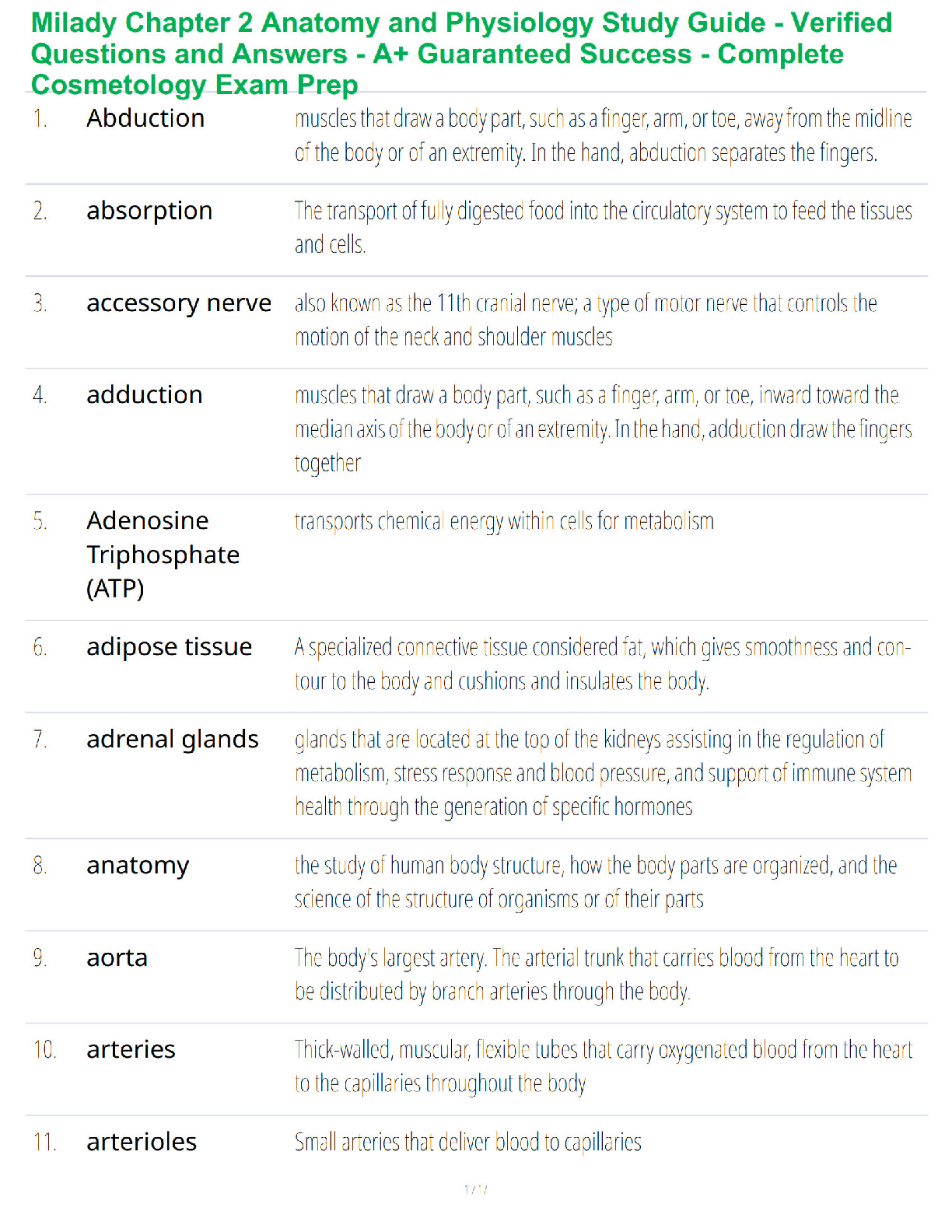
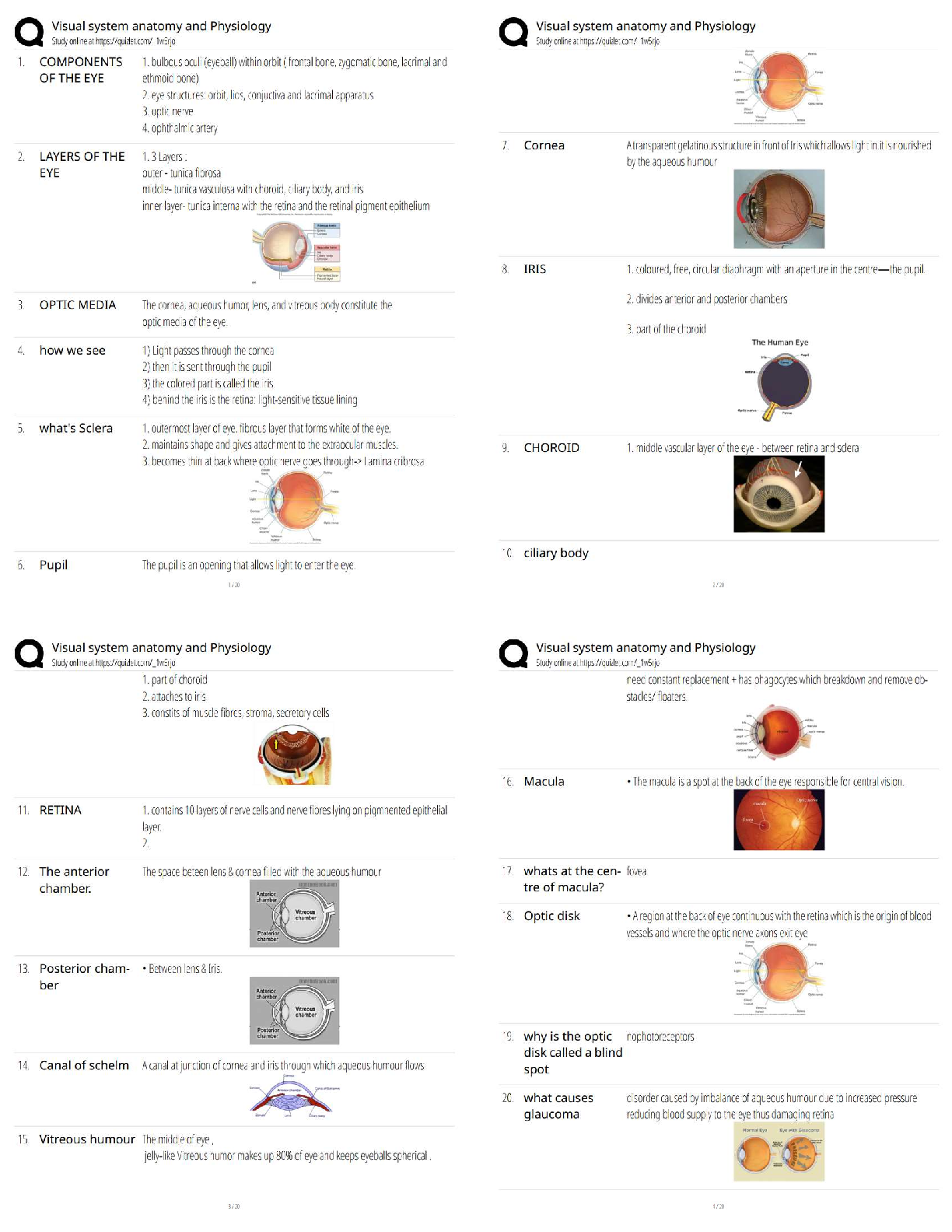




 (Diane Pacitti etc.png)