EPPP ETHICS REAL EXAM QUESTIONS AND ANSWERS 100% ACCURATE
The Examination for Professional Practice in Psychology (EPPP) is best described as:
A
a measure of basic knowledge of psychology.
B
a predictor of job profi
...
EPPP ETHICS REAL EXAM QUESTIONS AND ANSWERS 100% ACCURATE
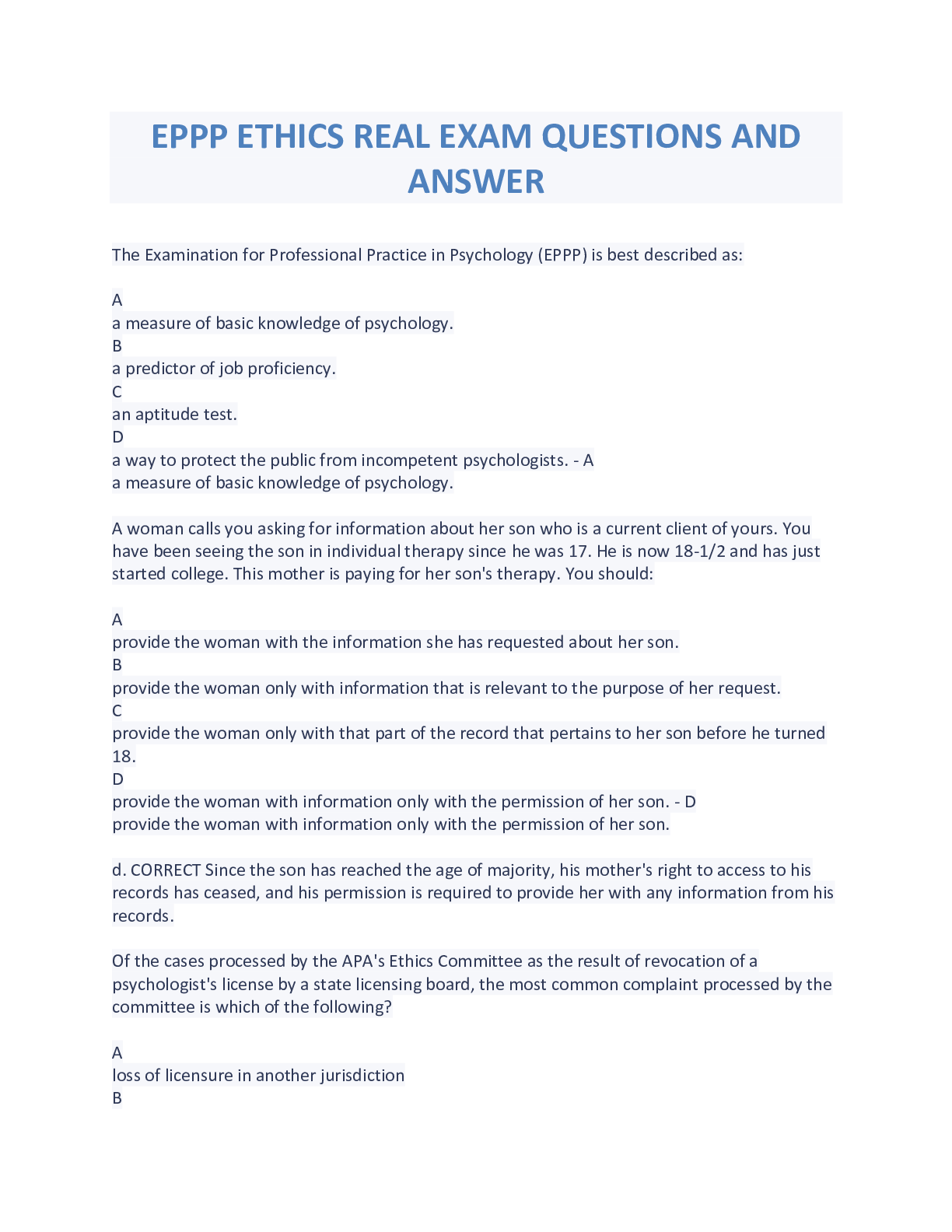
The Examination for Professional Practice in Psychology (EPPP) is best described as:
A
a measure of basic knowledge of psychology.
B
a predictor of job proficiency.
C
an aptitude test.
D
a way to protect the public from incompetent psychologists. - A
a measure of basic knowledge of psychology.
A woman calls you asking for information about her son who is a current client of yours. You
have been seeing the son in individual therapy since he was 17. He is now 18-1/2 and has just
started college. This mother is paying for her son's therapy. You should:
A
provide the woman with the information she has requested about her son.
B
provide the woman only with information that is relevant to the purpose of her request.
C
provide the woman only with that part of the record that pertains to her son before he turned
18.
D
provide the woman with information only with the permission of her son. - D
provide the woman with information only with the permission of her son.
d. CORRECT Since the son has reached the age of majority, his mother's right to access to his
records has ceased, and his permission is required to provide her with any information from his
records.
Of the cases processed by the APA's Ethics Committee as the result of revocation of a
psychologist's license by a state licensing board, the most common complaint processed by the
committee is which of the following?
A
loss of licensure in another jurisdiction
B
sexual misconduct
C
breach of confidentiality
D
issues related to competence - A
loss of licensure in another jurisdiction
A review of the reports of the APA's Ethics Committee published in the American Psychologist
from 2000 through 2008 reveals that loss of licensure is the most frequent reason for the
complaints processed by the Ethics Committee; followed by, in order, sexual misconduct with
an adult, inappropriate practice involving child custody, nonsexual dual relationship, and
inappropriate practice involving insurance or fees.
The court offers a defendant the choice of jail or an in-patient alcohol treatment program after
he is found guilty of driving while intoxicated. As the clinician who will be working with the man
at the treatment center, you should keep in mind that:
A
a waiver of confidentiality is not required because treatment has been court-ordered.
B
a waiver of confidentiality is not required because the man gave up his right to confidentiality
by committing the crime.
C
a waiver of confidentiality is not required because the man gave up his right to confidentiality
by choosing the treatment program instead of jail.
D
a waiver of confidentiality is required and should be obtained before you release any
information about the man's treatment to the court. - d. CORRECT The usual procedure is for
the individual to sign a waiver of confidentiality when he/she chooses the treatment option.
However, you would want to check to make sure this has occurred and, if not, you would want
to obtain a signed waiver.
You suspect a colleague of violating ethical guidelines. To be consistent with the provisions of
the Ethics Code, you should:
A
report the colleague to the local Ethics Committee immediately.
B
report the colleague to the local Ethics Committee only if the ethical violation is a serious one.
C
attempt to handle the situation informally by discussing the violation with the colleague and file
a report only if he is uncooperative.
[Show More]





![Preview of eBook [PDF] Abnormal Psychology 6th Edition By Gordon L. Flett, Nancy L. Kocovski, Gerald](https://scholarfriends.com/storage/Abnormal Physcology.png)
![Preview of Educational Psychology 8th Edition by John W. Santrock | eBook [PDF]](https://scholarfriends.com/storage/8BYyNJBH2025-01-30-09-00679bbe33eb6d6.png)

![Preview of eBook [PDF] Psychology of Success 8th Edition By Denis Waitley](https://browseimages.nyc3.digitaloceanspaces.com/paper-images/2024/Aug/29/1Z6F4tnd2024-08-29-08-3766d00924d3776.png)