Pharmacology Pediatrics Final HESI (Evolve) - Questions and Answers A 4-year-old child is admitted to the pediatric unit with the diagnosis of acute lymphocytic leukemia (ALL). A blood transfusion is ordered, and an in
...
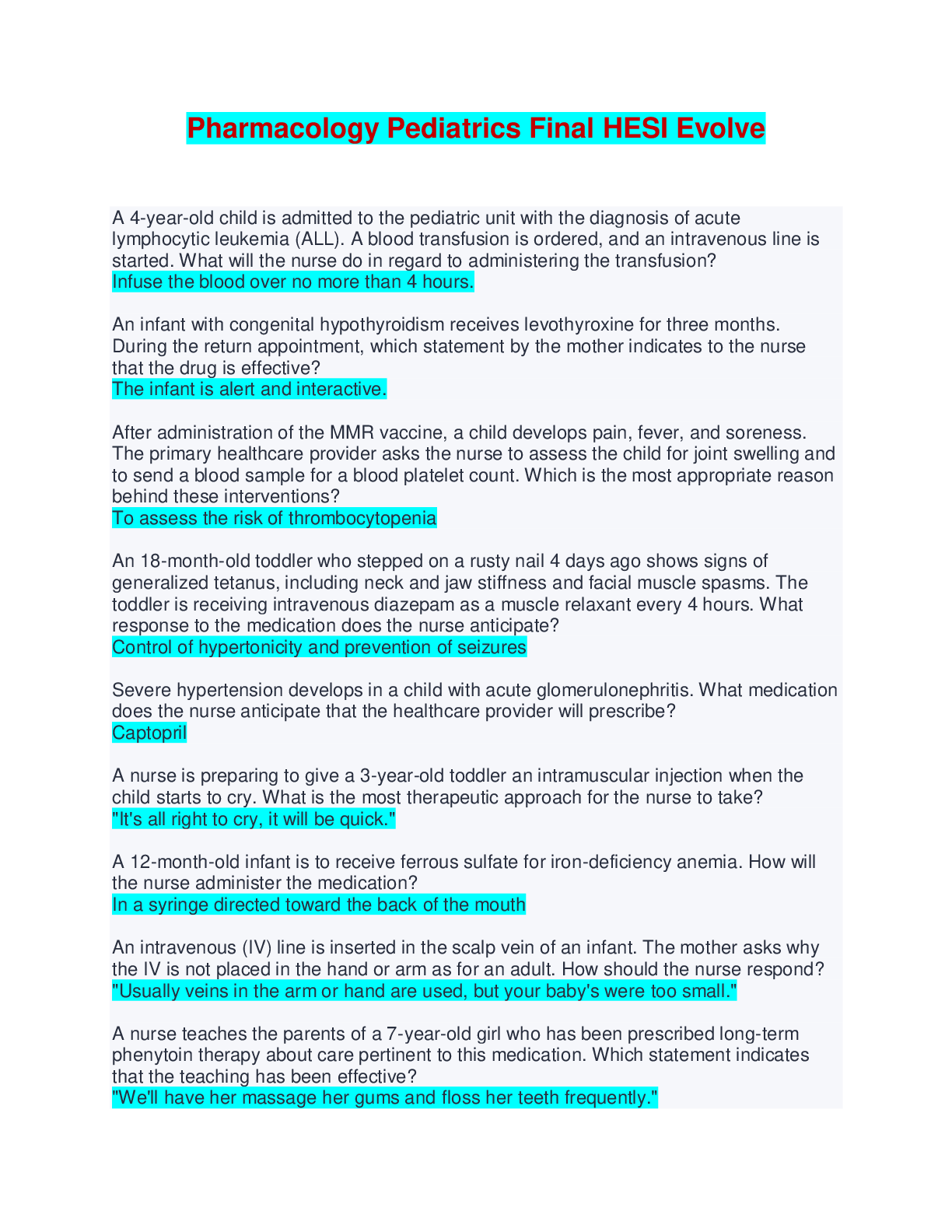
Pharmacology Pediatrics Final HESI (Evolve) - Questions and Answers A 4-year-old child is admitted to the pediatric unit with the diagnosis of acute lymphocytic leukemia (ALL). A blood transfusion is ordered, and an intravenous line is started. What will the nurse do in regard to administering the transfusion? Infuse the blood over no more than 4 hours. An infant with congenital hypothyroidism receives levothyroxine for three months. During the return appointment, which statement by the mother indicates to the nurse that the drug is effective? The infant is alert and interactive. After administration of the MMR vaccine, a child develops pain, fever, and soreness. The primary healthcare provider asks the nurse to assess the child for joint swelling and to send a blood sample for a blood platelet count. Which is the most appropriate reason behind these interventions? To assess the risk of thrombocytopenia An 18-month-old toddler who stepped on a rusty nail 4 days ago shows signs of generalized tetanus, including neck and jaw stiffness and facial muscle spasms. The toddler is receiving intravenous diazepam as a muscle relaxant every 4 hours. What response to the medication does the nurse anticipate? Control of hypertonicity and prevention of seizures Severe hypertension develops in a child with acute glomerulonephritis. What medication does the nurse anticipate that the healthcare provider will prescribe? Captopril A nurse is preparing to give a 3-year-old toddler an intramuscular injection when the child starts to cry. What is the most therapeutic approach for the nurse to take? "It's all right to cry, it will be quick." A 12-month-old infant is to receive ferrous sulfate for iron-deficiency anemia. How will the nurse administer the medication? In a syringe directed toward the back of the mouth An intravenous (IV) line is inserted in the scalp vein of an infant. The mother asks why the IV is not placed in the hand or arm as for an adult. How should the nurse respond? "Usually veins in the arm or hand are used, but your baby's were too small." A nurse teaches the parents of a 7-year-old girl who has been prescribed long-term phenytoin therapy about care pertinent to this medication. Which statement indicates that the teaching has been effective? "We'll have her massage her gums and floss her teeth frequently." A nurse is planning to give a preschool child an immunization consisting of bacteria that have been modified. What is the substance called? A vaccine The nurse is caring for a 7-year-old child with the diagnosis of plumbism. Edetate calcium disodium (calcium EDTA), a chelating agent, is prescribed. What is the most appropriate assessment before the calcium EDTA is administered? Checking for protein in the urine Status epilepticus develops in an adolescent with a seizure disorder who is taking antiseizure medication. What does the nurse identify as the most common reason for the development of status epilepticus? The prescribed antiseizure drug probably is not taken consistently. A senior nurse teaches a nursing student about how to treat poisoning in young children. Which statement by the nursing student indicates the need for further teaching? "Syrup of ipecac should be administered immediately after poisoning." A healthcare provider prescribes inhaled corticosteroids for a 6-year-old child with asthma. The nurse concludes that the mother understands the teaching about the side effects of this medication when the mother makes which statement? "I'll check for white patches in the mouth."
[Show More]