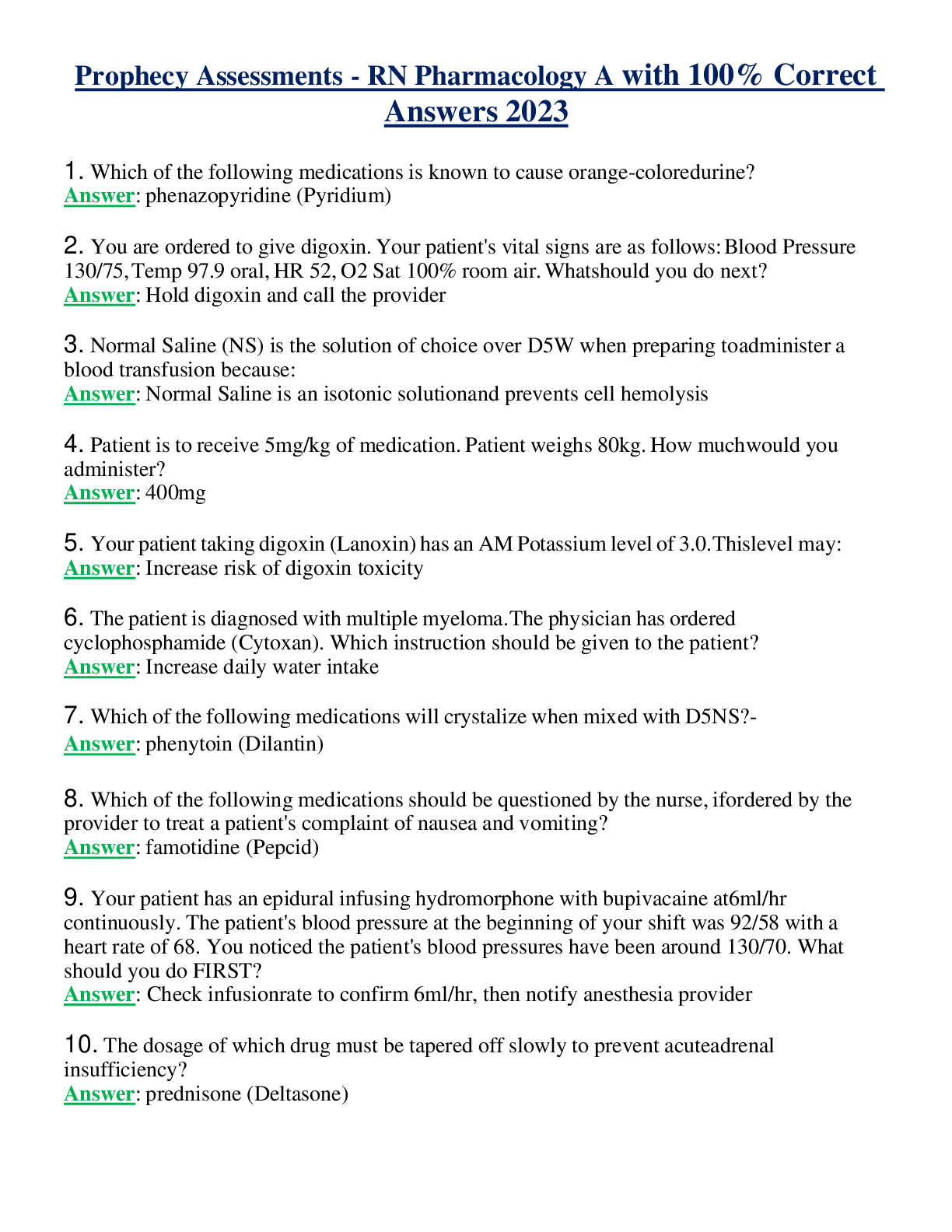
1. Which of the following medications is known to cause orange-coloredurine?
Answer: phenazopyridine (Pyridium)
2. You are ordered to give digoxin. Your patient's vital signs are as follows:Blood Pressure
130/75,Temp
...
1. Which of the following medications is known to cause orange-coloredurine?
Answer: phenazopyridine (Pyridium)
2. You are ordered to give digoxin. Your patient's vital signs are as follows:Blood Pressure
130/75,Temp 97.9 oral, HR 52, O2 Sat 100% room air.Whatshould you do next?
Answer: Hold digoxin and call the provider
3. Normal Saline (NS) is the solution of choice over D5W when preparing toadminister a
blood transfusion because:
Answer: Normal Saline is an isotonic solutionand prevents cell hemolysis
4. Patient is to receive 5mg/kg of medication. Patient weighs 80kg. How muchwould you
administer?
Answer: 400mg
5. Your patient taking digoxin (Lanoxin) has an AM Potassium level of 3.0.Thislevel may:
Answer: Increase risk of digoxin toxicity
6. The patient is diagnosed with multiple myeloma.The physician has ordered
cyclophosphamide (Cytoxan). Which instruction should be given to the patient?
Answer: Increase daily water intake
7. Which of the following medications will crystalize when mixed with D5NS?-
Answer: phenytoin (Dilantin)
8. Which of the following medications should be questioned by the nurse, ifordered by the
provider to treat a patient's complaint of nausea and vomiting?
Answer: famotidine (Pepcid)
9. Your patient has an epidural infusing hydromorphone with bupivacaine at6ml/hr
continuously. The patient's blood pressure at the beginning of your shift was 92/58 with a
heart rate of 68. You noticed the patient's blood pressures have been around 130/70. What
should you do FIRST?
Answer: Check infusionrate to confirm 6ml/hr, then notify anesthesia provider
10. The dosage of which drug must be tapered off slowly to prevent acuteadrenal
insufficiency?
Answer: prednisone (Deltasone)
[Show More]