PRINCIPLES OF SURGERY EXAM ANSWER KEY 2024-COMPLETE SOLUTION
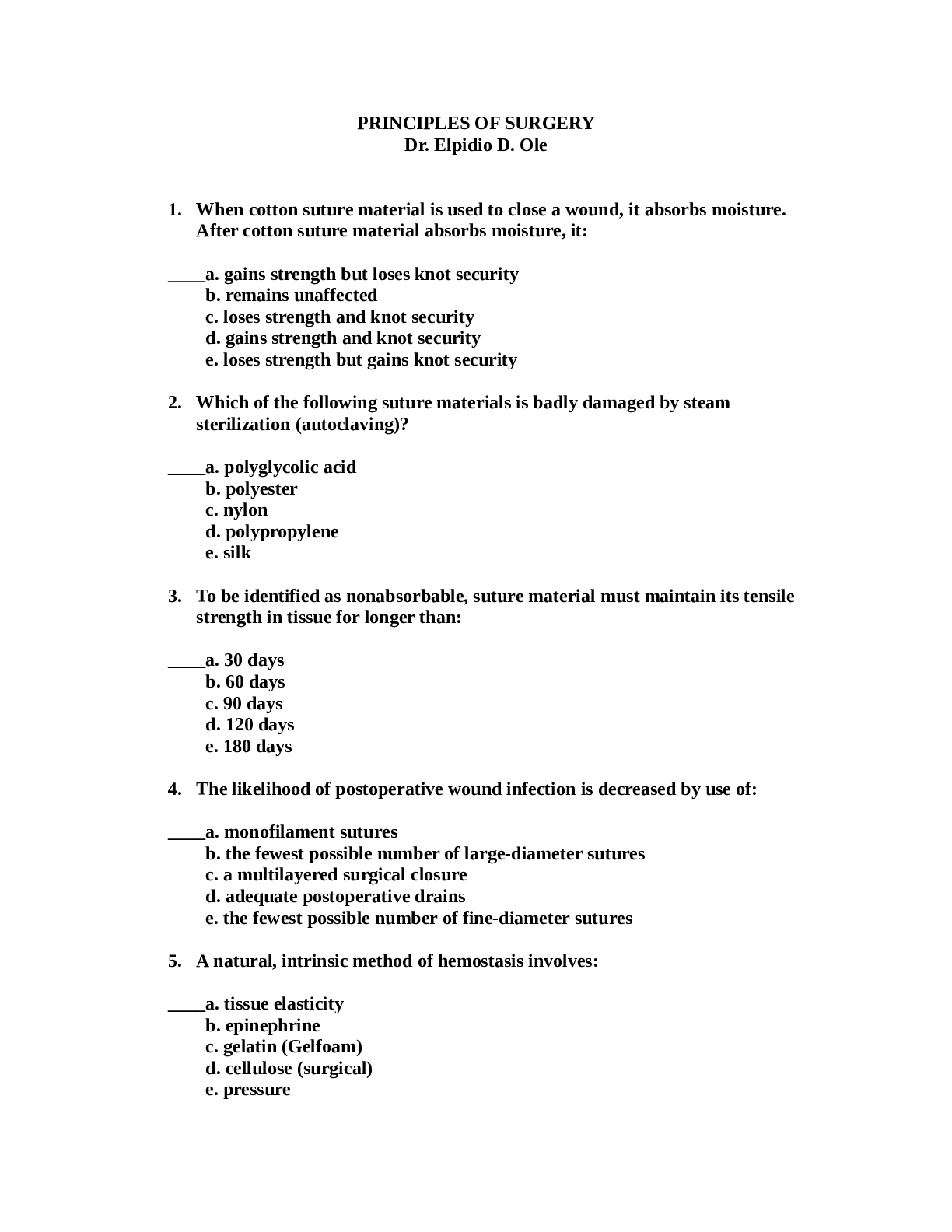
A tourniquet applied to a limb should not be left in place continuously for
longer than:
____a. 1 hour
b. 2 hours
c. 3 hours
d. ½ hour
e. 3 ½ hours
...
PRINCIPLES OF SURGERY EXAM ANSWER KEY 2024-COMPLETE SOLUTION
A tourniquet applied to a limb should not be left in place continuously for
longer than:
____a. 1 hour
b. 2 hours
c. 3 hours
d. ½ hour
e. 3 ½ hours
7. During surgery, a tourniquet applied to a body part should be:
____a. removed 5 minutes at half-hourly intervals
b. removed 10 minutes at half-hourly intervals
c. removed 10 minutes at hourly intervals
d. removed 15 minutes at hourly intervals
e. left in place until the procedure is completed
8. An autoclaved instrument pack protected by doubly-wrapped muslin and
stored on an open shelf will remain sterile for:
____a. 10 weeks
b. 8 weeks
c. 3 weeks
d. 12 weeks
e. 2 weeks
9. The pathogens most resistant to chemicals used for disinfection are:
____a. viruses
b. bacterial spores
c. fungi
d. vegetative bacteria
e. Gram-negative bacteria
10. The blood cells most critical for preventing infection are the:
____a. platelets
b. monocytes
c. lymphocytes
d. granulocytes
e. plasma cells
11. The organism most commonly cultured from bones with osteomyelitis in dogs
is:
____a. coagulase-positive Staphylococcus
b. Escherichia coli
c. Corynebacterium
d. Pasteurella
e. beta-hemolytic Streptococcus
12. Assuming other factors remain constant, for every hour of surgical time, the
infection rate:
____a. quadruples
b. triples
c. doubles
d. increases by 104
e. increases by 106
13. What estimated number of bacteria (per gram of tissue) is required for
infection to occur in a surgical wound?
____a. 5,000,000
b. 1,000,000
c. 10,000,000
d. 500,000
e. 750,000
14. Which suture produces eversion of tissues?
____a. crushing
b. Lembert
c. Cushing
d. horizontal mattress
e. Connell
15. Concerning types of wounds, which statement is most accurate?
____a. A contusion is a superficial wound in which only the skin is broken.
b. An abrasion results from penetration of the skin or mucous membrane
by a sharp object.
c. An incision is a superficial wound that results from rubbing off of the
epidermis and a portion of the dermis.
d. A penetrating wound is a stab wound in which the object enters an organ
and emerges from the opposite side.
e. A laceration is created by a dull object that is sufficiently sharp to tear
tissues.
16. Though hexachlorophene is a very effective antiseptic, a serious disadvantage
is that it:
____a. is easily inactivated
b. is highly allergenic
c. is unstable and rapidly loses its effectiveness
d. is absorbed through the skin and is neurotoxic
e. tends to sear tissues, trapping pockets of bacteria
17. Concerning sterilization by ethylene oxide, which statement is most
accurate?
____a. It is highly flammable and toxic, and should be used only on plastics and
objects unable to tolerate steam sterilization.
b. It is effective against bacteria, viruses and spores.
c. It is corrosive to delicate electrical equipment.
d. Ethylene oxide sterilization is less complex than autoclaving but requires
24 hours of aeration of sterilized material.
e. Ethylene oxide sterilization requires special care in packaging.
18. Which suture pattern does not invert the incision edges when used to close a
viscus?
____a. Cushing
b. crushing
c. Connell
d. Lembert
e. Parker-Kerr
19. A ground plate is not required with:
____a. a damped intermittent current
b. electrocoagulation
c. a biterminal unit
d. electrocautery
e. fulguration
[Show More]