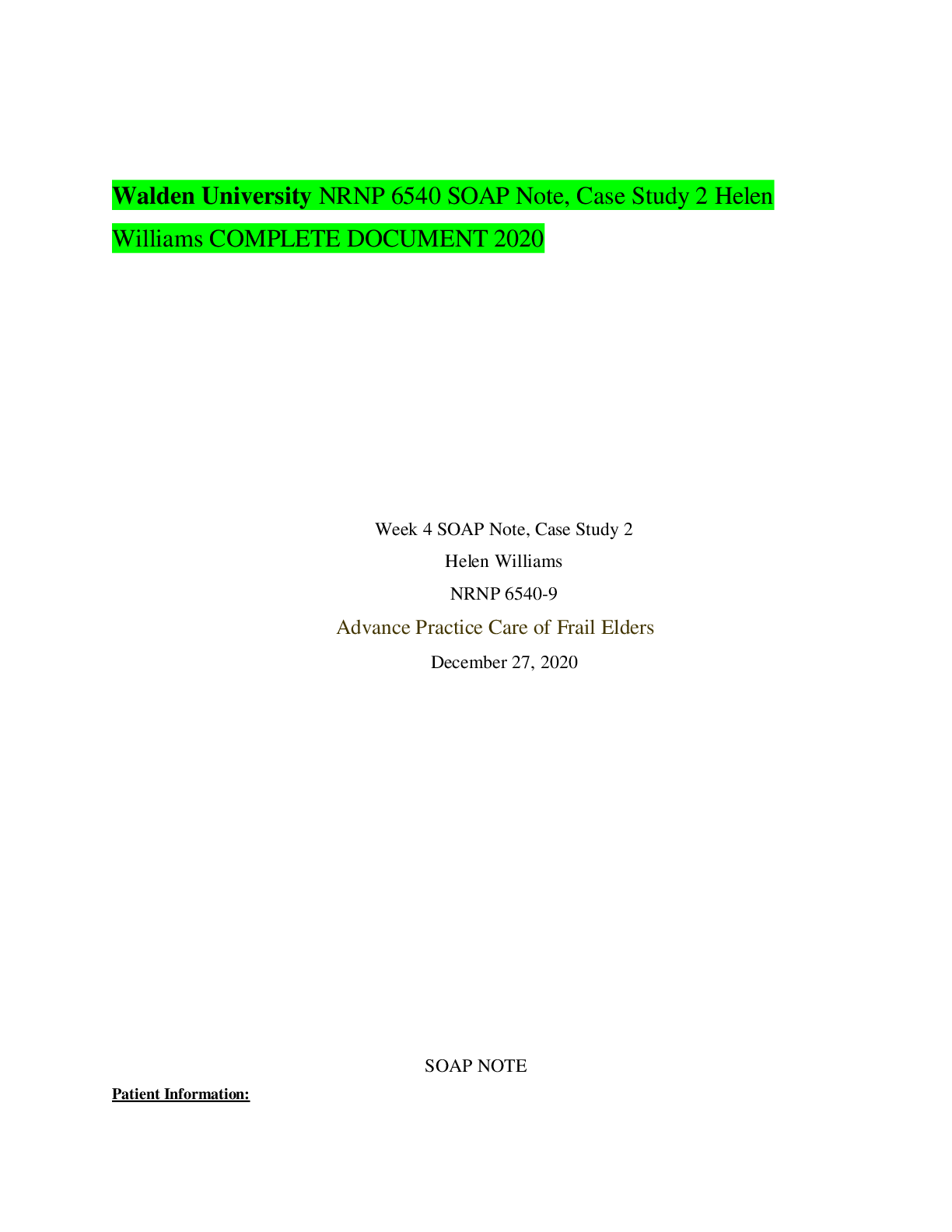
*NURSING > A-Level Question Paper > NRNP 6540 Midterm Exam (All)
2. You see a 69-year-old patient who recently moved to town and does not remember his last tetanus shot. What would you do? 3. E. D. is a 78-year-old woman who does not remember if she has ever had ... the immunization for herpes zoster. She does remember having chicken pox as a child. What would you recommend for her? Correct Answer: You could do one of two strategies: perform serologic testing for tetanus and diphtheria antitoxin to see if they are immune, or give one dose of Tdap, followed by Td at least 4 weeks later, followed by another dose of Td 6–12 months later. Tetanus/Tdap: In older adults, if the recommended childhood series was not done at all, the recommendation is one dose of Tdap, followed by Td at least 4 weeks later, followed by another dose of Td 6–12 months later. If vaccination documentation is incomplete, the provider can either consider serologic testing for tetanus and diphtheria antitoxin or assume that no vaccinations have been received and administer vaccine as directed above for patients who have not been vaccinated. 2 / Correct Answer: All influenza vaccines have the potential to cause an egg-related allergic reaction. Persons with a history of egg allergy who have experienced only urticaria after exposure to egg should receive influenza vaccine. Correct Answer: Before travel, older adults should be up to date on routine vaccines. Older adults should also receive other vaccines recommended for the countries they are visiting. These are listed by country on the CDC's Destinations Pages. Correct Answer: Older individuals are more likely to experience a severe infection, develop pneumonia, require hospitalization, or die. Mortality rates in patients 75 years and older are four to eight times higher than those seen for patients aged 65 to 74 years, and over 50 times higher than those seen before the age of 65 years. A total of 90% of deaths attributable to influenza occur in individuals aged 60 years and older. Following an acute care hospitalization, many older adults fail to return to their previous level of function. Nearly 40% of relatively healthy community-dwelling older adults who reported the presence of influenza or influenza-like illness required more than 2 weeks to recover, 20% required new assistance with daily functional tasks, and 13.9% were hospitalized. Aging impairs the ability of the immune system to adequately respond to influenza vaccination and infection, both in terms of humoral (antibody) and cell-mediated responses. The magnitude of these aging-related declines is increased in the presence of both frailty and chronic cytomegalovirus infection. 4. Name the most common allergic response to the flu vaccine, 5. Many older adults travel worldwide when they retire. For patients who are planning to travel overseas, what would you recommend? 6. Give three reasons why older adults are especially vulnerable to complications of influenza infections. 7. You have an 89-year-old patient on hospice care in a long-term care facility. The protocol is for flu vaccine to be given to all patients each fall. Would you vaccinate? Why, or why not? Correct [Show More]
Last updated: 1 year ago
Preview 1 out of 9 pages
Buy this document to get the full access instantly
Instant Download Access after purchase
Buy NowInstant download
We Accept:
Can't find what you want? Try our AI powered Search
Connected school, study & course
About the document
Uploaded On
Apr 09, 2024
Number of pages
9
Written in
All
This document has been written for:
Uploaded
Apr 09, 2024
Downloads
0
Views
82
Scholarfriends.com Online Platform by Browsegrades Inc. 651N South Broad St, Middletown DE. United States.
We're available through e-mail, Twitter, Facebook, and live chat.
FAQ
Questions? Leave a message!
Copyright © Scholarfriends · High quality services·