BIOS-255 Week 5 Exam 2 (Week 3 and 4): - With 100% Correct Answers- Graded An A+
1. A missing p-wave indicated what structure is not depolarizing/firing properly thus not properly depolarizing the atrium?
a. AV node
...
BIOS-255 Week 5 Exam 2 (Week 3 and 4): - With 100% Correct Answers- Graded An A+
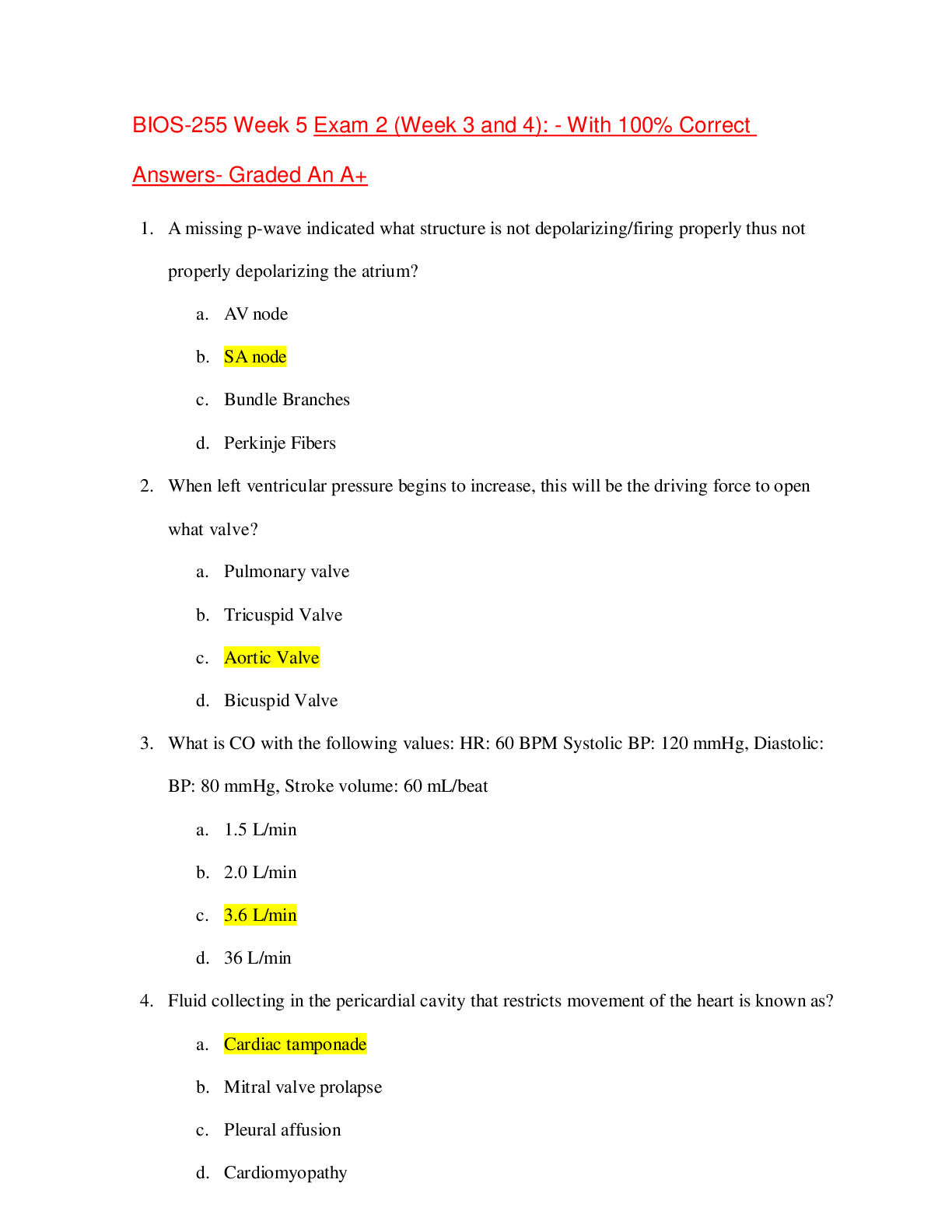
1. A missing p-wave indicated what structure is not depolarizing/firing properly thus not properly depolarizing the atrium?
a. AV node
b. SA node
c. Bundle Branches
d. Perkinje Fibers
2. When left ventricular pressure begins to increase, this will be the driving force to open what valve?
a. Pulmonary valve
b. Tricuspid Valve
c. Aortic Valve
d. Bicuspid Valve
3. What is CO with the following values: HR: 60 BPM Systolic BP: 120 mmHg, Diastolic:
BP: 80 mmHg, Stroke volume: 60 mL/beat
a. 1.5 L/min
b. 2.0 L/min
c. 3.6 L/min
d. 36 L/min
4. Fluid collecting in the pericardial cavity that restricts movement of the heart is known as?
a. Cardiac tamponade
b. Mitral valve prolapse
c. Pleural affusion
d. Cardiomyopathy
5. Structure that permits blood flow from right atrium to the left atrium in fetal circulation?
a. Foramen ovale
b. Interatrial septum
c. Coronary sinus
d. Fossa ovalis
6. Blood leaves the right ventricle by passing through which of the following valves? Exam question
a. Aortic Valve
b. Pulmonary Valve
c. Mitral Valve
d. Tricuspid Valve
7. The cusps (leaflets) of atrioventricular valves attach directly to the ?
a. Papillary muscle
b. Trabeculae carneae
c. Chordae tendineae
d. Coronary sulci
8. Contraction of papillary muscles:
a. Close the atrioventricular valves
b. Close the semilunar valves
c. Eject blood from the ventricles
d. Prevents the atrioventricular valve eversion
9. The visceral pericardium is the same as the:
a. Mediastinum
b. Parietal pericardium
c. Epicardium
d. Myocardium
10. The left ventricle pumps blood to the ?
a. Lungs
b. Right ventricle
c. Right atrium
d. Aorta
11. When ventricular pressure drops to less than atrial pressure, the AV valves then ?
a. Close
b. Open
c. Make the third heart sound
d. Contract
12. The pulmonary semilunar valve prevents backward flow into the ?
a. Aorta
b. Pulmonary trunk
c. Pulmonary veins
d. Right ventricle
13. In an EKG trace, the p-wave represents what?
a. Ventricular depolarization
b. Ventricular repolarization
c. Atrial depolarization
d. Atrial repolarization
14. In an EKG trace, the QRS-complex represents what?
a. Ventricular depolarization
b. Ventricular repolarization
c. Atrial depolarization
d. Atrial repolarization
15. The second nodal tissue structure to depolarize during one cardiac cycle is the ?
a. Perkinje fibers
b. SA node
c. AV node
d. Bundle branches
16. A heartrate that is above 100 beats per minute is known as what?
a. Tachycardia
b. Bradycardia
c. Atrial vibrations
17. The expandable extension of an atrium is called what?
a. Apex
b. Base
c. Auricle
d. Fossa ovalis
18. Each of the following will increase cardiac output EXCEPT:
a. Increased sympathetic stimulation
b. Increased venous return
c. Increased parasympathetic simulation
d. Increased heart rate
19. Cardiac muscle generate ATP via and .
a. Aerobic cellular respiration and citric acid cycle
b. Anaerobic cellular respiration and creating phosphate
c. Creatine phosphate and The Afterburn cycle
d. Glycolysis and glucose
20. This blood vessel carries blood away from the heart
a. Veins
b. Arteries
c. Venules
d. Capillaries
21. What type of circulation carries O2 and nutrients to body tissues and removes CO2 and wastes?
a. Fetal circulation
b. Pulmonary circulation
c. Hepatic portal circulation
d. Systemic circulation
22. The outer most layer of a blood vessel is?
a. Tunica externa
b. Tunica media
c. Tunica interna
d. Tunica outsidia
23. Which arteries are the largest in the body? Exam question
a. Muscular arteries
b. Pulmonary artery
c. Brachial artery
d. Elastic arteries
24. Where is your brachial artery located?
a. Posterior to the knee
b. Lateral to the larynx
c. Medial side of the biceps brachii
d. Medial to ear
25. Which one of these is NOT a type of shock?
a. Adrenal shock
b. Cardiogenic shock
c. Vascular shock
d. Obstructive shock
26. What is vasoconstriction? Exam question
a. The increase of the lumen in diameter
b. The distribution of blood to various parts of the body
c. The volume of blood that flows through tissue at any given time
d. The decrease in the diameter of the lumen of a blood vessel
27. Failure of the CV system to deliver enough O2 and nutrients to meet cellular metabolism results in: Exam question
a. Bradycardia
b. Aneurysm
c. Hypotension
d. Shock
28. The main control of peripheral resistance occurs in the
a. Arterioles
b. Venules
c. Veins
d. Capillaries
29. Resistance acts to:
a. Increases blood flow
b. Decreases blood flow
c. Never changes in a blood vessel
d. Acts with pressure to move blood along a vessel
30. The sites of exchange between the blood and the tissues are the
a. Arteries
b. Arterioles
c. Capillaries
d. Venules
31. Veins?
a. Carry blood toward the heart
b. Have thick layers of smooth muscle in the tunica medica
c. Hemoglobin
d. Have thin layers of connective tissue in the tunica externa
32. The volume of blood flowing back to the heart through systemic veins is called .
a. Microcirculation
b. Venus return
c. Pulmonary circulation
d. Venus input
33. Monitors move of joints and muscles provide input to the CV center during physical activity.
a. Proprioceptors
b. Chemoreceptor
c. Respiratory receptors
d. Filtration
34. Which option is venous return assisted by?
a. Skeletal muscle pump
b. Respiratory pump
c. Valves
d. All of the above
35. The development of blood cells and the formation of blood vessels come from which germ layer? Exam question
a. Mesoderm
b. Endoderm
c. Ectoderm
d. Epiderm
36. Which best describes a lymph node?
a. A type of pathogen that attacks the immune system
b. A special kind of immune cell that is found in the lymph
c. A capsule in lymph vessels filled with B cells and T cells
37. What is edema?
a. Swelling
b. Removing of lymph nodes
c. Cancer
d. Part of the lymphatic system
38. Lymph flow is maintained by
a. Pressure changes in the veins
b. Viscosity of lymph
c. Pressure changes during breathing
d. Length of vessel
39. Lymphatic tissue, mostly lymphocytes & microphages arranged around branches of splenic arteries
a. Red pulp
b. Medulla of spleen
c. White pulp
d. Hilus
40. Which of the following is an area of the body that will drain into the right lymphatic duct? Exam question
a. Right leg
b. Left leg
c. Right arm
d. Left head and neck
41. Which of the following is the correct order of lymphatic drainage?
a. Lymphatic trunks, vessels, nodes, and ducts
b. Lymphatic vessels, nodes, trunks, and ducts
c. Lymphatic nodes, trunks, ducts, and vessel
d. Lymphatic nodes, vessels, ducts, and trunks
42. What is the name of the structure formed by the joining of the lymphatics from both lower extremities? Exam question
a. Cisterna chyli
b. Thoracic duct
c. Lumbar trunk
d. Spleen
43. What is the name of the lymphatic organ that can be found between both lungs? Exam question
a. Thyroid gland
b. Spleen
c. Thymus gland
d. Posterior lymph sac
[Show More]