BIOS 255 Week 8 Final Exam (Essay & Explanatory) – Download To Score An A+
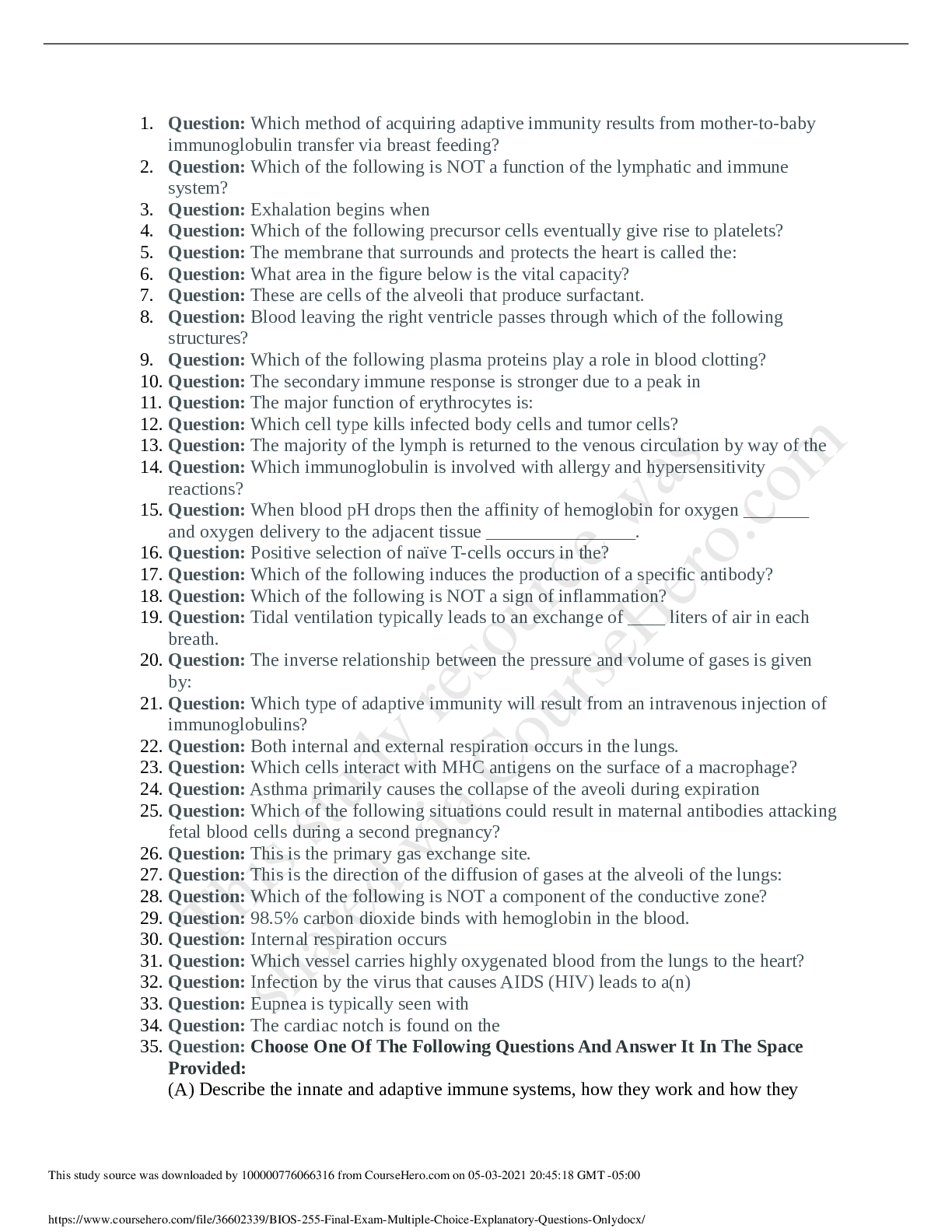
1. Question: Describe innate and adaptive immune systems, how they work and how they interact.
2. Question: Explain the various subclasses of a
...
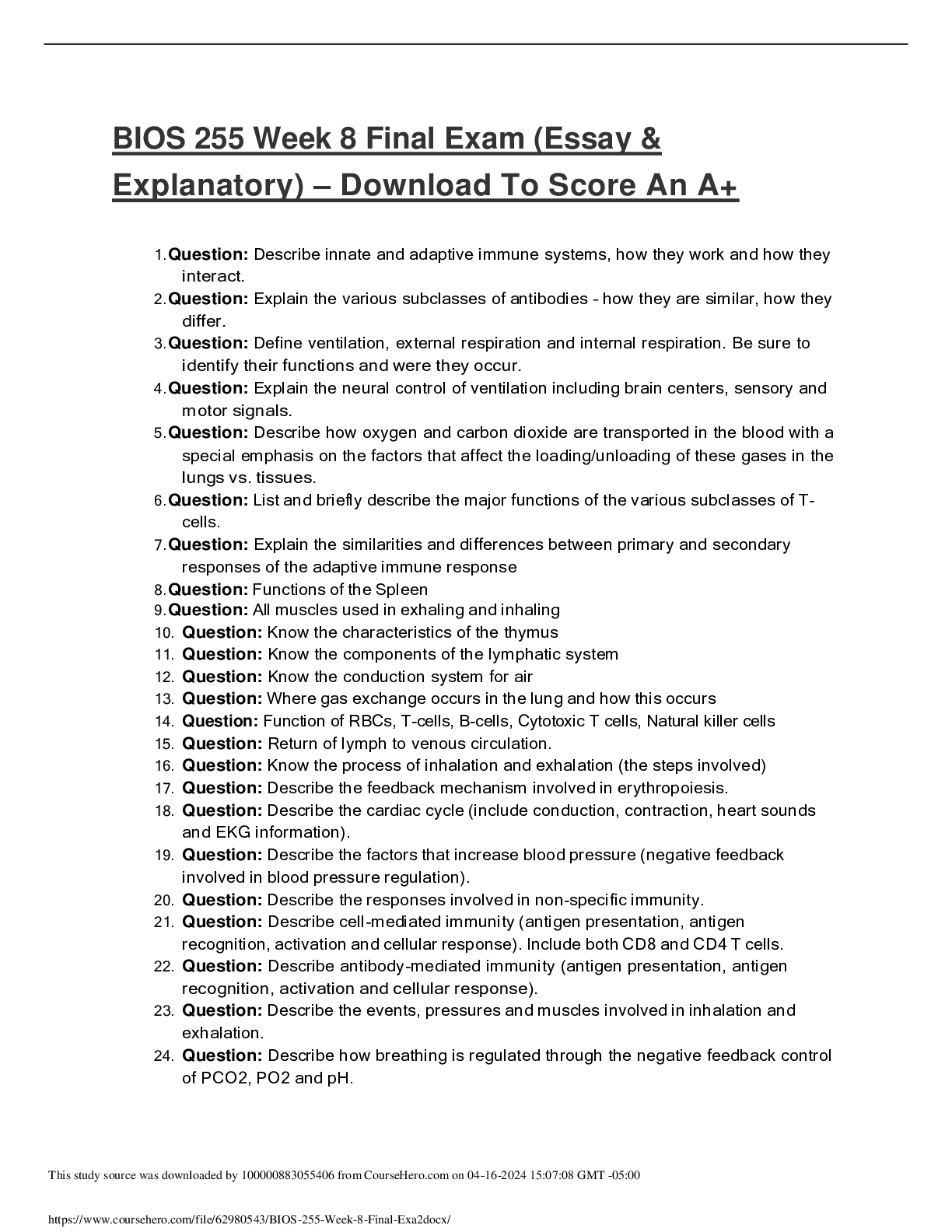
BIOS 255 Week 8 Final Exam (Essay & Explanatory) – Download To Score An A+
1. Question: Describe innate and adaptive immune systems, how they work and how they interact.
2. Question: Explain the various subclasses of antibodies – how they are similar, how they differ.
3. Question: Define ventilation, external respiration and internal respiration. Be sure to identify their functions and were they occur.
4. Question: Explain the neural control of ventilation including brain centers, sensory and motor signals.
5. Question: Describe how oxygen and carbon dioxide are transported in the blood with a special emphasis on the factors that affect the loading/unloading of these gases in the lungs vs. tissues.
6. Question: List and briefly describe the major functions of the various subclasses of T- cells.
7. Question: Explain the similarities and differences between primary and secondary responses of the adaptive immune response
8. Question: Functions of the Spleen
9. Question: All muscles used in exhaling and inhaling
10. Question: Know the characteristics of the thymus
11. Question: Know the components of the lymphatic system
12. Question: Know the conduction system for air
13. Question: Where gas exchange occurs in the lung and how this occurs
14. Question: Function of RBCs, T-cells, B-cells, Cytotoxic T cells, Natural killer cells
15. Question: Return of lymph to venous circulation.
16. Question: Know the process of inhalation and exhalation (the steps involved)
17. Question: Describe the feedback mechanism involved in erythropoiesis.
18. Question: Describe the cardiac cycle (include conduction, contraction, heart sounds and EKG information).
19. Question: Describe the factors that increase blood pressure (negative feedback involved in blood pressure regulation).
20. Question: Describe the responses involved in non-specific immunity.
21. Question: Describe cell-mediated immunity (antigen presentation, antigen recognition, activation and cellular response). Include both CD8 and CD4 T cells.
22. Question: Describe antibody-mediated immunity (antigen presentation, antigen recognition, activation and cellular response).
23. Question: Describe the events, pressures and muscles involved in inhalation and exhalation.
24. Question: Describe how breathing is regulated through the negative feedback control of PCO2, PO2 and pH.
25. Question: Explain the difference between nonspecific and specific defense and the role of lymphocytes in each of the immune response.
26. Question: Identify the major components of the lymphatic system and explain their functions.
27. Question: List the body’s nonspecific defenses, and explain the function of two of them, also describe the components and mechanisms.
28. Question: Discuss the types of T cells and the role played by each in the immune response, and explain the mechanisms of their activation.
29. Question: Describe the mechanisms of B cell activation and the differentiation of plasma cells and memory B cells.
30. Question: Describe the structure of an antibody, and discuss the types and functions of antibodies in body fluids and secretions.
31. Question: Identify the organs forming the respiratory passageway(s) in descending order until the alveoli are reached. Distinguish between conducting and respiratory zone structures.
32. Question: List several physical factors that influence pulmonary ventilation and list the various lung volumes and capacities.
33. Question: Describe how oxygen and carbon dioxide are ……… in the blood.
34. Question: Compare the causes and consequences of such conditions as chronic bronchitis, emphysema, asthma, COPD, ‘black lung,’ and lung cancer
[Show More]