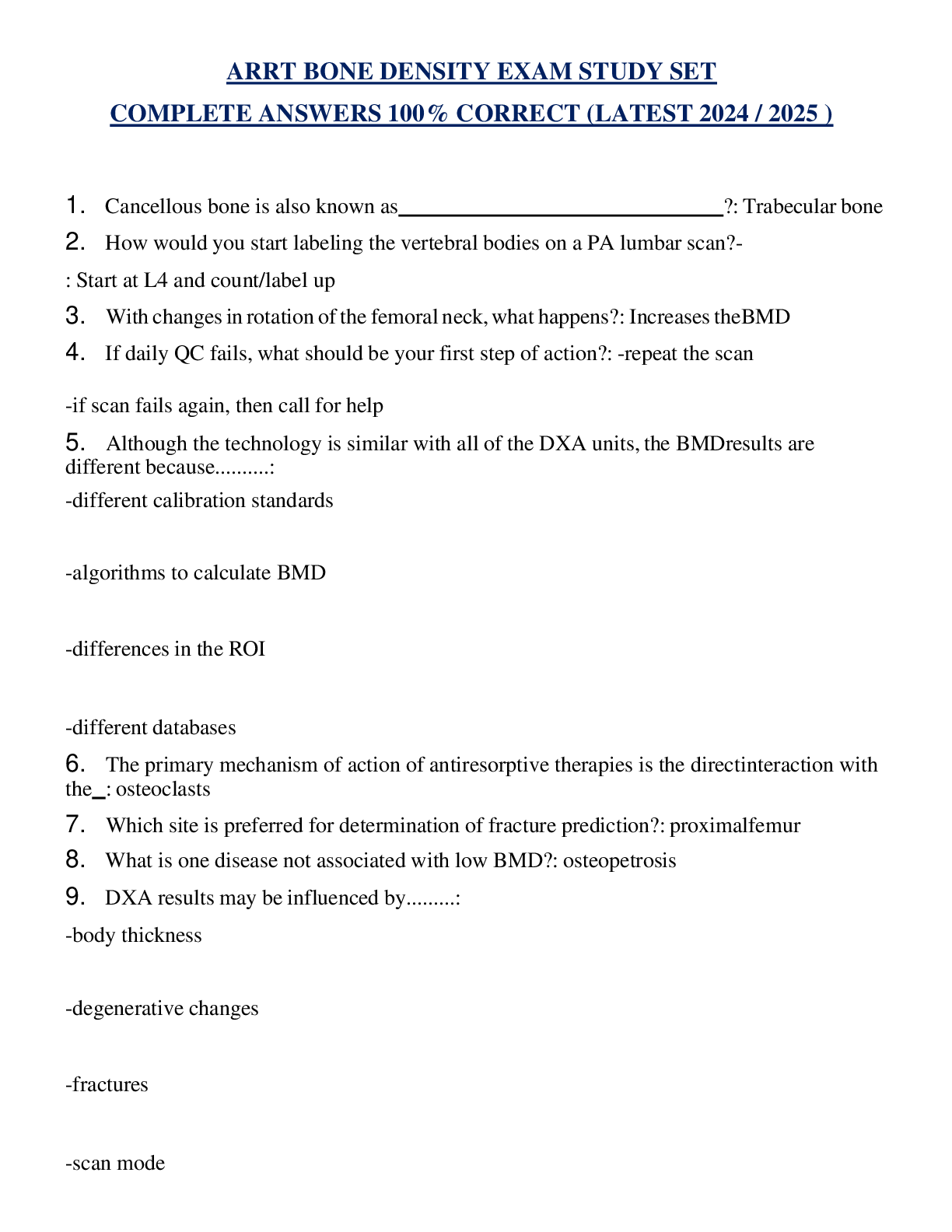
SOC 200 FINAL EXAM 1 (Latest 2023 / 2024) GRADED A+ Questions & Answers
Document Content and Description Below
Power
Answer: Capacity to bring about some outcome, to effect changes or
prevent them from occurring.
It is neutral, does not always require action, and sometimes causes conflict
which is not always a bad thing.
One
...
[Show More]
Last updated: 2 years ago
Preview 1 out of 14 pages
Instant download
Buy this Document to get the Full Access Instantly
Provided by Students Who Aced it
We Verify Document Content to Gurantee Accuracy
Reviews( 0 )
Document information
Connected school, study & course
About the document
Uploaded On
Apr 22, 2024
Number of pages
14
Written in
All

Additional information
This document has been written for:
Uploaded
Apr 22, 2024
Downloads
0
Views
88
Topic Tags
Recommended For You
Get more on EXAM »
$13.5
11 Pages
NR 599 / NR599 Midterm Exam (Latest 2023 / 2024) Nursing Infor...
$25
20 Pages
NURSING Fundamentals Of Nursing Questions and Answers (Latest...
$10
12 Pages
SOC 200 - Case Study Report 1: THREE JAYS CORPORATION; Complet...
$10
7 Pages
OREGON REAL ESTATE FINAL STUDY GUIDE LATEST 2023 RATED A+
$10
12 Pages
NRF Customer Service Study Guide part 2 Latest 2023 Rated A+
$10
12 Pages
NRF Customer Service Study Guide Part 1 Latest 2023 Already Pa...
$20
391 Pages
Society in Focus An Introduction to Sociology 9th Edition By W...
$24
502 Pages
Test Bank for Discover Sociology 4th Edition By William Chambl...
$25
157 Pages
Medical Sociology, 15th Edition William Cockerham | Test Bank
$28
314 Pages
A Concise Introduction to Logic, 12e Patrick Hurley (Instructo...

$15
12 Pages
BEHS 364 Alcohol In U. S. Society Final Examination (updated s...

$100.5
996 Pages
ATI TEAS 7 | 4 Versions for Reading, Math, Science, English, A...
More related documents below