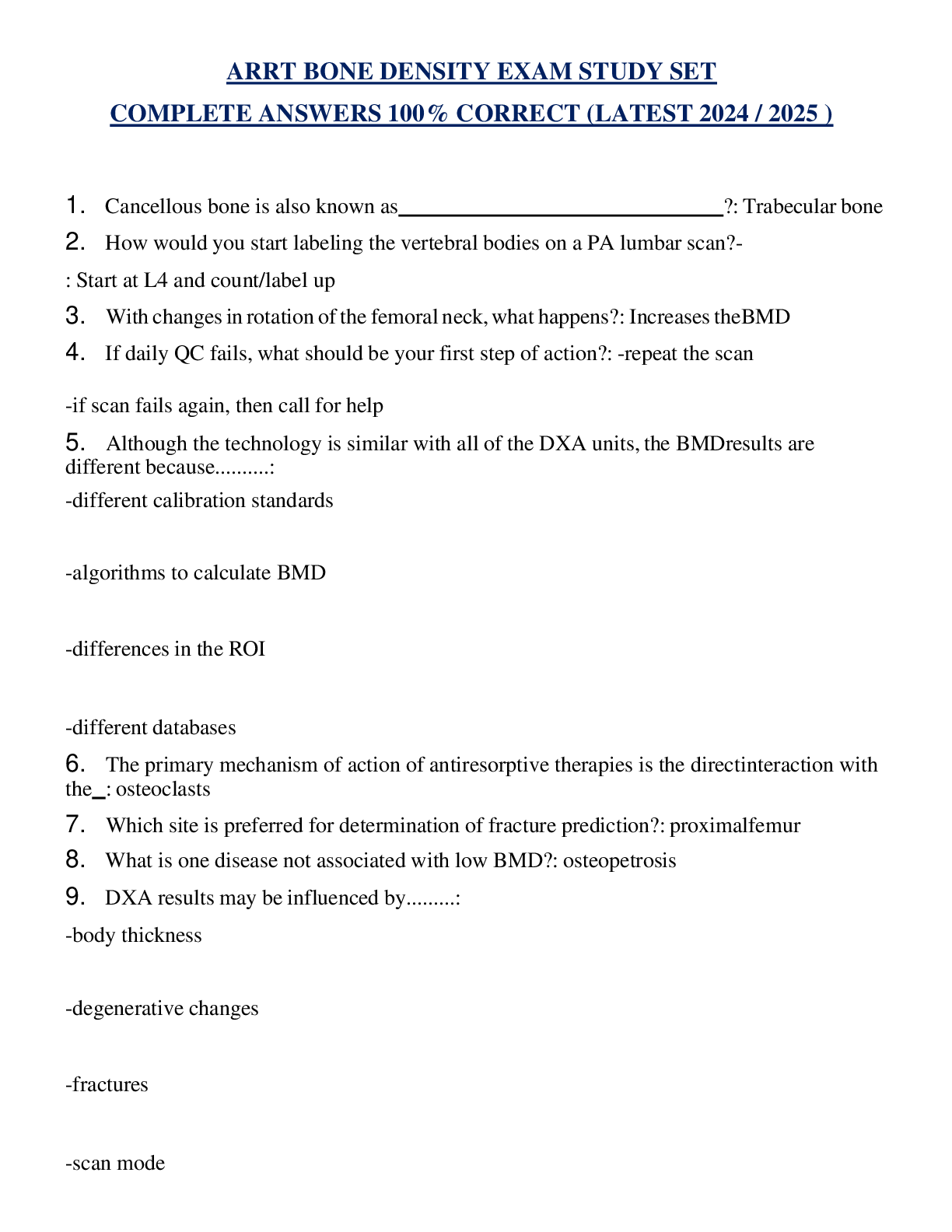
SOC 200 FINAL EXAM 2 (Latest 2023 / 2024) GRADED A+ Questions & Answers
Document Content and Description Below
Deviance is any behavior, belief or condition that violatessignificant social
norms in the society of group in which it occurs. Some forms of deviant
behavior violate the criminal law, which defines the behaviors that
...
[Show More]
Last updated: 2 years ago
Preview 1 out of 10 pages
Instant download
Buy this Document to get the Full Access Instantly
Provided by Students Who Aced it
We Verify Document Content to Gurantee Accuracy
Reviews( 0 )
Document information
Connected school, study & course
About the document
Uploaded On
Apr 22, 2024
Number of pages
10
Written in
All

Additional information
This document has been written for:
Uploaded
Apr 22, 2024
Downloads
0
Views
75
Topic Tags
Recommended For You
Get more on EXAM »
$13.5
11 Pages
NR 599 / NR599 Midterm Exam (Latest 2023 / 2024) Nursing Infor...
$10
12 Pages
SOC 200 - Case Study Report 1: THREE JAYS CORPORATION; Complet...
$8
339 Pages
Pharmacology Exam Study Guide Test Bank_Complete Latest 2023 |...
$10
7 Pages
OREGON REAL ESTATE FINAL STUDY GUIDE LATEST 2023 RATED A+

$25
157 Pages
Medical Sociology, 15th Edition William Cockerham | Test Bank
$20
391 Pages
Society in Focus An Introduction to Sociology 9th Edition By W...
$20
446 Pages
TEST BANK for By the People: Debating American Government 5th...
More related documents below