1. acceptable use policy (AUP)
Answer: A document that stipulates restrictions and practices that a user must agree in order
to use organizational computing and networkresources.
2. Acceptance
Answer: When an organi
...
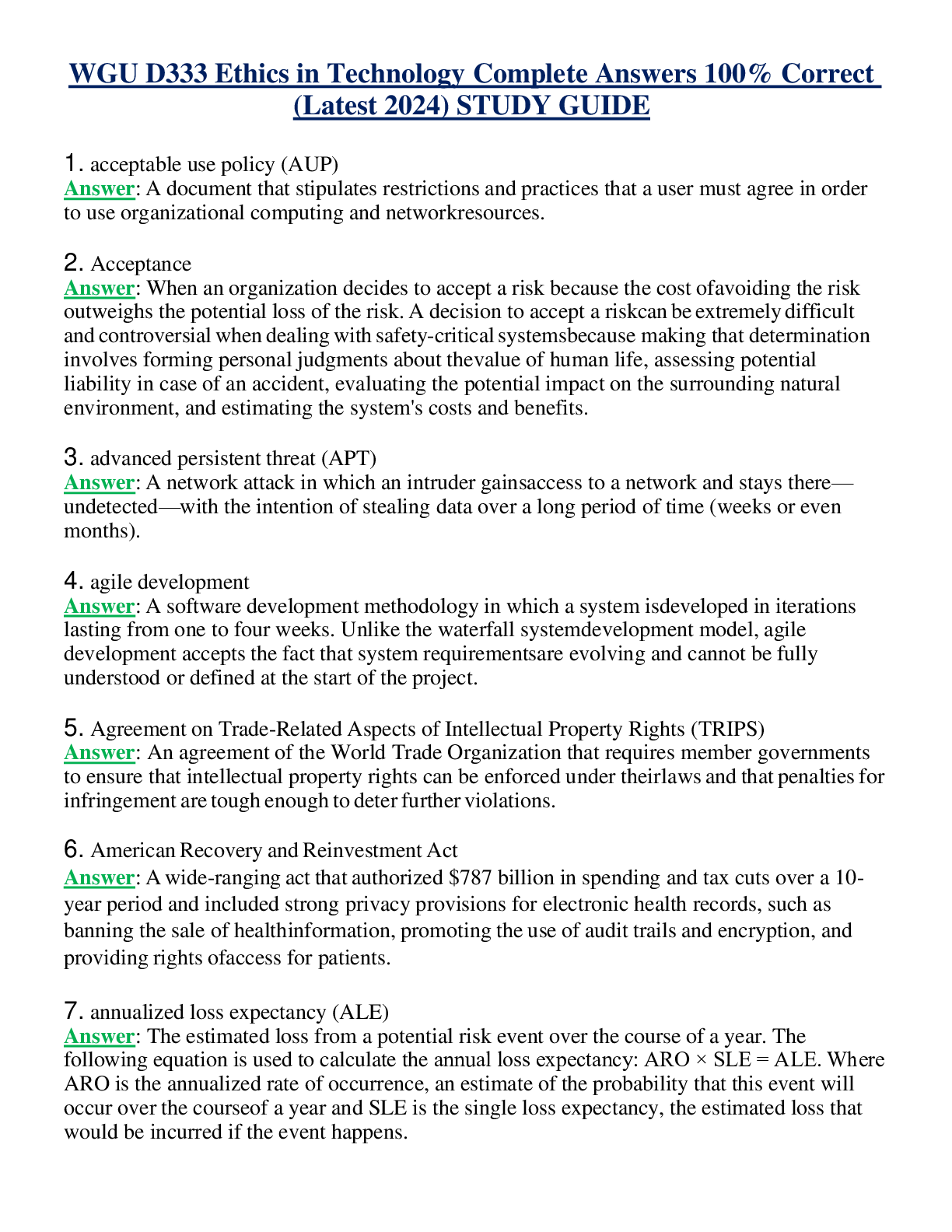
1. acceptable use policy (AUP)
Answer: A document that stipulates restrictions and practices that a user must agree in order
to use organizational computing and networkresources.
2. Acceptance
Answer: When an organization decides to accept a risk because the cost ofavoiding the risk
outweighs the potential loss of the risk. A decision to accept a riskcan be extremely difficult
and controversial when dealing with safety-criticalsystemsbecause making that determination
involves forming personal judgments about thevalue of human life, assessing potential
liability in case of an accident, evaluating the potential impact on the surrounding natural
environment, and estimating the system's costs and benefits.
3. advanced persistent threat (APT)
Answer: A network attack in which an intruder gainsaccess to a network and stays there—
undetected—with the intention of stealing data over a long period of time (weeks or even
months).
4. agile development
Answer: A software development methodology in which a system isdeveloped in iterations
lasting from one to four weeks. Unlike the waterfall systemdevelopment model, agile
development accepts the fact that system requirementsare evolving and cannot be fully
understood or defined at the start of the project.
5. Agreement on Trade-Related Aspects of Intellectual Property Rights (TRIPS)
Answer: An agreement of the World Trade Organization that requires member governments
to ensure that intellectual property rights can be enforced under theirlaws and that penaltiesfor
infringement are tough enough to deter further violations.
6. American Recovery and Reinvestment Act
Answer: A wide-ranging act that authorized $787 billion in spending and tax cuts over a 10-
year period and included strong privacy provisions for electronic health records, such as
banning the sale of healthinformation, promoting the use of audit trails and encryption, and
providing rights ofaccess for patients.
7. annualized loss expectancy (ALE)
Answer: The estimated loss from a potential risk event over the course of a year. The
following equation is used to calculate the annual loss expectancy: ARO × SLE = ALE. Where
ARO is the annualized rate of occurrence, an estimate of the probability that this event will
occur over the courseof a year and SLE is the single loss expectancy, the estimated loss that
would be incurred if the event happens.
[Show More]