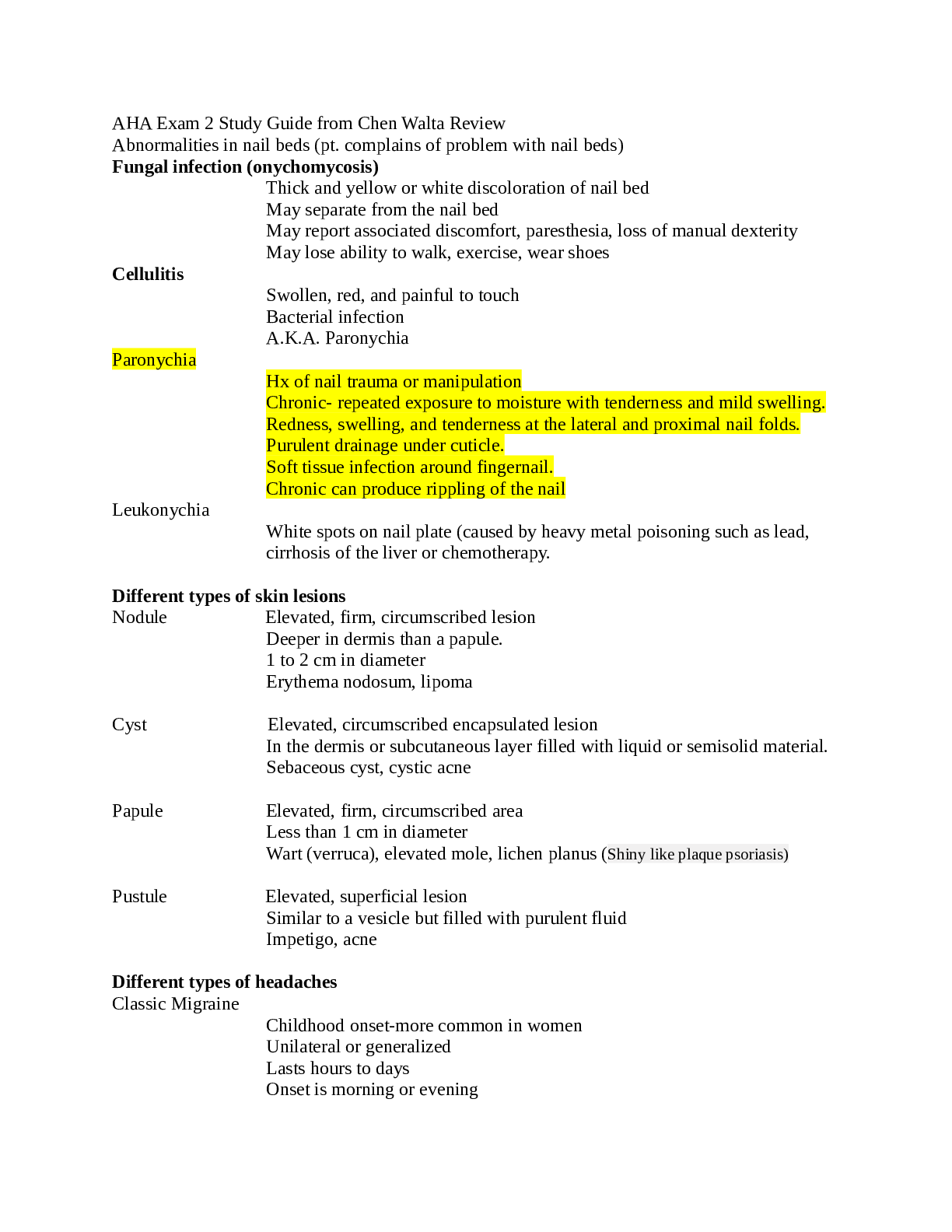
AHA Exam 2 Study Guide from Chen Walta Review
Abnormalities in nail beds (pt. complains of problem with nail beds)
Fungal infection (onychomycosis)
Thick and yellow or white discoloration of nail bed
May separate fro
...
AHA Exam 2 Study Guide from Chen Walta Review
Abnormalities in nail beds (pt. complains of problem with nail beds)
Fungal infection (onychomycosis)
Thick and yellow or white discoloration of nail bed
May separate from the nail bed
May report associated discomfort, paresthesia, loss of manual dexterity
May lose ability to walk, exercise, wear shoes
Cellulitis
Swollen, red, and painful to touch
Bacterial infection
A.K.A. Paronychia
Paronychia
Hx of nail trauma or manipulation
Chronic- repeated exposure to moisture with tenderness and mild swelling.
Redness, swelling, and tenderness at the lateral and proximal nail folds.
Purulent drainage under cuticle.
Soft tissue infection around fingernail.
Chronic can produce rippling of the nail
Leukonychia
White spots on nail plate (caused by heavy metal poisoning such as lead, cirrhosis of the liver or chemotherapy.
Different types of skin lesions
Nodule Elevated, firm, circumscribed lesion
Deeper in dermis than a papule.
1 to 2 cm in diameter
Erythema nodosum, lipoma
Cyst Elevated, circumscribed encapsulated lesion
In the dermis or subcutaneous layer filled with liquid or semisolid material.
Sebaceous cyst, cystic acne
Papule Elevated, firm, circumscribed area
Less than 1 cm in diameter
Wart (verruca), elevated mole, lichen planus (Shiny like plaque psoriasis)
Pustule Elevated, superficial lesion
Similar to a vesicle but filled with purulent fluid
Impetigo, acne
Different types of headaches
Classic Migraine
Childhood onset-more common in women
Unilateral or generalized
Lasts hours to days
Onset is morning or evening
Pulsating or throbbing pain.
Causes- Menstrual cycle, not eating, birth control pills, let down after stress.
Can cause nausea/vomiting
Temporal arteritis
Older adults
Unilateral or bilateral
Lasts hours to days
Occurs anytime
Throbbing
Causes-stress, anger, bruxism
Hypertensive
Adulthood
Bilateral or occiput
Lasts for hours
Occurs in morning
Throbbing
Remits as the day progresses
Cluster
Adulthood
Unilateral
½-2 hours duration
Onset at night
Intense burning, boring, searing, knifelike
Can cause personality changes, sleep disturbances
Caused by alcohol consumption
Occurs more in men
Thyroid problems based on patient history
Hypothyroidism
Weight gain
Constipation
Fatigue
Cold intolerance
Normal size thyroid
Goiter
Nodules
Hyperthyroidism
Weight loss
Tachycardia
Diarrhea
Heat sensitivity
Normal size thyroid
Goiter
Nodules
Fine hair
Brittle nails
Proptosis
Papules and pustules developed as result of hygienic activity.
Folliculitis
Inflammation and infection of hair follicle and surrounding dermis.
Patho:
inflammatory cells w/I the wall of the hair follicle create follicular based pustule
inflammation can be superficial or deep
Subjective data:
Acute onset of papules and pustules associated with pruritus or mild discomfort
May have pain with deep folliculitis
Risk factors- frequent shaving, hot tubs, occlusive dressing, obesity
Objective data:
Small pustules
May be surrounded by inflammation or nodular lesions
May have suppurative drainage with crusting.
Furuncle (Boil)
Deep seated infection of pilosebaceous unit
Patho:
Staph aureus most common
Starts as small perifollicular abscess
May occur singly or in multiples
Subjective data:
Acute onset of tender red nodule that becomes pustular
Objective data:
Skin is red, hot, and tender
Common in face, neck, arms, axillae, breasts, thighs, and buttocks
Tinea (Dermatophytosis)-Group of noncandidal fungal infections that involve the stratum
corneum, nails, or hair
Patho:
Infection of dermatophytes acquired by direct contact
Lesions classified according to the anatomic location on hairy or non-hairy parts.
Subjective
May report pruritus
Objective date:
May be popular, pustular, vesicular, erythematous, or scaling
Secondary bacterial infection
Nodules that occur in the supraclavicular area-causes and likely differential diagnosis
The supraclavicular node that warns of malignancy lies anterior to the sternocleidomastoid muscle.
Non-Hodgkin lymphoma- malignant neoplasm of the lymphatic system and the reticuloendothelial tissues.
Could also be abdominal/thoracic neoplasms, thyroid/laryngeal disease, or mycobacterial/fungal infections.
What is differential diagnosis?
Based on chief complaint, signs and symptoms
What all can be wrong?
What do we suspect?
A patient with cough, wheezing, and fever
DDx could be bronchitis, PNA, asthma, etc.
How do you palpate lymph nodes on the body depending on which lymph node it is?
Head and neck:
Lightly palpate the entire neck for nodes
Bending the patient’s head forward or to the side will ease taut tissues and allow better accessibility to palpation
Feel for nodes on the head in the following six step sequence:
The occipital nodes at the base of the skull
The postauricular nodes located superficially over the mastoid process.
The preauricular nodes just in front of the ear
The parotid and retropharyngeal (tonsillar) nodes at the angle of the mandible.
The submandibular nodes halfway between the angle and the tip of the mandible.
The submental nodes in the midline behind the tip of the mandible
Then move down to the neck, palpating in the following four step sequence
The superficial cervical nodes at the sternocleidomastoid muscle.
The posterior cervical nodes along the anterior border of the trapezius muscle.
The cervical nodes deep to the sternocleidomastoid (the deep cervical nodes may be difficult to feel if you press too vigorously; probe gently with your thumb and fingers around the muscle.)
The supraclavicular areas, probing deeply in the angle formed by the clavicle and the sternocleidomastoid muscle, the area of Virchow nodes.
Axillae:
Imagine a pentagonal structure: the pectoral muscle anteriorly, the back muscles (i.e. latissimus dorsi and subscapularis) posteriorly, the rib cage medially, the upper arm laterally, and the axilla at the apex.
Let the soft tissue roll between your fingers, the chest wall, and the muscles as you palpate.
A firm, deliberate, yet gentle touch may feel less ticklish to the patient.
Support the patient’s forearm with your contralateral arm and bring the palm of your examining hand flat into the axilla; let the patient’s forearm rest on that of your examining hand.
Rotate your fingertips and palm, feeling the nodes; if they are palpable attempt to glide your fingers beneath the nodes.
Epitrochlear:
Support the arm in one hand as you explore the elbow with the other.
Grasp the patient’s right wrist, palm facing up, with your left hand.
The elbow should be in the relaxed position at approximately 90 degrees.
Place your right hand under the patient’s right elbow and cup your fingers around the elbow to find the area that is proximal and slightly anterior to the medial epicondyle of the humerus.
There is a groove between the triceps and biceps muscles
Palpate that groove with your fingers using a circular motion.
Repeat using your left hand for the patient’s left elbow
Inguinal and popliteal:
Use a systemic approach when palpating sites of lymph node clusters
Move the hand in a circular fashion, probing gently without pressing hard.
Relieve tension by flexion of the extremity.
To palpate have the patient lie supine with the knee slightly flexed.
The superior superficial inguinal (femoral) nodes are close to the surface over the inguinal canals.
The inferior superficial inguinal nodes lie deeper in the groin.
To examine the popliteal nodes, relax the posterior popliteal fossa by flexing the knee.
Wrap your hand around the knee and palpate the fossa with your fingers.
Patient complains of pain between shoulder blades, it is more intense with deep breathing and coughing.
Pleurisy- inflammatory process of the visceral and parietal pleura.
Patho:
Result of infective process
Tumor
Subjective data:
Sudden onset with chest pain when taking a deep breath or cough
Pain may be referred to ipsilateral shoulder
Objective data:
Pleural friction rub heard on auscultation
Fever
Tachypnea that is shallow
***
Pleural effusion vs PNA vs Asthma vs P.E.
Pleural effusion:
Inspection:
Diminished and delayed respiratory movement on affected side.
Palpation:
Trachea shifted
Diminished fremitus
Tachycardia
Percussion:
Dullness and flatness
Hyperresonance above the affected area.
Auscultation:
Diminished to absent breath sounds
Crackles
Bronchophony, whispered pectoriloquy, egophony
Occasional friction rub
Pneumonia:
Inspection:
Tachypnea
Shallow breathing
Nasal flaring
Palpation:
Increased fremitus with consolidation
Decreased fremitus with empyema or pleural effusion
Tachypnea
Percussion:
Dullness
Auscultation:
Crackles, rhonchi, bronchial breath sounds, whispered pectoriloquy
Asthma:
Inspection:
Tachypnea
Nasal flaring
Retractions
Percussion:
Hyperresonance
Limited diaphragmatic expansion
Auscultation:
Prolonged expirations
Wheezing
Pulmonary embolism (P.E.):
Pleuritic chest pain with or without dyspnea
Tachycardia
Tachypnea
Low grade fever
Hypoxia
>>>>>>>>>>>>>>>>>>>>>CONTINUES.......(20 pages)
[Show More]







 2022.png)