A lesion centered within the carotid space will
displace the ipsilateral parapharyngeal fat
anteromedially.
The infrahyoid carotid space contains the vagus
nerve, as well as the common carotid artery and
interna
...
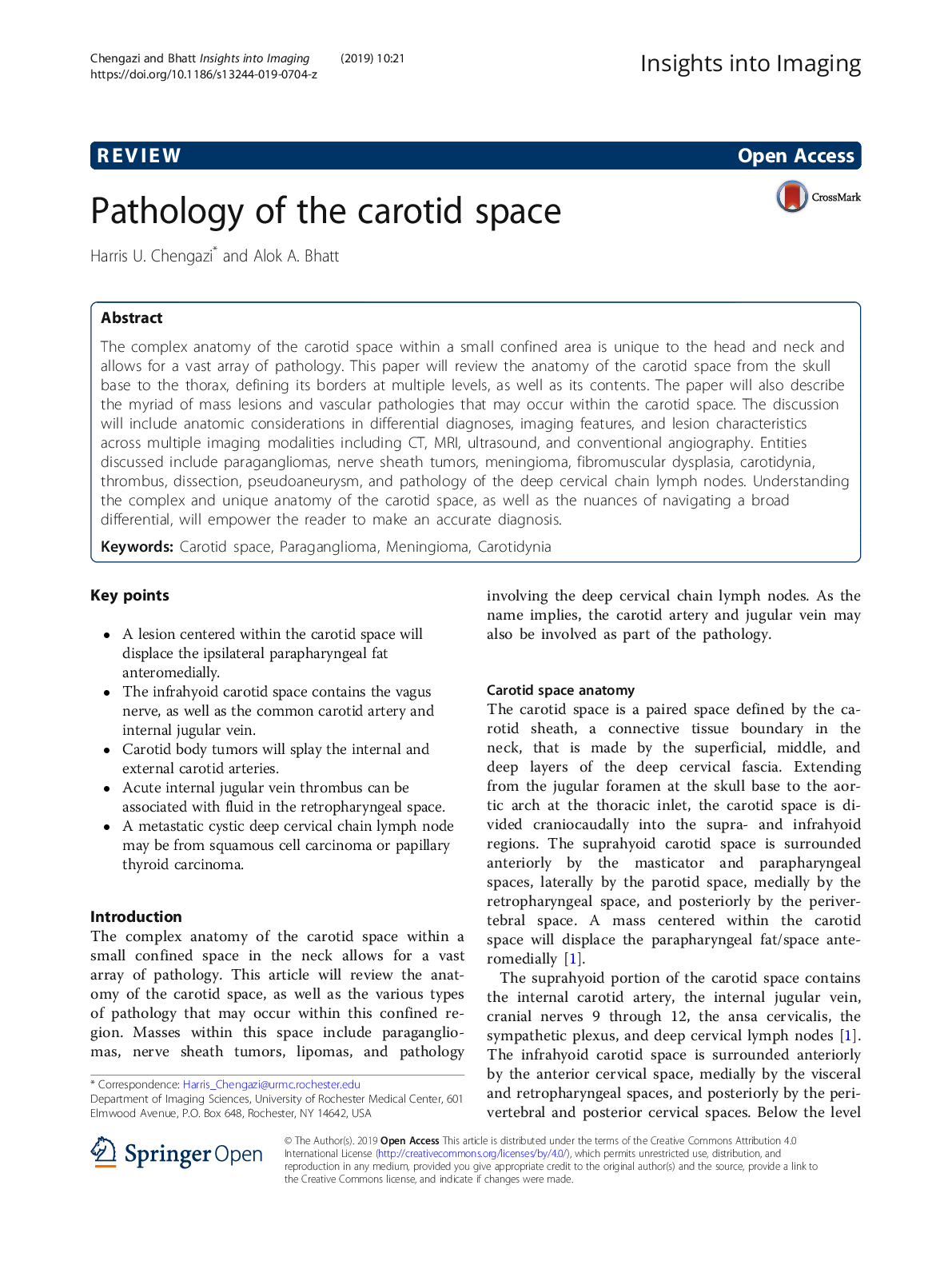
A lesion centered within the carotid space will
displace the ipsilateral parapharyngeal fat
anteromedially.
The infrahyoid carotid space contains the vagus
nerve, as well as the common carotid artery and
internal jugular vein.
Carotid body tumors will splay the internal and
external carotid arteries.
Acute internal jugular vein thrombus can be
associated with fluid in the retropharyngeal space.
A metastatic cystic deep cervical chain lymph node
may be from squamous cell carcinoma or papillary
thyroid carcinoma.
Introduction
The complex anatomy of the carotid space within a
small confined space in the neck allows for a vast
array of pathology. This article will review the anatomy of the carotid space, as well as the various types
of pathology that may occur within this confined region. Masses within this space include paragangliomas, nerve sheath tumors, lipomas, and pathology
involving the deep cervical chain lymph nodes. As the
name implies, the carotid artery and jugular vein may
also be involved as part of the pathology.
Carotid space anatomy
The carotid space is a paired space defined by the carotid sheath, a connective tissue boundary in the
neck, that is made by the superficial, middle, and
deep layers of the deep cervical fascia. Extending
from the jugular foramen at the skull base to the aortic arch at the thoracic inlet, the carotid space is divided craniocaudally into the supra- and infrahyoid
regions. The suprahyoid carotid space is surrounded
anteriorly by the masticator and parapharyngeal
spaces, laterally by the parotid space, medially by the
retropharyngeal space, and posteriorly by the perivertebral space. A mass centered within the carotid
space will displace the parapharyngeal fat/space anteromedially [1].
The suprahyoid portion of the carotid space contains
the internal carotid artery, the internal jugular vein,
cranial nerves 9 through 12, the ansa cervicalis, the
sympathetic plexus, and deep cervical lymph nodes [1].
The infrahyoid carotid space is surrounded anteriorly
by the anterior cervical space, medially by the visceral
and retropharyngeal spaces, and posteriorly by the perivertebral and posterior cervical spaces. Below the level
* Correspondence:
[email protected]
Department of Imaging Sciences, University of Rochester Medical Center, 601
[Show More]