Biology > Study Notes > Novi High School - SCIENCE BiologyDichotomousKeysSE_Geiger (All)
Novi High School - SCIENCE BiologyDichotomousKeysSE_Geiger
Document Content and Description Below
Last updated: 7 months ago
Preview 1 out of 7 pages
Instant download
.png)
Buy this Document to get the Full Access Instantly
Provided by Students Who Aced it
We Verify Document Content to Gurantee Accuracy
Reviews( 0 )
Document information
Connected school, study & course
About the document
Uploaded On
Mar 11, 2021
Number of pages
7
Written in
All

Additional information
This document has been written for:
Uploaded
Mar 11, 2021
Downloads
0
Views
365
Topic Tags
Recommended For You
Get more on Study Notes »
Test Bank For Understanding Biology 4th Edition By Kenneth Mas...
TEST BANK for Campbell Biology 12th Edition by Lisa Urry,Micha...
Test Bank for Biology The Essentials 4th Edition By Marielle H...

Test Bank for Introduction To Marine Biology 4th Edition Karle...
TEST BANK for Human Biology, 16th Edition By Mader and Windels...

Test Bank for An Invitation to Health 18th Edition By Dianne H...
Solutions Manual Campbell Essential Biology 8th Edition By Eri...
eBook [PDF] Advances in Chromatography Volume 60 By Grinberg N...
BIOLOGY CELL SIGNALING, HORMONES & NERVOUS SYSTEM EXAM 2026/20...
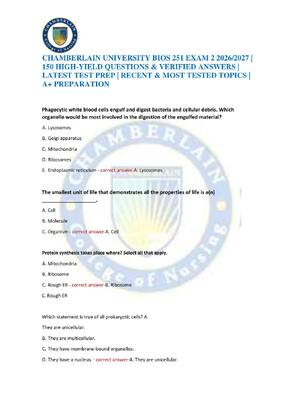
CHAMBERLAIN UNIVERSITY BIOS 251 EXAM 2 2026/2027 | 150 HIGH-YI...
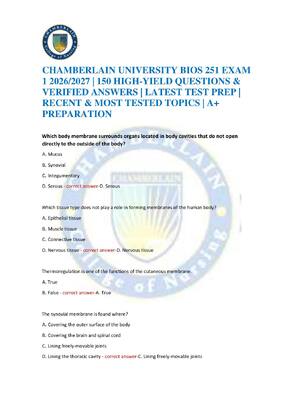
CHAMBERLAIN UNIVERSITY BIOS 251 EXAM 1 2026/2027 | 150 HIGH-YI...

NUR 123 Exam 3 Practice Notes: Oxygenation, Perfusion, Gastroi...
Nursing Fundamentals Study Guide, Nursing Notes ( 28 pages/28...

Nervous System Overview for Nurses: Anatomy, Physiology, and D...

.png)



.png)
.png)


