NUR 202 exam 1 OB (100 out of 100) Questions and Answers (Already GRADED A)
Document Content and Description Below
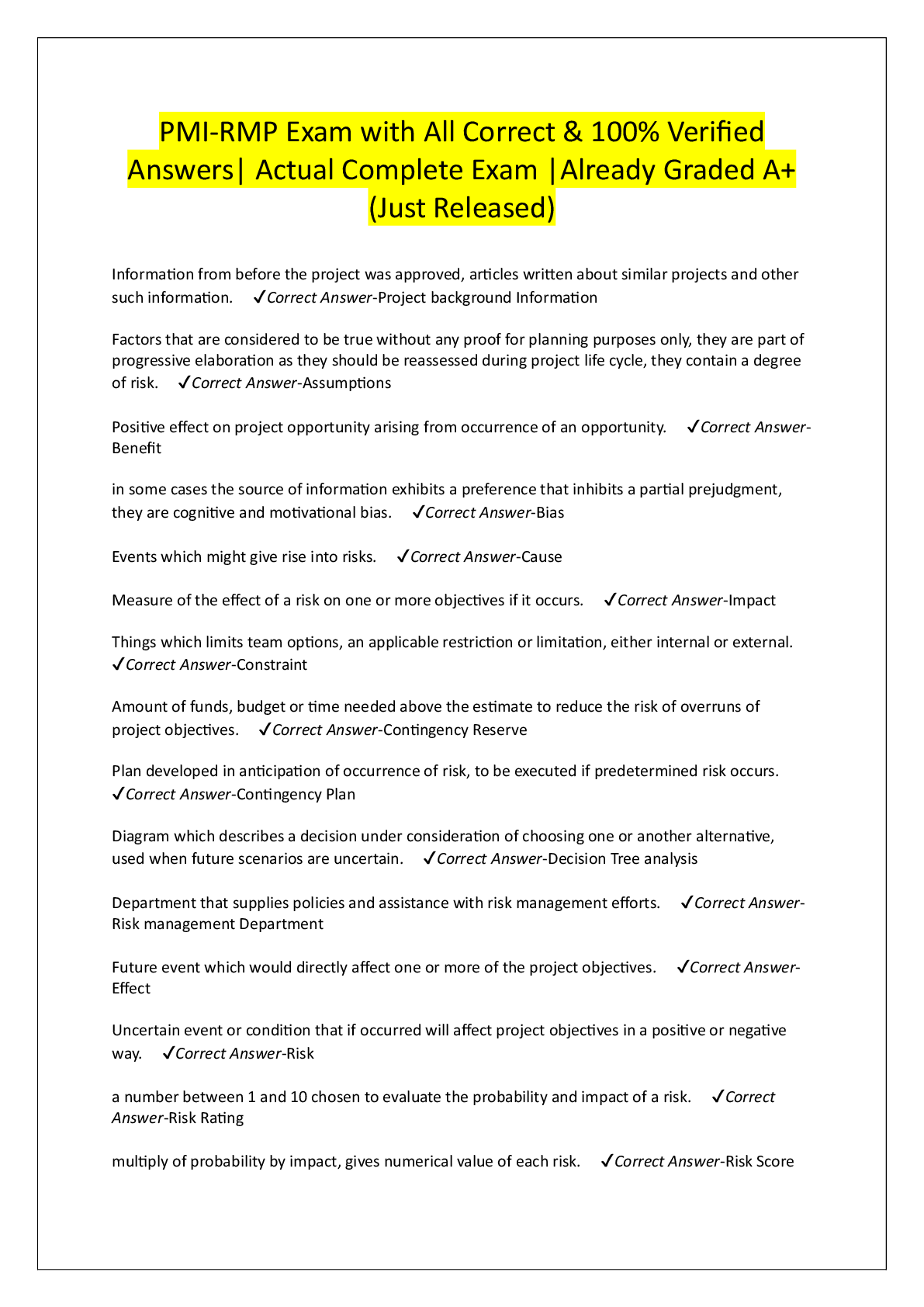
NUR 202 exam 1 OB (100 out of 100) Questions and Answers (Already GRADED A) Maternal and Fetal Monitoring Exam 1. Leopold’s maneuver consists of how many steps? Answer: 4 2. If the baby is in ... a left occiput anterior (LOA) position, where would you place the fetal monitor on the mother’s abdomen? Answer: Left Lower Quadrant (LLQ) 3. What is the term for a fetal heart rate (FHR) less than 110 beats per minute for at least 10 minutes? Answer: Fetal bradycardia 4. What is the cause of early decelerations in FHR? Answer: Head compression 5. What is the priority nursing intervention for variable decelerations? Answer: Reposition the mother. The baby may be compressing the umbilical cord. 6. What does a late deceleration indicate? Answer: Deoxygenation (HR decreases after the peak of a contraction) 7. What is the purpose of fetal surveillance? Answer: To evaluate how the fetus tolerates labor and to identify potential hypoxic insult to the fetus during labor. 8. Where does the fetus receive oxygen from? Answer: The placenta 9. True or False: Reductions in the mother’s circulating blood volume reduce perfusion of the intervillous spaces with oxygenated maternal blood. Answer: True 10. List conditions that may reduce perfusion of the intervillous spaces with oxygenated maternal blood. Answer: Hemorrhage, epidural block causing hypotension, maternal hypertension, lowered oxygen levels, maternal acid-base imbalance, asthma, pulmonary infection, smoking. 11. True or False: Dilation is dependent on the pressure of the presenting part and the contraction and retraction of the uterus. Answer: True 12. Describe hypertonic uterine activity. Answer: Contractions lasting over 90-120 seconds, occurring too frequently (closer than every 2 minutes), or allowing less than 30 seconds of complete relaxation. 13. What can oligohydramnios (low amniotic fluid) cause in relation to the umbilical cord? Answer: Cord compression due to inadequate fluid to cushion the cord. 14. What effect do fetal hypoxia, cord compression, or placental detachment have on FHR? Answer: They cause bradycardia (a decrease in FHR). 15. What can fetal tachycardia result from? Answer: Infection 16. What happens when there is a mix of maternal and fetal blood, causing the mother to develop antibodies? Answer: The fetus can become anemic. 17. What is the fetoscope useful for detecting? Answer: Fetal cardiac dysrhythmias 18. In practice, what is a doppler ultrasound useful for if the baby is early in gestation or if the mother has increased abdominal fat? Answer: It is useful for FHR monitoring. 19. When is the best time to listen to the FHR during a contraction to detect late decelerations? Answer: At the end of a contraction 20. For how long should FHR be assessed after a contraction during intermittent auscultation to establish a baseline? Answer: For a full minute 21. Where is FHR most clearly heard in relation to the fetus? Answer: At the fetal back 22. In a cephalic presentation, in which quadrant is FHR best heard? Answer: Lower quadrant 23. In a breech presentation, at or above what level is FHR best heard? Answer: Maternal umbilicus 24. True or False: External monitoring can be used with intact membranes, a cervix that is not dilated, as well as with ruptured membranes and a dilating cervix. Answer: True 25. Where is the tocodynamometer (toco) placed to detect uterine activity? Answer: Over the fundus 26. Which monitoring device requires rupture of membranes (ROM) and a cervical dilation of at least 2 cm, along with a low-presenting part and a skilled practitioner for placement? Answer: Internal fetal monitoring 27. Which internal fetal monitoring device requires ROM: the FHR scalp electrode or intrauterine pressure catheter (IUPC)? Answer: The scalp electrode requires ROM, while the IUPC does not. 28. What is the correct order for evaluating a fetal monitoring strip? Answer: 1. Baseline rate 2. Variability 3. Patterns of rate change from baseline 29. What are the four elements used to evaluate uterine activity? Answer: Frequency, duration, intensity of contractions, and uterine resting tone 30. Which method is most accurate in identifying extreme fetal oxygenation and acid-base balance issues? Answer: Fetal monitoring strip 31. What is the normal average FHR range? Answer: 110-160 bpm 32. What is considered fetal tachycardia? Answer: FHR greater than 160 bpm for at least 10 minutes 33. What is considered fetal bradycardia? Answer: FHR less than 110 bpm for at least 10 minutes 34. What is considered minimal variability? Answer: Less than 5 beats of change 35. What is considered moderate variability? Answer: 6-25 beats of change (normal) 36. What is considered marked variability? Answer: Greater than 25 beats of change 37. What does the evaluation of variability clarify about the fetus? Answer: How the fetus is tolerating stress during labor, including factors that cause hypoxia. 38. What factors can lead to decreased variability? Answer: Fetal sleep (20-40 minutes), narcotics, sedatives like magnesium sulfate, alcohol, illicit drugs, fetal tachycardia, gestational age <28 weeks, fetal anomalies affecting the CNS, severe hypoxia, abnormalities of the heart or CNS, maternal acidemia or hypoxia. 39. What are periodic changes in FHR a response to? Answer: Contractions 40. What are accelerations, and are they reassuring? Answer: Temporary increases in FHR (15 beats for 15 seconds), associated with fetal movement, vaginal exams, uterine contractions, or mild cord compression. They are reassuring and indicate the fetus is responsive and not in acidosis. 41. Describe early decelerations. Answer: Occur during contractions as the fetal head is compressed. They mirror the contraction, reaching their lowest point when the contraction is at its peak, and return to baseline by the end of the contraction. They are not associated with fetal compromise and require no additional interventions other than documentation. 42. Describe late decelerations and the required interventions. Answer: Begin after the contraction starts (often near the peak) and return to baseline after the contraction ends. They indicate impaired placental exchange or uteroplacental insufficiency. Interventions include stopping oxytocin, applying oxygen, repositioning to side-lying, and increasing fluids. 43. Which action should be done first for late decelerations? Answer: Stop Pitocin 44. What causes variable decelerations, and what should be done first? Answer: Caused by reduced flow through the umbilical cord (cord compression). The first action is to reposition the mother into a knee-chest position, followed by applying oxygen and increasing fluids. 45. What is used to estimate contraction intensity and resting tone when using an external monitor? Answer: Palpation 46. Reassuring or nonreassuring: Accelerations with fetal movement. Answer: Reassuring 47. Reassuring or nonreassuring: Signs associated with fetal hypoxia or acidosis. Answer: Nonreassuring 48. Reassuring or nonreassuring: Tachycardia, bradycardia, decreased or absent variability, late decelerations, variable decelerations, prolonged decelerations, hypertonic uterine activity. Answer: Nonreassuring 49. What evaluates the fetal response to tactile stimulation during labor and indicates a fetus with normal oxygen and acid-base balance? Answer: Fetal scalp stimulation 50. True or False: Fetal scalp stimulation is restricted for preterm fetuses, PROM, intrauterine infections, placenta previa, or maternal fever of unknown origin. Answer: True 51. Describe vibroacoustic stimulation and its use. Answer: Uses sound and vibration applied to the mother’s lower abdomen for 3 seconds to stimulate the fetus. A 15 bpm acceleration lasting 15 seconds is a reassuring response. 52. What is the purpose of fetal oxygen saturation monitoring? Answer: To determine if nonreassuring FHR patterns require operative intervention. Normal fetal oxygen saturation is 30-65%. [Show More]
Last updated: 1 year ago
Preview 3 out of 7 pages

Loading document previews ...
Buy this document to get the full access instantly
Instant Download Access after purchase
Buy NowInstant download
We Accept:

Reviews( 0 )
$11.00
Can't find what you want? Try our AI powered Search
Document information
Connected school, study & course
About the document
Uploaded On
Aug 15, 2024
Number of pages
7
Written in
All

Additional information
This document has been written for:
Uploaded
Aug 15, 2024
Downloads
0
Views
97




 Questions and Answers 100% VERIFIED.png)
 Questions and Answers 100% correct Solutions.png)