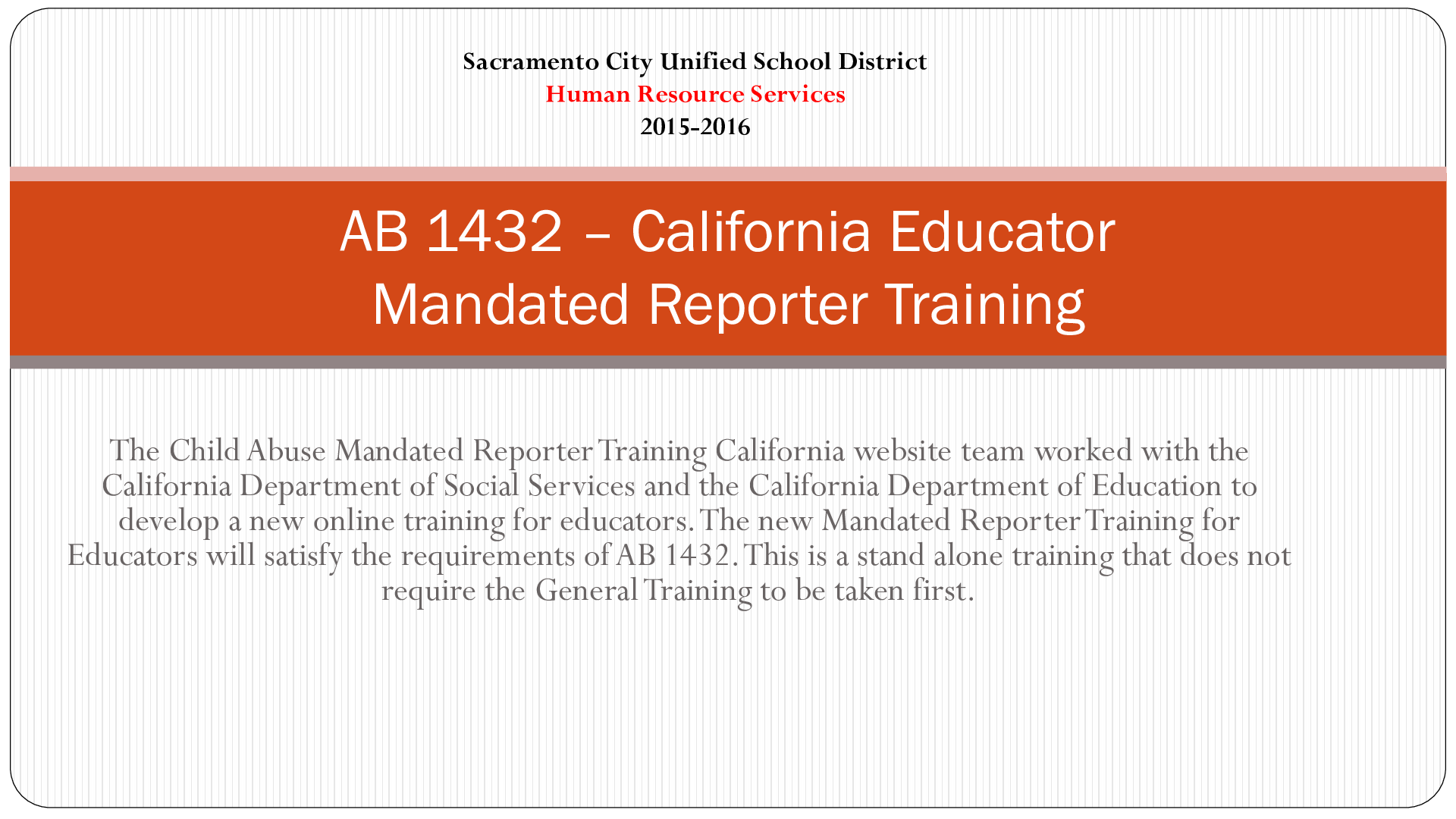
The Child Abuse Mandated Reporter Training California website team worked with the
California Department of Social Services and the California Department of Education to
develop a new online training for educators. The
...
The Child Abuse Mandated Reporter Training California website team worked with the
California Department of Social Services and the California Department of Education to
develop a new online training for educators. The new Mandated Reporter Training for
Educators will satisfy the requirements of AB 1432. This is a stand alone training that does not
require the General Training to be taken first.
As knowledge and understanding of child abuse increased over time, it became
evident that professionals other than physicians might also be in a position to
identify child maltreatment. This led to a substantial increase in the number of
professional groups designated in state laws as mandated reporters. The definition
of child abuse has also expanded to include other forms of child maltreatment that
must be reported.
The Child Abuse and Neglect Reporting Act (CANRA) was passed in 1980. It can
be found in the California Penal Code (P.C.), sections 11164-11174.3. CANRA
provides definitions, procedures for reporting suspected abuse, and protections as
well as liabilities for mandated reporters. Sections of the Education Code (E.C.)
also provide procedures for educators reporting suspected abuse.
Define physical abuse, sexual abuse, emotional abuse, and neglect
Be able to provide examples of the various types of abuse
Be familiar with physical signs and behavioral indicators that should raise suspicion for possible child maltreatment
Vignettes will test your knowledge throughout the lessons, but are not part of your test or score.
You are an employee at a school. A seven-year-old child comes to school with
patterned red marks on his cheeks. He was absent the day prior. When you ask him
what happened to his cheek, he replies that he fell while riding his bike. Do you
report this injury?
It is important to remember that any sexual act that is coerced, forced, or
accomplished without the consent of the partner is considered abuse and must be
reported. As with all forms of abuse, if you are unsure whether what you have seen
or heard is abuse, call a child protective agency for advice.
Lesson 1 - Sexual Abuse Disclosure
Lesson 1 - Vignette 2
You become concerned because 8-year-old Sara, a student in your class, is caught exposing
herself to other children on the playground and telling them to touch her. You talk with her
about this behavior, and she informs you that her 14-year-old brother always wants to see
her “pee pee” and likes to touch it.
What should you do?
A second-grade student often complains that she is hungry, and had no breakfast. She rarely brings anything
for lunch, and when she does, it is generally packaged pastry or chips. You also notice that her clothing is
often inappropriate for the weather, and she appears dirty and unkempt. You ask the child’s teacher of the
previous year if the girl’s situation was the same then. The teacher said that it was, and talking with the
parents did not seem to help. You have noticed that her parents do not attend any school functions, and are
never at home when you attempt to contact them.
What concerns would you have about this student?
In the course of your work, you work with a troublesome nine-year-old boy. He has frequent and
severe behavior problems and is taking psychiatric medications for a mood disorder. You notice the
child is not eating lunch. When you ask why, he tells you that he got in trouble with his parents and
is not allowed to eat today. He tells you the last time he ate was 2 days ago, but that he must sit at
the table and watch while the rest of the family eats. What do you do?
Parent lacks understanding of child development/normal child
behaviors:
Parent has unrealistic expectation of child (e.g., toilet-training a 6-month-old)
Parent is unduly harsh and rigid about childrearing
Parent lacks understanding of parent/child relationship and/or
perceives child in a negative light:
Parenting is impaired by:
Lesson 1 - Child Red Flags for Abuse/Neglect
With regard to behavioral indicators, keep in mind that children react differently to being abused, and many abused
children do not exhibit behavioral symptoms. The presence of any of the following indicators does not prove that a child is
being abused, but should serve as a warning signal to look further
What is “reasonable suspicion”?
You work at a school. Volunteers come weekly to tutor and work with troubled teenagers.
A volunteer tells you that a child has disclosed sexual abuse by her father. What are you
obligated to do?
To protect mandated reporters from repercussions for obeying the law and protecting
children, there are laws that punish anyone who interferes with a mandated reporter
making a report. Other laws provide for confidentiality and immunity from
prosecution for making a report
Lesson 2 - Protections for Mandated Reporters
Lesson 2 - Failure to Report Lesson 3 - Legal and Ethical Issues Lesson 3 - Determining Reasonable Suspicion Lesson 3 - Talking With Students Lesson 3 - Talking With Students You are concerned about a seventh-grade student who has exhibited behavioral changes. Although
she has always been a straight-A student, she has stopped turning in homework and does poorly on
tests. She frequently appears tired and has even fallen asleep in class. She also no longer socializes
with her friends. You decide to talk with her about your concerns. Lesson 3 - After the Report Is Made Lesson 3 - Child Abuse Central Index When you report abuse you create a "paper trail" that makes it easier to stop a
repeat offender or to build a solid case against an offender. The California
Department of Justice maintains a central repository of information about reported
child abuse, called the Child Abuse Central Index, or CACI Lesson 3 - Practice Questions
Practice Question 1
Under CANRA, a mandated reporter is required to report suspected abuse to:
A. His or her employer or supervisor
B. Local child protective authorities
C. The child’s parents
D. The California Department of Justice.
Practice Question 2
According to CANRA, a Mandated Reporter only needs “reasonable suspicion” to make a child abuse report.
A. True
B. False
Practice Question 3
Under FERPA, school records may be released without parental consent in cases of health and safety emergencies.
A. True
B. False Lesson 4 - Corporal Punishment Lesson 4 - Physical Contact With Students Lesson 4 - Reporting Colleagues You are the principal of an elementary school. The parent of one of your students contacts you because she is concerned
about the behavior of her 10-year-old son’s substitute teacher. She says that her son told her that, while getting help with
his class work, he had to sit on the teacher’s lap, and the teacher rubbed his back and thighs. She tells you that her son’s
friend complained of this as well, and that both boys initially refused but that the teacher insisted. Lesson 4 - Licensing Requirement This lesson covers situations that do not fit perfectly into the four categories of abuse as described by
CANRA:
•Domestic violence
•Parental substance abuse.
•Homeless children esson 5- Children with Developmental Disabilities Lesson 5- Incidence of Abuse
[Show More]