GRE VOCABULARY LATEST UPDATE WITH COMPLETE SOLUTION
$ 8.5

Pearson Edexcel_Further Mathematics_9FM0/3B Mark Scheme_2021 | PAPER 3B: Further Statistics 1
Psychology > EXAM > WGU D094 OA Study Quiz (100 out of 100) Questions and Verified Answers | Latest Update | GRADED A (All)
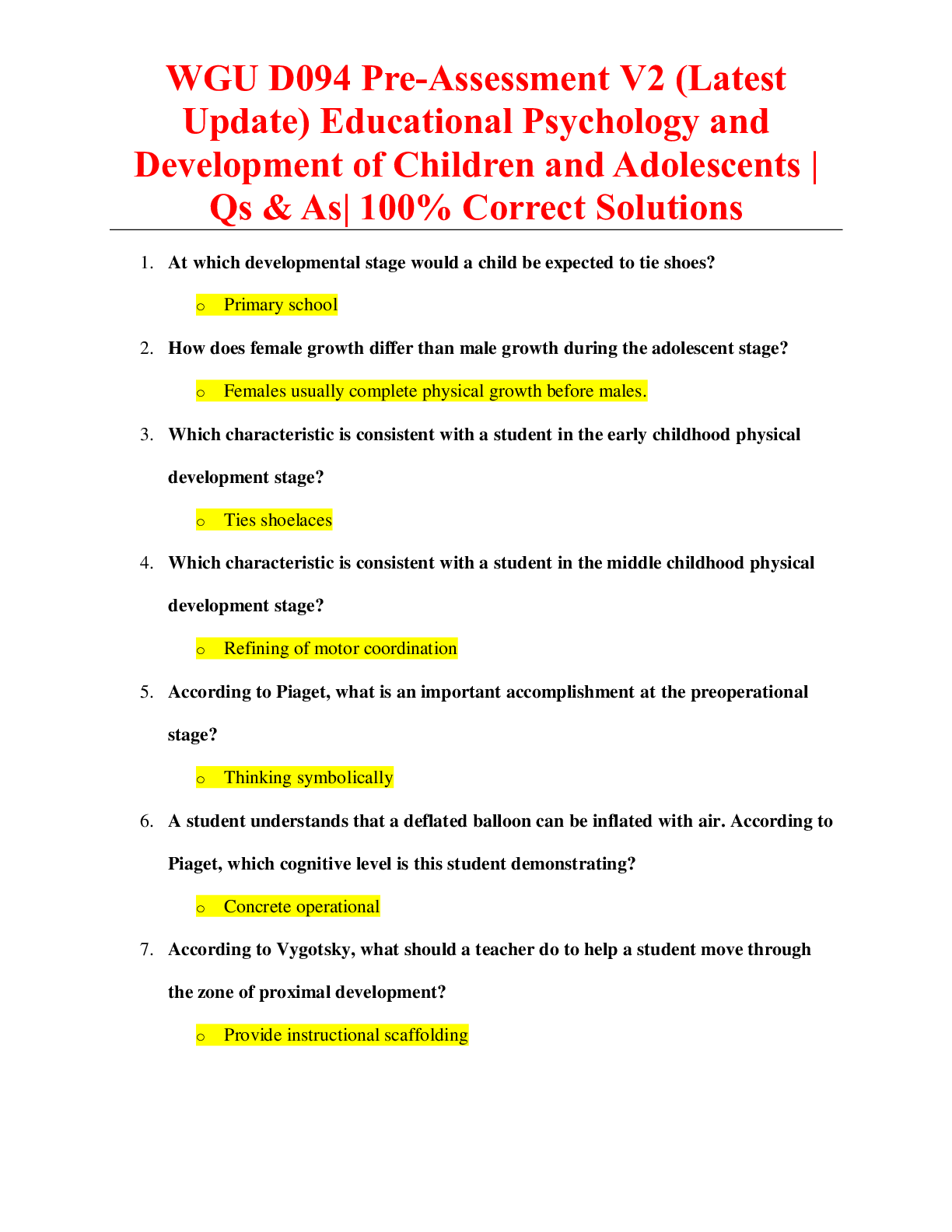
WGU D094 OA Study Quiz (100 out of 100) Questions and Verified Answers | Latest Update | GRADED A 1. Physical Development Stages • Infancy (0-2 years) o Hold heads up, crawl, increase coordinat ... ion. o Develop fine motor skills: throw balls, use zippers. • Early Childhood (2-6 years) o Gross motor skills: run, hop. o Fine motor skills: use jigsaw puzzles, print names, use utensils. • Middle Childhood (6-10 years) o Steady growth, improved speed, and coordination. o Refinement of motor skills, improved handwriting. • Adolescence (10-18 years) o Girls enter puberty earlier, boys grow taller. o Reach sexual maturity; girls’ growth slows while boys' growth continues. 2. Piaget's Cognitive Development Stages • Sensorimotor Stage (Birth - 2 years) o Learning through movement and senses; object permanence. • Preoperational Stage (Preschool/Kinder) o Prelogical thought, symbolic play, egocentrism. • Concrete Operational Stage (Elementary) o Logical thinking; concepts like sorting, classifying, conservation. • Formal Operational Stage (Middle/High School) o Abstract thinking, hypothesis testing, systematic problem solving. 3. Vygotsky's Cognitive Development • Key Concepts: o Scaffolding, Zone of Proximal Development (ZPD), role of more knowledgeable others. o Emphasis on social and cultural interaction in learning. 4. Erikson's Psychosocial Stages • Trust vs. Mistrust (Infancy) o Need for care, love, and safety. • Autonomy vs. Shame and Doubt (Toddler) o Desire for independence; the "Me do" stage. • Initiative vs. Guilt (Preschool/Kinder) o Exploration, asking questions, trying new activities. • Industry vs. Inferiority (Elementary) o Intellectual curiosity, school performance, positive reinforcement needed. • Identity vs. Role Confusion (Adolescence) o Development of a sense of self, influenced by peers and social role models. • Intimacy vs. Isolation (Young Adults) o Forming relationships, developing a sense of self. 5. Kohlberg's Moral Development Stages • Preconventional Stage o Focus on self-interest, obedience to avoid punishment. • Conventional Stage o Adherence to laws and rules; importance of being a good citizen. • Postconventional Stage o Flexible view of rules based on context; consideration of others' rights. 6. Language Development Theories • Chomsky’s Stages of Language Development o Babbling Stage (0-11 months): Producing sounds ("ba-ba, ma-ma"). o Holophrastic Stage (11 months - 1.5 years): Single-word sentences ("juice"). o Two-Word Stage (1.5 - 2.5 years): Mini sentences ("me play"). o Telegraphic Stage (2.5+ years): Early multiword phrases ("I want ball"). • Skinner’s Language Development o Language learned through reinforcement, imitation, and shaping. • Vygotsky’s Language Development o Emphasizes social interaction, scaffolding, and private speech. 7. Theories of Intelligence • Spearman: General intelligence (g factor). • Thurstone: Seven-factor intelligence theory. • Sternberg: Triarchic theory (creative, analytical, practical). • Gardner: Multiple intelligences (e.g., logical-mathematical, spatial, linguistic). 8. Learning Theories • Behaviorist: Teacher-directed, mastery of basic skills. • Constructivist: Student-centered learning, knowledge building. • Cooperative/Collaborative: Focuses on group interactions; either teacher-led (cooperative) or student-led (collaborative). • Information Processing: Emphasizes memory, metacognition, and attention. • Social Cognitive: Focus on self-regulation, modeling, reciprocal teaching. • Humanistic: Emphasizes emotions, motivation, and a safe, engaging environment. 9. Assessment Strategies • Formative Assessment o Ongoing, provides feedback during learning, helps guide instruction. o Includes written responses, selected-response (e.g., multiple-choice), and constructed-response (e.g., short answer, essay). • Summative Assessment o Evaluates learning outcomes after instruction; includes performance assessments. • Norm-Referenced o Compares student scores to others. • Criterion-Referenced o Measures against set standards or criteria. [Show More]
Last updated: 1 year ago
Preview 2 out of 4 pages

Loading document previews ...
Buy this document to get the full access instantly
Instant Download Access after purchase
Buy NowInstant download
We Accept:

WGU D094 Objective Assessments & Pre-Assessments & Final Review Exams (STUDY BUNDLE WITH COMPLETE SOLUTIONS) Educational Psychology and Development of Children and Adolescents | Questions and Answers...
By Prof. Goodluck 1 year ago
$22.5
4
Can't find what you want? Try our AI powered Search
Connected school, study & course
About the document
Uploaded On
Aug 29, 2024
Number of pages
4
Written in
All
This document has been written for:
Uploaded
Aug 29, 2024
Downloads
0
Views
100
Scholarfriends.com Online Platform by Browsegrades Inc. 651N South Broad St, Middletown DE. United States.
We're available through e-mail, Twitter, Facebook, and live chat.
FAQ
Questions? Leave a message!
Copyright © Scholarfriends · High quality services·




 Questions and Answers 100% VERIFIED.png)
 Questions and Answers 100% correct Solutions.png)