UCI Econ 13/ IS 13 Homework 2 (100 points)
Due: Check Syllabus for due date
Name:____________________ ID:__________________ TA: __________________
Multiple Choice (3 pts each)
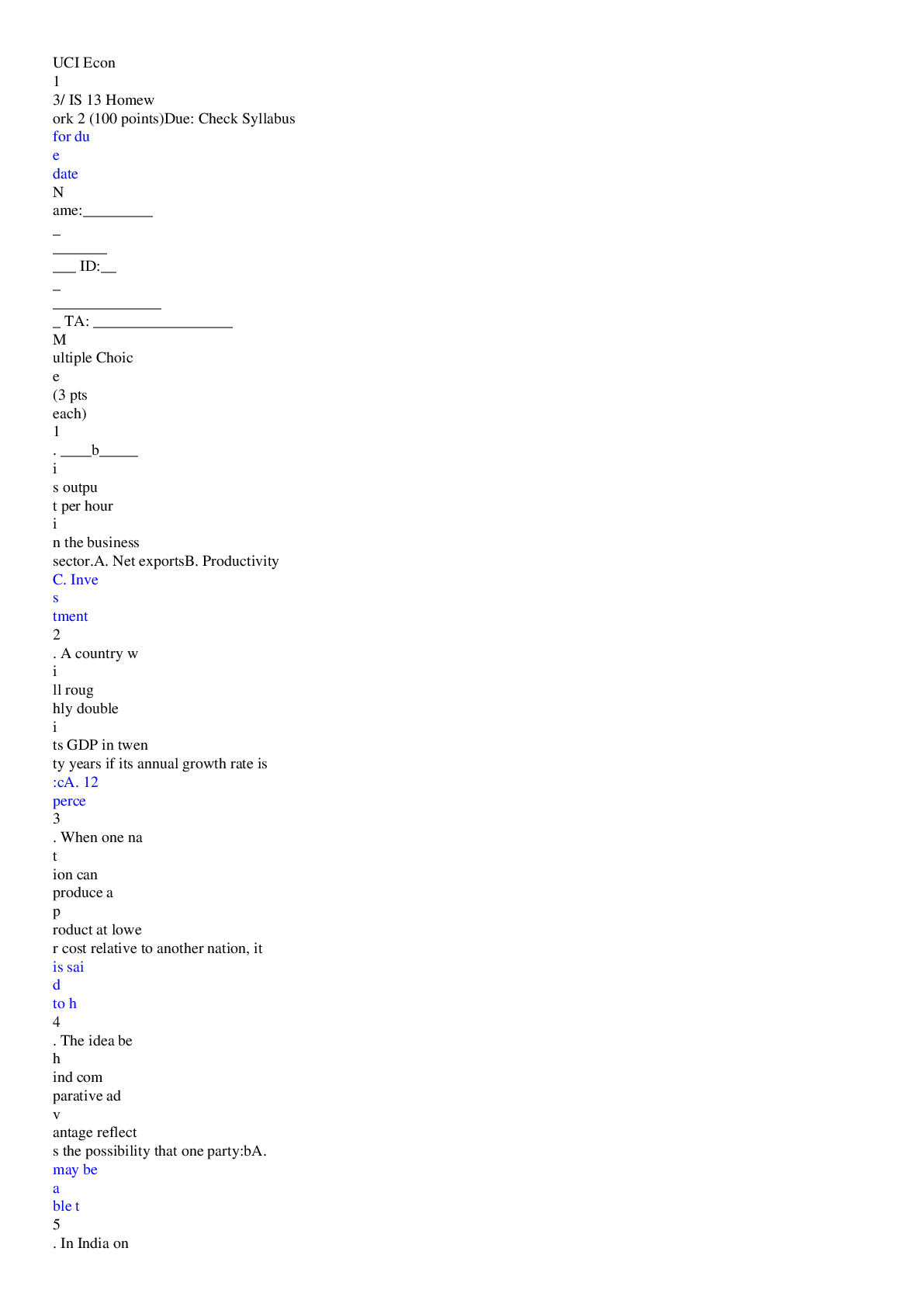
1. ____b_____ is output per hour
...
UCI Econ 13/ IS 13 Homework 2 (100 points)
Due: Check Syllabus for due date
Name:____________________ ID:__________________ TA: __________________
Multiple Choice (3 pts each)
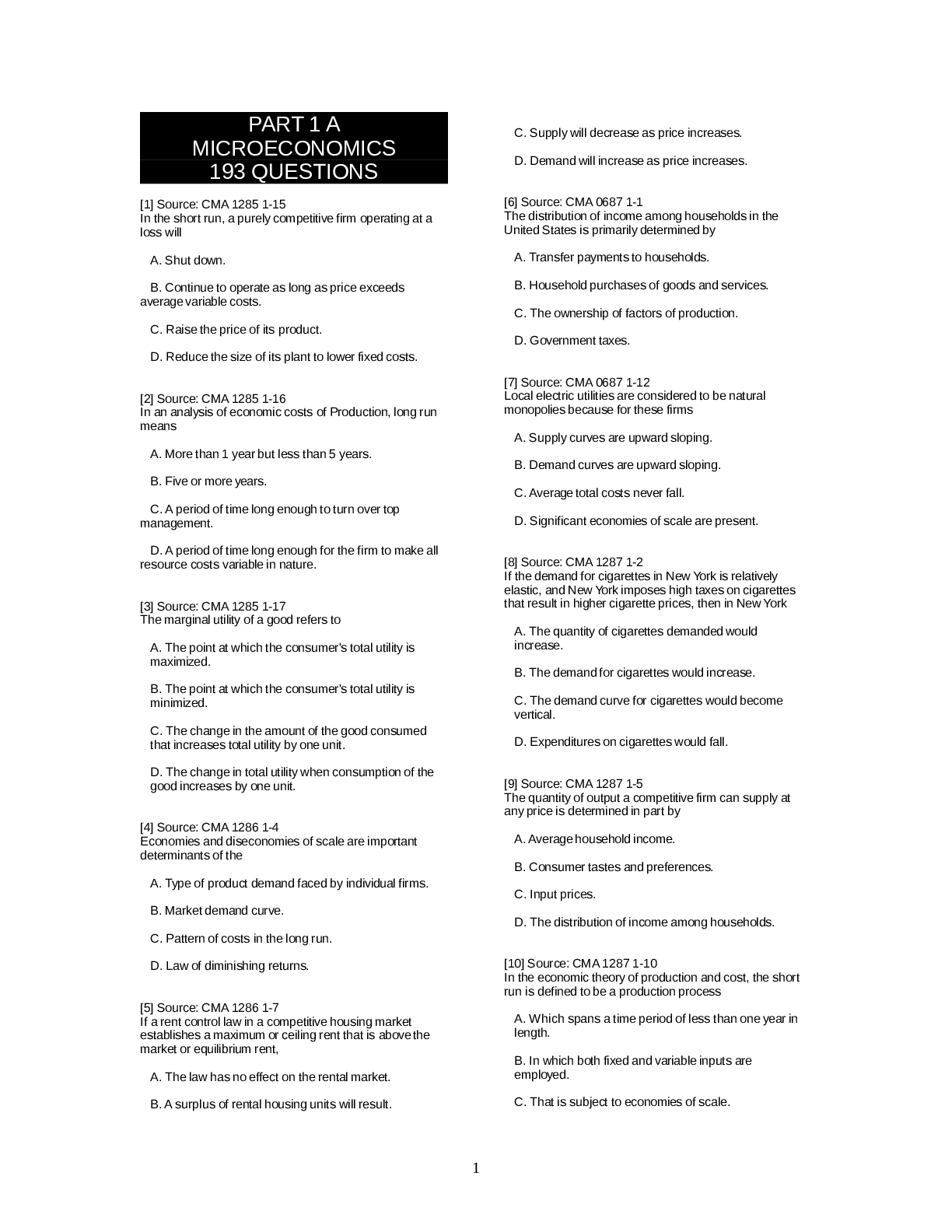
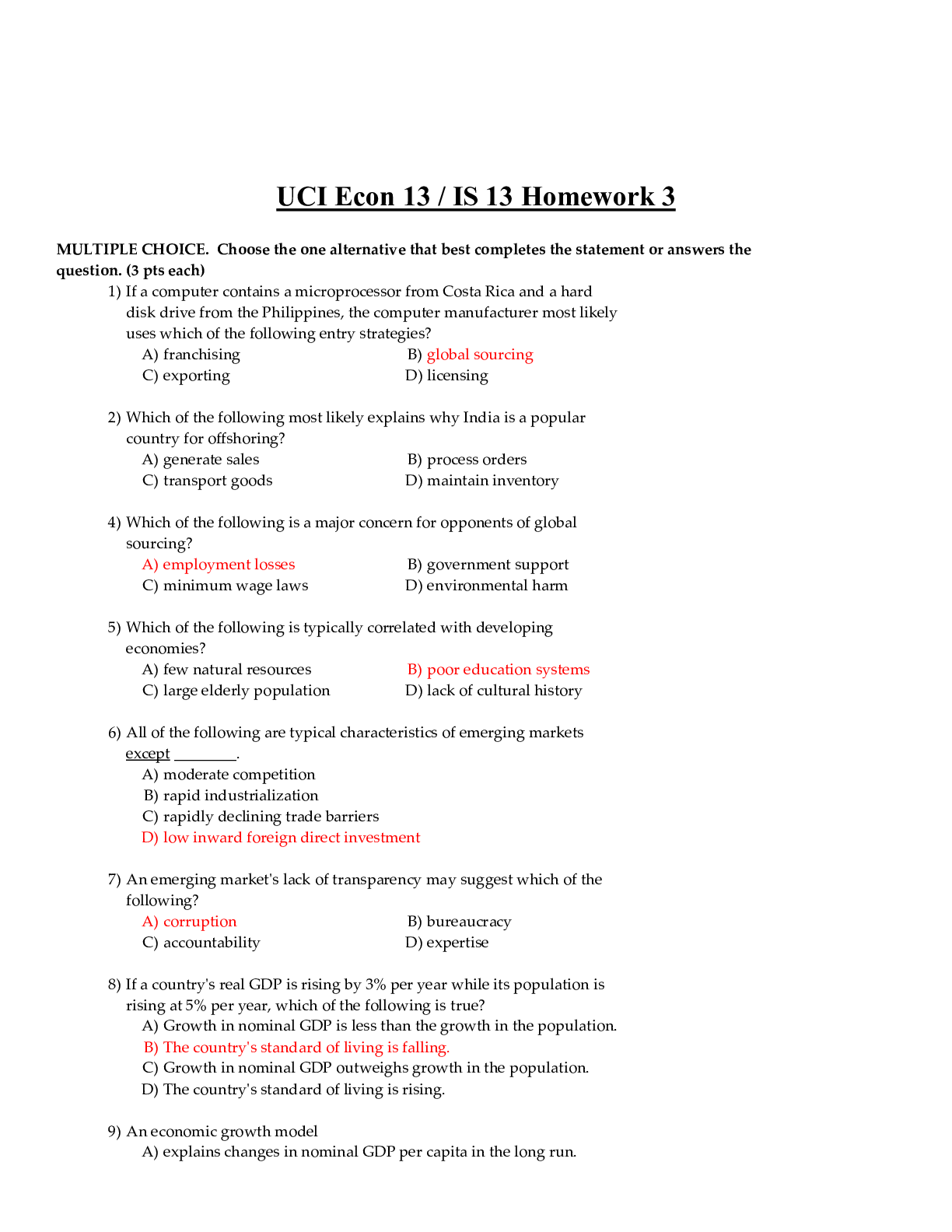
1. ____b_____ is output per hour in the business sector.
2. A country will roughly double its GDP in twenty years if its annual growth rate is:
cent.
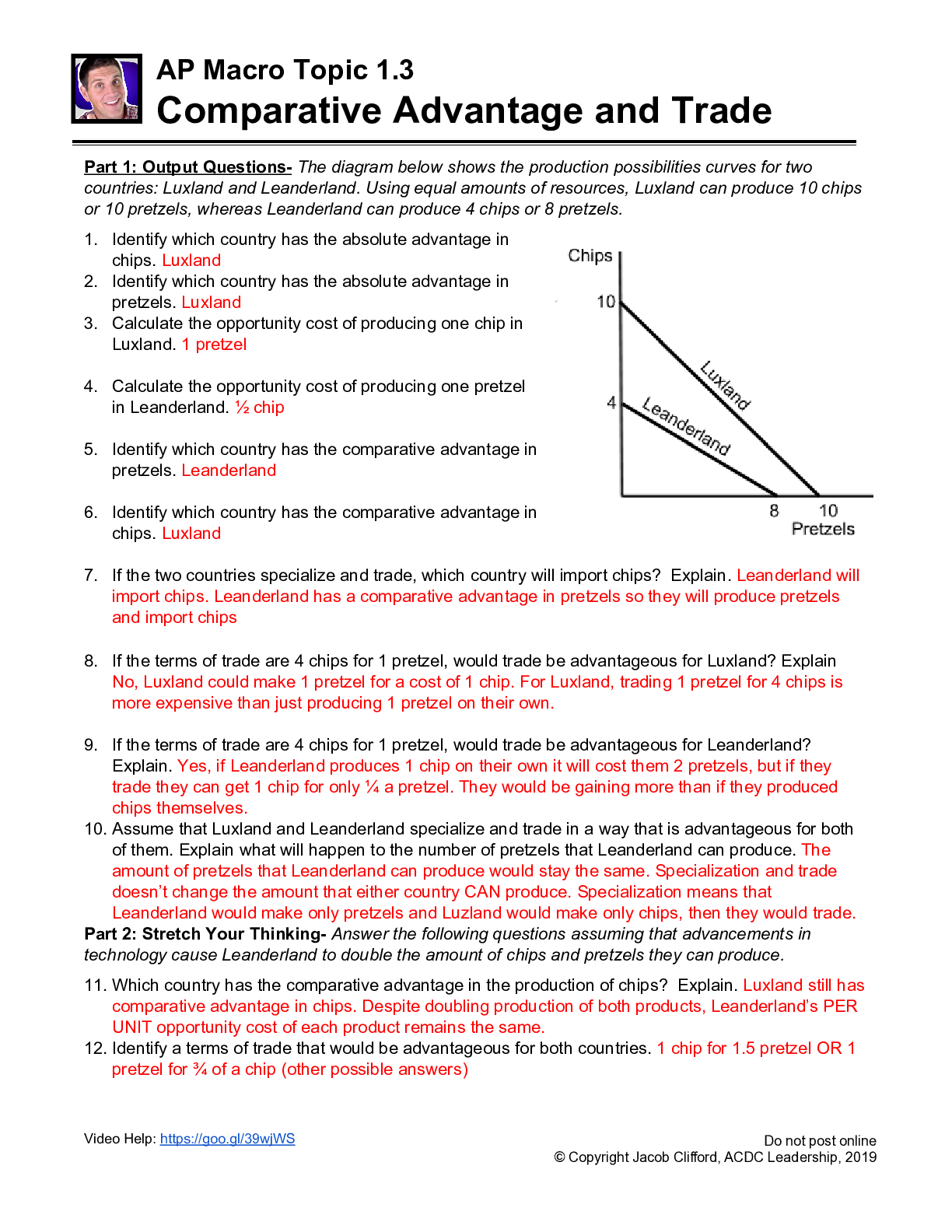
3. When one nation can produce a product at lower cost relative to another nation, it is said to have a(n) __________b________ in producing that product.
4. The idea behind comparative advantage reflects the possibility that one party:
5. In India one person can produce 330 pounds of rice or 110 shirts in one year. In China one person can produce 400 pounds of rice or 200 shirts in one year. Which of the following statements is true?
c
A. India has a comparative advantage in the production of rice.
B. China has a comparative advantage in the production of rice.
C. China has both an absolute and comparative advantage in the production of rice.
D. India has an absolute advantage in the production of rice.
6. Alpha can produce either 18 oranges or 9 apples an hour, while Beta can produce either 16 oranges or 4 apples an hour. The opportunity cost of producing 1 orange for Alpha and Beta, respectively, are:
d
A. 0.25 apples; 0.5 apples.
B. 9 apples; 4 apples.
C. 0.5 apples; 0.25 apples.
D. 2 apples; 4 apples
7. Which of the following is true?
8. The theory of comparative advantage shows that the gains from international trade do not just result from the absolute advantage of producing at lower cost, but also from pursuing comparative advantage and producing at a lower _________a_______.
9. A tariff differs from a quota in that a tariff is:
d
10. The infant industry argument for protectionism suggests that an industry must be protected in the early stages of its development so that:
11. _____b_____ means selling goods below their cost of production.
12. Low-wage U.S. workers suffer from protectionism in all the industries that they don’t work in, because:d
A. protectionism provides a barrier to entry to the job markets that the low-wage earners want entry to.
B. protectionism forces them to pay higher prices for basic necessities like clothing and food.
C. protectionism will envourage foreign workers to apply for American jobs.
D. protectionism will prevent them from applying for those jobs in other industries.
13. The race to the bottom scenario of global environmental degradation is explained roughly like this:
14. People or firms use one currency to purchase another currency at the _________c______________.
15. If government policy allows a country's currency to be determined in the exchange rate market, then that currency will be subject to
16. For firms engaged in international lending and borrowing, __________a__________ can have an enormous effect on profits.
17. If 112 Japanese yen purchased $1.00 U.S. in 2008 and 83 Japanese yen purchased $1.00 U.S. in 2009, then
18. If $1.00 U.S. bought $1.40 Canadian dollars in 2006 and in 2010 it bought $1.00 Canadian dollar, then
19. In 2008, 1 Swiss franc cost .56 British pounds and in 2010 it cost .51 British pounds in 2010. How much would 1 British pound purchase in Swiss francs in 2008 and 2010?
20. Which of the following is an example of a pegged currency?
21. A stronger euro is less favorable for
22. If the U.S. dollar weakens, which of the following parties will benefit?
23. Using the term "spillover" is a less formal means of describing
24. Market failure describes a situation in which the market itself ____________c__________ in a way that balances social costs and benefits.
25. Market-oriented environmental tools _______c________ for firms to take the social costs of pollution into account and ____________________ in reacting to these incentives.
26. The supply and demand conditions facing a firm that makes widgets and generates a negative externality by dumping a highly toxic sludge in a nearby river is given in the table below.
Price Quantity Demanded Quantity Supplied without Paying Social Costs Quantity Supplied after Paying Social Costs
100 0 120 75
80 10 100 50
55 30 90 30
40 55 85 25
30 80 80 20
20 100 65 15
The equilibrium price and quantity when social costs are taken into account are
a
27. ________d_______ include both the private costs incurred by firms and also costs incurred by third parties outside the production process.
Short Answers (19 points)
3. What is comparative advantage, and why is it important in international trade? (4 points)
4. Steve and Craig have been shipwrecked on a deserted island in the South Pacific. Their economic activity consists of either gathering pineapples or fishing. We know Steve can catch four fish in one hour or harvest two baskets of pineapples. In the same time Craig can reel in two fish or harvest two baskets of pineapples.
Assume Craig and Steve both operate on straight-line production possibilities curves. What is Steve's opportunity cost of producing a basket of pineapples? Of a producing a fish? What is Craig's opportunity cost of producing a basket of pineapples? Of a producing a fish? (5 points)
What is Steve's opportunity cost of producing a basket of pineapples? 0.5 fish
Of a producing a fish? 2 Pineapples
What is Craig's opportunity cost of producing a basket of pineapples? 1 fish
Of a producing a fish? (5 points) 1 pineapple
7. Identify the exchange rate that equalizes the prices of internationally traded goods across countries and briefly discuss the main functions this exchange rate serves. (3 points)
10. Briefly discuss the shortcomings of environmental command-and-control regulations. (3 points)
12. Briefly explain what is meant by the term "externality" and how it occurs (4 points)
Externality is an effect of a purchase or use decision by one set of parties on others who did not have a choice and whose interests were not taken into account.
[Show More]