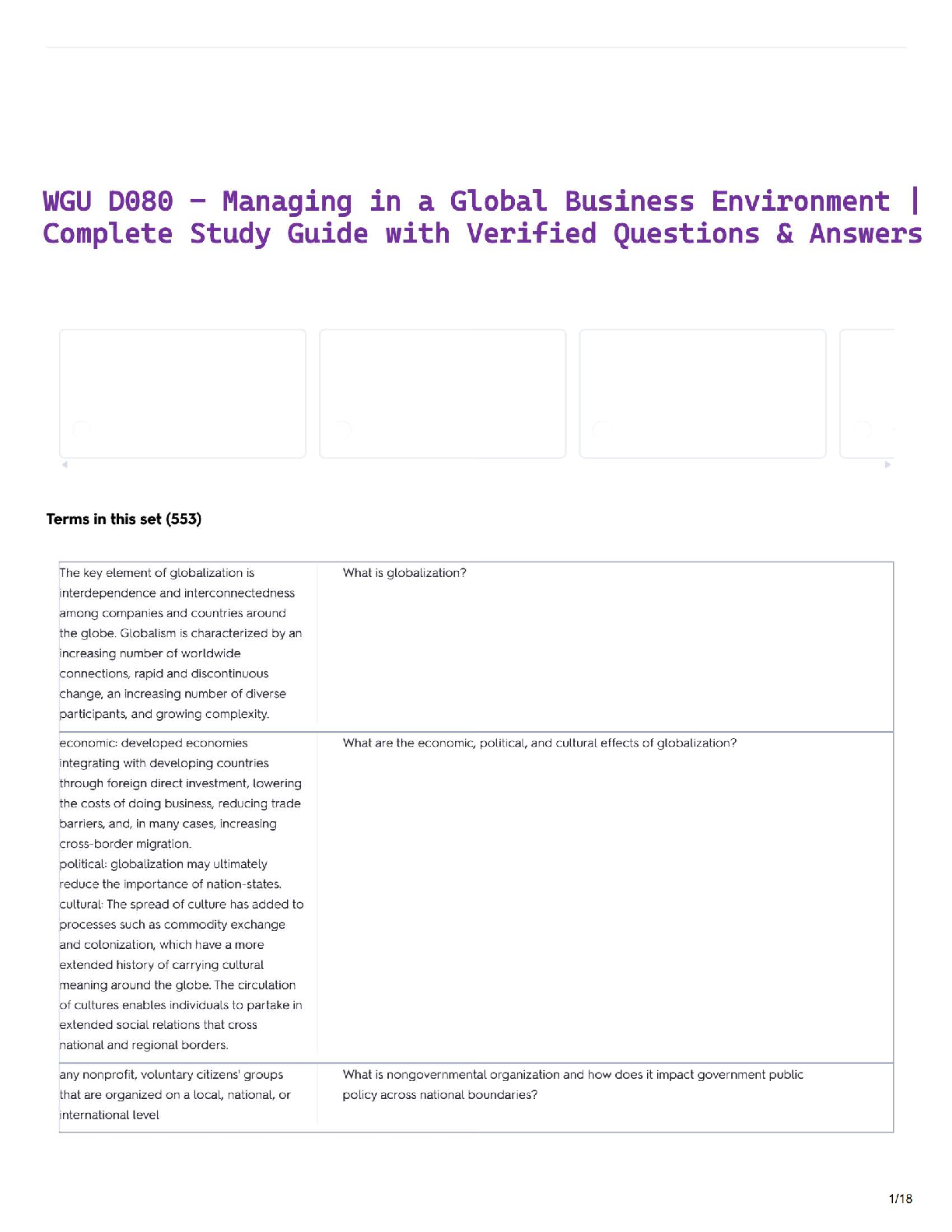
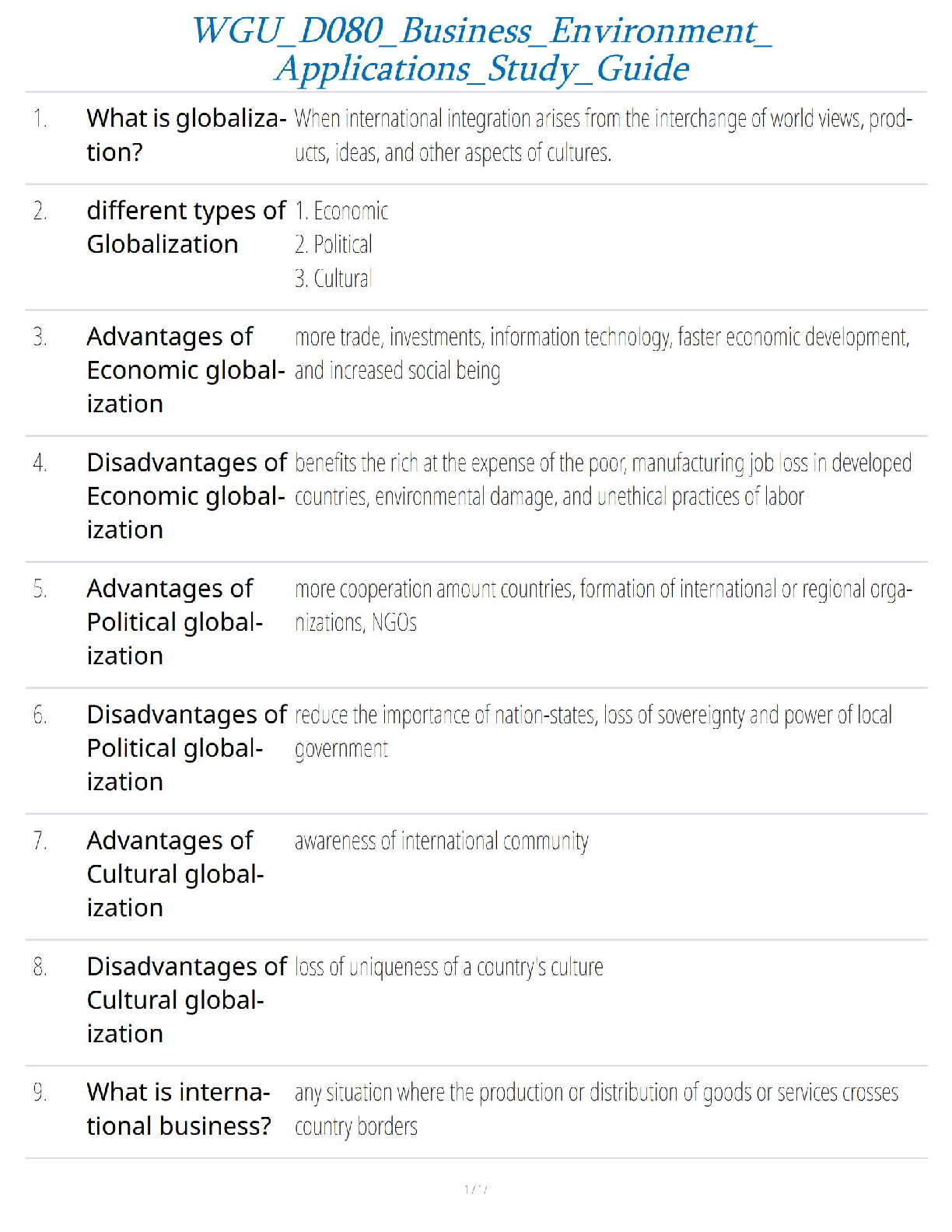
What is globalization? ✔✔as international integration arising from the exchange of world views,
products, ideas, and other aspects of culture.
What is Culture Globalization? ✔✔refers to the transmission of ideas, meani
...
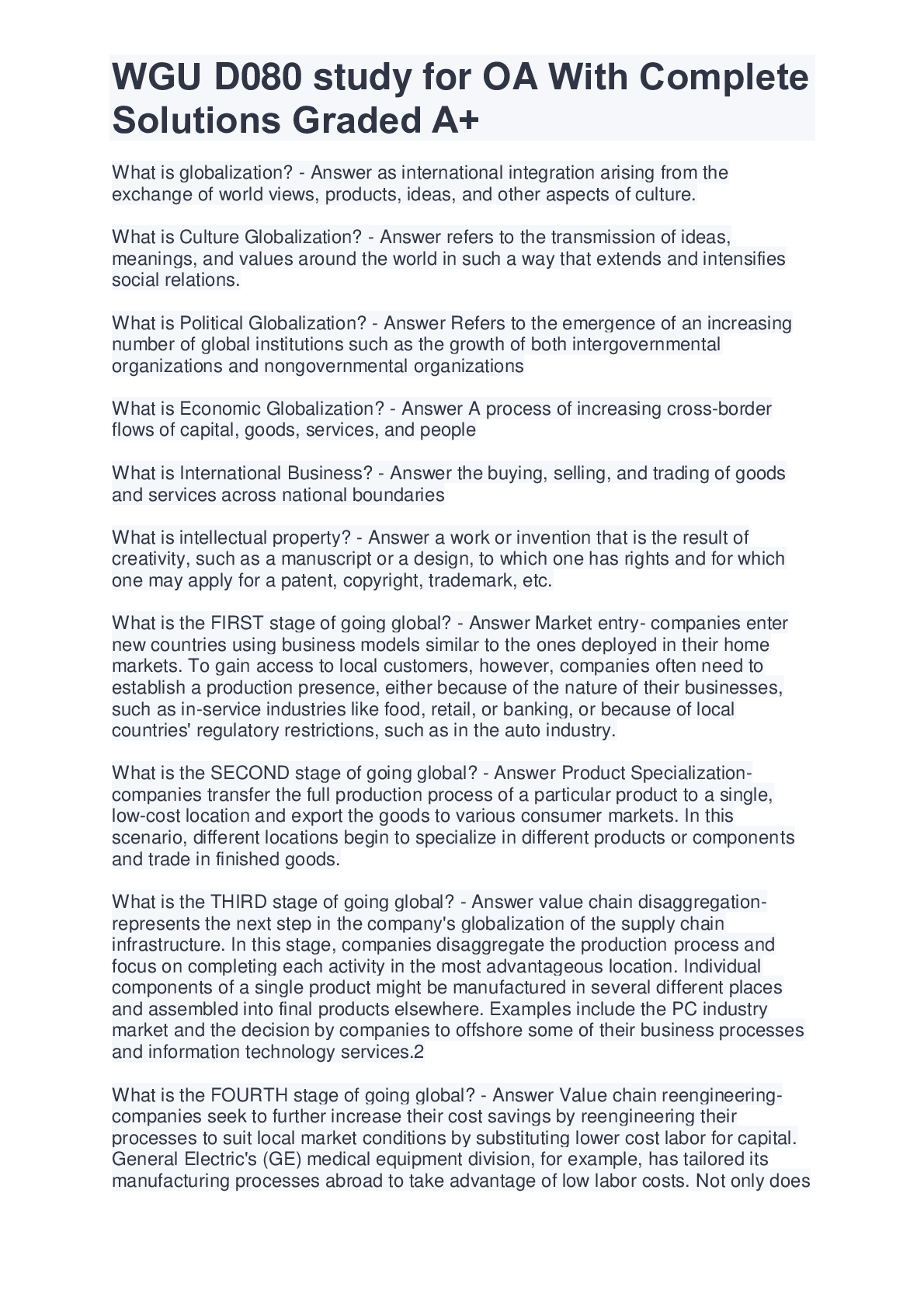
What is globalization? ✔✔as international integration arising from the exchange of world views,
products, ideas, and other aspects of culture.
What is Culture Globalization? ✔✔refers to the transmission of ideas, meanings, and values
around the world in such a way that extends and intensifies social relations.
What is Political Globalization? ✔✔Refers to the emergence of an increasing number of global
institutions such as the growth of both intergovernmental organizations and nongovernmental
organizations
What is Economic Globalization? ✔✔A process of increasing cross-border flows of capital,
goods, services, and people
What is International Business? ✔✔the buying, selling, and trading of goods and services across
national boundariesWhat is intellectual property? ✔✔a work or invention that is the result of creativity, such as a
manuscript or a design, to which one has rights and for which one may apply for a patent,
copyright, trademark, etc.
What is the FIRST stage of going global? ✔✔Market entry- companies enter new countries
using business models similar to the ones deployed in their home markets. To gain access to
local customers, however, companies often need to establish a production presence, either
because of the nature of their businesses, such as in-service industries like food, retail, or
banking, or because of local countries' regulatory restrictions, such as in the auto industry.
What is the SECOND stage of going global? ✔✔Product Specialization- companies transfer the
full production process of a particular product to a single, low-cost location and export the goods
to various consumer markets. In this scenario, different locations begin to specialize in different
products or components and trade in finished goods.
What is the THIRD stage of going global? ✔✔value chain disaggregation- represents the next
step in the company's globalization of the supply chain infrastructure. In this stage, companies
disaggregate the production process and focus on completing each activity in the most
advantageous location. Individual components of a single product might be manufactured in
several different places and assembled into final products elsewhere. Examples include the PCindustry market and the decision by companies to offshore some of their business processes and
information technology services.2
What is the FOURTH stage of going global? ✔✔Value chain reengineeringcompanies seek to further increase their cost savings by reengineering their processes to suit
local market conditions by substituting lower cost labor for capital. General Electric's (GE)
medical equipment division, for example, has tailored its manufacturing processes abroad to take
advantage of low labor costs. Not only does it use more labor-intensive production processes, but
it also designs and builds the capital equipment for its local plants
What is the FIFTH stage of going global? ✔✔creation of new markets- the focus is on market
expansion. This allows companies to substantially lower their sticker prices in both old and new
markets and to expand demand. Significantly, the value of new revenues generated in this last
stage is often greater than the value of cost savings in the other stages.
What are Globalization drivers? ✔✔*Market
*Cost
*Competition
*GovernmentWhat is a market globalization driver? ✔✔Opportunity for scale
Convergence of needs
What is a cost globalization driver? ✔✔Deals with economies of scale and scope, Exploiting
cost of factors of production
What is a competitive driver in globalization? ✔✔new markets
increase levels of trade
What is a government driver in globalization? ✔✔favorable policies
support for industry
What is economies of scale? ✔✔when the average cost of producing a good or service falls as
the quantity produced increases
What is economies of scope? ✔✔-Lowering the initial price of production
-Multi-product productionWhat are some issues that can arise when a company moves to another country? ✔✔Ethical
issues, governmental policies, and economic restrictions are all likely when a company moves
into an unfamiliar global space. A multinational company may also face infrastructural and
technological challenges in a developing country.
What is Anarchism? ✔✔which contends that individuals should control political activities, and
public government is both unnecessary and unwanted.
What is Totalarianism? ✔✔which contends that every aspect of an individual's life should be
controlled and dictated by a strong central government.
What is Pluralism? ✔✔which asserts that both public and private groups are essential in a wellfunctioning political system. Although most countries are pluralistic politically, they may lean
more to one extreme than to the other.
What is a Authoritarian government? ✔✔centralize all control in the hands of one strong leader
or a strong small group of leaders who have full authority. These leaders are not democratically
elected and are not politically, economically, or socially accountable to the people in the country.
What is a Monarchy? ✔✔A single person rules until he or she dies or abdicates the throne.Power can vary by type: absolute, constitutional, or a mix of both.
What is Oligarchy? ✔✔A small, elite group holds power
Status not achieved through noble ancestry
What is dictatorship? ✔✔A single person (or a very small group of people) holds power.
Wields complete and absolute authority over a government and population.
What is a democracy? ✔✔Citizens organize political parties and elect leaders
Leaders power organized through constitution and term limits
What government do other countries favor in terms of having a high success rate?
✔✔Authoritarian
What are the classifications of economic growth in countries? ✔✔industrialized, developing, and
less-developed nations.
What is an industrialized nation? ✔✔Industrialized nation is technology, $$$, and jobs.EXAMPLE: USA, Canada, Italy, France, Most other nations.
What is a less-developed country? ✔✔agriculture remains the common industry. Subsistence
Farming is common and poverty is extremely high. Latin America, Asia and Africa are very high
in underdeveloped countries
What is a developing nation? ✔✔that make the transition from economies based on agricultural
and raw materials production to industrialized economies. They exhibit rising levels of
education, technology, and per capita incomes. Governments in these nations have often made
steady progress in improving the climate for business, which attracts business and economic
investment. Examples of developing nations include India and Costa Rica.2
What is a traditional economy? ✔✔Centered around a family or tribe and guided by tradition
Found in hunt-gatherer and nomadic societies; everyone consumes and produces the same goods.
Relies on bartering
Members produce what they need with no surplus
Eventually, the economy evolves to some form of currencyWhat are the advantages of a traditional economy? ✔✔There is little or no friction between
members. Each member depends on each other for support. Custom and tradition dictate
resource allocation.
All members understand their position in society and what they are expected to contribute.
It is more sustainable.
What are the disadvantages of a traditional economy? ✔✔It is at the mercy of the climate.
There is a lower standard of living.
It is vulnerable to a more efficient market or to command economies
What is a command economy? ✔✔an economy in which production, investment, prices, and
incomes are determined centrally by a government.
What are advantages of a command economy? ✔✔Organizations can mobilize large amounts of
resources without fear of lawsuits or environmental regulatory issues. Therefore, large projects
can more easily be undertaken.
An entire economy can be transformed based on a leader's vision.What are disadvantages of a command economy? ✔✔Rapid change can lead to the neglect of
society's needs.
The production of goods and services are not tied to demand, and, if too little is produced,
rationing is necessary.
Following the rules, not innovation, is rewarded.
Black markets or shadow economies are common
The economy is less flexible and slower to react to change
What is a Market economy? ✔✔In a market (decentralized) economic system, leaders make
decisions based on consumer demands. Goods and services are produced and distributed
according to the rules of supply and demand. In other words, consumers influence how much
product and services are made available through their purchasing and usage patterns.
What are the advantages of a market economy? ✔✔Consumers pay for the things they want the
most, and businesses produce the goods and services that will earn them a profit.
Production methods are efficient in increasing both productivity and profitability.
Innovation is encouraged and rewarded.
Investments by individuals and organizations in other successful organizations drive both
innovation and quality improvement.is a decentralized economy in which firms and households determine how resources are allocated
based on how best to satisfy their needs.
What are disadvantages of a market economy? ✔✔Those who cannot compete as well, such as
people with disabilities and their caretakers, may be at a competitive disadvantage.
Not all can reach their full potential due to their inability to access education and obtain means to
improve skills.
There is a significant divide between the privileged and the underprivileged. Society must choose
how to balance self-interest and protect the vulnerable.
What is a mixed economy? ✔✔A mixed economy borrows the following characteristics from a
market economy: It protects private property, the laws of supply and demand determine prices in
a free market, and it is driven by self-interest. A mixed economy, like a command economy, uses
the federal government to protect the people and the market as well as oversee the military and
international trade and national transportation (Amadeo, 2019). Variations of this structure range
from social democratic welfare states, such as in Sweden, to mixed economies where a
significant percentage of GDP comes from the state sector, such as in Norway, which ranks
among the highest countries in quality of life and equality of opportunity for its citizens.
has less government intervention than a command economy. Supply and demand control the
economy, and ideally, the government steps in when needed.What are the advantages of a mixed economy? ✔✔mirror those of the market economy in that
goods and services are distributed where they are most needed. Prices are set by supply and
demand, innovation is encouraged, and capital is allocated to the businesses that are the most
innovative and efficient. A mixed economy minimizes the disadvantages of a market economy
by having a more significant role for government intervention in the market.
What are the disadvantages of a mixed economy? ✔✔include too much government interference,
too much or too little freedom of choice, the government restricting competition, and the country
going into debt because of government intervention
What is a legal risk? ✔✔the likelihood that a trading partner will opportunistically break a
contract or expropriate property rights
What is civil law? ✔✔Civil law is does not rely on case rulings and precedents. It is usually
between individual plaintiffs and defendants. Most widespread law system in the world.
What is Common law? ✔✔law made by judges through their decisions, not through specific
statutesWhat is religious law? ✔✔Religious law is based on the interpretation of religious doctrines.
One example is a requirement in Sharia that people following Sharia may not borrow money. To
compensate for the inability to take on debt, an asset-based system has been established.
What is the purpose of the IMF? ✔✔The IMF helps maintain liquidity of global funding by
providing a straight-forward method for nations to borrow and loan to each other through a
mechanism called the special drawing right.
To help ensure that the IMF loans are used for the intended purpose and repaid, the IMF sets
conditions both before and during the loan phase. These conditions are not without controversy.
The conditions put on the loan require the recipient country to have a policy of austerity. This
policy, which usually results in a cut in funding for social programs, can have a significant effect
on citizens who are living in poverty, according to critics of the IMF.
Other criticisms of the IMF address a lack of representation by the global south, an
overrepresentation by the United States, and environmental damage.
What are criticisms of the world bank? ✔✔The developed countries such as the U.S. and Europe
have too much control over its decisions.What does the world bank do? ✔✔The World Bank provides low-interest loans, interest-free
credits, and conditional grants to developing countries in which a government (or sovereign)
guarantees repayment.
The World Bank Group is comprised of private lending banks as well as the World Bank.
Some criticisms of the World Bank include: an imbalance of leadership power, enforced
conditionality, and environmental impacts.
What is the function of the WTO? ✔✔WTO supports developing nations by providing both
training and support.
The WTO reviews the trade policies of all nations to ensure that each country is treated fairly
and equally under the most favored nation requirement.
Criticisms of the WTO Include a lack of equal trade, ensuring adoption of labor standards and
rights, and ignoring environmental concerns.
What is the criticism of the WTO? ✔✔It protects developed countries more than developing
countries.
What is an embargo? ✔✔an official ban on trade or other commercial activity with a particular
country.What is mercantilism? ✔✔An economic system where the government regulates trade for its
own benefit at the expense of its rivals.
What is a trade surplus? ✔✔when a country exports more than it imports
What is protectionism? ✔✔the theory or practice of shielding a country's domestic industries
from foreign competition by taxing imports.
What is an absolute advantage? ✔✔The ability to produce more of a product with the same
resources as your competitor. This is called an absolute advantage because you are just simply
overall more productive.
What is a comparative advantage? ✔✔the ability to produce a good at a lower opportunity cost
than another producer
What is free trade? ✔✔the movement of goods and services among nations without political or
economic barriers
eliminates imports and exports tariffs.What is the global strategy rivalry theory of barriers to entry? ✔✔The obstacle that make it
difficult for a new company to enter a given market. These barriers may include technology
challenges, high start-up costs, or government regulations.
How does free trade affect jobs? ✔✔imports might injure workers in several different way:
fewer jobs, lower wages, or poor working conditions.
What does the NAFTA do? ✔✔NAFTA eliminates trade barriers and tariffs, and quotas for trade
between the US, Canada, and Mexico
What is protectionism? ✔✔Protectionism is the practice of shielding one or more industries
within a country's economy from foreign competition through the use of tariffs or quotas.
What are tariffs? ✔✔Taxes on imported goods
What is an import tariff? ✔✔are taxes on goods that are imported into a country. They are more
common than export tariffs.What are export tariffs? ✔✔are taxes on goods that are leaving a country. Taxing exports may be
implemented to raise tariff revenue or restrict the world supply of a good.
What are protective tariffs? ✔✔are tariffs levied to reduce imports of a product and protect
domestic industries.
What are revenue tariffs? ✔✔are tariffs levied to raise revenue for the government.
What are specific tariffs? ✔✔are tariffs that levy a flat rate on each item imported. For example,
a specific tariff would be a fixed $1,000 duty on every car imported into a country, regardless of
how much the car costs.
What are Ad valorem tariffs? ✔✔are tariffs based on a percentage of the value of each item.4
The United States currently levies a 2.5% ad valorem tariff on imported automobiles. Thus, if
$100,000 worth of automobiles is imported, the U.S. government collects $2,500 in tariff
revenue. In this case, $2,500 is collected whether two $50,000 BMWs or ten $10,000 Hyundai's
are imported.
[Show More]


.png)
.png)
.png)