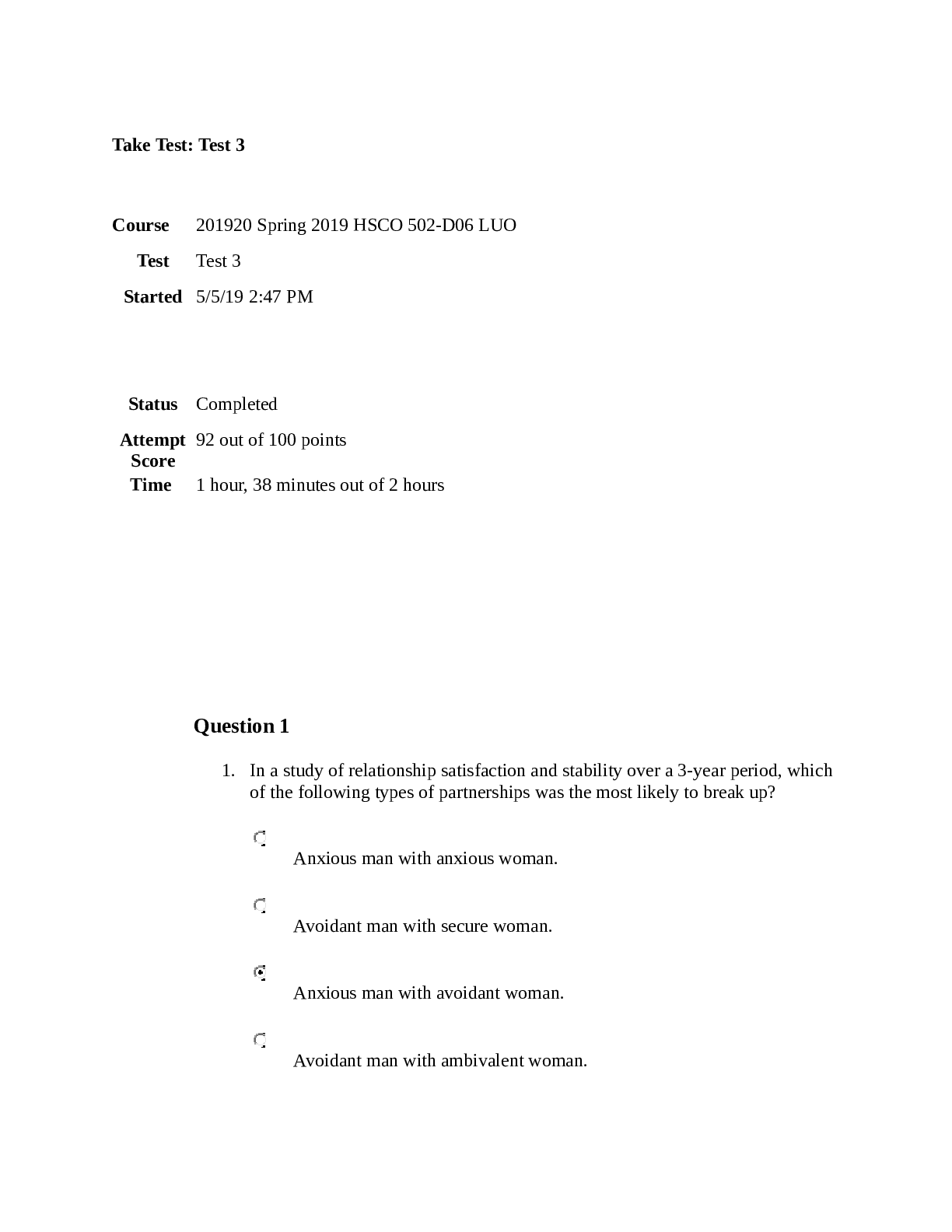
Question 1
1. In a study of relationship satisfaction and stability over a 3-year period, which
of the following types of partnerships was the most likely to break up?
Anxious man with anxious woman.
Avoidant man wit
...
Question 1
1. In a study of relationship satisfaction and stability over a 3-year period, which
of the following types of partnerships was the most likely to break up?
Anxious man with anxious woman.
Avoidant man with secure woman.
Anxious man with avoidant woman.
Avoidant man with ambivalent woman.
2 points
Question 2
1. Which of these is the best definition of relativistic thought according to Perry?
Every person has a right to his or her own opinion and we should not
question each other.
People relate to each other because everyone is in search of absolute
truth.
Relativistic thinking is a stage that supersedes the ability to see inherent
contradictions.
Weighing evidence and considers ideas and values more objectively.
2 points
Question 3
1. Research on job satisfaction indicates which of the following?
Job satisfaction is more closely related to monetary compensation than
to any other variable.
Job satisfaction is most closely related to sociability, with sociable
individuals more likely to be satisfied with any job.
Personal style and job characteristics are important ingredients in job
satisfaction.
Job satisfaction actually has nothing to do with how well personality
characteristics match the demands of the job.
2 points
Question 4
1. Based upon research about marital relationships conducted by Gottman, what
feature of a relationship best predicts the demise of a relationship?
Homeostatic steady state.
Negative affect reciprocity.
Disillusionment.
Childlessness.
2 points
Question 5
1. In self-determination theory, which of the following is considered one of the
basic psychological needs that motivates our adaptation or coping efforts at
any age?
Autonomy.
Optimization.
Avoidance.
Generativity.
2 points
Question 6
1. Measures of subjective well-being typically assess degree of felt happiness or
positive emotion know as hedonic well-being. Other measures of well-being
focus more on assessing feelings of purpose, growth and master which is
sometimes called
Self-determination
Psychological well-being
Eudaemonic well-being.
Expressive well-being.
2 points
Question 7
1. Which of the following individuals would most likely be in the
reorganizational stage according to Schaie’s view of adult adjustment?
A 20-year-old carpenter’s apprentice.
A 25-year-old single mother.
A 45-year-old businessman.
A 62-year-old truck driver.
2 points
Question 8
1. The “Big Five” personality traits are
Conscientiousness, agreeableness, aggressiveness, neuroticism and
introversion.
Warmth, neuroticism, conscientiousness, introversion and extroversion.
Sociability, openness, neuroticism, agreeableness and aggressiveness.
Agreeableness, neuroticism, openness, extraversion and
conscientiousness.
2 points
Question 9
1. How do sociologists classify actions like entry into marriage and becoming a
parent?
As social constructions.
As dualistic decisions.
As adult rituals.
As marker events
2 points
Question 10
1. Reitzes and Mutran suggest Several factors at preretirement are strong
predictors of positive attitudes toward retirement later, including
religiosity.
feeling confident in relationships with friends.
number of close relatives, especially children.
mandatory retirement age.
2 points
Question 11
1. Kindling-behavioral sensitization describes
A process of shaping behavior to desired outcomes.
A process of increasing sensitivity to stressful triggers.
A process that explains how neurobiological factors interact with
chemicals in the brain.
The measure of total life stresses.
2 points
Question 12
1. In late adulthood, many of the physical losses of middle adulthood (e.g.,
sensory decline) continue. For people over 65 there is also a new physical
problem that about half of the population must contend with, called
osteoarthritis.
diabetes.
multi-infarct dementia.
Alzheimer’s disease.
2 points
Question 13
1. Video response. Review the video on, page 481 of your book; from the 3
statements select which one(s) are correct.
Statement 1: John stated three changes relevant to middle age; physical ability
declines, mental abilities are still intake, and there are some sexual changes
for men, but not to the extent that women experience.
Statement 2: John stated that he has experience significant decline in his
physical abilities, his ability to be successful as an adult student, and has
encountered erectile dysfunction.
Statement 3: a. John’s commentary on middle age demonstrates the concept of
regulation of loss, representing an adaption of expectations.
Statements 1, 2, and 3 are correct.
Statement 1 is correct
Statement 2 is correct
Statements 1 and 3 are correct.
2 points
Question 14
1. Which of the following is the most important factor in helping young adults
avoid a slide into poverty?
Education.
Religion.
Family size.
Avoiding delinquency.
2 points
Question 15
1. Video response. Review the video on, page 411 of your book; from the 3
statements select which one(s) are correct.
Statement 1: the video demonstrates Gary’s conflict between returning to a
previous status of relying on his parents while in graduate school and the
obligation he feels to be independent and care for his family.
Statement 2: Gary feels like his success thus far is attributed to the values that
his parent exemplified and reflects their support and expectations for him.
Statement 3: Gary is an example of the failure to launch syndrome and is
comfortable relying on his parents for support while in graduate school.
Statement 1 is correct.
Statement 2 is correct
Statement 1 and 2 are correct
Statement 3 is correct.
2 points
Question 16
1. Which of the following is the most likely physical change that most adults
will experience in their 40s ?
For many, it will take longer for eyes to adapt to changes in light than
before.
Many will acquire a serious disability.
For most people the ability to hear normal speech sounds will
noticeably decline.
For most people their body will produce more elastin as they age.
2 points
Question 17
1. How do the attitudes toward death among elderly people compare to the
attitudes of younger age groups?
Elderly people report more anxiety about death than middle-aged
adults.
Elderly people report less anxiety about death than middle-aged adults.
Elderly people are less realistic about its inevitability than middle-aged
adults are.
There are no differences between the elderly and other age groups in
regard to attitudes toward death.
2 points
Question 18
1. According to Erikson’s theory, which developmental task is central to the
middle adulthood stage of life?
Ego integrity.
Intimacy.
Autonomy.
Generativity.
2 points
Question 19
1. Which statement regarding the research findings of partner selection is NOT
accurate.
Secure individuals tend to be paired more often with other secure
individuals.
Research suggests that having a secure individual in the partnership will
automatically improve the quality of the relationship.
The most rare paring is between avoidant-avoidant and anxious
-anxious persons.
Insecure individuals need someone that can confirm their expectations
of close relationshipsl
2 points
Question 20
1. Gender differences in career choice are influenced by gender-role beliefs and
life style preferences including this notion
The gender-role beliefs of males and females have not changed in the
last 40 years.
Women today more often choosing to be full time homemakers.
Women still give greater priority to their role as caregiver, and men still
give greater priority to their role as breadwinner.
Men now share equally in housework and child care.
2 points
Question 21
1. In Super’s developmental approach to career satisfaction, he argues that an
individual’s vocational self-concept evolves over time. What is the career
development stage that usually characterizes adolescents and young adults?
[Show More]














.png)
.png)

