NUR 336 Exam 1 | Questions, Answers and Rationales In which nurse interaction may SBAR be used? a. Nurse to social worker b. Nurse to doctor c. Nurse to nurse d. All of the above A nurse tells a doctor a patient has di
...
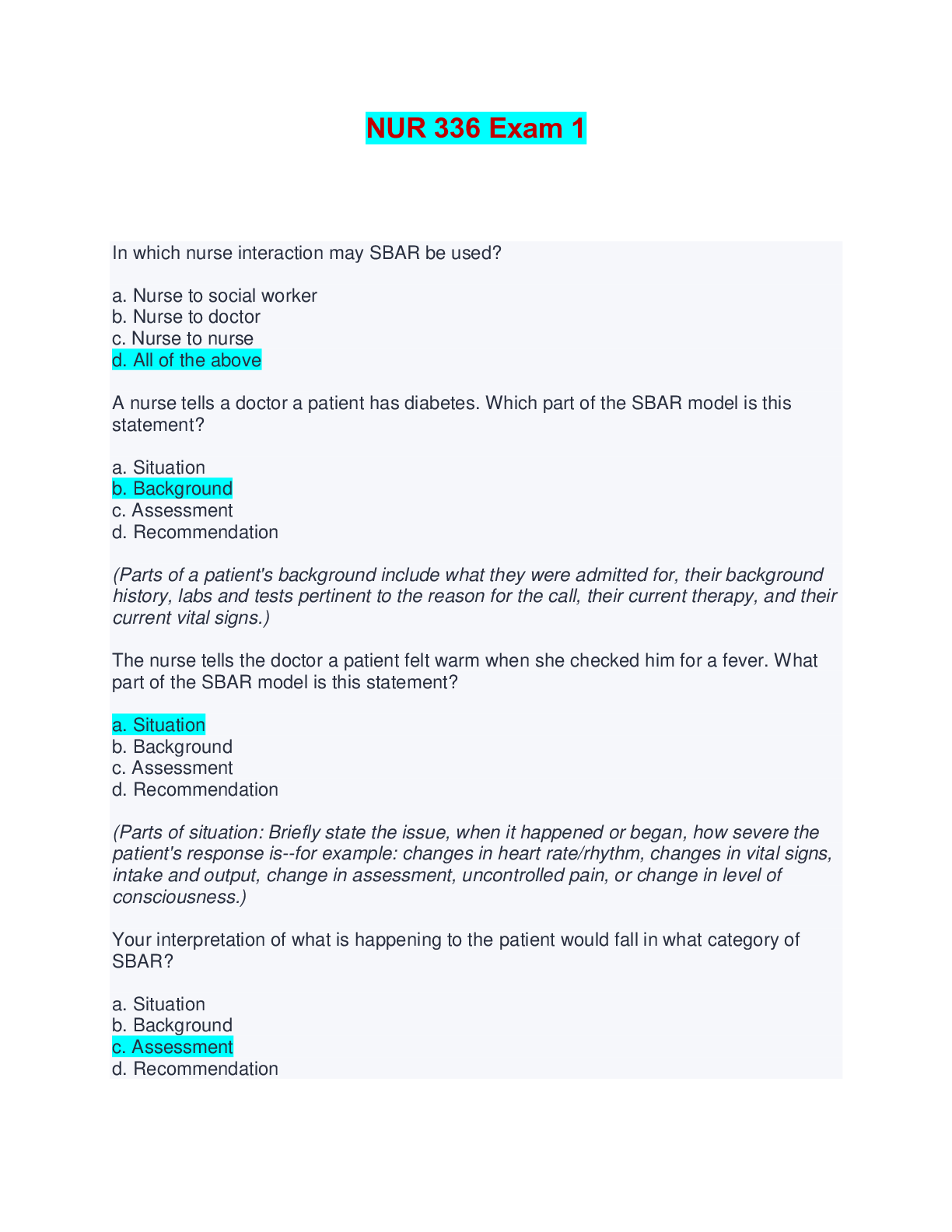
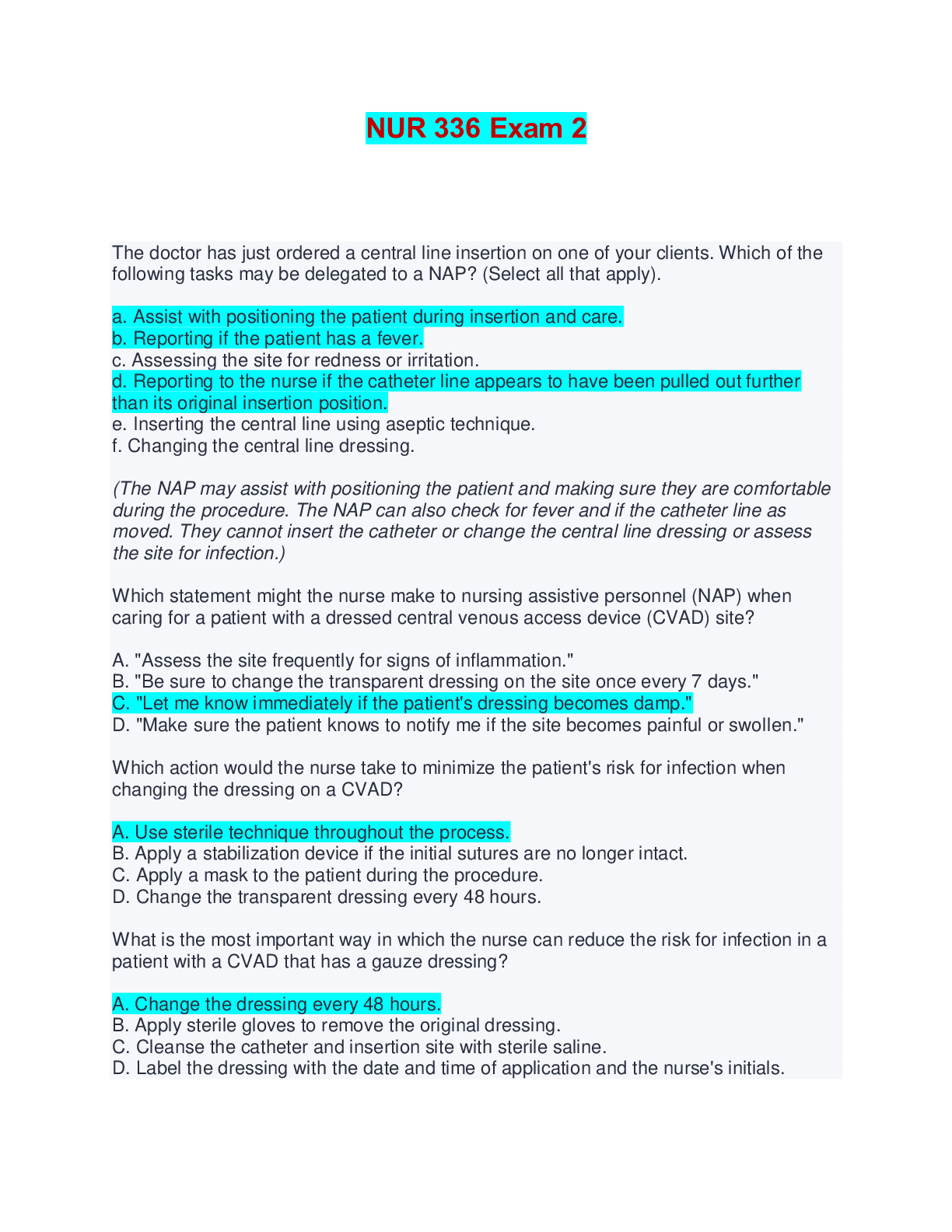
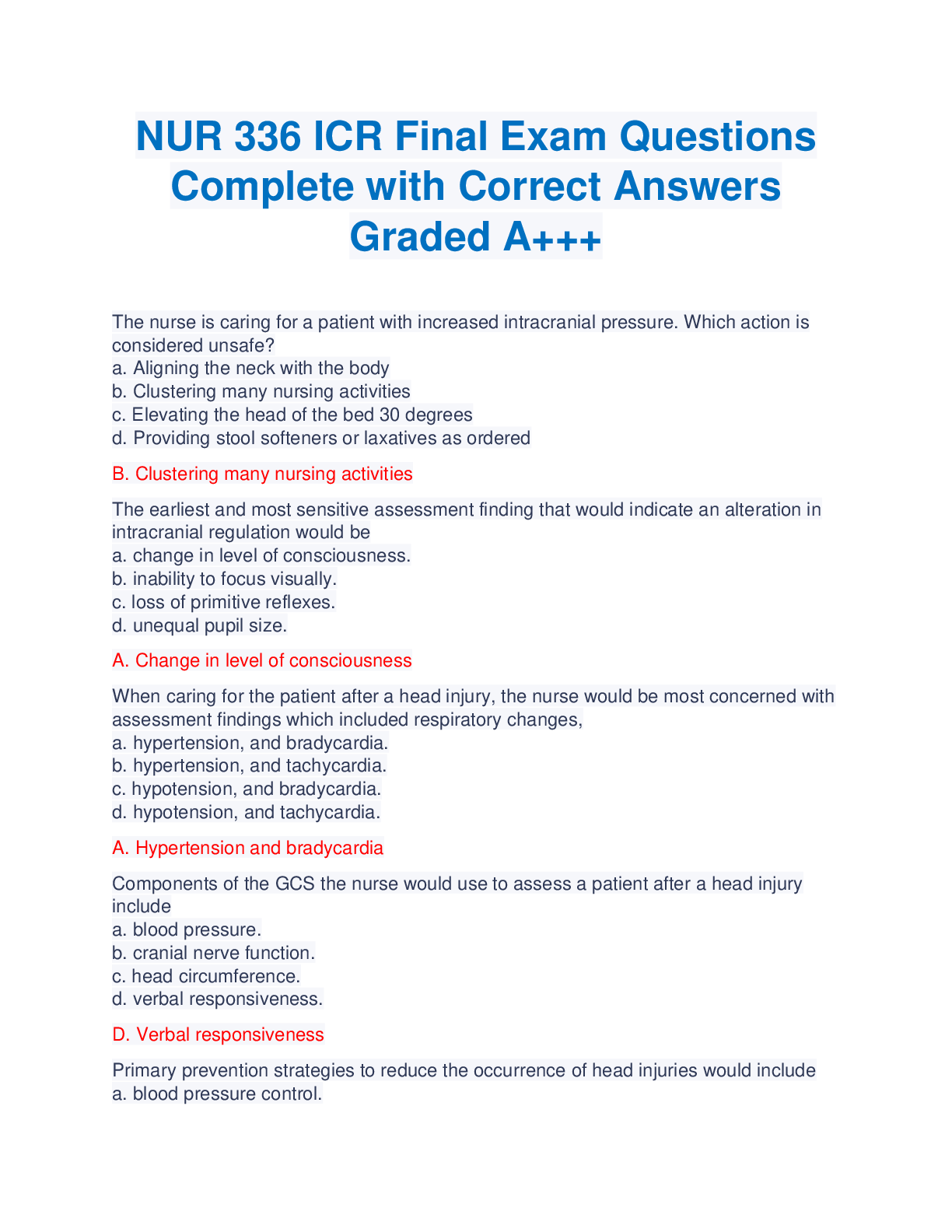
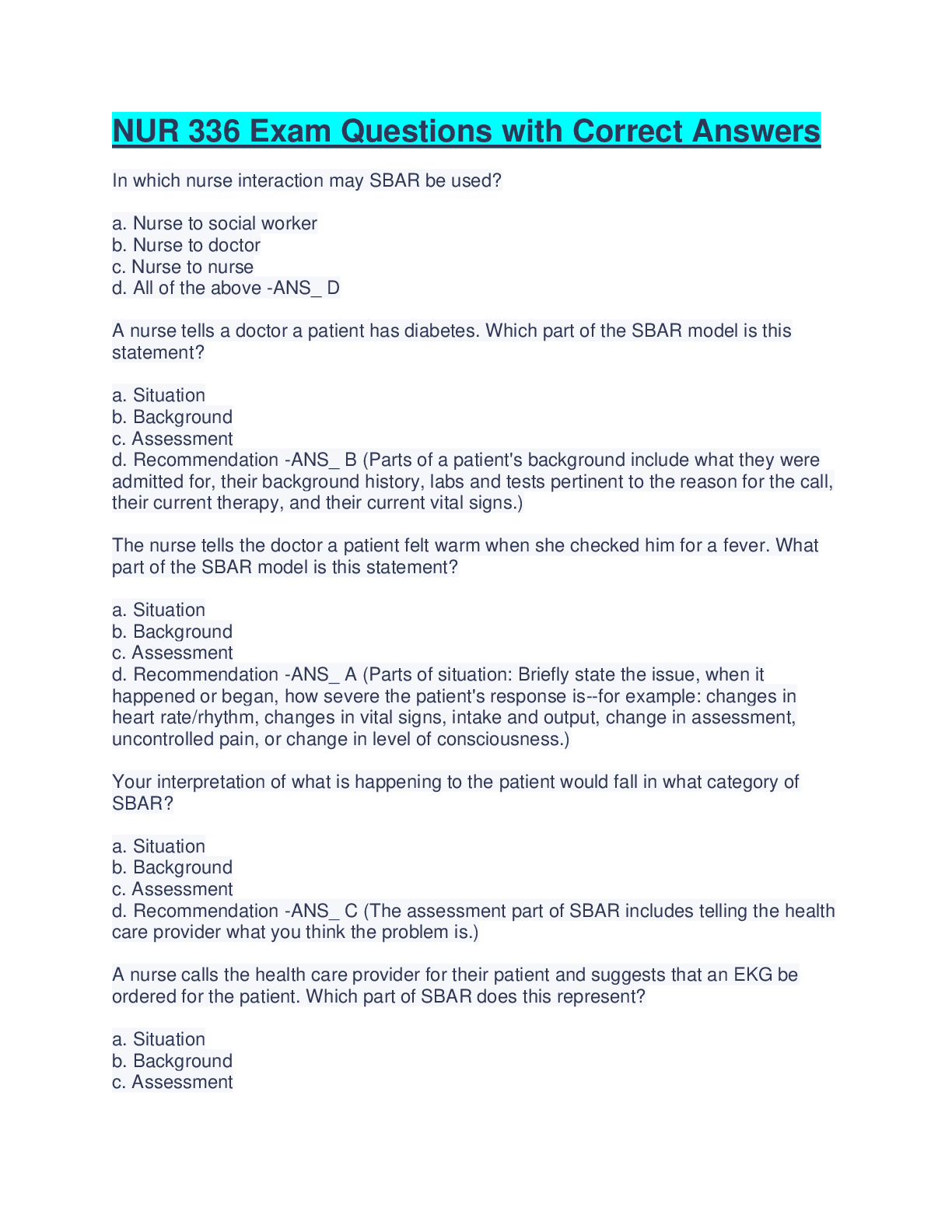
NUR 336 Exam 1 | Questions, Answers and Rationales In which nurse interaction may SBAR be used? a. Nurse to social worker b. Nurse to doctor c. Nurse to nurse d. All of the above A nurse tells a doctor a patient has diabetes. Which part of the SBAR model is this statement? a. Situation b. Background c. Assessment d. Recommendation (Parts of a patient's background include what they were admitted for, their background history, labs and tests pertinent to the reason for the call, their current therapy, and their current vital signs.) The nurse tells the doctor a patient felt warm when she checked him for a fever. What part of the SBAR model is this statement? a. Situation b. Background c. Assessment d. Recommendation (Parts of situation: Briefly state the issue, when it happened or began, how severe the patient's response is--for example: changes in heart rate/rhythm, changes in vital signs, intake and output, change in assessment, uncontrolled pain, or change in level of consciousness.) Your interpretation of what is happening to the patient would fall in what category of SBAR? a. Situation b. Background c. Assessment d. Recommendation (The assessment part of SBAR includes telling the health care provider what you think the problem is.) A nurse calls the health care provider for their patient and suggests that an EKG be ordered for the patient. Which part of SBAR does this represent? a. Situation b. Background c. Assessment d. Recommendation (Recommendation involves suggesting/requesting that the HCP order certain tests, a change in the patient’s treatment, a higher level of care is needed (Ex. Referral to a specialist) and asking the HCP is they have any questions for you or if they need any other information.) The nurse asks a newly admitted client, "What can we do to help you?" What is the purpose of this therapeutic communication technique? a. To reframe the client's thoughts about mental health treatment b. To put the client at ease c. To explore a subject, idea, experience, or relationship d. To communicate that the nurse is listening to the conversation (This is an example of the therapeutic communication technique of exploring. The purpose of using exploring is to delve further into the subject, idea, experience, or relationship. This technique is especially helpful with clients who tend to remain on a superficial level of communication.) Which nursing statement is a good example of the therapeutic communication technique of focusing? a. "Describe one of the best things that happened to you this week." b. "I'm having a difficult time understanding what you mean." c. "Your counseling session is in 30 minutes. I'll stay with you until then." d. "You mentioned your relationship with your father. Let's discuss that further." (This is an example of the therapeutic communication technique of focusing. Focusing takes notice of a single idea or even a single word and works especially well with a client who is moving rapidly from one thought to another.) During a nurse-client interaction, which nursing statement may belittle the client's feelings and concerns? a. "Don't worry. Everything will be alright." b. "You appear uptight." c. "I notice you have bitten your nails to the quick." d. "You are jumping to conclusions." (This nursing statement is an example of the nontherapeutic communication block of belittling feelings. Belittling feelings occur when the nurse misjudges the degree of the client's discomfort, thus a lack of empathy and understanding may be conveyed.) A client on an inpatient psychiatric unit tells the nurse, "I should have died because I am totally worthless." In order to encourage the client to continue talking about feelings, which should be the nurse's initial response? a. "How would your family feel if you died?" b. "You feel worthless now, but that can change with time." c. "You've been feeling sad and alone for some time now?" d. "It is great that you have come in for help." (This nursing statement is an example of the therapeutic communication technique of reflection. When reflection is used, questions and feelings are referred back to the client so that they may be recognized and accepted.) Which therapeutic communication technique should the nurse use when communicating with a client who is experiencing auditory hallucinations? a. "My sister has the same diagnosis as you and she also hears voices." b. "I understand that the voices seem real to you, but I do not hear any voices." c. "Why not turn up the radio so that the voices are muted." d. "I wouldn't worry about these voices. The medication will make them disappear." (This is an example of the therapeutic communication technique of presenting reality. Presenting reality is when the client has a misperception of the environment. The nurse defines reality or indicates his or her perception of the situation for the client.) A mother rescues two of her four children from a house fire. In the emergency department, she cries, "I should have gone back in to get them. I should have died, not them." What is the nurse's best response? a. "The smoke was too thick. You couldn't have gone back in." b. "You're feeling guilty because you weren't able to save your children." c. "Focus on the fact that you could have lost all four of your children." d. "It's best if you try not to think about what happened. Try to move on." (The best response by the nurse is, "You're experiencing feelings of guilt because you weren't able to save your children." This response utilizes the therapeutic communication technique of reflection which identifies a client's emotional response and reflects these feelings back to the client so that they may be recognized and accepted.) Which of the following are examples of objective data? (Select all that apply.) a. When asked to report their pain on a scale from 0 to 10, the patient reports a 6. b. The patient's liver is non palpable. c. The patient's scalp is round, symmetrical, and no bumps or lumps are present. d. The patient has had frequent headaches for the past few weeks. e. The patient's tympanic membrane is a pearly/gray white. The nurse is helping a patient with hemiparesis take a few steps. A gait belt has been applied. The patient is using a cane. Where should the nurse stand in relation to the patient? A. On the patient's strong side B. On the patient's weak side C. Behind the patient D. In front of the patient The nurse is preparing to delegate the ambulation of a patient with the use of a gait belt to nursing assistive personnel (NAP). Which statement made by NAP requires the nurse to follow up? A. "I will be sure to put nonskid slippers on the patient before getting him up to ambulate." B. "I will use the under-axillae technique to help him up to a standing position." C. "Rocking the heavier patient into a standing position seems to work really well for me." D. "I will grasp the gait belt in the middle of the patient's back." The nurse is preparing to initiate ambulation with a patient who is recovering from a stroke. What information will help the nurse determine how far to walk? A. Ask the patient how far she would like to go. B. Review the health care provider's order. C. Review the medical record to see how far the patient has walked during the past several therapeutic ambulations. D. Review the records of other patients who are at a similar point in their stroke rehabilitation. (Setting mutual goals increases the likelihood of success in achieving the goal of ambulation. The health care provider's order will only state "ambulate"; it will not specify how far to ambulate the patient. The patient's circumstances or condition may not be similar to those he or she undertook during the past several ambulations. Patient care should be individualized. The status of other patients in stroke rehabilitation is not relevant to this patient.) The nurse is ambulating a patient with a gait belt when he says he feels sick to his stomach. What would the nurse do? A. Return the patient to the bed or chair (whichever is closer). B. Encourage the patient to complete the distance of ambulation. C. Help him to the restroom. D. Ease him to the floor. The nurse has applied a gait belt to a postoperative patient to facilitate ambulation. Within a few feet of the bed, the patient begins to complain of dizziness and leans heavily on the nurse. What would be the nurse's initial response? A. Slowly lower the patient to the floor. B. Attempt to sit the patient down on a chair just a few steps away. C. Try to hold the patient up until the dizziness passes. D. Call for assistance in a loud but calm voice. The nurse is preparing to provide perineal care for a female patient who is on bed rest. Which patient position should the nurse use for this care? A. Supine B. Prone C. Side-lying D. Dorsal recumbent How can the nurse promote infection control while providing perineal care for a female patient who has a catheter? A. By avoiding the application of tension on the catheter. B. By patting, not rubbing, the skin dry after thoroughly rinsing it. C. By cleansing the patient's labia from the pubic area toward the rectum. D. By using warm water to cleanse the patient's entire perineal area. (Cleansing the labia from the pubic area toward the rectum minimizes the risk of introducing microorganisms from the rectum to the urethra and vagina. Although avoiding tension on the catheter is encouraged in order to prevent its accidental dislodgment, this precaution does not pertain to infection control. Patting the skin dry, rather than rubbing it, helps minimize skin damage, but this action does not pertain to infection control. Cleansing with soap and water reduces the number of microorganisms in the perineal area. Using warm water alone, however, has little effect.) The nurse is delegating to nursing assistive personnel (NAP) the perineal care of a female patient who is totally dependent and confined to bed. Which statement by the NAP requires the nurse's follow-up? A. "I'll ask for assistance if I need help positioning her." B. "I'll see if she's up to the care right now." C. "I'll let you know if I notice any signs of redness or discharge." D. "I'll be sure to use hot, soapy water, since she has been incontinent." As the nurse is preparing to provide perineal care to a female patient with limited mobility, the patient says, "I can do that myself." Which action would be the priority? A. Provide all the necessary supplies and linen for this task. B. Assess the patient's ability to perform proper perineal care. C. Ensure that the patient has privacy while performing perineal care. D. Document any complaints of irritation or pain in the perineal area. (Determining the appropriateness of self-care by assessing the patient's ability to provide her own perineal care is the priority action. Although it is a nursing responsibility to provide all the items necessary for the patient to perform this task, ensuring the patient's privacy, and documenting patient complaints, doing so would not take priority over assessing the patient's ability to perform perineal care.) The nurse is delegating a female patient's perineal care to nursing assistive personnel (NAP). Which instruction would the nurse give to ensure the NAP's safety while performing this care? A. Wear sterile gloves. B. Wear clean gloves. C. Wear an isolation gown. D. Use hot water. When a nursing assistive personnel (NAP) enters the room of a patient in a belt restraint, he finds the patient's gown bunched around the patient's chest and the patient asking for help. What would the NAP do? A. Check the patient's blood pressure and pulse before smoothing the gown B. Untie the restraint and smooth the patient's gown C. Put on the call light for help D. Ask the patient what specific help she would like Why does the nurse instruct nursing assistive personnel (NAP) to remove the wrist restraint of a confused patient every 2 hours? A. To try a less restrictive type of restraint if a more confining restraint has proved effective B. To double-check the size by inserting one finger between the wrist and the restraint C. To check the skin integrity and range of motion of the wrist D. To comply with Joint Commission standards To which patient might the nurse apply a physical restraint? A. An 83-year-old patient with dementia and a history of wandering whose fall risk assessment indicates a high risk of falling. B. A 42-year-old critical care patient with a traumatic brain injury who has repeatedly tried to pull out her shunt. C. A 74-year-old patient confined to bed who is at risk of pressure ulcers. D. A 60-year-old patient with dementia who seemed increasingly confused shortly after having had restraints applied for 1 hour that morning. The nurse is discussing the risk of falling with the wife of a patient with cognitive impairment. What is the nurse's best response when the patient's wife says, "I don't like him being tied down in the bed?" A. "I'm sure you don't want him to fall again." B. "Can you suggest an alternative?" C. "What did you do to prevent him from falling when he was at home?" D. "We will try all other alternatives before using physical restraints." What would the nurse instruct nursing assistive personnel (NAP) to report when caring for a patient in a wrist restraint? A. "Tell me if the patient's pulse changes." B. "Tell me if the skin under the restraint becomes abraded or raw." C. "Let me know if you think she's ready for them to come off." D. "Let me know if the patient needs anything for pain." . When performing the task of bed making, which safety interventions should the nurse consider for themselves and the client? a. Lower the bed to the floor b. Wear sterile gloves c. Wear clean gloves and dispose of soiled linens in the biohazard container d. Make a patient who has limited mobility get out of bed during the bed making Which instruction would the nurse give a patient who is able to assist with transfer from a bed to a wheelchair using a transfer belt? A. "When I count to three, please rock yourself into a standing position." B. "Please hold on to my waist while I help you stand." C. "Please tell me how I can best help you get up off the bed and stand up." D. "Please push down onto the mattress with both hands and stand when I count to three." (Telling the patient to push against the mattress is the best instruction the nurse can give because it teaches the patient how to help achieve a standing position during the transfer. The patient and nurse rock together for three counts. The patient would not be instructed to hold on to the nurse's waist. Doing so is not a safe action. Asking the patient to advise the nurse does not instruct the patient on moving from the bed to a wheelchair.) The nurse is preparing to transfer a patient with left-sided weakness from the bed to a wheelchair using a transfer belt. Which position would the nurse instruct the patient to assume? A. Place both feet together on the floor. B. Place your weaker foot forward and your stronger leg toward the back. C. Extend both of your legs and feet. D. Place your stronger leg forward and your weaker leg toward the back. (The nurse will instruct the patient to place the stronger leg forward, with the weaker foot toward the back, allowing the stronger leg to support most of the patient's body weight. Placing both feet together on the floor will not help the patient stand safely. Placing the weaker foot forward places the stronger leg in the dependent position. The weaker leg, called upon to bear the bulk of the patient's weight, may not be able to do so. Extending both of the legs and feet will not help the patient stand safely.) A patient has been transferred to a wheelchair with a transfer belt. What is one action the nurse would take to position the patient safely in the chair? A. Remove the wheelchair leg rests. B. Ask the patient to rate his or her pain level. C. Lower the foot rests, and place the patient's feet on them. D. Remove the transfer belt. When preparing to safely transfer a patient from a bed to a wheelchair using a transfer belt, the nurse would do what first? A. Coordinate extra help. B. Assess the patient's vital signs. C. Assess the patient's physiological capacity to transfer. D. Determine whether to transfer the patient to a wheelchair or chair. A patient lying supine in bed is being transferred to a wheelchair using a transfer belt. Which action would the nurse perform just before moving the patient to the side of the bed? A. Help the patient put on skid-resistant footwear. B. Raise the head of the bed 30 degrees. C. Place the transfer belt over the patient's clothing. D. Position the chair so that the patient will move toward his or her stronger side. (The nurse would raise the head of the bed 30 degrees right before moving the patient to the side of the bed. Footwear and the transfer belt would not be applied at this point in the process. The wheelchair would already be in position at this point in the process.) When feeding a patient, you should put them in which position? a. High-Fowlers b. Low-Fowlers c. Supine d. Dorsal (Putting the patient in the High-Fowlers position when feeding them prevents the risk of aspiration.) When feeding a patient that has difficulty swallowing, the nurse should do what as a safety intervention? a. Put the patient in Low-Fowlers position. b. Give the patient water between every bite. c. Use a thickener to prevent aspiration. d. Raise the head of the bed 30 degrees to make the patient more comfortable. The physician's order says to administer 'Furosemide (Lasix) 40 mg PO BID'. The nurse verifies the physician's order against the MAR by verbally stating the patients name, date of birth, allergies, name of mediation, dose of medication, route of medication, and frequency of administration. The nurse retrieves the medication while doing their first check at the med cart. The nurse goes into the client's room and introduces themselves and administers the Furosemide medication intravenously to the patient at the correct time. The nurse documents the time they administered the medication and signs their name on the MAR. Which of the following rights of medication administration did the nurse violate? (Select all that apply.) a. Right patient b. Right medication c. Right dose d. Right route e. Right time f. Right documentation (The nurse did not verify the patient's identity. The nurse administered the medication the incorrect route, Lasix should be given orally.) When retrieving an oral medication from the med cart, the nurse should: a. Never split any pill b. Wear sterile gloves c. Place dose in cup, leaving in individual wrapper d. Pour liquid medication while standing above the counter When retrieving an oral medication from the med cart, the nurse should: a. Select one med cup per tablet b. Select two med cups per tablet c. Select two cups for water to take to designated location d. Open all oral tablets at the med cart Which of the following options are true regarding medication administration? a. It is important to check the patient's room number b. You should always verify the order with the physician even if there is nothing unusual about it c. It is imperative to check the patient's allergies before retrieving and administering the medication d. You should use one patient identifier before administering a medication to a client Which of the following should you NOT do before administering an oral medication to a patient? (Select all that apply) a. Introduce yourself to the client and state the purpose of the nurse/client interaction b. Identify the client with their name, birth date, and medical record number while matching the client MAR. c. Keep the door open so the client feels more comfortable. d. Perform hand hygiene after entering the room. e. Put the patient in a supine position so they are able to swallow the medication more easily. f. Wear clean gloves while taking the medication out of the wrapper. Which of the following medication is a nurse able to split? a. Enteric-coated tablet b. Sustained-release tablet c. A tablet that is scored d. Extended-release tablet Which of the following cannot be used as a patient identifier? a. Room number b. Full name
[Show More]


 Correct Study Guide, Download to Score A.png)
 Correct Study Guide, Download to Score A.png)