Unit 3 - Milestone 3
"Segregation of white and colored children in public schools has a detrimental effect upon the
colored children. The impact is greater when it has the sanction of the law, for the policy of
separa
...
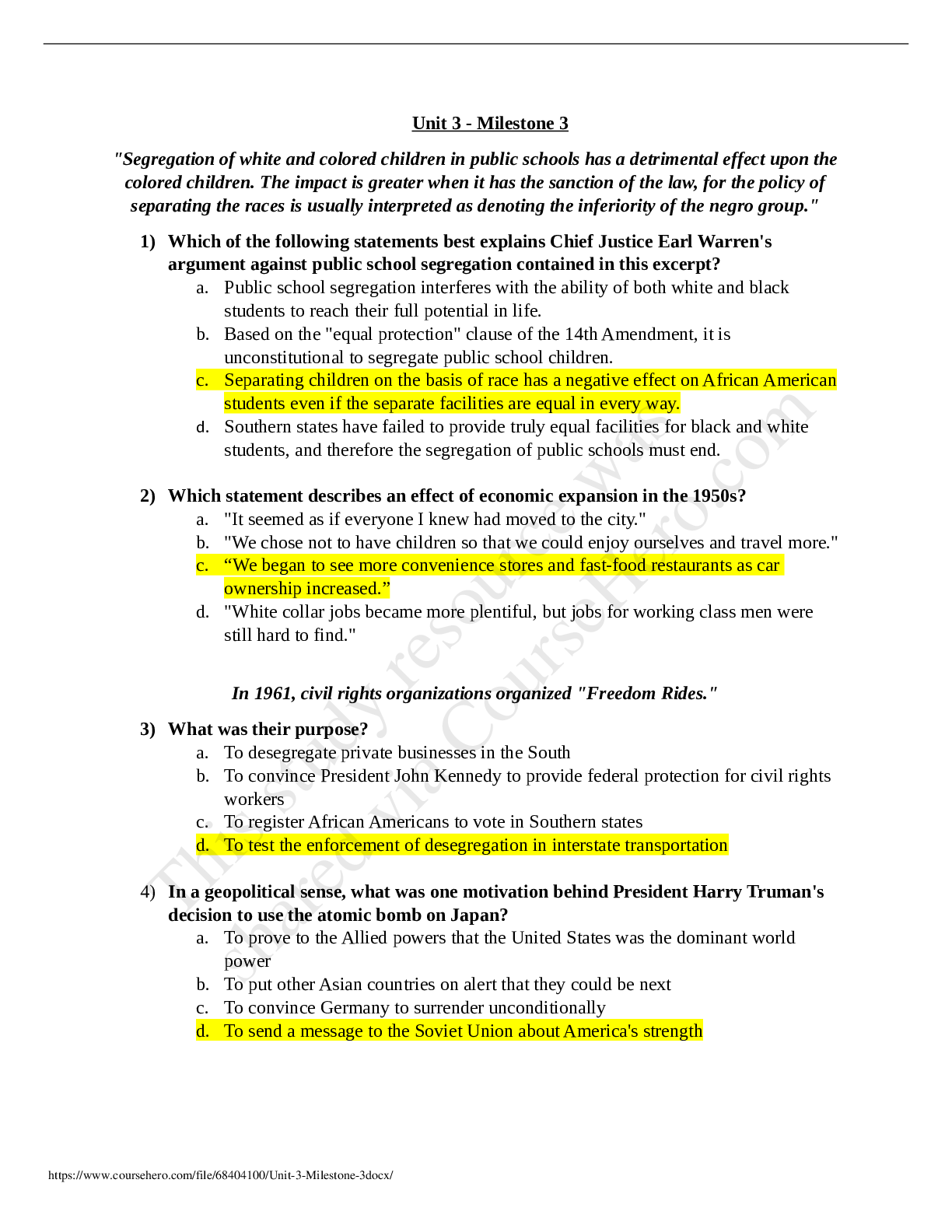
Unit 3 - Milestone 3
"Segregation of white and colored children in public schools has a detrimental effect upon the
colored children. The impact is greater when it has the sanction of the law, for the policy of
separating the races is usually interpreted as denoting the inferiority of the negro group."
1) Which of the following statements best explains Chief Justice Earl Warren's
argument against public school segregation contained in this excerpt?
a. Public school segregation interferes with the ability of both white and black
students to reach their full potential in life.
b. Based on the "equal protection" clause of the 14th Amendment, it is
unconstitutional to segregate public school children.
c. Separating children on the basis of race has a negative effect on African American
students even if the separate facilities are equal in every way.
d. Southern states have failed to provide truly equal facilities for black and white
students, and therefore the segregation of public schools must end.
2) Which statement describes an effect of economic expansion in the 1950s?
a. "It seemed as if everyone I knew had moved to the city."
b. "We chose not to have children so that we could enjoy ourselves and travel more."
c. “We began to see more convenience stores and fast-food restaurants as car
ownership increased.”
d. "White collar jobs became more plentiful, but jobs for working class men were
still hard to find."
In 1961, civil rights organizations organized "Freedom Rides."
3) What was their purpose?
a. To desegregate private businesses in the South
b. To convince President John Kennedy to provide federal protection for civil rights
workers
c. To register African Americans to vote in Southern states
d. To test the enforcement of desegregation in interstate transportation
4) In a geopolitical sense, what was one motivation behind President Harry Truman's
decision to use the atomic bomb on Japan?
a. To prove to the Allied powers that the United States was the dominant world
power
b. To put other Asian countries on alert that they could be next
c. To convince Germany to surrender unconditionally
d. To send a message to the Soviet Union about America's strength
https://www.coursehero.com/file/68404100/Unit-3-Milestone-3docx/
This study resource was
shared via CourseHero.com
5) Why did the United States adopt a "Europe first" strategy upon entering World
War II?
a. Nazi Germany appeared to be on the brink of conquering Europe.
b. Soviet soldiers were preventing German troops from entering key Soviet cities.
c. The United States owed large sums of money to European nations after World
War I.
d. Winston Churchill and Franklin Roosevelt had convinced Joseph Stalin that Italy
was vulnerable to invasion.
In the summer of 1963, President John Kennedy stated his support for a civil rights bill.
6) The bill he envisioned would give the federal government greater power to do which of
the following actions?
a. Introduce affirmative action
b. Oversee elections in Southern states
c. Arrest violent protestors
d. Enforce school desegregation
7) Federal housing policies prior to World War II and government agencies, such as
the Home Owners' Loan Corporation, helped create ________.
a. residential segregation
b. de jure segregation
c. low-income housing
d. equal access to home ownership
8) Choose the statement that best analyzes events in the year 1968 through the lens of
politics.
a. Divisions over the Vietnam War paved the way for a more conservative coalition
to come to power.
b. Women’s liberation groups targeted the Miss America pageant for being
exploitative of women.
c. The discovery of U.S. military actions at My Lai exposed the moral consequences
of the Vietnam War.
d. Technological achievements, such as television coverage broadcast from space of
manned space flight Apollo 7, unified Americans in challenging times.
9) Choose the true statement about women in the workforce during World War II.
a. Women made up more than a third of the domestic workforce.
b. Employers did not want to hire married women with children.
c. The number of working women fell, as women supported the war effort by caring
for the home.
d. Women were temporarily able to achieve equal pay with men.
https://www.coursehero.com/file/68404100/Unit-3-Milestone-3docx/
This study resource was
shared via CourseHero.com
The United Nations issued a Universal Declaration of Human Rights in 1948.
10) Which of the following statements reflects an idea contained in the United Nations'
Universal Declaration of Human Rights?
a. Reason and conscience can guide human beings to treat one another as equals.
b. Humans must cede some of their rights to governments in exchange for
protection.
c. The Declaration of Human Rights shall be applicable only to Christian nations.
d. The ideals outlined shall be enforced equally in all of the world’s nations and
governments.
11) Which of the following is true about the Yalta Conference?
a. The U.S. and the Soviet Union promised to fight Japan together.
b. Germany was split into multiple zones of occupation.
c. It occurred after Germany's surrender but before Japan's.
d. The Allied powers agreed to put Nazi officials on trial at the end of the war.
12) Economic expansion and suburbanization in the 1950s led to cultural pressures to
behave in certain ways according to your __________.
a. gender
b. income
c. location
d. profession
"As part of the Lyndon Johnson administration's War on Poverty, my teenage son participated
in a program which provided training and work experience so he could have the same
advantages as others."
13) What was the name of that program?
a. Community Action Program
b. Teacher Corps
c. Head Start
d. Job Corps
14) Choose the statement that explains one way the federal government supported
private business during World War II.
a. “We will decrease taxes on corporations and allow them to lower wages for the
duration of the war.”
b. “We will award defense contracts to the smallest 100 corporations in the United
States.”
c. “We will enforce antitrust regulations while wartime mobilization and production
are in effect.”
d. “We will assume the majority of costs associated with converting your factory to
produce wartime materials.”
https://www.coursehero.com/file/68404100/Unit-3-Milestone-3docx/
This study resource was
shared via CourseHero.com
15) Which of the following was a significant effect of containment policy and the Cold
War on the American government in the 1940s and 1950s?
a. The creation of new federal bodies, such as the National Security Council and the
Central Intelligence Agency, to curtail Communist subversion at home and abroad
b. The expulsion of all persons of Russian descent from state and federal
employment
c. The temporary suspension of the First Amendment in an effort to contain state
secrets related to the atomic bomb
d. A gradual acceptance of diverse views and behaviors related to sexuality and
gender
16) What did President Kennedy do in response to the Cuban Missile Crisis?
a. He demanded the Soviet Premier remove the missiles from Cuba.
b. He invaded Cuba and dismantled the missiles.
c. He persuaded the Cuban leader to ally with the U.S. rather than the Soviet Union.
d. He bombed the missile silos until they were damaged beyond repair.
17) Choose the statement that best explains why Richard Nixon represented a
significant challenge to the Democratic Party in the 1968 presidential election.
a. He believed that racial equality in the United States must be accompanied by
economic equality.
b. His antiwar campaign was most popular with college students and idealistic
young activists.
c. He did not foresee making any significant changes to president Lyndon Johnson’s
domestic or foreign policies.
d. He represented the majority of Americans opposed to the social changes taking
place in the country.
18) Select the statement that best reflects Dwight Eisenhower's New Look strategy
during the Cold War.
a. It provided the U.S. with a range of nonmilitary options for dealing with
communist aggression.
b. It encouraged the formation of the Green Berets, a special forces unit trained in
counterinsurgency.
c. It reduced the American nuclear arsenal to diminish the threat of nuclear war.
d. It cut the size of the armed forces nearly in half while building up the nuclear
arsenal.
https://www.coursehero.com/file/68404100/Unit-3-Milestone-3docx/
This study resource was
shared via CourseHero.com
19) Which of the following was associated with the counterculture movement in the
1960s?
a. Organizing sit-ins at lunch counters
b. Experimenting with marijuana and psychedelic drugs
c. Protesting free speech policies at universities
d. Registering African American voters in the South.
20) Choose the statement that describes an economic consequence of the United States
as an "arsenal of democracy" during World War II.
a. "The group that benefited most, economically, from wartime production was U.S
soldiers."
b. "Scrap metal and other materials are really hard to come by these days."
c. "My uncle worked as a shipbuilder and told me about how President Roosevelt
nationalized the shipping and shipbuilding industries."
d. "President Roosevelt had the government take over the shipping industry."
21) Choose the statement that reflects U.S. involvement in Vietnam during the
Eisenhower administration.
a. The U.S. provided support—money and advisors—to Ngo Dinh Diem in South
Vietnam because the administration believed that the Soviet Union and China
controlled North Vietnam.
b. Congress passed a resolution that increased the executive branch’s war power, and
the U.S. became an official combatant in the war.
c. The United States escalated the bombing campaign against North Vietnam and
almost doubled military spending—to over $80 million—in one year.
d. Despite U.S. support, the government of South Vietnam grew weaker. As a result,
the United States approved a military coup against the faltering government.
22) Choose the true statement regarding the adoption of containment policy by the
United States during the Cold War.
a. The United States feared that Germany would reemerge as a military power.
b. The United States wanted other nations to take the lead in combatting the
expansion of the Soviet Union.
c. The United States believed that communism was only a mild threat to the world.
d. The United States hoped to trigger the collapse of the Soviet Union.
https://www.coursehero.com/file/68404100/Unit-3-Milestone-3docx/
This study resource was
shared via CourseHero.com
Identity politics emerged in the 1960s as movements began to focus on issues specific to the
subgroups to which their participants belonged.
23) Choose the true statement about the effects of the Black Power movement.
a. " I supported nonviolence as the best strategy for social change."
b. "I supported the decision to kick whites out of the Student Nonviolent
Coordinating Committee."
c. "It was easier for white Americans to support the aims of the Black Power
movement than the traditional Civil Rights movement."
d. “I learned that integration was the best way to solve problems in the African
American community.”
24) Prior to Brown v. Board of Education, President Truman created a committee to
________.
a. investigate racial discrimination in the United States
b. grant equal access to graduate education
c. desegregate sports
d. strike down racially discriminatory real estate covenants
President Harry Truman and secretary of state George Marshall proposed the Marshall Plan
to Congress in 1947.
25) Choose the statement that best summarizes the purpose of this plan.
a. "We will create an alliance with Western Europe to fight against Soviet
aggression."
b. "We will provide financial and military assistance to any country resisting
Communist aggression."
c. “We will provide financial support to rebuild European countries and stem the
spread of Communism.”
d. "We will halt all trade with the Soviet Union and encourage European nations to
do the same."
https://www.coursehero.com/file/68404100/Unit-3-Milestone-3docx/
This study resource was
shared via CourseHero.com
Read the excerpt from a presidential committee report published in 1947:
"It is impossible to decide who suffers the greatest moral damage from our civil rights
transgressions, because all of us are hurt. That is certainly true of those who are victimized.
Their belief in the basic truth of the American promise is undermined . . . The damage to
those who are responsible for these violations of our moral standards may well be greater . . .
All of us must endure the cynicism about democratic values which our failures breed."
26) How does this excerpt demonstrate that the Cold War affected the civil rights
movement in the United States?
a. Those who oppose the United States are trying to create hostilities toward it by
members of other races.
b. In response to global criticism, the committee vows to investigate and prosecute
racism in the United States.
c. The committee is aware that the United States needs to take stronger steps to
address racial discrimination at home.
d. Communists are distorting America’s racial shortcomings to challenge the growth
of democracies.
27) The United States, while concerned with the rise of fascism, was committed to
nonintervention in European affairs in the 1930s for which of the following reasons?
a. Russia was committed to stopping the spread of fascism and the rise of Nazi
Germany.
b. The United States did not fully comprehend the scale of Adolf Hitler's antiSemitic campaigns.
c. The United States was already committed to defending China from Japan.
d. Franklin Roosevelt signed a non-aggression pact with Hitler in the 1930s.
28) Which of the following World War II events happened first?
a. Congress passed the Lend-Lease Act to assist Great Britain.
b. Britain and France declared war on Germany.
c. Japan invaded China and captured the city of Nanjing.
d. Japan and Germany signed a mutual defense treaty.
29) Which of the following was a cause of the attack on Pearl Harbor?
a. American citizens were ordered to leave Japan and return to the U.S.
b. America was protecting its Pacific interests.
c. The U.S. was providing supplies to Great Britain.
d. The U.S. had placed an embargo on Japan's ally, Italy.
https://www.coursehero.com/file/68404100/Unit-3-Milestone-3docx/
This study resource was
shared via CourseHero.com
30) Choose the statement that describes a way that conformity was encouraged among
Americans during the Second Red Scare.
a. "The government required us to report to the police anyone whom we felt might
be a communist."
b. "The state must protect all workers from exploitation by subjecting industry to
strict government regulation and supervision."
c. "Our neighbors seem to have an unusual family structure and nontraditional
gender roles, and we think they might be Communists."
d. "Our national health insurance program takes away our freedom of choice."
31) Choose the statement that best reflects a reaction against Brown v. Board of
Education by Southerners during the 1950s.
a. “I’d never seen Southern congressmen unified in such open resistance to a court
decision."
b. "Governor Faubus must be removed from office for complying with the court
decision."
c. “Before that bus boycott, we had to enter through and sit in the back of the bus.”
d. "We support an amendment to the Constitution that limits the power of the federal
courts."
https://www.coursehero.com/file/68404100/Unit-3-Milestone-3docx/
This study resource was
shared via CourseHero.com Powered by TCPDF (www.tcpdf.org)
[Show More]








.png)
.png)

