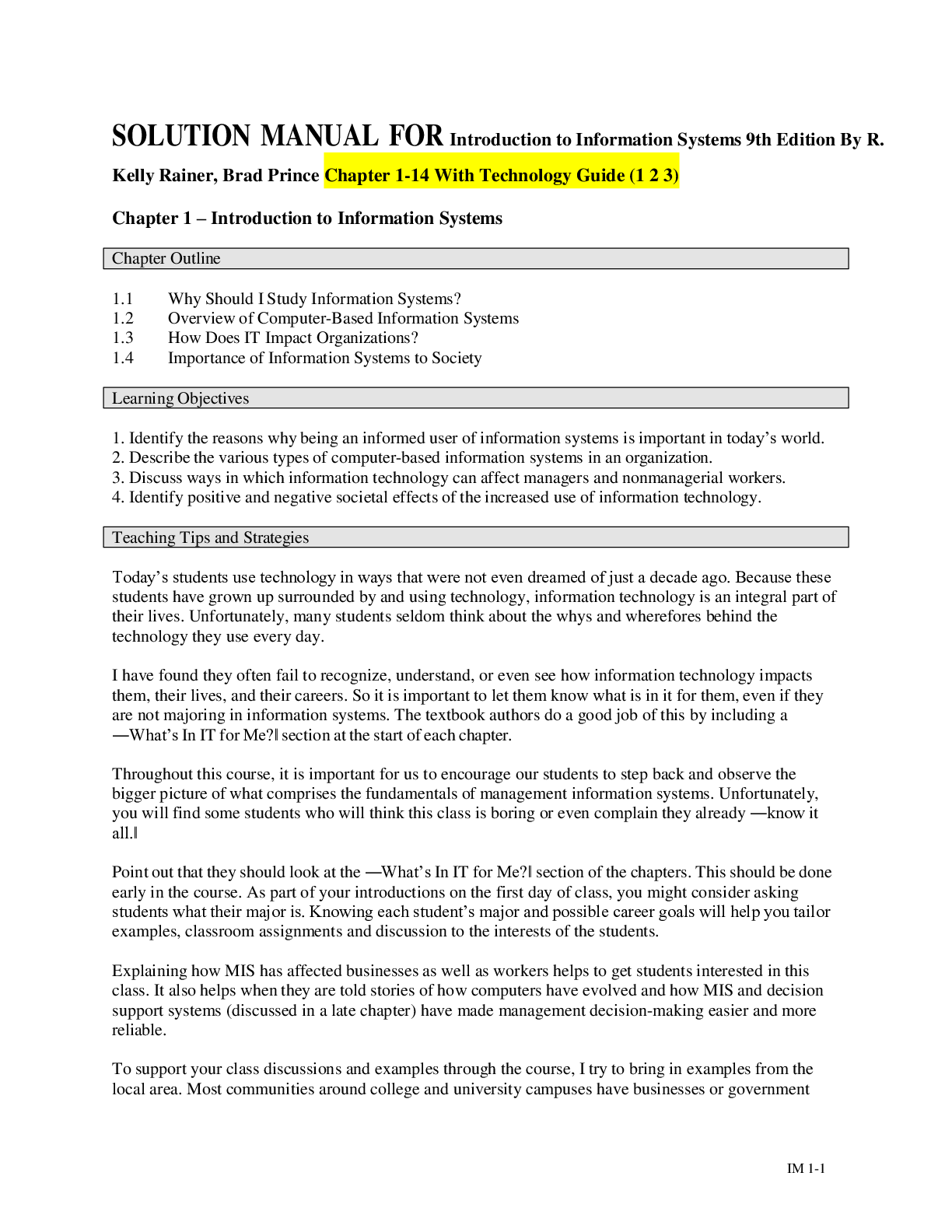
Economics > SOLUTIONS MANUAL > SOLUTION MANUAL FOR Managerial Economics, 9th Edition William F. Samuelson, Stephen G. Marks, Jay L. (All)
SOLUTION MANUAL FOR Managerial Economics, 9th Edition William F. Samuelson, Stephen G. Marks, Jay L. Zagorsky-1. Managerial economics is the analysis of important management decisions using the tools ... of economics. Most business decisions are motivated by the goal of maximizing the firm‟s profit. The tools of managerial economics provide a guide to profitmaximizing decisions. 2. i) Multinational Production and Pricing. The global automobile company needs information on 1) demand (how many vehicles can be sold in each market at different prices), 2) plant capacities and production costs, and 3) trade barriers and tariffs. ii) Market Entry. Remember that Uber began as a ridesharing idea, before ultimately becoming a market disruptor with respect to the long established taxicab industry. Crucial necessary information and questions include: Would city regulators allow Uber to operate at all? What market niche (how much demand) could it carve out of the taxi and car service markets? At what prices relative to taxis? Would customers trust a rideshare service? How many drivers could rideshare firms attract and at what costs? iii) Building a New Bridge. The authority should estimate usage of the bridge over its useful life, the likely cost of building and maintaining the bridge, and other important side-effects, pro and con -- including positive effects on business activity and the impacts on air pollution and traffic congestion. iv) A Regulatory Problem. Before deciding whether to promote the oil-to-coal conversion, government regulators need information on how much oil would be saved (and the dollar value of savings) and the cost of the chain of side-effects -- not only the direct cost of electricity provision but also pollution costs and environmental damage. v) Boeing and the 737 Max. Boeing gathered extensive information on potential airline demand for a new more fuel-efficient aircraft, yet considerable uncertainty remained with respect to future orders. Would the new aircraft shift significant orders and sales from Airbus, Boeing‟s longtime rival? Could Boeing achieve its aggressive R&D and production plan on budget and on schedule? Could it address and solve myriad reliability and safety problems, big and small? How severe would be ongoing regulatory oversight and how high a bar would the FAA set for certification requirements? Five or ten years from now, would the world economy continue to grow, fueling strong demand for air travel and for the new and improved aircraft? vi) An R&D Decision. The pharmaceutical company should quiz its scientists on the chances of success (and the timetable for completion) for each R&D approach. The company's marketing department would supply estimates of possible revenues from the drug; its production department would estimate possible costs. vii) David Letterman. Dave must carefully assess what he wants from a new contract (in particular how much he values the earlier time slot). As the negotiations unfold, Dave will glean valuable information as to the current competing offers of CBS and NBC. Of course, Dave must also try to assess how far the two networks might be willing to go in sweetening their offers. 3. The six steps might lead the soft-drink firm to consider the following questions. Step 1: What is the context? Is this the firm‟s first such soft drink? Will it be first to the marketplace, or is it imitating a competitor? Step 2: What is the profit potential for such a drink? Would the drink achieve other objectives? Is the fruit drink complementary to the firm‟s other products? Would it enhance the firm‟s image? Step 3: Which of six versions of the drink should the firm introduce? When (now or later) and where (regionally, nationally, or internationally) should it introduce the drink? What is an appropriate advertising and promotion policy? Step 4: What are the firm‟s profit forecasts for the drink in its first, second, and third years? What are the chances that the drink will be a failure after 15 months? Should the firm test market the drink before launching it? Step 5: Based on the answers to the questions in Steps 1 through 4, what is the firm‟s most profitable course of action? Step 6: In light of expected (or unexpected) developments in the first year of the launch, how should the firm modify its course of action? [Show More]
Last updated: 9 months ago
Preview 5 out of 90 pages
Loading document previews ...
Buy this document to get the full access instantly
Instant Download Access after purchase
Buy NowInstant download
We Accept:
Can't find what you want? Try our AI powered Search
Connected school, study & course
About the document
Uploaded On
Oct 23, 2024
Number of pages
90
Written in
All
This document has been written for:
Uploaded
Oct 23, 2024
Downloads
0
Views
69
Scholarfriends.com Online Platform by Browsegrades Inc. 651N South Broad St, Middletown DE. United States.
We're available through e-mail, Twitter, Facebook, and live chat.
FAQ
Questions? Leave a message!
Copyright © Scholarfriends · High quality services·