PSY 379 Exam 4 (Ch 10-12) | Complete Solutions (Answered) The _____ is known as the "heart muscle." Myocardium ________ is a chronic disease in which cholesterol and other fats are deposited on the inner walls of the
...
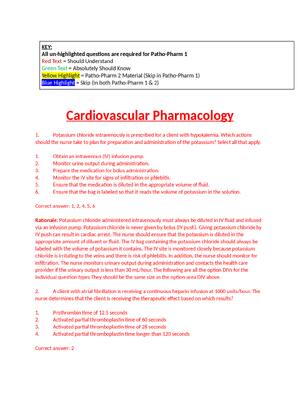
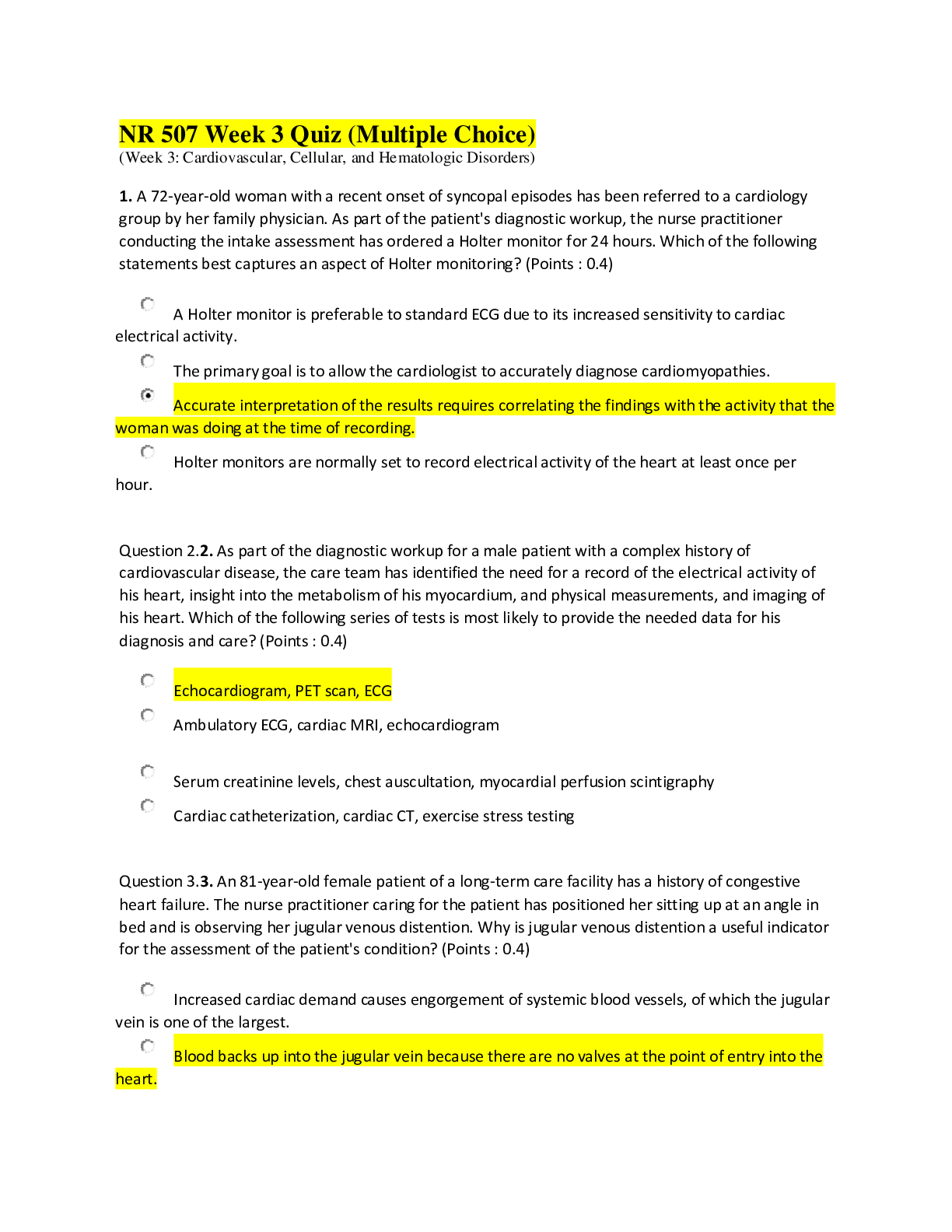
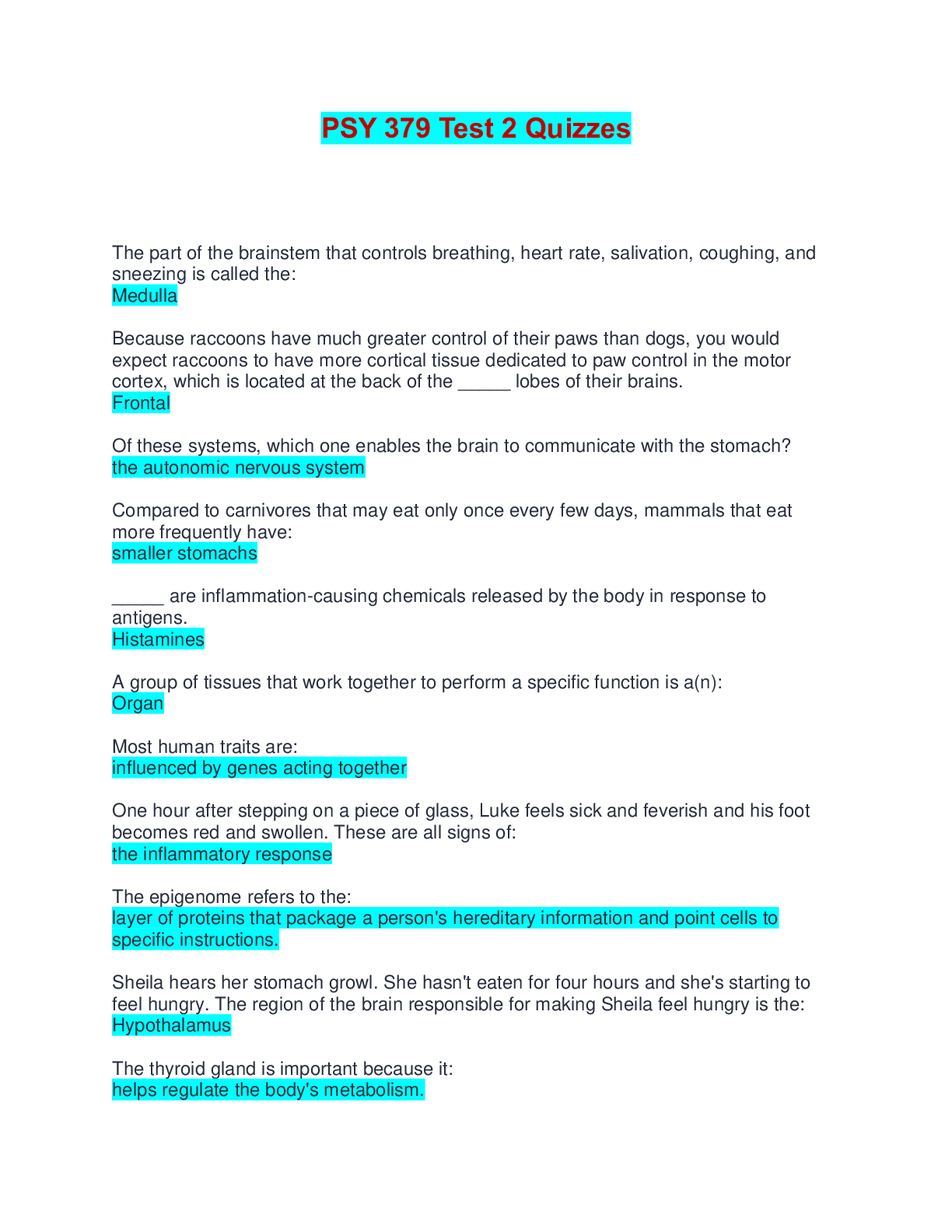
PSY 379 Exam 4 (Ch 10-12) | Complete Solutions (Answered) The _____ is known as the "heart muscle." Myocardium ________ is a chronic disease in which cholesterol and other fats are deposited on the inner walls of the coronary arteries, reducing circulation to heart tissue. Atherosclerosis When an individual develops atherogenesis, which of these would indicate damage to the coronary arterial walls? a) reduced platelet count b) formation of fatty streaks c) decreased oxygen supply to the aorta d) increased diastolic blood pressure _____ is a condition of extreme chest pain caused by a restriction of the blood supply to the heart. angina pectoris The Framingham Heart Study used a(n) _____ research design. a) retrospective b) experimental c) prospective d) case-study Once blood pressure consistently exceeds _____, the condition is called Stage 2 hypertension. a) 120/80 b) 140/80 c) 140/90 d) 130/90 A blood cholesterol level greater than 240 doubles the risk of: CVD The "toxic core" of Type A behavior is that of feeling _____ and _____ hostile and angry Which disorder is underdiagnosed and acts as both an independent risk factor for cardiovascular disease (CVD) and an aftereffect of CVD diagnosis? a) hypomania b) mania c) depression d) anxiety Frank has recently been diagnosed with high blood pressure. What is his doctor most likely to recommend as the first line of treatment? Medication Which of these is NOT a symptom of Type 2 diabetes? a) unusual weight loss b) blurred vision c) numbness in hands or feet d) cuts that heal slowly Blood glucose awareness training is similar in many ways to: a) operant conditioning b) positive reinforcement c) aversive behavioral treatment d) biofeedback Relaxation training appears to be beneficial for people with diabetes who are experiencing: Stress What is metastasis? The spread of malignancy from one part of the body to another Sandeep was diagnosed with the most common type of cancer. Sandeep was MOST likely diagnosed with what type of cancer? a) sarcoma b) lymphoma c) carcinoma d) leukemia Hodgkin's disease is a rare form of: a) carcinoma that attacks the epithelial cells. b) sarcoma that spreads from cartilaginous tissue. c) lymphoma that spreads from a single lymph node. d) leukemia that attacks blood-forming tissue The epithelial cells lining the inner surfaces of Hilmi's body are being attacked by a type of cancer. Hilmi will MOST likely be diagnosed with: a) carcinoma b) lymphoma c) sarcoma d) leukemia _____ are cancers that attack the blood and blood-forming tissues, leading to a proliferation of white blood cells that impairs the immune system. Leukemias What is the most common form of cancer in women? breast cancer What is the most common form of cancer in men? prostate cancer Fatima started smoking when she was 14. What type(s) of cancer is Fatima at risk for developing? a) lung b) mouth, lung, esophagus, and kidney c) mouth, lung, esophagus d) mouth, lung, esophagus, kidney, bladder, and others Which of these is NOT a dietary recommendation to reduce the risk of developing cancer? a) increasing intake of oat-based breakfasts b) limiting intake of red meat c) eating mostly plant-based foods d) limiting sodium intake People who drink excessive amounts of alcohol: a) often develop cirrhosis, a frequent cause of colon cancer b) may also suffer from poor nutrition and other factors that increase their risk for cancer. c) have a normal functioning immune system, but worse impulse control. d) increase their risk for developing breast cancer by 80%. Environmental toxins in the air, soil, and water contribute to about 2% of fatal cancers, mostly _____ cancer and _____ cancer. lung; bladder The _____ helps explain how stressful events promote the development of cancer. a) immunocompetence theory b) "two-hit" hypothesis c) immune surveillance theory d) "throttle and brake" analogy _____ was the first effective drug to treat HIV. a) protein inhibition treatment b) Interleukin-2 c) The acquired immunodeficiency syndrome (AIDS) vaccine d) AZT The use of _____ has been identified as the single most important factor in the development of antimicrobial resistance. a) antibiotics b) antiviral drugs c) antibacterial soap d) hand sanitizer _____ transmission of HIV through vaginal intercourse is far more common than _____ transmission. a) Young adult; older adult b) Male-to-female; female-to-male c) Older adult; young adult d) Female-to-male; male-to-female In 2016, who was MOST likely to be diagnosed with HIV? a) Sarah, a 27-year-old b) Remi, an 18-year-old c) Miriam, a 50-year-old d) Lucy, a 35-year-old The human immunodeficiency virus (HIV) destroys a type of lymphocyte called the: a) T cell. b) natural killer (NK) cell. c) B cell. d) astrocyte. The human immunodeficiency virus (HIV) injects a copy of its _____ into the DNA of the host cell. Genome _____ is the actual cause of death in 60% of people with acquired immunodeficiency syndrome (AIDS). a) Delirium b) Dementia c) HIV d) Pneumonia Kira was told by her doctor that in order to slow the progression of her AIDS, she should seek interventions that reduce her depression. Kira does not understand why her depression has anything to do with AIDS. Her doctor is MOST likely to explain that interventions that reduce depression are valuable in the fight against AIDS because depression: a) increases the severity of immune-related disorders. b) accelerates the onset of blood vessel malignancies. c) reduces the risk of developing opportunistic infections. d) decreases the effectiveness of medical treatments. ____ has served as the framework for a number of psychosocial HIV/AIDS interventions a) Classical learning theory b) Operant learning theory c) Cognitive-behavioral theory d) Social-cognitive theory Research has shown a strong association between _____ and the prevalence of high-risk sexual behaviors. a) learned helplessness b) self-esteem c) peer support d) perceived self-efficacy The disorder that includes the formation of plaque in the arteries is______. Atherosclerosis Restriction of blood flow is called _______. ischemia Atherosclerosis may affect blood supply in any part of the body, but it is most dangerous when it affects: a) veins in the extremities. b) arteries in the extremities. c) any veins d) coronary arteries Since 1960, death rates from cardiovascular disease have _______. decreased dramatically Bill Clinton, whose story introduced this chapter, had some family history of heart disease and had eaten a high-fat diet for many years of his life. Which of his risks would be an inherent cardiovascular risk factor for the former President? a) his high-stress job as President b) his gender c) his history of being overweight d) his diet The strongest physiological risk factor for cardiovascular disease is: a) lack of social support b) hypertension c) obesity d) smoking e) all of the above Which combination yields the lowest risk of cardiovascular disease? a) moderate total levels of cholesterol with a ratio of total cholesterol to HDL of more than 6 to 1 b) moderate total levels of cholesterol with a 3.5 to 1 ratio of total cholesterol to LDL c) low levels of total cholesterol with a ratio of total cholesterol to HDL of less than 4.5 to 1 d) low total levels of cholesterol with a 3.5 to 1 ratio of LDL to total cholesterol Grace owns a large manufacturing firm. She is competitive, nearly always angry, and constantly in a hurry to get things done. Grace's greatest risk for heart disease is: a) her anger b) her great number of decisions she has to make. c) her great sense of time urgency d) her competitiveness The toxic component of hostility seems to be: a) expressed anger b) repressed fear c) the Type A behavior pattern d) the Type B behavior pattern The best advice to give an angry middle-aged man at risk for heart disease would be to: a) suppress his anger. b) violently express his anger. c) avoid situations that arouse his competitive drive. d) express his anger with a soft, slow vocal pattern. e) get a divorce. Psychologists have contributed to cardiovascular health primarily through: a) the development of tests to assess the Type A behavior pattern. b) the identification of risk factors for cardiovascular disease. c) the development of methods to alter behavioral risk factors for cardiovascular disease. d) educating people concerning adherence to a low calorie diet. Reducing hypertension is difficult because: a) hypertension has no visible symptoms. b) no drugs have yet proven effective in lowering blood pressure. c) most cardiologists do not consider hypertension as a risk factor for heart disease. d) high cholesterol is a powerful side-effect of reductions in blood pressure. Of the following, the most direct cause of both coronary heart disease and stroke: a) cigarette smoking b) atherosclerosis c) Type A behavior pattern d) obesity e) diet From about 1900 until the mid-1990s, cancer death rates in the United States ______. rose steadily Which of these hypothesis best explains the recent drop in cancer death rates in the U.S.? a) better treatment procedures b) better techniques for diagnosing cancer c) changes in lifestyles d) both a and c contributed to the drop. In the United States, _____ cancer accounts for about 28% of all cancer deaths but only about 15% of cancer cases. a) lung b) breast c) prostate d) skin For women, death rates for are highest for ___ cancer. a) lung b) stomach c) uterine d) skin In the United States both prostate cancer and breast cancer... a) have the highest incidence and the highest mortality rates. b) have low incidence and low mortality rates. c) have high incidence but relatively lower death rates. d) none of these. Which of these is the strongest inherent risk factor for cancer? a) advancing age b) background c) gender d) family history Lee Ann believes that diet is an important factor in cancer. She wants to eat a diet that will protect her. Current research indicates that.. a) Lee Ann should concentrate on eating a high-protein diet. b) Lee Ann should take vitamin supplements. c) Lee Ann should eat "natural" foods with no preservatives. d) Lee Ann should eat a diet high in fruits and vegetables. Physical activity seems to offer some protection against... a) non-hodgkins lymphoma b) colon cancer c) bone cancer d) lung cancer
[Show More]




![Preview of [eBook] [PDF] Essentials of Nursing Research 10th Edition By Denise Polit, Cheryl Beck](https://browseimages.nyc3.digitaloceanspaces.com/paper-images/2025/May/22/jRKkstMR2025-05-22-06-40682f457046752.png)