Multiple Choice
Identify the choice that best completes the statement or answers the question.
____ 1. When a patient with meningitis was admitted, the nurse charted that he could not extend his legs without
complaini
...
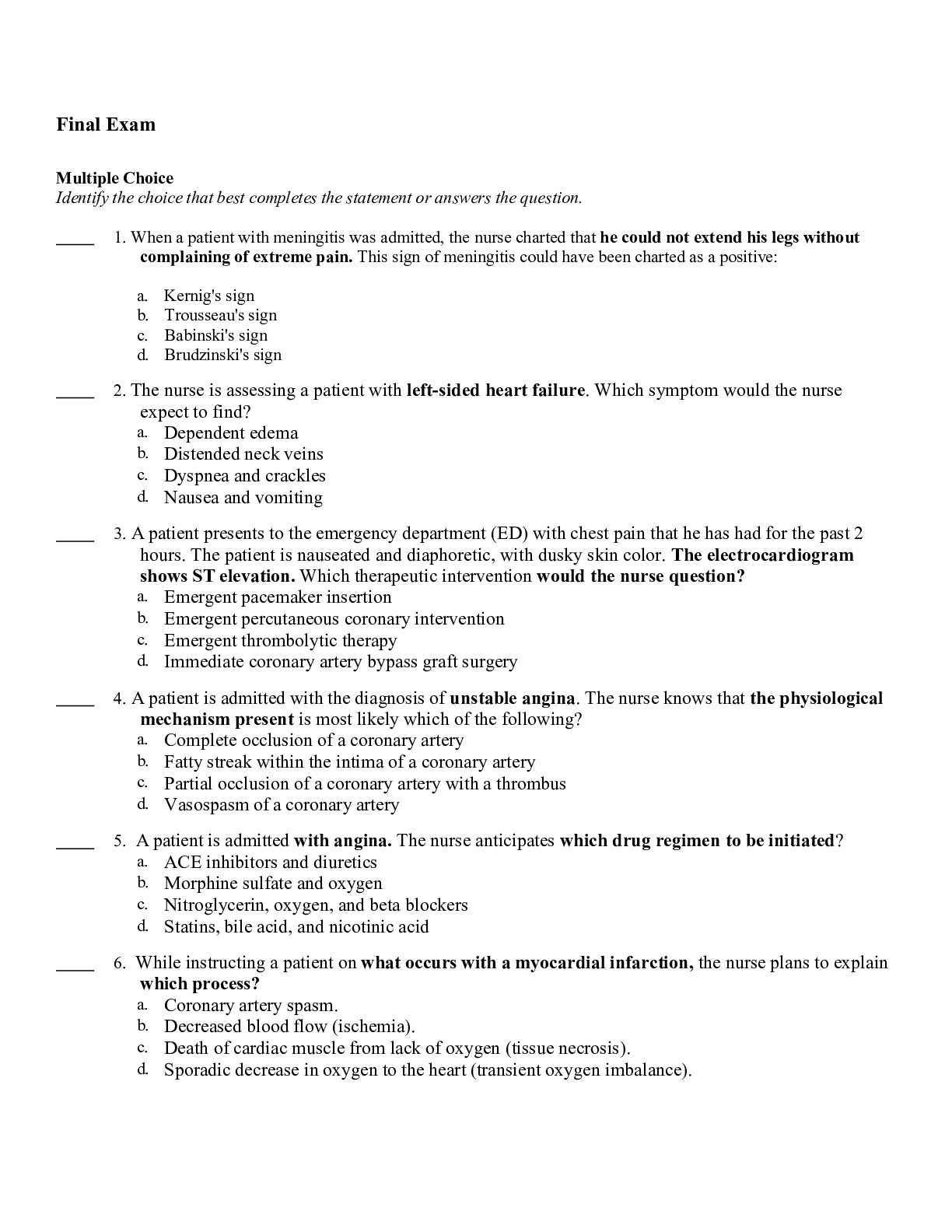
Multiple Choice
Identify the choice that best completes the statement or answers the question.
____ 1. When a patient with meningitis was admitted, the nurse charted that he could not extend his legs without
complaining of extreme pain. This sign of meningitis could have been charted as a positive:
a. Kernig's sign
b. Trousseau's sign
c. Babinski's sign
d. Brudzinski's sign
____ 2. The nurse is assessing a patient with left-sided heart failure. Which symptom would the nurse
expect to find?
a. Dependent edema
b. Distended neck veins
c. Dyspnea and crackles
d. Nausea and vomiting
____ 3. A patient presents to the emergency department (ED) with chest pain that he has had for the past 2
hours. The patient is nauseated and diaphoretic, with dusky skin color. The electrocardiogram
shows ST elevation. Which therapeutic intervention would the nurse question?
a. Emergent pacemaker insertion
b. Emergent percutaneous coronary intervention
c. Emergent thrombolytic therapy
d. Immediate coronary artery bypass graft surgery
____ 4. A patient is admitted with the diagnosis of unstable angina. The nurse knows that the physiological
mechanism present is most likely which of the following?
a. Complete occlusion of a coronary artery
b. Fatty streak within the intima of a coronary artery
c. Partial occlusion of a coronary artery with a thrombus
d. Vasospasm of a coronary artery
____ 5. A patient is admitted with angina. The nurse anticipates which drug regimen to be initiated?
a. ACE inhibitors and diuretics
b. Morphine sulfate and oxygen
c. Nitroglycerin, oxygen, and beta blockers
d. Statins, bile acid, and nicotinic acid
____ 6. While instructing a patient on what occurs with a myocardial infa
[Show More]



NURSING 3165 Predictor Complete Version2.png)


.png)