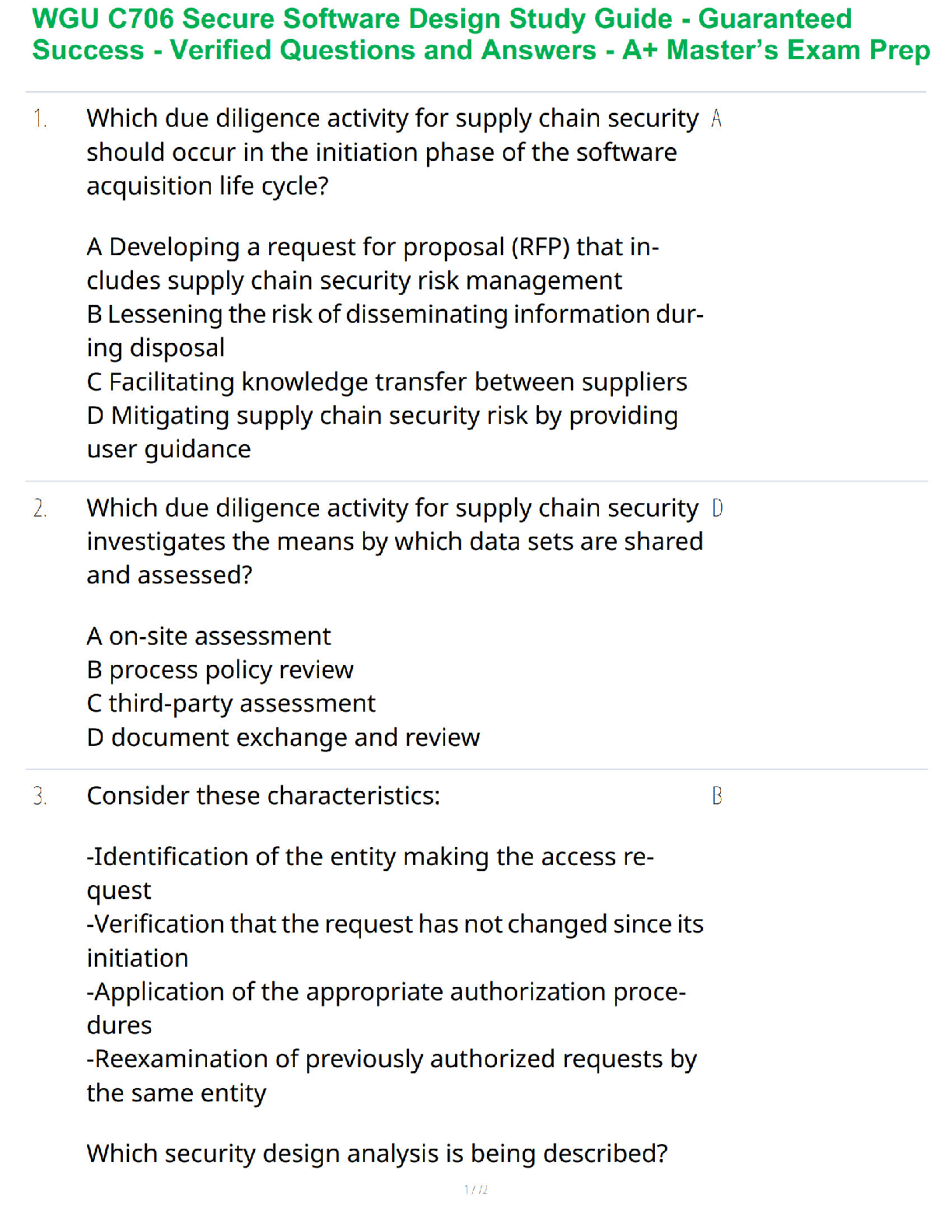
Question 1
10 out of 10 points
What is the gold standard approach to analyzing data from a clinical trial
when there is attrition from the study?
Selected
Answer:
D.
Intention-to-treat
analysis
Answers: A.
Powe
...
Question 1
10 out of 10 points
What is the gold standard approach to analyzing data from a clinical trial
when there is attrition from the study?
Selected
Answer:
D.
Intention-to-treat
analysis
Answers: A.
Power analysis
B.
Per-protocol
analysis
C.
Analysis of
covariance
D.
Intention-to-treat
analysis
Response
Feedback:
An intention-to-treat analysis maintains the integrity of
randomization by keeping participants in the groups to which
they were randomly assigned—even if they drop out of the
study. A per-protocol analysis only analyzes data from members
of the treatment group if they received the intervention. Power
analysis and ANCOVA do not have a bearing on analyzing trial
data when there is attrition.
Question 2
0 out of 10 points
Which strategy can achieve constancy of conditions in implementing a
treatment?
This study source was downloaded by 100000831988016 from CourseHero.com on 03-20-2022 13:52:42 GMT -05:00
https://www.coursehero.com/file/23748720/Quiz-5-Breezy/
Selected
Answer:
D.
Using a homogeneous sample
Answers: A.
Instituting manipulation checks
B.
Having standardized research
protocols
C.
Maximizing precision
D.
Using a homogeneous sample
Response
Feedback:
The careful development of standard protocols is an important
strategy for enhancing constancy of conditions in implementing
an intervention; monitoring adherence to the protocols is also
an important aspect of intervention fidelity. Using a
homogenous sample and instituting manipulation checks do not
contribute to the faithful implementation of an intervention.
Efforts to maximize precision include using highly accurate
measures and controlling confounding variables, but these are
unrelated to efforts to achieve intervention fidelity.
Question 3
10 out of 10 points
Women with and without lymphedema following breast cancer surgery
were compared in terms of their prior body mass index. What type of
design did the researcher use?
Selected
Answer:
B.
Casecontrol
Answers: A.
Time
series
B.
Casecontrol
C.
Crossover
D.
Prospecti
ve
Response
Feedback:
In this example, the researcher began with the outcome for two
This study source was downloaded by 100000831988016 from CourseHero.com on 03-20-2022 13:52:42 GMT -05:00
https://www.coursehero.com/file/23748720/Quiz-5-Breezy/
groups, those with and without lymphedema, and looked back
in time to see if body weight was a potential risk factor. This is a
retrospective case-control design. Prospective designs studies
begin with a presumed cause (e.g., weight) and look forward in
time for its effects on outcomes of interest. Both time series
and crossover designs involve an intervention, which is not the
case in this example.
[Show More]




NURSING 3165 Predictor Complete Version2.png)