Adequate nutrition is required for healing after treatment for recurrent aphtous ulcers (RAU). Which client
response indicates that nursing teaching has been effective?
A. “I've ordered a snack of milk and pretzels.”
...
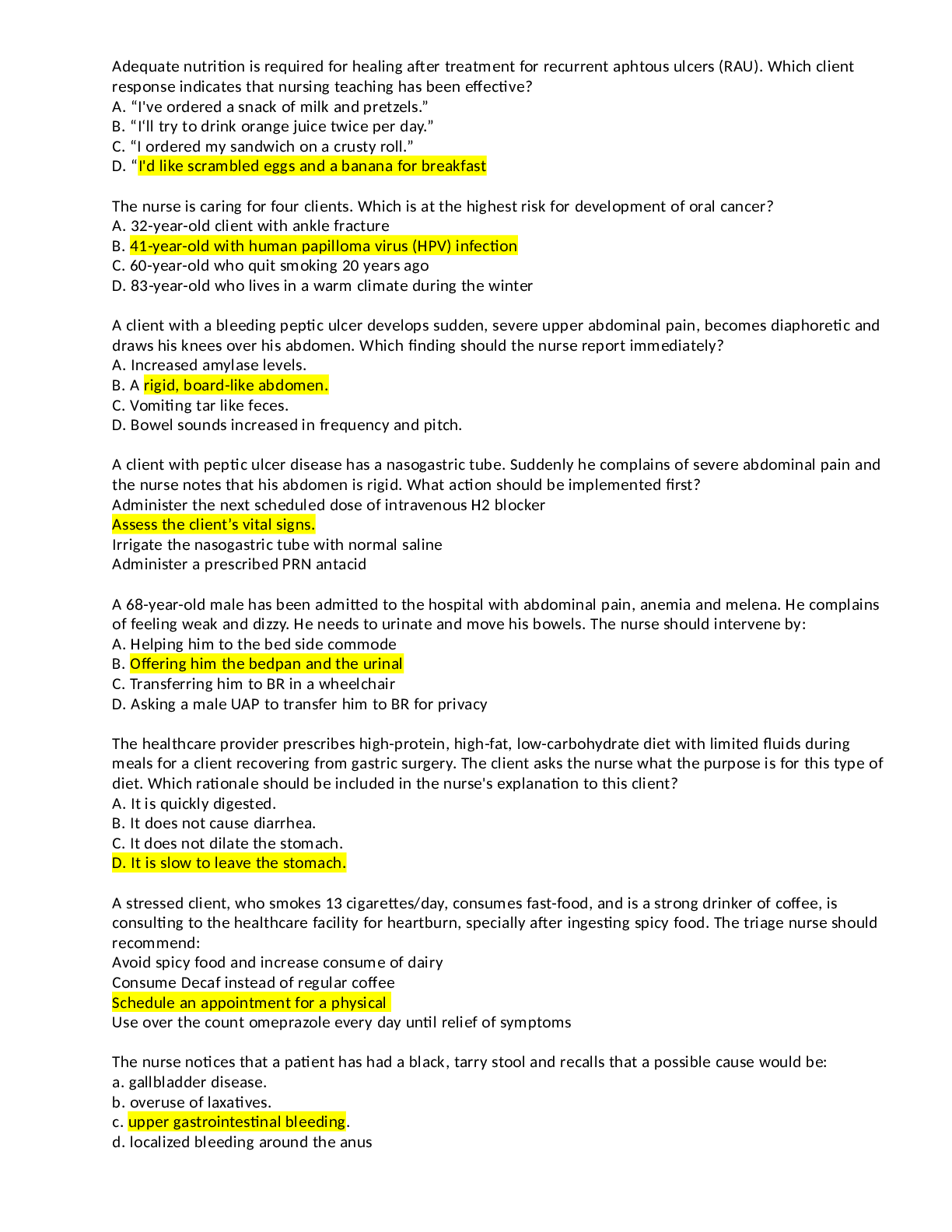
Adequate nutrition is required for healing after treatment for recurrent aphtous ulcers (RAU). Which client
response indicates that nursing teaching has been effective?
A. “I've ordered a snack of milk and pretzels.”
B. “I‘ll try to drink orange juice twice per day.”
C. “I ordered my sandwich on a crusty roll.”
D. “I'd like scrambled eggs and a banana for breakfast
The nurse is caring for four clients. Which is at the highest risk for development of oral cancer?
A. 32-year-old client with ankle fracture
B. 41-year-old with human papilloma virus (HPV) infection
C. 60-year-old who quit smoking 20 years ago
D. 83-year-old who lives in a warm climate during the winter
A client with a bleeding peptic ulcer develops sudden, severe upper abdominal pain, becomes diaphoretic and
draws his knees over his abdomen. Which finding should the nurse report immediately?
A. Increased amylase levels.
B. A rigid, board-like abdomen.
C. Vomiting tar like feces.
D. Bowel sounds increased in frequency and pitch.
A client with peptic ulcer disease has a nasogastric tube. Suddenly he complains of severe abdominal pain and
the nurse notes that his abdomen is rigid. What action should be implemented first?
Administer the next scheduled dose of intravenous H2 blocker
Assess the client’s vital signs.
Irrigate the nasogastric tube with normal saline
Administer a prescribed PRN antacid
A 68-year-old male has been admitted to the hospital with abdominal pain, anemia and melena. He complains
of feeling weak and dizzy. He needs to urinate and move his bowels. The nurse should intervene by:
A. Helping him to the bed side commode
B. Offering him the bedpan and the urinal
C. Transferring him to BR in a wheelchair
D. Asking a male UAP to transfer him to BR for privacy
The healthcare provider prescribes high-protein, high-fat, low-carbohydrate diet with limited fluids during
meals for a client recovering from gastric surgery. The client asks the nurse what the purpose is for this type of
diet. Which rationale should be included in the nurse's explanation to this client?
A. It is quickly digested.
B. It does not cause diarrhea.
C. It does not dilate the stomach.
D. It is slow to leave the stomach.
A stressed client, who smokes 13 cigarettes/day, consumes fast-food, and is a strong drinker of coffee, is
consulting to the healthcare facility for heartburn, specially after ingesting spicy food. The triage nurse should
recommend:
Avoid spicy food and increase consume of dairy
Consume Decaf instead of regular coffee
Schedule an appointment for a physical
Use over the count omeprazole every day until relief of symptoms
The nurse notices that a patient has had a black, tarry stool and recalls that a possible cause would be:
a. gallbladder disease.
b. overuse of laxatives.
c. upper gastrointestinal bleeding.
d. localized bleeding around the anus
In a paracentesis 3 liters of fluid are removed. Which assessment parameter is most critical for the nurse to
monitor following the procedure?
A. Pedal pulses.
B. Breath sounds.
C. Gag reflex.
D. Blood pressure.
What finding is a priority in a patient with peptic ulcer disease (PUD)?
Tarry stools 3 times during the day
Dizziness when sitting in bed
Epigastric pain 2 hours after meals
Loss of 10 pounds of weight since the last month
The nurse is teaching a client with advanced COPD who was prescribed theophylline. Which client statement
indicates that additional teaching is required?
I need to avoid caffeinated products
I need to get my blood drug levels checked periodically
I need to report anorexia and sleeplessness
I take cimetidine for my heartburn
After a subtotal gastrectomy, care of the client’s nasogastric tube and drainage system should include which of
the following nursing interventions?
Irrigate the tube with 30 ml of sterile water every hour, if needed.
Reposition the tube if it is not draining well
Monitor the client for nausea or vomits
Turn the machine to high suction of the drainage is sluggish on low suction.
A client is to take one daily dose of ranitidine (Zantac) at home to treat her peptic ulcer. The nurse knows that
the client understands proper drug administration of ranitidine when she says that she will take the drug at
which of the following times?
Before meals
With meals
At bedtime
When pain occurs
A client has been on long-term therapy with esomeprazole. What is essential for the nurse to ask the client?
Are you drinking plenty of water with the medication?
Are you taking the medication after meals?
Have you had a bone density test recently?
Have you had your blood pressure taken regularly?
The nurse is preparing a client diagnosed with peptic ulcer disease for a barium study of the stomach and
esophagus. Which nursing intervention is the priority for this client?
1. Obtain informed consent from the client for the diagnostic procedure.
2. Discuss the need to increase oral fluid intake after the procedure.
3. Explain to the client that he or she will have to drink a white, chalky substance.
4. Tell the client not to eat or drink anything prior to the procedure
At 0830, the day shift nurse is preparing to administer medications to the client NPO for an endoscopy. Which
medication should the nurse question administering?
1. Digoxin 0.125 mg PO every day.
2. Furosemide 40 mg PO bid.
3. Ranitidine 150 mg in 250 mL NS IV continuous infusion every 24 hours.
4. Vancomycin 850 mg IVPB every 24 hours.
5. Mylanta 30 mL PO PRN heartburn.
The client is diagnosed with esophageal bleeding. Which of the following assessment data warrants immediate
intervention by the nurse?
1. The client’s hemoglobin/hematocrit is 11.4/32.
2. The client’s abdomen is soft to touch and non-tender.
3. The client’s vital signs are T 99, AP 114, RR 18, B/P 88/60.
4. The client’s nasogastric tube has coffee ground drainage.
The client 2 days postoperative from a laparoscopic cholecystectomy tells the office nurse, “My right shoulder
hurts so bad I can’t stand it.” Which statement is the
nurse’s best response?
1. “This is a result of the carbon dioxide gas used in surgery.”
2. “Call 911 and go to the emergency department immediately.”
3. “Increase the pain medication the surgeon ordered.”
4. “You need to ambulate in the hall to walk off the gas pains.”
[Show More]




 HESI VI EXIT EXAM.png)
.png)