NUR 603
Exam 1 cmpltd ANUR 603
Exam 1 cmpltd A
A 23-year-old sexually active woman presents for her first Pap smear. Her history includes nulligravida,
age at first intercourse 14, and more than 10 sexual partners. W
...
NUR 603
Exam 1 cmpltd ANUR 603
Exam 1 cmpltd A
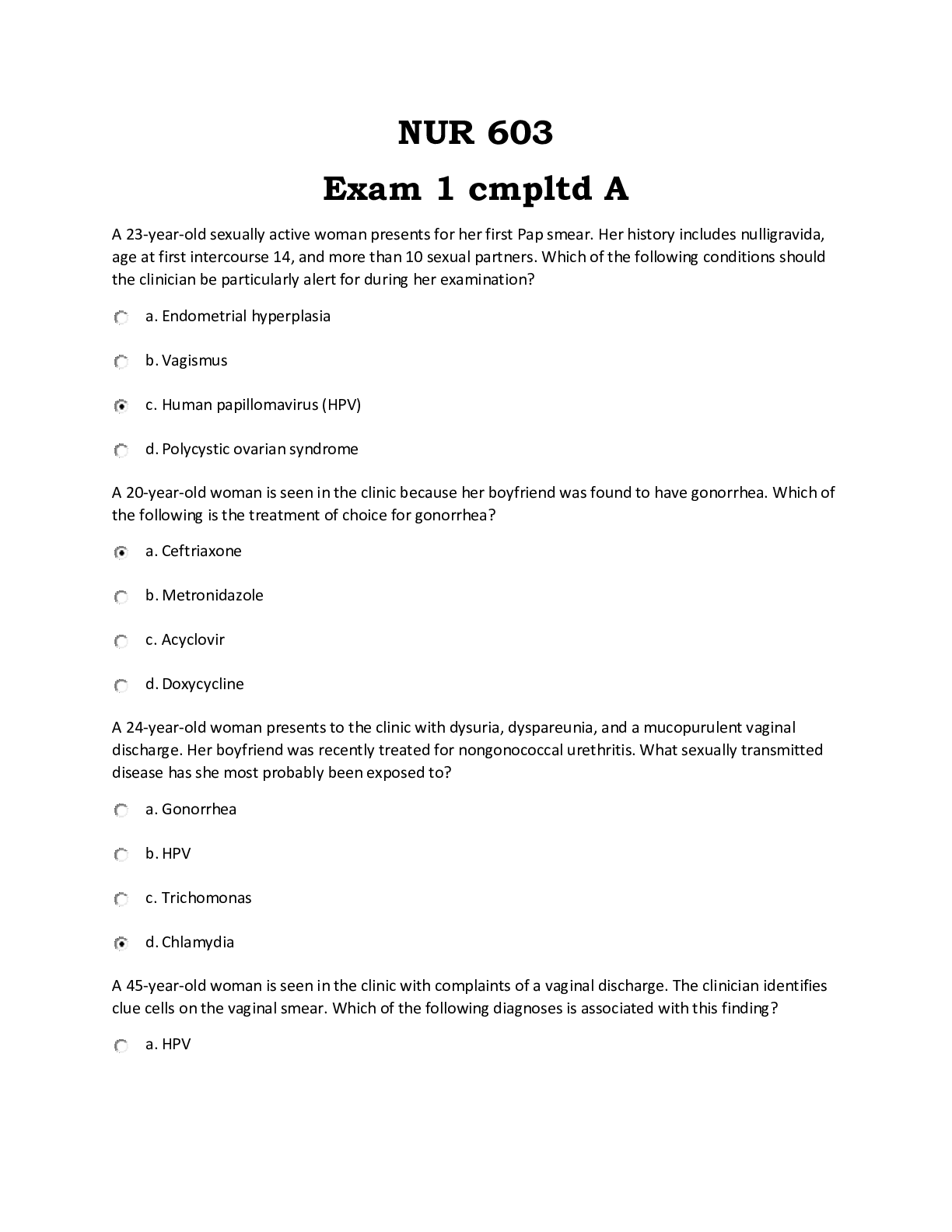
A 23-year-old sexually active woman presents for her first Pap smear. Her history includes nulligravida,
age at first intercourse 14, and more than 10 sexual partners. Which of the following conditions should
the clinician be particularly alert for during her examination?
a. Endometrial hyperplasia
b. Vagismus
c. Human papillomavirus (HPV)
d. Polycystic ovarian syndrome
A 20-year-old woman is seen in the clinic because her boyfriend was found to have gonorrhea. Which of
the following is the treatment of choice for gonorrhea?
a. Ceftriaxone
b. Metronidazole
c. Acyclovir
d. Doxycycline
A 24-year-old woman presents to the clinic with dysuria, dyspareunia, and a mucopurulent vaginal
discharge. Her boyfriend was recently treated for nongonococcal urethritis. What sexually transmitted
disease has she most probably been exposed to?
a. Gonorrhea
b. HPV
c. Trichomonas
d. Chlamydia
A 45-year-old woman is seen in the clinic with complaints of a vaginal discharge. The clinician identifies
clue cells on the vaginal smear. Which of the following diagnoses is associated with this finding?
a. HPVb. Herpes simplex virus
c. Trichomonas
d. Bacterial vaginosis
Which of the following medications is the treatment of choice for trichomonas?
a. Doxycycline
b. Diflucan
c. Metronidazole
d. Ceftriaxone
A 58-year-old woman presents with a breast mass. Which of the following responses by the clinician
would be most appropriate?
a. “Because your lump is painful, it is most likely not cancer.”
b. “We will go ahead and schedule you for a biopsy because that is the only way to know for sure.”
c. “We will order a mammogram and ultrasound to help establish a diagnosis.”
d. “It is probably just a cyst because that is the most common breast mass.”
A 26-year-old woman is seen with complaints of irregular vaginal bleeding. Which of the following tests
should be the first priority?
a. Pregnancy test
b. Endometrial biopsy
c. Platelet count
d. Pelvic ultrasound
A 42-year-old woman presents to the clinic with complaints of painful intercourse for the last month.
Which of the following should be explored as the likely cause of her dyspareunia?
a. Menopause
b. Sexual trauma as a child
c. Dehydrationd. Excess progesterone
A 36-year-old woman is seen with complaints of vaginal itching, burning, and discharge. On potassium
hydroxide (KOH) wet mount of vaginal discharge, the clinician notices hyphae. Which of the following
treatments would be appropriate?
a. Doxycycline
b. Metronidazole
c. Fluconazole
d. Estrogen vaginal cream
A 21-year-old woman is seen in the clinic requesting birth control pills. Which of the following tests is
essential before prescribing any oral contraceptive?
a. Complete blood cell count
b. Thyroid-stimulating hormone
c. Urine dip for protein
d. Pregnancy test
A 40-year-old woman is seen for her yearly examination. She is single and not in a monogamous
relationship. Her social history includes smoking cigarettes “occasionally” and drinking about two beers
a day. Her body mass index (BMI) is 25. She is requesting birth control. Which of the following methods
would be best for this patient?
a. Vaginal contraceptive sponge
b. Oral contraceptive
c. Condom
d. Intrauterine device
A 44-year-old patient with breast cancer is prescribed tamoxifen by her surgeon. She is complaining
about hot flashes. Which of the following responses by the clinician would be most appropriate?
a. “The hot flashes are a result of the antiestrogenic effects of tamoxifen.”
b. “Tamoxifen will impact your temperature regulation center.”c. “The drug destroys your ovaries.”
d. “You must be having menopause.”
A 32-year-old woman is seen in the clinic because she has been unable to get pregnant after 12 months
of unprotected sex. In order to determine the cause of the infertility, the clinician should question her
about which of these possible causes?
a. Oral contraceptive use for 15 years
b. Early menarche
c. Diet high in soy protein
d. Pelvic inflammatory disease
When assessing a woman for infertility, which of the following tests should be done first?
a. Magnetic resonance imaging (MRI)
b. Analysis of partner’s sperm
c. Estrogen level
d. Hysterosalpingogram
A 15-year-old girl is seen in the clinic because she has not yet had her first period. Which of the
following questions would help the clinician determine the cause?
a. “Are you sexually active?”
b. “Did your mother take diethylstilbestrol during her pregnancy?”
c. “Have you noticed any changes in your moods lately?”
d. “How long have you been underweight?”
What is the most common cause of secondary amenorrhea?
a. Pregnancy
b. Genetic disorders
c. Pituitary dysfunction
d. Inadequate estrogen levelsA 22-year-old woman is diagnosed with premenstrual syndrome. Which of the following lifestyle
changes should the clinician suggest to help minimize the patient’s symptoms?
a. Take vitamin A supplements
b. Eat a diet high in iron
c. Regular exercise
d. At least 4 cups of green tea daily
A 26-year-old woman tells the clinician that she has endometriosis, because she has frequent pelvic
pain. The clinician also should consider which of these differential diagnoses?
a. Ovarian cysts
b. Cholelithiasis
c. Kidney stones
d. Diverticulitis
Which of the following would be appropriate treatment for a woman with mild endometriosis?
a. Hysterectomy
b. Nafarelin nasal spray
c. Leuprolide acetate injections
d. Oral contraceptives
A 45-year-old woman is seen in the clinic with abnormal uterine bleeding and pain during intercourse.
The clinician should consider which of the following diagnoses?
a. Leiomyoma
b. Pregnancy
c. Ovarian cancer
d. All of the above
A 48-year-old woman is seen in the clinic with complaints of prolonged heavy menstrual periods. She is
pale and states she can no longer exercise. Pelvic exam reveals a single, very large mass. Which of the
following diagnostic tests should the clinician order first?a. Endometrial biopsy
b. Abdominal computed tomography scan
c. Transvaginal ultrasound
d. MRI
A 45-year-old woman is seen because of irregular menstrual periods. Her follicle-stimulating hormone
(FSH) level is 48 mIU/mL, and her luteinizing hormone (LH) level is elevated. She asks the clinician what
this means. Which would be the best response?
a. “Your FSH is normal, but your pituitary is making too much LH.”
b. “There is an imbalance between your ovaries and pituitary.”
c. “You are approaching menopause.”
d. “You have a hormonal imbalance.”
Which of the following tests is essential for a 46-year-old woman who the clinician suspects is
perimenopausal?
a. Pregnancy
b. Progesterone level
c. LH level
d. Estrogen level
A 60-year-old woman is seen for an annual checkup. Her obstetric history reveals para 6, gravida 6. She
reports that she went through menopause at age 45. Her grandmother died at age 80 of colon cancer,
and her father died of lung cancer. What in her history would be a risk factor for ovarian cancer?
a. Her grandmother’s history of colon cancer
b. Her numerous pregnancies
c. Her father’s history of lung cancer
d. Her age at menopause
A 58-year-old woman, who had a total abdominal hysterectomy at the age of 45, is diagnosed with
atrophic vaginitis. Which of the following is the most appropriate treatment?a. Conjugated estrogen, 0.3 mg + medroxyprogesterone 1.5 mg/day oral
b. Medroxyprogesterone, 10 mg/day oral
c. Estradiol, 7.5 mcg/24 hr vaginal ring
d. Conjugated estrogen, 0.625 mg/day oral
[Show More]

.png)






.png)