: Fetal heart tones, Fetal movement, Ultrasound
5. Integumentary changes: Spider angiomas and palmar erythema,
Hyperpigmentation: Linea nigra, Chloasma; Striae gravidarum, Vascular Spider
Nevi, Sebaceous glands, Hair/
...
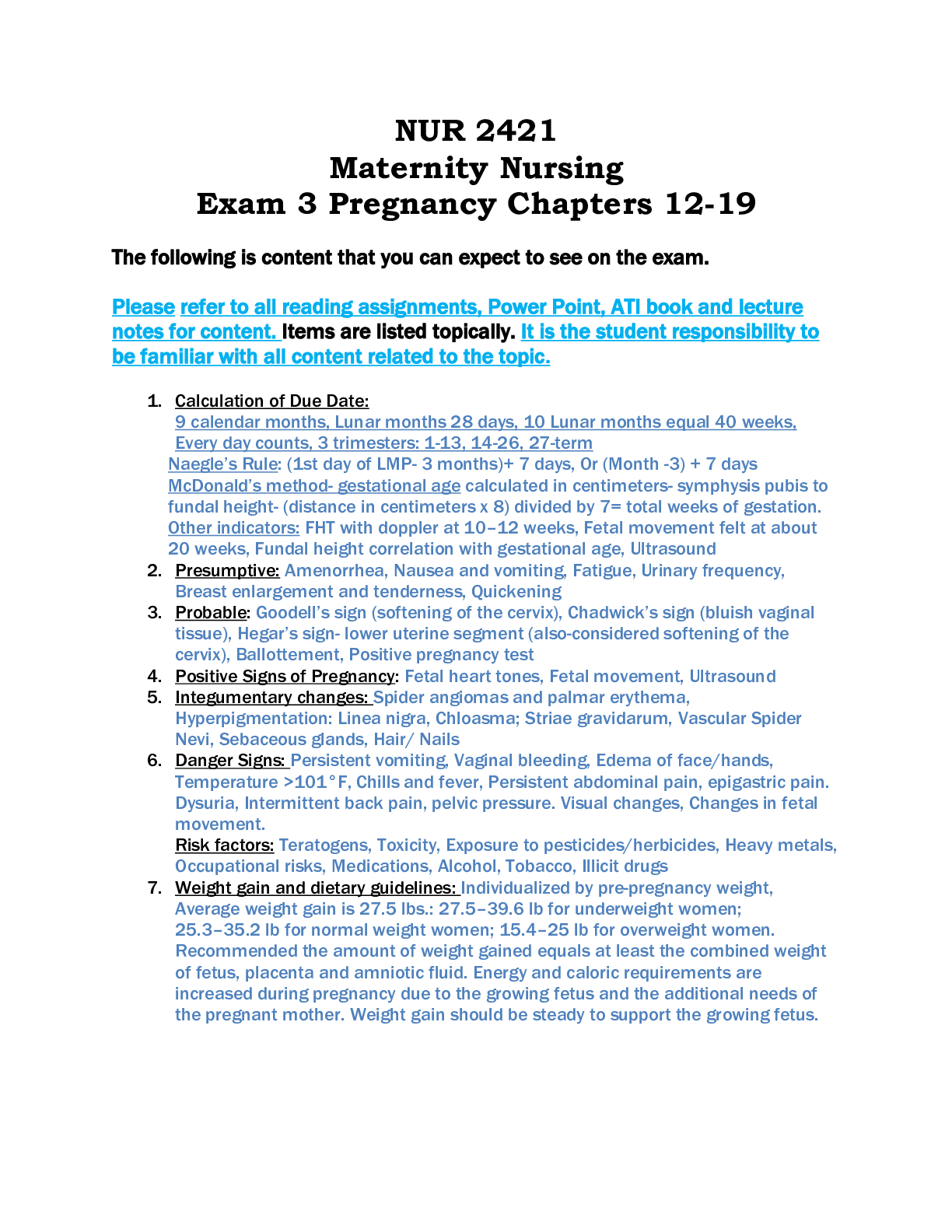
: Fetal heart tones, Fetal movement, Ultrasound
5. Integumentary changes: Spider angiomas and palmar erythema,
Hyperpigmentation: Linea nigra, Chloasma; Striae gravidarum, Vascular Spider
Nevi, Sebaceous glands, Hair/ Nails
6. Danger Signs: Persistent vomiting, Vaginal bleeding, Edema of face/hands,
Temperature >101°F, Chills and fever, Persistent abdominal pain, epigastric pain.
Dysuria, Intermittent back pain, pelvic pressure. Visual changes, Changes in fetal
movement.
Risk factors: Teratogens, Toxicity, Exposure to pesticides/herbicides, Heavy metals,
Occupational risks, Medications, Alcohol, Tobacco, Illicit drugs
7. Weight gain and dietary guidelines: Individualized by pre-pregnancy weight,
Average weight gain is 27.5 lbs.: 27.5–39.6 lb for underweight women;
25.3–35.2 lb for normal weight women; 15.4–25 lb for overweight women.
Recommended the amount of weight gained equals at least the combined weight
of fetus, placenta and amniotic fluid. Energy and caloric requirements are
increased during pregnancy due to the growing fetus and the additional needs of
the pregnant mother. Weight gain should be steady to support the growing fetus.8. Preterm labor: pregnancy that has reached 20 weeks of gestation but before
completion of 37 weeks of gestation, and documented uterine contractions and
cervical effacement of 80 percent or cervical dilation of more than one cm. Late
preterm: pregnancy between 34-37 weeks (previously called near term).
Treatment: Stop activity, Drink 2-3 glasses of H2O, CONTACT HCP, GO TO HOSPITAL
9. Musculoskeletal changes: Lordosis develops: Back pain common during pregnancy,
Ligaments soften due to relaxin: Pelvic discomfort, Unsteady gait, Teeth/ Gums,
Pelvic joints- Relaxin, Lumbodorsal Spinal Curve, Diastasis Recti
10.Cardiovascular changes: Heart displaced up and to the left, Heart enlarges, Systolic
murmurs common, Cardiac output Increases by 10 weeks and peaks at 24 weeks,
Heart rate increases by 20 beats/minute, Blood pressure Decreases in first
trimester - Returns to normal reading by term, Systemic vascular resistance
Decreases during pregnancy
Cardiovascular Changes (adaptive and protective): Blood pressure: 140/90,
125/75, 130/85, 30mm change, Supine hypotensive syndrome
Blood volume and composition: Anemia of pregnancy, Erythrocytes- >30% O2
requirements/Fetus
Leukocytosis
Plasma >50%, 1500ml/ 40% peak at 32 weeks
Cardiac output: > 30-50% by 32 weeks
Circulation and coagulation times, Hypercoagulability
11.Quickening: When a woman feels her baby move for the first time. Usually between
18-20 weeks, but sometimes as early as 16 weeks in a multigravida or as late as
22 weeks in some primigravidas
12.Edema: Etiology: Increased fluid volume, Sluggish venous return
Client teaching: Avoid long periods of standing, Elevate feet, Exercise
13.Reproductive system changes: Uterus: Changes in size, shape and position: Egg,
pear, orange, grapefruit. 10 mL to 5000 mL, “Show” 14 weeks, Hegar’s sign- lower
uterine segment, Changes in contractility - Braxton Hicks, Uteroplacental bloodflow- 20x flow, 1/6 mat. Vol., 500ml/min, Ovaries stop ovum production, 20–25%
of cardiac output goes to uterus, Braxton Hicks contractions occur throughout
pregnancy, Changes related to presence of fetus, Endometrium is referred to as
decidua, Quickening- 16/18 weeks, Leukorrhea, Enlarges to hold a volume of 15–
20 liters, At 12 weeks rises out of the pelvis, Walls thin, but strengthened with
fibrous tissue
Cervical changes- Goodell’s sign, Softens and becomes bluish in color, Mucous plug
forms to protetor is an inherited protein found on the surface of red
blood cells. If your blood has the protein, you are Rh positive. If your blood lacks the
protein, you are Rh negative. If you're Rh negative and your baby is Rh positive,
however, your body might produce proteins called Rh antibodies after exposure to
the baby's red blood cells. The concern is with your next pregnancy. If your next
baby is Rh positive again, your body will produce Rh antibodies that can cross the
placenta and damage the baby's red blood cells. This could lead to life-threatening
anemia, a condition in which there are not enough red blood cells. If this condition
is not prevented, each Rh positive baby you carry after your first pregnancy might
have severe anemia.
19.Maternal Respiratory system changes:
Changes in mechanical function: Diaphragm rises 4 cm, Chest circumference
increases 5 to 7 cm
Progesterone: Causes increase in tidal volume (30–40%) and decrease in Pco2
(compensated respiratory alkalosis)
Rate does not change, Changes facilitate removal of carbon dioxide from fetus.
Structural changes- > sub costal angle A/P diameter / elevated diaphragm:
Pulmonary function: O2 requirements, Basal metabolism rate: “HOT HOT HOT”,
Respiratory Rate, Acid-base balance: Respiratory Alkalosis/ Metabolic acididosis
20.Sequencing of events in pregnancy: example heart tones, movement, positive test
etc. First Trimester
The first trimester lasts from the first through the 13th week of pregnancy.
Although you may not look pregnant during the first trimester, your body is going
through enormous changes as it accommodates a growing fetus. In the first few
weeks following conception, your hormone levels change significantly. Your uterus
begins to support the growth of the placenta and the fetus, your body adds to its
blood supply to carry oxygen and nutrients to the developing baby, and your heart
rate increases. These changes accompany many of the pregnancy symptoms, such
as fatigue, morning sickness, headaches, and constipation. The first trimester is
vital for the development of your baby. The fetus will develop all of its organs by the
end of the third month, so this is a crucial time. It's important to maintain a healthy
diet, including adding an adequate amount of folic acid in order to help prevent
neural tube defects. Cut out any bad habits, such as smoking and alcohol. Both
have been related to serious complications in pregnancy and birth defects.
gives you the opportunity to ask any questions or voice any concerns
to a trained childbirth instructor.
Due Date
A normal, full-term pregnancy can last anywhere from 37 to 42 weeks. Your due
date is really an estimated date of delivery (EDD). It’s dated from the first day of
your last period, even though you actually conceive two weeks or so after this date.
The dating system works well for women who have fairly regular menstrual cycles.
However, for women who have irregular periods, the dating system may not work
and other methods may be needed to determine the EDD. The most accurate
method of determining the due date is an ultrasound in the first trimester, because
early fetal development is fairly regular across all pregnancies.21.Antenatal Laboratory testing:
Genetic
tests for
inherited
diseases
Genetic testing
for inherited
diseases
Check carrier status for certain
genetic diseases to determine
risk of having a baby with such
a disease
Pre-conception or
first trimester
Mother and
father (blood
sample)
Genetic testing
for hemoglobin
disorders
Check carrier status for certain
abnormal hemoglobin
disorders to determine risk of
having a baby with such a
disease
Pre-conception or
during pregnancy
er
Mother and
father (blood
sample)
Testing to detect
health conditions in
the mother
Blood glucose or
hemoglobin A1c
To screen women at risk of
type 2 diabetes (which is
different than gestational
diabetes)
Pre-conception or
first trimester
Mother (blood
sample)
Pap test and HPV
testing
Screen for cervical cancer and
some STDs
Pre-conception or
first trimester
Mother (cells
from her cervix)
Immunity to
rubella (German
measles)
Check for immunity to the
virus, which can cause birth
defects
Pre-conception or
first trimester
Mother (blood
sample)
HIV screening
test
Check for HIV infection so
ns,
which can cause miscarriage
or infect the baby during
delivery
Pre-conception or
first trimester; may
be repeated in third
trimester if at high
risk
Mother (cervical
cells, urine or
blood sample,
depending on
test)
Hepatitis B and
hepatitis C
Detect hepatitis B or hepatitis
C infection
Pre-conception or
first trimester; may
Mother (blood
sample)screening be repeated in the
third trimester if at
high risk
Varicella zoster
virus testing
Check for immunity to
chickenpox, which can cause
birth defects
Pre-conception or
first trimester
Mother (blood
sample)
TORCH panel Check for infection with
toxoplasmosis and other
infections that can cause birth
d
Detect infection, which can
cause pre-term labor
Pre-conception or
whenever symptoms
experienced
Mother (vaginal
secretions)
Urine culture for
bacteriuria
Detect bacterial infection in
the urinary tract, which can
lead to kidney infection or
increased risk of pre-term
delivery and low birth weight
First prenatal visit or
between 12 and 16
weeks of pregnancy;
may be repeated in
third trimester
Mother (urine
sample)
Group
Bstreptococcus
Detect infection, which can
harm the baby during birth and
infect the mother’s uterus,
urinary tract, and any incision
made during a cesarean
section
Between weeks 35
and 37 of pregnancy
Mother
(specimen from
vaginal and
rectal areas)
Confirmation and
monit
count (CBC)
Check for anemia and/or
detect low platelet count
Pre-conception
and/or early in the
first trimester;
repeated in third
Mother (blood
sample)trimester
Blood typing and
antibody screen
Check for potential
incompatibility in blood type
between mother and fetus
(such as Rh factor antibodies)
First trimester;
antibody screen
repeated between
weeks 28 and 29 of
pregnancy
Mother (blood
sample)
Glucose
challenge
test/oral glucose
tolerance test
Check for gestational diabetes Between 24 and 28
weeks of pregnancy
Mother (blood
sample)
Thyroid
stimulating
hormone (TSH)
In women with known thyroid
conditions, to adjust
medication if necessary
Throughout
pregnancy
Mother (blood
sample)
Detection of fetal
abnormalities or
assessment of risk
First trimester
Down syndrome
screen
Assess risk of carrying a fetus
with certain chromosomal
abnormalities, such as Down
syndrome
Usually between 11
and 14 weeks of
pregnancy
Mother (blood
sample plus
ultrasound)
Seers
During or after the
10thweek of
f
recommended
Mother (cells
from the
placenta)
Amniocentesis Detect certain birth defects
and chromosomal
abnormalities
Between 15 and 20
weeks of pregnancy,
if recommended
Mother (amniotic
fluid)Cordocentesis Detect chromosomal
abnormalities, blood disorders,
and certain infections
Between weeks 18
and 22 of
pregnancy, if
recommended
Mother/fetus
(fetal blood
sample obtained
from vein in the
umbilical cord)
Fetal
maturity/readiness for
birth
Am
(fFN)
Detect fFN; negative result is
highly predictive that pre-term
delivery will NOT occur in the
next 7-14 days
Between week 22
and 35 of
pregnancy, if having
symptoms of preterm labor
Mother (cervical
or vaginal fluid
sample)
22.Exercise guidelines:
SEE ATTACHED
[Show More]