EMT-B - Emergency Medical Technician - Basic > EXAM > WEST COAST EMT BLOCK 2024 EXAM 1 COMPLETE STUDY QUESTIONS WITH CORRECT ANSWERS GUARANTEED PASS | RAT (All)
WEST COAST EMT BLOCK 2024 EXAM 1 COMPLETE STUDY QUESTIONS WITH CORRECT ANSWERS GUARANTEED PASS | RATED A+
Document Content and Description Below
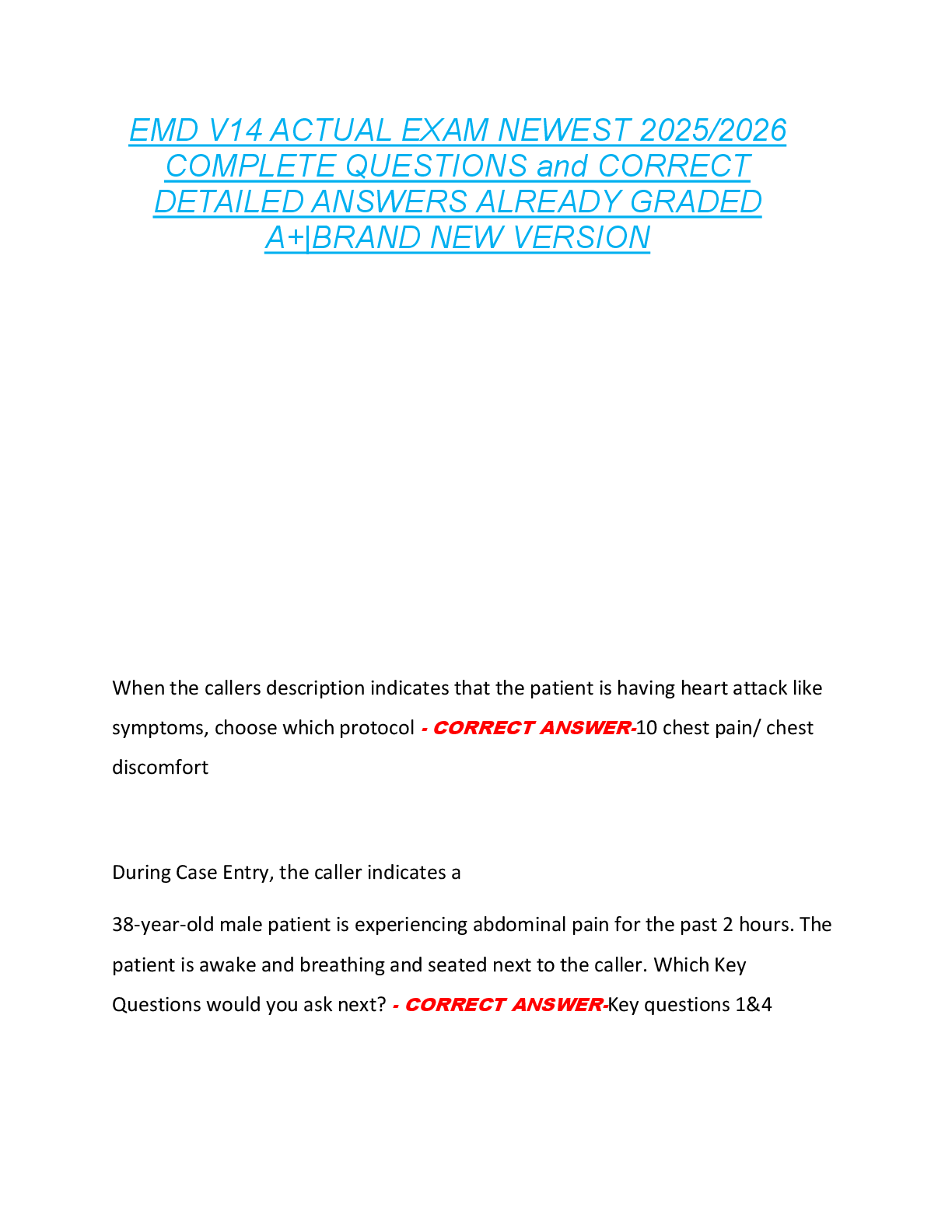
You and your partner arrive at the scene of a major motor vehicle crash. The driver, a young male, is severely entrapped in his car. He has an open head injury and massivefacial trauma. He is unresp ... onsive, is not breathing, and does not have a palpable carotid pulse. You should: Select one: A. ventilate the patient for 5 minutes and then stop if there is no response. B. stop any active bleeding and advise dispatch to send a paramedic crew. C. have your partner check for a pulse to confirm that the patient is deceased. D. request the fire department to extricate the patient so you can begin CPR. ✔✔ C.have your partner check for a pulse to confirm that the patient is deceased. A 33-year-old restrained driver of a motor vehicle crash is awake and alert, complainingonly of neck pain and left leg pain. The vehicle is stable and no hazards are present. When removing this patient from his vehicle, you should: Select one: A. apply a full leg splint prior to extrication.B. use the rapid extrication technique. C. maintain slight traction to his neck area. D. immobilize him with a vest-style device. ✔✔ D. immobilize him with a vest-style device. You respond to the home of a 59-year-old man who is unconscious; has slow, shallow breathing; and has a weak pulse. The family states that the patient has terminal brain cancer and does not wish to be resuscitated. They further state that there is a DNR order for this patient, but they are unable to locate it. You should: Select one: A. decide on further action once the DNR order is produced. B. honor the patient's wishes and withhold all treatment. C. transport the patient without providing any treatment. D. begin treatment and contact medical control as needed. ✔✔ D. begin treatment andcontact medical control as needed. At a scene with downed electrical lines, the EMT should . Select one: A. enter the danger (hot) zone for patient removal only B. relocate the danger (hot) zone away from the patientC. stabilize the patient in the danger (hot) zone D. remain outside the danger (hot) zone ✔✔ D. remain outside the danger (hot) zone Extrication is defined as: Select one: A. using heavy equipment to access a patient. B. removal from a dangerous situation or position.C. dismantling an automobile to remove a victim. D. immobilizing a patient before moving him or her. ✔✔ B. removal from a dangerous situation or position. If a technical rescue team is required at the scene, but is not present when you arrive,you should: Select one: A. don personal protective equipment and begin the rescue process. B. check with the incident commander to ensure that the team is en route.C. remain with your ambulance until the rescue team arrives at the scene. D. have fire personnel initiate the rescue process if they are at the scene. ✔✔ B. checkwith the incident commander to ensure that the team is en route. The areas of the infant's skull that have not yet fused together are called . Select one: A. fontanelles B. cranial valleys C. sutures D. ventricles ✔✔ A. fontanellesYou and your partner arrive at the scene of a major motor vehicle crash. The driver, a young male, is severely entrapped in his car. He has an open head injury and massivefacial trauma. He is unresponsive, is not breathing, and does not have a palpable carotid pulse. You should: Select one: A. ventilate the patient for 5 minutes and then stop if there is no response. B. stop any active bleeding and advise dispatch to send a paramedic crew. C. have your partner check for a pulse to confirm that the patient is deceased. D. request the fire department to extricate the patient so you can begin CPR. ✔✔ C.have your partner check for a pulse to confirm that the patient is deceased. A 33-year-old restrained driver of a motor vehicle crash is awake and alert, complainingonly of neck pain and left leg pain. The vehicle is stable and no hazards are present. When removing this patient from his vehicle, you should: Select one: A. apply a full leg splint prior to extrication.B. use the rapid extrication technique. C. maintain slight traction to his neck area. D. immobilize him with a vest-style device. ✔✔ D. immobilize him with a vest-style device. You respond to the home of a 59-year-old man who is unconscious; has slow, shallow breathing; and has a weak pulse. The family states that the patient has terminal brain cancer and does not wish to be resuscitated. They further state that there is a DNR order for this patient, but they are unable to locate it. You should: Select one: A. decide on further action once the DNR order is produced. B. honor the patient's wishes and withhold all treatment. C. transport the patient without providing any treatment. D. begin treatment and contact medical control as needed. ✔✔ D. begin treatment andcontact medical control as needed. At a scene with downed electrical lines, the EMT should . Select one: A. enter the danger (hot) zone for patient removal only B. relocate the danger (hot) zone away from the patientC. stabilize the patient in the danger (hot) zone D. remain outside the danger (hot) zone ✔✔ D. remain outside the danger (hot) zone Extrication is defined as: Select one: A. using heavy equipment to access a patient. B. removal from a dangerous situation or position.C. dismantling an automobile to remove a victim. D. immobilizing a patient before moving him or her. ✔✔ B. removal from a dangerous situation or position. If a technical rescue team is required at the scene, but is not present when you arrive,you should: Select one: A. don personal protective equipment and begin the rescue process. B. check with the incident commander to ensure that the team is en route.C. remain with your ambulance until the rescue team arrives at the scene. D. have fire personnel initiate the rescue process if they are at the scene. ✔✔ B. checkwith the incident commander to ensure that the team is en route. The areas of the infant's skull that have not yet fused together are called . Select one: A. fontanelles B. cranial valleys C. sutures D. ventricles ✔✔ A. fontanelles [Show More]
Last updated: 11 months ago
Preview 1 out of 40 pages

Loading document previews ...
Buy this document to get the full access instantly
Instant Download Access after purchase
Buy NowInstant download
We Accept:

Reviews( 0 )
$17.50
Can't find what you want? Try our AI powered Search
Document information
Connected school, study & course
About the document
Uploaded On
Jan 11, 2025
Number of pages
40
Written in
All

Additional information
This document has been written for:
Uploaded
Jan 11, 2025
Downloads
0
Views
11