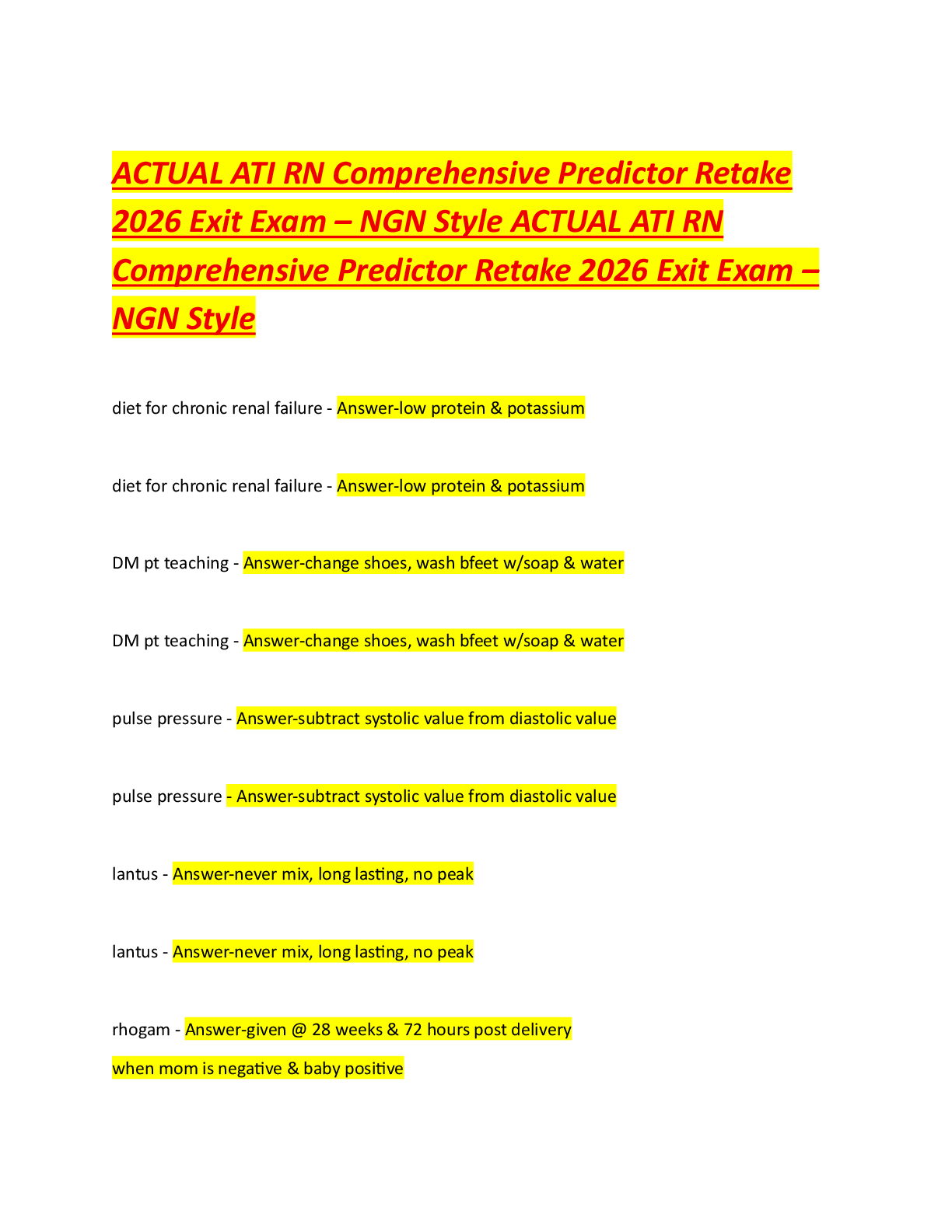
ATI Live Review
Management of Care
Adverse = worst possible side effect
Asthma bronchodilator adverse effect increased myocardial oxygen use, hypokalemia, hyperglycemia Age in stem is important
PAD dangle the legs
...
ATI Live Review
Management of Care
Adverse = worst possible side effect
Asthma bronchodilator adverse effect increased myocardial oxygen use, hypokalemia, hyperglycemia Age in stem is important
PAD dangle the legs because the blood isn’t reaching the distal parts, cool skin, weak pulses PVD elevate the legs because blood isn’t able to come back to the heart, edema, skin is pigmented Only send RBC tubing and remaining blood only if pt is having a reaction
Trach pt You can suction for 10-15 seconds, always need a secure tie, trach at the bedside (one at the same size, one a size smaller)
Priority Questions physiological, safety, love and belonging, self-esteem, self-actualization
• Airway (patent) Breathing (are they or not) Circulation (are they circulating or not)
• Nursing Process: if you have assessment in your stem your answer is action, pt complaint in stem answer is assess
• Safety and Risk reduction: old client always prioritize safety
• Maslows
• Never pick an answer that’s expected
Survival Potential acute over chronic pts, stable (only pt you can delegate) vs unstable (who I’m seeing first)
• Burns to the face and respiratory stridor is a red tag Delegation cant delegate someone whos new (pt, dx, or meds)
• LPN can give piggy back iv meds, catheters, sterile dressing changes Immediate post op airway (gag relex) bleeding (hemorrhage)
5 days postop infection
Preoperative priority consent, allergies, vs, teaching, labs, surgical site is marked Intraoperative priority time out, count
Postoperative priority airway, bleeding
Early vs. Late Symptoms hypovolemic shock (tachycardia) ICP (change in LOC)
Methohexital sedative
Succinylcholine paralytic to prevent harm to pt
More Strategies Always stay with the client, if the pt dies stay with the family, use what you know, prevent harm from the client, safe and effective delegation, look for the most complete answer
Chest tube at the bedside clamps, sterile dressings, sterile water
RA autoimmune disorder TX with immunosuppressant methotrexate (low WBC low PLATELET)
Crutch walking 6 inches in front and to the side, up the stairs good foot first the crutches, going down the stairs crutches first then bad foot, CANE/CRUTCH OPPOSITE AFFECTED LEG
TPN hypertonic solution (highly sugary) glucose checks Q4hrs, with sliding scale insulin
Management Styles PAGE 10 Communication PAGE 10-12 Conflict resolution PAGE 11
Collaborating is a win win, competing is win lose, cooperating is a lose win, smoothing is a lose lose(ignoring the problem), avoiding is a lose lose (not addressing the problem)
Incident Report management investigates the incident, reports include description and actions taken, reports are confidential
• No copy in health record, not in the nurses notes
Delegation PAGE 13-14 Scope of Practice PAGE 13-14 Prioritization PAGE 14-15 Ethics & Consent PAGE 16 Negligence PAGE 17
negligence is done when harm has occurred
IT PAGE 18
Ebola is reported to the Health Department (CDC FOR REPORTABLE DISEASES)
Nurses role in Community Health PAGE 20 Disaster Planning PAGE 20-23
Cultural Considerations PAGE 24-27
• Jewish person cant eat shellfish, can eat a fish with scales and a fin, cant have meat and milk in the same meal
• Mormon person don’t allow alcohol, coffee or tea
Pharmacology PAGE 30
Assess Peak after you give medication
Assess trough before next dose of medication Infiltration elevate and apply cold compress Catheter Emboli apply tourniquet Extravasation aspirate
Hematoma light pressure Phlebitis apply warm compress
Central Lines (directly into the heart) sterile technique, can cause PNX or air emboli, must flush admin med flush then give heparin (so line doesn’t clot)
AntiHTN Medication
CCB may increase heart failure ACE can cause angioedema Vasodilators rapidly drop BP
Alpha Agonists contraindicated with anticoagulants
Digoxin PAGE 37
• Good for Heart Failure Pts, monitor pulse, K (hypokalemia is the number one cause of dig toxicity)
Nitroglycerin PAGE 36-37
• Reduce preload, decrease afterload
• SE: hypotension, tachycardia, headache, tolerance
• Handle with gloves, in a dark brown bottle
• Avoid any of the “fils”
Antidysrhythmic Medication
Adenosine converts SVT to sinus rhythm, stops the heart
• SE: flushing, bronchospasm
Amiodarone assists with VFIB and unstable VTACH
• SE: bradycardia, pulmonary comps
• Monitor respirations, don’t give with heparin Atropine treats bradycardia
• Assess heart rate, and urine output
Advanced Life Support Medications LEAN OR LEAD
• Lidocaine, epinephrine, atropine, dopamine
• Lidocaine, epi, atropine, Narcan
• Lidocaine slows down the heart rate
Cholesterol Lowering Medications PAGE 38
Avoid grapefruit, assess HDL, LDL, LFT, rhabdomyolysis (CKMB and LACIC ACID)
Respiratory Medications PAGE 39-40
Bronchodilator remove the mouthpiece cover, shake it, inhale exhale completely, place between teeth and sealed around inhaler, inhale and depress, hold breath for 5-10 seconds
Beta Agonists (erol) contraindicated with tachy dysrhythmias
Methlyxanthines causes rapid heart rate, therapeutic range is 10-20mcg, taken PO
Anticholinergics contraindicated in peanut allergy pts, maximum effects take 2-3 weeks (maintance meds)
Glucocorticoids abrupt cessation may cause addisons VS chronic use may cause cushing Leukotriene Modifiers not used for acute asthma, interacts with warfarin & theopyline
Oral Hypoglycemia PAGE 41-42
Hold 48hrs before and after dye, pregnant women cant use
Insulins PAGE 42
blood sugar goes up when theyre sick, only regular and NPH can be mixed, only regular can be given IV
• Need to have food right away with rapid and short acting
Thyroid Medications PAGE 42-43
Hypothyroid levothyroxine (take in the am, empty stomach, full glass of water)
• Hypotension, paresthesia, constipation, decrease appetie Hyperthyroid methimazole (no breast feeding)
Blood Admin PAGE 44-45
Packed RBC for anemia, monitor HEMO (F-12-16/ M-14-18) hematocrit multiply HEMO by 3 Platelets for thrombo, monitor platelets (150-450)
Albumin given for burns, monitor albumin (3.5-5)
FFP for bleeding related to warfarin, monitor PT (11-12.5secs) PTT 75, critical is 100
Growth Factors PAGE 45
Filgrastim stimulate WBC production
• SE: leukocytosis
• Monitor CBC
Oprelvekin stimulate platelet production
• SE: cardiac dysthymias
• Give after chemo
Iron Prep PAGE 45
Client Education Give deep IM, Z track, no massage, leave air bubble in, change needle after prep (will stain tissue)
• Give through a straw with orange juice, its stains
• Avoid teas
• Changes stool color
Anticoagulants & Antiplatelet & Thrombolytics PAGE 46-47
Anticoags heparin, warfarin, enoxaparin (check platelet) Antiplatelets interferes with platelets aggregation, aspirin, clopidogrel
Thrombolytics dissolve clots, “PASE”, must be given within 4-6hrs of symptoms
• Stroke pts
Hemoglobin lets you know youre bleeding
GI Medications PAGE 47-49
Take PPI on an empty stomach, risk for PNA, osteoporosis Take antacids 1hr after meals
Antiemetics can cause EPS
Antidiarrheals monitor fluid and electrolytes
Diuretics page 49-50
Potassium Wasting- hypokalemia, hyponatremia, hyperglycemia
• Risk for falls
Antimicrobials PAGE 52
Need a culture and sensitivity Nephrotoxic meds vanco, gentamicin
CONTINUES......................................................
[Show More]








.png)

.png)