A registered nurse (RN) on the 7 a.m.–3 p.m. shift is planning client
assignments for the day. Which clients would be appropriate for the RN to
assign to the licensed practical nurse (LPN)? Select all that apply.
A. A
...
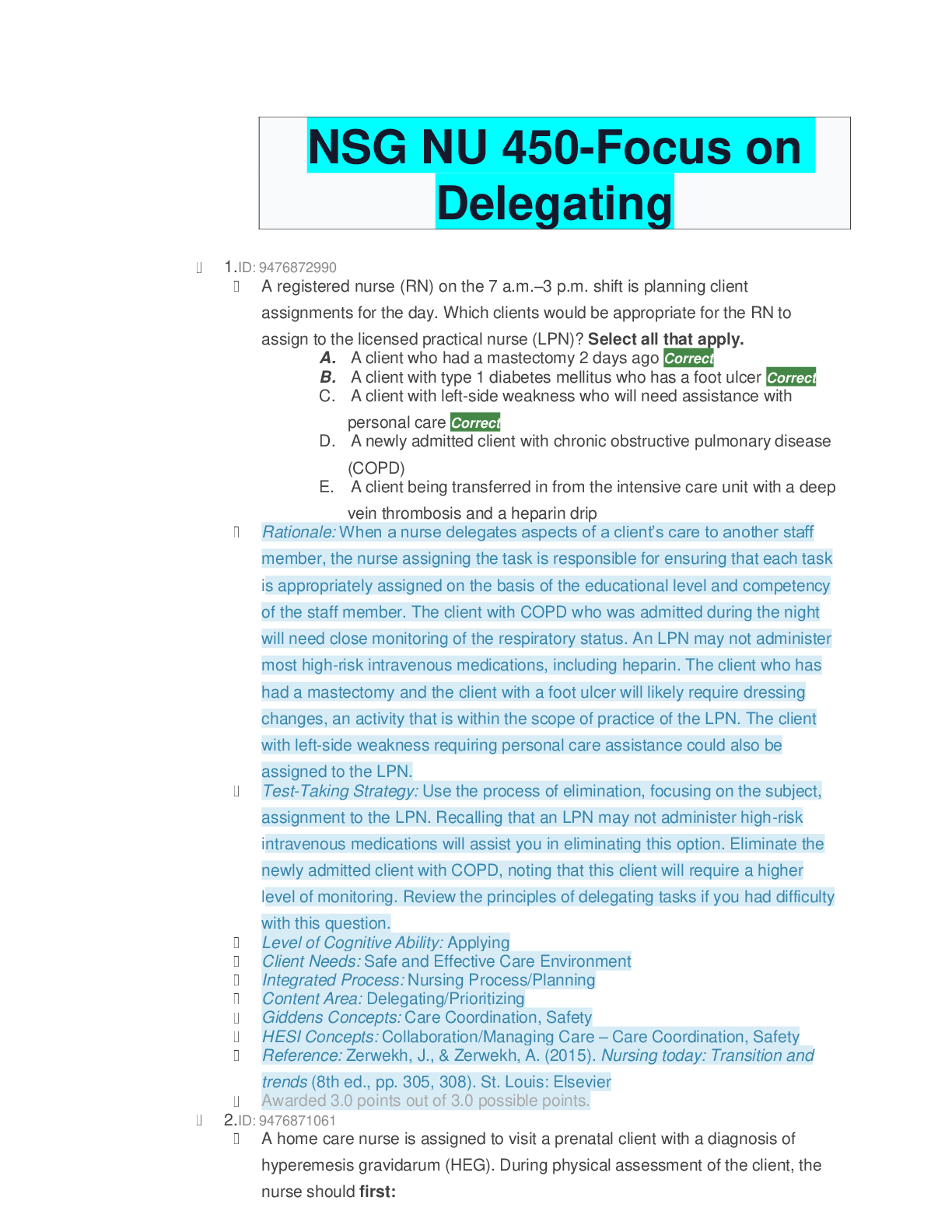
A registered nurse (RN) on the 7 a.m.–3 p.m. shift is planning client
assignments for the day. Which clients would be appropriate for the RN to
assign to the licensed practical nurse (LPN)? Select all that apply.
A. A client who had a mastectomy 2 days ago Correct
B. A client with type 1 diabetes mellitus who has a foot ulcer Correct
C. A client with left-side weakness who will need assistance with
personal care Correct
D. A newly admitted client with chronic obstructive pulmonary disease
(COPD)
E. A client being transferred in from the intensive care unit with a deep
vein thrombosis and a heparin drip
� Rationale: When a nurse delegates aspects of a client’s care to another staff
member, the nurse assigning the task is responsible for ensuring that each task
is appropriately assigned on the basis of the educational level and competency
of the staff member. The client with COPD who was admitted during the night
will need close monitoring of the respiratory status. An LPN may not administer
most high-risk intravenous medications, including heparin. The client who has
had a mastectomy and the client with a foot ulcer will likely require dressing
changes, an activity that is within the scope of practice of the LPN. The client
with left-side weakness requiring personal care assistance could also be
assigned to the LPN.
� Test-Taking Strategy: Use the process of elimination, focusing on the subject,
assignment to the LPN. Recalling that an LPN may not administer high-risk
intravenous medications will assist you in eliminating this option. Eliminate the
newly admitted client with COPD, noting that this client will require a higher
level of monitoring. Review the principles of delegating tasks if you had difficulty
with this question.
� Level of Cognitive Ability: Applying
� Client Needs: Safe and Effective Care Environment
� Integrated Process: Nursing Process/Planning
� Content Area: Delegating/Prioritizing
� Giddens Concepts: Care Coordination, Safety
� HESI Concepts: Collaboration/Managing Care – Care Coordination, Safety
� Reference: Zerwekh, J., & Zerwekh, A. (2015). Nursing today: Transition and
trends (8th ed., pp. 305, 308). St. Louis: Elsevier
� Awarded 3.0 points out of 3.0 possible points.
� 2.ID: 9476871061
� A home care nurse is assigned to visit a prenatal client with a diagnosis of
hyperemesis gravidarum (HEG). During physical assessment of the client, the
nurse should first:
A. Weigh the client
B. Assess the client’s intake and output Correct
C. Encourage the client to verbalize her feelings about the diagnosis
D. Review the results of the hemoglobin and hematocrit
determinations
� Rationale: HEG is persistent, uncontrolled vomiting that begins before the 20th
week of pregnancy. It can have serious consequence, including loss of 5% of
prepregnancy weight, dehydration, ketosis, acid-base imbalance, and
electrolyte imbalances. Physical assessment begins with determining the
client’s intake and output, because these data provide information regarding
hydration and the nutritional status of the client. The client’s weight would be
obtained and the baseline value compared with previous and subsequent
values. Additionally, the nurse would instruct the client in how to accurately
check and monitor her weight. Laboratory data may need to be evaluated;
increased hemoglobin and hematocrit values may occur as a result of
dehydration. Encouraging the client to verbalize her feelings about the
diagnosis is a component of the plan of care but is not the first intervention
during physical assessment.
� Test-Taking Strategy: Note the strategic word “first.” Use Maslow’s Hierarchy of
Needs theory to eliminate the option that indicates encouraging the client to
verbalize her feelings, recalling that physiological needs are the priority. To
select from the remaining options, recall the description of HEG; this will direct
you to the correct option. Review the priority physical assessment techniques in
this disorder if you had difficulty with this question.
� Level of Cognitive Ability: Analyzing
� Client Needs: Physiological Integrity
� Integrated Process: Nursing Process/Assessment
� Content Area: Delegating/Prioritizing
� Giddens Concepts: Care Coordination, Nutrition
� HESI Concepts: Collaboration/Managing Care – Care Coordination, Nutrition
� Reference: McKinney, E., James, S., Murray, S., Nelson, K. & Ashwill, J. (2013).
Maternal-child nursing (4th ed., pp. 589-590). St. Louis: Elsevier.
� Awarded 1.0 points out of 1.0 possible points.
� 3.ID: 9476869315
� A registered nurse (RN) on the night shift has a licensed practical nurse (LPN)
and an unlicensed assistive personnel (UAP)on the team and is planning the
client assignments for the night. Which client does the RN assign to the LPN?
Select all that apply.
A. A client who undergoing a 24-hour urine collection
B. A client with a nasogastric tube who underwent bowel resection 2
days ago Correct
C. A client with urinary frequency who needs assistance in getting to
the bathroom
D. A client scheduled for renal dialysis in the morning who needs
assistance with hygiene
E. A client who has been fitted with skeletal traction of the right leg
after an open reduction measuresCorrect
� Rationale: When a nurse delegates aspects of a client’s care to another staff
member, the nurse assigning the task is responsible for ensuring that each task
is appropriately assigned on the basis of the educational level and competency
of the staff member. An LPN may perform certain invasive procedures. A client
with a nasogastric tube who underwent bowel resection 2 days ago and a client
in skeletal traction to the right leg after open reduction may safely be assigned
to the LPN, because the LPN is capable of performing the nasogastric tube
care, dressing changes, and monitoring for postoperative complications that the
clients will require. Interventions such as assisting clients with ambulation and
hygiene measures and performing noninvasive procedures — the types of tasks
identified in the other options — may be assigned to a nursing assistant.
� Test-Taking Strategy: Use the process of elimination, focusing on the subject,
assignment to an LPN. Eliminate the options that are comparable or alike in that
they are noninvasive procedures. Also note that the remaining options involve
routine care of the postoperative client and activities that are within the scope of
practice for the LPN. Review the principles of delegation if you had difficulty with
this question.
� Level of Cognitive Ability: Applying
� Client Needs: Safe and Effective Care Environment
� Integrated Process: Nursing Process/Planning
� Content Area: Delegating/Prioritizing
� Giddens Concepts: Care Coordination, Safety
� HESI Concepts: Collaboration/Managing Care – Care Coordination, Safety
� Reference: Potter, P., Perry, A. G., Stockert, P. A., & Hall, A. M. (2013).
Fundamentals of nursing. (8thed., pp. 262, 281-283). St. Louis: Mosby.
� Awarded 2.0 points out of 2.0 possible points.
� 4.ID: 9476867243
� A nurse is monitoring a client with preeclampsia who is receiving intravenous
magnesium sulfate to prevent seizures. The nurse notes that the client’s
respiratory rate is 10 breaths/min. On the basis of this finding, the nurse first:
A. Takes the client’s vital signs health care provider
B. Contacts the health care provider
C. Discontinues the magnesium sulfate Correct
D. Checks the most recent serum magnesium sulfate level
� Rationale: A respiratory rate slower than 12 breaths/min is a sign of magnesium
toxicity. Other signs include the absence of deep tendon reflexes, altered
sensorium, hypotension, and a serum magnesium level above the therapeutic
range of 5 to 8 mg/dL (2.05 to 3.29 mmol/L). In this situation, the nurse would
first discontinue the magnesium sulfate. The nurse would then take the client’s
vital signs and contact the health care provider health care providerThe most
recent serum magnesium level may be checked; however, a current serum level
would provide more useful data.
� Test-Taking Strategy: Use the process of elimination, focusing on the data in the
question. Recalling that a respiratory rate slower than 12 breaths/min is a sign
of magnesium toxicity will direct you to the correct option. Review these signs
and the appropriate nursing interventions if you had difficulty with this question.
� Level of Cognitive Ability: Applying
� Client Needs: Safe and Effective Care Environment
� Integrated Process: Nursing Process/Implementation
� Content Area: Delegating/Prioritizing
� Giddens Concepts: Clinical Judgment, Safety
� HESI Concepts: Clinical Decision-Making/Clinical Judgment, Safety
� Reference: McKinney, E., James, S., Murray, S., Nelson, K. & Ashwill, J. (2013).
Maternal-child nursing (4th ed., p. 595). St. Louis: Elsevier.
� Awarded 1.0 points out of 1.0 possible points.
� 5.ID: 9476864338
� A client who has just undergone abdominal surgery calls the nurse and states, “I
feel as if I just split open.” The nurse checks the abdominal incision and finds
wound evisceration. The nurse immediately:
A. Documents the findings
B. Notifies the operating room
C. Takes the client’s vital signs
D. Contacts the health care provider Correct
� Rationale: Wound evisceration is the total separation of a surgical incision or
wound with extrusion of the internal organs or viscera through the open wound.
When evisceration occurs, the nurse immediately calls for help and has the
health care provider notified. The nurse stays with the client and positions the
client with the hips and knees bent. The nurse then covers the abdominal
wound with a sterile dressing moistened with sterile saline solution. The nurse
would then take the client’s vital signs and document the occurrence. Since this
is a surgical emergency, the operating room would be notified but this would not
be done until directed to do so by the surgeon.
� Test-Taking Strategy: Use the process of elimination and your prioritizing skills.
Note the strategic word “immediately.” Recalling that wound evisceration is a
surgical emergency will direct you to the correct option. Review the nursing
actions to be taken immediately in the event of wound evisceration occurs if you
had difficulty with this question.
� Level of Cognitive Ability: Applying
� Client Needs: Physiological Integrity
� Integrated Process: Nursing Process/Implementation
� Content Area: Delegating/PrioritizingGiddens Concepts: Clinical Judgment,
Caregiving
� HESI Concepts: Clinical Decision-Making/Clinical Judgment, Cargiving
� Reference: Lewis, S., Dirksen, S., Heitkemper, M., & Bucher, L. (2014).
Medical-surgical nursing: Assessment and management of clinical problems (9th
ed., p. 180). St. Louis: Mosby.
� Awarded 1.0 points out of 1.0 possible points.
� 6.ID: 9476874711
� A client is receiving an intravenous (IV) infusion of 1000 mL of normal saline
solution at a rate of 125 mL/hr. The client suddenly complains of shortness of
breath, and the nurse notes the presence of dependent edema and puffiness
around the client’s eyes. The nurse suspects circulatory overload and
immediately:
A. Slows the IV rate Correct
B. Administers a diuretic
C. Contacts the health care provider
D. Places the client in a supine position
� Rationale: Signs of circulatory overload include shortness of breath, cough,
increased blood pressure, puffiness around the eyes, and edema in dependent
areas. The client’s neck veins may be engorged, and the nurse may hear moist
breath sounds on auscultation of the lungs. If circulatory overload occurs, the
nurse must immediately slow the IV rate and then notify the health care
provider. The client would be placed in an upright position. The nurse would
monitor the client’s vital signs and administer oxygen and diuretics as
prescribed.
� Test-Taking Strategy: Focus on the data in the question and note the strategic
word “immediately.” Eliminate the option in which the client is place in a supine
position, because this position will exacerbate the existing shortness of breath.
Recalling that administration of a diuretic requires a health care provider’s
prescription will assist you in eliminating this option. To select from the
remaining options, focus on the strategic word and note that circulatory
overload is suspected; this will direct you to the correct option. Review the
interventions to be taken immediately when circulatory overload is suspected if
you had difficulty with this question.
� Level of Cognitive Ability: Applying
� Client Needs: Physiological Integrity
� Integrated Process: Nursing Process/Implementation
� Content Area: Intravenous therapyGiddens Concepts: Clinical Judgment, Safety
� HESI Concepts: Clinical Decision-Making/Clinical Judgment, Safety
� Reference: Ignatavicius, D., & Workman, M. (2013). Medical-surgical nursing:
Patient-centered collaborative care. (7th ed., p. 230). St. Louis: Saunders.
� Awarded 1.0 points out of 1.0 possible points.
� 7.ID: 9476864386
� A nurse is performing closed suctioning through a tracheostomy for a ventilatordependent client. During the procedure, the alarm on the cardiac monitor
sounds and the nurse notes severe bradycardia. The nurse stops suctioning the
client and immediately:
A. Contacts the respiratory therapist
B. Rechecks all ventilator connections
C. Oxygenates the client manually with 100% oxygen Correct
D. Increases the degree of PEEP the client is receiving
� Rationale: Suctioning is associated with several complications, including
hypoxia, tissue (mucosal) trauma, infection, vagal stimulation, and
bronchospasm. Vagal stimulation may result in severe bradycardia,
hypotension, heart block, ventricular tachycardia, or asystole. If vagal
stimulation occurs, the nurse stops suctioning immediately and oxygenates the
client manually with 100% oxygen. Contacting the respiratory therapist will
delay the required and immediate intervention. Although regular checks of the
ventilator connections are the standard of care for a client undergoing
mechanical ventilation, doing so will not alleviate the client’s problem in this
situation. An increase in PEEP is not indicated at this time.
� Test-Taking Strategy: Focus on the data in the question and note that the client
is exhibiting severe bradycardia. Use your knowledge of the ABCs — airway,
breathing, and circulation. This will direct you to the correct option. Review the
complications associated with suctioning and the immediate nursing
interventions if you had difficulty with this question.
� Level of Cognitive Ability: Applying
� Client Needs: Physiological Integrity
� Integrated Process: Nursing Process/Implementation
� Content Area: Delegating/Prioritizing
� Giddens Concepts: Clinical Judgment, Gas Exchange
� HESI Concepts: Clinical Decision-Making/Clinical Judgment, Oxygenation/Gas
Exchange
� Reference: Lewis, S., Dirksen, S., Heitkemper, M., & Bucher, L. (2014).
Medical-surgical nursing: Assessment and management of clinical problems (9th
ed., p. 1623). St. Louis: Mosby.
� Awarded 1.0 points out of 1.0 possible points.
� 8.ID: 9476867288
� Inner maxillary fixation (IMF) is performed on a client who sustained a
mandibular fracture in a motor vehicle crash. During an assessment, the client
begins to vomit. The nurse suctions the client but is unsuccessful, and the client
exhibits signs of hypoxia. The nurse immediately:
A. Cuts the mouth wires Correct
B. Administers an antiemetic
C. Contacts the anesthesiologist
D. Places the client is a supine position
� Rationale: IMF is a common means of securing a mandibular fracture. The
bones are realigned and then wired in place with the bite closed. After surgery,
the client is at risk for aspiration if he or she vomits because of the impossibility
of opening the jaws to allow ejection of the emesis. If vomiting occurs, the nurse
would attempt to suction the client. If suctioning is unsuccessful, the wires are
cut. Wire cutters are kept with the client at all times in readiness for this
emergency. Antiemetics may be prescribed to prevent nausea and subsequent
vomiting; however, this is not the immediate action if the client is vomiting.
Placing the client in a supine position increases the risk of aspiration. The client
is placed in an upright position and turned to the side. There is no helpful
reason to contact the anesthesiologist.
� Test-Taking Strategy: Use the process of elimination and visualize this surgical
procedure. Noting that the client is vomiting and recalling that aspiration is a risk
in this situation will direct you to the correct option. Review care of the client
after IMF if you had difficulty with this question.
� Level of Cognitive Ability: Applying
� Client Needs: Safe and Effective Care Environment
� Integrated Process: Nursing Process/Implementation
� Content Area: Safety
� Giddens Concepts: Clinical Judgment, Gas Exchange
� HESI Concepts: Clinical Decision-Making/Clinical Judgment, Oxygenation/Gas
Exchange
� Reference: Lewis, S., Dirksen, S., Heitkemper, M., & Bucher, L. (2014).
Medical-surgical nursing: Assessment and management of clinical problems (9th
ed., pp. 1529-1530). St. Louis: Mosby.
� Awarded 1.0 points out of 1.0 possible points.
� 9.ID: 9476869352
� A child arrives at the emergency department experiencing anaphylaxis after
being stung by a bee on the right arm. The nurse should first:
A. Call a code
B. Start an intravenous (IV) line
C. Initiate cardiopulmonary resuscitation (CPR)
D. Place a tourniquet proximal to the site of the insect sting Correct
� Rationale: Anaphylaxis is a severe immediate hypersensitivity reaction to an
excessive release of chemical mediators. Treatment of anaphylaxis must be
started immediately, because it may be only a matter of minutes before the child
experiences shock. The nurse would immediately take steps to ensure an
adequate airway, place a tourniquet just proximal to the site of the insect sting
to help confine the allergen, administer epinephrine (medication of choice) as
prescribed, administer oxygen, administer corticosteroids and antihistamines as
prescribed, keep the child warm and lying flat or with the feet slightly elevated,
and start an IV line.
� Test-Taking Strategy: Note the strategic word “first” and use the skills of
prioritizing to answer the question. Recognizing that there is no information in
the question that indicates that CPR is necessary will assist you in eliminating
the options that are comparable or alike (calling a code and initiating
cardiopulmonary resuscitation). To select from the remaining options, visualize
the situation and note the relationship between the situation and the correct
option. Review the interventions to be taken immediately in the event of
anaphylaxis resulting from a bee sting if you had difficulty with this question.
� Level of Cognitive Ability: Applying
� Client Needs: Safe and Effective Care Environment
� Integrated Process: Nursing Process/Implementation
� Content Area: Critical Care
� Giddens Concepts: Clinical Judgment, Gas Exchange
� HESI Concepts: Clinical Decision-Making/Clinical Judgment, Oxygenation/Gas
Exchange
� References: Hammond, B., & Zimmermann, P. (2013) Sheehy’s Manual of
Emergency Care (7th ed., p. 351). St. Louis: Elsevier.
� Hockenberry, M, & Wilson, D. (2015). Wong’s nursing care of infants and
children (10th ed. pp. 627, 629-630). St Louis: Mosby.
� Awarded 1.0 points out of 1.0 possible points.
� 10.ID: 9476869370
� A nurse is preparing to care for a child being admitted to the hospital with
infectious gastroenteritis. The priority nursing intervention is:
A. Obtaining a stool sample for culture
B. Administering prescribed antimicrobials
C. Starting an intravenous (IV) line as prescribed Correct
D. Instructing the parents in home care measures to prevent infection
� Rationale: Infectious gastroenteritis is caused by a variety of communicable
viruses, bacteria, and parasites capable of causing serious diarrhea, massive
fluid and electrolyte loss, sepsis, and death. The priority therapy in a child with
infectious gastroenteritis is the replacement of water and correction of acid-base
or fluid and electrolyte disturbances with the use of IV fluids or oral electrolytereplacement preparations. A stool culture and antimicrobial drugs may be
prescribed, but these are not the priority interventions. Instructions to the
parents may be necessary but are not the priority on admission of the child to
the hospital.
� Test-Taking Strategy: Note the strategic words “priority nursing intervention.”
Use Maslow’s Hierarchy of Needs theory and your knowledge of the ABCs
(airway, breathing, and circulation). The correct option addresses a
physiological need and the child’s circulatory status. Review care of the child
with infectious gastroenteritis if you had difficulty with this question.
� Level of Cognitive Ability: Applying
� Client Needs: Safe and Effective Care Environment
� Integrated Process: Nursing Process/Implementation
� Content Area: Delegating/PrioritizingGiddens Concepts: Cargiving, Fluid and
Electrolytes
� HESI Concepts: Caregiving, Fluids and Electrolytes
� Reference: Hockenberry, M, & Wilson, D. (2015). Wong’s nursing care of
infants and children (10th ed. p. 955). St Louis: Mosby.
� Awarded 1.0 points out of 1.0 possible points.
[Show More]


.png)





.png)