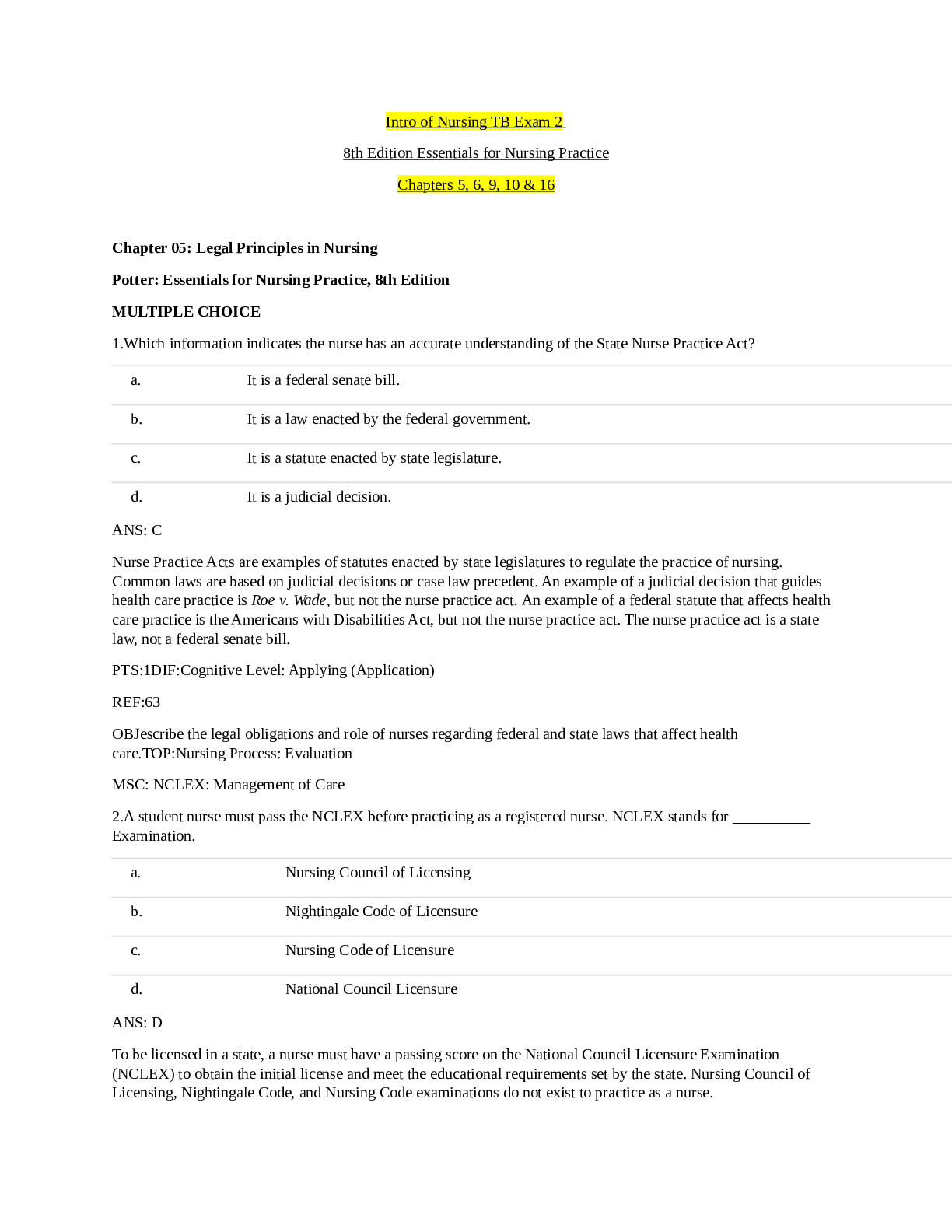
Chapter 05: Legal Principles in Nursing
Potter: Essentials for Nursing Practice, 8th Edition
MULTIPLE CHOICE
1.Which information indicates the nurse has an accurate understanding of the State Nurse Practice Act?
a. I
...
Chapter 05: Legal Principles in Nursing
Potter: Essentials for Nursing Practice, 8th Edition
MULTIPLE CHOICE
1.Which information indicates the nurse has an accurate understanding of the State Nurse Practice Act?
a. It is a federal senate bill.
b. It is a law enacted by the federal government.
c. It is a statute enacted by state legislature.
d. It is a judicial decision.
ANS: C
Nurse Practice Acts are examples of statutes enacted by state legislatures to regulate the practice of nursing.
Common laws are based on judicial decisions or case law precedent. An example of a judicial decision that guides
health care practice is Roe v. Wade, but not the nurse practice act. An example of a federal statute that affects health
care practice is the Americans with Disabilities Act, but not the nurse practice act. The nurse practice act is a state
law, not a federal senate bill.
PTS:1DIF:Cognitive Level: Applying (Application)
REF:63
OBJescribe the legal obligations and role of nurses regarding federal and state laws that affect health
care.TOP:Nursing Process: Evaluation
MSC: NCLEX: Management of Care
2.A student nurse must pass the NCLEX before practicing as a registered nurse. NCLEX stands for __________
Examination.
a. Nursing Council of Licensing
b. Nightingale Code of Licensure
c. Nursing Code of Licensure
d. National Council Licensure
ANS: D
To be licensed in a state, a nurse must have a passing score on the National Council Licensure Examination
(NCLEX) to obtain the initial license and meet the educational requirements set by the state. Nursing Council of
Licensing, Nightingale Code, and Nursing Code examinations do not exist to practice as a nurse.
PTS: 1 DIF: Cognitive Level: Remembering (Knowledge)
REF:63
OBJescribe the legal obligations and role of nurses regarding federal and state laws that affect health
care.TOP:Nursing Process: Assessment
MSC: NCLEX: Management of Care
3.A registered nurse was accused of patient abandonment when the nurse became angry, quit the job, and left the
hospital before the end of the shift. This is an example of violating legal standards/guidelines set by which
organization?
a. The State Department of Health
b. The Joint Commission
c. The State Board of Nursing
d. The National League for Nursing
ANS: C
Nurse Practice Acts permit the State Board of Nursing to set rules, regulations, and guidelines that specifically
define the standard of care in nursing practice. An example is the guidelines that define patient abandonment. The
State Department of Health, the Joint Commission, and the National League for Nursing do not set the legal rules
and regulations for patient abandonment.
PTS:1DIF:Cognitive Level: Applying (Application)
REF:63
OBJ: Explain the legal concepts of standard of care and informed consent.
TOP: Nursing Process: Evaluation MSC: NCLEX: Management of Care
4.An RN suffers from chronic back pain that was the result of an injury suffered when pulling a patient up in bed.
The nurse is addicted to pain medication and has recently been accused of stealing narcotics. This is an example of
which violation of the law?
a. Misdemeanor
b. Tort
c. Malpractice
d. Felony
ANS: D
A felony is a serious offense that results in significant harm to another person or society in general. Felony crimes
may carry penalties of monetary restitution, imprisonment for greater than 1 year, or death. Examples of Nurse
Practice Act violations that may carry criminal penalties include practicing nursing without a license and misuse of
controlled substances. A misdemeanor is a crime that, although injurious, does not inflict serious harm. Torts are
civil wrongful acts or omissions against a person or a persons property that are compensated by awarding monetary
damages to the individual whose rights were violated. Malpractice is an example of negligence, sometimes referred
to as professional negligence. The law defines nursing malpractice as the failure to use the degree of care that a
reasonable nurse would use under the same or similar circumstances.
PTS:1DIF:Cognitive Level: Applying (Application)
REF:63-64
OBJ: Define the legal relationships of nurse-patient, nurse-health care provider, nurse-nurse, and nurse-employer.
TOP: Nursing Process: Evaluation
MSC: NCLEX: Management of Care
5.The nurse is caring for a patient who refuses to cooperate for a dressing change. The nurse tells the patient that he
or she will tie the patient down if the patient does not hold still. Which action did the nurse commit?
a. Assault
b. Unintentional tort
c. Battery
d. Felony
ANS: A
Assault is an intentional threat toward another person that gives that person a reasonable fear of harmful contact. No
actual contact is required for an assault to occur. An example of an assault in nursing practice is to threaten to
restrain a patient for an x-ray procedure when the patient has refused consent. Battery is intentional offensive
touching without consent or lawful justification. Negligence is an unintentional tort. A felony is a serious offense
that results in significant harm to another person or society in general, like misusing controlled substances.
PTS:1DIF:Cognitive Level: Applying (Application)
REF:64
OBJ: Define the legal relationships of nurse-patient, nurse-health care provider, nurse-nurse, and nurse-employer.
TOP: Nursing Process: Evaluation
MSC: NCLEX: Management of Care
6.Which chart entry by a nurse would require follow up?
a. 0815 Patient found on floor.
b. 0816 Patient assessed and helped back to bed.
c. 0818 Physician notified of incident.
d. 0820 Occurrence report completed.
ANS: D
Do not document in the nurses notes that an occurrence report was completed. All the other entries are accurate.
Objectively record the details of the event and any statements
the patient makes. At the time of the event, always assess the patient thoroughly, and then contact the health care
provider to examine him or her.
PTS:1DIF:Cognitive Level: Analyzing (Analysis)
REF: 66 OBJ: Identify nursing interventions to improve patient safety.
TOP: Nursing Process: Evaluation MSC: NCLEX: Management of Care
7.To establish the elements of malpractice against a nurse, which must be proved by the patient?
a. The patient must have been harmed as a result of the injury.
b. The patient must have paid for the health care services.
c. The patient must show evidence of malicious intent.
d. The patient must demonstrate personal accountability.
ANS: A
To establish the elements of malpractice, the patient or plaintiff must prove the following: (1) the nurse
defendant owed a duty to the patient, (2) the nurse breached that duty, (3) the patient was injured because of the
nurses breach of duty, and (4) the patient has accrued damages as a result of the injury. The patient paying, showing
evidence of malicious intent, and demonstrating personal accountability are not elements of malpractice.
PTS: 1 DIF: Cognitive Level: Remembering (Knowledge)
REF:64
OBJ:Explain the concept of negligence and identify the elements of professional negligence.TOP:Nursing Process:
Assessment
MSC: NCLEX: Management of Care
8.Which behavior is the best way for a nurse to avoid being liable for malpractice?
a. Purchasing quality malpractice insurance coverage on a yearly basis
b. Practicing nursing that meets the generally accepted standard of care
c. Not sharing his or her last name with patients and families
d. Not delegating any tasks to unlicensed assistive personnel
[Show More]










.png)
.png)

