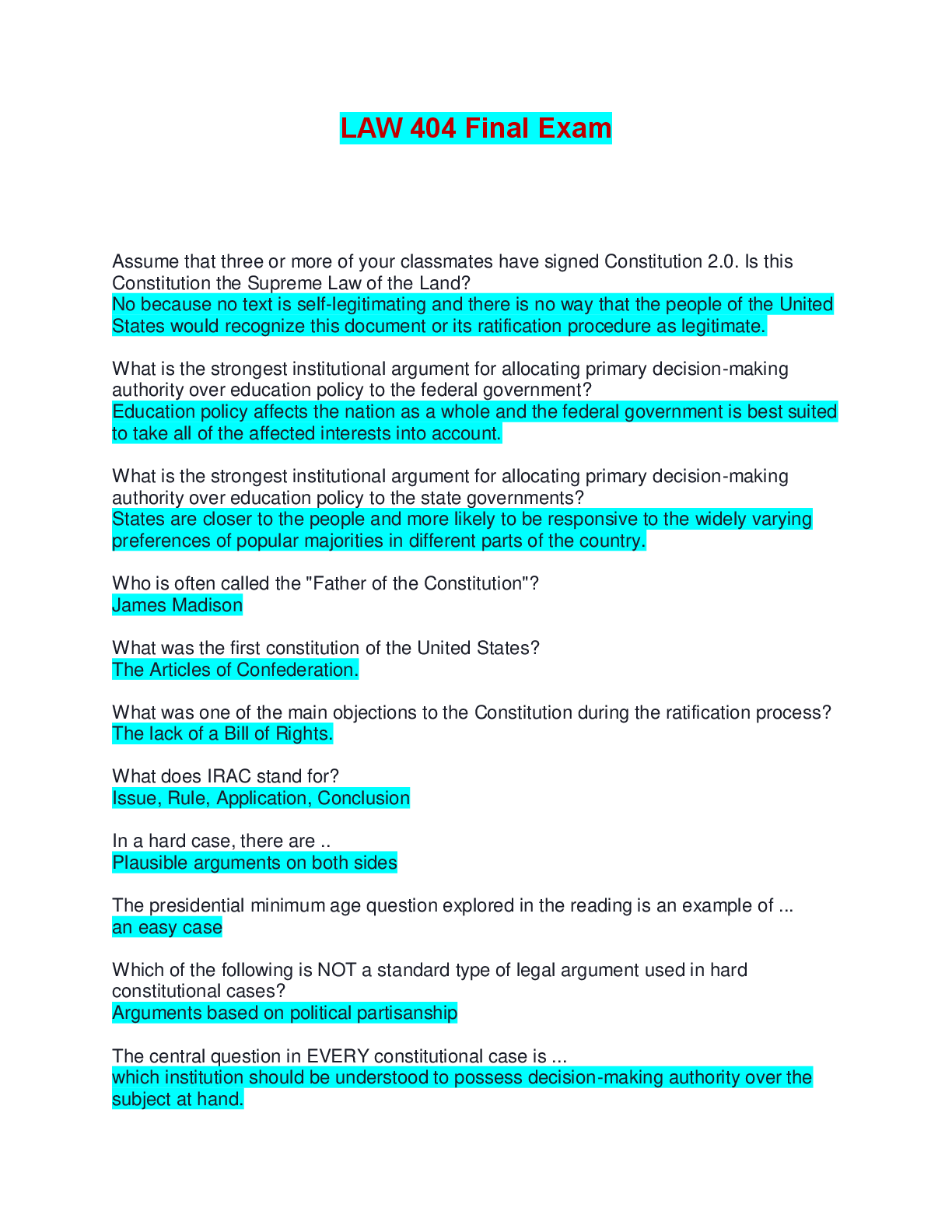
LAW 404 Midterm Study Guide | Questions with Verified Answers Assume that three or more of your classmates have signed Constitution 2.0. Is this Constitution the Supreme Law of the Land? No because no text is self-leg
...
LAW 404 Midterm Study Guide | Questions with Verified Answers Assume that three or more of your classmates have signed Constitution 2.0. Is this Constitution the Supreme Law of the Land? No because no text is self-legitimating and there is no way that the people of the United States would recognize this document or its ratification procedure as legitimate. What is the strongest institutional argument for allocating primary decision-making authority over education policy to the federal government? Education policy affects the nation as a whole and the federal government is best suited to take all of the affected interests into account. What is the strongest institutional argument for allocating primary decision-making authority over education policy to the state governments? States are closer to the people and more likely to be responsive to the widely varying preferences of popular majorities in different parts of the country. Who is often called the "Father of the Constitution"? James Madison What was the first constitution of the United States? The Articles of Confederation. What was one of the main objections to the Constitution during the ratification process? The lack of a Bill of Rights. What does IRAC stand for? Issue, Rule, Application, Conclusion In a hard case, there are .. Plausible arguments on both sides The presidential minimum age question explored in the reading is an example of ... an easy case Which of the following is NOT a standard type of legal argument used in hard constitutional cases? Arguments based on political partisanship The central question in EVERY constitutional case is ... which institution should be understood to possess decision-making authority over the subject at hand. The three big questions of institutional choice in American constitutional law are ... Federalism, separation of powers, and individual rights The question of federalism typically arises in disputes over ... The Article I powers of Congress. Under the U.S. Constitution, those powers not granted to the United States are ... Reserved to the States. Easy federalism cases are clearly resolved by ... The constitutional text and previous decisions of the U.S. Supreme Court By broad consensus, the greatest weakness of the federal government is ... its remoteness from the people and consequent susceptibility to tyranny of the minority. According to Anti-Federalist critics of the Constitution, state governments are ... more responsive to popular majorities than the federal government and thus less vulnerable to powerful special interests. The most important advantage of the federal government over the states is ... its greater ability to handle interstate spillovers--that is, problems that affect more than one state. The President's greatest strengths include ... the ability to act quickly and decisively in a crisis. Most constitutional disputes over the separation of powers are really disputes about whether a particular constitutional power should be entrusted ... to the President alone or to the President and Congress acting jointly. James Madison's maxim that "ambition must be made to counteract ambition" is ... famous but wrong. Most individual rights questions involve ... The Bill of Rights or the 14th Amendment What is the political process? A collective term for state and federal institutions that are directly or indirectly responsible to the people. What is the question of institutional choice in every individual rights case? The federal courts vs. the political process Which of the following best describes Thomas Jefferson's views on the first bank of the United States? Jefferson opposed the creation of a national bank as beyond the powers of Congress. The proper scope of national power ... has always been controversial. In McCulloch v. Maryland, the Supreme Court upheld the power of Congress to create a national bank because ... The bank was an appropriate means of carrying into effect the enumerated powers of Congress under the Necessary and Proper Clause. In Gibbons v. Ogden, Chief Justice Marshall's opinion defined commerce as ... intercourse, meaning interchange or interaction. In Gibbons v. Ogden, Chief Justice Marshall defined commerce "among the several states" as ... commerce that concerns or affects more states than one. Over the course of U.S. history, the commerce power ... has contributed greatly to a vast expansion of federal power since the founding. How did the Supreme Court initially respond to FDR's New Deal reforms? The Court struck down several important New Deal statutes. Under the manufacturing/commerce distinction established in E.C. Knight, Congress was ... Permitted to regulate commerce or trade but not manufacturing. Over the course of the 19th Century ... Revolutions in transportation, communication, and industrial organization utterly transformed the U.S. economy After Jones & Laughlin Steel Co., the Supreme Court ... did not strike down another law as beyond the federal commerce power until 1995. In Lopez and Morrison, the Supreme Court ... substantially narrowed federal power to regulate economic activity and upheld Congress's broad power to regulate economic activity. How does Gonzales v. Raich define economic activity? the production, distribution, or consumption of commodities. Where is the spending power found in the constitutional text? It's a trick question. The spending power is not explicitly granted by the constitutional text. Which of the following best describes Hamilton's view of the spending power? Hamilton thought the spending power granted Congress the power to spend money for any purpose connected to the general welfare. Which of the following best describes James Madison's views on the spending power? Madison worried that the spending power would give Congress effective control over all human activities. Madison thought Congress could only spend money in the service of its other enumerated powers. In what sense is the 10th Amendment a "truism"? it merely reaffirms that Congress has only those powers granted to it. How does commandeering compromise the integrity and independence of state electoral processes? By requiring state officials to act as puppets of the federal government rather than as representatives of state voters. What is the anti-commandeering principle? The rule that Congress may not force state or local officials to enforce or administer federal law. What is the strongest institutional argument for allocating primary decision-making authority over marijuana regulation to the federal government? Drug policy affects the nation as a whole and the federal government is best suited to take all of the affected interests into account. What is the strongest institutional argument for allocating primary decision-making authority over marijuana regulation to the state governments? States are closer to the people and more likely to be responsive to the widely varying preferences of popular majorities in different parts of the country. What is the strongest institutional argument for allocating primary decision-making authority over mercury regulation to the executive branch? The executive branch possesses greater expertise and investigative research than the legislative branch to deal with the complex scientific questions raised in this context. What is the strongest institutional argument for allocating primary decision-making authority over mercury regulation to Congress? Congress is more likely to ensure buy-in from the nation as a whole, including geographically concentrated minorities. What is the strongest institutional argument for allocating decision-making authority over the emergency seizure of production facilities to the President? The President is better able to respond quickly to a fast-developing crisis. What is the strongest institutional argument for allocating decision-making authority over the emergency seizure of production facilities to Congress? Congress is more likely to ensure buy-in from the nation as a whole, including geographically concentrated minorities. What is the strongest institutional argument for allocating primary decision-making authority over the death penalty to federal courts? The federal courts are less susceptible to tyranny of the majority, which is a significant risk in the treatment of accused criminals, especially given the long history of racial disparities in the administration of the death penalty. What is the strongest institutional argument for allocating primary decision-making authority over the death penalty to state legislatures? The question is both morally and empirically complex (does the death penalty deter murder? by how much? how many innocent persons are likely to be executed? how does race factor into the administration of capital punishment?), with wide-ranging effects on interests unlikely to be represented before a court. What is the strongest institutional argument for allocating primary decision-making authority over school funding to state legislatures? The question is empirically complex (how many students are there per district? what are their current needs and resources? how far can students be reasonably expected to travel to school? should some funding be local to ensure community investment in schools? Etc., etc.), with wide-ranging effects on interests unlikely to be represented before a court. What is the strongest institutional argument for allocating primary decision-making authority over school funding to federal courts? The federal courts are less susceptible to tyranny of the majority, which is a significant risk in the context of school funding disparities which disproportionately disfavor poor minority communities. Which of the following best describes the issue in McCulloch v. Maryland? Does Congress possess the constitutional power to create a national bank under the Necessary and Proper Claus What is the question of institutional choice in McCulloch v. Maryland? Should the power to charter banks rest with the states alone or should the federal government also possess that power when appropriate to carrying out its other powers? If almost everyone agrees that the Constitution is binding law, does it matter why we treat it as such? Yes, how we interpret the constitution depends on why we treat it as binding law. In a hard constitutional case, what kind of arguments are key? Arguments based on the strengths and weaknesses of different institutions. When are constitutional cases easy? When the constitutional text or existing case law is clear. How are easy federalism cases resolved?
[Show More]