As a nurse at a local hospital, you spend most of your day helping people and talking with
sick people. One of your favorite parts of this time is when you get let in on a heartwarming
private moment. One such moment h
...
As a nurse at a local hospital, you spend most of your day helping people and talking with
sick people. One of your favorite parts of this time is when you get let in on a heartwarming
private moment. One such moment happened when making your rounds late last night. An
elderly grandmother was telling her grandchild a story:
"What do you think? If a man owns 100 sheep, and one of them wanders away, will he not
leave the 99 on the hills and go to look for the one that wandered off? And if he finds it, I tell
you the truth, he is happier about that one sheep than about the 99 that did not wander off.
In the same way your Father in heaven is not willing to let any of these little ones be lost."
This kind of narrative would be called a(n) (A) parable .
The person in the neighboring bed couldn’t help but overhear the story and interrupts the
grandmother to ask some questions. The three get to talking about the story and life in
general.
At one point the conversation even moves towards religion and health. It turns out they both
see a strong connection between the two. The neighbor says, "one of the most important
parts of my religious tradition is the acknowledgement that suffering is a part of life. It's not
that there is no joy in life but that we need to disconnect from the desires and wants that
cause this suffering."
Her comment would fit best with which religious belief system?
Confucianism
Buddhism
Islam
Judaism
Christianity
Sikhism
Taoism
Shinto
Hinduism
As you enter the next room a patient, Shane, seems to be quietly lost in thought. You try to
close the door without Shane noticing, but he does. You apologize for interrupting, but Shane
does not seem to mind and continues sitting quietly. Later he explains:
"No worries. I just try to spend at least a little time in sitting silently everyday. The important
thing is that I attempt to practice mindfulness and am sometimes able to lose track of my
sense of being an individual self."
Many religions encourage such a practice, called (A) meditation , in order to clear one's mind
and become closer to the divine. In Hinduism, this might be accompanied by the use of one
of the four types of Yoga.
The next stop on your rounds takes you to Quinn's room. Quinn has been in the hospital for
months fighting cancer. Quinn is a great storyteller and you love when you get a chance to
talk about his life with him.
One of his only regrets is that he didn't get a chance to make another spiritual pilgrimage.
Match the location with the religion that is most likely to make a pilgrimage to that spot.
Hinduism
Judaism
D C
https://www.coursehero.com/file/60038907/Approaches-to-Studying-Religions-Unit-4-Challenge-3docx/
This study resource was
shared via CourseHero.comChristianity
A.
Bethlehem
B.
Mecca
C.
Temple Mount
D.
Kumbh Mela
HINT
Consider that pilgrimages are a holy action. Where would a pilgrim from each of these
religions go?
Quinn doesn't look good today and he shares with you that he can feel life slipping away. You
start to tear up at the thought of not having him around to tell you stories. Quinn notices
your sadness and tells you not to worry because even though he is close to death he is not
at all fearful of dying.
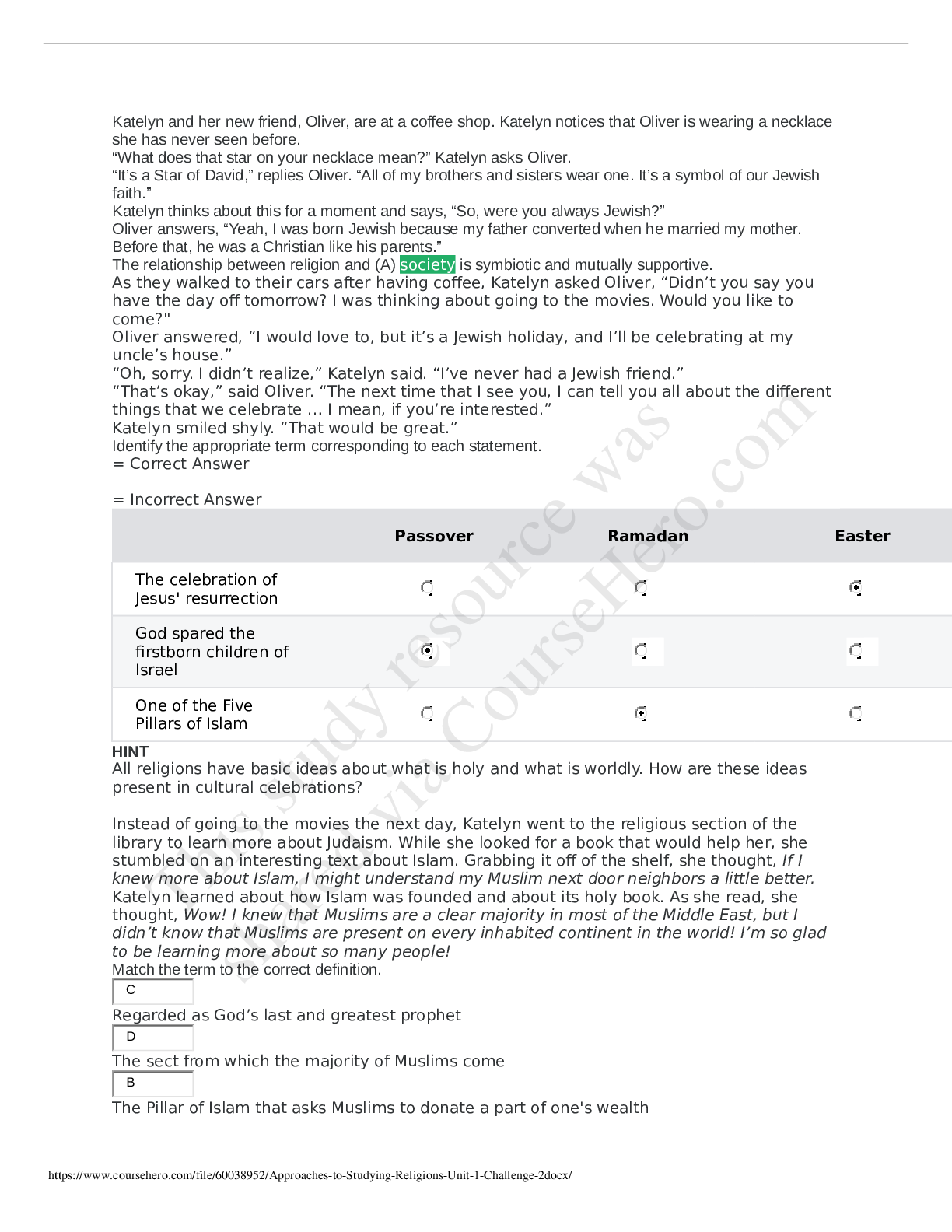
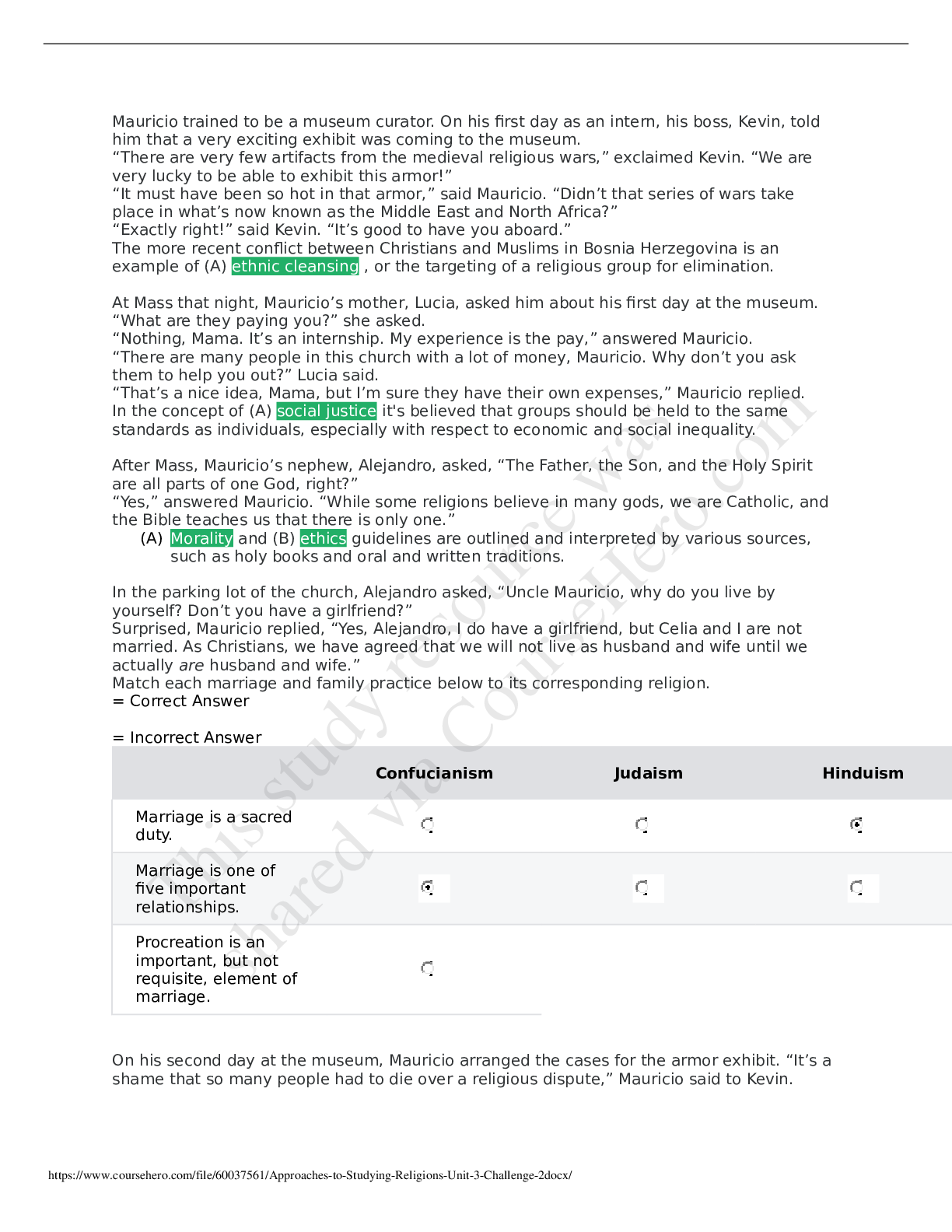
Match the religion to the statement describing its belief about death.
= Correct Answer
= Incorrect Answer
Hinduism Primal Religions Christianity
At death a person is
judged for earthly
deeds and Quinn
feels good about his
life choices.
At death a person
has the possibility of
rebirth and
enlightenment.
At death a person
becomes an ancestor
to guide the living.
HINT
Think about how different religions view death. Based on that information how could each
religion be ok with dying?
After finishing your chat with Quinn, you move on to the next room on your rounds.
You enter the room across the hall and stumble onto an awkward conversation. A mother is
talking with one of her daughters about why she should get married:
"Lynn, please listen to me. I know you feel like you are not ready to get married yet, but it's
not just about you. As a good religious person, you know that holy matrimony is sanctified
by the church. And once you're married, you'll be able to have children."
Lynn's mother's perspective on the reasons for getting married most likely comes from
the (A) Catholic religion.
It's been a busy morning. As you sit down for your mid-morning break you reflect on all the
different sorts of interactions you've had today. You realize you have observed a variety of
A
combelief systems in action as you visited different patients. You think about a recent online
course you took in the comparison of different religions.
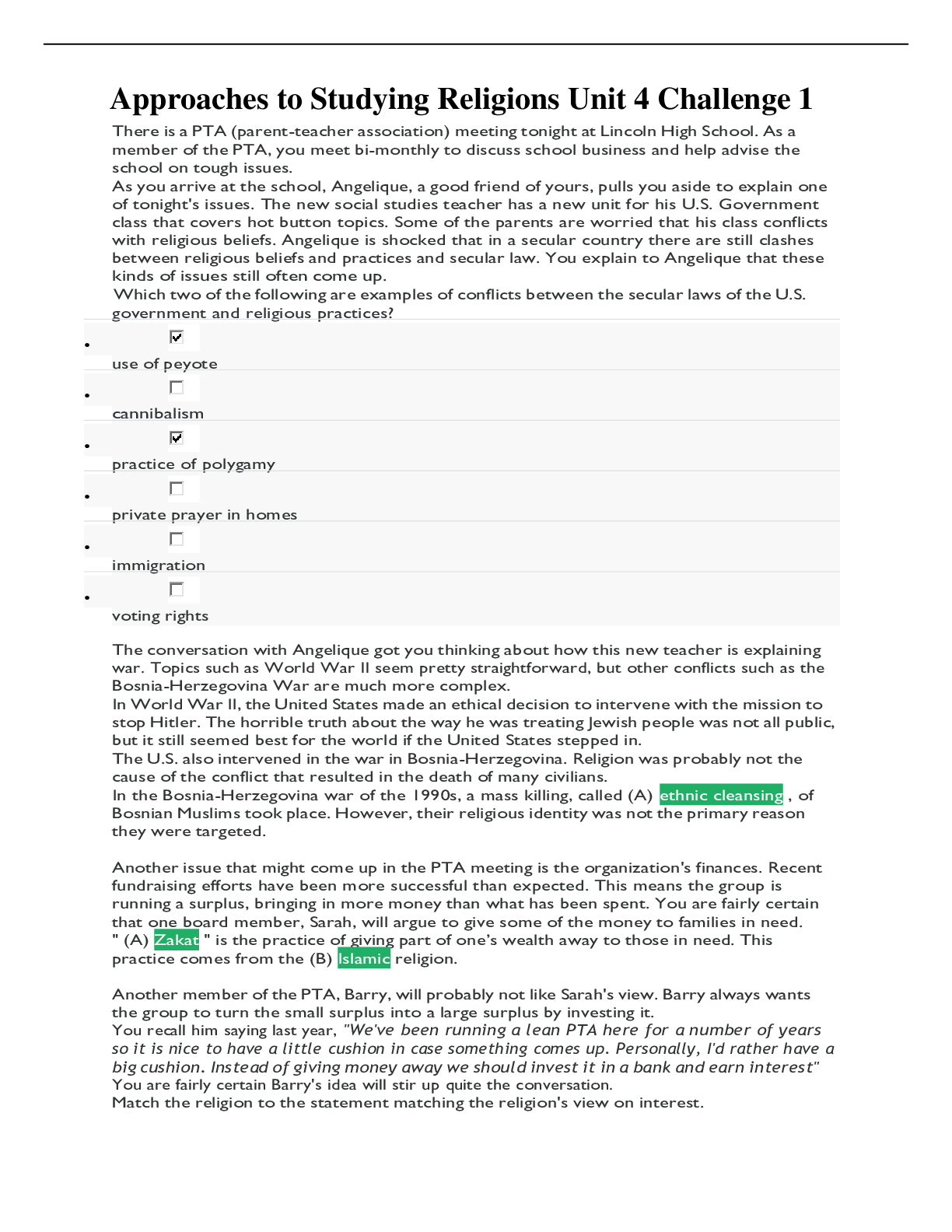
An academic applying the phenomenological approach to studying religions would be most
interested in which two of the following items?
Tracking down the development and changes of a specific myth.
The experience of mysticism in individuals.
The story being passed down from generation to generation.
Data on the prayer rates of people in hospitals versus non-hospitalized people.
Interviewing people going on a pilgrimage.
The similarities between different faiths' views on the holy.
HINT
Considering what you know about the phenomenological approach to studying religion,
which statements would fit this perspective the best?
[Show More]