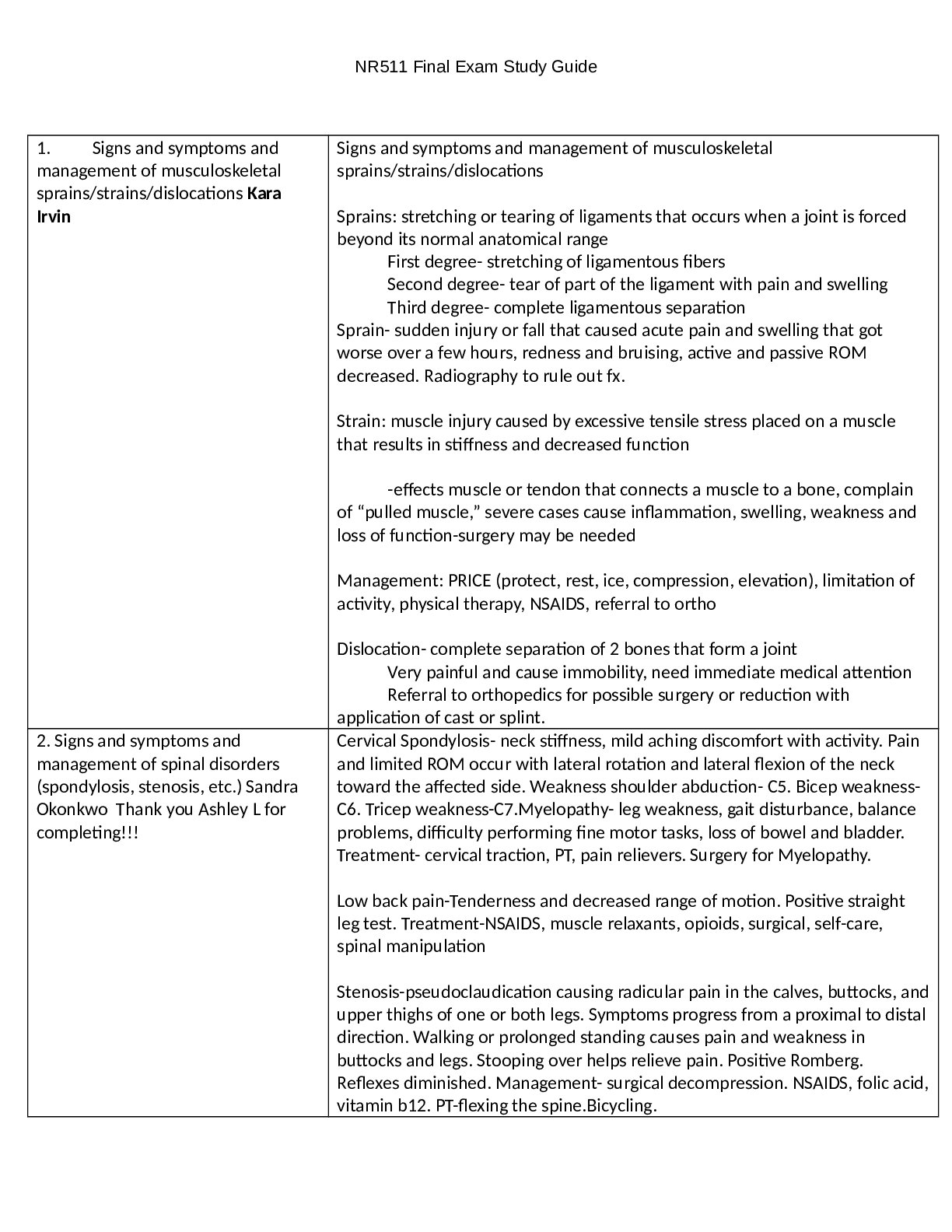
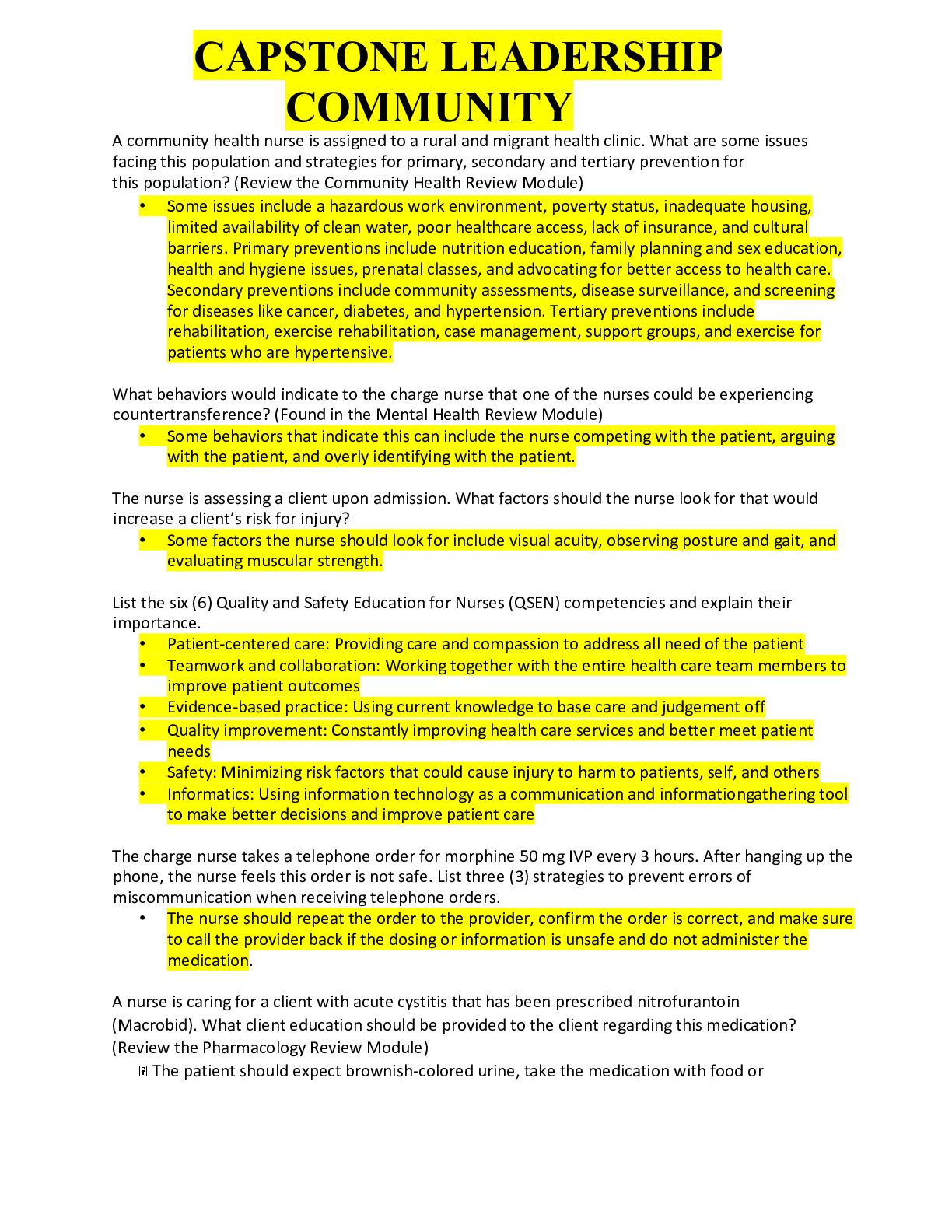
NR511-Final Exam Study Guide WEEK 1 1.Define diagnostic reasoning
Reflective thinking because the process involves questioning one's thinking to determine if all possible avenues have been explored and if the conclusio
...
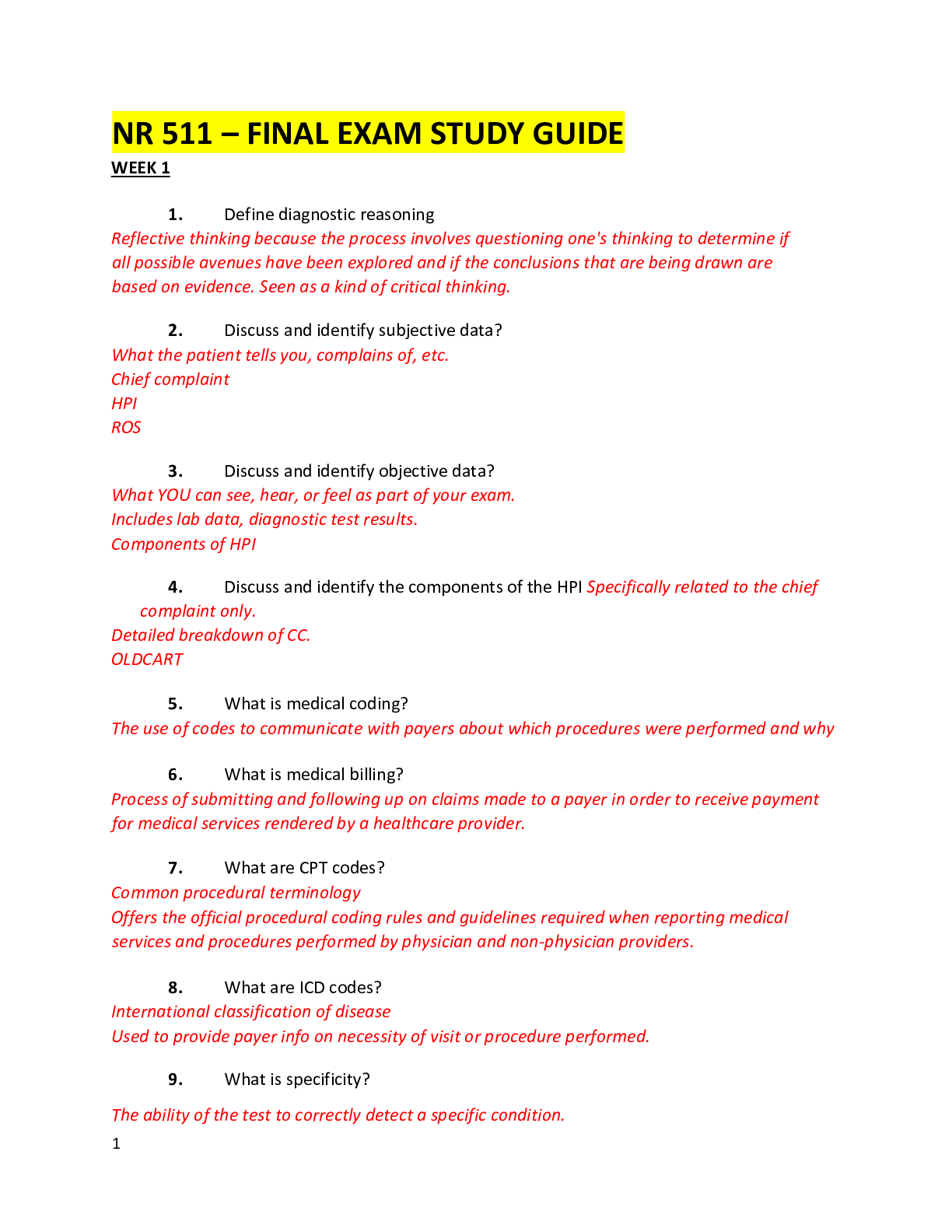
NR511-Final Exam Study Guide WEEK 1 1.Define diagnostic reasoning
Reflective thinking because the process involves questioning one's thinking to determine if all possible avenues have been explored and if the conclusions that are being drawn are based on evidence. Seen as a kind of critical thinking.
2. Discuss and identify subjective data?
What the patient tells you, complains of, etc.
Chief complaint
HPI
ROS
3. Discuss and identify objective data?
What YOU can see, hear, or feel as part of your exam.
Includes lab data, diagnostic test results.
Components of HPI
4. Discuss and identify the components of the HPI Specifically related to the chief complaint only.
Detailed breakdown of CC.
OLDCART
5. What is medical coding?
The use of codes to communicate with payers about which procedures were performed and why
6. What is medical billing?
Process of submitting and following up on claims made to a payer in order to receive payment for medical services rendered by a healthcare provider.
7. What are CPT codes?
Common procedural terminology
Offers the official procedural coding rules and guidelines required when reporting medical services and procedures performed by physician and non-physician providers.
8. What are ICD codes?
International classification of disease
Used to provide payer info on necessity of visit or procedure performed.
9. What is specificity?
The ability of the test to correctly detect a specific condition.
If a patient has a condition but test is negative, it is a false negative.
If a patient does NOT have a condition but the test is positive, it is a false positive.
10.What is sensitivity?
Test that has few false negatives.
Ability of a test to correctly identify a specific condition when it is present. The higher the sensitivity, the lesser the likelihood of a false negative.
11.What is predictive value?
The likelihood that the patient actually has the condition and is, in part, dependent upon the prevalence of the condition in the population.
If a condition is highly likely, the positive result would be more accurate.
12.Discuss the elements that need to be considered when developing a plan
Pt's preferences and actions
Research evidence
Clinical state/circumstances
Clinical expertise
13.Describe the components of Medical Decision Making in E&M coding
Risk
Data
Diagnosis
The more time and consideration involved in dealing with a pt, the higher the reimbursement from the payer. Documentation must reflect MDM! evaluation and management (E&M)
14.Correctly order the E&M office visit codes based on complexity from least to most complex
New patient: Established patient:
1. Minimal/RN visit: 99201 Minimal RN visit: 99211
2. Problem focused: 99202 Problem focused: 99212
3. Expanded problem focused: 99203 Expanded problem focused: 99213
4. Detailed: 99204 Detailed: 99214
5. Comprehensive: 99205 Comprehensive: 99215
15.Discuss a minimum of three purposes of the written history and physical in relation to the importance of documentation
Important reference document that gives concise info about the pt's Hx and exam findings.
Outlines a plan for addressing issues that prompted the visit. Info should be presented in a logical fashion that prominently features all data relevant to the pt's condition.
Is a means of communicating info to all providers involved in the pt's care.
Is a medical-legal document.
Is essential in order to accurately code and bill for services.
16.Accurately document why every procedure code must have a corresponding diagnosis code
Diagnosis code explains the necessity of the procedure code. Insurance won't pay if they don't correspond.
17.Correctly identify a patient as new or established given the historical information If that pt has never been seen in that clinic or by that group of providers OR if the pt has not been seen in the past 3 years.
18.Identify the 3 components required in determining an outpatient, office visit E&M code
Place of service
Type of service
Patient status
19.Describe the components of Medical Decision Making in E&M coding
Risk
Data
Diagnosis
The more time and consideration involved in dealing with a pt, the higher the reimbursement from the payer. Documentation must reflect MDM! evaluation and management (E&M)
20.Explain what a “well rounded” clinical experience means
Includes seeing kids from birth through young adult visits for well child and acute visits, as well as adults for wellness or acute/routine visits.
Seeing a variety of pt's, including 15% of peds and 15% of women's health of total time in the program.
21.State the maximum number of hours that time can be spent “rounding” in a facility
No more than 25% of total practicum hours in the program
22.State 9 things that must be documented when inputting data into clinical encounter Date of service
Age
Gender and ethnicity
Visit E&M code
CC
Procedures
Tests performed and ordered
Dx
Level of involvement (mostly student, mostly preceptor, together, etc.)
23.What is the first “S” in the SNAPPS presentation?
Summarize: present the pt's H&P findings
24.What is the “N” in the SNAPPS presentation?
Narrow: based on the H&P findings, narrow down to the top 2-3 differentials
25.What is the “A” in the SNAPPS presentation?
Analyze: analyze the differentials. Compare and contrast H&P findings for each of the differentials and narrow it down to the most likely one
26.What is the first “P” in the SNAPPS presentation?
Probe: ask the preceptor questions of anything you are unsure of.
27.What is the second “P” in the SNAPPS presentation?
Plan: come up with a specific management plan
.
28.What is the last “S” in the SNAPPS presentation?
Self-directed learning: an opportunity to investigate more about any topics that you are uncertain of.
WEEK 2
1. What is the most common type of pathogen responsible for acute gastroenteritis? Viral (can be viral, bacterial, or parasitic), usually norovirus
2. Assessing for prior antibiotic use is a critical part of the history in patients presenting with diarrhea. True
3. Describe the difference between Irritable Bowel Disease (IBS) and Inflammatory Bowel Disorder (IBD)
IBS: disorder of bowel function (as opposed to being due to an anatomic abnormality).
Changes in bowel habits (diarrhea, constipation, abd pain, bloating, rectal urgency w/diarrhea).
Symptoms fall into two categories: abd pain/altered bowel habits, and painless diarrhea. Usually pain is LLQ.
PE: normal except for tenderness in colon.
Labs: CBC, ESR. Most other labs and radiology/scopes are normal.
Dx made on careful H&P.
May be associated with non-intestinal (extra-intestinal) symptoms (sexual function difficulty, muscle aches/pains, fatigue, fibromyalgia, HAs, back pain, urinary symptoms). Not associate with serious medical consequences. Not a risk factor for other serious GI dz's.
Does not put extra stress on other organs.
Overall prognosis is excellent.
Major problem: changes quality of life.
Treatment: based on symptom pattern. May include diet, education, pharm (for modsevere pt's)/other supportive interventions. Usually focuses on lifestyle, diet, and stress reduction. NO PROVEN TREATMENT! Antidiarrheals: use temporarily, reserve for severe. Loperamide (Imodium) or diphenoxylate (Lomotil) 2.5-5mg q6h usually works. Constipation: high fiber diet, hydration, exercise, bulking agents. If these don't work, intermittent use of stimulant laxatives (lactulose or mag hydroxide); don't use long-term! Linzess (linaclotide), Trulance (plecanatide), and Amitiza (lubiprostone): newer for constipation, work locally on apical membrane of GI tract to increase intestinal fluid secretion and improve fecal transit. Abd pain: dicloclymine (Bentyl), hyoscyamine (avoid anticholinergics in glaucoma and BPH, especially in elderly). TCAs and SSRIs can relieve symptoms in some pt's.
Can be managed by PCP, but if not responsive to tx, refer to GI.
IBD: chronic immunological dz that manifests in intestinal inflammation.
UC and Crohn's are most common.
UC: mucosal surface of colon is inflamed, resulting in friability, erosions, bleeding. Usually occurs in rectosigmoid area, but can involve entire colon. Ulcers form in eroded tissue, abscesses form in crypts, become necrotic and ulcerate, mucosa thickens/swells, narrowing lumen. Pt's are at risk for perforation. Symptoms: bleeding, cramping, urge to defecate. Stools are watery diarrhea with blood/mucus. Fecal leuks almost always present in active UC. Tenderness usually in LLQ or across entire abd. Crohn's: inflammation extends deeper into intestinal wall. Can involve all or any layer of bowel wall and any portion of GI tract from mouth to anus. Characteristic segmental presentation of dz'd bowel separated by areas of normal mucosa ("skipped lesions"). With progression, fibrosis thickens bowel wall, narrowing lumen, leading to obstructions, fistulas, ulcerations. Pt's are at greater risk for colorectal cancer. Most common symptoms: cramping, fever, anorexia, wt loss, spasms, flatulance, RLQ pain/mass, bloody/mucus/pus stools. Symptoms increase with stress, after meals. 50% of pt's have perianal involvement (anal/perianal fissures).
Inflammation can lead to bleeding, fever, increased WBC, diarrhea, cramping.
Abnormalities can be seen on cross-sectional imaging or colonscopy.
No single explanation for IBD. Theory: viral, bacterial, or allergic process initially inflames small or large intestine, results in antibody development which chronically attack intestine, leading to inflammation. Possible genetic predisposition.
Dx made by H&P correlated with symptoms, must exclude infectious cause for colitis. Primary dx tools: sigmoidoscopy, colonoscopy, barium enema w/small bowel followthrough, CT.
Tx is very complex, managed by GI.
Drugs: 5-aminosalicylic acid agents have been used for >50yrs, but have shown to be of
little value in CD; still used as first attempt for UC. Antidiarrheals w/caution
(constipation). Don't use in acute UC or if toxic megacolon. Corticosteroids used when 5-ASA not working. If corticosteroids don't work, use immunomodulators (azathioprine, methotrexate, 6-mercaptopurine), but can cause bone marrow suppression and infection. Newer class: anti-TNF (biologic response modifiers) for mod-severe dz. Remicade (infliximab), Humira (adalimumab), Entyvio (vedolizumab); can increase risk of infection.
4. Discuss two common Inflammatory Bowel Diseases UC and Crohn's are most common.
5. Discuss the diagnosis of diverticulitis, risk factors, and treatments
Subjective:
S/S of infection (fever, chills, tachycardia)
Localized pain LLQ
Anorexia, n/v
If fistula present, additional s/s will be present associated w/affected organ (dysuria, pneumaturia, hematachzia, frank rectal bleeding, etc)
Objective:
Tenderness in LLQ
Maybe firm, fixed mass at area of diverticuli
Maybe rebound tenderness w/involuntary guarding/rigidity
Hypoactive bowel sounds initially, then hyperactive if obstructive process present
Rectal tenderness +occult blood
Diagnostics:
Mild-moderate leukocytosis
Possibly decreased hgb/hct r/t rectal bleeding
Bladder fistula: urine will have increased WBC/RBC, culture may be +
If peritonitis, blood culture should be done (for bacteremia)
Abd XR: perforation, peritonitis, ileus, obstruction
CT may be needed to confirm
6. Identify the significance of Barrett’s esophagus.
A condition in which the esophageal lining is replaced by a tissue resembling intestinal lining. Squamous lining of lower esophagus turns into columnar epithelium (goblet cells).
Average age of onset: 55
1.6 – 6.8% of persons affected (5-10% of people with GERD get Barrett’s esophagus).
Risk Factors:
GERD
Obesity
Smoking
Age
Gender Ethnicity
Signs/Symptoms:
1.Long-term indigestion-heart burn, fullness, bloating, belching
2. difficulty swallowing food
3. losing symptoms of GERD without doing anything
Diagnosis:
Upper endoscopy & biopsy if cells are present How to tx:
Medications (acid suppressing (proton pump inihibitors)
Endoscopic ablative therapies
Endoscopic mucosal resection Esophagectomy
Increases Risk of BE:
H. pylori
NSAIDS and aspirins Diet and nutrition
Decreases Risk of BE:
Folate
Vitamin E
Intake of Lutein
7. What is best test for diagnosing GERD?
24 pH probe
- Probe through nose, sits in esophagus for 24 hours
- Constantly monitors pH
Heartburn is typical symptom. Usually occurs 30-60 min after meals and with reclining. Burning chest pain and regurgitation are common. Pain may be relieved by antacids.
Most have no structural defects
Non-GI symptoms included asthma, chronic cough, laryngitis, sore throat or noncardiac chest pain.
8. Risk factors of GERD:
Obesity
Pregnancy
Smoking
Collagen Vascular Disease
ETOH use
Hiatal Hernia
Gender (more common in males)
9. How do we treat suspected GERD in patients with classic symptoms? Empiric therapy (PPI trial) is used both as a test and a treatment
Empiric therapy:
PPI once daily for 4-8 weeks
PPI are preferred over H2 receptor antagonists
PPI should be taken 30min before breakfast Many PPI's now over OTC formulations
10-20% will need twice daily PPI to get relief
Patients with good symptom control on empiric therapy s/b continued on PPI for 8-12 weeks.
1st line: life modification (elevate HOB, smoking cessation, avoid high fat/large meals, chocolate, ETOH, peppermint, caffeine, onions, garlic, citrus, tomatoes); don't sleep 34hrs after meal, avoid bedtime snack.
Meds: avoid Ca blockers, beta blockers, alpha adrenergic agonists, theophylline, nitrates, some sedatives.
Encourage wt loss for overweight/obese pts
If lifestyle mods not working: step-up/down treatment guidelines for GERD. Mild, intermittent symptoms: trial for 4wks, if symptoms persist, step up:
1. Dietary/lifestyle mods
2. Antacid
3. OTC H2-RA: cimetidine (Tagamet), ranitidine (Zantac), famotidine (Pepcid), nizatidine(Axid)
Trial above for 6wks, if symptoms persist, step up +referral to GI:
1. Continue dietary/life mods
2. H2-RA Rx dosage: cimetidine 800mg TID, ranitidine 150mg TID, nizatidine 150mg
TID, famotidine 20mg TID. OR PPI: omeprazole 20mg, rabeprazole 20mg, lansoprazole 30mg, esomeprazole 20mg, or pantoprazole 40mg daily.
Trial above for 8wks, if symptoms persist step up:
1. Diet/lifestyle mods
2. PPI increase to 40mg daily
Trial for 8wks, if symptoms persist, step up:
1. Diet/lifestyle mods
2. Surgical intervention
10. How do we treat suspected GERD in patients with “alarm symptoms”? EGD+/-PPI trial
-EGD good for finding complications of GERD (stricture, esophagits, barrett’s), but bad for looking at GERD itself. It misses non-erosive reflux disease (NERD).
11.What are “alarm symptoms” for patients with suspected GERD?
Weight loss
Dysphagia
Anemia
Early satiety Bleeding
12. Clinical characteristics of GERD:
Heartburn
Regurgitation
Water brash (reflex salivation)
Dysphagia
Sour taste in mouth in the morning
Odynophagia (painful swallowing)
Belching
Coughing
Hoarseness
Wheezing usually at night
Substernal or retrosternal chest pain
Aggravating: reclining after eating, eating large meal, alcohol, chocolate, caffeine, fatty/spicy food, nicotine, constrictive clothes, heavy lifting, straining, bending over.
Alleviating: antacids, sitting upright after meal, eating small meals
13.Discuss the differential diagnosis of acute abdominal pain, work-up and testing, treatments
One of the most frequent complaints in Primary Care: Abdominal Pain
Most Frequent cause of ABD pain in pediatric patients and common in all ages is: Nonspecific Abdominal Pain (NSAP)
Common Cause of Abd pain in RUQ: Hepatitis, GBD, Renal disease, Pylo, Renal stone
Common Cause of Abd pain in LUQ: Spleen, Renal disease
Common Cause of Diffuse Abd pain: IBD, IBS, Gastroenteritis, AAA, Bowel Obstruction, Ischemic Bowel
Common Cause of RLQ ABD pain: Appendicitis, PID, Ovarian Cyst, Ectopic Pregnancy
Common Cause of LLQ ABD pain: Ectopic Pregancy, Ovarian Cysts, Diverticulitis, PID
Common Cause of Epigastric ABD pain: MI, PUD, Biliary Disease, Pancreatitis Common cause of Periumbilical Region: Early Appendicitis, Small bowel disease.
Terminology Signs:
Murphy's:
RUQ pain on deep inspiration: seen with inflamed gallbladder. May also be elicited by palpating the RUQ as they take a deep breath.
Signs of Peritoneal Irritation: Guarding:
voluntary: usually symmetric, muscles more tense on inspiration, usually does hurt to rise from supine to sitting position (using abd muscles), lessens with distraction.
involuntary: asymmetrical, rigidity present on inspiration and expiration, rising to sitting position greatly increases pain, doesn't chg with distraction.
Rebound Tenderness: McBurney’s point slowly compress abd, then quickly release pressure pain increases.
Lab Test for abdominal pain:
CBC (to look for infection and blood loss)
CMP: (check hydration with BUN, Cr, electrolytes, check LFT's for hepatitis or biliary disease)
Amylase/Lipase: (elevated in pancreatitis)
UA: (nitrates, leukocytes, RBCs may indicate UTI)
Stool for occult blood: (cancer, IBD, diverticulitis, PUD)
Pregnancy test of all childbearing age females: (remember this even in young teens)
Imaging in Abd Pain:
KUB :
may detect renal stones, look for stool in colon free air in perforation, dilated loops of bowel in obstruction)
Abdominal US:
look for gallstones, ovarian cysts or ectopic pregnancy, hydronephrosis due to renal stone, high specificity for appy but not as sensitive as CT.
CT:
[Show More]