POST ASSESSMENT QUESTIONS FOR MODULE
LEADERSHIP/MANAGEMENT/COMMUNITY HEALTH
RN ATI Capstone Content Review: Leadership/Management/Community Health PostAssessment Focused, Individualized Review Assignment
1. What behav
...
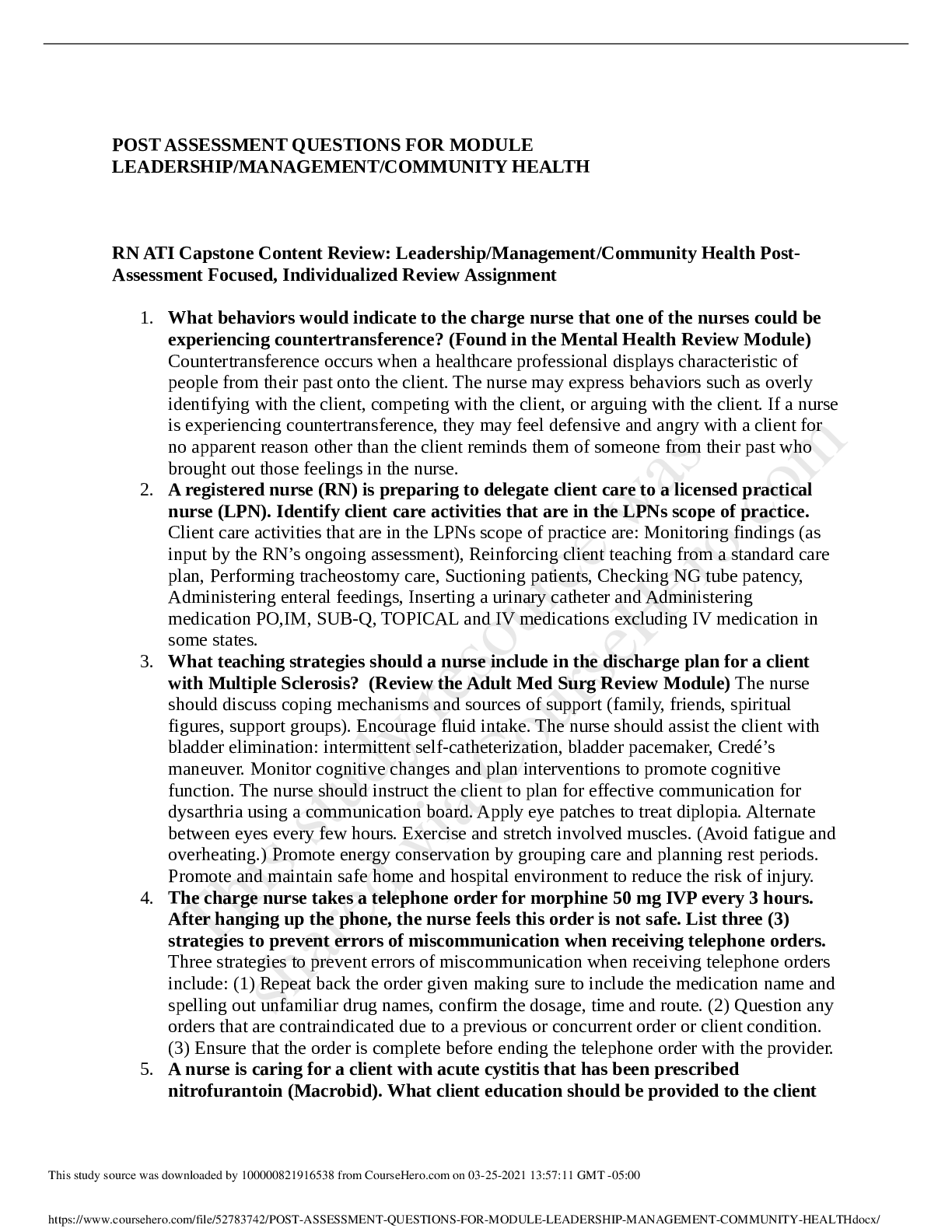
POST ASSESSMENT QUESTIONS FOR MODULE
LEADERSHIP/MANAGEMENT/COMMUNITY HEALTH
RN ATI Capstone Content Review: Leadership/Management/Community Health PostAssessment Focused, Individualized Review Assignment
1. What behaviors would indicate to the charge nurse that one of the nurses could be
experiencing countertransference? (Found in the Mental Health Review Module)
Countertransference occurs when a healthcare professional displays characteristic of
people from their past onto the client. The nurse may express behaviors such as overly
identifying with the client, competing with the client, or arguing with the client. If a nurse
is experiencing countertransference, they may feel defensive and angry with a client for
no apparent reason other than the client reminds them of someone from their past who
brought out those feelings in the nurse.
2. A registered nurse (RN) is preparing to delegate client care to a licensed practical
nurse (LPN). Identify client care activities that are in the LPNs scope of practice.
Client care activities that are in the LPNs scope of practice are: Monitoring findings (as
input by the RN’s ongoing assessment), Reinforcing client teaching from a standard care
plan, Performing tracheostomy care, Suctioning patients, Checking NG tube patency,
Administering enteral feedings, Inserting a urinary catheter and Administering
medication PO,IM, SUB-Q, TOPICAL and IV medications excluding IV medication in
some states.
3. What teaching strategies should a nurse include in the discharge plan for a client
with Multiple Sclerosis? (Review the Adult Med Surg Review Module) The nurse
should discuss coping mechanisms and sources of support (family, friends, spiritual
figures, support groups). Encourage fluid intake. The nurse should assist the client with
bladder elimination: intermittent self-catheterization, bladder pacemaker, Credé’s
maneuver. Monitor cognitive changes and plan interventions to promote cognitive
function. The nurse should instruct the client to plan for effective communication for
dysarthria using a communication board. Apply eye patches to treat diplopia. Alternate
between eyes every few hours. Exercise and stretch involved muscles. (Avoid fatigue and
overheating.) Promote energy conservation by grouping care and planning rest periods.
Promote and maintain safe home and hospital environment to reduce the risk of injury.
4. The charge nurse takes a telephone order for morphine 50 mg IVP every 3 hours.
After hanging up the phone, the nurse feels this order is not safe. List three (3)
strategies to prevent errors of miscommunication when receiving telephone orders.
Three strategies to prevent errors of miscommunication when receiving telephone orders
include: (1) Repeat back the order given making sure to include the medication name and
spelling out unfamiliar drug names, confirm the dosage, time and route. (2) Question any
orders that are contraindicated due to a previous or concurrent order or client condition.
(3) Ensure that the order is complete b
[Show More]