Signs of pregnancy (presumptive, probable, positive)
Presumptive Signs of Pregnancy: Symptoms that are suggestive of pregnancy are considered
“presumptive signs” which means that they are the least objective or subje
...
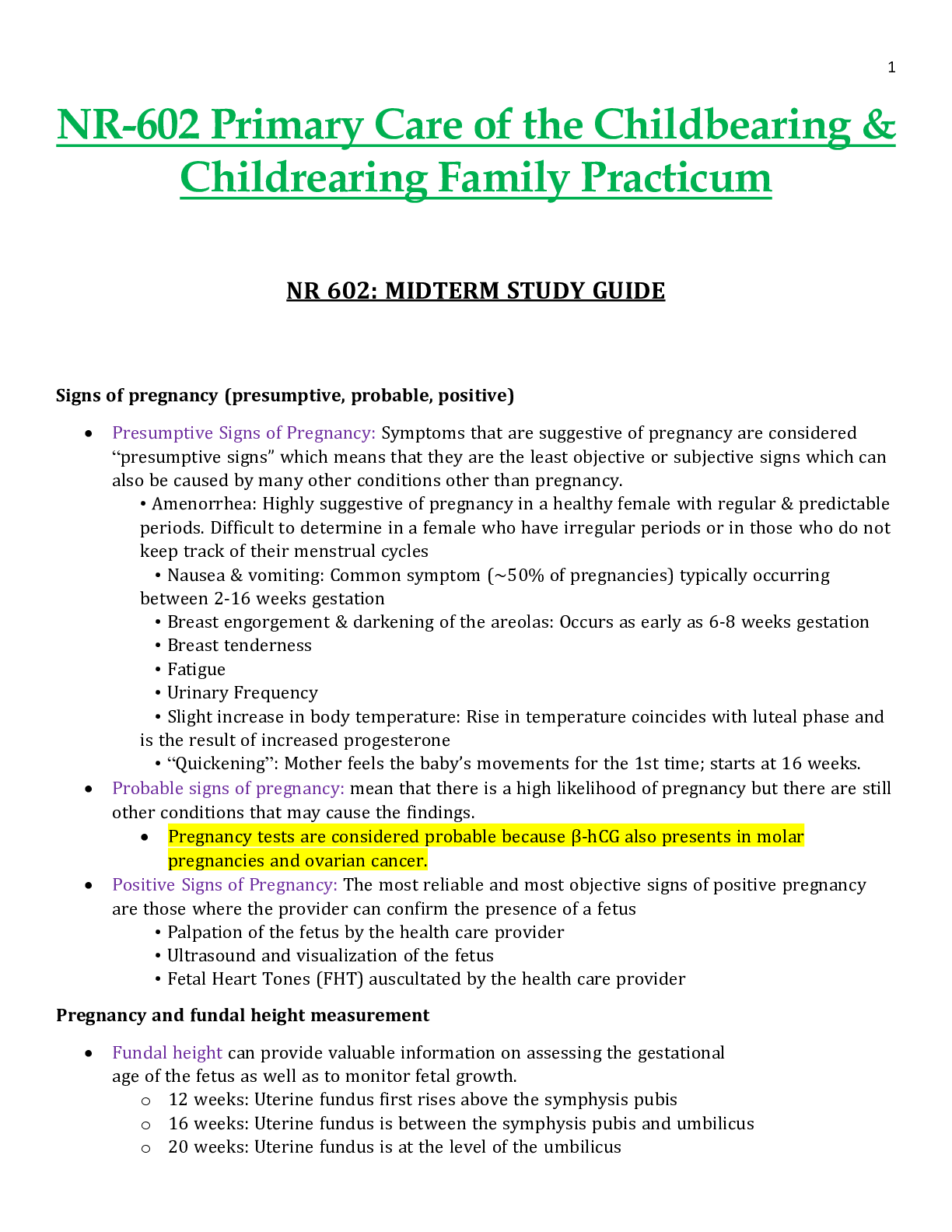
Signs of pregnancy (presumptive, probable, positive)
Presumptive Signs of Pregnancy: Symptoms that are suggestive of pregnancy are considered
“presumptive signs” which means that they are the least objective or subjective signs which can
also be caused by many other conditions other than pregnancy.
• Amenorrhea: Highly suggestive of pregnancy in a healthy female with regular &
predictable periods. Difficult to determine in a female who have irregular periods or in those
who do not keep track of their menstrual cycles
• Nausea & vomiting: Common symptom (~50% of pregnancies) typically occurring
between 2-16 weeks gestation
• Breast engorgement & darkening of the areolas: Occurs as early as 6-8 weeks gestation
• Breast tenderness
• Fatigue
• Urinary Frequency
• Slight increase in body temperature: Rise in temperature coincides with luteal phase and
is the result of increased progesterone
• “Quickening”: Mother feels the baby’s movements for the 1st time; starts at 16 weeks.
Probable signs of pregnancy: mean that there is a high likelihood of pregnancy but there are still
other conditions that may cause the findings.
Pregnancy tests are considered probable because β-hCG also presents in molar
pregnancies and ovarian cancer.
Positive Signs of Pregnancy: The most reliable and most objective signs of positive pregnancy are
those where the provider can confirm the presence of a fetus
• Palpation of the fetus by the health care provider
• Ultrasound and visualization of the fetus
• Fetal Heart Tones (FHT) auscultated by the health care provider
Pregnancy and fundal height measurement
Fundal height can provide valuable information on assessing the gestational
age of the fetus as well as to monitor fetal growth.
o 12 weeks: Uterine fundus first rises above the symphysis pubis
o 16 weeks: Uterine fundus is between the symphysis pubis and umbilicus
o 20 weeks: Uterine fundus is at the level of the umbilicus
o 25-35 weeks: Measure the distance between the upper edge of pubic symphysis and the
top of the uterine fundus with a tape measure. Fundal height in centimeters equals the
number of gestational weeks (+/- 2cm). For example, a 28 week gestation fetus should
have a fundal height that measures between 26 and 30cm.
* Between 25-35 weeks the fundal height should measure equally to the number of gestational
weeks (+/- 2cm).
2
Naegele’s rule
The EDD is calculated by adding seven days to the first day of the last menstrual period,
subtracting three months and adding one year.
*For example, if the patient's last menstrual period, LMP, was on August 10, 2019, the EDD
would be calculated as follows. LMP equals August 10, 2019 plus seven days. August 17, 2019,
minus three months. May 17, 2019 plus one year and that equals May 17, 2020.
Hematological changes during pregnancy-See Table 29.2 p. 777
blood volume increases by 30% to 50%, or 1,100 to 1,600 mL and peaks at 30 to 34 weeks’
gestation.
The increase in blood volume improves blood flow to the vital organs and protects against
excessive blood loss during birth.
Fetal growth during pregnancy and newborn weight are correlated with the degree of blood
volume expansion.
Of the blood volume expansion occurring during pregnancy, 75% is considered to be plasma
There is also a slight increase in red blood cell volume (RBC).
The blood volume changes result in hemodilution, which leads to a state of physiologic anemia
during pregnancy.
As the RBC volume increases, iron demands also increase.
Leukocytosis occurs in pregnancy, with white blood cell counts increasing to as much as 14,000
to 17,000 cells per mm3
of blood (Table 29-3).
Clotting factors increase as well, creating a risk for clotting events during pregnancy.
Systemic vascular resistance is reduced due to the effects of progesterone, prostaglandins,
estrogen, and prolactin.
This lowered systemic vascular resistance, in combination with inferior vena cava compression, is
partly responsible for the dependent edema that occurs in pregnancy.
Epulis of pregnancy, or hypertrophy of the gums accompanied by bleeding, may also occ
[Show More]






![Preview of WEEK **5 [Chamberlain university]NR 602 IHUMAN Case Week #5 Deborah Arnaudin 54 Year Old](https://browseimages.nyc3.digitaloceanspaces.com/paper-images/2026/03/31/zbQKePwt2026-03-31-11-4669cc328fcad96.png)









.png)
.png)

