Chalazion
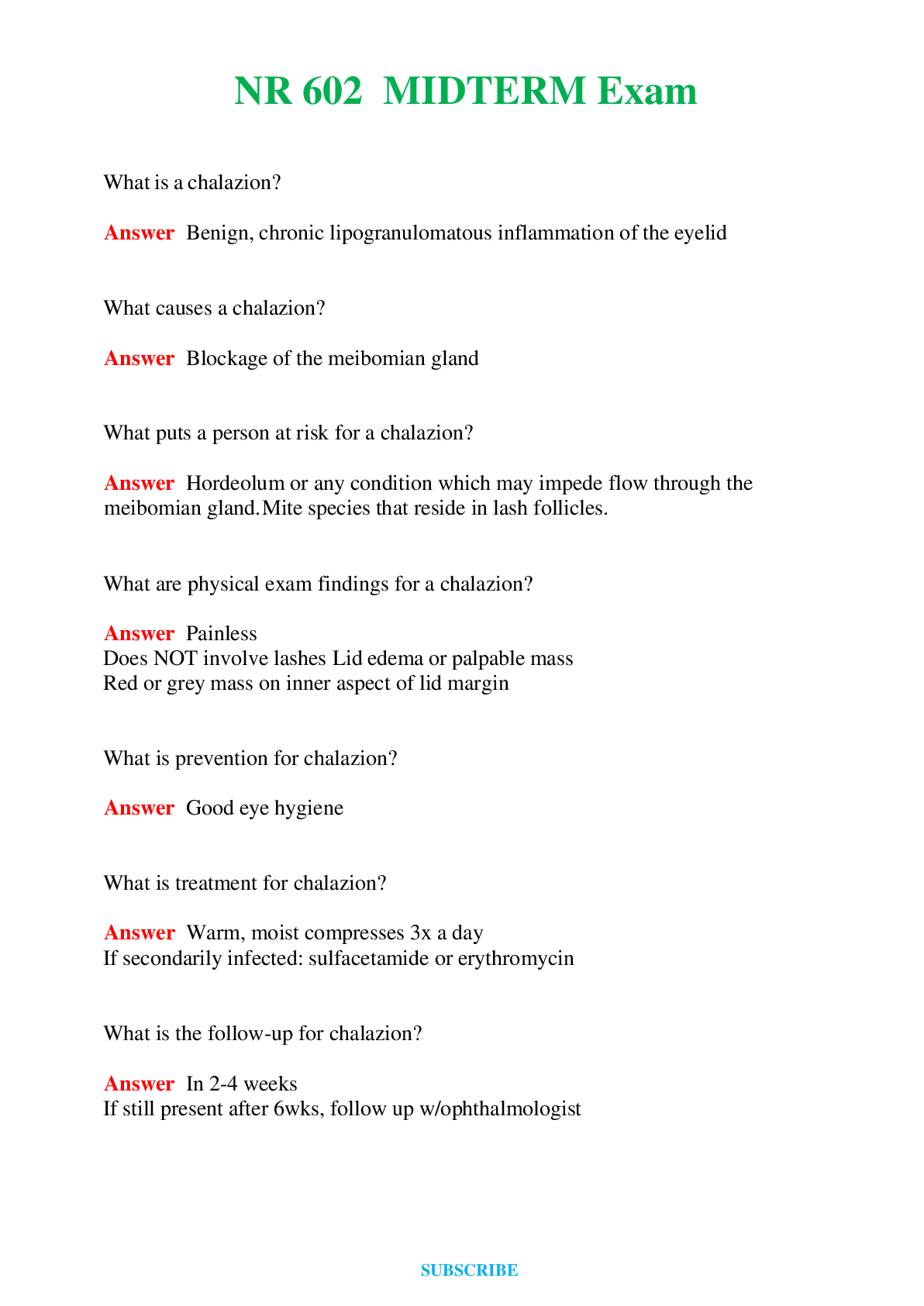
Chalazion is a chronic sterile inflammation of the eyelid resulting from a
lipogranuloma of the meibomian glands that line the posterior margins of the
eyelids (see Fig. 29-7). It is deeper in the eyelid tis
...
Chalazion
Chalazion is a chronic sterile inflammation of the eyelid resulting from a
lipogranuloma of the meibomian glands that line the posterior margins of the
eyelids (see Fig. 29-7). It is deeper in the eyelid tissue than a hordeolum and
may result from an internal hordeolum or retained lipid granular secretions.
Clinical Findings
Initially, mild erythema and slight swelling of the involved eyelid are seen.
After a few days the inflammation resolves, and a slow growing, round,
nonpigmented, painless (key finding) mass remains. It may persist for a long
time and is a commonly acquired lid lesion seen in children (see Fig. 29-7).
727
Management
• Acute lesions are treated with hot compresses.
• Refer to an ophthalmologist for surgical incision or topical intralesional
corticosteroid injections if the condition is unresolved or if the lesion
causes cosmetic concerns. A chalazion can distort vision by causing
astigmatism as a result of pressure on the orbit.
Complications
Recurrence is common. Fragile, vascular granulation tissue called pyogenic
granuloma that enlarges and bleeds rapidly can occur if a chalazion breaks
through the conjunctival surface.
Types of Conjunctivitis
Type Incidence/Etiology
Clinical
Finding
s
Diagnosis Management*
Ophthalmi
a
neonat
orum
Neonates: Chlamydia
trachomatis,
Staphylococcus aureus,
Neisseria
gonorrhoeae, HSV
(silver nitrate reaction
occurs in 10% of
neonates)
Erythema,
chemo
sis,
purule
nt
exudat
e
with N
Culture (ELISA,
PCR), Gram
stain, R/O N.
gonorrhoeae,
chlamydia
Saline irrigation to
eyes until
exudate gone;
follow with
erythromycin
ointment
For N.
gonorrhoeae:ceft
riaxone or IM or
IV
1
Type Incidence/Etiology
Clinical
Finding
s
Diagnosis Management*
.
gonorr
hoeae;
clear
to
mucoi
d
exudat
e with
chlamy
dia
For chlamydia:
erythromycin or
possibly
azithromycin PO
For HSV: antivirals
IV or PO
Bacterial
conjun
ctivitis
In neonates 5 to 14 days old,
preschoolers, and
sexually active
teens: Haemophilus
influenzae(nontypeable),
Streptococcus
pneumoniae, S. aureus,
N. gonorrhoeae
Erythema,
chemo
sis,
itching
,
burnin
g,
mucop
urulent
exudat
e,
matter
in
eyelas
hes; ↑
in
winter
Cultures (required
in neonate);
Gram stain
(optional);
chocolate agar
(for N.
gonorrhoeae)
R/O
pharyngitis, N.
gonorrhoeae,
AOM, URI,
seborrhea
Neonates:
Erythromycin
0.5% ophthalmic
ointment
≥1 year old:
Fourthgeneration
fluoroquinolone
For concurrent
AOM: Treat
accordingly for
AOM
Warm soaks to
eyes three times a
day until clear
No sharing towels,
pillows
No school until
treatment begins
Chronic
bacteri
al
conjun
ctivitis
School-age children and
teens: Bacteria,
viruses, C. trachomatis
Same as
above;
foreign
body
sensati
Cultures, Gram
stain; R/O
dacryostenosis
, blepharitis,
corneal ulcers,
Depends on prior
treatment,
laboratory
results, and
differential
diagnoses
Review
2
Type Incidence/Etiology
Clinical
Finding
s
Diagnosis Management*
(unres
ponsiv
e
conjun
ctivitis
previo
usly
treated
as
bacteri
al in
etiolog
y)
on trachoma
compliance and
prior drug
choices of
conjunctivitis
treatment
Consult with
ophthalmologist
Inclusion
conjun
ctivitis
Neonates 5 to 14 days old
and sexually active
teens: C. trachomatis
Erythema,
chemo
sis,
clear
or
mucoi
d
exudat
e,
palpeb
ral
follicle
s
Cultures (ELISA,
PCR), R/O
sexual activity
Neonates:
Erythromycin or
azithromycin PO
Adolescents:
Doxycycline,
azithromycin,
EES,
erythromycin
base,
levofloxacin PO
Viral
conjun
ctivitis
Adenovirus 3, 4, 7; HSV,
herpes zoster, varicella
Erythema,
chemo
sis,
tearing
(bilater
al);
HSV
Cultures, R/O
corneal
infiltration
Refer to
ophthalmologist
if HSV or
photophobia
present
Cool compresses
three or four
times a day
3
Type Incidence/Etiology
Clinical
Finding
s
Diagnosis Management*
and
herpes
zoster:
unilate
ral
with
photop
hobia,
[Show More]






![Preview of WEEK **5 [Chamberlain university]NR 602 IHUMAN Case Week #5 Deborah Arnaudin 54 Year Old](https://browseimages.nyc3.digitaloceanspaces.com/paper-images/2026/03/31/zbQKePwt2026-03-31-11-4669cc328fcad96.png)






.png)
.png)

