Burns' Pediatric Primary Care 7th Edition Test Bank
Chapter 1: Health Status of Children: Global and National Perspectives
1. Which region globally has the highest infant mortality rate?
A. Indonesia
B. South
...
Burns' Pediatric Primary Care 7th Edition Test Bank
Chapter 1: Health Status of Children: Global and National Perspectives
1. Which region globally has the highest infant mortality rate?
A. Indonesia
B. Southern Asia
C. SubSaharan Africa
D. Syria
2. The primary care pediatric nurse practitioner understands that, to achieve the
greatest worldwide
reduction in child mortality from pneumonia and diarrhea, which intervention is
most effective?
A. Antibiotics
B. Optimal nutrition
C. Vaccinations
D. Water purification
3. Which is true about the health status of children in the United States?
.
13348413856
A. Globalism has relatively little impact on child health measures in the U.S.
B. Obesity rates among 2to5yearolds have shown a recent significant
decrease.
.
C. The rate of household poverty is lower than in other economically developed nations.
D. Young children who attend preschool or day care have higher food insecurity.
The primary care pediatric nurse practitioner understands that a major child
health outcome associated with worldwide climate change is A. cost of living.
B. education.
C. nutrition. D. pollution.
When providing well child care for an infant in the first year of life, the primary
care pediatric nurse practitioner is adhering to the most recent American Academy of
PediatricsRecommendations for Preventive Pediatric Health Care guidelines by
A. focusing less on development and more on illness prevention and nutrition.
B. following guidelines established by theBright Futures publication.
C. scheduling wellbaby visits to coincide with key developmental milestones.
D. seeing the infant at ages 2, 4, 6, and 12 months when immunizations are due.
Chapter 2. Unique Issues in Pediatrics
A nurse is explaining the therapeutic milieu to a new nurse. The best explanation of this term would be:
The place where the child is receiving care.
2. Group therapy.
3. Personal interactions between patients and staff.
4. All of the above are .
A 16-year-old male has received a pink-slip from the police for inpatient psychiatric treatment. The teen
has been expressing thoughts of hanging himself because Life sucks. The nursing staff should consider
placing the child:
With peers.
In an area where he can be watched one-on-one.
With a roommate that is expressing the same concerns.
In an area close to an external door.
3. Learning disabilities in children have scientifically been linked to:
1. Poor nutrition.
2. The environment in which the child lives.
3. Genetics.
4. Watching more than four hours of television a day.
A mental health nurse has assessed a child and determined that the child exhibits behavioral challenges.
When the school nurse explains this to a teacher, the best description would be:
.
The child may exhibit physical outbursts.
The child may exhibit violence toward others.
The child may be defiant or have tantrums.
The child will need special interventions for learning.
A child that has not exhibited enuresis in four years has exhibited this behavior pattern for the last week.
The reason a child may revert back to this behavior pattern is because of:
Hallucinations.
Behavioral challenges.
Delusions.
Stress.
An 18-year-old male has called the crisis line for help. The crisis nurse recognizes the intervention needs
may consist of all of the following except:
Discussing the individuals everyday activities.
Recognizing that the patient may be in a catharsis state.
Expressing empathy toward the caller.
Avoiding entropy.
An 8-year-old boy with a history of hallucinations and violent behavior has been place in a seclusion room
at the hospital because he has been hurting others. The nurse checks on the patient and realizes she must take
him out of the seclusion room when:
He is crying to be released.
2. He states, I will be a good boy now.
.
He starts headbutting the window.
He complains that his parents will file a lawsuit.
A child has been exhibiting the MacDonald Triad. These behaviors include:
Enuresis, pushing others, and pyromania.
Swinging a cat by the tail, bed-wetting, and lighting paper on fire in the trash can.
Playing with other children, laughing, and conversing with adults.
Playing with a campfire, watching television, and seeking adult attention.
A teenager diagnosed with borderline personality disorder should have discharge planning instructions of:
A consistent caregiver.
Monitoring of media, such as the Internet, television, and video games.
Obtaining support from family and friends.
Seeking medical attention when the teenager feels good.
A mental health nurse is teaching the mother of a child with executive functioning issues ways to help
her child. Interventions the mother should use include:
Placing visual aids on the bathroom mirror so that the child will follow the morning routine.
Give the child a choice in foods to eat.
Allowing the child to ask for help when needed.
Reminding the child to be nice to others.
.
11. Ellie, a 9-year-old girl, was adopted by a family at the age of 4 after several years of severe neglect by her birth family. The adoptive family has been reporting that Ellie is angry a lot, manipulative with her
teachers, and does not seek positive attention. The nurse working with Ellie will need to:
1. Provide education on decreasing stimuli in the home environment that triggers the anger.
2. Realize Ellie may have attachment issues related to her previous history and will need to encourage the
family to be active in her care.
3. Support the family in the decision-making process of continuing to let Ellie live in the home.
4. Discuss inpatient therapy to decrease Ellies manipulative behavior patterns.
12. An infant displays depression by:
1. Smiling at strangers.
Bonding to someone other than the immediate family.
Crying more than an average infant.
Looks away when an adult attempts to play with the infant.
A father reports that his adolescent daughter has gotten good grades up until the last quarter of school.
She has been hanging out by herself and does not want to talk to him anymore. The mental health nurse
should:
Realize that this is a natural part of growing up.
Perform a mental health screening to check for depression.
Attempt to get the adolescent to discuss why she does not like her father anymore.
Let the adolescent talk when she is ready.
A teen should be checked for depression at __________ physician visit(s).
Every
.
One
Monthly
Bi-yearly
When using the SAD FACES depression screen, it is important to assess:
Anhedonia.
Suicidal ideations.
Sleep patterns.
All of the above
A school nurse is giving an in-service to teachers on bullycide. The main reason for the teaching is so
that:
Teachers are aware bullying occurs.
Teachers are able to identify students who are risk.
Teachers can be aware of the fact that suicides can happen due to bullying by others.
Teachers are aware of their role in causing bullycide.
An adolescent with a known history of bipolar disorder is in the school nurses office because a teacher
reported that she was talking fast and acting like she was God. The school nurse assesses the girl and notes
that:
She is probably in a manic phase and needs to be treated professionally.
She has had too much sleep and is now hyperactive.
She forgot to take her medications today.
She requires some food and rest before going back to class.
Chapter 3. Genetics and Child Health Questions
What is true about haploid cells?
.
13348407644
C. Each contains 23 paired chromosomes.
D. Each one contains 23 chromosomes. E. Replication produces two identical cells.
F. They replicate via the process of mitosis.
2. What does the following genetic notation symbol mean 47,XX,6q?
.
13348407650
A. Male with deletion of chromosome 6 B. Female with deletion of chromosome 6
C. Male with deletion on the long arm of chromosome 6 D. Female with deletion on the long arm of chromosome 6
3. A child has a recessive genetic disorder that is homozygous for that mutation.
.
13348407646
What is most likely about this child’s parents?
A. Neither parent has a copy of that gene mutation.
B. Only the mother has a copy of that gene mutation.
C. Only the father has a copy of that gene mutation.
D. Each parent has one copy of that gene mutation. 4. Which type of mutation is responsible for many singlegene genetic disorders?
.
13348407636
A. Copy number variations
B. Nucleotide repeat expansions
C. Point mutations
D. Single nucleotide polymorphisms (SNP)
.
Cystic fibrosis is a recessive disease requiring the presence of a gene mutation
.
13348407638
on both alleles inherited from the parents. Which type of genetic disorder is this?
A. Chromosome B. Mitochondrial
C. Monogenetic D. Multifactorial
.
The primary care pediatric nurse practitioner is counseling a couple about genetic
risks and learns that one parent has neurofibromatosis, an autosomal dominant disorder, and the other
parent does not. What will the nurse practitioner include when discussing this disorder and its
transmission?
C. Children must inherit a gene from both parents to develop the disease.
D. Each child born to this couple will have a 50% risk of having the disease.
E. This type of disorder characteristically skips generations.
F. Unaffected offspring may still pass on the disease to their offspring.
A family medical history conducted during a well baby exam for a newborn girl
reveals that hemophilia A, an Xlinked
recessive disorder, is present in males in three previous
generations in the mother’s family, whose father had the disease. What will the primary care
pediatric nurse practitioner tell the parents about the risk of this disease in their children?
E. All of their sons will be affected by the disease.
F. Any sons they have will not be affected by the disease.
G. Daughters have a 50% chance of being carriers of the disease.
H. Their daughter has a 25% chance of having the disease.
What is an important responsibility of the primary care pediatric nurse practitioner . to
help determine genetic risk factors in families?
E. Assessing physical characteristics of genetic disorders F. Knowing which genetic screening tests to perform
G. Making appropriate referrals to pediatric geneticists
D. Obtaining a threegeneration pedigree for each family
Which diagnostic study may be ordered when the provider wishes to detect the
.
presence of additional genetic material on a chromosome? A. Chromosomal microarray
B. FISH D. Karyotype
E. Molecular testing
Which type of testing will the primary care pediatric nurse practitioner recommend .
for a couple concerned about the potential for having children with cystic fibrosis?
A. Biochemical testing
B. Carrier testing C. FISH testing
D. Karyotype testing
Chapter 4. Environmental Issues Questions
1. What has been the result of passage of the Toxic Substances Control Act. (TSCA) of 1976?
G. A mandate for corporations to disclose known toxic chemicals
H. A requirement that all manufactured chemicals undergo toxicity testing
I. Authorization of the EPA to require testing and reporting of some chemicals
J. Development of a mechanism to report reactions to toxic chemicals
Many European nations use the “precautionary principle” to help regulate potentially toxic chemicals. What does this mean?
G. Chemicals must be proven to be safe before being introduced into the
environment.
H. Corporations may be exempt from testing if their costs in doing so are too high.
I. Regulators must demonstrate risk to the public before banning a chemical.
J. Without a strong risk, corporations need not release data about their products.
During a clinic visit, a child’s rapid capillary screening test for lead reveals
a
level of 11 mcg/dL. What will the primary care pediatric nurse practitioner do next?
I. Institute lead abatement measures in the child’s home. J. Monitor lead levels monthly until decreased.
K. Order a venous sample to test for lead levels. L. Test the child’s siblings and parents for lead.
A child has a lead level of 25 mcg/dL. Once lead abatement measures are instituted, what is an important intervention to help prevent permanent damage
H. Chelation therapy I. Dietary changes
C. Followup testing
.
D. Testing family members
A child whose parent works in a factory pr esents with swelling of the extremities, pain and weakness in the pelvis, and an erythematous maculopapular rash. Which
industrial toxin will the primary care pediatric nurse practitioner suspect in this child?
A. Lead
B. Mercury
C. Organophosphates D. Phthalates
When counseling a mother who smokes about preventing exposure to smokingrelated
risks to her nursing newborn, what will the primary care pediatric nurse practitioner tell her?
F. If she quits now, her child will not have longterm effects from exposure.
G. Prenatal smoke exposure does not cause respiratory effects after the infant is born.
H. Smoking outdoors or near an open window prevents exposure to tobacco smoke.
I. Thirdhandsmoke exposure risks may last for years even if the mother quits now.
A child who has been playing in a public park is brought to the clinic with wheezing, vomiting, diarrhea, and drooling. A physical exam reveals a low heart
rate and diaphoresis. What will the primary care pediatric nurse practitioner suspect as a cause for these symptoms?
B. Arsenic consumption C. Lead poisoning
C. Organophosphate exposure D. Phthalate ingestion
A parent asks about ways to limit exposure to risks associated with plastics.
Besides avoiding using plastic containers when possible, what else will the primary care
pediatric nurse practitioner recommend?
A. Avoid heating foods and liquids in plastic containers.
B. Clean plastic containers well using the dishwasher.
C. Use only plastics stamped with “#7” on the bottom.
D. Used canned food products whenever possible.
A parent desires to buy only organic produce to avoid exposing a child to pesticides but complains that these foods are expensive. The primary care pediatric nurse
practitioner provides a list of foods that are relatively safe whether they are organic or not.
Which foods are on this list? A. Apples, celery, and peaches
B. Potatoes, cherry tomatoes, and peaches C. Strawberries, grapes, and cucumbers
D. Sweet corn, cantaloupe, and kiwi
Chapter 5. Child and Family Health Assessment Questions
1. The primary care pediatric nurse practitioner is obtaining a medical history about a child. To integrate both nursing and medical aspects of primary care, which will be included in the medical history?
K. Complementary medications, alternative health practices, and chief complaint
L. Developmental delays, nutritional status, and linear growth patterns M. Medication currently taking, allergy information, and family medical history
N. Speech and language development, beliefs about health, and previous
illnesses
2. When formulating developmental diagnoses for pediatric patients, the primary
care pediatric nurse practitioner may use which resource?
A. DC: 03R
K. ICD10CM
L. ICSD3
M. NANDA International
3. The primary care pediatric nurse practitioner sees a 3yearold child who
chronically withholds stools, in spite of the parents’ attempts to stop the behavior, requiring frequent treatments with laxative medications. Which diagnosis will the nurse practitioner use to facilitate thirdparty reimbursement?
M. Altered elimination pattern
N. Elimination disorder
C. Encopresis
D. Parenting alteration
The primary care pediatric nurse practitioner is assessing a toddler whose weight and body mass index (BMI) are below the 3rd percentile for age. The nurse practitioner
learns that the child does not have regular mealtimes and is allowed to carry a bottle of juice
around at all times. The nurse practitioner plans to work with this family to develop improved meal
patterns. Which diagnosis will the nurse practitioner use for this problem?
J. Failure to thrive
K. Home care resources inadequate
L. Nutrition alteration – less than required
D. Parenting alteration
.
The primary care pediatric nurse practitioner is p erforming a well child checkup
on a 20monthold
child. The child was 4 weeks premature and, according to a parentcompleted developmental questionnaire, has achieved milestones for a 15monthold infant.
Which action is ?
J. Perform an indepth developmental assessment screen at this visit to evaluate this child.
K. Reassure the parent that the child will catch up to normal development by age 2
years.
L. Reevaluate this child’s development and milestone achievements at the 2year visit.
M. Refer the child to a specialty clinic for evaluation and treatment of developmental delay.
The primary care pediatric nurse practitioner performs a developmental assessment on a 3yearold child and notes normal cognitive, finemotor, and grossmotor
abilities. The child responds appropriately to verbal commands during the assessment but
refuses to speak when asked questions. The parent tells the nurse practitioner that the child talks
at home and that most other adults can understand what the child says. The nurse practitioner
will
D. ask the parent to consider a possible speech delay and report any concerns.
E. continue to evaluate the child’s speech at subsequent visits.
F. refer the child for a speech and hearing evaluation.
G. tell the parent to spend more time in interactive conversations with the child.
The parent of a toddler is concerned that the child may have autism. The primary care pediatric nurse practitioner completes a Modified Checklist for Autism in Toddlers
(MCHAT)
tool, which indicates several areas of concern. What will the nurse practitioner do?
E. Administer a Childhood Autism Rating Scale (CARS) in the clinic. F. Consult a specialist to determine appropriate early intervention strategies.
G. Refer the child to a behavioral specialist for further evaluation.
H. Tell the parent that this result indicates that the child has autism.
The primary care pediatric nurse practitioner learns that the mother of a 3yearold
child has been treated for depression for over 5 years. Which aspect of this child’s
development will be of the most concern to the nurse practitioner?
D. Fine motor
E. Gross motor
F. Social/emotional
D. Speech and language
.
When meeting with a new family, the primary care pediatric nurse practitioner
develops a database that identifies family members and others living in the household,
relationships with others outside the household, and significant behavioral and emotional
problems. Which tool will the nurse practitioner use to record this information?
C. CRAFFT D. Ecomap
C. Genogram D. Pedigree
A child is in the clinic for evaluation of an asthma action plan. The primary
care pediatric nurse practitioner notes that the child’s last visit was for a prekindergarten
physical and observes that the child is extremely anxious. What will the nurse practitioner do
initially?
A. Ask the child’s parent why the child is so anxious.
B. Perform a physical assessment to rule out shortness of breath. C. Reassure the child that there is nothing to be afraid of.
D. Review the purpose of this visit and any anticipated procedures.
The primary care pediatric nurse practitioner is evaluating health literacy in the
mother of a new preschoolage
child. How will the nurse practitioner assess
C. Ask the child how many books he has at home. D. Ask the mother about her highest grade in school.
E. Ask the mother to determine the dose of a drug from a label. F. Ask the mother to read a health information handout aloud.
The mother of a newborn tells the primary care pediatric nurse practitioner
that she is worried that her child will develop allergies and asthma. Which tool will the nurse
practitioner use to evaluate this risk?
A. Threegeneration pedigree A. Review of systems
B. Genogram C. Ecomap
1 3. The primary care pediatric nurse practitioner is performing a well child assessment on an adolescent and is concerned about possible alcohol and tobacco use. Which
assessment tool will the nurse practitioner use?
A. CRAFFT
HEEADSSS
PHQ2
RAAPS
The primary care pediatric nurse practitioner evaluates a schoolage child
whose body mass index (BMI) is greater than the 97th percentile. The nurse practitioner is concerned about possible metabolic syndrome and orders laboratory tests to evaluate this. Which diagnosis will the nurse practitioner document for this visit?
A. Metabolic syndrome
B. Nutritional alteration: more than required
C. Obesity
A. Rule out type 2 diabetes mellitus
Chapter 6. Cultural Considerations for Pediatric Primary Care Questions
The primary care pediatric nurse practitioner provides well child care for a community of immigrant children from Central America. The pediatric nurse practitioner is
surprised to learn that some of the families are Jewish and not Catholic. This response is an
example of cultural O. collectivism.
P. constructivism.
Q. essentialism. R. individualism.
The primary care pediatric nurse practitioner learns that an AfricanAmerican
family lives in a neighborhood with a high crime rate and suggests that they try moving to
another neighborhood for the safety of their children. This is an example of N. cultural sensitivity.
O. group bias.
P. individual privilege. Q. racial awareness.
The primary care pediatric nurse practitioner cares f or children from a Native
American family and learns that they used many herbs to treat and prevent illness. Which
approach will the pediatric nurse practitioner use to promote optimum health in the children?
O. Ask about the types of practices used and when they are applied.
P. Provide a list of harmful herbs and ask the family to avoid those.
Q. Suggest that the family avoid using these remedies in their children.
R. Tell the parents to use the herbs in conjunction with modern medications.
The primary care pediatric nurse practitioner works with families from a variety of cultures and socioeconomic classes. Which is an example of cultural humility in
practice?
M. Giving health care advice that takes cultural differences into account
N. Identification of other cultures that may be superior to one’s own culture
C. Receptivity to learning about the perspectives of other cultures
D. Respecting other cultures while maintaining the views of one’s own
A Somalian immigrant mother is concerned that her 8yearold
child is underweight. The primary care pediatric nurse practitioner notes that the child’s weight is at the 25th percentile. After realizing that the mother is comparing her child to a group of
Americanborn children who are overweight, the pediatric nurse practitioner is able to convince
the mother that this is a normal weight. Which domain of cultural competence does this
represent?
Global
Interpersonal
Intrapersonal
Organizational
The primary care pediatric nurse practitioner in a community health center meets a family who has recently immigrated to the United States who speak only Karon. They
arrive in the clinic with a church sponsor, who translates for them. The pediatric nurse practitioner
notices that the sponsor answers for the family without giving them time to speak. The pediatric
nurse practitioner will
H. ask the sponsor to allow the family to respond.
I. develop the plan of care and ask the sponsor to make sure it is followed. J. request that the sponsor translate written instructions for the family.
K. use the telephone interpreter service to communicate with the family.
The primary care pediatric nurse practitioner prescribes a twice daily inhaled
corticosteroid for a 12yearold
child. At a well child visit, the child reports not using the
medication on a regular basis. Which response by the pediatric nurse practitioner
demonstrates an understanding of clientcentered care?
A. Asking the child to describe usual daily routines and schedules
I. Referring the family to a social worker to help with medication compliance J. Reviewing the asthma action plan with the parent and the child
K. Teaching the child how the medication will help to control asthma Symptoms
A primary care pediatric nurse practitioner working in a community health center wishes to develop a program to assist impoverished children and families to have access
to healthy foods. Which strategy will the pediatric nurse practitioner employ to ensure the
success of such a program?
G. Asking community members to assist in researching and implementing a
program
H. Designing a community garden approach that involves children and their parents
I. Gaining support from the corporate community to provide needed resources
J. Providing evidencebased information about the importance of a healthy diet
The parents of a special needs child tell the primary care pediatric nurse practitioner that they are planning a 3month
visit to their home country in Africa. The pediatric
nurse practitioner assists the family to obtain a sufficient supply of medications and formula and to make sure that the child’s equipment can be transported and used during the trip and at the destination. This is an example of
E. global application.
F. global awareness.
G. system application.
H. system awareness.
The primary care pediatric nurse practitioner is examining a child whose parents recently emigrated from a wartorn
country in the Middle East. Which is a priority assessment when performing the patient history?
A. Asking about physical, psychological, and emotional trauma
E. Determining the parents’ English language competency and literacy level F. Learning about cultural preferences and complementary medicine practices
G. Reviewing the child’s previous health and illness records
Chapter 7. Children with Special Health Care Needs
A child born with Dandy Walker malformation is receiving palliative care in the pediatric unit. A
nurse should:
Provide the parents, patient, and family members with supportive care during this time.
Ask the parents to be part of the plan of care as much as possible.
Attempt to provide a primary nurse for this particular patient on each shift.
All of the above are .
A head circumference is being measured at a 4 month olds well-baby checkup. It is noted that the
head circumference has not grown since the previous assessment. The nurse should:
Ask the mother about the childs nutrition.
K. L. . M.N..
Notify the doctor.
Re-measure the head circumference, check developmental milestones, assess the nutritional status,
and discuss the findings with the doctor.
Document the normal findings.
A child with a diagnosis of schizencephaly is assigned to a new nurse on the pediatric floor. The new nurse has not worked with a child with this diagnosis before. A career nurse discusses the plan of care needed for the child with the new nurse. It will be important to:
Assess the side of the body that has paralysis for any lesions or sores.
Let the patient do as much as possible for activities of daily.
Discourage the patient to move the paralyzed side of the body.
Provide full care for the patient.
A nurse is assessing a 6-month-old boys suture lines. The nurse notes that the baby has
craniosynostosis. The nurse should be concerned because:
1. The suture line closure will not allow the brain to grow.
2. This can lead to hydrocephalus.
3. The child will have immediate developmental delays because of the lack of space for the brain to grow.
4. The child will not require surgery.
5. A child that had a shunt placed four years ago for hydrocephalus is in the emergency room
complaining of a rapid onset of vomiting and increased lethargy. The nurse knows that the child will
need:
1. Nothing, as this is a normal complication and not an emergency.
2. To be placed on IV fluids to help maintain an electrolyte balance.
3. Small amounts of fluids until the vomiting has subsided.
4. To consider this a neurological medical emergency and check the childs head circumference.
6. Night terrors can occur in adolescents because of:
1. Emotional stress.
Alcohol use.
Bullying.
All of the above can trigger night terrors in adolescents.
When speaking with a family about their 9-year-old daughters nightmares, it is important to ask:
If the child has a history of daytime napping.
What medications the child takes during the day.
How often the child consumes caffeine.
All of the above should be part of the assessment.
A quality of a partial seizure is:
Status epilepticus.
Tonic movements.
Fluttering eyelids.
Clonic movements.
9. A mother is asking the nurse why her daughter continues to have temporal lobe seizures even though
she is on medication. The nurse knows this is occurring because:
1. The medication may not be in the therapeutic range.
2. Temporal lobe seizures do not respond well to medications.
3. The daughter may be missing doses of her medication.
4. The food her daughter eats may have a negative reaction with the medication, causing more seizures.
10. Which of the following types of epilepsy are photosensitive?
1. Juvenile myoclonic epilepsy
Temporal lobe epilepsy
Febrile seizures
Childhood absence epilepsy
A child who had a seizure one hour ago is exhibiting signs of paralysis on the left side of the body.
The nurse understands the child is exhibiting signs of:
1. Lethargy due to previous seizure activity.
2. Postictal paralysis.
3. Permanent paralysis of the left side of the body.
4. Major brain damage that is going to have long-term effects.
A child with a known history of Benign Rolandic Epilepsy is having a seizure during lunch at the
middle school. The school nurse is called to the cafeteria. What is the school nurses priority at this time?
Prevent a possible choking incident by checking the students mouth for food.
Lay the child down on the floor and make sure the area is safe.
Call the EMTs for help.
Notify the parents that their daughter is having a seizure.
.
An 18 month old is having a seizure when the nurse is assessing him. The nurse notes that the child
is fluttering his eyes and smacking his lips. The nurse should document this seizure as:
An absence seizure.
A tonic-clonic seizure.
A myoclonic seizure.
A febrile seizure.
A 9 month old is admitted to the pediatric unit for seizures of unknown origin. The child has an EEG
performed for several hours. The EEG notes several seizures occurring at different intervals. The nurse
knows this child:
Will develop at the same rate as his peers.
May have severe mental and physical challenges due to the frequent seizure activity.
May exhibit a slight cognitive delay as he grows.
Will grow out of having seizures.
A child has been status epileptics for the last 20 minutes. The child has Depakote, Valporic Acid,
and Diazepam gel ordered. The nurse should prepare which medication for administration at this time?
Depakote
Valporic acid
Diazepam
None of the medications. The child will stop on his own.
Care for a child during status epilepticus should include all of the following except:
Turn the patient to the right side.
Loosen tight clothes.
Move toys out of the area to prevent injury.
Stay with the patient until the seizure has stopped.
The nurse is identifying the difference between primary headaches to secondary headaches.
Secondary headaches can occur:
Because of stress.
In relation to low blood pressure.
Because of concussions.
Because of migraines.
Cyclic vomiting may:
Last for days.
Require SSRIs to stop hurting.
Not be associated with a headache.
Requires pain medication and Zofran.
A child that has rhythmic, repetitive, involuntary movements is exhibiting:
Tremors.
Dystonia.
Contractures.
Tics.
Identify a therapeutic management technique for a child with a tic disorder.
Behavioral modification to suppress the tics
Administer anti-psychotic medications to reduce the tics
Education and support for the child and the family
Genetic counseling for the family
Identify a true statement about Tourettes Syndrome (TS) is that:
Manifestations rarely change once developed.
Children with TS do not have obsessive compulsive disorders.
The tics of TS can lead to mental deterioration.
The tics are involuntary, and the person cannot control the behavior.
The assessment a nurse performed on a 12-year-old boy demonstrated a positive Kernigs sign and a
Brudzinskis sign. Identify the priority for the nurses next action.
Document the findings and note as normal.
Further assess the neurological function of the child and call the doctor with a report.
Explain to the patient that the assessment was abnormal and there is no a cause for concern.
Prepare the child for a lumbar puncture.
Results from cerebrospinal fluid that was tested for meningitis have been received by the nurse. The
results indicate bacterial meningitis. The nurse knows this because the results show:
A low protein count and a low glucose count.
A low red blood cell count.
An elevated protein count and a low glucose level.
A normal protein count and a high glucose count.
.
Chapter 8. Developmental Management in Pediatric Primary
Care
Questions
A single mother of an infant worries that living in a household with only one
parent will cause her child to be maladjusted. To help address the mother’s concerns, the
primary care pediatric nurse practitioner will suggest
S. developing consistent daily routines for the child. T. exposing her child to extended family members when possible. U. not working outside the home during the first few years.
V. taking her child to regular play date activities with other children.
During a well child exam, the primary care pediatric nurse practitioner learns
that the parents of a young child fight frequently about finances. The parents state that they do not fight in front of the child and feel that the situation is temporary and related to the father’s job layoff. What will the nurse practitioner do?
R. Reassure them that the child is too young to understand.
S. Recommend that they continue to not argue in front of the child.
T. Suggest counseling to learn ways to handle stress. U. Tell them that the conflict will resolve when the situation changes.
During a well child assessment of an 18monthold
child, the primary care
pediatric nurse practitioner observes the child becoming irritable and uncooperative. The
parent tells the child to stop fussing. What will the nurse practitioner do? S. Allow the parent to put the child in a “timeout.”
T. Ask the parent about usual discipline practices.
U. Offer the child a book or a toy to look at. V. Stop the exam since the child has reached a “meltdown.”
Which recommendation will a primary care pediatric nurse practitioner make
when parents ask about ways to discipline their 3yearold child who draws on the walls with
crayons?
O. Give the child washable markers so the drawings can be removed easily.
P. Provide a roll of paper for drawing and teach the child to use this.
Q. Put the child in “timeout” each time the child draws on the walls. R. Take the crayons away from the child to prevent the behavior.
The primary care pediatric nurse practitioner conducts a well baby exam on .
an infant and notes mild gross motor delays but no delays in other areas. Which initial course of
action will the nurse practitioner recommend?
P. Consult a developmental specialist for a more complete evaluation. Q. Prepare the parents for a potentially serious developmental disorder. R. Refer the infant to an early intervention program for physical therapy.
S. Teach the parents to provide exercises to encourage motor development.
The primary care pediatric nurse practitioner is examining a newborn infant
recently discharged from the neonatal intensive care unit after a premature birth. The parent is
upset and expresses worry about whether the infant will be normal. What will the nurse
practitioner do in this situation?
L. Explain to the parent that developmental delays often do not manifest at first.
M. Perform a developmental assessment and tell the parent which delays are evident.
N. Point out the tasks that the infant can perform while conducting the
assessment.
D. Refer the infant to a developmental specialist for a complete evaluation.
The primary care pediatric nurse practitioner sees a developmentally delayed
toddler for an initial visit. The family has just moved to the area and asks the nurse practitioner aboutcommunity services and resources for their child. What should the nurse practitioner do initially?
L. Ask the parents if they have an individualized family service plan (IFSP).
M. Consult with a physician to ensure the child gets appropriate care. N. Inform the family that services are provided when the child begins school.
O. Refer the family to a social worker for assistance with referrals and services.
The primary care pediatric nurse practitioner has a cohort of patients who have special health care needs. Which is an important role of the nurse practitioner when
caring for these children?
A. Care coordination and collaboration O. Developing protocols for parents to follow
P. Monitoring individual education plans (IEPs) Q. Providing lists of resources for families
The primary care pediatric nurse practitioner performs a physical examination
on a 9montholdinfant and notes two central incisors on the lower gums. The parent states that
the infant nurses, takes solid foods three times daily, and occasionally takes water from a cup.
What will the pediatric nurse practitioner counsel the parent to promote optimum dental
health?
I. To begin brushing the infant’s teeth with toothpaste J. To consider weaning the infant from breastfeeding K. To discontinue giving fluoride supplements
D. To make an appointment for an initial dental examination
The primary care pediatric nurse practitioner enters an exam room and finds
a 2monthold
infant in a car seat on the exam table. The infant’s mother is playing a game on her
smart phone. The nurse practitioner interprets this behavior as H. a sign that the mother has postpartum depression.
I. extremely concerning for potential parental neglect.
J. of moderate concern for parenting problems.
K. within the normal range of behavior in early parenthood.
Chapter 9. Developmental Management of Newborns Multiple Choice
1. 1. A mother brings her 9 month infant in for a routine visit. What milestone would be appropriate
for the doctor to ask if the infant is meeting?
1. Walking
2. Speaking in two word phrases
3. Rolls back to stomach and stomach to back
4. All of the above
A 5 day old infant comes in for a newborn checkup. On assessment of the newborn, you note that the skin is jaundice in color. The anterior fontanel is slightly sunken. Per mom, the infant has only had 2 diapers today. The infant is strictly breastfed and this is moms first child. She states baby is having trouble latching on. A bilirubin level is sent and comes back at 18. You identify this newborn to be dehydrated and is most likely to have breast milk jaundice. Which nursing intervention(s) will be required for this baby?
Phototherapy
Providing support and education for the lactating mother
Strict monitoring of intake and output
All of the above
ANS 4
Apgar scores measure heart rate, respiratory rate, reflex irritability, color and :
1. Rigidity
2. Muscle tone
3. Birth weight
4. Capillary refill
A mother on the postpartum unit asked to have her infant back from the nursery so that she can breastfeed. The nurse brings the newborn to the room and hands the baby to the mother. She asks the mother to let her know how long the baby feeds. What vital step did the nurse forget to take before giving the baby to the mother?
1. The nurse should have made sure that the baby was latching ly
2. The nurse should have identified the babys ID band with the mothers
3. The nurse should have the mother speak with a lactation consultant
4. The nurse should have asked the mother how long she planned to feed
Excessive heat loss results in which of these?
RDS
Depletion of glucose levels
Jaundice
Increase in surfactant levels
A mother has just delivered her new baby a few hours ago. She asks the nurse if she can bathe the baby
because he has blood on him. The best response from the nurse would be.
Sure, let me get you some soap and washcloths
Why dont you get some rest, there will be lots of time for bathing
Its important that we not bathe the baby too soon after birth. Lets wait till later in the day.
Sure, but why dont you feed the baby
A 4 week old infant is brought to the ED. Mom states that the baby hasnt been eating well and has had
decreased diapers for 2 days. The baby has been sleeping more and has been hard to wake up. On
assessment, you find that the baby is difficult to arouse, is hypotonic and temperature is 35.4 rectally. What
is an important lab value to check? Choose the best answer.
Complete metabolic panel
Liver panel
Blood glucose
PTT
A pregnant woman with a history of a clotting disorder is required to self-administer heparin during her
pregnancy. After delivery, the infant will be at greater risk for:
Low blood sugar
Decrease Vitamin K
Increased Vitamin K
High blood sugar
.
A part of injury prevention is making and keeping infant appointments. The required checkups and
vaccinations are at:
3 months, 6 months, 9 months
2 months, 4 months, 6 months and 1 year
2 months, 4 months, 6 month, 9 months and 1 year
2 months, 4 months, 9 months and 1 year
You are taking care of an infant who was admitted with dehydration. His weight is 6kg. You have been
watching his I & Os. What would you expect the infants urinary output to be in order to maintain adequate
hydration?
0.52 ml/kg/hr
0.52.5 ml/kg/hr
13 ml/kg/hr
As long as he is having wet diapers it doesnt matter
A mother brings her newborn daughter to the ER with concerns that she is having vaginal bleeding. You
know this is normal and called what?
Pseudomenstruation
Milia
Vernix caseosa
Toxicum
While interviewing the mother of an infant, you note that the mother gets frustrated as she explains that
her baby has been up all night crying at least 3 times a week for the last 2 weeks. She states that she has
tried everything and feels hopeless. What would be the BEST response from you as the nurse?
Believe me, I know. I have a newborn too.
Have you tried warm milk?
Its ok to be frustrated and feel overwhelmed.
You are doing nothing wrong. This can be a common occurrence in infants and you
should not feel guilty.
Chapter 10. Developmental Management of Infants Questions
1. The parent of a newborn infant asks the primary care pediatric nurse practitioner
when to intervene to help the infant’s future intellectual growth. What will the
nurse practitioner tell
the parent?
W. Cognitive learning begins during the toddler years.
X. Intellectual growth begin when speech develops.
Y. Language and literacy skills begin at birth. Z. Preschool is an optimal time to begin general learning.
2. The primary care pediatric nurse practitioner performs a well baby examination
on a 7dayold
infant who is nursing well, according to the mother. The nurse practitioner notes that the infant weighed 3250 grams at birth and 2990 grams
when discharged on the second day of life. The infant weighs 3080 grams at this visit. Which action is ?
V. Follow up at the 2month
checkup.
W. Refer to a lactation consultant.
X. Schedule a weight check in 1 week. Y. Suggest supplementing with formula.
3. During an assessment of a 4weekold infant, the primary care pediatric nurse
practitioner learns that a breastfed infant nurses every 2 hours during the day but is able to sleep for a
4hour
period during the night. The infant has gained 20 grams per day in the interval since last seen
in the clinic. What will the nurse practitioner recommend?
A. Continuing to nurse the infant using the current pattern W. Nursing the infant for longer periods every 4 hours
X. Supplementing with formula at the last nighttime feeding Y. Waking the infant every 2 hours to nurse during the night
The primary care pediatric nurse practitioner is performing a well baby examination on a 2monthold
infant who has gained 25 grams per day in the last interval. The
mother is nursing and tells the nurse practitioner that her infant seems fussy and wants to nurse more often. What will the nurse practitioner tell her?
S. She may not be making as much breastmilk as before.
T. She should keep a log of the frequency and duration of each feeding.
U. The infant may be going through an expected growth spurt.
V. The infant should stay on the previously established nursing schedule. .
5. The mother of a 6weekold
breastfeeding infant tells the primary care pediatric
nurse practitioner that her baby, who previously had bowel movements with each
feeding, now has
a bowel movement once every third day. What will the nurse practitioner tell her?
T. Her baby is probably constipated.
U. It may be related to her dietary intake.
V. She should consume more water.
W. This may be normal for breastfed babies.
6 . The mother of a 3monthold
child tells the primary care pediatric nurse
practitioner that it is “so much fun” now that her infant coos and smiles and wants to play. What is
important for the nurse practitioner to teach this mother?
A. Appropriate ways to stimulate and entertain the infant
B. How to read the infant’s cues for overstimulation
O. The importance of scheduling “play dates” with other infants P. To provide musical toys to engage the infant
7. The parent of a 5monthold
is worried because the infant becomes fussy but
doesn’t always seem interested in nursing. What will the nurse practitioner tell
this parent?
P. The infant may be expressing a desire to play or to rest. Q. The parent should give ibuprofen for teething pain before nursing.
R. This is an indication that the infant is ready for solid foods.
S. This may indicate gastrointestinal discomfort such as constipation.
The mother of a 6monthold infant is distressed because the infant can Say “dada” but not “mama” and asks the primary care pediatric nurse practitioner why this is when she is the one who spends more time with the infant. How will the nurse practitioner respond?
R. “At this age, your baby does not understand the meaning of sounds.”
S. “Babies at this age cannot make the ‘ma’ sound.”
T. “Most sounds made by babies at this age are accidental.” U. “This may mean that your baby doesn’t hear well.”
The primary care pediatric nurse practitioner is performing a well child examination on a 9monthold
infant whose hearing is normal but who responds to verbal cues with only single syllable vocalizations. What will the nurse practitioner recommend to the parents to
improve speech and language skills in this infant?
L. Provide educational videos that focus on language.
M. Read simple board books to the infant at bedtime. L. Sing to the child and play lullabies in the baby’s room.
M. Turn the television to Sesame Streetduring the day.
The primary care pediatric nurse practitioner is examining a 12monthold Infant who was 6 weeks premature and observes that the infant uses a raking
motion to pick up small objects. The PEDS questionnaire completed by the parent did not show significant developmental delays. What will the nurse practitioner do first?
G. Perform an indepth developmental assessment. H. Reassure the parent that this is normal for a premature infant.
I. Refer the infant to a developmental specialist.
J. Suggest activities to improve fine motor skills.
Chapter 11. Developmental Management of Early
Childhood
Questions
The primary care pediatric nurse practitioner is evaluating a 2yearold with a
documented speech delay. Screenings to assess motor skills and cognition are
normal, and the child passed a recent hearing test. What will the pediatric nurse practitioner do next?
AA. Ask the child’s parents whether they read to the child. BB. Give parents educational materials to encourage speech.
CC. Refer the child to an early intervention program. DD. Suggest that they purchase ageappropriate music videos.
The primary care pediatric nurse practitioner performs a developmental assessment on a 32monthold child. The child’s parent reports that about 70%
of the child’s speech is intelligible. The pediatric nurse practitioner observes that
the child has difficulty pronouncing “t,” “d,” “k,” and “g” sounds. Which action
is ?
Z. Evaluate the child’s cognitive abilities. AA. Obtain a hearing evaluation.
BB. Reassure the parent that this is normal. CC. Refer the child to a speech therapist.
During a well child assessment of an 18monthold
child, the primary care
pediatric nurse practitioner observes the child point to a picture of a dog and say, “Want
puppy!” The nurse practitioner recognizes this as an example of Z. holophrastic speech.
AA. receptive speech.
BB. semantic speech.
CC. telegraphic speech.
The primary care pediatric nurse practitioner is offering anticipatory guidance
to the parents of a 12monthold child. The parents are bilingual in Spanish and English and
have many Spanishspeaking relatives nearby. They are resisting exposing the child to Spanish
out of concern that the child will not learn English well. What will the pediatric nurse
practitioner tell the parents?
Children who learn two languages simultaneously often confuse them in conversation.
Children with Multilanguage proficiency do not understand that others cannot do this.
Learning two languages at an early age prevents children from developing
a
dominant language.
Most bilingual children are able to shift from one language to another when
appropriate.
The primary care pediatric nurse practitioner is counseling the parents of a toddler about appropriate discipline. The parents report that the child is very active and
curious, and they are worried about the potential for injury. What will the pediatric nurse
practitioner recommend?
Allow the child to explore and experiment while providing appropriate limits.
Be present while the child plays to continually teach the child what is appropriate.
Let the child experiment at will and to make mistakes in order to learn. Say “no” whenever the child does something that is not acceptable.
T. The mother of a 3yearold child takes the child to a play group once a week. . 13348437961
She expresses concern that the child plays with toys but does not interact with the other toddlers.What will the primary care pediatric nurse practitioner counsel the mother?
The child probably is very shy but will outgrow this tendency with repeated exposure to other children.
V. The toddler may have a language delay that interferes with socialization with other
children.
W. Toddlers may be interested in other children but usually do not engage in
interactive play.
X. Toddlers need more structured play to encourage interaction and socialization with others.
The parent of a 4yearold
points to a picture and says, “That’s your sister.”
The child responds by saying, “No! It’s my baby!” This is an example of which type of thinking
in preschoolage
children?
P. Animism
Q. Artificialism
R. Egocentrism
D. Realism
8. The parent of a 24monthold
child asks the primary care pediatric nurse
practitioner when toilet training should begin. How will the pediatric nurse practitioner
respond?
N. “Begin by reading to your child about toileting.” O. “Most children are capable by age 2 years.”
K. “Tell me about your child’s daily habits.” L. “We should assess your child’s motor skills.”
The primary care pediatric nurse practitioner performs a physical examination
on a 9monthold
infant and notes two central incisors on the lower gums. The
parent states that the infant nurses, takes solid foods three times daily, and occasionally takes water from a cup. What will the pediatric nurse practitioner
counsel the parent to promote optimum dental health? D. To begin brushing the infant’s teeth with toothpaste E. To consider weaning the infant from breastfeeding F. To discontinue giving fluoride supplements
D. To make an appointment for an initial dental examination
The parents of a 3yearold
child are concerned that the child has begun
refusing usual foods and wants to eat mashed potatoes and chicken strips at every meal and snack.The child’s rate of weight has slowed, but the child remains at the same percentile for weight on a growth chart. What will the primary care pediatric nurse practitioner tell the parents to do?
D. Allow the child to choose foods for meals to improve caloric intake.
E. Place a variety of nutritious foods on the child’s plate at each meal.
F. Prepare mashed potatoes and chicken strips for the child at mealtimes.
G. Suggest cutting out snacks to improve the child’s appetite at mealtimes.
Chapter 12. Developmental Management of Middle Childhood Questions
1. The primary care pediatric nurse practitioner is examining a 6yearold Child who attends first grade. The child reports “hating” school. The parent states that
the child pretends to be sick frequently in order to stay home from school. To further assess this situation, the nurse practitioner will first ask the child EE. about school performance and grades.
FF. why school is so distressing.
GG. to name one or two friends. HH. whether bullying is taking place.
2. The parent of a 10yearold
boy tells the primary care pediatric nurse practitioner that the child doesn’t appear to have any interest in girls and spends most of his time with a couple of other boys. The parent is worried about the child’s sexual identity. The nurse practitioner will tell the parent
DD. children at this age who prefer interactions with samegender peers
usually have
a homosexual orientation.
EE. children experiment with sexuality at this age as a means of deciding later sexual orientation.
FF. this attachment to other samegender children is how the child learns to interact with others.
GG. to encourage mixedgender interactions in order to promote development of sexual values.
3. The parents of a 12yearold
child are concerned that some of the child’s older
classmates may be a bad influence on their child, who, they say, has been raised to believe in
right and wrong. What will the primary care pediatric nurse practitioner tell the parent?
DD. Allowing the child to make poor choices and accept consequences is important for
learning values
EE. Children at this age have a high regard for authority and social norms, so this is not
likely to happen
FF. Moral values instilled in the early schoolage period will persist throughout childhood
GG. The pressures from outside influences may supersede parental teachings and should be
confronted
4. During a well child exam of a schoolage child, the primary care pediatric nurse
practitioner learns that the child has been having angry episodes at school. The nurse
practitioner observes the child to appear withdrawn and sad. Which action is appropriate?
A. Ask the child and the parent about stressors at home PP. Make a referral to a child behavioral specialist
QQ. Provide information about anger management D. Suggest consideration of a different classroom
5. The primary care pediatric nurse practitioner is preparing to conduct a well child
.
assessment of an 8yearold child. How will the nurse practitioner begin the exam?
A. Ask the child about school, friends, home activities, a nd sports
Y. Discuss the purpose of the visit and explain the procedures that will be performed
Z. Offer ageappropriate
information about usual developmental tasks
AA. Provide information about healthy nutrition and physical activities
6. The parent of a 6yearold
child expresses concern that the child may have ADHD.
Which screening tool will the primary care pediatric nurse practitioner use to evaluate this possibility?
Q. Behavioral and Emotional Screening System for Children (BESS2)
R. Behavioral Assessment for Children – 2nd ed. (BASC2)
C. Conner’s 3 Parent and Teacher Rating Scale
D. Pediatric Symptom Checklist (PSC)
7. The parent of a 5yearold
child who has just begun kindergarten expresses concern
that the child will have difficulty adjusting to the birth of a sibling. What will the primary care
pediatric nurse practitioner recommend?
U. Allowing the child opportunities to discuss feelings about the baby V. Giving the child specific baby care tasks to promote sibling bonding
C.Having snack time with the child each day to discuss the school day
D. Providing reassurance that the sibling will not replace the child 8. A schoolage
child has begun refusing all cooked vegetables. What will the primary care pediatric nurse practitioner recommend to the parent?
Y. Allow the child to make food choices since this is usually a phase
Z. Ensure that the child has three nutritious meals and two nutritious snacks each
day
Prepare vegetables separately for the child to encourage adequate intake
Teach the child how important it is to eat h ealthy fruits and vegetables
9. The primary care pediatric nurse practitioner performs a physical examination on a
12yearold child and notes poor hygiene and inappropriate clothes for the weather. The child’s
mother appears clean and well dressed. The child reports getting 6 to 7 hours of sleep each night
because of texting with friends late each evening. What action by the nurse practitioner will
help promote healthy practices?
A. Discuss setting clear expectations about selfcare with the mother
B. Give the child information about sleep and selfcare S. Reassure the mother that this “noncompliance”
is temporary
T. Tell the mother that experimenting with selfcare behaviors is normal
10. During a well child exam on a 5yearold child, the primary care pediatric nurse
practitioner assesses the child for school readiness. Which finding may be a factor in limiting school
readiness for this child?
T. Adherence to daily family routines and regular activities U. Having two older siblings who attend the same school
C. Parental concerns about bullying in the school D. The child’s ability to recognize four different colors
The primary care pediatric nurse practitioner is examining a schoolage child who
complains of frequent stomach pain and headaches. The parent reports that the child misses several
days of school each month. The child has a normal exam. Before proceeding with further diagnostic tests, what will the nurse practitioner initially ask the parent?
A. About the timing of the symptoms each day and during the week
M. How well the child performs in school and in extracurricular activities N. If the parent feels a strong need to protect the child from problems O. Whether there are any unusual stressors or circumstances at home
The primary care pediatric nurse practitioner is evaluating recurrent stomach pain
in
a schoolage
child. The child’s exam is normal. The nurse practitioner learns that
the child reports pain most evenings after school and refuses to participate in sports
but does not have nausea or vomiting. The child’s grandmother recently had gallbladder surgery. Which action is ?
A. Encourage the child to keep a log of pain, stool patterns, and dietary intake
G. Order radiologic studies and laboratory tests to rule out systemic causes
H. Reassure the child and encourage resuming sports when symptoms subside
I. Refer the child to a counselor to discuss anxiety about health problems
Chapter 13. Developmental Management of Adolescents/Young Adults Questions
The primary care pediatric nurse practitioner is performing a well child assessment on a 13yearold
female whose mother asks when her daughter’s periods may start.
Which information will the nurse practitioner use to help estimate the onset of periods?
A. The age of the mother’s menarche
B. The patient’s age at thelarche II. When adrenarche occurred
JJ. Whether linear growth has stopped
The primary care pediatric nurse practitioner is examining a 15yearold female who reports having her first period at age 13. She states that she has had five periods in the
last year, with the last one 2 months prior. She participates in basketball at school. Which action
is ?
HH. Perform biometric screening to determine lean body mass.
II. Prescribe oral contraceptives pills to regulate her periods. JJ. Reassure her that this is perfectly normal at her age.
KK. Refer her to an endocrinologist for hormonal evaluation.
During a well child assessment of a 13yearold
male, the primary care
pediatric nurse practitioner notes small testicles and pubic and axillary hair. To further evaluate
these findings, the nurse practitioner will ask the patient about
alcohol and tobacco use.
changes in voice.
increase in height and weight.
participation in sports.
4. The mother of a 16yearold
male was recently divorced after several years
of an abusive relationship and tells the primary care pediatric nurse practitioner that the adolescent
has begun skipping school and hanging out with friends at the local shopping mall. When she
confronts her child, he responds by saying that he hates her. What will the nurse practitioner tell
this mother?
Adolescence is marked by an inability to comprehend complex situations.
Adolescence is typically marked by tempestuous and transient episodes.
Adolescents normally have extreme, disruptive conflicts with parents.
Adolescents often need counseling to help them cope with life events.
.
5. The primary care pediatric nurse practitioner is performing a well child exam
on a 12yearold
female who has achieved early sexual maturation. The mother reports that she
spends more time with her older sister’s friends instead of her own classmates. What will the nurse
practitioner tell this parent?
BB. Earlymaturing
girls need to identify with older adolescents to feel a sense of belonging.
CC. Girls who join an older group of peers may become sexually active at an earlier
age.
DD. Spending time with older adolescents indicates a healthy adjustment to her
maturing body.
EE. The association with older adolescents will help her daughter to gain social maturity.
6. The mother of a 15yearold adolescent female tells the primary care
pediatric nurse practitioner that her daughter has extreme mood swings prior to her periods, which
the adolescent vehemently denies. When asked if she notices anything different just before her
periods, the adolescent points to her mother and says, “She gets really hard to
live with.” This demonstrates which characteristic of adolescent thinking?
A. Apparent hypocrisy
S. Imaginary audience
T. Overthinking
U. Personal fable
7. The primary care pediatric nurse practitioner is performing an exam on an adolescent male who asks about sexual identity because of concern that a friend is worried
about being gay. Which response will the nurse practitioner make in this situation?
W. Provide the teen with a questionnaire to gain information about his sexuality.
X. Remind the adolescent that mandatory reporting requires disclosure to parents.
Y. Suggest that the adolescent discuss sexual concerns with his parents.
Z. Tell the adolescent that, unless he is at risk, what he says will be confidential.
8. The parent of a 14yearold child tells the primary care pediatric nurse practitioner that the child skips classes frequently in spite of various disciplinary measures, such
as grounding and extra homework and is earning Cs and Ds in most classes. What will the nurse
practitioner recommend?
CC. Counseling for emotional problems
DD. Development of an Individual Education Plan
C. Evaluation for possible learning disorders D. Referral for a behavioral disorder
9. The parent of a 14yearold
child tells the primary c are pediatric nurse
practitioner that the adolescent has expressed a desire to be a vegetarian, is refusing all meat served
at home, and wants the family to eat vegetarian meals. What will the nurse practitioner tell the
parent?
U. Do not allow a vegetarian diet in order to maintain appropriate limits for the
adolescent.
V. Provide vegetarian options for the adolescent that preserve adequate nutrition and
protein intake.
W. Suggest that the adolescent prepare appropriate vegetarian dishes to complement
family meals.
X. Tell the adolescent that a vegetarian diet may be considered in adulthood but not while living at home.
1 0. The primary care pediatric nurse practitioner is performing a well child exam
on a 17yearold
female whose mother is present during the history. The mother expresses concern
that her daughter wishes to have an eyebrow piercing and states that she is opposed to the idea.
What will the nurse practitioner do?
V. Provide information about piercings and encourage continued discussion.
W. Remind the adolescent that her mother is responsible for her health.
X. State that piercings are relatively harmless and are an expression of individuality.
Y. Suggest that she wait until she is 18 years old and can make her own decisions.
11. The parent of a 16yearold
tells the primary care pediatric nurse practitioner
that the teen was recently caught smoking an electronic cigarette (ecigarette).
What will the nurse practitioner tell this parent?
P. Ecigarette use may be a risk factor for later substance abuse.
Q. Experimentation with ecigarettes does not lead to future tobacco use.
R. Most teens who experiment with tobacco usually do not become addicted.
S. This form of nicotine ingestion is safer than regular cigarettes.
The parent of an adolescent reports noting cutting marks on the teen’s arms
and asks the primary care pediatric nurse practitioner what it means. What will the nurse
practitioner tell this parent?
J. Cutting is a way of dealing with emotional distress. K. It is a method of fitting in with other adolescents.
L. The behavior is common and will usually stop.
H. This type of behavior is a type of suicide attempt.
Chapter 14. Introduction to Health Promotion Health Protection for Children & Families
Questions
The primary care pediatric nurse practitioner is performing a focused problem
assessment on a child who has asthma and learns that one of the child’s parents
smokes around the child in spite of being advised against this. The nurse practitioner
recognizes this as a possible
alteration in which functional health pattern?
Cognitiveperceptual
Health perception
Rolerelationship
Valuesbeliefs
The primary care pediatric nurse practitioner examines an infant whose weight is
below the 3rd percentile and whose mother does not comply with the feeding regimen. When attempting to enlist the help of the infant’s grandmother, the grandmother says, “My daughter was like this when she was a baby and she turned out all right.” Which approach will the nurse practitioner take to improve
the outcome for this infant?
LL. Ask the grandmother about her daughter’s health during childhood.
MM. Explain that the condition is potentially serious if not treated.
NN. Give the grandmother and mother information about normal growth. OO. Refer the family to a social worker to investigate possible neglect.
The primary care pediatric nurse practitioner provides patient teaching for children newly diagnosed with irritable bowel syndrome (IBS). At which stage of development will
children be able to understand the link between stress and the symptoms of the disease?
A. Concreteoperational stage
B. Formaloperational stage LL. Preconceptual stage
MM. Sensorimotor stage
.
.
.
.
The primary care pediatric nurse practitioner is counseling an obese adolescent
.
13348422928
whose parents both have type 2 diabetes mellitus. Which health behavior prediction
model is
useful when the nurse practitioner discusses lifestyle changes with this client?
A. Behavioral change model
B. Health belief model JJJ. Health promotion model KKK. Transtheoretical model
.
The primary care pediatric nurse practitioner is co unseling a schoolage child
about asthma management strategies. The child states that it is “too much trouble” to remember to use
an inhaled corticosteroid medication twice daily and reports feeling fine, in spite of exhibiting
expiratory wheezes. Which action uses the health belief and selfefficacy model to teach this child
about asthma management?
FF. Asking the child to try to use the inhaler at least once daily GG. Discussing whether the child wants to participate in athletics
C. Obtaining preand posttreatment spirometry testing D.Providing written information about inhaled corticosteroids
An adolescent who is overweight expresses a desire to lose weight in order
to
participate in sports but tells the primary care pediatric nurse practitioner that he doesn’t want to
give up sweets and soft drinks because he enjoys them too much. Which stage of
change does this represent? A. Action
B. Contemplation V. Precontemplation
W. Preparation
The primary care pediatric nurse practitioner sees a 17yearold
client who quit
smoking almost a year prior but who reports having renewed cravings when around friends who
smoke. Using knowledge of the maintenance stage of change, the primary care pediatric nurse
practitioner will
go over with the adolescent about the health risks associated with smoking.
recommend avoiding friends who smoke and making new friends.
remind the adolescent about the struggles associated with quitting smoking.
suggest that the teen consider taking up a sport or other physical activity.
8. The primary care pediatric nurse practitioner is working with a 12yearold female
who has poor diabetes control. The child tells the nurse practitioner that the parent forgets to
remind her to check her blood sugars. Which action is ?
Assess the parent’s knowledge about diabetes management.
Help the child develop a strategy to remember without parental prompts.
Refer to a social worker to help the family overcome obstacles to care.
Remind the child’s parent about the importance of good diabetes control.
.
The primary care pediatric nurse practitioner is counseling an obese 16yearold
client about weight management. The adolescent says, “I know I need to lose weight, but I don’t
want to give up all my favorite foods.” When using motivational interviewing techniques, how
will the nurse practitioner respond?
Y. “Do you think there are any foods you could limit or do without for a while?”
Z. “I hear you telling me that you really don’t have a desire to lose weight.” AA. “If you can’t give up these foods, you won’t see the benefits of weight loss.”
BB. “In the long run, the sacrifices you make today will improve your health.”
The parent of a newborn has quit smoking cigarettes within the past month and
reports feeling fidgety. Using a “reframing” technique, how will the primary care pediatric
nurse practitioner respond?
Z. Explore ways that the parent can use this extra energy to do things for the
baby.
AA. Remind the parent that this is a normal, temporary part of nicotine withdrawal.
BB. Suggest that the parent take up exercise to enjoy the benefits of not smoking.
CC. Tell the parent that, over time, these symptoms of withdrawal will subside.
The primary care pediatric nurse practitioner is assessing the health literacy of
the parent of a toddler. Which tool will the nurse practitioner use to estimate reading level?
T. FleschKincaid Readability Test
U. Gunning Fog Index
V. Number of children’s books in the home
D. SMOG
1 2. The pediatric nurse practitioner provides primary care for a special needs infant
whose parent takes an active role in the infant’s care. The parent has a high school diploma and
asks many questions about her infant’s treatments. Which approach will the nurse practitioner take
to ensure health literacy for this parent?
M. Ask the parent to read back all information given. N. Encourage the parent to ask questions when confused.
O. Provide written materials presented at an 8th grade level.
P. Reinforce written information with verbal instructions.
.
.
.
.
Chapter 15. Behavioral and Mental Health Promotion Questions
A child who has attentiondeficit/ hyperactivity disorder (ADHD) has difficulty
stopping activities to begin other activities at school. The primary care pediatric nurse
practitioner understands that this is due to difficulty with the selfregulation component of
MM. emotional control.
NN. flexibility.
inhibition.
problemsolving.
The primary care pediatric nurse practitioner cares for a preschoolage child
who was exposed to drugs prenatally. The child bites other children and has tantrums when asked to stop but is able to state later why this behavior is wrong. This child most likely has a disorder of
PP. executive function. QQ. information processing.
RR. sensory processing. SS. social cognition.
The primary care pediatric nurse practitioner uses the Neurodevelopmental
Learning Framework to assess cognition and learning in an adolescent. When evaluating
social cognition, the nurse practitioner will ask the adolescent
NN. about friends and activities at school. OO. if balancing sports and homework is difficult.
PP. to interpret material from a pie chart.
QQ. to restate the content of something just read.
The primary care pediatric nurse practitioner is evaluating a schoolage child
who has been diagnosed with ADHD. Which plan will the nurse practitioner recommend asking
the child’s school about to help with academic performance?
A. 504
TTT. FAPE UUU. IDEA VVV. IEP
.
.
.
.
.
The parent of a child diagnosed with ADHD tells the primary care pediatric .
nurse practitioner that the child gets overwhelmed by homework assignments, doesn’t seem to
know which ones to do first, and then doesn’t do any assignments. T he nurse practitioner
tells the parent that this represents impairment in which executive function? A.
Activation HH. Effort
II. Emotion JJ. Focus
The primary care pediatric nurse practitioner is considering medication options for a schoolage
child recently diagnosed with ADHD who has a primarily hyperactive
presentation. Which medication will the nurse practitioner select initially? A. Lowdose
stimulant
B. Moderatedose stimulant
X. Lowdose nonstimulant
Y. Moderatedose nonstimulant
7. The parent of a 4yearold
child reports that the child gets upset when the
hall light is left on at night and won’t leave the house unless both shoes are tied equally tight. The primary care pediatric nurse practitioner recognizes that this child likely has which type of
sensory processing disorder?
A. Dyspraxia
B. Overresponder
EE. Sensory seeker
FF. Underresponder
8. The parent of a preschoolage
child who is diagnosed with a sensory
processing disorder (SPD) asks the primary care pediatric nurse practitioner how
to help the
child manage the symptoms. What will the nurse practitioner recommend?
II. Establishing a reward system for acceptable behaviors JJ. Introducing the child to a variety of new experiences
C. Maintaining predictable routines as much as possible D.Providing frequent contact, such as hugs and cuddling
The primary care pediatric nurse practitioner is performing an examination
on
a 5yearold child who exhibits ritualistic behaviors, avoids contact with other children, and has
limited speech. The parent reports having had concerns more than 2 years ago about autism, but was
told that it was too early to diagnose. What will the nurse practitioner do first?
A. Administer an MCHAT screen to screen the child for communication and socialization delays.
CC. Ask the parent to describe the child’s earlier behaviors from infancy through
preschool.
DD. Reassure the parent that if symptoms weren’t present earlier, the likelihood of
autism is low.
EE. Refer the child to a pediatric behavioral specialist to develop a plan of treatment and management.
The primary care pediatric nurse practitioner is examining a 3yearold child
who speaks loudly, in a monotone, does not make eye contact, and prefers to sit on the exam room
floor moving a toy truck back and forth in a repetitive manner. Which disorder
does the nurse practitioner suspect?
A. Attentiondeficit/hyperactivity disorder
B. Autism spectrum disorder DD. Executive function disorder
EE. Sensory processing disorder
The primary care pediatric nurse practitioner is selecting a medication for
a
12yearold child who is newly diagnosed with ADHD. The child is overweight, has a history of an atrial septal defect at birth, and reports mild shortness of breath during exercise. What will the nurse practitioner prescribe?
W. A lowdose stimulant medication
X. A nonstimulant medication
Y. Behavioral therapy only
D. Cardiovascular prescreening
The primary care pediatric nurse practitioner is conducting a followup examination on a child who has recently begun taking a lowdose stimulant medication to treat
ADHD. The child’s school performance and home behaviors have improved. The child’s parent
reports noticing a few tics, such a twitching of the eyelids, but the child is unaware of them and isn’t
bothered by them. What will the nurse practitioner recommend? Q. Adding an alphaagonist
medication
R. Changing to a nonstimulant medication
C. Continuing the medication as prescribed I. Stopping the medication immediately
.
.
.
.
Continue
.
Chapter 16. Breastfeeding
Questions
The primary care pediatric nurse practitioner provides anticipatory guidance for a
6monthold
infant who is breastfed who takes 400 IU of vitamin D daily. The parent reports that the infant has begun taking cereals, fruits, and vegetables in
addition to nursing. What will the nurse practitioner recommend to promote healthy
nutrition?
QQ. Begin supplementing with iron.
RR. Continue to nurse as long as desired. SS. Discontinue the vitamin D supplement.
TT. Stop breastfeeding at 1 year of age.
The parent of a toddler tells the primary care pediatric nurse practitioner that
the
family has adopted a plantbased
diet and the child is receiving rice and almond milk instead of
cow’s milk. The nurse practitioner will counsel the parents about TT. calcium deficiency.
UU. excess caloric intake. VV. excess fat intake.
WW. protein deficiency.
3. The parent of a 12monthold
infant asks the primary care pediatric nurse
practitioner why 2% cow’s milk is recommended instead of whole milk. What will the nurse
practitioner tell this parent?
Whole milk is usually not fortified with vitamin D.
2% milk is higher in essential proteins and minerals.
Young children don’t need the extra calories found in whole milk.
Younger children need a limited amount of fats.
4. The primary care pediatric nurse practitioner sees a 3yearold child whose
parents report is a picky eater in spite of their continued efforts to provide nutritious meals. The
parents ask whether a multivitamin is necessary. How will the nurse practitioner respond?
WWW. Ask the parents to provide a 3day food diary.
XXX. Prescribe a daily multivitamin with iron.
YYY. Reinforce the need to meet DRIs each day.
ZZZ. Tell them that supplements are unnecessary
5. The primary care pediatric nurse practitioner is examining a toddler who is below . 13348422916 the
3rd percentile for weight even though the parents claim that the child eats “constantly.” What
will the nurse practitioner do initially?
KK. Evaluate the child’s feeding and elimination behaviors and ask the family to describe
mealtime routines.
LL. Recommend giving a multivitamin and offering highcalorie foods, such as ice cream.
MM. Refer the child to a feeding evaluation clinic for a swallow study and evaluation of
possible GERD.
NN. Suggest that the parents supplement the child’s food intake with a Highcalorie formula.
6. The mother of a 6yearold
child tells the primary care pediatric nurse practitioner
that the child only wants to eat French fries and hamburgers and refuses most
vegetables. What
will the nurse practitioner recommend?
Z. Giving the child a multivitamin since this is a phase
AA. Having the child eat vegetables before getting the hamburger
C. Providing a variety of healthy foods at each meal D.Putting extra lettuce and tomatoes on hamburgers
7 . The parents of a toddler tell the primary care pediatric nurse practitioner that they
get frustrated trying to get the child to eat any vegetables other than squash and carrots. What will the
nurse practitioner recommend?
GG. Continue to offer a variety of foods without forcing the child to eat
them.
HH. Offer snacks to make up for calories the child misses by not eating the vegetables.
II. Prepare dishes the child likes to ensure that a vegetable is eaten at each meal.
JJ. Require the child to take 1 to 2 bites of each food at each meal.
The primary care pediatric nurse practitioner is providing anticipatory guidance to
the mother of a breastfed 6monthold infant who asks about “babyled weaning.” What will the
nurse practitioner tell her about this practice?
KK. “Foods given for this purpose do not meet all the child’s nutritional needs.”
LL. “Giving infants control of the feeding process will help prevent obesity.”
MM. “Infants are given soft, mashable table foods when able to selffeed.”
NN. “Infants must be able to grasp and feed themselves from a spoon to do this.”
.
The primary care pediatric nurse practitioner is performing a well child examination on a 15yearold
girl who consumes a vegan diet. Based on this assessment, which nutrients may this adolescent need to supplement?
A. Calcium, vitamin C, and vitamin A
B. Iron, folic acid, and B12 FF. Magnesium, vitamin E, and zinc
GG. Vitamin D, vitamin C, and phosphorus
The primary care pediatric nurse practitioner is evaluating a schoolage child who,
after removal of a pituitary tumor, has altered hypothalamic control over hunger and satiety. The
child is morbidly obese and expresses feeling depressed because of the obesity. What will the nurse
practitioner recommend?
A. Developing a system to reward compliance with a dietary regimen
B. Restricting all access to food in the house and at school FF. Suggesting an afterschool
exercise program to help with weight loss
GG. Using a food diary to track all calories and food intake
When counseling an adolescent with a family history of hyperinsulinemia and type
2 diabetes, the primary care pediatric nurse practitioner will recommend avoiding
Z. baked potato chips. AA. canned vegetables. BB. highfiber cereals.
CC. processed breads.
The parent of a schoolage
child reports that the child is on a glutenfree diet.
When questioned about the reason for this diet, the parent states that the child has fewer stomach aches since beginning the diet but has never been diagnosed with celiac disease. The parent reports using glutenfree grain products for all family members. The nurse practitioner will tell this parent that glutenfree diets
S. are generally low in sugar and fat.
T. are healthy and help prevent obesity.
U. may be deficient in essential nutrients. V. provide adequate protein to meet daily needs.
Chapter 17. Nutrition
Questions
1. The primary care pediatric nurse practitioner performs a well child assessment on
a 6monthold
infant whose mother reports having less breast milk because of stressors associated with pumping and returning to work. The nurse practitioner will
provide resources to promote pumping and
UU. discuss adding other foods to the baby’s diet. VV. encourage the mother to increase her fluid intake. WW. prescribe a multivitamin containing iron.
XX. suggest offering only breast milk to the infant.
2. The mother of a newborn asks the primary care pediatric nurse practitioner about .
benefits of breastfeeding. What will the nurse practitioner tell her?
XX. Breastfeeding for 9 months or longer will reduce the incidence of food allergies.
.
YY. Breast milk is an excellent source of vitamin D, iron, and other essential nutrients for the
baby.
ZZ. Nursing her baby exclusively for at least 4 months will help her infant to resist
infections.
AAA. There is a decreased risk of atopic dermatitis in babies who nurse for 12 months or
longer.
3. The primary care pediatric nurse practitioner learns that the mother of a newborn
infant is being tested for tuberculosis after a positive TB skin test. What will the nurse practitioner
tell the mother who states a desire to breastfeed her baby?
VV. Breast milk is contraindicated if the mother has tuberculosis.
WW. She may continue to nurse her baby since the risk of transmission is low.
C. That she can express breast milk and feed that to her infant
D. To give formula until results of tuberculosis testing are known 4. The primary care pediatric nurse practitioner sees a 3dayold nursing infant
whose newborn metabolic screen is positive for galactosemia. The nurse practitioner refers the
newborn to a specialist for immediate evaluation and will tell the mother AAAA. to continue to breastfeed her infant.
BBBB. to give the infant a cow’s milk formula.
CCCC. to supplement breast milk with formula.
DDDD. to stop breastfeeding immediately.
.
The mother of a nursing infant expresses concern about whether highcholesterol
foods will increase her infant’s risk of hyperlipidemia. What will the primary care pediatric nurse
practitioner tell her?
OO. Breastfed infants have lower serum cholesterol levels than those who are not breastfed.
Maternal cholesterol levels affect the cardiovascular risk of breastfed babies.
Maternal dietary cholesterol intake does not affect the infant’s serum cholesterol
values.
She should limit her dietary cholesterol to prevent hyperlipidemia in her infant.
The primary care pediatric nurse practitioner is counseling the mother of a newborn about breastfeeding her infant. Which supplements will the nurse practitioner recommend?
BB. Fatsoluble vitamins CC. Iron
DD. Multivitamins with iron
D. Vitamin D
The primary care pediatric nurse practitioner is examining a newborn who
is
breastfeeding and notes the presence of an ankyloglossia. What will the nurse
practitioner do next?
KK. Ask the mother if the infant has any feeding difficulties. LL. Refer the infant for a possible frenulectomy.
MM. Schedule an appointment with a lactation consultant. NN. Suggest that the mother feed breast milk by bottle.
The primary care pediatric nurse practitioner performs an initial well baby exam
on a 1weekold
infant who is breastfeeding and who is at birth weight. The mother
tells the nurse practitioner that her baby is already sleeping 5 or 6 hours at night. What
will the nurse practitioner recommend?
OO. Consultation with a lactation specialist to assess intake
PP. Pumping her breast during the night to maintain milk supply QQ. Supplementing the last feeding of the day with formula
D. Waking the infant up at least every 3 hours to nurse
The mother of a newborn infant asks the primary care pediatric nurse practitioner
about pumping her breasts when she returns to work in 2 months. What will the nurse practitioner include in teaching this mother?
A. Frozen breast milk may be stored up to 3 months in a 0° F freezer.
HH. Once she begins pumping the infant should drink only pumped breast milk.
II. Pumped breast milk must be discarded after 3 days when stored in the refrigerator.
JJ. Unused defrosted breast milk may be stored in the refrigerator for 48 hours.
The mother of a 2monthold
infant tells the primary c are pediatric nurse
practitioner that she is afraid her breast milk is “drying up” because her baby never seems satisfied
and wants to nurse all the time. Which action is ?
Recommend pumping her breasts after feedings.
Refer the mother to a lactation consultant.
Suggest supplementation with formula.
KK. Weigh the infant to assess for a growth spurt.
11. The mother of a 15monthold
infant tells the primary care pediatric nurse
practitioner that she wishes to continue nursing her child for another year, if possible. What will the
nurse practitioner recommend?
DD. Breastfeed only at bedtime to establish meal patterns.
EE. Clean the toddler’s teeth each time after breastfeeding. FF. Offer the breast just prior to meals to maintain milk supply.
GG. The toddler should continue to be breastfed “on demand.”
The primary care pediatric nurse practitioner is performing an assessment on a 1weekold
newborn with a slightly elevated bilirubin who is breastfeeding well and who has
gained 30 grams in the past 24 hours. The infant is stooling and voiding well. The nurse
practitioner suspects breast milk jaundice. Which action is ? W. Order home phototherapy and closely monitor bilirubin levels.
X. Reassure the mother that the bilirubin level will drop in a few days.
Y. Recheck the serum bilirubin and infant’s weight in 24 hours.
Z. Recommend that the mother pump her breast milk for a couple of days.
Chapter 18. Elimination
Questions
The primary care pediatric nurse practitioner is performing a well child exam
on a 4monthold
infant who is nursing exclusively. The mother reports that the infant has had a
marked decrease in the number of stools each day, from 3 to 5 stools each day to only one stool
every other day. How will the nurse practitioner respond?
YY. Ask the mother to describe the color and consistency of the stools.
ZZ. Explain to the mother that breastfed infants should have daily stools. AAA. Recommend using a glycerin suppository as needed.
BBB. Suggest to the mother that she increase her intake of fluids.
The primary care pediatric nurse practitioner is performing a well child exam
on a 12monthold
infant. The parent tells the nurse practitioner that the infant has predictable bowel
and bladder habits and asks about toilet training. What will the nurse practitioner tell this parent?
BBB. It is too early to begin introducing the child to the toilet, and the parent should wait
until the child is at least 2 years old.
CCC. Placing the child on a “potty” chair helps the child associate elimination cues with
the toilet.
DDD. Predictability of elimination patterns indicates readiness for toilet training, and the
parent can begin this process.
EEE. The parent should wait until other signs of toilet training readiness occur before
introducing the child to the toilet.
The primary care pediatric nurse practitioner is performing a well child exam
on a 24monthold
child. The parent tells the nurse practitioner that the child is being toilet trained
and expresses frustration that on some days the child uses the toilet every time and on other days
not at all. What will the nurse practitioner do?
XX. Advise the parent to make the child get clean clothes after an accident.
YY. Ask the parent about the child’s toilet habits and understanding of toilet
training.
ZZ. Recommend using an awards system to encourage toilet use.
AAA. Suggest that the parent place the child on the toilet at predictable intervals.
The primary care pediatric nurse practitioner is discussing toileting issues with the parent of a 3yearold
toddler who reports that the child has been toilet trained for
several months but has recently been refusing to have bowel movements and is becoming
constipated. What will the nurse practitioner do?
OOOO. Ask the parent about bathroom facilities in the child’s day care.
PPPP. Refer the child to a gastroenterologist for evaluation of pathology. QQQQ. Suggest putting the child in diapers and resuming toilet training in a few weeks.
RRRR. Tell the parent that this represents a developmental delay.
5 . The primary care pediatric nurse practitioner is evaluating a 5yearold child
who has frequent soiling of stool associated with stomach aches and decreased appetite for the past
2 months. The parent states that the child has two or fewer formed bowel movements each week
and has been toilet trained for about 2 years. Which initial assessment will the
nurse practitioner make?
SS. History of neurogenic conditions
TT. Recent adjustments in the family
C. Recent illnesses, fluid intake, changes in diet D. Toilet training history
The primary care pediatric nurse practitioner is managing a 6yearold child
who has chronic constipation and encopresis. The nurse practitioner has ruled out neurogenic
etiology. The parents report that the child was difficult to toilet train as a toddler. What is key to
managing this child’s condition?
A. Encouraging use of maintenance medications for at least 2 months after resolution
of constipation
EE. Referral to a mental health consultant to manage problems in the parentchild dyad
FF. Spending time with the parents to uncover their feelings about their child’s condition
GG. Teaching the parents that the symptom of stool retention is often voluntary for the child
7. The parent of a 5yearold
child tells the primary care pediatric nurse
practitioner that the child has been using the toilet to urinate for since age 3 but continues to
defecate in “pullups.”
The nurse practitioner learns that the child has predictable bowel movements and a physical examination is normal. What will the nurse practitioner recommend?
OO. Providing a reward system to offer incentives when the child uses the toilet
PP. Put the child back in diapers and resume toilet training in a few months.
QQ. Putting the child on the toilet for 5 to 10 minutes at the usual time
of defecation
RR. Use of polyethylene glycol until the child is able to use the toilet regularly
.
.
.
.
The primary care pediatric nurse practitioner evaluates a 4yearold girl .
whose parent reports frequent urination in the evenings on weekdays, incontinence after
voiding. The parent reports that the child has soft formed stools 5 or 6 times weekly. Which
assessment will the nurse practitioner make initially?
A. Examination for labial adhesions RR. Palpation for abdominal masses
SS. Screening for potential child abuse TT. Urine culture and sensitivity
The primary care pediatric nurse practitioner is co ncerned that a toddler may
have vesicoureteral reflux based on a history of dysfunctional voiding patterns and a series of
urinary tract infections. Which intervention is appropriate? KK. Initiating a bladder retraining program
LL. Ordering a voiding cystourethrogram
C. Referral to a urologist for evaluation D. Treatment with prophylactic antibiotics
The primary care pediatric nurse practitioner is evaluating a 4yearold female child for enuresis. The parents reports that the child has never been dry at night and has
recently begun having daytime incontinence, usually when at preschool. The nurse practitioner
learns that the child does not appear to have an abnormal urine stream. What will the nurse
practitioner do next?
LL. Examine the urethral meatus and labia and obtain a dipstick clean catch
urinalysis.
MM. Reassure the parent that the child probably gets distracted and puts off voiding
until it is urgent.
NN. Refer the child to a pediatric urologist for evaluation of possible vesicoureteral reflux.
Suggest a bladder retraining program and use of a nighttime bedwetting alarm.
The primary care pediatric nurse practitioner is counseling the parent of an 8yearold
child who has primary nocturnal enuresis. The nurse practitioner recommends an
enuresis alarm, but the parent wishes to use medication. What will the nurse practitioner tell the
parent?
HH. Anticholinergic medications are most commonly used for enuresis.
II. Drug therapy is an effective way to achieve longterm control.
JJ. Drug therapy is safest when the nasal spray form is used.
KK. The combination of alarm therapy and intermittent drug therapy is best.
.
Chapter 19. Physical Activity and Sports Questions
The primary care pediatric nurse practitioner counseling the parent of an overweight schoolage
child about improving overall fitness. What will the nurse practitioner include?
CCC. Encourage the child to begin by engaging in swimming or cycling.
DDD. Exercise will help lower total cholesterol and lowdensity lipoproteins.
EEE. Schoolage
children need 60 minutes of moderate exercise daily.
FFF. Strength training exercises are not safe for schoolage children.
The parent of a child who has asthma asks the primary care pediatric nurse
practitioner about whether the child may engage in strenuous exercise. What will the nurse
practitioner tell the parent?
FFF. Children with asthma should be excluded from vigorous exercise and most
strenuous sports.
GGG. Children with asthma show improved aerobic and anaerobic fitness
with moderate to vigorous/physical activity.
HHH. Physical activity has been shown to improve overall pulmonary function in children with asthma.
III. Vigorous exercise helps improve symptoms in children with poorly controlled
asthma.
The primary care pediatric nurse practitioner is discussing lifestyle changes
with an adolescent who has hypertension. What will the nurse practitioner recommend about
exercise for this client?
A.Regular to vigorous activity initially with a combination of resistance and aerobic
exercise to maintain lower blood pressure
Moderate daily exercise such as walking for 20 minutes daily with increasing intensity as blood pressure drops
Vigorous aerobic exercise combined with maximal strength training to lower blood pressure
Vigorous aerobic exercise only to reduce blood pressure and then to maintain
lowered blood pressure
.
.
.
.
.
4. The primary care pediatric nurse practitioner is o ffering anticipatory guidance
to the parents of a 6yearold
child who has Down syndrome. What will the nurse practitioner tell the parents about physical activity and sports in school?
A. Children with Down syndrome get frustrated easily when engaging in sports.
SSSS. Children with Down syndrome should not participate in strenuous aerobic activity.
TTTT. Their child should have a cervical spine evaluation be fore participation in
sports.
D. Their child should only participate in sports sanctioned by the Special Olympics.
5. The primary care pediatric nurse practitioner is discussing fitness and exercise with the parents of a 5yearold
child who ask what kinds of activities
are developmentally appropriate for their child. What will the nurse practitioner recommend?
A. Bike riding
UU. Interactive play
VV. Martial arts
WW. Organized sports
6. The parents of a prepubertal
female who is on the local swim team tell the
primary care pediatric nurse practitioner that their daughter wants to begin a strength training
program to help improve her swimming ability. What will the nurse practitioner recommend?
Avoiding strength training programs until after puberty to minimize the risk for injury
Enrolling their daughter in a program that uses fixed weight machines or resistance
bands
Having their daughter participate in weight training 4 or 5 times
each week for maximum effect
KK. Making sure that their daughter begins with the greatest weight tolerable using lower repetitions
7. The parent of a 14yearold
child asks the primary care pediatric nurse
practitioner how to help the child prevent injuries when basketball tryouts begin later in the
school year. Which recommendation will be of most benefit?
A. Preseason conditioning
SS. Proper footwear
TT. Protective knee braces
UU. Stretching before practices
The primary care pediatric nurse practitioner is counseling a parent about bicycle helmet use. The parent reports having a helmet used a year previously by an older child
and wonders about using it for a younger child since they are so expensive. What will the nurse
practitioner tell the parent?
UU. “As long as the helmet does not have cracks, you may use it.”
VV. “If the helmet is free from marks, you may use it.” MM. “You may continue to use a helmet up to 10 years.”
NN. “You should always purchase a new helmet for each child.”
The primary care pediatric nurse practitioner is performing a well child examination on a high school age adolescent who plays football who has hypercalciuria.
Which dietary supplement will the nurse practitioner question the adolescent about?
A. Protein supplements PP. Salt tablets
QQ. Sports drinks RR. Vitamin C
1 0. The primary care pediatric nurse practitioner is performing a preparticipation
sports physical examination on a 14yearold male who will be on the wrestling team at school.
What will the nurse practitioner include when discussing healthy practices with this adolescent?
A. Risks associated with repeatedly losing and gaining weight
The need for an electrocardiogram or echocardiogram prior to participation
The need to consume 20 to 30 grams of protein after exercise
To consume water with CHO prior to activity lasting up to an hour
11. The primary care pediatric nurse practitioner is evaluating a heart murmur
during a preparticipation examination of a high school athlete. Which finding would be a concern requiring referral to a cardiologist?
AA. A murmur that is louder when squatting and softer when standing
BB. A murmur that is quieter when squatting and louder with a Valsalva
maneuver
CC. A murmur with narrow and variable splitting of S2 DD. A systolic murmur that is grade 1 or 2
12. The parent of a 12yearold
child who has sickle cell trait (SCT) asks the
primary care pediatric nurse practitioner whether the child may play football. What will the
nurse practitioner tell this parent?
J. Children with SCT should not play any contact sports.
K. Children with SCT may not play for NCAA schools in college.
L. Children with SCT should follow heat acclimatization guidelines.
M. Children with SCT should not participate in organized sports.
.
13. The parent of a child newly diagnosed with epilepsy a sks the primary care
pediatric nurse practitioner if the child will ever be able to participate in gym or sports. What
will the nurse practitioner recommend?
C. Bicycle riding is not safe for children with seizures.
D. Contact sports should be avoided.
E. Direct supervision of some activities is necessary. F. Underwater sports are not recommended.
14. The primary care pediatric nurse practitioner diagnoses a high school basketball player with mononucleosis. The adolescent asks when she may resume play. What will
the nurse practitioner tell her?
B. After 3 weeks, she may begin lifting weights but not full sports.
C. After 4 weeks, she may return to full play and practice.
D. At 4 weeks, she must have an exam to determine fitness for play.
E. She may engage in moderate exertion and practice after 3 weeks.
15. A 12yearold
child who plays soccer is diagnosed with vocal cord
dysfunction. What will the primary care nurse practitioner say when the child’s
parents ask
about continued sports participation?
A. The child may continue to participate in soccer. B. The child should limit activity to nonaerobic
sports.
C. This condition is a contraindication for all sports.
D . This condition predisposes the child to sudden cardiac death.
16. The parent of a high school basketball player tells the primary care pediatric
nurse practitioner that the adolescent becomes short of breath only when exercising. What will
the nurse practitioner recommend?
A. Permanent discontinuation of all strenuous and aerobic activities B. Enrollment in a conditioning program to improve performance
C. Evaluation for underlying cardiac causes of this symptom D.Treatment for exerciseinduced asthma with a bronchodilator
17. A 10yearold
is hit in the head with a baseball during practice and is
diagnosed with concussion, even though no loss of consciousness occurred. The primary care
pediatric nurse practitioner is evaluating the child 2 weeks after the injury and learns that the child
is still experiencing some sleepiness every day. The neurological exam is normal. The child and
the parent are adamant that the child be allowed to return to play baseball. What will the nurse
practitioner recommend?
A. Continuation of cognitive rest only
B. Continuation of physical and cognitive rest A. Continuation of physical rest only
B. Returning to play
18. A 15yearold
female basketball player who has secondary amenorrhea is
evaluated by the primary care pediatric nurse practitioner who notes a BMI in the
3rd
percentile. What will the nurse practitioner counsel this patient? A. That amenorrhea in female athletes is not concerning
B. That she should begin a program of plyometrics and strength training C. To consider a different sport, such as volleyball
D. To work with a dietician to improve healthy weight gain
The primary care pediatric nurse practitioner is examining a 17yearold male
who is on his high school swim team. The adolescent is concerned about “lumps” on his chest. The nurse practitioner notes a marked increase in weight
since the last visit along with worsening of the adolescent’s acne. Given this set of symptoms, which performanceenhancing
substance will the nurse
practitioner be most concerned about and ask about? A. Creatine
B. Dehydroepiandrosterone (DHEA) A. Ephedra
B. Growth hormone
Chapter 20. Sleep
Questions
The primary care pediatric nurse practitioner is performing a well child examination on a 4yearold
child. The parent reports that the child snores frequently, often
awakens during the night, and seems cranky during the day. What will the nurse practitioner tell
this parent?
GGG. Most sleep disorders are benign and will be outgrown.
HHH. Sleep disorders are symptomatic of underlying behavior problems.
III. Sleep disorders at this age can have longterm impacts on learning.
JJJ. The child will need longer daytime naps to compensate for lost sleep.
The parent of a schoolage
child who is overweight tells the primary care
pediatric nurse practitioner that the child seems to crave highcalorie, highcarbohydrate
foods,
even when full. The nurse practitioner learns that the child is often irritable and sleepy at school
in spite of sleeping 9 or 10 hours each night. What will the nurse practitioner recommend?
JJJ. Assessment of leptin and ghrelin hormone levels
KKK. Consultation with a dietician to develop an appropriate diet
C. Referral to a sleep disorder clinic for a sleep study D. Taking one or two naps each day to increase the amount of sleep
The primary care pediatric nurse practitioner is performing a well baby examination on a 2weekold
infant. The parent is concerned that the infant sleeps too much. The nurse practitioner asks the parent to keep a sleep log and will teach the parent that which amount
of sleep per day is optimal for this infant?
EEE. 10 to 12 hours
FFF. 12 to 15 hours
C. 15 to 18 hours
D. 18 to 20 hours
The primary care pediatric nurse practitioner is counseling a new parent about ways to reduce the risk of sudden infant death syndrome (SIDS). What will the nurse
practitioner include when discussing SIDS?
UUUU. Bedsharing with infants greatly increases the risk of SIDS.
VVVV. Breastfeeding does not appear to have any influence on SIDS risk. WWWW. Infants who attend day care have a higher than usual incidence of SIDS.
XXXX. There is no difference in SIDS rates in immunized versus nonimmunized
infants.
.
5. The primary care pediatric nurse practitioner is counseling the parents of a toddler about sleep. The parents report that the toddler has recently begun resisting sleep and is
often more irritable during the day. What will the nurse practitioner recommend?
XX. Cosleeping with the child to help alleviate possible nighttime fears YY. Referral to a sleep disorders clinic for evaluation of sleepdisordered breathing
ZZ. Reintroducing a second, morning nap time to compensate for lost sleep
D. Understanding that sleep resistance is a common developmental problem
6. The parent of a 3yearold
child tells the primary care pediatric nurse
practitioner that the child has never been able to fall asleep without a parent in the room. The
child has a new sibling and the parent is concerned that the toddler’s cries will awaken the infant.
What will the nurse practitioner counsel the parent?
A.Leaving the room as the child is falling asleep and returning at intervals to check on
the child
Offering a reward for each night the child falls asleep without the parent in the room
Putting the child to bed at the same time every night and ignoring all sleep interfering behaviors
Taking away a favorite activity or video for each night the child fusses about the
parent not being in the room
7. The parent of a 4yearold
who has difficulty initiating and maintaining sleep
has tried several nonpharmacological methods with variable success and asks about medications. What will the primary care pediatric nurse practitioner recommend?
VV. Diphenhydramine
WW. Lorazepam
C. Melatonin
D. Zolpidem
8. The parent of a 3yearold
child tells the primary care pediatric nurse
practitioner that after falling asleep in the living room and being awakened to go to bed one
evening, the child appeared confused and disoriented for a period of time. What will the nurse
practitioner counsel this parent?
EEE. That if this occurs again, to question the child about nightmares
FFF. That this is a sign of sleep walking and could be dangerous
GGG. That this is a type of sleep terror which will resolve over time
D. That this is probably a benign, temporary type of a sleep disorder
.
9. During a well child examination, the primary care pediatric nurse practitioner
learns that a 5yearold
child has had several episodes of walking out of the bedroom after falling asleep, looking dazed, with open eyes, and saying things that don’t make sense. What will the
nurse practitioner recommend?
A. Establishing a graduated extinction program and good sleep hygiene
B. Making sure that stairs are blocked and doors are locked OO. Referral to a sleep disorder clinic for evaluation of a parasomnia
PP. To awaken the child when these occur and asking about nightmares
10. The parent of a schoolage
child tells the primary care pediatric nurse
practitioner that the child is restless most nights and complains often that bugs
are in the bed. After consultation with a sleep disorder specialist and subsequent
evaluation of a ferritin level of 30, the nurse practitioner may expect to treat this
child with
SS. clonazepam.
TT. ferrous sulfate.
UU. gabapentin.
VV. sertraline.
11. An adolescent exhibits mild depressive symptoms and tells the primary care
pediatric nurse practitioner that he is most concerned about difficulty falling and staying asleep. The adolescent does not want to take medication to treat the
depressive symptoms. What will the nurse practitioner recommend?
A. A program of sleep hygiene and gradual sleep extension OO. A sedativenarcotic
will help both sleep and depression
PP. Cognitive therapy can help the adolescent to sleep better QQ. Using an antidepressant will improve sleep patterns
12. A child with Down syndrome who has sleepdisordered breathing with
obstructive sleep apnea continues to have symptoms in spite of tonsillectomy and
adenoidectomy and treatment with a leukotriene receptor antagonist medication and a nasal
steroid spray. The primary care pediatric nurse practitioner will refer the child to a sleep disorder
clinic to discuss which therapy?
EE. Craniofacial surgery
FF. Oral appliances
C. Positive airway pressure therapy
D. Supplemental oxygen
.
Chapter 21. Sexuality Section Questions
1. The mother of a 3monthold
male infant tells the primary care pediatric
nurse practitioner that she occasionally notices he has a penile erection just after nursing.
What will the nurse practitioner tell the mother? KKK. Infants should be prevented from masturbating.
LLL. The infant is conscious of the pleasure associated with nursing.
MMM. This is a form of infantile priapism.
NNN. This is a normal, reflexive behavior at this age.
2. The primary care pediatric nurse practitioner is performing a well child examination on a 3yearold.
The child’s parent reports that the child has recently begun
masturbating. What will the nurse practitioner counsel this parent? LLL. To allow the behavior whenever it occurs, since it is normal MMM. To discuss sexuality with the child
NNN. To explore whether the child is being abused
D. To teach the child about privacy and hand hygiene
3. The parent of an 8yearold
child tells the primary care pediatric nurse
practitioner that the child has begun to ask questions about why a schoolmate has “2 daddies” and
wonders how to talk to the child about this. What will the nurse practitioner recommend?
Beginning a discussion about different types of sexual relationships and samesex
partners
Discussing the issue with the child in terms of the parent’s religious values and norms
Explaining that not all families are the same and what is most important is that they love and care for their children
Telling the child that some adult relationships are complicated and
will be
understood when the child is older
The primary care pediatric nurse practitioner is performing a well child exam
on an 8yearold
girl and notes the presence of breast buds. What will the nurse practitioner include when initiating anticipatory guidance for this patient?
A. A discussion about the risks of pregnancy and sexually transmitted diseases
B. Information about sexual maturity and menstrual periods
AAA. Material about the human papillomavirus vaccine
BBB. Sexual orientation and the nature of sexual relationships
.
The primary care pediatric nurse practitioner is co unseling the parents of
a 13yearold
female who has Down syndrome about sexual maturation. What will the nurse
practitioner tell these parents?
OO. It is important to discuss and support healthy sexuality. PP. Providing too much information about sexuality may be confusing given the child’s
cognitive level of understanding.
QQ. Suppressing periods with contraceptives will lessen their daughter’s distress.
RR. They should give her information about periods but not about sexuality.
6 . During a well child exam on a 13yearold female, the primary care pediatric
nurse practitioner notes that the child is at Tanner Stage 3. During the exam, when the nurse
practitioner initiates a conversation about healthy sexuality education, the parent states that this
topic is “off limits.” What will the nurse practitioner do?
XX. Ask the adolescent whether she wishes to discuss these matters since she is
becoming an adult.
YY. Separate the parent from the adolescent to discuss the adolescent’s concerns in
private.
ZZ. Spend private time with the parent to discuss how sexuality education reduces the risk
of early sexual intercourse and risky sexual behaviors. AAA. Tell the parent that this information is a routine part of adolescent well child examinations and must be included.
7. During a well child examination, a 15yearold female tells the primary care
pediatric nurse practitioner that some of her friends have begun having sex. She
has a boyfriend but denies engaging in sex with him. What will the nurse practitioner do initially?
HHH. Ask her for her definitions of “sex.”
III. Discuss the risks of sexually transmitted diseases.
JJJ. Find out if she is considering sexual relations.
KKK. Give her information about contraception.
8. During a well child examination of a 6yearold girl, the primary care pediatric
nurse practitioner notes that the child becomes embarrassed and resists taking off her
underwear for the exam. What should the nurse practitioner infer from this observation?
The child has been sexually molested.
The child is feeling violated by the examiner.
The parent is exhibiting regressive behavior.
TT. This is a normal reaction in a child of this age.
.
The primary care pediatric nurse practitioner is providing anticipatory guidance to the parent of a schoolage
boy. The parent expresses concerns that the
child prefers to play with dolls, is worried that the child will be a homosexual, and
asks what can be done to prevent this from happening. What will the nurse practitioner
tell this parent?
WW. Homosexual identity formation cannot be predicted by early childhood behavior.
XX. Masculinizing boys from an early age helps to determine heterosexual orientation.
YY. Sexual orientation identification begins late in adolescence and not in childhood.
ZZ. The development of sexual orientation is generally a multifaceted process.
Chapter 22. Immunizations
Questions
1. A 2monthold
infant has a staccato cough and fever. Which aspect of the history is most important in determining the diagnosis?
A. Day care attendance
B. Immunization history
OOO. Medication history
PPP. Past medical history
When reviewing a white blood cell (WBC) count, the primary care pediatric nurse
practitioner suspects a viral infection when which WBC element is elevated? OOO. Bands
PPP. Leukocytes
C. Lymphocytes D. Neutrophils
Which lab value is most concerning in an infant with fever and a suspected bacterial infection?
A. Creactive protein of 11.5 mg/L JJJ. Lymphocyte count of 8.7
KKK. Platelet count of 475
LLL. White blood cell count of 14
A toddler is receiving longterm
antibiotics to treat osteomyelitis. Which laboratory
test will the primary care pediatric nurse practitioner order to monitor response to therapy in this
child?
A. Blood cultures
B. Erythrocyte sedimentation rate (ESR)
Serum procalcitonin (ProCT)
White blood count (WBC)
According to recent research, which populations may have higher rates of under.
13348428779 immunization than others?
A. Those with higher rates of Asians
B. Those with higher rates of graduate degrees C. Those with lower rates of poverty
.
D. Those with lower rates of primary providers 6. The parent of a 2monthold
infant is reluctant to have the baby vaccinated. What . 13348428749 is an initial step in responding to these concerns?
Inform the parent that all vaccines may be given without thimerosol.
Providing Vaccine Information Statements for the parent to review.
Question the parent’s reasons for concern about immunizations.
Remind the parent that the infant is exposed to thousands of germs
each day.
A parent is concerned about vaccine adverse reactions. Based on an Institute of
Medicine report, what will the primary care pediatric nurse practitioner tell the parent?
SS. Administering multiple vaccines may trigger the development of type 1 diabetes.
TT. The MMR may be linked to febrile seizures in immunocompromised children.
UU. There is some risk of CNS disorders associated with the hepatitis B vaccine.
VV. Vaccines containing thimerosol are linked to pervasive developmental disorders.
A 2monthold
infant will receive initial immunizations, and the parent asks about
giving medications to increase the infant’s comfort and minimize fever. What will the
pediatric nurse practitioner recommend?
A. Administering ibuprofen or acetaminophen as needed BBB. Avoiding antipyretics if possible to attain better immunity
CCC. Giving ibuprofen and acetaminophen only after the vaccines DDD. Pretreating the infant with both ibuprofen and acetaminophen
The parent of an infant asks why some vaccines, such as MMR, are not given
along with the other series of immunizations at 2, 4, and 6 months of age. What will
the primary
care pediatric nurse practitioner tell this parent?
LLL. Febrile seizures are more likely in younger infants with some vaccines.
MMM. Maternal antibodies neutralize some vaccines and are delayed
until 12 months.
NNN. The risk of adverse effects is lower for some vaccines after the first year.
OOO. Too many vaccines at once can overwhelm the infant’s immune system.
.
.
.
13348428777
.
.
The primary care pediatric nurse practitioner is performing an initial well child
exam on a 3yearold
child recently adopted from Africa. The adoptive parent has a record of immunizations indicating that the child is fully vaccinated. What will the nurse practitioner do?
WW. Administer a booster dose of each vaccine to ensure immunity.
XX. Find out whether the vaccines were provided by reliable suppliers.
YY. Perform antibody titers and reimmunize the child. ZZ. Record the vaccines in the child’s electronic medical record.
The primary care pediatric nurse practitioner reviews the immunization records of
an 18monthold
child and notes that the child received an MMR immunization 2 days prior to the
first birthday. What will the nurse practitioner do?
AAA. Administer a reduced dose of MMR to ensure adequate immunity. BBB. Obtain mumps, measles, and rubella titers to determine immunity.
CCC. Recommend the next dose of MMR vaccine at 4 to 5 years of age.
DDD. Repeat the MMR vaccine since the first dose was given too soon
A 5yearold
child who has a history of pertussis infection as an infant is in the
clinic for immunizations prior to kindergarten. Which vaccine will be given?
A. DTaP
RR. DTP
SS. Td
TT. Tdap
13. An adolescent female who is sexually active and who has not had the HPV
vaccine asks if she may have it. What will the primary care pediatric nurse practitioner tell her?
GG. Getting the vaccine now will still protect her from HPV oncogenic types even if
already exposed
HH. Receiving the HPV vaccine series will replace the need for regular cervical cancer
screening
II. She will need to have Papanicolaou and pregnancy screening prior to receiving the
vaccine
JJ. The vaccine will not protect her from any HPV oncogenic types acquired
previously
14. An 18monthold
child has bronchopulmonary dysplasia. To help prevent pneumococcal disease, which vaccine will be ordered?
PCV7
PCV13
PCV23
PCV33
.
15. A 5yearold
child who received VariZIG after exposure to varicella while immunocompromised during chemotherapy is in the clinic 5 months after stopping chemotherapy for
kindergarten vaccines. What will the primary care pediatric nurse practitioner order for this child?
A. MMR and Tdap
B. MMR, Varivax, Tdap
G. Tdap only
H. Varivax and Tdap
16. A 3yearold
child who attends day care has had a fever, nausea, and vomiting
several weeks prior and now has darkened urine and constipation along with hepatomegaly and
right upper quadrant tenderness. What treatment is warranted for this child? F. HAV vaccine
G. Immunoglobulin G
H. Interferonalfa
D. Supportive care
17. A 10monthold
infant who is new to the clinic has chronic hepatitis B infection.
What will the primary care pediatric nurse practitioner do to manage this infant’s
disease?
E. Consult a pediatric infectious disease specialist. F. Prescribe interferonalfa.
G. Provide supportive care.
H. Consider use of lamivudine.
The primary care pediatric nurse practitioner performs a well child examination on
a 1monthold.
The infant was recently discharged from the neonatal intensive care unit after treatment with parenteral acyclovir for a neonatal herpetic infection and is
currently taking oral acyclovir. What will the nurse practitioner do to manage this
infant’s care?
C. Obtain regular absolute neutrophil counts. D. Perform routine skin cultures for herpes simplex virus.
E. Reinforce the need to give acyclovir indefinitely. F. Stop the oral acyclovir at 2 months of age.
.
19. A 9monthold
infant has had a fever of 103°F for 2 days and now has a diffuse, maculopapular rash that blanches on pressure. The infant’s immunizations are uptodate.
What will
the primary care pediatric nurse practitioner do?
C. Administer immunoglobulin G to prevent fulminant illness.
D. Perform serologic testing for human herpes virus 6
and human herpes virus 7.
E. Reassure the parent that this is a mild, selflimiting disease.
F. Recommend avoiding contact with pregnant women.
20. A child who is immunocompromised has a fever and a rash consisting of macules,
papules, and pustules. What will the primary care pediatric nurse practitioner do?
D. Administer varicella immune globulin (VariZIG).
E. Hospitalize the child for intravenous acyclovir. F. Order intravenous immunoglobulin as an outpatient.
G. Prescribe oral acyclovir for the duration of the illness.
21. A child whose parents have refused vaccines has been exposed to chickenpox,
and the parents ask whether the child may attend day care. What will the primary care pediatric
nurse practitioner tell them?
C. The child may attend day care as long as no rash is present even with mild fever or
other symptoms.
D. The child should remain home and receive oral acyclovir for 5 days to prevent onset of
symptoms.
E. The child should stay home until the 21day incubation period has passed even if symptom free.
F. The child should stay home if any symptoms occur and may return in 1
week if no rash develops.
22. An 18monthold
child who developed upper respiratory symptoms 1 day prior is brought to the clinic with a high fever, chills, muscle pains, and a dry, hacking
cough. A rapid influenza test is negative and a viral culture is pending. What will
the primary care pediatric nurse practitioner do?
B. Consider therapy with rimantadine.
C. Hospitalize for supportive treatment.
C. Prescribe oseltamivir and follow closely
D.Wait for cultures to determine treatment.
23. The primary care pediatric nurse practitioner is reviewing medical records for a
newborn that is new to the clinic. The toddler’s mother was found to be HIV positive during her
pregnancy with this child and received antiretroviral therapy during pregnancy. The child was born by
cesarean section, begun on antiretroviral
prophylaxis, and did not breastfeed. What is the management for this child?
A. Consult with a pediatric HIV specialist. B. Discontinue cART after 4 weeks of age.
C. Obtain a CD4+ cell count and HIV RNA levels.
D. Reinforce the need to give cART for life.
24. A 3yearold
child whose immunizations are uptodate has been exposed to
measles because of a localized outbreak among unvaccinated children. The parent reports that contact
with infected children occurred within the last 2 days at a birthday party. What is the best course of
action?
A. Administer the MMR vaccine to help prevent disease. B. Give antiviral medications at the first sign of symptoms.
C. Give the child a dose of immune globulin to mitigate the response.
D. Reassure the parent that most exposed children will not get measles.
25. A preschoolagechild is brought to clinic for evaluation of a rash. The primary
care pediatric nurse practitioner notes an intense red eruption on the child’s cheeks and circumoral
pallor. What will the nurse practitioner tell the parents about this rash? A. This rash may be a prodromal sign of rubella or roseola.
B. The child will need immunization boosters to prevent serious disease.
C. This is a benign rash with no known serious complications.
D. Expect a lacy, maculopapular rash to develop on the trunk and extremities.
26. An unimmunized schoolage
child whose mother is in her first trimester of
pregnancy is diagnosed with rubella after a local outbreak. What will the primary
care pediatric
nurse practitioner recommend?
A. Assessment of maternal rubella titers B. Intravenous immunoglobulin for the child
C. MMR vaccine for the mother and child D. Possible termination of the pregnancy
A child is brought to the clinic with a fever, headache, malaise, and a red, annular
macule surrounded by an area of clearing and a larger, erythematous annular ring. The child
complains of itching at the site. What will the primary care pediatric nurse practitioner do to
determine the diagnosis?
.
A. Ask about recent tick bites A. Obtain a skin culture
B. Order blood cultures
.
D. Perform serologic testing
28. A child whose family has been camping in a region with endemic Lyme disease
suffered several tick bites. The parents report removing the ticks but are not able to or
the length of time the ticks were attached. The child is asymptomatic. What is the
action?
C. Administer a prophylactic single dose of doxycycline.
D. Perform serologic testing for IgG or IgM antibodies.
E. Prescribe amoxicillin three times daily for 14 to 21 days.
F. Teach the parents which signs and symptoms to report. 29. A 10monthold
infant has an erythematous, fluctuant, nondraining abscess on
the right buttock after 10 days of treatment with amoxicillin for impetigo. What is the
next step in
managing this infant’s care?
A. Consultation with a pediatric infectious disease specialist B. Culture of any superficial open surface wounds
C. Empiric treatment with clindamycin
D. Incision and drainage of the abscess with culture
A child with a history of a pustular rash at the site of a cat scratch on one arm now
has warm, tender, swollen axillary lymph nodes on the affected side. The primary care pediatric
nurse practitioner notes induration and erythema of these nodes. What will the nurse practitioner do?
A. Obtain a complete blood count and Creactive protein.
B. Order an immunofluorescent assay (IFA) for serum antibodies.
C. Perform a needle aspiration of the affected lymph nodes. D . Prescribe a 5daycourse of azithromycin.
A 7yearold
child whose immunizations are uptodate has a fever, headache,
stiff neck, and photophobia. What course of treatment is indicated? A. Empiric treatment with oral antibiotics or intramuscular ceftriaxone
B. Hospitalization for diagnosis and treatment with antibiotics
C. Immediate vaccination with meningococcal vaccine
D. Outpatient lab work, including a CBC and blood and CSF cultures C.
32. A schoolage
child has fever of 104°F, sore throat, vomiting and malaise. The primary care pediatric nurse practitioner observes that the tonsils, oropharynx, and palate are
erythematous and covered with exudate; the tongue is coated and red; and there is a red,
sandpaperlike
rash on the child’s neck, trunk, and extremities. A rapid strep test is positive. What will
the nurse practitioner do to manage this child’s illness?
A. Administer intramuscular ceftriaxone.
B. Hospitalize for further diagnostic tests.
C. Prescribe oral amoxicillin.
D. Refer to a pediatric infectious disease specialist.
An adolescent has a TB skin test prior to working as a volunteer in a hospital. The
adolescent is healthy and has not travelled to or from a TBendemic area or had close contact with
anyone who has TB. The Mantoux skin test shows 10 mm of induration after
hours. What will the
primary care pediatric nurse practitioner do?
A. Ask the adolescent about exposure to homeless persons.
B. Order a chest radiograph to rule out active TB.
C. Reassure the adolescent that this is a negative screen. D. Refer the adolescent to an infectious disease specialist.
The primary care pediatric nurse practitioner is examining a 2monthold infant
with fever and cough. A WBC is 14,000/mm3 and a chest radiograph is normal. The infant is
nursing well and having normal stools. What would be an appropriate next step?
A. Admitting the infant to the hospital for LP and IV antibiotics
B. Obtaining a blood culture, erythrocyte sedimentation rate, and Creactive protein
C. Performing a catheterized urinalysis to screen for leukocytes and nitrites
D.Prescribing empiric, broadspectrum antibiotics with close followup
Chapter 23. Dental Health and Oral Disorders Questions
1. A 9monthold
infant has developed two teeth since the 6month checkup. The
local water supply contains fluoride. What will the primary care pediatric nurse practitioner do to
promote healthy dentition at this visit?
QQQ. Apply sodium fluoride varnish to the infant’s teeth. RRR. Encourage the parents to make an initial dental appointment.
SSS. Prescribe oral fluoride supplementation.
TTT. Teach the parents how to brush the infant’s teeth with fluoride toothpaste.
2. What will the primary care pediatric nurse practitioner recommend to the parent of an
infant who is teething who asks about comfort measures? QQQ. Administer oral ibuprofen or apply topical salicylates. RRR. Apply a topical anesthetic such a benzocaine to the gums.
SSS. Give the infant a cold teething ring or wet washcloth to chew.
TTT. Try Baby Orajel on the infant’s gums several times daily.
3. An 18monthold
child has horizontal, bright white lines along the upper gum line
of the teeth. What is the most important question the primary care pediatric nurse
practitioner will
ask the child’s parents?
A. If the child is still drinking milk from a bottle MMM. If the child or the parents are brushing the teeth NNN. If they are brushing the child’s teeth twice daily
OOO. If they have taken the child to a dentist 4. A 4yearold
child who has had extensive dental surgery to treat dental caries has white spot lesions on the primary teeth. How often should this child receive fluoride varnish
applications?
JJJJJ. Annually
KKKKK. Twice yearly
C. Every 3 to 6 months
D. Every month
5. The parents of a formulafed
newborn report that they get their drinking water
from a well. What will the primary care pediatric nurse practitioner recommend to provide adequate
fluoride for this infant?
A. Giving the infant a fluoride supplement
B. Testing the fluoride level of their water source
Using bottled water to prepare the infant’s formula
Using powdered formula with added fluoride
What will the primary care pediatric nurse practitioner teach the parent of
an
infant about cleaning the child’s teeth?
WW. To allow the child to control the amount of toothpaste used XX. To choose a toothpaste with a mint flavor
C. To use a smear of toothpaste and not to rinse the mouth D. To use a toothpaste containing whitening agents
A parent asks about ways to promote dental health in schoolage
children while on a
family vacation that are convenient while camping and picnicking. What will the
pediatric nurse practitioner recommend?
Getting fluoride varnish treatments prior to vacations
Giving the children fluoridated water after meals
Having the children use a chlorhexidine gluconate oral rinse
Offering gum containing xylitol after meals
8. An adolescent has localized bleeding of the gums when brushing the teeth.
An
exam of the mouth reveals the presence of plaque and calculus on the teeth, which are not loose.
What will the primary care pediatric nurse practitioner recommend?
A. Consistently brushing and flossing the teeth twice daily
PPP. Referral to an oral surgeon for treatment
QQQ. Rinsing the mouth daily with chlorhexidine gluconate RRR. Using a xylitolcontaining gum after meals
9. A schoolage
child has had herpes stomatitis for a week and continues to
complain of pain. What will the primary care pediatric nurse practitioner recommend?
AAA. Administration of a topical antiviral medication BBB. Taking oral acyclovir for 5 to 7 days
C. Topical application of diphenhydramine and Maalox D. Using a chlorhexidine gluconate rinse
.
A child has several shallow mucosal lesions on the buccal mucosa and tongue
that are surrounded with an erythematous halo and covered by yellow plaques. What will the
primary care pediatric nurse practitioner recommend?
A. Chlorhexidine gluconate EEE. Diphenhydramine and Maalox FFF. Oral acyclovir
GGG. Topical antiviral medication
During a well child exam, the primary care pediatric nurse practitioner notes
yellowishwhite serpentinebordered
lesions on the anterior portion of a child’s tongue. What will
the nurse practitioner do?
UU. Order chlorhexidine gluconate rinses to treat the lesions. VV. Prescribe oral acyclovir to shorten the course of the disease.
WW. Reassure the parent that these are benign lesions. XX. Refer the child to a pediatric dentist for evaluation.
A 4yearold
child who has asthma has teeth with smooth, cuppedout teeth on the
chewing surfaces. Which is the most likely explanation for this finding? KK. Bruxism
LL. Bulimia
MM. Decreased saliva
D. Gastroesophageal reflux
13. An adolescent female reports facial pain and frequent popping of her jaw. An
exam reveals unilateral tender facial muscles and a deviation of the mandible to the
affected side with opening of the mouth. What will the primary care pediatric nurse
practitioner do?
JJ. Recommend ice packs, NSAIDs, and a soft diet.
KK. Refer to a pediatric mental health specialist.
LL. Refer to an orthodontist for a surgical intervention.
MM. Suggest obtaining Botox injection treatments.
14. A 5yearold
child is hit in the face with a baseball bat and is brought to the clinic
by a parent. An exam reveals three avulsed front teeth. Radiologic studies are negative for facial
fractures. What is the recommended treatment?
I. Prescribe tetracycline 4.4 mg/kg twice daily for 7 to 10 days.
J. Refer the child to a dentist for reimplantation of the avulsed teeth.
K. Refer the child to a dentist immediately for further examination.
L. Remove the teeth, place them in saline, and refer the child to a dentist.
.
A child with cerebral palsy receives all nutrition via gastrostomy t ube. What will the
primary care pediatric nurse practitioner recommend to promote dental health in this child?
A. Applying topical iodine every month
B. Daily chlorhexidine gluconate rinses I. Ordering medications to prevent drooling
J. Prescribing prophylactic antibiotics
Chapter 24. Intentional and Unintentional Injuries: Injury Prevention Child Maltreatment
1.Which of the following statements best defines the term child maltreatment?
a. intentional injury of a child c. failure to provide what a child needs
b. not giving a child what he or she wants d. accidental harm to a child by someone
ANS: A
2.Which of the following statements best defines the term physical abuse? a. bodily injury to a person that seems to have been inflicted by other than accidental means
b. purposefully beating a child so that there are highly visible marks on the childs body
c. use of the hands applied to a child in an excessively forceful manner d. any damage to a child that involves the use of muscle-applied force ANS: A
3.The school nurse observes parents interacting with a school-aged child and notices that they do not show
any affection toward the child and there is no evidence of emotional support or supervision. Later the nurse
learns from the child that he must take care of all his own hygiene tasks, has to find something to eat on his
own, and his parents never say anything nice about him. The nurse at this point believes that the parents are
engaging in:
a. physical abuse c. poor parenting
b. psychological abuse d. withholding of love ANS: B
4.The majority of perpetrators of abuse to children reported to state Child Protective Service agencies as
suspected victims of abuse and neglect are:
a. neighbors within one block c. parents
b. strangers d. relatives other than parents ANS: C
MN..
.
5.The majority of child abuse victims fall into which of the following age ranges?
a. over 10 years c. 6 to 8 years
b. 8 to 10 years d. under 6 years
ANS: D
6.Which of the following is the most common type of mistreatment of children?
a. physical abuse c. sexual abuse
b. neglect d. emotional maltreatment
ANS: B
7.In the sociological model of family violence, family violence is viewed as:
a. a pattern of behavior that is passed from generation to generation
b. a pattern of harm within the nuclear family with no outside persons involved
c. any harmful action(s) between related persons no matter how distant the relationship is
d. harmful activities within a group designated as family no matter what the relationship
ANS: A
8.When family violence is passed from generation to generation, this type of abuse has which of the
following characteristics?
a. It continues without changing to another type.
b. The form of abuse may change.
c. It usually gets more violent.
d. It is more detrimental to the child from generation to generation. ANS: B
9.Which of the following children is in a high-risk family for less nurturing and more hurtful behavior?
a. a child being raised by grandparents
b. a child who is forbidden from playing with other children c. a child being raised by two men
d. a child in a nuclear family there both parents have full-time jobs ANS: B
10.The social-interactional systemic perspective of child abuse and neglect says that the legitimization of
violence in the family is due to which of the following factors?
a. family pathology of a genetic nature
b. increased availability of pornography
c. emphasis on hiding sexuality and not being open d. societys attitudes, beliefs, and values
ANS: D
11.According to the social-interactional systemic perspective of child abuse and neglect, four factors place
the family members at risk for abuse. These risk factors are the family itself, the caregiver, the child, and:
a. chronic poverty c. the presence of a family crisis b. genetics d. the national emphasis on sex
ANS: C
12.When caregivers lack knowledge about parenting, lack parenting skills, and are emotionally immature,
the child often assumes which of the following roles?
victim
caregiver role toward the caregiver
regressed child of regressed caregivers
scapegoat
ANS: B
13.Which of the following examples best defines the term role reversal? a. The child assumes a caregiver role toward the caregiver.
b. The good child takes on a bad child role.
c. A person who has been a good provider quits his or her job.
d. A lazy person becomes very productive in the family.
ANS: A
14.When there is a depressed parent in the family, it is most likely that the depression will have which of the
following effects?
a. will not affect the persons ability or performance in parenting
b. will cause the parent who is depressed to try harder to be a good parent c. places the parent at risk for physically or emotionally abusing the children d. will be seen in the child during the growing-up years
ANS: C
15.The nurse working in the pediatric clinic notices that a newborn seems particularly fussy. The mother
verifies that this is a very fussy baby and that it is impossible to soothe the baby. In thinking through what to
further assess and what to teach the mother, the nurse will keep in mind that fussy babies are:
a. often in some kind of pain c. often victims of the mothers drug use b. somewhat neurologically unstable d. at greater risk for abuse ANS: D
.
16.Which of the following children are at greatest risk of abuse or neglect by the parents?
a. postmaturity babies
b. 13-year-old children
c. children with high intelligent quotient (IQ)
d. premature infants
ANS: D
17.An infant is separated from his parents for a few minutes while the nurse weighs him. The infant seems
distressed and looks around for the mother. The mother soothes the infant then the nurse is through weighing
him. This type of attachment between mother and baby is most likely which of the following types of
attachment?
a. avoidant c. secure
b. disorganized d. strange
ANS: C
18.The nurse is caring for an infant who shows no distress then her parents leave, and then they return the
infant ignores her parents. There was no evidence of distress while the parents were gone. This type of
attachment between the infant and parents is most likely which of the following types of attachment?
a. secure c. ambivalent
b. avoidant d. detached
ANS: B
19.Asian parents bring their child to the hospital with what appears to be burns or abrasions on the neck,
spines, and ribs. The parents use the words cao gao. The nurse is aware that these physical findings and the
term cao gao refers to:
a. an Asian practice of burning and inflicting pain on children who wont obey b. parents rubbing a pumice stone over a childs body to sand off evil spirits c. rubbing a coin or a spoon heated in oil on an ill childs neck, spine, and ribs d. burning incense on a rice paper on a childs upper body to bring good luck ANS: C
20.A child of Russian parentage is brought to the hospital with what appears to be second-degree burns. The
nurse is aware of a Russian practice of treating headaches and abdominal pain by creating a vacuum under a
cup or glass then a small amount of burning material is placed on the skin.
This practice is called:
a. tassos c. ventosos
b. mal de vaso d. veritas
ANS: C
.
21.A child is brought to the pediatric clinic for immunizations for school. The parent
wants the immunizations to be given in the arm. The nurse explains that at least one
of the injections has to be given in the buttocks. When the nurse pulls the diaper
down, the nurse sees bite marks around the genital and buttock area. Which of the
following explanations is most likely?
a. A neighborhood toddler is in a biting stage.
b. This child is in a biting stage, and the parents bit him back to get him to stop biting.
c. The child is a victim of sexual or physical abuse.
d. This must have happened then the dog slept with the child.
ANS: C
22.A parent brings a toddler to the pediatric clinic. The nurse observes a number of
bruises on the child in various stages of healing. The parent claims the toddler bruises easily. The best action
on the part of the pediatrician and the nurse would be to:
a. believe the parents and schedule an appointment in 2 weeks
b. report this to child and family services and order a screening battery of bleeding and clotting blood work
c. check with the other parent or another caregiver to see what he or she might be able to add to this history
d. tell the parent that it is clear that he or she is lying and to tell the truth ANS: B
Common injuries to pediatric and adolescent female genital tract include straddle injuries. These injuries
result from a fall on a:
Bicycle.
Wagon.
Sidewalk.
Step.
Chapter 25. Acute/Chronic Disease Management and Principles of Diagnostic Testing Questions
The primary care pediatric nurse practitioner uses a shared decisionmaking
(SDM) model when working with families of children with chronic health conditions. When using this
model, the nurse practitioner can expect
UUU. considerably more time in each encounter.
VVV. improved patient health outcomes. WWW. less PNP involvement in health care decisions.
XXX. lower provider and higher patient satisfaction.
The primary care pediatric nurse practitioner diagnoses a 5yearold child with asthma and prescribes an oral steroid and a shortacting betaadrenergicmedication via a metereddose
inhaler to manage acute symptoms. Along with education about the prescribed
medications, what information is important to give the child’s family at this visit?
A. An asthma action plan
B. Effects and side effects of current medications
UUU. Information about spirometry testing VVV. Instructions for medications at school
The parent of a child with complex health care needs tells the primary care
pediatric nurse practitioner that the child has had difficulty breathing the past two nights but can’t
articulate specific symptoms. The child has normal oxygen saturations and a normal respiratory rate
with clear breath sounds. What will the nurse practitioner do?
PPP. Admit the child to the hospital for close observation and monitoring of respiratory status.
QQQ. Encourage the parent to call when concerned and schedule a followup
appointment the next day.
RRR. Perform a complete blood count, blood cultures, and a chest radiograph to evaluate
symptoms.
SSS. Reassure the parent that the child has a normal exam and is most likely not ill.
Which characteristic is the key criterion that identifies a child has having special
needs?
A. Cognitive function B. Emotional health
C. Health service requirements D. Medical diagnosis
.
The primary care pediatric nurse practitioner is performing a well baby examination on a 2weekold
infant who was recently discharged home from the neonatal intensive care unit. The mother reports that the infant was born at 26 weeks’ gestation and states she was told that her
baby will probably have developmental delays. What is the most important aspect of longterm
management for this infant?
A. Careful monitoring of attainment of developmental milestones
LLLLL. Familiarizing the parent with laws that mandate educational support MMMMM. Providing genetic counseling to the infant’s parents
NNNNN. Referral to social services for assistance with resources
The primary care pediatric nurse practitioner is preparing to perform a well child
examination on a 5yearold
child who has multiple developmental and cognitive delays. The child’s mother is angry and tells the nurse practitioner that her friends’ children are all preparing for
kindergarten. The nurse practitioner will
allow the mother to express her feelings, understanding that she is experiencing
grief.
reassure the mother that special educational opportunities are available for her child.
suggest that the mother find a support group with other children with special needs.
tell her that most schools provide services for children with special health care needs.
The parent of a toddler who has special health care needs is resistant to a suggestion that her child needs a gastrostomy tube for nutrition. The toddler has fallen from the 10th
percentile to the 5th percentile in the past few months and resists taking in appropriate amounts of
food by mouth even with assistance from occupational therapy. What will the primary care pediatric
nurse practitioner do?
YY. Inform the mother that, since other options have failed, the gastrostomy tube is the only
option.
ZZ. Refer the child to a dietician to teach the mother the importance of adequate nutrition.
AAA. Set weight gain and food intake goals with the mother and schedule
regular visits to monitor weight.
BBB. Suggest that the gastrostomy tube may be tried temporarily and removed
once the child gains weight.
8 . What is the most important role of the primary care pediatric nurse practitioner
who provides care for a child with special health care needs who sees several specialists and
receives community and schoolbased
services?
A. Assessing the parent’s ability to perform home care tasks
B. Coordinating services to ensure continuity of care
C. Monitoring the family’s adherence to the health care plan D. Ordering medications and other prescribed treatments
A toddler swallowed a coin several days prior. T he child’s parent has not found
the coin in the child’s stool. Which imaging test will the primary care pediatric nurse
practitioner
employ to evaluate this ingestion? HHH. Abdominal ultrasound
III. Computed tomography
C. Conventional radiograph D. Magnetic resonance imaging
The primary care pediatric nurse practitioner is assessing an ill 2monthold
infant
who is febrile and refusing most fluids. The preliminary blood work indicates a viral infection and
shows that the infant is hydrated. The infant is alert. The infant’s parents are attentive and live close
by. What will the nurse practitioner do?
SSS. Administer a parenteral antibiotic and antipyretic and send the infant
home.
TTT. Admit the infant to an inpatient hospital unit for overnight monitoring.
UUU. Give the parents sick care instructions and follow up in the clinic in
the morning.
VVV. Send the infant to the urgent care center for intravenous fluids.
A toddler is prescribed a liquid oral medication. The parent tells the primary care
pediatric nurse practitioner that the child refuses to take medications and usually spits them out.
What will the nurse practitioner do?
CCC. Demonstrate oral medication administration with the toddler in the office.
DDD. Instruct the parent to hide the medication in a favorite food or beverage.
EEE. Order the medication to be given via another route if possible.
FFF. Tell the parent to offer the child a reward each time the medication is taken.
The primary care pediatric nurse practitioner orders a pulmonology consult for a
child who has severe asthma. The nurse practitioner writes “child with asthma refractory to
conventional treatments needs suggestions for alternative treatments.” The nurse practitioner
expects the pulmonologist to
HHH. confirm the medical diagnosis for the child’s parents.
III. make recommendations for disease management. JJJ. stress the importance of adherence to the medication regimen. KKK. take over management of this child’s chronic illness.
.
13. The primary care pediatric nurse practitioner c ares for several families with
chronically ill children who text status updates about their children to a mobile
device that has an encryptionprotection platform installed. If the nurse
practitioner misplaces the mobile device, it is important to
YY. disconnect the user from the system to avoid a data breach.
ZZ. notify the families that their messages may be read by others.
AAA. obtain a new device as soon as possible to resume communication.
BBB. upload the messages from another remote device.
14. The parent of an 18monthold
child calls the clinic to report that the child has a
rectal temperature of 100.4°F (38°C). The child is playing normally, taking fluids well, and has a slightly reduced appetite. What will the primary care pediatric nurse practitioner recommend?
NN. Administering an antipyretic medication OO. Bringing the child to the clinic for evaluation
C. Offering extra fluids and calling if symptoms change D. Ordering outpatient lab work such as a CBC
15. The parent of a preschoolage
child calls the clinic to report that the child has
clear, watery drainage from both eyes, mild erythema of the conjunctiva, and no
fever or other
symptoms. What will the primary care pediatric nurse practitioner recommend?
NN. Allow the child to go to preschool. OO. Bring the child to the clinic for a culture. PP. Keep the child home for 2 days. QQ. Use antibiotic eyedrops for 3 days..
16. A parent brings a 4monthold
infant to the clinic who has had a lowgrade fever
for 24 hours. The primary care nurse practitioner notes that the infant has a weak cry, slightly dry
oral mucosa, mottled skin, and a respiratory rate of 65 breaths per minute and sleeps unless
stimulated by the examiner,. What will the nurse practitioner do? O. Administer oral fluids in the clinic.
P. Admit the infant to the hospital.
Q. Order outpatient laboratory tests.
R. Send the infant home with close followup.
Chapter 26. Prescribing Medications in Pediatrics
.
Questions
A pharmaceutical company has developed a new drug that was tested only
on adults. The FDA has declared this drug to have potential benefits for ill children. According to
the Pediatric Research Equity Act (PREA), what may the pharmaceutical company be required to
do?
YYY. Conduct pediatric drug studies to determine whether the drug is safe and effective
in children.
ZZZ. Provide labeling stating that the safety and efficacy of the drug is not established
for children.
AAAA. Receive a patent extension for conducting pediatric studies to determine
use in children.
BBBB. Survey existing data about the drug to determine potential use in the pediatric population.
The primary care pediatric nurse practitioner prescribes a new medication for
a child who develops a previously unknown adverse reaction. To report this, the
nurse practitioner will
WWW. access the BPCA website.
XXX. call the PREA hotline.
YYY. log onto the FDA Medwatch website. ZZZ. use the AAP online PediaLink program.
The primary care pediatric nurse practitioner is considering use of a relatively
new drug for a 15monthold
child. The drug is metabolized by the liver, so the nurse
practitioner will consult a pharmacologist to discuss giving the drug:
TTT. less often or at a lower dose. UUU. more often or at a higher dose.
VVV. via a parenteral route.
WWW. via the oral route.
The primary care pediatric nurse practitioner is considering using a drug for
an “offlabel”
use in a child. The nurse practitioner has used the drug in a similar situation previously, has consulted a pharmacology resource and the FDA website, and has determined that
there are no significant contraindications and warnings for this child. What else must the nurse
practitioner do when prescribing this drug?
.
OOOOO. Discuss recommendations with the parents and document their consent.
PPPPP. Document anecdotal reports of previous use of the drug by other providers.
UUU. Follow up daily with the parents to determine safe administration of the drug.
VVV. Report this use to the FDA Medwatch website for tracking purposes.
The primary care pediatric nurse practitioner is counseling an adolescent who was recently hospitalized for an asthma exacerbation and learns that the child usually forgets
to use twicedaily
inhaled corticosteroid medications that are supposed to be given at 0800 and
2000 each day. Which strategy may be useful in this case to improve adherence?
CCC. Ask the adolescent to identify two times each day that may work better.
DDD. Consider having the school nurse supervise medication administration.
EEE. Prescribing a daily oral corticosteroid medication instead.
FFF. Suggest that the parent enforce the medication regimen each day.
The primary care pediatric nurse practitioner is treating a toddler who has
a
lower respiratory tract illness with a lowgrade fever. The child is eating and taking fluids well
and has normal oxygen saturations in the clinic. The nurse practitioner suspects that the child has
a viral pneumonia and will JJJ. order an antiviral
medication and schedule a followup appointment.
KKK. prescribe a broadspectrum
antibiotic until the lab results are received.
LLL. teach the parents symptomatic care and order labs to help with the
diagnosis.
MMM. write a prescription for an antibiotic to be given if the child’s condition worsens.
The single mother of a 4yearold
who attends day care tells the primary
care
pediatric nurse practitioner that she had difficulty giving her child a twicedaily
amoxicillin for 10 days to treat otitis media during a previous
episode several months earlier because she works two jobs and is too busy. The child has an ear infection in the clinic today. What will the nurse practitioner do?
Administer an intramuscular antibiotic.
Order twicedaily
amoxicillin for 5 days.
YYY. Prescribe azithromycin once daily for 5 days. ZZZ. Reinforce the need to adhere to the plan of care.
8. The parent of a schoolage
child who has asthma tells the primary care
pediatric nurse practitioner that the child often comes home from school with severe wheezing
after gym class and needs to use his metereddose inhaler right away. What will the nurse practitioner do?
GGG. Recommend that the child go to the school nurse when symptoms start.
HHH. Review the child’s asthma action plan and possibly increase his steroid dose.
TTT. Suggest asking the school to excuse the child from gym class.
UUU. Write the prescription for two metereddose inhalers with spacers.
Chapter 27. Complementary and Integrative Health in
Pediatrics
Questions
The primary care pediatric nurse practitioner is performing a medication history
on a child and learns that the child’s parents use various complementary treatments
and remedies for the child. According to the American Academy of Pediatrics standard for providers, what will the nurse practitioner do?
CCCC. Evaluate the safety and efficacy of each product and monitor use.
DDDD. Incorporate these therapies into standard care practices. EEEE. Recommend not using the products until the child is older. FFFF. Suggest that most of these treatments are not safe for children.
According to the 2007 NHIS analysis of the use of CAM therapy, use was higher
among
AAAA. families whose parent or parents had a college education.
BBBB. Hispanic and AfricanAmerican populations.
CCCC. persons who had not recently taken prescription medications. DDDD. those living in households earning less than $65,000.
The parent of a child who has numerous allergies reports using herbal remedies
to help treat the child because they are “natural” products. What will the primary
care pediatric
nurse practitioner suggest to this parent about using these products?
XXX. Brandname
herbal products have been tested for efficacy.
Natural ingredients are usually safe for use in children.
There are few interactions between drugs and supplements.
Use singleherb supplements whenever possible.
Which label on a CAM therapy product verifies that a product meets standards for
contamination, adulteration, manufacturing processes, and pharmacologic properties?
.
YYYYY. Generally Recognized as Safe (GRAS)
ZZZZZ. National Sanitation Foundation International (NSF) AAAAAA. Natural Products Association (NPA)
D. United States Pharmacopeia (USP)
The parent of a newborn reports using echinacea for family members to help
treat viral illnesses and feels that it is usually effective. What will the primary care pediatric nurse
practitioner tell this parent?
A. That echinacea has no known therapeutic effects and should not
be given .
B. That the supplement should not be given to children under 2 years of age
WWW. To give half the recommended adult dose until the child is 5 years old
XXX. To wait until the infant is at least 1 month old before giving this product
A child has wheat allergies and continues to have problems in spite of consuming
a diet without breads and cereals. What will the primary care pediatric nurse practitioner caution the parents to look for on product labels that may indicate
wheat products are present in foods? A. Casein
B. Malt GGG. Miso HHH. Whey
An adolescent will begin taking the combination oral contraceptive pill (OCP).
Which supplement will the primary care pediatric nurse practitioner caution the adolescent to avoid
while taking OCPs? NNN. Ginkgo OOO. Kava
C. St. John’s wort D. Valerian
Chapter 28. Pediatric Pain and Fever Management Questions
The primary care pediatric nurse practitioner is evaluating a 10yearold child
who is describing shooting pain in both legs associated with aching, tingling, and
burning. The child is unable to pinpoint specific locations for this pain. Which type of pain does the nurse
practitioner suspect?
A. Chronic pain
B. Neuropathic pain
Somatic pain
Visceral pain
2. A 3yearold
child is recovering from injuries sustained in a motor vehicle
.
accident. How will the primary care pediatric nurse practitioner evaluate this child’s pain?
Ask the child to rate pain intensity on a 4to
5item
pain discrimination scale.
Have the child describe any pain as “no pain, a little pain, or a lot of pain.”
Question the child about the intensity and specific location of any
pain.
Rely on nonverbal responses such as facial expressions and limb movements.
3. A 4yearold
child has just been released from the hospital after orthopedic
surgery on one leg following a bicycle accident. The child is sitting quietly on the exam table.
When asked to rate pain, the child points to the “1” on a faces rating pain scale. What will the
primary care pediatric nurse practitioner do next?
BBBB. Assess the child’s vital signs and ability to walk without pain.
CCCC. Refill the prescription for a narcotic analgesic medication.
DDDD. Suggest that the parents give acetaminophen for mild pain.
E EEE. Teach the parent to give analgesics based on the child’s report of pain.
A developmentally and cognitively disabled 10yearold child who is unable to
communicate must undergo a series of surgeries, and the child’s parent asks how to know if the
child is in pain and when to give pain medication. What will the primary care pediatric nurse
practitioner teach this parent to use to assess this child’s pain? BBBBBB. Comfort scale
CCCCCC. FLACC scale
C. NCCPCR D. Nonverbal observations
.
The primary care pediatric nurse practitioner is preparing to perform a painful
procedure on a 4monthold
infant. Besides providing local anesthesia, what other pain control
method provides analgesic effects? YYY. Providing toys
ZZZ. Singing or music
C. Sucrose solution D. Swaddling or cuddling
6. An adolescent female reports moderate dysmenorrhea with periods and tells the
primary care pediatric nurse practitioner that 400 mg ibuprofen every 6 to 8 completely control her pain. What will the nurse practitioner recommend?
III. Increasing the ibuprofen dose to 600 to 800 mg every 6 to 8 hours
JJJ. Taking extrastrength acetaminophen 1000 mg every 4 to 6 hours
C. Taking naproxen 500 mg initially and then 250 mg every 6 to 8 hours D.Using extendedrelease naproxen 500 mg every 12 hours
7. What is the most important doselimiting factor when prescribing acetaminophen with hydrocodone?
A. Acetaminophen dose
Gastrointestinal side effects
Pruritis symptoms
Urinary retention
8. An adolescent takes ibuprofen, acetaminophen, and a tricyclic antidepressant
(TCA) to treat phantom limb pain and reports that the medications are no longer effective.
What will the primary care pediatric nurse practitioner do?
AAAA. Change the TCA to a selective serotonin reuptake inhibitor.
BBBB. Evaluate the adolescent for drugseeking
behavior.
CCCC. Increase the TCA dose and reevaluate in 2 to 3 weeks.
DDDD. Refer the adolescent to a pain management specialist.
9. The parent of a schoolage
child with a chronic pain condition tells the
primary care pediatric nurse practitioner that the child has requested to stay home from school
more often in the past few months. The child’s exam does not reveal any significant change in
pathology, and a review of the child’s medications indicates appropriate dosing of analgesic
medications. What will the nurse practitioner recommend? A. Assessing the child’s pain every day to determine changes
.
B
.
C.Ensuring the child stays quiet in bed with videos when having pain
Having the child do homework when staying home from school
III. Requiring the child to go to school even during pain episodes
Chapter 29. Perinatal Disorders Questions
The primary care pediatric nurse practitioner is discussing newborn care with
parents prior to the delivery of their first child. What will the nurse practitioner
tell them about circumcision?
IIII. Circumcision is a relatively painless procedure.
The benefits of the procedure outweigh the risks of the procedure.
There is a slight increase in penile cancer in circumcised males.
There is no good evidence to support the practice.
The primary care pediatric nurse practitioner performs a well baby exam on a
2dayold infant and notes clusters of firm, yellowwhite papules with a surrounding
erythematous flare. What will the nurse practitioner do? IIII. Encourage frequent cleansing with mild soap.
JJJJ. Obtain a Wrightstained smear of the lesions. KKKK. Prescribe a topical antibiotic medication.
LLLL. Reassure the parents that no treatment is necessary.
A wellbaby
examination of a 3dayold
infant born to a primigravida mother
reveals swelling on the right parietal area of the scalp that stops at the suture line. What action
will the primary care pediatric nurse practitioner take based on this finding? FFFF. Assess the infant for sacral dimpling.
GGGG. Observe the infant for hyperbilirubinemia. HHHH. Obtain a computerized tomography scan.
IIII. Perform serum coagulation studies.
4. The parent of a 2weekold
infant reports that the infant was diagnosed with
transient tachypnea of the newborn shortly after birth. The primary care pediatric nurse
practitioner understands that, in this condition,
DDDDDD. antibiotic therapy is generally necessary to prevent severe infection.
EEEEEE. home oxygen therapy is needed until the infant grows out of the condition.
FFFFFF. recovery is usually complete with minimal intervention and treatments.
GGGGGG. treatment with exogenous surfactant and mechanical ventilation is needed.
5. The parent of a 4weekold
infant reports that the infant began having forceful vomiting 1 week prior,
which has worsened over time. The infant continues to nurse . well but is losing weight. A physical examination reveals a 90g weight loss over the past 2
weeks, dry mucous membranes, and a sunken fontanel. What will the primary care pediatric
nurse practitioner do?
AAAA. Encourage the mother to nurse the infant more frequently for shorter duration.
BBBB. Obtain serum electrolytes and hospitalize for surgical intervention.
CCCC. Recommend oral rehydration fluids for 24 to 48 hours to dehydration.
DDDD. Suggest trying a soybased or hydrolyzed protein formula until vomiting resolves.
6. A 5dayold
infant who was delivered at home has abdominal distension and
poor feeding. The mother is worried that the infant is constipated because he didn’t have a first
stool until yesterday and has only passed a small amount of meconium. What will the primary
care pediatric nurse practitioner do?
Obtain a sweat chloride skin test to evaluate for possible cystic fibrosis.
Order an abdominal radiograph and refer the infant to a pediatric surgeon.
Prescribe glycerin suppositories to use as needed until bowel
function is normal.
NNN. Suggest that the mother increase her fluid intake to help with constipation.
7. The parent of a 4dayold
infant tells the primary care pediatric nurse
practitioner that the infant was diagnosed with hydronephrosis while in utero and asks what
will be done. What will the nurse practitioner tell this parent?
SSS. Renal function will be abnormal and will require lifetime treatment.
TTT. Spontaneous resolution often occurs within 6 months to a year of
age.
UUU. The affected kidney will be nonfunctional but the other kidney will
compensate.
The infant will eventually require renal transplantation for that kidney.
8. A 2monthold
infant has increased head circumference from the 10th percentile at the 2week
exam to the 30th percentile today. What will the primary care pediatric
nurse practitioner do?
EEEE. Order a magnetic resonance imaging exam of the infant’s head.
FFFF. Refer the infant immediately to a pediatric neurosurgeon.
GGGG. Schedule frequent clinic visits to monitor head growth.
HHHH. Watch the infant closely over time if the rest of the exam is normal.
9. A 3dayold
infant has a total serum bilirubin (TSB) level of 15.7 mg/dL after
having a TSB of 10.8 mg/dL 24 hours prior. The infant nursed 8 times, had 7 wet diapers, and
passed 4 stools in the past 24 hours. What is the indicated treatment for this infant?
JJJ. Admit to an inpatient setting for phototherapy and every12hour bilirubin monitoring.
VVV. Have the mother supplement with extra fluids and return to the clinic in 24 hours for a repeat TSB.
WWW. Recommend nursing every 2 hours, order a biliblanket, and recheck TSB in 24 hours.
XXX. Suspend breastfeeding for 24 to 72 hours and have the mother save pumped breast milk.
The primary care pediatric nurse practitioner is performing a wellbaby examination on a 7dayold
infant born to a Chlamydiapositive
mother. The infant’s eyes are clear
without exudate. The infant is free from cough and lungs are clear. What will the primary care pediatric
nurse practitioner do to prevent illness in this infant?
Administer a single dose of intramuscular ceftriaxone.
Obtain bacterial cultures of both conjunctivae.
Prescribe prophylactic erythromycin suspension.
Schedule a followup appointment in 1 week.
Chapter 30. Mental Health Disorders Questions
1. During a well child examination on a 4monthold infant, the primary care pediatric
nurse practitioner evaluates mental health issues. Which statement by the parent indicates a
potential problem with the parentinfant relationship?
MMMM. “I can sense a difference in my baby’s cries.”
NNNN. “I let my baby cry a while to learn to be patient.”
OOOO. “My baby prefers to nurse in a darkened room.”
PPPP. “My baby seems very sensitive to loud noises.”
2. A child has a difficult temperament. What will the primary care pediatric nurse
practitioner tell the parent about managing this child’s behavior? MMMM. A difficult temperament is its own risk factor for maladjustment disorders.
KKK.
LLL. .
NNNN. Children with difficult temperaments need strict adherence to rules. OOOO. Having a difficult temperament limits intelligence and emotional maturity
PPPP. It is important for the parent to learn to manage criticism and power struggles.
3. During a well child assessment of a preschoolage ch ild, the parent voices
concerns that, because the child has behavior problems at school, the child may have a mental
health disorder. Which initial approach will provide the best information? JJJJ. Ask the parent whether other caregivers have voiced similar concerns. KKKK. Interview the child separately from the parent to encourage sharing of feelings.
LLLL. Take time to actively listen to the parent’s and child’s perceptions of the
problem.
MMMM. Use a validated screening tool to ensure that all aspects of behaviors are evaluated.
The primary care pediatric nurse practitioner attempts to learn more about the
emotional health of an 18monthold
child through which assessment strategy?
HHHHHH. Asking the child to tell a story using dolls and other props IIIIII. Asking the child to draw a picture of himor herself and other family members
JJJJJJ. Interviewing the child separately from caretakers and parents
KKKKKK. Observation of the child with caretakers in structured and unstructured
situations
5. A middleschoolage
child is skipping school frequently and getting poor grades
since the child’s father was killed while deployed in the military. How will the primary care pediatric
nurse practitioner manage this situation?
EEEE. Prescribe shortterm
antidepressants for this situational depression.
FFFF. Refer the child to a mental health specialist for evaluation and treatment.
GGGG. Schedule extended appointments for counseling and mental health interventio.
HHHH. Suggest that the child have close followup by a school counselor.
6. The parent of a 4yearold
child reports that the child seems to be having trouble
adjusting to a new day care and reportedly is always engaging in solitary play when the parent
arrives to pick up the child. What will the primary care pediatric nurse practitioner do?
OOO. Ask the parent if the child is slow to warm up to other new situations.
PPP. Reassure the parent that parallel play is common among preschoolage children.
QQQ. Recommend that the parent spend time encouraging the child to play with others.
RRR. Suggest that the day care center may be neglecting the child.
7. The parent of a schoolage
child is concerned because the child has started to
express anger about a grandparent’s death even though this occurred when the child was a
toddler. What will the primary care pediatric nurse practitioner tell the parent?
WWW. Anger is an abnormal reaction to bereavement and loss in this age child.
XXX. Counseling is needed since the child has had sufficient time to resolve this issue.
YYY. Grief and bereavement lasting longer than a year may require medication.
ZZZ. The significance of this loss must be reworked at each developmental
level.
8. The parent of a schoolage
child reports that the child doesn’t like being alone in
rooms because of a fear of aliens hiding in closets. What will the primary care pediatric
nurse
practitioner tell the parent?
IIII. “Fear of imaginary creatures does not usually occur at this age.”
JJJJ. “I may need to refer your child to a pediatric mental health specialist.” KKKK. “Your child is expressing normal fears for a schoolage
child.”
LLLL. “Your child may be watching too much violence on television.”
9. The parent of a preschoolage
child reports that the child often appears anxious
and nervous and that this is associated occasionally with a rapid heart rate and tremors. What is the
best type of referral that the primary care pediatric nurse practitioner could recommend?
Cognitivebehavioral therapy
Family therapy
Medication therapy
Play therapy
.
10. A 9yearold
child exhibits school refusal and a reluctance to attend sleepovers
with classmates. The parent is concerned because the child has recently begun sleeping in the
parents’ bed. Which initial action by the primary care pediatric nurse practitioner is appropriate?
YYY. Assess for environmental stress, parental dysfunction, and maternal
depression.
ZZZ. Ask about recent traumatic events that may have precipitated this behavior.
AAAA. Consider a possible pediatric autoimmune neuropsychiatric disorder cause.
BBBB. Recommend firm insistence on school and activity attendance.
11. The parent of a schoolage
child reports that the child becomes frustrated when
unable to perform tasks well and often has temper tantrums and difficulty sleeping. Which disorder
may be considered in this child?
A. Generalized anxiety disorder (GAD)
Obsessivecompulsive disorder (OCD)
Pediatric autoimmune neuropsychiatric disorder associated with streptococcal infection (PANDAS)
Separation anxiety disorder (SAD)
12. The parent of a schoolage
girl reports that the child has difficulty getting ready
for school and is often late because of a need to check and recheck whether her
teeth are clean and her room light has been turned off. What will the primary care
pediatric nurse practitioner recommend to this parent?
A. Cognitivebehavioral
therapy
PP. Deferral of treatment until symptoms worsen QQ. Medication management with an SSRI
RR. Referral to a child psychiatrist
13. The parents of a 4yearold
boy are concerned because he has begun twisting
and pulling out his hair, especially when he is tired or stressed. What will the primary
care pediatric
nurse practitioner recommend as part of an initial approach to treat this behavior?
A. Consultation with a pediatric behavioral specialist
B. Cutting his hair so that it is too short to pull RR. Longterm antistreptococcal prophylaxis
SS. Medication with risperidol or clonidine
A newly divorced mother of a toddler reports that the child began having difficulty
sleeping and nightmares along with exhibiting angry outbursts and tantrums 2 months prior. The
primary care pediatric nurse practitioner learns that the child refuses to play with usual playmates
.
and often spends time sitting quietly. What will the nurse practitioner doinitially?
S. Ask the mother about the child’s relationship with the father.
T. Consult with a child psychiatrist to prescribe medications.
U. Recommend cognitive behavioral or psychodynamic therapy.
V. Refer the family to a child behavioral specialist for counseling.
An adolescent has recently b egun doing poorly in school and has stopped
participating in sports and other extracurricular activities. During the history interview, the adolescent
reports feeling tired, having difficulty concentrating, and experiencing a loss of appetite for the past
few weeks but cannot attribute these changes to any major life event. Which is an important next step
in managing this patient?
K. Administering a diagnostic rating scale for depression L. Considering a shortterm
trial of an antidepressant medication
C. Determining suicidal ideation and risk of suicide D.Referring the adolescent to a mental health specialist
An adolescent is diagnosed with major depression, and the mental health specialist has prescribed fluoxetine. What other treatment is important to protect against suicide
risk?
A. Addition of risperidone therapy
B. Cognitivebehavioral therapy C.Family therapy Hospitalization
G. A 13yearold
child has exhibited symptoms of mild depression for several weeks. . 13348419846
The parent reports feeling relieved that the symptoms have passed but concerned that the child now seems to
have boundless energy and an inability to sit still. What will the primary care pediatric nurse practitioner do?
Administer an ADHD diagnostic scale and consider an ADHD medication.
Consult with a child psychiatrist to prescribe an antidepressant medication.
Reassure the parent that this behavior is common after mild depressive symptoms.
Refer the child to a child psychiatrist for evaluation of bipolar disorder.
A toddler has begun hitting and biting other children at a day care center and is
exhibiting temper tantrums and bad language at home. The parent reports that these behaviors began
shortly after a sibling was born. What will the primary care pediatric nurse practitioner do?
A. Advise the parent that the child is exhibiting early symptoms of ADHD.
G. Engage the parent in positive parenting strategies to facilitate appropriate child
coping.
H. Recommend evaluating the child for conduct or oppositional defiant disorder.
I. Suggest putting the child in another day care center to ameliorate the problems.
A 14yearold
female comes to the clinic with amenorrhea for 3 months. A pregnancy test is negative. The adolescent’s body weight is at 82% of expected for height and age. The mother reports that her daughter often throws up and refuses to eat most foods. Which condition does the primary care pediatric nurse practitioner suspect?
A. Anorexia nervosa
H. Bulimia nervosa
I. Depression
J. Substance abuse
Chapter 31. Infectious Diseases
Which of the following is a consideration in the administration of immunizations?
Immunizations can only be administered if a child is free from any illnesses.
Caregivers should administer aspirin prior to the injection to prevent any side effects.
Children should be isolated from other children for 24 hours after receiving immunizations.
Caregivers should be advised that immunizations may cause a mild fever or soreness and redness at the
injection site.
2. A vaccine that contains fragments of cells that stimulate an immune response, but does not contain the
whole cell is known as a:
1. Toxoid.
2. Subunit.
3. Acellular.
4. Attenuated.
Which of the following is true about immunizations containing thimersal and autism?
Thimersal has been removed from all vaccines.
Only the MMR vaccine is associated with autism.
Thimersal has been linked to learning disabilities, but not autism.
Researchers have found no evidence that thimersal is linked to autism.
A 27-year-old mother has just delivered a healthy 7 lb. 3 oz. baby boy. Which of the following is true
regarding the babys immunization schedule for Hepatitis B?
The infant will need two doses administered at least 6 months apart.
The infant should not receive the vaccine until at least 12 months of age.
The infant will not need any vaccines at this time because of passive immunity from the mother.
If the mother is Hepatitis B surface antigen positive, the baby will need
5ml of Hepatitis B Immune Globulin.
.
.
A mother is bringing her 2-month-old son in for his well-child visit. He is due to receive his Diphtheria,
Tetanus, and Pertussis vaccine. The nurse is educating the mother on the possible side effects of the vaccine,
which include:
Pain and swelling in the joints.
Irritability, loss of appetite, and seizures.
Nausea, vomiting, and abdominal pain.
Fever and decreased white blood cell count.
When a fetus receives antibodies from the mother by way of the placenta, this is known as:
Active immunity.
Natural Passive immunity.
Transmission immunity.
Attenuated immunity.
Which of the following is a high risk group among children and adolescents for contracting Hepatitis B?
Those living in institutions
Individuals infected by sexual partners
Children who are hemophiliacs or are receiving frequent blood transfusions
All of the above
A 15-year-old girl has been diagnosed with Hepatitis B and will be starting treatment with Interferonalpha
(IFN). The nurse needs to educate the patient on this medication. Which of the following should be
included in this education?
The medication reduces the replication of the Hepatitis B virus.
The patient needs to remain on treatment for one year.
Patients may develop resistance to Interferon-alpha over time.
Interferon-alpha has fewer side effects than Lamivudine, which is also used to treat Hepatitis B.
A 6-year-old boy with Varicella-zoster (chickenpox) and a visible rash is being admitted to the hospital
for treatment of dehydration. Which of the following isolation precautions needs to be taken?
Contact
Airborne
Contact and droplet
Contact and airborne
The mother of a 4-year-old girl brings her daughter in to be evaluated for a fever of 101 degrees and a
headache that has lasted for the past three days. The mother was concerned this morning when the child
woke up and had reddened cheeks that looked like she had been slapped. The nurse suspects the child has:
Impetigo.
Fifths disease.
German measles.
Hand-Foot-Mouth Disease
Which of the following should be considered in the administration of the influenza vaccine?
The vaccine is contraindicated for individuals who are allergic to eggs or egg products.
The Live Attenuated Influenza Virus (LAIV) is a safe alternative for children of any age.
The influenza vaccine is contraindicated in children with asthma and wheezing within the past
months.
Since influenza has a bimodal seasonal pattern, children under 18 years of age should receive
two doses of the vaccine.
.
The period of time when a child begins to have mild signs and symptoms until the main illness appears,
and which is associated with increased communicability, is referred to as:
Transmission.
Susceptibility.
Prodromal period.
Incubation period.
Reyes Syndrome can be a life-threatening disease affecting the brain and liver of children. The cause of
this disease comes from the ingestion of:
Ibuprofen during a viral illness.
Ibuprofen during a bacterial illness.
Aspirin or other salicylates during a viral illness.
Aspirin or other salicylates during a bacterial illness.
A mother brings in her 4-year-old daughter to be evaluated for a rash all over her torso. The mother
states that the 4 year old was recently around her grandmother, who is presently recovering from shingles.
The mother is now concerned that the child has contracted shingles. Which of the following would be an
appropriate response by the nurse to the mother?
It is possible that she has contracted shingles from her grandmother.
She has contracted chickenpox since both diseases are from the same virus.
She can only get shingles from someone who has chickenpox.
This rash does follow the normal pattern along a dermatome or particular nerve fiber.
A 6-year-old boy is admitted to the hospital with a severe case of chickenpox with persistent fever. The
nurse monitors the child for which of the following complications?
Pneumonia
Kidney failure
Seizure activity
Rheumatic fever
Chapter 32. Common Genetic Disorders
1. Trisomy 13, also known as Patau syndrome, is the least common and most severe of the autosomal
trisomies. It has an average survival of:
1. Less than three days.
2. Less than two weeks.
3. Less than six months.
4. Less than five years.
HIV testing should be done on all teens or young adults at a minimum of:
Annually.
Once.
Every 2 years.
Every 5 years.
All the following are true of pelvic inflammatory disease (PID) except that:
It is caused most often by genital gonorrhea.
It may result in oophoritis, which is an infection of the ovaries.
It may result in peritonitis, which is an infection of the abdominal lining.
Frequent douching does not increase risk of developing PID.
Select the statement that best describes the thelarche stage of puberty in females.
Appearance of pubic hair
Appearance of breast tissue maturation
Onset of first menstrual period
All the above
ANS 4
Congenital Syphilis occurs when the spirochete Treponema palladium is transferred from the pregnant
woman to her fetus. Education to the parent should include all of the following except:
Infants can be asymptomatic for up to two years after birth.
Any rash involving the palms and soles can have an appearance of copper.
The central nervous system is rarely affected.
Long bone abnormalities with possible fractures may limit movement and give an appearance of paralysis.
Congenital Hypothyroidism is common in infants with Downs syndrome. Newborn screening for
Congenital Hypothyroidism is required in all 50 states. Thyroid studies should be performed several times
during the first years of life, and then a minimum of:
Every two months.
Every month.
Every six months.
Yearly.
6. The only known disorder where a fetus can survive despite loss of an entire X chromosome is known as:
1. Edwards syndrome.
2. Sturge-Weber syndrome.
3. Turners syndrome.
4. Williams syndrome.
7. Which of the following statements is true of Turners syndrome?
1. It affects only girls. There are no living males with Turners syndrome.
2. It is the result of the loss of an entire X chromosome.
3. Both 1 and 2
4. None of the above
Malignancies are common in children with Downs syndrome. The incidence is 18 times that of the
general population for developing:
Colon cancer.
Leukemia.
Pancreatic cancer.
Bladder cancer.
Downs syndrome children often have instability of the neck at the first and second cervical vertebrae. As
a nurse, you explain to the caregiver that he/she should look for signs and symptoms of spinal cord changes,
such as:
Changes in reflexes.
Changes in bowel function.
All of the above.
None of the above.
Children with Sturge-Webers syndrome are at a high risk for:
Pediatric stroke.
Congenital heart complications.
Juvenile arthritis.
Type I diabetes.
Stereotypic behaviors of males with Fragile X syndrome include a lack of eye contact, aggression,
anxiety, and:
Jerking legs.
Hand flapping.
Pill-rolling of the fingers.
All of the above
.
Fetal Alcohol Syndrome Disorder (FASD) is divided into four subtypes. As a nurse,
you know that the most severe type is:
Alcohol-Related Birth Defects.
Alcohol-Related Neurodevelopmental Disorder.
Partial Fetal Alcohol Syndrome.
Fetal Alcohol Syndrome
Angelman syndrome is the deletion of which chromosome?
Maternal chromosome 12
Maternal chromosome 15
Paternal chromosome 17
Paternal chromosome 19
Chapter 33. Atopic, Rheumatic, and Immunodeficiency
Disorders
Questions
1. An 8yearold
child is diagnosed with systemic lupus erythematosus (SLE), and
the child’s parent asks if there is a cure. What will the primary care pediatric nurse
practitioner tell
the parent?
Complete remission occurs in some children at the age of puberty.
Periods of remission may occur but there is no permanent
cure.
SLE can be cured with effective medication and treatment.
The disease is always progressive with no cure and no remissions.
The primary care pediatric nurse practitioner examines a child who has had
stiffness and warmth in the right knee and left ankle for 7 or 8 months but no back
pain. The nurse
practitioner will refer the child to a rheumatology specialist to evaluate for QQQQ. enthesitisrelated
JIA.
RRRR. oligoarticular JIA. SSSS. polyarticular JIA.
TTTT. systemic JIA.
The primary care pediatric nurse practitioner is managing care for a child who has
JIA who has a positive ANA. Which specialty referral is critical for this child? A. Cardiology
B. Ophthalmology NNNN. Orthopedics OOOO. Pain management
.
The primary care pediatric nurse practitioner is prescribing ibuprofen for a
kg
child with JIA who has oligoarthitis. If the child will take 4 doses per day, what is the maximum
amount the child will receive per dose?
A. 200 mg
B. 250 mg
LLLLLL. 400 mg
MMMMMM. 450 mg
5. The parent of a schoolage
child who is diagnosed with oligoarticular JIA asks the
primary care pediatric nurse practitioner what exercises the child may do to help reduce
symptoms. What will the nurse practitioner recommend?
Running
Swimming
Weights
Yoga
6. A 12yearold
child is brought to the clinic with joint pain, a 3week history of lowgrade
fever, and a facial rash. The primary care pediatric nurse practitioner palpates an enlarged liver 2
cm below the subcostal margin along with diffuse lymphadenopathy. An ANA test
is positive.
Which test may be ordered to confirm a diagnosis of SLE?
A. Antidoublestrand DNA antibodies SSS. AntiLa antibodies
TTT. AntiRo antibodies
UUU. AntiSm antibodies
The primary care pediatric nurse practitioner is reviewing the rheumatology plan
of care for a child who is diagnosed with SLE. Besides reinforcing information about prescribed medications, what will the nurse practitioner teach the family to
help minimize flaring of episodes?
AAAA. Have the child rest between activities. BBBB. Obtain regular ophthalmology exams. CCCC. Participate in lowimpact
exercises.
DDDD. Use UVA and UVB sunscreen daily.
An adolescent female reports poor sleep, fatigue, muscle and joint paint, and
anxiety lasting for several months. The primary care pediatric nurse practitioner notes
point
tenderness at several sites. What will the nurse practitioner do next? MMMM. Evaluate the adolescent’s pain using a numeric pain scale. NNNN. Obtain ANA, CBC, liver function, and muscle enzymes tests. OOOO. Reassure the adolescent that this condition is not lifethreatening.
PPPP. Refer the adolescent to a rheumatologist for further evaluation.
A child has a fever and arthralgia. The primary care pediatric nurse practitioner
learns that the child had a sore throat 3 weeks prior and auscultates a murmur in the clinic. Which test
will the nurse practitioner order? A. AntiDNase
B test
B. ASO titer
Rapid strep test
Throat culture
.
The primary care pediatric nurse practitioner sees a child for followup care after
hospitalization for ARF. The child has polyarthritis but no cardiac involvement. What will the nurse
practitioner teach the family about ongoing care for this child?
CCCC. Aspirin is given for 2 weeks and then tapered to discontinue the medication.
DDDD. Prophylactic amoxicillin will need to be given for 5 years.
EEEE. Steroids will be necessary to prevent development of heart disease. FFFF. The child will need complete bedrest until all symptoms subside.
An 8yearold
boy has a recent history of an upper respiratory infection and
comes to the clinic with a maculopapular rash on his lower extremities and swelling and tenderness in
both ankles. The pediatric nurse practitioner performs a UA, which shows proteinuria
and hematuria and diagnoses HSP. What ongoing evaluation will the nurse practitioner perform
during the course of this disease?
A. ANA titers
B. Blood pressure measurement
Chest radiographs
Liver function studies
A 10yearold child has a 1week
history of fever of 104°C that is unresponsive to
antipyretics. The primary care pediatric nurse practitioner examines the child and notes
bilateral conjunctival injection and a polymorphous exanthema, with no other symptoms.
Lab tests show elevated ESR, CRP, and platelets. Cultures are all negative. What will the
nurse practitioner do?
SS. Begin treatment with intravenous methyl prednisone.
TT. Consider IVIG therapy if symptoms persist one more week.
UU. Order a baseline echocardiogram today and another in 2 weeks.
VV. Reassure the child’s parents that this is a selflimiting disorder.
The primary care pediatric nurse practitioner is evaluating an 11monthold
infant
who has had three viral respiratory illnesses causing bronchiolitis. The child’s parents both have
seasonal allergies and ask whether the infant may have asthma. What will the nurse practitioner tell
the parents?
TT. “Although it is likely, based on family history, it is too soon to tell.”
UU. “There is little reason to suspect that your infant has asthma.” VV. “With your infant’s history of bronchiolitis, asthma is very likely.”
“Your infant has definitive symptoms consistent with a diagnosis of asthma.”
RRR. SSS. . TTT.
UUU. . VVV. WWW. . XXYXY. Y. .
.
14. The primary care pediatric nurse practitioner is examining a schoolage child who . 13348419870 has
had several hospitalizations for bronchitis and wheezing. The parent reports that the child has
several coughing episodes associated with chest tightness each week and gets relief with an
albuterol metereddose
inhaler. What will the nurse practitioner order?
W. Allergy testing
X. Chest radiography
C. Spirometry testing
D. Sweat chloride test
15. A schoolage
child who uses a SABA and an inhaled corticosteroid medication is seen in the clinic for an acute asthma exacerbation. After 4 puffs of an inhaled shortacting
B2agonist
(SABA) every 20 minutes for three treatments, spirometry testing shows an FEV1 of 60% of the child’s
personal best. What will the primary care pediatric nurse practitioner do next?
M. Administer an oral corticosteroid and repeat the three treatments of the inhaled SABA.
N. Admit the child to the hospital for every 2 hour inhaled SABA and intravenous steroids.
O. Give the child 2 mg/kg of an oral corticosteroid and have the child taken to the
emergency department.
P. Order an oral corticosteroid, continue the SABA every 3 to 4 hours, and
Follow closely.
A child who has been diagnosed with asthma for several years has been using a
shortacting B2agonist
(SABA) to control symptoms. The primary care pediatric nurse practitioner learns that the child has recently begun using the SABA two or three times each
week to treat wheezing and shortness of breath. The child currently has clear breath
sounds and an FEV1 of
75% of personal best. What will the nurse practitioner do next?
I. Add a daily inhaled corticosteroid. J. Administer 3 SABA treatments.
K. Continue the current treatment. L. Order an oral corticosteroid.
An adolescent who has asthma and severe perennial allergies has poor asthma
control in spite of appropriate use of a SABA and a daily highdose inhaled corticosteroid. What will
the primary care pediatric nurse practitioner do next to manage this child’s asthma?
H. Consider daily oral corticosteroid administration.
I. Order an anticholinergic medication in conjunction with the current regimen.
J. Prescribe a LABA/inhaled corticosteroid combination medication.
K. Refer to a pulmonologist for omalizumab therapy.
.
.
.
.
18. An adolescent who has exerciseinduced
asthma (EIA) is on the high school track . 13348419888 team
and has recently begun to practice daily during the school week. The adolescent uses 2 puffs
of albuterol via a metereddose
inhaler 20 minutes before exercise but reports decreased effectiveness since beginning daily practice. What will the primary care pediatric nurse practitioner do?
J. Counsel the adolescent to decrease the number of practices each week.
K. Increase the albuterol to 4 puffs 20 minutes prior to exercise.
L. Order a daily inhaled corticosteroid medication. M. Prescribe cromolyn sodium in addition to the albuterol.
19. A schoolage
child with asthma is seen for a well child checkup and, in spite of
“feeling fine,” has pronounced expiratory wheezes, decreased breath sounds, and an
FEV1less than 70% of personal best. The primary care pediatric nurse practitioner learns that the
child’s parent administers the daily mediumdose ICS but that the child is responsible for using the SABA. A treatment of 4 puffs of a SABA in clinic results in marked improvement in the child’s status.
What will the nurse practitioner do?
K. Have the parent administer all of the child’s medications. L. Increase the ICS medication to a highdose preparation.
M. Reinforce teaching about the importance of using the SABA.
N. Teach the child and parent how to use home PEF monitoring.
20. The parent of a schoolage
child reports that the child usually has allergic rhinitis symptoms beginning each fall and that nonsedating antihistamines are only marginally effective,
especially for nasal obstruction symptoms. What will the primary care pediatric nurse practitioner do?
G. Order an intranasal corticosteroid to begin 1 to 2 weeks prior to pollen season.
H. Prescribe a decongestant medication as adjunct therapy during pollen season.
I. Recommend adding diphenhydramine to the child’s regimen for additional relief.
J. Suggest using an overthecounter intranasal decongestant.
21. A 4monthold
infant has a history of reddened, dry, itchy skin. The primary care
pediatric nurse practitioner notes fine papules on the extensor aspect of the infant’s arms, anterior
thighs, and lateral aspects of the cheeks. What is the initial treatment? A. Moisturizers
D. Oral antihistamines
E. Topical corticosteroids
F. Wet wrap therapy
The primary care pediatric nurse practitioner is performing a wellbaby Check upon a 6montholdinfant and notes a candida diaper rash and oral thrush. The infant has had two
ear infections in the past 2 months and is in the 3rd percentile for weight. What will
the nurse practitioner do?
E. Order a CBC with differential and platelets and quantitative immunoglobulins.
F. Order candida and pneumococcal skin tests and lymphocyte surface markers.
G. Refer the infant to an immunologist for evaluation of immunodeficiency. H. Refer the infant to an otolaryngologist to evaluate recurrent otitis media.
Chapter 34. Dermatologic Disorders Questions
1. The primary care pediatric nurse practitioner is teaching a parent of a child
with dry skin about hydrating the skin with bathing. What will the nurse practitioner include in
teaching?
UUUU. Apply lubricating agents at least 1 hour after the bath.
VVVV. Have the child soak in a lukewarm water bath. WWWW. Keep the child in the bath until the skin begins to “prune.” XXXX. Soaping should be done at the beginning of the bath.
2. A child will need an occlusive dressing to treat lichen simplex chronicus. What
will the primary care pediatric nurse practitioner tell the parents about applying
this treatment?
UUUU. Apply ointment before the dressing.
VVVV. Plastic wrap should not be used.
WWWW. The dressing should be applied to dry skin.
XXXX. Change the dressing twice daily.
3. When prescribing topical glucocorticoids to treat inflammatory skin conditions,
the primary care pediatric nurse practitioner will PPPP. initiate therapy with a highpotency glucocorticoid.
QQQQ. order lotions when higher potency is necessary.
RRRR. prescribe brandname preparations for consistent effects.
S SSS. use fluorinated steroids to minimize adverse effects.
4. A preschool
age child has honeycrusted
lesions on erythematous, eroded
skin around the nose and mouth, with satellite lesions on the arms and legs. The child’s parent has
several similar lesions and reports that other children in the day care have a similar rash. How will
this be treated?
A. Amoxicillin 40 to 5 mg/kg/day for 7 to 10 days
B. Amoxicillinclavulanate 90 mg/kg/day for 10 days NNNNNN. Bacitracin cream applied to lesions for 10 to 14 days OOOOOO. Mupirocin ointment applied to lesions until clear
A child is brought to clinic with several bright red lesions on the buttocks. The
primary care pediatric nurse practitioner examines the lesions and notes sharp margins and an
“orange peel” look and feel. The child is afebrile and does not appear toxic.
What is the .
course of treatment for these lesions?
Hospitalize the child for intravenous antibiotics and possible I&D of the lesions.
Initiate empiric antibiotic therapy and follow up in 24 hours to assess
response.
Obtain blood cultures prior to beginning antibiotic treatment.
Perform gram stain and culture of the lesions before initiating antibiotics.
An adolescent who recently spent time in a hot tub while on vacation has discrete, erythematous 1to
2mm
papules that are centered around hair
follicles on the thighs, upper arms, and buttocks. How will the primary care pediatric nurse practitioner manage this condition?
VVV. Culture the lesions and treat with appropriate IM antibiotics. WWW. Hospitalize for incision and drainage and intravenous antibiotics.
XXX. Order an antistaphylococcal betalactamaseresistant antibiotic.
YYY. Prescribe topical keratolytics and topical antibiotics.
An infant is brought to clinic with bright erythema in the neck and flexural folds after recent treatment with antibiotics for otitis media. What is the treatment for this
condition?
EEEE. 1% hydrocortisone cream to affected areas for 1 to 2 days FFFF. Oral fluconazole 6 mg/kg on day 1, then 3 mg/kg/dose for 14 days
GGGG. Topical keratolytics and topical antibiotics for 7 to 10 days
D. Topical nystatin cream applied several times daily
A schoolage
child has several annular lesions on the abdomen
characterized by central clearing with scaly, red borders. What is the first step in
managing this
condition?
QQQQ. Fluoresce the lesions with a Wood’s lamp.
RRRR. Obtain fungal cultures of the lesions.
SSSS. Perform KOHtreated scrapings of the lesion borders. TTTT. Treat empirically with antifungal cream.
A child has several circular, scaly lesions on the arms and abdomen, some
of
which have central clearing. The primary care pediatric nurse practitioner notes a smaller,
scaly lesion on the child’s scalp. How will the nurse practitioner treat this child?
ZZZ. Obtain scrapings of the lesions for fungal cultures. AAAA. Order prescriptionstrength
antifungal creams.
GGGG. Prescribe oral griseofulvin for 2 to 4 weeks. HHHH. Recommend OTC antifungal creams and shampoos.
A child is diagnosed with tinea versicolor. What is the management of . 13348425718
this disorder?
A. Application of selenium sulfide 2.5% lotion twice weekly for 2 to 4 weeks
LLL. Oral antifungal treatment with fluconazole once weekly for 2 to 3 weeks MMM. Sun exposure for up to an hour every day for 2 to 4 weeks
NNN. Using ketoconazole 2% shampoo on lesions twice daily for 2 to 4 weeks
An adolescent female has grouped ve sicles on her oral mucosa. To determine whether these are caused by HSV1
or HSV2, the primary
care pediatric nurse
practitioner will order which test? WW. Direct fluorescent antibody test XX. Enzymelinked immunosorbent assay
YY. Tzanck smear
D. Viral culture
A 4yearold
child has clusters of small, clear, tense vesicles with an
erythematous base on one side of the mouth along the vermillion border, which are causing discomfort and difficulty eating. What will the primary care pediatric nurse practitioner recommend as treatment?
XX. Mupirocin ointment applied to lesions 3 times daily
YY. Oral acyclovir 20 to 40 mg/kg/dose for 7 to 10 days
ZZ. Topical acyclovir applied to lesions 4 times daily
D. Topical diphenhydramine and magnesium hydroxide
13. A previously healthy schoolage
child develops herpes zoster on the lower
back. What will the primary care pediatric nurse practitioner do to manage this condition?
Y. Order Burow solution and warm soothing baths as comfort measures.
Z. Prescribe oral acyclovir 30 mg/kg/day in 4 doses/day for 5 days.
Recommend topical antihistamines to control itching.
Stress the need to remain home from school until the lesions are gone.
.
.
.
.
14. A child has small, firm, fleshcolored papules in both axillae which are mildly
pruritic. What is an acceptable initial approach to managing this condition? Q. Application of trichloroacetic acid 25% to 50% using a dropper
R. Applying liquid nitrogen for 2 to 3 seconds to each lesion
S. Reassuring the parents that these are benign and may disappear spontaneously
T. Referral to a dermatologist for manual removal of lesions with curettage
15. A schoolage
child is brought to clinic after a pediculosis capitis infestation is
reported at the child’s school. If this child is positive, what will the primary care pediatric nurse
practitioner expect to find on physical examination, along with live lice near the scalp?
M. Excoriated macules along the child’s collar and underwear lines N. Inflammation and pustules on the face and neck
C. Itching of the scalp, with skin excoriation on the back of the head
D. Linear or Sshaped
lesions in webs of fingers and sides of
hands
16. A 3yearold
child has head lice. What will the initial treatment recommendation be to treat this child?
A. Lindane
B. Permethrin
L. Pyrethrin
M. Spinosad
17. A 9monthold
infant has vesiculopustular lesions on the palms and soles, on
the face and neck, and in skin folds of the extremities. The primary care pediatric nurse
practitioner notes linear and Sshaped
burrow lesions on the parent’s hands and wrists. What is the treatment for this rash for this infant?
N. Ivermectin 200 mcg/kg for 7 to 14 days, along with symptomatic treatment for
itching
O. Permethrin 5% cream applied to face, neck, and body and rinsed off in 8 to 14
hours
P. Treatment of all family members except the infant with permethrin 5% cream and
ivermectin
Q. Treatment with permethrin 5% cream for 7 days in conjunction with ivermectin 200
mcg/kg
An adolescent has acne with lesions on the cheeks and under the chin.
.
13348425708
Which distribution is this? A. Athletic
Frictional
Hormonal
Pomadal
An adolescent has acne characterized by p apules and pustules mostly on the
forehead and chin. What will the primary care pediatric nurse practitioner prescribe?
O. Azelaic acid applied daily at nighttime P. Benzoyl peroxide applied twice daily
C. Topical erythromycin with benzoyl peroxide D.Tretinoin applied nightly after washing the face
A child has an area of inflammation on the neck that began after wearing
a handknot
woolen sweater. On examination, the skin appears chafed with mild erythematous
patches. The lesions are not pruritic. What is an appropriate initial treatment?
K. Application of a lanolinbased emollient
L. Burow solution soaks and cool compresses M. Oral antihistamines given 4 times daily
D. Topical corticosteroids applied 2 to 3 times daily
An adolescent who had cradle cap as an infant is in the clinic with thick crusts
of yellow, greasy scales on the forehead and behind the ears. What will the primary care
pediatric nurse practitioner recommend?
A. Daily application of ketoconazole 2% topical cream G. Highpotency
topical corticosteroids applied daily
H. Mineral oil and shampoo on the affected areas
I. Selenium sulfide shampoo twice weekly to the face
A child is brought to the clinic with a generalized, annular rash characterized
by raised wheals with pale centers. On physical examination, the child’s lungs are clear and
there is no peripheral edema. A history reveals ingestion of strawberries earlier in the day. What
is the initial treatment?
I. Aqueous epinephrine 1:1000 subcutaneously
J. Cetirizine once in clinic and then once daily for 2 weeks
C. Diphenhydramine 0.5 to 1 mg/kg/dose every 4 to 6 hours D.Prednisone 1 to 2 mg/kg/day for 1 week with rapid taper
.
A child who has been taking antibiotics is brought to the clinic with a rash.
The parent reports that the child had a fever associated with what looked like sunburn and now
has “blisters” all over. A physical examination shows coalescent target lesions and widespread
bullae and areas of peeled skin revealing moist, red surfaces. What will the primary care
pediatric nurse practitioner do?
E. Consult with a pediatric intensivist for admission to a pediatric intensive care
unit.
F. Order oral acyclovir 20 mg/kg/day in two doses for 6 to 12 months. G. Prescribe systemic antihistamines and antimicrobial medications as prophylaxis.
H. Recommend analgesics, cool compresses, and oral antihistamines for comfort.
24. A schoolage
child has a rash without fever or preceding symptoms. Physical examination reveals a 3cm
ovoid, erythematous lesion on the trunk with a finely scaled elevated border, along with generalized macular, ovoid lesions appearing in a “Christmas tree” pattern on
the child’s back. What is the initial action?
E. Obtain a KOH preparation of a skin scraping to verify the diagnosis.
F. Prescribe topical steroid creams to shorten the course of the disease.
G. Reassure the child’s parents that the rash is benign and selflimited.
H. Recommend topical antihistamines and emollients to control the spread.
25. A child who has psoriasis, who has been using a moderatepotency topical
steroid on thick plaques on the extremities and a highpotency topical steroid on
more severe plaques on the elbows and knees, continues to have worsening of
plaques. In consultation with a dermatologist, which treatment will be added?
A. Anthralin ointment in high strength applied for 10 to 30 minutes daily E. Calcipotriol cream applied liberally each day to the entire body
F. Oral steroids and methotrexate therapy until plaques resolve G. Wideband ultraviolet therapy for 15 minutes twice daily
26. During a well child examination of an infant, the primary care pediatric nurse
practitioner notes 10 café au lait spots on the infant’s trunk. What is the potential concern
associated with this finding?
I. Endocrine disorders
J. Malignancy
C. Neurofibromatosis
D. SturgeWeber syndrome
27. The primary care pediatric nurse practitioner notes velvety, brown thickening .
of skin in the axillae, groin, and neck folds of an adolescent Hispanic female who
is
overweight. What is the initial step in managing this condition? A. Consultation with a pediatric dermatologist
B. Performing metabolic laboratory tests G. Prescribing topical retinoic acid cream
H. Referral to a pediatric endocrinologist
28. An AfricanAmerican
child has recurrent tinea capitis and has just developed
a new area of alopecia after successful treatment several months prior. When
prescribing treatment with griseofulvin and selenium shampoo, what else will the
primary care pediatric nurse practitioner do?
D. Monitor CBC, LFT, and renal function during therapy.
E. Order oral prednisone daily for 5 to 14 days.
F. Perform fungal cultures on family members and pets. G . Prescribe oral itraconazole or terbinafine.
Chapter 35. Eye and Vision Disorders Questions
1. The primary care pediatric nurse practitioner performs a vision screen on a 4monthold
infant and notes the presence of convergence and accommodation with mild esotropia
of the left eye. What will the nurse practitioner do?
YYYY. Patch the right eye to improve coordination of the left eye.
ZZZZ. Reassure the parents that the infant will outgrow this.
AAAAA. Recheck the infant’s eyes in 2 to 4 weeks.
BBBBB. Refer the infant to a pediatric ophthalmologist.
2. During a well child exam on a 4yearold child, the primary care pediatric nurse
practitioner notes that the clinic nurse recorded “20/50” for the child’s vision and
noted that the child had difficulty cooperating with the exam. What will the nurse
practitioner recommend?
YYYY. Follow up with a visual acuity screen in 6 months.
ZZZZ. Refer to a pediatric ophthalmologist.
AAAAA. Retest
the child in 1 year.
BBBBB. Test the child’s vision in 1 month.
During a well child assessment of an AfricanAmerican infant, the primary care
pediatric nurse practitioner notes a dark redbrown light reflex in the left eye and a slightly brighter, redorange
light reflex in the right eye. The nurse practitioner will TTTT. dilate the pupils and reassess the red reflex. UUUU. order autorefractor screening of the eyes. VVVV. recheck the red reflex in 1 month.
WWWW. refer the infant to an ophthalmologist.
The primary care pediatric nurse practitioner performs a Hirschberg test to evaluate
PPPPPP. color vision.
QQQQQQ. ocular alignment. RRRRRR. peripheral vision.
SSSSSS. visual acuity.
The primary care pediatric nurse practitioner applies fluorescein stain to a child’s
eye. When examining the eye with a cobalt blue filter light, the entire cornea appears cloudy. What
does this indicate?
A. The cornea has not been damaged. OOOO. There is too little stain on the cornea.
There is damage to the cornea.
There is too much stain on the cornea.
6. A toddler exhibits exotropia of the right eye during a coveruncover screen. The
primary care pediatric nurse practitioner will refer to a pediatric ophthalmologist to
initiate which
treatment?
ZZZ. Botulinum toxin injection
AAAA. ive lenses
BBBB. Occluding the affected eye for 6 hours per day
D. Patching of the unaffected eye for 2 hours each day
7. The primary care pediatric nurse practitioner performs a well child examination on
a 9monthold
infant who has a history of prematurity at 28 weeks’ gestation. The infant was treated for retinopathy of prematurity (ROP) and all symptoms have
resolved. When will the infant need an ophthalmologic exam?
A. At 12 months of age
HHHH. At 24 months of age
IIII. At 48 months of age
JJJJ. At 60 months of age
8. During a wellbaby
assessment on a 1weekold
infant who had a normal exam
when discharged from the newborn nursery 2 days prior, the primary care pediatric
nurse practitioner notes moderate eyelid swelling, bulbar conjunctival injections, and
moderate amounts
of thick, purulent discharge. What is the likely diagnosis?
A. Chemicalinduced
conjunctivitis
B. Chlamydia trachomatis conjunctivitis UUUU. Herpes simplex virus (HSV) conjunctivitis VVVV. Neisseria gonorrhea conjunctivitis
The primary care pediatric nurse practitioner performs a well baby assessment of
a 5dayold
infant and notes mild conjunctivitis, corneal opacity, and serosanguinous discharge in the
right eye. Which course of action is ?
HHHH. Administer intramuscular ceftriaxone 50 mg/kg.
IIII. Admit the infant to the hospital immediately. JJJJ. Give oral erythromycin 30 to 50 mg/kg/day for 2 weeks. KKKK. Teach the parent how to perform tear duct massage.
.
10. A preschoolage
child who attends day care has a 2day
history of matted eyelids
in the morning and burning and itching of the eyes. The primary care pediatric nurse practitioner
notes yellowgreen
purulent discharge from both eyes, conjunctival erythema, and mild URI symptoms. Which action is ?
Culture the conjunctival discharge.
Observe the child for several days.
Order an oral antibiotic medication.
Prescribe topical antibiotic drops.
A 14yearold child has a 2week
history of severe itching and tearing of both
eyes. The primary care pediatric nurse practitioner notes redness and swelling
of the eyelids along
with stringy, mucoid discharge. What will the nurse practitioner prescribe? OOO. Saline solution or artificial tears
PPP. Topical mast cell stabilizer
C. Topical NSAID drops D. Topical vasoconstrictor drops
The primary care pediatric nurse practitioner observes a tender, swollen
red
furuncle on the upper lid margin of a child’s eye. What treatment will the nurse
practitioner recommend?
ZZ. Culture of the lesion to determine causative organism AAA. Referral to ophthalmology for incision and drainage BBB. Topical steroid medication
D. Warm, moist compresses 3 to 4 times daily
The primary care pediatric nurse practitioner is treating an infant with lacrimal duct
obstruction who has developed bacterial conjunctivitis. After 2 weeks of treatment with topical
antibiotics along with massage and frequent cleansing of secretions, the infant’s symptoms have not
improved. Which action is ? AAA. Perform massage more frequently. BBB. Prescribe an oral antibiotic.
CCC. Recommend hot compresses.
DDD. Refer to an ophthalmologist. LLLL.
MMMM. . NNNN. OOOO. . PPPP. QQQQ. . RRSRSRSS. . .
.
14. A preschoolage
child is seen in the clinic after waking up a temperature of
102.2°F, swelling and erythema of the upper lid of one eye, and moderate pain when looking from
side to side. Which course of treatment is ?
CC. Admit to the hospital for intravenous antibiotics.
DD. Obtain a lumbar puncture and blood culture.
EE. Order warm compresses 4 times daily for 5 days.
FF. Prescribe a 10to 14day course of oral antibiotics.
15. A schoolage
child is seen in the clinic after a fragment from a glass bottle flew
into the eye. What will the primary care pediatric nurse practitioner do?
U. Refer immediately to an ophthalmologist. V. Attempt to visualize the glass fragment.
W. Irrigate the eye with sterile saline.
X. Instill a topical anesthetic.
16. A schoolage
child is hit in the face with a baseball bat and reports pain in one
eye. The primary care pediatric nurse practitioner is able to see a dark red fluid
level between the cornea and iris on gross examination, but the child resists any
exam with a light. Which action is ? O. Administer an oral analgesic medication.
P. Apply a Fox shield and reevaluate the eye in 24 hours.
Q. Instill anesthetic eyedrops into the affected eye.
R. Refer the child immediately to an ophthalmologist.
Chapter 36. Ear and Hearing Disorders Questions
1. The parent of a 4monthold
infant is concerned that the infant cannot hear.
Which test will the primary care pediatric nurse practitioner order to evaluate potential hearing loss
in this infant?
CCCCC. Acoustic reflectometry
DDDDD. Audiometry
C. Auditory brainstem response (ABR) D.Evoked otooacoustic emission (EOAE) testing
The primary care pediatric nurse practitioner obtains a tympanogram on a child that
reveals a sharp peak of 180
mm H2O. What does this value indicate? CCCCC. A normal tympanic membrane DDDDD. Middle ear effusion
C. Negative ear pressure D. Tympanic membrane perforation
An 18monthold
child with no previous history of otitis media awoke during the
night with right ear pain. The primary care pediatric nurse practitioner notes an axillary
temperature of 100.5°F and an erythematous, bulging tympanic membrane. A tympanogram
reveals of peak of +150 mm H2O. What is the recommended treatment for this child?
A. Amoxicillin 80 to 90 mg/kg/day in two divided doses
B. An analgesic medication and watchful waiting XXXX. Ceftriaxone 50 to 75 mg/kg/dose IM given once
YYYY. Ototopical antibiotic drops twice daily for 5 days 4. A 7monthold
infant has had two prior acute ear infections and is currently on the 10th day of therapy with amoxicillinclavulanate
after a failed course of amoxicillin. The primary
care pediatric nurse practitioner notes marked middle ear effusion and erythema of the TM. The
child is irritable and has a temperature of 99.8°F. What is the next step in management of this child’s
ear infection?
TTTTTT. Order a second course of amoxicillinclavulanate.
UUUUUU. Perform tympanocentesis for culture.
VVVVVV. Prescribe clindamycin twice daily.
WWWWWW. Refer the child to an otolaryngologist.
5. A 3yearold
child with pressureequalizing
tubes (PET) in both ears has otalgia in .
one ear. The primary care pediatric nurse practitioner is able to visualize the tube and does not see
exudate in the ear canal and obtains a type A tympanogram. What will the nurse practitioner do?
RRRR. Order ototopical antibiotic/corticosteroid drops. SSSS. Prescribe a prophylactic antibiotic medication. TTTT. Reassure the parent that this is a normal exam. UUUU. Refer the child to an otolaryngologist for followup
What will the primary care pediatric nurse practitioner teach the parents of a child
who has new pressureequalizing tubes (PET) in both ears?
CCCC. Parents should notice improved hearing in their child. DDDD. PET will help by reducing the number of ear infections the child has. EEEE. The child should use earplugs when showering or bathing.
FFFF. The tubes will most likely remain in place for 3 to 4 years.
A child with a history of otitis externa asks about ways to prevent this condition.
What will the primary care pediatric nurse practitioner recommend? A. Cleaning ear canals well after swimming
B. Drying the ear canal with a hair dryer KKKK. Swimming only in chlorinated pools
LLLL. Using cerumenolytic agents daily
A child complains of itching in both ears and is having trouble hearing. The primary care pediatric nurse practitioner notes periauricular edema and marked
swelling of the external auditory canal and elicits severe pain when manipulating
the external ear structures. Which is an appropriate intervention? WWWW. Obtain a culture of the external auditory canal.
XXXX. Order ototopical antibiotic/corticosteroid drops. YYYY. Prescribe oral amoxicillinclavulanate.
ZZZZ. Refer the child to an otolaryngologist.
A child who has otitis externa has severe swelling of the external auditory canal
that persists after 2 days of therapy with ototopical antibiotic/corticosteroid drops. What is the next
step in treatment for this child?
TTTT. Insert a wick into the external auditory canal. UUUU. Irrigate the external auditory canal with saline.
VVVV. Order systemic corticosteroids.
D. Prescribe an oral antibiotic medication.
10. The primary care pediatric nurse practitioner notes a small, round object in a
child’s external auditory canal, near the tympanic membrane. The child’s parent
thinks it is
probably a dried pea. What will the nurse practitioner do to remove this object?
MMMM. Irrigate the external auditory canal to flush out the object.
NNNN. Refer the child to an otolaryngologist for removal. OOOO. Remove the object with a wire loop curette.
PPPP. Use a bayonet forceps to grasp and remove the object.
11. A 3yearold
child has had one episode of acute otitis media 3 weeks prior with a normal tympanogram just after treatment with amoxicillin. In the clinic today, the
child has a type B tympanogram, a temperature of 102.5°F, and a bulging tympanic
membrane. What will the primary care pediatric nurse practitioner order? QQQ. A referral for tympanocentesis
RRR. Amoxicillin twice daily
C. Amoxicillinclavulanate twice daily D. Intramuscular ceftriaxone
The primary care pediatric nurse practitioner diagnoses acute otitis media in a 2yearold
child who has a history of three ear infections in the first 6 months of life. The
child’s tympanic membrane is intact and the child has a temperature of 101.5°F. What
will the nurse practitioner prescribe for this child? A. Amoxicillin twice daily for 10 days
B. An analgesic medication and watchful waiting CCC. Antibiotic ear drops and ibuprofen
DDD. Ceftriaxone given once intramuscularly
A child who was treated with amoxicillin and then amoxicillinclavulanate for acute
otitis media is seen for followup.
The primary care pediatric nurse practitioner notes dullgray tympanic membranes with a visible airfluid
level. The child is afebrile and without pain. What is the next course of action?
EEE. Administering ceftriaxone IM FFF. Giving clindamycin orally
C. Monitoring ear fluid levels for 3 months D.Watchful waiting for 48 to 72 hours
.
14. A schoolage
child has a history of chronic otitis media and is seen in the clinic
with vertigo. The primary care pediatric nurse practitioner notes profuse purulent
otorrhea from both pressureequalizing
tubes and a pearlywhite
lesion on one
tympanic membrane. Which condition is most likely?
A. Cholesteatoma
GG. Mastoiditis
Otitis externa
Otitis media with effusion
Chapter 37. Respiratory Disorders Questions
In a respiratory disorder causing a checkvalve obstruction, which symptoms will be present?
A. Air entry on inspiration with expiratory occlusion EEEEE. Complete obstruction on inspiration and expiration FFFFF. Narrowing of the lumen with increased air flow resistance GGGGG. Obstruction of air entry with unimpeded expiratory air flow
A child has an acute infection causing lower airway obstruction. Which initial
symptom is expected in this child? EEEEE. Atelectasis
FFFFF. Barrel chest GGGGG. Overinflation
D. Wheezing
A 4yearold
child with an upper respiratory tract infection has cloudy nasal
discharge and moderate nasal congestion interfering with sleep. The parent asks what product to use
to help with symptoms. What will the primary care pediatric nurse practitioner recommend?
ZZZZ. Antihistamines
AAAAA. Decongestant sprays
C. Saline rinses
D. Zinc supplements
4. A 5yearold
child has enlarged tonsils and a history of four throat infections in the previous year with fever, cervical lymphadenopathy, and positive Group
AStreptococcus pyogenes
(GABHS) cultures. The parent reports that the child snores at night and expresses concerns about
the child’s quality of sleep. The next step in managing this child’s condition is to
continue to observe the child for two or more GABHS infections.
prescribe prophylactic antibiotics to prevent recurrent infection.
refer to a pulmonologist for polysomnography evaluation.
refer to an otolaryngologist for possible tonsillectomy.
5. A schoolage
child has an abrupt onset of sore throat, nausea, headache, and a temperature of 102.3°F. An examination reveals petechiae on the soft palate, beefyred
tonsils with
yellow exudate, and a scarlatiniform rash. A Rapid Antigen Detection Test (RADT) is negative. What
is the next step in management for this child?
Consider a sexual abuse diagnosis.
Obtain an antistreptococcal antibody titer.
Perform a followup throat culture.
Prescribe amoxicillin for 10 days.
6. An adolescent has suspected infectious mononucleosis after exposure to the
virus in the past week. The primary care pediatric nurse practitioner examines the adolescent and notes
exudate on the tonsils, soft palate petechiae, and diffuse adenopathy. Which test will the primary care
pediatric nurse practitioner perform to confirm the diagnosis?
A. Complete blood count
B. EBVspecific antibody testing GGGG. Heterophile antibody testing HHHH. Throat culture
7. A schoolage
child has had nasal discharge and daytime cough but no fever for
12 days without improvement in symptoms. The child has not had antibiotics recently
and there is no significant antibiotic resistance in the local community. What is the
appropriate treatment for this child?
A. Amoxicillin 45 mg/kg/day
Amoxicillin 8090 mg/kg/day
Amoxicillinclavulanate
8090
mg/kg/day
Saline irrigation for symptomatic relief
After 14 days of treatment with amoxicillin 45 mg/kg/day for acute rhinosinusitis,
a
child continues to have mucopurulent nasal discharge along with induration, swelling, and
erythema of both eyelids. What is the next course of treatment? AAAAA. Amoxicillin 80 mg/kg/day for 14 days
BBBBB. Amoxicillinclavulanate for 10 to 14 days
CCCCC. Antibiotic ophthalmic drops for 5 to 7 days
D. Referral to a pediatric otolaryngologist
The parent of a toddler and a 4weekold
infant tells the primary care pediatric
nurse practitioner that the toddler has just been diagnosed with pertussis. What will the nurse
practitioner do to prevent disease transmission to the infant?
Administer the initial diphtheria, pertussis, and tetanus vaccine.
Instruct the parent to limit contact between the toddler and the infant.
Order azithromycin 10 mg/kg/day in a single dose daily for 5 days.
Prescribe erythromycin 10 mg/kg/dose four times daily for 14 days.
A schoolage child has frequent nosebleeds. Nasal visualization reveals fresh
clots and excoriated nasal mucosa but no visible site of bleeding. Coagulation studies are normal. In spite of symptomatic measures, the child continues to have nosebleeds. What is the next course of action?
QQQQ. Cauterize the mucosa with silver nitrate sticks. RRRR. Order a topical vasoconstrictor medication. SSSS. Prescribe a barrier agent such as petrolatum jelly.
TTTT. Refer to an otolaryngologist for further evaluation.
A child is in the clinic because of symptoms of purulent, foulsmelling
nasal
discharge from the right nostril. Nasal visualization reveals something shiny in a
mass of mucous in
the nasal cavity. What will the primary care pediatric nurse practitioner do?
SSS. Attempt to remove the mass gently using alligator forceps.
TTT. Perform a saline nasal rinse using a water jet device.
UUU. Refer the child to a pediatric otolaryngologist.
VVV. Suction the mucoid mass using a bulb syringe.
12. A 2yearold
child is brought to the clinic after developing a hoarse, barklike
cough during the night with “trouble catching his breath” according to the parent. The history reveals a
2 day history of lowgrade
fever and upper respiratory symptoms. On exam, the
child has a respiratory rate of 40 breaths per minute, occasional stridor when crying,
and a temperature of 101.3°F. What is the next step in treatment for this child?
EEE. Administer intramuscular dexamethasone.
FFF. Admit the child for inpatient hospitalization.
GGG. Give the child a racemic epinephrine treatment in the office. HHH. Prescribe oral dexamethasone for 2 days.
The primary care pediatric nurse practitioner evaluates a child who awoke with a
sore throat and high fever after a nap. The child appears anxious and is sitting on the parent’s lap with
the neck hyperextended. The physical exam reveals stridor, drooling, nasal flaring, and retractions.
What will the nurse practitioner do next? GGG. Administer a broadspectrum intravenous antibiotic.
HHH. Obtain blood and throat cultures and start antibiotic therapy.
III. Send the child to radiology for a lateral neck radiograph.
JJJ. Transport the child to the hospital via emergency medical services.
.
14. A 5monthold
infant who has a 3day
history of cough and rhinorrhea has
developed symptoms of respiratory distress with audible expiratory wheezes and increased coughing.
The infant’s immunizations are uptodate.
The physical exam reveals a respiratory rate of 50 breaths
per minute, coarse expiratory wheezing, and prolonged expiration. An oxygen saturation is 96% on
room air. What is the recommended treatment for this infant?
JJ. Administer a trial of bronchodilators.
KK. Obtain a viral culture of nasal washings.
LL. Order an oral corticosteroid medication.
MM. Recommend increased fluids and close followup.
15. A previously healthy schoolage child develops a cough and a lowgrade fever.
The primary care pediatric nurse practitioner auscultates wheezes in all lung fields.
Which
diagnosis will the nurse practitioner suspect?
A. Atypical pneumonia
Y. Bacterial pneumonia
Bronchiolitis
Bronchitis
A child is diagnosed with communityacquired pneumonia and will be treated as
an outpatient. Which antibiotic will the primary care pediatric nurse practitioner
prescribe?
A. Amoxicillin S. Azithromycin
T. Ceftriaxone U. Oseltamivir
The primary care pediatric nurse practitioner manages care in conjunction with a
pediatric pulmonologist for a child with cystic fibrosis. Which medication regimen is used to
facilitate airway clearance for this child? A. Ibuprofen and azithromycin
B. Inhaled dornase alfa N. Ivacaftor
O. Prophylactic clindamycin
Chapter 38. Cardiovascular Disorders Questions
The primary care pediatric nurse practitioner is examining a 2weekold infant and
auscultates a wide splitting of S2 during expiration. What condition may this finding
represent?
A. Atrial septal defect HHHHH. Coarctation of the aorta IIIII. Patent ductus arteriosis JJJJJ. Ventricular septal defect
The primary care pediatric nurse practitioner auscultates a new grade II vibratory,
midsystolic
murmur at the mid sternal border in a 4yearold child that is
louder when the child is
supine. What type of murmur is most likely? HHHHH. Pathologic murmur
IIIII. Pulmonary flow murmur
C. Still’s murmur D. Venous hum
During a well child assessment, the primary care pediatric nurse practitioner
auscultates a harsh, blowing grade IV/VI murmur in a 6monthold infant. What will
the nurse practitioner do next?
BBBBB. Get a complete blood count to rule out severe anemia.
Obtain an electrocardiogram to assess for arrhythmia.
Order a chest radiograph to evaluate for cardiomegaly.
Refer to a pediatric cardiologist for further evaluation.
The primary care pediatric nurse practitioner provides primary care for a 4monthold
infant who has a ventricular septal defect. The infant has been breastfeeding well but in the past month has dropped from the 20th percentile to the 5th for
weight. What will the nurse practitioner recommend?
A. Adding solid foods to the infant’s diet to increase caloric intake
B. Fortifying breast milk to increase the number of calories per ounce
BBBBBBB. Stopping breastfeeding and giving 30 kcal/ounce formula CCCCCCC. Supplementing breastfeeding with 24 kcal/ounce formula
A 12monthold
infant who had cardiopulmonary bypa ss with RBC and plasma
infusions during surgery at 8 months is seen for a well child examination. Which vaccine may be
administered at this visit?
MMR AAAAA. OPV
C. PCV13
Varivax
The primary care pediatric nurse practitioner performs a well child examination on
a 12monthold
child who had repair of a congenital heart defect at 8 months of age. The child has a
normal exam. The parent reports that the child is not taking any medications. The nurse practitioner
will contact the child’s cardiologist to discuss whether the child needs which medication?
A. Amoxicillin IIII. Capoten
JJJJ. Digoxin KKKK. Furosemide
During a well baby examination of a 6weekold
infant, the primary care pediatric
nurse practitioner notes poor weight gain, acrocyanosis of the hands and feet, and
a respiratory rate of 60 breaths per minute. Oxygen saturation on room air is 93%. The remainder of the exam is unremarkable. Which action is ? PPPP. Followup
in 1 week to assess the infant’s weight.
QQQQ. Order a chest radiograph and an electrocardiogram.
RRRR. Reassure the parents that the exam is within normal limits.
SSSS. Refer the infant to a pediatric cardiologist. 8. A 3monthold
infant who was previously healthy now has a persistent cough,
bilateral lung crackles, and poor appetite. The primary care pediatric nurse practitioner auscultates a grade III/VI, lowpitched,
holosystolic murmur
over the left lower sternal border and palpates the liver at one centimeter below the ribs. What diagnosis is likely?
DDDDD. Atrial septal defect
EEEEE. Coarctation of the aorta
FFFFF. Patent ductus arteriosis
D. Ventricular septal defect
9. An infant with trisomy 21 has a complete AV canal defect. Which finding, associated with having both of these conditions, will the primary care pediatric nurse practitioner
expect?
A. Crackles in both lungs
B. Hepatomegaly
C. Oxygen desaturation
D. Peripheral edema
10. A 9monthold
infant has a grade III/VI, ha rsh, rumbling, continuous murmur in the left infraclavicular fossa and pulmonic area. A chest radiograph reveals cardiac enlargement. The
primary care pediatric nurse practitioner will refer the infant to a pediatric cardiologist and prepare the
parents for which intervention to repair this defect?
A. Cardiopulmonary bypass surgery
B. Coil insertion in the catheterization laboratory PPPPP. Indomethacin administration
QQQQQ. Observation for spontaneous closure
11. A 5yearold
child who had a repair for transposition of the great arteries shortly
after birth is growing normally and has been asymptomatic since the surgery. The
primary care nurse practitioner notes mild shortness of breath with exertion and, upon
questioning, learns that the child has recently complained of dizziness. What will the
nurse practitioner do?
UUUU. Order an echocardiogram and chest radiograph.
VVVV. Perform pulmonary function testing.
WWWW. Reassure the parent that these symptoms are common. XXXX. Refer the child to the cardiologist immediately.
The primary care pediatric nurse practitioner is performing a well child examination on a schoolage
child who had complete repair of a tetralogy of Fallot defect in
infancy. What is important in this child’s health maintenance regime?
A. Cardiology clearance for sports participation
WWW. Restriction of physical activity to avoid pulmonary complications XXX. Subacute
bacterial endocarditis prophylaxis precautions
YYY. Teaching about management of hypercyanotic episodes
The primary care pediatric nurse practitioner is performing a sports physical on an
adolescent whose history reveals mild aortic stenosis. What will the nurse practitioner
recommend?
III. Avoidance of all sports to prevent sudden death JJJ. Clearance for any sports since this is mild
C. Evaluation by a cardiologist prior to participation D.Lowintensity sports, such as golf or bowling
.
14. During a routine well child exam on a 5yearold child, the primary care pediatric
nurse practitioner auscultates a grade II/VI, harsh, late systolic ejection murmur at the upper left
sternal border that transmits to both lung fields. The child has normal growth and development. What
will the nurse practitioner suspect?
KKK. Aortic stenosis
LLL. Patent ductus arteriosus
C. Pulmonic stenosis
D. Tricuspid atresia
15. A 5yearold
child has an elevated blood pressure during a well child exam. The primary care pediatric nurse practitioner notes mottling and pallor of the child’s feet and lower legs
and auscultates a systolic ejection murmur in the left infraclavicular region radiating to the child’s back. The nurse practitioner will suspect which condition?
A. Aortic stenosis
B. Coarctation of the aorta NN. Patent ductus arteriosus
OO. Pulmonic stenosis
16. An adolescent female has a history of repaired tetralogy of Fallot. Which longterm
complication is a concern for this patient?
BB. Aortic stenosis
CC. Chronic cyanosis
C. Mitral valve prolapse
D. Ventricular failure
17. A 6yearold
child has a systolic blood pressure between the 95th and 99th
percentile for age, sex, and height and a diastolic blood pressure between the 90th and
the 95th
percentile on three separate clinic visits. This child’s blood pressure is classified as
V. normotensive.
W. prehypertensive.
X. stage 1 hypertensive.
Y. stage 2 hypertensive.
18. A 12yearold
child whose weight and BMI are in the 75th percentile has a
diastolic blood pressure that is between the 95th and 99th percentiles for age, sex, and height on three
separate occasions. Initial tests for this child will include P. complete blood count.
Q. erythrocyte sedimentation rate.
R. renal function and plasma renin tests. S. urinalysis and electrolytes.
19. A 12yearold
child whose BMI is greater than t he 95th percentile has a blood
pressure at the 98th percentile for age, sex, and height. After lifestyle changes that
include diet and exercise, the child’s BMI drops to the 90th percentile, but the blood
pressure remains the same. What is the primary care pediatric nurse practitioner’s next step in treating this child?
R. Continued close monitoring of blood pressure S. Ordering an echocardiogram or MRI
T. Prescribing an ACE inhibitor medication
D. Referral to a nephrologist or cardiologist
20. A 7yearold
child who has a history of a repaired congenital heart defect has many dental caries along with gingival erythema and irritation and a temperature
of 102.5°F. What
will the primary care pediatric nurse practitioner do next?
Q. Admit to the hospital with a pediatric cardiology consult. R. Obtain blood cultures and a CBC and consult a pediatric
cardiologist.
S. Refer the child to a pediatric dental surgeon immediately.
T. Start prophylactic antibiotics such as penicillin twice daily for 2 weeks.
21. A 15yearold
female reports fainting at school in class on two occasions. The adolescent’s orthostatic blood pressures are normal. The primary care pediatric nurse practitioner
suspects a cardiac cause for these episodes and will order which tests before referring her to a pediatric
cardiologist?
A. 12lead electrocardiogram
Echocardiogram
Tilt table testing
Treadmill exercise testing
Chapter 39. Hematologic Disorders Questions
1. The primary care pediatric nurse practitioner reviews a child’s complete blood
count with differential white blood cell values and recognizes a “left shift” because of
KKKKK. a decreased eosinophil count.
LLLLL. a decreased lymphocyte count.
MMMMM. an elevated monocyte count.
NNNNN. an elevated neutrophil count.
2. A complete blood count on a 12monthold infant reveals microcytic, hypochromic
anemia with a hemoglobin of 9.5 g/dL. The infant has mild pallor with no hepatosplenomegaly. The
primary care pediatric nurse practitioner suspects JJJJJ. hereditary spherocytosis.
KKKKK. Irondeficiency anemia. LLLLL. lead intoxication.
MMMMM. sicklecell
anemia.
The primary care pediatric nurse practitioner evaluates a 5yearold child who
presents with pallor and obtains labs revealing a hemoglobin of 8.5 g/dL and a hematocrit of 31%.
How will the nurse practitioner manage this patient?
FFFFF. Prescribe elemental iron and recheck labs in 1 month.
GGGGG. Reassure the parent that this represents mild anemia. HHHHH. Recommend a diet high in ironrich
foods.
IIIII. Refer to a hematologist for further evaluation.
The primary care pediatric nurse practitioner is managing care for a child diagnosed with irondeficiency
anemia who had an initial hemoglobin of 8.8 g/dL and hematocrit of
32% who has been receiving ferrous sulfate as 3 mg/kg/day of elemental iron for 4 weeks. The child’s
current lab work reveals elevations in Hgb/Hct and reticulocytes with a hemoglobin of 10.5 g/dL and a
hematocrit of 36%. What is the next step in management of this patient?
DDDDDDD. Continue the current dose of ferrous sulfate and recheck labs in 1 to 2 months.
EEEEEEE. Discontinue the supplemental iron and encourage an ironenriched diet.
FFFFFFF. Increase the ferrous sulfate dose to 4 to 6 mg/kg/day of elemental iron.
GGGGGGG. Refer the child to a pediatric hematologist to further evaluate the anemia.
The primary care pediatric nurse practitioner performs a well baby examination
.
on a 4monthold
infant who is exclusively breastfed and whose mother plans to introduce only small amounts of fruits and vegetables in addition to breastfeeding. To ensure that the infant gets
adequate amounts of iron, what will the nurse practitioner recommend?
A. Elemental iron supplementation of 1 mg/kg/day until cereals are added
BBBBB. Elemental iron supplementation of 3 mg/kg/day for the duration of breastfeeding
CCCCC. Monitoring the infant’s hemoglobin and hematocrit at every wellbaby checkup
DDDDD. Offering ironfortified
formula to ensure adequate iron intake
The primary care pediatric nurse practitioner reviews hematology reports on a
child with betathalassemia
minor and notes an Hgb level of 8 g/dL. What will the nurse practitioner
do?
LLLL. Evaluate serum ferritin. MMMM. Order Hgb electrophoresis. NNNN. Prescribe supplemental iron. OOOO. Refer for RBC transfusions.
The primary care pediatric nurse practitioner sees a 12monthold
infant who is
being fed goat’s milk and a vegetarian diet. The child is pale and has a beefyred,
sore tongue and oral mucous membranes. Which tests will the nurse practitioner order to evaluate this child’s condition?
A. Hemoglobin electrophoresis
B. RBC folate, iron, and B12 levels
Reticulocyte levels
Serum lead levels
A toddler who presents with anemia and reticulocytopenia has a history of
a
gradual decrease in energy and increase in pallor beginning after a recent viral
infection. How will
the primary care pediatric nurse practitioner treat this child?
GGGGG. Closely observe the child’s symptoms and lab values.
HHHHH. Consult with a pediatric hematologist. IIIII. Prescribe supplemental iron for 4 to 6 months. JJJJJ. Refer for transfusions to the anemia.
The pediatric nurse practitioner provides primary care for a 30monthold child
who has sickle cell anemia who has had one dose of 23valent pneumococcal vaccine. Which is an
appropriate action for health maintenance in this child?
RRRRR. Administer an initial meningococcal vaccine. SSSSS. Begin folic acid dietary supplementation.
YYYY. Decrease the dose of penicillin V prophylaxis.
ZZZZ. Give a second dose of 23valent pneumococcal vaccine.
A 2yearold
child who has SCA comes to the clinic with a cough and a fever of
101.5°C. The child currently takes penicillin V prophylaxis 125 mg orally twice
daily. What will the
primary care pediatric nurse practitioner do?
ZZZ. Admit the child to the hospital to evaluate for sepsis.
AAAA. Give intravenous fluids and antibiotics in clinic.
BBBB. Increase the penicillin V dose to 250 mg.
CCCC. Order a chest radiograph to rule out pneumonia.
11. A schoolage
child comes to the clinic for evaluation of excessive bruising. The primary care pediatric nurse practitioner notes a history of an upper respiratory infection 2 weeks
prior. The physical exam is negative for hepatosplenomegaly and lymphadenopathy.
Blood work reveals a platelet count of 60,000/mm3 with normal PT and aPTT. How
will the nurse practitioner
manage this child’s condition?
Admit to the hospital for IVIG therapy.
Begin a short course of corticosteroid therapy.
Refer to a pediatric hematologist.
Teach to avoid NSAIDs and contact sports.
The primary care pediatric nurse practitioner is examining a 5yearold child who
has had recurrent fevers, bone pain, and a recent loss of weight. The physical exam reveals scattered petechiae, lymphadenopathy, and bruising. A complete blood count shows thrombocytopenia, anemia, and an elevated white cell blood count. The nurse practitioner will refer this child to a specialist for
MMM. bone marrow biopsy.
corticosteroids and IVIG.
hemoglobin electrophoresis.
immunoglobulin testing.
The primary care pediatric nurse practitioner is performing a well child examination on a schoolage
child who has a history of cancer treated with cranial irradiation. What will the nurse practitioner monitor in this child?
A. Cardiomyopathy and arrhythmias
B. Leukoencephalopathy PP. Obesity and gonadal dysfunction
QQ. Peripheral neuropathy and hearing loss RR.
Chapter 40. Gastrointestinal Disorders Questions
1. The parent of an infant asks about using a probiotic medication. What will the
primary care pediatric nurse practitioner tell this parent?
OOOOO. Probiotic medications have demonstrated efficacy in treating colic. PPPPP. Probiotics are not safe to use to treat infants who have
colic.
QQQQQ. There are no studies showing usefulness of probiotics to manage colic.
RRRRR. There is no conclusive evidence about using probiotics to treat
colic.
2. A toddler who was born prematurely refuses most solid foods and has poor weight gain. A barium swallow study reveals a normal esophagus. What will the
primary care
pediatric nurse practitioner consider next to manage this child’s nutritional needs?
NNNNN. Consultation with a dietician
OOOOO. Fiberoptic endoscopy evaluation
PPPPP. Magnetic resonance imaging
D. Videofluoroscopy swallowing study
3. A toddler is seen in the clinic after a 2day history of intermittent vomiting and
diarrhea. An assessment reveals an irritable child with dry mucous membranes, 3second
capillary
refill, 2second
recoil of skin, mild tachycardia and tachypnea, and cool hands and feet. The child has
had two wet diapers in the past 24 hours. What will the primary care pediatric nurse practitioner
recommend?
JJJJJ. Antidiarrheal
medication and clear fluids for 24 hours
KKKKK. Bolus of IV normal saline in the clinic until improvement LLLLL. Hospital admission for IV rehydration and oral fluids
D. Oral rehydration solution with followup in 24 hours 4. A 9yearold
girl has a history of frequent vomiting and her mother has frequent migraine headaches. The child has recently begun having more frequent and prolonged episodes
accompanied by headaches. An exam reveals abnormal eye movements and mild ataxia. What is the
action?
HHHHHHH. Begin using an antimigraine medication to prevent headaches.
IIIIIII. Prescribe ondansetron and lorazepam to help manage symptoms. JJJJJJJ. Reassure the parent that this is expected with cyclic vomiting syndrome.
KKKKKKK. Refer to a pediatric gastroenterologist for further workup.
5. The parent of a 3monthold
reports that the infant arches and gags while feeding .
and spits up undigested formula frequently. The infant’s weight gain has dropped to the 5th
percentile from the 12th percentile. What is the best course of treatment for this infant?
EEEEE. Begin a trial of extensively hydrolyzed protein formula for 2 to 4 weeks.
FFFFF. Institute an empiric trial of acid suppression with a proton pump inhibitor (PPI).
GGGGG. Perform esophageal pH monitoring to determine the degree of reflux.
HHHHH. Reassure the parent that these symptoms will likely resolve by 12 to 24 months.
6. A schoolage
child has a 3month
history of dull, a ching epigastric pain that
worsens with eating and awakens the child from sleep. A complete blood count
shows a
hemoglobin of 8 mg/dL. What is the next step in management? PPPP. Administration of H2RA or PPI medications
QQQQ. Empiric therapy for H. pylori (HP)
RRRR. Ordering an upper GI series
D. Referral for esophagogastroduodenoscopy (EGD)
7. A 2monthold
infant cries up to 4 hours each day and, according to the parents,
is inconsolable during crying episodes with fists and legs noted to be tense and
stiff. The infant is breastfeeding frequently but is often fussy during feedings. The
physical exam is normal and the infant is gaining weight normally. What will the
primary care pediatric nurse practitioner recommend?
A. A complete workup,
including laboratory and radiologic tests
B. Eliminating certain foods from the mother’s diet
Empiric treatment with a proton pump inhibitor medication
Stopping breastfeeding and beginning a hydrolyzed formula
A child is in the clinic after swallowing a metal bead. A radiograph of the
GI tract
shows a 6 mm cylindrical object in the child’s stomach. The child is able to swallow without difficulty
and is not experiencing pain. What is the course of treatment? KKKKK. Administer ipecac to induce vomiting.
LLLLL. Have the parents watch for the object in the child’s stool.
MMMMM. Insert a nasogastric tube to flush out the object.
NNNNN. Refer the child for endoscopic removal of the object.
.
.
.
.
.
9. A 10yearold
child has had abdominal pain for 2 days, which began in the
periumbilical area and then localized to the right lower quadrant. The child vomited once today and
then experienced relief from pain followed by an increased fever. What is the likely diagnosis?
A. Appendicitis with perforation
Gastroenteritis
Pelvic inflammatory disease (PID)
Urinary tract infection (UTI)
10. An 18monthold
child has a 1day
history of intermittent, c ramping abdominal pain with nonbilious
vomiting. The child is observed to scream and draw up his legs during pain episodes and becomes lethargic in between. The primary care pediatric nurse practitioner notes a small
amount of bloody, mucous stool in the diaper. What is the most likely diagnosis?
AAAAA. Appendicitis
BBBBB. Gastroenteritis
C. Intussusception
D. Testicular torsion
11. A schoolage
child has had abdominal pain for 3 months that occurs once or twice weekly and is associated with a headache and occasional difficulty sleeping, often causing the child to
stay home from school. The child does not have vomiting or diarrhea and is gaining weight normally.
The physical exam is normal. According to Bishop, what is included in the initial
diagnostic workup
for this child?
A. CBC, ESR, amylase, lipase, UA, and abdominal ultrasound DDDD. CBC, ESR, CRP, and fecal calprotectin
EEEE. CBC, ESR, CRP, UA, stool for ova, parasites, and culture FFFF. Stool for H. pylori antigen and serum IgA, IgG, tTg
An adolescent is diagnosed with functional abdominal pain (FAP). The child’s
symptoms worsen during stressful events, especially with school anxiety. What
will be an important
part of treatment for this child?
OOO. Informing the parents that the pain is most likely not real PPP. Instituting a lactosefree
diet along with lactobacillus supplements
C. Teaching about the braingut interaction causing symptoms
D.Using histamine2blockers
to help alleviate symptoms
13. A schoolage
child has recurrent diarrhea with foulsmelling stools, excessive
flatus, abdominal distension, and failuretothrive.
A 2week
lactosefree
trial failed to reduce
symptoms. What is the next step in diagnosing this condition?
A. Lactose hydrogen breath test
B. Serologic testing for celiac disease C. Stool for ova and parasites
D. Sweat chloride test for cystic fibrosis
14. A child is diagnosed with Crohn disease. What are likely complications for this
child?
A. Cancer of the colon and possible colectomy
B. Intestinal obstruction with scarring and strictures QQQ. Intestinal perforation and hemorrhage
RRR. Liver disease and sepsis
15. A 12monthold
infant exhibits poor weight gain a fter previously normal growth patterns. There is no history of vomiting, diarrhea, or irregular bowel movements,
and the physical
exam is normal. What is the next step in evaluating these findings? A. Complete blood count and electrolytes
B. Feeding and stooling history and 3day diet history
Stool cultures for ova and parasites
Swallow study with videofluoroscopy
16. A 2yearold
child has an acute diarrheal illness. The ch ild is afebrile and, with
oral rehydration measures, has remained well hydrated. The parent asks what can be done to help
shorten the course of this illness. What will the primary care pediatric nurse practitioner recommend?
A. Clear liquids only
B. Lactobacillus
DD. Loperamide
EE. Peppermint oil
Chapter 41. Genitourinary Disorders Questions
1. A 30monthold
girl who has been toilet trained for 6 months has daytime enuresis and dysuria and a lowgrade
fever. A dipstick urinalysis is negative for leukocyte esterase and nitrites. What is the next step?
Begin empiric treatment with trimethoprimsulfamethoxazole.
Discuss behavioral interventions for toilet training.
Reassure the child’s parents that the child does not have a urinary tract infection.
Send the urine to the lab for culture.
The clean catch urine specimen of a child with dysuria, frequency, and fever has
a colony count between 50,000 and 100,000 of E. coli. What is the treatment for this
child?
QQQQQ. Obtain a complete blood count and Creactive protein.
RRRRR. Perform sensitivity testing before treating with antibiotics. SSSSS. Repeat the culture if symptoms persist or worsen.
TTTTT. Treat with antibiotics for urinary tract infection.
A dipstick urinalysis is positive for leukocyte esterase and nitrites in a schoolage
child with dysuria and foulsmelling
urine but no fever who has not had previous
urinary tract infections. A culture is pending. What will the pediatric nurse practitioner do to treat this child?
MMMMM. Order ciprofloxacin ER once daily for 3 days if the culture is positive.
NNNNN. Prescribe trimethoprimsulfamethoxazole (TMP) twice daily for 3 to 5 days.
OOOOO. Reassure the child’s parents that this is likely an asymptomatic bacteriuria.
PPPPP. Wait for urine culture results to determine the course of treatment.
A preschoolage
child with no previous history ha s mild flank pain and fever but
no abdominal pain or vomiting. A urinalysis is positive for leukocyte esterase and nitrites. A culture
is pending. Which is the course of treatment for this child?
Hospitalize for intravenous antibiotics.
Order amoxicillin clavulanate.
Prescribe trimethoprimsulfamethoxazole.
Refer for a voiding cystourethrogram.
5. A 3yearold
child has just completed a 7day
course of amoxicillin for a second
febrile urinary tract infection and currently has a negative urine culture. What is the next course of
action?
A. Obtain a renal and bladder ultrasound. .
Prescribe prophylactic antibiotics to prevent recurrence.
Refer the child for a voiding cystourethrogram.
Screen urine regularly for leukocyte esterase and nitrites.
6. A 9monthold
infant with a history of three urinary tract infections is diagnosed
with grade II vesicoureteral reflux. Which medication will be prescribed? SSSS. Amoxicillin 10 mg/kg as a single daily dose
TTTT. Ceftriaxone IM 50 mg/kg as a single daily dose UUUU. Nitrofurantoin 12
mg/kg as a single daily dose
D. TMPSMX;
TMP 2 mg/kg as a single daily dose
7. The parent of a toddler diagnosed with grade V vesicoureteral reflux asks the
primary care pediatric nurse practitioner how the disease will be treated. What will
the nurse
practitioner tell this parent?
A. That longterm
antibiotic prophylaxis will prevent scarring
B. That surgery to the condition is possible XXXX. that the child will most likely require kidney transplant YYYY. that the condition will probably resolve spontaneously
8. A healthy 14yearold
female has a dipstick urinalysis that is positive for 56 RBCs
per hpf but otherwise normal. What is the first question the primary care pediatric nurse
practitioner will ask this patient?
“Are you sexually active?”
“Are you taking any medications?”
“Have you had a recent fever?”
“When was your last menstrual period (LMP)?”
A child has gross hematuria, abdominal pain, and arthralgia as well as a rash.
What diagnosis is most likely? A. HenochSchönlein purpura
EEEEEE. Rhabdomyosarcoma FFFFFF. Sickle cell disease
GGGGGG. Systemic lupus erythematosus
An adolescent has 2+ proteinuria in a random dipstick urinalysis. A subsequent
firstmorning
voided specimen is negative. What will the primary care pediatric nurse practitioner
do to manage this condition?
CCCCC. Monitor for proteinuria at each annual well child examination.
DDDDD. Order a 24hour
timed urine collection for creatinine and protein excretion.
EEEEE. Reassure the parents that this is a benign condition with no followup
needed.
FFFFF. Refer the child to a pediatric nephrologist for further evaluation.
A child is diagnosed with nephrotic syndrome, and the pediatric nurse practitioner
provides primary care in consultation with a pediatric nephrologist. The child was
treated with steroids and responded well to this treatment. What will the nurse
practitioner tell the child’s parents about this disease? GGGG. “Future episodes are likely to have worse outcomes.”
HHHH. “Steroids will be used when relapses occur.” IIII. “This represents a cure from this disease.”
JJJJ. “Your child will need to take steroids indefinitely.”
12. A child who has nephrotic syndrome is on a steroids and a saltrestricted diet for
a relapse of symptoms. A dipstick urinalysis shows 1+ protein, down from 3+ at the beginning of the
episode. In consultation with the child’s nephrologist, what is the course of treatment
considering this finding?
QQQ. Begin a taper of the steroid medication while continuing salt restrictions.
RRR. Continue with steroids and salt restrictions until the urine is negative
for protein.
SSS. Discontinue the steroids and salt restrictions now that improvement has occurred.
TTT. Relax salt restrictions and continue administration of steroids until proteinuria is gone.
13. A child who had GABHS 2 weeks prior is in the clinic with periorbital edema,
dyspnea, and elevated blood pressure. A urinalysis reveals teacolored urine with
hematuria and mild proteinuria. What will the primary care pediatric nurse practitioner do to manage this condition?
SSS. Prescribe a 10to
14day
course of highdose
amoxicillin.
TTT. Prescribe highdose
steroids in consultation with a nephrologist.
UUU. Reassure the parents that this condition will resolve spontaneously.
VVV. Refer the child to a pediatric nephrologist for hospitalization.
14. An adolescent has rightsided
flank pain without fever. A dipstick ur inalysis reveals
gross hematuria without signs of infection or bacteriuria, and the primary care pediatric nurse
practitioner diagnoses possible nephrolithiasis. What is the initial treatment for this condition?
A. Extracorporeal shockwave lithotripsy (ESWL)
B. Increasing fluid intake up to 2 L daily
Percutaneous removal of renal calculi
Referral to a pediatric nephrologist
15. During a well child examination of a 2yearold child, t he primary care pediatric
nurse practitioner palpates a unilateral, smooth, firm abdominal mass which does
not cross the
midline. What is the next course of action that?
FF. Order a CT scan of the chest, abdomen, and pelvis.
GG. Perform urinalysis, CBC, and renal function tests.
HH. Reevaluate the mass in 1 to 2 weeks.
II. Refer the child to an oncologist immediately. 16. A 6monthold
infant has a retractile testis that was noted at the 2month well
baby exam. What will the primary care pediatric nurse practitioner do to manage this condition?
Z. Reassure the parent that the testis will most likely descend into place on its own.
AA. Refer the infant to a pediatric urologist or surgeon for possible orchiopexy.
BB. Teach the parent to manipulate the testis into the scrotum during diaper changes.
CC. Tell the parent that hormonal therapy may be needed to the condition.
17. A 9monthold
infant is brought to the clinic with scrotal swelling and fussiness.
The primary care pediatric nurse practitioner notes a tender mass in the affected
scrotum that is
difficult to reduce. What is the action?
T. Obtain an abdominal radiograph.
U. Refer immediately to a pediatric surgeon. V. Schedule an appointment with a pediatric urologist.
W. Teach the parents signs of incarceration.
18. The mother of a 12monthold
uncircumcised male infant reports that the child
seems to have pain associated with voiding. A physical examination reveals a tight, pinpoint opening
of the foreskin, which thickened and inflamed. What will the primary care pediatric nurse
practitioner do?
U. Attempt to retract the foreskin to visualize the penis.
V. Order corticosteroid cream 3 times daily for 4 weeks.
W. Refer the child to a pediatric urologist.
X. Teach the mother to gently stretch the foreskin with cleaning.
.
An adolescent male comes to the clinic reporting unilateral scrotal pain, nausea,
and vomiting that began that morning. The primary care pediatric nurse practitioner
palpates a painful, swollen testis and elicits increased pain with slight elevation of the
testis (a negative Phren’s sign). What will the nurse practitioner do?
U. Administer IM ceftriaxone and prescribe doxycycline twice daily for 10 days.
V. Encourage bed rest, scrotal support, and ice packs to the scrotum as tolerated.
W. Prescribe NSAIDs, limited activities, and warm compresses to the scrotum.
X. Refer the adolescent immediately to a pediatric urologist or surgeon.
Chapter 42. Gynecologic Disorders Questions
The primary care pediatric nurse practitioner needs to assess a potential hymenal
tear in a prepubertal female who is apprehensive about the exam. Which approach
will the nurse practitioner use?
WWWWW. Have the child sit froglegged on the parent’s lap.
XXXXX. Place the child in the kneechest position on the exam table.
YYYYY. Put the child supine on the exam table with her feet in the stirrups.
ZZZZZ. Refer the child for a speculum exam under sedation.
The primary care pediatric nurse practitioner is prescribing contraception for
an
adolescent who has not used birth control previously. The adolescent has a normal exam and has no family history of cardiovascular and peripheral vascular disease or diabetes. Which preparation is used initially?
UUUUU. A combination oral contraceptive pills (OCP) with 30 to 35 mcg of
estrogen and low progestin
VVVVV. A combination OCP with low androgenic potency, such as OrthoCyclen
WWWWW. A progestinonly minipill oral contraceptive
XXXXX. A subdermal implant contraception, such as Implanon or Nexplanon
An adolescent female tells the primary care pediatric nurse practitioner that she
had unprotected sexual intercourse 4 days prior and is worried she might become pregnant. What
will the nurse practitioner do?
QQQQQ. Prescribe ulipristal acetate (Ella). YZ..
RRRRR. Recommend levonorgestrel (Plan B One Step). SSSSS. Start a combination OCP at regular doses.
TTTTT. Suggest using the less expensive After Pill preparation.
A 4yearold
female who has had two urinary tract infections has persistent dysuria and genital redness. The physical exam reveals a thin, flat membrane from the posterior
fourchette almost to the clitoris. Which treatment is indicated?
PPPPPPP. Application of A&D ointment
QQQQQQQ. Counseling about hygiene
RRRRRRR. Reassurance and observation
D. Use of estrogencontaining cream
5. A schoolage
female has had vulvovaginitis for 2 months. All cultures and tests . 13348417468
are negative, but the symptoms persist after treatment with both topical antibiotics and oral
amoxicillin. What is the next course of action to treat this condition? A. Estrogen cream at bedtime for 2 to 3 weeks
Referral to a pediatric gynecologist for further evaluation
Trimethoprimsulfamethoxazole
daily for 1 to 2 months
NNNNN. Workup for possible sexual abuse 6. A 16yearold
female reports dull, achy cramping pa in in her lower abdomen
lasting 2 or 3 hours that occurs between her menstrual periods each month. The
adolescent is not
sexually active. What is the treatment for this condition?
VVVV. Abdominal ultrasound to rule out ovarian cyst WWWW. Oral contraceptives to suppress ovulation
C. Prostaglandin inhibitor analgesics and a heating pad D. Referral to a pediatric gynecologist
7. A 17yearold
sexually active female who began having periods at age 14 reports having moderate to severe dull lower abdominal pain associated predominantly with
periods but that occurs at other times as well. The history reveals a recent onset of
these symptoms. A pregnancy test is negative. Which course of action is most
important?
ZZZZ. Perform a full diagnostic workup to evaluate potential causes.
AAAAA. Prescribe a prostaglandin synthetase inhibitor.
BBBBB. Start a 3to 6month trial of oral contraceptive pills.
CCCCC. Suggest using transcutaneous electrical nerve stimulation.
8. A 15yearold
female has a positive pregnancy test and asks the primary care pediatric nurse practitioner not to tell her parents. She is tearful and says she isn’t
sure she wants
to keep the baby. What will the nurse practitioner do first?
SSSSS. Determine the statemandated reporting laws. TTTTT. Encourage the adolescent to talk to her parents.
UUUUU. Obtain a social work consult to discuss adoption options.
VVVVV. Refer her to a prenatal care specialist for followup.
9. A 16yearold
female reports breast tenderness and a “lump.” The primary care
.
pediatric nurse practitioner palpates a small fluidfilled mass in her right breast. A pregnancy test is negative. Which action is ?
HHHHHH. Obtain a CBC to rule out infection.
IIIIII. Order an ultrasound of the mass. GGGGG. Prescribe NSAIDs to treat her discomfort. HHHHH. Reassure her that the findings are normal.
10. A 16yearold
female has not had a menstrual period yet and is concerned. She denies sexual activity. An exam reveals an adult sexual maturity rating. Which
laboratory test will
the primary care pediatric nurse practitioner order initially?
KKKK. Genetic test for Turner syndrome
LLLL. Pituitary hormone tests
C. Pregnancy test
D. Thyroid function tests
An adolescent female has periods every 30 days that are consistently heavy and last
from 5 to 8 days. What is her diagnosis? A. Menometrorrhagia
B. Menorrhagia UUU. Metrorrhagia
VVV. Polymenorrhea
12. An adolescent female has heavy periods that are also irregular. The physical
exam is normal. A complete blood count reveals a hemoglobin of 8.9 g/dL. What test
will the
primary care pediatric nurse practitioner order next?
A. Coagulation studies
WWW. Creactive
protein
XXX. Thyroid function
YYY. Ultrasound of pelvis
13. A 14yearold
female has menometrorrhagia with moderate increase in menstrual flow and irregular periods. Her hemoglobin is 13.1 g/dL. How will this be managed?
A. Iron supplementation and prostaglandin inhibitors WW. One OCP twice daily for 3 to 4 days and then daily
XX. Progestin every day for 10 to 14 days
YY. Referral to a pediatric gynecologist for treatment
1 4. A sexually active adolescent female tests positive for N. gonorrhoeae and
C.
JJJJJJ.
KKKKKK. I
LLLLLL.
MMMMMM. I
NNNNNN.
OOOOOO. I
PPPPPP.
QQQQQQ. I
RRRRRR.
SSSSSS. .
trachomatis . She tells the primary care pediatric nurse practitioner that she wants to be treated
today since she is moving out of town the next day. What will the nurse practitioner order?
A. Azithromycin 1 g PO in a single dose
B. Ceftriaxone 250 mg IM and azithromycin 1 g PO one time each
JJ. Doxycycline 100 mg PO bid for 7 days
KK. Erythromycin base 500 mg PO qid for 7 days
15. A 16yearold
sexually active female has a fever, bilateral lower abdominal pain,
and malaise. A speculum and bimanual exam reveals adnexal tenderness. The urinalysis is normal and cervical cultures are pending. What medications will the primary care pediatric nurse practitioner prescribe for this patient?
DD. Azithromycin, doxycycline, and penicillin EE. Cefotaxime, azithromycin, and penicillin
C. Ceftriaxone, doxycycline, and metronidazole D. Doxycycline, penicillin, and metronidazole
Chapter 43. Musculoskeletal Disorders Questions
1. A schoolage
child has a fractured wrist with a SalterHarris
Type II fracture,
according to the radiologist. What is true about this type of fracture? AAAAAA. Growth disturbance of the long bones of the arm is likely.
BBBBBB. There is a metaphyseal fragment on the compression side of
fracture.
CCCCCC. There is usually a compression or crushing injury to the physis.
DDDDDD. This will require anatomic reduction using an open approach.
2. What will the primary care pediatric nurse practitioner elicit when obtaining a
positive Barlow maneuver when screening for developmental dysplasia of the hip?
.
A. Dislocation of an unstable hip YYYYY. Dropping of the iliac crest with a raised leg ZZZZZ. Reduction of a dislocated hip
AAAAAA. Unequal knee heights in a supine child
3. A 3yearold
child is brought to the clinic by a parent who reports that the
child refuses to use the right arm after being swung by both arms while playing. The child is
sitting with the right arm held slightly flexed and close to the body. There is no swelling or
ecchymosis present. What will the primary care pediatric nurse practitioner do?
Consider maltreatment as a possible cause of injury.
Gently attempt a supination and flexion technique.
Immobilize the arm with a sling and refer to orthopedics.
Obtain a radiograph of the child’s right arm and elbow.
4. A schoolage
child falls off a swing and suffers a closed fracture of the right clavicle. How will this be managed?
Application of a figureeight clavicle brace for 6 to 8 weeks
Hospitalization for traction of the affected extremity and shoulder
Immobilization with a sling to support the affected extremity
Referral to an orthopedic specialist for possible surgical reduction
A young adolescent reports chest pain associated with coughing and lifting.
Physical examination reveals tenderness over several ribs, radiating to the back. Auscultation of
the heart, lungs, and abdomen are normal. There is no history of injury. What will the primary
care pediatric nurse practitioner do?
OOOOO. Obtain a chest radiograph to evaluate possible causes for these symptoms.
PPPPP. Order an electrocardiogram to rule out potential cardiovascular disease.
QQQQQ. Recommend NSAIDs, stretching exercises, and ice packs to the area.
RRRRR. Refer the child to a pediatric orthopedist for evaluation and treatment.
A young adolescent female is observed to have mild unequal scapula
prominences on gross examination while standing. In the Adams forward bending position,
this inequality disappears. What will the primary care pediatric nurse practitioner
do?
XXXX. Discuss posture and exercise and ask about backpacks and books.
YYYY. Obtain radiographic studies of the entire spine and neck.
ZZZZ. Reassure the child’s parent that functional scoliosis will selfresolve.
AAAAA. Refer to an orthopedic specialist for evaluation and possible bracing.
The primary care pediatric nurse practitioner elicits positive Ortolani and Barlow signs in a 6monthold
infant not previously noted in the medical record. What is the
treatment? DDDDD. Pavlik harness EEEEE. Spica cast
C. Surgical intervention D. Triple diapering
A 14yearold
boy who is overweight develops a unilateral limp with pain in
the hip and knee on the affected side. An exam reveals external rotation of the
hip when flexed and pain associated with attempts to internally rotate the hip.
What is most important initially when managing this child’s condition?
WWWWW. Place the child on crutches or in a wheelchair to prevent weightbearing.
XXXXX. Provide information about weight loss to minimize further injury.
Recommend seeing an orthopedic specialist as soon as possible.
Refer the child to physical therapy to improve range of motion.
A parent is concerned that a 12monthold child is “bowlegged.”
A physical
examination reveals internal tibial torsion bilaterally. A radiograph reveals asymmetric bowing of
the legs with an angle greater than 15 degrees. What is the action for the primary care
pediatric n urse practitioner?
TTTTTT. Observe the child’s condition over time to assess progression. UUUUUU. Order physical therapy to prevent progression of symptoms. VVVVVV. Reassure the parent that the child will outgrow this deformity.
D. Refer to a pediatric orthopedic specialist for treatment.
A child who plays soccer is in the clinic reporting pa in and swelling in both
knees. A physical examination reveals swelling and focal tenderness at the tibial tuberosities, with pain worsening when asked to extend the knees against
resistance. What is the treatment for this condition?
IIIII. Apply ice packs to both knees and avoid activities that cause pain.
JJJJJ. Begin quadricepsstretching exercises now to prevent further injury.
KKKKK. Obtain radiographic studies to rule out fractures or ligament tears.
Refer to a pediatric orthopedic specialist to evaluate the need for surgery.
During a well baby examination of a newborn, the primary care pediatric nurse practitioner notes adduction of the right forefoot, with normal position of the midand
hindfoot,
along with a convexshaped lateral border of the
foot. What will the nurse practitioner do to evaluate this deformity?
MMMM. Grasp the heel with one hand and abduct the forefoot with the other hand.
NNNN. Observe both legs for medial and lateral rotations.
OOOO. Order anteriorposterior and lateral radiographs of both feet. PPPP. Refer the infant immediately to a pediatric orthopedic specialist.
Chapter 44. Injuries and Toxic Exposures Questions
A child is brought to the clinic after falling from a swing and scraping both knees and hands. An examination reveals abraded skin with oozing serous fluid and blood,
along with dirt and grime from the playground surface. What will the primary care pediatric
nurse practitioner do to minimize the risk of infection? EEEEEE. Apply povidoneiodine
to all areas.
WWWWWW. XXXXXX. I YYYYYY. ZZZZZZ. .
FFFFFF. Irrigate gently with normal saline. GGGGGG. Rinse with hydrogen peroxide.
HHHHHH. Scrub the abraded areas with alcohol.
A schoolage
child steps on a nail while wearing tennis shoes and develops cellulitis in that foot. The child’s immunizations are uptodate. What antibiotic will the pediatric
nurse practitioner empirically prescribe?
Amoxicillinclavulanate
Ciprofloxacin
Clindamycin
Trimethoprimsulfamethoxazole
3. A child has a 1cm
laceration on the forehead proximal to the hairline after
running into a pole while playing sports. To minimize the risk of infection, the primary care
pediatric nurse practitioner will irrigate the wound and
allow the wound to heal by secondary intention.
delay closure of the wound for several days.
refer the child to a plastic surgeon for wound closure.
suture the wound within 6 hours.
The primary care pediatric nurse practitioner is preparing to close a laceration on a child’s forehead using topical skin adhesive. What is the way to apply
this product?
UUUUUUU. Apply the adhesive between the wound margins and then hold the edges together.
Apply the adhesive to the wound and then secure the edges with surgical tape.
Have the child remain still for 15 to 20 minutes after the adhesive is applied.
Hold the wound edges together and apply the adhesive on top of the skin.
A toddler is brought to the clinic after grabbing the hot end of his mother’s
.
curling iron. An examination reveals a pale, yellow burned area to the palm of one hand. What is
true about this burn?
SSSSS. It may take up to 3 weeks to heal with scarring likely. TTTTT. Scarring is unlikely, with healing expected in 3 to 7 days.
UUUUU. Surgical intervention and skin grafting are usually required. VVVVV. This type of burn usually heals without scarring in 7 to 14 days.
A schoolage
child sustained a contusion on the front of one thigh while
playing football and reports some difficulty flexing his foot on the affected side. What will the
primary care pediatric nurse practitioner do to treat this injury?
Place the child on crutches and limit weightbearing until symptoms subside.
Prescribe acetaminophen with hydrocodone along with NSAIDs.
Recommend rest, ice packs, compression, and elevation of the extremity.
Refer the child to an orthopedic specialist for immediate evaluation and treatment.
A child is bitten on one arm by a neighbor’s dog. The dog is immunized against rabies and the child’s last tetanus immunization was 4 years prior. The
wound edges are gaping and avulsed. What is an important initial intervention
when treating this injury?
FFFFF. Administration of rabies prophylaxis and a tetanus booster GGGGG. Debriding and suturing the wound to prevent infection
C. Irrigation of the wounds with highpressure normal saline
D. Reporting the animal bite to the local animal control authority
A child is brought to the clinic immediately after being stung by a wasp while
playing in the yard. The physical examination reveals localized redness and edema at the site, along with abdominal tenderness, watery eyes, and generalized hives. What is the initial treatment?
AAAAAA. Administer intramuscular epinephrine. BBBBBB. Apply a topical glucocorticoid cream.
CCCCCC. Give oral diphenhydramine. DDDDDD. Order a bronchodilator treatment.
A child is bitten by a snake near a swimming pool in an area where copperhead snakes are known to inhabit, although the parents cannot describe the snake. An
examination of the bite reveals a severe local reaction at the site with edema and intense pain. What
will the primary care pediatric nurse practitioner do first? A. Administer narcotic analgesics to provide comfort. AAAAAAA. Begin treatment with oral amoxicillinclavulanate for 5
days.
BBBBBBB. Clean the wound and administer tetanus prophylaxis.
CCCCCCC. Transport the child by ambulance to a medical center.
Chapter 45. Endocrine and Metabolic Disorders Questions
The primary care pediatric nurse practitioner evaluates children’s growth
to
screen for endocrine and metabolic disorders. Which is a critical component of this screening?
A. Measuring supine length in children over the age of 2 years
B. Obtaining serial measurements to assess patterns over time
IIIIII. Using the CDC growth chart for children under age 2 years JJJJJJ. Using the WHO growth chart for children over age 2 years
The primary care pediatric nurse practitioner is performing a well child examination on a 5yearold girl. The parents ask if the child s adult height can be
predicted. The nurse practitioner learns that the mother is 5'8" tall and the father is
5'11" tall. The nurse
practitioner will estimate which expected adult height for this child? A. 5'11" tall
B. 5'7" tall DDDDDD. 5'8" tall EEEEEE. 6' tall
The primary care pediatric nurse practitioner is performing a well child examination on a 2yearold
child with a history of intrauterine growth retardation (IUGR) whose
height remains less than the 3rd percentile on a WHO growth chart. What will the nurse practitioner
do?
CCCCCC. Consider prescribing growth hormone therapy. DDDDDD. Reassure the parent that this is normal for this child. EEEEEE. Refer the child to a dietician for dietary supplementation.
FFFFFF. Refer the child to a pediatric endocrinologist.
The primary care pediatric nurse practitioner is evaluating a child who has short
stature. Although bone age studies reveal a delay in bone age, the child’s growth is consistent with
bone age. Which diagnosis is most likely?
A. Constitutional growth delay YYYYYYY. Growth hormone deficiency ZZZZZZZ. Idiopathic short stature AAAAAAAA. Klinefelter syndrome
The mother of a female infant is concerned that her daughter is developing
breasts. The primary care pediatric nurse practitioner notes mild breast development but no pubic
or axillary hair. What is the likely diagnosis?
WWWWW. Congenital adrenal hyperplasia causing breast development XXXXX. Precocious puberty needing endocrinology management YYYYY. Premature adrenarche which will lead to pubic hair onset
D. Premature thelarche which will resolve over time
6. A 7yearold
female has recently developed pubic and axillary ha ir without breast development. Her bone age is consistent with her chronological age, and a pediatric endocrinologist
has diagnosed idiopathic premature adrenarche. The primary care pediatric nurse practitioner will
monitor this child for which condition?
Adrenal tumor
Congenital adrenal hyperplasia
Polycystic ovary syndrome
Type 1 diabetes mellitus
7. A 6yearold
female has had a recent growth spurt and an exam reveals breast
and pubic hair development. Her bone age is determined to be 8 years. What will the
primary care
pediatric nurse practitioner do next?
HHHHH. Order LH and FSH levels and a longacting GnRH agonist.
IIIII. Order thyroid function tests to exclude primary hypothyroidism.
JJJJJ. Reassure the parent that this is most likely idiopathic.
KKKKK. Refer the child to a pediatric endocrinologist for management.
An infant has congenital adrenal hyperplasia. At a routine well baby checkup, the
primary care pediatric nurse practitioner notes vomiting, poor feeding, lethargy, and
dehydration. Which action is ?
EEEEEE. Administer an intramuscular stress dose of hydrocortisone succinate.
FFFFFF. Administer intravenous fluids in the clinic and reassess hydration status.
GGGGGG. Prescribe an oral hydrocortisone in a replacement dose of 8 to 10 mg/M2.
HHHHHH. Refer the infant to the emergency department for fluids, dextrose, and steroids.
The primary care pediatric nurse practitioner performs a physical examination on
a 9monthold
infant with congenital hypothyroidism who takes daily levothyroxine sodium and
notes a recent slowing of the infant’s growth rate. What will the nurse practitioner order?
A. Free serum T4 and TSH levels
B. Serum levothyroxine level Total T4 and free T4 levels TSH and total T4 levels MMMMM. A 12yearold
10.child has a recent history of increased thirst and frequent urination. . The child’s weight has been in the 95th percentile for several years. A dipstick UA is
positive for glucose, and random plasma glucose is 350 mg/dL. Which test will the primary care
pediatric nurse practitioner order to determine the type of diabetes in this child?
Fasting plasma glucose
Hemoglobin A1C levels
C. Pancreatic antibodies
D. Thyroid function tests
The primary care pediatric nurse practitioner diagnoses an 8yearold child with
type 1 diabetes after a routine urine screen is positive for glucose and negative for
ketones and plasma glucose is 350 mg/dL. The child’s weight is normal and the parents report a mild
increase in thirst and urine output in the past few days. Which course of action is ?
QQQQ. Admit the child to the hospital for initial insulin management.
RRRR. Begin insulin and refer the child to a children’s diabetes center.
SSSS. Order a fasting serum glucose and a dipstick UA in the morning. TTTT. Send the child to the emergency department for fluids and IV insulin.
The primary care pediatric nurse practitioner is reviewing lab work and diabetes
management with a schoolage
child whose HbA1C is 7.6% who reports
usual blood sugars before meals as being 80 to 90 mg/dL. The nurse practitioner will consult with the child’s endocrinologist
to consider which therapy?
A. Continuous glucose monitoring WWW. Continuous subcutaneous insulin infusion XXX. Selfmonitoring of blood glucose
YYY. Use of a longacting insulin analogue
The primary care pediatric nurse practitioner is performing a well child examination on a 12yearold
child who was diagnosed with type 1 diabetes at age 9. The child had a lipid screen at age 10 with an LDL cholesterol <100 mg/dL. What will the nurse practitioner
recommend as part of ongoing management for this child? ZZZ. Annual lipid profile evaluation
AAAA. Annual screening for microalbuminuria
C. Comprehensive ophthalmologic exam D.Hypothyroidism screening every 5 years
A 13yearold
Native American female has a BMI at the 90th percentile for age. The primary care pediatric nurse practitioner notes the presence of a hyperpigmented velvetlike
rash
in skin folds. The child denies polydipsia, polyphagia, and polyuria. The nurse practitioner will
ZZ. counsel the child to lose weight to prevent type 2 diabetes.
AAA. diagnose type 2 diabetes if the child has a random glucose of 180 mg/dL.
BBB. order a fasting blood sample for a metabolic screen for type 2 diabetes.
CCC. refer the child to a pediatric endocrinologist.
The primary care pediatric nurse practitioner prescribes metformin for a 15yearold
adolescent newly diagnosed with type 2 diabetes. What will the nurse practitioner include when
teaching the adolescent about this drug?
A. That insulin therapy will be necessary in the future
B. The importance of checking blood glucose 3 or 4 times daily
LL. To consume a diet with foods that are high in vitamin B12
MM. To use a stool softener to prevent gastrointestinal side effects
A 16yearold
adolescent female whose BMI is at the 90th percentile reports irregular periods. The primary care pediatric nurse practitioner notes widespread acne
on her face and back and an abnormal distribution of facial hair. The nurse practitioner
will evaluate her further based on a suspicion of which diagnosis?
FF. Dyslipidemia
GG. Hypothyroidism
HH. Nonalcoholic steatohepatitis
D. Polycystic ovary syndrome
The primary care pediatric nurse practitioner is providing nutritional counseling for
a 9yearold
female whose weight is at the 95th percentile for her age. What is the goal for this
patient?
X. A loss of 10 to 15 pounds in 6 months
Y. An average weight loss of 2 pounds per month
C. Maintenance of her current weight D. Weight loss of 5% of her current body weight
The primary care pediatric nurse practitioner notes a musty odor when examining . 13348411102 a
newborn at a 2week
checkup. What will the nurse practitioner suspect? AA. Galactosemia
BB. Glucose6phosphatase deficiency
C. Phenylketonuria D. Urea cycle disorder
An initial key part of management of a child suspected of having an inborn error
of metabolism is
A. consulting a metabolic specialist. B. obtaining a complete family history.
C. ordering metabolic screening tests. D. referring the family to a dietician.
Chapter 46. Neurologic Disorders Questions
When performing a neurologic exam to assess for meningeal signs in an infant, the
primary care pediatric nurse practitioner will attempt to elicit the Kernig sign by
KKKKKK. bending the infant at the waist to touch fingers to toes.
extending the leg at the knee with the infant supine.
flexing the infant’s neck to touch chin to chest.
turning the infant’s head from side to side.
To evaluate brain tissue disorders in infants, which test is useful? FFFFFF. Computerized tomography
GGGGGG. Head radiographs HHHHHH. Magnetic resonance imaging
D. Ultrasonography
A female infant who was developing normally s tops meeting developmental
milestones at age 12 months and then begins losing previously acquired skills. What will the
primary care pediatric nurse practitioner expect to tell the parents about this child’s prognosis?
GGGGGG. Cognitive development will be normal but motor skills will be lost. HHHHHH. Physical and speech therapy will help the infant regain lost skills.
IIIIII. The child’s intellectual development will not progress further.
JJJJJJ. This is a temporary condition with full recovery expected.
A 14yearold
child has a headache, unilateral weakness, and blurred vision
preceded by fever and nausea. The child’s parent reports a similar episode several months prior. The
primary care pediatric nurse practitioner will consult with a pediatric neurologist to order
BBBBBBBB. a lumbar puncture.
CCCCCCCC. an electroencephalogram (EEG).
DDDDDDDD. neuroimaging with magnetic resonance imaging (MRI).
EEEEEEEE. positron emission tomography (PET) scan.
During a well baby exam on a 9monthold infant, the parent reports that the baby
always uses the left hand to pick up objects and asks if the baby will be lefthanded.
What will the
primary care pediatric nurse practitioner do?
ZZZZZ. Explain that it is too soon to tell which hand the infant will prefer later.
AAAAAA. Perform a careful assessment of fine and gross motor skills.
HHHHH. Teach the parent to encourage the infant to use both hands.
IIIII. Tell the parent that a hand preference usually develops between 6 and
months.
The pediatric nurse practitioner provides primary care for a 5yearold child who
has cerebral palsy who exhibits athetosis and poor weight gain in spite of receiving highcalorie
formula to supplement intake. The child has had several episodes of pneumonia in the
past year. Which specialty consultation is a priority for this child? LLLLL. Feeding clinic to manage caloric intake
MMMMM. Neurology to assess medication needs NNNNN. Pulmonology for possible tracheotomy
D. Surgery for possible fundoplication and gastrostomy
Because of their inability to ambulate, children with cerebral palsy should
be
evaluated for which nutrients?
A. Calcium and vitamin D IIIIII. Fatsoluble vitamins
JJJJJJ. Iron and zinc
KKKKKK. Sodium and potassium
A child with a recent history of URI reports tingling and pain in one ear followed by
sagging of one side of the face. The primary care pediatric nurse practitioner observes that the child
cannot close the eye or mouth on the affected side but does not elicit limb weakness on that side.
What will the nurse practitioner do?
DDDDDDD. Initiate a short course of antibiotic therapy. EEEEEEE. Perform diagnostic testing to rule out serious causes. FFFFFFF. Prepare the parents for lifelong complications.
GGGGGGG. Prescribe oral prednisone 1 mg/kg/day initially.
A child who has had a single nonfebrile
seizure has a normal neurologic exam.
Which diagnostic test is indicated?
Magnetic resonance imaging (MRI)
Polysomnography
BBBBBB.
CCCCCC. .
DDDDDD.
EEEEEE. .
FFFFFF.
GGGGGG. .
.
10. The parents of an 18monthold
child bring the child to the clinic after observing a .
brief seizure of less than 2 minutes in their child. In the clinic, the child has a temperature of
103.1°F, and the primary care pediatric nurse practitioner notes a left otitis media. The child is alert and
responding normally. What will the nurse practitioner do?
UUUU. Order a lumbar puncture, complete blood count, and urinalysis.
VVVV. Prescribe an antibiotic for the ear infection and reassure the parents.
WWWW. Refer to a pediatric neurologist for anticonvulsant and antipyretic prophylaxis.
XXXX. Send the child to the emergency department for EEG and possible MRI.
An adolescent female reports unilateral headache pain associated with abdominal
pain and nausea occurring just prior to periods each month. The adolescent has been
using naproxen sodium for 6 months but reports little relief from symptoms. What will
the primary care pediatric nurse practitioner do?
ZZZ. Add acetaminophen and ondansetron to the naproxen regimen.
Consider prophylactic therapy with a betablocker or anticonvulsant
drug.
Prescribe sumatriptan nasal spray at the onset of headache
and
every 2 hours.
Refer the adolescent to a pediatric neurologist for neuroimaging studies.
A child who has sustained a head injury after falling on the playground is brought
to the clinic. The parents report that the child cried immediately and was able to walk
around after falling. The primary care pediatric nurse practitioner notes slight slurring of
the child’s speech and the child has vomited twice in the exam room. Which course of
action is warranted?
BBBB. Admit the child to the hospital for a neurology consult.
CCCC. Observe the child in the clinic for several hours. DDDD. Order a head CT and observe the child at home. EEEE. Send the child home with instructions for followup.
The primary care pediatric nurse practitioner performs a well baby exam on a
term 4monthold
infant and observes flattening of the left occiput, bossing of the right occiput, and
anterior displacement of the left ear. The parents report performing various positioning maneuvers, but
say that the baby’s head shape has worsened. What will the nurse practitioner recommend to
this finding?
DDD. Allow the infant to sleep on the tummy when the parents are in the room.
EEE. Lay the infant in the “back to sleep” position, alternating the left and right occiput.
FFF. Order a head CT to evaluate the infant for craniosynostosis.
GGG. Refer the infant for orthotic cranial molding helmet therapy.
A 4yearold
child who has previously met developmental milestones is not toiled . 13348422972
trained. The primary care pediatric nurse practitioner notes decreased reflexes in the lower
extremities and observe a dimple above the gluteal cleft. Which diagnosis may be considered for
this child?
NN. ArnoldChiari
malformation
OO. Reye syndrome
PP. Spina bifida cystica
D. Tethered cord
[Show More]





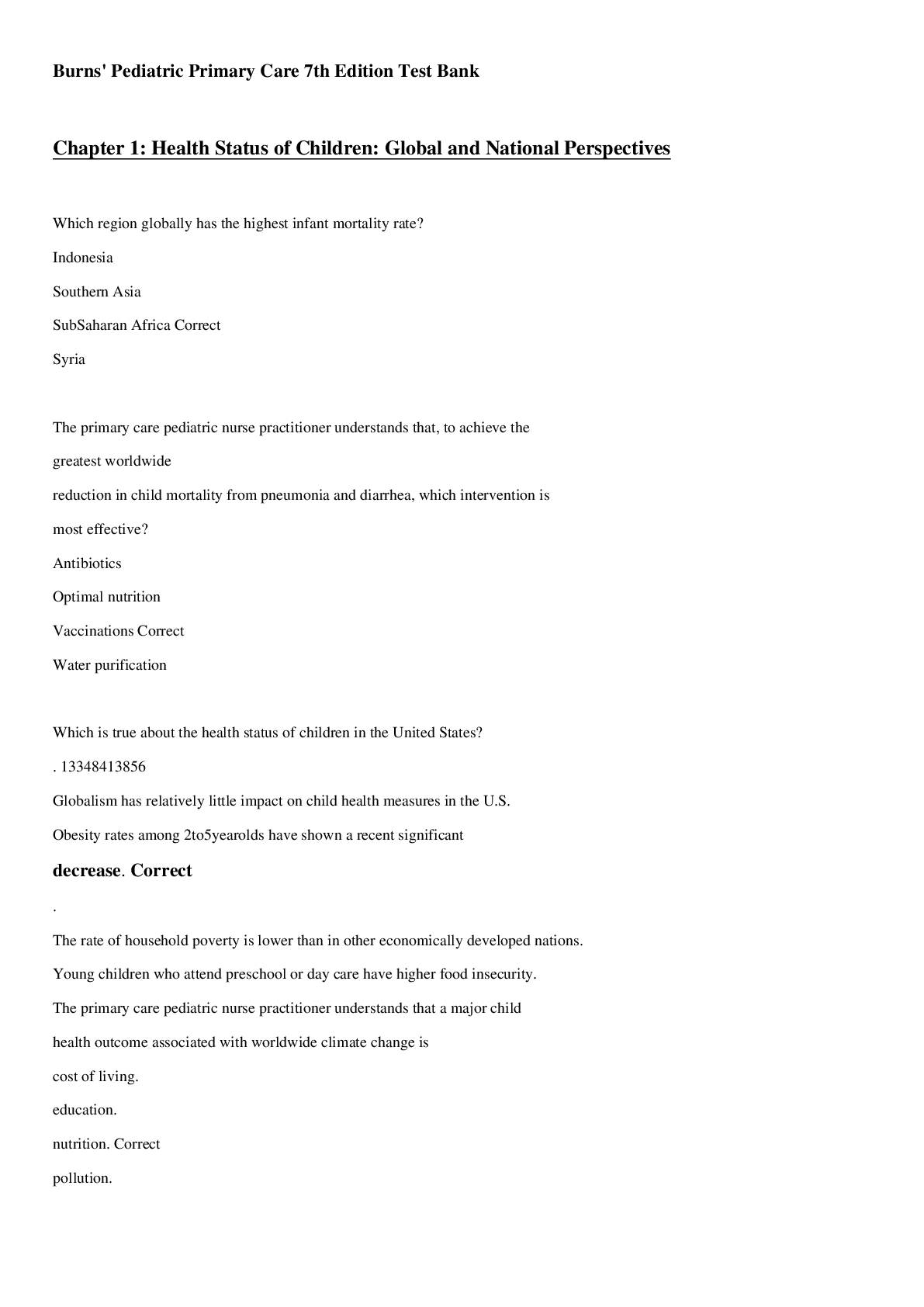
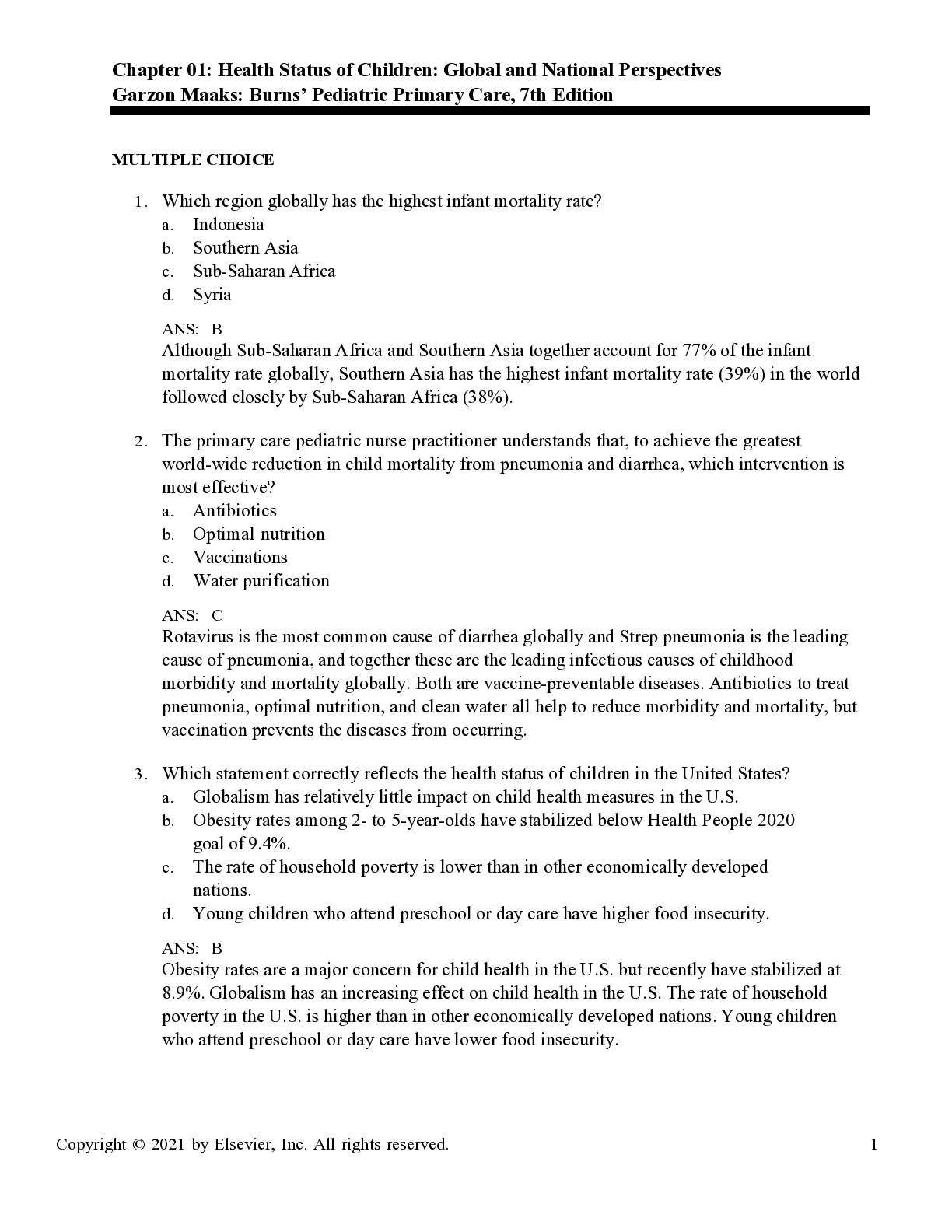
![Preview of eBook [PDF] Burns' Pediatric Primary Care 7th Edition BY Dawn Lee Garzon Maaks,, Nancy Bar](https://browseimages.nyc3.digitaloceanspaces.com/paper-images/2024/Aug/26/WR2rowXX2024-08-26-02-0966cc625bea839.png)