CD 445 Weekly Quizzes | Questions and Answers, Spring 2025 Define Audiology the study of hearing disorders and the rehabilitation of people with hearing impairments What is the difference between behavioral vs non-beh
...
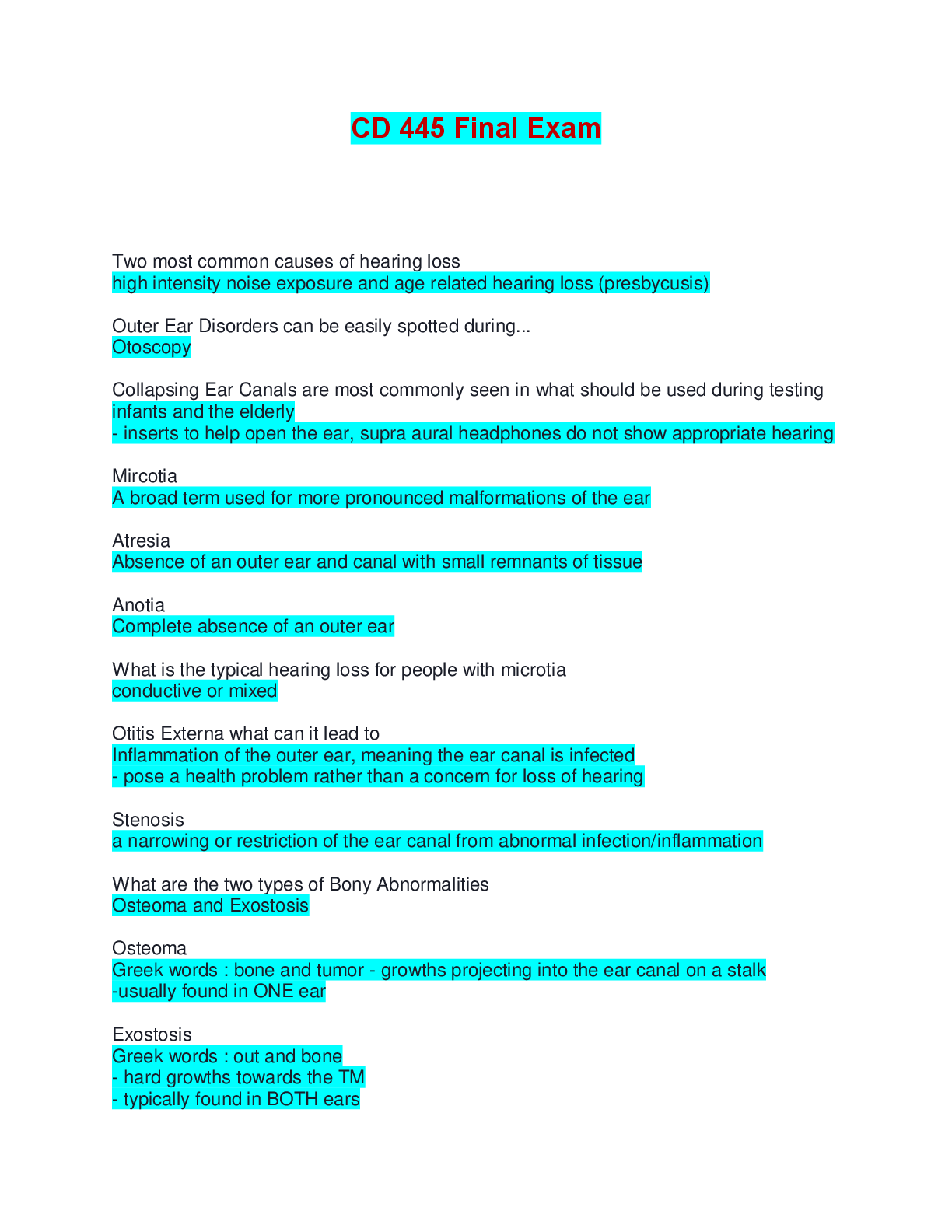
CD 445 Weekly Quizzes | Questions and Answers, Spring 2025 Define Audiology the study of hearing disorders and the rehabilitation of people with hearing impairments What is the difference between behavioral vs non-behavioral testing? behavioral is when the procedure requires the patient to actively participate in a task vs. non behavioral is when a patient is not required to actively participate in a task What are the core disciplines of audiology? evaluation rehabilitation identification prevention hearing impairments only affect old people false what are the 3 parts of the ear that send sound to the brain? outer ear middle ear inner ear what are the names of the 3 bones called the ossicles incus stapes malleus the cochlea is organized tonotopically meaning the ________ is responsible for high pitched and the ______ for low pitched bases apex what are the two cochlear fluids? perilymph and endolymph what are the two types of hair cells and how many cells do each have? outer — 12,000 inner — 3,500 what is one characteristic of pure tones? one frequency stimuli (ex. tone bursts) what is the purpose of otoscopy? to inspect the pinna and ear canal which of the following are transducers? microphones loud speakers tuning fork earphones bone oscillator is this type of test a subjective or objective response? detection subjective is this type of test a subjective or objective response? discrimination subjective is this type of test a subjective or objective response? tympanometry objective is this type of test a subjective or objective response? recognition subjective is this type of test a subjective or objective response? otoacoustic emissions (OAE) objective is this type of test a subjective or objective response? comprehension subjective is this type of test a subjective or objective response? auditory nerve brainstem (ABR) objective on the audiogram the x axis is ______ and the y axis is _____ the x-axis is frequency in Hz the y-axis is hearing level in dB which frequencies are considered inter-octaves? 750, 1500, 3000, 6000 it is important that ambient sound is limited to reduce distractions even though your test booth is sound proof false properly fitted insert earphones are the least effective in reducing or attenuating the background noise that reaches the inner ear false your patients hearing at 4000 Hz is 60dB. an alarm blaring at 4000Hz is approximately 110dB. how loud is the alarm for the patient in SL? 50dB a simple mistake such as reversing ear transducers could be fixed by changing the colors of symbols in the audiogram false what is the purpose of HIPAA? protect patients health information and gives patients more control over who can access their medical records Match the correct symbol: Air conduction O (right ear) X (left ear) Match the correct symbol: Air conduction with masking △ (right ear) □ (left ear) Match the correct symbol: Bone conduction < (right ear) > (left ear) Match the correct symbol: Bone conduction with masking [ (right ear) ] (left ear) what frequency(s) is/are the ear canal resonance most sensitive at? 3000-3500Hz dynamic range the difference between the threshold curve and loudness discomfort level hearing levels are not equal across frequencies true the bone conduction pathway directly stimulates the cochlea by setting bones of the skull into vibration true the bone conduction pathway bypasses the mechanisms of the outer and middle ear true in the bone conduction pathway both cochlea's are stimulated regardless of placement side true in the bone conduction pathway the tympanic membrane is the main component of bone conduction false in the bone conduction pathway the vibration of the skull set the ossicles in motion false in the bone conduction pathway the skull vibrates because of the sound entering the ear canal false Modified Hughson-Westlake technique threshold tracking procedure familiarization present tone decreases level by 10dB til there is no response go up by 5dB until the tone is heard decrease level by 10dB til there is no response repeat ascending and descending again *looking for 50% positive response* what is the correct frequency test order 1000 2000 4000 8000 1000 500 250 normal hearing normal AC and normal BC conductive hearing loss hearing loss AC and normal BC significant air bone gap sensorineural hearing loss hearing loss AC and BC no air bone gap mixed hearing loss hearing loss AC and BC BC better than AC what is a significant air bone gap > 10 flat configuration thresholds at each frequency within 20dB of each other sloping configuration hearing loss increases gradually as frequency increases (10dB per octave) rising configuration hearing loss decreases gradually as frequency increases sharply sloping configuration hearing loss increases at a rate greater than 20dB an octave fragmentary/corner responses are noted in the left corn r of the audiogram only and the rest of the frequencies are no response notch drop in hearing in a particular frequency region through/cookie-bite poorer hearing in mid-frequencies, better hearing at high and low frequencies what factors affect the testing & masking of individual ears cross hearing occlusion effect interaural attenuation the air conduction interaural attenuation is 40-60dB, depending on the transducer true occlusion effect match the dB to the Hz 30dB 250 Hz occlusion effect match the dB to the Hz 20dB 500 Hz occlusion effect match the dB to the Hz 10dB 1000 Hz occlusion effect match the dB to the Hz 0dB 2000 Hz & 4000 Hz When do we mask for bone conduction? when there is an air-bone gap of >10 between unmasked BC and AC Ipsilateral masking is used in audiology False the signal tone is still heard by the non-test ear undermasking when the noise effectively makes the NTE and prevents responding for tones in the TE effective masking when the masking noise in the NTE is too loud and heard by the TE overmasking white noise is best used as the source of masking false without masking, bone conduction is a true value of health of the cochlea on the side that the bone conduction is placed false
[Show More]