*NURSING > MED-SURG EXAM > Lower Gastrointestinal Problems : Medical-Surgical Nursing _ Test bank > complete questions/answers/ (All)
Lower Gastrointestinal Problems : Medical-Surgical Nursing _ Test bank > complete questions/answers/rationales; latest 2021 ed.
Document Content and Description Below
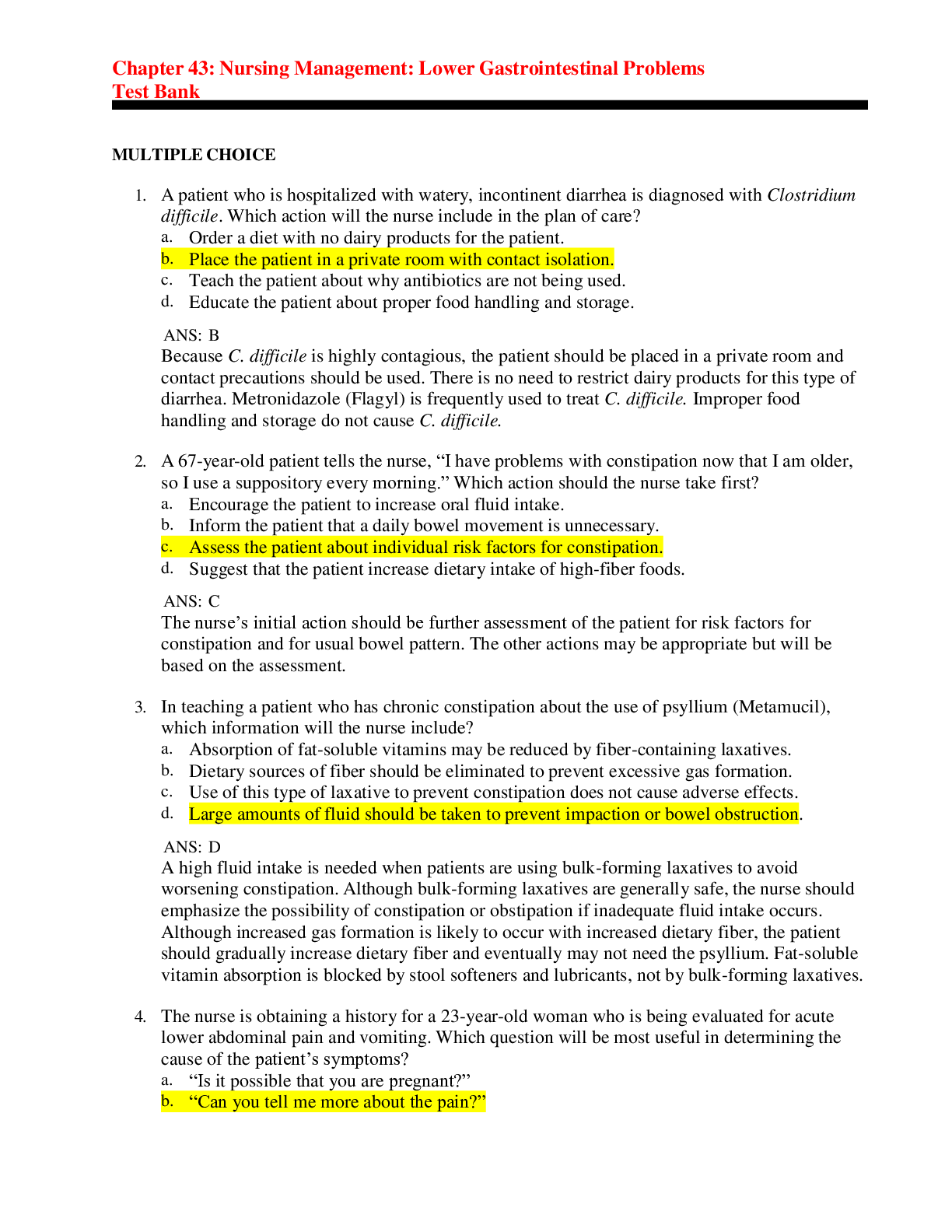
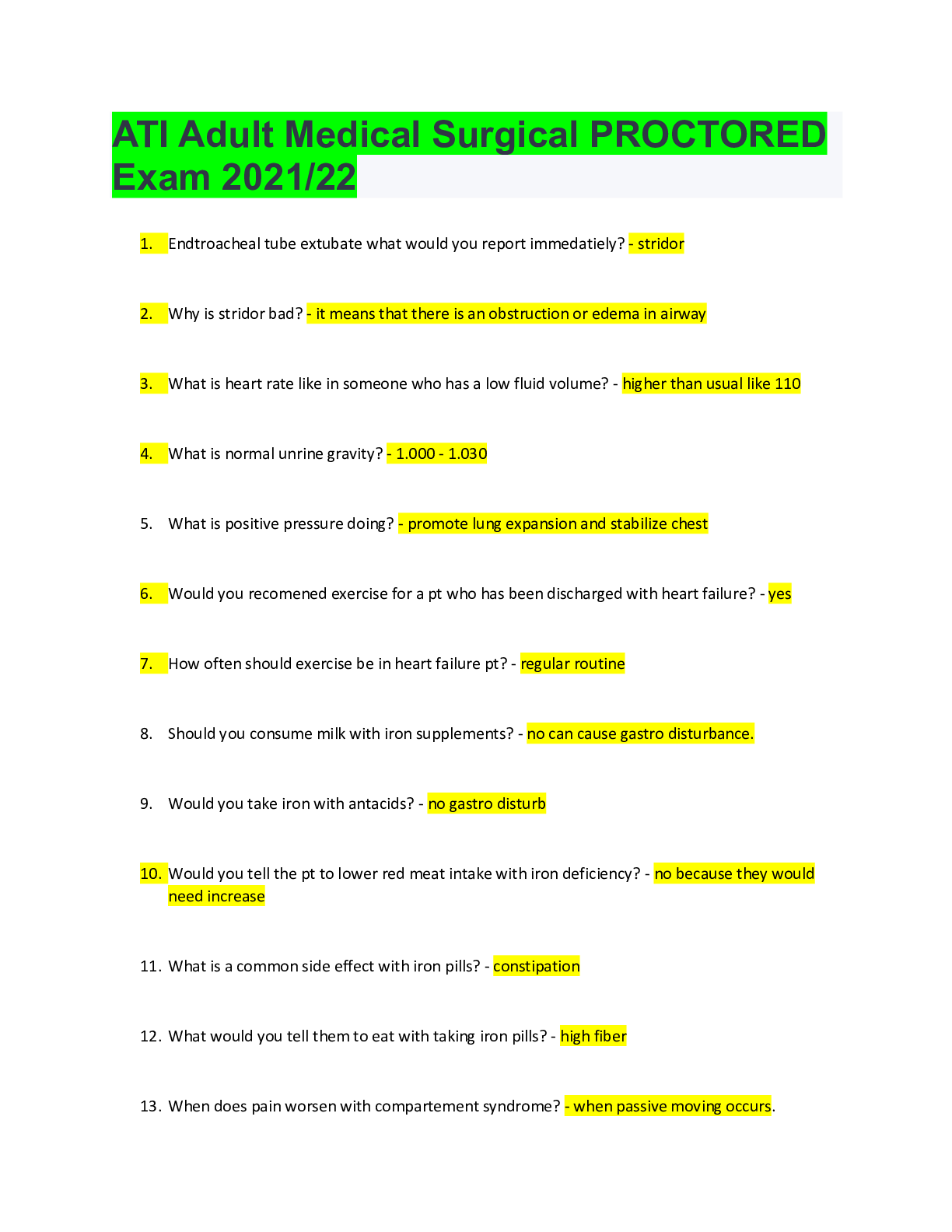
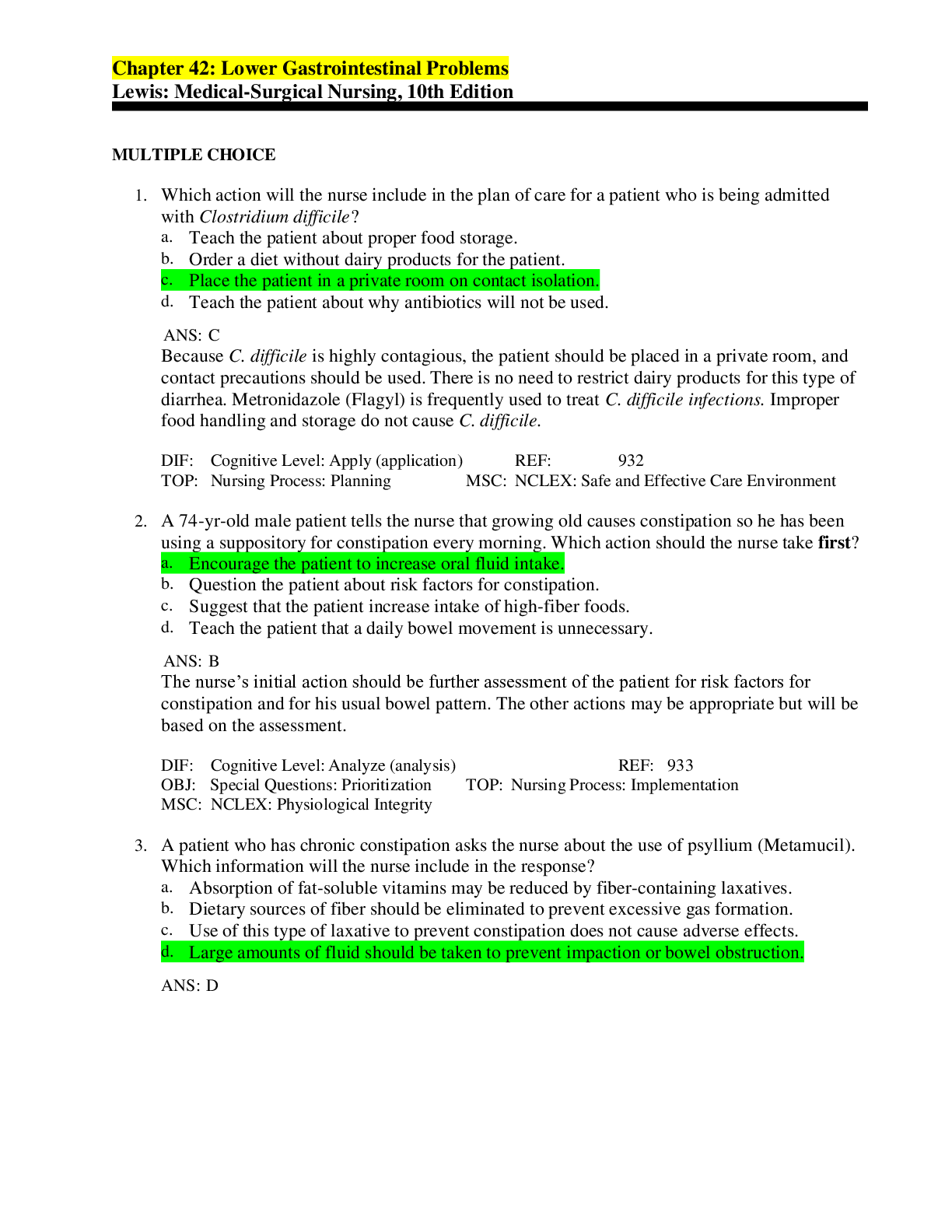
Chapter 42: Lower Gastrointestinal Problems Lewis: Medical-Surgical Nursing, 10th Edition MULTIPLE CHOICE 1. Which action will the nurse include in the plan of care for a patient who is being ... admitted with Clostridium difficile? a. Teach the patient about proper food storage. b. Order a diet without dairy products for the patient. c. Place the patient in a private room on contact isolation. d. Teach the patient about why antibiotics will not be used. 2. A 74-yr-old male patient tells the nurse that growing old causes constipation so he has been using a suppository for constipation every morning. Which action should the nurse take first? a. Encourage the patient to increase oral fluid intake. b. Question the patient about risk factors for constipation. c. Suggest that the patient increase intake of high-fiber foods. d. Teach the patient that a daily bowel movement is unnecessary. 3. A patient who has chronic constipation asks the nurse about the use of psyllium (Metamucil). Which information will the nurse include in the response? a. Absorption of fat-soluble vitamins may be reduced by fiber-containing laxatives. b. Dietary sources of fiber should be eliminated to prevent excessive gas formation. c. Use of this type of laxative to prevent constipation does not cause adverse effects. d. Large amounts of fluid should be taken to prevent impaction or bowel obstruction. 4. A 26-yr-old woman is being evaluated for vomiting and abdominal pain. Which question from the nurse will be most useful in determining the cause of the patient’s symptoms? a. “What type of foods do you eat?” b. “Is it possible that you are pregnant?” c. “Can you tell me more about the pain?” d. “What is your usual elimination pattern?” 5. A patient complains of gas pains and abdominal distention 2 days after a small bowel resection. Which nursing action should the nurse take? a. Encourage the patient to ambulate. b. Instill a mineral oil retention enema. c. Administer the prescribed IV morphine sulfate. d. Offer the prescribed promethazine (Phenergan). 6. A 58-yr-old patient with blunt abdominal trauma from a motor vehicle crash undergoes peritoneal lavage. If the lavage returns brown fecal drainage, which action will the nurse plan to take next? a. Auscultate the bowel sounds. b. Prepare the patient for surgery. c. Check the patient’s oral temperature. d. Obtain information about the accident. 7. A young adult patient is admitted to the hospital for evaluation of right lower quadrant abdominal pain with nausea and vomiting. Which action should the nurse take? a. Assist the patient to cough and deep breathe. b. Palpate the abdomen for rebound tenderness. c. Suggest the patient lie on the side, flexing the right leg. d. Encourage the patient to sip clear, noncarbonated liquids. 8. Which nursing action will be included in the plan of care for a 25-yr-old male patient with a new diagnosis of irritable bowel syndrome (IBS)? a. Encourage the patient to express concerns and ask questions about IBS. b. Suggest that the patient increase the intake of milk and other dairy products. c. Teach the patient to avoid using nonsteroidal antiinflammatory drugs (NSAIDs). d. Teach the patient about the use of alosetron (Lotronex) to reduce IBS symptoms. 9. A patient being admitted with an acute exacerbation of ulcerative colitis reports crampy abdominal pain and passing 15 or more bloody stools a day. The nurse will plan to a. administer IV metoclopramide (Reglan). b. discontinue the patient’s oral food intake. c. administer cobalamin (vitamin B12) injections. d. teach the patient about total colectomy surgery. 10. Which nursing action will the nurse include in the plan of care for a 35-yr-old male patient admitted with an exacerbation of inflammatory bowel disease (IBD)? a. Restrict oral fluid intake. c. Ambulate six times daily. b. Monitor stools for blood. d. Increase dietary fiber intake. 11. Which patient statement indicates that the nurse’s teaching about sulfasalazine (Azulfidine) for ulcerative colitis has been effective? a. “The medication will be tapered if I need surgery.” b. “I will need to use a sunscreen when I am outdoors.” c. “I will need to avoid contact with people who are sick.” d. “The medication prevents the infections that cause diarrhea.” 12. A 22-yr-old female patient with an exacerbation of ulcerative colitis is having 15 to 20 stools daily and has excoriated perianal skin. Which patient behavior indicates that teaching regarding maintenance of skin integrity has been effective? a. The patient uses incontinence briefs to contain loose stools. b. The patient uses witch hazel compresses to soothe irritation. c. The patient asks for antidiarrheal medication after each stool. d. The patient cleans the perianal area with soap after each stool. 13. Which diet choice by the patient with an acute exacerbation of inflammatory bowel disease (IBD) indicates a need for more teaching? a. Scrambled eggs c. Oatmeal with cream b. White toast and jam d. Pancakes with syrup 14. After a total proctocolectomy and permanent ileostomy, the patient tells the nurse, “I cannot manage all these changes. I don’t want to look at the stoma.” What is the best action by the nurse? a. Reassure the patient that ileostomy care will become easier. b. Ask the patient about the concerns with stoma management. c. Postpone any teaching until the patient adjusts to the ileostomy. d. Develop a detailed written list of ostomy care tasks for the patient. 15. A patient has a new diagnosis of Crohn’s disease after having frequent diarrhea and a weight loss of 10 lb (4.5 kg) over 2 months. The nurse will plan to teach about a. medication use. c. enteral nutrition. b. fluid restriction. d. activity restrictions. 16. A young woman who has Crohn’s disease develops a fever and symptoms of a urinary tract infection (UTI) with tan, fecal-smelling urine. What information will the nurse add to a general teaching plan about UTIs in order to individualize the teaching for this patient? a. Bacteria in the perianal area can enter the urethra. b. Fistulas can form between the bowel and bladder. c. Drink adequate fluids to maintain normal hydration. d. Empty the bladder before and after sexual intercourse. 17. A patient with diverticulosis has a large bowel obstruction. The nurse will monitor for a. referred back pain. c. projectile vomiting. b. metabolic alkalosis. d. abdominal distention. 18. The nurse preparing for the annual physical exam of a 50-yr-old man will plan to teach the patient about a. endoscopy. b. colonoscopy. c. computerized tomography screening. d. carcinoembryonic antigen (CEA) testing. 19. The nurse is providing preoperative teaching for a patient scheduled for an abdominal-perineal resection. Which information will the nurse include? a. The patient will begin sitting in a chair at the bedside on the first postoperative day. b. IV antibiotics will be started at least 24 hours before surgery to reduce the bowel bacteria. c. An additional surgery in 8 to 12 weeks will be used to create an ileal-anal reservoir. d. The site where the stoma will be located will be marked on the abdomen preoperatively. 20. A patient preparing to undergo a colon resection for cancer of the colon asks about the elevated carcinoembryonic antigen (CEA) test result. The nurse explains that the test is used to a. identify any metastasis of the cancer. b. monitor the tumor status after surgery. c. confirm the diagnosis of a specific type of cancer. d. determine the need for postoperative chemotherapy. 21. A 71-yr-old patient had an abdominal-perineal resection for colon cancer. Which nursing action is most important to include in the plan of care for the day after surgery? a. Teach about a low-residue diet. b. Monitor output from the stoma. c. Assess the perineal drainage and incision. d. Encourage acceptance of the colostomy stoma. 22. A patient is transferred from the recovery room to a surgical unit after a transverse colostomy. The nurse observes the stoma to be deep pink with edema and a small amount of sanguineous drainage. The nurse should a. place ice packs around the stoma. b. notify the surgeon about the stoma. c. monitor the stoma every 30 minutes. d. document stoma assessment findings. 23. Which information will the nurse include in teaching a patient who had a proctocolectomy and ileostomy for ulcerative colitis? a. Restrict fluid intake to prevent constant liquid drainage from the stoma. b. Use care when eating high-fiber foods to avoid obstruction of the ileum. c. Irrigate the ileostomy daily to avoid having to wear a drainage appliance. d. Change the pouch every day to prevent leakage of contents onto the skin. 24. A patient with a new ileostomy asks how much drainage to expect. The nurse explains that after the bowel adjusts to the ileostomy, the usual drainage will be about cups daily. a. 2 c. 4 b. 3 d. 5 25. The nurse admitting a patient with acute diverticulitis explains that the initial plan of care is to a. administer IV fluids. b. prepare for colonoscopy. c. give stool softeners and enemas. d. order a diet high in fiber and fluids. 26. A 40-yr-old male patient has had a herniorrhaphy to repair an incarcerated inguinal hernia. Which patient teaching will the nurse provide before discharge? a. Soak in sitz baths several times each day. b. Cough 5 times each hour for the next 48 hours. c. Avoid use of acetaminophen (Tylenol) for pain. d. Apply a scrotal support and ice to reduce swelling. 27. Which breakfast choice indicates a patient’s good understanding of information about a diet for celiac disease? a. Oatmeal with nonfat milk c. Bagel with low-fat cream cheese b. wheat toast with butter d. Corn tortilla with scrambled eggs 28. After a patient has had a hemorrhoidectomy at an outpatient surgical center, which instructions will the nurse include in discharge teaching? a. Maintain a low-residue diet until the surgical area is healed. b. Use ice packs on the perianal area to relieve pain and swelling. c. Take prescribed pain medications before you expect a bowel movement. d. Delay having a bowel movement for several days until you are well healed. 29. A patient calls the clinic to report a new onset of severe diarrhea. The nurse anticipates that the patient will need to a. collect a stool specimen. c. schedule a barium enema. b. prepare for colonoscopy. d. have blood cultures drawn. 30. The nurse will plan to teach a patient with Crohn’s disease who has megaloblastic anemia about the need for a. iron dextran infusions b. oral ferrous sulfate tablets. c. routine blood transfusions. d. cobalamin (B12) supplements. 31. The nurse is assessing a patient with abdominal pain. The nurse, who notes that there is ecchymosis around the area of umbilicus, will document this finding as a. Cullen sign. c. McBurney sign. b. Rovsing sign. d. Grey-Turner’s sign. 32. A critically ill patient with sepsis is frequently incontinent of watery stools. What action by the nurse will prevent complications associated with ongoing incontinence? a. Apply incontinence briefs. b. Use a fecal management system c. Insert a rectal tube with a drainage bag. d. Assist the patient to a commode frequently. 33. Which question from the nurse would help determine if a patient’s abdominal pain might indicate irritable bowel syndrome (IBS)? a. “Have you been passing a lot of gas?” b. “What foods affect your bowel patterns?” c. “Do you have any abdominal distention?” d. “How long have you had abdominal pain?” 34. A patient in the emergency department has just been diagnosed with peritonitis caused by a ruptured diverticulum. Which prescribed intervention will the nurse implement first? a. Insert a urinary catheter to drainage. b. Infuse metronidazole (Flagyl) 500 mg IV. c. Send the patient for a computerized tomography scan. d. Place a nasogastric (NG) tube to intermittent low suction. 35. A 25-yr-old male patient calls the clinic complaining of diarrhea for 24 hours. Which action should the nurse take first? a. Inform the patient that laboratory testing of blood and stools will be necessary. b. Ask the patient to describe the character of the stools and any associated symptoms. c. Suggest that the patient drink clear liquid fluids with electrolytes, such as Gatorade or Pedialyte. d. Advise the patient to use over-the-counter loperamide (Imodium) to slow gastrointestinal (GI) motility. 36. A patient is admitted to the emergency department with severe abdominal pain and rebound tenderness. Vital signs include temperature 102°F (38.3°C), pulse 120 beats/min, respirations 32 breaths/min, and blood pressure (BP) 82/54 mm Hg. Which prescribed intervention should the nurse implement first? a. Administer IV ketorolac 15 mg for pain relief. b. Draw a blood sample for a complete blood count (CBC). c. Infuse a liter of lactated Ringer’s solution over 30 minutes. d. Send the patient for an abdominal computed tomography (CT) scan. 37. Four hours after a bowel resection, a 74-yr-old male patient with a nasogastric tube to suction complains of nausea and abdominal distention. The first action by the nurse should be to a. auscultate for hypotonic bowel sounds. b. notify the patient’s health care provider. c. check for tube placement and reposition it. d. remove the tube and replace it with a new one. 38. A 19-yr-old woman is brought to the emergency department with a knife handle protruding from her abdomen. During the initial assessment of the patient, the nurse should a. remove the knife and assess the wound. b. determine the presence of Rovsing sign. c. check for circulation and tissue perfusion. d. insert a urinary catheter and assess for hematuria. 39. Which activity in the care of a patient with a new colostomy could the nurse delegate to unlicensed assistive personnel (UAP)? a. Document the appearance of the stoma. b. Place a pouching system over the ostomy. c. Drain and measure the output from the ostomy. d. Check the skin around the stoma for breakdown. 40. Which information obtained by the nurse interviewing a 30-yr-old male patient is most important to communicate to the health care provider? a. The patient has a history of constipation. b. The patient has noticed blood in the stools. c. The patient had an appendectomy at age 27. d. The patient smokes a pack/day of cigarettes. 41. Which care activity for a patient with a paralytic ileus is appropriate for the registered nurse (RN) to delegate to unlicensed assistive personnel (UAP)? a. Auscultation for bowel sounds b. Nasogastric (NG) tube irrigation c. Applying petroleum jelly to the lips d. Assessment of the nares for irritation 42. After several days of antibiotic therapy, an older hospitalized patient develops watery diarrhea. Which action should the nurse take first? a. Notify the health care provider. b. Obtain a stool specimen for analysis. c. Teach the patient about handwashing. d. Place the patient on contact precautions. 43. Which patient should the nurse assess first after receiving change-of-shift report? a. A 60-yr-old patient whose new ileostomy has drained 800 mL over the previous 8 hours b. A 50-yr-old patient with familial adenomatous polyposis who has occult blood in the stool c. A 40-yr-old patient with ulcerative colitis who has had six liquid stools in the previous 4 hours d. A 30-yr-old patient who has abdominal distention and an apical heart rate of 136 beats/minute 44. A patient with Crohn’s disease who is taking infliximab (Remicade) calls the nurse in the outpatient clinic about new symptoms. Which symptom is most important to communicate to the health care provider? a. Fever c. Joint pain b. Nausea d. Headache 45. A 33-yr-old male patient with a gunshot wound to the abdomen undergoes surgery, and a colostomy is formed as shown in the accompanying figure. Which information will be included in patient teaching? a. Stool will be expelled from both stomas. b. This type of colostomy is usually temporary. c. Soft, formed stool can be expected as drainage. d. Irrigations can regulate drainage from the stomas. 46. A 76-yr-old patient with obstipation has a fecal impaction and is incontinent of liquid stool. Which action should the nurse take first? a. Administer bulk-forming laxatives. b. Assist the patient to sit on the toilet. c. Manually remove the impacted stool. d. Increase the patient’s oral fluid intake. 47. A patient is awaiting surgery for acute peritonitis. Which action will the nurse include in the plan of care? a. Position patient with the knees flexed. b. Avoid use of opioids or sedative drugs. c. Offer frequent small sips of clear liquids. d. Assist patient to breathe deeply and cough. 48. A 72-yr-old male patient with dehydration caused by an exacerbation of ulcerative colitis is receiving 5% dextrose in normal saline at 125 mL/hour. Which assessment finding by the nurse is most important to report to the health care provider? a. Patient has not voided for the last 4 hours. b. Skin is dry with poor turgor on all extremities. c. Crackles are heard halfway up the posterior chest. d. Patient has had 5 loose stools over the previous 6 hours. ANS: C The presence of crackles in an older patient receiving IV fluids at a high rate suggests volume overload and a need to reduce the rate of the IV infusion. The other data will also be reported but are consistent with the patient’s age and diagnosis and do not require a change in the prescribed treatment. DIF: Cognitive Level: Analyze (analysis) REF: 948 OBJ: Special Questions: Prioritization TOP: Nursing Process: Assessment MSC: NCLEX: Physiological Integrity 49. A new 19-yr-old male patient has familial adenomatous polyposis (FAP). Which action will the nurse in the gastrointestinal clinic include in the plan of care? a. Obtain blood samples for DNA analysis. b. Schedule the patient for yearly colonoscopy. c. Provide preoperative teaching about total colectomy. d. Discuss lifestyle modifications to decrease cancer risk. 50. Which menu choice by the patient with diverticulosis is best for preventing diverticulitis? a. Navy bean soup and vegetable salad b. Whole grain pasta with tomato sauce c. Baked potato with low-fat sour cream d. Roast beef sandwich on whole wheat bread 51. After change-of-shift report, which patient should the nurse assess first? a. A 40-yr-old male patient with celiac disease who has frequent frothy diarrhea b. A 30-yr-old female patient with a femoral hernia who has abdominal pain and vomiting c. A 30-yr-old male patient with ulcerative colitis who has severe perianal skin breakdown d. A 40-yr-old female patient with a colostomy bag that is pulling away from the adhesive wafer 52. The nurse is admitting a 67-yr-old patient with new-onset steatorrhea. Which question is most important for the nurse to ask? a. “How much milk do you usually drink?” b. “Have you noticed a recent weight loss?” c. “What time of day do your bowels move?” d. “Do you eat meat or other animal products?” 53. Which information will the nurse teach a patient with lactose intolerance? a. Ice cream is relatively low in lactose. b. Live-culture yogurt is usually tolerated. c. Heating milk will break down the lactose. d. Nonfat milk is tolerated better than whole milk. 54. Which prescribed intervention for a patient with chronic short bowel syndrome will the nurse question? a. Senna 1 tablet every day b. Ferrous sulfate 325 mg daily c. Psyllium (Metamucil) 3 times daily d. Diphenoxylate with atropine (Lomotil) prn loose stools MULTIPLE RESPONSE 1. Which information will the nurse include when teaching a patient how to avoid chronic constipation (select all that apply)? a. Stimulant and saline laxatives can be used regularly. b. Bulk-forming laxatives are an excellent source of fiber. c. Walking or cycling frequently will help bowel motility. d. A good time for a bowel movement may be after breakfast. e. Some over-the-counter (OTC) medications cause constipation. [Show More]
Last updated: 3 years ago
Preview 1 out of 18 pages
Buy this document to get the full access instantly
Instant Download Access after purchase
Buy NowInstant download
We Accept:

Also available in bundle (1)
Click Below to Access Bundle(s)
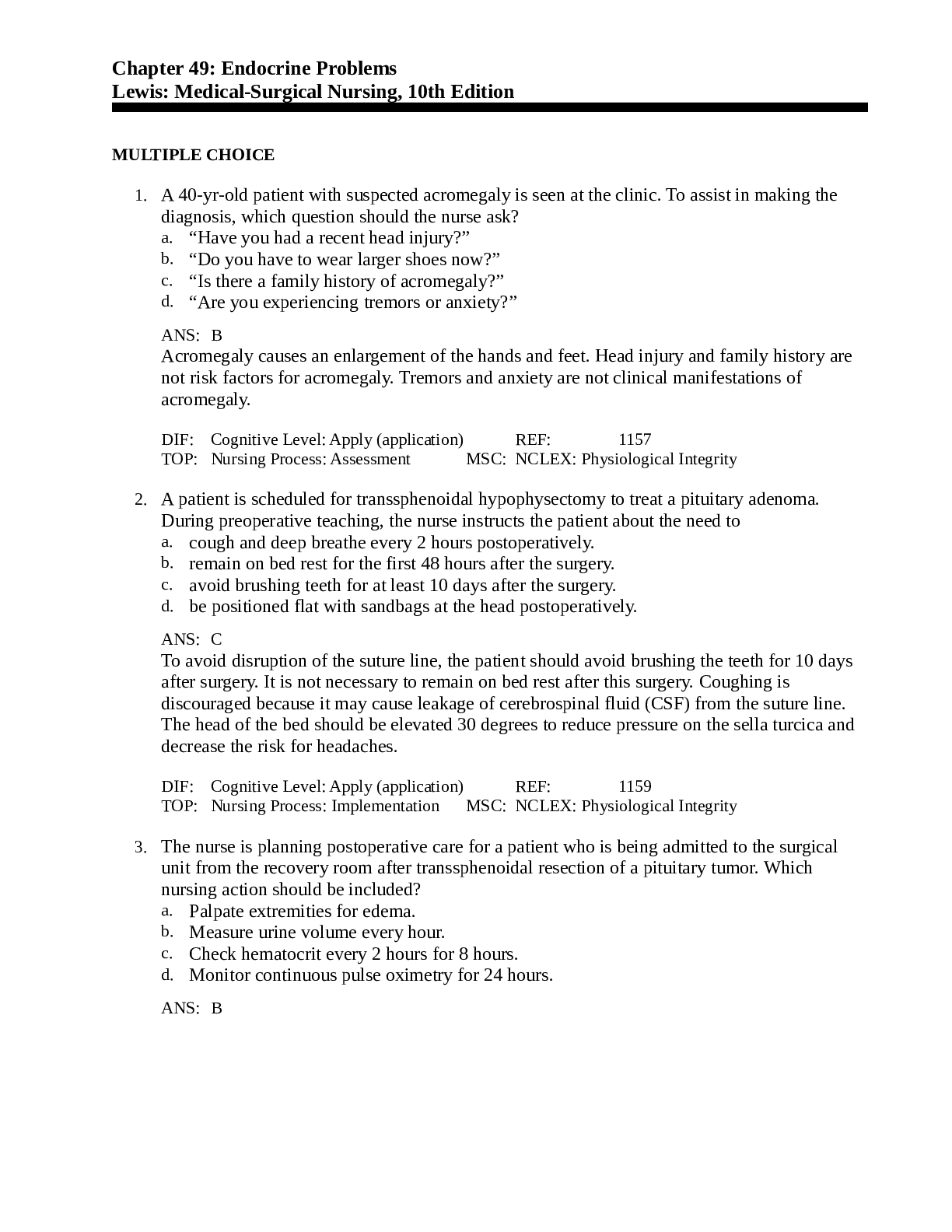
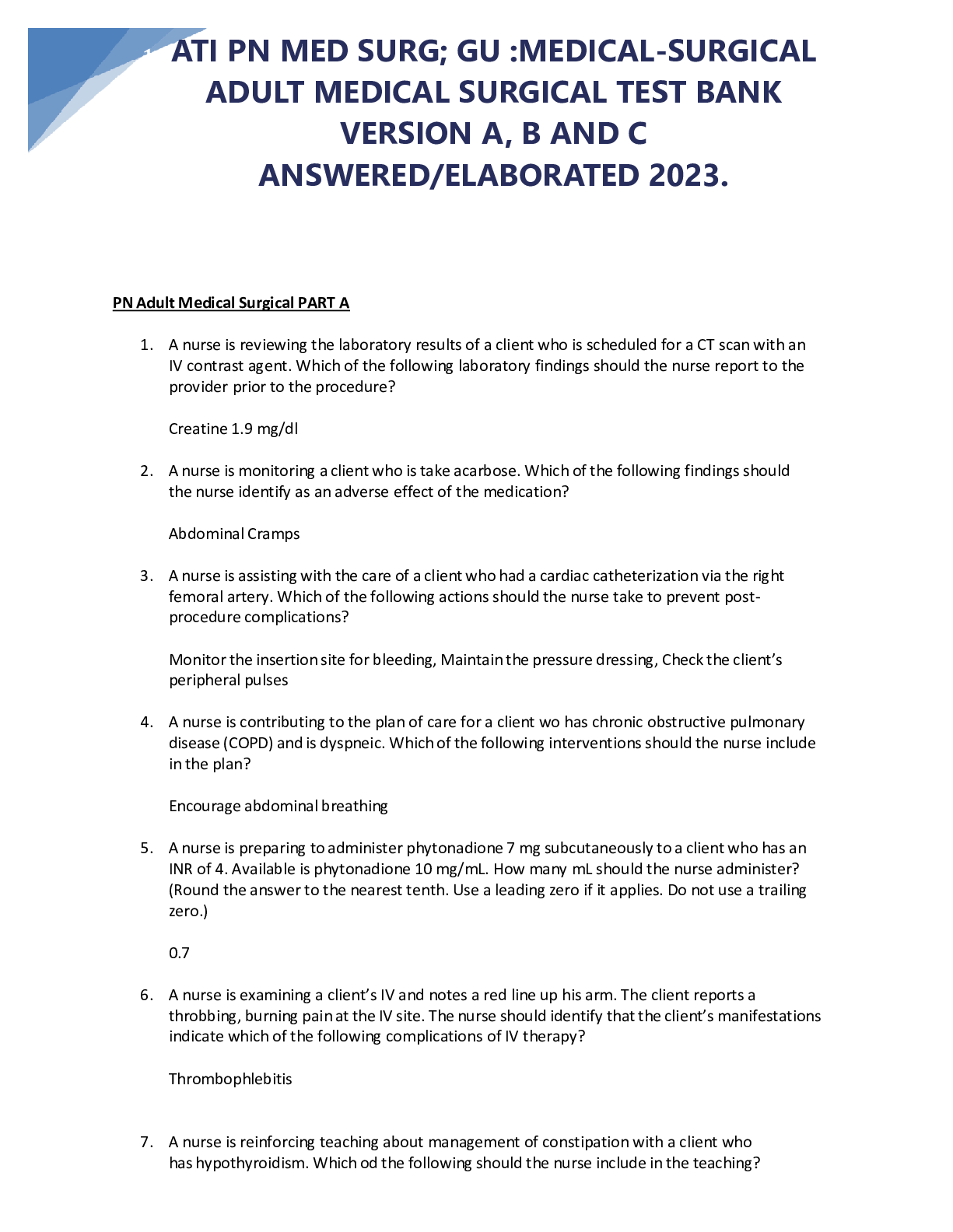
Med Surg Exams (Lower GI Problems test banks (different latest new versions) A+ help
Chapter 49: Endocrine Problems Medical-Surgical Nursing, Questions & answers > Endocrine Problems Lewis: Medical-Surgical Nursing, 10th Edition (answers/ rationales) 2021 Lower Gastrointestinal Probl...
By Courses_Exams 4 years ago
$30
6
Reviews( 0 )
$10.00
Can't find what you want? Try our AI powered Search
Document information
Connected school, study & course
About the document
Uploaded On
Mar 29, 2021
Number of pages
18
Written in
All

Additional information
This document has been written for:
Uploaded
Mar 29, 2021
Downloads
0
Views
179