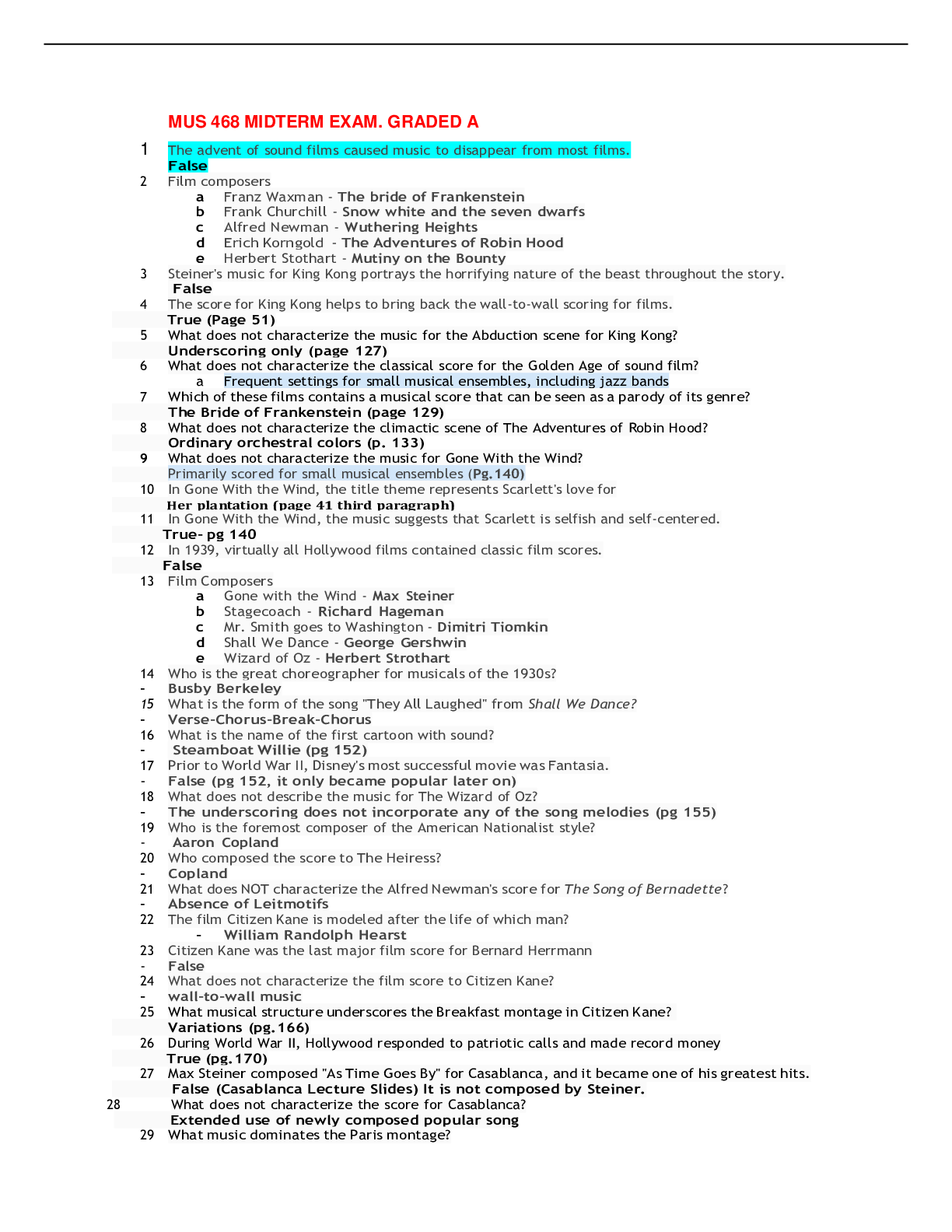
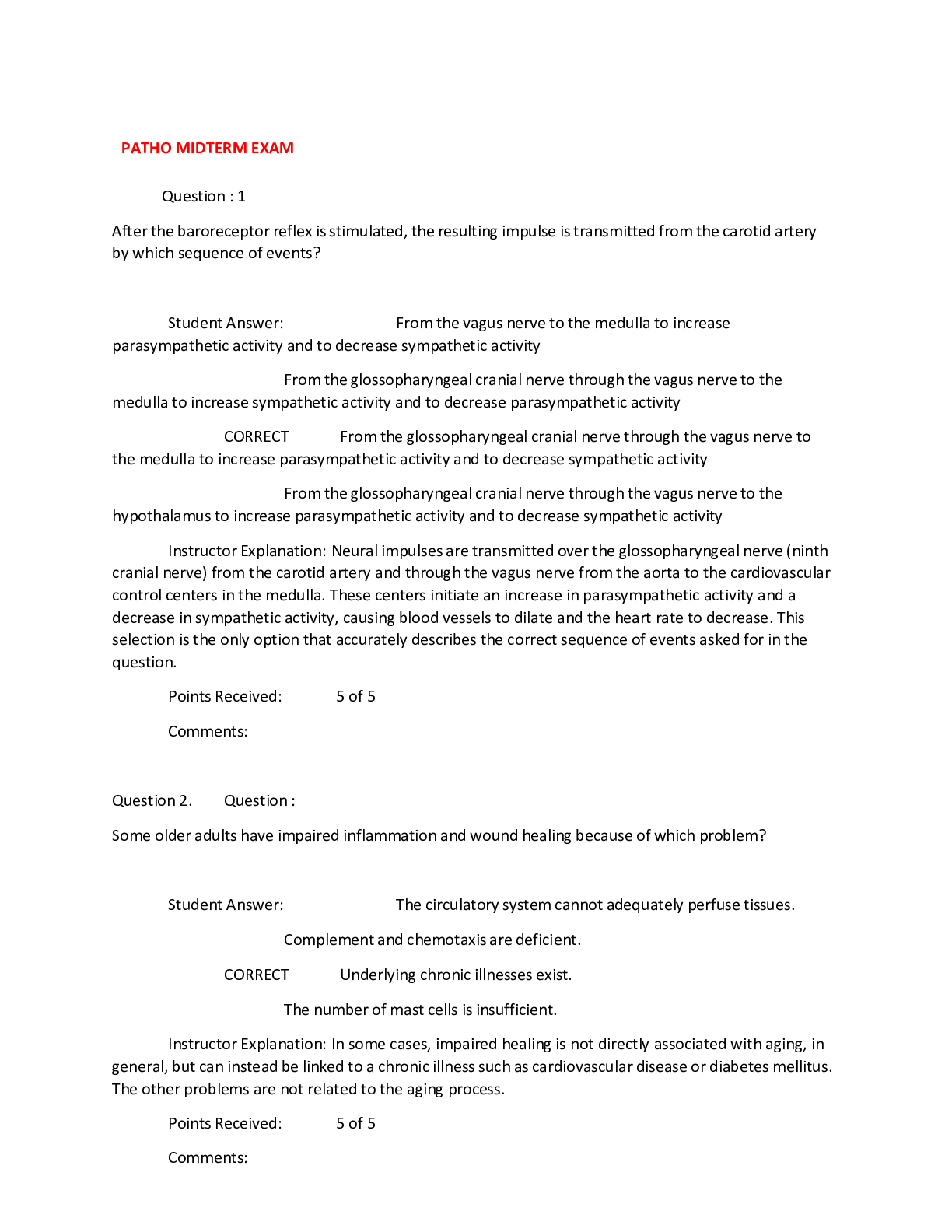
NR 224 FINAL EXAM GUIDE
1. A nurse is teaching a client how to perform personal ileostomy care prior to discharge. The client says “I don’t think that I am going to be able to take care of this myself.” Which is the
...
NR 224 FINAL EXAM GUIDE
1. A nurse is teaching a client how to perform personal ileostomy care prior to discharge. The client says “I don’t think that I am going to be able to take care of this myself.” Which is the most appropriate response from the nurse?
a. In time you will be better at this than I am.
b. Don’t worry about it, most clients feel like you do at first.
c. What part of the ileostomy care are you having trouble with?
d. I agree. This is a difficult process.
2 The adult child of a client who has had a colon resection will be caring for their parent at home. The client’s son tells the nurse “I don’t know how I am going to care for my mom now”. Which is the best nursing response?
a. A home health nurse will be stopping by tomorrow to answer your questions.
b. Your mother has been taught to care for her colostomy independently.
c. What part of your mother’s care are you concerned with?
d. It is quite simple. I’ll change the colostomy bag before she is discharged.
3 A nurse in the medical-surgical unit is assigning client care to a nurse who is floating from PACU. The float nurse is most qualified to care for which client?
a. A client who is postoperative following a lobectomy and has a chest tube
b. A client who is being discharged to a long-term care facility
c. A client who needs teaching prior to initiating cardiac rehabilitation activities
d. A client who needs teaching about insulin self-administration
4
A client asks the nurse what causes constipation. Choose the best response by the nurse.
a. Constipation occurs when the bowel absorbs too much water
b. Eating too many processed foods cause constipation
c. When the bowel releases too much water it causes constipation
d. Using over the counter laxatives causes constipation
5 The nurse caring for a post-operative client performs an abdominal assessment. The nurse does not hear any bowel sounds over the left lower quadrant of the abdomen. What is the most likely reason for this?
a. The client has been NPO for several hours
b. Post-operative clients may develop an ileus resulting in absent bowel sounds
c. There is gas in the abdomen
d. The client emptied their bowels before surgery
6 The nurse admits a client who is to undergo a colonoscopy. The nurse understands that this will be required in preparation for the procedure.
a. NPO status for 24 hours
b. A complete bowel cleanse
c. Clear liquids after midnight
d. A fleet enema to prep the bowel
7
A nurse is teaching a client about colorectal cancer testing. The nurse expects the provider to first perform this test for colorectal screening.
a. Colonoscopy
b. Barium enema
c. Fecal occult blood test
d. Cat scan of the lower intestine
8 A nurse is caring for a client with a newly placed colostomy. The nurse teaches the client they may have formed stool after the bowel has healed because the surgeon placed the stoma where?
a. Ascending colon
b. Transverse colon
c. Descending colon
d. Sigmoid colon
9 The nurse is administering a tap water enema to a client in preparation for bowel surgery. The nurse correctly positions the enema bag containing the fluid where?
a. 12 inches above the anus for a regular enema
b. 6-10 inches above the anus for a high enema
c. To shoulder height then lower it 6 inches
d. On an IV pole 18 inches above the bed
10
The nurse correctly positions a client for a fleets enema by placing them in this position:
a. Supine with the knees flexed
b. Prone with the right leg flexed
c. On the left side with the right leg flexed
d. On the right side with both knees flexed
Correct positioning for administering an enema is to place the client on their left side with their right leg bent to follow the natural curve of the colon.
11 The nurse is preparing a new ostomy flange for the client’s abdomen. Choose the correct action by the nurse.
a. Scrub the skin on the abdomen with antiseptic soap
b. Report the appearance of a red, moist stoma
c. After measuring the diameter of the stoma cut the opening of the wafer
d. Tape the wafer in place in a window-pane format
12 The nurse would plan to perform more frequent perineal care to prevent skin breakdown for this client.
a. Client with an indwelling catheter
b. Client who uses a walker to ambulate
c. Client with urinary frequency
d. Client with an incision on their abdomen
13 A female nurse is upset because a male client has requested only a male nurse help them with personal care. What is the best response from the charge nurse?
a. The female nurse should ask the client what they did to offend them.
b. The client may have gender identity issues.
c. The client may have been abused by their mother.
d. The client’s religious beliefs may prevent a female care-giver.
14
Select the priority nursing intervention for performing a complete bed bath on a client.
a. Provide for privacy
b. Allow the client to do as much of the bath as they can
c. Identify the client with 2 identifiers before beginning
d. Ask another nurse to assist with the bathing
Before performing any nursing action, the nurse must make certain they have the correct client. Therefore, it is a priority to first identify the client using 2 identifiers.
Choose the adjunct therapy that can help improve circulation and assist in debridement of wounds.
a. Hydrotherapy
b. Electrical stimulation therapy
c. Phototherapy
d. Ultrasound therapy
16 A nurse is providing oral care for a client who is immobile. Choose the correct nursing action for this client.
a. Apply petroleum jelly to the client’s lips after oral care
b. Turn the client on the side before starting oral care
c. Use the thumb and index finger to keep the client’s mouth open
d. Use a stiff toothbrush to clean the client’s teeth
17
The nurse caring for a client with C. Difficile must use which personal protective equipment?
a. Gown only
b. Gown and surgical mask
c. Mask and clean gloves
d. Gown and clean gloves
A client with C. Difficile is placed on contact precautions. The nurse must wear a gown and clean gloves.
18
a. Use a bottle of feeding solution that has been kept refrigerated
b. Use only a sterile irrigation syringe to flush before and after feeding
c. Perform handwashing before and after administering the feeding
d. Insert a new feeding tube every 24 hours
19
Choose the correct statement regarding sterile gloves.
a. Sterile gloves do not require handwashing prior to donning
b. The outside of the glove may only be touched by another sterile glove
c. If there is a tear in the package the glove may still be used
d. Once the gloves have been used they may be reused after washing
20 A student nurse notices a family member walking into a room under contact isolation. The student stops the visitor and instructs them how to don the appropriate protective equipment.
The student is practicing this:
a. Malpractice
b. Humility
c. Accountability
d. Feasibility
21 A nurse is caring for a client who has a Clostridium difficile infection. Which cleansing agent should the nurse use for hand hygiene?
a. Chlorhexidine
b. Povidone-iodine
c. Hand soap
d. Alcohol-based hand rub
22 The nurse is teaching a nursing assistant on correct use of personal protective equipment (PPE). The nurse knows the teaching was understood when the NA demonstrates this:
a. Wears gloves whenever coming into contact with a client
b. Wears gloves and a gown when bathing a client with open skin lesions
c. Wears gloves constantly to avoid having to wash hands
d. Wears gloves when delivering a lunch tray
23 The nurse is teaching students the importance of hand hygiene. Choose the most correct statement.
a. “If you wear gloves you do not need to wash your hands”
b. “Rub all surfaces of your hands with an alcohol rub for 20-30 seconds”
c. “Use an alcohol rub if your hands are visibly soiled”
d. “If you don’t have an infection, your hands won’t infect others”
24
The nurse is preparing to exit the room of a client who has been placed on contact precautions. Identify the sequence to be followed when removing the personal protective equipment (PPE).
1. Wash hands
2. Place discarded PPE in the designated trash container
3. Remove gloves
4. Remove the gown
5. Remove protective eyewear if used a. 3, 4, 5, 2, 1
b. 1, 3, 4, 5, 2
c. 3, 5, 4, 2, 1
d. 1, 3, 5, 4, 2
25
The nurse uses medical asepsis when caring for clients when they do this.
a. Use sterile equipment to start an intravenous line
b. Maintain a sterile field
c. Properly empty and discard wound drains
d. Hand a surgeon surgical instruments
Surgical asepsis requires only sterile items touch other sterile items.
26 A nurse is teaching a group of new mothers on infant care. The nurse includes which information on teaching about infection prevention.
a. Infants will not get sick if you keep them at home.
b. Handwashing before caring for the baby is only necessary if someone in the house is sick.
c. Infants have immature immune systems and are more susceptible to infections than older children.
d. Placing infants in the same room as a sibling who is sick will help them develop immunity.
27 An older client tells the nurse that they never get a flu shot because at their age, they’ve had every kind of flu there is. Choose the best response from the nurse.
a. Flu viruses are specific and you may not be immune to newer strains.
b. Older adults have natural immunity and don’t need immunization.
c. Older adults who contract the flu are less sick than younger adults.
d. The risk is greater that an older adult will contract the flu from getting immunized.
28
The nurse is caring for an older adult who complains they don’t eat as much as they used to. Their overall physical and mental condition is good. Choose the best response from the nurse.
a. Try to eat your meals with a companion. Having company often improves the appetite.
b. It must be difficult cooking for yourself. You can always freeze left-overs.
c. Older adults have fewer energy needs. It’s not unusual to eat less than you used to.
d. Make an appointment with your provider if you start to lose weight.
29 A nurse is assessing a young woman diagnosed with anorexia nervosa. The nurse suspects the client is not eating all of the food on their prescribed diet when they observe this:
a. They make frequent bathroom visits after meals
b. Food waste is often found in the trash after family visits
c. The client does not gain any weight between weigh-ins
d. The client has very specific meal preferences
30
The nurse caring for a new mother is teaching about proper nutrition for the infant. Choose the best statement regarding infant nutrition.
a. Infant formulas are the same as breast milk
b. Breast milk is recommended for infants up to 12 months of age
c. Solid foods may be introduced at 3 months
d. Avoid using breast milk that has been pumped as it is not as nutritious
31 The nurse is performing a mini-nutritional assessment for a newly admitted client from a nursing home. The best description of this type of assessment is what?
a. It helps the nurse identify the client’s favorite foods
b. It is a quick method of identifying malnutrition and risks for malnutrition
c. To identify caregivers in need of diet teaching
d. To assist with food selection and meal planning
32 The nurse is assessing a client’s peripheral circulation. Choose where the nurse will palpate a popliteal pulse.
a. Top of the foot
b. Behind the knee
c. In the groin
d. At the ankle
33
The nursing assistant reports these vital signs to a nurse:
tympanic temperature 98.8ºF, pulse 92 bpm, respiratory rate 18 breaths/min, blood pressure 98/58. What does the nurse do next?
a. Retake Temperature
b. Recheck Pulse
c. Assess Respirations
d. Retake Blood Pressure
34 A nurse instructs a group of new mothers to make sure the infant is covered up whenever in an air-conditioned space. Choose the best rationale for this action.
a. Some infants get cold faster than others
b. Covering the infant protects them against respiratory infection
c. Newborns and infants have poor thermoregulation
d. Newborns and infants have poor thermoregulation and must be kept covered in cooler environments.
35
The nurse is caring for a client with an irregular radial pulse. What action should the nurse take next?
a. Assess the apical pulse for a full minute
b. Use a doppler device on the radial pulse
c. Assess the radial pulse for a full minute
d. Ask another nurse to recheck the pulse
A client is prescribed a medication that has adrenergic effects. Choose the effect on the vital signs that this drug can have.
a. Decreased pulse
b. Low blood pressure
c. Increased temperature
d. Increased heart rate
A nurse is preparing to administer a medication prescribed to treat the client’s tachycardia. The
nurse should perform this action before giving the medication.
a. Assess the blood pressure
b. Assess the client for pain
c. Assess the oxygen saturation
d. Assess an apical pulse
38 A nurse assigns the nursing assistant the task of collecting vital signs on several clients. Select the client for whom the nurse should assess vital signs.
a. A client being discharged from the hospital this morning
b. A surgical client who is stable and 3 days post-op
c. A maternity client who just delivered her infant
d. A client who has just been transferred to the rehab unit for therapy
A group of student nurses is learning about adrenergic cardiovascular effects. Choose the chemicals most likely to cause these effects.
epinepherine and norepinephrine serotonin and dopamine prostaglandins
histamines
A nurse caring for an older client who has been a smoker for several years can expect to assess this abnormal vital sign.
Decreased respiratory rate
Increased blood pressure Decreased pulse
Increased oxygen saturation
A young teen is injured playing football when he is shoved into a goalpost and suffers a head injury. The nurse is concerned that this part of the brain may have suffered damage that can impact respirations.
The frontal lobe The parietal lobe
The medulla oblongata
The meninges
A nursing assistant has just taken a client’s blood pressure and suspects the reading is not accurate. Choose a valid reason for blood pressure error.
Rechecking both arms to compare readings
Smoothly deflating the cuff after taking the measurement Using a large cuff for a client who has large upper arms
Reinflating the cuff before allowing it to complete deflate
A nurse caring for a client who is short of breath places the client in this position to facilitate lung expansion.
Prone
Supine Lateral
Fowlers
A nurse is caring for a client who is on fall precautions. An appropriate alternate solution to the
use of restraints would be what?
Turning on the TV so the client is distracted
Using a bed or wheelchair alarm
Assigning a double room so the other client can watch them Dimming the hall lights at night
A nurse is teaching other healthcare workers about the acronym for fire safety: R.A.C.E. The
nurse explains that the letter “E” stand for what? Explain
Eliminate Extinguish
Evaluate
R.A.C.E. stands for Rescue, Activate, Confine and Extinguish
A nurse witnesses a client having a seizure. What is the nurse’s priority action? Turn the client on their side
Insert a mouth guard or bite-block Restrain the client to prevent injury
Stay with the client and call for help
The nurse prepares to help a client with crutch-walking. The nurse correctly places the crutches
in this position:
Directly in front of and parallel to the client
6 inches in front of and 6 inches to the side of each foot With the elbow straight
Snug against each armpit
The nurse is caring for a client with a deep, infected wound. The provider has prescribed wound irrigations be performed with each dressing change. Choose the best nursing action.
Flood the wound with warm tap water
Use a sterile irrigation syringe to instill a solution of povidone iodine and water Use sterile saline to thoroughly flush the wound bed
Wash the wound bed with soap and water and rinse well
A nurse is preparing to discharge a client who has been hospitalized to treat a Stage IV decubitus
ulcer. Select the best statement from the nurse regarding the client’s wound. Your wound was a Stage IV but now is has healed to a Stage III
You will need to continue to keep pressure off the wound area
Once the wound is completely healed the tissue will be stronger than ever It is normal to smell a foul odor from your dressing
A nurse caring for a client with a Stage III pressure ulcer notes a foul odor coming from the
room. What does the nurse do next?
Notify the provider the wound is infected
Perform a complete assessment including vital signs and lab values
Consult with the wound care nurse for a change in wound care for the client Do a focused assessment of the wound
The nurse is preparing to teach a client how to do their own wound care once discharged home.
Choose the best statement regarding wound packing.
The wound should be packed with several dry sterile gauze pads
Wound packing must be tightly compacted to facilitate healing
Pack the wound loosely with saline moistened sterile gauze
Avoid packing any tunnels or undermining
A nurse is discharging a client following surgical removal of the gall bladder. The nurse defines
this type of wound healing as what? Primary intention
Secondary intention
Tertiary intention Preliminary intention
53
1 / 1 pts A nurse has admitted a client to the hospital from home. During assessment the nurse notes a reddened, warm spot on the client’s coccyx. Choose an appropriate nursing action to address this finding.
Massage the client’s coccyx twice a shift
Reposition the client off their coccyx every two hours
Order an off-loading mattress to relieve pressure on the coccyx Use a pillow as a cushion on the client’s bedside chair
A clinic nurse is assessing a client who complains of a large blister on their left heel following participation in a 5K race. Choose the best nursing action to treat this wound.
Use a sterile needle to break the blister then apply a dry sterile dressing Instruct the client to leave the wound open to the air
Protect the wound with a dry sterile gauze pad
Carefully cut away the blistered skin and leave it open to the air
A nurse is caring for a client with a Stage III pressure ulcer. The nurse will measure and record what data in the client’s medical record?
Length, width and depth of the wound and any undermining or tunnelling Length and width of the wound with undermining noted
Length, width and depth of the wound
Length and width of the wound with tunnelling and undermining noted
A client asks the nurse about bilevel positive airway pressure (BiPap) devices as the provider just prescribed one for them. Choose the best explanation from the nurse.
It provides negative pressure on inspiration and positive pressure on expiration BiPap provides both negative and positive pressure on inspiration
It provides positive pressure on inspiration and expiration BiPap senses the client’s breathing and regulates it
The nurse is preparing to perform tracheal suctioning on a client. Select the best position in which to place this client.
Lateral
Semi-fowlers Supine
Sims
The nurse is suctioning a client when the oxygen saturation drops below 90%. Select the action the nurse should perform next.
Complete the suctioning as quickly as possible Increase oxygen flowing through the suction catheter
Remove the suction catheter and hyperoxygenate the client
Complete the suctioning and then hyperoxygenate the client
The nurse assesses a client having an anxiety attack who complains of numbness around the lips
and tingling in the fingers. The nurse correctly recognizes these as signs of what? Hypoventilation
Tachycardia Hypoglycemia
Hyperventilation
A nurse is teaching a group of post-operative clients how to correctly use the incentive
spirometer. What does the nurse include in the teaching?
Blow as hard as you can into the device
Wash your hands before and after using the device
Hold your breath for 10 seconds after taking a deep breath Use the device whenever you feel the need to cough
The nurse is preparing to discharge a client home who will be using an oxygen concentrator. The nurse teaches the client to do what to maintain safety while using oxygen?
Always check the regulator before using oxygen
Increase the liters per minute when you feel short of breath
Only smoke in the room with oxygen if you use 2 liters or less per minute Wear synthetic clothing to prevent static electricity
A nurse admits a client with bacterial pneumonia. The nurse recognizes the client is most at risk
for this:
Infection Hypoxia
Hypovolemia
Metabolic alkalosis
The nurse is caring for several clients in the urgent care clinic. The nurse understands that this
group is most likely to suffer oxygenation problems. Infants and toddlers
Middle school children Teens and young adults
Older adults
The nursing student is developing a plan of care for a client whose diagnosis is ineffective airway clearance related to retained pulmonary secretions as evidenced by the production of thick, yellow sputum. An appropriate nursing action for this client is what?
Elevate the head of the bed 30º Restrict fluids to 1000 mL/day
Encourage the client to cough and deep breathe
Medicate the client with a cough suppressant
The nurse teaching a group of students explains the purpose of postural drainage for a client with
oxygenation problems. The best explanation for the use of postural drainage is what? To provide a more comfortable position when sleeping
To use gravity to pool secretions in the lower lobes To avoid suctioning the client
To improve clearance of secretions
The nurse is caring for a client who is able to cough productively, but unable to expectorate or swallow the sputum. Choose the appropriate nursing intervention and device.
Oral Suctioning
Oral Suctioning
Oral Suctioning
The nurse must select a prescribed oxygen delivery device that provides low flow oxygen at 60%. Select the correct device.
A nurse in a long-term care facility instructs nurses about using an assistive device during ambulation. Choose the correct way to instruct ambulating with a cane.
The cane should move first, then the client
The client should hold the can on the weaker side of the body
The grip should be level with the client’s waist
The client moves the strong leg first than the weak one
A nurse is preparing to move a client who is only partially able to assist up in bed. Which method should the nurse plan to use?
One nurse lifting as the client pushes with their feet Two nurses lifting the client under the shoulders
One nurse lifting the client’s legs as the client uses a trapeze bar
Two nurses use a friction-reducing device
Plantar flexion contractures can best be prevented through the use of this device.
Trochanter roll Sheepskin heel pad Abduction pillow
Footboard or plantar boot
A nurse who is applying a gait belt before ambulating a client will correctly place the belt in this position:
Tightly just below the ribs
Snugly just above the client’s hips Loosely above the abdomen Tightly just below the client’s hips
The correct placement of a gait belt is snugly just above the client’s hips.
A nurse is helping to ambulate a client who frequently loses balance while walking. Choose the best device to aid in safety for this client.
Gait belt Jacket harness
Four-wheel walker
Cane
A client frequently attemps to remove his intravenous catheter. A family member asks the nurse
to apply restraints. Choose the most appropriate response from the nurse. “I’ll provide more stimulation in the environment”
“I will call the provider for an order”
“I will cover the catheter to distract the client’s attention away from it”
“I will wait and see if the behavior continues”
A nurse is caring for a client who is postoperative and has an indwelling urinary catheter to
gravity drainage. The nurse notes no urine output in the past 2 hours. Which action should the nurse take first?
Check to determine if the catheter tubing is kinked Palpate the bladder
Obtain a prescription to irrigate the catheter with 0.9% sodium chloride
Encourage the client to drink more fluids
The nurse is preparing a client for a diagnostic testing of urinary function. The nurse must make
sure a consent form is on the client’s chart for this test:
Urinalysis Renal X-ray
IV pyelogram
Urine culture
The nurse receives intake and output reports on several clients from the nursing assistant. Select the output which the nurse should report to the provider.
120 mL in 4 hours
500 mL in 6 hours
300 mL in 4 hours
100 mL in 6 hours
Normal urine output is at least 30 mL per hour. 100 mL in 6 hours is 16 mL/hr and is too low.
A client reports to the nurse that they feel the need to urinate but can’t. Select the priority nursing intervention for this client.
Perform a bladder scan
Palpate the bladder for distention Collect urine for a urinalysis Perform a straight catheterization
The nurse is assigning care to a nursing assistant (NA) for a client with an indwelling urinary catheter. The nurse instructs the NA to do this in order to best prevent catheter associated urinary tract infection:
Tape the catheter to the upper thigh Offer the client oral fluids every hour
Use medical asepsis to change the drainage bag
Perform good perineal care daily
Keeping the perineum and catheter clean is the best way to prevent a CAUTI in a catheterized client.
A client with this type of urinary diversion requires the nurse to instruct them how to self-
catheterize. Ileal conduit
Continent urinary reservoir
Nephrostomy Ileostomy
The nurse can delegate this intervention to the nursing assistant. Empty and record output from a urinary drain bag
Remove a foley catheter once the balloon is deflated Change the drain bag on a foley catheter
Perform a straight catheterization to collect a urine sample
The nursing assistant may only empty and record output from a urinary drain bag. Any maintenance or handling of the catheter itself is a nursing responsibility.
While caring for a post-procedure client who underwent a cystoscopy a few hours ago, the nurse
notes pink-tinged urine in the client’s urinal. Select the priority nursing action. Immediately contact the provider who performed the procedure
Empty the urinal and record the amount voided
Encourage the client to restrict oral fluids
Start IV fluids to rehydrate the client
A nurse caring for an older adult male client understands that this is an expected physiological change.
Foul smelling urine Brown urine
Renal calculi
Decreased bladder capacity
The nurse is teaching a group of home care providers about caring for the older adult with urine incontinence. The nurse includes this statement in the teaching:
It is best to have the client wear adult diapers
Unless contraindicated, restrict oral fluids to 1 liter per day
Kegel exercises are not effective for older adults to prevent incontinence
Establishing a toileting plan can help limit episodes of incontinence
A nurse is doing preoperative teaching for a client about to undergo abdominal surgery. The
nurse will insert a foley catheter prior to taking the client to the preoperative area. The best rationale for this intervention is what?
To prevent bladder distention during surgery
To prevent the client from voiding on the surgical table To collect urine specimens during the surgery
To maintain the client’s comfort throughout the procedure
The nurse is caring for a female client who requires the insertion of an indwelling urinary
catheter. The nurse will place the client in this position to best facilitate catheter insertion. Semi-fowlers
Supine
Dorsal recumbent Sims
The nurse is caring for a post-operative client and notes a moderate amount of serous drainage on the dressing 24 hours after surgery. What is an appropriate nursing action?
Notify the surgeon that you suspect the client has an infection Leave the dressing intact
Remove the dressing and leave the wound open to air
Change the dressing
The nurse is assessing a wound that is 75% covered with eschar. What treatment does the nurse expect to be ordered?
Clean several times a day with normal saline and sterile gauze
Apply a dry sterile dressing daily to the wound
Prepare the client for surgical debridement Stage the wound as a Stage IV pressure ulcer
The nurse is preparing to administer enteric feeding through a nasogastric tube. What does the nurse do after checking the placement of the tube?
Position the client with head of the bed elevated to 20 degrees Chill the feeding solution before giving it
Flush the tube with 30 ml of sterile or tap water
Offer the client sips of water during the feeding
The nurse is inserting a nasogastric tube when the client begins to gag. What does the nurse do
next after stopping the insertion? Have the client take a deep breath
Check the mouth for a curled tube Administer an antiemetic
Remove the tube and call provider
The nurse is preparing to insert a straight catheter into a male client. Which action is appropriate?
Ask the client to void into a sterile container
Insert the catheter slowly if the client has an erection
Hold the penis parallel to the scrotum during insertion
Retract the foreskin if present before cleaning the glans
The nurse is teaching teen-age girls about nutrition. Which nutrient do teen girls need more of
that teen boys do not? Iron
Calcium
Protein Potassium
The nurse is assessing an older client for dysphagia. What sign indicates the client may have
dysphagia? Memory loss
Constipation
Drooling Weight gain
The nursing assistant is feeding a client with dysphagia. What can the nurse teach the assistant to help prevent choking during feeding?
Check the mouth for food after feeding
Select hot, pureed foods to improve appetite Offer sips of ice water through a straw
Use only finger foods the client can feed themselves
A client tells the nurse they are still constipated despite increasing fiber in their diet. What is an
appropriate to ask the client?
What kind of fiber are you eating?
How many glasses of water do you drink a day? What time of day are you eating the most fiber?
Are you eating cooked or raw fiber?
The nurse is providing a bath for a client who is bedbound. The nurse understands these care
benefits from good hygiene: {Select all that apply}
Provides comfort
Prevents infection Prevents pressure ulcers
Provides rest
Promotes communication
The nurse is teaching a group of home care workers about pressure ulcer formation. Choose the
condition(s) that place a client at risk for pressure ulcer formation. {Select all that apply}
Fecal incontinence
Dehydration
Wound infection Malnutrition
A nurse is caring for a group of clients. Choose the client most likely to suffer from inadequate
oxygenation {Select all that apply}
Accident victim with heavy blood loss
Client with blood clots in the lungs Teen with seasonal allergies
Child recovering from drowning
Older adult with heart failure
A client suddenly starts to slide down to the floor while ambulating. Choose the correct actions
by the nurse to prevent injury to both themselves and the client. {Select all that apply}
Stand in front of the client to prevent foward falling motion
Stand with feet apart in a wide base behind the client Push out against the client to ease their fall
Extend one leg out to allow the client to slide against it
Bend your knees and lower the client slowly to the floor
The nurse is preparing to collect a sterile urine specimen from a client’s foley catheter. Choose
the correct actions the nurse will perform. {Select all that apply}
Wash hands and apply clean gloves
Clamp the drain tube for 30 minutes
Use a 10 mL syringe to withdraw urine from the drain port
Transfer the urine to a sterile specimen container
The nurse is helping a client select items for lunch from a clear liquid diet menu. Which items are allowed on this diet? {Select all that apply}
Pudding
Chicken broth
Jello
Cream of wheat Black coffee
[Show More]