MBA 575 MIDTERM MC PRACTICE
MC and TRUE/FALSE TESTS/SOUTIONS
True or False
1 According to many influential economists, the increase in international trade and cross border investment will resul
...
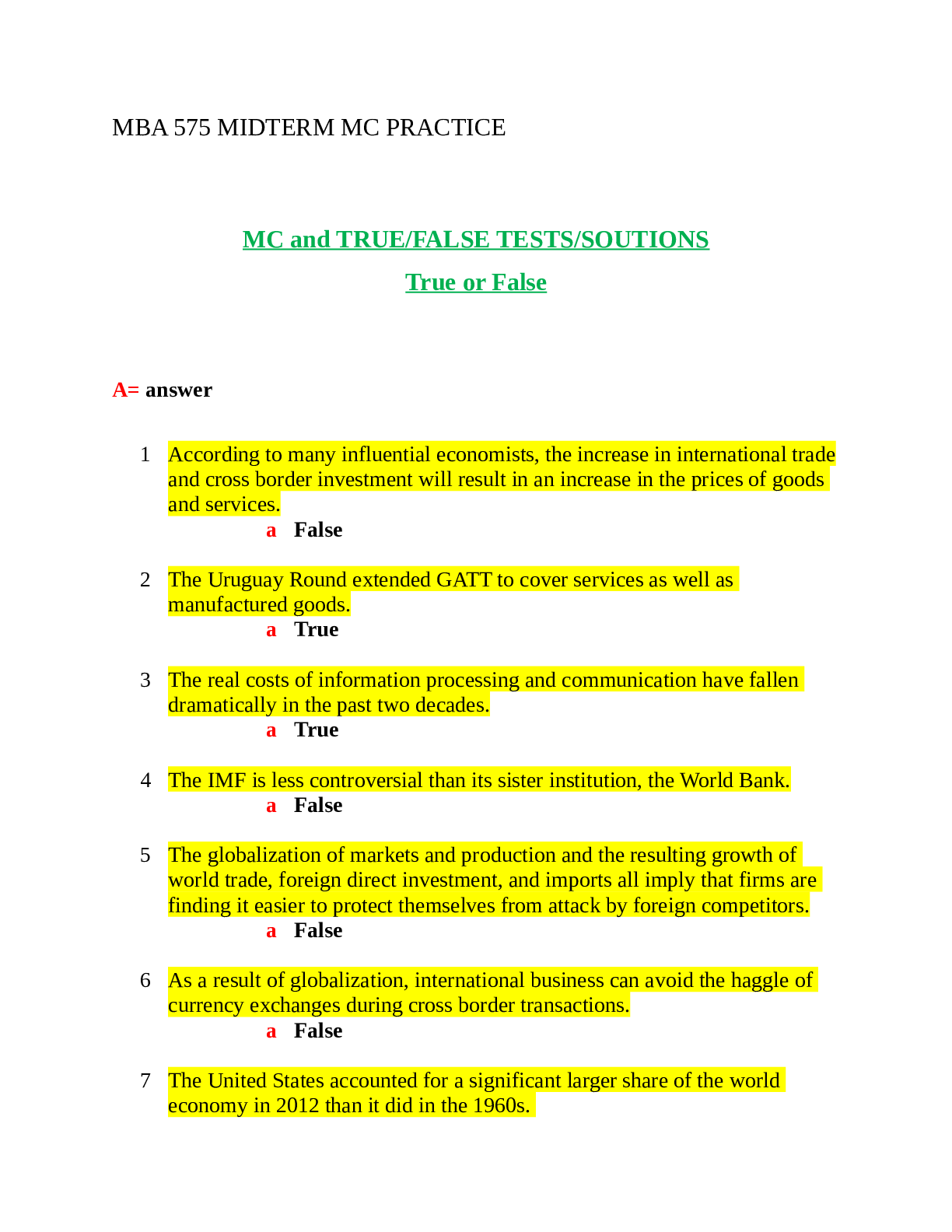
MBA 575 MIDTERM MC PRACTICE
MC and TRUE/FALSE TESTS/SOUTIONS
True or False
1 According to many influential economists, the increase in international trade and cross border investment will result in an increase in the prices of goods and services.
2 The Uruguay Round extended GATT to cover services as well as manufactured goods.
3 The real costs of information processing and communication have fallen dramatically in the past two decades.
4 The IMF is less controversial than its sister institution, the World Bank.
5 The globalization of markets and production and the resulting growth of world trade, foreign direct investment, and imports all imply that firms are finding it easier to protect themselves from attack by foreign competitors.
6 As a result of globalization, international business can avoid the haggle of currency exchanges during cross border transactions.
7 The United States accounted for a significant larger share of the world economy in 2012 than it did in the 1960s.
8 The move toward a global economy has strengthened the adoption of conservative economic policies by the developing nations.
9 The WTO is seen as the lender of last resort to nation states whose economies are in turmoil and whose currencies are losing value against those of other nations.
10 The stock of foreign direct investment refers to the total cumulative value of foreign investments in a country.
11 Despite all the talk about the emerging global village, differences between countries such as cultures and political systems are very profound and enduring.
12 Is it possible that economic growth in developed nations has offset the fall in the share of national income enjoyed by unskilled workers, raising their living standards?
13 By offering the same basic products worldwide, firms help to create a global market.
14 Throughout the 1990’s, the amount of investment directed at both developed and developing nations increased dramatically.
15 As a result of international trade, the economies of the world’s nation states are becoming less intertwined.
16 Although most international trade and investments are still conducted by large firms, many medium sized and small businesses are becoming increasingly involved in international trade and investment.
17 As a result of globalization, we have been moving toward a world in which national economies are relatively self-contained entities.
18 Managers in an international business must find ways to work around the limits imposed by specific governmental institutions.
19 Many of the former Communist nations of Europe and Asia seem to share a commitment to democratic policies and free market economies.
20 As a result of globalization, companies rarely need to customize marketing strategies, product features, and operating practices in different countries.
21 Foreign direct investment (FDI) occurs when a firm invests resources in business activities outside its home country.
22 Highly indebted poor countries (HIPCs) can bootstrap themselves out of poverty by pursuing retaliatory trade policies rather than free trade policies
23 Substantial impediments such as barriers to foreign direct investment make it difficult for firms to achieve the optimal dispersion of their productive activities to locations around the globe.
24 Beginning in the 1970’s, European and Japanese firms began to shift labor-intensive manufacturing operations from developing nations to their home countries where labor costs were lower.
25 In general, as countries get richer, they enact tougher environmental and labor regulations.
26 The growing income inequality is a result of the wages for skilled workers being discounted.
27 After World War II, the advanced nations of the west committed themselves to increasing barriers to the free flow of goods, services, and capital between nations.
28 Containerization has revolutionized the transportation business, significantly lowering the costs of shipping goods over long distances.
29 The World Trade Organization, the International Monetary Fund and its sister institution the World Bank, and the United Nations were all created by voluntary agreement between individual nation-states.
30 The lowering of trade and investment barriers allows firms to base production at the optimal location for that activity.
Multiple Choice
31 Automobile companies promote different car models in different countries depending on a range of factors such as demographics, local taste, local fuel costs, income levels, traffic congestion, and cultural values. This most likely demonstrates that:
32 The advent of containerization has:
33 Supporters of globalization insist that dislocation in the form of lost jobs is a tradeoff that will ultimately lead to the economy being better off. Which of the following is being justified in this case?
34 Globalization critics argue that the decline in unskilled wage rates in advanced economies is due to the:
35 Which of the following countries has seen a relative decline in its share of world output between 1960 and 2012?
36 Which of the following statements best supports the claim that greater uniformity replaces diversity in the context of global markets?
37 Which of the following statements supports the claim that the gap between the rich and the poor nations of the world has gotten wider because of globalization?
38 Which of the following was a part of the agenda of the Doha Round of the talks launched by the WTO?
39 Which of the following statements reflects the nature of the global economy of the twenty first century?
40 Which of the following is a macro factor underlying the trend toward greater globalization?
41 Which of the following has been declining in the developing nations of the world such as China, India, Russia, Indonesia, Thailand, South Korea, Mexico and Brazil?
42 Which of the following refers to the total cumulative value of foreign investments?
43 Critics of globalization say that exporting jobs to low wage nations results in higher unemployment and lower living standards in the home nations. Which of the following statements does not support this argument?
44 According to the UN Charter, one of the four purposes of the UN is to:
45 What are mini multinationals?
46 Which of the following is most likely to be observed in today’s global economy?
47 Gerald bough his son, David, a computer two years ago. Recently, he decided to buy his daughter, Julian, a computer of her own. In the context of the two-year gap between the purchase of both the computers and Moore’s law, it is most likely that:
48 Which of the following best exemplifies foreign direct investment (FDI)?
49 Which of the following conditions is most likely to act deterrent for foreign firms willing to do business with former communist nations of East Europe and central Asia?
50 Ryan is the executive general manager of a U.S. multinational and Veronica is a manager in a similar position, but works for another U.S. company that operates only in its home country. In this context, which of the following business functions will be most typically exclusive to Ryan?
51 Which of the following services cannot be outsourced to foreign nations?
52 Which of the following statements is a general implication of globalization?
53 Due the changing economic geography, many of tomorrow’s economic opportunities are most likely to be found in the:
54 Which of the following is an argument put forth by critics of the IMF?
55 An argument in support of the falling barriers to international trade and investment is that the falling barriers:
56 Which of the following statements reflects the changing demographics of the global economy?
57 In the past two decades, the majority of Latin American countries have:
58 What is the shift toward a more integrated and independent world economy called?
59 While the lowering of trade barriers made globalization of markets and production a theoretical possibility, which of the following has made it a tangible reality?
60 Which of the following has been reduced as a result of globalization?
61 Which of the following was established after Uruguay Round to police the international trading system?
62 Why was the World Bank set up?
63 West Electric Corporation sources goods and services for its electronics products from different locations around the globe in an attempt to take advantage of differences in the cost and quality of labor and land. This practice demonstrates the:
64 The lowering of trade and investment barriers:
65 Universal Lingo, a U.K. based language translation company employing just 65 people worldwide, has an annual turnover of $1.5 million. In this context, Universal Lingo is most likely to be classified as a(n)
66 For foreign direct investment (FDI) to occur, a firm should primarily
67 The NAFTA was formed in 1994 between:
68 Which of the following best illustrates the globalization of production?
69 Which of the following identifies the motivation for much of the foreign direct investment by non- U.S. firms?
70 Michelle, an Italian fashion designer, sells her merchandise by exporting them to the United States, U.K., and Brazil. According to this information, Michelle is most likely involved in
71 “Exporting jobs” to low-wage nations has contributed to
72 Which of the following is the most appropriate solution to the problem of rising carbon dioxide emissions in developed economies?
a
73 Which of the following is NOT a concern for managers in international businesses?
74 The motive behind the high tariffs imposed by nations on imports of manufactured goods, prior to World War II, was to
75 Which of the following statements supports the claim that the gap between the rich and poor nations of the world has gotten wider because of globalization?
76 Free trade alone, some argue, is a necessary but not significant prerequisite to help the world’s poorest countries bootstrap themselves out of poverty. They also recommend:
a
77 Richard purchased a computer for $600 in 2014. Compared to the $900 that he had purchased way back in 2010, the new one seems to be more efficient in terms of the price he has paid and the power of the microprocessor technology. This is best explained by:
78 In the context of the environment, globalization critics argue that:
79 Which of the following has seen a positive change from 1960 to 2012?
80 Who, along with representatives from the European Union and European Central Bank, represent the 19 largest economies in the world on the G20?
81 Which of the following statements reflects the trend in the changing nature of multinational enterprises?
82 Silver Fire Electric Inc., a U.S. based company, has productive activities in more than two countries. As a result, it would be most appropriate to refer to Silver Fire Electric as what type of enterprise?
83 Which of the following reasons contributed to the Great Depression of the 1930’s?
84 Which of the following refers to the sourcing of goods and services from locations around the globe to take advantage of national differences in the cost and quality of factors such as labor, energy, land, and capital?
85 Early outsourcing efforts were primarily confined to:
a
86 The 1993 Uruguay Round:
87 Which of the following has increased in the United States as a result of globalization?
a
88 A concern voiced by critics of globalization is that today's increasingly interdependent global economy shifts economic power toward:
89 Which of the following is a power of the WTO?
a .
90 The minimum that a firm has to do to engage in international business is to
More MC Questions/Answers
Questions and Answers
1.
Globalization has __________ the opportunities for a firm to expand its
revenues by selling around the world and __________ its costs by
producing in nations where key inputs are cheap.
2.
__________ refers to the shift toward a more integrated and interdependent
world economy.
3.
The two main components of globalization are:
o A.
The globalization of technology and the globalization of markets
o B.
The globalization of finance and the globalization of accounting
o C.
The globalization of advertising and the globalization of services
o D.
The globalization of markets and the globalization of production
4.
The two main components of globalization are the globalization of markets and the:
o A.
Globalization of production
o B.
Globalization of services
o C.
Globalization of accounting
o D.
The globalization of markets refers to the merging of historically
distinct and separate national markets into:
5.
The globalization of markets refers to the merging of historically distinct and separate national markets into:
o A.
Markets defined by a common language
o B.
One huge global marketplace
o C.
Markets defined by a common culture
o D.
Several distinct regional markets
6.
Failing barriers to cross-border trade:
o A.
Have made it easier to sell internationally for manufacturing firms but
harder to sell internationally for service firms
o B.
Have made it harder to sell internationally
o C.
Have had no meaningful impact on international trade
o D.
Have made it easier to sell internationally
7.
Which of the following markets has experienced the highest degree of globalization?
o A.
Services
o B.
Industrial goods and materials
o C.
Consumer products
o D.
Intellectual capital
8.
The most global markets currently are not markets for __________, where
national differences in tastes and preferences are still often important enough to act as a break on globalization, but markets for __________ that serve a universal need the world over.
o A.
Services, consumer products
o B.
Industrial goods and materials, intellectual capital
o C.
Intellectual capital, services
o D.
Consumer products, industrial goods and materials
9.
The globalization of production refers to:
o A.
The tendency among firms to recruit production workers from foreign
countries
o B.
The tendency among firms to move production facilities to foreign
countries where wage rates are lower
o C.
The tendency among firms to use similar production methods
o D.
The tendency among firms to source goods and services from locations around the globe to take advantage of national differences in the cost and quality of factors of production
10.
In producing its latest mainframe computer, IBM purchased goods and services from different suppliers around the globe in an attempt to take advantage of national differences in the cost and quality of factors of production. This practice is made possible by the globalization of:
o A.
Production
o B.
Commerce
o C.
Markets
o D.
Finance
11.
An international firm like 3M may design a product in one country, produce
component parts for the product in another country, assemble the product in
a third country, and export the product to several other countries. This
scenario is made possible by:
Discuss
o A.
The globalization of management
o B.
The globalization of marketing
o C.
The globalization of production
o D.
The globalization of technology
12.
According to former Secretary of Labor Robert Reich, the propensity for firms to outsource many of their productive activities to different suppliers around the world has resulted in the creation of __________ products.
o A.
International
o B.
Cross-national
o C.
Cross-cultural
o D.
Global
13.
Which of the following is not an impediment that makes it difficult for firms to achieve the optimal dispersion of their productive activities to locations around the globe?
o A.
Transportation costs
o B.
A slowdown in the trend towards globalization worldwide
o C.
Issues associated with economic and political risk
o D.
Barriers to foreign direct investment
14.
The two macro factors that seem to underlie the trend towards greater globalization are:
o A.
The increase in barriers to the free flow of goods, services, and capital
that has occurred since the end of World War II, and the decline in
economic pressures around the world
o B.
The decline in political tensions around the world, formal and informal
barriers to trade between countries
o C.
The decline in barriers to the free flow of goods, services, and capital
that has occurred since the end of World War II, and technological
change
o D.
A convergence in consumer tastes around the world, an increase in
political tensions around the world
15.
__________ occurs when a firm exports goods or services to consumers in
another country.
o A.
16.
Car manufacturers like General Motors, Ford, and Honda export goods and services to consumers in other countries. This practice is referred to as:
o A.
International trade
o B.
Country-to-country exchange
o C.
Global salesmanship
o D.
Cross-national barter
17.
__________ occurs when a firm invests resources in business activities
outside its home country.
o A.
International diversification
o B.
Foreign direct investment
o C.
Cross-national investment
o D.
Transnational commerce
19.
The __________ is a treaty designed to remove barriers to the free flow of
goods, services, and capital between nations.
o
o
A.
Tariff Buster Trade Agreement
B.
North Atlantic Agreement on Trade and International Business
o C.
General Agreement on Tariffs and Trade
o D.
United Nations Treaty on Trade
20.
Under the umbrella of GATT, there have been eight rounds of negotiations among member states. The most recent round of negotiations was referred to as the:
o A.
Paris Round
o B.
Pacific-Rim Round
o C.
Central Asian Round
o D.
Uruguay Round
21.
All of the following were accomplishments of the 1993 Uruguay Round, with the exception of:
o A.
Further reduced trade barriers
o B.
Provided enhanced protection for patents, trademarks, and copyrights
o C.
Established a common currency for international trade
o D.
Established the World Trade Organization
22.
The acronym GATT stands for:
o A.
General Agreement on Tariffs and Trade
o B.
Global Agreement on Taxation and Tariffs
o C.
Global Association for Technology and Trade
o D.
Global Agreement on Taxation and Trademarks
23.
Which of the following statements in incorrect in regard to trends in international trade?
o A.
The lowering of barriers to international trade enables firms to view
the world, rather than a single country, as their market
o B.
The volume of world trade has grown at the same rate as world output
since 1950
o C.
The lowering of trade barriers has facilitated the globalization of
production
o D.
Foreign direct investment is playing an increasing role in the global
economy
24.
According to data from the World Trade Organization, the volume of world trade has grown faster than the volume of world output since the 1950s. This relationship suggests all of the following except:
o A.
Nations are becoming increasingly self-sufficient for important goods
and services
o B.
More firms are dispersing different parts of their overall production
process to different locations around the globe to increase quality
o C.
The economies of the world's nation states are becoming more
intertwined.
o D.
FDI is playing an increasing role in the global economy
26.
According to our textbook, the single most important technological innovation that has impacted international trade has been the:
o A.
Containerized shipping
o B.
Telephone
o C.
Development of optic fiber
o D.
Microprocessor
27.
According to __________, the power of microprocessor technology doubles
and the cost its production falls in half every 18 months.
o A.
Timmon's Principle
o B.
Jacob's Theorem
o C.
Moore's Law
o D.
Porter's Statute
28.
According to our textbook, __________ promise to develop into the
information backbone of tomorrow's global economy.
o A.
MSNBC and other cable television networks
o B.
The Internet and World Wide Web
o C.
Fiber optics telephone and teletype service
o D.
Videoconferencing and fax technology
29.
Viewed globally, the Web is emerging as:
o A.
An equalizer
o B.
Too expansive of a medium to be effective
o C.
A disruptive influence on international trade
o D.
A predominately Western phenomenon
30.
__________ has (have) revolutionized the transportation business,
significantly lowering the costs of shipping goods over long distances.
o A.
Satellite communications
o B.
Containerization
o C.
Super tankers
o D.
Computer operated barges
31.
Although the characteristics of the global economy have changed dramatically over the past 30 years, as late as the 1960s all of the following demographic characteristics were true except:
o
o
A.
The U.S. dominated the world economy and the world trade picture
B.
Roughly half the world was governed by centrally planned economies
of the Communist world, and was off-limits to Western international
business
o C.
Small, U.S. entrepreneurial firms dominated the international business
scene
o D.
The U.S. dominated the world foreign direct investment picture
32.
The percentage of world output accounted for by the United States has
__________ since the early 1960s.
o A.
Increased sharply
o B.
Increased slightly
o C.
Fallen slightly
o D.
Fallen sharply
33.
Which of the following countries increased its share of world output from 1963 to 2000?
o A.
Canada
o B.
United States
o C.
Japan
o D.
Germany
34.
If we look 20 years into the future, most forecasts now predict a
__________ in the share of world output accounted for by developing
nations such as China, India, Indonesia, and Brazil, and a __________ in
the share enjoyed by rich industrialized countries such as Great Britain, Germany, Japan, and the United States.
o A.
Rapid rise, slight decline
o B.
Rapid rise, rapid decline
o C.
Sharp rise, sharp decline
o D.
Slight rise, slight decline
35.
The World Bank has estimated that if current trends continue, by 2020 the
__________ economy could be larger than that of the United States.
o A.
Japanese
o B.
Indonesian
o C.
Chinese
o D.
Germany
36.
According to our textbook, the dramatic shift that is taking place in the economic geography of the world suggests that many of tomorrow's economic opportunities may be found in __________, and many of
tomorrow's most capable competitors will probably also emerge from these regions.
o A.
The developing nations of the world
o B.
Eastern Europe and the republics of the former Soviet Union
o C.
South America and Africa
o D.
Western Europe, including Britain, France, Germany and Belgium
37.
The following is an example of a developing nation.
o A.
Germany
o B.
Japan
o C.
Britain
o D.
India
38.
All of the following are examples of developing nations with the exception of:
o A.
Brazil
o B.
Thailand
o C.
Japan
o D.
China
39.
In the 1960s, the two most dominant countries in terms of foreign direct investment were:
40.
During the 1970s and 1980s, the foreign direct investment by non-U.S.
firms was motivated primarily by the following two factors:
o A.
The desire to disperse production activities to optimal locations; and
the desire to build a direct presence in major foreign markets
o B.
The desire to disperse production activities to optimal locations; and
the desire to influence foreign exchange rates
o C.
The desire to influence foreign exchange rates; and the desire to
influence political developments in foreign countries
o D.
The number of foreign direct investments exceeding $25,000
41.
The "stock of foreign direct investment" refers to:
o A.
The total cumulative value of foreign direct investments
o B.
The nations in the world that have the potential to participate in foreign
direct investment
o C.
The nations in the world that participate in foreign direct investment
o D.
The nations in the world that participate in foreign direct investment
42.
From 1980 to 1999, the share of the total stock in foreign direct investment accounted for by the U.S.:
o A.
Increased slightly
o B.
Declined
o C.
Remained stable
o D.
Increased dramatically
43.
Among developing nations, __________ has received the greatest volume
of inward FDI in recent years.
o A.
South Korea
o B.
Brazil
o C.
India
o D.
China
44.
A __________ is any business that has productive activities in two or more
countries.
o A.
Multinational enterprise
o B.
International conglomerate
o C.
International consortium
o D.
Global endeavor
45.
Companies such as Honda, 3M, and Nestle have operations in two or more countries. These types of firms are commonly referred to as __________ enterprises.
o A.
Multinational
o B.
Cross-boarder
o C.
Worldwide
o D.
Diverse-national
46.
Since the 1960s, there have been two notable trends in the demographics of the multinational enterprise. These two trends have been:
o
o
o
A.
The rise of U.S. multinationals and the disappearance of mini-
multinationals
B.
The decline of non-U.S. multinationals and the decline of mini-
multinationals
C.
The rise of U.S. multinationals and the growth of mini-multinationals
o D.
The rise of non-U.S. multinationals and the growth of mini-
multinationals
47.
Mini-multinationals are:
o A.
Multinational firms that obtain less than 10 percent of their revenues
from investments in foreign countries
o B.
Multinational firms from relatively small countries
o C.
Multinational firms that operate in three or less foreign countries
o D.
Small and medium-sized multinationals
48.
Lubricating Systems Inc. is a small firm that generates more than $2 million in annual revenues through exports to a number of different foreign countries. Lubricating Systems Inc. and similar firms are referred to as:
o A.
Mini-multinationals
o B.
Secondary-multinationals
o C.
Emerging-multinationals
o D.
Subordinate-multinationals
49.
Which of the following statements is not accurate in regard to many of the former communist nations of Europe and Asia?
o A.
Many of these countries seem to share a commitment to democratic
politics and free market economies
o B.
In these countries, the opportunities for international business may be
enormous
o C.
The economies of most of the former communist states are weak
o D.
The risk of doing business in these countries is minimal
50.
Which of the following statements is not true regarding the majority of Latin American countries?
o A.
Governments are selling state-owned enterprises to private investors
o B.
Neither democracy nor free market reforms have seemed to take hold
o C.
Foreign investment is welcome
o D.
Debt and inflation are down
51.
Many influential economists, politicians, and business leaders argue that the twin engines that are driving the global economy toward greater prosperity are:
o A.
Political reforms, information technology
o B.
Investment, information technology
o C.
Strong currencies worldwide, political reforms
o D.
Falling barriers to international trade, investment
52.
Economists argue that increased international trade and cross-boarder investments will result in __________ prices for goods and services.
o A.
Stable
o B.
Higher
o C.
Unstable
o D.
Lower
53.
One frequently voiced concern about globalization is that it destroys manufacturing jobs in wealthy advanced economies such as the U.S. The basic thrust of the critics' argument is:
o A.
The governments of developing countries will heavily subsidize their
primary industries, making competing products produced in advanced
economies less attractive
o B.
Falling trade barriers allows firms to move their manufacturing
activities offshore to countries where wage rates are much lower
o C.
Globalization increases the pace of the shift from a world economy
based on manufactured goods to a world economy based on services
o D.
Developing nations will recruit employees from the more advanced
economies, thereby depleting their labor pools
55.
In general, supporters of globalization argue that free trade benefits
__________ that adhere to a free trade regime.
o A.
All but the largest countries
o B.
All countries
o C.
All but the smallest countries
o D.
All but the countries with the highest wage rates
56.
Critics use the following argument to suggest that globalization is a contributing factor to an increase in pollution.
o A.
Globalization results in an increase in the amount of activity that takes
place in companies that do not have adequate pollution controls
o B.
Globalization results in increased commerce between countries, which
results in an increase in the amount of transportation activity (e.g.,
trains, barges, air cargo, trucks, and so on)
o C.
Firms that operate in countries that have adequate pollution regulations
have a tendency to move their manufacturing operations to countries
that have less stringent or no pollution controls to avoid the cost of
regulation
o D.
Globalization results in increased production, which has the
undesirable side-effects of increased pollution
57.
Supporters of free trade argue that tougher environmental regulations and stricter labor standards __________ economic progress.
o
A.
Diminish
o B.
Have no impact on
o C.
Are incompatible with
o D.
Go hand in hand with
58.
What is the primary purpose of the World Trade Organization?
o A.
Monitor the implementation of trade agreements such as NAFTA
o B.
Arbitrate trade disputes
o C.
Act as a "watchdog" for countries that lower their pollution standards
in an effort to attract more foreign manufacturing activity
o D.
Set tariffs for countries that signed the GATT agreements
59.
The __________ was founded in 1994 to police the world trading system.
o A.
United Nations Trade Administration
o B.
Global Trade Monitoring Commission
o C.
International Trade Enforcement Agency
o D.
World Trade Organization
60.
The __________ was founded in 1994 to police the world trading system.
o A.
United Nations Trade Administration
o B.
Global Trade Monitoring Commission
o C.
International Trade Enforcement Agency
o D.
World Trade Organization
61.
The rate at which globalization is spreading around the world has increased in recent years.
o A.
TRUE
o B.
FALSE
62.
The global economy is moving towards a world in which national economies are merging into an interdependent global economic system, commonly referred to as globalization.
o A.
TRUE
o B.
FALSE
63.
Globalization has two main components: the globalization of markets and the globalization of production.
o A.
TRUE
o B.
FALSE
64.
Because of the global presence of widely accepted products like Citicorp credit cards, Coca-Cola, and McDonalds, national markets are all but disappearing.
o A.
TRUE
o B.
FALSE
65.
The most global markets are the markets for consumer products.
o A.
TRUE
o B.
FALSE
66.
The most global markets are the markets for consumer products.
o A.
TRUE
o B.
FALSE
67.
Although many companies have lowered their overall cost structure and have improved the quality of their products by dispersing their production
activities to locations around the world, this activity is confined primarily to large firms.
o A.
TRUE
o B.
FALSE
68.
As a result of the great promise of the globalization of production, very few impediments make it difficult for firms to achieve the optimal dispersion of their productive activities to locations around the world.
o A.
TRUE
o B.
FALSE
69.
Foreign direct investment occurs when a firm exports goods or services to consumers in another country.
o A.
TRUE
o B.
FALSE
70.
International trade occurs when a firm invests resources in business activities outside its home country.
o A.
TRUE
o B.
FALSE
71.
Early on, many of the barriers to international trade took the form of high tariffs on imports of manufactured goods.
o A.
TRUE
o B.
FALSE
72.
The lowering of barriers to international trade enables firms to view the world, rather than a single country, as their market.
o A.
TRUE
o B.
FALSE
73.
The lowering of trade barriers has impeded the globalization of production.
o A.
TRUE
o B.
FALSE
74.
According to our textbook, the single most important innovation has been the development of the jet airplane.
o A.
TRUE
o B.
FALSE
76.
Containerization has revolutionized the transportation business, significantly lowering the costs of shipping goods over a long business.
o A.
TRUE
o B.
FALSE
77.
If we look 20 years into the future, most forecasts now predict a rapid rise in the share of world output accounted for by developing nations such as China, India, and South Korea.
o A.
TRUE
o B.
FALSE
78.
The World Bank has estimated that today's developing nationals may account for over 60 percent of world economy activity by 2020.
o A.
TRUE
o B.
FALSE
79.
Germany is an example of a developing nation.
o A.
TRUE
o B.
FALSE
80.
The United States in an example of a developed nation.
o A.
TRUE
o B.
FALSE
81.
The stock of foreign direct investment refers to the total cumulative value of foreign investments.
o A.
TRUE
o B.
FALSE
82.
A multinational enterprise is any business that has productive activities in three or more countries
o A.
TRUE
o B.
FALSE
83.
According to United Nations data, the ranks of the world's largest multinationals are still dominated by firms from developed economies.
o A.
TRUE
o B.
FALSE
84.
Medium-sized and small multinationals are referred to as mini-multinationals.
o A.
TRUE
o B.
FALSE
85.
The last quarter century has seen little change in the global economy.
o A.
TRUE
o B.
FALSE
86.
Increased international trade and cross-border investment will result in lower prices for goods and services.
o A.
TRUE
o B.
FALSE
88.
One concern associated with globalization is that free trade may encourage firms from advanced nations to move manufacturing facilities offshore to less developed countries that lack adequate regulations to protect labor and the environment by abuse by the unscrupulous.
o A.
TRUE
o B.
FALSE
89.
The Global Trade Federation was founded in 1994 to police the world trading system established by the General Agreement on Tariffs and Trade.
o A.
TRUE
o B.
FALSE
90.
An international business is any firm that employs people from more than one country.
o A.
TRUE
o B.
FALSE
Chapter 1:
1. The two main components of globalization are:
A. the globalization of finance and the globalization of accounting
B. the globalization of markets and the globalization of production
C. the globalization of advertising and the globalization of services
D. the standardization of technology and the globalization of markets
2. Which of the following statements is not an accurate depiction of the impact of the World Wide Web on international trade?
A. the web has been used successfully by large firms, but is of little use
to smaller firms
B. the web frees firms from some of the constraints of location, scale,
and time zones
C. the web allows businesses to expand their global presence, at a lower
cost than ever before
D. the web makes it easier for buyers and sellers to find each other
3. The percentage of world output accounted for by the United States has
__________ since the early 1960s.
A. increased slightly
B. fallen slightly
C. increased sharply
D. fallen sharply
4. The globalization of production refers to the tendency among firms to source goods and services from locations around the globe to take advantage of national differences in the cost and quality of factors of production.
True
False
5. Although most international trade and investment is still conducted by large firms, small to medium sized firms are increasingly involved in international trade and investment.
True
False
Chapter 2:
1. The last major communist power left in the world is:
A. Hungary
B. Brazil
C. India
D. China
2. The four broad types of economic systems are:
A. market economy, command economy, mixed economy, and state-
directed economy
B. market economy, collective economy, production economy, and
political economy
C. collective economy, production economy, mixed economy, and
politically-controlled economy
D. market economy, production economy, politically-controlled
economy, and command economy
3. There are two main legal traditions found in the world today. These are:
A. administrative law system and civil law system
B. common law system and mutual law system
C. common law system and civil law system
D. interdependent law system and independent law system
4. There is general agreement that innovation is the engine of long-run economic growth.
True
False
5. In the most general sense, the long-run monetary benefits of doing business in a country are a function of the size of the market, the present wealth of consumers in that market, and the likely future wealth of consumers.
True
False
Chapter 3:
1. A distinctive aspect of __________ is the tendency to aggressively court FDI believed to be in the national interest by, for example, offering subsidies to foreign MNEs in the form of tax breaks or grants.
A. the dogmatic view
B. the conservative view
C. the radical view
D. pragmatic nationalism
2. When a German consumer purchases a Canadian chain saw, this transaction is recorded as a:
A. debit on the German capital account
B. credit on the Canadian current account
C. debit on the German current account
D. credit on the Canadian capital account
3. Which of the following is not a policy designed to encourage FDI?
A. the manipulation of tax rules to try to encourage investment at home
B. capital assistance
C. tax incentives
D. foreign risk insurance
4. In recent years, the Japanese government has pressured many Japanese firms to cut back on their FDI.
True
False
5. Many host governments worry that FDI is accompanied by some loss of economic independence.
True
False
Chapter 4:
1. __________ occurs when a government does not attempt to influence through quotas or duties what its citizens can buy from another country or what they can produce and sell to another country.
A. Clear commerce
B. Free trade
C. Unrestrained exchange
D. Unencumbered commerce
2. __________ initially proposed the product life-cycle theory in the mid-1960s.
A. David Ricardo
B. Bertil Ohlin
C. Raymond Vernon
D. Michael Porter
3. The __________ argues that in many industries, because of substantial economies of scale, there are increasing returns to specialization.
A. new trade theory
B. product life-cycle
C. Heckscher-Ohlin theory
D. theory of the comparative advantage
4. The main tenant of mercantilism was that it is in a country's best interest to maintain a trade deficit, to import more than its exports.
True
False
5. The basic message of the theory of comparative advantage is that potential world production is greater with unrestricted free trade then it is with restricted trade.
True
False
Chapter 5:
1. The __________ of FDI refers to the total amount of FDI undertaken over a given time period (normally a year).
A. stock
B. register
C. flow
D. portfolio
2. A(n) __________ is an industry composed of a limited number of large firms (i.e. an industry in which four firms control 80 percent of a domestic market).
A. syndicate
B. oligopoly
C. cartel
D. monopoly
3. __________ is essentially the service-industry version of licensing - although it normally involves much longer-term commitments than licensing.
A. Franchising
B. Exporting
C. Outsourcing
D. FDI
4. Gross fixed capital formation summarizes the total amount of capital invested in factories, stores, office buildings, and the like.
True
False
5. FDI is expensive because a firm must bear the costs of establishing production facilities in a foreign country or of acquiring a foreign enterprise.
True
False
Chapter 6:
. The __________ of FDI refers to the total amount of FDI undertaken over a given time period (normally a year).
A. stock
B. register
C. flow
D. portfolio
2. A(n) __________ is an industry composed of a limited number of large firms (i.e. an industry in which four firms control 80 percent of a domestic market).
A. syndicate
B. oligopoly
C. cartel
D. monopoly
3. __________ is essentially the service-industry version of licensing - although it normally involves much longer-term commitments than licensing.
A. Franchising
B. Exporting
C. Outsourcing
D. FDI
4. Gross fixed capital formation summarizes the total amount of capital invested in factories, stores, office buildings, and the like.
True
False
5. FDI is expensive because a firm must bear the costs of establishing production facilities in a foreign country or of acquiring a foreign enterprise.
True
False
Chapter 7:
1. A distinctive aspect of __________ is the tendency to aggressively court FDI believed to be in the national interest by, for example, offering subsidies to foreign MNEs in the form of tax breaks or grants.
A. the dogmatic view
B. the conservative view
C. the radical view
D. pragmatic nationalism
2. When a German consumer purchases a Canadian chain saw, this transaction is recorded as a:
A. debit on the German capital account
B. credit on the Canadian current account
C. debit on the German current account
D. credit on the Canadian capital account
3. Which of the following is not a policy designed to encourage FDI?
A. the manipulation of tax rules to try to encourage investment at home
B. capital assistance
C. tax incentives
D. foreign risk insurance
4. In recent years, the Japanese government has pressured many Japanese firms to cut back on their FDI.
True
False
5. Many host governments worry that FDI is accompanied by some loss of economic independence.
True
False
Reference:
CHAPTER 6,
novellaqalive2.mheducation.com/sites/dl/free/007253789x/95441/chap06.doc;
http://www.mhhe.com/cgi-bin/netquiz.pl
Chapter Summaries
Three Broad Types of Ethical Theory: Ethical theories are often broadly divided into three types: 1) Consequentialist theories, which are primarily concerned with the ethical consequences of particular actions;
Chapter 1
Global Management
As business became more global in nature, governments cited a need to create institutions that would help manage, regulate, and police the global marketplace. These organizations would also promote the use of multinational treaties to govern the global nature of the business system. The World Trade
Broken Barriers
Since the end of World War II, there has been a decline in the barriers that had prevented the free flow of goods, services, and capital across national borders. This is not to say that no barriers exist today. Barriers remain, but they have declined dramatically since World War II. Another change that has occurred is technology.
Chapter 2
This chapter has reviewed how the political, economic, and legal systems of different countries vary. The potential benefits, costs, and risks of doing business in a country are a function of its political, economic, and legal systems. More specifically:
Chapter 3
We have looked at the nature of social culture and drawn out some of the implications for business practice. The following points have been made in the chapter:
Chapter 4
This chapter has reviewed a number of theories that explain why it is beneficial for a country to engage in international trade and has explained the pattern of international trade that we observe in the world economy. We have seen how the theories of Smith, Ricardo, and Heckscher-Ohlin all make strong cases for unrestricted free trade. In contrast, the mercantilist doctrine and, to a lesser extent, the new trade theory can be interpreted to support government intervention to promote exports through subsidies and to limit imports through tariffs and quotas.
Chapter 5
This chapter described how the reality of international trade deviates from the theoretical ideal of unrestricted free trade that we reviewed in Chapter 4. In this chapter, we reviewed the various instruments of trade policy, reviewed the political and economic arguments for government intervention in international trade, reexamined the economic case for free trade
Chapter 6
This chapter reviewed theories that attempt to explain the pattern of FDI between countries. This objective takes on added importance in light of the expanding volume of FDI in the world economy. As we saw early in the chapter, the volume of FDI has grown more rapidly than the volume of world trade in recent years. We also noted that any theory seeking to explain FDI must explain why firms go to the trouble of acquiring or establishing operations abroad when the alternatives of exporting and licensing are available.
We reviewed a number of theories that attempt to explain horizontal and vertical FDI. With regard to horizontal FDI, it was argued that the market imperfections and location-specific advantages approaches might have the greatest explanatory power and therefore be most useful for business practice. This is not to belittle the explanations for horizontal FDI put forward by Vernon and Knickerbocker, since these theories also
have value in explaining the pattern of FDI in the world economy. Still, both theories are weakened by their failure to explicitly consider the factors that drive the choice among exporting, licensing, and FDI. Finally, with regard to vertical FDI, it was argued that the strategic behavior and market imperfections approaches both have a certain amount of explanatory power.
Chapter 7
According to Hill (2017). by their choice of policies, both host- country and home-country governments encourage and restrict FDI. An important determinant of government policy toward FDI is political ideology. Political ideology ranges from a radical stance that is hostile to FDI to a noninterventionist, free market stance. Between the two extremes is an approach best described as pragmatic nationalism.
References:
Chabot College. (n.d.). International Business, Retrieved from,
http://www.chabotcollege.edu/learningconnection/WRAC/online/essays/Exa mplebusinesswritingthree.asp
Hill, C.W.L. (2017). International Business, (10th ed.), New York, NY: McGraw-
Hill Irwin, ISBN: 978-1-30-888074-7.
This chapter examined governments' influence on firms' decisions to invest in foreign countries. By their choice of policies, both host-country and home- country governments encourage and restrict FDI. We also explored the factors that influence negotiations between a host- country government and a firm contemplating FDI. The chapter made the following points:
Chapter 8
This chapter pursued three main objectives: to examine the economic and political debate surrounding regional economic integration; to review the progress toward regional economic integration in Europe, the Americas, and elsewhere; and to distinguish the important implications of regional economic integration for the practice of international business. This chapter made the following points:
Chapter 9
This chapter explained how the foreign exchange market works, examined the forces that determine exchange rates, and then discussed the implications of these factors for international business. Given that changes in exchange rates can dramatically alter the profitability of foreign trade and investment deals, this is an area of major interest to international business. This chapter made the following points:
Discussion Questions and Answers
Good source:
Jackson, J.K. (2017, June 29). U.S. direct investment abroad: Trends and current issues, Congressional Research Service, pp. 1-15, Retrieved from, https://fas.org/sgp/crs/misc/RS21118.pdf
https://fas.org/sgp/crs/misc/RS21118.pdf
1. Question:
Should a government consider human rights when
granting preferential trading rights? Take either a pro or
with a well-
con viewpoint. Explain your answer
constructed argument and provide examples to illustrate
your point of view.
Question 2. Question:
What were the causes of the 2010- 2012 debt crisis within the EU? What does this tell us with regard to the potential weaknesses of the euro? Explain your answer with a well-constructed and cogent response.
Question:
What were the causes of the 2010-2012 debt crisis within the EU? What does this tell us with regard to the potential weaknesses of the euro? Explain your answer with a well-constructed and cogent response.
References:
Hill, C. W. L. (2015). International business: Competing in the Global
Marketplace, (10th ed.), New York, NY: McGraw-Hill, ISBN: 978-0-07-
811277-5.
Kenney, T. (2017, February 21). What is the European debt crisis? The Balance,
Retrieved from, https://www.thebalance.com/what-is-the-european-debt-crisis-416918
Stracca, L. (2013, August). The Global Effects of the Euro Debt Crisis. Retrieved
from Eupopean Central Bank, Retrieved from,
https://www.ecb.europa.eu/pub/pdf/scpwps/ecbwp1573.pdf
Question 3 Question:
.
Economic progress within a country seems to depend on how well property rights are protected. Explain the relationship between property rights, corruption, and economic progress and their importance to the economic development of a nation. Explain your answer with a well-constructed and cogent response.
Case Discussion and Internet Exploration Questions
Chapter 1
Case Discussion Questions
1. What is the rationale for the merger between Travelers and Citicorp? How will this merger create value for (a) the stockholders of Citigroup and (b) the customers of Citigroup's global retail bank?
2. In 1997 the World Trade Organization brokered an agreement to liberalize cross-border trade and investment in global financial services. What will be the impact of this deal on competition in national markets? What would you expect to see occur?
3. Does the 1997 WTO agreement represent an opportunity for Citigroup or a threat?
4. How is Citigroup trying to build a global retail brand in financial services? What assumptions is this strategy based on? Do you think the assumptions and strategy make sense?
Chapter 2
Case Discussion Questions
1. What does GE's experience in Hungary tell you about the relationship among economic systems, political systems, and national culture?
2. Given the problems GE experienced with Tungsram, in retrospect might it have chosen a better strategy to attack the Western European lighting products market?
3. How important to the economic development of Hungary are investments such as GE's? What are the benefits that GE brings to Hungary?
4. If Tungsram had continued under local ownership, what do you think would have been its fate?
Chapter 3
Case Discussion Questions
1. What assumptions did Disney make about the tastes and preferences of French consumers? Which of these assumptions were correct? Which were not?
2. How might Disney have had a more favorable initial experience in France? What steps might it have taken to reduce the mistakes associated with the launch of EuroDisney?
3. In retrospect, was France the best choice for the location of EuroDisney?
Chapter 4
Case Discussion Questions
1. To what extent does the theory of comparative advantage explain the rise of the Indian software industry?
2. To what extent does the Heckscher-Ohlin theory explain the rise of the Indian software industry?
3. Use Michael Porter's diamond to analyze the rise of the Indian software industry. Does this analysis help explain the rise of this industry?
Chapter 5
Case Discussion Questions
1. Do you think the United States is correct to try to use its law and trade policy to force other countries to adopt environmental policies that it perceives to be sound?
2. Does the WTO decision have implications for US national sovereignty? If so, what?
3. Do you think that it is correct for the WTO to decouple trade policy from environmental policy? Why?
4. Do you think that other countries are correct to accuse the United States of hypocrisy on the environmental issue?
5. How should the United States react to the WTO decision in this case?
Chapter 6
Case Discussion Questions
Internet Exploration Question
Chapter 7
Case Discussion Questions
1. What are the benefits to the Russian economy from foreign direct investment in general and in the oil industry in particular?
2. What are the risks that foreign companies must bear when making investments in Russia?
3. What is the source of these risks? How substantial are they?
4. How can foreign companies reduce these risks?
Chapter 8
Case Discussion Questions
1. What are the economic costs and benefits to Martin's Textiles of shifting production to Mexico?
2. What are the social costs and benefits to Martin's Textiles of shifting production to Mexico?
3. Are the economic and social costs and benefits of moving production to Mexico independent of each other?
4. What seems to be the most ethical action?
5. What would you do if you were John Martin?
More info at:
http://www.mhhe.com/uop/hill3e/student/olc/ch06s_np.html
Reference:
Hill, (1998). International Business, McGraw-Hill
http://www.mhhe.com/uop/hill3e/student/olc/ch06s_np.html
Hill, C.W.L. (2017). International Business, (10th ed.), New York, NY: McGraw-
Hill Irwin, ISBN: 978-1-30-888074-7.
Reference List:
Ahmed, Z. S., Kingsolver, B. (n.d.). Poverty, family stress & parenting, Retrieved
from,
http://www.humiliationstudies.org/documents/AhmedPovertyFamilyStressP
arenting.pdf
Barnat, R. (2014). Strategic management: Formation and implementation, 24xls, Retrieved from, http://applications-of-strategic-management.24xls.com/en111
Best, R. (2016, May 4). Venezuela economics: 4 reasons why this country may go
under, Investopedia, Retrieved from,
http://www.investopedia.com/articles/markets/050416/venezuela-
economics-4-reasons-why-country-may-go-under.asp?
ad=dirN&qo=investopediaSiteSearch&qsrc=0&o=40186
Bremmer, I. (2005, June). Managing risks in an unstable world, Harvard Business Review, Retrieved from, https://hbr.org/2005/06/managing-risk-in-an-unstable-world
Brickley, J.A., Smith, C.W., Zimmerman, J.L. (2016). Managerial Economics & Organizational Architecture, (6th ed.), New York: NY: McGraw-Hill, ISBN: 978-1-3-085931-8-0.
Bureau of International Labor Affairs. (2008, August 27). 2007 Findings on the Worst Forms of Child Labor – Egypt, United States Department of Labor, Retrieved from, http://www.refworld.org/docid/48caa46dc.html
Christopher, M., Towill, D.R. (2001). An integrated model for the design of agile supply chain, International Journal of Physical Distribution & Logistics Management, 31(4), pp.235–246, Retrieved from, http://www.emeraldinsight.com/doi/abs/10.1108/09600030110394914
Corwin, J., Puckett, R. (2009, April). Japan’s Manufacturing Competitiveness Strategy: Challenges for Japan, Opportunities for the United States, Washington, DC: U.S. Department of International Trade Administration, Department of Commerce, Retrieved from, http://www.trade.gov/mas/ian/build/groups/public/@tg_ian/documents/webc ontent/tg_ian_002085.pdf
EconomyWatch. (2010, June 29). Trade policy, Retrieved from, http://www.economywatch.com/international-trade/trade-policy.html
Edmonds, E.V., Pavcnik, N. (2005). Child Labor in the global economy, Journal of Economic Perspectives, 19(1), pp. 199-220, Retrieved from, http://pubs.aeaweb.org/doi/pdfplus/10.1257/0895330053147895
Evanoff, T. (2017, August 4). Toyota might look at Tennessee 'megasite' outside Memphis, USA Today Network, Retrieved from,
http://www.commercialappeal.com/story/money/2017/08/04/toyota-might-look-tennessee-megasite-outside-memphis/540751001/
Expatistan. (n.d.). Cost of living in Caracas, Venezuela, Retrieved from, https://www.expatistan.com/cost-of-living/caracas?currency=BRL
Federal Reserve Bank of St. Louis. (2007). Banco Central de Venezuela: BP statistical review, Federal Reserve Economic Data (FRED), Retrieved from, http://venezuelanalysis.com/files/images/economy_figure_1.gif
Felter, C., Renwick, D. (2017, August 1). Venezuela in crisis, Council on Foreign Affairs, Retrieved from, https://www.cfr.org/backgrounder/venezuela-crisis
Fontinelle, A. (2017, May 12). Standard of living vs. quality of life, Investopedia, Retrieved from, http://www.investopedia.com/articles/financial-theory/08/standard-of-living-quality-of-life.asp
Frankel, J.A. (2000). Globalization of the economy NBER working paper no. w7858, Retrieved from, http://www.nber.org/papers/w7858.pdf
Gillespie, P. (2016, October 6). 4 reasons why Venezuela became the world's worst
economy, CNN, Retrieved from,
http://money.cnn.com/2016/10/25/news/economy/venezuela-breaking-point/
Google. (n.d.). Images of founder of Toyota motors, Retrieved from,
https://www.google.com/search?
q=images+of+founder+of+Toyota+motors&tbm=isch&tbs=rimg:CYYepxU
yUrTTIjgLpRQcibzq9G2NbXrPvFN9pusfNLgp_1oRGhKGZWNvaI8DWe
FlxjzDuloE_19XlfQkwqYPYexc08ASoSCQulFByJvOr0EZMnRxHqDsojK
hIJbY1tes-8U30RhBQcoeq5UlYqEgmm6x80uCn-
hBEKsS52AfD8CyoSCUaEoZlY29ojEXvPUOjM5maOKhIJwNZ4WXGP
MO4RuQdAn8BkaBEqEgmWgT_11eV9CTBE66rlgcpUpGyoSCSpg9h7Fz
TwBEUhxqPMyW_1FO&tbo=u&sa=X&ved=0ahUKEwir-
qPBsZXWAhWKzIMKHeqRAuQQ9C8IHw&biw=1366&bih=638&dpr=1#
imgrc=4jA_2pfArITnrM
Hill, C.W.L. (2011). International Business: Competing in the Global Marketplace,
(8th ed.), New York, NY: McGraw-Hill Irwin, ISBN: 978-0-07-813719-8.
Hill, C.W.L. (2017). International Business, (10th ed.), New York, NY: McGraw-
Hill Irwin, ISBN: 978-1-30-888074-7.
Horaguchi, H., Toyne, B. (1990). Setting the record straight: Hymer, internalization theory and transaction cost economics, Journal of International Business Studies, 21, pp. 487-494.
Hymer, S.H. (1972). The multinational corporation and the law of uneven development, in J. N. Bhagwati (ed.), Economics and World Order, New York, NY: MacMillan, pp. 113-40.
International Monetary Fund (IMF). (2004). Definition of foreign direct investment
(FDI) terms, Retrieved from
https://www.imf.org/External/NP/sta/bop/pdf/diteg20.pdf
Investor’s Business Daily. (2017, July 21). Tesla, China are driving an ‘epic’ revolution in auto engineering, Retrieved from, http://www.nasdaq.com/article/how-tesla-and-china-spurred-a-revolution-in-auto-engineering-cm819470
Jackson, J.K. (2017, June 29). U.S. direct investment abroad: Trends and current issues, Congressional Research Service, pp. 1-15, Retrieved from, https://fas.org/sgp/crs/misc/RS21118.pdf
Kindleberger, C.P. (1969). American Business Abroad: Six Lectures on Direct
Investment, New Haven, NJ: Yale University Press.
Krug, E.G., Dahlberg, L. L., Mercy, J.A., Zwi, A.B., Lozano, R. (2002). World
Report on Violence and Health, World Health Organization: Geneva, ISBN:
92-4-154561-5, Retrieved from,
http://apps.who.int/iris/bitstream/10665/42495/1/9241545615_eng.pdf
Krugman, P. (1994). The Age of Diminished Expectations, (4th ed.), Cambridge, MA: MIT Press, ISBN-13: 978-0262611343, Retrieved from, https://www.amazon.com/Age-Diminished-Expectations-Third-Economic/dp/0262611341
Levitt. T. (1983). The globalization of markets, Harvard Business Review, Retrieved from, https://hbr.org/1983/05/the-globalization-of-markets
Makoni, P. L. (2015). An extensive exploration of theories of foreign direct
investment, Risk Governance & Control: Financial Markets & Institutions, 5(2), pp.77-83, Retrieved from http://virtusinterpress.org/IMG/pdf/10-22495_rgcv5i2c1art1.pdf
Matsumoto, D. (2009). The Cambridge Dictionary of Psychology, New York: Cambridge University Press, ISBN: 978-0-521-85470-2, Retrieved from, https://www.oldsaybrookschools.org/uploaded/Staff/Teachers/OSHS/Social_ Studies/Roarick/AP_review_books/The_Cambridge_dictionary_of_psycholo gy.pdf
Misha, P., Sharma, R.K. (2014). Benchmarking SCM performance and empirical analysis: a case from paint industry, Logistics Research, 7(113), Retrieved from,
https://rd.springer.com/content/pdf/10.1007%2Fs12159-014-0113-0.pdf
McClelland, A., Macdonald, F., MacDonald, H. (1998). Young people and labor market disadvantages: the situation of young people not in education or full-time work, Discussion Skills Forum, Australia’ youth: reality and risk, Sydney, Retrieved from, http://dusseldorp.org.au/wp-content/uploads/1999/04/09YAdultsDisadvantage_APR99.pdf
McFarlane, G. (2017). Where NOT to invest in Latin America, Investopdia,
Retrieved from,
http://www.investopedia.com/articles/investing/110714/where-not-invest-
latin-america.asp
McKinsey Global Institute. (2015, March). The future of Japan: Reigniting productivity and growth, Retrieved from, file:///C:/Users/cindy/Downloads/Future_of_Japan_Full_report_March_201 5.pdf
Musonera, E. (n.d.). International trade: An explanation of today’s foreign direct investment into emerging economies, Stetson School of Business and Economics, Mercer University, USA, Retrieved from, http://www.jgbm.org/page/28%20Etienne%20Musoner.pdf
Nayak, D., Choundhury, R.N. (2014). A selective review of foreign direct investment theories, ARTNeT Working Paper Series, (143), pp. 1-27. Retrieved from http://www.unescap.org/sites/default/files/AWP%20No. %20143.pdf
Rapoza, R (2017, February 22). As Brazil economy finally starts growing, investors worry about Lula 2018, Forbes, Retrieved from, https://www.forbes.com/sites/kenrapoza/2017/02/22/as-brazil-economy-finally-gets-growing-investors-worry-about-lula-2018/#337a9f8263a6
Rapoza, K. (2017, June 6). World Bank: Brazil is the worst economy in Latin
America, Forbes, Retrieved from,
https://www.forbes.com/sites/kenrapoza/2017/06/06/world-bank-brazil-is-
the-worst-economy-in-latin-america/#4bf4303129f0
Rugman, A.M. (1985). Internalization is still a general theory of foreign direct investment, Weltwirtschaftliches Archive, 121, pp. 570-575.
Rugman, A.M. (1986). New theories of the multinational enterprise: An assessment of internalization theory, Bulletin of Economic Research, 38, pp.101- 118.
Saber, K. (2003). ECPAT international: Report on the commercial sexual exploitation of children in Egypt, Retrieved from http://digitalcommons.ilr.cornell.edu/cgi/viewcontent.cgi? article=1543&context=key_workplace
Sao Paulo, J.P. (2014, November 8). Brazil’s economy: After the election, the reckoning, The Economist, Retrieved from, https://www.economist.com/blogs/americasview/2014/11/brazils-economy
Study.com. (2017). Tariffs and quotas: Effects on imported goods and domestic prices, Retrieved from, http://study.com/academy/lesson/tariffs-and-quotes-effects-on-imported-goods-and-domestic-prices.html
Takeuchi, H., Osono, E., Shimizu, N. (2008, June). The contradictions that drive Toyota’s success, Harvard Business Review, Retrieved from, https://hbr.org/2008/06/the-contradictions-that-drive-toyotas-success
The Heritage Foundation. (2017). Brazil, Retrieved from, http://www.heritage.org/index/pdf/2017/countries/brazil.pdf
The United States Securities and Exchange Commission, (USSEC). (2015, June 24). The United States Securities and Exchange Commission, (USSEC). Washington, D.C., Form 20-F, Commission file number: 001-14948, Toyota Jidosha Kabushiki Kaisha, Toyota Motor Corporation, Hiroaki Shimizu, Toyota City, and Aichi Prefecture, Japan, Retrieved from, https://www.sec.gov/Archives/edgar/data/1094517/000119312515232464/d8 77884d20f.htm#rom877884_9
The University of Minnesota, (UMN). (2016) Exploring Business, 3.2 Opportunities in international business, ISBN: 978-1-946135-09-4, Retrieved from, http://open.lib.umn.edu/exploringbusiness/chapter/3-2-opportunities-in-international-business/
Toyota Industries. (2017). The story of Sakichi Toyoda: A strong ambition to contribute to society, Retrieved from, https://www.toyota-industries.com/company/history/toyoda_sakichi/
Toyota Motor Corporation, (TMC). (2012). Corporate value creation, Retrieved from, http://www.toyota-
global.com/company/history_of_toyota/75years/data/automotive_business/p roducts_technology/research/creation/details.html
Toyota Motor Corporation, (TMC). (2017). Toyota code of conduct, Retrieved
from, http://www.toyota-
global.com/pages/contents/company/vision_philosophy/pdf/chapter2.pdf
Unite for Sight. (2015). Module 4: Child labor and child abuse in developing countries, Retrieved from, http://www.uniteforsight.org/gender-power/module4
U.S. Department of Labor’s Bureau of International Affairs. (2008). The U.S. Department of Labor 2007 findings on the worst forms of child labor, Retrieved from, http://digitalcommons.ilr.cornell.edu/cgi/viewcontent.cgi? article=1543&context=key_workplace
U.S. Government. (1995, October). The Challenge of Ethnic Conflict to National and International Order in the 1990s: Geographic Perspectives, A Conference Report, R7T 95-10039, Washington, DC: Library of Congress, Retrieved from,
https://www.cia.gov/library/readingroom/docs/1995-10-01A.pdf
Vieth, W. (2001, November 14). Major concessions lead to success for WTO talks, Los Angeles Times, (2001, November 17). “Seeds Sown for Future Growth,” The Economist, pp. 65–66, Retrieved from, file:///C:/Users/Downloads/HillCh1.pdf
Wagner, D. (2000, October). Defining “political risk,” International Risk
Management Institute, Retrieved from,
https://www.irmi.com/articles/expert-commentary/defining-political-risk
Williamson, O.E. (1985). The Economic Institutions of Capitalism, Free Press:
New York.
World Trade Organization, (WTO). (2017). Japan and the WTO, Retrieved from, https://www.wto.org/english/thewto_e/countries_e/japan_e.htm
Yi, F. (2017). Determinants of Foreign Direct Investment (FDI), Oxford Research
Encyclopedia of Politics, Retrieved from
http://politics.oxfordre.com/view/10.1093/acrefore/9780190228637.001.000
1/acrefore-9780190228637-e-559
What were the causes of the 2010-2012 debt crisis within the EU? What does this tell us with regard to the potential weaknesses of the euro?
[Show More]

.png)
.png)