Physics  >  QUESTIONS & ANSWERS  >  Mountain View College - PHYS 1405Lab 3 (All)

Mountain View College - PHYS 1405Lab 3

Document Content and Description Below

Virtual Lab: Velocity and Acceleration on a Frictionless Inclined Plane, and Free Fall Theory: The Italian scientist Galileo Galilei (1564-1642) discovered mathematical relationships that describe ... the motion of falling objects, and the motion of objects rolling down inclined planes. These equations paved the way for the subsequent development of the field of classical mechanics (the science of forces and motion) by the English physicist, Sir Isaac Newton, who was born the same year Galileo died. This short PBS video describes Galileo’s groundbreaking work on inclined planes: https://www.pbslearningmedia.org/resource/phy03.sci.phys.mfw.galileoplane/galileos-inclinedplane/ In this lab, we will explore the motion of objects on inclined planes just like Galileo did, some 400 years ago. Definitions: Speed: a measure of how fast an object moves, or how much distance it covers in a given amount of time. The units for speed are m/s. Velocity (v): the quantity that describes the speed of an object as well as the direction in which it is traveling. The units for velocity are m/s. Acceleration (a): a measure of how much the velocity of an object changes in a given amount of time (or how fast its velocity is changing). The change in velocity may be due to change(s) in the object’s speed, or due to change(s) in the object’s direction. The units for acceleration are m/s2 . Free fall: motion of an object that falls under the influence of the force of gravity alone, with other forces such as air resistance being so small that they can be ignored. In the absence of air resistance all objects, heavy or light, fall at the same speed and with the same acceleration, whose value is g = 9.80 m/s2 . This acceleration experienced by all objects on our planet is called the acceleration due to gravity, and it can be rounded off to: g = 10.0 m/s2 . To study an object’s motion, we measure quantities such as the height it falls through, its velocity, the time it takes, and so on. The height through which an object falls is denoted by the symbols h or d, and is measured in meters. In free fall, the above three quantities are related through the equation: v 2 = 2gh … Equation [1] Taking the square root of both sides, this equation can also be written as: v=√2 gh (remember, this is only for free fall, where we can ignore air resistance.) [Show More]

Last updated: 3 years ago

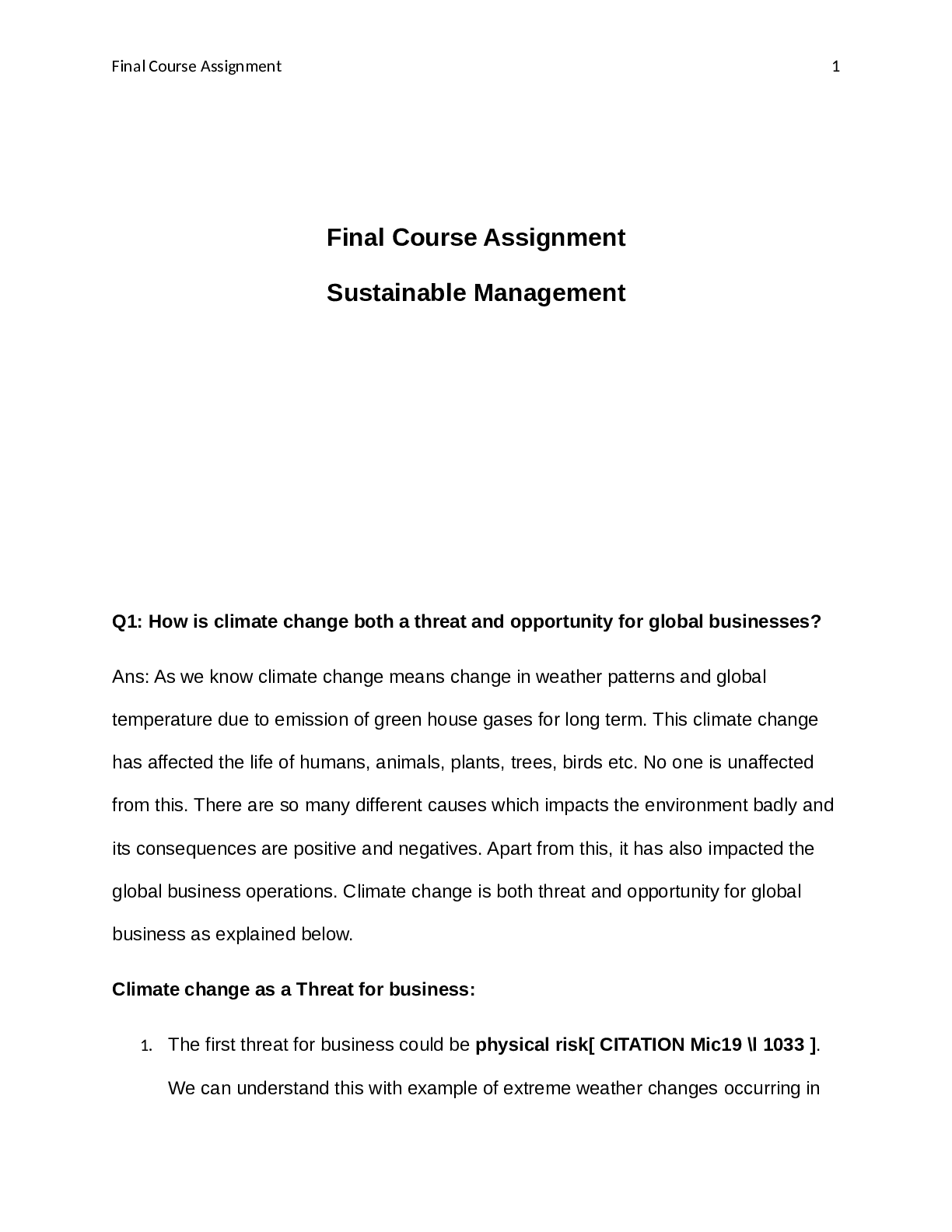
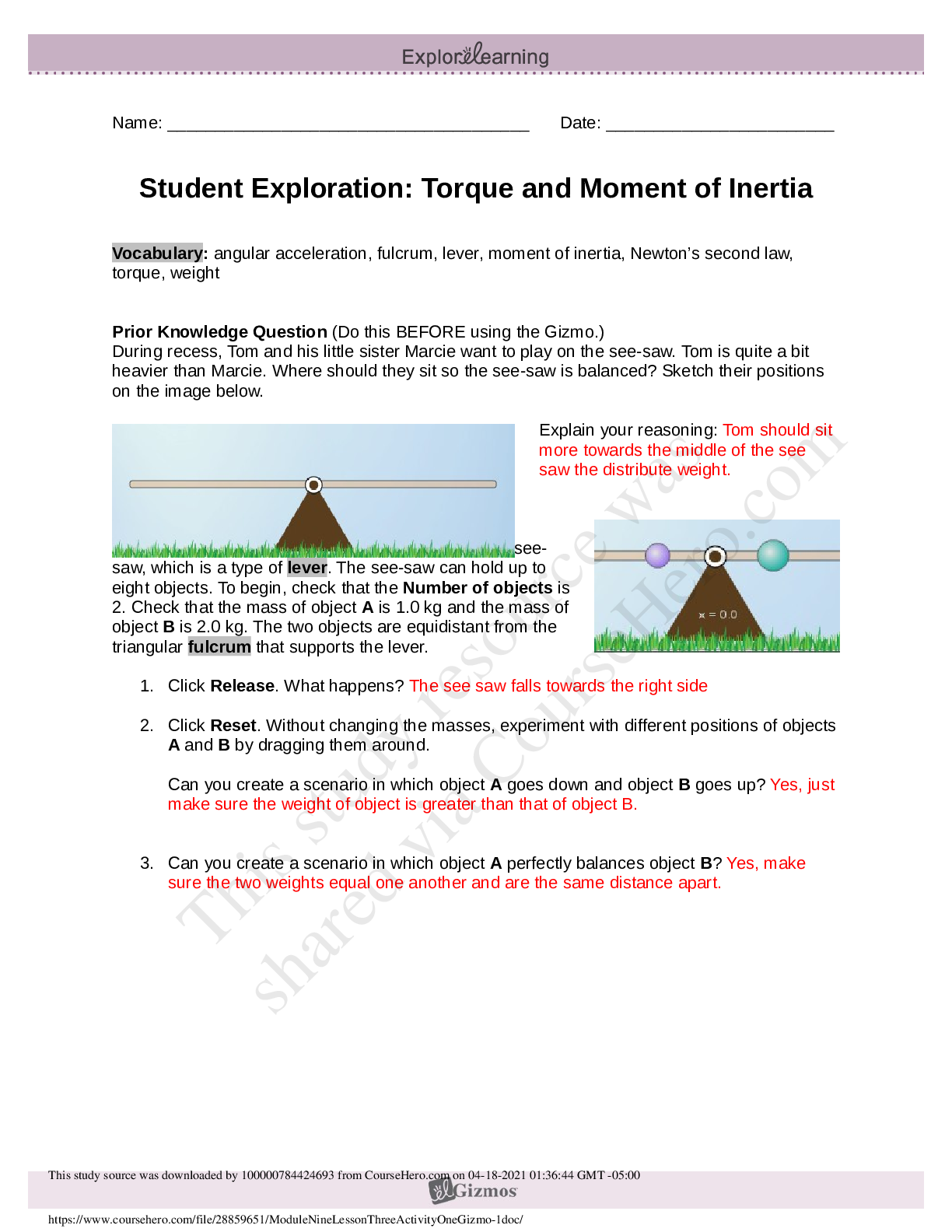
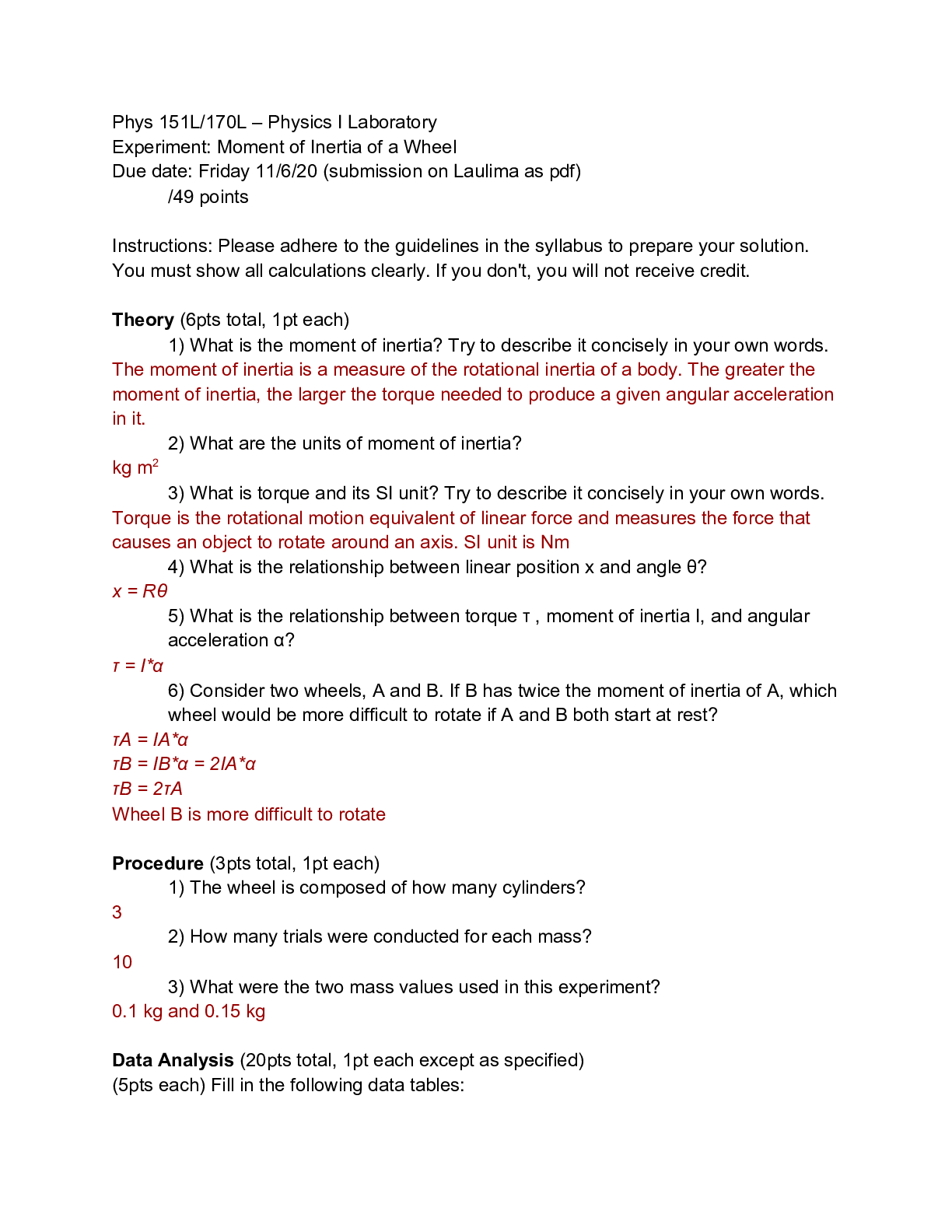
Preview 1 out of 8 pages

Buy Now

Instant download

We Accept:

Payment methods accepted on Scholarfriends (We Accept)
Preview image of Mountain View College - PHYS 1405Lab 3 document

Buy this document to get the full access instantly

Instant Download Access after purchase

Buy Now

Instant download

We Accept:

Payment methods accepted on Scholarfriends (We Accept)

Reviews( 0 )

$6.00

Buy Now

We Accept:

Payment methods accepted on Scholarfriends (We Accept)

Instant download

Can't find what you want? Try our AI powered Search

69
0

Document information


Connected school, study & course


About the document


Uploaded On

Apr 03, 2021

Number of pages

8

Written in

All

Seller


Profile illustration for AGRADES
AGRADES

Member since 4 years

8 Documents Sold

Reviews Received
2
0
0
0
0
Additional information

This document has been written for:

Uploaded

Apr 03, 2021

Downloads

 0

Views

 69

Document Keyword Tags


$6.00
What is Scholarfriends

Scholarfriends.com Online Platform by Browsegrades Inc. 651N South Broad St, Middletown DE. United States.

We are here to help

We're available through e-mail, Twitter, Facebook, and live chat.
 FAQ
 Questions? Leave a message!

Follow us on
 Twitter

Copyright © Scholarfriends · High quality services·